Spatial Disparities in Housing Values in the United States During the Great Depression: A Place-Based Sustainability Perspective



Abstract
1. Introduction
2. Data
3. Methods
3.1. GIS Visualization Methods
3.2. Global Regression Analysis
3.3. Local Regression Analysis
4. Results
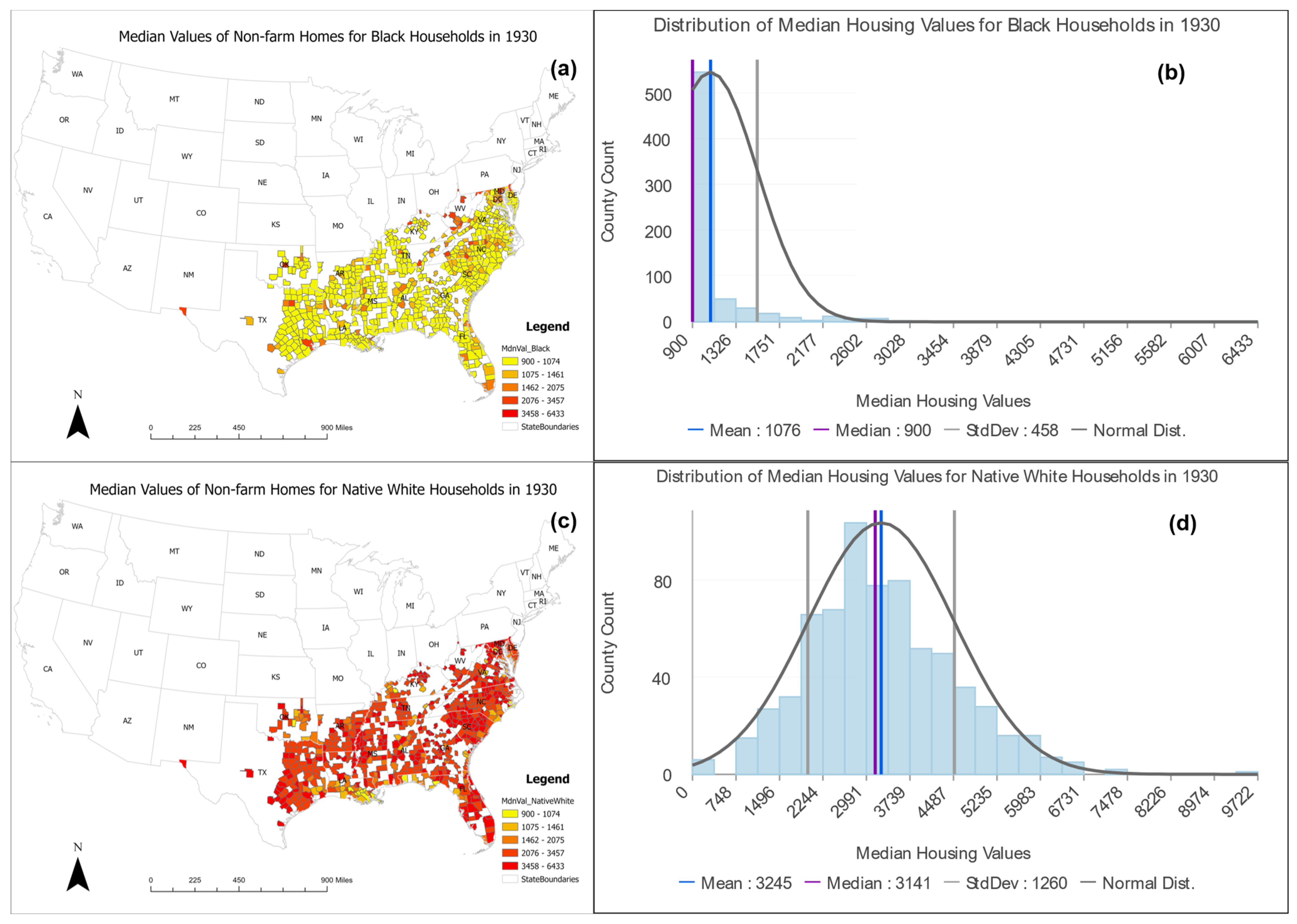
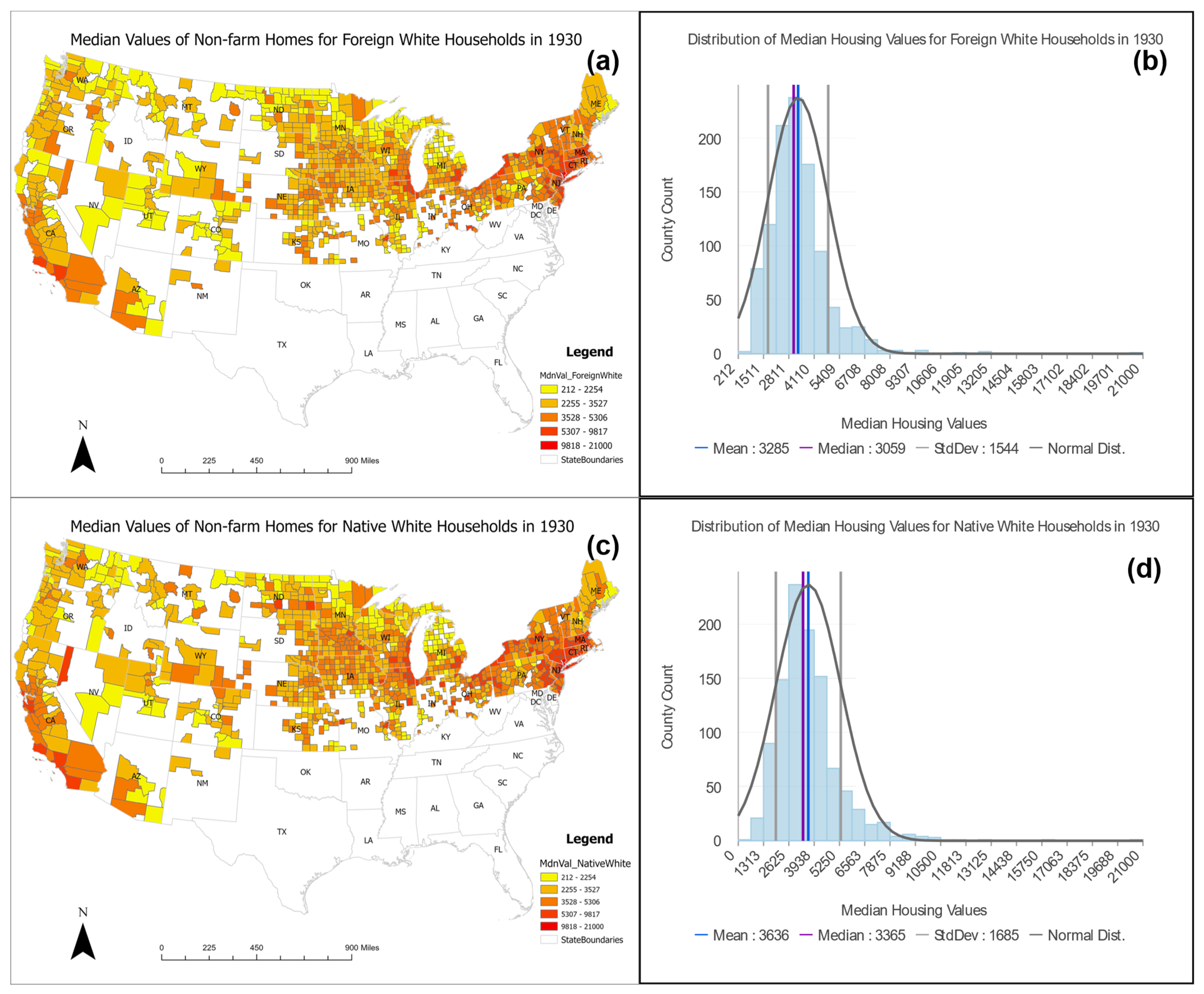
4.1. How Did Housing Values Vary Across Different Counties During the 1930s?
4.2. How Were the Depression-Era, Dust Bowl, Education, Unemployment, and Income Factors Associated with This Spatial Inequality in Housing Values?
4.2.1. Global Effects
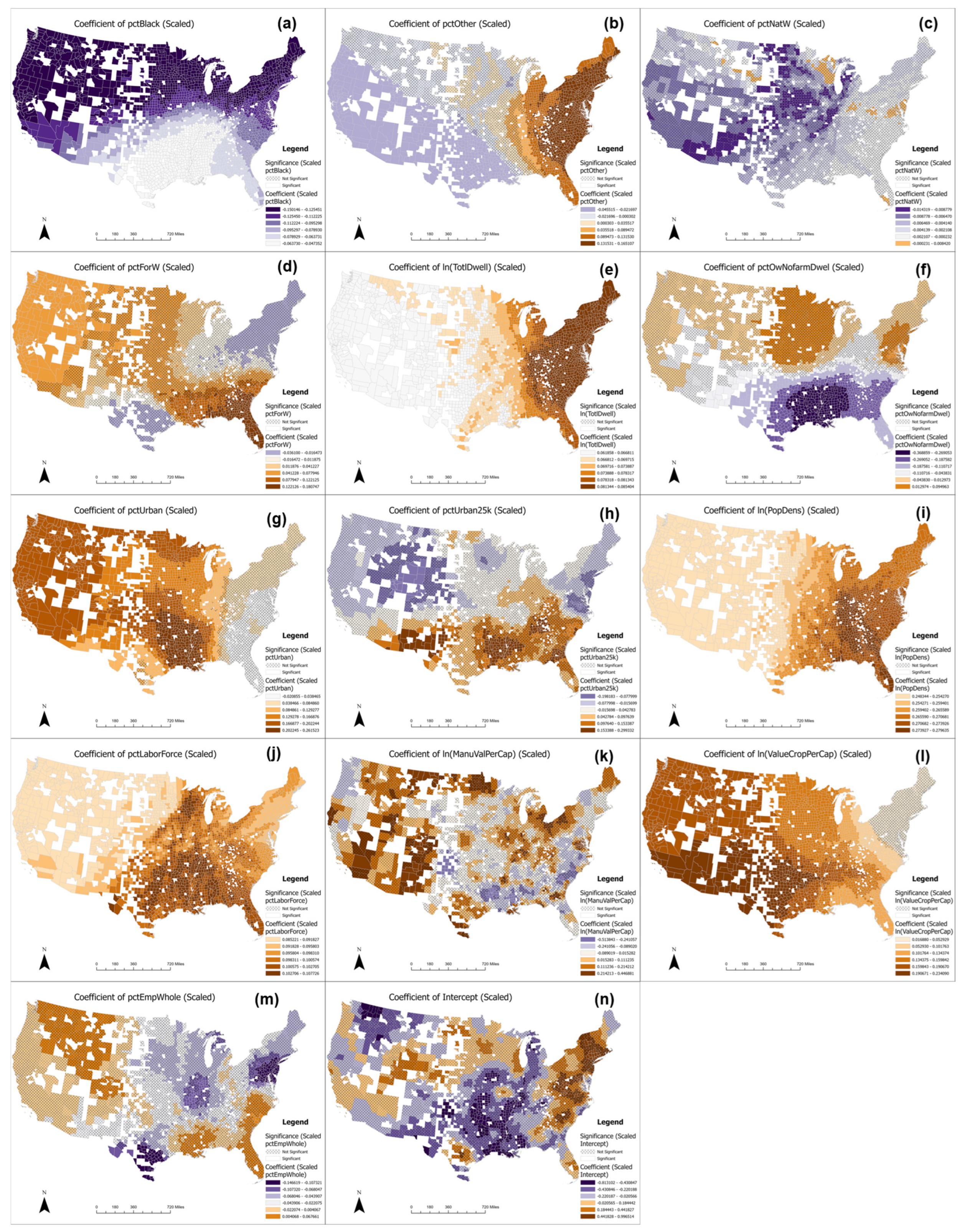
4.2.2. Local Effects
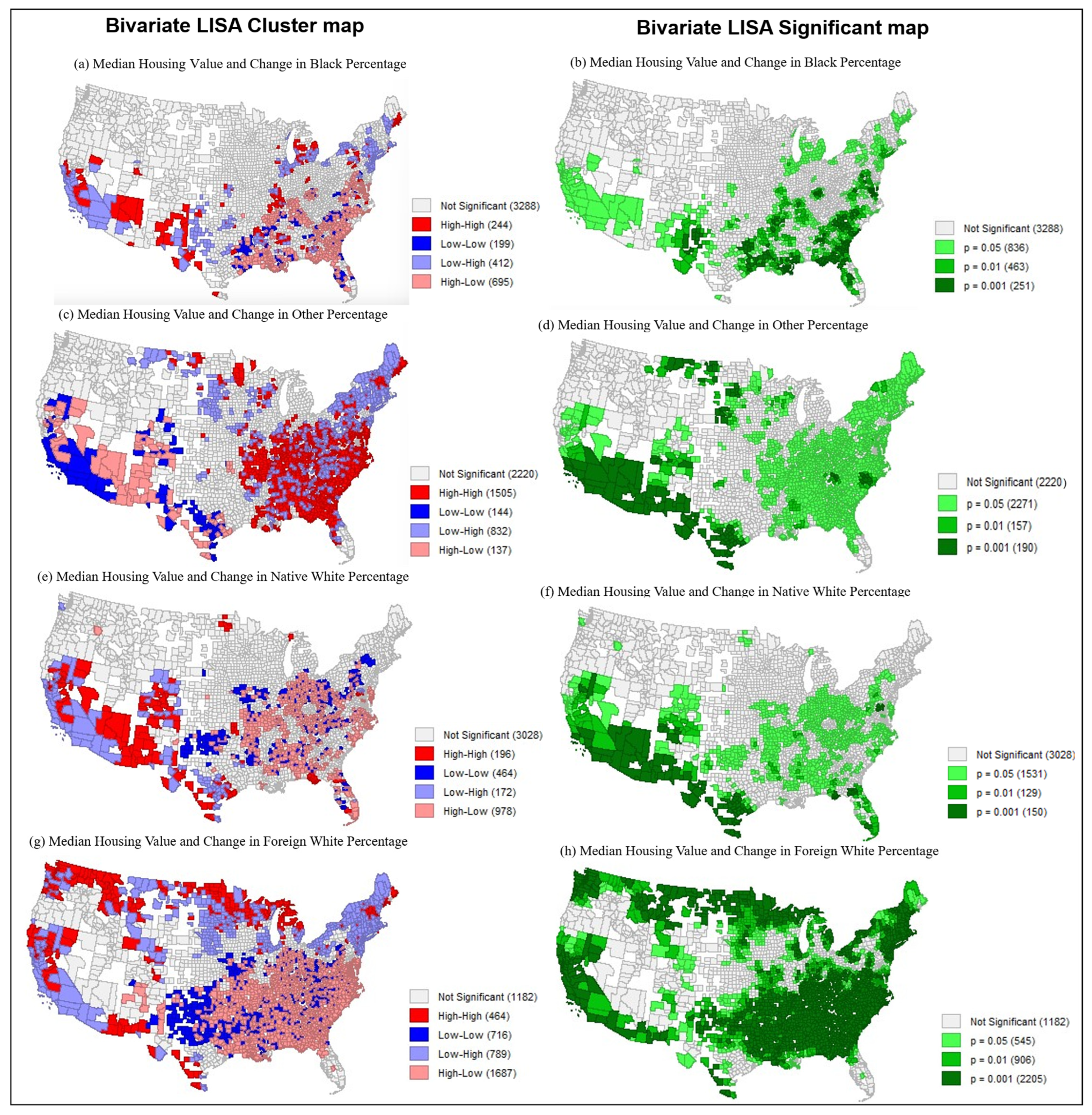
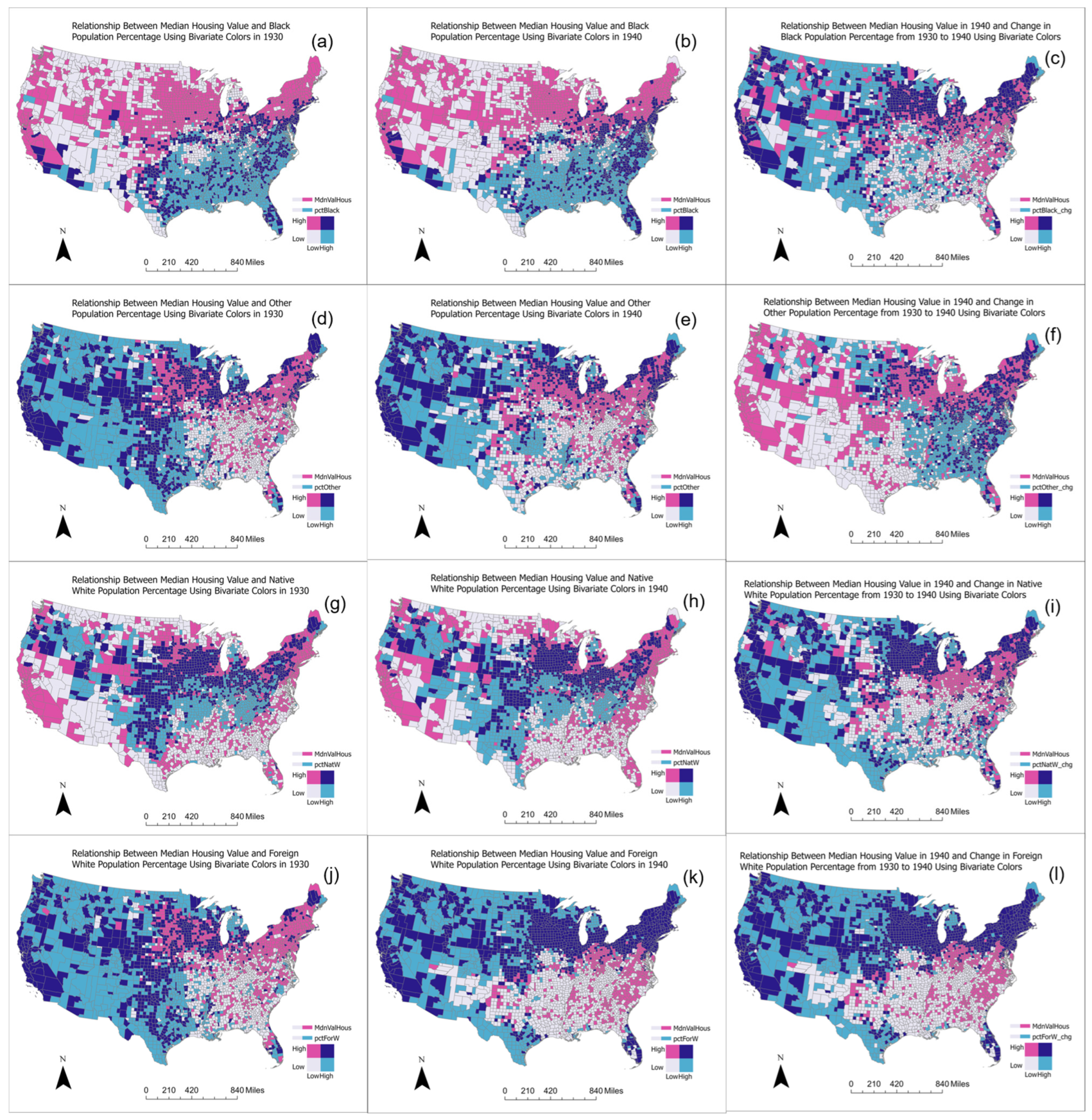
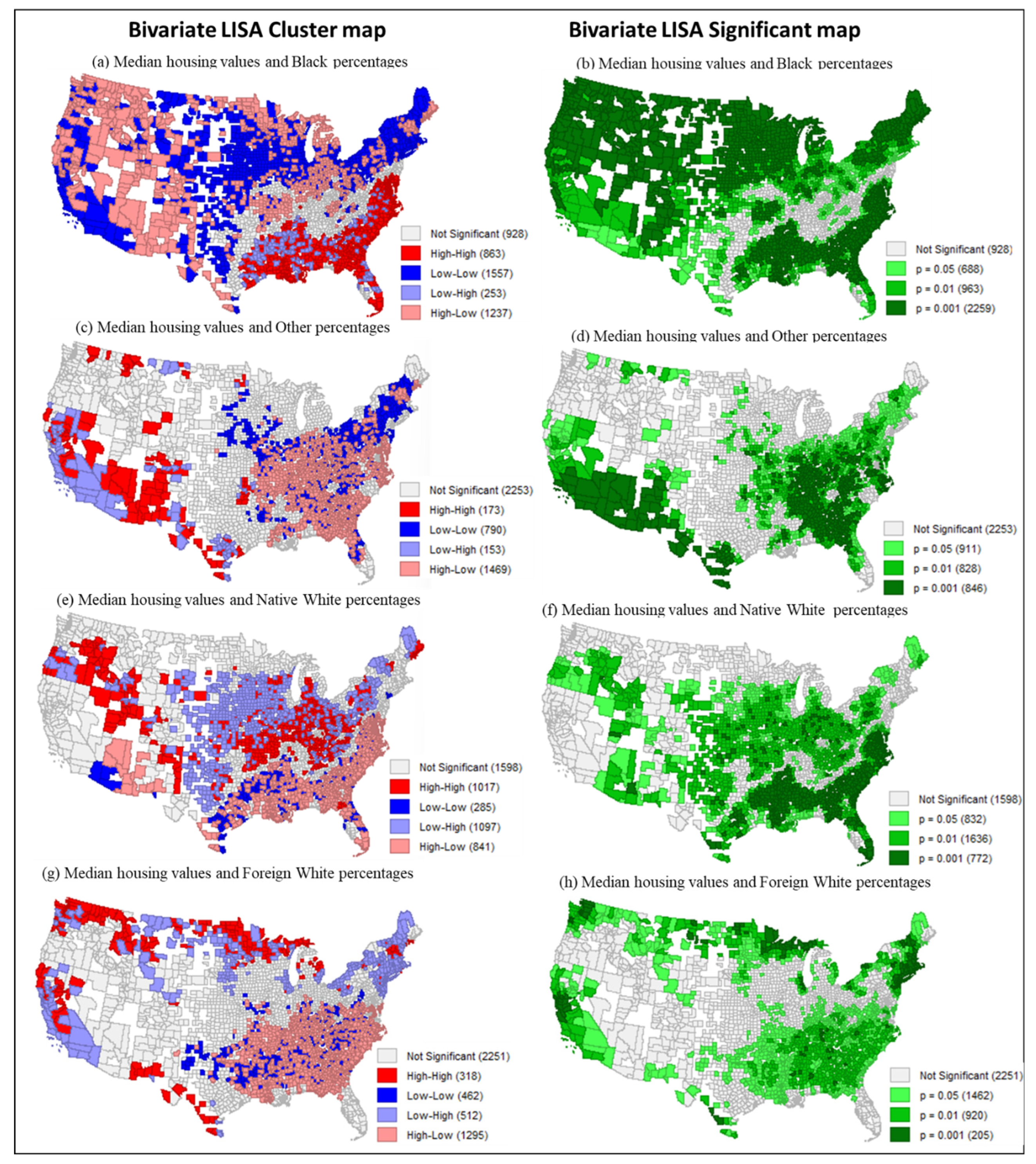
4.3. How Did Racial and Nativity Group Differences in Housing Values Manifest Across Counties and Within Shared Geographic Contexts?
5. Discussion
5.1. Implications for Contemporary Housing Inequality, Sustainability, and Policy
5.2. Limitations and Directions for Future Research
6. Conclusions
Author Contributions
Funding
Institutional Review Board Statement
Informed Consent Statement
Data Availability Statement
Conflicts of Interest
Appendix A

| Variable | Obs | Mean | Std. Dev. | Min | Max | Category | Variable Description |
|---|---|---|---|---|---|---|---|
| MdnValHous | 6200 | 2044.2 | 1297.512 | 0 | 20,000 | Dependent Variable | Median value of owner-occupied dwelling units |
| pctWhite | 6200 | 87.33 | 18.76 | 0 | 100 | Race | Percentage of White population |
| pctBlack | 6200 | 10.94 | 18.08 | 0 | 85.83 | Race | Percentage of Black population |
| pctOther | 6200 | 1.67 | 6.99 | 0 | 86.02 | Race | Percentage of ‘Other’ population |
| pctNatW | 6200 | 83.24 | 19.46 | 0 | 696.76 | Nativity | Percentage of native-born White population |
| pctForW | 6200 | 1.89 | 3.93 | 0 | 90.63 | Nativity | Percentage of foreign-born White population |
| After | 6200 | 0.50 | 0.50 | 0 | 1 | Year | 1 for 1940; 0 for 1930 |
| DustBowl | 6200 | 0.22 | 0.41 | 0 | 1 | DustBowl counties | 1 for DustBowl counties; 0 for other counties |
| After*DustBowl | 6200 | 0.11 | 0.31 | 0 | 1 | Year*DustBowl | After*Treated_DustBowl |
| TotlDwell | 6200 | 10,085 | 33,826 | 0 | 1,170,557 | Housing | Total dwelling units |
| pctOwNofarmDwel | 6200 | 20.44 | 11.16 | 0 | 79.78 | Housing | Percentage of owner-occupied nonfarm dwelling units |
| pctWhiteDwel | 6200 | 87.65 | 18.44 | 0 | 100 | Housing | Percentage of dwelling units by White occupant |
| pctBlackDwel | 6200 | 10.90 | 17.93 | 0 | 87.35 | Housing | Percentage of dwelling units by Black occupant |
| pctRadio | 6200 | 47.53 | 28.79 | 0 | 100 | Housing | Percentage of occupied dwelling units with radio |
| TotalPop | 6200 | 41,036.72 | 139,534 | 0 | 4,063,342 | Population | Total population |
| pctUrban | 6200 | 22.28 | 25.62 | 0 | 100 | Population | Percentage of urban population |
| pctUrban25k | 6200 | 5.98 | 19.34 | 0 | 100 | Population | Percentage of population in cities of 25,000 and over |
| PopDens | 6200 | 190.81 | 1961.06 | 0 | 85,906 | Population | Population per square mile |
| pctIllit | 6200 | 4.68 | 5.27 | 0 | 58.52 | Education | Percentage of illiterate population |
| pctUnemp | 6200 | 6.46 | 4.52 | 0 | 34.4 | Employment | Percentage of unemployed population |
| pctLaborForce | 6200 | 38.65 | 4.74 | 0 | 78.00 | Employment | Percentage of population in civilian labor force |
| SalRetailPerCap | 6200 | 249.15 | 134.88 | 0 | 2112.98 | Economy | Net sales of retail establishments per capita |
| SalWholPerCap | 6200 | 88,979.77 | 246,212.10 | 0 | 6,048,932 | Economy | Net sales of wholesale establishments per capita |
| ManuValPerCap | 6200 | 244.51 | 430.39 | 0 | 10,265.46 | Economy | Value of manufactured products plus value added by manufacture per capita |
| pctEmpRetail | 6200 | 6.76 | 3.41 | 0 | 79.04 | Economy | Percentage of employees in retail business |
| pctEmpWhole | 6200 | 1.20 | 1.59 | 0 | 31.85 | Economy | Percentage of employees in wholesale business |
| ValueCropPerCap | 6200 | 111.41 | 109.81 | 0 | 1708.64 | Agriculture | Value of crops per capita |

References
- Logan, J.R.; Molotch, H. Urban Fortunes: The Political Economy of Place, with a New Preface; University of California Press: Oakland, CA, USA, 2007. [Google Scholar]
- Sharkey, P. Stuck in Place: Urban Neighborhoods and the End of Progress toward Racial Equality; University of Chicago Press: Chicago, IL, USA, 2013. [Google Scholar]
- Field, A.J. Uncontrolled land development and the duration of the Depression in the United States. J. Econ. Hist. 1992, 52, 785–805. [Google Scholar] [CrossRef]
- Nicholas, T.; Scherbina, A. Real estate prices during the roaring twenties and the great depression. Real Estate Econ. 2013, 41, 278–309. [Google Scholar] [CrossRef]
- Faber, J.W. Contemporary echoes of segregationist policy: Spatial marking and the persistence of inequality. Urban Stud. 2021, 58, 1067–1086. [Google Scholar] [CrossRef]
- Abelson, E.S. Women who have no men to work for them: Gender and homelessness in the Great Depression, 1930–1934. Fem. Stud. 2003, 29, 105–127. [Google Scholar]
- Crouse, J.M. The Homeless Transient in the Great Depression: New York State, 1929–1941; State University of New York Press: Albany, NY, USA, 1986. [Google Scholar]
- Fishback, P.; Kollmann, T. New Multicity Estimates of the Changes in Home Values, 1920–1940. In Housing and Mortgage Markets in Historical Perspective; White, E.N., Snowden, K., Fishback, P., Eds.; University of Chicago Press: Chicago, IL, USA, 2014; pp. 203–244. [Google Scholar]
- Gjerstad, S.; Smith, V.L.; White, E.; Snowden, K. Consumption and Investment Booms in the 1920s and Their Collapse in 1930. In Housing and Mortgage Markets in Historical Perspective; White, E.N., Snowden, K., Fishback, P., Eds.; University of Chicago Press: Chicago, IL, USA, 2014; pp. 81–114. [Google Scholar]
- Holloran, P.C. Boston’s Wayward Children: Social Services for Homeless Children, 1830–1930; Fairleigh Dickinson University Press: Madison, NJ, USA, 1989. [Google Scholar]
- Johnson, R.A. African Americans and homelessness: Moving through history. J. Black Stud. 2010, 40, 583–605. [Google Scholar] [CrossRef]
- Rose, J.D. Reassessing the magnitude of housing price declines and the use of leverage in the Depressions of the 1890s and 1930s. Real Estate Econ. 2022, 50, 907–930. [Google Scholar] [CrossRef]
- Snowden, K.A. The Anatomy of a Residential Mortgage Crisis: A Look Back to the 1930s. In The Panic of 2008: Causes, Consequences and Proposals for Reform; Mitchell, L.E., Wilmarth, A.E., Jr., Eds.; Edward Elgar Publishing: Cheltenham, UK, 2010. [Google Scholar]
- Wade, J. Home or homelessness? Marginal housing in Vancouver, 1886–1950. Urban Hist. Rev. 1997, 25, 19–29. [Google Scholar] [CrossRef]
- Ali, O. On the Impact of Federal Housing Policies on Racial Inequality. AEA Pap. Proc. 2022, 112, 229–233. [Google Scholar] [CrossRef]
- Courtemanche, C.; Snowden, K. Repairing a mortgage crisis: HOLC lending and its impact on local housing markets. J. Econ. Hist. 2011, 71, 307–337. [Google Scholar] [CrossRef]
- Fishback, P. How successful was the New Deal? The microeconomic impact of New Deal spending and lending policies in the 1930s. J. Econ. Lit. 2017, 55, 1435–1485. [Google Scholar] [CrossRef]
- Fishback, P.V.; Horrace, W.C.; Kantor, S. The impact of New Deal expenditures on mobility during the Great Depression. Explor. Econ. Hist. 2006, 43, 179–222. [Google Scholar] [CrossRef]
- Fishback, P.V.; Flores-Lagunes, A.; Horrace, W.C.; Kantor, S.; Treber, J. The influence of the home owners’ loan corporation on housing markets during the 1930s. Rev. Financ. Stud. 2011, 24, 1782–1813. [Google Scholar] [CrossRef]
- Fishback, P.; Rose, J.; Snowden, K.A.; Storrs, T. New evidence on redlining by federal housing programs in the 1930s. J. Urban Econ. 2022, 141, 103462. [Google Scholar] [CrossRef]
- Fishback, P.V.; LaVoice, J.; Shertzer, A.; Walsh, R.P. The HOLC maps: How race and poverty influenced real estate professionals’ evaluation of lending risk in the 1930s. J. Econ. Hist. 2023, 83, 1019–1056. [Google Scholar] [CrossRef]
- Gelfand, M.I. A Nation of Cities: The Federal Government and Urban America, 1933–1965; Oxford University Press: New York, NY, USA, 1975. [Google Scholar]
- Grebler, L.; Blank, D.M.; Winnick, L. Capital Formation in Residential Real Estate; Princeton University Press: Princeton, NJ, USA, 1956. [Google Scholar]
- Jackson, K.T. Crabgrass Frontier: The Suburbanization of the United States; Oxford University Press: Oxford, UK, 1987. [Google Scholar]
- Kollmann, T.M.; Fishback, P.V. The New Deal, race, and home ownership in the 1920s and 1930s. Am. Econ. Rev. 2011, 101, 366–370. [Google Scholar] [CrossRef][Green Version]
- Von Hoffman, A. History lessons for today’s housing policy: The politics of low-income housing. Hous. Policy Debate 2012, 22, 321–376. [Google Scholar] [CrossRef]
- Wheelock, D.C. The federal response to home mortgage distress: Lessons from the great depression. Rev. Fed. Reserve Bank St. Louis 2008, 90, 133. [Google Scholar] [CrossRef]
- McElvaine, R.S. The Great Depression: America 1929–1941; Crown: New York, NY, USA, 1993. [Google Scholar]
- Roth, B. The Great Depression: A Diary; Public Affairs: New York, NY, USA, 2009. [Google Scholar]
- Terkel, S. Hard Times: An Oral History of the Great Depression; The New Press: New York, NY, USA, 2005. [Google Scholar]
- Aaronson, D.; Hartley, D.; Mazumder, B. The effects of the 1930s HOLC “redlining” maps. Am. Econ. J. Econ. Policy 2021, 13, 355–392. [Google Scholar] [CrossRef]
- Garraty, J.A. Unemployment during the great depression. Labor Hist. 1976, 17, 133–159. [Google Scholar] [CrossRef]
- Brocker, M.; Hanes, C. The 1920s American Real Estate Boom and the Downturn of the Great Depression: Evidence from City Cross Sections. In Housing and Mortgage Markets in Historical Perspective; White, E.N., Snowden, K., Fishback, P., Eds.; University of Chicago Press: Chicago, IL, USA, 2014; pp. 161–202. [Google Scholar]
- Connolly, N.D.B.; Winling, L.; Nelson, R.K.; Marciano, R. Mapping Inequality: ‘Big Data’ Meets Social History in the Story of Redlining. In The Routledge Companion to Spatial History; Gregory, I., Debats, D., Lafreniere, D., Eds.; Routledge: London, UK, 2018; pp. 502–524. [Google Scholar]
- Akbar, P.A.; Hickly, S.L.; Shertzer, A.; Walsh, R.P. Racial segregation in housing markets and the erosion of black wealth. Rev. Econ. Stat. 2025, 107, 42–54. [Google Scholar] [CrossRef]
- Anders, J. The long run effects of de jure discrimination in the credit market: How redlining increased crime. J. Public Econ. 2023, 222, 104857. [Google Scholar] [CrossRef]
- Appel, I.; Nickerson, J. Pockets of poverty: The long-term effects of redlining. SSRN 2016, 2852856. [Google Scholar] [CrossRef]
- Faber, J.W. We built this: Consequences of New Deal era intervention in America’s racial geography. Am. Sociol. Rev. 2020, 85, 739–775. [Google Scholar] [CrossRef]
- Fowle, M.Z. Racialized homelessness: A review of historical and contemporary causes of racial disparities in homelessness. Hous. Policy Debate 2022, 32, 940–967. [Google Scholar] [CrossRef]
- Krimmel, J. Persistence of prejudice: Estimating the long term effects of redlining. SocArXiv 2018. [Google Scholar] [CrossRef]
- Logan, T.D.; Parman, J.M. The national rise in residential segregation. J. Econ. Hist. 2017, 77, 127–170. [Google Scholar] [CrossRef]
- Winling, L.C.; Michney, T.M. The roots of redlining: Academic, governmental, and professional networks in the making of the new deal lending regime. J. Am. Hist. 2021, 108, 42–69. [Google Scholar] [CrossRef]
- Schroeder, J.; Van Riper, D.; Manson, S.; Knowles, K.; Kugler, T.; Roberts, F.; Ruggles, S. IPUMS National Historical Geographic Information System: Version 20.0 [dataset]; IPUMS: Minneapolis, MN, USA, 2025. [Google Scholar] [CrossRef]
- Buckley, R.; Ermisch, J. Theory and empiricism in the econometric modelling of house prices. Urban Stud. 1983, 20, 83–90. [Google Scholar] [CrossRef]
- Gallin, J. The long-run relationship between house prices and income: Evidence from local housing markets. Real Estate Econ. 2006, 34, 417–438. [Google Scholar] [CrossRef]
- Holly, S.; Pesaran, M.H.; Yamagata, T. A Spatio-temporal model of house prices in the USA. J. Econom. 2010, 158, 160–173. [Google Scholar] [CrossRef]
- Li, X.; Zhang, C. Did the COVID-19 pandemic crisis affect housing prices evenly in the US? Sustainability 2021, 13, 12277. [Google Scholar] [CrossRef]
- Li, X.; Kao, C. Spatial analysis and modeling of the housing value changes in the US during the COVID-19 pandemic. J. Risk Financ. Manag. 2022, 15, 139. [Google Scholar] [CrossRef]
- Malpezzi, S.; Chun, G.H.; Green, R.K. New place-to-place housing price indexes for US Metropolitan Areas, and their determinants. Real Estate Econ. 1998, 26, 235–274. [Google Scholar] [CrossRef]
- Ozanne, L.; Thibodeau, T. Explaining metropolitan housing price differences. J. Urban Econ. 1983, 13, 51–66. [Google Scholar] [CrossRef]
- Libecap, G.D.; Hansen, Z.K. US Land Policy, Property Rights, and the Dust Bowl of the 1930s (No. 69.2001). 2001. Nota di Lavoro. Available online: https://www.econstor.eu/bitstream/10419/155232/1/NDL2001-069.pdf (accessed on 8 January 2026).
- Baerlocher, D.; Cortes, G.; Sant’Anna, V. Finding Home When Disaster Strikes: Dust Bowl Migration and Housing in Los Angeles. SSRN 2024. [Google Scholar] [CrossRef]
- Gregory, J.N. The Southern Diaspora: How the Great Migrations of Black and White Southerners Transformed America; University of North Carolina Press: Chapel Hill, NC, USA, 2006. [Google Scholar]
- Hornbeck, R. Dust Bowl Migrants: Identifying an Archetype (No. w27656); National Bureau of Economic Research: Cambridge, MA, USA, 2020; Available online: https://www.nber.org/system/files/working_papers/w27656/w27656.pdf (accessed on 8 January 2026).
- Hornbeck, R. Dust bowl migrants: Environmental refugees and economic adaptation. J. Econ. Hist. 2023, 83, 645–675. [Google Scholar] [CrossRef]
- Cunfer, G. Scaling the Dust Bowl (Chapter 4). In Placing History: How Maps, Spatial Data, and GIS Are Changing Historical Scholarship; Hillier, A., Knowles, A.K., Eds.; ESRI Press: Redlands, CA, USA, 2008; pp. 95–121. [Google Scholar]
- Gutmann, M.P.; Brown, D.; Cunningham, A.R.; Dykes, J.; Leonard, S.H.; Little, J.; Mikecz, J.; Rhode, P.W.; Spielman, S.; Sylvester, K.M. Migration in the 1930s: Beyond the dust bowl. Soc. Sci. Hist. 2016, 40, 707–740. [Google Scholar] [CrossRef]
- Jenks, G.F. The data model concept in statistical mapping. Int. Yearb. Cartogr. 1967, 7, 186–190. [Google Scholar]
- Fotheringham, A.S.; Yang, W.; Kang, W. Multiscale geographically weighted regression (MGWR). Ann. Am. Assoc. Geogr. 2017, 107, 1247–1265. [Google Scholar] [CrossRef]
- Massey, D.S.; Denton, N.A. American Apartheid: Segregation and the Making of the Underclass; Harvard University Press: Cambridge, MA, USA, 1993. [Google Scholar]
- Aaronson, D.; Faber, J.; Hartley, D.; Mazumder, B.; Sharkey, P. The long-run effects of the 1930s HOLC “redlining” maps on place-based measures of economic opportunity and socioeconomic success. Reg. Sci. Urban Econ. 2021, 86, 103622. [Google Scholar] [CrossRef]
- Hornbeck, R. The enduring impact of the American Dust Bowl: Short-and long-run adjustments to environmental catastrophe. Am. Econ. Rev. 2012, 102, 1477–1507. [Google Scholar] [CrossRef]
- Rothstein, R. The Color of Law: A Forgotten History of How Our Government Segregated America; Liveright Publishing: New York, NY, USA, 2017. [Google Scholar]
- Neumark, D.; Simpson, H. Place-Based Policies. In Handbook of Regional and Urban Economics; Elsevier: Amsterdam, The Netherlands, 2015; Volume 5, pp. 1197–1287. [Google Scholar]
- Kline, P.; Moretti, E. People, places, and public policy: Some simple welfare economics of local economic development programs. Annu. Rev. Econ. 2014, 6, 629–662. [Google Scholar] [CrossRef]
- Li, X.; Zhang, C. The Impact of the Dust Bowl on Housing Markets During the Great Depression in 1930s. Ann. Reg. Sci. 2026, submitted.
- White, E.N. Lessons from the Great American Real Estate Boom and Bust of the 1920s. In Housing and Mortgage Markets in Historical Perspective; White, E.N., Snowden, K., Fishback, P., Eds.; University of Chicago Press: Chicago, IL, USA, 2014; pp. 115–158. [Google Scholar]




| Depend. Var. ln(MdnValHous) | (1) OLS | (2) SLM | (3) SEM | (4) Fixed-Effects | ||||
|---|---|---|---|---|---|---|---|---|
| After | −0.304 | *** | −0.299 | *** | −0.339 | *** | −0.320 | *** |
| (0.019) | (0.014) | (0.014) | (0.018) | |||||
| DustBowl | −0.037 | ** | 0.014 | −0.033 | ||||
| (0.018) | (0.016) | (0.030) | ||||||
| After*DustBowl | −0.145 | *** | −0.175 | *** | −0.178 | *** | −0.105 | *** |
| (0.026) | (0.021) | (0.019) | (0.015) | |||||
| pctIllit | −0.017 | *** | −0.009 | *** | −0.014 | *** | −0.013 | *** |
| (0.002) | (0.001) | (0.002) | (0.002) | |||||
| pctUnemp | −0.031 | *** | −0.023 | *** | −0.024 | *** | −0.014 | *** |
| (0.002) | (0.001) | (0.001) | (0.002) | |||||
| ln(SalRetailPerCap) | 0.375 | *** | 0.291 | *** | 0.292 | *** | 0.184 | *** |
| (0.020) | (0.015) | (0.015) | (0.029) | |||||
| Control Variables | yes | yes | yes | yes | ||||
| Observations | 4838 | 4838 | 4838 | 4838 | ||||
| R2 | 0.715 | 0.781 | 0.812 | 0.850 | ||||
| Adjusted R2 | 0.714 | 0.850 | ||||||
| Depend. Var. ln(MdnValHous) | (1) OLS | (2) SLM | (3) SEM | (4) Fix-Effect | ||||
|---|---|---|---|---|---|---|---|---|
| After (Scaled) | −0.267 | *** | −0.262 | *** | −0.298 | *** | −0.282 | *** |
| (0.017) | (0.012) | (0.012) | (0.016) | |||||
| DustBowl (Scaled) | −0.025 | ** | 0.015 | −0.022 | ||||
| (0.012) | (0.010) | (0.020) | ||||||
| After*DustBowl (Scaled) | −0.072 | *** | −0.088 | *** | −0.088 | *** | −0.052 | *** |
| (0.013) | (0.010) | (0.009) | (0.008) | |||||
| pctIllit (Scaled) | −0.150 | *** | −0.073 | *** | −0.125 | *** | −0.114 | *** |
| (0.017) | (0.012) | (0.015) | (0.019) | |||||
| pctUnemp (Scaled) | −0.228 | *** | −0.162 | *** | −0.175 | *** | −0.107 | *** |
| (0.014) | (0.010) | (0.010) | (0.012) | |||||
| ln(SalRetailPerCap) (Scaled) | 0.358 | *** | 0.265 | *** | 0.278 | *** | 0.176 | *** |
| (0.019) | (0.014) | (0.015) | (0.028) | |||||
| Control Variables | yes | yes | yes | yes | ||||
| Observations | 4838 | 4838 | 4838 | 4838 | ||||
| R2 | 0.715 | 0.791 | 0.812 | 0.850 | ||||
| Adjusted R2 | 0.714 | 0.850 | ||||||
| Pearson Correlation r | MdnValHous (1930 & 1940) | MdnValHous (1930) | MdnValHous (1940) |
|---|---|---|---|
| pctWhiteDwel | 0.1721 | 0.2419 | 0.1548 |
| pctWhite | 0.1656 | 0.2346 | 0.1479 |
| pctBlackDwel | −0.1409 | −0.1811 | −0.1276 |
| pctBlack | −0.1389 | −0.1794 | −0.1178 |
| pctOther | −0.0907 | −0.1544 | −0.1193 |
| pctNatW | 0.0332 | 0.0749 | 0.0437 |
| pctForW | 0.01 | −0.0603 | 0.4171 |
Disclaimer/Publisher’s Note: The statements, opinions and data contained in all publications are solely those of the individual author(s) and contributor(s) and not of MDPI and/or the editor(s). MDPI and/or the editor(s) disclaim responsibility for any injury to people or property resulting from any ideas, methods, instructions or products referred to in the content. |
© 2026 by the authors. Licensee MDPI, Basel, Switzerland. This article is an open access article distributed under the terms and conditions of the Creative Commons Attribution (CC BY) license.
Share and Cite
Li, X.; Zhang, C. Spatial Disparities in Housing Values in the United States During the Great Depression: A Place-Based Sustainability Perspective. Sustainability 2026, 18, 1500. https://doi.org/10.3390/su18031500
Li X, Zhang C. Spatial Disparities in Housing Values in the United States During the Great Depression: A Place-Based Sustainability Perspective. Sustainability. 2026; 18(3):1500. https://doi.org/10.3390/su18031500
Chicago/Turabian StyleLi, Xinba, and Chuanrong Zhang. 2026. "Spatial Disparities in Housing Values in the United States During the Great Depression: A Place-Based Sustainability Perspective" Sustainability 18, no. 3: 1500. https://doi.org/10.3390/su18031500
APA StyleLi, X., & Zhang, C. (2026). Spatial Disparities in Housing Values in the United States During the Great Depression: A Place-Based Sustainability Perspective. Sustainability, 18(3), 1500. https://doi.org/10.3390/su18031500