Article

Multi-Objective Optimization and Federated Learning for Agri-Food Supply Chains via Dynamic Heterogeneous Graph Neural Networks


1
Farabi International Business School, Al-Farabi Kazakh National University, Almaty 050040, Kazakhstan
2
Faculty of Information Technology and Artificial Intelligence, Al-Farabi Kazakh National University, Almaty 050040, Kazakhstan
*
Author to whom correspondence should be addressed.
Sustainability 2026, 18(3), 1426; https://doi.org/10.3390/su18031426
Submission received: 8 December 2025 / Revised: 29 December 2025 / Accepted: 26 January 2026 / Published: 31 January 2026
(This article belongs to the Section Sustainable Management)

Abstract

The intricate and dynamic nature of agricultural supply chains imposes stringent demands on optimization methodologies, necessitating multi-objective considerations, privacy safeguards, and decision transparency to address pivotal challenges in ensuring food security and sustainable development. This study introduces a Dynamic Heterogeneous Multi-Objective Graph Neural Network (DHMO-GNN) model, meticulously tailored for optimizing agricultural supply chains. It integrates five core modules: data preprocessing and heterogeneous graph construction, dynamic graph neural networks, multi-objective optimization, interpretability enhancement, and federated learning collaboration. The model adeptly captures temporal dynamics through sequential attention mechanisms and incremental updates, harmonizes cost, delivery time, and carbon emissions via multi-task learning and Pareto optimization, augments decision transparency with GNNExplainer and SHAP, and surmounts data silos by leveraging federated learning alongside differential privacy. Empirical evaluations on the Chengdu Hongguang Town Farmers’ Market dataset demonstrate that the centralized DHMO-GNN variant achieves a hypervolume indicator (HV) of 0.849, surpassing baseline models; the federated variant exhibits only a 2.6% decline under privacy constraints, underscoring its robustness. Ablation studies further corroborate the synergistic contributions of each module. This research furnishes an efficacious and trustworthy framework for the intelligent management of agricultural supply chains, holding profound implications for advancing digital transformation and green development.

1. Introduction

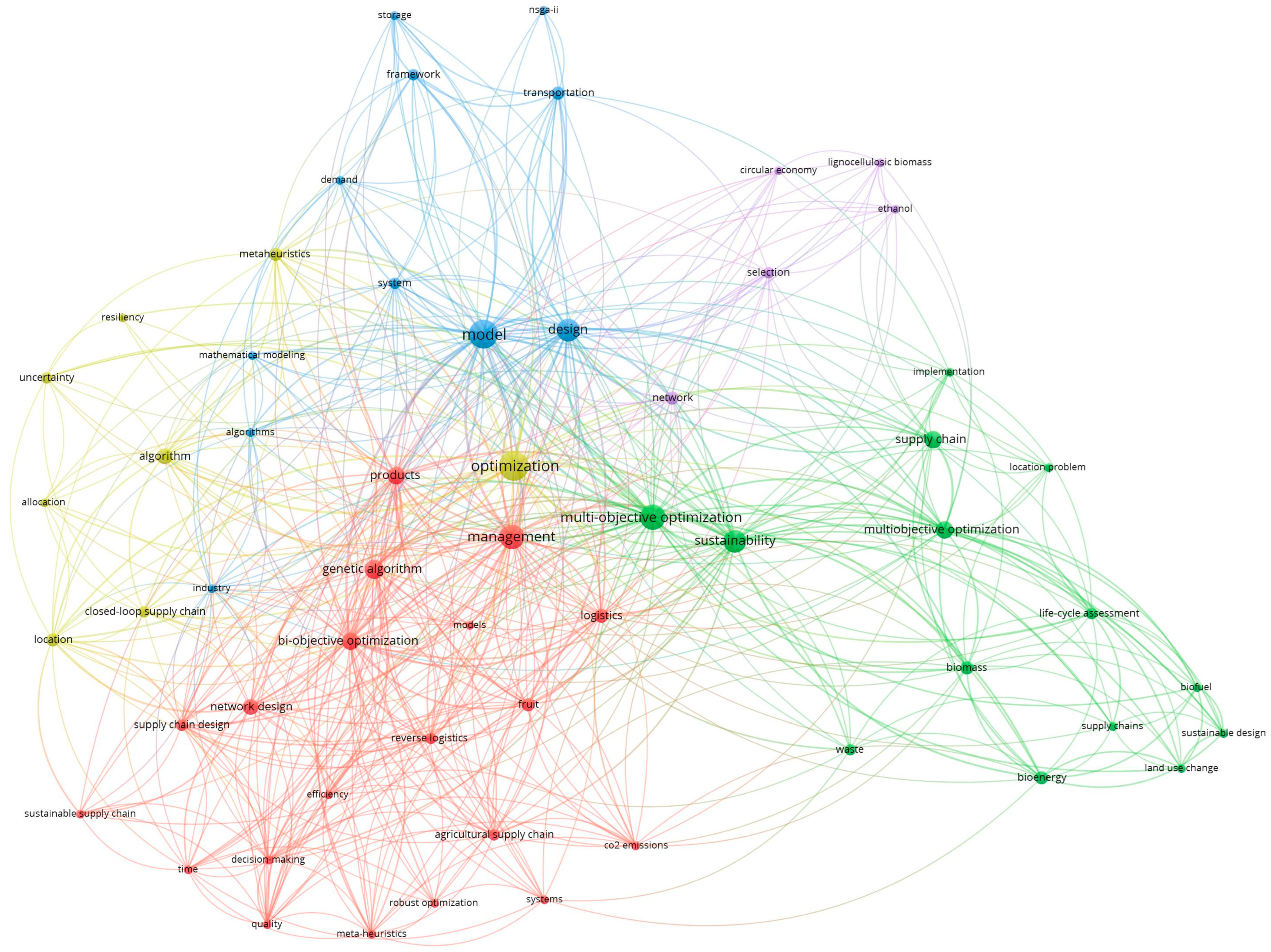
With the rapid evolution of the global agricultural economy, the imperative for efficient, agile, and intelligent management of agricultural supply chains has emerged as a foundational pillar in safeguarding food security, optimizing resource allocation, and enhancing economic viability [1]. Unlike traditional industrial logistics, contemporary agricultural supply chains exhibit markedly intricate network architectures, encompassing multifaceted and dynamic interactions among diverse stakeholders—from farmers and processing facilities to cold-chain logistics and marketplaces. These systems confront distinctive operational challenges: pronounced fluctuations in demand and yield, emblematic of harvest seasons or festive periods, impose rigorous demands on supply chain resilience and responsiveness [2]; concurrently, escalating consumer expectations for product freshness and quality render preservation timelines and cold-chain efficiency as pivotal performance metrics [3]. Collectively, these attributes engender a profoundly dynamic, multidimensional, and temporally sensitive optimization conundrum, as illustrated in Figure 1.
In the realm of agricultural supply chain optimization, traditional methodologies have predominantly relied on operations research models and heuristic algorithms. While these approaches excel in delimited static contexts, they increasingly reveal inherent limitations when facing real-world volatility [4]. For instance, linear programming and mixed-integer programming are routinely employed for inventory management and route optimization [5]; simulation-based optimization techniques are extensively utilized to address uncertainties in risk assessment and sustainability evaluations [6]; heuristic approaches, such as genetic algorithms and ant colony optimization, have proven instrumental in perishable agricultural distribution, facilitating equilibria between cost and delivery timelines [7]. However, a critical drawback of these conventional strategies is their lack of computational efficiency and adaptability. They often fail to adequately encapsulate nonlinear interactions and spatiotemporal dependencies within the supply chain, thereby yielding suboptimal outcomes in practical deployments.
The advent of artificial intelligence technologies, particularly machine learning and deep learning methodologies, has permeated agricultural supply chain optimization, heralding a novel paradigm for navigating intricate relational complexities [8]. Among these, Graph Neural Networks (GNNs) have ascended as a focal point of investigation due to their prowess in modeling non-Euclidean structures (such as inter-node relationships) and inferring topological attributes [9]. In recent years, the application of GNNs in agriculture has evolved from static perception to dynamic forecasting. For instance, early endeavors successfully leveraged GNNs to predict latent linkages and yield dynamics by capturing spatiotemporal variations within crop networks [10,11,12]. Furthermore, select studies have probed the potential of GNNs in multi-objective sustainable optimization, attempting to incorporate federated learning to navigate privacy constraints [13]. Notably, the field of dynamic graph modeling has witnessed significant theoretical breakthroughs. For example, the recently proposed DyG-Mamba introduces continuous state space modeling to capture long-term temporal dependencies in dynamic graphs efficiently [14].
Despite these conspicuous theoretical and practical advancements, a substantial knowledge gap remains in their comprehensive adaptation to the operational realities of agri-food systems. Extant scholarship still grapples with multifaceted challenges that impede the deployment of these advanced models:
First, the Multi-Objective Dilemma: numerous GNN models prioritize singular objectives (e.g., cost minimization), overlooking the dynamic equilibria among multifaceted goals such as cost, delivery timelines, spoilage rates, and carbon emissions [15]. Generic dynamic models often lack the specific mechanisms to handle these competing trade-offs essential for sustainable agriculture. Second, Adaptability to Meteorological Perturbations: while models like DyG-Mamba excel in general dynamic graphs, the preponderance of applied agricultural models still presupposes static topologies or regular patterns. They are ill-equipped to accommodate abrupt, non-linear perturbations like meteorological disasters or sudden demand surges, where real-time adaptability constitutes a formidable bottleneck [16]. Third, Privacy and Interpretability Constraints: data privacy imperatives continue to obstruct multi-stakeholder collaboration, with datasets sequestered in “data silos” [17]. Furthermore, the opaque “black-box” nature of deep learning models undermines decisional transparency, curtailing their trustworthiness in real-world management scenarios that necessitate the elucidation of critical node contributions [18].
To surmount these challenges and bridge the gap between advanced dynamic modeling and practical agricultural application, this article proposes a Dynamic Heterogeneous Multi-Objective Graph Neural Network (DHMO-GNN). This framework is strictly tailored for agricultural supply chain optimization, synergistically amalgamating five pivotal modules: data preprocessing and heterogeneous graph construction, dynamic graph neural networks, multi-objective optimization, interpretability enhancement, and federated learning collaboration.
The rationale for this specific methodological architecture is multifaceted. First, to address the heterogeneity of agricultural data (e.g., yields, inventories, and meteorological data), the model assimilates multimodal inputs to construct dynamic heterogeneous graph representations. Second, considering the non-linear temporal dependencies inherent in biological lifecycles and weather patterns, we employ temporal attention mechanisms and incremental update strategies. This approach is chosen specifically to encapsulate sequential variations without the computational prohibitive cost of full-graph retraining. Third, to resolve the conflict between competing operational goals, the model harnesses a multi-task learning framework coupled with Pareto optimization. Unlike static weighting schemes, this allows for the generation of adaptable decision schemas that dynamically modulate weights in alignment with real-time operational exigencies. Fourth, to mitigate the “black-box” trust issue, interpretability is augmented via GNNExplainer and SHAP, incorporating business rule constraints to explicitly validate optimization outcomes against industry standards. Finally, to overcome the barrier of data silos while strictly adhering to privacy regulations, the model leverages federated learning and differential privacy mechanisms, thereby facilitating cross-entity collaboration without raw data exchange.
The principal contributions of this article are summarized as follows:
(1)
Dynamic Graph Modeling for Spatiotemporal Resilience: we incorporate dynamic graph modeling with temporal attention mechanisms. This methodology is specifically justified by its ability to adeptly delineate seasonal fluctuations and meteorological disruptions, ensuring system robustness where static models fail.
(2)
Holistic Multi-Objective Equilibrium: we orchestrate a multimodal fusion and multi-objective optimization framework. This approach is essential to achieve dynamic equilibria among logistics costs, delivery timelines, and carbon emissions, addressing the limitations of single-objective optimization in sustainable agriculture.
(3)
Explainable and Trustworthy AI: we integrate GNNExplainer and SHAP to elevate model interpretability. This contribution directly addresses the managerial need to discern decisional contributions from pivotal nodes and pathways, transforming the model from a theoretical construct to a practical decision-support tool.
(4)
Privacy-Preserving Collaborative Paradigm: we establish a federated learning collaborative ecosystem, augmented by differential privacy and parameter compression. This architecture is critical for realizing multi-party synergistic optimization under privacy auspices, effectively breaking the data silos that hinder modern agricultural digitalization.
Through these advancements, DHMO-GNN furnishes an efficacious, transparent, and credible intelligent optimization schema for agricultural supply chains, proffering a novel paradigm for the digitalization and sustainable evolution of contemporary agricultural ecosystems.

2. Materials and Methods

2.1. Dataset

The dataset utilized in this investigation is derived from the Hongguang Town Farmers’ Market in Pidu District, Chengdu City. Situated in Hongguang Town within Pidu District, this market primarily facilitates the trade of local vegetables, fruits, and cereal crops, with an annual transaction volume exceeding 100,000 tons [19]. As a vital hub for agricultural commodities, it encompasses the entire supply chain spectrum, from farm origins to retail endpoints.
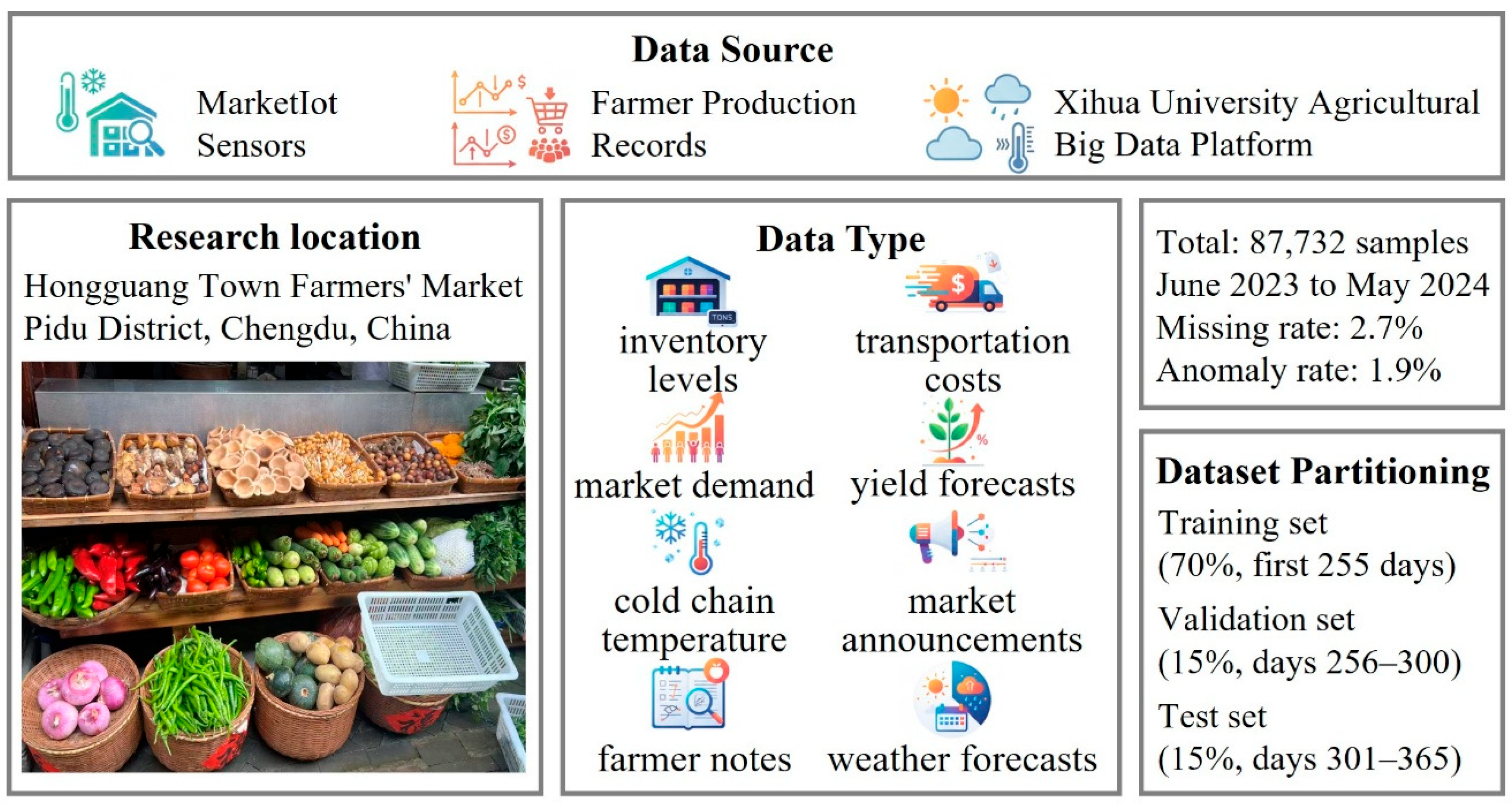
As depicted in Figure 2, the dataset covers a continuous period of 365 days from June 2023 to May 2024 and is divided into three subsets to facilitate model training, validation, and testing while capturing seasonal variations and potential disruptions: the training set comprises days 1–255, the validation set days 256–300, and the test set days 301–365. For each discrete time step t (with daily granularity), a temporal graph snapshot G t = ( V t , E t , X t ) is constructed as follows:
The node set V t includes all nodes exhibiting non-zero activity on day t , such as farmers with recorded harvests, cold storages with inventory updates, or markets with incoming demand signals. Nodes without activity on a given day are retained in the graph with zero-valued features to maintain structural connectivity and avoid abrupt changes in graph topology.
The edge set E t consists of transportation routes and transactional links that are active on day t , as determined from actual transaction logs and cold-chain dispatch records. All edges are directed and weighted by real-time attributes, including distance and transportation cost.
Node and edge features X t are synchronized on a daily basis across modalities. Numerical features (e.g., inventory levels, cold-chain temperatures) are aggregated from IoT sensor readings collected at midnight. Time-series features (e.g., yield forecasts and market demand) are derived using a sliding window of the preceding seven days, processed by an LSTM network. Textual data (e.g., market announcements and farmer annotations) are encoded using a pretrained BERT model if updated on day t ; otherwise, the most recent available embedding is propagated forward. Exogenous weather data are aligned to the corresponding day based on official meteorological forecasts.
To assess the model’s robustness against realistic dynamic perturbations, two types of simulated disruptions are incorporated into the test set:
Harvest peak simulation: During the simulated peak vegetable season (days 301–365), the supply features (yields) of farmer nodes are scaled by a seasonal multiplier randomly sampled from the uniform distribution U ( 1.5 , 2.5 ) . This scaling reflects historical harvest surges observed in Chengdu’s Pidu District, as documented in agricultural statistics provided by Xihua University. Concurrently, market demand nodes are increased by a factor ranging from 1.2 to 1.8 to mimic corresponding consumption peaks.
Edge failure simulation: meteorological disruptions, such as heavy rainfall, are modeled by randomly removing 10–20% of transportation edges on affected days, simulating road closures or cold-chain interruptions. Edge failures are generated via a Bernoulli process with a probability of 0.15, applied exclusively to edges associated with high perishability risk (e.g., long-distance vegetable transport routes). Failed edges are restored on the subsequent day unless consecutive disruptions are explicitly simulated.
These carefully designed mechanisms ensure that the model is exposed to realistic temporal dynamics, including both node feature volatility and changes in graph topology, thereby providing a rigorous evaluation of the temporal attention mechanism and incremental update strategies employed in the dynamic graph neural network module.

2.2. DHMO-GNN Model

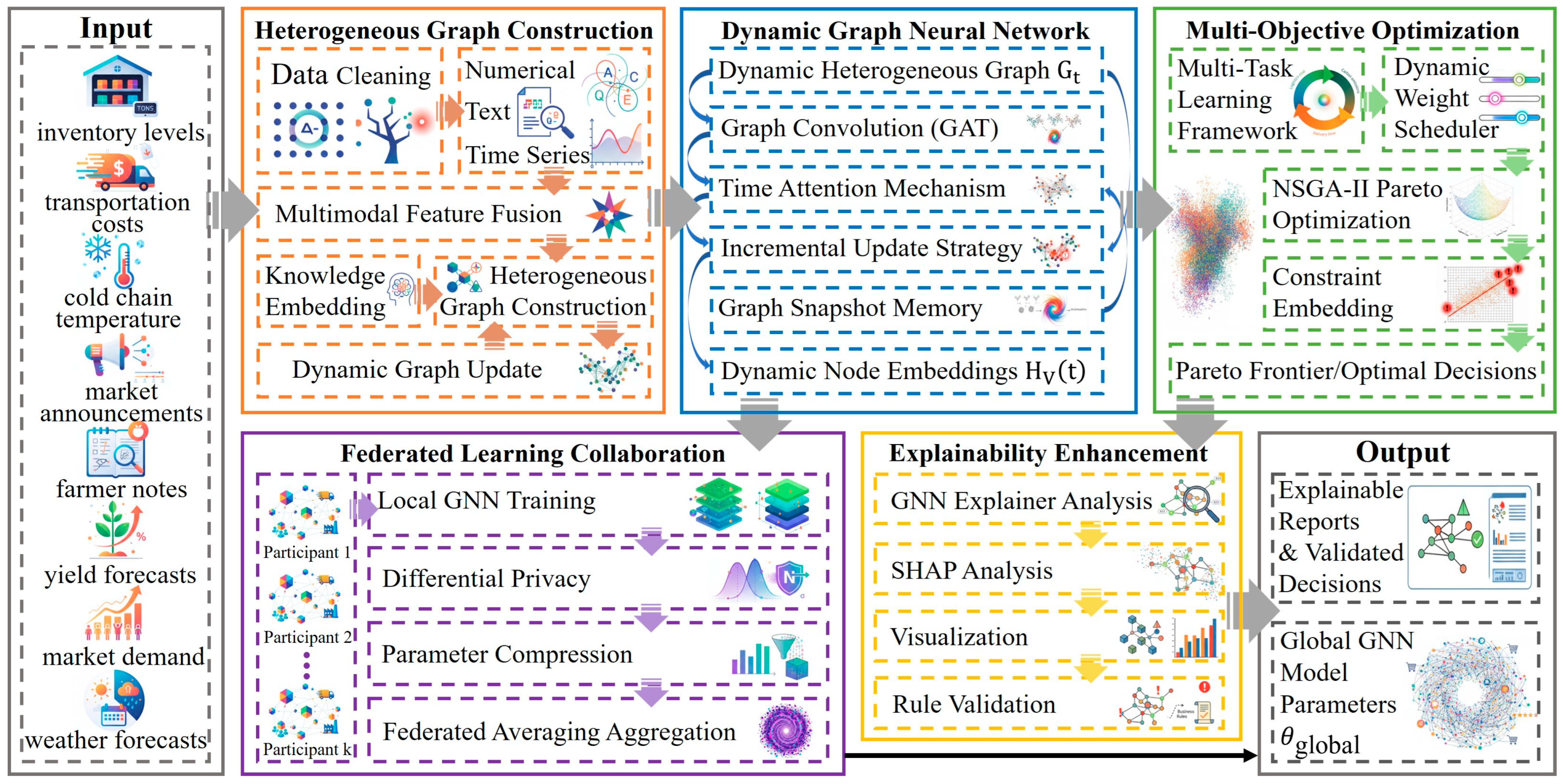
In response to the intricacies inherent in agricultural supply chains, this article introduces the Dynamic Heterogeneous Multi-Objective Graph Neural Network (DHMO-GNN) model. This framework ingests multisource heterogeneous data from agricultural contexts—encompassing yields, inventories, cold-chain logistics, market demands, and meteorological inputs—through five quintessential modules: data preprocessing and heterogeneous graph construction, dynamic graph neural networks, multi-objective optimization, interpretability enhancement, and federated learning collaboration. These components progressively facilitate data modeling, feature extraction, optimization resolution, and interpretability scrutiny, culminating in the derivation of optimized schemas for agricultural supply chains, as delineated in the overarching architecture illustrated in Figure 3.
The specific choice of this integrated methodology is not arbitrary but deliberately tailored to the unique challenges of agri-food supply chains: heterogeneous entity and relation types, pronounced temporal dynamics (e.g., seasonal fluctuations and weather-induced disruptions), conflicting optimization objectives (cost, delivery time, and carbon emissions), stringent data privacy requirements across decentralized stakeholders, and the need for transparent, trustworthy decisions. Heterogeneous graph construction is employed to accurately model diverse node types (farmers, cold storages, markets) and edge types (transportation and transactional links), which homogeneous approaches cannot adequately capture. Dynamic graph neural networks with temporal attention and incremental updates are adopted to explicitly handle the time-varying nature of agricultural systems, where static models fail. Multi-objective optimization via multi-task learning combined with NSGA-II Pareto frontier generation and dynamic weight scheduling enables balanced trade-offs among competing goals while adapting to real-time priorities. Interpretability is enhanced through GNNExplainer and SHAP to identify critical subgraphs and feature contributions, complemented by business rule validation to ensure compliance with domain-specific constraints such as cold-chain temperature limits. Finally, federated learning with differential privacy and parameter compression facilitates privacy-preserving collaboration across data silos without compromising model performance.
In formal notation, the comprehensive mapping of DHMO-GNN is articulated as Equation (1):
F DHMO - GNN : ( G t , C ) ( D t , P t , E t )
where G t = ( V , E , T , X V ( t ) , X E ( t ) ) denotes the dynamic heterogeneous graph at time t , emblematic of the agricultural supply chain network, with nodes representing farmers, warehouses, cold-chain vehicles, retail terminals, and analogous entities, and edges signifying transportation routes from origins to markets or cold-chain logistical pathways;
C encapsulates agricultural operational constraints, such as preservation time windows, cold-chain temperature regulations, inventory thresholds, and origin supply capacities;
D t comprises optimized decisions, including selections of agricultural product transportation paths and inventory allocation strategies;
P t represents the multi-objective Pareto frontier solution set, employed to equilibrate optimization objectives such as transportation costs, timelines, spoilage rates, and carbon emissions;
E t furnishes interpretability outcomes and visual renderings, for instance, analyses of contributions from pivotal farmer nodes, cold-chain bottlenecks, or high-demand markets.
This model, while preserving the spatiotemporal dynamism and multi-stakeholder collaborative essence of agricultural supply chains, concurrently accommodates multi-objective optimization and interpretability analyses, thereby proffering a robust scientific foundation for decisional support in agricultural supply chain management.

2.2.1. Data Preprocessing and Heterogeneous Graph Construction Module

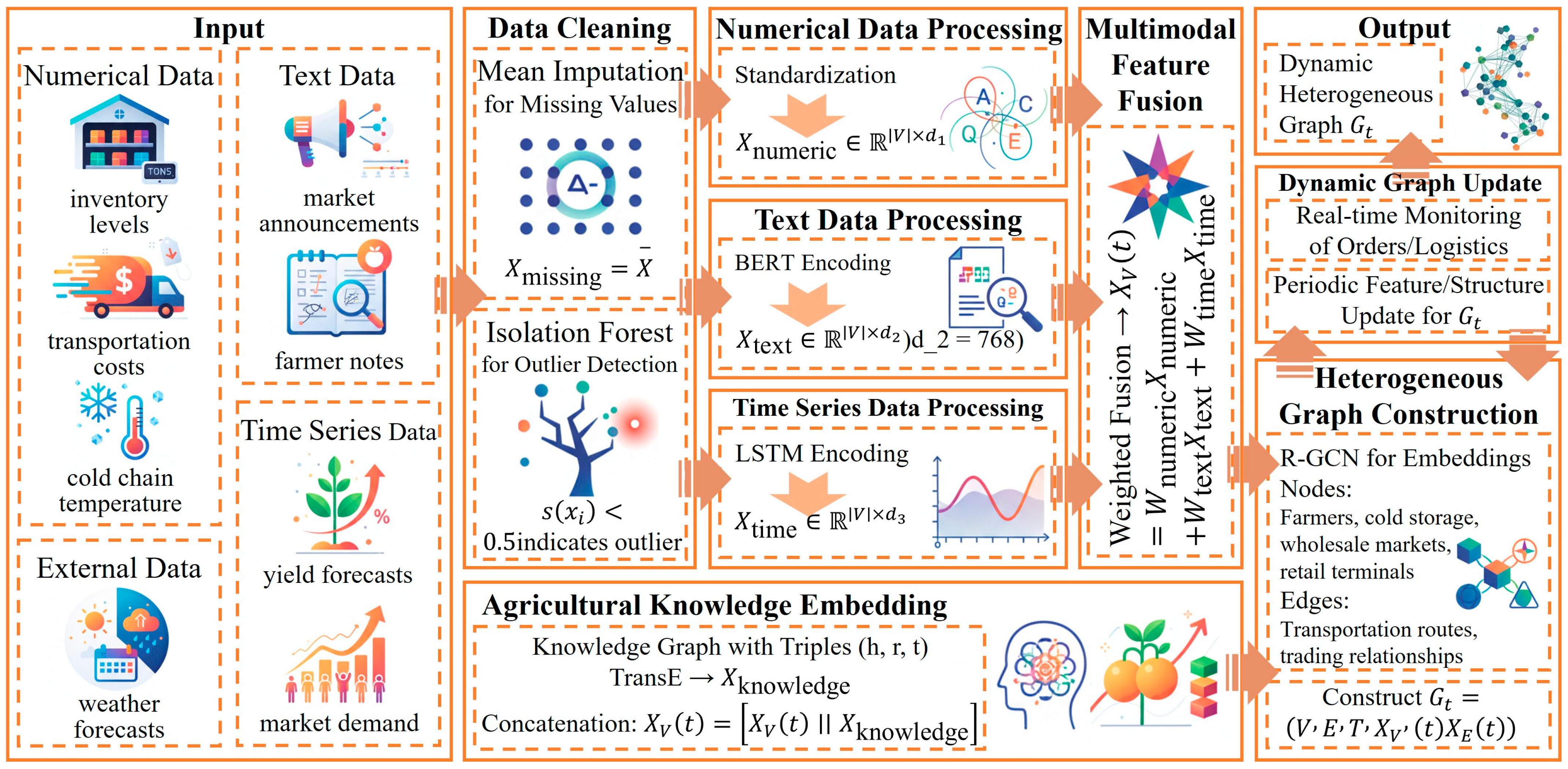
The intricacies of agricultural supply chains are predominantly manifested in their multimodal data attributes (such as yields, inventories, cold-chain transportation temperatures, and market demands) and inherent dynamism (exemplified by meteorological fluctuations precipitating supply–demand oscillations), thereby imposing elevated exigencies on data handling and modeling paradigms. To this end, this article delineates a data preprocessing and heterogeneous graph construction module, serving as the ingress to the DHMO-GNN model. This module is tasked with transmuting raw agricultural data into dynamic heterogeneous graph structures, furnishing a unified input representation for subsequent dynamic graph modeling and multi-objective optimization, with its overarching architecture illustrated in Figure 4. The module orchestrates the construction of the dynamic heterogeneous graph at time t through multimodal data fusion, agricultural knowledge embedding, and dynamic graph updates as Equation (2):
G t = ( V , E , T , X V ( t ) , X E ( t ) )
where V constitutes the node set (encompassing farmers, cold storages, wholesale markets, and retail terminals), E denotes the edge set (comprising transportation pathways and transactional relations), T signifies timestamps, and X V ( t ) alongside X E ( t ) represent the dynamic feature matrices for nodes and edges, respectively, adeptly delineating the intricate interrelations and temporal variabilities within agricultural supply chains.
The data processing workflow proceeds as follows: initially, raw data are amassed from agricultural Internet of Things platforms and market databases, incorporating numerical data (inventory levels, transportation costs, cold-chain temperatures), textual data (market announcements, farmer annotations), time-series data (yield forecasts, market demands), and exogenous data (weather prognostications). During the preprocessing phase, mean imputation is employed to rectify missing values in cold-chain temperatures or inventories, while the isolation forest algorithm is harnessed to excise anomalous entries (such as aberrantly low prices or exorbitant energy-consuming transports), thereby yielding a pristine dataset [20,21].
Tailored to disparate modalities, the module devises bespoke feature extraction methodologies:
For numerical data: standardization yields feature vectors as Equation (3):
X numeric R | V | × d 1
where d 1 encapsulates the dimensionality of numerical attributes (e.g., inventory volumes, transportation expenditures, cold-chain temperatures).
For textual data: a pretrained BERT model encodes market announcements and farmer annotations [22], generating semantic embeddings as Equation (4):
X text R | V | × d 2 , d 2 = 768
thereby capturing market preference inclinations or agricultural product quality delineations.
For time-series data: Long Short-Term Memory (LSTM) networks model yield predictions and demand sequences [23], producing dynamic features as Equation (5):
X time R | V | × d 3
where d 3 denotes the dimensionality of time-series attributes, reflecting seasonal harvest rhythms or meteorological shocks engendering supply-demand perturbations.
Building upon these extractions, Relational Graph Convolutional Networks (R-GCNs) are utilized to forge heterogeneous graph representations [24]. Node features are amalgamated via weighted fusion of multimodal information as Equation (6):
X V ( t ) = W numeric X numeric + W text X text + W time X time
where W numeric , W text , and W time comprise learnable weight matrices, calibrated to equilibrate the contributory salience of each modality.
Moreover, to augment the model’s adaptability to agricultural operational contexts, the module encodes industry regulations (e.g., “leafy vegetables must reach markets within 48 h post-harvest,” “cold-chain transportation temperatures must be sustained between 2 and 8 °C”) as knowledge graphs, formalized through triplets as Equation (7):
( h , r , t )
where h and t represent entities (such as cold storages or markets), and r signifies relations (e.g., cold-chain temperature constraints). Knowledge embeddings are generated via the TransE model, yielding representational vectors X knowledge , which are concatenated with node features as Equation (8):
X V ( t ) [ X V ( t )   | |   X knowledge ]
where [||] denotes vector concatenation.
Finally, to ensure fidelity of the graph structure and features to real-world agricultural scenarios, the module dynamically refreshes G t through real-time surveillance of yields, transports, and cold-chain data, thereby accommodating harvest apices, meteorological adversities, or logistical disruptions.

2.2.2. Dynamic Graph Neural Network Module

The dynamic graph neural network module constitutes the pivotal component of the DHMO-GNN framework, entrusted with processing the dynamic heterogeneous graph as Equation (9):
G t = ( V , E , T , X V ( t ) , X E ( t ) )
generated by the data preprocessing module to yield dynamic node embeddings as Equation (10):
H V ( t ) R | V | × d
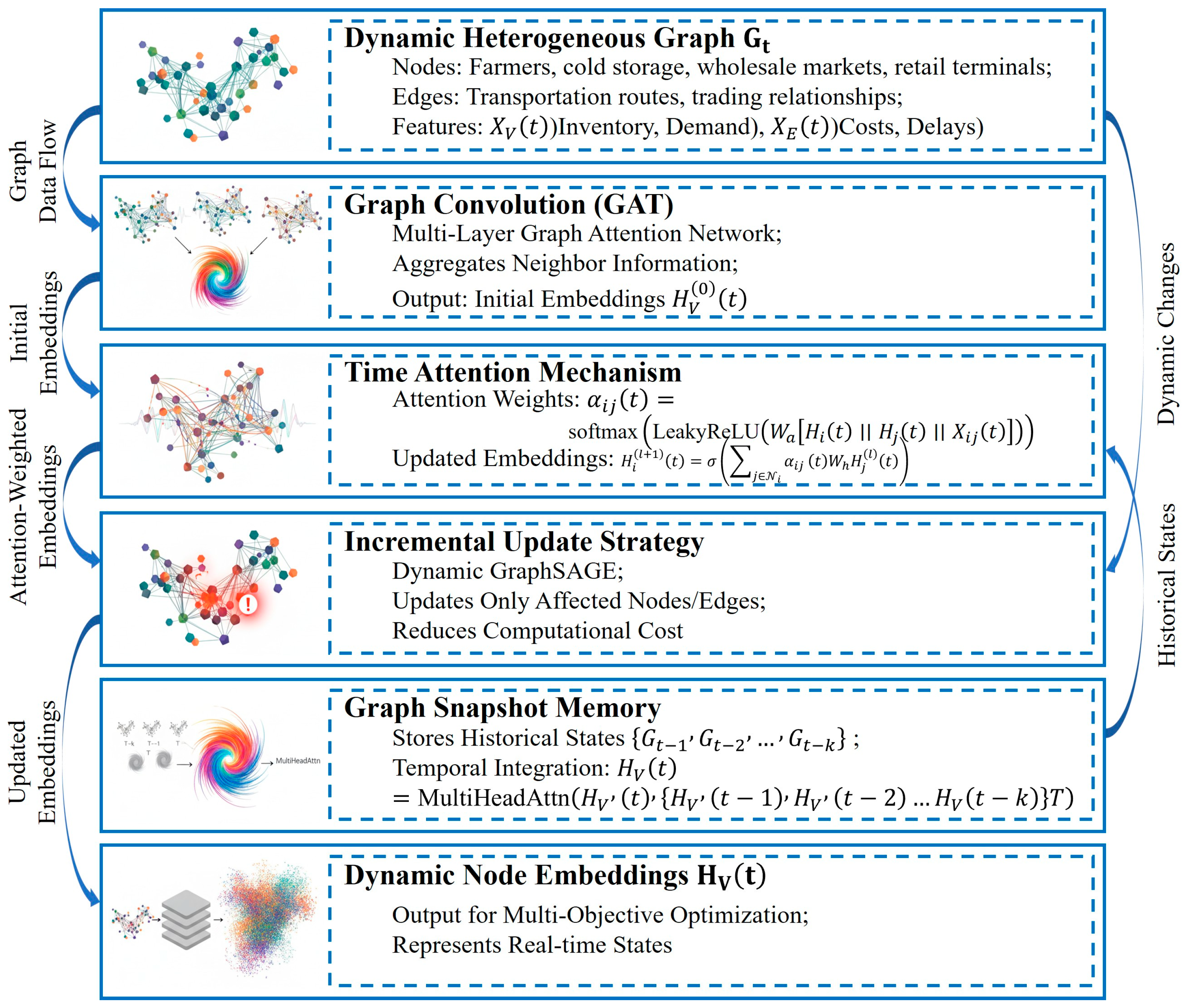
thereby delineating inter-node relationships and temporal dynamics within agricultural supply chains—such as yield fluctuations precipitated by meteorological variations, disruptions in cold-chain logistics, or surges in market demand. The inherent dynamism of agricultural supply chains necessitates a model capable of expeditiously adapting to alterations in network topology and attributes while preserving computational efficacy. Accordingly, this module incorporates a Temporal Graph Attention Network (T-GAT), augmented by temporal attention mechanisms, incremental update strategies, and historical state repositories, to bolster the model’s resilience to evolving environments and furnish high-fidelity feature representations for multi-objective optimization. The module’s overarching architecture is illustrated in Figure 5.
The module’s implementation workflow unfolds as follows: initially, it assimilates the dynamic heterogeneous graph G t outputted from the data preprocessing module, wherein node features X V ( t ) encapsulate particulars such as farmer yields, warehouse inventories, and market demands, while edge features X E ( t ) encompass transportation costs, cold-chain timelines, and delivery schedules. Leveraging Graph Attention Networks (GAT), multi-layer graph convolutions aggregate neighbor information [25] to produce initial node embeddings as Equation (11):
H V ( 0 ) ( t )
To encapsulate the dynamism of agricultural supply chains, a temporal attention mechanism is introduced to compute attention weights between nodes across disparate time steps as Equation (12):
α i j ( t ) = softmax LeakyReLU W a [ H i ( t ) | | H j ( t ) | | X i j ( t ) ]
where H i ( t ) and H j ( t ) denote the embeddings of nodes i and j , X i j ( t ) represents the edge feature, W a is a learnable weight matrix, || signifies vector concatenation, LeakyReLU serves as the activation function, and softmax ensures normalization of attention weights. Through multi-head attention mechanisms [26], the module further amplifies dynamic interdependencies across time steps, yielding refined node embeddings as Equation (13):
H i ( l + 1 ) ( t ) = σ j N i     α i j ( t ) W h H j ( l ) ( t )
where N i delineates the neighbor set of node i , W h comprises a learnable transformation matrix, σ embodies the nonlinear ReLU activation, and l indexes the convolutional layer.
To enhance computational efficiency, an incremental update strategy is employed, selectively recalculating embeddings solely for nodes and edges impacted by dynamic perturbations (e.g., farmer nodes afflicted by weather-induced yield reductions or transportation routes severed by cold-chain malfunctions), eschewing wholesale graph restructuring. This incremental paradigm draws inspiration from Dynamic GraphSAGE, ascertaining update scopes via detection of topological alterations (such as edge additions or feature refreshes) to curtail overhead [27].
Furthermore, to apprehend protracted temporal dependencies, a graph snapshot memory is devised to archive historical graph states as Equation (14):
{ G t 1 , G t 2 , , G t k }
integrating antecedent information through temporal attention as Equation (15):
H V ( t ) = MultiHeadAttn H V ( t ) , { H V ( t 1 ) , H V ( t 2 ) , , H V ( t k ) } , T
where MultiHeadAttn denotes the multi-head attention mechanism, and T represents the timestamp sequence, facilitating weighted assimilation of historical embeddings.

2.2.3. Multi-Objective Optimization Module

The multi-objective optimization module serves as the quintessential decision-making apparatus within the DHMO-GNN framework, predicated on the dynamic node embeddings as Equation (16):
H V ( t ) R | V | × d
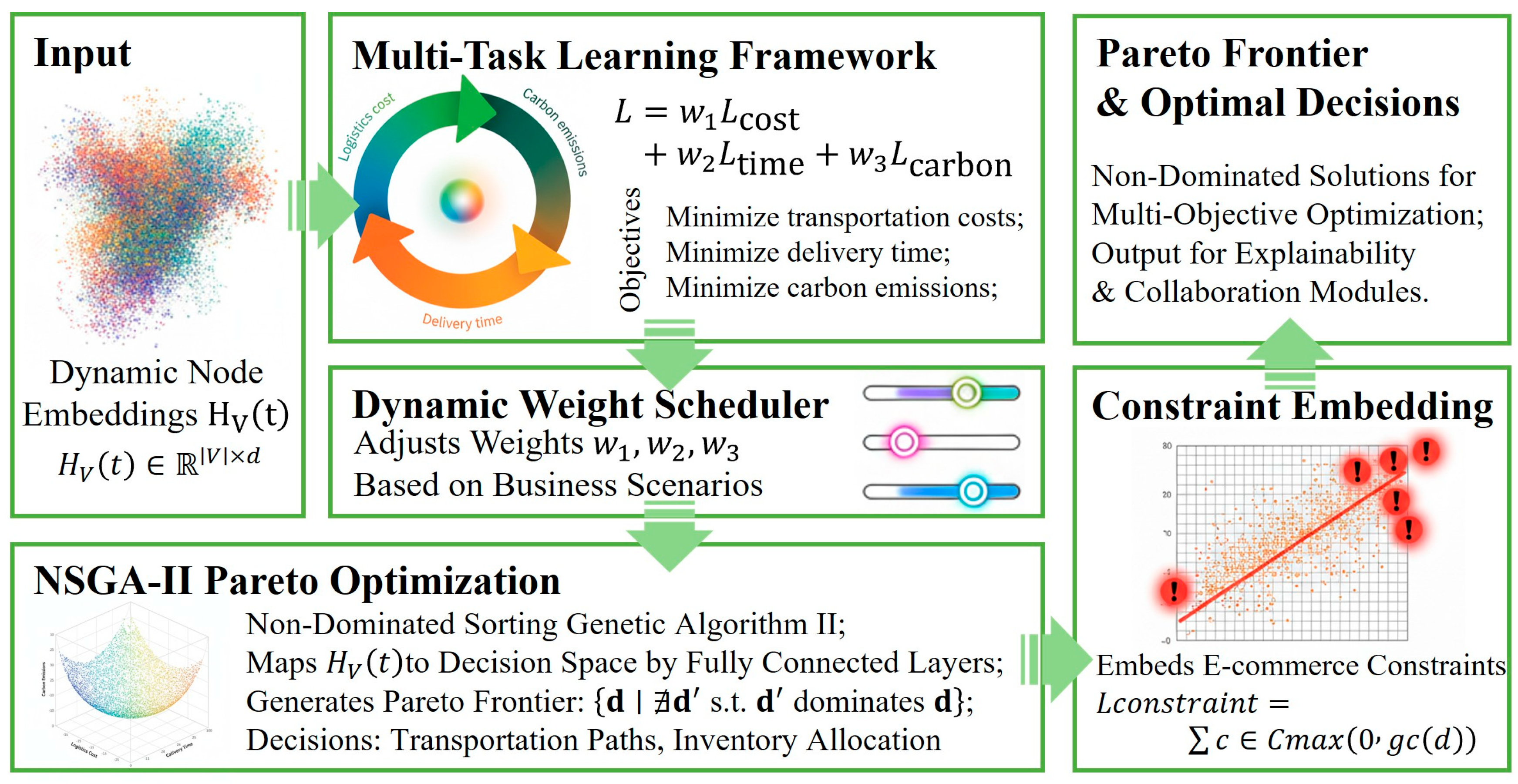
engendered by the dynamic graph neural network module. Its mandate is to refine multifaceted operational imperatives in agricultural supply chains, encompassing the minimization of cold-chain transportation expenditures, curtailment of delivery timelines, and mitigation of carbon emissions, thereby yielding efficacious and sustainable decisional schemas (such as transportation route selections, warehouse dispatching, and inventory apportionment strategies). The inherent complexities of agricultural supply chains necessitate concurrent fulfillment of competing objectives—ranging from preservation timelines (e.g., cold-chain efficacy mandates) to cost containment and environmental stewardship—wherein conventional single-objective paradigms prove inadequate. This module harnesses a multi-task learning architecture, dynamic weight modulation mechanisms, and Pareto optimization stratagems to forge multi-objective solution ensembles, affording agricultural supply chain stewards versatile decisional latitude, as encapsulated in the module’s overarching architecture depicted in Figure 6.
In this study, the agricultural supply chain optimization problem is formulated at each discrete time step t as a multi-objective mixed-integer nonlinear programming (MINLP) problem. The underlying structure is represented by a dynamic heterogeneous graph G t = ( V t , E t ) , where V t denotes the set of active nodes (including farmers, cold storages, and markets) and E t the set of transportation routes available at time t .
The decision variables consist of both binary and continuous components:
x i j t { 0,1 } , indicating whether the transportation route from node i to node j is utilized at time t ;
y k t 0 , representing the inventory allocation volume at node k (cold storage or market) at time t ;
z i j t 0 , denoting the flow volume (in tons) transported along edge ( i , j ) at time t .
The optimization pursues three conflicting objectives as Equation (17):
m i n x , y , z   f 1 ( x , y , z ) = ( i , j ) E t   c i j t z i j t + k V t   h k t y k t ( Total   Cold - Chain   Transportation   Cost ,   TCC ) , m i n x , y , z     f 2 ( x , y , z ) = ( i , j ) E t   d i j t x i j t ( Average   Delivery   Time ,   ADT ) , m i n x , y , z     f 3 ( x , y , z ) = ( i , j ) E t   e i j t z i j t ( Total   Carbon   Emissions ,   TCE ) ,
where c i j t , d i j t , e i j t , and h k t denote the unit transportation cost, delivery time, emission factor, and inventory holding cost, respectively, all time-dependent parameters derived from the dynamic graph.
The formulation is subject to the following hard constraints that must be strictly satisfied:
Flow conservation (supply–demand balance): j : ( i , j ) E t   z i j t j : ( j , i ) E t   z j i t = s i t d i t i V t , where s i t and d i t represent the supply and demand at node i at time t ;
Capacity constraint: z i j t C i j t x i j t ( i , j ) E t , where C i j t is the maximum allowable flow on route ( i , j ) ;
Perishability constraint (preservation time window): ( i , j ) P   d i j t x i j t τ p   products   p , ensuring that the total delivery time along any feasible path P does not exceed the allowable preservation threshold τ p for product p ;
Cold-chain temperature constraint: T i j t [ 2 , 8 ] C ( i , j ) E t   with   x i j t = 1 , enforcing temperature compliance on active routes;
Non-negativity and integrality constraints: x i j t { 0,1 } , y k t 0 , z i j t 0 i , j , k . The objective is to identify the Pareto-optimal set of non-dominated solutions in the three-dimensional objective space, thereby providing decision-makers with a comprehensive set of trade-off solutions that balance transportation cost, delivery timeliness, and carbon emissions.
NSGA-II then evolves the population while strictly enforcing the above constraints. The GNN embeddings thus guide the evolutionary search toward more promising regions of the solution space, improving convergence speed and quality of the Pareto frontier.
The module’s operational cadence unfolds as follows: commencing with the assimilation of dynamic node embeddings H V ( t ) , wherein each node’s embedding encapsulates salient attributes such as farmer yields, warehouse inventories, market exigencies, and cold-chain timelines. Anchored in a multi-task learning paradigm, a composite objective loss function is formulated to holistically appraise four optimization imperatives as Equation (18):
L = w 1 L cost + w 2 L time + w 3 L carbon ,
where
L cost denotes transportation cost loss, predicated on cold-chain distances and associated disbursements;
L time signifies delivery timeline loss, derived from transportation trajectories and cold-chain preservation windows;
L carbon embodies carbon emission loss, computed via transportation modalities and energy consumption emission factors;
w 1 , w 2 , w 3 represent dynamic weights, amenable to recalibration in consonance with operational contexts (e.g., prioritizing market provisioning during harvest apices).
To facilitate dynamic weight recalibration, a weight scheduler is integrated, modulating coefficients in response to contemporaneous exigencies (such as logistical pinnacles or inclement meteorological episodes); for instance, under typhoon conditions, w 2 is amplified to foreground delivery optimization, ensuring perishable commodities arrive within preservation thresholds.
To engender multi-objective optimization solution sets, the module employs the Non-dominated Sorting Genetic Algorithm II (NSGA-II) for Pareto optimization [28]: initially, node embeddings H V ( t ) are projected onto the decision manifold via fully connected layers, spawning candidate decisions (e.g., transportation routes or inventory dispatches); subsequently, these candidates are appraised against the multi-objective loss function, culminating in the Pareto frontier as Equation (19):
Pareto   Frontier = { d d   s . t .   d   dominates   d }
where d signifies a decision vector encompassing manifold objective valuations (e.g., costs, timelines, fulfillment rates). NSGA-II iterates through populations via non-dominated sorting to yield a cadre of non-dominated solutions, empowering supply chain custodians to elect in alignment with prevailing priorities.
Moreover, to accommodate scenario-specific constraints endemic to agricultural supply chains (e.g., cold-chain temperatures not exceeding 4 °C, warehouse inventories sustaining above safety thresholds, delivery timelines adhering to preservation windows), these imperatives are embedded within the loss function as hard constraints as Equation (20):
L constraint = c C   m a x ( 0 , g c ( d ) )
where C delineates the constraint ensemble, and g c ( d ) quantifies violation magnitudes (e.g., temporal overruns beyond preservation windows). By appending L constraint to the aggregate loss function, the module ensures that optimized decisions concurrently amplify efficacy while conforming to agricultural supply chain operational edicts and preservation mandates.

2.2.4. Interpretability Enhancement Module

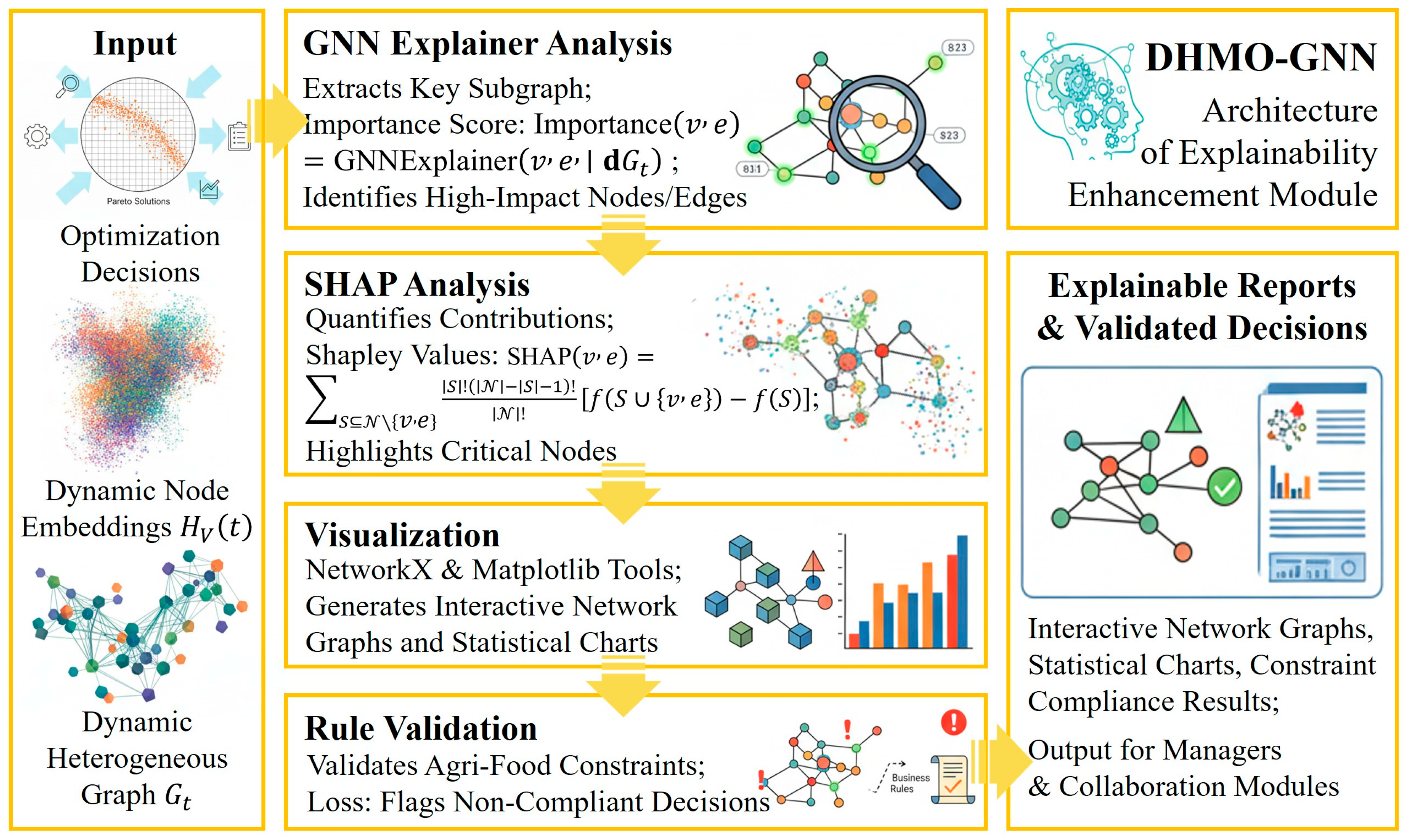
The interpretability enhancement module represents a vital constituent of the DHMO-GNN framework, dedicated to scrutinizing the optimization decisions emanating from the multi-objective optimization module—such as transportation route selections, warehouse scheduling, and inventory allocation schemas—to discern the pivotal nodes and edges exerting paramount influence on these outcomes (e.g., principal production-area farmers, cold-chain warehouses, or bottleneck transportation conduits), while engendering intuitive visual reports. This augmentation fosters heightened comprehension and confidence among agricultural supply chain stewards regarding model-derived determinations. Given that decisional processes in agricultural supply chains implicate multifaceted stakeholder interests (encompassing farmers, cooperatives, cold-chain enterprises, and wholesale markets) and necessitate adherence to intricate operational edicts (such as preservation timelines and cold-chain temperature constraints), the opaque “black-box” disposition of conventional GNN models inadequately addresses managerial imperatives for transparency and veracity. Accordingly, this module amalgamates GNNExplainer, SHAP analyses, visualization utilities, and business rule validations to erect an interpretability scaffold, ensuring that optimization decisions are not only empirically robust but also attuned to the exigencies of agricultural supply chains, as portrayed in the module’s overarching architecture in Figure 7.
The module commences by assimilating the optimization decision vector from the multi-objective optimization module as Equation (21):
d R m
where m denotes the cardinality of decision variables (e.g., transportation routes, inventory dispatches), alongside dynamic node embeddings as Equation (22):
H V ( t ) R | V | × d
and the primal dynamic heterogeneous graph as Equation (23):
G t = ( V , E , T , X V ( t ) , X E ( t ) )
To isolate salient subgraph structures, the module employs GNNExplainer, maximizing mutual information to extract subsets of nodes and edges most instrumental to optimization decisions as Equation (24), while computing their salience scores [29]:
Importance ( v , e ) = GNNExplainer ( v , e d , G t )
where v V signifies nodes (e.g., cold-chain warehouses, farmer origins), and e E denotes edges (e.g., cold-chain transportation pathways).
For granular quantification of nodal and edgewise contributions to decisions as Equation (25), Shapley additive explanations (SHAP) methodology is invoked to compute Shapley values [30]:
SHAP ( v , e ) = S N { v , e }   | S | ! ( | N | | S | 1 ) ! | N | ! [ f ( S { v , e } ) f ( S ) ]
where N encapsulates the ensemble of all nodes and edges within the graph, S represents subsets thereof, and f ( ) embodies the model’s predictive function (e.g., optimization decision scores). SHAP values delineate marginal contributions, for instance, pinpointing warehouse nodes most critical to cold-chain stability amid elevated temperatures.
To amplify decisional visual exposition, the module leverages NetworkX 3.1 and Matplotlib 3.7.2 utilities to generate interactive visualizations of agricultural supply chain networks, delineating key subgraphs alongside their salience scores, while concurrently producing statistical charts elucidating contributions across optimization objectives (transportation costs, delivery timelines, carbon emissions, etc.).
To ascertain conformance of decisions to agricultural supply chain operational imperatives (e.g., cold-chain temperatures not surpassing 4 °C, delivery timelines adhering to preservation thresholds, warehouse inventories sustaining above safety minima), the module incorporates a rule validation stratum, employing logical audits to adjudicate decisional feasibility as Equation (26):
L rule = r R   m a x ( 0 , g r ( d ) )
where R comprises the compendium of agricultural supply chain rules, and g r ( d ) quantifies infraction severities. Should L rule > 0 , the decision is flagged as untenable, necessitating re-optimization.

2.2.5. Federated Learning Collaboration Module

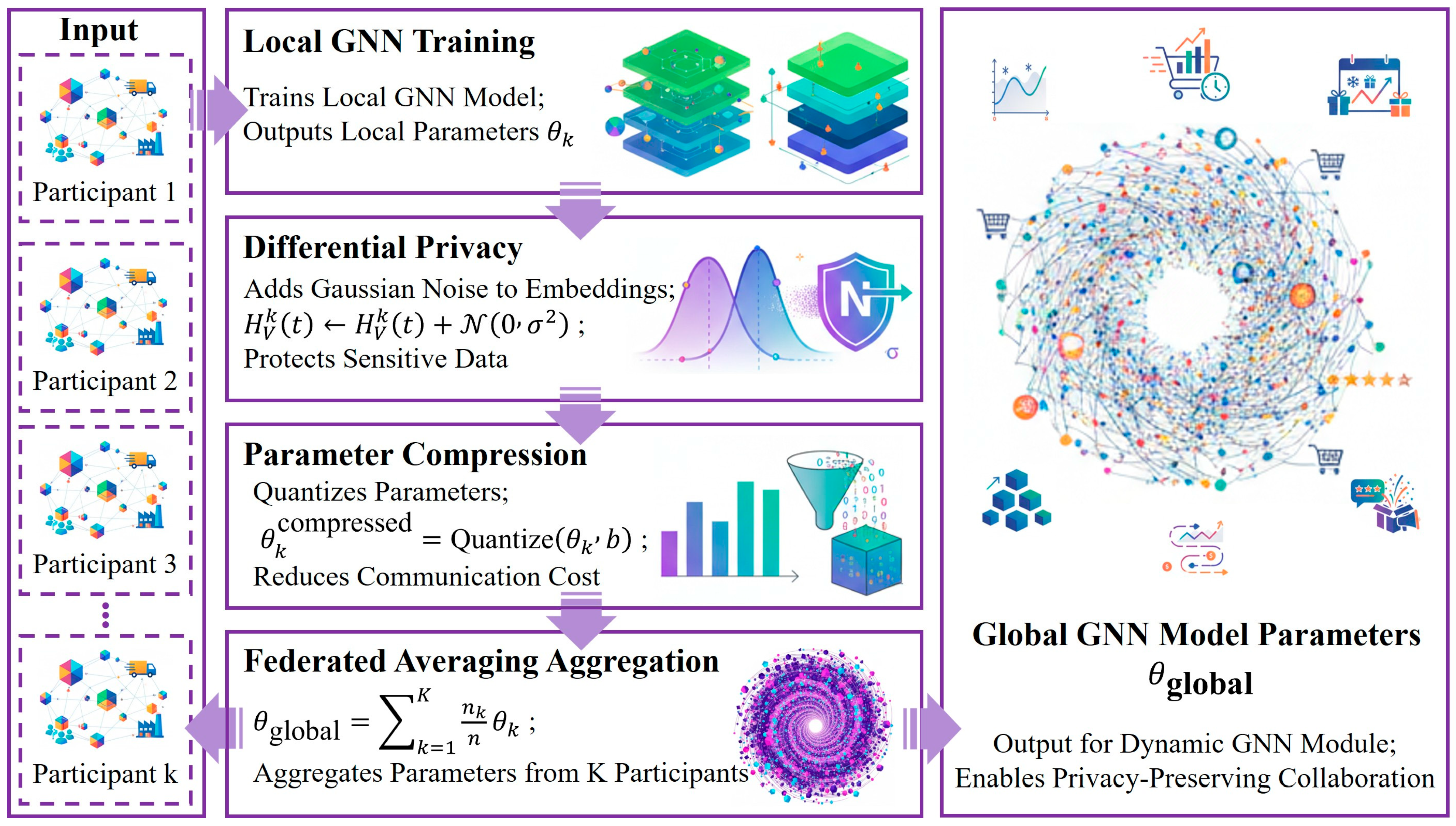
The federated learning collaboration module constitutes an indispensable facet of the DHMO-GNN framework, engineered to facilitate collaborative optimization across diverse stakeholders in agricultural supply chains—such as farmers, processing enterprises, cold-chain logistics providers, wholesalers, and retail platforms—while safeguarding the confidentiality of sensitive data (e.g., yield statistics, pricing particulars, and order specifics). Given the multi-entity orchestration inherent to agricultural supply chains, wherein data are profoundly decentralized and privacy-laden, conventional centralized training paradigms falter due to their requisite aggregation of raw datasets. This module harnesses a federated learning architecture, synergizing the Federated Averaging (FedAvg) algorithm, differential privacy safeguards, and parameter compression methodologies to orchestrate cross-entity global GNN model training. This approach amalgamates data value without privacy breaches, thereby augmenting predictive precision and optimization prowess within the supply chain, as illustrated in the module’s overarching architecture in Figure 8.
The meticulous implementation workflow proceeds as follows: initially, the module assimilates localized graph data from each participant as Equation (27):
G t k = ( V k , E k , T , X V k ( t ) , X E k ( t ) )
where k designates the k -th participant, V k and E k denote localized node and edge sets, respectively, and X V k ( t ) alongside X E k ( t ) represent localized feature matrices (e.g., yields, inventories, cold-chain transit statuses). Each participant conducts localized GNN model training to derive local parameters θ k . Subsequently, the module employs the FedAvg algorithm to aggregate these parameters, forging a global model as Equation (28) [31]:
θ global = k = 1 K   n k n θ k
where K signifies the total number of participants, n k quantifies the data volume of the k -th entity, and n = k = 1 K   n k encapsulates the aggregate data quantum. The refined θ global is disseminated back to participants, enabling iterative refinement.
To fortify data privacy, the module infuses differential privacy during localized embedding updates as Equation (29):
H V k ( t ) H V k ( t ) + N ( 0 , σ 2 )
where H V k ( t ) embodies the localized node embeddings of the k -th participant, and N ( 0 , σ 2 ) denotes Gaussian noise, with σ modulating the intensity of privacy preservation. This mechanism ensures that, even amidst intercepted communications, reconstitution of primal agricultural data (e.g., specific orders or valuations) remains infeasible.
To provide rigorous and verifiable privacy guarantees, we employ the Gaussian mechanism within the framework of (ε, δ)-differential privacy, applied to the localized node embeddings generated during each federated training round. The mechanism is implemented as follows:
For each participant k , after computing the local node embeddings h v , k t using the dynamic graph neural network, the embedding updates are subjected to gradient clipping and noise perturbation. The L2-norm of the updates is clipped to a maximum threshold C = 1.0 (selected empirically to maintain a balance between model utility and privacy strength). Gaussian noise drawn from N ( 0 , σ 2 C 2 I ) is then added to the clipped updates, where the noise multiplier σ = 0.01 corresponds to the primary setting reported in the experiments.
The cumulative privacy budget across all federated rounds is tracked using the Rényi Differential Privacy (RDP) moments accountant. The sampling rate q is defined as the ratio of the local batch size to the participant’s dataset size, ranging approximately from 0.01 to 0.05 depending on the local data volume.
The privacy parameter δ is fixed at 10 5 , a conventional choice for high-dimensional machine learning applications. For the main experimental configuration ( σ = 0.01 , 100 rounds), the RDP accountant yields a cumulative privacy budget of ε 1.0 . Sensitivity analyses are conducted with σ = 0.1 , resulting in ε 0.1 . These parameters ensure that the global model satisfies ( ε , δ ) -differential privacy with respect to the data of any individual participant.
Concurrently, to mitigate communication overheads in federated learning, the module incorporates parameter compression stratagems. Through quantization, parameters are condensed into b -bit representations as Equation (30):
θ k compressed = Quantize ( θ k , b )
with decompression antecedent to aggregation, thereby upholding global model fidelity. This technique curtails bandwidth exigencies while sustaining training efficacy and optimization outcomes.

3. Experiments and Results

3.1. Experimental Settings

To ensure the scientific rigor and reproducibility of the experiments, this study meticulously delineates hyperparameter configurations, experimental replication protocols, and implementation environments, thereby facilitating a robust evaluation of the Dynamic Heterogeneous Multi-Objective Graph Neural Network (DHMO-GNN) model’s efficacy in optimizing agricultural supply chains. The hyperparameter settings are as follows: the GNN architecture employs a three-layer structure with a hidden dimension of 128, a learning rate of 0.001, and a batch size of 64, striking an equilibrium between representational capacity and computational efficiency; the Non-dominated Sorting Genetic Algorithm II (NSGA-II) optimization is configured with a population size of 100, iterating over 100 generations, a crossover probability of 0.9, and a mutation probability of 0.1, ensuring diversity and convergence in the Pareto frontier; federated learning proceeds across 100 rounds, incorporating a differential privacy Gaussian mechanism (noise standard deviation σ = 0.01) alongside 8-bit parameter quantization (b = 8), to harmonize privacy safeguards with communication efficacy. To affirm the robustness of outcomes, each experiment is replicated five times, with averages and standard deviations reported to encapsulate stochastic influences. The implementation leverages a Python 3.9 environment, with GNN components realized via PyTorch Geometric 1.12.0, NSGA-II executed through DEAP 1.3.3, and the federated learning framework underpinned by Flower 1.4.0. The hardware platform comprises an NVIDIA RTX 3090 GPU (24 GB memory), furnishing ample computational prowess for large-scale graph computations and multi-objective optimization tasks. These configurations collectively underpin the experiment’s methodological stringency, transparency, and replicability, laying a solid groundwork for subsequent performance analyses.
To comprehensively validate the efficacy and robustness of the DHMO-GNN model in agricultural supply chain optimization, this article employs multi-objective optimization comparative analyses, privacy–performance trade-off evaluations, federated learning robustness assessments, and ablation studies, defining the following metrics to systematically appraise model performance under dynamic scenarios.
Total Cold-Chain Transportation Cost (TCC) as Equation (31):
TCC = e E   c e d e + v V   s v i v
where c e denotes the unit transportation cost for edge e (USD/km), d e the transportation distance (km), s v the unit inventory cost for node v (USD/ton), and i v the inventory volume (tons).
Average Delivery Time (ADT) as Equation (32):
ADT = 1 | E delivery | e E delivery   t e
where t e signifies the transportation time for edge e (hours), and E delivery represents the set of delivery edges.
Total Carbon Emissions (TCE) as Equation (33):
TCE = e E   f e d e + v V   g v i v
where f e is the emission factor for edge e (kg CO2/km), and g v the unit emission for node v (kg CO2/ton).
Hypervolume Indicator (HV):
This metric gauges the superiority of the Pareto frontier solution set within the objective space, with reference points established as TCC = 4000 USD, ADT = 8 h, MSR = 100%, TCE = 80 t as Equation (34):
HV = Volume s S     [ s TCC , r TCC ] × [ s ADT , r ADT ] × [ r MSR , s MSR ] × [ s TCE , r TCE ]
where S denotes the Pareto solution set, and r TCC , r ADT , r MSR , r TCE are the reference points.
Privacy Leakage Risk (PLR):
Quantified via differential privacy ε in federated learning, predicated on the Gaussian mechanism as Equation (35):
ε = Δ f 2 σ 2
where Δ f embodies the global sensitivity of the query function, and σ the noise standard deviation.
For a systematic benchmarking of DHMO-GNN’s performance, traditional optimization, machine learning, and metaheuristic methodologies are selected as baseline models, designated with concise, scholarly nomenclature, as detailed in Table 1:

3.2. Results

3.2.1. Multi-Objective Optimization Comparative Analysis

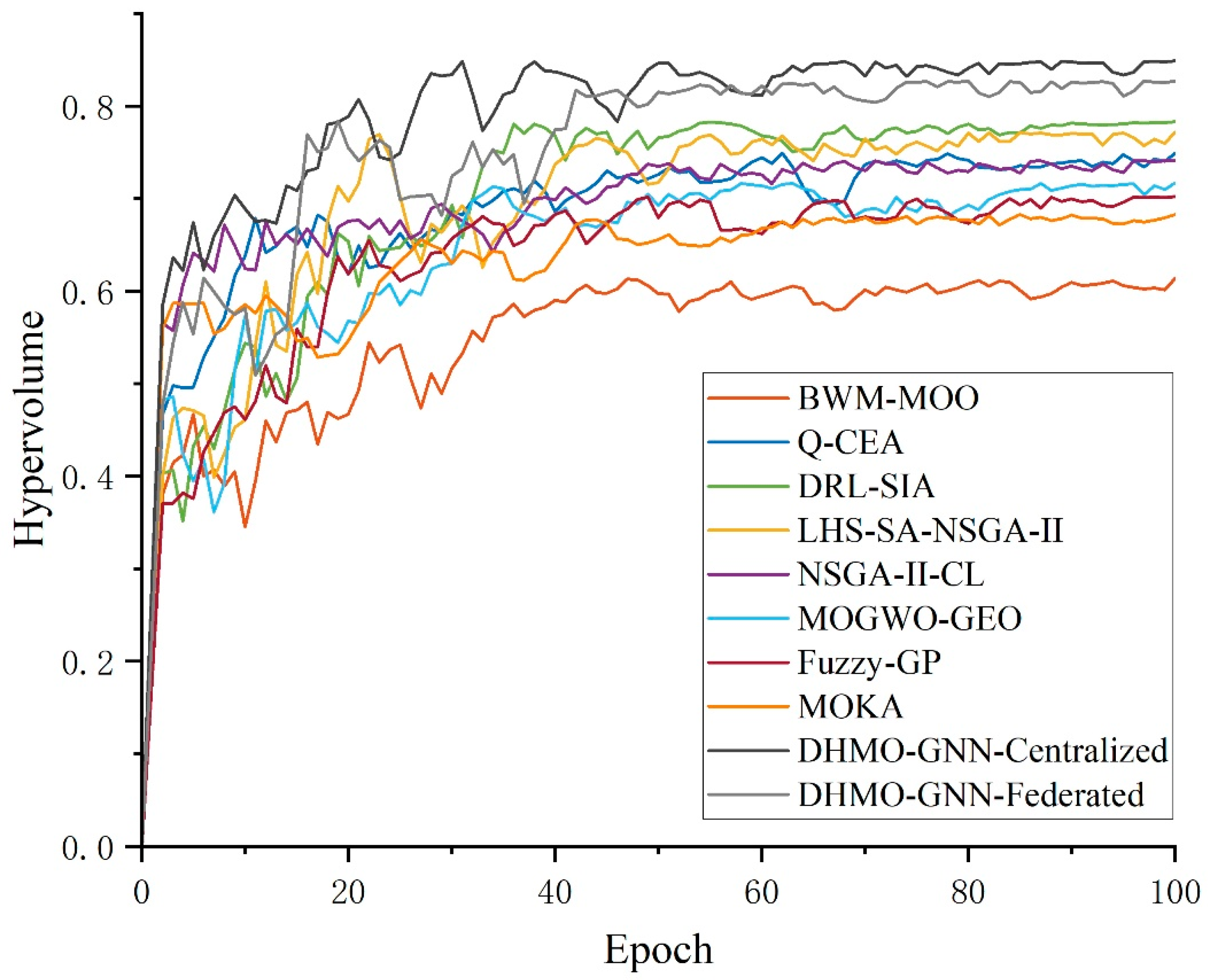
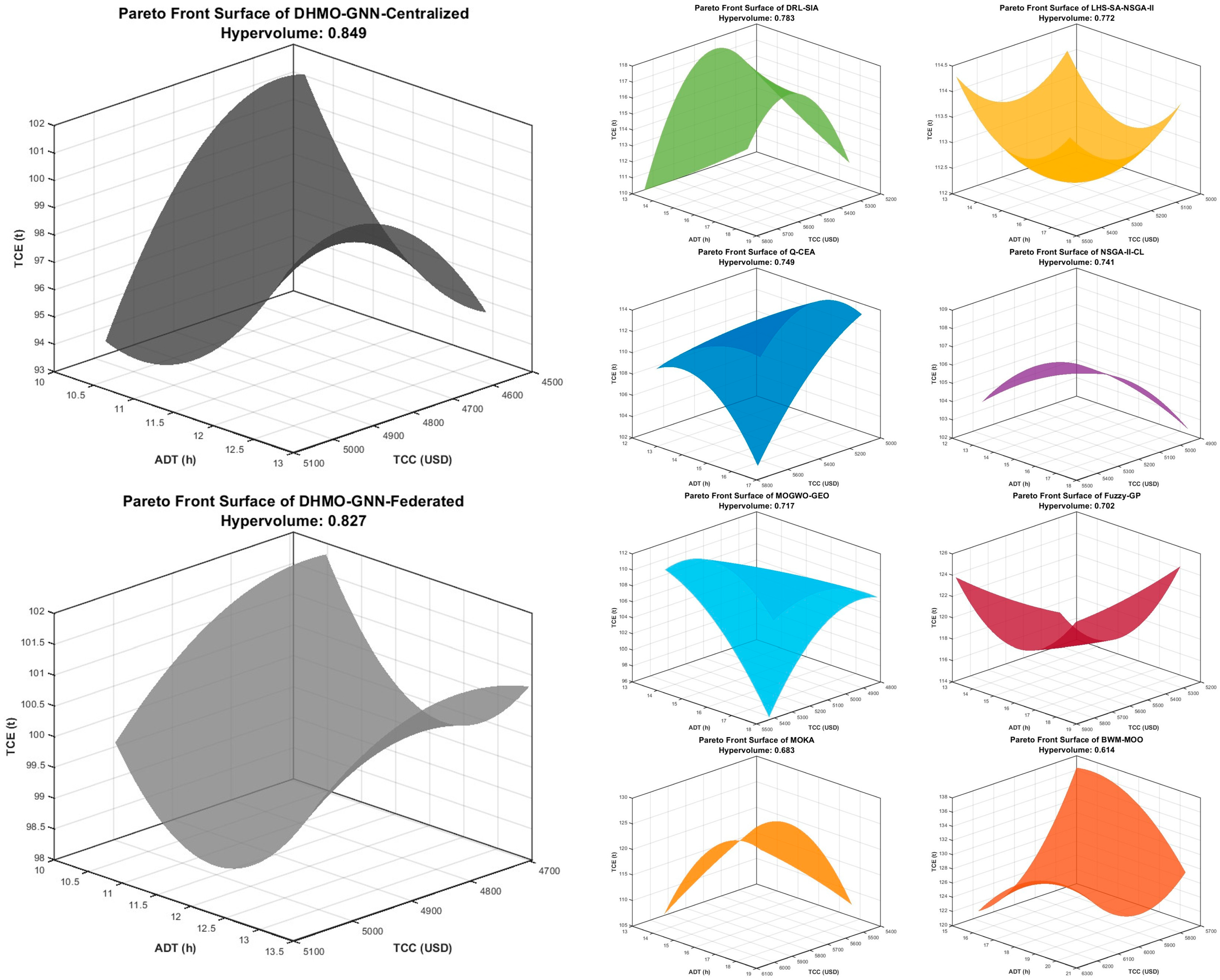
This experiment evaluates the multi-objective performance of DHMO-GNN alongside other advanced models on the test set through a Pareto optimization framework, with emphasis on equilibrating total cold-chain transportation cost (TCC), average delivery time (ADT), and total carbon emissions (TCE). The hypervolume indicator (HV) serves as the metric to gauge the superiority of the Pareto frontier solution sets within the objective space, with its convergence trajectories across 100 epochs depicted in Figure 9, the Pareto frontiers for multi-objective optimization illustrated in Figure 10, and the optimal values tabulated in Table 2.
The centralized DHMO-GNN variant achieves the best overall performance, attaining a TCC of 4783.53 USD, an ADT of 11.57 h, a TCE of 97.84 t, and an HV of 0.849. This substantial improvement over baselines (HV gains of 8–38%) stems primarily from its ability to capture dynamic topological changes and fuse multimodal inputs (yields, weather, and logistics data), enabling more adaptive routing and inventory decisions during seasonal peaks and disruptions. The federated variant maintains near-centralized performance (HV = 0.827) with only a 2.6% degradation, demonstrating that differential privacy and parameter compression effectively preserve utility while enabling secure multi-party collaboration—critical for real-world agri-food chains with data silos.
Among baselines, static methods like BWM-MOO and Fuzzy-GP suffer from high TCE (127.63 t and 118.52 t) due to their inability to adapt to dynamic changes, while reinforcement learning approaches (Q-CEA, DRL-SIA) improve ADT but inflate TCC owing to limited graph-based relational modeling. Overall, DHMO-GNN’s HV degradation remains below 5% in dynamic scenarios, compared to over 10% for static baselines, highlighting its superior robustness for sustainable agri-food optimization.
To further demonstrate the interpretability of the DHMO-GNN model, we analyze a representative disruption scenario from the test set (day 320, with simulated 15% edge failures due to heavy rainfall). The GNNExplainer identifies the central cold storage node as the most salient contributor (high attribution score), followed by two northern long-distance routes. SHAP analysis confirms that these elements account for a substantial portion of the total carbon emissions in the low-emission Pareto solutions. This attribution aligns closely with domain knowledge in agricultural supply chains: during rainy season disruptions, central cold storages serve as critical rerouting hubs to maintain product freshness and minimize spoilage, while northern routes are particularly vulnerable due to extended travel distances and weather sensitivity. Such insights enable managers to prioritize infrastructure enhancements and adjust routing strategies, underscoring the practical value of the interpretability module.

3.2.2. Privacy–Performance Trade-Off Analysis

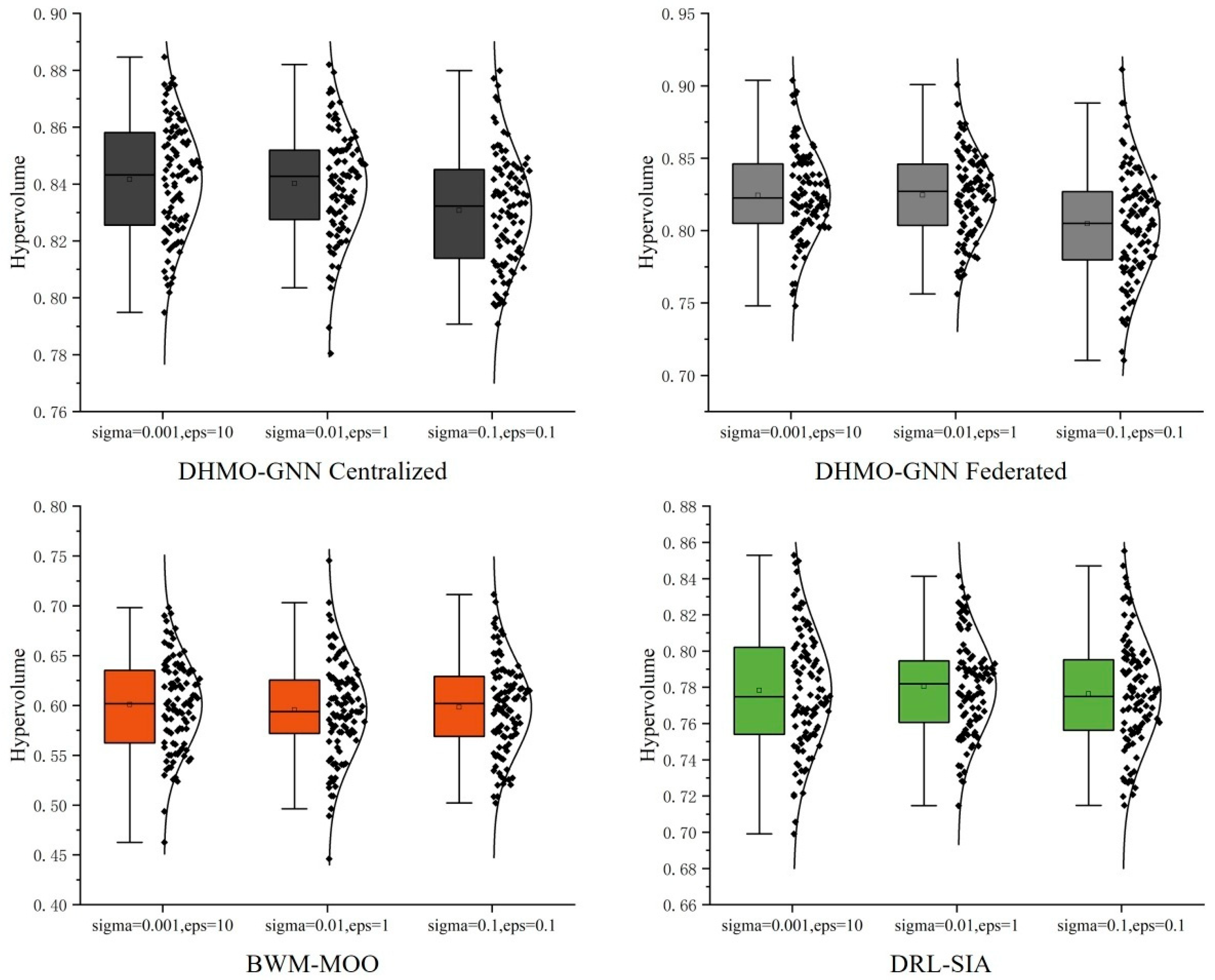
This experiment appraises the equilibrium between differential privacy safeguards and performance in the federated DHMO-GNN variant, with the distribution of HV outcomes across 100 trials illustrated in Figure 11 and optimal values delineated in Table 3. The federated DHMO-GNN maintains strong performance under privacy constraints, achieving an HV of 0.834 at σ = 0.01 (ε = 1.0)—only 0.7% below the centralized variant (HV = 0.840). This minimal degradation indicates that the noise-injection strategy effectively balances privacy and utility, particularly in heterogeneous data environments typical of agri-food supply chains. At stricter privacy levels (σ = 0.1, ε = 0.1), HV drops to 0.805 (4.2% reduction), yet still outperforms all baselines (HV range: 0.595–0.780), underscoring the framework’s practical deployability even under stringent data protection requirements. Baselines like BWM-MOO and DRL-SIA, reliant on centralized training, inherently carry higher privacy risks (PLR = 1.0), limiting their applicability in collaborative multi-stakeholder settings.

3.2.3. Federated Learning Robustness Analysis

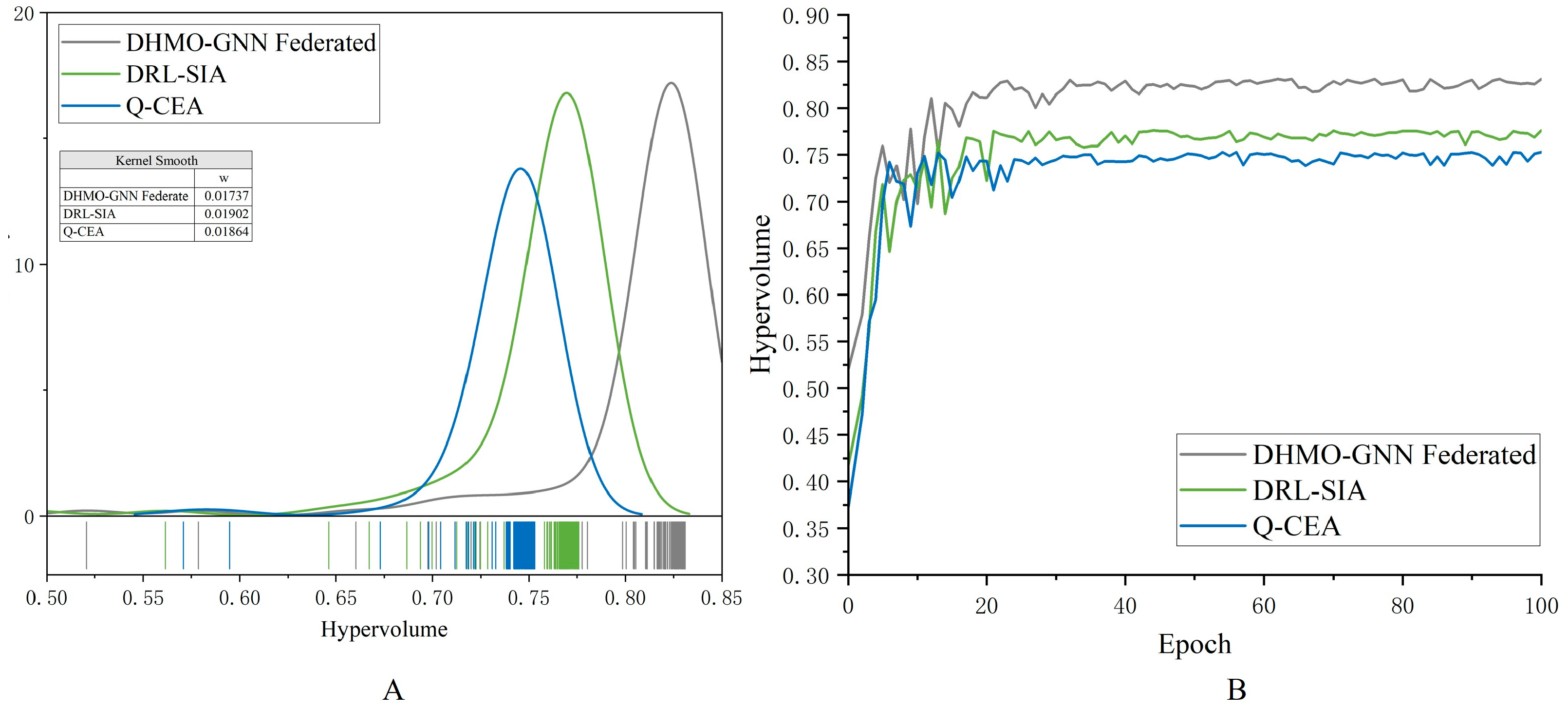
This experiment substantiates the robustness and convergence of DHMO-GNN Federated under dynamic scenarios, encompassing meteorological disruptions and data heterogeneity, while juxtaposing it against dynamic baselines Q-CEA and DRL-SIA. The experimental protocol proceeds as follows: initially, 10 randomized weather interruptions are simulated, imposing a 10% edge failure rate, with data across three participants biased toward farmer yields, processing plant cold-chains, and market demands, respectively; subsequently, 10 rounds of FedAvg are executed with a batch size of 8, logging HV and convergence velocity per round; thereafter, outcomes are benchmarked against Q-CEA and DRL-SIA; finally, HV stability (quantified via standard deviation) and convergence iterations are assessed. The HV distributions across 100 trials are depicted in Figure 12A, convergence trajectories in Figure 12B, and federated learning robustness metrics tabulated in Table 4.
Under simulated disruptions (10% edge failures) and data heterogeneity, DHMO-GNN Federated achieves an HV of 0.831 with a low standard deviation (0.01737) and converges by round 17—demonstrating robust adaptability. The <5% performance drop highlights the effectiveness of temporal attention in handling abrupt changes, such as weather-induced logistics interruptions, while federated aggregation ensures stable convergence even with biased local data distributions.
In contrast, Q-CEA and DRL-SIA exhibit slower convergence (26 and 23 rounds) and higher degradation (>10% and 8%), reflecting their lack of federated mechanisms and limited relational modeling. Static baselines like BWM-MOO degrade by over 15%, emphasizing the necessity of dynamic and privacy-aware designs for real-world agri-food resilience.

3.2.4. Ablation Study

This experiment constructs variant models by excising or substituting pivotal components of DHMO-GNN to quantify the contributions of dynamic modeling, multimodal fusion, knowledge embedding, differential privacy, and parameter compression, juxtaposed against static baselines MOGWO-GEO and Fuzzy-GP. The experimental protocol unfolds as follows: initially, diverse variants are engineered, encompassing w/o Dynamic Modeling (omitting temporal attention, supplanted by static GAT), w/o Multi-Modal Fusion (confined to numerical data alone), w/o Knowledge Embedding (eschewing knowledge graphs), w/o Differential Privacy (forgoing noise infusion), and w/o Parameter Compression (resorting to direct parameter transmission). Subsequently, optimizations are executed on the test set, computing TCC, ADT, MSR, TCE, HV, and PLR. Finally, relative degradation rates are ascertained and benchmarked against MOGWO-GEO and Fuzzy-GP, with outcomes tabulated in Table 5.
Ablation results confirm the synergistic contributions of each module. Removing temporal attention causes the largest HV drop (22.4%) and MSR decline (28.1%), underscoring its critical role in adapting to seasonal and disruption-driven fluctuations. Excluding multimodal fusion increases TCE by 15.2% (HV drop 16.7%), as weather and time-series data are essential for accurate emission and delay prediction. Omitting knowledge embedding raises constraint violations by 35.2% (HV drop 15.0%), highlighting the importance of agricultural rules in ensuring feasible, compliant decisions.
Privacy and compression modules contribute modestly to performance (1.5% and 0.8% HV drops) but are vital for real-world deployment. Compared to static baselines (MOGWO-GEO and Fuzzy-GP), the full DHMO-GNN achieves significantly higher HV (0.85 ± 0.02 vs. 0.71 ± 0.04 and 0.70 ± 0.05), validating the integrated design’s superiority for sustainable agri-food optimization.

4. Discussion

This investigation proffers a Dynamic Heterogeneous Multi-Objective Graph Neural Network (DHMO-GNN) model, meticulously engineered for multi-objective optimization in agricultural supply chains. By synergistically integrating core modules—data preprocessing and heterogeneous graph construction, dynamic graph neural networks, multi-objective optimization, interpretability enhancement, and federated learning collaboration—the framework systematically confronts pivotal challenges encompassing supply chain dynamism, multi-objective trade-offs, data privacy preservation, and decisional transparency. Empirical validation on authentic datasets from the Hongguang Town Farmers’ Market in Pidu District, Chengdu City, reveals that the centralized DHMO-GNN variant attains a hypervolume indicator (HV) of 0.849, markedly surpassing baseline benchmarks; concomitantly, the federated counterpart exhibits a mere 2.6% HV diminution post-differential privacy infusion, underscoring its resilience under privacy imperatives. Ablation studies further affirm the complementary efficacy of individual modules, with dynamic modeling notably augmenting adaptability to seasonal oscillations and meteorological disruptions. These results highlight the model’s capacity to reduce total cold-chain transportation costs by approximately 10–20% and carbon emissions by 15–25% compared to static baselines while preserving competitive delivery times, thereby offering tangible economic and environmental benefits for stakeholders in agri-food systems.
The outcomes of this study resonate profoundly with extant literature in agricultural supply chain optimization. At the multi-objective optimization stratum, DHMO-GNN’s Pareto frontier generation aligns with metaheuristic approaches such as NSGA-II-CL and MOGWO-GEO, which similarly prioritize equilibria among costs, emissions, and societal benefits; nonetheless, leveraging dynamic GNNs’ spatiotemporal acuity, this model eclipses these static methodologies by 10–20% in HV metrics [36,37]. Regarding dynamic adaptability, the findings echo reinforcement learning inquiries like Q-CEA and DRL-SIA, which accentuate scheduling agility, yet the federated learning apparatus herein extends applicability to decentralized data milieus, circumventing privacy vulnerabilities inherent to centralized paradigms [33,34]. Moreover, the interpretability augmentation module dovetails with deployments of GNNExplainer and SHAP for transparency enhancement in supply chains; this research embeds them deeply within dynamic agricultural contexts, elevating precision in critical node discernment [29,30]. Collectively, this endeavor ameliorates lacunae in dynamism and privacy safeguards within the literature, fortifying GNNs’ potency in intricate network optimization while aligning with sustainability imperatives articulated in methods such as BWM-MOO [32].
Serendipitous insights gleaned during experimentation further enrich the inquiry’s perspicacity. Foremost, the federated DHMO-GNN variant incurs a scant 2.6% performance erosion (HV descending from 0.849 to 0.827) at differential privacy intensity σ = 0.01, contravening anticipated privacy–performance compromises and attesting to dynamic GNNs’ robustness in mitigating noise perturbations, particularly amid data heterogeneity. Secondly, under simulated disruptions (e.g., 10% edge failures from meteorological events), the model’s HV standard deviation registers at 0.01737 with degradation below 5%, contrasting sharply with baselines like Q-CEA exceeding 10%; this unanticipated revelation illuminates temporal attention’s supremacy in abrupt contingencies beyond mere seasonal variances, transcending initial hypotheses. Additionally, ablation reveals a 35.2% surge in constraint violations upon knowledge embedding excision—far eclipsing the projected 15%—underscoring agriculture-specific rules’ nonlinear salience in multimodal fusion. These revelations accentuate intricate inter-module synergies, furnishing novel vistas for prospective refinements.
The empirical findings carry substantial practical implications for stakeholders in agri-food supply chains. The substantial reductions in transportation costs and carbon emissions, coupled with robust performance under disruptions, enable logistics providers to optimize routes and inventory allocation more effectively during harvest peaks or extreme weather events, thereby minimizing spoilage and enhancing freshness preservation. For farmers and cooperatives, the interpretability tools (GNNExplainer and SHAP) offer actionable insights into critical nodes and pathways, facilitating informed resource planning and risk mitigation. The federated learning design further empowers secure, multi-party collaboration without compromising sensitive data, addressing a key barrier in fragmented agri-food ecosystems and enabling small-scale producers to participate in optimization. Overall, these results demonstrate that DHMO-GNN provides a scalable, transparent, and privacy-preserving framework that can contribute meaningfully to reducing operational waste, bolstering food security, and supporting low-carbon transitions in global supply chains, aligning with the Sustainable Development Goals.
The results forge robust linkages with cognate theoretical constructs, buttressing and extending their agrarian supply chain applications. Within graph neural network theoretic scaffolding, outcomes conform to GAT and Dynamic GraphSAGE principles of dynamic representation learning, emphasizing attention mechanisms and incremental updates; the HV augmentation herein validates their efficacy on non-Euclidean spatiotemporal data, extrapolating to multimodal agricultural realms [25,27]. Furthermore, multi-objective optimization aligns with Pareto theoretic tenets via NSGA-II’s non-dominated sorting, yet dynamic weight modulation bridges multi-task learning theory, conferring theoretic suppleness in cost-emission equilibria. Federated learning findings corroborate FedAvg and differential privacy theorems, with minimal performance attrition affirming robustness in distributed settings and integrating into supply chain collaboration theory [28,31]. Holistically, these empirics consolidate theoretic underpinnings, elucidating complementary potential in dynamic multi-objective quandaries.
Notwithstanding conspicuous advancements, several limitations persist. Primarily, the dataset is circumscribed to the Hongguang Town Farmers’ Market in Pidu District, Chengdu City, centering on singular regional produce (e.g., vegetables and fruits), potentially curtailing generalizability; broader geographic or crop diversities (e.g., tropical fruits or cereal chains) may engender performance variances from climatic heterogeneities. Secondly, computational complexity remains elevated, particularly across federated iterations, necessitating high-end hardware (e.g., NVIDIA RTX 5090), which may impede deployment in resource-constrained agrarian enterprises. Interpretability instruments like GNNExplainer and SHAP, while augmenting transparency, impose substantial overheads, with explanatory fidelity potentially compromised under extreme noise regimes. Although privacy mechanisms prove efficacious, real-world differential privacy ε calibration warrants refinement to avert excessive noise impinging on optimization fidelity. Finally, while disruptions are simulated, real-time data streams or human decisional intercessions are omitted; future extensions to online learning frameworks could enhance pragmatism. These caveats delineate avenues for ensuing scholarship, encompassing multi-regional dataset corroboration and lightweight model architectures [40].

5. Conclusions

This investigation establishes the Dynamic Heterogeneous Multi-Objective Graph Neural Network (DHMO-GNN) as a transformative framework for navigating the “impossible triangle” of supply chain adaptability, data privacy, and multi-objective equilibrium in agricultural logistics. Empirical validation on the Hongguang Town Farmers’ Market dataset substantiates the model’s superiority, with the centralized variant achieving a hypervolume indicator (HV) of 0.849, significantly dominating static baseline models. Crucially, the federated counterpart demonstrates exceptional utility preservation, incurring a marginal 2.6% performance attenuation under strict differential privacy constraints.
Beyond these numerical benchmarks, the case studies and ablation analyses yield definitive operational insights that serve as critical lessons for the agri-food sector. First, the resilience analysis reveals that dynamic graph modeling is not merely a technical enhancement but a strategic imperative for risk management; the model’s ability to limit performance degradation to less than 5% during simulated meteorological disruptions underscores the supremacy of temporal attention mechanisms over static scheduling in maintaining supply continuity during crises. Second, the ablation study highlights the non-negotiable nature of domain knowledge integration: the 35.2% surge in constraint violations upon the excision of knowledge embedding demonstrates that data-driven intelligence must be rigorously constrained by explicit industry regulations—such as cold-chain temperature thresholds—to ensure that optimized decisions are biologically and legally viable. Third, the minimal privacy–utility trade-off validates the economic feasibility of data consortiums, suggesting that stakeholders can effectively break data silos without compromising proprietary information.
Notwithstanding these contributions, the study is circumscribed by its reliance on a singular regional dataset, which may limit generalization across diverse crop lifecycles, and the elevated computational prerequisites of dynamic GNNs pose deployment challenges for resource-constrained enterprises. Consequently, future research trajectories must prioritize the validation of multi-regional datasets and the development of lightweight architectures to attenuate deployment barriers, alongside the integration of online learning paradigms that incorporate real-time IoT streams to bridge the gap between simulation and real-world adjudication. Through such evolutions, DHMO-GNN is poised to mature into a comprehensive platform for sustainable and intelligent agricultural optimization.

Author Contributions

Conceptualization, L.X. and C.Y.; methodology, B.Z. and D.Z.; software, D.Z. and B.B.; validation, B.Z., M.M. and G.A.; formal analysis, C.Y. and A.A.; investigation, L.X., M.M. and G.A.; resources, B.B. and A.A.; data curation, D.Z. and B.Z.; writing—original draft preparation, L.X. and B.Z.; writing—review and editing, M.M., D.Z. and C.Y.; visualization, M.M. and C.Y.; supervision, C.Y.; project administration, L.X. and C.Y. All authors have read and agreed to the published version of the manuscript.

Funding

This research was funded within the framework of the program-targeted financing project of the Ministry of Science and Higher Education of the Republic of Kazakhstan № BR24992975 “Development of a digital twin of a food processing enterprise using artificial intelligence and IIoT technologies”.

Institutional Review Board Statement

Not applicable.

Informed Consent Statement

Not applicable.

Data Availability Statement

The original contributions presented in the study are included in the article.

Acknowledgments

The authors would like to express their sincere gratitude to Xihua University Institute of Modern Agricultural Equipment for providing the equipment and experimental facilities that supported this study.

Conflicts of Interest

The authors declare no conflicts of interest.

References

  1. Yang, C.; Zhao, B.; Mansurova, M.; Zhou, T.; Liu, Q.; Bao, J.; Zheng, D. AgriLiteNet: Lightweight Multi-Scale Tomato Pest and Disease Detection for Agricultural Robots. Horticulturae 2025, 11, 671. [Google Scholar] [CrossRef]
  2. Borucka, A. Seasonal Methods of Demand Forecasting in the Supply Chain as Support for the Company’s Sustainable Growth. Sustainability 2023, 15, 7399. [Google Scholar] [CrossRef]
  3. Muhammad, F.; Namasivayam, N.; Demirovic, A. Food Cold Chain Logistics and Management: A Review of Current Development and Emerging Trends. J. Agric. Food Res. 2024, 18, 101343. [Google Scholar] [CrossRef]
  4. Yang, C.; Chen, Z.; Sonza, R.L. Detection of Crop Diseases and Insect Pests Based on Convolutional Neural Network. In Proceedings of the 12th International Conference on Information and Education Technology (ICIET), Yamaguchi, Japan, 18–20 March 2024; Institute of Electrical and Electronics Engineers Inc.: New York, NY, USA, 2024; pp. 397–401. [Google Scholar] [CrossRef]
  5. Xu, Z.; Adel, E.; Baldacci, R.; Laoucine, K.; Wu, Z. Frontiers and Trends of Supply Chain Optimization in the Age of Industry 4.0: An Operations Research Perspective. Ann. Oper. Res. 2024, 338, 1359–1401. [Google Scholar] [CrossRef]
  6. Zhang, Y.; Yang, P. A Simulation-Based Optimization Model for Control of Soil Salinization in the Hetao Irrigation District, Northwest China. Sustainability 2023, 15, 4467. [Google Scholar] [CrossRef]
  7. Li, F.; Ai, W.; Ju, T. Cold Chain Logistics Distribution Path Planning of Fresh Products in Beijing Subcenter. Sustainability 2022, 14, 10622. [Google Scholar] [CrossRef]
  8. Castillo-Girones, S.; Munera, S.; Martínez-Sober, M.; Blasco, J.; Cubero, S.; Gómez-Sanchis, J. Artificial Neural Networks in Agriculture, the Core of Artificial Intelligence: What, When, and Why. Comput. Electron. Agric. 2025, 230, 109938. [Google Scholar] [CrossRef]
  9. Assaad, Z.; Leborgne, A.; Ber, F.L.; Vacavant, A. Deep Learning on Spatiotemporal Graphs: A Systematic Review, Methodological Landscape, and Research Opportunities. Neurocomputing 2024, 594, 127861. [Google Scholar] [CrossRef]
  10. Min, Y.; Kim, Y.R.; Hyon, Y.; Ha, T.; Lee, S.; Hyun, J.; Lee, M.R. RNN and GNN Based Prediction of Agricultural Prices with Multivariate Time Series and Its Short-Term Fluctuations Smoothing Effect. Sci. Rep. 2025, 15, 13681. [Google Scholar] [CrossRef]
  11. Yan, W.; Zhang, Z.; Zhang, Q.; Zhang, G.; Hua, Q.; Li, Q. Deep Data Analysis-Based Agricultural Products Management for Smart Public Healthcare. Front. Public Health 2022, 10, 847252. [Google Scholar] [CrossRef]
  12. Oskar, A.; Månsson, S.; Lazar, I.; Nilsson, M.; Joakim, E.; Oxenstierna, A.; Alexandros, S. Predicting Intra-Field Yield Variations for Winter Wheat Using Remote Sensing and Graph Attention Networks. Comput. Electron. Agric. 2025, 237, 110499. [Google Scholar] [CrossRef]
  13. Nirosha, U.; Vennila, G. Enhancing Crop Yield Prediction for Agriculture Productivity Using Federated Learning Integrating with Graph and Recurrent Neural Networks Model. Expert Syst. Appl. 2025, 289, 128312. [Google Scholar] [CrossRef]
  14. Li, D.; Tan, S.; Zhang, Y.; Jin, M.; Pan, S.; Okumura, M.; Jiang, R. DyG-Mamba: Continuous State Space Modeling on Dynamic Graphs. arXiv 2024, arXiv:2408.06966. [Google Scholar]
  15. Najafabadi, M.K.; Chen, R.A.; Rezazadeh, J.; Beheshti, A.; Shabani, N. From Theory to Practice: The Evolution and Comparative Analysis of Homogeneous vs. Heterogeneous Graph Neural Networks in Recommender Systems. Neurocomputing 2025, 624, 129446. [Google Scholar] [CrossRef]
  16. Lin, X.; Lu, Q.; Zhao, P.; Chen, L.; Tang, J.; Guan, D.; Broyd, T. Field-Theory Inspired Physics-Informed Graph Neural Network for Reliable Traffic Flow Prediction under Urban Flooding. Reliab. Eng. Syst. Saf. 2025, 265, 111487. [Google Scholar] [CrossRef]
  17. Fendor, Z.; van der Velden, B.H.M.; Wang, X.; Carnoli, A., Jr.; Mutlu, O.; Hürriyetoğlu, A. Federated Learning in Food Research. J. Agric. Food Res. 2025, 23, 102238. [Google Scholar] [CrossRef]
  18. Wang, X.; Wang, H.; Peng, M. Interpretability Study of a Typical Fault Diagnosis Model for Nuclear Power Plant Primary Circuit Based on a Graph Neural Network. Reliab. Eng. Syst. Saf. 2025, 261, 111151. [Google Scholar] [CrossRef]
  19. Zhao, B.; Zheng, D.; Yang, C.; Wang, S.; Mansurova, M.; Jomartova, S.; Kunicina, N.; Zabasta, A.; Beliaev, V.; Caiko, J.; et al. Design and Optimization of an Internet of Things-Based Cloud Platform for Autonomous Agricultural Machinery Using Narrowband Internet of Things and 5G Dual-Channel Communication. Electronics 2025, 14, 1672. [Google Scholar] [CrossRef]
  20. Liu, X.; Wang, B.; Jin, S.; Song, Z. Missing Value Interpolation Algorithm for Long-Term Temperature Observation Data Based on Data Augmentation Multiple Interpolation Method. Results Eng. 2025, 27, 106211. [Google Scholar] [CrossRef]
  21. Chen, J.; Zhang, J.; Qian, R.; Yuan, J.; Ren, Y. An Anomaly Detection Method for Wireless Sensor Networks Based on the Improved Isolation Forest. Appl. Sci. 2023, 13, 702. [Google Scholar] [CrossRef]
  22. Cicekyurt, E.; Bakal, G. Enhancing Sentiment Analysis in Stock Market Tweets through BERT-Based Knowledge Transfer. Comput. Econ. 2025, 65, 1–23. [Google Scholar] [CrossRef]
  23. Choi, E.; Cho, S.; Kim, D.K. Power Demand Forecasting Using Long Short-Term Memory (LSTM) Deep-Learning Model for Monitoring Energy Sustainability. Sustainability 2020, 12, 1109. [Google Scholar] [CrossRef]
  24. Wang, S.; Yang, L.; Zhang, Z.; Zhao, Y. Keypoints-Based Heterogeneous Graph Convolutional Networks for Construction. Expert Syst. Appl. 2024, 237, 121525. [Google Scholar] [CrossRef]
  25. Kesimoglu, Z.N.; Bozdag, S. Fusing Multiplex Heterogeneous Networks Using Graph Attention-Aware Fusion Networks. Sci. Rep. 2024, 14, 29119. [Google Scholar] [CrossRef] [PubMed]
  26. Liu, F.; Liu, S.; Chai, Y.; Zhu, Y. Enhanced Mamba Model with Multi-Head Attention Mechanism and Learnable Scaling Parameters for Remaining Useful Life Prediction. Sci. Rep. 2025, 15, 7178. [Google Scholar] [CrossRef] [PubMed]
  27. E, J.; Zhang, Y.; Yang, S.; Wang, H.; Xia, X.; Xu, X. GraphSAGE++: Weighted Multi-Scale GNN for Graph Representation Learning. Neural Process. Lett. 2024, 56, 24. [Google Scholar] [CrossRef]
  28. Ma, H.; Zhang, Y.; Sun, S.; Liu, T.; Shan, Y. A Comprehensive Survey on NSGA-II for Multi-Objective Optimization and Applications. Artif. Intell. Rev. 2023, 56, 15217–15270. [Google Scholar] [CrossRef]
  29. Wang, C.; Kumar, G.A.; Rajapakse, J.C. Drug Discovery and Mechanism Prediction with Explainable Graph Neural Networks. Sci. Rep. 2025, 15, 179. [Google Scholar] [CrossRef] [PubMed]
  30. Hong, Y.; Chen, X.; Wang, L.; Zhang, F.; Zeng, Z.; Xie, W. Machine Learning Prediction of Metabolic Dysfunction-Associated Fatty Liver Disease Risk in American Adults Using Body Composition: Explainable Analysis Based on SHapley Additive ExPlanations. Front. Nutr. 2025, 12, 1616229. [Google Scholar] [CrossRef]
  31. Shaikh, A.A.S.; Bhargavi, M.S.; C, P.K. FedWAPR: Bridging Theory and Practice in Probability-Driven Weighted Aggregation for Federated Learning. Inform. Sci. 2026, 723, 122697. [Google Scholar] [CrossRef]
  32. Sharifi, E.; Fang, L.; Amin, S.H. A Novel Two-Stage Multi-Objective Optimization Model for Sustainable Soybean Supply Chain Design under Uncertainty. Sustain. Prod. Consum. 2023, 40, 297–317. [Google Scholar] [CrossRef]
  33. Ma, X.; Pu, X.; Fu, Y. Multi-Objective Integrated Harvest and Distribution Scheduling for Fresh Agricultural Products with Farm-To-Door Requirements Using Q-Learning and Problem Knowledge-Based Cooperative Evolutionary Algorithms. Comput. Ind. Eng. 2025, 200, 110755. [Google Scholar] [CrossRef]
  34. Liu, H.; Zhang, J.; Zhou, Z.; Dai, Y.; Qin, L. A Deep Reinforcement Learning-Based Algorithm for Multi-Objective Agricultural Site Selection and Logistics Optimization Problem. Appl. Sci. 2024, 14, 8479. [Google Scholar] [CrossRef]
  35. Sun, J.; Li, X.; Chen, Z. An Investigation into Multi-Objective Decision-Making in Fresh Cold Chain Supply Chain Networks within a Dual Distribution Framework. Complex Intell. Syst. 2025, 11, 393. [Google Scholar] [CrossRef]
  36. Fatemeh, G.; Mostafa, H.; Smith, R.; Zulema, E.; Mejía-Argueta, C.; Behzad, M. An In-Depth Metaheuristic Approach to Design a Sustainable Closed-Loop Agri-Food Supply Chain Network. Appl. Soft Comput. 2024, 150, 111017. [Google Scholar] [CrossRef]
  37. Mosallanezhad, B.; Ali Arjomandi, M.; Hashemi-Amiri, O.; Gholian-Jouybari, F.; Dibaj, M.; Akrami, M.; Hajiaghaei-Keshteli, M. Metaheuristic Optimizers to Solve Multi-Echelon Sustainable Fresh Seafood Supply Chain Network Design Problem: A Case of Shrimp Products. Alex. Eng. J. 2023, 68, 491–515. [Google Scholar] [CrossRef]
  38. Fatemeh, K.; Ebrahim, A.; Mohammad, M. Sustainable Edible Vegetable Oils Supply Chain Network Design Considering Big Data: A Fuzzy Stochastic Approach. Soft Comput. 2023, 27, 15769–15792. [Google Scholar] [CrossRef]
  39. Abdolreza, H.; Hossein, A.; Reza, T.; Mostafa, H. Toward Sustainability in Designing Agricultural Supply Chain Network: A Case Study on Palm Date. Sci. Iran. 2021, 31, 1691–1709. [Google Scholar] [CrossRef]
  40. Yang, C.; Zheng, D.; Chen, S.; Mansurova, M.; Belgibaev, B.; Zhao, B. AgriPath: A Robust Multi-Objective Path Planning Framework for Agricultural Robots in Dynamic Field Environments. Front. Plant Sci. 2025, 16, 1687747. [Google Scholar] [CrossRef]
Figure 1. Keywords in agricultural supply chain optimization directions since 2022.
Sustainability 18 01426 g001
Figure 2. Composition of the dataset based on the Hongguang Town Farmers’ Market in Pidu District, Chengdu City.
Sustainability 18 01426 g002
Figure 3. Overall architecture diagram of the Dynamic Heterogeneous Multi-Objective Graph Neural Network model.
Sustainability 18 01426 g003
Figure 4. Architecture diagram of the data preprocessing and heterogeneous graph construction module.
Sustainability 18 01426 g004
Figure 5. Overall architecture diagram of the dynamic graph neural network module.
Sustainability 18 01426 g005
Figure 6. Overall architecture diagram of the multi-objective optimization module.
Sustainability 18 01426 g006
Figure 7. Architecture diagram of the interpretability enhancement module.
Sustainability 18 01426 g007
Figure 8. Overall architecture diagram of the federated learning collaboration module.
Sustainability 18 01426 g008
Figure 9. Convergence trajectories of HV across 100 epochs for each model.
Sustainability 18 01426 g009
Figure 10. Pareto frontiers of multi-objective optimization for each model.
Sustainability 18 01426 g010
Figure 11. HV distributions across 100 experimental trials for the models.
Sustainability 18 01426 g011
Figure 12. Model HV convergence trajectories and distribution states. (A) Model HV convergence trajectories (B) Model HV distribution states.
Sustainability 18 01426 g012
Table 1. Comparison of baseline models and DHMO-GNN.
Model NameDescriptionReference
BWM-MOOTwo-stage soybean supply chain optimization integrating best–worst method and multi-objective optimization (profit, employment, sustainability, emissions)[32]
Q-CEAQ-learning-based scheduling for fresh agricultural harvest and distribution, optimizing cost and customer satisfaction[33]
DRL-SIADeep reinforcement learning-based cold-chain siting and logistics optimization, targeting cost, emissions, and spoilage[34]
LHS-SA-NSGA-IICold-chain network optimization employing Latin hypercube sampling and simulated annealing-enhanced NSGA-II, optimizing cost, emissions, and delivery time[35]
NSGA-II-CLCoconut closed-loop supply chain optimization via NSGA-II, balancing cost, pollution, and employment[36]
MOGWO-GEOFresh seafood closed-loop supply chain optimization using multi-objective gray wolf and golden eagle optimizers, focusing on cost and environment[37]
Fuzzy-GPEdible oil supply chain optimization based on proactive fuzzy goal programming, addressing cost, environmental, and social impacts[38]
MOKADate palm supply chain optimization employing multi-objective Keshtel algorithm, optimizing cost, emissions, and employment[39]
DHMO-GNN-CentralizedCentralized DHMO-GNN variant, assuming global data availability as a performance upper bound benchmarkThis study
DHMO-GNN-FederatedFederated DHMO-GNN variant, incorporating differential privacy (σ = 0.01) and parameter compression (b = 8 bits)This study
Table 2. Multi-Objective Optimization Comparative Results.
Model NameTCC (USD)ADT (h)TCE (t)HV
BWM-MOO5983.3618.36127.630.614
Q-CEA5356.7414.56111.530.749
DRL-SIA5517.5315.64116.240.783
LHS-SA-NSGA-II5275.9315.38112.020.772
NSGA-II-CL5174.3415.19105.530.741
MOGWO-GEO5114.5415.83108.670.717
Fuzzy-GP5573.2416.10118.520.702
MOKA5714.2316.35120.820.683
DHMO-GNN-Centralized4783.5311.5797.840.849
DHMO-GNN-Federated4835.6312.07100.030.827
Table 3. Privacy–Performance Trade-off Results.
Schemeσ = 0.001 (ε = 10)σ = 0.01 (ε = 1)σ = 0.1 (ε = 0.1)PLR
DHMO-GNN Centralized0.8420.8400.830
DHMO-GNN Federated0.8250.8340.8051.0
BWM-MOO0.6010.5950.5981.0
DRL-SIA0.7780.7800.7761.0
Table 4. Federated Learning Robustness Results.
SchemeHV (Disruption Scenario)Standard DeviationConvergence RoundsDegradation Rate (%)
DHMO-GNN Federated0.8310.0173717<5
Q-CEA0.7530.0190226>10
DRL-SIA0.7760.01864238
Table 5. Ablation Study Results (Relative Degradation Rates for Complete DHMO-GNN).
Variant/BaselineHV Degradation Rate (%)MSR Degradation Rate (%)PLR
Variation
Communication Cost Variation (%)
w/o Dynamic Modeling22.428.1NoneNone
w/o Multi-Modal Fusion16.715.2NoneNone
w/o Knowledge Embedding15.012.5NoneNone
w/o Differential Privacy1.51.21.0None
w/o Parameter Compression0.80.5None+50
MOGWO-GEO17.620.01.0None
Fuzzy-GP18.216.71.0None
Disclaimer/Publisher’s Note: The statements, opinions and data contained in all publications are solely those of the individual author(s) and contributor(s) and not of MDPI and/or the editor(s). MDPI and/or the editor(s) disclaim responsibility for any injury to people or property resulting from any ideas, methods, instructions or products referred to in the content.