1. Introduction
Urban mobility in rapidly growing megacities has become increasingly constrained by congestion, air pollution, and inefficient transport systems. In cities such as Dhaka, where motorization has expanded faster than infrastructure, commuting delays and overcrowding pose significant economic and social costs. The introduction of Mass Rapid Transit (MRT) systems has been widely regarded as a transformative solution, promising to reduce congestion, improve accessibility, and shift commuters away from private vehicles. The success of such investments depends not only on physical infrastructure but also on whether commuters are willing to adopt the new system once it becomes available. Understanding how adoption evolves, what people intend to do before service launch, how they perceive the system immediately after, and what choices they ultimately make in practice is central for transport planning and policy.
Understanding how commuters make mode choice decisions has long been a central concern in transport research. When evaluating the introduction of new mass transit systems, this is particularly important. Discrete choice theory, grounded in the random utility maximization framework, has provided the theoretical foundation for such analyses. Building on this, Ben-Akiva and Lerman introduced logit-based models for travel demand, establishing them as the standard tool for analyzing commuter behavior [
1]. Walker and Ben-Akiva subsequently extended this and generalized the random utility model. This enabled hybrid specifications that integrate latent attitudes and perceptions [
2]. These approaches still remain central, but they typically rely on maximum likelihood estimation, which limits their ability to quantify parameter uncertainty or incorporate prior knowledge. More recently, machine learning models have shown strong predictive performance, with studies reporting that neural networks and boosting methods outperform traditional discrete choice models [
3]. However, these techniques generally lack the behavioral interpretability required for policy evaluation. This gap motivates the exploration of Bayesian frameworks, where inference is based on posterior distributions. These distributions can be derived using simulation-based methods such as Markov Chain Monte Carlo (MCMC), offering both predictive robustness and interpretable behavioral insights.
The combination of Stated Preference (SP) and Revealed Preference (RP) surveys has been used for a long time to learn more about how people choose to commute. SP surveys present hypothetical scenarios to assess preferences for new modes, while RP surveys record actual choices made in real-world contexts. Together, these approaches provide complementary insights, with SP capturing intended behavior and RP revealing trade-offs commuters make in practice. Early studies such as Bamberg et al. combined SP and RP to examine how a prepaid bus ticket intervention influenced student bus use, while Carrus et al. emphasized the role of attitudes, norms, and socioeconomic–psychological factors in shaping mode choice [
4,
5]. Building on this foundation, a growing set of studies has applied SP and RP specifically to metro and MRT contexts. Schmid et al. pooled RP–SP mixed logit models to estimate user- and mode-specific values of travel time savings (VTTS) across different modes, while Wu et al. analyzed metro access and egress patterns in Nanjing, highlighting the importance of station catchments [
6,
7]. Most recently, Hridoy et al. employed a combined RP–SP design with mixed logit models to study the influence of real-time information on metro mode choice [
8]. Collectively, these works demonstrate the value of integrating SP and RP to better capture behavioral realism in metro adoption studies. This study contributes to the SP-RP literature by introducing a rare three-stage approach that tracks metro adoption over time through Pre-MRT Stated Preference (SP), Post-MRT SP, and Post-MRT Revealed Preference (RP) surveys. While previous SP-RP studies have combined SP and RP data, they typically rely on frequentist methods that do not fully capture parameter uncertainty or the evolution of commuter behavior. The staged Bayesian MCMC approach used in this study addresses this gap by providing probabilistic insights into how adoption determinants change from expectations to actual behavior. The use of a three-stage approach, instead of a two-stage approach, is crucial as it allows for a better understanding of behavior after commuters have experienced the metro service and then evaluate their behavior in hypothetical scenarios (post-MRT SP). This distinction helps refine the findings, offering valuable insights for future MRT services. Dhaka’s MRT case uniquely justifies this approach due to its rapid urbanization, congestion, and lack of public transport, making it an ideal setting to observe the shift in commuter preferences over time. This dynamic, sequential modeling approach offers more accurate insights than conventional methods that treat SP and RP data in isolation.
A wide range of studies highlight that metro adoption and modal shift are shaped by both trip characteristics and socioeconomic conditions. In Dhaka, Aktar et al. found that affordability, availability, accessibility, and sociodemographic variables were the main factors in determining users’ likelihood of shifting to the new MRT [
9]. Similarly, Fraszczyk et al. found that in Salaya, Thailand, commuters’ willingness to adopt the metro was strongly tied to reliable timetables and good connectivity, and priorities varied across different shifter groups [
10]. In India, studies have shown that connectivity, accessibility, and perceptions of comfort, reliability, and safety significantly influence metro adoption across different cities [
11,
12]. Wang et al. found that in Xi’an, suburban auto users, female taxi and auto users, and long-distance travelers were more inclined to shift to the metro, though inadequate transfer facilities limited adoption [
13]. Peng et al. highlighted that age and trip purpose influenced express versus local train preferences in Shanghai. Elderly and non-commuters were less likely to choose express services [
14]. Gender differences in transit preferences have been highlighted in various studies, including Yan et al., which found that women, particularly middle-aged and high-income groups, prioritize safety, comfort, and amenities like women-only seating in their transit choices [
15]. Recent advancements in modeling commuter behavior and mobility integration have improved predictions for metro and shared mobility systems. Song et al. assess transit stop accessibility using multiple feeder modes, focusing on first/last mile connectivity [
16]. Wang et al. develop a real-time ride-sharing model optimizing routes with a “wait time threshold” to improve system efficiency [
17]. Liu et al. introduce ODMixer, a spatial-temporal MLP architecture for metro OD prediction, improving accuracy [
18]. Wang et al. combine the Node-Place model with SHAP for metro ridership estimation, outperforming traditional methods [
19]. Xing et al. create a spatiotemporal demand prediction model for shared bikes around metro stations, integrating STAGCN, LSTM, and Informer architectures, improving prediction accuracy [
20].
Applications of Bayesian inference in travel behavior research remain relatively limited compared to the dominance of classical maximum likelihood estimation, yet recent studies demonstrate its growing potential. For example, Li et al. applied a Bayesian hierarchical framework to jointly estimate SP and RP data for travel mode choice [
21]. Becker et al. proposed a hierarchical Bayesian estimator for logit mixtures that captures both inter- and intra-consumer heterogeneity, showing faster computation and better fit than maximum simulated likelihood, with validation including mode-choice data [
22]. Li et al. applied a Bayesian mixed multinomial logit model to intercity mode choice in Xi’an, revealing heterogeneous effects of ticket purchasing method, comfort, punctuality, and access time across travelers [
23]. These works collectively highlight that Bayesian methods estimated via MCMC offer a robust alternative to frequentist techniques by providing full posterior distributions, incorporating prior information, and better characterizing uncertainty. However, their application to metro adoption, particularly in developing country remains scarce.
As stated earlier, this study adopts a rare three-stage design that integrates Pre-MRT SP, Post-MRT SP, and Post-MRT RP data. This enables a dynamic examination of how adoption determinants shift from intentions to perceptions to actual behavior. Implemented through Bayesian logistic regression with MCMC estimation, the framework extends beyond conventional maximum likelihood by offering probabilistic inference and a transparent representation of uncertainty. The study shows how affordability, accessibility, safety, and socio-demographic factors change as the system develops, using Dhaka’s MRT Line-6 as a case study. Beyond the standard SP–RP pairing, this sequential approach leverages the MRT’s launch as a natural experiment to observe expectation formation, updating, and realized behavior. To our knowledge, no prior studies have employed such a three-stage modeling framework with SP and RP at this scale, making the staged Bayesian MCMC approach a unique contribution that provides a granular view of how commuter intentions translate—or fail to translate—into actual adoption.
2. Methodology
2.1. Data Collection
The data were collected through a two-stage home-interview survey (HIS) campaign designed to capture both SP and RP responses. The SP survey was structured to represent commuter choices in both pre-MRT and post-MRT contexts. This simulated the process of decision-making with and without MRT as an available mode. The RP survey was conducted after MRT services commenced, recording actual mode choices in the new operating environment. Four MRT stations were selected to ensure coverage of diverse urban contexts: Pallabi, Kazipara, Bijoy Sharani, and Motijheel, representing industrial-dominated, residential-dominated, institutional-dominated, and commercial-dominated mixed land use types, respectively. Around each station, a 1500-m buffer was selected to identify the target households, and the required sample size was calculated as 0.5% of the buffer-area population based on density estimates from the Detailed Area Plan (DAP). In metro-related studies, the catchment area of a station is commonly outlined using a buffer radius, typically ranging between 500 and 1500 m [
24]. This ensured that the survey captured a socioeconomically and spatially representative commuter base.
The survey was developed after reviewing mode choice studies in developing cities and included socio-demographic, household, trip-related, and perceptual variables. A pilot study was conducted with 196 respondents and produced only 25 complete interviews. However, this offered critical feedback on clarity and how to sequence the survey, leading to refinements. This small sample provided important feedback, revealing issues with question clarity and survey length. In response, the survey was refined to improve question precision and reduce its length. Additionally, face-to-face interviews were preferred as online surveys had low response rates, and the decision was made to switch to Alchemer, a survey software, to streamline response management and avoid manual data entry for future analysis. The main survey was conducted in two stages. Stage one took place from 15 March to 16 May 2024, before the inauguration of MRT Line 6. Stage two was carried out from 22 June to 26 June 2024, after the inauguration of MRT Line 6. Face-to-face interviews were conducted using Alchemer. Respondents provided household details, a one-day travel diary, and perceptions of MRT attributes such as reliability, safety, comfort, integration, and waiting environment. Out of 1979 approached, 1701 completed the full survey. Active supervision reduced dropout. After cleaning and screening, 1533 valid responses remained for analysis.
2.2. Questionnaire Survey Design
The survey gathered information on various socioeconomic factors such as age, gender, income, education, and occupation. Additionally, household details like size, income, and vehicle ownership were also recorded. All the questions were mandatory. Individual characteristics, including age, gender, sex, household income, employment status, and educational attainment, fall under the first category of socio-demographic variables, while the second category is devoted to elements particular to the method of transportation and includes parameters like waiting time, in-vehicle travel time, fare, and distance to the final destination. The third category, contextual considerations, includes things like trip objectives, weather, and travel time of the day. Additionally, respondents completed a one-day travel diary, detailing trips between home and workplace (and return), allowing cross-verification of reported choices and contextual conditions.
It is important to note that the pre-MRT SP survey did not include certain variables such as inflation concerns, social media influence, and employment status (e.g., full-time or part-time). At that time, these factors were not fully anticipated as factors of MRT adoption. However, following the MRT’s inauguration, these variables were added to the Post-MRT SP and RP surveys due to their potential influence on commuter choices and perceptions.
The final analytical dataset was constructed with a binary dependent variable indicating MRT choice (1 = MRT, 0 = otherwise). Explanatory variables were grouped into the socio-demographic, household, trip-related, and perceptual domains described above.
2.3. Model Specification
Bayesian logistic regression was applied to model the probability of MRT adoption as a function of commuter characteristics, travel attributes, and perceptual factors. Let
denote the binary outcome for respondent
, where
if the respondent chooses MRT and
otherwise. The likelihood of observing
is given by a Bernoulli distribution with success probability
calculated using Equation (1):
The log-odds of MRT adoption are expressed as a linear combination of explanatory variables through the logit link function using Equation (2):
where
is the probability of the outcome (e.g., choosing the metro),
is the intercept, and
(i.e.,
,
,……
) are the coefficients of the explanatory variables
.
In the classical (frequentist) approach, parameters are estimated using maximum likelihood estimation (MLE). A positive coefficient indicates that an increase in the predictor raises the probability of MRT adoption, while a negative coefficient implies the opposite. Logistic regression relies on several assumptions, including independence of observations, linearity of continuous predictors in the logit scale, and absence of multicollinearity among explanatory variables.
The Bayesian formulation extends this model by treating the regression coefficients as random variables rather than fixed parameters. Each coefficient is assigned a prior distribution .
A common choice of prior distribution is the normal distribution,
. Alternative priors can also be specified depending on the degree of regularization or prior knowledge. The likelihood function for the observed data is then combined with these priors using Bayes’ theorem (Equation (3)):
This provides a full posterior distribution for each coefficient, which directly quantifies parameter uncertainty and enables probabilistic interpretation. For example, instead of reporting a single point estimate, inference is based on posterior means, medians, and credible intervals that reflect the probability of a parameter being above or below zero.
Since the posterior distribution does not have a closed-form solution in logistic regression, Markov Chain Monte Carlo (MCMC) methods are employed to approximate it. Algorithms such as Gibbs sampling or Metropolis–Hastings generate samples from the posterior distribution. These samples are then summarized to obtain estimates of central tendency, dispersion, and interval credibility for each coefficient.
This Bayesian framework is particularly advantageous for SP–RP data, where sample sizes may be limited, and behavioral heterogeneity is pronounced. By fully characterizing uncertainty around parameter estimates, the Bayesian specification provides a richer basis for inference compared to classical MLE.
A consistent binary logit model was applied across all three stages of analysis (Pre-MRT SP, Post-MRT SP, and Post-MRT RP) to ensure comparability of results. This approach facilitates a direct comparison of factors influencing metro adoption across the different stages, from commuter intentions in the SP surveys to actual behavior in the RP survey. The objective of this study is to track the evolution of metro adoption over time, making consistency in the modeling approach essential. Although RP data ideally includes alternative-specific attributes, such as competition modes, the primary focus of this study is on understanding metro adoption. Including competition modes would complicate the analysis without providing additional insights specific to the metro adoption process, which is the core research question of this study.
2.4. Prior Distribution
In the Bayesian specification, regression coefficients were assigned to prior distributions to reflect initial uncertainty before incorporating the data. At the outset, a weakly informative normal prior, was specified for all parameters. However, diagnostic tests revealed convergence issues due to the flat posterior surface caused by the wide range of the normal prior. This issue arose because weakly informative priors can initialize values that are too broad, leading to undefined or unstable estimates.
To improve model stability, the prior structure was modified after diagnostic testing. A weakly informative normal prior was retained for the intercept term, while a uniform prior was adopted for the slope coefficients. The results were checked against simple logistic regression to avoid any identifiability issues. This combination provided more stability in estimation while preserving flexibility in capturing underlying relationships in the data.
2.5. Estimation Procedure
The Bayesian models were estimated using the MultiBUGS (version 2.0) environment, a parallel-computing extension of OpenBUGS designed to improve the computational efficiency of Markov Chain Monte Carlo (MCMC) inference. This platform was particularly suitable for handling the large-scale Bayesian models developed in this study.
The estimation process followed a standard workflow: (i) the model was coded in BUGS language in a model file, (ii) data were prepared in BUGS/S-PLUS format, (iii) initial values were automatically generated using MultiBUGS routines, (iv) the MCMC sampler was run to generate posterior draws, and (v) convergence and posterior summaries were inspected through diagnostic output and exported files. Automatic initialization was adopted, as manual values often led to start-up failures.
For each model, an MCMC simulation was conducted with 12,000 iterations. The first 2000 iterations were discarded as burn-in to allow the chain to stabilize. The remaining 10,000 iterations were retained for posterior inference. The Gibbs sampling algorithm was primarily employed, while the Metropolis–Hasting’s step was used for updating regression coefficients. Convergence of the chains was inspected through history plots and Monte Carlo errors relative to posterior standard deviations.
Two types of models were estimated: a null (intercept-only) model, used to compute baseline fit measures, and a full model including all selected explanatory variables. Model adequacy was assessed using multiple Bayesian fit statistics, including the log-likelihood, pseudo R2, mean deviance D¯, Deviance Information Criterion (DIC), and Watanabe–Akaike Information Criterion (WAIC). These criteria provided a balance between model fit and complexity, allowing robust comparison across specifications.
2.6. Convergence Diagnostics
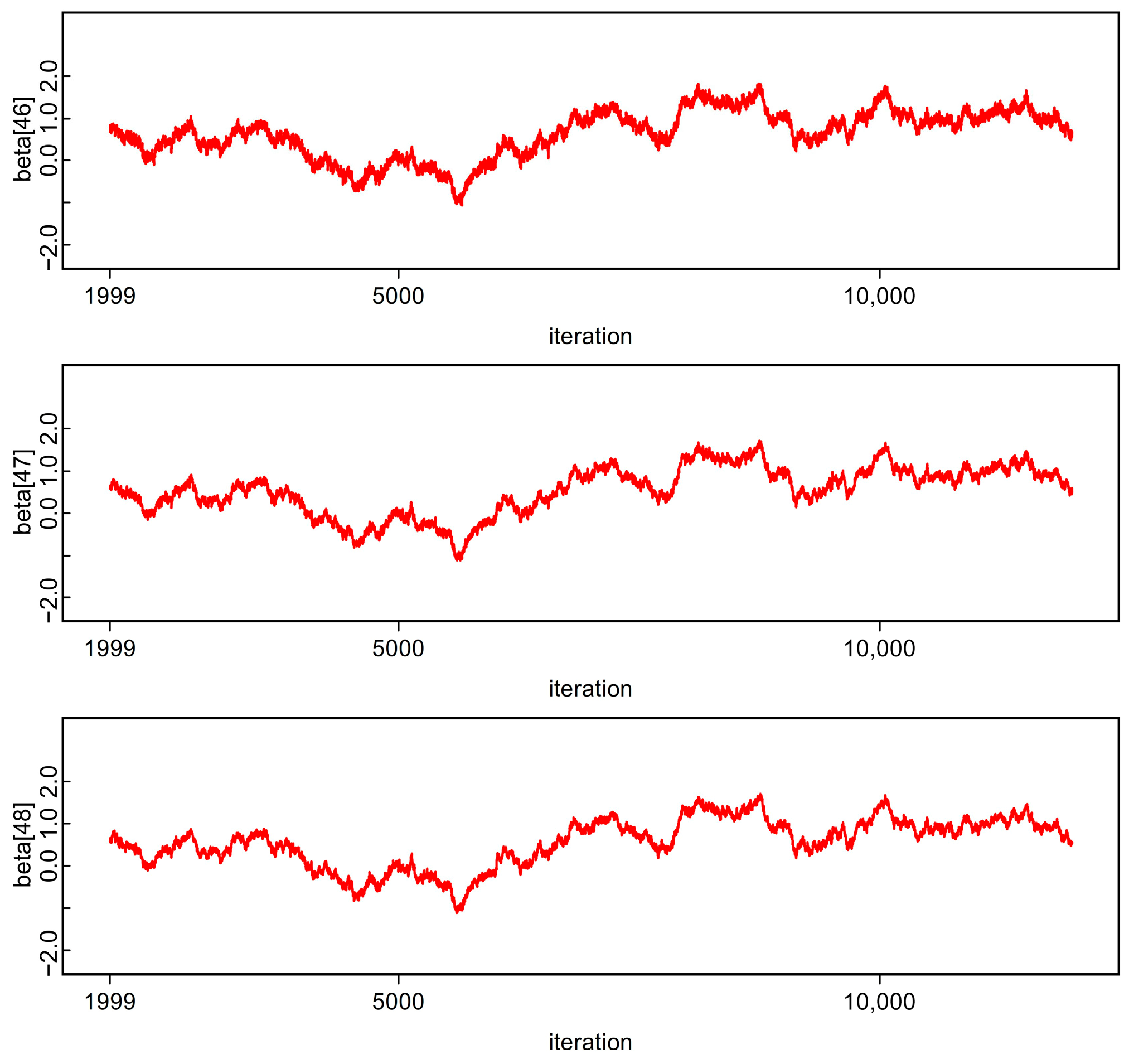
The convergence of the MCMC chains for all three stages—Pre-MRT SP, Post-MRT SP, and Post-MRT RP—was assessed using trace plots for each model parameter (beta coefficients).
Figure 1 shows some example convergence plots for selected beta coefficients. These plots indicate that after the initial burn-in period, the chains have stabilized and reached convergence, with fluctuations in the parameter estimates diminishing across iterations. This stabilization across all stages suggests that the model has effectively explored the parameter space and that the posterior samples obtained for each stage are reliable, ensuring the robustness of the estimates used in further analysis.
3. Results and Discussion
3.1. Model Performance Across Scenarios
Table 1 presents a comparative summary of fit statistics across the three Bayesian logistic regression models.
The pre-MRT SP model achieved only modest improvement over the null model (Pseudo R2 = 0.0668), reflecting the uncertainty typical of intention-based data. Explanatory power increased substantially in the post-MRT SP case (Pseudo R2 = 0.1862), as perceptions became more structured after system introduction. The post-MRT RP model achieved the strongest fit by a wide margin (Pseudo R2 = 0.5017). This confirms that revealed preference data capture actual behavioral trade-offs far more effectively. DIC and WAIC results are consistent with this progression, with the RP model showing both lower deviance and better parsimony relative to the SP models. Overall, model performance improves systematically across the three stages, underscoring the methodological value of combining SP and RP evidence to trace adoption dynamics.
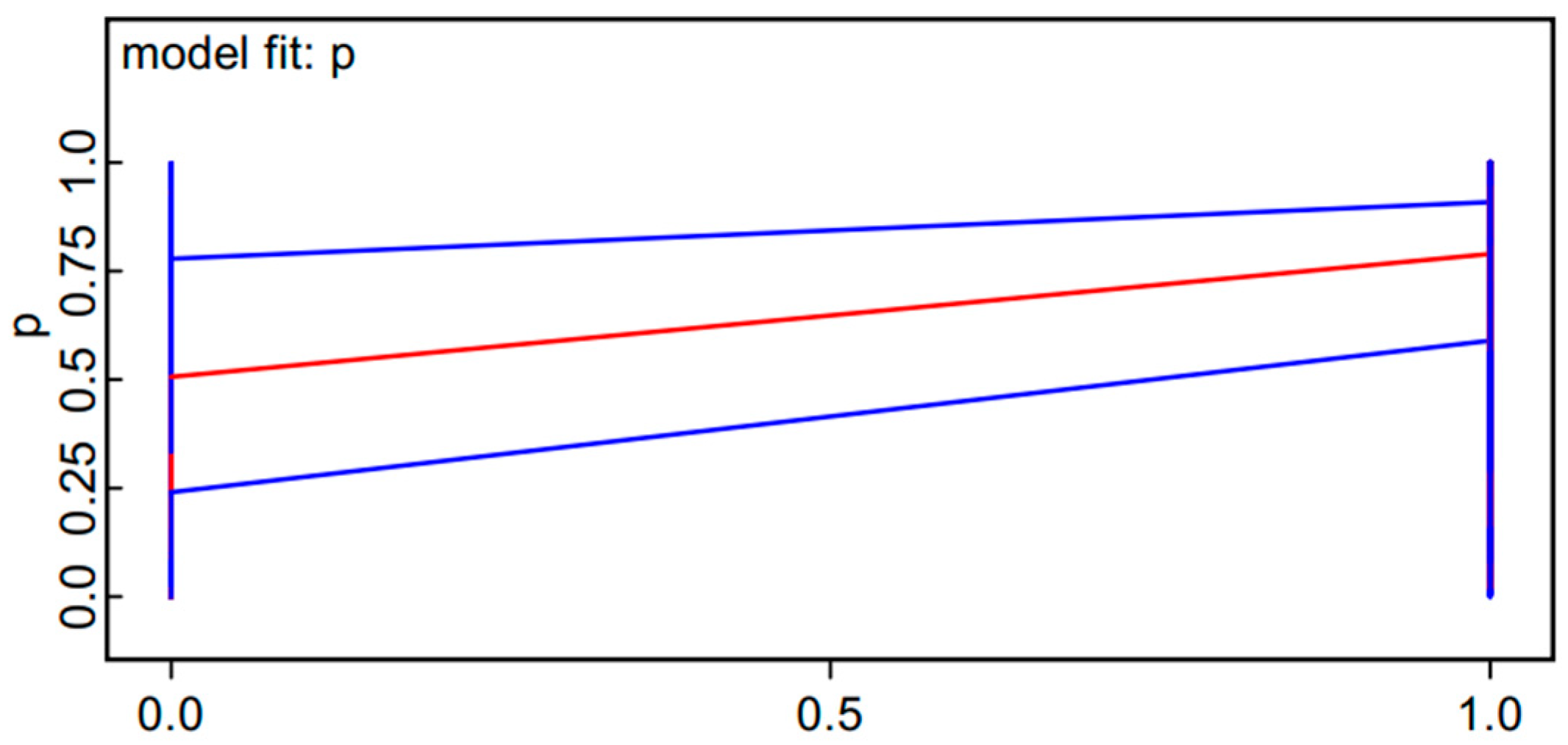
The Posterior Predictive Check (PPC) plot (
Figure 2) compares the predicted probabilities (blue line) with the observed data (red line). The vertical bars represent the uncertainty intervals around the predictions, showing the range of possible outcomes. The close alignment between the predicted and observed lines suggests that the model provides a good fit to the observed data, with the uncertainty intervals capturing the model’s confidence in its predictions.
Table 2 summarizes the significant estimated parameters from the Bayesian logistic regression models across the three scenarios (Pre-MRT SP, Post-MRT SP, and Post-MRT RP). For each parameter, the posterior mean coefficient is reported along with the 95% Bayesian credible interval. The results highlight how sensitivity to fare, waiting time, and socio-demographic characteristics evolved across scenarios, providing insights into the determinants of MRT adoption.
3.2. Pre-MRT SP Results
The pre-MRT SP model achieved a pseudo R2 of 0.0668, reflecting modest explanatory power typical of intention-based models. Fare sensitivity emerged as a negative predictor, underscoring that increasing fares reduced MRT preference. Shorter waiting times were attractive features, while reliability and safety/security perceptions were negatively associated with MRT choice. In contrast, accessibility was positively valued, suggesting respondents appreciated easier station access even before service launch. Demographic patterns showed that younger respondents were significantly more inclined to adopt, while older groups were notably less likely. Vehicle ownership also reduced the likelihood of choosing MRT. These results reflect early-stage concerns, where perceptions of cost, safety, and convenience largely shaped intentions. It is expected that these perceptions might shift once the system becomes operational, as actual experiences typically alter these initial biases. Overall, the pre-MRT SP model captures cautious, cost-sensitive intentions shaped more by perceptions than actual experience.
3.3. Post-MRT SP Results
The post-MRT SP model reported improved explanatory power (pseudo R2 = 0.186), reflecting more structured perceptions after MRT. Gender became significant, with women showing a higher preference. Employment status also mattered: full-time workers and those working from home full-time showed strong positive associations, while students also demonstrated a significant positive inclination. Rapid Pass ownership emerged as one of the strongest positive predictors. However, reliability and safety perceptions remained negative, and social media exposure further reduced preference, highlighting skepticism during early operations. This indicates that even as the system became operational, skepticism persisted due to lingering concerns about reliability and safety. Age effects persisted as older (<65) groups were significantly less likely to choose MRT compared to the reference. Overall, post-MRT SP results show that socio-demographic and institutional factors gained prominence, though trust in service quality remained fragile.
3.4. Post-MRT RP Results
The post-MRT RP model achieved the strongest fit (pseudo R2 = 0.502), confirming the superior explanatory power of revealed preference data. Education emerged as a significant positive factor, with higher attainment associated with adoption. Perceptions of security also shifted from negative in SP to strongly positive in RP, reflecting passengers’ actual experience of safer, more orderly conditions. This shift suggests that safety concerns in the pre-MRT and post-MRT SP models were likely exaggerated by hypothetical biases, but once commuters experienced the system, safety became a positive predictor. Similarly, fare sensitivity exhibited a reversal: while fare was a negative factor in both the pre- and post-MRT SP models, it turned positive in the RP model, indicating that commuters became more willing to accept the fare structure once they experienced the service firsthand. In contrast, private vehicle ownership strongly deterred MRT use, especially for multi-vehicle households. This reflects a common challenge in shifting commuters from private to public transport, as vehicle ownership often correlates with a preference for the convenience and perceived prestige of personal vehicles. Age effects persisted as negative, while proximity to stations (≤500 m) emerged as one of the most powerful predictors overall. Cost-related factors such as bus–MRT fare differences also showed modest positive effects. RP findings thus highlight how tangible system features such as security, proximity, and access dominate real behavior, while barriers like car ownership and age remain decisive.
3.5. Comparative Discussion and Policy Implications
The staged estimation approach across Pre-MRT SP, Post-MRT SP, and Post-MRT RP models provides a rare opportunity to trace how commuter decision-making evolves from expectations to perceptions and, ultimately, to realized behavior. Rather than treating each model in isolation, the comparative perspective reveals how the importance of predictors shifts across phases, with some variables maintaining consistent influence, others fading in relevance, and several undergoing complete reversals.
3.5.1. Factors Gaining Salience
Gender shifted from neutral to significant. In the pre-MRT SP model, male and female respondents did not differ in their stated intentions. Post-MRT SP revealed a higher female inclination, and in the RP model, the positive effect for women persisted. This progression reflects how gender-specific needs intersected with MRT’s design features. Before launch, women expressed no greater interest than men, likely because they were uncertain about whether the new system would address safety and comfort concerns. Once MRT was operational, however, the reality of its service made a difference. A strict policy of reserving one women-only car in every transit unit was enforced so that only women could board, providing a tangible assurance of safety, privacy, and comfort that other modes of transport in Dhaka lack. This measure directly addressed long-standing concerns around harassment, overcrowding, and lack of security in buses and informal modes. As a result, women’s inclination increased in the post-MRT SP stage and translated into higher adoption in RP. To sustain and expand female ridership, MRT operations should continue strict enforcement of women-only cars, while also ensuring broader gender-sensitive measures such as well-lit stations, visible security personnel, and clear complaint mechanisms. These features not only support women’s adoption but also reinforce MRT’s positioning as a safe, inclusive mode of transport.
Reliability remained a consistent negative predictor across all stages, but for different reasons. Before the MRT opened, respondents were skeptical about its dependability, which was influenced by past experiences with unreliable public transport. This skepticism is typical for new transport systems, which often face doubts about operational effectiveness. After the MRT’s inauguration, lingering operational glitches reinforced negative perceptions in SP surveys, as people recalled how quickly new systems could become unreliable. In RP, reliability still mattered, but its relative importance declined as tangible factors like fare and accessibility became more prominent in actual choices. This shift suggests that, after some real-world exposure, commuters began to tolerate minor issues, prioritizing factors like affordability and convenience. Additionally, as MRT offered better reliability than other public transport systems, it likely overcame some initial concerns. The initial skepticism reflects the gap between expectations and reality, while the decline in RP indicates an adaptive response to operational realities. Ensuring operational reliability from the start is key to mitigating early skepticism and supporting long-term adoption.
Safety-related perceptions shifted dramatically. Pre- and post-MRT SP models showed skepticism. The negative view before the MRT opened is not unusual, as safety is often perceived as a conditional concern in hypothetical situations. This is amplified by previous experience with other types of public transport. Once in operation, RP data revealed a marked shift, with security becoming a strong positive predictor, reflecting passengers’ lived experience of safer, more orderly conditions compared to buses. The change in perception occurred because safety concerns are often exaggerated in hypothetical settings (SP) but become more grounded once individuals actually experience the system. Security measures implemented after launch, such as better lighting, security personnel, and improved design features, likely played a significant role in transforming perceived safety into a core advantage. To proactively address safety concerns and build public confidence during both the design and operational phases, it is crucial to implement concrete actions such as publicizing regular security audits, maintaining visible security personnel at stations and on trains, and installing CCTV for monitoring. Additionally, well-lit stations and clear, accessible incident reporting channels could further reassure passengers. These measures would help transform perceived safety into a core advantage, directly addressing initial concerns and fostering long-term trust in the system.
Proximity to stations showed a strong effect only after MRT was operational. The variable was not included in the pre-MRT SP model, and in the post-MRT SP stage, it appeared as a small but insignificant positive factor, suggesting that respondents did not yet fully recognize the importance of station access when answering hypothetical surveys. In the RP model, however, proximity within 500 m emerged as one of the strongest predictors overall, with nearby residents and workers much more likely to use MRT. This highlights that in real behavior, the convenience of access is a decisive factor. Expanding station coverage and ensuring that stops are within easy reach of residential and commercial centers can therefore substantially enhance MRT adoption.
In the post-MRT SP model, employment showed strong associations: full-time workers, students, those working from home full-time, and informal workers (classified as “others”) were more likely to prefer MRT. This reflects how structured commuting needs shape expectations. Full-time and work-from-home employees making regular peak-hour trips valued MRT’s speed, predictability, and comfort, while students also recognized its affordability and reliability for their frequent educational trips. Informal workers benefited as well, since MRT offered a cheaper and more reliable option than buses, reducing exposure to congestion and delays. By contrast, part-time and hybrid workers showed weaker and statistically insignificant effects, consistent with their more flexible schedules and lower trip frequency. In the RP model, however, employment categories no longer showed significant influence, as universal factors such as Rapid Pass ownership, proximity, and safety dominated actual choices across all groups. Employment thus shaped expectations in hypothetical settings but faded once real-world trade-offs determined behavior. Policy should still ensure peak-hour capacity for workers while extending incentives like student discounts, flexible passes, and outreach to informal commuters to broaden adoption.
3.5.2. Persistent Barriers
Vehicle ownership remained one of the most consistently negative predictors. In both SP models, owning one or more private vehicles was associated with lower SP for MRT, and the RP results showed even larger negative coefficients. The deterrent effect of private vehicle ownership extends beyond flexibility and comfort; it is also social and cultural. In Dhaka, cars are not just transport assets but markers of social status. Many owners see their car as an expression of prestige, so shifting to public transport feels like a status loss, regardless of MRT’s advantages. There is also a sunk cost element: once a household invests in a vehicle, there is a strong tendency to use it regularly to justify the expense, rather than letting it sit idle. Moreover, cars provide unmatched convenience through door-to-door service, which MRT cannot fully replicate. These factors explain why, even after MRT’s launch, private vehicle users’ perception of MRT prevailed. Reducing car dependence will require more than just providing MRT as an alternative. Policies such as congestion pricing, limited parking near CBDs, or creating car-free zones around stations could discourage habitual car use. At the same time, MRT campaigns could reframe the narrative, emphasizing public transport as modern, efficient, and status-neutral, reducing the perception that it is only for those without cars. Additionally, integrating Mobility-as-a-Service (MaaS) options could play a crucial role in addressing the car ownership barrier. MaaS platforms that combine last-mile services like ride-sharing, bike-sharing, or electric scooters with metro access may offer a smooth, adaptable, and practical mode of transportation.
Income effects showed a clear shift across stages. In the pre-MRT SP model, family income had a small positive effect, suggesting that higher-income respondents were initially more open to adopting the system when it was still hypothetical. This may reflect expectations that MRT would be a premium, modern service offering comfort and time savings. However, once the system’s fare structure and operations became known, the pattern reversed. In the post-MRT SP model, both family and personal income displayed significant negative effects, indicating that wealthier commuters were less favorable toward MRT in SP. This trend persisted in the RP model, where higher income was again associated with lower actual adoption. The reversal likely reflects a reality check. While MRT is efficient and reliable, it is priced as a mass service rather than a premium one. Higher-income commuters, with greater access to private vehicles and other flexible modes, were less inclined to switch. Maintaining MRT’s affordability and ensuring quality service is crucial to retain its appeal among lower- and middle-income commuters, while targeted measures may be needed to attract higher-income groups who otherwise prefer to choose private modes.
3.5.3. Factors Demonstrating Hypothetical Bias
Fare sensitivity displayed a striking reversal across stages. In both pre- and post-MRT SP models, higher fares reduced SP for MRT, with respondents clearly indicating that affordability was central to their hypothetical choices. However, in the RP model, the effect turned positive, with fare emerging as a significant driver of actual adoption. This shift suggests that once commuters experienced MRT firsthand, they were more willing to accept its fare structure, viewing it as reasonable in relation to the service quality, time savings, and comfort offered.
Access and egress time showed unstable effects across models. In the pre-MRT SP model, it appeared as a positive and significant factor, a counterintuitive result likely reflecting perception bias in hypothetical responses rather than true behavioral tendencies. The post-MRT SP model showed a small negative but insignificant effect, suggesting that once respondents had more concrete knowledge of the system, access time was no longer a central concern. In the RP model, the effect returned to a small positive but remained insignificant, indicating that in real usage, access and egress did not strongly influence MRT adoption. Overall, the shifting signs point to weak and inconsistent influence, highlighting the difficulty of capturing first-/last-mile considerations through stated surveys.
3.5.4. Shifting Demographics and Socioeconomic Characteristics
Education displayed a notable reversal. In the pre-MRT SP model, education had no significant influence, suggesting that intentions were not shaped by attainment level before the system opened. In the post-MRT SP model, however, the coefficients turned negative. This is possibly because educated commuters tend to be more critical and cautious, expecting higher standards of service. However, RP results showed that educated individuals were more likely to adopt MRT once it became operational. This reversal can be attributed to the fact that educated individuals are generally more analytical and thus skeptical about new services in hypothetical surveys. However, once they experience the system firsthand and witness its benefits, such as time savings, reliability, and comfort, they are quicker to recognize these advantages and embrace the service. Educational campaigns aimed at more educated commuters can focus on the value proposition of MRT, highlighting tangible benefits and data-driven results that appeal to this group’s decision-making style. These findings suggest that educated commuters are more data-driven in their decision-making process. As such, targeted communication strategies focusing on the MRT’s proven benefits could effectively engage this group. Educational campaigns aimed at more educated commuters should emphasize the system’s data-driven results, such as reduced travel time, improved comfort, and overall reliability, to appeal to their decision-making style. By highlighting these quantifiable benefits, such campaigns can more effectively convince this demographic to adopt the MRT.
Age effects shifted notably across stages. In the pre-MRT SP model, younger people were more inclined to adopt MRT, reflecting a generational openness to explore and experiment compared to older commuters who were less willing to try something new. This also ties to behavioral and physical factors; young commuters are generally more mobile, more willing to try new modes and technologies, and better able to handle station access and transfers, while older groups face habitual and physical barriers that discourage experimentation. In the post-MRT SP model, commuters under 35 and under 45, largely middle-aged family earners from the previous generation, were significantly less likely to choose MRT, reflecting a preference for consistency and reluctance to change established travel routines. In the RP model, all age groups showed negative coefficients, but none were statistically significant, indicating that once MRT was operational, its design and service quality appealed broadly, and adoption was driven more by mobility needs than by age.
Taken together, these shifts demonstrate how MRT adoption determinants are dynamic rather than static.
Table 3 summarizes the shifts of variables across stages. The comparative lens underscores the limitations of relying solely on SP data for forecasting, as perceptions can understate or misrepresent actual behavior. For researchers, the results advocate for staged or longitudinal approaches that trace the evolution of adoption. For policymakers, they highlight that effective interventions must be timed: pre-launch messaging should focus on affordability and integration, early operation on safety and reliability, and established operation on accessibility, proximity, and demand management.
4. Conclusions
This study advances understanding of how commuter adoption of Dhaka’s MRT evolves over time by integrating pre-launch intentions, post-launch perceptions, and revealed behaviors within a unified Bayesian logistic regression framework. By adopting a staged SP–RP design, it demonstrates how expectations and realized choices often diverge, showing why it is important to track behavior over time instead of relying only on one-time surveys in transport research. A limitation of this study is the short time frame (about one month) between the post-MRT SP and RP surveys. This may not fully capture the long-term evolution of commuter behavior, as early adoption patterns might differ from settled habits. Future research with longer follow-up periods could provide a deeper understanding of this dynamic.
Beyond the empirical case of Dhaka, the research highlights two broader contributions. First, it shows how Bayesian inference, implemented through MCMC estimation, can more effectively capture uncertainty and provide probabilistic insights into mode choice behavior. This methodological shift enriches transport modeling by moving beyond point estimates toward distributions that reflect real-world complexity. Second, it illustrates the practical value of aligning interventions with the temporal phases of system adoption, building confidence and affordability before launch, strengthening perceptions of safety and reliability during early operations, and ensuring accessibility and integration as the system matures.
For policymakers, the staged lens underscores that investments in infrastructure alone are insufficient; sustained adoption requires coordinated action across pricing, safety, feeder services, and land use planning. By situating Dhaka’s Line-6 within this context, the study offers transferable lessons for other Global South cities. Future research could apply this staged Bayesian approach to larger networks, longer study periods, or integration with traffic simulation, helping both researchers and policymakers better understand and manage urban mobility.