4.1. Results
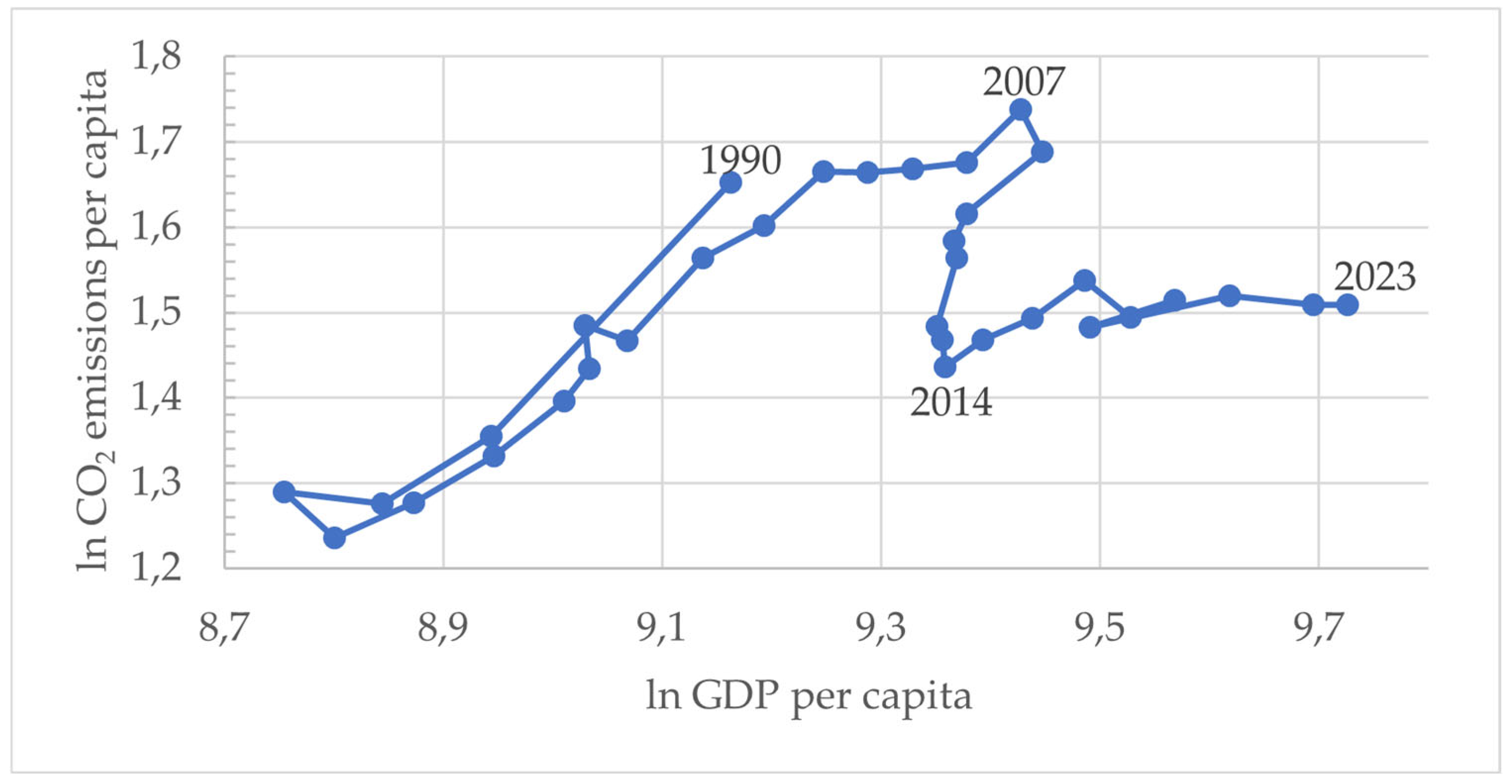
Figure 1 presents the relationship between economic growth and CO
2 emissions in Croatia in the observed period 1990–2023, in what is commonly known as the Environmental Kuznets Curve (EKC). Both the GDP per capita and CO
2 emissions per capita are expressed in natural logarithms to make the data more stable, improve their distribution, and match the functional form typically used in EKC models.
Figure 1 shows how the growth of the GDP per capita was initially accompanied by the growth of CO
2 emissions. The peak was reached in 2007, after which there was a gradual decline and stabilization of emissions despite further GDP growth. This trend suggests a potential inverted U-shaped relationship between economic development and environmental degradation, providing partial support for the EKC hypothesis, according to which pollution levels rise at the early stages of economic growth but begin to decrease once a certain income threshold (turning point) is reached.
This visual impression is broadly in line with the results reported by Jošić, Jošić and Janečić [
7], who report that Croatia reached its peak in CO
2 emissions in 2007, followed by a noticeable drop. Their interpretation centers mostly on the impact of the 2008–2013 recession. The data used in this paper, however, paint a slightly different story: emissions continue drifting downwards even after the economy recovers, which suggests something more persistent, i.e., a possible decoupling of growth and emissions that fits well with the EKC hypothesis.
Table 2 summarizes the descriptive statistics for all of the variables in their original levels. Presenting them this way helps keep the scale intuitive before switching to the logarithmic transformations used later in the ARDL estimations.
According to the results from
Table 2 and the data (
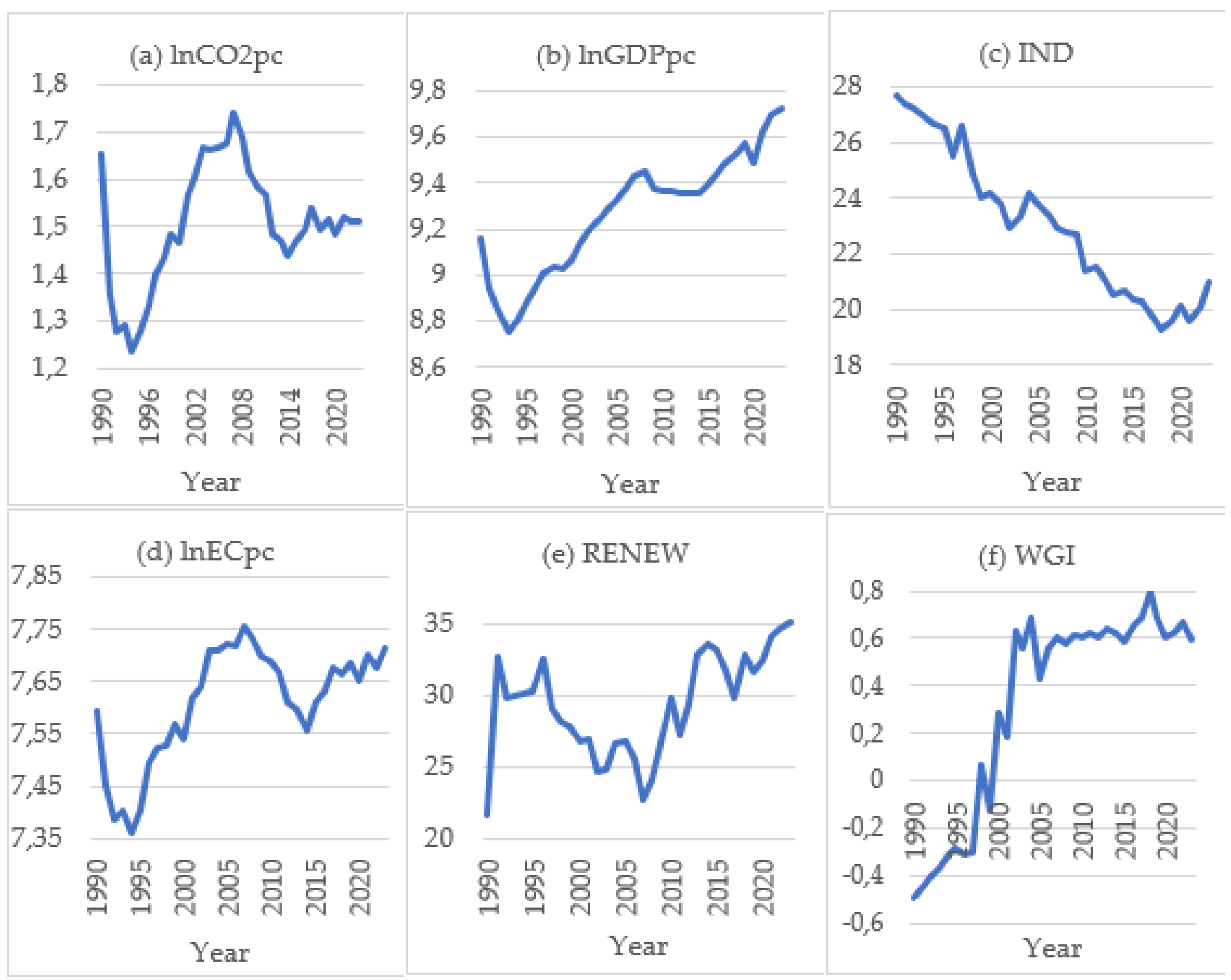
Figure 2), Croatia’s per-capita CO
2 emissions averaged 4.54 metric tons over the period, with relatively small fluctuations from year to year. The GDP per capita, at roughly USD 10,900 on average (2015 prices), shows a long, steady upward trend. The industrial share of the GDP, around 23%, suggests a moderately industrialized structure that has gradually shifted toward services (also visible in
Figure 2c). The energy use per capita, averaging 2026 kg of oil equivalent, remains extremely stable over the entire period. The share of renewable energy, with an average of 29.3%, indicates a steady progress in the country’s energy transition. The data for the WGI index (average of 0.33) suggest gradual improvements in institutional quality and overall governance in the observed period.
Overall, the results highlight that over the observed period, Croatia experienced almost continuous economic growth (with the exception of the crisis years) alongside an increasing share of renewable energy sources and relatively stable emissions, particularly in more recent years. This combination suggests that Croatia may be in the early stages of decoupling economic growth from environmental pressures, which is broadly consistent with the expectations of the EKC hypothesis.
To complement this overview,
Table 3 presents a correlation matrix that offers a first look at how the variables relate to one another. Although descriptive, these correlations help identify any potential multicollinearity issues that could influence the econometric results discussed later.
Table 3 presents the correlation results for the variables. At first glance, most of the correlations are fairly strong and statistically significant, which is not surprising given how closely economic growth, energy use and institutional quality tend to move together. The high correlations between the GDP per capita, its squared term and energy consumption are quite expected from a theoretical standpoint; as income rises, energy demand usually increases as well, and with it, emissions. Renewable energy (RENEW), on the other hand, shows a negative correlation with CO
2 emissions. This suggests that a higher share of renewables is generally associated with lower emission levels, which fits well with the idea behind the EKC and the broader expectation that cleaner energy sources help ease environmental pressure. Similarly, the negative relationship between the industrial value added and both the GDP per capita and the governance quality suggests structural changes in the Croatian economy toward a more service-oriented and institutionally developed framework. Although some correlation coefficients exceed 0.80, these values are typical for macroeconomic time series and do not necessarily imply multicollinearity problems; this will be formally verified through diagnostic testing in the ARDL model. Overall, the correlation analysis supports the theoretical expectations of the EKC hypothesis and provides a sound basis for the subsequent econometric estimation.
Figure 2 shows a graphical representation of the time-series data in the period from 1990 to 2023.
A quick look at the time-series data (
Figure 2) reveals distinct trends among the main variables over the period 1990–2023. Several of them, such as lnGDPpc, IND and WGI, show fairly clear upward or downward movements over time, which already hints that these series might not be stationary in their original levels. In contrast, the patterns for lnCO
2pc, lnECpc, and RENEW appear more stable, although their visual inspection alone does not allow for a definitive conclusion regarding stationarity. Given these observations, and in line with the requirements of the ARDL methodology, it is necessary to formally test the order of integration of all of the variables. Therefore, the Augmented Dickey–Fuller (ADF) test was applied to examine whether each series is stationary at the level or becomes stationary after first differencing. This step ensures that none of the variables are integrated of order two, I(2), which would violate the assumptions of the ARDL bounds testing approach.
The results of the ADF stationarity test presented in
Table 4 indicate that the variables lnCO
2pc, lnECpc, lnGDPpc, and (lnGDPpc)
2 are stationary at levels (I(0)). On the other hand, the variables IND, RENEW, and WGI are non-stationary at levels but become stationary after first differencing (I(1)). This satisfies one of the fundamental prerequisites for the application of the ARDL approach, since none of the variables were integrated of order two (I(2)).
To examine the existence of a long-run equilibrium relationship between CO
2 emissions and the selected explanatory variables, the ARDL bounds testing approach was employed. Three model specifications were estimated. The first model includes one lag and no dummy variables. The second model incorporates structural dummy variables capturing major shocks: Croatia’s EU accession, the COVID-19 pandemic, and the energy crisis of 2022–2023, using one lag. Finally, the third model includes the same dummy variables with two lags. The results of the ARDL bounds tests for all of the model specifications are presented in
Table 5.
The results confirm the presence of a statistically significant long-run relationship between CO2 emissions and the selected explanatory variables. The strongest evidence of cointegration is observed in the model with one lag and included dummy variables, indicating that structural and external shocks play an important role in explaining the long-run dynamics. These findings justify the application of the ARDL approach for analyzing the long-run and short-run dynamics among the variables.
Our findings differ from those of Jošić, Jošić, and Janečić [
7], whose results did not confirm cointegration between CO
2 emissions and the GDP per capita for the period 1990–2013. The difference between their results and the results in this study are already explained in the literature review part. In addition to a longer period of analysis and the inclusion of additional variables in the model, this paper also employs different methodological procedures. Their study relied on Engle–Granger and Johansen procedures, which are known to have weaker power in short or structurally unstable samples. On the other hand, our analysis employs the ARDL bounds testing approach, which is more robust to structural breaks and more effective in identifying long-run relationships. Taken together, these elements help explain why our study finds evidence of cointegration, whereas the earlier study did not.
Table 6 reports the results of diagnostic tests used to assess the adequacy and statistical validity of the ARDL model. Among the estimated specifications, the ARDL(1,1,1,1,1,0,1) model, which includes one lag and structural dummy variables, was selected as the preferred model. This specification provides the strongest statistical evidence of cointegration (F = 19.14) and demonstrates theoretical consistency with the observed structural changes.
Diagnostic tests were carried out to check whether the estimated ARDL(1,1,1,1,1,0,1) model is appropriate and statistically reliable. The results support the null hypothesis in all cases, as all of the p-values are above the 0.05 significance level. This means that the model’s residuals are normally distributed, show no signs of heteroscedasticity or serial correlation, and that the model is correctly specified. In other words, the estimated ARDL model is statistically sound and stable, making it suitable for interpreting both the long-run and short-run relationships in the analysis.
Following the confirmation of a long-run relationship among the variables, the ARDL(1,1,1,1,1,0,1) model was estimated to examine both the long-run and short-run dynamics between CO
2 emissions and its determinants.
Table 7 presents the estimated long-run and short-run coefficients along with their corresponding significance levels.
The results of the ARDL(1,1,1,1,1,0,1) model presented in
Table 7 provide evidence supporting the Environmental Kuznets Curve (EKC) hypothesis for Croatia during the period 1990–2023. The long-run coefficients show that the GDP per capita (lnGDPpc) has a positive and statistically significant effect on CO
2 emissions (α = 6.603,
p < 0.01), while the squared GDP per capita term (lnGDPpc
2) is negative and significant (α = −0.365,
p < 0.01). This provides evidence of an inverted U-shaped relationship between economic growth and environmental degradation, suggesting that CO
2 emissions initially rise with economic development but begin to decline once income surpasses a certain turning point.
In a quadratic log EKC specification, the impact of income on emissions is not constant but varies with the level of income. The marginal effect of the GDP per capita on CO
2 emissions is given by the expression
where
∂lnCO2,t/∂lnGDPpct denotes the marginal effect (elasticity evaluated at time t) of GDP per capita on CO2 emissions per capita;
α1 is the estimated long-run coefficient on lnGDPpct;
α2 is the estimated long-run coefficient on the squared income term (lnGDPpct)2;
lnGDPpct is the natural logarithm of GDP per capita at time t, evaluated at a specific income level;
the expression highlights that the elasticity of emissions with respect to income varies with the level of GDP per capita and is therefore not constant along the EKC.
Evaluating this expression at representative income levels shows that at lower income levels the effect of GDP growth on emissions is positive, it approaches zero around the estimated turning point and becomes negative at higher income levels.
The marginal effects reported in
Table 8 indicate that the relationship between income and CO
2 emissions in Croatia has changed over time. During the mid-1990s, when the GDP per capita was relatively low, economic growth was associated with rising emissions, reflecting an energy-intensive growth pattern characteristic of the early transition period. As income increased, the marginal effect of the GDP per capita on emissions gradually weakened and approached zero, before turning negative at higher income levels.
Building on this pattern of marginal effects, the EKC turning point was calculated using the estimated long-run income coefficients from the preferred ARDL(1,1,1,1,1,0,1) model, following standard practice as exp(−
α1/2
α2). The resulting estimate of approximately USD 8550 per capita (2015 prices) suggests that Croatia may be operating around the income range associated with the EKC turning point. This estimate falls within the range commonly reported in the EKC literature (e.g., Grossman and Krueger [
12]) and indicates that, after a period in which emissions increased alongside economic growth, further income growth was no longer associated with rising CO
2 emissions but instead coincided with their gradual stabilization and decline.
It is important to emphasize that the estimated turning point is defined in income space rather than in calendar time. While total CO2 emissions in Croatia reached their empirical peak somewhat later, in 2007, the marginal effect of income on emissions was already negative by that stage. This suggests that income levels associated with declining marginal effects may have been reached earlier, with emissions adjusting only gradually over time. Such a lagged response is consistent with the presence of structural rigidities and delayed adjustments in the energy mix, whereby changes in production structures, technologies, and energy sources translate into lower emissions only with some delay.
At the same time, the estimated EKC turning point proves to be sensitive to sample composition. When the model is re-estimated on a reduced sample excluding all of the interpolated observations (1996–2021), the implied turning point increases substantially, to around USD 14,470 per capita (
Appendix A). While this robustness check confirms the presence of an inverted U-shaped EKC relationship, it also indicates that the precise income level at which emissions begin to decline is not uniquely identified. Consequently, the timing of Croatia’s transition into the downward segment of the EKC should be interpreted with caution, with a greater emphasis placed on the overall pattern of decoupling rather than on a specific income threshold.
The energy consumption per capita (lnECpc) has a strong, positive and significant effect on emissions, which is in line with our expectations. The positive coefficient (lnECpc, 0.924) indicates that a 1% increase in energy consumption raises emissions by about 0.92% in the long run. Since the elasticity is so close to one, the results suggest that emissions move almost in step with energy consumption. That means that Croatia’s energy mix is still based on fossil fuels.
The coefficient for renewable energy consumption in the total final energy consumption (RENEW) is negative and significant, which implies that a higher share of renewable energy in the total energy consumption significantly reduces CO2 emissions. Since this variable is measured in percentage points and CO2 emissions in logarithms, the coefficient (−0.014) implies that a one-percentage-point increase in renewable energy consumption reduces emissions per capita in the long run by around 1.4%. These results are also in line with our expectations. Although the impact may appear modest at first glance, changes in the energy mix accumulate over time, so the long-run contribution to decarbonization can be quite meaningful.
The coefficient of industry share in the GDP (IND) is positive and marginally significant, suggesting that a higher share of industry in the GDP increases emissions. Since this variable is measured in percentage points and CO2 emissions in logarithms, the coefficient of 0.019 means that if the industry’s share in GDP rises by one percentage point, emissions increase by about 1.9%.
The institutional quality (WGI) shows a positive and significant long-run link with emissions, which is not in line with our expectations. The coefficient of 0.091 means that a one-unit increase in the governance index raises emissions by approximately 9% in the long run. One possible interpretation is that improvements and reforms of the Croatian institutions after transition are accompanied by greater economic activity, which implies greater energy consumption and greater emissions. In many countries, including Croatia, the environmental benefits of stronger and more inclusive institutions take time to reduce emissions, especially in post-socialist countries. That means that Croatia is still in a stage of development where “better” institutions have not yet shifted towards green policies, a phase that is expected to come to an end in the near future as EU green policies are increasingly adopted. This result is consistent with the distinction between “strong” and “green” institutions often discussed in the environmental governance literature, where governance improvements initially stimulate economic activity before environmental regulation becomes binding.
The short-run results indicate that in the short term, most of the variables used in the model do not have a statistically significant influence on CO2 emissions. The GDP per capita (∆lnGDPpc) and its squared form (∆lnGDPpc2) are statistically insignificant, meaning that fluctuations in economic activity do not immediately affect CO2 emissions. This is not unexpected, because short-run emissions tend to be driven more by energy consumption than by the GDP itself.
In contrast to the GDP variables, energy consumption (∆lnECpc) is an exception, as its short-run coefficient is positive and highly significant. It indicates that a 1% increase in per-capita energy consumption raises emissions per capita by about 0.85% within the same period. The large value of the coefficient indicates that short-run emissions respond quickly to changes in energy consumption per capita. This suggests that the current energy mix in Croatia is still carbon-intensive.
Other structural and institutional variables used in this model, such as changes in the industry share and shifts in governance quality, do not show statistically significant short-run effects. Their impact appears to emerge more gradually, which is why it becomes evident primarily in the long-run relationship rather than in the short-run dynamics.
Dummy variables included in the model have different impacts on emissions. EU accession has a small but marginally significant positive effect. The short-run coefficient on the EU dummy variable (0.032) suggests that Croatian accession to the EU was associated with an immediate increase in CO2 emissions of approximately 3.2%. This short-term rise likely reflects increased economic activity, inflow of investments and EU funds, and consequently an energy demand. That was before the gradual adoption of EU environmental and climate policies began to exert downward pressure on emissions. The ESOK dummy, which captures the energy shock of 2022–2023, shows a positive and significant short-run effect on emissions. This indicates that the energy crisis temporarily pushed emissions upward. The last dummy variable, COVID, is insignificant in this model.
The error correction term (ECT), which connects short-term dynamics (variable changes) with long-term equilibrium and shows whether the system returns to long-term equilibrium after a shock and at what speed, is negative and highly significant. Its value of −0.738 indicates a relatively fast correction of deviations from the long-run path. About 74% of any imbalance is adjusted within a single year. This confirms that the model is stable and that a valid long-run relationship exists among the variables.
Taken together, the results indicate that Croatia’s CO2 emissions are shaped primarily by long-run structural and energy-related factors rather than by short-run economic fluctuations. Economic growth, changes in the production structure, energy consumption patterns, and the gradual expansion of renewable energy sources play a central role in determining emissions dynamics over time. In contrast, short-term variations in the GDP and institutional indicators exert only limited and mostly insignificant effects on emissions. This pattern underscores the importance of long-run adjustments in the energy system and economic structure for achieving sustained emissions reductions.
4.2. Discussion
The ARDL results provide strong evidence of a stable long-run relationship between economic growth and CO2 emissions in Croatia. The findings support the presence of an inverted U-shaped relationship between the GDP per capita and emissions, as predicted by the Environmental Kuznets Curve (EKC), and are consistent with the first hypothesis of the paper. The results further suggest that Croatia is likely operating around, or possibly beyond, the income range associated with the EKC turning point, such that further income growth is accompanied by declining marginal effects on emissions. At the same time, the estimated turning point is sensitive to model specification and sample composition. While the baseline model implies a turning point at around USD 8550 per capita (2015 prices), the robustness checks excluding interpolated observations yield substantially higher estimates. This indicates that, although the EKC relationship itself appears robust, the precise income level at which the transition occurs should be interpreted with caution.
The estimated turning point from the baseline specification falls within the range reported in the seminal EKC literature. Grossman and Krueger [
11] document turning points for local air pollutants at income levels generally below USD 8000 per capita, while a number of later studies also identify relatively low turning points for transition and middle-income economies. In the Croatian context, the results of this study reinforce and extend the findings of Ahmad et al. [
9], who confirm an inverted U-shaped EKC for the period 1992–2011 using an ARDL framework, although their estimated turning point is based on a shorter sample and a more parsimonious specification. By contrast, studies that do not identify an EKC for Croatia, such as Jošić et al. [
7] and Škrinjarić [
8], rely on shorter time spans, static econometric techniques, or subnational data, which may limit their ability to capture long-run nonlinear dynamics and structural breaks. The use of a longer time series (1990–2023), an extended EKC specification, and a dynamic ARDL approach in this study helps explain why an EKC relationship is identified here but not in some earlier contributions. The results also differ from those of Ziemblińska et al. [
2], who argue that Croatia has not yet entered the downward phase of the EKC; this divergence appears to stem primarily from methodological differences, as their analysis relies on descriptive and graphical methods without formally testing long-run relationships or controlling for additional covariates and structural breaks.
The energy use per capita shows a strong and positive long-run impact on emissions. This is consistent with the results of other similar studies, for example, Ang [
24] for Malaysia, Halicioglu [
36] for Turkey, and Hassan et al. [
17] for a broad panel of developed and developing countries, all of whom identify energy use as the dominant driver of emissions. These findings suggest that income growth alone does not guarantee environmental improvement unless it is accompanied by changes in the energy mix and energy efficiency.
The negative and statistically significant coefficient on renewable energy consumption is consistent with a growing strand of the EKC-related literature emphasizing the role of clean energy in reducing emissions. Similar conclusions are reported by Zhang et al. [
45] and Hassan et al. [
17], who show that an increasing share of renewables contributes to long-run decarbonization, although the magnitude of the estimated effects is typically modest. In this context, the size of the renewable energy coefficient obtained for Croatia is broadly in line with the findings for other transition and emerging economies, suggesting that the impact of renewables on emissions is comparable rather than unusually weak or strong. This indicates that while renewable energy expansion is necessary, it may not be sufficient on its own without complementary policies aimed at reducing overall energy intensity. Nevertheless, the result clearly shows that Croatia’s shift toward cleaner energy sources is moving in the right direction.
In addition to long-run structural factors, the results also highlight the importance of short-run energy shocks. The positive and statistically significant coefficient of the energy shock dummy (ESOK) indicates that the 2022–2023 energy crisis was associated with a temporary increase in CO
2 emissions in Croatia. This suggests that periods of acute energy-market stress can disrupt decarbonization trends, even in economies where longer-run dynamics point toward declining marginal effects of income on emissions. Recent energy-system research emphasizes that energy crises are often accompanied by heightened electricity price volatility and market instability, which can alter consumption patterns and constrain short-term adjustment of energy systems, thereby intensifying emissions pressures [
37]. In this sense, the Croatian case illustrates how external energy shocks can temporarily offset longer-run improvements driven by income growth and renewable energy expansion.
One of the more intriguing results concerns institutional quality, which exhibits a positive long-run association with emissions. Although this may initially seem counter-intuitive, it is compatible with parts of the literature suggesting that improvements in institutions in developing or transition countries often accompany periods of more intensive economic activity as well as higher energy use. Zhang et al. [
45] find similar results for several emerging economies, arguing that improvements in governance often coincide with periods of accelerated economic activity and higher energy demand. In transition economies, institutional strengthening may initially support market expansion and industrial restructuring rather than immediate environmental protection. This result does not imply that better institutions necessarily worsen environmental outcomes but rather that their environmental effectiveness depends on whether governance improvements are explicitly aligned with climate and energy policies. In this sense, the Croatian case appears to reflect a transitional phase in which institutional development has not yet fully translated into lower emissions. More specifically, the results suggest that Croatia’s institutions have become stronger in terms of governance and administrative capacity, but not yet explicitly greener.
Overall, the findings confirm that the EKC is not an automatic outcome of income growth but a conditional relationship shaped by energy structure, institutional development, and policy choices. The differences between this study and earlier research on Croatia largely stem from variations in time coverage, econometric methodology, and model specification, reinforcing the importance of country-specific and long-run analyses when evaluating the EKC hypothesis.