2.1. Literature Review
In recent years, the impact of ED on capital market performance, particularly in relation to financing costs, has attracted growing academic attention. Existing studies generally suggest that ED helps mitigate information asymmetry, reduce investors’ perceptions of environmental risk, and send positive signals about firms’ sustainability, thereby lowering the expected return required by investors and ultimately reducing the COE [
7,
9]. However, empirical findings differ across institutional contexts, industry characteristics, and disclosure regimes, indicating that the capital market effects of ED are context-dependent and require careful interpretation.
International studies focusing on environmental responsibility and disclosure provide evidence of a negative association between environmental-related practices and the COE in several settings. For example, El Ghoul et al. [
10], using panel data from manufacturing firms across 30 countries, found that corporate environmental responsibility helps reduce environmental risk exposure and optimizes investor preferences, thus lowering equity financing costs. In an emerging market context, Atasel et al. [
11] found that voluntary ED by 39 non-financial firms listed in Turkey helped alleviate investor concerns and reputation-related risk premiums, leading to a lower COE. Similarly, Garzón-Jiménez and Zorio-Grima [
9], drawing on data from 27 countries and 12 sectors in the Morgan Stanley Capital International Emerging Markets Index, reported that firms that actively disclosed environmental information to meet the expectations of key stakeholders could prevent reputational losses and conflict risks, reduce risk premiums, and consequently lower COE. Nevertheless, whether such associations hold consistently across industries remains subject to debate.
Industry-specific studies reveal more pronounced heterogeneity. Tarulli et al. [
12], based on 73 agri-food companies across 30 countries, found no significant ED-COE relationship. Ime et al. [
8], using a sample of seven listed pharmaceutical companies in Nigeria, reported a statistically insignificant positive ED-COE relationship. The authors attributed this to a limited sample size, low disclosure levels, and insufficient variable variability, which reduced the statistical power of their tests. They also suggested that in some emerging markets, capital markets may not fully recognize the value of environmental information, with investors placing greater emphasis on other dimensions of corporate social responsibility, such as employee welfare and community contributions.
In the Chinese context, empirical research on the ED–COE relationship has also produced mixed results. On the one hand, several studies support the view that ED reduces COE by mitigating information asymmetry and conveying positive signals, a mechanism explained by Hughes et al. [
13], who argue that investors typically demand higher risk premiums under conditions of information asymmetry, thereby increasing the cost of capital. Specifically, Li and Zhang [
14] and Yao and Liang [
15], using samples from China’s marine and manufacturing sectors, respectively, found that enhanced ED helped reduce perceived risk and information asymmetry, thereby lowering the expected rate of return. Moreover, Lv et al. [
7], focusing on heavily polluting industries, showed that high-quality ED serves as a costly and credible signal of sound environmental management and sustainable cash flows, which reduces reputational risks and, consequently, COE. In addition, Li and Liu [
16], drawing on a large sample of listed firms in China, integrated perspectives from risk management, asymmetric information, and signaling theory, and demonstrated that under multi-stakeholder pressure and regulatory frameworks, ED significantly reduced COE, particularly among large and state-owned enterprises. Taken together, these findings suggest that the ED-COE relationship may be influenced by the credibility and informational content of the disclosed information.
On the other hand, some studies failed to identify a consistent cost-reducing impact of ED. For instance, Yan et al. [
17], after constructing an ED index for Chinese firms, found no significant overall ED-COE relationship. They further observed that while ED was associated with lower costs in non-polluting industries, the opposite held in highly polluting sectors, where enhanced ED may heighten investor concerns about environmental risks. Similarly, Tian et al. [
6], employing a difference-in-differences approach based on the 2010 mandatory disclosure regulation, reported that, following the policy implementation, ED did not significantly reduce COE. They attributed this outcome to the high degree of content homogeneity in corporate disclosures, which undermined their signaling effectiveness.
Collectively, these findings suggest that the capital market consequences of ED are sensitive to the informational content and credibility of disclosed information, rather than the mere presence of disclosure. Supporting this interpretation, Vitolla et al. [
18] documented that higher integrated reporting quality is associated with a lower COE, indicating that the quality of broader nonfinancial reporting, beyond stand-alone environmental disclosure, may influence investors’ required returns. This evidence reinforces the view that disclosure credibility, rather than disclosure per se, is central to understanding capital market responses to ED.
To explain these inconsistencies, some scholars have turned their attention to corporate governance as a potential moderating factor influencing the financial effects of ED. Iqbal et al. [
19], studying integrated reporting quality, found that effective corporate governance could mitigate agency conflicts, enhance transparency and credibility, and thus amplify the risk-mitigating effect of disclosures, which may strengthen capital market responses to nonfinancial information and support more favorable financing outcomes. From an international reporting perspective, sustainability reporting frameworks such as the Global Reporting Initiative (GRI) aim to enhance the comparability and credibility of environmental and social disclosures, and governance structures may influence firms’ adoption and implementation of such frameworks. Such frameworks, therefore, form an important institutional backdrop for understanding how governance affects the credibility of ED. Consistent with this view, Fuente et al. [
20] showed that board characteristics and governance mechanisms are associated with sustainability reporting practices aligned with GRI guidelines. This suggests that corporate governance may shape how environmental information is perceived by capital market participants.
Several studies have already explored this possibility. Jafar et al. [
21], using Indonesian listed companies, found that while Environmental, Social and Governance (ESG) disclosures generally reduced COE, the negative relationship was weakened in firms with higher board independence, larger board size, and greater gender diversity. This implies that an effective governance structure may partially substitute for the risk-reducing function of ESG disclosures. Additionally, Kiran et al. [
22], based on data from Next-11 emerging economies, found an inverted U-shaped moderating effect of managerial ownership: moderate ownership enhanced the credibility of ESG signals and lowered COE, whereas excessive or insufficient ownership reduced incentive alignment and information reliability. In China, Meng et al. [
23] showed that high-quality internal controls significantly strengthened the ability of ED to ease financing constraints by enhancing transparency and investor confidence.
In summary, while prior studies provide valuable insights into the ED-COE relationship, the existing evidence remains mixed and context-dependent. First, much of the existing literature focuses on multi-country samples or broad industrial sectors, while empirical evidence remains relatively limited for specific industries operating under evolving regulatory environments, such as China’s pharmaceutical sector following the post-2018 partial mandatory disclosure regime. Second, although prior studies examine individual corporate governance characteristics, fewer studies adopt composite measures that capture overall governance effectiveness. As a result, it remains unclear whether overall governance effectiveness, rather than isolated governance mechanisms, plays a consistent role in shaping the credibility of ED in capital markets.
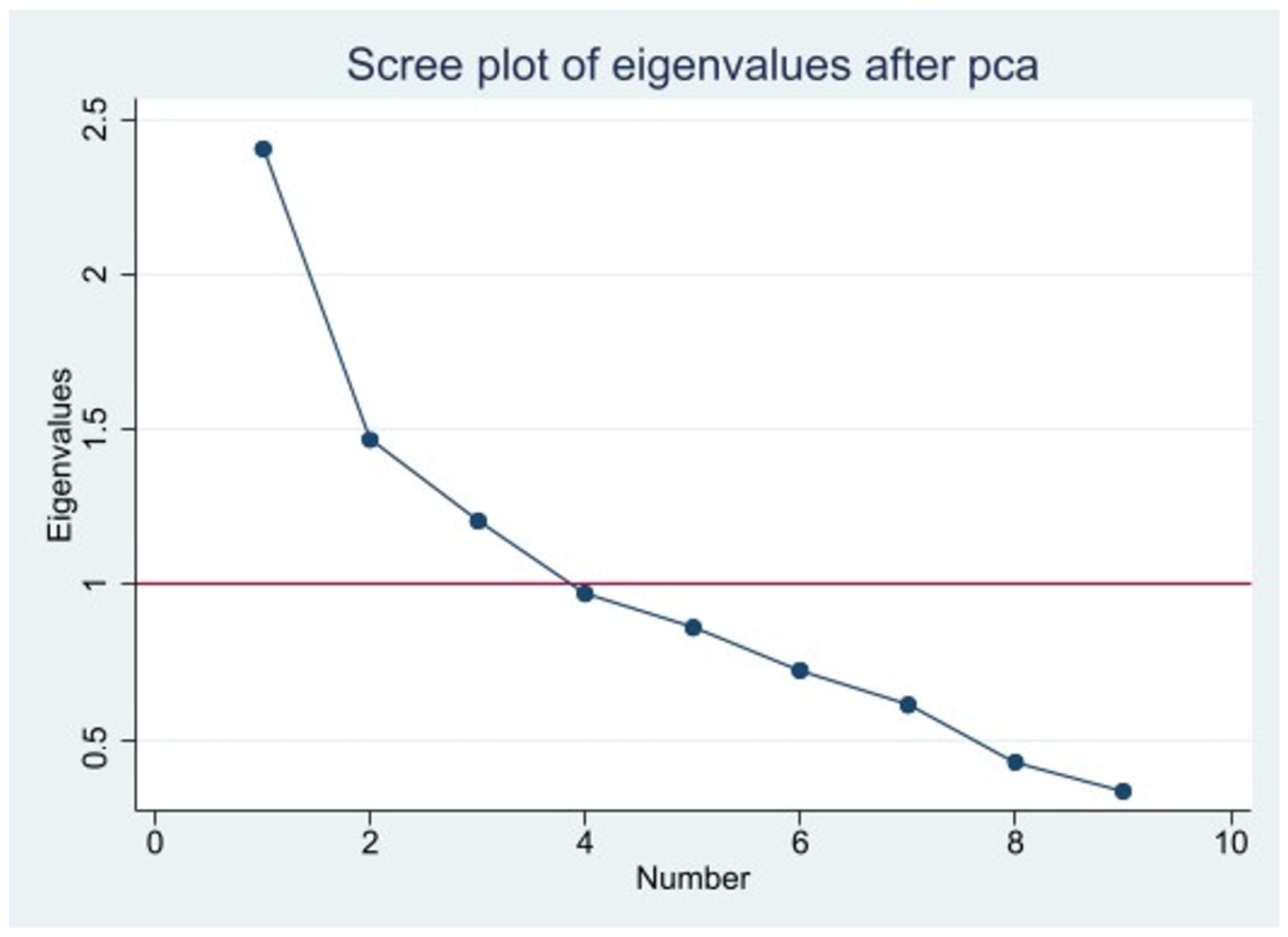
Against this backdrop, this study focuses on listed pharmaceutical firms in China, examining the post-2018 regulatory context. In addition to investigating the direct relationship between ED and the COE, we construct a comprehensive corporate governance index using PCA and explore its moderating role in this relationship. By focusing on a specific industry and regulatory setting, this study seeks to provide more context-specific empirical evidence on the ED-COE relationship and the role of corporate governance, with implications that may be informative for future research and regulatory discussions.
2.2. Theoretical Framework and Hypotheses Development
In capital markets, a significant information asymmetry exists between firms and external investors [
24]. Firms possess internal information about their operations and strategic direction, while investors and creditors rely primarily on publicly disclosed information to make informed decisions. Within this context, signaling theory [
25] offers a useful theoretical lens, suggesting that information-advantaged parties (e.g., firms) may transmit costly and observable signals to external stakeholders (e.g., investors) to convey firm quality, thereby mitigating adverse selection and moral hazard and improving the efficiency of resource allocation.
ED constitutes one such signaling behavior. On the one hand, the disclosure of environmental information is inherently costly. Firms with favorable environmental performance and corporate social responsibility are more likely to voluntarily disclose their environmental initiatives and achievements to signal their high quality to potential investors, thereby enhancing market recognition and investor trust [
7]. In contrast, poorly performing firms often lack the resources or willingness to bear the costs associated with high-quality ED, making it difficult for them to mimic such signals. On the other hand, the effectiveness of signaling is also reflected in a firm’s initiative and compliance in demonstrating its environmental responsibility, which helps shape a positive corporate reputation [
26]. Such reputational effects may influence how firms are perceived by market participants and enhance investor confidence, without necessarily implying an automatic or direct reduction in financing costs.
Consistent with this reasoning, prior empirical studies document associations between ED and COE across different institutional settings [
7,
9,
11,
15,
16]. However, as discussed in the preceding literature review, these associations are not uniform across contexts. Accordingly, the following hypothesis is proposed:
H1: Corporate environmental disclosure is negatively associated with the cost of equity.
However, under the current institutional context in China, issues such as selective disclosure [
1] may weaken the signaling effectiveness of ED. In a partial mandatory disclosure regime, the mere act of disclosure may not be sufficient to convey firm quality, as investors may question the credibility and informational content of reported environmental information. From the perspective of agency theory [
27], corporate governance serves as a key institutional mechanism for addressing information asymmetry, with one of its central roles being to enhance the credibility and reliability of corporate disclosures. Specifically, prior research showed that corporate governance mechanisms, such as board and audit committee oversight, are positively associated with disclosure quality and the use of credibility-enhancing mechanisms [
28]. Through stronger oversight and expertise-based governance arrangements, firms may improve the transparency and credibility of disclosed information.
Given the limited empirical evidence focusing explicitly on the moderating role of corporate governance in the ED-COE relationship, some scholars have expanded the discussion through a broader ESG perspective. For example, Jafar et al. [
21] found that board independence and board size significantly moderate the relationship between ESG disclosure and capital market responses. Although ESG encompasses social and governance dimensions, environmental disclosure constitutes a central component of ESG reporting, suggesting that governance mechanisms influencing ESG credibility may also be relevant for understanding the ED-COE relationship. Furthermore, Meng et al. [
23] demonstrated that, in the Chinese context, the quality of internal controls significantly strengthens the alleviating effect of high-quality ED on financing constraints by improving information transparency and enhancing investor trust, indicating that governance-related mechanisms can condition the financial consequences of ED.
It is important to note that corporate governance is not merely the function of individual attributes but reflects the comprehensive institutional arrangement of governance practices [
29]. A more effective governance system can enhance the credibility of disclosed information and strengthen its signaling value to investors. Accordingly, the following hypothesis is proposed:
H2: Corporate governance has a positive moderating effect on the impact of corporate environmental disclosure on the cost of equity.