Creating a Proactive Churn Retention Strategy in a Telecommunications Company Through the Application of Design for Lean Six Sigma



Abstract
1. Introduction
2. Literature Review
- RQ1: How can the DMADV framework be effectively applied to reduce customer churn in the telecommunications sector?
- RQ2: What are the most impactful Lean Six Sigma tools and metrics for improving customer satisfaction and loyalty in this context?
3. Research Methodology
3.1. Overview
3.2. Define, Measure, Analyze, Design, Verify
3.2.1. Define
- Customer Churn Rate: the percentage of customers terminating service in each period, calculated monthly to track overall attrition and tenure-based patterns.
- Save Rate: the percentage of customers intending to cancel who were retained after intervention applied to inbound retention calls and proactive pilot cohorts as the primary success measure.
- Repeat Rate: the percentage of previously retained customers who re-contact or cancel again within 30–90 days, used to assess retention quality and sustainability.
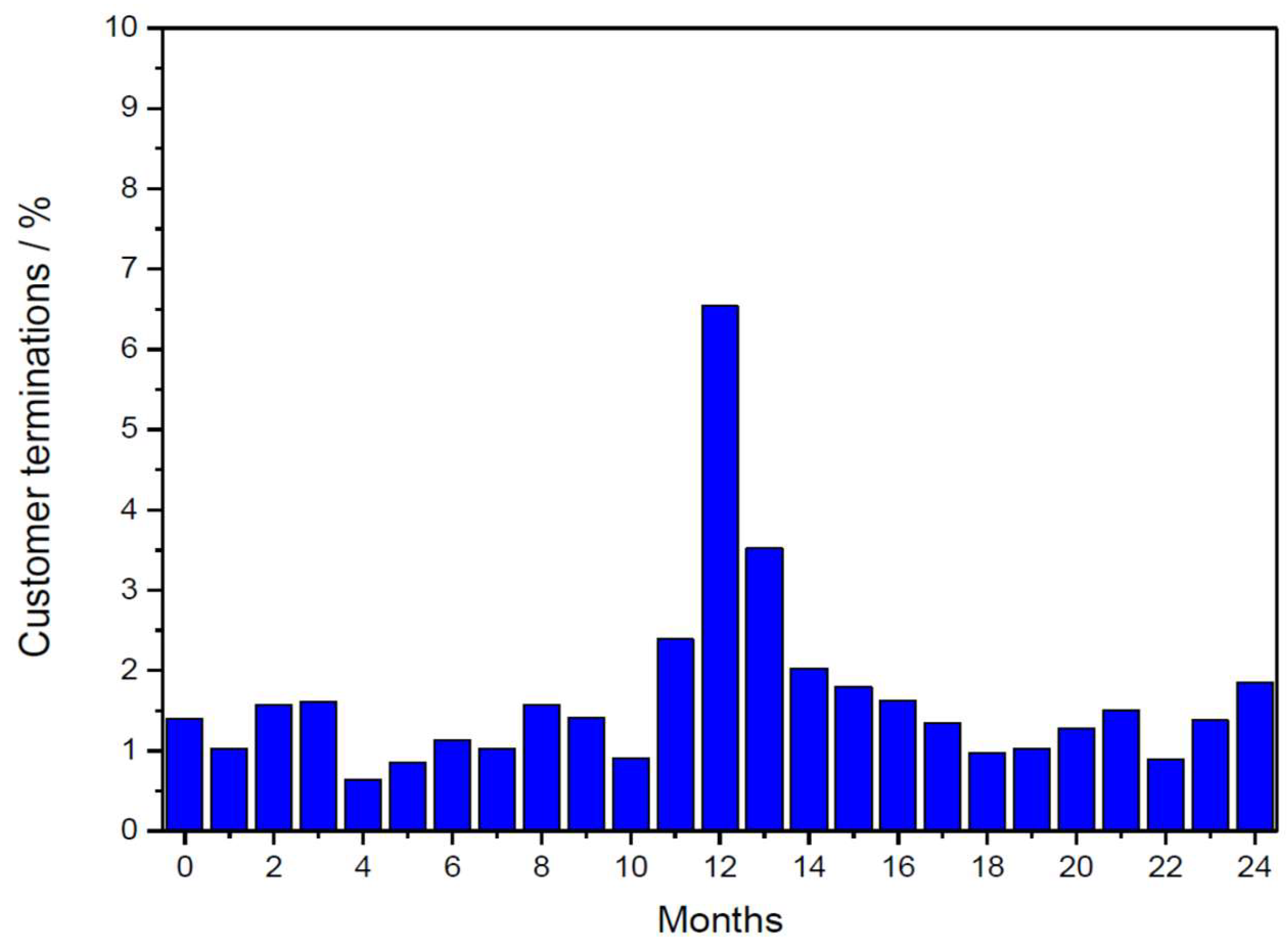
- Contract Base: the total number of active customers under fixed-term contracts, excluding out-of-contract customers, used to segment churn by tenure and to identify high-risk windows (months 10–12).
3.2.2. Measure
3.2.3. Analyze
3.2.4. Design
3.2.5. Verify
4. Results
4.1. Define
4.2. Measure
4.3. Analyze
4.4. Design
4.5. Verify
5. Discussion
6. Conclusions
Author Contributions
Funding
Institutional Review Board Statement
Informed Consent Statement
Data Availability Statement
Conflicts of Interest
Correction Statement
Abbreviations
| AI | Artificial Intelligence |
| AUC | Area Under the Curve |
| CTQ | Critical to Quality |
| CLV | Customer Lifetime Value |
| DFLSS | Design for Lean Six Sigma |
| DFSS | Design for Six Sigma |
| DMAIC | Define, Measure, Analyze, Improve, Control |
| DMADV | Define, Measure, Analyze, Design, Verify |
| DOE | Design of Experiments |
| GE | General Electric |
| PII | Personally Identifiable Information |
| KPI | Key Performance Indicator |
| LSS | Lean Six Sigma |
| NPS | Net Promoter Score |
| QFD | Quality Function Deployment |
| R&R | Repeatability & Reproducibility |
| SHAP | SHapley Additive exPlanations |
| SDL | Service-Dominant Logic |
| SIPOC | Suppliers, Inputs, Process, Outputs, Customers |
| SPC | Statistical Process Control |
| SVM | Support Vector Machine |
| VOC | Voice of the Customer |
| VOE | Voice of the Employee |
References
- Meena, M.; Geng, J. Dynamic Competition in Telecommunications: A Systematic Literature Review. SAGE Open 2022, 12, 1–10. [Google Scholar] [CrossRef]
- Helping Consumers Get Better Deals: A Review of the Impact of End of Contract Notifications and Pricing Commitments by Broadband and Mobile Providers. Available online: https://www.ofcom.org.uk/phones-and-broadband/service-quality/helping-consumers-get-better-deals (accessed on 5 May 2025).
- Ascarza, E.; Iyengar, R.; Schleicher, M. The perils of proactive churn prevention using plan recommendations: Evidence from a field experiment. J. Mark. Res. 2016, 53, 46–60. [Google Scholar] [CrossRef]
- George, M.L. Lean Six Sigma for Service: How to Use Lean Speed and Six Sigma Quality to Improve Services and Transactions; McGraw Hill: New York, NY, USA, 2003. [Google Scholar]
- Kaswan, M.; Rathi, R. Green Lean Six Sigma for sustainable development: Integration and framework. Environ. Impact Assess. Rev. 2020, 83, 106396. [Google Scholar] [CrossRef]
- Lubowe, D.; Blitz, A. Driving operational innovation using Lean Six Sigma. Bus. Perform. Manag. 2008, 6, 10–15. [Google Scholar]
- Cudney, E. Agustiady, Design for Six Sigma, A Practical Approach Through Innovation; CRC Press: Boca Raton, FL, USA, 2016. [Google Scholar]
- Neslin, S.; Gupta, S.; Kamakura, W.; Lu, J.; Mason, C. Defection Detection: Measuring and Understanding the Predictive Accuracy of Customer Churn Models. J. Mark. Res. 2006, 43, 204–211. [Google Scholar] [CrossRef]
- Schroeder, R.; Linderman, K.; Liedtke, C.; Choo, A. Six Sigma: Definition and underlying theory. J. Oper. Manag. 2008, 26, 536–554. [Google Scholar] [CrossRef]
- Zu, X.; Fredendall, L.; Douglas, T. The evolving theory of quality management: The role of Six Sigma. J. Oper. Manag. 2008, 26, 630–650. [Google Scholar] [CrossRef]
- Kubiak, T.; Benbow, D. The Six Sigma Handbook; McGraw-Hill: New York, NY, USA, 2009. [Google Scholar]
- Bhargava, M.; Bhardawj, A.; Rathore, A. Six Sigma Methodology Utilisation in Telecom Sector for Quality Improvement—A DMAIC Process. Int. J. Eng. Sci. Technol. 2010, 2, 7653–7659. [Google Scholar]
- Kumar, S.; Sosnoski, M. Reflective practice: Using DMAIC Six Sigma to systematically improve shopfloor production quality and costs. Int. J. Product. Perform. Manag. 2009, 58, 254–273. [Google Scholar] [CrossRef]
- Womack, J.; Jones, D. Lean Thinking: Banish Waste and Create Wealth in Your Corporation; Simon & Schuster: London, UK, 1996. [Google Scholar]
- Laureani, A.; Antony, J.; Douglas, A. Lean six sigma in a call centre: A case study. Int. J. Product. Perform. Manag. 2010, 59, 757–768. [Google Scholar] [CrossRef]
- Piercy, N.; Rich, N. Lean transformation in the pure service environment: The case of the call service centre. Int. J. Oper. Prod. Manag. 2009, 29, 54–76. [Google Scholar] [CrossRef]
- Antony, J. Six Sigma for Service Processes. Int. J. Serv. 2006, 12, 234–248. [Google Scholar] [CrossRef]
- Breyfogle, F. Better Fostering Innovation: 9 Steps That Improve Lean Six Sigma. Bus. Perform. Manag. 2008, 6, 16–20. [Google Scholar]
- Snee, R. Lean Six Sigma—Getting better all the time. Int. J. Lean Six Sigma 2010, 1, 9–29. [Google Scholar] [CrossRef]
- Antony, J.; Escamilla, J.; Caine, P. Lean Sigma [production and supply chain management]. Manuf. Eng. 2003, 82, 40–42. [Google Scholar] [CrossRef]
- Linderman, K.; Schroeder, R.; Zaheer, S.; Choo, S. Six Sigma: A goal-theoretic perspective. J. Oper. Manag. 2003, 21, 193–203. [Google Scholar] [CrossRef]
- Schiebler, T.; Lee, N.; Brodbeck, F.C. Expectancy-disconfirmation and consumer satisfaction: A meta-analysis. J. Acad. Mark. Sci. 2025, 1, 1–22. [Google Scholar] [CrossRef]
- Padigar, M.; Li, Y.; Manjunath, C. “Good” and “bad” frictions in customer experience: Conceptual foundations and implications. Psychol. Mark. 2024, 42, 21–43. [Google Scholar] [CrossRef]
- Abdellaoui, M.; Bleichrodt, H.; Paraschiv, C. Loss aversion under prospect theory: A parameter-free measurement. Manag. Sci. 2007, 53, 1659–1674. [Google Scholar] [CrossRef]
- Bleichrodt, H.; L’Haridon, O. Prospect theory’s loss aversion is robust to stake size. Judgm. Decis. Mak. 2023, 18, e14. [Google Scholar] [CrossRef]
- Gao, L.; de Haan, E.; Melero-Polo, I.; Sesé, F. Winning your customers’ minds and hearts: Disentangling the effects of lock-in and affective customer experience on retention. J. Acad. Mark. Sci. 2023, 51, 334–371. [Google Scholar] [CrossRef]
- Teece, D.; Pisano, G.; Shuen, A. Dynamic Capabilities, Strategic Management. Strateg. Manag. J. 1997, 18, 509–533. [Google Scholar] [CrossRef]
- Ascarza, E.; Neslin, S.; Netzer, O.; Anderson, Z.; Fader, P.; Provost, F.; Schrift, R.; Hardie, B.; Lemmens, A.; Libai, B.; et al. In pursuit of enhanced customer retention management: Review, key issues, and future directions. Cust. Needs Solut. 2017, 4, 65–81. [Google Scholar] [CrossRef]
- Trubetskaya, A.; Mullers, H. Transforming a global human resource service delivery operating model using Lean Six Sigma. Int. J. Eng. Bus. Manag. 2021, 13, 1–16. [Google Scholar] [CrossRef]
- McDermott, O.; Antony, J. Lean Six Sigma as an enabler for healthcare operational excellence in COVID-19. In 8th International Conference of Lean Six Sigma; Purdue University: West Lafayette, IN, USA, 2021. [Google Scholar]
- Huang, C.; Chen, K.; Chang, T. An application of DMADV methodology for increasing the yield rate of surveillance cameras. Microelectron. Reliab. 2010, 50, 266–272. [Google Scholar] [CrossRef]
- Gijo, E.V.; Bhat, S.; Antony, J.; Park, S.H. Ten commandments for successful implementation of design for Six Sigma. TQM J. 2021, 33, 1666–1682. [Google Scholar] [CrossRef]
- Park, S.; Antony, J. Robust Design for Quality Engineering and Six Sigma; World Scientific: Singapore, 2008. [Google Scholar]
- Zorn, S.; Jarvis, W.; Bellman, S. Attitudinal perspectives for predicting churn. J. Res. Interact. Mark. 2010, 4, 157–169. [Google Scholar] [CrossRef]
- Burnham, T.; Frels, J.; Mahajan, V. Consumer switching costs: A typology, antecedents, and consequences. J. Acad. Mark. Sci. 2003, 31, 109–126. [Google Scholar] [CrossRef]
- Xia, L.; Monroe, K.; Cox, J. The Price Is Unfair! A Conceptual Framework of Price Fairness Preceptions. J. Mark. 2004, 68, 1–15. [Google Scholar] [CrossRef]
- Zeithaml, V.; Berry, L.L.; Parasuraman, A. The Behavioral Consequences of Service Quality. J. Mark. 1996, 60, 31–46. [Google Scholar] [CrossRef]
- Zelenkov, Y.; Suchkova, A. Predicting customer churn based on changes in their behavior patterns. Bus. Inform. 2023, 17, 7–17. [Google Scholar] [CrossRef]
- Ahlstrand, J.; Boldt, M.; Borg, A.; Grahn, H. Predicting B2B Customer Churn using a Time Series Approach. In Proceedings of the 2024 Fifth International Conference on Intelligent Data Science Technologies and Applications (IDSTA), Dubrovnik, Croatia, 24–27 September 2024; pp. 44–51. [Google Scholar]
- De Caigny, A.; Coussement, K.; Verbeke, W.; Idbenjra, K.; Phan, M. Uplift modeling and its implications for B2B customer churn prediction: A segmentation-based modeling approach. Ind. Mark. Manag. 2021, 99, 28–39. [Google Scholar] [CrossRef]
- Fader, P.; Hardie, B.; Lee, K.L.O. RFM and CLV: Using Iso-Value Curves for Customer Base Analysis. J. Mark. Res. 2005, 41, 415–430. [Google Scholar] [CrossRef]
- Sinaga, R.; Widianto, S. Understanding Telecommunication Customer Churn: Insights from LightGBM Predictive Modelling and SHAP Feature Interpretation. Asian Manag. J. 2023, 15, 45–62. [Google Scholar] [CrossRef]
- Ribeiro, H.; Barbosa, B.; Moreira, A.; Rodrigues, R. Determinants of churn in telecommunication services: A systematic literature review. Rev. Manag. Sci. 2023, 74, 1327–1364. [Google Scholar] [CrossRef]
- Ruker, R. Citibank increases customer loyalty with defect-free processes. J. Qual. Particip. 2000, 23, 32–36. [Google Scholar]
- Bhat, S.; Antony, J.; Maalouf, M.; Salah, S. Applications of Six Sigma for service quality enhancement in the UAE: A multiple case study analysis and lessons learned. Int. J. Lean Six Sigma 2023, 14, 1492–1517. [Google Scholar] [CrossRef]
- Shamsuzzaman, M.; Alzeraif, M.; Alsyouf, I.; Chong, M. Using Lean Six Sigma to improve mobile order fulfilment process in a telecom service sector. Prod. Plan. Control. 2018, 29, 301–314. [Google Scholar] [CrossRef]
- Psychogios, A.; Atanasovski, J.; Tsironis, L. Lean Six Sigma in a service context: A multi-factor application approach in the Telecommunications Industry. Int. J. Qual. Reliab. Manag. 2012, 29, 122–139. [Google Scholar] [CrossRef]
- Popjanev, I. Managing Customer Loyalty in Automotive Industry. MEST J. 2016, 4, 99–110. [Google Scholar] [CrossRef]
- Pyzdek, T. The Six Sigma Handbook Revised and Expanded; McGraw Hill: New York, NY, USA, 2003. [Google Scholar]
- Thomas, M.; Singh, N. Design for lean six sigma (DFLSS): Philosophy, tools, potential and deployment challenges in automotive product development. In SAE Technical Paper No. 2006-01–0503; SAE International: Warrendale, PA, USA, 2006. [Google Scholar]
- Vargo, S.; Lusch, R. Service-dominant logic: Reactions, reflections and refinements. Mark. Theory 2006, 6, 281–288. [Google Scholar] [CrossRef]
- Brophy, P.; McDermott, O.; Trubetskaya, A. Implementing a customised Lean Six Sigma methodology at a compound animal feed manufacturer in Ireland. Int. J. Lean Six Sigma 2023, 14, 1075–1095. [Google Scholar] [CrossRef]
- Burez, J.; Van den Poel, D. Handling class imbalance in customer churn prediction. Expert. Syst. Appl. 2009, 36, 4626–4636. [Google Scholar] [CrossRef]
- Snee, R.; Hoerl, R. Leading Six Sigma—A Step-by-Step Guide Based on Experience with GE and Other Six Sigma Companies. Int. J. Qual. Reliab. Manag. 2004, 21, 467–468. [Google Scholar]
- Griffin, A.; Hauser, J. The Voice of the Customer. Mark. Sci. 1993, 12, 1–27. [Google Scholar] [CrossRef]
- He, Z.; Goh, T. Enhancing the Future Impact of Six Sigma Management. Qual. Technol. Quant. Manag. 2015, 12, 83–92. [Google Scholar] [CrossRef]
- Knowles, G. Six Sigma; Bookboon: London, UK, 2011. [Google Scholar]
- El-Haik, B.; Roy, D. Service Design for Six Sigma: A Roadmap for Excellence. J. Prod. Innov. Manag. 2006, 23, 470–472. [Google Scholar] [CrossRef]
- Wendland, D. Brainstorming More Effectively. Available online: https://www.forbes.com/councils/forbesagencycouncil/2023/01/13/brainstorming-more-effectively/ (accessed on 6 May 2025).
- Bowles, D.; Gardiner, R. Supporting process improvements with process mapping and system dynamics. Int. J. Product. Perform. Manag. 2018, 67, 1255–1270. [Google Scholar] [CrossRef]
- Stroud, J. To Pilot or Not to Pilot a Six Sigma Project or Design. Available online: https://www.isixsigma.com/project-selection-tracking/pilot-or-not-pilot-six-sigma-project-or-design (accessed on 5 May 2025).
- Hanoosh, J.; Kowang, T. The Fundamental Concept of Integrates Lean Six Sigma and DMADV Methodologies. Int. J. Acad. Res. Bus. Soc. Sci. 2023, 13, 1027–1040. [Google Scholar] [CrossRef]
- Montgomery, D. Introduction to Statistical Quality Control; John Wiley & Sons: Maitland, FL, USA, 2013. [Google Scholar]
- Riebling, N.; Norouzzadeh, S.; Reeder, G.; Hillier, A.; Cowan, R.; Doerfler, M.; Mouradian, C. Quantifying patient satisfaction with process metrics using a weighted bundle approach. BMJ Open Qual. 2019, 8, e000458. [Google Scholar] [CrossRef]
- Osborn, A. Applied Imagination: Principles and Procedures of Creative Thinking; Scribner: New York, NY, USA, 1953. [Google Scholar]
- Zaheer, S.; Alamgir Khan, S.; Khawaja, U. Customer Contentment and Churn Control in PTCL for Broadband (BB) services by means of Lean Six Sigma (LSS). Int. J. Sci. Eng. Res. 2018, 9, 92–97. [Google Scholar]
- Garbarino, E.; Johnson, M. The Different Roles of Satisfaction, Trust, and Commitment in Customer Relationships. J. Mark. 1999, 63, 70–87. [Google Scholar] [CrossRef]
- Bolton, R.; Lemon, K.; Verhoef, P. The theoretical underpinnings of customer asset management: A framework and propositions for future research. J. Acad. Mark. Sci. 2004, 32, 271–292. [Google Scholar] [CrossRef]
- De Caigny, A.; Coussement, K.; De Bock, K. A new hybrid classification algorithm for customer churn prediction based on logistic regression and decision trees. Eur. J. Oper. Res. 2018, 269, 760–772. [Google Scholar] [CrossRef]
- Ramirez, J.S.; Coussement, K.; De Caigny, A.; Benoit, D.; Guliyev, E. Incorporating usage data for B2B churn prediction modeling. Ind. Mark. Manag. 2024, 120, 191–205. [Google Scholar] [CrossRef]
- Shukla, A.; Srinivasan, R. Six Sigma implementation at Bharti Infotel. Asian Case Res. J. 2007, 11, 367–384. [Google Scholar] [CrossRef]
- Xia, L.; Nasr Bechwati, N. Word of Mouse: The Role of Cognitive Personalization in Online Consumer Reviews. J. Interact. Advert. 2008, 9, 3–13. [Google Scholar] [CrossRef]
- Selvi, K.; Majumdar, R. Six sigma-overview of DMAIC and DMADV. Int. J. Innov. Sci. Mod. Eng. 2014, 2, 16–19. [Google Scholar]
- Li, J. Customer Churn Prediction using Machine Learning: A Case Study of E-commerce Data. Int. J. Comput. Appl. 2024, 186, 22–25. [Google Scholar] [CrossRef]
- Gerpott, T.; Rams, W.; Schindler, A. Customer Retention, Loyalty, and Satisfaction in the German Mobile Cellular Telecommunications Market. Telecommun. Policy 2001, 25, 249–269. [Google Scholar] [CrossRef]





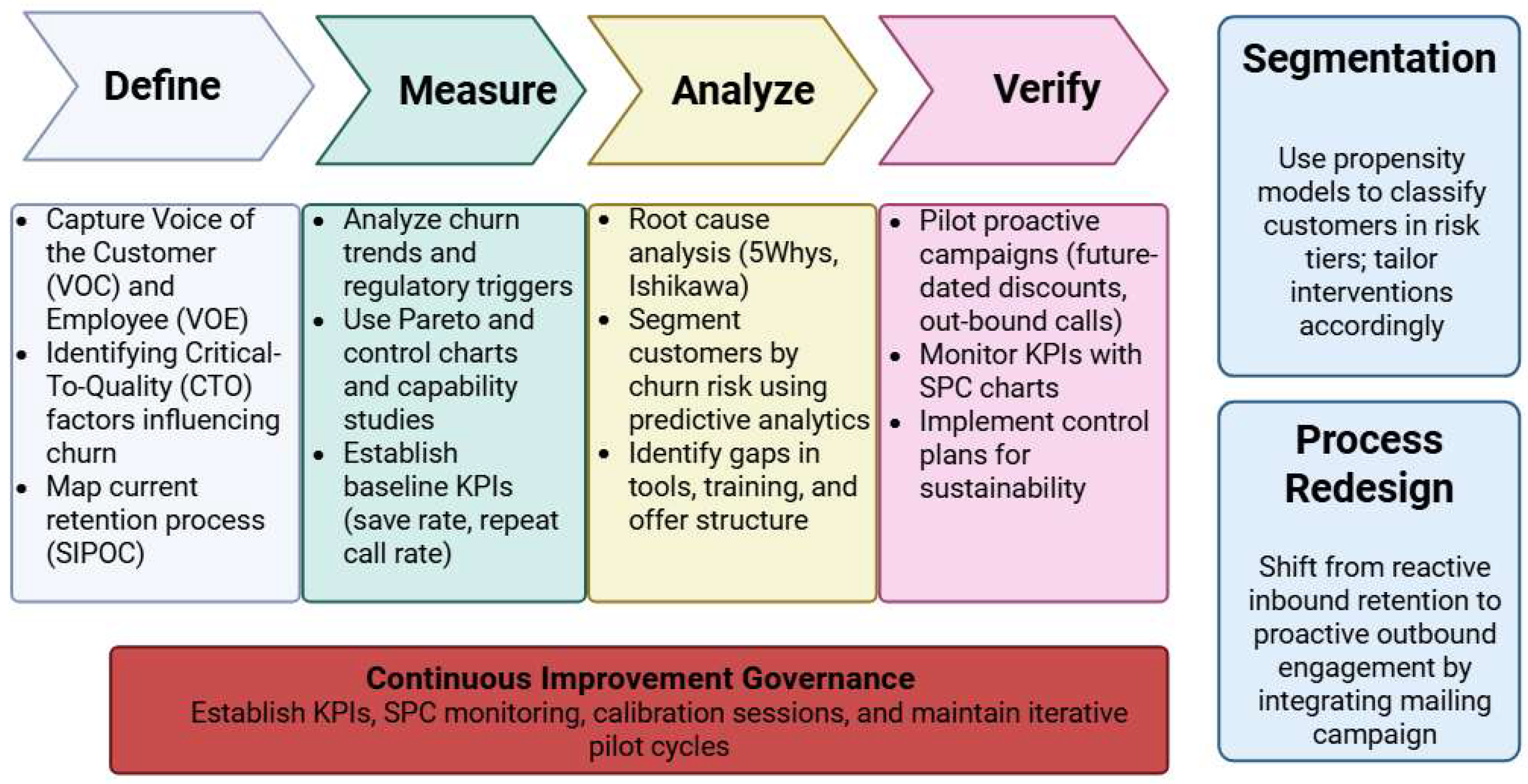
| Define | Measure | Analyze | Design | Verify |
|---|---|---|---|---|
| SIPOC | Check sheets | Ishikawa diagram | Pilot implementation plan | Pilot execution |
| Project charter | Pareto chart | 5 Why’s analysis | New process creation | Visual controls |
| Voice of the Customer | Capability study | Workshop brainstorming | Standard work script | Training plan |
| Stakeholder Analysis | Control charts | Process flows | New metrics | Statistical process controls |
| Gemba walk | Critical to quality tree | Design of experiments | Gemba follow ups |
| Source | Description | Period | Volume | Purpose |
|---|---|---|---|---|
| Agent Surveys | Internal surveys on retention challenges and tools | 2 months | 250 surveys (5 agents) | VOE; identify pain points |
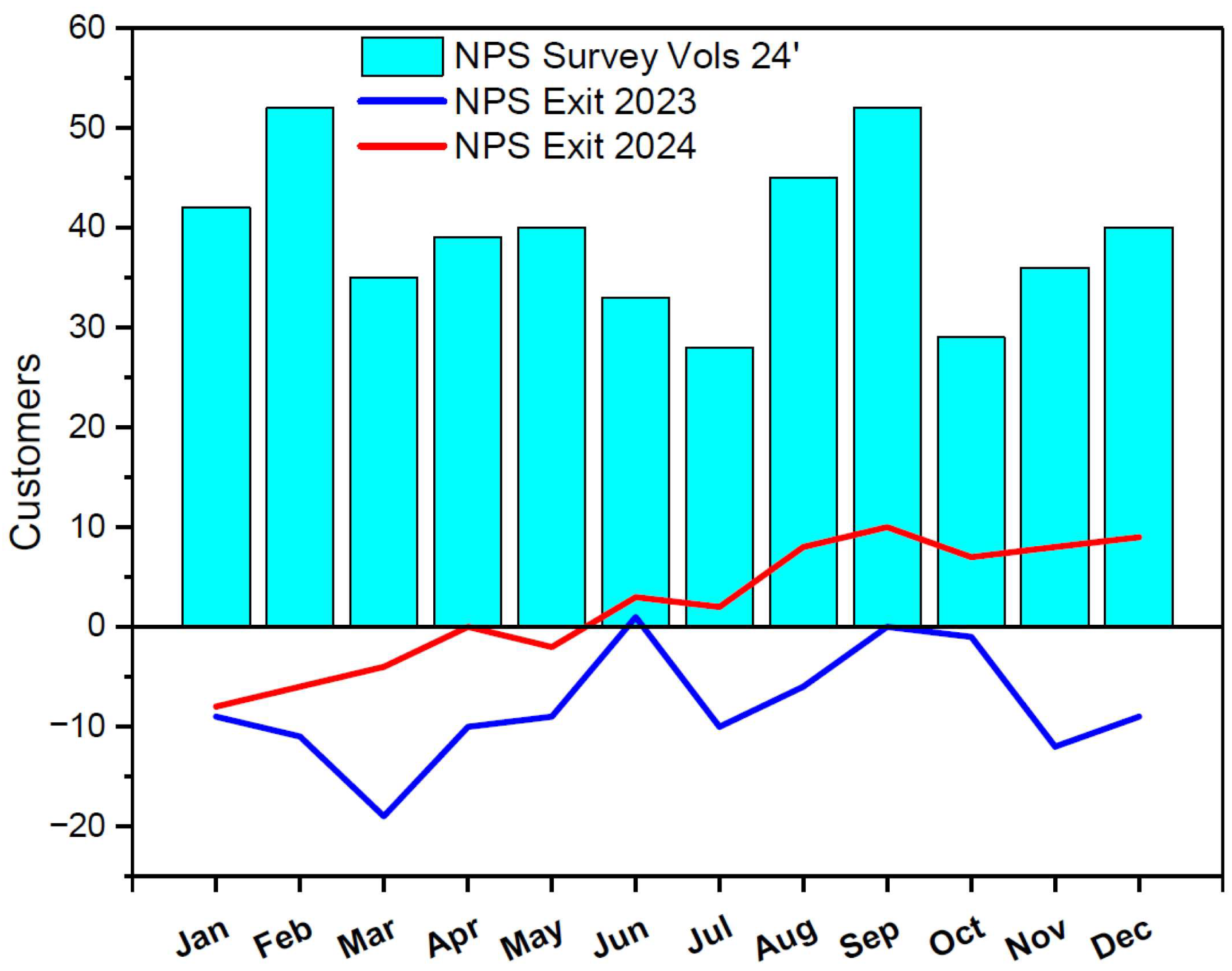
| Customer Surveys (NPS and VOC) | Feedback from exit journey customers | 2 months | 250 surveys (5% of 5000 churn base) | Identify CTQ factors |
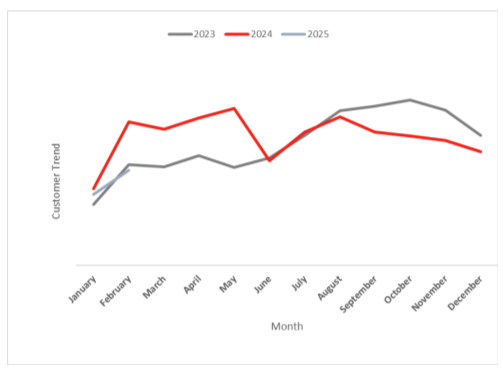
| Operational Churn Data | Broadband churn and cancellations from CRM | Historical | ~100,000 base customers live | Analyze churn trends and lifecycle |
| Retention Segment Volumes | Segmentation: reactive vs. proactive | Pilot and baseline | Reactive: 10 k/month; Proactive: 6 k/month | Targeting and evaluation |
| Process Performance Metrics | Save rate, tenure, cancellation rates | Historical and pilot | Population-level | Capability analysis and pilot verification |
| Workshops and Qualitative Inputs | Kaizen, Gemba walks, brainstorming | Project duration | Multiple agents and leaders | Root cause analysis and future-state design |
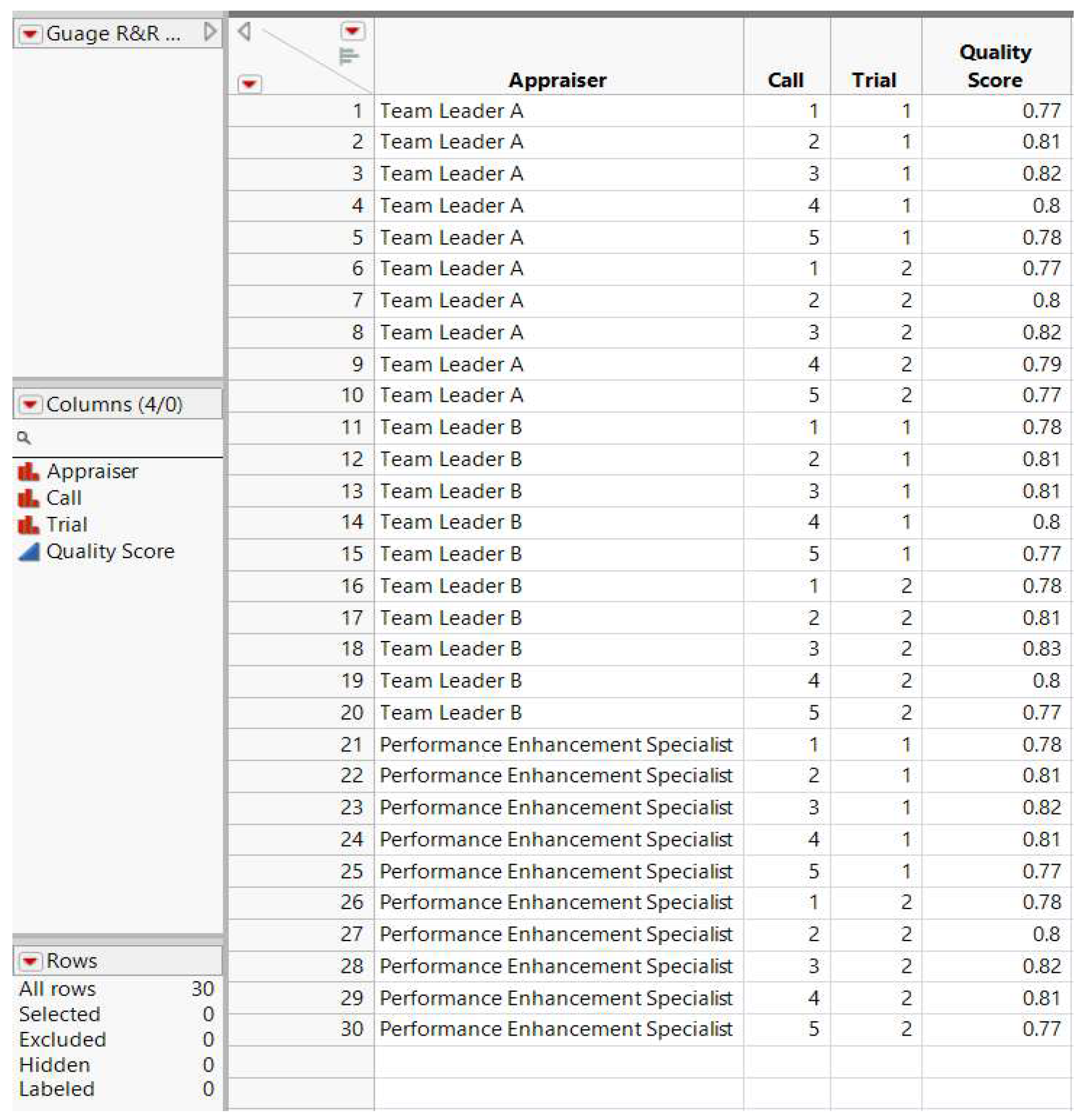
| Aspect | Design of Experiment (DOE) | Gauge R&R (Measurement Reliability) |
|---|---|---|
| Objective | Identify coaching factors impacting call quality and save rate % | Assess repeatability and reproducibility of call scoring |
| Factors | Agent tenure, coach tenure, feedback location, timing, frequency | Appraisers (3), calls (5), trials (2) |
| Levels | Each factor at 2 levels (e.g., low vs. high, in-office vs. online) | Same scorecard template across evaluators |
| Design | Resolution V fractional factorial, 16 runs, 2 blocks (location) | Randomized scoring of calls by multiple evaluators |
| Response Variables | Call quality score, save rate % | Call quality score consistency |
| Main Effects | Agent tenure (most significant), coach tenure, feedback location | Slight bias: Team Leader A scored lower consistently |
| Model Fit | Adjusted R2 > 70%, strong explanatory power | Variance components: 10.51% (acceptable) |
| Power Analysis | 94% → high likelihood of detecting true effects | %Tolerance: 16.89% (within permissible limits) |
| Reliability Outcome | DOE robust, refined model focuses on top 3 factors | Measurement system acceptable but needs calibration |
| Recommendations | Optimize coaching onsite, refine hiring and scheduling | Regular calibration meetings, updated manuals, training |
| Pain Points When Contacting Telecommunication Company | Suggestions for Improvement | Satisfaction Score |
|---|---|---|
| I’m always asked to call back if I’m still in contact as I can get an offer today. | Allow me to renew my contract today. | 6 |
| Wait times can be high, and then I’m asked to call again, as I can’t renew my contract today. | Give me an offer today, and don’t lose my current offer. | 4 |
| Agents are friendly, but I was told I couldn’t renew my contract despite receiving an email. | Renew my contract when I call, so I don’t have to wait again. | 8 |
| Contract notification received too early; I can’t renew without losing my offer. | Contact me when I can renew or allow renewal when I call. | 6 |
| As a loyal customer, I recontract every year but was asked to call back again. I missed it and got a full bill. | Allow me to recontract and enjoy the rest of my current offer. | 7 |
| Unable to recontract when I call. | Let me recontract with a new offer when the current one expires. | 8 |
| Told by agent to call back to take on a new contract. | Let me update today and reduce my waiting times. | 7 |
| The agent said they could apply for a discount but asked me to call back. | Allow the agent to apply for a new offer, so I don’t have to call again. | 6 |
| I want to stay a customer but couldn’t recontract last month. | I should have been able to renew my contract when I called. | 5 |
| Waited on the line only to be told I can’t renew yet. | Reduce wait times and let me start a new contract when I call. | 5 |
| Suppliers | Input | Processes | Outputs | Customers |
|---|---|---|---|---|
| External Customers Inbound Agents IT Customer Value Management Planning Team Operations Leadership Group Business Information Team Training Team Legal Team Finance Team | Customer inbound phone calls Agent outbound phone calls Customer emails Tiered Offer Management—Spend Management System Updates—Next Best Offer Updates Headcount Planning and Management Data for daily KPIs Order data Customer Propensity to Churn Conversational Framework | Customer contacts and indicates decisions to terminate contract with retention agent The agent handles queries, asks customer details and gathers further information Customer indicates reason for leaving and agent attempts to save the customer using retention offer toolkit. If the customer agrees, the order is entered into the system. If not, the process continues to step 4. Customer decides to be contacted for termination with Save Agent Team, and Agent processes this in the system to reflect the decision Customer receives follow-up communication via email based on their decision | Orders entered Customer recontacted Customer terminated KPI Overview: Inbound Save Rate, Outbound Save Volume of customers saved, cancelled orders Agent Interactions on System re outcome of their discussion Customer Rights Directive if a new contract has been agreed Customer in contract/out of contract details sent back later Customer receives email with details of termination if they decide to leave In Contract Cancellation Fee applied if a customer terminates within their contract period Revenue—Discount spend Next Best Offer: through using the tool, it informs the system of how it can approve the offer it recommends for customer type Revenue Lost—Customer churns and moves to competitor | Customers Inbound Agents Customer Value Management Planning Team Operations Leadership Group Finance Team Competitors—Customers Switching Business Information Team |
| Causes | Cumulative Total | Cumulative % | 80% (80/20 Rule) | |
|---|---|---|---|---|
| Unhappy with overall price and loyalty shown | 250 | 250 | 50% | 80% |
| Coming to end of contract and looking to switch | 100 | 350 | 70% | 80% |
| Looking to move house | 80 | 430 | 86% | 80% |
| Technical issues | 40 | 470 | 94% | 80% |
| Billing issues | 30 | 500 | 100% | 80% |
| Action No | Action | Owner | Timeline |
|---|---|---|---|
| 1 | Block schedule coaching sessions for each agent weekly into the last hour of the agent shifts. | Planning Manager | 30-Nov |
| 2 | Review hiring plan of team leaders to attract team leaders of higher tenure into the business. | Recruitment/Training Manager | 15-Dec |
| 3 | Change model for agents with tenure < 6 months to be onsite full time for the first 6 months. | Recruitment/Training Manager | 01-Jan |
| 4 | For agents >6 months tenure, move to a model with >75% of time spent onsite. | Senior Operations Managers | 01-Feb |
| 5 | Plan 2 coaching sessions per week with agents < 6 months tenure, using high-tenure coaches. | Planning Manager | 01-Jan |
| 6 | Offer regular training updates to reinforce standards and address new criteria or process changes. | Recruitment/Training Manager | Ongoing |
| 7 | Organize weekly calibration meetings, where evaluators review and score the same calls together. | Senior Operations Managers | Ongoing |
| 8 | Develop a scoring manual with best practices, common pitfalls, and feedback tips. | Recruitment/Training Manager | 20-Dec |
| 9 | Create a distraction-free space in the contact center for evaluators. | Site Director | 01-Mar |
| 10 | Provide training on common biases affecting scoring (e.g., halo effect, leniency, central tendency). | Not specified | Not specified |
Disclaimer/Publisher’s Note: The statements, opinions and data contained in all publications are solely those of the individual author(s) and contributor(s) and not of MDPI and/or the editor(s). MDPI and/or the editor(s) disclaim responsibility for any injury to people or property resulting from any ideas, methods, instructions or products referred to in the content. |
© 2026 by the authors. Licensee MDPI, Basel, Switzerland. This article is an open access article distributed under the terms and conditions of the Creative Commons Attribution (CC BY) license.
Share and Cite
Mulcahy, E.; Moran, R.; Walsh, P.; Trubetskaya, A. Creating a Proactive Churn Retention Strategy in a Telecommunications Company Through the Application of Design for Lean Six Sigma. Sustainability 2026, 18, 1400. https://doi.org/10.3390/su18031400
Mulcahy E, Moran R, Walsh P, Trubetskaya A. Creating a Proactive Churn Retention Strategy in a Telecommunications Company Through the Application of Design for Lean Six Sigma. Sustainability. 2026; 18(3):1400. https://doi.org/10.3390/su18031400
Chicago/Turabian StyleMulcahy, Enda, Rachel Moran, Patrick Walsh, and Anna Trubetskaya. 2026. "Creating a Proactive Churn Retention Strategy in a Telecommunications Company Through the Application of Design for Lean Six Sigma" Sustainability 18, no. 3: 1400. https://doi.org/10.3390/su18031400
APA StyleMulcahy, E., Moran, R., Walsh, P., & Trubetskaya, A. (2026). Creating a Proactive Churn Retention Strategy in a Telecommunications Company Through the Application of Design for Lean Six Sigma. Sustainability, 18(3), 1400. https://doi.org/10.3390/su18031400