Article

Drought Effects on Seed Yield Stability and Oil Quality Traits in Different Rapeseed Genotypes: Toward Adaptive Sustainability of Crops in Semi-Arid Regions


1
Research Unit of Plant Breeding and Plant Genetic Resources Conservation, Regional Agricultural Research Center of Meknes, National Institute of Agricultural Research, Rabat 10090, Morocco
2
Laboratory of Natural Resources and Environment, Polydisciplinary Faculty of Taza, Sidi Mohamed Ben Abdallah University, Taza 35000, Morocco
3
Biotechnology, Environment, Agri-Food and Health Laboratory, Faculty of Sciences, Dhar el Mahraz, Sidi Mohamed Ben Abdellah University, Fez 30000, Morocco
4
Department of Agronomy and Plant Breeding, National School of Agriculture of Meknes, Meknes 50000, Morocco
*
Authors to whom correspondence should be addressed.
Sustainability 2026, 18(3), 1388; https://doi.org/10.3390/su18031388
Submission received: 31 December 2025 / Revised: 25 January 2026 / Accepted: 27 January 2026 / Published: 30 January 2026
(This article belongs to the Section Air, Climate Change and Sustainability)

Abstract

Rapeseed (Brassica napus L.) is a major oilseed crop worldwide, particularly valued for its high yield potential, favorable fatty acid composition, and its bioactive compounds that improve nutritional and industrial quality. However, its productivity and oil quality are increasingly compromised by climate change-induced water scarcity, particularly in semi-arid Mediterranean regions. In this study, the performance of 17 genotypes was evaluated under well-watered (irrigated) and rainfed (stressful) conditions across two contrasting locations, Douyet Experimental Station (DYT) and Ecole Nationale d’Agriculture de Meknès (ENAM), during the 2023/2024 growing season. The assessment concerned seed yield, oil traits, and nutraceutical quality. The results obtained show that drought stress significantly reduced seed yield by about 26% (from 2.29 to 1.69 t ha−1) and decreased oil content by about 8.3% (from 41.1% to 37.7%). The highest reductions were observed for sensitive genotypes, particularly ‘IND23’, ‘IND82’, and ‘H2M-5’, while ‘Moufida’, ‘Nap9’, and ‘TP2’ maintained seed and oil yield above the overall average across both water regimes. Drought also impacted the accumulation of secondary metabolites, with mean total phenolic content increasing from 5.41 to 9.98 mg GAE g−1 (+84.5%) and total flavonoid content rising from 25.25 to 34.93 mg QE g−1 (+38.3%) under rainfed conditions, accompanied by marked increases in antioxidant activity (DPPH, ABTS), particularly for ‘Moufida’, ‘Nap9’, ‘TP2’, and ‘Marina’. Oil quality indices remained within Codex Alimentarius standards, with a slight increase in acidity values accompanied by a decrease in peroxide values, thus suggesting improved oxidative stability. Principal component analysis grouped genotypes into distinct clusters, with an elite group (‘Moufida’, ‘Nap9’, and ‘TP2’) characterized by yield stability, accumulation of phenolics, and high antioxidant activity, thus confirming their strong adaptation to the dry conditions of the Mediterranean region. These drought-tolerant lines, with high agronomic performance combined with good nutritional quality, can be recommended as valuable cultivars for sustainable and high-quality rapeseed production in dry Mediterranean regions.

1. Introduction

Rapeseed (Brassica napus L.) is a globally important oilseed crop cultivated across diverse agroecological regions, ranging from temperate to semi-arid zones [1,2]. Its global production reached 68.9 million tonnes in 2024, covering approximately 33.7 million hectares [3]. Rapeseed contributes substantially to human as well as animal nutrition, owing to its high seed oil content and the important nutritional value of its protein-rich meal [4,5]. Its oil is prized for its favorable fatty acid profile with about 60% monounsaturated (oleic acid, C18:1), 20% polyunsaturated (linoleic and α-linolenic acids), and only ~7% saturated fatty acids, alongside a beneficial ω-6/ω-3 ratio, making it particularly advantageous for cardiovascular and metabolic health [6,7,8,9]. Additionally, the presence of sinapic acid derivatives and tocopherols enhances its oxidative stability and antioxidant capacity [10]. However, sustaining rapeseed productivity under semi-arid environments, such as those in the Mediterranean basin, including Morocco, is increasingly challenged by climate-induced drought events [11,12,13]. Drought stress during critical phenological stages, particularly flowering, disrupts physiological processes such as photosynthesis, stomatal conductance, and nutrient uptake, ultimately reducing seed yield, oil content, and oil quality [14,15]. Furthermore, drought alters fatty acid biosynthesis and impairs the production of antioxidant compounds, thereby degrading the oil’s nutritional value and oxidative stability [16,17].
Although advances in canola breeding, such as the development of high-oleic, low-linoleic (HOLL) varieties, have improved oil quality [18,19], the combined evaluation of drought-tolerance and oil quality remains little explored, especially under field conditions reflective of semi-arid climates. Brassica juncea and B. rapa, for example, have demonstrated superior tolerance to abiotic stress in warm and dry environments [20]; however, limited research has addressed the dual challenge of maintaining both yield stability and oil quality in B. napus under water-deficient conditions. To date, only a few integrated studies have evaluated B. napus genotypes under drought by simultaneously considering yield, oil quality, and biochemical indices in semi-arid field environments [9,21,22,23,24,25]. The detrimental impacts of water stress, particularly the reduction in biomass, floral fertility, pod and seed formation, and alterations in oil composition, are well established [26,27,28]. However, the interactions between genotype and water availability for the oil’s biochemical attributes remain insufficiently investigated.
In Morocco, over the last 20 years, many rapeseed germplasms and inbred lines have been developed, of which nine varieties with good agronomic performance, high oil content, and canola quality have been registered [13,29,30]. Very recently, it was reported that some of those inbred lines and varieties, including ‘Nap10’, ‘Nap9’, and ‘Baraka’, exhibited drought tolerance at early growth stages under in vitro [31] and controlled greenhouse conditions [32]. However, despite reported variation in drought responsiveness in controlled or early-stage evaluations, the oil quality of these materials has rarely been assessed under water deficits in multi-environment field conditions. Therefore, we selected a panel of 17 genotypes representative of the genetic and agronomic diversity currently used or targeted in Moroccan/Mediterranean semi-arid production systems (including released cultivars and advanced lines) [9] and evaluated their performance under two water regimes (irrigated vs. rainfed) across two contrasting environments. The assessment covered several parameters, including seed yield, oil content, total phenolic content (TPC), total flavonoid content (TFC), antioxidant activities (DPPH and ABTS), and lipid quality indices (acidity, peroxide, iodine, and refractive index). The subsequent objective of the study was to identify genotypes that combine drought tolerance with high oil quality, thereby supporting the development of cultivars adapted to dry environmental conditions and enhancing the nutritional value, sustainability, and utilization of this strategic oilseed crop.

2. Materials and Methods

2.1. Experimental Sites and Climatic Conditions

A field experiment was conducted during the 2023–2024 growing season at two distinct agro-climatic locations in Morocco under two contrasting water regimes (irrigated and rainfed). The first site is the INRA Douyet Experimental Station (DYT), located approximately 10 km from Fez city (34°04′ N, 5°07′ W; 416 m a.s.l.). The site receives an average annual rainfall of 350 mm and has a Mediterranean climate characterized by cold and Sirocco winds, wet winters, and hot, dry summers, with an average annual temperature of 18.5 °C [33]. The soil is classified as a vertisol with a texture composed of 29% clay, 58% silt, and 12% sand. The second site is the experimental farm of the National School of Agriculture of Meknes [34], situated approximately about 10 km away from Meknes city (33°50′ N, 5°28′ W; 906 m a.s.l.). This site presents a warm temperate climate with precipitation concentrated during the winter season. The mean annual rainfall is 509 mm, and the average annual temperature is 17.4 °C. The soil is moderately deep, with a clay loam texture, neutral pH, and a gentle slope.

2.2. Plant Material

Seventeen rapeseed genotypes were evaluated, including six pure lines, two synthetic varieties registered in Morocco, three elite breeding lines, two accessions from Australia, two accessions from Pakistan, and two commercial hybrid cultivars from Germany, also registered in Morocco. The selected genotypes differ in plant architecture, phenological behavior (early to late flowering and maturity), branching pattern, leaf and silique morphology, biomass production, and reported yield stability under contrasting water availability, which are traits commonly associated with drought adaptation. A detailed description of genotypes, including origin, registration year, and key morphological and agronomic traits, is presented in Table 1.

2.3. Experimental Design and Water Regimes

A completely randomized design (CRD) with three replications was used at each site. Sowing was performed manually in the second week of November 2023, following regional technical recommendations for rapeseed cultivation. Plots consisted of 3 m-long rows spaced 0.6 m apart. A basal fertilizer of 60 kg ha−1 nitrogen (N), 80 kg ha−1 phosphorus (P2O5), and 80 kg ha−1 potassium (K2O) was applied before sowing. Thinning was performed at the two-leaf stage to ensure a uniform interplant distance of 4–5 cm. Manual weeding was carried out at the rosette stage, and insecticide treatments were applied based on pest monitoring thresholds. A topdressing of 60 kg ha−1 nitrogen was split equally between the rosette and flowering stages.
A drip irrigation system was used to manage water delivery, consisting of 16 mm-diameter polyethylene pipes fitted with emitters rated at 2 L/h. Field performance measurements showed the emitters maintained an average flow rate of 1.6 L/h over a continuous two-hour irrigation period, with a calculated uniformity coefficient (UC) of 92.81%. Irrigated plots were watered twice per week, and the irrigation volume was determined based on daily weather data. The amount of water required was calculated as the difference between crop evapotranspiration (ETc) and effective rainfall to offset moisture losses. ETc (mm/day) was estimated using the FAO Penman–Monteith method [37], according to the equation ETc = ET0 × Kc, where ET0 is the reference evapotranspiration, and Kc is the crop coefficient. In contrast, rainfed plots received no supplemental irrigation and relied exclusively on natural rainfall throughout the growing season. All plots were mechanically harvested at full physiological maturity in late June, and grain yield was measured after adjusting seed moisture content to 10%.

2.4. Seed and Oil Yields

After harvest, seed yield (kg ha−1) was determined for each genotype under both water regimes. Grain moisture content was adjusted to 10% before yield calculation, as described by Channaoui et al. [24]. Oil extraction was carried out using a semi-automated solvent extractor (SER 148/6, VELP Scientifica, Usmate Velate, Italy) operating according to the Randall (hot solvent extraction/Soxtec) technique (immersion–rinsing–recovery). For each sample, 20 g of crushed seeds were extracted with 150 mL of n-hexane for 3 h using a Soxhlet apparatus under reflux at atmospheric pressure. The heating mantle set-point (130 °C) was adjusted to maintain a constant reflux rate at the hexane boiling point (≈69 °C). The solvent was removed by evaporation at 40 °C using a rotary evaporator (HAHNVAPOR, HAHNSHIN, Gimpo, Republic of Korea).
Oil content (%) was calculated using the following equation:
Oil content (%) = [(M1 − M0)/M2] × 100
where
  • M0 = mass of the empty flask (g)
  • M1 = mass of the flask after solvent evaporation (g)
  • M2 = initial mass of the seed sample (g)
Extracted oil samples were stored at 4 °C in the dark until further physicochemical and biochemical analyses. Oil yield (kg ha−1) was calculated by multiplying oil content (%) by seed yield (kg ha−1).

2.5. Drought Tolerance and Yield Stability Indices

Drought tolerance indices were employed to discriminate the canola genotypes evaluated under well-watered and drought conditions. Two widely used indices were calculated to assess yield stability and drought tolerance according to the following formulas:
  • Stress Tolerance Index (STI) [38]:
STI = (Yp × Ys)/(Ȳp)2
  • Yield Stability Index (YSI) [39]:
YSI = Ys/Yp
where Ys is the seed yield under drought stress conditions, Yp is the seed yield under well-watered conditions, and Ȳp represents the mean seed yield of all genotypes under non-stress conditions.

2.6. Physicochemical Analysis

The physicochemical properties of rapeseed oil were determined following international standards, as presented by Guirrou et al. [9]. The acidity index (mg KOH/g oil) was measured by titration of an oil–ethanol solution with ethanolic KOH, according to NF EN ISO 660:2009 [40]. The peroxide value (mEq O2/kg oil) was assessed by iodine titration, following NF ISO 3960:2004 [41]. The iodine value (g I2/100 g oil) was determined using ISO 3961:2018 [42], in which oil samples were reacted with Wij’s reagent, and excess iodine was titrated with sodium thiosulfate. The refractive index at 20 °C was measured with an Abbe refractometer (BK-R2S, BIOBASE, Jinan, China), following ISO 6320:2017 [43].

2.7. Biochemical Analysis

2.7.1. Phenolic Extraction

Phenolic compounds were extracted following the protocol of Tsimidou et al. [44], with slight modifications. Briefly, 2 g of oil were dissolved in 10 mL of n-hexane and mixed with 4 mL of 60% (v/v) methanol. The mixture was vortexed and kept under continuous agitation for 2 h at room temperature in the dark. After extraction, the samples were filtered through Whatman No. 1 filter paper. All extractions were performed in triplicate. The filtrates obtained from the three extractions were pooled, washed with 10 mL of hexane to remove residual lipids, and stored at 4 °C in amber vials until analysis.

2.7.2. Total Phenolic Content

The total phenolic content (TPC) was determined using the Folin–Ciocalteu method [45]. A total of 50 μL of extract was mixed with 3.0 mL of distilled water, 250 μL Folin–Ciocalteu reagent, and 750 μL of 7% sodium carbonate. After 8 min, 950 μL of distilled water was added, and the solution was incubated in the dark for 2 h. Absorbance was measured at 765 nm using a UV–Vis spectrophotometer (V-530, Jasco GmbH, Pfungstadt, Germany). Results were expressed as mg gallic acid equivalents per 100 g of oil (mg GAE/100 g).

2.7.3. Total Flavonoid Content

The total phenolic content (TFC) was determined using the method of Favati et al. [46], with modifications. An extract aliquot 0.5 mL was mixed with 0.5 mL of 2% aluminum chloride solution in methanol. After 15 min of incubation at room temperature, absorbance was recorded at 430 nm using methanol as a blank. Quercetin was used for the standard curve, and results were expressed as mg quercetin equivalents per 100 g of oil (mg QE/100 g).

2.7.4. Free-Radical Scavenging Activity (FRSA)

Antioxidant activity was assessed using both DPPH and ABTS•+ assays, as originally described by Brand-Williams et al. [47] and Re et al. [48], respectively, with slight modifications.
  • DPPH assay: A total of 50 μL of oil extract was mixed with 950 μL of 0.030 mg/mL DPPH methanolic solution. After 60 min of dark incubation at room temperature, absorbance was measured at 515 nm. The percentage of inhibition was calculated as follows:
FRSA (%) = [(Ac − Ae)/Ac] × 100
where Ac and Ae represent the absorbance of the control and sample, respectively.
  • ABTS assay: ABTS•+ was prepared by mixing 7 mM ABTS with 2.45 mM potassium persulfate and incubating for 18 h in the dark. The resulting solution was diluted with methanol to an absorbance of 0.700 ± 0.05 at 734 nm. Then, 10 μL of extract or water (control) was added to 990 μL of ABTS•+ solution and incubated in darkness for 30 min. Absorbance was read at 734 nm, and inhibition was calculated as follows:
FRSA (%) = [(Ac − Ae)/Ac] × 100
where Ac represents the absorbance of the control, and Ae represents the absorbance of the sample.

2.7.5. Quality Control and Data Expression

All extractions and colorimetric assays were performed in triplicate for each sample. Reagent blanks were included for each batch, and calibration curves were prepared using gallic acid (TPC) and quercetin (TFC) standards. Results are reported as “extractable” phenolics/flavonoids under the present extraction conditions (methanolic fraction after hexane defatting). Absolute recovery/extraction efficiency was not determined; therefore, values should be interpreted comparatively among genotypes and treatments rather than as absolute totals.

2.8. Statistical Analyses

All statistical analyses were performed using R software (version 4.3.2). The experiment was arranged in a completely randomized design (CRD) with three replicates. Data were analyzed using a three-way ANOVA with Genotype (G), Water regime (W), and Site (S) as fixed factors, including their interactions. Mean differences among irrigation regimes, canola genotypes, and their interactions were compared using the Tukey HSD test (p ≤ 0.05). Principal component analysis (PCA) was performed to classify genotypes and identify key traits contributing to drought tolerance and oil quality.

3. Results

3.1. Climatic Data Analysis

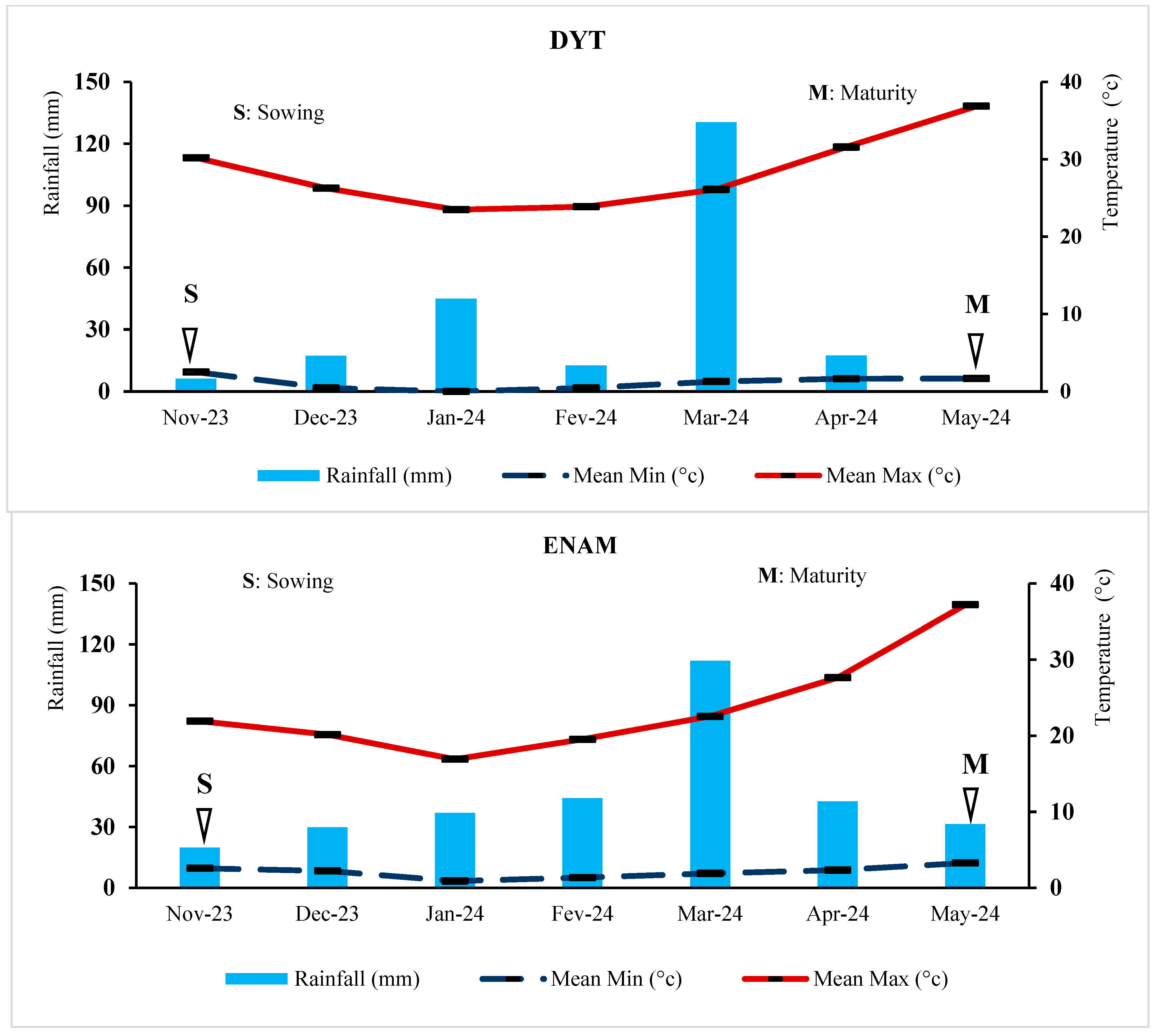
In both environments, meteorological variables were recorded continuously using an automated weather stations Figure 1 summarizes rainfall and temperatures registered during the 2023–2024 cropping season. Climatic conditions confirm that rapeseed genotypes at both experimental sites experienced substantial water limitation. At DYT, cumulative rainfall reached only 229.5 mm, with very low precipitation during sowing and emergence (6.2–17.2 mm in November–December), well below the 30–40 mm required for uniform establishment in Mediterranean environments [49]. Vegetative growth also occurred under moisture deficit, as January rainfall (44.9 mm) remained below the 60–80 mm/month typically needed for canopy development [50]. The most severe shortage occurred during bolting and the beginning of flowering (February), which received only 12.6 mm, a drought-sensitive phase in rapeseed development [51]. Also, the last developmental stages (April–May), corresponding to pod onset and seed-filling, received less than 18 mm/month combined with rising temperatures (>19–23 °C), thus generating pronounced late drought [52]. Nevertheless, during the full-flowering stage, occurring in March, the experimental trials were well-watered, as they registered 130.4 mm of rain in DYT and 112 mm in ENAM. On the other hand, ENAM recorded higher seasonal rainfall (296 mm compared to 229.5 mm at DYT), yet early-season precipitation remained limited (<50 mm), and late-season rainfall (<45 mm) was insufficient to meet crop water demand under progressively warmer conditions. Across both sites, cumulative rainfall remained below the 282–399 mm minimum reported for rapeseed in semi-arid regions [50] and under the 400–450 mm required for optimal spring rapeseed performance in Mediterranean climates [52].

3.2. Results of Analysis of Variance

The ANOVA results (Table 2) showed that water regime, genotype, and their interaction significantly affected seed yield, oil content, oil yield, total phenolic content (TPC), total flavonoid content (TFC), antioxidant activities (%DPPH and %ABTS), acidity index, peroxide index, iodine value, and refractive index. Water regime was the main driver of the observed variation, explaining more than 90% for TPC, %DPPH, and %ABTS, 70–85% for oil content, TFC, iodine value, acidity index, peroxide index, and refractive index, and more than 53% for seed yield. The environment strongly impacted seed yield (≈41%) and oil yield (≈31%), and also affected TFC and iodine value (≈18%). On the other hand, Genotype contributed most to refractive index (~23%) and explained 4–10% variation in oil content, acidity index, iodine value, and seed yield. Interaction effects, though significant for several traits, accounted for only 0.2–4% of variation, indicating stable genotype ranking across environments and water regimes. These results highlight opportunities to select high-performing, stress-resilient cultivars that combine drought tolerance with superior oil quality, adapted to arid and semi-arid regions, and supporting sustainable production of this strategic oilseed.
Taken together, these findings demonstrate that all investigated traits were primarily affected by water regime (irrigated vs. non-irrigated, followed by environmental conditions (location) and, to a lesser extent, genotype. This multilevel variability provides a robust basis for identifying promising cultivars with stable performance and desirable seed and oil traits under contrasting water availability.

3.3. Seed and Oil Yields

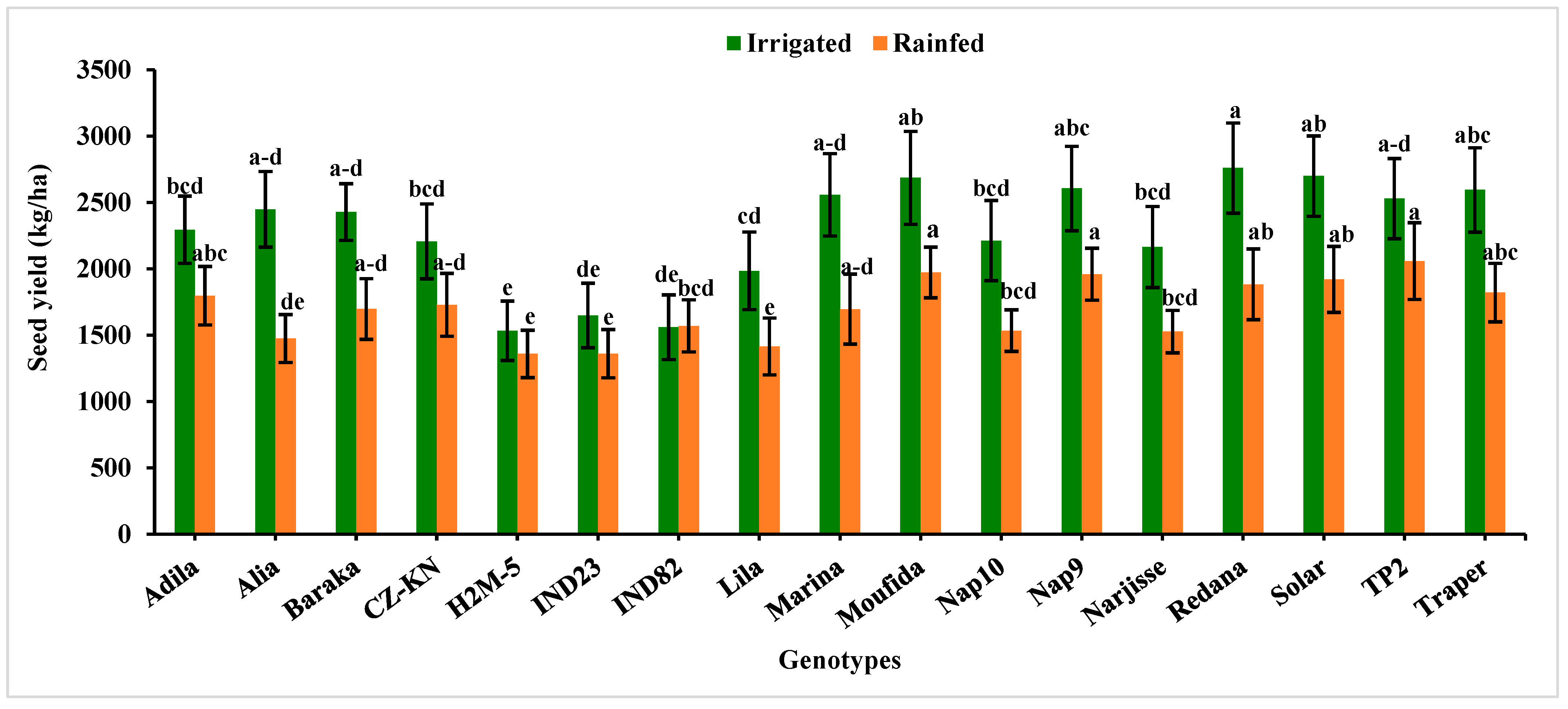
Under irrigated conditions, the overall mean seed yield was 2289.14 kg ha−1, with the highest yields obtained from ‘Redana’ (2759.03 kg ha−1), ‘Solar’ (2699.58 kg ha−1), and ‘Moufida’ (2686.22 kg ha−1) while the lowest yields were recorded for ‘IND82’ (1560.30 kg ha−1) and ‘H2M-5’ (1533.00 kg ha−1). Under rainfed (stressful) conditions, the overall mean yield declined to 1692.92 kg ha−1, with ‘TP2’ (2058.66 kg ha−1), ‘Moufida’ (1972.86 kg ha−1), and ‘Nap9’ (1960.13 kg ha−1) being the highest-performing, whereas ‘Lila’ (1414.88 kg ha−1), ‘IND23’ (1360.78 kg ha−1) and ‘H2M-5’ (1359.03 kg ha−1) exhibited the lowest values (Figure 2). Yield reductions under drought are generally attributed to impaired water uptake, photosynthesis, and assimilate partitioning, which shorten the seed-filling period and reduce biomass accumulation [14]. Despite these constraints, genotypes such as ‘TP2’, ‘Moufida’, and ‘Nap9’ consistently maintained the highest seed yields under rainfed conditions, confirming their superior performance and relative resilience. These findings are consistent with earlier studies that reported ‘Nap9’ and ‘Moufida’ as drought-tolerant at germination and seedling stages [12,31]. For irrigated conditions, the average yield (2.29 t ha−1) was very close to the value reported by Anastasi and Scavo [53] (2.27 t ha−1). However, under rainfed conditions, the mean seed yield recorded in the present study (1.69 t ha−1) was higher than those reported by Delgado [54] (1.45 t ha−1) and Morsi et al. [55] (1.54 t ha−1). Overall, these comparisons demonstrate that Moroccan genotypes, particularly ‘TP2’, ‘Moufida’, and ‘Nap9’, maintain competitive yields and resilience under contrasting water regimes, thus supporting their potential for cultivation in semi-arid Mediterranean environments.
As indicated above, the environment strongly influenced seed yield, with a significant difference detected between DYT and ENAM (p < 0.05) (Table 2). While yields were generally higher at ENAM, genotypes such as ‘TP2’, ‘Moufida’, and ‘Nap9’ maintained stable performance with only moderate reductions, indicating adaptability to contrasting environments (Table 3). This response is supported by high Stress Tolerance Index (STI) and Yield Stability Index (YSI) values (Table 4), indicating limited yield loss under drought and supporting the classification of these genotypes as drought-tolerant and yield-stable, with relevance for breeding under water-limited conditions.
Their yield stability highlights their potential value for breeding programs targeting resilience under variable and water-limited conditions.
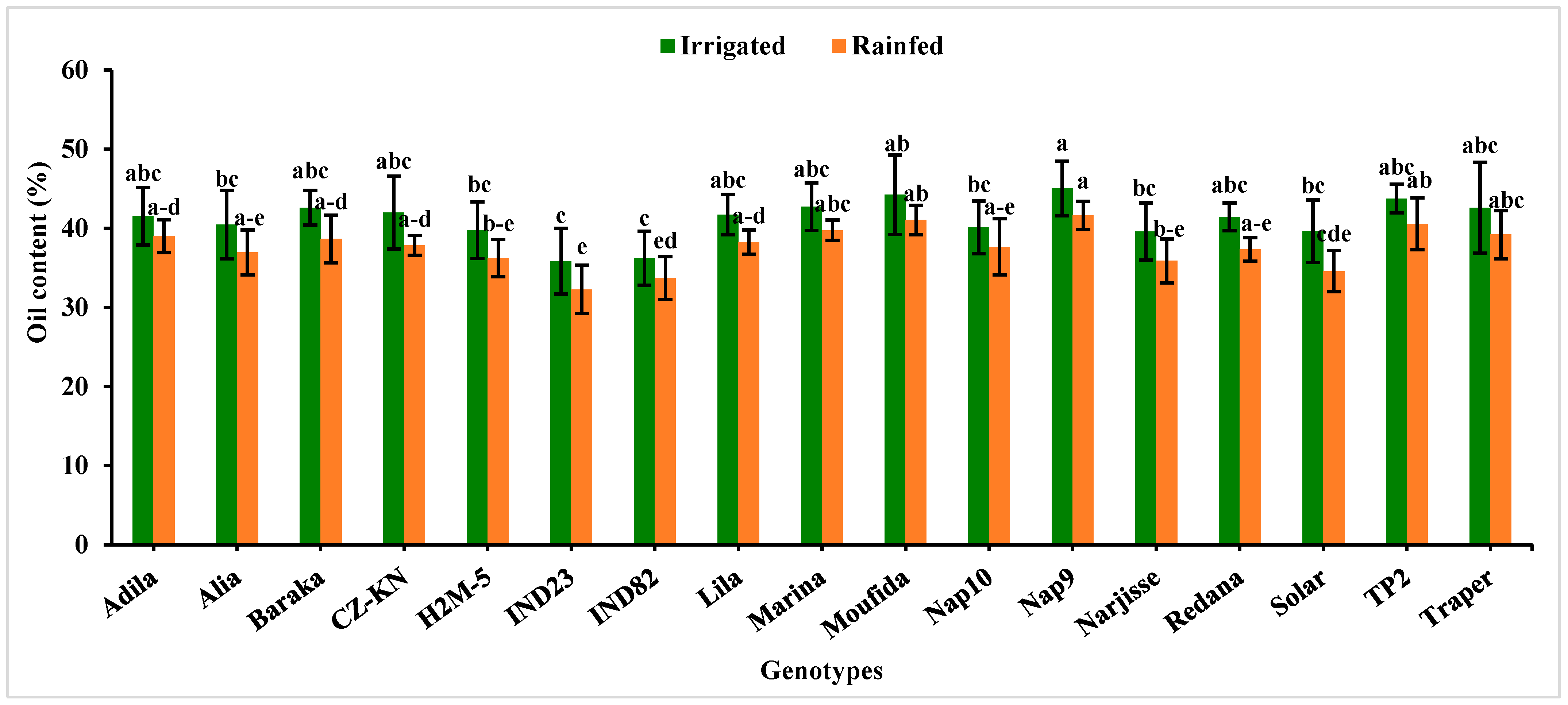
Under irrigated conditions, the mean oil content (OC) was 41.13%. The highest values were recorded for ‘Nap9’ (45.02%) and ‘Moufida’ (44.24%), whereas the lowest values were observed for ‘IND82’ (36.21%) and ‘IND23’ (35.83%). Under rainfed conditions, mean oil content declined to 37.68%, representing an overall reduction of 8.2% relative to optimal irrigation, with genotype-specific decreases ranging from 6.07% (‘Moufida’) to 12.74% (‘Solar’) (Figure 3). Overall, oil content was relatively little affected by water stress, indicating a moderate sensitivity of lipid accumulation to drought, in agreement with previous findings reported by Morsi et al. [55]. The observed reduction in OC under water deficit may be attributed to physiological constraints such as reduced carbon assimilation, impaired translocation of assimilates, and the reallocation of resources toward stress-defense mechanisms [56]. On the other hand, ‘Nap9’ (7.51% reduction) and ‘TP2’ (7.30% reduction) maintained relatively stable oil contents, which highlights their potential as promising candidates for oil production under water-limited conditions. Moreover, along with their high oil content, ‘Nap9’ and ‘Moufida’ have been identified as drought-tolerant genotypes at the germination stage [31], making them particularly suitable for cultivation in arid and drought-prone regions. These findings are consistent with previous studies on Moroccan genotypes, which reported OC values ranging from 36.7% to 39.9% and emphasized the important effect of the environment in regulating lipid accumulation [9].
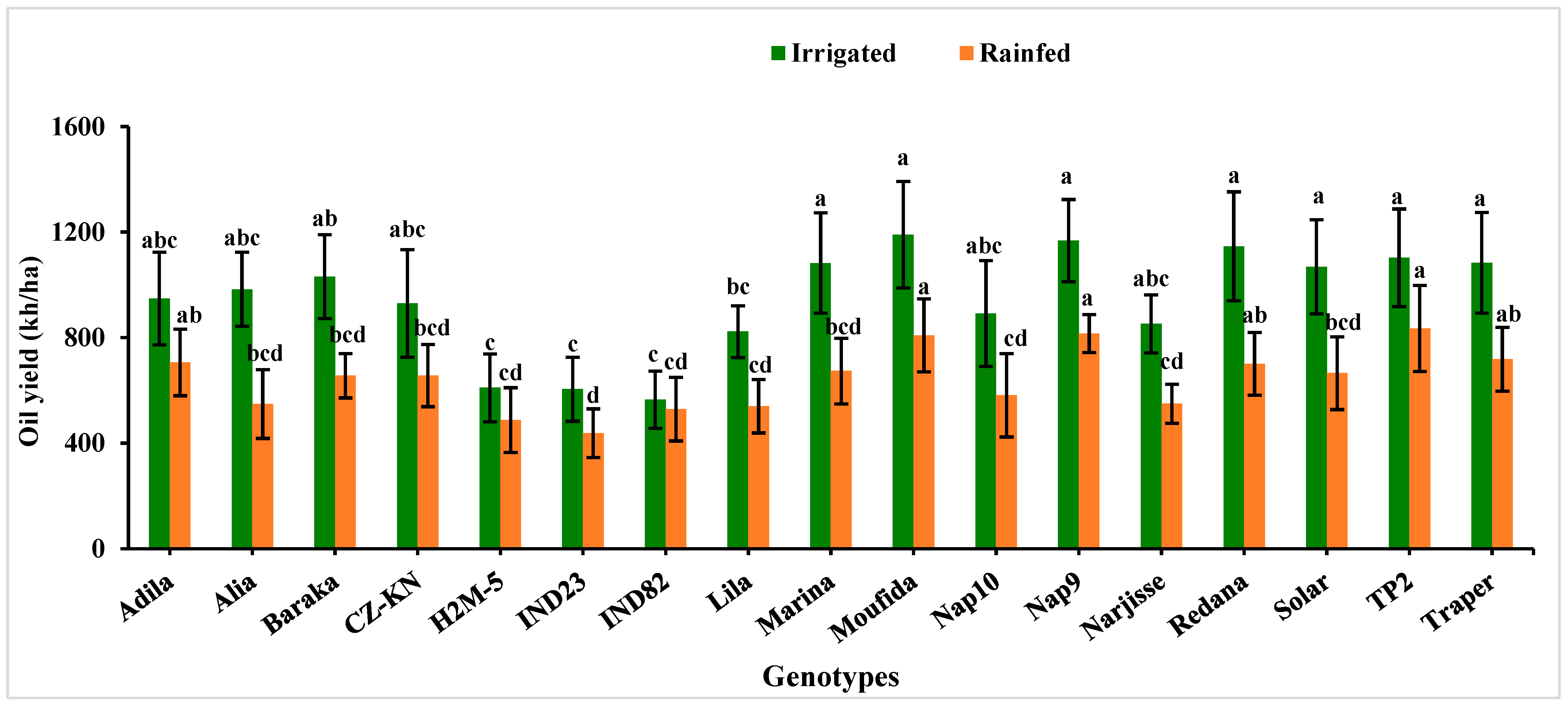
Under irrigated conditions, the average oil yield (OY) was 945.93 kg ha−1. The genotypes ‘Moufida’, ‘Nap9’, ‘Redana’, ‘TP2’, ‘Traper’, ‘Marina’, and ‘Solar’ achieved the highest yields with respective values of 1190.54, 1167.75, 1146.39, 1102.50, 1083.60, 1082.88, and 1068.42 kg ha−1, all exceeding the mean value, whereas ‘IND82’ (564.93 kg ha−1), ‘IND23’ (604.60 kg ha−1), and ‘H2M-5’ (609.94 kg ha−1) recorded the lowest values (Figure 4). Under rainfed conditions, the mean oil yield declined to 641.86 kg ha−1, with ‘TP2’ (835.25 kg ha−1), ‘Nap9’ (815.36 kg ha−1), and ‘Moufida’ (808.76 kg ha−1) maintaining above-average performance, while ‘IND23’ (438.06 kg ha−1) showed the lowest yields (Figure 4). Oil yield losses under drought are mainly attributed to restricted carbon assimilation due to stomatal closure, shortened seed-filling duration, and disruption of lipid biosynthesis during reproductive growth [50,57]. Nevertheless, ‘TP2’, ‘Moufida’, and ‘Nap9’ maintained the highest oil yields under rainfed conditions, as compared to the other genotypes (Figure 4). Consistent with these findings, previous studies also identified ‘Moufida’ and ‘Nap9’ as drought-tolerant genotypes, reporting oil yield reductions of approximately 23% under water deficit conditions [12]. In comparative terms, the mean oil yield under well-watered conditions of the present study (945.93 kg ha−1) was comparable to that reported under Mediterranean conditions in Sicily (960 kg ha−1) [58], while under rainfed conditions, the average oil yield (835 kg ha−1) exceeded values observed in semi-arid environments (650 kg ha−1) [54]. Overall, these results demonstrate that Moroccan genotypes, particularly ‘TP2’, ‘Moufida’, and ‘Nap9’, achieve competitive oil yields and maintain stability under both irrigated and water-limited environments, emphasizing their potential for cultivation in Mediterranean and semi-arid regions.
Overall, genotypes such as ‘Moufida’, ‘Nap9’, and ‘TP2’ maintained comparatively higher oil yields at both sites, although they experienced clear reductions when shifting from the ENAM site to the more water-limited DYT environment (Table 3). Consistent with their STI and YSI values (Table 4), these genotypes appear relatively better adapted and more yield-consistent across environments, making them promising candidates for breeding under variable, water-limited conditions.

3.4. Drought Tolerance and Yield Stability Indices

The stress tolerance index (STI) and yield stability index (YSI) were used as formal, quantitative measures to assess drought tolerance and yield stability of rapeseed (Brassica napus L.) genotypes across irrigated and rainfed environments (Table 4). The combined indices clearly discriminated genotype responses. ‘Nap9’, ‘TP2’, ‘Moufida’, and ‘Redana’ exhibited the highest joint STI (0.99–1.03) and YSI (0.91–1.02) values, quantitatively demonstrating their capacity to maintain high productivity under both stress and non-stress conditions, consistent with established selection criteria [38,59]. Notably, ‘Nap9’, ‘TP2’, and ‘Moufida’ showed YSI values close to or exceeding unity, indicating minimal yield reduction under rainfed conditions. In contrast, ‘H2M-5’ displayed the lowest STI (0.422), reflecting poor drought tolerance, while ‘IND23’ and ‘IND82’ combined low STI (<0.47) with moderate YSI, indicating stable but low-yielding responses rather than effective adaptation. ‘Solar’ showed the lowest YSI (0.560), revealing marked yield instability under drought. Overall, the joint STI–YSI analysis provides quantitative support for genotype classification and validates ‘Nap9’, ‘TP2’, ‘Moufida’, and ‘Redana’ as drought-tolerant and stable materials for Mediterranean semi-arid environments, in agreement with recent genetic evidence in rapeseed [55,60].

3.5. Physicochemical Analyses

3.5.1. Acidity Index (AI)

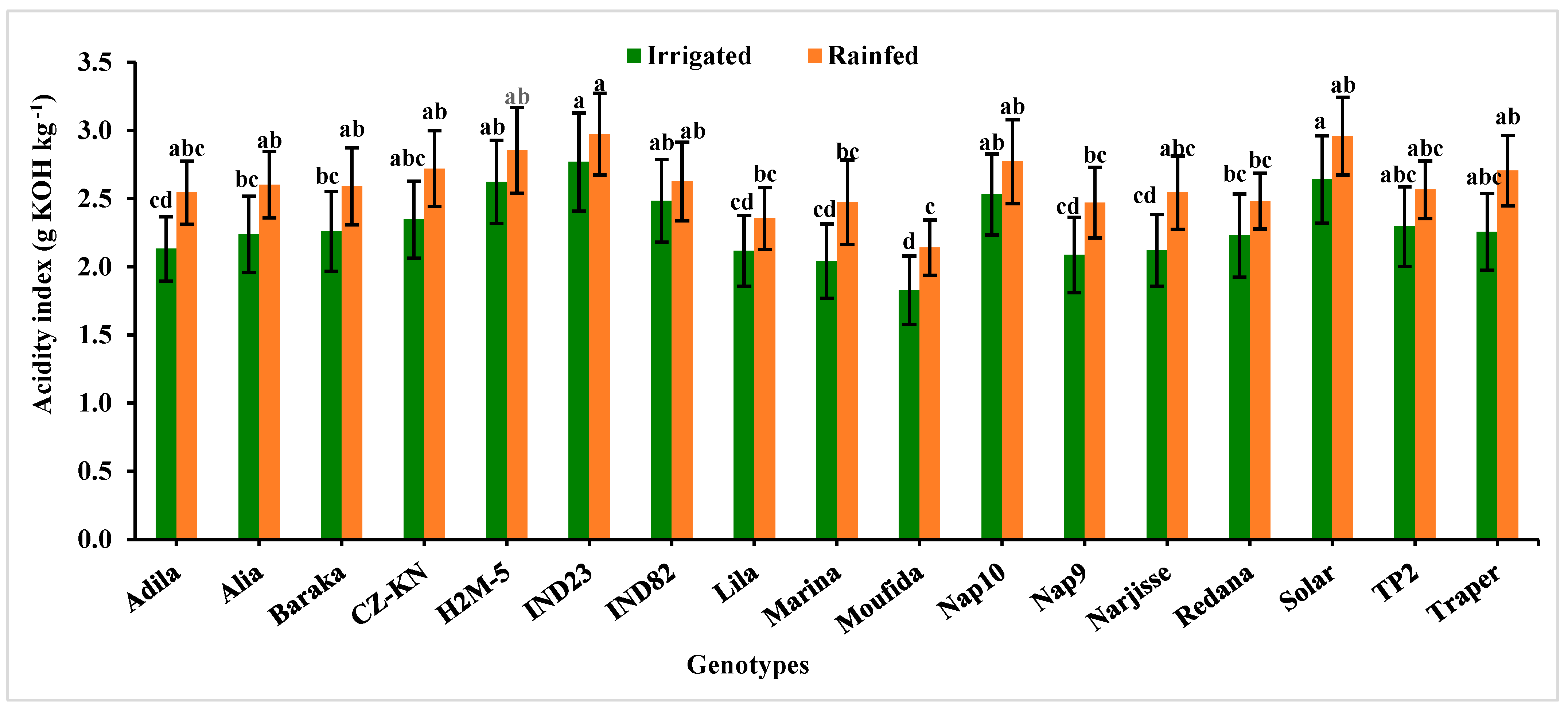
Under irrigated conditions, the overall mean acidity index (AI) was 2.29 mg KOH g−1. The highest values were observed for ‘IND23’ (2.76 mg KOH g−1) and ‘Solar’ (2.64 mg KOH g−1), whereas ‘Moufida’ (1.82 mg KOH g−1) showed the lowest values (Figure 5). Under rainfed conditions, the mean AI increased to 2.61 mg KOH g−1 (Figure 5). Once again, ‘IND23’ (2.97 mg KOH g−1) exhibited the highest indices, while the lowest were recorded for ‘Moufida’ (2.14 mg KOH g−1) (Figure 5). The drought-induced rise in AI is likely associated with accelerated lipid hydrolysis via lipase activation, promoting oxidative rancidity [61,62]. Similar trends have been reported for rapeseed and sunflower, where drought during seed filling increased free fatty acids and reduced oxidative stability [63]. In the present study, acidity index (AI) values slightly exceeded the 2.1–2.5 mg KOH g−1 range reported under milder conditions by Guirrou et al. [9], likely reflecting the harsher climatic constraints of Moroccan semi-arid sites. Comparable drought-induced increases in free fatty acids have also been observed in sunflowers during seed filling [63], suggesting a conserved oilseed response to water deficit. Nevertheless, all genotypes remained below the Codex Alimentarius limit for crude virgin rapeseed oil (≤4.0 mg KOH g−1; Zhang et al. [64]), confirming their suitability for food use. Notably, ‘Moufida’, ‘Marina’, and ‘Nap9’ exhibited the lowest increases under drought, reflecting more efficient antioxidant systems that limit lipolysis and oxidation, making them strong candidates for breeding programs aimed at stabilizing oil quality in Mediterranean semi-arid environments.

3.5.2. Peroxide Index (PI)

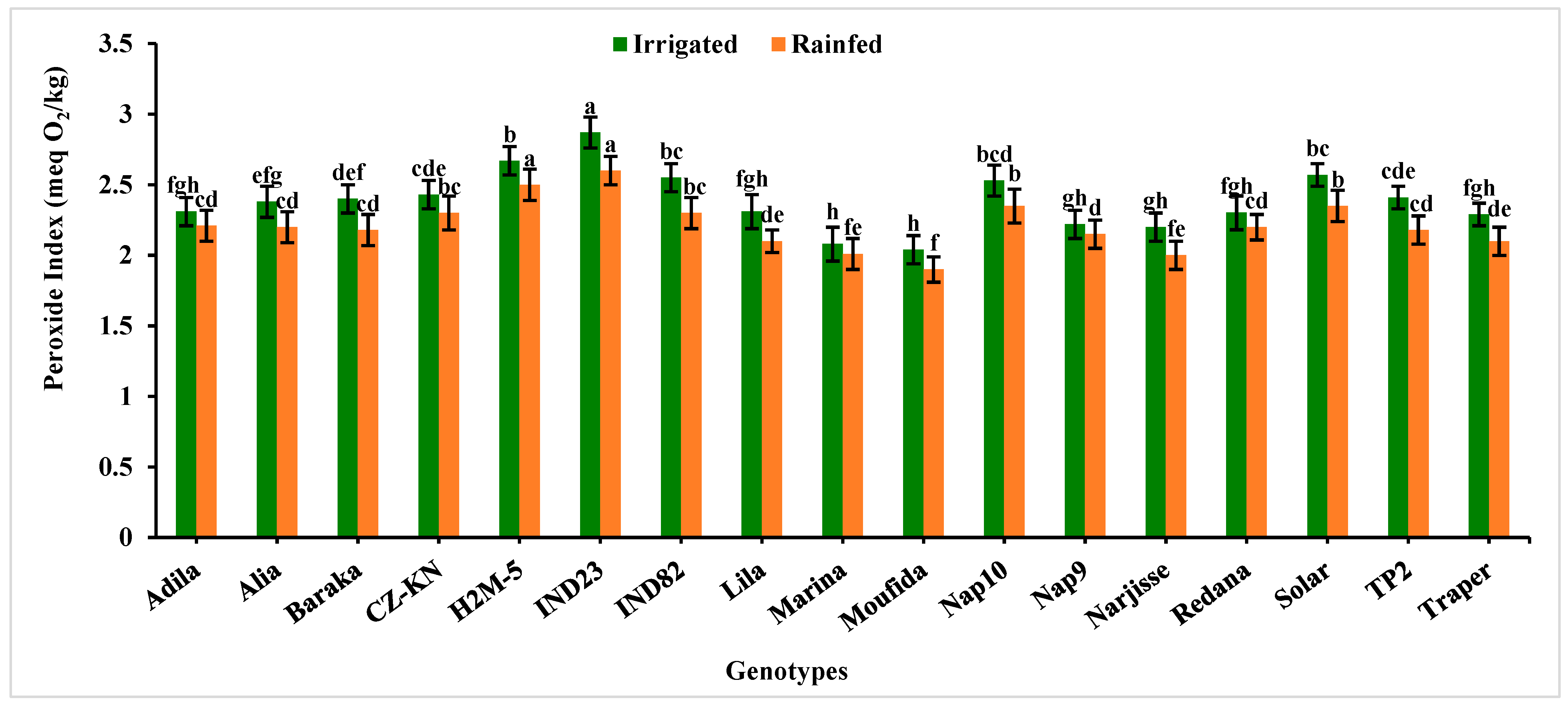
Under irrigated conditions, the overall mean peroxide value (PI) was 2.42 meq O2/kg. Genotypes ‘IND23’ and ‘H2M-5’ exhibited the highest values (2.87 and 2.67 meq O2/kg, respectively), whereas ‘Marina’ (2.08 meq O2/kg) and ‘Moufida’ (2.04 meq O2/kg) recorded the lowest (Figure 6). Under rainfed conditions, the overall mean PI decreased to 1.90 meq O2/kg. The highest indices were registered for ‘IND23’ (2.60 meq O2/kg), ‘H2M-5’ (2.50 meq O2/kg), while the lowest values were observed for ‘Moufida’ (1.90 meq O2/kg) (Figure 6). The lower PI observed under rainfed conditions indicates a reduced level of primary lipid oxidation compared to irrigated conditions. A similar decline in PI under drought stress has been reported by Guirrou et al. [9] in six Moroccan rapeseed varieties and has also been documented in sunflowers [63]. According to the literature, this response may be associated with drought-induced changes in oil composition, including reduced proportions of polyunsaturated fatty acids (PUFAs) and increased levels of monounsaturated and saturated fatty acids [65], as well as enhanced concentrations of natural antioxidants such as tocopherols and phenolic compounds that inhibit hydroperoxide formation [66].
All PI values recorded in this study were well below the Codex Alimentarius thresholds for virgin vegetable oils (≤15 meq O2/kg for cold-pressed oils; ≤10 meq O2/kg for refined oils; [67]), confirming the high quality of the oils produced. The consistently low PI values of ‘Marina’, ‘Narjisse’, and ‘Moufida’ highlight their superior oxidative stability and suggest their strong potential as candidates for breeding programs aimed at developing stable, high-quality rapeseed oils.
Although several rapeseed genotypes showed differences in PI between the ENAM and DYT environments (Table 3), ‘Narjisse’, ‘Moufida’, and ‘Marina’ maintained consistently low values across both sites, indicating reduced susceptibility to lipid peroxidation under variable conditions.

3.5.3. Iodine Value (IV)

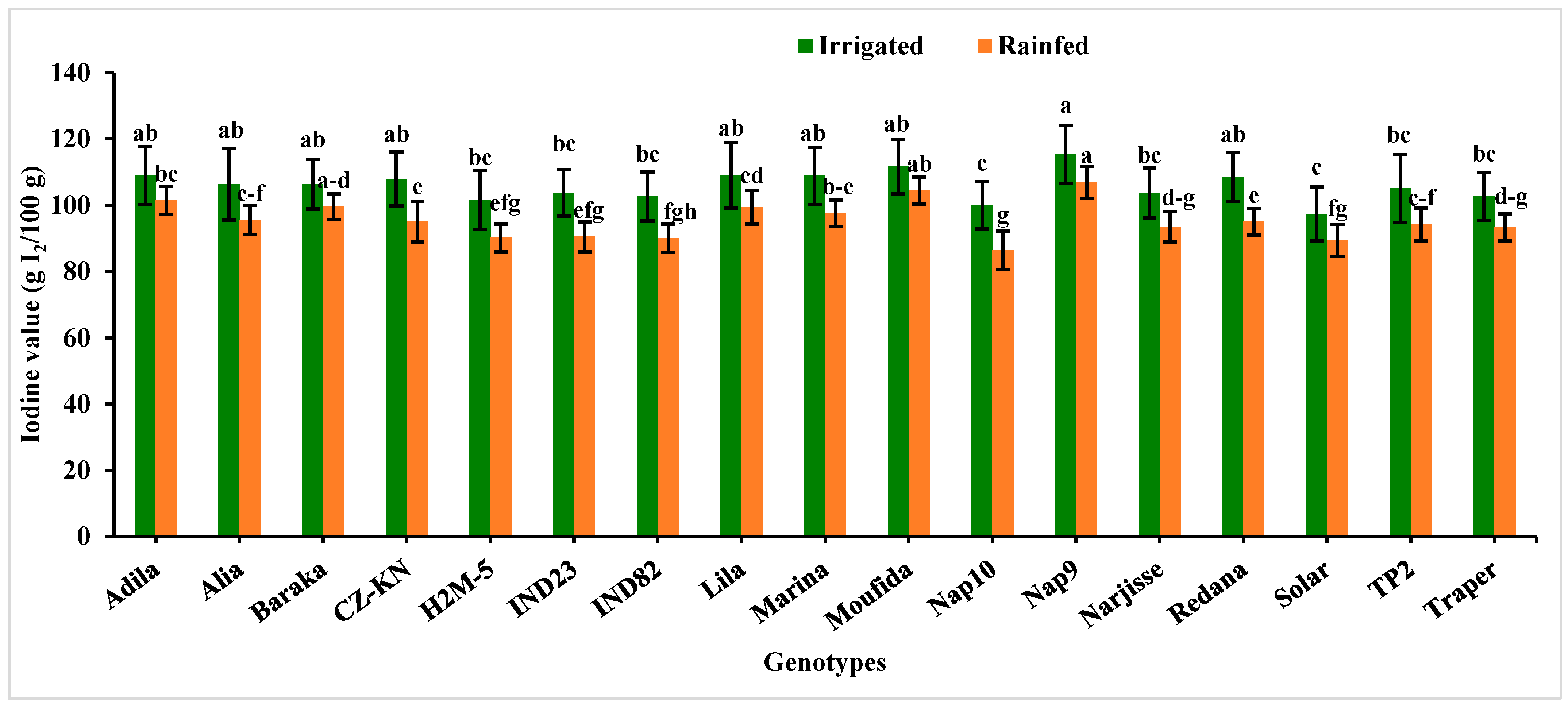
Under irrigated conditions, the overall mean iodine value (IV) was 105.49 g I2/100 g. The highest values were recorded in ‘Nap9’ (115.36 g I2/100 g), whereas the lowest were observed for ‘Nap10’ (99.97 g I2/100 g) and ‘Solar’ (97.36 g I2/100 g) (Figure 7). Under rainfed conditions, the mean IV decreased to 95.68 g I2/100 g, with ‘Nap9’ maintaining the highest value (106.97 g I2/100 g) and ‘Nap10’ showing the lowest (86.47 g I2/100 g) (Figure 7). This reduction under drought reflects a lower degree of oil unsaturation and is consistent with literature reports describing drought-induced modifications in fatty acid composition, notably increased saturated fatty acids and reduced polyunsaturates as a consequence of inhibited desaturase activity [65,68], in agreement with the findings reported by Guirrou et al. [9]. Comparable reductions in IV have also been observed in sunflower [63] and safflower [69]. In this study, higher IVs, as in ‘Nap9’, ‘Moufida’, and ‘Marina’, likely had greater unsaturation, which may benefit nutritional quality but can reduce oxidative stability; conversely, lower IV may suggest improved stability yet a less unsaturated profile, so IV should be interpreted cautiously.
Interestingly, all genotypes remained within or close to the Codex Alimentarius standard for low-erucic acid rapeseed oil (94–120 g I2/100 g), confirming their suitability for edible oil production.

3.5.4. Refractive Index (RI)

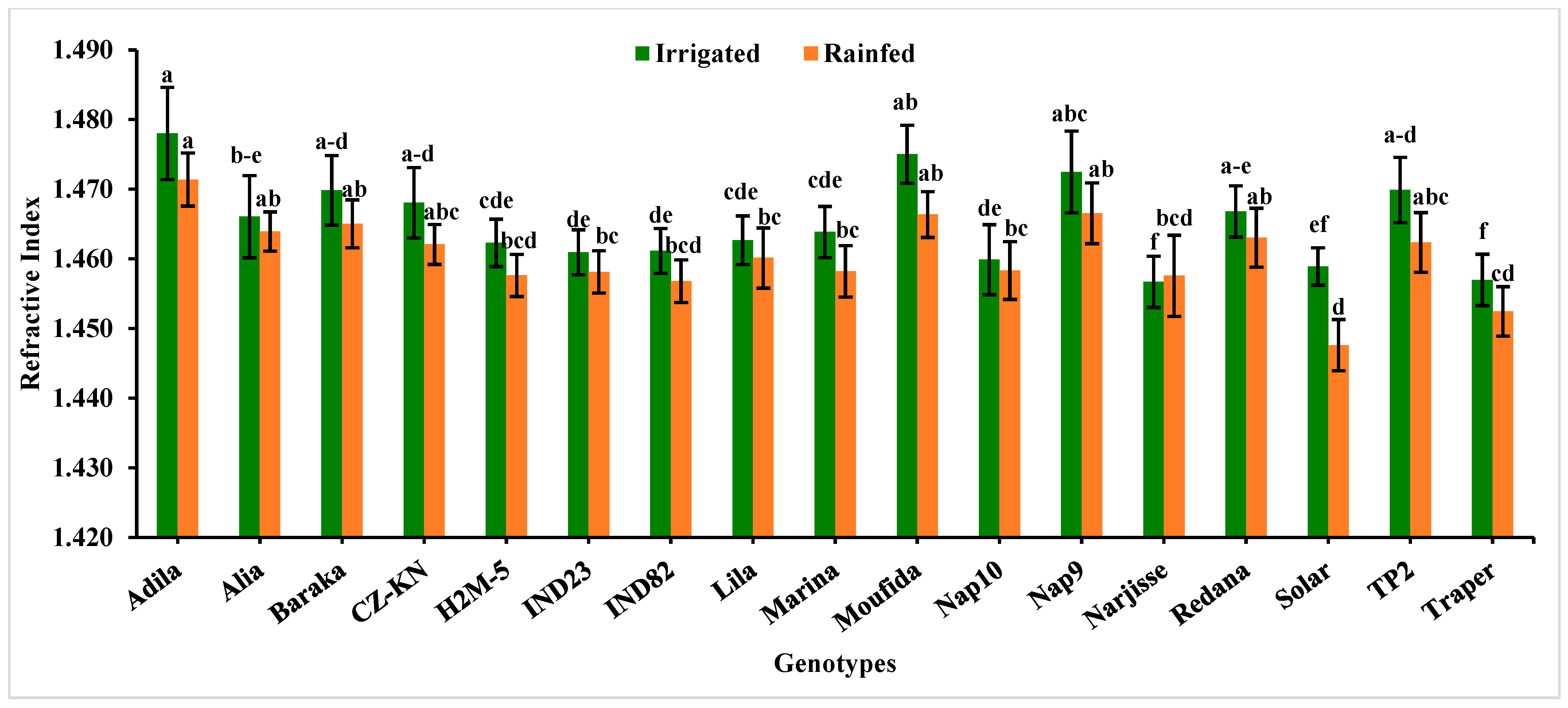
Under irrigated conditions, the overall mean refractive index (RI) was 1.467. Genotypes ‘Adila’, followed by ‘Moufida’, exhibited the highest values (1.478 and 1.476, respectively), whereas ‘Traper’ and ‘Narjisse’ recorded the lowest, each reaching 1.456 (Figure 8). Under rainfed conditions, the overall mean RI decreased slightly to 1.462. The genotype ‘Adila’ retained the highest value (1.471), while ‘Traper’ (1.452) and ‘Solar’ (1.447) presented the lowest values (Figure 8). The slight decrease in refractive index (RI) under water deficit reflects modifications in the physicochemical properties of the oil. Since RI is commonly used as a quality and purity indicator, the narrow range of values observed in this study confirms the good quality of the oils produced under both water regimes [70,71]. Similar trends have been reported in soybeans [72] and sunflowers [63,73]. Genotypes such as ‘Adila’ and ‘Moufida’ maintained higher RI across both water regimes, which may indicate relatively higher unsaturation and potential nutritional value, but could also imply greater susceptibility to oxidation. Therefore, these genotypes appear promising for maintaining acceptable physicochemical indices under water-limited conditions, although nutritional and stability implications require confirmation by fatty acid profiling and direct stability assays.

3.6. Biochemical Analysis

3.6.1. Total Phenolic Content (TPC)

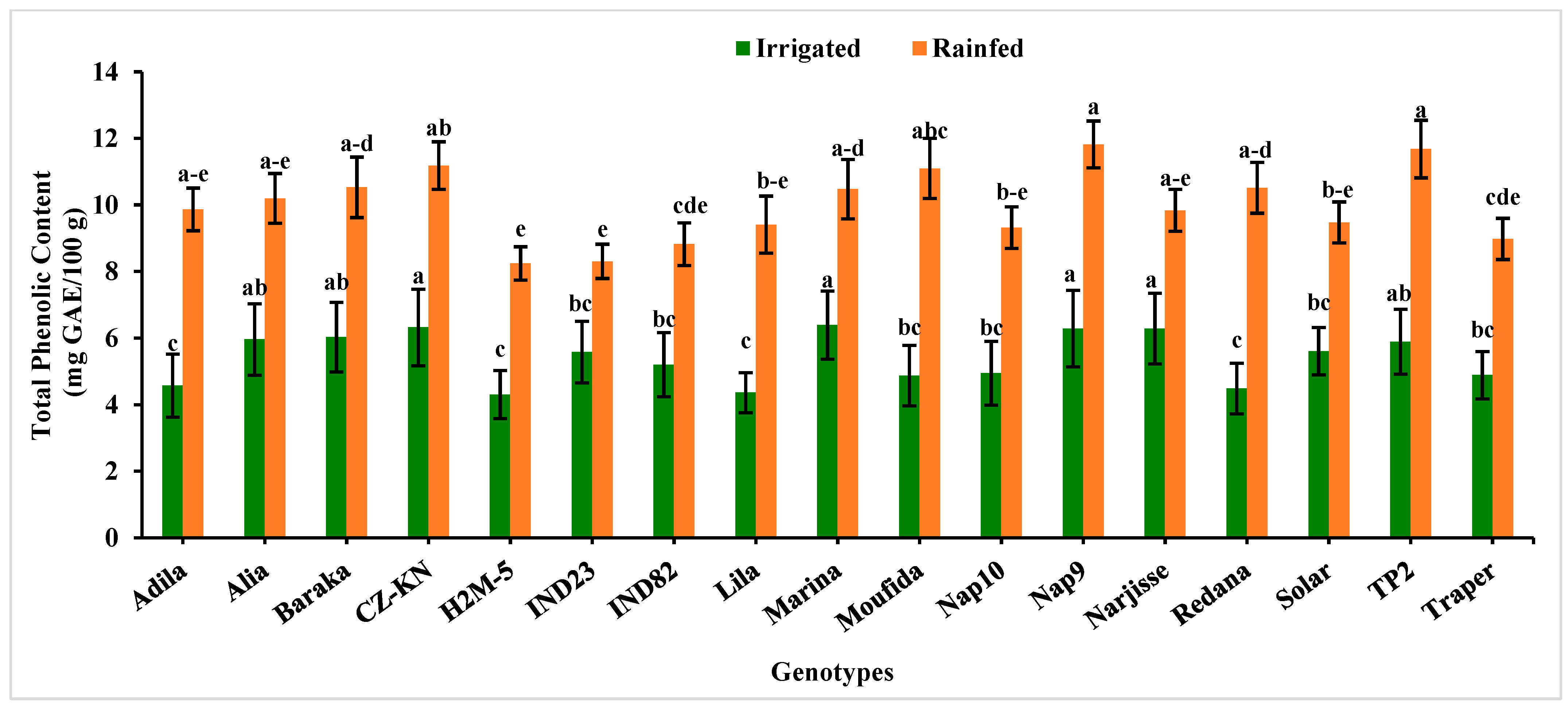
Under irrigated conditions, the overall mean TPC was 5.41 mg GAE/100 g oil, with the highest values recorded for ‘Marina’ (6.38 mg GAE/100 g), ‘CZ-KN’ (6.32 mg GAE/100 g), ‘Narjisse’ (6.28 mg GAE/100 g), and ‘Nap9’ (6.29 mg GAE/100 g). However, the lowest values were registered for ‘Adila’ (4.57 mg GAE/100 g), ‘Redana’ (4.48 mg GAE/100 g), ‘Lila’ (4.36 mg GAE/100 g), and ‘H2M-5’ (4.31 mg GAE/100 g) (Figure 9). Under rainfed conditions, the overall mean almost doubled to reach 9.98 mg GAE/100 g oil. ‘Nap9’ (11.82 mg GAE/100 g) and ‘TP2’ (11.68 mg GAE/100 g) exhibited the highest values, while ‘IND23’ (8.31 mg GAE/100 g) and ‘H2M-5’ (8.24 mg GAE/100 g) recorded the lowest ones. The marked increase in TPC under water stress can be attributed to activation of the phenylpropanoid pathway and enhanced phenylalanine ammonia-lyase activity, which promotes phenolic accumulation and reinforces oxidative stability through reactive oxygen species scavenging and inhibition of lipid peroxidation [74]. Notably, the TPC levels observed in ‘Nap9’ and ‘TP2’exceeded by 15.4% those previously reported in rapeseed oils [9,24] and also surpassed typical values reported for sunflowers (4.04–8.21 mg GAE/100 g) [63,75]. These results highlight the potential of Moroccan genotypes, particularly ‘Nap9’ and ‘TP2’, to produce rapeseed oils with enhanced antioxidant stability, which can present wide applications in functional, nutraceutical, and culinary domains.
Environmental factors significantly influenced TPC variation among genotypes (Table 2); however, ‘Nap9’, ‘TP2’, and ‘CZ-KN’ showed consistent performance across ENAM and DYT sites, maintaining higher phenolic levels than other genotypes (Table 3), supporting their potential as robust genetic resources combining drought resilience with enhanced oil antioxidant quality under Mediterranean conditions

3.6.2. Total Flavonoid Content (TFC)

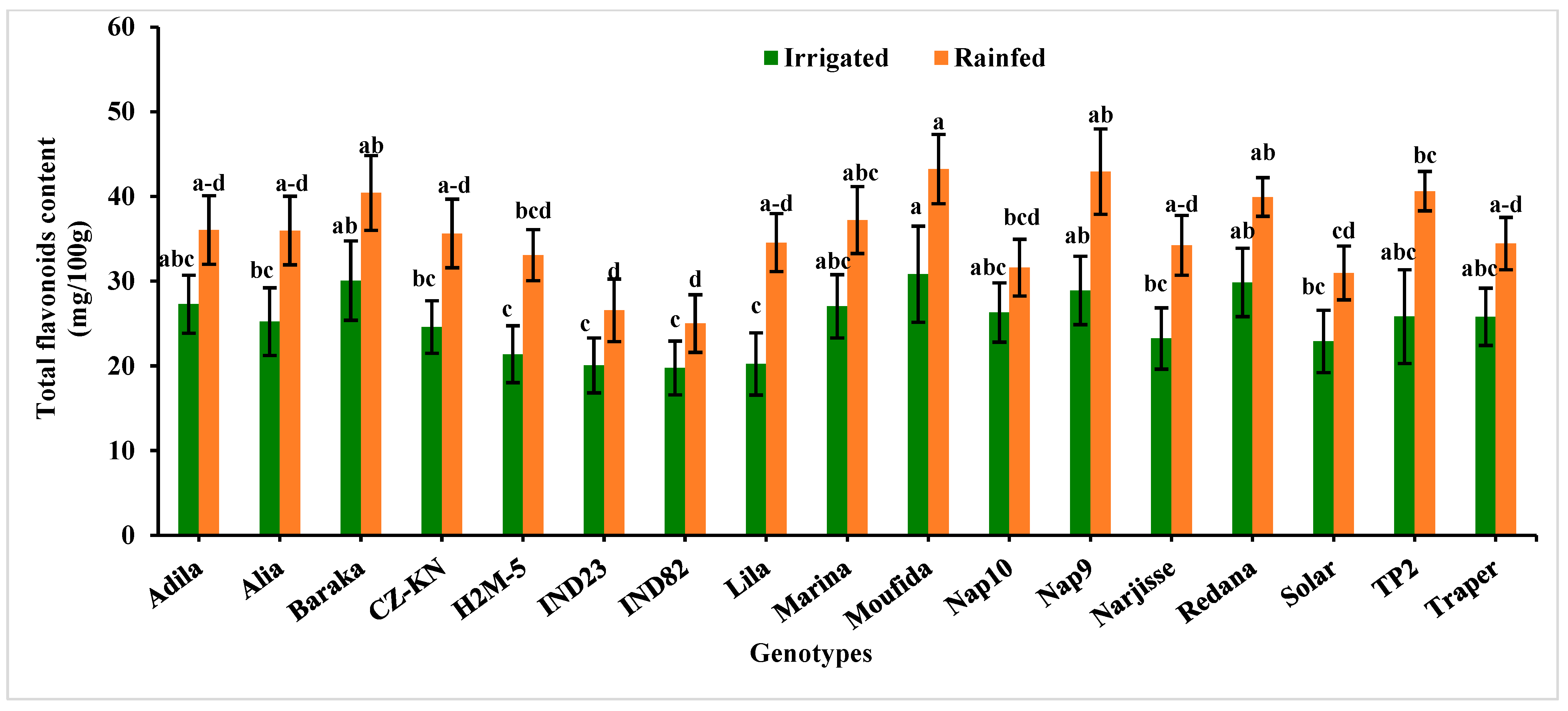
Under irrigated conditions, the overall mean total flavonoid content (TFC) was 25.25 mg/100 g oil. The highest values were recorded for ‘Moufida’ (30.83 mg/100 g), ‘Baraka’ (30.07 mg/100 g), ‘Redana’ (29.85 mg/100 g), and ‘Nap9’ (28.90 mg/100 g), whereas the lowest were registered for ‘H2M-5’ (21.37 mg/100 g), ‘Lila’ (20.23 mg/100 g), ‘IND23’ (20.05 mg/100 g), and ‘IND82’ (19.75 mg/100 g). Under rainfed conditions, the overall mean TFC increased markedly to 34.93 mg/100 g oil. ‘Moufida’ (43.23 mg/100 g), ‘Nap9’ (40.93 mg/100 g), ‘Baraka’ (40.41 mg/100 g), and ‘Redana’ (39.93 mg/100 g) exhibited the greatest accumulation, highlighting their strong responsiveness to water stress. In contrast, ‘IND23’ (26.55 mg/100 g) and ‘IND82’ (25.01 mg/100 g) showed, again, the lowest values (Figure 10). This pronounced increase under drought may be related to the activation of phenylalanine ammonia-lyase (PAL), a key enzyme in secondary metabolite biosynthesis [57]. Notably, the high TFC levels of Moroccan genotypes, particularly ‘Moufida’, ‘Nap9’, ‘TP2’, and ‘Redana’, were consistently higher than those previously reported in rapeseed oils [74,76] and in agreement with the findings of Guirrou et al. [9]. They also clearly surpassed the range reported for other cold-pressed oils such as sunflower (12.7–25.6 mg/100 g) [63], underscoring their strong adaptive potential and superior oxidative stability, which confirms the importance and the good performance of the Moroccan varieties studied herein, in general, and ‘Moufida’, ‘Nap9’, and ‘TP2’ in particular.
Significant differences in TFC were observed between the ENAM and DYT experimental sites (Table 2). However, ‘Moufida’, ‘Baraka’, ‘Nap9’, and ‘Redana’ showed stable performance across both sites, consistently maintaining higher flavonoid levels, compared to the other genotypes (Table 3). This stability highlights their potential to deliver superior oxidative protection and nutraceutical quality under contrasting Mediterranean conditions.
The pronounced increase in TPC and TFC under rainfed conditions highlights genotype-dependent plasticity of secondary metabolism. In our panel, ‘Nap9’ displayed consistently high values for both TPC and TFC under water deficit, while ‘Moufida’ and ‘Baraka’ showed particularly strong flavonoid accumulation. Such responses may reflect differences in agronomic adaptation strategies (e.g., conservative water use and maintenance of functional photosynthesis under stress) and intrinsic metabolic regulation, where drought-induced ROS signaling activates the phenylpropanoid pathway and enhances the activity/expression of key enzymes such as phenylalanine ammonia-lyase (PAL), leading to increased accumulation of phenolics and flavonoids [77,78]. Importantly, these antioxidant-related traits may contribute to drought stress mitigation by improving ROS scavenging and protecting cellular structures, which is particularly relevant under the intermittent droughts typical of Mediterranean semi-arid environments. Consistently, the antioxidant activity assessed using radical-scavenging assays (DPPH and ABTS) provides a functional indicator of the redox-buffering capacity of the extracts; however, the strength of the relationship between TPC/TFC and FRSA may remain genotype-dependent, suggesting that other oil constituents can also contribute to the observed antioxidant responses [79,80].

3.6.3. Free-Radical Scavenging Activity

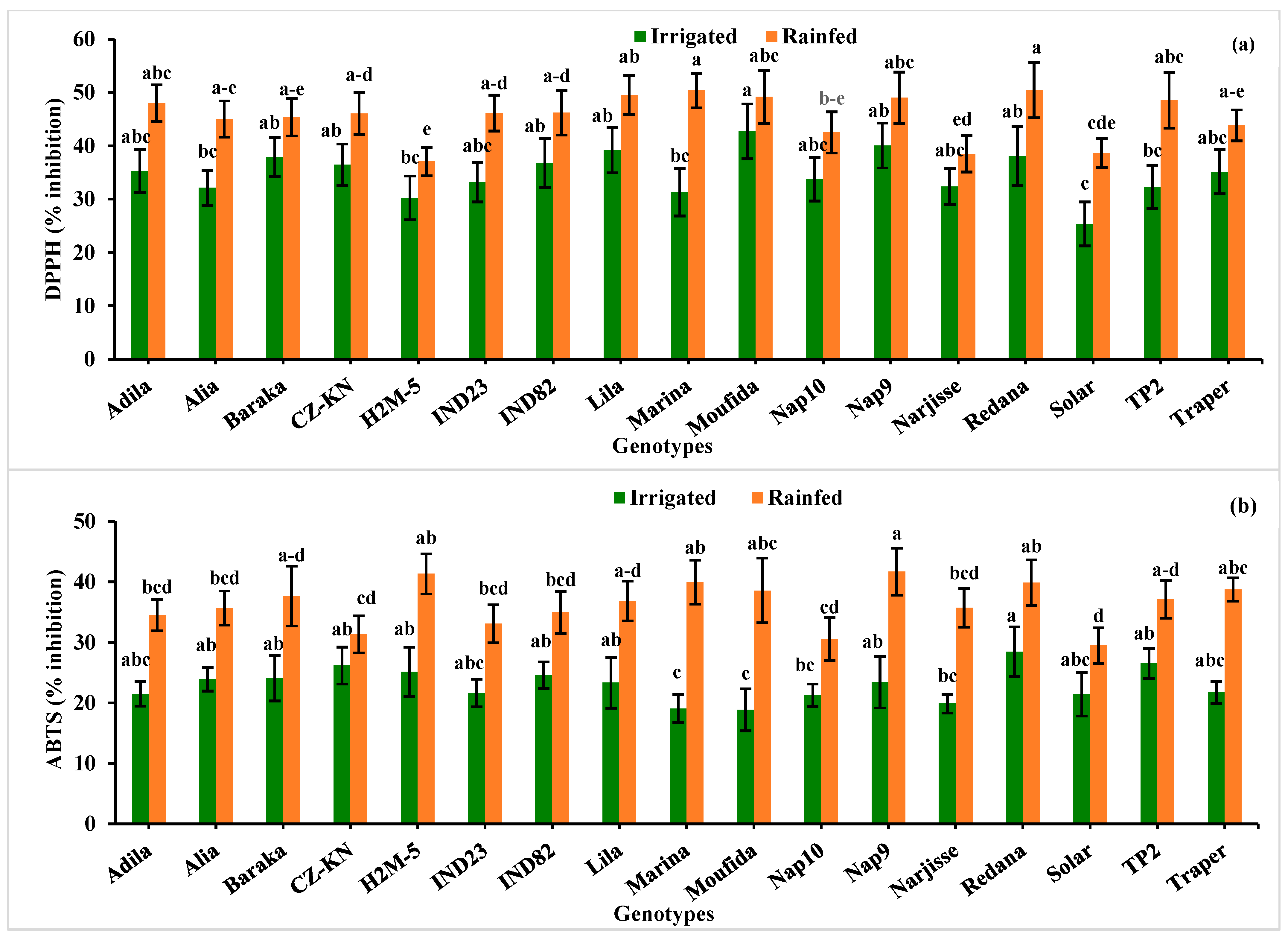
Free-radical scavenging activity (FRSA) differed significantly among rapeseed genotypes and was strongly influenced by water regime (p < 0.05). In the DPPH assay, antioxidant activity under irrigated conditions ranged from 25.37% in ‘Solar’ to 42.71% in ‘Moufida’. High values were also observed in ‘Moufida’ (42.71%) (Figure 11a). Under rainfed conditions, FRSA increased, ranging from 36.13% to 50.45%. The highest activities were recorded for ‘Redana’ (50.45%) and ‘Marina’ (50.34%) (Figure 11a). In contrast, ‘Narjisse’ and ‘H2M-5’ exhibited the lowest FRSA values (38.49% and 36.13%, respectively). In the ABTS assay, inhibition under irrigation ranged from 18.86% to 28.46%, with ‘Redana’ showing the highest value (28.46%), followed by ‘TP2’ (26.54%), and ‘CZ-KN’ (26.19%), whereas ‘Marina’ and ‘Moufida’ presented the lowest values (19.05% and 18.86%, respectively). Under rainfed conditions, antioxidant activity ranged from 29.11% to 41.68%, with ‘Nap9’ (41.68%), ‘Marina’ (39.96%), and ‘Redana’ (39.84%) showing the highest values, while ‘Solar’ (29.50%) showed the lowest (Figure 11b). The consistently high antioxidant capacity of ‘Moufida’, ‘Nap9’, ‘TP2’, and ‘Marina’ may be attributed to their richness in polyphenols and flavonoids, which aligns with previous studies reporting that phenolic and flavonoid compounds are the primary contributors to the antioxidant potential of rapeseed oil extracts [9,24,81]. Although TPC/TFC likely contribute to FRSA, genotype-dependent responses suggest other constituents also modulate DPPH/ABTS; thus, FRSA should be interpreted as an integrated antioxidant response rather than a direct proxy of TPC/TFC. Moreover, other studies suggest that specific metabolites such as vinylsyringol (canolol), derived from the decarboxylation of sinapic acid, may further enhance antioxidant capacity [82]. Overall, these findings highlight the value of ‘Moufida’, ‘Nap9’, ‘TP2’, and ‘Marina’ as promising sources of high-quality, antioxidant-rich rapeseed oil for functional foods and nutraceutical applications under Mediterranean semi-arid conditions.
Environmental factors significantly influenced free radical scavenging activity (FRSA) among the rapeseed genotypes (Table 2). Nevertheless, ‘Moufida’, ‘Nap9’, and ‘Marina’ maintained high FRSA values across environments, demonstrating strong antioxidant activity despite differences in water availability (Table 3). This stability suggests that these genotypes may deliver enhanced nutritional and functional performance under varying Mediterranean conditions.

3.7. Principal Component Analysis

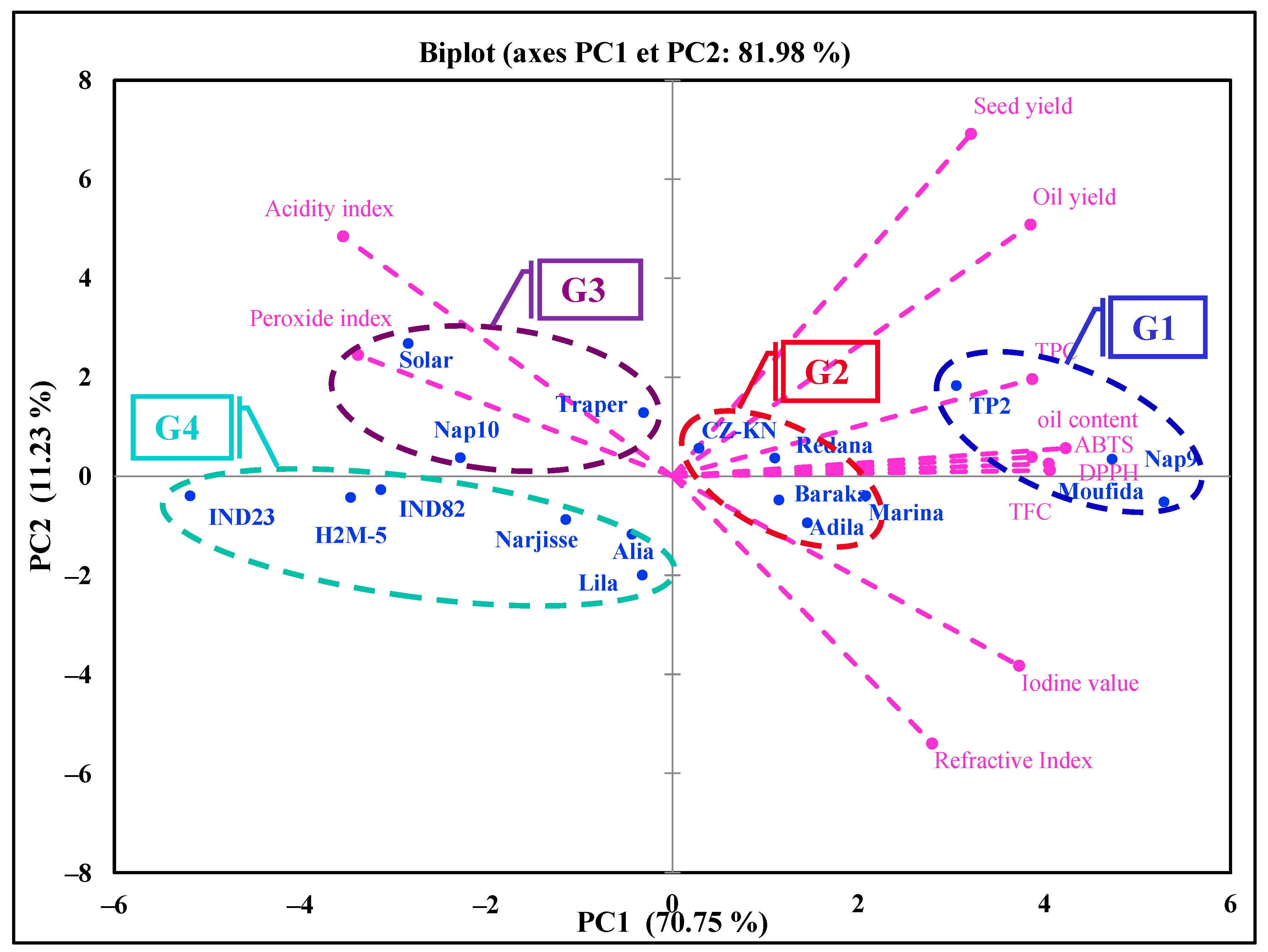
Principal component analysis (PCA) clearly distinguished the genotypes based on their yield performance and oil quality traits, explaining 81.98% of the total variance through the first two components (Figure 12). The first component, PC1, which accounted for 70.75%, was positively associated with seed yield, oil yield, oil content, total phenolic content (TPC), total flavonoid content (TFC), and antioxidant activities (DPPH, ABTS), and negatively associated with iodine value and refractive index, making it a combined indicator of yield and nutraceutical oil quality.
The second component, PC2 (11.23%), was mainly related to acidity and peroxide indices in opposition to refractive index, thus reflecting oil oxidative stability. The PCA biplot presented in Figure 12 classified all genotypes into four distinct groups based on their yield performance and oil-quality traits. Genotypes in Group-1 are positioned on the high positive side of PC1, while those in Group-4 exhibit high negative values for PC1. In contrast, the genotypes in Group-2 occupy intermediate positive positions on PC1, whereas those in Group-3 are mainly separated along PC2.
The genotypes of Group-1, namely ‘Nap9’, ‘Moufida’, and ‘TP2’, present the highest positive scores on PC1 for traits such as seed yield, oil yield, oil content, TPC, TFC, and antioxidant activity (DPPH, ABTS), as well as the lowest negative values for iodine value and refractive index. This indicates that these genotypes exhibit the most favorable combination of high yield potential and enhanced nutraceutical oil quality. On the other hand, genotypes in Group-4, including ‘Narjisse’, ‘Alia’, ‘Lila’, ‘IND23’, ‘IND82’, and ‘H2M-5’ are strongly and negatively correlated with PC1 and, thus, present the lowest scores for seed yield, oil yield, oil content, and antioxidant traits, indicating that they possess the lowest performance for both yield and oil-quality attributes. Group-3 includes the genotypes ‘Solar’, ‘Nap10’, and ‘Traper’, which are mainly distinguished by their high positive scores on PC2 for acidity and peroxide values, reflecting reduced oxidative stability compared to the other groups. Finally, the Group-2 genotypes, including ‘Redana’, ‘Marina’, ‘Baraka’, ‘Adila’, and ‘CZ-KN’, show moderate positive values for PC1 and low values for PC2, suggesting intermediate performance for both yield-related traits and oil-quality indices (Figure 12).
The PCA further strengthened these findings by integrating yield and oil-quality traits into a coherent multivariate structure, clearly distinguishing between high-performing and sensitive genotypes. ‘Moufida’, ‘Nap9’, and ‘TP2’ clustered strongly on PC1 due to their combined high performance for seed and oil yields, elevated phenolic and flavonoid contents, and superior antioxidant capacity, traits known to enhance oil stability and stress resilience in Brassica crops as reported by Jamshidi Zinab et al. [28] and Batool et al. [83]. In contrast, the sensitive genotypes (‘IND23’, ‘IND82’, ‘H2M-5’, ‘Nap10’) clustered on the negative side of PC1, reflecting lower productivity and weaker oil quality. These clustering patterns highlight the coordinated nature of physiological and biochemical traits that contribute to resilience under semi-arid conditions. Overall, the genotypes ‘Moufida’, ‘Nap9’, and ‘TP2’ can be proposed as valuable cultivars for drought-prone environments as well as promising parental material for breeding programs targeting yield stability and enhanced nutraceutical oil quality.

4. Conclusions

This study demonstrates that water deficit, associated with rainfed conditions across two contrasting environments, significantly impairs rapeseed yield and oil traits. Moreover, it allows identifying genotypes capable of sustaining productivity and quality under such water stress. Water regime stood out as the dominant factor driving trait variation, while site-specific conditions further shaped performance. Among the tested genotypes, ‘Moufida’, ‘Nap9’, and ‘TP2’ consistently combined yield stability with superior oil quality, characterized by lower acidity and peroxide values, higher phenolic and flavonoid contents, and stronger antioxidant activity. These findings underline the potential of these genotypes as resilient candidates for cultivation in semi-arid Mediterranean regions. Overall, these genotypes are promising for semi-arid conditions based on yield, physicochemical traits, and antioxidant indices; however, nutritional gains and oxidative stability should be confirmed by fatty acid profiling and direct stability tests (e.g., Rancimat/OSI). Promoting such genotypes can help secure oilseed production under climate change. Breeding programs should prioritize traits such as stable oil yield, high antioxidant potential, and resilience across environments. Furthermore, integrating multi-season and multi-location evaluations with genomic, transcriptomic, and metabolomic tools would accelerate the development of climate-resilient rapeseed cultivars. Complementary analyses of fatty acid composition, antibacterial activity, sensory traits, and post-storage quality will further allow strengthening the industrial and nutraceutical value. These results also provide a practical framework for screening rapeseed germplasms under contrasting water regimes in other drought-prone arid and semi-arid regions worldwide. The combined use of multi-environment field testing and antioxidant-related oil traits can support breeding pipelines aiming at stable yield and quality under climate variability. Future work should further validate these candidates across additional seasons and environments representative of global semi-arid production zones. Together, these integrated approaches will support the deployment of high-quality cultivars adapted to water-limited environments and offering superior nutritional and industrial properties.

Author Contributions

Investigation, data curation, formal analysis, writing—original draft, A.B. and A.N.; conceptualization, methodology, writing—review and editing, visualization, validation, supervision, H.D.; methodology, writing—original draft, H.B.; writing—review and editing, R.B.; methodology. M.K.; software, writing—review and editing, I.G. and C.E.-d.K.; methodology, K.H.; writing—review and editing, Supervision, A.K.; writing—review and editing, supervision. All authors have read and agreed to the published version of the manuscript.

Funding

This research received no external funding.

Institutional Review Board Statement

Not applicable.

Informed Consent Statement

Not applicable.

Data Availability Statement

The entire dataset used in the study is available from the corresponding author.

Conflicts of Interest

The authors declare no conflicts of interest.

References

  1. Friedt, W.; Tu, J.; Fu, T. Academic and economic importance of Brassica napus rapeseed. In The Brassica napus Genome; Springer: Cham, Switzerland, 2018; pp. 1–20. [Google Scholar] [CrossRef]
  2. El-Badri, A.M.; Batool, M.; Mohamed, I.A.; Khatab, A.; Sherif, A.; Wang, Z.; Salah, A.; Nishawy, E.; Ayaad, M.; Kuai, J.; et al. Modulation of salinity impact on early seedling stage via nano-priming application of zinc oxide on rapeseed (Brassica napus L.). Plant Physiol. Biochem. 2021, 166, 376–392. [Google Scholar] [CrossRef]
  3. Food and Agriculture Organization of the United Nations. FAOSTAT. Statistical Database. Available online: https://www.fao.org/faostat/fr/#compare (accessed on 20 September 2025).
  4. Sadras, V.; Calderini, D. Crop Physiology Case Histories for Major Crops; Academic Press: Cambridge, MA, USA, 2020. [Google Scholar]
  5. Zhang, R.; Fang, X.; Feng, Z.; Chen, M.; Qiu, X.; Sun, J.; Wu, M.; He, J. Protein from rapeseed for food applications: Extraction, sensory quality, functional and nutritional properties. Food Chem. 2024, 439, 138109. [Google Scholar] [CrossRef]
  6. Lee, Y.-H.; Park, W.; Kim, K.-S.; Jang, Y.-S.; Lee, J.-E.; Cha, Y.-L.; Moon, Y.-H.; Song, Y.-S.; Lee, K. EMS-induced mutation of an endoplasmic reticulum oleate desaturase gene (FAD2-2) results in elevated oleic acid content in rapeseed (Brassica napus L.). Euphytica 2018, 214, 28. [Google Scholar] [CrossRef]
  7. Zhao, M.; Ren, Y.; Wei, W.; Yang, J.; Zhong, Q.; Li, Z. Metabolite analysis of Jerusalem artichoke (Helianthus tuberosus L.) seedlings in response to polyethylene glycol-simulated drought stress. Int. J. Mol. Sci. 2021, 22, 3294. [Google Scholar] [CrossRef] [PubMed]
  8. Li, X.-C.; Chang, C.; Pei, Z.-M. Reactive oxygen species in drought-induced stomatal closure: The potential roles of NPR1. Plants 2023, 12, 3194. [Google Scholar] [CrossRef]
  9. Guirrou, I.; El Harrak, A.; El Antari, A.; Hssaini, L.; Hanine, H.; El Fechtali, M.; Nabloussi, A. Bioactive Compounds Assessment in Six Moroccan Rapeseed (Brassica napus L.) Varieties Grown in Two Contrasting Environments. Agronomy 2023, 13, 460. [Google Scholar] [CrossRef]
  10. Zhou, Z.; Gao, P.; Zhou, Y.; Wang, X.; Yin, J.; Zhong, W.; Reaney, M.J. Comparative analysis of frying performance: Assessing stability, nutritional value, and safety of high-oleic rapeseed oils. Foods 2024, 13, 2788. [Google Scholar] [CrossRef] [PubMed]
  11. Benabderrahim, M.A.; Elfalleh, W.; Belayadi, H.; Haddad, M. Effect of date palm waste compost on forage alfalfa growth, yield, seed yield and minerals uptake. Int. J. Recycl. Org. Waste Agric. 2018, 7, 1–9. [Google Scholar] [CrossRef]
  12. El Idrissi, I.S.; Kettani, R.; Brhadda, N.; Louali, A.; Channaoui, S.; Gaboune, F.; Nabloussi, A. Variation in rapeseed genotype’s reaction to drought during flowering and identification of tolerant-genotypes selection index. J. Agric. Food Res. 2023, 14, 100872. [Google Scholar] [CrossRef]
  13. Nabloussi, A.; Kouighat, M.; Channaoui, S.; Fechtali, M.E. Mutagenesis breeding for drought-tolerance and improvement of oil and seed quality in oilseed crops: Case of rapeseed and sesame. In Plant Mutagenesis: Sustainable Agriculture and Rural Landscapes; Springer: Berlin/Heidelberg, Germany, 2024; pp. 27–41. [Google Scholar]
  14. Elferjani, R.; Soolanayakanahally, R. Canola responses to drought, heat, and combined stress: Shared and specific effects on carbon assimilation, seed yield, and oil composition. Front. Plant Sci. 2018, 9, 1224. [Google Scholar] [CrossRef]
  15. Ahmed, T.; Masood, H.A.; Noman, M.; Al-Huqail, A.A.; Alghanem, S.M.; Khan, M.M.; Muhammad, S.; Manzoor, N.; Rizwan, M.; Qi, X.; et al. Biogenic silicon nanoparticles mitigate cadmium (Cd) toxicity in rapeseed (Brassica napus L.) by modulating the cellular oxidative stress metabolism and reducing Cd translocation. J. Hazard. Mater. 2023, 459, 132070. [Google Scholar] [CrossRef]
  16. Fghire, R.; Anaya, F.; Lamnai, K.; Faghire, M. Alternative Crops as a Solution to Food Security Under Climate Changes; Springer: Berlin/Heidelberg, Germany, 2022; pp. 87–98. [Google Scholar]
  17. Nasr, J.; Cursaru, D.-L. The performance of Carbon-Based nanomaterials in different base oils and an oil blend. Lubricants 2024, 12, 90. [Google Scholar] [CrossRef]
  18. DeBonte, L.; Iassonova, D.; Liu, L.; Loh, W. Commercialization of high oleic canola oils. Lipid Technol. 2012, 24, 175–177. [Google Scholar] [CrossRef]
  19. Liu, L.; Lassonova, D. High-oleic canola oils and their food applications. Inf. Int. News Fats Oils Relat. Mater. 2012, 23, 491–495. [Google Scholar]
  20. McVetty, P.B.; Duncan, R.W. Canola, rapeseed, and mustard: For biofuels and bioproducts. In Industrial Crops: Breeding for BioEnergy and Bioproducts; Springer: Berlin/Heidelberg, Germany, 2014; pp. 133–156. [Google Scholar]
  21. Knothe, G. Structure indices in FA chemistry. How relevant is the iodine value? J. Am. Oil Chem. Soc. 2002, 79, 847–854. [Google Scholar] [CrossRef]
  22. Fard, N.S.; Abad, H.H.S.; Rad, A.S.; Heravan, E.M.; Daneshian, J. Effect of drought stress on qualitative characteristics of canola cultivars in winter cultivation. Ind. Crops Prod. 2018, 114, 87–92. [Google Scholar] [CrossRef]
  23. Szydłowska-Czerniak, A.; Tułodziecka, A.; Momot, M.; Stawicka, B. Physicochemical, antioxidative, and sensory properties of refined rapeseed oils. J. Am. Oil Chem. Soc. 2019, 96, 405–419. [Google Scholar] [CrossRef]
  24. Channaoui, S.; Hssaini, L.; Velasco, L.; Mazouz, H.; El Fechtali, M.; Nabloussi, A. Comparative study of fatty acid composition, total phenolics, and antioxidant capacity in rapeseed mutant lines. J. Am. Oil Chem. Soc. 2020, 97, 397–407. [Google Scholar] [CrossRef]
  25. Shafighi, A.; Teymoori, M.; Ardakani, M.R.; Rad, A.H.S.; Alavifazel, M.; Rafiei, F. Evaluation of the oil quality properties of Rapeseed genotypes contributed to drought stress at the flowering stage in semi-arid conditions. J. Biol. Res. 2022, 95, 10297. [Google Scholar] [CrossRef]
  26. Kourani, M.; Mohareb, F.; Rezwan, F.I.; Anastasiadi, M.; Hammond, J.P. Genetic and physiological responses to heat stress in Brassica napus. Front. Plant Sci. 2022, 13, 832147. [Google Scholar] [CrossRef] [PubMed]
  27. Lohani, N.; Singh, M.B.; Bhalla, P.L. Short-term heat stress during flowering results in a decline in Canola seed productivity. J. Agron. Crop Sci. 2022, 208, 486–496. [Google Scholar] [CrossRef]
  28. Jamshidi Zinab, A.; Hasanloo, T.; Naji, A.M.; Delangiz, N.; Farhangi-Abriz, S.; Asgari Lajayer, B.; Hemati, A.; Shobbar, Z.-S.; Farooq, M. Physiological and biochemical evaluation of commercial oilseed rape (Brassica napus L.) cultivars under drought stress. Gesunde Pflanz. 2023, 75, 847–860. [Google Scholar] [CrossRef]
  29. Channaoui, S.; Labhilili, M.; Mouhib, M.; Mazouz, H.; El Fechtali, M.; Nabloussi, A. Development and evaluation of diverse promising rapeseed (Brassica napus L.) mutants using physical and chemical mutagens. OCL 2019, 26, 35. [Google Scholar] [CrossRef]
  30. Nabloussi, A.; Kouighat, M.; Channaoui, S.; El Idrissi, I.S.; El Fechtali, M. Stratégie de recherche et réalisations en sélection d’oléagineux pour faire face aux défis du changement climatique. Afr. Mediterr. Agric. J. 2024, 143, 49–65. [Google Scholar] [CrossRef]
  31. Bouchyoua, A.; Kouighat, M.; Hafid, A.; Ouardi, L.; Khabbach, A.; Hammani, K.; Nabloussi, A. Evaluation of rapeseed (Brassica napus L.) genotypes for tolerance to PEG (polyethylene glycol) induced drought at germination and early seedling growth. J. Agric. Food Res. 2024, 15, 100928. [Google Scholar] [CrossRef]
  32. Bouchyoua, A.; Kettani, R.; Kouighat, M.; Ouardi, L.; Adiba, A.; Lamoumni, O.; El Fechtali, M.; Khabbach, A.; Hammani, K.; Nabloussi, A. Unveiling differential genotypic responses to soil moisture stress during early plant stages in rapeseed (Brassica napus L.). Ind. Crops Prod. 2025, 235, 121782. [Google Scholar] [CrossRef]
  33. Chetto, O.; Belqadi, L.; Fatemi, Z.E.A.; Charafi, J.; Kouighat, M.; Najmi, A.; El Fechtali, M.; Houmanat, K.; Nabloussi, A. Assessment of elite faba bean lines for enhanced productivity and resilience in contrasting challenging environments using phenotypic and molecular markers. J. Agric. Food Res. 2024, 18, 101488. [Google Scholar] [CrossRef]
  34. Germchi, S.; Shekari, F.; Hassanpooraghdam, M.B.; Benam, M.; Shekari, F. Water deficit stress affects growth and some biochemical characteristics of rapeseed (Brassica napus L.). J. Food Agric. Environ. 2010, 8, 1126–1129. [Google Scholar]
  35. Houmanat, K.; Nabloussi, A.; Rhazlaoui, Y.; Bahri, H.; El Fechtali, M.; Charafi, J. Genetic relationship and diversity among some Moroccan and introduced rapeseed (Brassica napus L.) varieties as revealed by molecular markers. OCL 2023, 30, 18. [Google Scholar] [CrossRef]
  36. Medimagh, S.; Mechri, M.; Mansouri, S.; Zouani, R. Optimisation de la Fertilisation Azotée du Colza Oléagineux dans les Conditions du Semi-Aride Tunisien. IOSR J. Agric. Vet. Sci. 2020, 13, 27–33. [Google Scholar]
  37. Allen, R.G.; Pereira, L.S.; Raes, D.; Smith, M. FAO Irrigation and Drainage Paper No. 56; Food and Agriculture Organization of the United Nations: Rome, Italy, 1998; Volume 56, p. e156. [Google Scholar]
  38. Fernandez, G.C. Effective selection criteria for assessing plant stress tolerance. Adapt. Food Crops Temp. Water Stress 1992, 257–270. [Google Scholar]
  39. Bouslama, M.; Schapaugh, W., Jr. Stress tolerance in soybeans. I. Evaluation of three screening techniques for heat and drought tolerance. Crop Sci. 1984, 24, 933–937. [Google Scholar] [CrossRef]
  40. NF EN ISO 660:2009; Animal and Vegetable Fats and Oils—Determination of Acid Value and Acidity. Association Francaise de Normalisation: Paris, France, 2009. Available online: https://www.intertekinform.com/en-gb/standards/nf-en-iso-660-2009-53019_saig_afnor_afnor_114718/?srsltid=AfmBOooxpxNTz5d4VAxNal33qpsd2r5Uyb9OHoveBm184s58KGInb76t (accessed on 20 September 2025).
  41. NF ISO 3960:2004; Animal and Vegetable Fats and Oils—Determination of Peroxide Value. Association Francaise de Normalisation: Paris, France, 2004. Available online: https://en.gostinfo.ru/catalog/Details/?id=3948278 (accessed on 20 September 2025).
  42. ISO 3961:2018; Animal and Vegetable Fats and Oils—Determination of Iodine Value. International Organization for Standardization: Geneva, Switzerland, 2018. Available online: https://www.iso.org/obp/ui/#iso:std:iso:3961:ed-6:v1:en (accessed on 20 September 2025).
  43. ISO 6320:2017; Animal and Vegetable Fats and Oils—Determination of Refractive Index. International Organization for Standardization: Geneva, Switzerland, 2017. Available online: https://www.iso.org/standard/71267.html (accessed on 20 September 2025).
  44. Tsimidou, M.; Papadopoulos, G.; Boskou, D. Phenolic compounds and stability of virgin olive oil—Part I. Food Chem. 1992, 45, 141–144. [Google Scholar] [CrossRef]
  45. Singleton, V.L.; Orthofer, R.; Lamuela-Raventós, R.M. [14] Analysis of total phenols and other oxidation substrates and antioxidants by means of folin-ciocalteu reagent. In Methods in Enzymology; Elsevier: Amsterdam, The Netherlands, 1999; Volume 299, pp. 152–178. [Google Scholar] [CrossRef]
  46. Favati, F.; Caporale, G.; Bertuccioli, M. Rapid determination of phenol content in extra virgin olive oil. Grasas y Aceites 1994, 45, 68–70. [Google Scholar] [CrossRef]
  47. Brand-Williams, W.; Cuvelier, M.-E.; Berset, C. Use of a free radical method to evaluate antioxidant activity. LWT Food Sci. Technol. 1995, 28, 25–30. [Google Scholar] [CrossRef]
  48. Re, R.; Pellegrini, N.; Proteggente, A.; Pannala, A.; Yang, M.; Rice-Evans, C. Antioxidant activity applying an improved ABTS radical cation decolorization assay. Free Radic. Biol. Med. 1999, 26, 1231–1237. [Google Scholar] [CrossRef]
  49. Safi, S.; Kamgar-Haghighi, A.; Zand-Parsa, S.; Emam, Y.; Honar, T. Evaluation of yield, actual crop evapotranspiration and water productivity of two canola cultivars as influenced by transplanting and seeding and deficit irrigation. Int. J. Plant Prod. 2019, 13, 23–33. [Google Scholar] [CrossRef]
  50. Rad, A.H.S.; Zandi, P. The effect of drought stress on qualitative and quantitative traits of spring rapeseed (Brassica napus L.) cultivars. Agriculture 2012, 99, 47–54. [Google Scholar]
  51. Aboodeh, H.; Bakhshandeh, A.; Moradi Telavat, M.R.; Siadat, S.A.; Moosavi, S.A.; Alami Saeid, K. The physiological response of rapeseed (Brassica napus L.) genotypes to drought stress. Agrotech. Ind. Crops 2024, 4, 38–47. [Google Scholar] [CrossRef]
  52. Marjanović-Jeromela, A.; Terzić, S.; Jankulovska, M.; Zorić, M.; Kondić-Špika, A.; Jocković, M.; Hristov, N.; Crnobarac, J.; Nagl, N. Dissection of year related climatic variables and their effect on winter rapeseed (Brassica napus L.) development and yield. Agronomy 2019, 9, 517. [Google Scholar] [CrossRef]
  53. Anastasi, U.; Scavo, A. Cropping Systems and Agronomic Management Practices of Field Crops. Agronomy 2023, 13, 2328. [Google Scholar] [CrossRef]
  54. Delgado, I.; Muñoz-Romero, V.; Girón, I.; García-Ruiz, R.; López-Bellido, L. Performance of rapeseed (Brassica napus L.) under rainfed Mediterranean conditions in Northeastern Spain. Agronomy 2021, 11, 1656. [Google Scholar] [CrossRef]
  55. Morsi, N.A.; Hashem, O.S.; El-Hady, M.A.A.; Abd-Elkrem, Y.M.; El-Temsah, M.E.; Galal, E.G.; Gad, K.I.; Boudiar, R.; Silvar, C.; El-Hendawy, S.; et al. Assessing drought tolerance of newly developed tissue-cultured canola genotypes under varying irrigation regimes. Agronomy 2023, 13, 836. [Google Scholar] [CrossRef]
  56. Chada, S.; Asiedu, S.; Ofoe, R. An overview of plant morpho-physiology, biochemicals, and metabolic pathways under water stress. Hortic. Int. J. 2023, 7, 115–125. [Google Scholar] [CrossRef]
  57. Hatzig, S.V.; Nuppenau, J.-N.; Snowdon, R.J.; Schießl, S.V. Drought stress has transgenerational effects on seeds and seedlings in winter oilseed rape (Brassica napus L.). BMC Plant Biol. 2018, 18, 297. [Google Scholar] [CrossRef] [PubMed]
  58. Anastasi, U.; Cosentino, S.; Copani, V.; Sortino, O.; Virgillito, S.; Lazzeri, L. Phenology, grain yield and quality of Ethiopian mustard grown in Southern Italy. In VI International Symposium on Brassicas and XVIII Crucifer Genetics Workshop; International Society for Horticultural Science: Leuven, Belgium, 2021; Volume 1005, pp. 487–494. [Google Scholar] [CrossRef]
  59. Pour-Aboughadareh, A.; Yousefian, M.; Moradkhani, H.; Moghaddam Vahed, M.; Poczai, P.; Siddique, K.H. iPASTIC: An online toolkit to estimate plant abiotic stress indices. Appl. Plant Sci. 2019, 7, e11278. [Google Scholar] [CrossRef]
  60. Wang, J.; Mao, L.; Li, Y.; Lu, K.; Qu, C.; Tang, Z.; Li, J.; Liu, L. Natural variation in BnaA9.NF-YA7 contributes to drought tolerance in Brassica napus L. Nat. Commun. 2024, 15, 2082. [Google Scholar] [CrossRef]
  61. Khan, S.; Anwar, S.; Kuai, J.; Noman, A.; Shahid, M.; Din, M.; Ali, A.; Zhou, G. Alteration in yield and oil quality traits of winter rapeseed by lodging at different planting density and nitrogen rates. Sci. Rep. 2018, 8, 634. [Google Scholar] [CrossRef]
  62. Li, F.; Qian, F.; Du, W.; Yang, M.; Long, J.; Mahalec, V. Refinery production planning optimization under crude oil quality uncertainty. Comput. Chem. Eng. 2021, 151, 107361. [Google Scholar] [CrossRef]
  63. Guirrou, I.; El Antari, A.; El Harrak, A.; Nabloussi, A. Formulation of a High-Quality Cold-Pressed Vegetable Oil (Virgin) Based on a Blend of Four Oilseeds. Foods 2024, 13, 3347. [Google Scholar] [CrossRef]
  64. Zhang, W.; Li, N.; Feng, Y.; Su, S.; Li, T.; Liang, B. A unique quantitative method of acid value of edible oils and studying the impact of heating on edible oils by UV–Vis spectrometry. Food Chem. 2015, 185, 326–332. [Google Scholar] [CrossRef]
  65. El Sabagh, A.; Hossain, A.; Barutcular, C.; Gormus, O.; Ahmad, Z.; Hussain, S.; Islam, M.; Alharby, H.; Bamagoos, A.; Kumar, N.; et al. Effects of drought stress on the quality of major oilseed crops: Implications and possible mitigation strategies—A review. Appl. Ecol. Environ. Res. 2019, 17, 4019–4043. [Google Scholar] [CrossRef]
  66. Sayfzadeh, S.; Ashkiani, A.; Shirani Rad, A.H.; Valadabadi, S.A.; Hadidi Masouleh, I. Effect of irrigation cut-off on quality characteristics and grain yield of rapeseed genotypes under zinc application conditions. J. Agric. Sci. Sustain. Prod. 2021, 31, 79–93. [Google Scholar] [CrossRef]
  67. Goszkiewicz, A.; Kołodziejczyk, E.; Ratajczyk, F. Comparison of microwave and convection method of roasting sunflower seeds and its effect on sensory quality, texture and physicochemical characteristics. Food Struct. 2020, 25, 100144. [Google Scholar] [CrossRef]
  68. Feizabadi, A.; Noormohammadi, G.; Fatehi, F. Changes in growth, physiology, and fatty acid profile of rapeseed cultivars treated with vermicompost under drought stress. J. Soil Sci. Plant Nutr. 2021, 21, 200–208. [Google Scholar] [CrossRef]
  69. Abou Chehade, L.; Angelini, L.G.; Tavarini, S. Genotype and seasonal variation affect yield and oil quality of safflower (Carthamus tinctorius L.) under Mediterranean conditions. Agronomy 2022, 12, 122. [Google Scholar] [CrossRef]
  70. Ashkiani, A.; Sayfzadeh, S.; Shirani Rad, A.H.; Valadabadi, A.; Hadidi Masouleh, E. Effects of foliar zinc application on yield and oil quality of rapeseed genotypes under drought stress. J. Plant Nutr. 2020, 43, 1594–1603. [Google Scholar] [CrossRef]
  71. Godswill, A.C.; Amagwula, I.O.; Igwe, V.S.; Gonzaga, A.I. Effects of repeated deep frying on refractive index and peroxide value of selected vegetable oils. Int. J. Adv. Acad. Res. 2018, 4, 106–119. [Google Scholar]
  72. Bakal, H.; Gulluoglu, L.; Onat, B.; Arıoglu, H. The effect of growing seasons on some agronomic and quality characteristics of soybean varieties in Mediterranean Region in Turkey. Turk. J. Field Crops 2017, 22, 187–196. [Google Scholar] [CrossRef]
  73. Ali Sahari, M.; Morovati, N.; Barzegar, M.; Asgari, S. Physicochemical and antioxidant characteristics of safflower seed oil. Curr. Nutr. Food Sci. 2014, 10, 268–274. [Google Scholar] [CrossRef]
  74. Hasanuzzaman, M.; Raihan, M.R.H.; Alharby, H.F.; Al-Zahrani, H.S.; Alsamadany, H.; Alghamdi, K.M.; Ahmed, N.; Nahar, K. Foliar application of ascorbic acid and tocopherol in conferring salt tolerance in rapeseed by enhancing K+/Na+ homeostasis, osmoregulation, antioxidant defense, and glyoxalase system. Agronomy 2023, 13, 361. [Google Scholar] [CrossRef]
  75. Gagour, J.; Ahmed, M.N.; Ait Bouzid, H.; Oubannin, S.; Bijla, L.; Ibourki, M.; Hajib, A.; Koubachi, J.; Harhar, H.; Gharby, S. Proximate Composition, Physicochemical, and Lipids Profiling and Elemental Profiling of Rapeseed (Brassica napus L.) and Sunflower (Helianthus annuus L.) Grown in Morocco. Evid. Based Complement. Altern. Med. 2022, 2022, 3505943. [Google Scholar] [CrossRef] [PubMed]
  76. Dawood, M.G.; Sadak, M.S. Physiological role of glycinebetaine in alleviating the deleterious effects of drought stress on canola plants (Brassica napus L.). Middle East J. Agric. Res. 2014, 3, 943–954. [Google Scholar]
  77. Liu, X.; Zhang, G.; Dai, M.; Zhao, H.; Ma, W.; Hu, Y.; Yao, N.; Zhang, J.; Ahmad, N.; Liu, X. The Phenylpropanoid Gatekeeper CtPAL1 Coordinates ABA-Induced Flavonoid Biosynthesis and Oxidative Stress Tolerance in Safflower (Carthamus tinctorius L.). Plants 2025, 14, 3606. [Google Scholar] [CrossRef]
  78. Ninkuu, V.; Aluko, O.O.; Yan, J.; Zeng, H.; Liu, G.; Zhao, J.; Li, H.; Chen, S.; Dakora, F.D. Phenylpropanoids metabolism: Recent insight into stress tolerance and plant development cues. Front. Plant Sci. 2025, 16, 1571825. [Google Scholar] [CrossRef] [PubMed]
  79. Amarowicz, R.; Cwalina-Ambroziak, B.; Janiak, M.A.; Damszel, M.; Stępień, A.; Sulewska, K.; Karamać, M.; Penkacik, K. Effect of fertilization on phenolics of rapeseeds and their antioxidant potential. Foods 2024, 13, 561. [Google Scholar] [CrossRef]
  80. Rao, M.J.; Zheng, B. The role of polyphenols in abiotic stress tolerance and their antioxidant properties to scavenge reactive oxygen species and free radicals. Antioxidants 2025, 14, 74. [Google Scholar] [CrossRef]
  81. Siger, A.; Nogala-kalucka, M.; Lampart-Szczapa, E. The content and antioxidant activity of phenolic compounds in cold-pressed plant oils. J. Food Lipids 2008, 15, 137–149. [Google Scholar] [CrossRef]
  82. Koski, A.; Pekkarinen, S.; Hopia, A.; Wähälä, K.; Heinonen, M. Processing of rapeseed oil: Effects on sinapic acid derivative content and oxidative stability. Eur. Food Res. Technol. 2003, 217, 110–114. [Google Scholar] [CrossRef]
  83. Batool, M.; El-Badri, A.M.; Hassan, M.U.; Yang, H.; Wang, C.; Yan, Z.; Kuai, J.; Wang, B.; Zhou, G. Drought stress in Brassica napus: Effects, tolerance mechanisms, and management strategies. J. Plant Growth Regul. 2022, 42, 21–45. [Google Scholar] [CrossRef]
Figure 1. Rainfall distribution and average monthly temperatures at DYT and ENAM sites during the 2023–2024 growing season.
Sustainability 18 01388 g001
Figure 2. Mean seed yield of the studied rapeseed genotypes under two water regimes (irrigated and rainfed). Bars represent mean ± SD. Within each water regime, genotypes sharing the same letter are not significantly different according to Tukey’s HSD test (p ≤ 0.05).
Sustainability 18 01388 g002
Figure 3. Mean oil content of the studied rapeseed genotypes under two water regimes (irrigated and rainfed). Bars represent mean ± SD. Within each water regime, genotypes sharing the same letter are not significantly different according to Tukey’s HSD test (p ≤ 0.05).
Sustainability 18 01388 g003
Figure 4. Mean oil yield of the studied rapeseed genotypes under two water regimes (irrigated and rainfed). Bars represent mean ± SD. Within each water regime, genotypes sharing the same letter are not significantly different according to Tukey’s HSD test (p ≤ 0.05).
Sustainability 18 01388 g004
Figure 5. Mean Acidity index of the studied rapeseed genotypes under two water regimes (irrigated and rainfed). Bars represent mean ± SD. Within each water regime, genotypes sharing the same letter are not significantly different according to Tukey’s HSD test (p ≤ 0.05).
Sustainability 18 01388 g005
Figure 6. Mean peroxide index of the studied rapeseed genotypes under two water regimes (irrigated and rainfed). Bars represent mean ± SD. Within each water regime, genotypes sharing the same letter are not significantly different according to Tukey’s HSD test (p ≤ 0.05).
Sustainability 18 01388 g006
Figure 7. Mean iodine value of the studied rapeseed genotypes under two water regimes (irrigated and rainfed). Bars represent mean ± SD. Within each water regime, genotypes sharing the same letter are not significantly different according to Tukey’s HSD test (p ≤ 0.05).
Sustainability 18 01388 g007
Figure 8. Mean refractive index of the studied rapeseed genotypes under two water regimes (irrigated and rainfed). Bars represent mean ± SD. Within each water regime, genotypes sharing the same letter are not significantly different according to Tukey’s HSD test (p ≤ 0.05).
Sustainability 18 01388 g008
Figure 9. Mean total phenolic content in the oils of investigated rapeseed genotypes under two water regimes (irrigated and rainfed). Bars represent mean ± SD. Within each water regime, genotypes sharing the same letter are not significantly different according to Tukey’s HSD test (p ≤ 0.05).
Sustainability 18 01388 g009
Figure 10. Mean Total flavonoid content in the oil of investigated rapeseed genotypes under two water regimes (irrigated and rainfed). Bars represent mean ± SD. Within each water regime, genotypes sharing the same letter are not significantly different according to Tukey’s HSD test (p ≤ 0.05).
Sustainability 18 01388 g010
Figure 11. Free radical scavenging activity (FRSA) of methanolic oil extracts from the investigated rapeseed genotypes under two water regimes (irrigated and rainfed), measured using the DPPH (a) and ABTS (b) assays. Bars represent mean ± SD. Within each water regime, genotypes sharing the same letter are not significantly different according to Tukey’s HSD test (p ≤ 0.05).
Sustainability 18 01388 g011
Figure 12. PCA-biplot of 17 rapeseed genotypes evaluated in two environments and under irrigated and rainfed conditions, based on yield and oil-quality traits (TPC, total phenolic content; TFC, total flavonoid content; DPPH and ABTS, radical scavenging activity).
Sustainability 18 01388 g012
Table 1. Origin and description of rapeseed genotypes used in this study.
GenotypesType/Genetic
Structure
OriginRegistration YearMain Attributes
NarjissePure line varietyMorocco2008Tall plant featuring fully grown leaves, robust lobes, and a bright green leaf surface; early-to-mid spring flowering and well-developed branches [24].
MoufidaPure line varietyMorocco2009The plant has a moderate height with deeply lobed, green, serrated leaves; elongated siliques and anthem-yellow flowers [9].
AliaPure line varietyMorocco2017A tall plant with underdeveloped leaves, robust appendages, and a small, vibrant green blade [9].
AdilaSynthetic varietyMorocco2015The leaves have an intermediate green blade, robust margins, and moderate serration; moderate stem height. The primary stem attains a moderate stature. Long beaks characterize siliques, which present pale yellow flowers [24].
LilaSynthetic varietyMorocco2015Moderately developed with robust lobes and moderate serration; intermediate green blade; moderate stem height; long-beaked siliques and pale-yellow flowers [24].
BarakaPure line varietyMorocco2018Large plant with light green leaves, sturdy appendages, late flowering, and abundant branching [9].
MarinaPure line varietyMorocco2023A moderately tall plant with light-green, lobed leaves, early flowering, and high seed yield [31].
RedanaPure line varietyMorocco2023A tall plant with dark-green, lobed leaves, early flowering, and thin siliques prone to shattering but with high seed yield [31].
CZKNInbred lineMorocco2025A moderately tall plant with deep-green, lobed leaves, early flowering, thick siliques resistant to shattering, and a high seed yield [31].
H2M-5Mutant lineMoroccoNot yetLarge leaves, a strong root system, early flowering, and elevated oleic acid content [24].
TP2Mutant lineMoroccoNot yetA late-flowering line with large leaves and high biomass and seed yield.
Nap9Pure line varietyAustraliaIn progressThis short plant has dark green, underdeveloped foliage, with early flowering and maturation, demonstrating strong drought adaptation [31].
Nap10Pure line varietyAustraliaIn progressThe plant has dark green leaves, early flowering, good drought adaptation at the germination stage, and a satisfactory yield [31].
IND23Pure line varietyPakistanNot yetA moderately tall plant with light-green, lobed leaves, a slender stem, and a significant reduction in height under stress; early flowering; moderate seed yield with a high thousand-seed weight.
IND82Pure line varietyPakistanNot yetMedium-sized plant with dark-green, serrated leaves, a compact structure, and few branches. It produces a high thousand-seed weight, flowers early, develops elongated siliques, and has low pod production under stress conditions.
TraperHybrid
Variety
Germany2014Dark green, sparse foliage; early flowering and rapid maturity; maintains a satisfactory yield under drought conditions [35]
SolarHybrid
Variety
Germany2020A semi-early and Clearfield-type variety, with high biomass and seed yield [36].
Table 2. Mean squares from the combined analysis of variance for the 17 rapeseed genotypes evaluated under two water regimes across two contrasting sites.
Source of VariationDFSeed YieldOil ContentOil YieldTPCTFC% DPPH% ABTSAcidity IndexPeroxide IndexIodine
Value
Refractive Index
Site (S)113,798,721.25 ***9.002,307,498.24 ***66.28 ***1152.35 ***123.04 ***30.930.450.63 ***1286.05 ***0.00002
Water regime (WR)118,129,368.86 ***607.77 ***4,715,495.30 ***1090.08 ***4783.56 ***5943.54 ***9094.78 ***5.08 ***1.52 ***5536.13 ***0.001 ***
S × WR1841,084.22 **12.88122,695.92 **5.83 ***3.77111.47 **26.650.120.023 ***376.95 ***0.00001
Genotype (G)161,058,636.30 ***75.85 ***282,649.65 ***6.67 ***196.66 ***146.56 ***69.33 ***0.60 ***0.44 ***291.19 ***0.0004 ***
G × WR16202,486.79 *1.3038,563.70 **2.64 ***18.69 ***44.88 ***53.52 ***0.020.01 ***15.820.000002
S × G16278,045.46 ***7.0248,204.67 ***4.44 ***68.46 ***80.49 ***47.17 ***0.110.00330.060.00004
S × WR × G16149,857.6625.63 **23,947.492.36 ***84.12 ***32.57 ***24.94 ***0.150.00225.900.00003
DF: Degree of freedom. *: significant at 0.05. **: significant at 0.01. ***: significant at 0.001.
Table 3. Seed yield, biochemical, and oil quality traits mean values for 17 rapeseed genotypes evaluated across two contrasting environments (DYT and ENAM).
GenotypesSeed YieldOil ContentOil YieldTPCTFCFRSA% (DPPH)FRSA% (ABTS)Acidity IndexPeroxide IndexIodine ValueRefractive Index
ENAMDYTENAMDYTENAMDYTENAMDYTENAMDYTENAMDYTENAMDYTENAMDYTENAMDYTENAMDYTENAMDYT
Adila2511.03 ab1582.25 a–d40.74 abc39.81 ab1022.80 a631.82 a–e8.42 ab6.49 ab35.25 a32.41 a–d38.83 ab44.47 a28.64 ab27.37 b2.38 ab2.28 def2.33 cde2.19 d–g103.01 abc107.37 a1.473 a1.475 a
Alia2261.75 ab1662.6 a–d38.90 abc38.52 ab876.97 ab655.04 a–e7.96 ab8.18 a34.09 a27.10 b–e35.53 ab41.62 ab29.65 ab29.12 ab2.42 ab2.41 de2.36 cde2.21 def96.97 abc105.02 a1.465 bcd1.464 bcd
Baraka2157.87 b–e1968.33 abc40.72 abc40.52 ab877.76 ab809.30 a–d8.63 ab7.92 a35.33 a37.82 ab39.75 ab43.54 a28.32 ab33.44 a2.48 ab2.37 de2.36 cde2.21 def101.74 abc104.18 a1.470 ab1.464 a–d
CZ-KN2307.22 ab1628.90 a–d40.37 abc39.47 ab940.20 ab646.38 a–e9.03 a8.47 a31.64 b28.57 a–d40.16 ab42.38 ab31.67 ab25.87 b2.57 ab2.48 ab2.41 cd2.31 cd95.81 bc107.22 a1.467 bc1.462 bcd
H2M-51802.01 b1090.02 d37.81 abc38.18 ab682.40 b415.37 e8.05 b5.82 b32.10 ab22.35 cde31.21 b38.64 b35.21 a31.24 ab2.89 a2.58 a2.67 ab2.5 ab95.83 bc98.08 a1.459 cde1.460 cd
IND231762.60 b1246.80 cd34.43 c33.67 b622.12 b420.54 de7.31 b6.56 ab28.02 b18.59 e38.69 ab40.65 ab27.30 ab30.28 b2.69 a2.69 a2.80 a2.66 a95.87 bc98.29 a1.458 de1.460 cd
IND821672.77 b1457.80 a–d36.41 bc33.50 b607.22 b486.92 cde6.84 b7.18 ab24.39 b20.36 de40.39 ab42.64 ab31.08 ab30.83 b2.65 ab2.45 ab2.46 bcd2.39 bc93.89 bc98.81 a1.459 cde1.458 cd
Lila1891.25 b1508.77 a–d39.12 abc40.87 ab742.48 b620.81 a–e8.25 b6.51 ab32.37 ab22.41 de44.90 ab43.82 a26.69 b33.48 a2.27 ab2.19 b2.23 d–g2.17 efg99.54 abc108.92 a1.461 b–e1.461 bcd
Marina2252.08 ab2002.33 abc40.47 abc42.02 a909.46 ab847.09 abc9.17 ab8.18 a32.10 ab32.15 abc38.19 ab43.44 a28.81 ab30.20 ab2.19 ab2.31 def2.08 fg2.00 gh99.86 abc106.61 a1.462 b–e1.459 cd
Moufida2417.52 ab2241.57 a44.19 a41.10 ab1085.86 a913.44 a9.27 a6.43 ab36.58 a37.48 a48.21 a43.66 ab26.73 b30.71 ab1.18 b2.13 b2.01 g1.93 g106.47 ab109.70 a1.470 ab1.471 ab
Nap102389.65 ab1357.82 c39.97 abc37.82 ab958.90 ab514.03 b-e9.32 a4.94 b36.64 a21.26 de36.26 ab39.98 ab24.68 b27.19 b2.73 a2.56 a2.49 bc2.49 bc92.19 bc94.23 a1.463 bcd1.455 d
Nap92412.77 ab2152.95 a42.78 ab43.87 a1035.67 ab947.44 a9.19 ab8.79 a33.66 ab36.18 ab44.61 ab44.45 a29.49 ab35.61 a2.43 ab2.11 b2.23 d-g2.13 fgh111.39 a110.93 a1.471 ab1.468 abc
Narjisse1986.70 b1704.87 a-d37.27 abc38.20 ab744.55 b657.46 a-e8.27 ab7.85 ab28.72 b28.74 a-d31.30 b39.56 ab27.52 ab28.11 b2.45 ab2.20 b2.15 efg2.04 gh96.26 bc100.88 a1.455 de1.458 cd
Redana2733.43 a1908.77 a-d39.84 abc38.95 ab1097.09 a750.20 a-e8.38 ab6.61 ab36.19 a36.09 ab43.85 ab44.64 a37.53 a30.77 ab2.41 ab2.29 def2.32 c-f2.18 efg99.35 abc104.28 a1.467 bc1.461 bcd
Solar2479.60 a2140.40 ab38.28 abc35.93 b952.69 ab781.19 a-e7.60 b7.48 ab30.07 b19.45 de34.84 ab32.18 b23.85 b27.45 b2.92 a2.67 a2.53 bc2.39 bc89.09 c97.63 a1.451 e1.455 d
TP22486.77 a2290.58 a41.69 abc42.61 a1037.20 a900.55 ab8.97 a8.59 a33.43 ab26.44 cde47.10 ab33.76 b30.06 ab33.61 a2.38 ab2.47 ab2.34 cde2.25 de96.04 bc103.20 a1.464 bcd1.468 abc
Traper2743.88 a1671.40 a-d40.49 abc41.29 ab1110.88 a690.68 a-e8.07 ab5.79 b32.87 ab27.37 a-e39.08 ab39.88 ab29.93 ab30.59 ab2.34 ab2.61 a2.24 d-g2.16 efg97.41 abc98.57 a1.453 de1.456 d
Average2251.11 a1730.95 b39.62 a39.20 a900.25 a687.55 b8.29 a7.15 b32.47 a27.71 b39.59 b41.14 a29.25 a30.03 a2.50 a2.41 a2.36 a2.25 b98.16 b103.17 a1.462 a1.463 a
TPC, total phenolic content; TFC, total flavonoid content; FRSA, free radical scavenging activity. Genotypes with mean values followed by the same lowercase letter, for each site, are not significantly different according to Tukey’s HSD test (p ≤ 0.05). The two sites, ENAM and DYT, are compared for all genotypes overall average (last line).
Table 4. Stress tolerance index and yield stability index of 17 rapeseed genotypes evaluated under irrigated and rainfed conditions across contrasting environments.
GenotypesStress Tolerance IndexYield Stability Index
Adila0.830 ab0.795 ab
Alia0.707 ab0.609 ab
Baraka0.788 ab0.703 ab
CZ-KN0.709 ab0.798 ab
H2M-50.422 b0.690 ab
IND230.439 b0.775 ab
IND820.464 b0.795 ab
Lila0.543 ab0.720 ab
Marina0.804 ab0.718 ab
Moufida1.020 a1.009 a
Nap100.604 ab0.699 ab
Nap91.030 a1.017 a
Narjisse0.632 ab0.717 ab
Redana0.992 a0.908 ab
Solar0.717 ab0.560 b
TP21.026 a0.993 a
Traper0.678 ab0.699 ab
Genotypes with mean values followed by the same lowercase letter are not significantly different according to Tukey’s HSD test (p ≤ 0.05).
Disclaimer/Publisher’s Note: The statements, opinions and data contained in all publications are solely those of the individual author(s) and contributor(s) and not of MDPI and/or the editor(s). MDPI and/or the editor(s) disclaim responsibility for any injury to people or property resulting from any ideas, methods, instructions or products referred to in the content.