


Abstract
Among Construction and demolition waste (CDW) has become a persistent challenge for urban sustainability, particularly in developing countries where institutional capacity and market coordination remain limited. While the reuse of CDW is widely recognized as technically feasible, its commercialization continues to face underlying obstacles. This research examines the factors limiting the consolidation of the CDW market in Maceió, Northeast Brazil, a city that recently experienced a large-scale geotechnical disaster and a sudden increase in CDW generation. The analysis is guided by the question: Which factors most strongly constrain the development of the CDW market in Maceió, and how do they interact? A mixed-methods design was adopted, combining survey data analyzed through the Relative Importance Index (RII), descriptive statistics, and ANOVA with semi-structured interviews involving professionals from construction, waste management, and public agencies. The results reveal five interconnected groups of barriers. The most influential are the absence of effective public policies (RII = 0.89), lack of fiscal incentives for recycling (RII = 0.88), fragmented legislation (RII = 0.87), and the systematic devaluation of recycled materials (RII = 0.85). Environmental constraints linked to land subsidence (RII = 0.90) further intensify market instability. Together, these findings show that CDW commercialization is shaped by interacting regulatory, economic, and cultural factors, underscoring the need for coordinated policy, fiscal, and governance responses in vulnerable urban contexts.
1. Introduction
The management of construction and demolition waste (CDW) has emerged as a major challenge for contemporary urban sustainability, particularly in developing countries, where institutional constraints, socio-spatial inequalities, and infrastructural deficiencies undermine the effective implementation of environmental policies. International estimates indicate that CDW accounts for between 30 and 60 percent of total municipal solid waste [1,2], constituting a large and heterogeneous material flow whose economic and environmental potential remains largely underexploited. While CDW has traditionally been framed primarily as an environmental liability, recent scholarship has reframed it as a strategic resource within production chains informed by circular economy principles [3,4,5]. This conceptual shift has expanded the analytical focus beyond narrowly technical solutions to include social, institutional, cultural, and market-related dimensions.
Despite these theoretical advances, significant challenges persist in practice. In Brazil, informal disposal practices, limited enforcement capacity, inadequate sorting and processing infrastructure, weak economic incentives, and resistance to recycled materials continue to constrain the development of CDW markets [6,7]. Even in contexts where technical feasibility has been demonstrated, concerns related to performance, quality, and material standardization remain pervasive [8,9]. Understanding the dynamics of the CDW market, therefore, requires analytical approaches that move beyond operational considerations and incorporate symbolic, institutional, and regulatory factors that shape market acceptance and long-term viability.
This broader perspective is particularly relevant in the Latin American context, which is characterized by pronounced socio-spatial inequalities, limited state capacity, and fragmented environmental governance frameworks [10]. Within this setting, the city of Maceió represents a critical case. The geotechnical disaster caused by soil subsidence, which displaced thousands of residents and led to the destruction of entire neighborhoods, dramatically increased the volume of construction and demolition waste while simultaneously exposing longstanding weaknesses in municipal waste management systems. The event intensified the urgency of developing structured and scalable solutions for CDW reuse and recycling [11].
Considering these conditions, the present study aims to identify and analyze the barriers that hinder the consolidation of the CDW market in Maceió through an in-depth and context-sensitive approach. The analysis integrates economic, environmental, sociocultural, institutional, and legal dimensions under a circular economy approach. The guiding research question is: What structural and perceptual factors limit the advancement of the CDW market in Maceió, and how might these barriers be addressed through integrated policies and collaborative management practices? This question enables the articulation of local experiences with broader debates on sustainable governance and transitions toward circular modes of production and consumption.
Although previous studies have identified technical and regulatory barriers to CDW valorization [12,13], limited attention has been given to how different categories of barriers interact and mutually reinforce uncertainty, thereby discouraging investment and innovation. Moreover, there remains a lack of comprehensive analyses that simultaneously incorporate the perspectives of public managers, engineers, recyclers, consultants, policymakers, and civil society actors, particularly through mixed-methods designs capable of capturing both empirical evidence and subjective interpretations.
The case of Maceió thus offers a valuable opportunity to examine how territorial conditions, structural inequalities, and institutional limitations shape CDW market dynamics in a vulnerable urban context. By moving beyond descriptive diagnosis, this study proposes an integrated interpretation of the identified barriers and outlines potential pathways for their mitigation, including strengthened governance arrangements, targeted economic instruments, investments in infrastructure and certification systems, and shifts in technical practices and public perceptions. In doing so, the research contributes to international discussions on circular economy and waste management in cities facing heightened social and environmental vulnerability, while demonstrating that the consolidation of CDW markets depends not only on technical solutions but also on broader institutional, cultural, and structural transformations essential to sustainable and inclusive urban development.
2. Theoretical Framework
2.1. Structural, Economic, and Regulatory Barriers to CDW Commercialization
The discussion on barriers affecting the reuse and commercialization of construction and demolition waste (CDW) has intensified in recent decades, driven by growing concern over the environmental footprint of the construction sector and the need to advance circular economy practices. Although construction waste (CW), typically generated during building and renovation activities, and demolition waste (DW), produced during large-scale dismantling and disaster-related clearances, differ in composition, volume, and management challenges, the literature frequently examines them jointly due to their interconnected flows and shared regulatory and market constraints.
Early studies from the 1990s and 2000s, particularly in Europe and Asia, focused primarily on environmental impacts, waste minimization, and the technical feasibility of recycling processes [14,15]. While these works laid the foundation for CDW research, they largely treated market development as a downstream consequence of technical implementation, relegating institutional, sociocultural, and economic dimensions to a secondary role. More recent reviews indicate that many of the barriers identified in this early literature remain persistent, especially in developing countries [4].
Contemporary research demonstrates that the challenge of CDW commercialization is considerably more complex than initially assumed. A substantial body of literature highlights structural and economic barriers, including insufficient fiscal incentives, limited sorting and processing infrastructure, price volatility, and high transportation and logistical costs [9,10,16]. These constraints are particularly relevant for demolition waste, which is often generated in large volumes over short periods and requires coordinated logistics and stable demand to be economically viable. At the same time, subjective and perceptual barriers, such as professional resistance to recycled materials and doubts regarding technical reliability, continue to exert a strong influence on market acceptance [7,17]. Studies focusing on supply chains further emphasize demand uncertainty and market instability, which discourage investment and undermine long-term planning [12,18]. Together, these findings reinforce the need for multidimensional analytical approaches capable of articulating technical, economic, institutional, and sociocultural variables.
In urban contexts of developing countries, these challenges tend to be intensified. Financial constraints, precarious infrastructure, fragmented regulation, and high levels of informality create unstable environments that hinder both the implementation of recycling systems and the commercialization of recycled products [6,10,19]. Cultural barriers further limit market uptake, as recycled materials are frequently associated with inferior quality, informality, or risk [7]. Limited state capacity and insufficient enforcement exacerbate distrust among market actors, contributing to disorganized and fragmented CDW chains. As a result, consolidating a CDW market requires far more than technical recycling capacity; it depends on effective governance arrangements, coordinated public policies, and sociocultural transformation.
There is also growing recognition that many traditional studies have inadequately addressed social acceptance and economic feasibility. Authors such as Refs. [8,17] highlight the persistence of stigma, gaps in quality standards, and failures in traceability as key factors constraining commercialization. Moreover, technical and sociocultural barriers are often treated separately, despite their close interaction in practice. As emphasized by Ref. [20], understanding stakeholder behavior and the functioning of CDW markets requires a contextualized perspective attentive to power relations, local practices, and urban priorities an approach particularly relevant in complex and unequal urban settings.
Despite advances in environmental regulation and circular economy discourse, CDW management continues to face structural challenges. Many obstacles identified in early studies [14,15,19] remain evident in recent empirical research [7,12,18]. Reviews such as Ref. [4] and applied analyses by Ref. [2] demonstrate that technological progress alone is insufficient to enable recycled materials to achieve stable market value. Among the most recurrent barriers are inadequate sorting infrastructure, low consumer acceptance, lack of long-term economic incentives, and weak coordination among public policies, companies, and managers. These issues recur across emerging economies, including China, India, Brazil, and South Africa, where rapid urbanization coexists with deep structural inequalities.
Several studies emphasize specific dimensions of these challenges. Technical limitations of recycling facilities are highlighted by Ref. [16], while Ref. [9] draws attention to price volatility and fluctuating demand. Regulatory instability and the need for more consistent legal frameworks are discussed by Ref. [12], and Ref. [5] argues that circular economy principles must be embedded within CDW management systems rather than introduced through isolated policy measures. Nevertheless, part of the literature continues to rely on simplified interpretations, assuming that regulatory adjustments or standalone economic incentives are sufficient to correct market failures. More recent research suggests that these obstacles are rooted in deeper dynamics, including cultural perceptions, local practices, power asymmetries, and institutional limitations, which shape how markets function in practice [6,7,10].
2.2. Sociocultural, Institutional, and Territorial Dimensions of CDW Markets
A further limitation in the literature concerns the limited attention given to the diversity of actors who sustain CDW flows in everyday practice. Waste pickers, cooperatives, small contractors, and intermediaries play a fundamental role in sorting, transporting, and reintroducing materials into circulation, yet they remain marginal in many academic analyses. The prevailing focus on large construction firms and government agencies restricts analytical perspectives and obscures the informal and hybrid arrangements through which CDW is effectively managed, particularly in demolition-intensive contexts. Overcoming barriers to commercialization, therefore, requires an analytical framework sensitive to territorial dynamics, informality, and structural urban inequalities.
Recent studies increasingly frame CDW commercialization within broader transformations in the construction sector, emphasizing circular economy models grounded in environmental justice, social inclusion, and collaborative governance [5]. Waste trading experiences analyzed by Ref. [20] show that markets for recycled materials only become viable when supported by stable and inclusive regulatory frameworks capable of coordinating multiple actors. Research on price instability [9] and structural financial limitations [10] further illustrates that CDW markets operate within complex socioeconomic systems, requiring territorially sensitive and human-centered approaches.
In this context, the notion that CDW commercialization simply involves recycling and returning materials to the market is insufficient. Studies such as Refs. [2,4] demonstrate that transforming waste into marketable products depends on regulatory and institutional dynamics that often favor conventional materials such as cement and natural aggregates. As Ref. [10] notes, the commercial viability of recycled products is embedded in competitive structures historically unfavorable to new materials and actors, indicating that technical recyclability alone does not guarantee market acceptance.
2.3. Contextualizing CDW Commercialization in Vulnerable Urban Settings
Table 1 synthesizes the main barriers to the commercialization of construction and demolition waste reported in the literature, distinguishing economic, technical, institutional, and sociocultural constraints that limit market consolidation.
Table 1.
Barriers to Commercialization of Construction and Demolition Waste (CDW) Reported in the Literature.
Although the literature identifies a wide range of obstacles, international experience demonstrates that effective CDW commercialization chains can be established when supported by coordinated public policies, adequate infrastructure, stable economic incentives, and long-term cultural change [5,9]. Against this backdrop, the case of Maceió provides a particularly relevant empirical setting. The land subsidence disaster not only intensified demolition waste generation but also exposed longstanding weaknesses in urban governance and waste management. Understanding how different actors, construction professionals, public managers, companies, cooperatives, and residents perceive and navigate the barriers summarized in Table 1 is therefore essential. These perceptions reveal that commercialization challenges extend beyond technical implementation, encompassing cultural meanings, social expectations, and institutional trust, all of which directly influence the acceptance and circulation of recycled materials in vulnerable urban contexts.
Based on the literature discussed in this section, several authors argue that CDW commercialization should be examined through context-specific and empirically grounded analyses. Case study approaches are particularly suitable, as they allow the phenomenon to be observed in its real setting and enable the exploration of interactions, conflicts, and institutional arrangements that are difficult to capture through generalized models [14,21].
In this sense, the municipality of Maceió offers a compelling empirical setting. The land subsidence disaster not only led to a sharp increase in demolition waste but also disrupted existing urban dynamics, exposing long-standing weaknesses in waste management, regulation, and market coordination. Understanding the barriers to CDW commercialization in such a context requires an analytical lens capable of simultaneously addressing technical, economic, social, and institutional dimensions.
The literature further suggests that combining quantitative and qualitative perspectives enhances the ability to interpret these complex dynamics. Quantitative analyses support the identification of patterns, differences among stakeholder groups, and the relative relevance of specific barriers [8,18,22,23], while qualitative approaches provide insight into local interpretations, perceptions, and institutional practices that are not fully captured through numerical indicators [9]. Integrating these perspectives strengthens the analytical depth of barrier assessments and contributes to a more nuanced understanding of how regulatory, socioeconomic, and cultural factors interact in shaping the consolidation of CDW markets, particularly in cities facing structural vulnerabilities such as Maceió.
3. Methodology
This research adopts a single-case, mixed-methods design to examine the barriers that limit the consolidation of the CDW market. The case study approach was selected because it enables an in-depth analysis of complex interactions among economic, institutional, sociocultural, environmental, and legal factors within an urban context.
The municipality of Maceió (Northeast Brazil) was selected as a critical case for three reasons. First, the city experienced a large-scale land subsidence disaster that resulted in the demolition of thousands of buildings and a sudden increase in CDW generation. Second, despite this increase in material availability, Maceió lacks an established and formalized CDW recycling and commercialization market. Third, the city exhibits structural conditions common to many medium-sized cities in developing countries, including regulatory fragmentation, limited institutional capacity, and pronounced socio-spatial inequalities. Together, these characteristics make Maceió a suitable case for analytically exploring how multiple barriers interact in vulnerable urban settings.
3.1. Research Development Strategy
The systematic review conducted in this research aimed to understand the scientific literature on the barriers and strategic factors that influence the Construction and Demolition Waste (CDW) market, as well as the elements that shape its adoption within circular economy models. The first analytical axis, “Barriers and strategic solutions for the CDW market in Maceió, with a focus on circular economy, public policy, and urban sustainability”, sought to move beyond superficial descriptions by thoroughly investigating the challenges that prevent the consolidation of more efficient and sustainable urban systems for reusing these materials.
To ensure rigor and comprehensiveness, the search was conducted in the Scopus and Web of Science (WoS) databases, both internationally recognized for the quality and breadth of their publications. A search strategy combining terms related to CDW, markets, commercialization, barriers, circular economy, and urban sustainability was employed. The review also defined thematic and linguistic criteria, including articles published between 1990 and 2025 in English, Portuguese, and Spanish. Additional filters targeted Latin American case studies to approximate the analysis to the context of Maceió and other cities with similar socioeconomic characteristics.
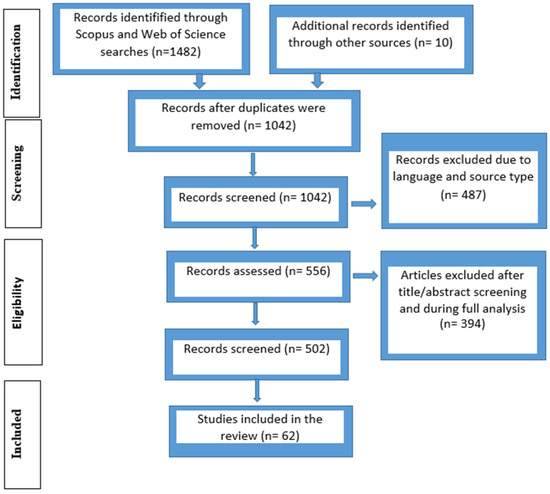
The selection process demonstrates the methodological rigor applied (Figure 1). Of the 1655 initial records, 612 were removed due to duplication. The remaining 1043 records underwent title and abstract screening, during which 487 studies were excluded for not fitting the scope of the research. Subsequently, 556 studies were read in full, resulting in the exclusion of 394 due to methodological limitations or thematic misalignment. In the end, 62 studies formed the basis of the review, a diverse and consistent body of evidence capable of providing a broad understanding of the state of the art on the subject.
Figure 1.
Flowchart of the literature review.
The variety of approaches and the depth of the selected studies reinforce the importance of this systematic review in understanding the challenges and opportunities of the circular economy within the construction sector. By bringing together evidence produced in different contexts, especially in regions marked by territorial inequalities and institutional fragilities, such as Maceió, the review offers a robust and necessary foundation for guiding analyses, interpretations, and policies that are more sensitive to contemporary urban realities.
3.2. Research Setting
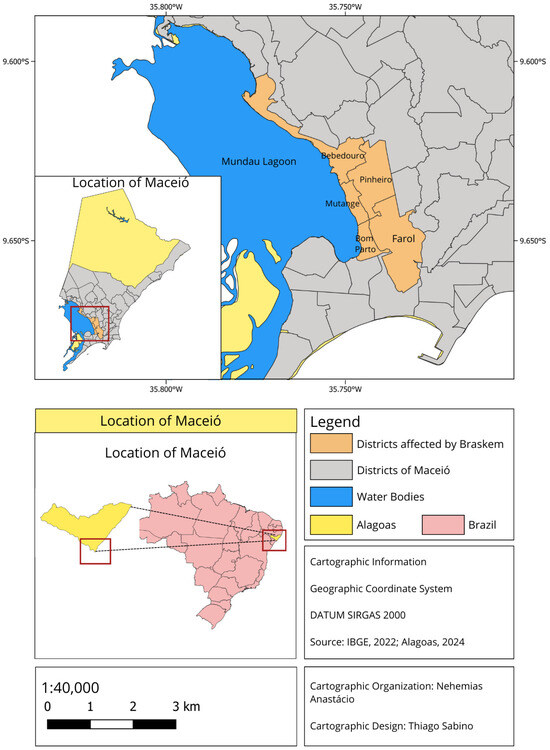
The land subsidence in Maceió has transformed the city into one of the most significant geotechnical episodes in Brazil’s urban history. Although the first cracks appeared almost silently in 2018 in the Pinheiro neighborhood, it soon became clear that this was not an isolated event. The expansion of fissures into Mutange, Bebedouro, Bom Parto, and Farol exposed the magnitude of a structural problem linked to the underground extraction of rock salt in the region [11,24]. Cavities left behind by years of mining operations, never adequately filled, compromised the stability of the terrain and triggered a process of ground failure that has permanently altered the city’s physical, social, and emotional landscape.
The human impact was devastating. Approximately 60,000 residents were forced to leave their homes, their histories, and their community ties almost overnight. Entire streets disappeared; family businesses that had operated for decades closed; neighborhoods that once pulsed with life became deserted areas marked by absence. More than 14,500 properties were demolished, leaving behind not only rubble but also interrupted memories and a profound sense of collective loss [25]. Environmentally, the disaster caused instability in green areas, affected groundwater sources, and produced an extraordinary volume of CDW, a scale of debris typically seen only after major natural disasters.
Paradoxically, while numerous studies highlight that the reuse of such waste can support urban reconstruction and strengthen circular economy practices, Maceió still lacks the infrastructure needed to turn this potential into reality. There are no fully operational CDW recycling plants, no organized cooperatives dedicated to sorting, and no clear municipal regulatory framework for utilizing these materials. As a result, what could be a sustainable opportunity has accumulated instead as an environmental and urban burden.
Beyond the disaster itself, Maceió reveals a complex urban landscape characterized by deep inequalities. In the same city, affluent coastal neighborhoods such as Ponta Verde, Pajuçara, and Jatiúca coexist with peripheral regions like Tabuleiro do Martins, Benedito Bentes, and Clima Bom, where residents face persistent challenges in mobility, access to public services, and basic infrastructure (Figure 2). These inequalities shape daily life and directly influence the city’s institutional capacity to respond to emergencies such as land subsidence. Despite having a diversified economy which includes a major chloralkali industrial hub, a robust service sector, and tourism, Maceió still struggles with chronic issues in transportation, urban planning, and environmental management [24].
Figure 2.
Location of the Neighborhoods Affected by Land Subsidence in Maceió.
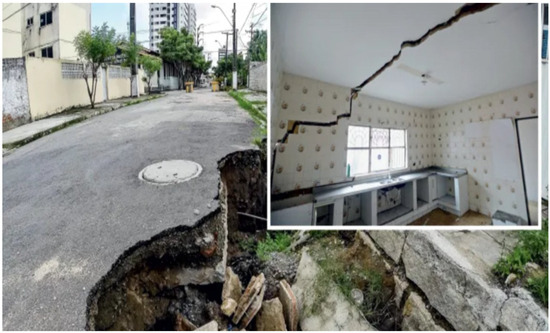
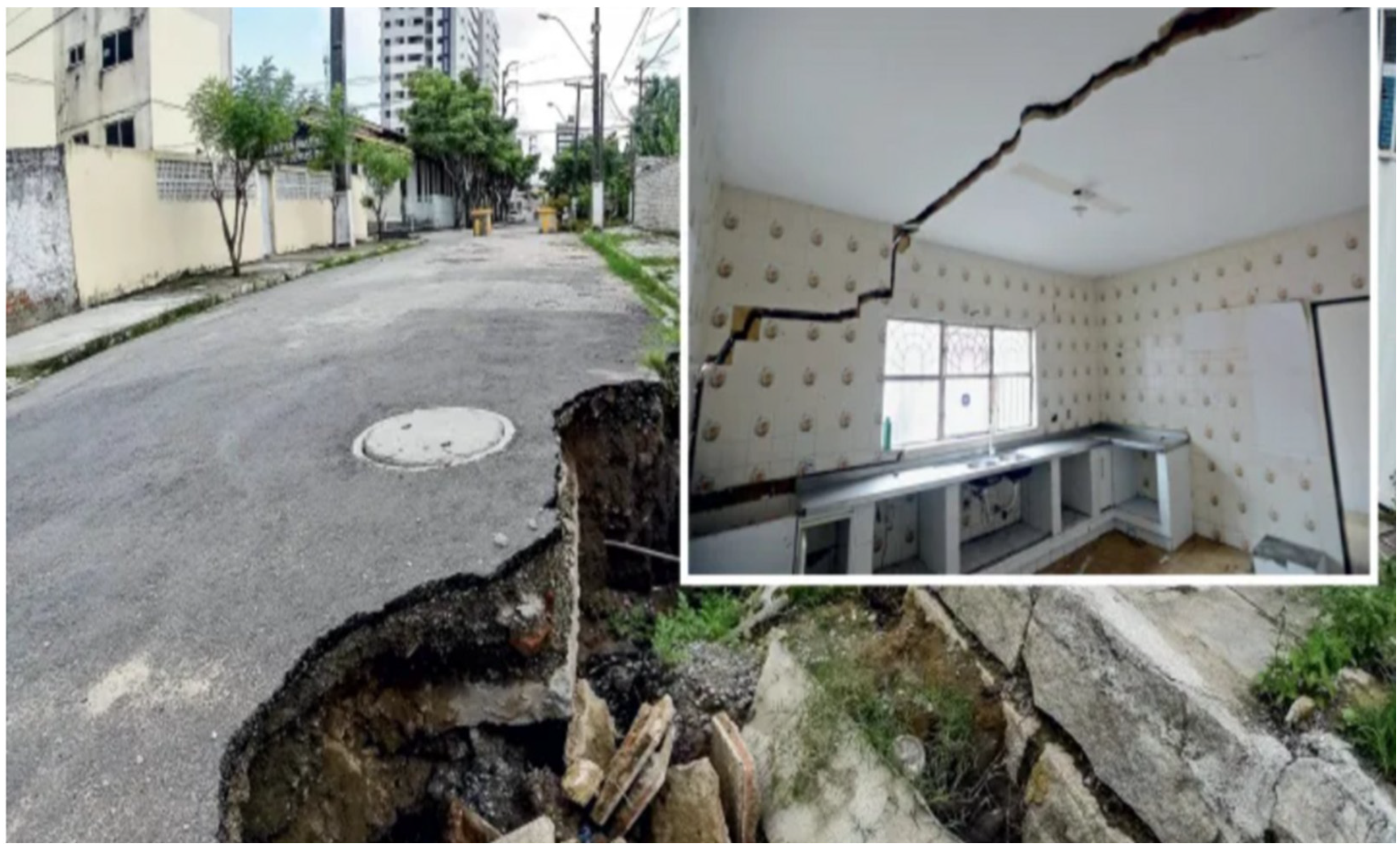
The land subsidence crisis exposed and intensified these weaknesses. The lack of coordination among public agencies, the informality of waste flows, and the absence of territorial planning became even more evident as the city was forced to manage massive volumes of debris, widespread displacement, and pressure for rapid solutions [26]. In this sense, Maceió becomes a true urban laboratory for understanding how vulnerable cities can or cannot navigate ecological and institutional transition processes. Figure 3 illustrates an example of a residence affected.
Figure 3.
Ground Subsidence in Maceió damage to public roads and residences.
Despite so many adversities, the situation also reveals possibilities. The crisis illuminated the urgent need to strengthen public policies, rethink governance models, and foster closer collaboration between government, the productive sector, and civil society. When effectively coordinated, these actors can transform longstanding challenges into opportunities for innovation, more sustainable reconstruction, and reorganization of the urban fabric.
Understanding CDW management in this context means looking far beyond technical considerations. It requires acknowledging that every operational barrier is intertwined with deeper social, cultural, institutional, and territorial factors. It means recognizing that meaningful change depends on both infrastructure and trust, on regulations as much as community engagement. The city possesses critical conditions to advance toward a circular economy, but this requires coordination, planning, and political will.
3.3. Data Collection
Data collection was conducted over three months using a mixed-methods strategy that combined a structured questionnaire, semi-structured interviews, and document analysis. This approach allowed the study to capture both measurable patterns and contextual interpretations related to barriers affecting the construction and demolition waste (CDW) market in Maceió.
The questionnaire was specifically designed to address the objectives of the study and was organized into two sections. The first section collected information on participants’ profiles, including areas of professional activity, years of experience, and involvement in waste generation, regulation, management, or commercialization. The second section presented a set of barriers identified in the literature and adapted to the local context of Maceió. Each barrier was assessed using a five-point Likert scale, ranging from “not relevant” to “very relevant.” The questionnaire was administered using a hybrid format, combining online distribution through professional networks and institutional contacts with in-person application during technical meetings and site visits. The average completion time ranged from 12 to 15 min.
The survey achieved a response rate of approximately 90%, indicating strong engagement among the targeted participants [27,28]. Although the study does not seek statistical representativeness of the entire construction sector, the sampling strategy was designed to ensure broad coverage of key stakeholder groups involved in CDW generation, regulation, management, and commercialization in Maceió. These groups included public managers, construction professionals, waste management operators, consultants, and representatives of recycling and intermediary activities. Within this defined analytical scope, the high response rate contributes to the internal consistency of the findings by ensuring that the perspectives of the principal actors shaping the local CDW market are adequately represented. As a case-based study, the results are interpreted as analytically generalizable to similar urban contexts rather than statistically representative of the national construction sector.
To complement the quantitative data, semi-structured interviews were conducted either in person or via videoconference, depending on participants’ availability. Interviews lasted between 40 and 60 min and followed a flexible script inspired by Refs. [29,30,31], allowing respondents to elaborate on technical, economic, institutional, and sociocultural aspects of CDW management and circular economy practices. All interviews were audio-recorded with participants’ consent and transcribed verbatim. Interviewees included experts, public managers, cooperative representatives, recycling plant operators, and members of civil society, enabling the inclusion of diverse viewpoints on barriers and opportunities within the sector.
Participant selection followed an intentional sampling strategy, prioritizing individuals directly involved in CDW-related activities and decision-making processes. Inclusion criteria comprised professional engagement with construction activities, waste management, recycling operations, environmental regulation, or policy implementation in Maceió. Participants represented the construction sector, local universities (including UFAL), public agencies such as the Municipal Superintendency for Sustainable Development (SUDES), the Environmental Institute (IMA), and Civil Defense, as well as recycling facilities and environmental organizations. This diversity was intended to capture variation in institutional roles and practical experience rather than to ensure statistical representativeness.
Invitations were sent through institutional emails, professional networks, and direct contacts established via academic and governmental channels. To minimize potential bias associated with the hybrid administration mode, identical instruments and question wording were used in both online and in-person formats. This methodological choice ensured the collection of qualified and contextually grounded information, in accordance with the recommendations of Ref. [15] for applied research in complex urban contexts. The integration of survey data, interviews, and document analysis supported triangulation, helping to mitigate limitations related to self-reported information and strengthening the interpretative robustness of the analysis [23,32].
Official documents, environmental regulations, technical reports, and institutional publications were also reviewed to contextualize the empirical findings and support their interpretation. All research procedures followed ethical standards established by Resolution No. 510/2016 of the Brazilian National Health Council. Participants signed an Informed Consent Form (ICF), and confidentiality and anonymity were fully preserved throughout the study.
3.4. Data Analysis
Data collection and analysis were conducted systematically using a mixed-methods approach that combined quantitative and qualitative techniques to ensure analytical rigor and interpretative depth. Structured questionnaires and semi-structured interviews served as the primary data sources, enabling the simultaneous examination of measurable perceptions and contextual interpretations related to barriers affecting the commercialization of construction and demolition waste (CDW) in Maceió.
Before analysis, all collected data underwent a review and standardization process to identify inconsistencies and ensure reliability. Quantitative data were analyzed using descriptive statistics, including means and standard deviations, followed by inferential procedures. Barrier relevance was assessed using the Relative Importance Index (RII), calculated by dividing the weighted score of each barrier by the maximum possible score, which allowed barriers to be ranked according to respondents’ perceived relevance. Analysis of variance (ANOVA) was applied to examine differences in perceptions across stakeholder groups. All statistical analyses were performed using R software (version 4.3.1).
Before conducting ANOVA, the underlying statistical assumptions were examined. Normality was assessed using the Shapiro–Wilk test, and homogeneity of variances was evaluated through Levene’s test. In cases where assumptions were marginally violated, results were interpreted with caution and supported by descriptive analyses. Missing or incomplete responses were limited (less than 5%) and were excluded using listwise deletion.
Qualitative data derived from semi-structured interviews were transcribed verbatim and analyzed using thematic content analysis, following the procedures proposed in Refs. [14,32]. This process enabled the identification of recurring themes related to market dynamics, governance arrangements, sociocultural perceptions, and institutional constraints influencing CDW commercialization. The integration of quantitative rankings (RII and ANOVA) with qualitative insights supported triangulation and enhanced the consistency and interpretative validity of the findings, in line with recommendations for mixed-methods research [13,33]. Through this analytical pathway, the study offers a contextualized and comprehensive understanding of the barriers shaping the consolidation of the CDW market in Maceió. The Supplementary Material comprises Table S1, presenting the Shapiro–Wilk test for normality; Table S2, reporting Levene’s test for homogeneity of variances; and Table S3, detailing missing data and listwise deletion.
4. Results and Discussion
The central focus of this article is to understand, in a broad and context-sensitive manner, the barriers that hinder the consolidation of the construction and demolition waste (CDW) market in Maceió. This analysis gains even greater relevance given the city’s current circumstances, marked by the profound socioenvironmental impacts caused by the ground subsidence disaster. In addition to generating an extraordinary volume of waste, this event exposed long-standing weaknesses in public management, making it urgent to investigate why the recycled materials market has not yet been consistently structured. Based on information gathered through questionnaires, interviews, and statistical analyses, it was possible to identify five major groups of obstacles that are interconnected and mutually reinforcing: economic, environmental, sociocultural, institutional and organizational barriers, as well as legal and public policy-related constraints.
4.1. Characterization of Tesearch Participants
A total of 53 participants contributed to the study: 43 responded to the structured questionnaire, forming the quantitative database, and 10 took part in the semi-structured interviews, enriching the qualitative analysis. Most participants were academics and environmental managers, who provided strong technical rigor to the evaluations. Meanwhile, the participation of public-sector representatives and contractors added practical and strategic perspectives from the CDW market. The group exhibited considerable diversity in professional experience, ranging from 5 to 20 years, which offered complementary insights into the functioning of the CDW management chain.
Table 2 presents the detailed distribution of respondents, categorized by professional background and experience in construction and demolition waste management. The research employed two main methods: structured questionnaires (quantitative approach) and expert interviews (qualitative approach). The key findings obtained through these procedures are presented below.
Table 2.
Distribution of Interviewees by Professional Category and Experience in Construction and Demolition Waste Management.
The study involved 43 respondents in the quantitative survey and 10 specialists in the qualitative interviews, encompassing a diverse group of professionals directly or indirectly involved in the management of construction and demolition waste (CDW). Among the participants were academics, environmental managers, public sector representatives, consultants, engineers, and architects, ensuring a wide range of technical and institutional perspectives. The interviewed specialists, whose professional experience ranged from 5 to 20 years, included project managers, sustainability managers, and public policy makers. Their insights helped contextualize the historical challenges faced by the sector and identify trends and opportunities for its improvement. The combination of quantitative data and qualitative insights enabled the development of a comprehensive, in-depth, and context-sensitive understanding of the complex reality of CDW management in Maceió.
4.2. Analysis of Barriers to the CDW Market in Maceió
The results provide insights that the challenges faced in Maceió are not limited to technical or operational issues. Instead, they reveal a broader set of structural, cultural, and political constraints that hinder the proper functioning of the recycled materials market. This indicates that overcoming these barriers requires coordinated strategies capable of integrating consistent public policies, economic incentives, institutional improvements, and social awareness initiatives. Understanding these interactions is essential for formulating context-sensitive and effective solutions aligned with the principles of the circular economy and the strengthening of urban sustainability in the municipality.
Table 3 presents a quantitative and interpretative synthesis of the main barriers that hinder the implementation of effective CDW commercialization practices in the city. The barriers were organized into five major analytical categories: economic, environmental, sociocultural, institutional/organizational, and legal/public policy, allowing for a structured reading of the phenomenon. The results, obtained through the Relative Importance Index (RII), means, standard deviations, and ANOVA tests, indicate which factors exert the greatest influence on the inefficiency of the current system. The purpose of this systematization is to highlight, with statistical rigor and interpretative clarity, the elements that most limit the advancement of the circular economy and the consolidation of a sustainable CDW market in Maceió.
Table 3.
Barriers to the Implementation of Effective Construction and Demolition Waste Trading Practices in Maceió.
In the economic dimension, the identified barriers reveal a significant impact on the functioning of the recycled materials market. The absence of tax incentives for recycling (RII = 0.88) and the devaluation of recycled materials (RII = 0.85) appear as the most critical issues, indicating that the sector still operates without stimulus policies capable of increasing its competitiveness. The high cost of transportation and logistics (RII = 0.83), combined with the low financial return of recycling activities (RII = 0.78), reinforces the existence of persistent structural limitations. The analysis of variance (p < 0.05) also indicates significant perception differences between public and private sector professionals, suggesting that economic impacts are experienced differently by various actors in the chain.
The environmental scenario is equally challenging. The impact of ground subsidence (RII = 0.90) stands out as the most relevant barrier, revealing how Maceió’s specific geotechnical conditions intensify the weaknesses of the waste management system. The scarcity of suitable areas for establishing recycling plants (RII = 0.87) and the risks of air and soil pollution (RII = 0.85) demonstrate that the municipality lacks adequate territorial planning and robust environmental infrastructure. These findings show that limiting the analysis to technical dimensions is insufficient: there is a structural constraint related to how the city organizes and occupies its territory, which hinders the advancement of the circular economy.
The sociocultural barriers, in turn, reveal deep dimensions of local culture. The lack of environmental awareness and education (RII = 0.83), combined with cultural resistance to recycling (RII = 0.80), indicates that sustainable practices still face historical obstacles in the construction sector. Negative perceptions of recycled materials persist, along with a preference for new inputs, often associated with higher quality. This scenario reinforces the importance of continuous educational actions and campaigns that promote the value of recycled materials, capable of transforming mindsets and strengthening a culture of sustainability.
In the institutional and organizational sphere, the challenges become even more evident. The absence of effective public policies (RII = 0.89) and excessive bureaucracy in licensing processes (RII = 0.86) emerge as central obstacles, undermining the construction of an integrated waste management system. The lack of public–private partnerships (RII = 0.84) and the weak coordination between public agencies and recycling companies (RII = 0.82) reinforce a context of institutional fragility, where cooperation remains limited. These results highlight the need to strengthen governance through more efficient, participatory, and transparent coordination mechanisms.
Finally, in the legal and public policy dimension, the results point to a set of challenges that compromise the effectiveness of environmental actions. Fragmented and inconsistent legislation (RII = 0.87) and insufficient enforcement (RII = 0.85) indicate that the lack of regulatory alignment weakens the implementation of sustainable practices. The absence of incentives that encourage integrated enforcement (RII = 0.84) reinforces the urgency of restructuring the regulatory framework, ensuring not only normative clarity but also governmental capacity for implementation. In this sense, repositioning the State as an articulator of a consistent regulatory environment becomes essential for fostering innovation, attracting investment, and consolidating a competitive and functional CDW recycling market.
4.3. Barriers to Circular Economy in Maceió’s CDW Market
The central objective of this research was to identify and deeply understand the barriers that hinder the consolidation of the construction and demolition waste (CDW) market in Maceió. To achieve this, the study integrated economic, environmental, sociocultural, institutional, and legal dimensions, aligning them with the conceptual framework of the circular economy. The guiding question which structural and perceptual factors limit the advancement of the CDW market in Maceió, and how can these obstacles be overcome through integrated policies and collaborative management practices? made it possible to connect the lived experiences of local actors with broader debates on sustainable governance and transitions toward circular models of production and consumption.
For the economic barriers, the findings are consistent with trends reported in previous studies [9,15], particularly regarding the absence of tax incentives, the low market valuation of recycled materials, and high logistical costs. However, the case of Maceió adds an important contextual dimension: urban precariousness and territorial instability appear to intensify these economic constraints. In a city affected by ground subsidence and spatial disruption, transportation costs, uncertainty in supply, and operational risks are amplified, reinforcing market instability. This observation supports arguments in Refs. [5,10,21] that economic instruments are unlikely to be effective when implemented in isolation from infrastructure planning and urban governance.
For the environmental barriers, the results align with findings from studies conducted in Asian and other rapidly urbanizing contexts. Refs. [2,20], where limited space for recycling facilities and environmental risks simultaneously motivate and constrain recycling activities. In Maceió, these dynamics are intricately linked to post-disaster conditions, suggesting that CDW management cannot be treated solely as an environmental or economic issue. Instead, it emerges as part of a broader process of urban reorganization and environmental justice, in which waste flows, land use, and risk management are deeply interconnected.
The sociocultural barriers identified in this study extend beyond information deficits. Persistent resistance to recycled materials reflects entrenched professional preferences and perceptions of quality, echoing the “imaginary of the new” discussed in Ref. [17]. In Maceió, this resistance appears to be reinforced by the absence of certification systems, traceability mechanisms, and standardized quality controls, elements highlighted by Ref. [8] as critical for building confidence in recycled products. The findings suggest that informational initiatives alone are unlikely to alter these perceptions. Instead, sociocultural acceptance appears to be linked to broader institutional conditions, including regulatory clarity, technical standards, and mechanisms that support gradual changes in professional practices.
Institutional and organizational barriers also play a central role. Consistent with Ref. [6], the results point to fragmented policies, lengthy licensing procedures, and limited coordination between public and private actors as factors contributing to systemic inefficiency. Beyond confirming these patterns, the analysis suggests that governance arrangements based on cooperation and co-production may help reduce fragmentation. In this sense, institutional capacity is not only a regulatory matter but also a relational one, shaped by the ability of public authorities, firms, and knowledge institutions to coordinate actions and share responsibilities.
For the legal and regulatory barriers, the findings align with previous diagnoses [6,12], identifying regulatory fragmentation and weak enforcement as persistent challenges. The case of Maceió, however, highlights a less explored dimension: the perceived impact of regulatory instability on the confidence of economic agents. Legal certainty, understood as clarity of rules, relative stability of regulatory arrangements, and institutional coherence, appears to be associated with how actors assess investment risks and long-term opportunities. From this perspective, regulation functions not merely as a background condition but as an element that interacts with market dynamics and influences strategic decision-making.
4.4. Interdependencies Among Economic, Institutional, Sociocultural, Environmental, and Legal Barriers
An important contribution of this study is the demonstration that the barriers identified do not act in isolation but are interconnected and mutually reinforcing. Regulatory uncertainty and limited enforcement tend to weaken incentives for long-term investment, which in turn restricts the expansion of sorting and recycling infrastructure. Insufficient infrastructure then contributes to higher logistical costs and greater price volatility, intensifying existing economic constraints. At the same time, inconsistent quality control and limited traceability foster sociocultural resistance, as construction professionals often perceive recycled materials as unreliable. These perceptions reduce demand and further destabilize the market. Taken together, institutional fragility, economic risk, and cultural stigma interact cumulatively, creating a self-reinforcing cycle that constrains the consolidation of the CDW market.
The barriers identified in Maceió are broadly consistent with those reported in international studies from both developed and developing contexts, including China, India, South Africa, and parts of Europe [2,4,9,16]. However, the Brazilian case exhibits distinct characteristics. Unlike contexts where strong regulatory enforcement or sustained fiscal incentives partially mitigate market risks, the findings from Maceió suggest a tighter coupling between institutional weakness and sociocultural resistance, intensified by informality and uneven state capacity. While international experience indicates that stable regulation and long-term incentives can support market consolidation, the present study suggests that such measures may have limited effectiveness when governance constraints and social mistrust remain unaddressed.
4.5. Context-Sensitive Policy Implications for Brazilian Cities
In the Brazilian context, policy responses must account for structural informality, fiscal constraints, and variations in municipal capacity. For cities such as Maceió, the findings suggest that priority actions include strengthening coordination among urban planning, environmental regulation, and waste management agencies; developing locally adapted quality standards and certification mechanisms for recycled materials that are compatible with national norms but accessible to small and medium recyclers; and expanding public procurement practices that incorporate recycled aggregates in non-structural applications, such as paving and urban infrastructure. In addition, supporting cooperatives and small-scale operators through technical assistance and institutional integration may be more effective than relying exclusively on large-scale private investments. These measures point to the importance of incremental, territorially grounded strategies rather than the direct transfer of models developed in highly regulated or high-income settings.
5. Conclusions
This study examined the barriers affecting the consolidation of the construction and demolition waste (CDW) market in Maceió, revealing a complex configuration of economic, environmental, sociocultural, institutional, and legal constraints that jointly limit progress toward more sustainable practices. While many of these challenges resemble those reported in other Brazilian cities, such as informal disposal, discontinuous public policies, and limited coordination along the production chain, the case of Maceió is distinguished by the effects of ground subsidence, which abruptly increased waste generation and intensified pressures on already fragile urban and environmental systems.
From an economic and logistical perspective, the findings indicate that the absence of fiscal incentives, high transportation costs, and the low market valuation of recycled materials are associated with reduced investment attractiveness. In practical terms, respondents highlighted the need for locally feasible incentive mechanisms, such as reduced municipal service fees for recycling operators, differentiated landfill tariffs, and the inclusion of recycled aggregates in public procurement for non-structural applications, including paving, sidewalks, and urban drainage works. These measures, when combined with clearer demand signals from public authorities, may help reduce market uncertainty and operational risk.
Environmental constraints further complicate CDW management in Maceió. Ground subsidence and the limited availability of suitable areas for recycling facilities restrict infrastructure expansion and increase logistical distances. The results suggest that integrating CDW facilities into municipal land-use planning and prioritizing rehabilitation of degraded areas for recycling operations could reduce spatial conflicts while addressing environmental vulnerability. At the same time, continued air and soil pollution from irregular dumping reinforces the importance of coordinated inspection and monitoring practices rather than isolated enforcement actions.
Sociocultural barriers remain significant. Persistent perceptions of inferior quality associated with recycled materials, combined with the scarcity of reference projects, continue to influence professional practices and market demand. The findings suggest that acceptance is more likely to improve when technical standards, traceability mechanisms, and pilot projects are implemented in parallel, allowing construction professionals to evaluate recycled materials under operating conditions rather than relying solely on informational campaigns.
Institutional and organizational constraints also play a central role. Fragmented responsibilities, lengthy licensing procedures, and limited interaction between public agencies and private actors restrict policy implementation and slow innovation. In this context, respondents emphasized the potential of collaborative arrangements involving municipalities, recycling operators, universities, and professional councils to support technical training, streamline administrative procedures, and facilitate knowledge exchange. Such arrangements do not require new institutional structures but rather the coordinated use of existing capacities.
In the legal and regulatory domain, inconsistent legislation and uneven enforcement contribute to legal uncertainty and competitive asymmetry, reinforcing informality within the CDW chain. The findings suggest that greater alignment between municipal regulations and state-level technical norms, coupled with clearer enforcement criteria, could improve predictability for economic agents and support long-term planning. Rather than introducing additional regulations, the results point to the value of improving coherence and stability within existing frameworks.
Despite these challenges, the study also identifies opportunities for incremental progress. Expanding public–private partnerships, developing regionally adapted quality standards, improving logistical planning, and strengthening municipal coordination across departments emerge as feasible pathways for advancing CDW commercialization in Maceió and in other Brazilian cities facing similar constraints.
This study has several limitations that should be acknowledged. First, as a case- based investigation, the findings are analytically rather than statistically generalizable and reflect the specific institutional, territorial, and socio-environmental conditions of Maceió. Second, although the mixed-methods approach allowed for triangulation, the quantitative sample size limits the use of more advanced statistical techniques. Third, the analysis relies on self-reported perceptions, which may be influenced by respondents’ professional positions and experiences.
Future research could expand the comparative scope by examining multiple Brazilian cities affected by different urban and environmental conditions, allowing for a more systematic assessment of how territorial factors influence CDW market dynamics. Longitudinal studies would also be valuable for evaluating how regulatory changes, pilot projects, or procurement policies affect market consolidation over time.
From an academic perspective, this study contributes by providing empirically grounded and context-sensitive evidence on the interdependent barriers shaping CDW commercialization in a city affected by an urban disaster and marked by structural inequalities. By emphasizing the interaction among economic, environmental, sociocultural, institutional, and legal dimensions, the research reinforces the need for multidimensional and territorially informed approaches to advancing circular economy practices in the construction sector.
Supplementary Materials
The following supporting information can be downloaded at: https://www.mdpi.com/article/10.3390/su18031387/s1, Table S1: Shapiro–Wilk Test for Normality; Table S2: Levene’s Test for Homogeneity of Variances; Table S3: Missing Data and Listwise Deletion.
Author Contributions
The authors contributed to the study as follows: N.A.S.d.S. was responsible for the conceptualization of the research, development of the methodological design, data collection, investigation procedures, formal analysis, data curation, visualization, and preparation of the original draft. R.A.G.B. contributed to the conceptualization, methodological refinement, supervision of all research stages, project administration, and critical review and editing of the manuscript. B.S.B. collaborated in methodological development, investigation activities, review and editing of the manuscript, and was responsible for securing funding. All authors have read and agreed to the published version of the manuscript.
Funding
This research received no external funding. The APC was not funded.
Institutional Review Board Statement
Ethical review and approval were waived for this study because it falls under the exceptions provided by Resolution No. 510/2016 of the Brazilian National Health Council (CNS), particularly Article 1, sole paragraph, item III, which exempts studies that use “public domain information or information whose access is freely available to any interested party” from ethics committee review.
Informed Consent Statement
Informed consent for participation was obtained from all subjects involved in the study. Although the data were collected directly from the experts, no sensitive data were gathered, and there were no ethical risks involved, characterizing a low-risk study with technical-professional content, consistent with the exceptions outlined in the referred regulation.
Data Availability Statement
The data is not publicly available due to the privacy restrictions of research participants.
Conflicts of Interest
The authors declare no conflicts of interest.
References
- Zhang, X. A systematic literature review on individuals’ waste separation behavior. Resour. Environ. Sustain. 2023, 14, 100137. [Google Scholar] [CrossRef] [Scilit]
- Ma, M.; Tam, V.W.Y.; Le, K.N.; Li, W. Challenges in current construction and demolition waste recycling: A China study. Waste Manag. 2020, 118, 610–625. [Google Scholar] [CrossRef] [Scilit]
- Kirchherr, J.; Reike, D.; Hekkert, M. Conceptualizing the circular economy: An analysis of 114 definitions. Resour. Conserv. Recycl. 2017, 127, 221–232. [Google Scholar] [CrossRef] [Scilit]
- Caldera, H.; Ryley, T.; Zatyko, N. A systematic review of circular economy adoption in construction. Sustain. Prod. Consum. 2020, 26, 187–202. [Google Scholar]
- Sajid, Z.W.; Aftab, U.; Ullah, F. Barriers to adopting circular procurement in the construction industry: The way forward. Sustain. Futures 2024, 8, 100244. [Google Scholar] [CrossRef] [Scilit]
- Kumar, A.; Thakur, A.K.; Gaurav, G.K.; Klemeš, J.J.; Sandhwar, V.K.; Pant, K.K.; Kumar, R. A critical review on sustainable hazardous waste management strategies: A step towards a circular economy. Environ. Sci. Pollut. Res. Int. 2023, 30, 105030–105055. [Google Scholar] [CrossRef] [Scilit]
- Zhang, Y. Overcoming Barriers to the Adoption of Recycled Construction Materials: A Comprehensive PEST Analysis and Tailored Strategies. Sustainability 2023, 15, 14635. [Google Scholar] [CrossRef] [Scilit]
- Rahman, M.M.; Bohara, A.K. Assessing the preference and spatial dependence of a solid waste management system in Nepal: A choice experiment approach. J. Environ. Manag. 2023, 327, 116805. [Google Scholar] [CrossRef] [Scilit] [PubMed]
- Ma, M.; Tam, V.W.Y.; Le, K.N.; Osei-Kyei, R. Analysing the impacts of key factors on the price of recycled concrete: A system dynamics model. J. Build. Eng. 2023, 80, 108123. [Google Scholar] [CrossRef] [Scilit]
- Islam, N.; Sandanayake, M.; Muthukumaran, S.; Navaratna, D. Review on Sustainable Construction and Demolition Waste Management—Challenges and Research Prospects. Sustainability 2024, 16, 3289. [Google Scholar] [CrossRef] [Scilit]
- Brazilian Geological Survey (CPRM). Monitoring Report No. 02 (January 2019): Ground Instability Studies in the Pinheiro District, Maceió, Alagoas, Brazil; Brazilian Geological Survey (CPRM): Brasília, Brazil, 2019.
- Shajidha, H.; Mortula, M.M. Sustainable Waste Management in the Construction Industry. Front. Sustain. Cities 2025, 7, 1582239. [Google Scholar] [CrossRef] [Scilit]
- Hasan, M.R.; Sagar, M.S.I.; Ray, B.C. Barriers to Improving Construction and Demolition Waste Management in Bangladesh. Int. J. Constr. Manag. 2023, 23, 2333–2347. [Google Scholar] [CrossRef] [Scilit]
- Poon, C.S. Management of construction and demolition waste in Hong Kong. Waste Manag. Res. 1997, 15, 129–141. [Google Scholar] [CrossRef] [Scilit]
- Tam, V.; Tam, C. Barriers to the reuse of construction waste materials. Resour. Conserv. Recycl. 2006, 47, 231–247. [Google Scholar]
- de Melo Nunes Lopes, C.; Cury, A.A.; Mendes, J.C. Construction and Demolition Waste Management and Artificial Intelligence—A Systematic Review. Rev. Gestão—RGSA 2024, 18, e08810. [Google Scholar]
- Buchard, M.V.; Christensen, T.B. Business Models for the Reuse of Construction and Demolition Waste. Waste Manag. Res. 2023, 42, 359–371. [Google Scholar] [CrossRef] [Scilit]
- Roy, P.; Mohanty, A.K.; Dick, P.; Misra, M. A Review on the Challenges and Choices for Food Waste Valorization: Environmental and Economic Impacts. ACS Environ. Au 2023, 3, 58–75. [Google Scholar] [CrossRef] [Scilit] [PubMed]
- Yuan, H. A model for assessing construction waste management performance. Waste Manag. 2012, 32, 1218–1228. [Google Scholar] [CrossRef] [Scilit]
- Shooshtarian, S.; Maqsood, T.; Wong, P.S.; Khalfan, M.; Yang, R.J. Extended Producer Responsibility in the Australian Construc-tion Industry. Sustainability 2021, 13, 620. [Google Scholar] [CrossRef] [Scilit]
- Delgado, F.C.M.; Bezerra, B.S.; Baldan, J.S.; Moretti Ribeiro da Silva, H.; Barriga, G.D.C. Factors influencing consumer intention to sort household waste: A Brazilian perspective. Waste Manag. Res. 2024, 43, 697–708. [Google Scholar] [CrossRef] [Scilit]
- Al-Otaibi, A.; Bowan, P.A.; Abdel Daiem, M.M.; Said, N.; Ebohon, J.O.; Alabdullatief, A.; Al-Enazi, E.; Watts, G. Identifying the Barriers to Sustainable Management of Construction and Demolition Waste in Developed and Developing Countries. Sustainability 2022, 14, 7532. [Google Scholar] [CrossRef] [Scilit]
- Silva, R.V.; de Brito, J.; Dhir, R.K. Availability and Processing of Recycled Aggregates within the Construction and Demolition Supply Chain: A Review. J. Clean. Prod. 2017, 143, 598–614. [Google Scholar] [CrossRef] [Scilit]
- IBGE—Brazilian Institute of Geography and Statistics. Available online: https://www.ibge.gov.br (accessed on 22 January 2024).
- CPRM—Serviço Geológico do Brasil. Mapeamento de Risco do Afundamento de Solo em Maceió: Relatório Técnico; CPRM: Brasília, Brazil, 2019.
- Metro1. Ground Subsidence in Maceió: Structural Damage and Urban Impacts. Metro1 News. 2023. Available online: https://www.metro1.com.br (accessed on 21 August 2025).
- Yin, R. Case Study Research and Applications: Design and Methods, 7th ed.; SAGE: Thousand Oaks, CA, USA, 2023. [Google Scholar]
- Field, A. Discovering Statistics Using R, 6th ed.; SAGE: London, UK, 2024. [Google Scholar]
- Ratnasabapathy, S.; Alashwal, A.; Perera, S. Exploring barriers to the implementation of waste trading practices in the Australian construction industry. Built Environ. Proj. Asset Manag. 2021, 11, 559–576. [Google Scholar] [CrossRef] [Scilit]
- Pallant, J. SPSS Survival Manual, 7th ed.; Routledge: New York, NY, USA, 2020. [Google Scholar]
- Gibbs, G. Analyzing Qualitative Data; SAGE: London, UK, 2018. [Google Scholar]
- Creswell, J.W.; Creswell, J.D. Research Design: Qualitative, Quantitative, and Mixed Methods Approaches, 6th ed.; SAGE: London, UK, 2023. [Google Scholar]
- Creswell, J.W.; Clark, V.L.P. Designing and Conducting Mixed Methods Research, 3rd ed.; SAGE: London, UK, 2018. [Google Scholar]

Disclaimer/Publisher’s Note: The statements, opinions and data contained in all publications are solely those of the individual author(s) and contributor(s) and not of MDPI and/or the editor(s). MDPI and/or the editor(s) disclaim responsibility for any injury to people or property resulting from any ideas, methods, instructions or products referred to in the content. |
© 2026 by the authors. Licensee MDPI, Basel, Switzerland. This article is an open access article distributed under the terms and conditions of the Creative Commons Attribution (CC BY) license.