1. Introduction
Greenwashing, now a common marketing practice, has been around in the information space for several decades. The term originated in the 1980s, coined by American ecologist Jay Westervelt [
1]. In 1986, in an article for the New York Times, he drew public attention to the new strategy of hotel companies that encouraged the reuse of towels throughout the customers’ stay, rather than replacing them daily [
2]. The guiding principle of these campaigns was the innovative idea of every guest participating in protecting the planet’s water resources and reducing the amount of detergents in wastewater. The problem was that the tourism industry, which in many areas intensively exploits the planet’s energy resources, failed to declare any other ecological initiatives on the part of the hotel. He questioned the idea of true environmental protection solely through such marginal savings, describing this measure as primarily aimed at reducing hotel operation costs. Jay Westervelt coined the term “greenwashing” by analogy with the English term “whitewashing,” which refers to the process of bleaching [
3]. Marketing activities invoking the idea of environmental protection quickly gained popularity, but unfortunately, they often evolved only in the scope of apparent actions without taking up real and effective challenges for environmental protection [
4,
5]. The paradox was that some companies used and disseminated the idea of greenwashing, while others did not advertise their ecological activities even though they carried out real work in the field of environmental protection [
6,
7].
The growing problems with environmental pollution caused by industrial production prompted a search for development opportunities and building a competitive advantage through the commercialization of ecological products. It should be emphasized that this course of action also led some companies to deliberately mislead their customers through greenwashing [
8,
9,
10]. In a relatively short time, the term “greenwashing” became synonymous with the terms “eco-bullshit,” “greenwashing,” and “green lies.” As early as 1992, Greenpeace published “The Greenpeace Book of Greenwash,” listing examples of such processes in various industries [
11]. Attempts to effectively combat these practices have been difficult to implement for years because legal regulations for individual countries and international structures were missing [
12,
13]. In order to combat the phenomenon of false environmental protection, the European Union introduced in 2005 a directive on unfair commercial practices used by businesses towards consumers in the internal market [
14]. Directive 2005/29/EC of the European Parliament and of the Council of 11 May 2005 concerns unfair business-to-consumer commercial practices in the internal market. Directive 2005/29/EC, in 2019, announced the idea of the European Green Deal [Communication From The Commission To The European Parliament, The European Council, The Council, The European Economic And Social Committee And The Committee Of The Regions The European Green Deal, COM/2019/640 final], and for the years 2020–2025, it adopted the implementation of the New Consumer Agenda [Communication From The Commission To The European Parliament And The Council New Consumer Agenda Strengthening consumer resilience for sustainable recovery, COM/2020/696 final], [
1].
It should be emphasized that contemporary greenwashing is used in an increasingly sophisticated form, according to the principle that the economic goal of the company (profit) justifies the means [
15]. Striving for net zero emissions that will be truly environmentally friendly and stop the destruction of ecosystems has become too difficult a challenge for many entities, which is why some companies are deliberately misleading the public by advertising their products as ecological [
16,
17]. An interesting issue is the pursuit of sustainable development also in the private sector, including the problem of applying greenwashing in terms of the proper interference of urban infrastructure with the natural environment [
18].
In the face of growing social awareness and increasingly stringent environmental regulations, automotive companies are increasingly emphasizing “green” values in their advertising campaigns and corporate communications [
19]. However, these declarations are not always reflected in actual actions. This work addresses the topic of greenwashing in the automotive industry, focusing both on the analysis of this phenomenon and on how it is perceived by consumers.
2. The Greenwashing Phenomenon in Terms of Consumer Behavior
Greenwashing by industrial companies involves informing the public about their environmental achievements by exaggerating their pro-ecological behavior. At the same time, they ignore and conceal the fact that they still cause widespread environmental pollution [
20,
21]. This greenwashing variant may be misleading or even deceptive towards consumers by spreading false advertising about environmental protection in order to improve the company’s image [
22].
Consumers assess whether companies use false advertising and conceal true information about their environmental impact, as well as their judgment and knowledge about the credibility and authenticity of companies’ environmental behavior is a measure of their perception of greenwashing [
23].
Greenwashing practices in companies have been shown to contribute to consumer distrust and skepticism, thus negatively impacting the company value, including its reputation [
22,
24] and the deterioration of the company’s financial results [
25] and share prices on the stock exchange [
26].
Early studies considered greenwashing primarily in terms of marketing, presenting it as a vital strategy used by eco-friendly companies to achieve larger market shares [
27]. Corporate greenwashing involves companies spreading false information about the environment in order to restore good relations with the public or create a positive media image. One of the fundamental principles of this practice is the manipulation and conflation of true and false information [
28,
29]. Later researchers began to define corporate greenwashing in terms of information communication. Sometimes, it is considered an information management strategy for companies to promote positive information and conceal negative aspects in order to present themselves as environmentally friendly and ecological [
30,
31]. This method involves combining the concealment of poor environmental performance with the active promotion of pro-ecological initiatives [
32].
In the theory of symbolic management, corporate greenwashing is defined as the engagement of companies in superficial ecological marketing, while refraining from taking any significant actions to protect the environment, or even consciously taking actions aimed at concealing the negative impact of their activities [
33]. This model of operation of corporations involves selectively disclosing the information regarding the impact on the environment [
34,
35,
36].
Green purchasing intention is the commitment of consumers to purchase eco-friendly and sustainable products, which reflects their willingness to purchase services or products from the companies having a good reputation for environmental protection [
37,
38]. The research shows that some consumers, when faced with information about ecological activities carried out by companies, perceive the declared ecological behavior or eco-friendly product features as marketing strategies, which makes them lose their trust in ecological information and convince them that the company practices greenwashing [
39]. When seeing corporate greenwashing practices, customers stop relying on the product of that brand [
34], perceiving the company as profit-oriented and devoid of social responsibility [
40], which causes negative consequences for consumers [
41]. Moreover, in an era of global information access, negative news about the greenwashing practices of a particular can spread easily, drawing the attention of consumers and making them more wary of its offered products. People are more likely to pay attention to negative information than to positive information [
42,
43] because negative information is perceived as more credible, resulting from deeper analysis. Therefore, when consumers perceive greenwashing by a specific brand, other brands in the industry may also be suspected of greenwashing, which will reduce their willingness to purchase other eco-friendly products from that industry [
36]. Consumers reduce their demand levels if a brand fails to meet its energy or environmental commitments [
38,
44], which may also lead to a lack of trust in other brands in the industry that have never used greenwashing [
45]. This is evidence that consumers have lost trust in the brand [
46] and are becoming more wary when dealing with similar eco-friendly products, or may even be entirely discouraged from purchasing such products altogether [
47].
Consumers who approach environmental issues with skepticism often believe that eco-friendly products are produced and promoted for practical reasons. Such customers tend to question the noble motives that drive the manufacturing of eco-friendly products or their eco-friendly advertising. They generally doubt the authenticity of environmental protection efforts. On the Chinese market, although many companies declare their active involvement in the protection of the environment, environmentally polluting activities have not yet been eliminated. This type of “greenwashing” behavior further increases consumer skepticism about companies’ environmental claims, making it more difficult for them to convince potential buyers of the products’ eco-friendliness. They may even develop a lower opinion of eco-friendly companies or products, perceiving them as misleading or at least providing incomplete information about the products’ eco-friendly properties or characteristics and their positive impact on the environment [
48]. The perception of greenwashing results in both a reduction in its value as well as greater distrust [
49]. The companies promoting their social responsibility may be met with the skepticism of consumers, who may perceive it as a way to hide certain issues or distort their true scale [
50].
3. The Phenomenon of Greenwashing in the Automotive Industry
The introduction of electric cars to the market is facing significant challenges worldwide. Research conducted by the American Trends Panel illustrates the skepticism surrounding this modern technology. The ATP, created by the Pew Research Center, is a nationwide panel consisting of randomly selected US adults. Panelists participate in the study via online surveys. The Pew Research Center is a nonpartisan, independent research center that informs the public about the issues, attitudes, and trends shaping the world. The center conducts data-driven public opinion research and does not take a political stance in its research [
51]. The Pew Research Center conducted the study to understand Americans’ views on electric vehicles. They surveyed 10,329 American adults between 30 May and 4 June 2023. [The research methodology is described at
https://www.pewresearch.org/science/2023/06/28/climate-change-methodology/ (date of access 12 November 2025)] It is important to emphasize that 50% of American adults say they are not considering buying an electric car, and only 38% say they might purchase a new electric vehicle. There is a need to understand the underlying reasons for this consumer attitude.
The automotive industry, which has a significant contribution to global greenhouse gas emissions, constitutes another area of market activity that has started to widely use greenwashing practices to achieve a competitive advantage in order to meet customer expectations [
52,
53]. Research has shown that the perception of greenwashing in relation to a given product reduces customers’ willingness to buy eco-friendly products offered by the competition [
54] and even threatens the industry development in general [
55]. Vehicles that use alternative energy sources to fossil fuels in their powertrains have become the subject of a number of government initiatives, including purchase subsidies and other privileges, such as parking and entry to city center zones. Eco-friendly vehicles are a strategic part of industrial production, which in the long term will be responsible for sustainable economic development [
56]. China has identified fully electric vehicles (EVs) as a prospective way to transform the entire automotive sector, where it is vying for global dominance. At the same time, the awareness of how important environmental protection is has grown, leading to electric vehicles emitting zero harmful substances, assuming top position in the consumer research aimed at determining purchasing preferences [
1,
57,
58].
Certain greenwashing practices, e.g., “selective environmental disclosure”, “exaggerated carbon reduction claims”, and “subsidy fraud” implemented by a number of electric vehicle industry brands, undoubtedly affect consumer purchase intentions. Customers choosing electric vehicles are often motivated by environmental responsibility. Nevertheless, existing research on the factors influencing electric vehicle demand primarily focuses on functional aspects, safety issues, and subsidy policies [
59,
60,
61,
62].
“Spillover” denotes the effect of economic activities, technologies, or policies in a particular field that evolve into other areas. This impact can be negative or positive, anticipated or unexpected. As regards consumer decisions, “spillover” is the situation where the actions or characteristics of one entity influence other entities related in some way with the first entity or share common attributes, but do not necessarily exhibit the same behaviors or characteristics [
63]. Research has shown that companies’ environmental protection efforts may result in positive spillovers for society and industrial chains, via such aspects as technical and technological innovations and the diversification of energy sources. Hence, the spillover effect of a company’s environmentally friendly actions may be considered as strengthening trust not only in the brand itself but also in other brands that provide environmentally friendly products or services [
64]. In consumer perception, all electric vehicle brands are interconnected; that is, consumers use the characteristics of one brand as a benchmark for evaluating other brands in the automotive industry. This influences customers’ purchase intentions for other electric vehicle brands, regardless of whether these brands engage in greenwashing or not. Consequently, false environmental claims made by one electric vehicle brand can have negative repercussions that will be attributed to other companies in the automotive industry [
65]. The main aim of this study was to determine the purchasing intentions of consumers who have a specific interest in fully electric vehicles. Previous studies indicate a decisive impact of consumers’ environmental awareness on their intention to buy electric vehicles [
66,
67,
68].
Customer skepticism is especially pronounced when a company claims to be environmentally friendly but fails to take any specific action. Consumers can often spot this discrepancy in performance and advertising, and they then become skeptical of the environmental message, a phenomenon called green skepticism [
50]. As the number of greenwashing cases in companies increases, so do doubts about companies’ environmental declarations [
7]. Studies on green skepticism indicate that the effect of intrinsic motivations on green skepticism should also take into account the influence of greenwashing, as this idea may create a feedback loop and thus influence green skepticism [
69]. When greenwashing is identified by consumers in a specific electric vehicle brand, they become skeptical of the entire electric vehicle sector. This lack of trust also stems from the fact that, in the case of electric vehicles, consumers receive a product with a number of technical concerns (the issue of actual, not just declared, battery life), operational concerns (the insufficient number and geographic coverage of charging stations), and operational concerns (the safety of power systems in terms of uncontrolled temperature rise and spontaneous combustion).
The widespread adoption of greenwashing behavior among consumers creates the illusion that companies’ operations are environmentally friendly, prompting them to think more deeply when exposed to information about companies’ pro-environmental practices and eco-friendly products and services. As consumers perceive instances of greenwashing, their trust in eco-friendly products wanes, which consequently reduces their willingness to purchase similar products advertised as eco-friendly [
23].
When consumer skepticism about environmental issues reaches a particular threshold, even individuals with a strong sense of environmental responsibility are unable to uphold their commitments to sustainable consumption and adopt eco-friendly consumer behavior. Consequently, when greenwashing behavior is identified in a particular electric vehicle brand, customers become skeptical of the environmental credentials of other electric vehicle brands, leading to a decline in demand. Eco-skepticism is associated with a negative attitude toward the supposedly environmentally friendly image of green products [
70]. In research on the consequences and causes of green skepticism, attribution theory was used, and it was determined that there is a direct negative correlation between green skepticism and the intention regarding prospective purchases [
69]. Moreover, green skepticism has also been indicated to influence purchase intention through intermediary mechanisms such as environmental concern and subjective environmental knowledge. Green skepticism, apart from decreasing purchase intention, also leads to consumers negatively evaluating a wide range of other green products.
4. Research Problem and Research Method
The main research question is consumer perception of greenwashing and its consequences when making purchasing decisions. The analysis utilized materials and reports from selected companies that declare pro-environmental activities to identify potential examples of greenwashing. A consumer survey was then conducted to assess awareness of greenwashing and the impact of pro-environmental messages on respondents’ purchasing decisions.
The primary aim of this paper is to assess the knowledge of the concept of greenwashing among consumers who are drivers of passenger cars and people who do not have a driver’s license and to analyze the effect of this phenomenon on customers’ trust in the automotive industry.
Based on these considerations, the proposed hypotheses are as follows:
Main hypothesis: Survey respondents are familiar with and properly understand the concept of greenwashing in the automotive industry.
H1. Respondents’ perception of electric cars as eco-friendly varies depending on gender, age, driver status, and place of residence.
H2. Respondents’ perception of the real benefits of eco-friendly cars varies depending on gender, age, driver status, and place of residence.
5. Materials and Methods
To explore the level of public awareness of greenwashing, a survey was conducted using a proprietary questionnaire.
The data for analysis came from a survey study consisting of closed-ended single- and multiple-choice questions and rating scale items. Prior to analysis, standard data cleaning was performed, including verifying the completeness of responses, standardizing coding, and recoding selected items. All variables included in the analysis were transformed into nominal categories: responses from multiple-choice questions were coded binary (0/1), and ordinal scales were grouped into categories consistent with the study’s purpose. Categories with a very low frequency were combined to ensure the correct construction of contingency tables. Crosstabulations were constructed from the raw data as input for correspondence analysis (CA). Variables were selected for their theoretical significance and response diversity. The analysis was conducted according to the classic CA procedure, involving the determination of row and column profiles, calculation of chi-square distances, and matrix decomposition (SVD) to obtain dimensions describing the structure of relationships between categories. The interpretation of the results was based on correspondence maps, taking into account the quality of point representation and the percentage of explained inertia.
The aim was to explore respondents’ opinions on company practices that ostensibly promote pro-environmental initiatives and to assess the extent to which consumers recognize such practices and how they influence their purchasing decisions. The survey was a vital part of the analysis of the problem and allowed for the collection of data necessary for further research conclusions.
The study results indicate moderate consumer awareness of greenwashing in the automotive industry. The most frequently cited examples of unethical practices were imprecise or unverified environmental claims by manufacturers and the promotion of products with questionable environmental impact. Some respondents admit that such messages influence their perception of a given brand. The characteristics of the respondents participating in the greenwashing survey are shown in
Table 1.
Respondents were interviewed with regard to their knowledge and awareness of the phenomenon of greenwashing, or marketing activities by companies aimed at creating a false impression that a given organization or its products are environmentally friendly. Questions included the ability to recognize greenwashing in advertising, trust in companies’ environmental claims, and the impact of these activities on purchasing decisions. The survey aimed to determine the public awareness level and assess the effectiveness of marketing strategies leveraging a “green image”.
When studying the greenwashing phenomenon in the automotive industry, correspondence analysis was used to identify relationships between qualitative variables, such as the type of environmental messages and their credibility in the opinion of consumers. Data obtained from the surveys were compiled into a contingency table, presenting the frequencies of the co-occurrence of categories. Correspondence analysis was then conducted, and this method enabled a graphical representation of the perception of greenwashing and the identification of potential areas of environmental manipulation in the marketing communications of car manufacturers.
6. The Course of Our Research and Analysis of Its Results—Correspondence Analysis
6.1. Respondents’ Concerns About Information Provided by Manufacturers About Electric Cars
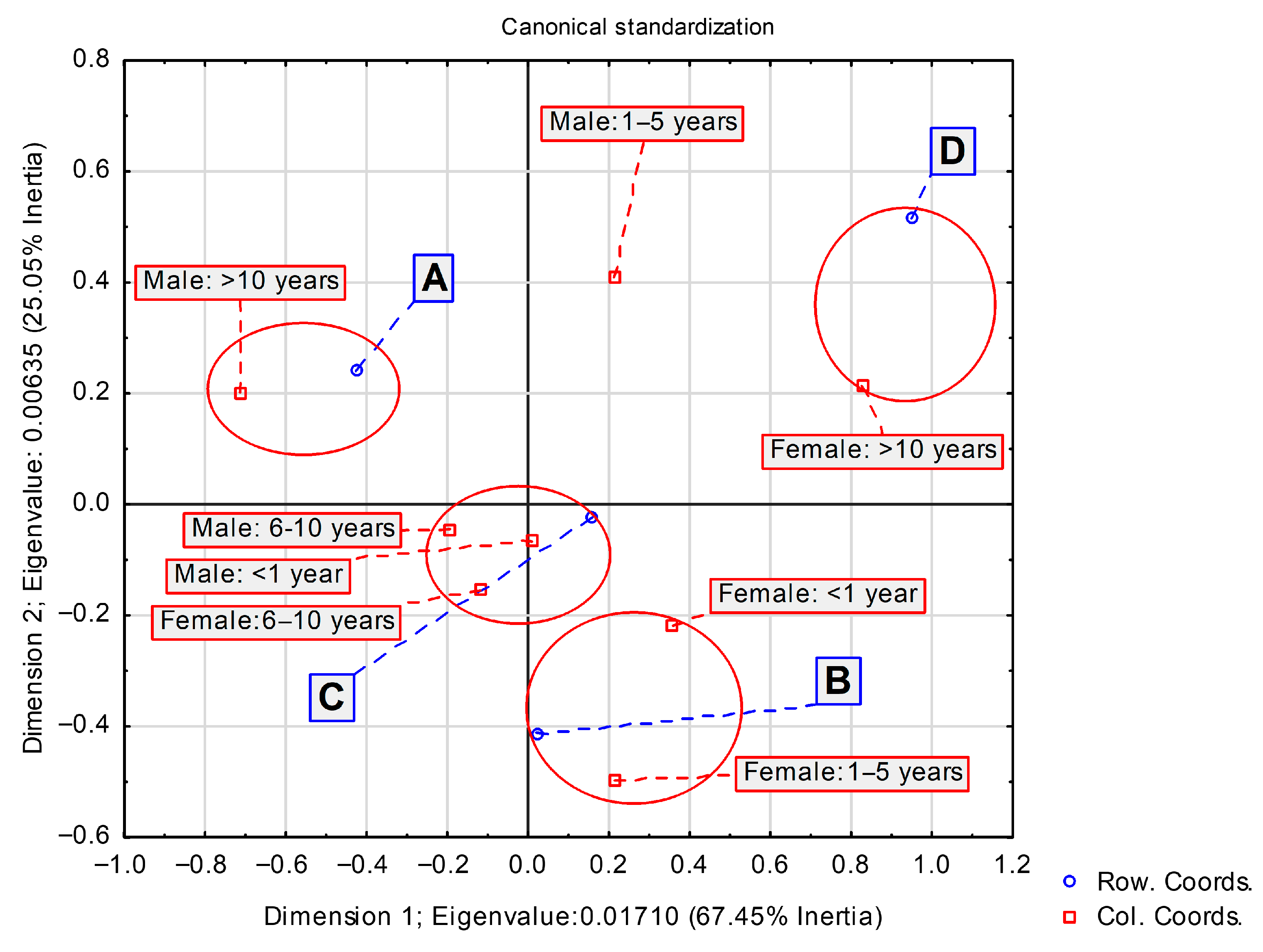
Initially, correspondence analysis was carried out to assess the compatibility of three groups of characteristics: drivers’ doubts about information provided by manufacturers (four response groups), respondents’ gender (two response groups), and driving experience (two groups). Respondents were asked about their doubts about information provided by manufacturers about electric cars offered on the market. A two-dimensional factorial space was selected to present the configuration of points representing the input data (
Table 2).
The first factor enabled the reproduction of up to 67.45% of the input data variability (i.e., total inertia), whereas the second factor reproduced up to 25.05% (this relationship is shown in
Table 2).
The greatest input for two-dimensional factor space creation, due to the emerging doubts of respondents regarding the information provided by manufacturers, was provided by the people who notice that car manufacturers broadcast advertisements suggesting zero CO2 emissions and that they focus on details instead of real changes (coordinate I) and that they focus on details instead of real changes and use the word “ecological” without proper explanation (coordinate II).
In turn, the most significant input to the creation of the two-dimensional factor space by gender and driving experience was provided by women and men with over 10 years of driving experience (dimension I) and women and men with 1–5 years of driving experience (dimension II) (
Figure 1). When examining the information in
Figure 1 in more detail, it can be concluded that four groups with similar indicator structures can be distinguished.
The first group consisted of men with over 10 years of driving experience who noticed that manufacturers broadcast advertisements suggesting zero CO2 emissions. The second group consisted of women with over 10 years of driving experience who believed that manufacturers focus on less important issues instead of demonstrating actual changes. The third group consisted of women with under 1 year of driving experience and 1–5 years of driving experience who noticed that manufacturers use the word “ecological” without properly explaining the concept of greenwashing.
In terms of customer concerns, men who have held their licenses for more than 10 years believe the ads imply zero CO
2 emissions, while women who have held their licenses for more than 10 years worry that companies focus on details rather than real changes. Meanwhile, women who have held their licenses for less than one year and those between 1 and 5 years believe that using the word “ecological” without explanation is a mistake, as shown in
Figure 1.
6.2. Respondents’ Expectations Regarding Information Provided by Manufacturers About Electric Cars
In the next step, respondents were asked about their expectations regarding information provided by manufacturers about electric cars. A two-dimensional factor space was selected to show the layout of points corresponding to the input data (
Table 3).
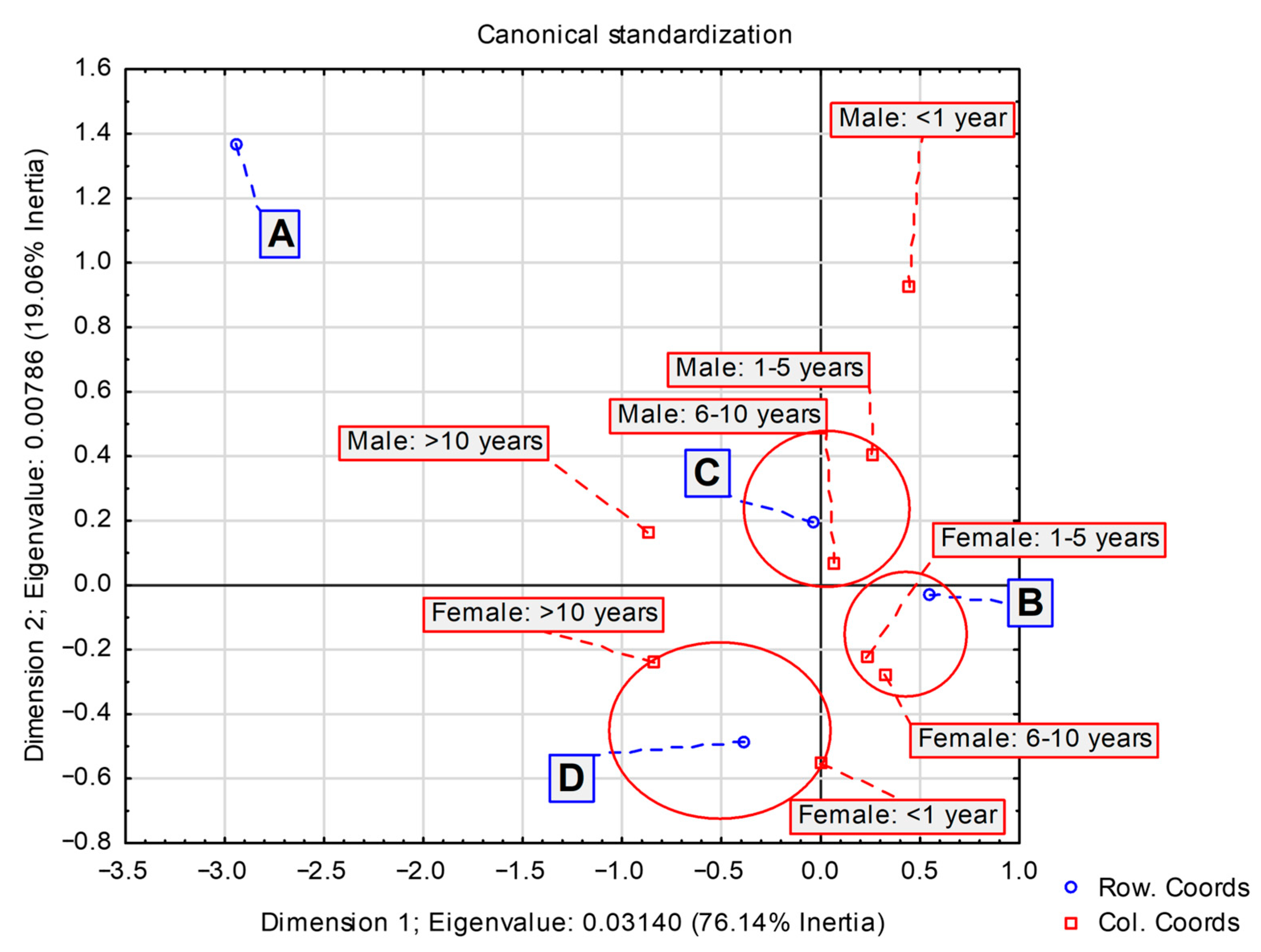
The first factor enabled the reproduction of 76.14% of the variability of the input data (i.e., total inertia), whereas the second factor reproduced 19.06% (this relation is shown in
Table 3).
The most significant input to the creation of the two-dimensional factor space, based on respondents’ expectations regarding information provided by manufacturers about electric cars, was provided by those who noted the need for greater transparency regarding environmental reports (coordinate I) and the need for driver education on environmentally friendly technologies (coordinate II). In turn, the most important input to the creation of the two-dimensional factor space by gender and driving experience was provided by women and men with over 10 years of driving experience (dimension I) and women and men with less than 1 year of driving experience (dimension II) (
Figure 2). By thoroughly examining the data shown in
Figure 2, it can be concluded that three groups with comparable indicator structures can be distinguished.
The first group consisted of men with driving licenses for 6–10 years and over 10 years, who expect independent certifications from car manufacturers. The second group consisted of women with driving licenses for 1–5 years and 6–10 years, who expect real investments in sustainable development. The third group consisted of women with a driving license for over 10 years who expect driver education in the field of environmentally friendly technologies in the electric car market.
In terms of customer expectations, women who have held their driving licenses for 1–5 years expect real investments in sustainable development, while men who have held their licenses for 1–5 years and 6–10 years expect organizations to present independent certificates confirming environmentally friendly solutions in the automotive industry. Women who have held their licenses for less than 1 year and more than 10 years expect driver education in environmentally friendly technologies, as shown in
Figure 2.
6.3. Declarations Regarding Potential Purchasing Decisions of Respondents Regarding Factors Determining Their Choices in the Electric Car Market
Next, the respondents’ declarations regarding their purchasing decisions regarding the factors determining their choices for electric cars were crucial. A two-dimensional factor space was selected to show the layout of points corresponding to the input data (
Table 4).
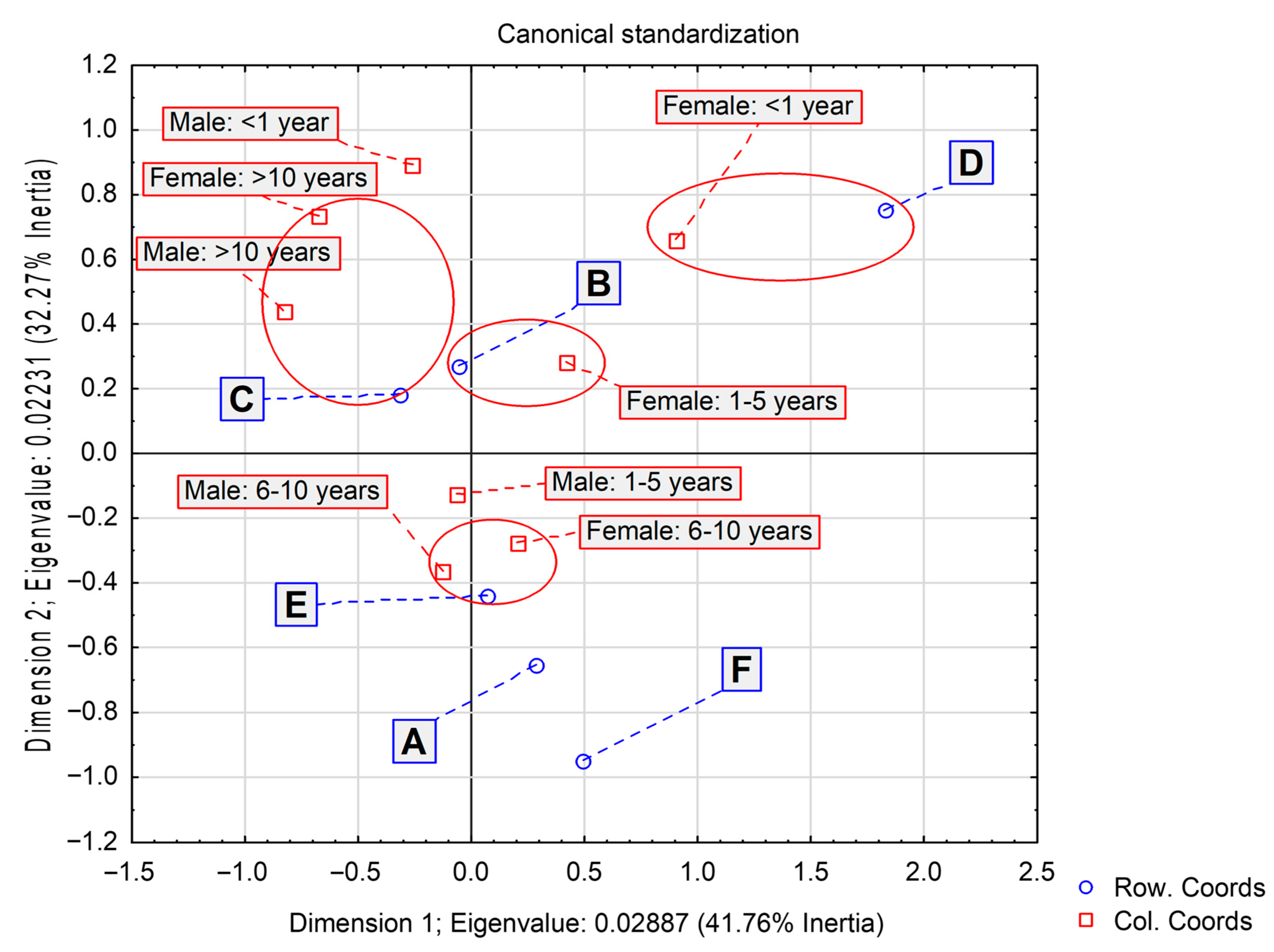
The first factor enabled the reproduction of 41.76% of the variability of the input data (i.e., total inertia), whereas the second factor reproduced 32.27% (this relation is shown in
Table 4).
The most significant input to the creation of the two-dimensional factor space, based on respondents’ declarations regarding future decisions regarding potential purchases of electric cars, was provided by those who emphasized technical parameters of cars, ecology, and low emissions (coordinate I) and the aforementioned issues related to ecology and modern technologies such as autonomous solutions (coordinate II). In turn, the most substantial input to the creation of the two-dimensional factor space by gender and driving experience was provided by men with over 10 years of driving experience (dimension I) and men with less than one year of driving experience (dimension II) (
Figure 3). A more detailed analysis of the information presented in
Figure 3 reveals four groups with comparable indicator structures.
The first group consisted of women and men with driving licenses for over 10 years, who declared that technical parameters were important to them when considering potential car purchases. The second group consisted of women with 1–5 years of driving experience, who believed price was a key factor in their decision to purchase a car. The third group consisted of women with less than 1 year of driving experience, who considered environmental friendliness and low emissions to be key factors in choosing a future car. The fourth group consisted of women and men with 6–10 years of driving experience and men with 1–5 years of driving experience. For these respondents, car maintenance costs were the most important factor.
In the context of potential car purchasing decisions, purchase price is the most important factor for women who have held their licenses for 1 to 5 years. For women and men who have held their licenses for over 10 years, the vehicle’s technical parameters are crucial. For women who have held their licenses for less than 1 year, ecology and low emissions are paramount, while for drivers, both women and men, who have held their licenses for 6 to 10 years, maintenance costs are the most important factor, as shown in
Figure 3.
6.4. Respondents’ Awareness of the Concept of Greenwashing Regarding Information Presented by Automotive Companies and Electric Car Manufacturers
The final step, crucial for the research, was to analyze respondents’ familiarity with the concept of greenwashing regarding information presented by automotive companies and electric vehicle manufacturers. A two-dimensional factor space was selected to present the layout of points corresponding to the input data (
Table 5).
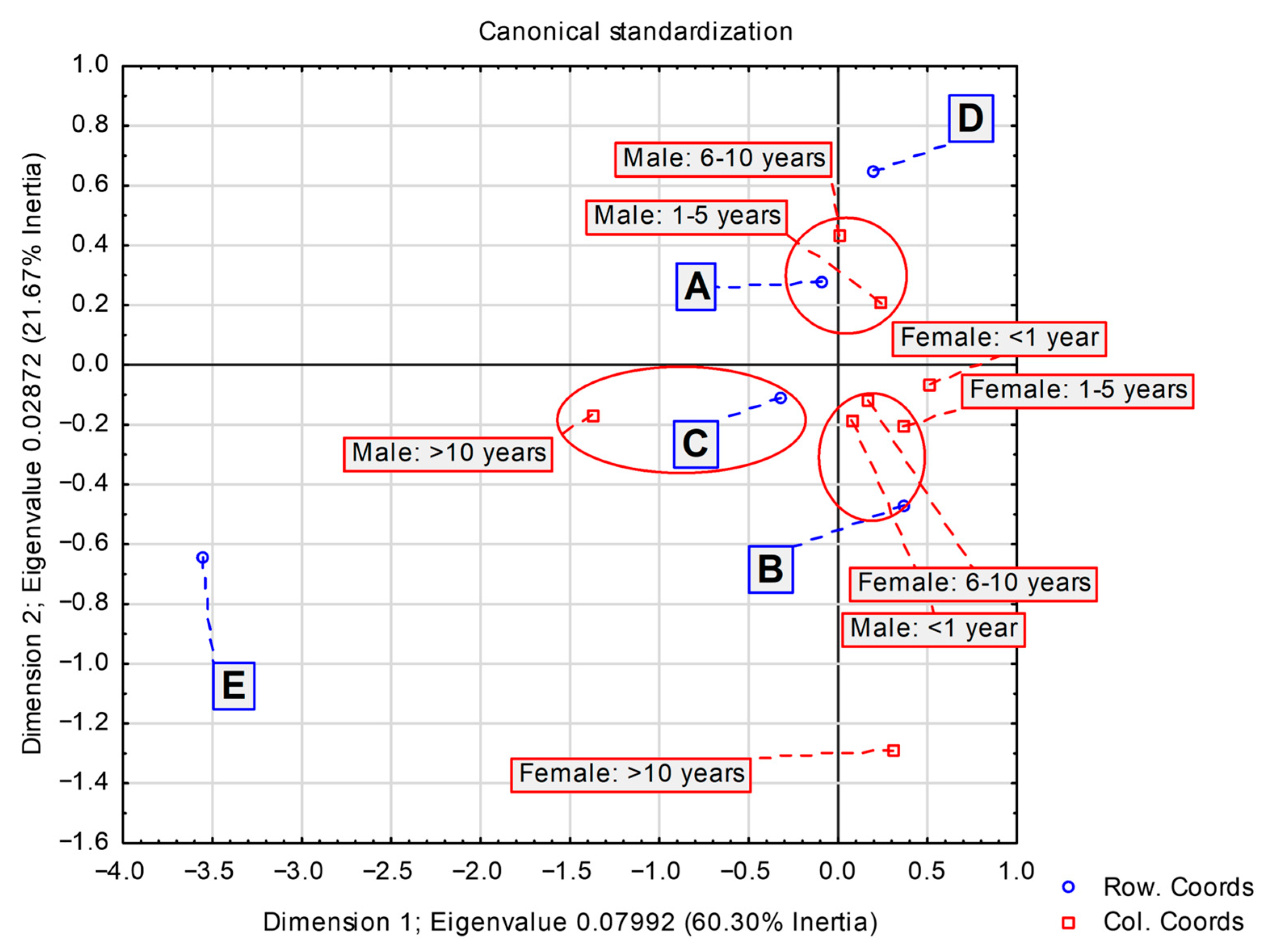
The first factor enabled the reproduction of 60.30% of the variability of the input data (i.e., total inertia), while the second factor reproduced 21.67% (this relation is shown in
Table 5).
The most significant input to the creation of the two-dimensional factor space, due to familiarity with the concept of greenwashing, was provided by individuals unfamiliar with the concept (coordinate I) and presenting cars in favorable natural conditions, as well as a lack of explanation of environmental certificate labeling (coordinate II). In turn, the most significant input to the creation of the two-dimensional factor space by gender and driving experience was provided by men with over 10 years of driving experience (dimension I), women with over 10 years of driving experience, and men with 6–10 years of driving experience (dimension II) (
Figure 4). When thoroughly studying the data shown in
Figure 4, it can be concluded that three groups with a comparable structure of indicators can be indicated.
The first group consisted of men who had held driving licenses for 1–5 years and 6–10 years, who, when it comes to the term “greenwashing,” consider the use of general terms such as “green energy” without any specific justification for the concept. The second group consisted of women who had held their licenses for 1–5 years and 6–10 years and men who had held their licenses for less than 1 year. They believed that manufacturers presented electric cars against a natural backdrop (forests, lakes, etc.). The third group consisted of men who had held their licenses for over 10 years, who noted that manufacturers emphasized low emissions only under specific operating conditions.
In the context of declarations regarding familiarity with the concept of greenwashing, the use of general terms such as “green energy” without specific justification is associated with men who have held their driving licenses for 1 to 5 years and 6 to 10 years. Presenting cars against a natural background (forests or lakes) is associated with women who have held their licenses for up to 10 years and men who have held their licenses for less than 1 year. Men who have held their licenses for over 10 years emphasize low emissions under specific operating conditions, as shown in
Figure 4.
7. Summary of Research Hypotheses and Findings
The main hypothesis: Survey respondents knowing and properly understanding the concept of greenwashing in the automotive industry has been negatively verified.
The results indicate that the concept of greenwashing is not widely understood across all respondent groups. A majority of women (53%) have not heard of the term, while 54% of men are familiar with it. Awareness is highest among residents of large cities, whereas individuals from rural areas and small towns are generally unfamiliar with the concept. Furthermore, those without a driving license tend to not know the term, in contrast to licensed drivers who are more likely to be aware of it. Awareness also varies by driving experience: it is notably low among drivers with less than 1 year, with 1–5 years, and with over 10 years of experience. Only those with 6–10 years of driving experience consistently declare familiarity with the concept. This demonstrates that, contrary to the main hypothesis, a significant portion of respondents lack proper understanding of greenwashing in the automotive sector.
Hypothesis H1. The perception of electric cars as eco-friendly depending on the respondents’ characteristics was positively verified.
The perception of electric vehicles (EVs) as environmentally friendly is clearly influenced by various demographic and experiential factors. In total, 41% of women and 43% of men believe that EVs are not more environmentally friendly than traditional cars. Residents of large- and medium-sized cities are more likely to say EVs are “rather not” more ecological, while residents of small towns and rural areas tend to respond more definitively, stating that EVs are “definitely not” more environmentally friendly. In terms of driver status, licensed drivers are more inclined to view EVs positively, while non-drivers tend to disagree with the notion of their ecological advantage. Driving experience also plays a role: respondents with 1–5 years and over 10 years of experience strongly believe EVs are not more eco-friendly, those with 6–10 years say “rather not”, and only those with less than 1 year of driving experience lean toward a more positive view (“rather yes”). These findings support Hypothesis 1.
Hypothesis H2. Respondents’ perception of the actual benefits of eco-friendly cars depending on the grouping variables was verified positively.
Perceptions of the real, practical benefits of eco-friendly cars vary among different groups of respondents. Women tend to notice benefits but consider them smaller than what is promised (40%), whereas 41% of men report no noticeable difference at all. Across all regions, respondents generally say they do not perceive a difference. Similarly, drivers with 1–5 and 6–10 years of experience also do not observe significant benefits. Those with over 10 years of experience recognize some advantages, but say they are less substantial than advertised. Among the least experienced drivers (less than 1 year), opinions are split—some see no difference, while others report noticeable benefits. This variation supports Hypothesis 2, indicating that perceptions of eco-friendly car performance are shaped by gender, driving experience, and place of residence.
8. Summary of Research Conclusions
Systemic efforts at the international level should continue to ensure equal protection of consumer rights and promote fair market practices [ECOS Environmental Coalition on Standards: Protecting Consumers against Unfair Commercial Practices and Green Washing], 2023. [Available online:
https://eeb.org/wp-content/uploads/2023/02/GW-Open-Letter.pdf (accessed on 10 September 2025)]. Implementing an effective sustainable development policy therefore requires understanding the fraud methods used in accounting that support greenwashing. Reducing this type of phenomena aims to strengthen corporate social responsibility (CSR) [
71,
72]. Research on greenwashing in the 21st century resulting from the growing public concern about environmental pollution has pointed to yet another aspect of implementing corporate social responsibility (CSR) [
73]. Voluntary implementation of CSR in companies actually favors the spread of greenwashing, as it creates a kind of gray zone in which companies spread the “green lie” with impunity [
74]. Effectively combating such practices will only be possible when clear legal provisions indicate the limits of creative CSR initiatives. After exceeding these applicable legal provisions, companies consciously misleading customers will have to take into account liability, including financial ones [
75,
76,
77]. The key to market assessment is that even the introduction of certified environmental management standards, i.e., ISO 14,001 and the Eco-Management and Audit Scheme (EMAS), does not guarantee the achievement of environmental performance by an enterprise when these are activities aimed at obtaining only the minimum required by the certificate [
78]. An important issue that still awaits in-depth research in global logistics is the problem of greenwashing at individual levels of the supply chain. When creating B2B strategies, inappropriate behavior may concern producers, suppliers, and recipients alike, and each party has a different opinion on guilt and responsibility for environmental protection [
79,
80].
9. Research Conclusions
Analysis of the research results supports the conclusion that consumers can identify specific examples of greenwashing in the automotive industry, such as advertising combustion engine cars as “environmentally friendly” or using green symbolism and slogans without any real support for the company’s pro-environmental activities. Furthermore, the results of the respondents’ responses suggest that the automotive market faces the challenge of building a genuine pro-environmental image, one that is not based solely on marketing claims but on real actions supported by transparency and evidence.
The survey revealed several important conclusions regarding public environmental awareness in the context of the automotive industry and awareness of the greenwashing phenomenon.
First, most respondents recognize the significant effect of the automotive industry on the environment, with this awareness being higher among women, residents of large- and medium-sized cities, and drivers with the least and most driving experience. This may indicate growing environmental sensitivity in these social groups.
Second, knowledge of environmental initiatives in the automotive industry is rated as fairly good by most respondents, particularly among men and residents of large cities, small towns, and rural areas. However, residents of medium-sized cities and the youngest drivers reported a lower level of knowledge, which may indicate the need to intensify educational efforts aimed at these groups.
Third, the concept of greenwashing remains relatively unknown—particularly among women, those without a driving license, and residents of rural areas and smaller towns. Men, those with driving licenses, and drivers with 6–10 years of experience demonstrated the greatest familiarity with the term. These results indicate an information gap regarding this phenomenon and the need to increase public awareness of marketing practices that may mislead consumers in terms of the actual effect of companies’ actions on the environment.
In summary, the research reveals varying levels of environmental awareness depending on gender, place of residence, and driver experience. At the same time, it emphasizes the need for further education and reliable public information on actual pro-environmental initiatives and the risks associated with greenwashing in the automotive sector.
The survey results indicate notable variations in the perception of environmental issues in the automotive industry, depending on factors such as place of residence, gender, driver’s license possession, and driving experience.
Respondents largely recognize the negative effect of the automotive industry on the natural environment, especially women, residents of large- and medium-sized cities, and drivers with very little or very long driving experience. At the same time, knowledge of environmental initiatives in this industry is rated relatively good, although its level varies between groups—those with the shortest driving experience and those living in medium-sized cities have the lowest scores.
Awareness of the concept of greenwashing is not universal—men, those with driver’s licenses, and drivers with 6–10 years of experience demonstrate greater awareness. In other groups, the term remains rarely known. Importantly, many respondents believe that greenwashing practices can discourage car purchases, especially among men, residents of large and small cities, and less experienced drivers. Meanwhile, automotive companies’ environmental initiatives are perceived by most respondents as insignificant, and in some groups, even completely unimportant. This attitude is more common among men, residents of small towns, and experienced drivers. Similarly, the environmental performance of electric cars is viewed skeptically—as many as 41% of women and 43% of men do not consider them more environmentally friendly than traditional vehicles. This view also prevails among residents of all types of towns and drivers with longer experience.
The vast majority of respondents declare a lack of trust in automotive companies’ advertising messages regarding environmental friendliness. These declarations are common regardless of gender, location, or driving experience—particularly strong among experienced drivers. This is also confirmed by the opinion that car manufacturers do not clearly communicate how their vehicles are environmentally friendly—the message is perceived as imprecise, general, and potentially misleading. Respondents clearly indicate that they perceive promoting eco-friendly cars primarily as a marketing strategy, rather than as a genuine environmental initiative. This opinion prevails across all groups—regardless of gender, place of residence, driver’s license status, or driving experience.
Regarding actual experiences with eco-friendly cars, most respondents have not had any experience with them and do not plan to use them. The exceptions are residents of large cities and drivers with 1–10 years of experience, who are more likely to report occasional use of such vehicles. At the same time, many respondents—regardless of group affiliation—do not perceive clear benefits from eco-friendly cars or perceive them as less than promised.
Attitudes toward eco-friendly cars are largely neutral, but skepticism is noticeable, particularly among men, residents of rural areas and small towns, and drivers with 1–6 years of experience.
Finally, it is notable that respondents’ assessment of the future of the automotive industry in the context of sustainable development is rather neutral, with “hard to say” responses dominating. Men, residents of small towns, and more experienced drivers are more likely to express a negative attitude, indicating that manufacturers’ actions are largely superficial. On the other hand, those without a driving license and young drivers are more optimistic, albeit with the caveat that more concrete action is needed.
Author Contributions
Conceptualization, A.D., S.J., P.D., and T.S.; methodology, A.D., S.J., P.D., and T.S.; software, A.D. and T.S.; validation, A.D. and A.D.; formal analysis, A.D., A.D., and T.S.; investigation, A.D. and T.S.; resources, A.D. and S.J.; data curation, A.D., S.J., P.D., and T.S.; writing—original draft preparation, A.D., S.J., P.D., and T.S.; writing—review and editing, A.D., S.J., P.D., and T.S.; visualization, A.D., P.D., and T.S.; supervision, A.D. and P.D.; project administration, A.D., S.J., and T.S.; funding acquisition, A.D. and P.D. All authors have read and agreed to the published version of the manuscript.
Funding
This research received no external funding.
Institutional Review Board Statement
Ethical review and approval were waived for this study by Institution Committee due to Legal Regulations (EU REGULATION 536/2014 of 16 April 2014 [
1]).
Informed Consent Statement
Informed consent was obtained from all subjects involved in the study.
Data Availability Statement
The datasets used and/or analyzed during the current study are available from the corresponding author on reasonable request. The original contributions presented in this study are included in the article; further inquiries can be directed to the corresponding author.
Conflicts of Interest
The authors declare no conflicts of interest.
References
- Spaniol, M.J.; Danilova-Jensen, E.; Nielsen, M.; Rosdahl, C.G.; Schmidt, C.J. Defining Greenwashing: A Concept Analysis. Sustainability 2024, 16, 9055. [Google Scholar] [CrossRef]
- Motavalli, J. A History of Greenwashing: How Dirty Towels Impacted the Green Movement. AOL. LIFE. 2011. Available online: https://www.yahoo.com/lifestyle/2011-02-12-the-history-ofgreenwashing-how-dirty-towels-impacted-the-green.html (accessed on 15 September 2025).
- Watson, B. The Troubling Evolution of Corporate Greenwashing. Chain. React. 2017, 38–40. [Google Scholar]
- Baum, L.M. It’s Not Easy Being Green or Is It? A Content Analysis of Environmental Claims in Magazine Advertisements from the United States and United Kingdom. Environ. Commun. A J. Nat. Cult. 2012, 6, 423–440. [Google Scholar] [CrossRef]
- Berrone, P.; Fosfuri, A.; Gelabert, L. Does Greenwashing Pay off? Understanding the Relationship between Environmental Actions and Environmental Legitimacy. J. Bus. Ethics 2017, 144, 363–379. [Google Scholar] [CrossRef]
- Amores-Salvadó, J.; Martin-de Castro, G.; Albertini, E. Walking the Talk, but above All, Talking the Walk: Looking Green for Market Stakeholder Engagement. Corp. Soc. Responsib. Environ. Manag. 2023, 30, 431–442. [Google Scholar] [CrossRef]
- Kim, E.-H.; Lyon, T.P. Greenwash vs. Brownwash: Exaggeration and Undue Modesty in Corporate Sustainability Disclosure. Organ. Sci. 2015, 26, 705–723. [Google Scholar] [CrossRef]
- de Freitas Netto, S.V.; Sobral, M.F.F.; Ribeiro, A.R.B.; Soares, G.R.d.L. Concepts and Forms of Greenwashing: A Systematic Review. Environ. Sci. Eur. 2020, 32, 19. [Google Scholar] [CrossRef]
- Delmas, M.A.; Burbano, V.C. The Drivers of Greenwashing. Calif. Manag. Rev. 2011, 54, 64–87. [Google Scholar] [CrossRef]
- Gutierrez, L.; Montiel, I.; Surroca, J.A.; Tribo, J.A. Rainbow Wash or Rainbow Revolution? Dynamic Stakeholder Engagement for SDG-Driven Responsible Innovation: Gutierrez et Al. J. Bus. Ethics 2022, 180, 1113–1136. [Google Scholar]
- Bruno, K. The Greenpeace Book of Greenwash; Greenpeace: Amsterdam, The Netherlands, 1992. [Google Scholar]
- Silva, D. The Fight against Greenwashing in the European Union. UNIO—EU Law J. 2021, 7, 124–137. [Google Scholar] [CrossRef]
- Pieróg, K. Greenwashing–Formy, Regulacje Prawa Unijnego i Konsekwencje. In Zrównoważony Rozwój—Trendy, Wyzwania, Kontrowersje; Wydawnictwo Uniwersytetu Ekonomicznego we Wrocławiu: Wrocław, Poland, 2024. [Google Scholar]
- Directive 2005/29/EC; Decision of the European Court of Justice (First Chamber) 17 January 2013–Case No. C-206/11 “Köck” Directive 2005/29/EC of the European Parliament and of the Council of 11 May 2005 Concerning Unfair Business-to-Consumer Commercial Practices in the Internal Market–Georg Köck v. Schutzverband Gegen Unlauteren Wettbewerb. European Parliament and of the Council: Strasbourg, France, 2014.
- Ruiz-Blanco, S.; Romero, S.; Fernandez-Feijoo, B. Green, Blue or Black, but Washing–What Company Characteristics Determine Greenwashing? Environ. Dev. Sustain. 2022, 24, 4024–4045. [Google Scholar] [CrossRef]
- Montgomery, A.W.; Lyon, T.P.; Barg, J. No End in Sight? A Greenwash Review and Research Agenda. Organ. Environ. 2024, 37, 221–256. [Google Scholar] [CrossRef] [PubMed]
- Nemes, N.; Scanlan, S.J.; Smith, P.; Smith, T.; Aronczyk, M.; Hill, S.; Lewis, S.L.; Montgomery, A.W.; Tubiello, F.N.; Stabinsky, D. An Integrated Framework to Assess Greenwashing. Sustainability 2022, 14, 4431. [Google Scholar] [CrossRef]
- Sheng, Q.; Zheng, X.; Zhong, N. Financing for Sustainability: Empirical Analysis of Green Bond Premium and Issuer Heterogeneity. Nat. Hazards 2021, 107, 2641–2651. [Google Scholar] [CrossRef]
- Szabo, S.; Webster, J. Perceived Greenwashing: The Effects of Green Marketing on Environmental and Product Perceptions. J. Bus. Ethics 2021, 171, 719–739. [Google Scholar] [CrossRef]
- Li, D.; Jia, X.; Xin, L. A Review and Prospect of Corporate Greenwashing Behavior Research. Foreign Econ. Manag. 2015, 37, 86–96. [Google Scholar]
- Chen, P.; Dagestani, A.A. Greenwashing Behavior and Firm Value–From the Perspective of Board Characteristics. Corp. Soc. Responsib. Environ. Manag. 2023, 30, 2330–2343. [Google Scholar] [CrossRef]
- Sajid, M.; Zakkariya, K.; Suki, N.M.; Islam, J.U. When Going Green Goes Wrong: The Effects of Greenwashing on Brand Avoidance and Negative Word-of-Mouth. J. Retail. Consum. Serv. 2024, 78, 103773. [Google Scholar] [CrossRef]
- Zhang, L.; Li, D.; Cao, C.; Huang, S. The Influence of Greenwashing Perception on Green Purchasing Intentions: The Mediating Role of Green Word-of-Mouth and Moderating Role of Green Concern. J. Clean. Prod. 2018, 187, 740–750. [Google Scholar] [CrossRef]
- Armour, C. What Is “Greenwashing” and What Are Its Potential Threats. Australian Securities & Investments Commission. Australian Securities & Investments Commission. 2023. Available online: https://asic.gov.au/about-asic/news-centre/articles/what-is-greenwashing-and-what-are-its-potential-threats/ (accessed on 2 April 2021).
- Lee, M.T.; Raschke, R.L. Stakeholder Legitimacy in Firm Greening and Financial Performance: What about Greenwashing Temptations? J. Bus. Res. 2023, 155, 113393. [Google Scholar] [CrossRef]
- Teti, E.; Etro, L.L.; Pausini, L. Does Greenwashing Affect Company’s Stock Price? Evidence from Europe. Int. Rev. Financ. Anal. 2024, 93, 103195. [Google Scholar] [CrossRef]
- Ioannou, I.; Kassinis, G.; Papagiannakis, G. The Impact of Perceived Greenwashing on Customer Satisfaction and the Contingent Role of Capability Reputation. J. Bus. Ethics 2023, 185, 333–347. [Google Scholar] [CrossRef]
- Laufer, W.S. Social Accountability and Corporate Greenwashing. J. Bus. Ethics 2003, 43, 253–261. [Google Scholar] [CrossRef]
- Greer, J.; Bruno, K. Greenwash: The Reality Behind Corporate Environmentalism; Apex Press: Lexington, KY, USA, 1996. [Google Scholar]
- Lyon, T.P.; Maxwell, J.W. Greenwash: Corporate Environmental Disclosure under Threat of Audit. J. Econ. Manag. Strategy 2011, 20, 3–41. [Google Scholar] [CrossRef]
- Tashman, P.; Marano, V.; Kostova, T. Walking the Walk or Talking the Talk? Corporate Social Responsibility Decoupling in Emerging Market Multinationals. J. Int. Bus. Stud. 2019, 50, 153–171. [Google Scholar] [CrossRef]
- Walker, K.; Wan, F. The Harm of Symbolic Actions and Green-Washing: Corporate Actions and Communications on Environmental Performance and Their Financial Implications. J. Bus. Ethics 2012, 109, 227–242. [Google Scholar] [CrossRef]
- Siano, A.; Vollero, A.; Conte, F.; Amabile, S. “More than Words”: Expanding the Taxonomy of Greenwashing after the Volkswagen Scandal. J. Bus. Res. 2017, 71, 27–37. [Google Scholar] [CrossRef]
- Bowen, F.; Aragon-Correa, J.A. Greenwashing in Corporate Environmentalism Research and Practice: The Importance of What We Say and Do. Organ. Environ. 2014, 27, 107–112. [Google Scholar] [CrossRef]
- Jones, E. Rethinking Greenwashing: Corporate Discourse, Unethical Practice, and the Unmet Potential of Ethical Consumerism. Sociol. Perspect. 2019, 62, 728–754. [Google Scholar] [CrossRef]
- Robertson, J.L.; Montgomery, A.W.; Ozbilir, T. Employees’ Response to Corporate Greenwashing. Bus. Strategy Environ. 2023, 32, 4015–4027. [Google Scholar] [CrossRef]
- Netemeyer, R.G.; Maxham, J.G., III; Pullig, C. Conflicts in the Work–Family Interface: Links to Job Stress, Customer Service Employee Performance, and Customer Purchase Intent. J. Mark. 2005, 69, 130–143. [Google Scholar] [CrossRef]
- Nyilasy, G.; Gangadharbatla, H.; Paladino, A. Perceived Greenwashing: The Interactive Effects of Green Advertising and Corporate Environmental Performance on Consumer Reactions. J. Bus. Ethics 2014, 125, 693–707. [Google Scholar] [CrossRef]
- Mao, Z.; Yu, W.; Li, Y. An Empirical Study on the Mechanism of Green Purchase Intention Formation: The Interaction between Green Advertising Appeals and Self-Construction. Contemp. Financ. Econ. 2017, 5, 79–88. [Google Scholar]
- Parguel, B.; Benoît-Moreau, F.; Larceneux, F. How Sustainability Ratings Might Deter ‘Greenwashing’: A Closer Look at Ethical Corporate Communication. J. Bus. Ethics 2011, 102, 15–28. [Google Scholar] [CrossRef]
- Liao, Y.; Wu, L. The Influence of Brand Greenwashing on EV Purchase Intention: The Moderating Role of Consumer Innovativeness and Peer Brand Attitude. World Electr. Veh. J. 2024, 15, 313. [Google Scholar] [CrossRef]
- Fiske, S.T. Attention and Weight in Person Perception: The Impact of Negative and Extreme Behavior. J. Personal. Soc. Psychol. 1980, 38, 889. [Google Scholar] [CrossRef]
- Klein, J.G. Negativity in Impressions of Presidential Candidates Revisited: The 1992 Election. Personal. Soc. Psychol. Bull. 1996, 22, 288–295. [Google Scholar] [CrossRef]
- Małek, A.; Taccani, R.; Kasperek, D.; Hunicz, J. Optimization of Energy Management in a City Bus Powered by the Hydrogen Fuel Cells. Commun. Sci. Lett. Univ. Zilina 2021, 23, E56–E67. [Google Scholar] [CrossRef]
- Wang, H.; Ma, B.; Bai, R. The Spillover Effect of Greenwashing Behaviours: An Experimental Approach. Mark. Intell. Plan. 2020, 38, 283–295. [Google Scholar] [CrossRef]
- Barbarossa, C.; De Pelsmacker, P. Positive and Negative Antecedents of Purchasing Eco-Friendly Products: A Comparison between Green and Non-Green Consumers. J. Bus. Ethics 2016, 134, 229–247. [Google Scholar] [CrossRef]
- Chen, K.; Deng, T. Research on the Green Purchase Intentions from the Perspective of Product Knowledge. Sustainability 2016, 8, 943. [Google Scholar] [CrossRef]
- Nguyen, T.T.H.; Yang, Z.; Nguyen, N.; Johnson, L.W.; Cao, T.K. Greenwash and Green Purchase Intention: The Mediating Role of Green Skepticism. Sustainability 2019, 11, 2653. [Google Scholar] [CrossRef]
- Chen, Y.-S.; Chang, C.-H. Greenwash and Green Trust: The Mediation Effects of Green Consumer Confusion and Green Perceived Risk. J. Bus. Ethics 2013, 114, 489–500. [Google Scholar] [CrossRef]
- Brown, T.J.; Dacin, P.A. The Company and the Product: Corporate Associations and Consumer Product Responses. J. Mark. 1997, 61, 68–84. [Google Scholar] [CrossRef]
- Spencer, A.; Ross, S.; Tyson, A. How Americans View Electric Vehicles. 2023. Available online: https://www.pewresearch.org/short-reads/2023/07/13/how-americans-view-electric-vehicles/ (accessed on 12 September 2025).
- Li, M.; Trencher, G.; Asuka, J. The Clean Energy Claims of BP, Chevron, ExxonMobil and Shell: A Mismatch between Discourse, Actions and Investments. PLoS ONE 2022, 17, e0263596. [Google Scholar] [CrossRef]
- Arouri, M.; El Ghoul, S.; Gomes, M. Greenwashing and Product Market Competition. Financ. Res. Lett. 2021, 42, 101927. [Google Scholar] [CrossRef]
- Mitra, C.; Roychowdhury, S. An Analytical Study on the Utilization of Eco-Friendly Cars in the Perspective of Sustainable Development in Automobile Industries. In Proceedings of the Global Conference on Innovations in Management and Business (GCIMB 2021), Online, 27–28 July 2021. [Google Scholar]
- Wellalage, N.H.; Kumar, V. Environmental Performance and Bank Lending: Evidence from Unlisted Firms. Bus. Strategy Environ. 2021, 30, 3309–3329. [Google Scholar] [CrossRef]
- Małek, A. Low-Emission Hydrogen for Transport—A Technology Overview from Hydrogen Production to Its Use to Power Vehicles. Energies 2025, 18, 4425. [Google Scholar] [CrossRef]
- Du, X. How the Market Values Greenwashing? Evidence from China. J. Bus. Ethics 2015, 128, 547–574. [Google Scholar] [CrossRef]
- Guo, R.; Zhang, W.; Wang, T.; Li, C.B.; Tao, L. Timely or Considered? Brand Trust Repair Strategies and Mechanism after Greenwashing in China—From a Legitimacy Perspective. Ind. Mark. Manag. 2018, 72, 127–137. [Google Scholar] [CrossRef]
- Yin, J.; Zhang, Z.; Liao, G. A Study on Consumer Purchase Intention of Electric Vehicles Based on the Technology Acceptance Model and Perceived Risk Theory. Forecasting 2019, 38, 83–89. [Google Scholar]
- Huang, X.; Ge, J. Electric Vehicle Development in Beijing: An Analysis of Consumer Purchase Intention. J. Clean. Prod. 2019, 216, 361–372. [Google Scholar] [CrossRef]
- Tian, X.; Zhang, Q.; Chi, Y.; Cheng, Y. Purchase Willingness of New Energy Vehicles: A Case Study in Jinan City of China. Reg. Sustain. 2021, 2, 12–22. [Google Scholar] [CrossRef]
- Lin, B.; Shi, L. Do Environmental Quality and Policy Changes Affect the Evolution of Consumers’ Intentions to Buy New Energy Vehicles. Appl. Energy 2022, 310, 118582. [Google Scholar] [CrossRef]
- Wang, X.; Zhao, G. A Review of Negative Exposure Events in Enterprise Marketing. Foreign Econ. Manag. 2009, 31, 33–39. [Google Scholar]
- Selsky, J.W.; Parker, B. Platforms for Cross-Sector Social Partnerships: Prospective Sensemaking Devices for Social Benefit. J. Bus. Ethics 2010, 94, 21–37. [Google Scholar] [CrossRef]
- Małek, A.; Karowiec, M.; Jóźwik, K. A Review of Technologies in the Area of Production, Storage and Use of Hydrogen in the Automotive Industry. Arch. Motoryz. 2023, 102, 41–67. [Google Scholar] [CrossRef]
- Wang, X.-W.; Cao, Y.-M.; Zhang, N. The Influences of Incentive Policy Perceptions and Consumer Social Attributes on Battery Electric Vehicle Purchase Intentions. Energy Policy 2021, 151, 112163. [Google Scholar] [CrossRef]
- Qayyum, A.; Jamil, R.A.; Sehar, A. Impact of Green Marketing, Greenwashing and Green Confusion on Green Brand Equity. Span. J. Mark. ESIC 2023, 27, 286–305. [Google Scholar] [CrossRef]
- Krishnan, V.V.; Koshy, B.I. Evaluating the Factors Influencing Purchase Intention of Electric Vehicles in Households Owning Conventional Vehicles. Case Stud. Transp. Policy 2021, 9, 1122–1129. [Google Scholar] [CrossRef]
- Leonidou, C.N.; Skarmeas, D. Gray Shades of Green: Causes and Consequences of Green Skepticism. J. Bus. Ethics 2017, 144, 401–415. [Google Scholar] [CrossRef]
- Choi, J.; Lee, D.-H.; Taylor, C.R. The Influence of Purchasing Context and Reversibility of Choice on Consumer Responses toward Personalized Products and Standardized Products. Psychol. Rep. 2016, 118, 510–526. [Google Scholar] [CrossRef]
- Kurpierz, J.R.; Smith, K. The Greenwashing Triangle: Adapting Tools from Fraud to Improve CSR Reporting. Sustain. Account. Manag. Policy J. 2020, 11, 1075–1093. [Google Scholar] [CrossRef]
- Lyon, T.P.; Montgomery, A.W. The Means and End of Greenwash. Organ. Environ. 2015, 28, 223–249. [Google Scholar] [CrossRef]
- Zhang, D. Are Firms Motivated to Greenwash by Financial Constraints? Evidence from Global Firms’ Data. J. Int. Financ. Manag. Account. 2022, 33, 459–479. [Google Scholar] [CrossRef]
- Zhou, Y.; Chen, L.; Zhang, Y.; Li, W. “Environmental Disclosure Greenwashing” and Corporate Value: The p Remium Effect and Premium Devalue of Environmental Information. Corp. Soc. Responsib. Environ. Manag. 2024, 31, 2424–2438. [Google Scholar] [CrossRef]
- Gatti, L.; Seele, P.; Rademacher, L. Grey Zone in–Greenwash out. A Review of Greenwashing Research and Implications for the Voluntary-Mandatory Transition of CSR. Int. J. Corp. Soc. Responsib. 2019, 4, 6. [Google Scholar] [CrossRef]
- Torelli, R. Sustainability, Responsibility and Ethics: Different Concepts for a Single Path. Soc. Responsib. J. 2021, 17, 719–739. [Google Scholar] [CrossRef]
- Zharfpeykan, R. Representative Account or Greenwashing? Voluntary Sustainability Reports in Australia’s Mining/Metals and Financial Services Industries. Bus. Strategy Environ. 2021, 30, 2209–2223. [Google Scholar] [CrossRef]
- Heras-Saizarbitoria, I.; Boiral, O.; Díaz de Junguitu, A. Environmental Management Certification and Environmental Performance: Greening or Greenwashing? Bus. Strategy Environ. 2020, 29, 2829–2841. [Google Scholar] [CrossRef]
- Pizzetti, M.; Gatti, L.; Seele, P. Firms Talk, Suppliers Walk: Analyzing the Locus of Greenwashing in the Blame Game and Introducing ‘vicarious Greenwashing’. J. Bus. Ethics 2021, 21–38. [Google Scholar] [CrossRef]
- Vangeli, A.; Małecka, A.; Mitręga, M.; Pfajfar, G. From Greenwashing to Green B2B Marketing: A Systematic Literature Review. Ind. Mark. Manag. 2023, 115, 281–299. [Google Scholar] [CrossRef]
Figure 1.
Respondents’ doubts regarding the information provided by manufacturers about electric cars among drivers according to the variable grouping of gender and driver experience. (Abbreviations: A—ads suggesting zero CO2 emissions; B—using the word “ecological” without explanation; C—hiding the negative environmental impact of electric car production; D—focusing on details instead of real changes; gender—female, male; driver experience: <1 year, 1–5 years, 6–10 years, >10 years.)
Figure 1.
Respondents’ doubts regarding the information provided by manufacturers about electric cars among drivers according to the variable grouping of gender and driver experience. (Abbreviations: A—ads suggesting zero CO2 emissions; B—using the word “ecological” without explanation; C—hiding the negative environmental impact of electric car production; D—focusing on details instead of real changes; gender—female, male; driver experience: <1 year, 1–5 years, 6–10 years, >10 years.)
Figure 2.
Respondents’ expectations regarding information provided by manufacturers about electric cars among drivers according to the variable grouping of gender and driver experience. (Abbreviations: A—more transparency in environmental reports; B—real investments in sustainable development; C—independent certifications; D—driver education on eco-friendly technologies; gender—female, male; driver experience: <1 year, 1–5 years, 6–10 years, >10 years.)
Figure 2.
Respondents’ expectations regarding information provided by manufacturers about electric cars among drivers according to the variable grouping of gender and driver experience. (Abbreviations: A—more transparency in environmental reports; B—real investments in sustainable development; C—independent certifications; D—driver education on eco-friendly technologies; gender—female, male; driver experience: <1 year, 1–5 years, 6–10 years, >10 years.)
Figure 3.
Declarations regarding factors determining consumer choices on the market regarding potential purchasing decisions regarding electric cars among drivers according to the variable grouping of gender and driver experience. (Abbreviations: A—brand and its reputation; B—price; C—technical parameters; D—ecology and low emissions; E—maintenance costs; F—modern technologies (e.g., autonomous systems, connectivity); gender—female, male; driver experience: <1 year, 1–5 years, 6–10 years, >10 years.)
Figure 3.
Declarations regarding factors determining consumer choices on the market regarding potential purchasing decisions regarding electric cars among drivers according to the variable grouping of gender and driver experience. (Abbreviations: A—brand and its reputation; B—price; C—technical parameters; D—ecology and low emissions; E—maintenance costs; F—modern technologies (e.g., autonomous systems, connectivity); gender—female, male; driver experience: <1 year, 1–5 years, 6–10 years, >10 years.)
Figure 4.
Respondents’ awareness of the concept of greenwashing regarding information presented by automotive companies and electric car manufacturers among drivers, based on the variable grouping of gender and driver experience. (Abbreviations: A—using general slogans such as “green energy” without specific justification; B—showing cars against natural backgrounds (forests, lakes, etc.); C—emphasizing low emissions only under specific operating conditions; D—lack of explanation regarding environmental certifications; E—I am not familiar with this concept; gender—female, male; driver experience: <1 year, 1–5 years, 6–10 years, >10 years.)
Figure 4.
Respondents’ awareness of the concept of greenwashing regarding information presented by automotive companies and electric car manufacturers among drivers, based on the variable grouping of gender and driver experience. (Abbreviations: A—using general slogans such as “green energy” without specific justification; B—showing cars against natural backgrounds (forests, lakes, etc.); C—emphasizing low emissions only under specific operating conditions; D—lack of explanation regarding environmental certifications; E—I am not familiar with this concept; gender—female, male; driver experience: <1 year, 1–5 years, 6–10 years, >10 years.)
Table 1.
Characteristics of respondents.
Table 1.
Characteristics of respondents.
| In Total | Number of Respondents | Percentage |
|---|
| 417 | 100.0 |
|---|
| Gender: | | |
| female (F) | 179 | 42.9 |
| male (M) | 238 | 57.1 |
| Age: | | |
| 18–24 years old | 149 | 35.7 |
| 25–40 years old | 98 | 23.5 |
| 41–54 years old | 130 | 31.2 |
| 55 years and more | 40 | 9.6 |
| Place of residence: | | |
| rural area | 115 | 27.6 |
| city <50,000 residents | 47 | 11.3 |
| 50,000–200,000 residents | 49 | 11.8 |
| city with more than 200,000 residents | 206 | 49.4 |
| Driving license: | | |
| yes | 392 | 94.0 |
| no | 25 | 6.0 |
| Driver experience: | | |
| <1 year | 11 | 2.6 |
| 1–5 years | 132 | 31.7 |
| 6–10 years | 174 | 41.7 |
| >10 years | 75 | 18.0 |
Table 2.
Information resources’ factors—respondents’ doubts regarding the information provided by manufacturers about electric cars.
Table 2.
Information resources’ factors—respondents’ doubts regarding the information provided by manufacturers about electric cars.
Number
of Dimensions | Eigenvalues and Inertia, Total Inertia = 0.02535
chi^2 = 20.433 df = 21 p = 0.04940 |
|---|
| Singular Value | Eigenvalues | Percentage of
Inertia | Cumulative
Percentage | chi^2 |
|---|
| 1 | 0.130768 | 0.017100 | 67.45483 | 67.4548 | 13.78284 |
| 2 | 0.079683 | 0.006349 | 25.04626 | 92.5011 | 5.11763 |
| 3 | 0.043601 | 0.001901 | 7.49891 | 100.0000 | 1.53223 |
Table 3.
Information resources’ factors—respondents’ expectations regarding information provided by manufacturers about electric cars.
Table 3.
Information resources’ factors—respondents’ expectations regarding information provided by manufacturers about electric cars.
Number
of Dimensions | Eigenvalues and Inertia, Total Inertia = 0.04124
chi^2 = 29.898 df = 21 p = 0.09417 |
|---|
| Singular Value | Eigenvalues | Percentage of
Inertia | Cumulative
Percentage | chi^2 |
|---|
| 1 | 0.177192 | 0.031397 | 76.13651 | 76.1365 | 22.76294 |
| 2 | 0.088654 | 0.007859 | 19.05887 | 95.1954 | 5.69813 |
| 3 | 0.044512 | 0.001981 | 4.80461 | 100.0000 | 1.43646 |
Table 4.
Information resources’ factors—declarations regarding respondents’ purchasing decisions regarding factors determining their choices regarding electric cars.
Table 4.
Information resources’ factors—declarations regarding respondents’ purchasing decisions regarding factors determining their choices regarding electric cars.
Number
of Dimensions | Eigenvalues and Inertia, Total Inertia = 0.06914
chi^2 = 68.998 df = 35 p = 0.00053 |
|---|
| Singular Value | Eigenvalues | Percentage of
Inertia | Cumulative
Percentage | chi^2 |
|---|
| 1 | 0.169919 | 0.028872 | 41.76174 | 41.7617 | 28.81465 |
| 2 | 0.149371 | 0.022312 | 32.27231 | 74.0341 | 22.26716 |
| 3 | 0.113285 | 0.012833 | 18.56266 | 92.5967 | 12.80781 |
| 4 | 0.065731 | 0.004321 | 6.24934 | 98.8461 | 4.31190 |
| 5 | 0.028245 | 0.000798 | 1.15395 | 100.0000 | 0.79620 |
Table 5.
Information resources’ factors—respondents’ awareness of the concept of greenwashing regarding information presented by automotive companies and electric car manufacturers.
Table 5.
Information resources’ factors—respondents’ awareness of the concept of greenwashing regarding information presented by automotive companies and electric car manufacturers.
Number
of Dimensions | Eigenvalues and Inertia, Total Inertia = 0.13254
chi^2 = 95.694 df = 28 p = 0.0000 |
|---|
| Singular Value | Eigenvalues | Percentage of
Inertia | Cumulative
Percentage | chi^2 |
|---|
| 1 | 0.282707 | 0.079923 | 60.30084 | 60.3008 | 57.70439 |
| 2 | 0.169483 | 0.028725 | 21.67229 | 81.9731 | 20.73912 |
| 3 | 0.126778 | 0.016073 | 12.12659 | 94.0997 | 11.60444 |
| 4 | 0.088432 | 0.007820 | 5.90028 | 100.0000 | 5.64622 |
| Disclaimer/Publisher’s Note: The statements, opinions and data contained in all publications are solely those of the individual author(s) and contributor(s) and not of MDPI and/or the editor(s). MDPI and/or the editor(s) disclaim responsibility for any injury to people or property resulting from any ideas, methods, instructions or products referred to in the content. |
© 2025 by the authors. Licensee MDPI, Basel, Switzerland. This article is an open access article distributed under the terms and conditions of the Creative Commons Attribution (CC BY) license (https://creativecommons.org/licenses/by/4.0/).