


Abstract
Against the backdrop of accelerating global digitalization and mounting climate pressures, enabling digital-economy growth while simultaneously controlling carbon emissions has become a critical challenge for China. This study constructs a Digital Economy Development Index (DEI) and a Carbon Emissions Index (CEI) to examine the spatiotemporal evolution and spatial heterogeneity of coordinated development between the digital economy and carbon emissions. We employ global and local Moran’s I, a spatial Markov chain model, and kernel density estimation to investigate spatiotemporal autocorrelation, interregional transition patterns, and the dynamic evolution of the coupling coordination degree over 2011–2022. The results indicate that China’s eastern region performs notably better in achieving coordinated development, maintaining persistently higher coupling coordination levels. In contrast, the central and western regions face substantial challenges; in particular, low-value areas exhibit considerable potential to transition toward higher-value states, suggesting substantial room for improvement. The spatiotemporal analysis further reveals pronounced regional disparities and provides a scientific basis for policymaking aimed at advancing green and low-carbon development strategies tailored to regional characteristics.
1. Introduction
Against the backdrop of an increasingly digitalized global economy, the digital economy has become a pivotal driver of national economic growth and innovation and is increasingly shaping industrial upgrading and socio-economic transformation [1]. With the continuous advancement and widespread application of information technologies, the digital economy enhances production efficiency and accelerates industrial upgrading and broader socio-economic development [2]. The diffusion of digital technologies has reshaped operational modes across sectors, accelerating the digital upgrading of traditional industries and creating new engines of economic growth [3,4]. However, the rapid expansion of the digital economy has also raised concerns about increasing energy consumption and carbon emissions, particularly due to the energy-intensive digital infrastructure, which may pose challenges to addressing global climate change and achieving sustainable development [5]. According to the consensus reached at the 26th UN Climate Change Conference (COP26), global carbon emissions must decline substantially over the coming decades to curb the adverse impacts of climate change [6]. As one of the world’s largest carbon emitters, China faces intense pressure to control carbon emissions while simultaneously advancing the rapid development of its digital economy [7]. In response, the Chinese government has articulated the “dual-carbon” targets—peaking carbon emissions before 2030 and achieving carbon neutrality before 2060 [8]. Achieving these targets requires not only accelerating industrial restructuring and improving energy efficiency but also addressing the tensions between digital-economy development and carbon-emissions control. In this context, a key scientific and policy question is whether digital-economy development and carbon-emissions control can evolve in a coordinated manner across regions with substantial heterogeneity in China [9]. Therefore, enabling sustained growth of the digital economy while effectively curbing carbon emissions [10] and promoting regionally differentiated green and low-carbon transitions [11] have become urgent issues in China’s development agenda. Accordingly, it is necessary to evaluate the coupling and coordination between the digital economy and carbon emissions from a spatiotemporal perspective, especially given China’s pronounced regional heterogeneity.
Most existing studies have provided preliminary evidence on the nexus between the digital economy and carbon emissions, mainly examining whether digital-economy development can facilitate emissions reduction [12], enhance resource-use efficiency through digital technologies [13], and optimize the energy structure [14]. The related research also explores carbon mitigation and spatiotemporal carbon assessments from ecological and land-use perspectives, such as CO2 emission compensation by urban green spaces [15] and land-use carbon budget and carbon balance capacity analyses [16]. However, the current literature is largely constrained to qualitative discussions or analyses based on a single dimension [17]. In particular, three limitations deserve further attention. First, many studies focus on one-directional effects (e.g., whether digitalization reduces emissions) and pay insufficient attention to whether digital-economy development and carbon-emissions control can progress in a coordinated manner over time [18]. Second, although China exhibits pronounced regional disparities, the existing studies have not fully captured the spatial dependence and spatiotemporal heterogeneity of digitalization and carbon emissions across regions, which may lead to incomplete policy implications [19]. Third, provinces differ substantially in carbon-emissions growth [20], emission levels, and mitigation potential [21]; these differences are closely related to local economic foundations [22], industrial structures [23], energy-consumption patterns [24], and policy environments [23], implying that the digital economy–carbon nexus may evolve unevenly across space.
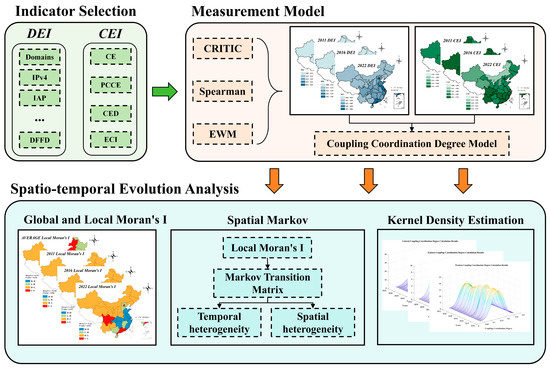
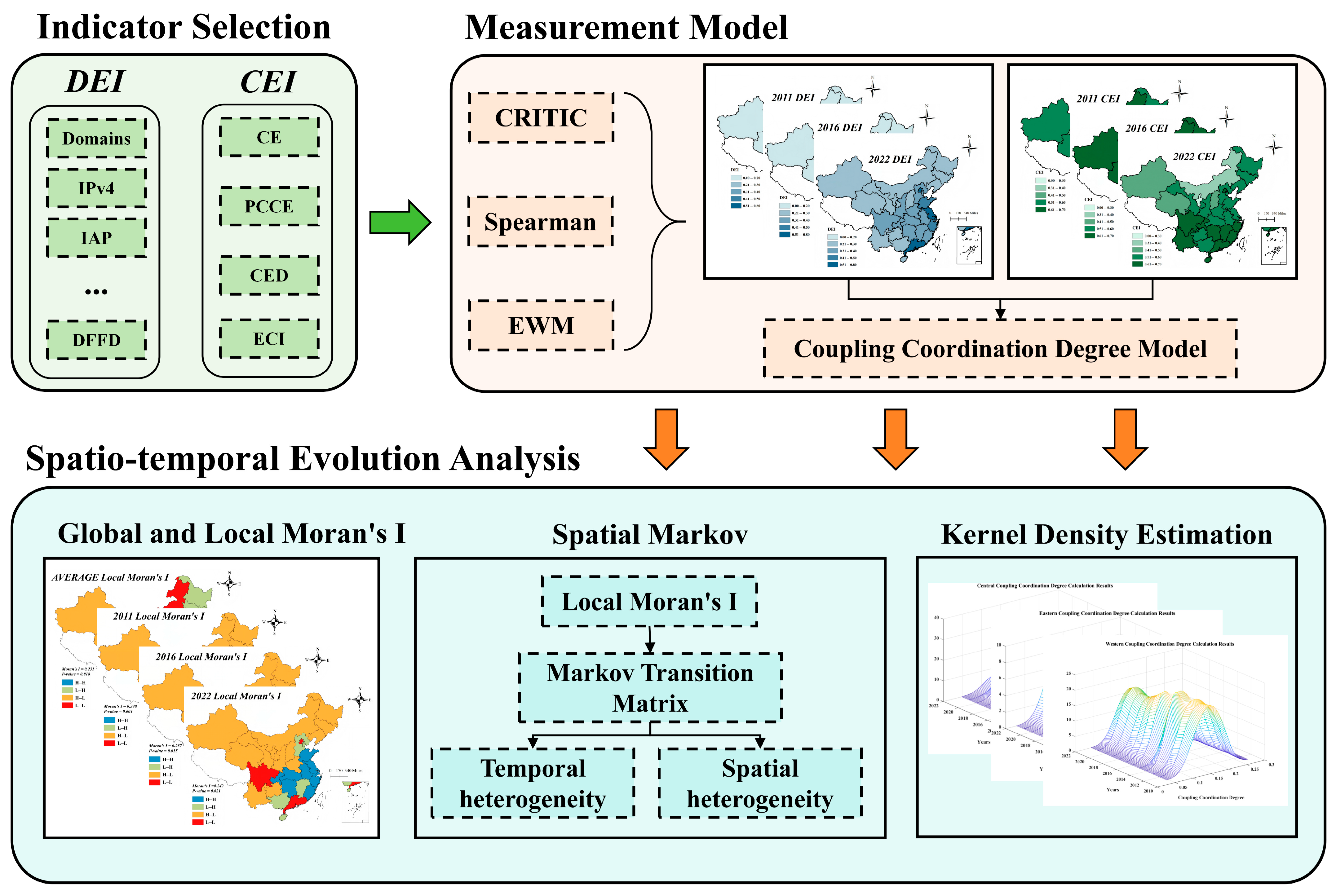
Accordingly, this study investigates the spatiotemporal evolution of the coupling coordination between China’s digital economy and carbon emissions from a regional heterogeneity perspective. We first establish comprehensive evaluation index systems for the Digital Economy Development Index (DEI) and the Carbon Emissions Index (CEI) and compute the two indices based on provincial data [25,26]. To improve the robustness of the index construction under non-normal data characteristics, we determine the indicator weights by integrating the CRITIC–Spearman method with the entropy weight method (EWM) [27]. We then measure the coupling coordination degree (CCD) between DEI and CEI to evaluate their coordinated development across provinces. Next, global and local Moran’s I are employed to examine the spatial autocorrelation and clustering patterns of CCD [24]. Based on the local Moran’s I classification, we further construct a spatial Markov chain model to reveal CCD state transitions under different spatial-lag contexts and to characterize the neighborhood-conditioned evolution process [28]. In addition, kernel density estimation is used to depict the distributional dynamics of CCD over time [29]. The overall research framework is presented in Figure 1.
Figure 1.
Research framework.
The innovations of this study are threefold. First, by developing comprehensive evaluation systems for the Digital Economy Development Index (DEI) and the Carbon Emissions Index (CEI), we assess the degree of coordination between digital-economy development and carbon emissions. Second, by integrating spatial analytical approaches, we examine interregional spatiotemporal evolution patterns and uncover region-specific pathways toward coordinated development between the digital economy and carbon emissions. Third, we compute CEI and DEI using the CRITIC–Spearman and entropy weight method (EWM), thereby improving the accuracy and robustness of the evaluation results. Through spatiotemporal evolution analysis, this study provides scientific evidence to inform policymaking and offers theoretical and empirical support for regionally differentiated strategies for green and low-carbon development in China.
2. Data and Methods
2.1. Data Sources and Indicator Selection
The dataset used in this study covers 30 provincial-level regions in China. Owing to data unavailability, Taiwan, Tibet, Hong Kong, and Macao are excluded. Data are drawn from publicly available sources, including the National Bureau of Statistics of China, the China Information and Communication Yearbook, and the China Energy Statistical Yearbook [30,31]. These data capture multiple dimensions of China’s digital-economy development and carbon emissions. Based on the collection and preprocessing of the relevant indicators, we establish evaluation index systems for the Digital Economy Development Index (DEI) [32] and the Carbon Emissions Index (CEI) [33]. Table 1 and Table 2 report the selected indicators and their detailed descriptions.
Table 1.
Indicator selection for the Digital Economy Development Index (DEI).
Table 2.
Indicator selection for the Carbon Emissions Index (CEI).
Table 1 reports three core dimensions of digital-economy development and their corresponding indicators. All indicators are specified as positive indicators, meaning that an increase in these variables is generally associated with a higher level of overall digital-economy development [34].
Table 2 presents the indicators used to construct the Carbon Emissions Index (CEI). Specifically, CE denotes carbon-emissions intensity, calculated as the total carbon emissions divided by GDP; PCCE denotes per-capita carbon emissions, calculated as the total carbon emissions divided by the total population; CED denotes carbon-emissions density, calculated as the total carbon emissions divided by the regional land area; and ECI denotes energy-consumption intensity, measured as the energy consumption per unit of GDP. All indicators in the CEI are treated as negative indicators, meaning that higher values indicate higher carbon emission pressure, and lower values are more conducive to reducing carbon emissions [35]. For transparency, the final weights of the DEI and CEI indicators are provided in Appendix A, which confirms that the DEI or CEI is not dominated by any single component.
Subsequently, we conducted descriptive statistics and normality tests for all indicators. The descriptive analysis reports the mean, standard deviation, maximum, and minimum for each variable to characterize the basic properties and distribution of the data. Normality was assessed using the Shapiro–Wilk (S–W) test to determine whether each indicator follows a normal distribution.
In the Shapiro–Wilk test, the null hypothesis (H0) is that the data are normally distributed. If the p-value is below the chosen significance level (typically 0.05), H0 is rejected, indicating a departure from normality; otherwise, H0 is not rejected, suggesting no evidence against normality. The results are reported in Table 3.
Table 3.
Descriptive statistics.
Based on the descriptive statistics and the Shapiro–Wilk (S–W) normality test results in Table 3, the majority of indicators significantly deviate from a normal distribution, as evidenced by p-values below 0.05 for most variables. For example, Domains, IPv4, and IAP all reject the null hypothesis of normality at the 5% level, whereas WPE yields a p-value of 0.0569, which is close to the threshold and suggests an approximately normal distribution. To account for these distributional characteristics, we adopt rank-based methods in the subsequent weighting procedure. Moreover, to assess whether the non-normality affects the temporal comparability of the composite indices, we further examine year-to-year rank stability for DEI and CEI. As reported in Table A3, the Spearman rank correlations between consecutive years remain consistently high and statistically significant, indicating that provincial DEI and CEI rankings are highly stable over time despite the observed non-normality. The reported means, standard deviations, maxima, and minima in Table 3 provide additional summaries of the basic dispersion and range of each indicator.
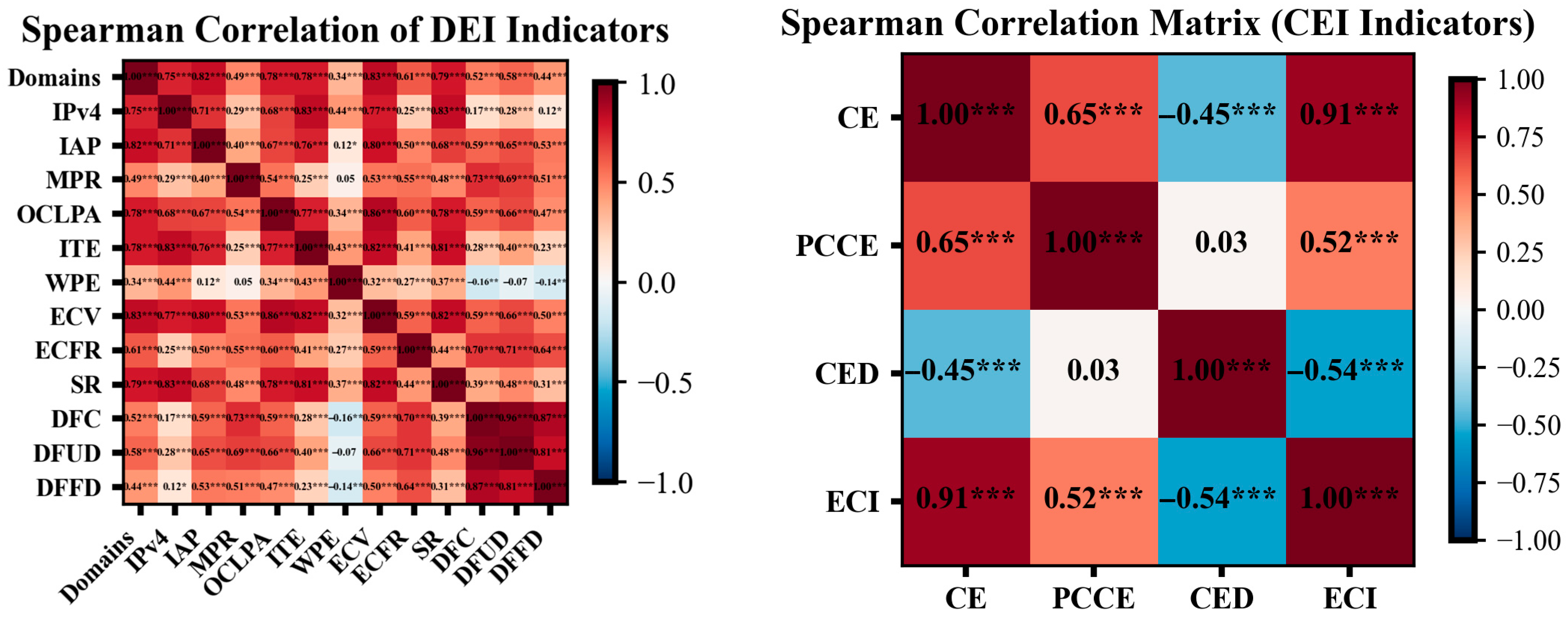
As shown in Figure A1, the DEI indicators exhibit predominantly positive and statistically significant Spearman correlations, implying that different dimensions of digital development tend to co-evolve across provinces. Stronger associations are observed among infrastructure-related variables and digital-industry indicators, as well as within the digital inclusive finance block, indicating a clear clustering structure in the digital-economy system. By contrast, a few indicators such as websites per 100 enterprises display comparatively weaker correlations with several other components, suggesting that certain firm-level digitalization attributes may evolve at a different pace than core infrastructure and financial digitalization. For the CEI system, the correlation structure is more heterogeneous: carbon-emissions intensity and energy-consumption intensity are highly positively correlated, while carbon-emissions density shows negative correlations with intensity-based measures, reflecting that the emission pressure may manifest differently through efficiency, scale, and spatial concentration. Overall, these patterns confirm meaningful inter-indicator dependence and support the use of the Spearman-based CRITIC procedure to mitigate redundancy while preserving multidimensional information.
2.2. Index Calculation Model
Because most variables deviate from normality, it is necessary to account for distributional properties before applying weighting and measurement procedures. Accordingly, this study proposes a CRITIC–Spearman approach, in which Spearman’s rank correlation coefficient is used to quantify inter-indicator correlations, thereby mitigating the influence of non-normality on correlation estimation. When the CRITIC method is used alone, it can assign weights based on the contrast intensity of indicators and their correlations, but it may overlook informational uncertainty. In contrast, the entropy weight method (EWM) incorporates information entropy to capture the uncertainty (or dispersion) of indicators; however, it does not adequately account for correlations among indicators. Therefore, we integrate CRITIC–Spearman with EWM to more comprehensively capture the joint effects of multiple dimensions of the digital economy.
2.2.1. CRITIC–Spearman Model
The CRITIC model is a weighting method that assigns indicator weights based on each indicator’s standard deviation and its correlation with other indicators. In this study, because most variables deviate from normality, the conventional Pearson correlation coefficient may be inappropriate. We therefore use Spearman’s rank correlation coefficient to quantify inter-indicator correlations. Spearman’s correlation is more robust and can effectively accommodate nonlinear associations and non-normally distributed data [33].
First, all indicators are normalized to ensure comparability across different units and scales. We adopt min–max normalization, as given by the following Equation (1):
where denotes the normalized value of the -th indicator for the -th observation, and and represent the minimum and maximum values of the -th indicator, respectively.
Next, we compute the standard deviation of each indicator. Specifically, the standard deviation is used to measure the variability of indicator . Indicators with larger variability provide stronger discriminatory information across observations and are thus considered more important:
where is the standard deviation of the -th indicator, and denotes the mean of indicator .
We then use Spearman’s rank correlation coefficient to quantify the correlations among indicators. Unlike the Pearson correlation coefficient, Spearman’s coefficient is computed on ranks, making it more suitable for non-normally distributed data and alleviating the limitations of Pearson correlation when the normality assumption is violated. Spearman’s correlation is calculated as Equation (3):
where denotes the difference in ranks between observation on the -th and -th indicators, and is the Spearman correlation coefficient between indicators and .
The amount of information conveyed by each indicator, , is defined as a function of its variability and its correlations with other indicators. Indicators with larger contribute more independent information and should therefore receive higher weights:
where denotes the information content of indicator , is the standard deviation of indicator , and is the Spearman correlation coefficient between indicators and .
Based on the information content of each indicator, the corresponding weight is calculated as
where denotes the weight of indicator , is the total number of indicators, and is the information content of indicator .
2.2.2. Entropy Weight Method (EWM)
The entropy weight method (EWM) is an information-theoretic weighting approach that determines indicator weights by quantifying the uncertainty of each indicator. A higher entropy value implies that an indicator carries less effective information; accordingly, it should be assigned a lower weight. Unlike the CRITIC method, EWM places higher emphasis on the distributional characteristics of each indicator and the uniformity of the data [27].
Similar to the CRITIC model, we first normalize all indicators to ensure comparability, using min–max normalization (identical to Equation (1)). We then compute the information entropy of each indicator. Larger entropy indicates higher uncertainty and thus a lower weight. Specifically, we begin by deriving the probability distribution of each indicator as in Equation (6):
where denotes the probability distribution of the normalized value of indicator for observation .
According to information theory, the entropy of indicator is computed as
where is the entropy value of the -th indicator, and is the number of observations.
Weights are then derived based on entropy. A larger entropy value indicates lower variation and less informative content and, therefore, a lower weight. The weight is calculated as
where denotes the weight of indicator , and is the entropy value of indicator .
2.2.3. Mixed Model
By integrating the CRITIC–Spearman approach with the entropy weight method (EWM), we can more comprehensively evaluate the contribution of each indicator to the Digital Economy Development Index (DEI) or the Carbon Emissions Index (CEI). The final weight is obtained as a weighted combination of the two methods, jointly accounting for each indicator’s standard deviation, inter-indicator correlation, and information entropy [27]:
where is an adjustment coefficient that balances the contributions of the CRITIC–Spearman and EWM; in this study, we set .
The composite index is then calculated using a weighted-average scheme:
where DEI denotes the digital economy development index, CEI denotes the carbon emissions index, is the weight of the -th indicator, and is the standardized value of the -th indicator.
This hybrid weighting strategy enables a more accurate representation of the joint influence of the indicators on the digital economy or carbon emissions, thereby yielding a more robust and interpretable DEI and CEI.
2.3. Coupling Coordination Degree Model
The coupling coordination degree (CCD) model is widely used to quantify the interactive relationship between two systems and to evaluate their level of coordinated development. In this study, the Digital Economy Development Index (DEI) and carbon emissions are treated as two interacting systems. We employ the CCD model to measure their interdependence and further examine how this relationship evolves across regions and over time.
In this framework, denotes the coupling degree, represents the digital economy development index (DEI), and denotes the carbon emissions; denotes the coordination index, with and defined as above; it should be noted that the CEI variables are reverse-normalized so that shares a consistent directional interpretation with , where a higher reflects relatively lower carbon-emission pressure. Finally, denotes the coupling coordination degree; numerically reflects both the strength of the relationship between the digital-economy and carbon-emissions systems and their overall coordination status.
In addition, to further enhance transparency, we also added a simple numerical example illustrating the CCD calculation for a single province–year. For instance, assuming = 0.6 and = 0.4, we obtain
This example makes the calculation procedure explicit and facilitates replication.
2.4. Spatial–Temporal Evolution Model
When examining the coupling coordination between the digital economy and carbon emissions, a spatiotemporal evolution framework enables an integrated analysis of data that vary across both space and time. By combining Moran’s I, the spatial Markov chain model, and kernel density estimation (KDE), we can characterize the evolution of the coupling coordination degree from complementary spatial and temporal perspectives, thereby revealing its spatiotemporal dynamics.
2.4.1. Moran’s I
Moran’s I is used to measure the spatial autocorrelation of areal data and to assess whether the coupling coordination degree exhibits spatial clustering or dispersion across regions. By quantifying the association between a spatial weight (adjacency) matrix and the coupling coordination degree, Moran’s I can reveal the extent to which coordination levels are spatially correlated.
We first construct an adjacency matrix to represent spatial contiguity between regions. The elements of the matrix are typically binary (0 or 1), indicating whether region and region share a common boundary [36]. We then compute Moran’s I as follows:
where denotes the total number of regions (in this study, 30 provinces, i.e., ); is the -th element of the adjacency matrix, indicating whether regions and are contiguous; and are the coupling coordination degree values for regions and , respectively; and is the mean coupling coordination degree across all regions.
2.4.2. Spatial Markov Chain
The spatial Markov chain approach is primarily used to examine state transitions in the coupling coordination degree, thereby revealing evolutionary regularities across periods and spatial units. It enables us to understand how the coupling coordination level of a region shifts from one state to another over time and, thus, to depict the spatiotemporal evolution of the digital economy–carbon emissions relationship [28].
Based on the results of Moran’s I, regions are classified into four groups—low, lower-middle, upper-middle, and high. The coupling coordination degree is then discretized into a set of corresponding states. Using changes in each region’s state across periods, we construct the transition probability matrix , where denotes the probability of transitioning from state to state . By tracking state changes between successive years, we estimate the state-transition probabilities for each region over time. The transition matrix is computed as follows:
where is the number of observations that transition from state to state , and is the total number of observations initially in state .
2.4.3. Kernel Density Estimation
Kernel density estimation (KDE) is a nonparametric smoothing technique used to estimate the probability density function of a random variable. In spatiotemporal evolution analysis, KDE helps characterize the spatial distribution and temporal evolution of the coupling coordination degree by depicting how its density varies across regions and over time [36]. KDE smooths the empirical distribution using a kernel function and is defined as follows:
where denotes the estimated density at point ; is the kernel function (e.g., a Gaussian kernel); is the bandwidth parameter controlling the degree of smoothing; and represents the sample observations.
3. Results
In this study, we begin by computing the Digital Economy Development Index (DEI) and the Carbon Emissions Index (CEI). These indices allow us to examine the temporal trends of digital economy development and carbon emissions. Next, we calculate the coupling coordination degree (CCD) between DEI and CEI and assess the spatial dependence across provinces using global Moran’s I and local Moran’s I. A spatial contiguity matrix (adjacency matrix) is specified as the spatial weight matrix for this analysis.
Building on the results from the local Moran’s I classification, we then apply a spatial Markov chain model to reveal the evolutionary patterns of CCD over time and across spatial units. Finally, using kernel density estimation (KDE), we visualize the spatiotemporal distribution of the coupling coordination degree. This helps to illustrate how the density of CCD changes over both years and regions.
3.1. Measurement Results of the Two Indices (DEI and CEI)
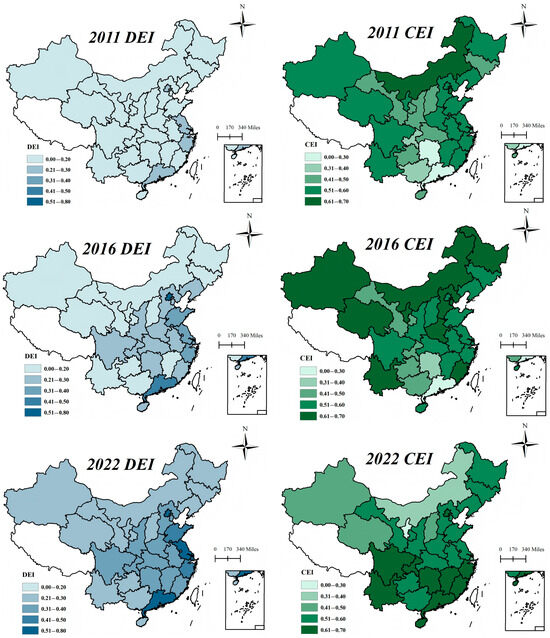
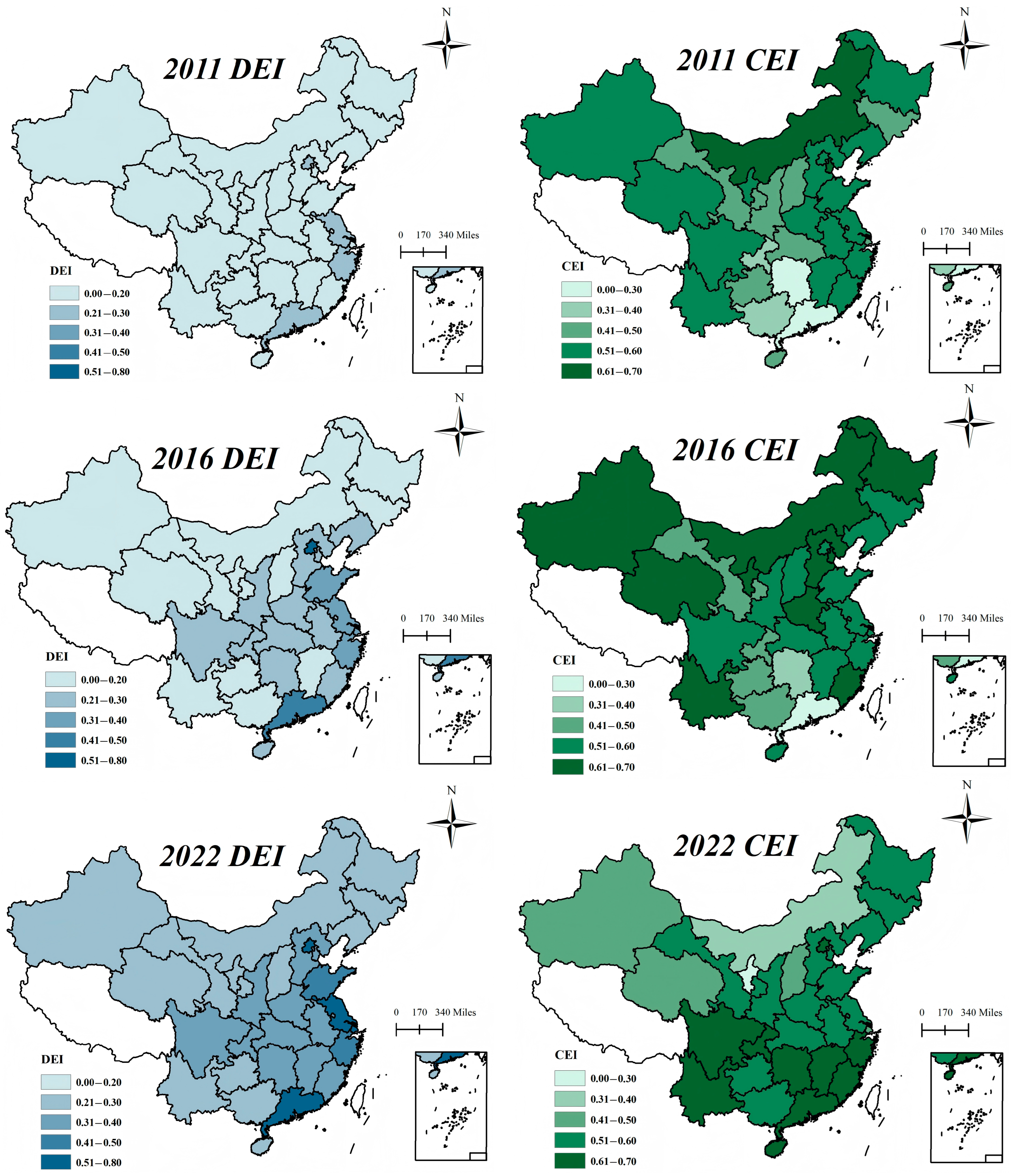
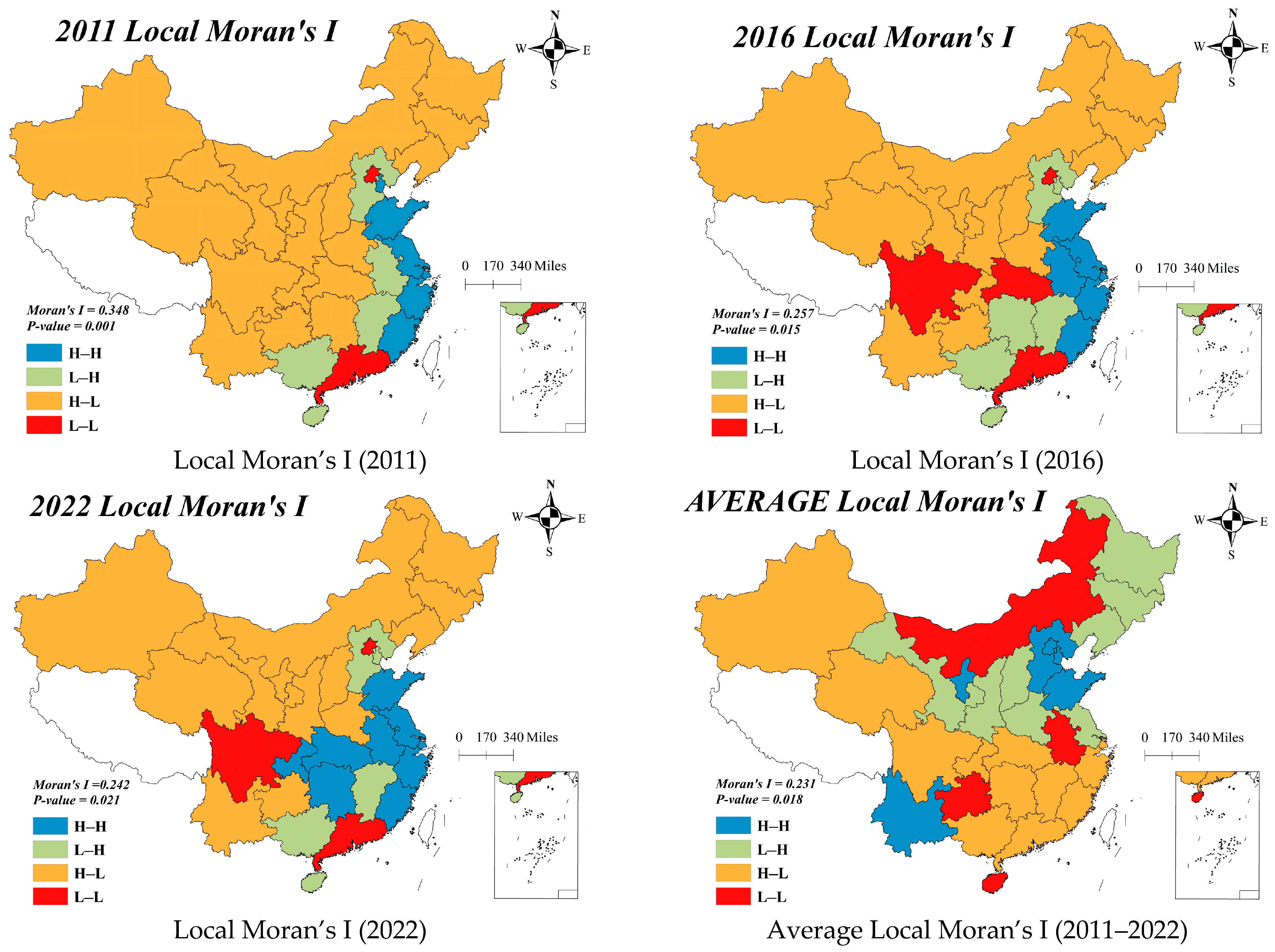
Based on the data shown in Figure 2 for the period 2011–2022, the provincial trajectories of the Digital Economy Development Index (DEI) and the Carbon Emissions Index (CEI) exhibit pronounced heterogeneity. To present the temporal evolution in a clear and representative manner, we report the local Moran’s I maps for 2011, 2016, and 2022, which correspond to the beginning, middle, and end of the study period, thereby providing an intuitive snapshot of the early-stage pattern, mid-period adjustment, and end-period configuration of spatial association.
Figure 2.
Measurement results of the DEI and the CEI.
Overall, the DEI increased in most provinces, with particularly strong and sustained growth in the eastern and coastal regions, such as Beijing, Shanghai, Jiangsu, and Zhejiang. These provinces maintained relatively high DEI levels and continued to improve over time, reflecting ongoing upgrades in digital infrastructure and digitalization. Notably, Beijing’s DEI rose from 0.25 in 2011 to 0.74 in 2022, highlighting the rapid expansion of the digital economy.
In contrast, the pattern for CEI shows that carbon-emission pressures remain significant in certain regions, especially in western provinces like Inner Mongolia and Xinjiang, where the CEI values remain relatively high. This suggests that these regions continue to face substantial challenges in emission mitigation. Despite progress in digital-economy development, carbon-emission constraints in these areas remain binding.
In contrast, the CEI results suggest that carbon-emission pressure has intensified in some resource- and energy-intensive provinces, such as Inner Mongolia, Ningxia, and Xinjiang. Specifically, the CEI values in these regions show a declining trend, which indicates worsening carbon-emission conditions and increasing mitigation pressure.
3.2. Results of the Coupling Coordination Degree
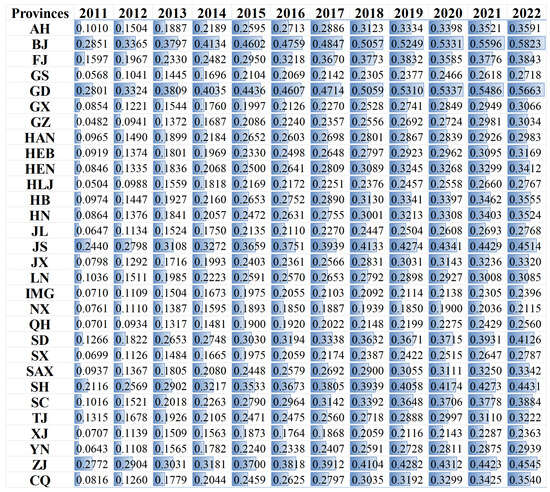
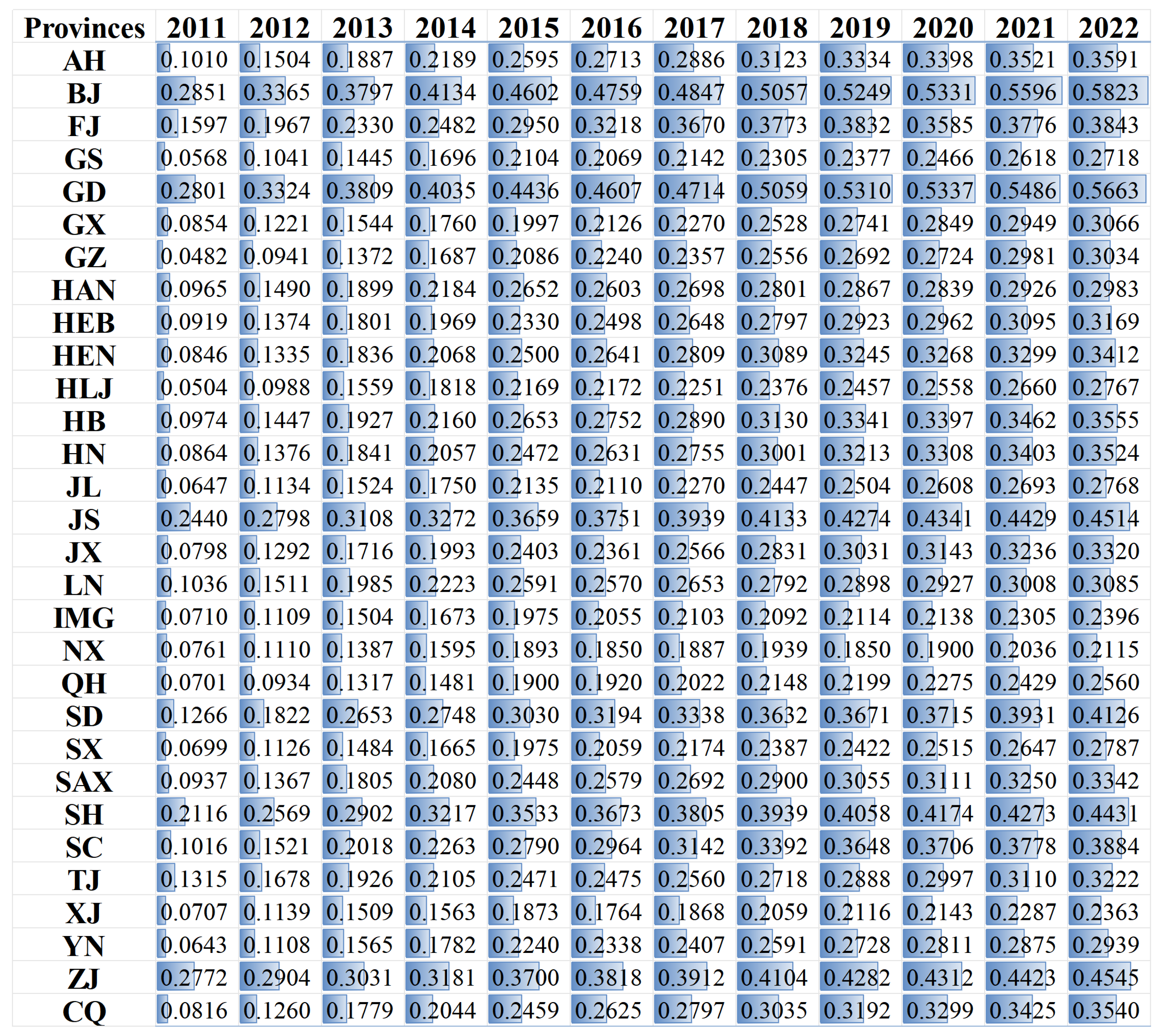
Based on the coupling coordination degree (CCD) between DEI and CEI shown in Figure 3 for 2011–2022, the CCD increases in most provinces over time, indicating an overall improvement in the coordination between digital-economy development and carbon emissions. For reference, the descriptive statistics of DEI, CEI, and CCD, including their central tendencies and dispersion measures, are reported in Appendix A, Table A4.
Figure 3.
Results of the coupling coordination degree.
The eastern and coastal provinces, such as Beijing, Shanghai, and Jiangsu, consistently maintain relatively high CCD levels. Following the equal-interval state classification used in this study, CCD values of 0–0.15, 0.15–0.30, 0.30–0.45, and 0.45–0.60 are interpreted as low, moderately low, moderately high, and high coordination, respectively. Under this criterion, the CCD values reported in many provinces around 0.25–0.31 correspond to a moderately low to transitional coordination stage, indicating that the two subsystems are improving but have not yet formed strong synergy.
In particular, Beijing’s CCD rises from 0.2851 in 2011 to 0.5823 in 2022, suggesting an upgrading from a moderately low coordination level to a high coordination level, reflecting better alignment between digital-economy expansion and emissions control in this region. In contrast, several western and central provinces, including Inner Mongolia, Gansu, and Guizhou, exhibit persistently lower CCD levels and more modest improvements. For example, Inner Mongolia’s CCD increases from 0.0710 in 2011 to 0.2396 in 2022. Although this represents growth, the province remains within the low or moderately low coordination range, implying that the coordination between digital-economy development and carbon-emission mitigation is still relatively weak and requires further strengthening.
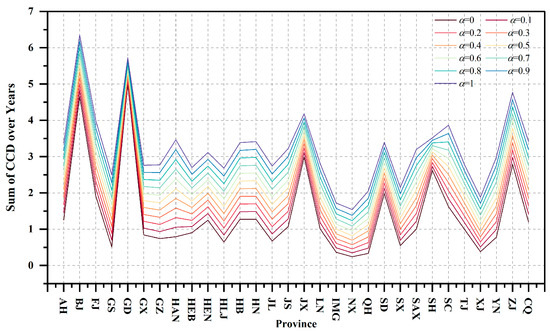
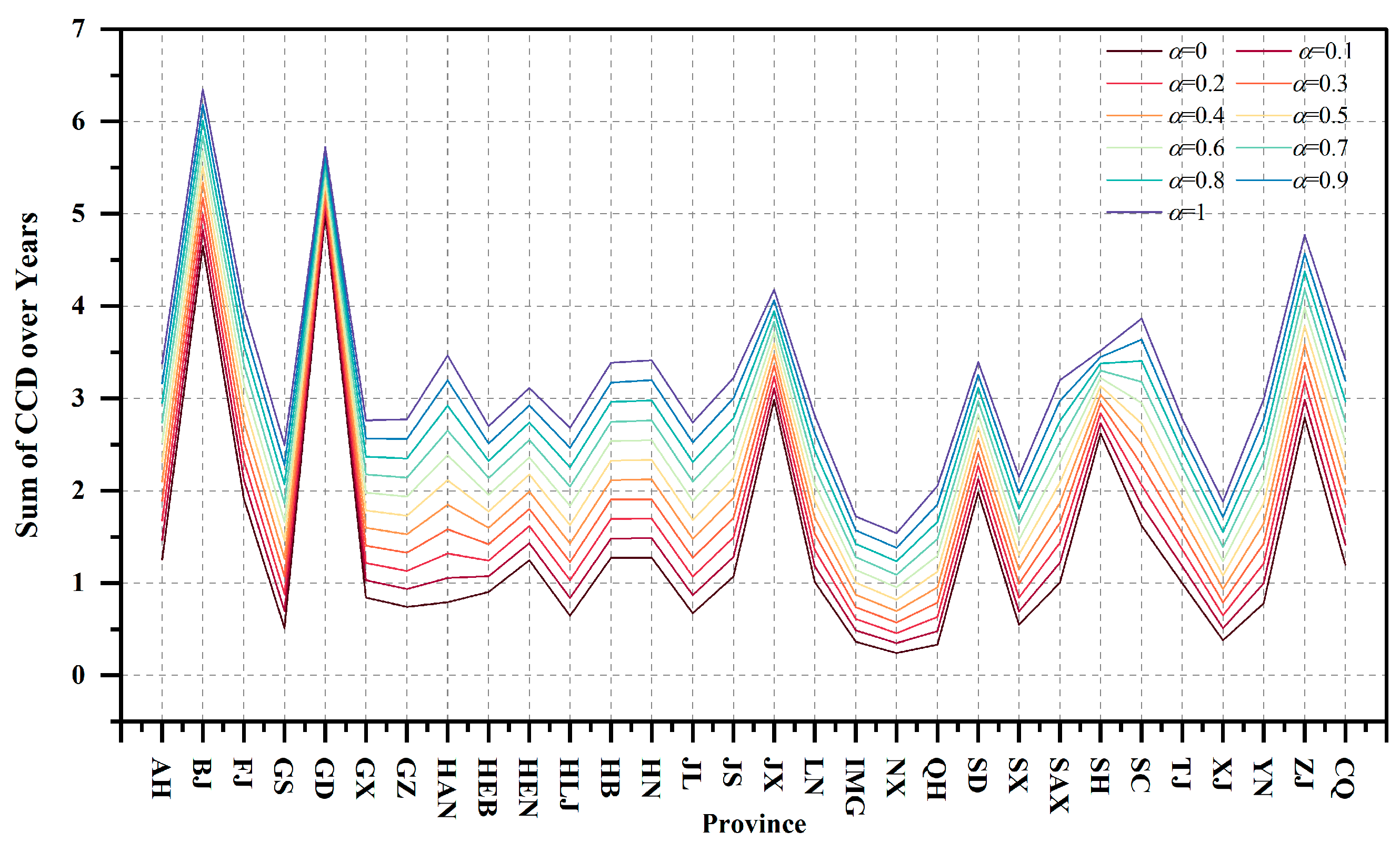
Further, to examine the robustness of the index-construction procedure and assess whether the coupling results are sensitive to the weighting setting, we conduct a sensitivity analysis by varying the parameter α in the Index Calculation Model. Specifically, while keeping the indicator system and raw data unchanged, we adjust from 0 to 1 with a fixed step size of 0.1 and re-calculate the DEI and CEI for each value using the CRITIC–Spearman and entropy weight methods. Based on the re-estimated DEI and CEI, we then recompute the CCD for each province–year and aggregate the CCD values of each province over the study period into a single summary measure for comparability across α settings. By comparing how provincial CCD levels and their relative patterns change as varies, we evaluate the stability of the coordination assessment under alternative weighting schemes. The results of this sensitivity analysis are presented in Figure 4.
Figure 4.
Sensitivity analysis results for CCD.
Figure 4 shows that as α increases, the province-level CCD sums rise almost uniformly, while the relative ranking and overall spatial pattern remain largely unchanged, indicating that the coupling-coordination results are robust to alternative weighting schemes and mainly differ in magnitude rather than structure.
3.3. Spatiotemporal Evolution Results
In the spatiotemporal analysis, we begin by computing Moran’s I to evaluate the spatial autocorrelation of the CCD across regions and to identify potential clustering or dispersion patterns. Next, we employ a spatial Markov chain model to examine the state transitions of provincial CCD across years, thereby revealing the changing patterns of coordinated development across regions. Finally, we apply kernel density estimation (KDE) to visualize the distributional features of CCD over both time and space, further enriching our understanding of regional development dynamics.
3.3.1. Moran’s I Results
- Global Moran’s I
Table 4 reports the results of global Moran’s I, which measures the spatial autocorrelation of the coupling coordination degree (between DEI and CEI) from 2011 to 2022. The “AVERAGE” row shows the Moran’s I values calculated using the annual mean CCD for each year. Overall, Moran’s I is positive in most years, and the associated p-values are well below 0.05, indicating the significant spatial clustering of CCD across provinces. This suggests that provinces tend to have CCD levels similar to those of neighboring provinces, implying spatial spillover effects.
Table 4.
Global Moran’s I.
More specifically, Moran’s I remains relatively high from 2011 to 2019, generally ranging from 0.242 to 0.348, indicating strong spatial dependence. Although Moran’s I declines in 2021 and 2022 (to 0.261 and 0.242, respectively), it remains statistically significant, suggesting that spatial clustering persists. The average Moran’s I value of 0.231 summarizes the overall level of spatial autocorrelation in CCD from 2011 to 2022, indicating a relatively stable clustering pattern over time. These results provide an empirical basis for the subsequent spatial Markov chain analysis and further confirm the spatial dependence of provincial CCD levels.
- 2.
- Local Moran’s I
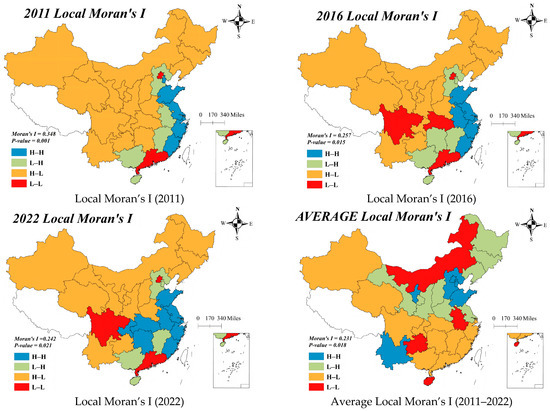
We report the results of local Moran’s I for 2011, 2016, and 2022 and provide the AVERAGE pattern for the 2011–2022 period in Figure 5. The results indicate that most provinces fall into two dominant spatial association types: high–high (H–H) and low–low (L–L). This suggests pronounced spatial clustering in the combined pattern of digital-economy development and carbon emissions across Chinese provinces. Specifically, provinces in high-value areas tend to cluster with other high-value provinces (H–H), while low-value areas exhibit L–L clustering. These findings highlight the spatial heterogeneity across provinces in both digital-economy development and carbon emissions, emphasizing the spatial linkages between regions.
Figure 5.
Local Moran’s I.
The spatial association patterns remained broadly consistent from 2011 to 2022, suggesting that the spatial configuration of most provinces stayed relatively stable, particularly with respect to digital-economy development and carbon emissions. To investigate the spatiotemporal evolution of these patterns, we next employ a spatial Markov chain model. By using the average local Moran’s I results from 2011 to 2022, we smooth year-to-year fluctuations, which helps better reflect stable transition structures and facilitates the identification of the overall spatiotemporal evolution process. This choice is also theoretically grounded in the spatial Markov framework, which typically relies on a relatively stable spatial-lag regime and time-homogeneous transition structure; therefore, using the averaged local Moran’s I provides a more representative long-run neighborhood context and reduces the influence of short-term volatility on the state classification.
- 3.
- Robustness Analysis for Moran’s I
To assess whether the estimated spatial dependence is sensitive to the specification of the spatial weight matrix, we conducted a robustness check by replacing the baseline adjacency-based matrix with two alternative geographic and economic distance matrices. Specifically, the geographic distance matrix was constructed using the inverse of the great-circle distance between province centroids. Let denote the spherical distance computed from latitude and longitude coordinates, which can be expressed as
where is the Earth’s radius, and and represent the latitude and longitude, respectively. The corresponding distance-based spatial weight is defined as for , and . In addition, we constructed an economic-distance matrix that jointly accounts for geographic proximity and economic similarity.
Let denote the average per-capita GDP of province over 2000–2021; the economic-distance weight is defined as for , and . All weight matrices were further standardized to ensure comparability across specifications. The robustness results of Moran’s I under these alternative spatial weights are reported in Table 5.
Table 5.
Robustness results of Moran’s I under different spatial weights.
Table 5 reports the robustness results of global Moran’s I under three alternative spatial weight specifications. Overall, the estimated Moran’s I remains positive and statistically significant across all years and matrix definitions, indicating that the spatial clustering of CCD is not an artefact of a single weighting scheme. The adjacency-based matrix produces consistently moderate spatial autocorrelation (with Moran’s I ranging from 0.242 to 0.348), while the distance-based matrix yields smaller but still significant Moran’s I values, suggesting that geographic proximity alone captures a weaker yet non-negligible spatial dependence. By contrast, the economic-distance matrix generally generates larger Moran’s I estimates than the other two specifications in most years, implying that economic similarity combined with geographic proximity may reinforce spatial spillover effects in coordinated development. Taken together, these results confirm the robustness of the main spatial dependence findings and support the validity of subsequent spatial Markov analyses under alternative neighborhood structures.
3.3.2. Spatial Markov Chain Results
- Spatial Markov Chain
Table 6 presents the spatiotemporal evolution of the coupling coordination level between DEI and CEI, as summarized by the transition probability matrix from the spatial Markov chain model. To construct the spatial Markov framework, we first discretize the continuous CCD values into four coordination states using equal-interval classification. Specifically, CCD is divided into low (L) , lower-middle (ML) , upper-middle (MH) , and high (H) , with an interval width of 0.15 for each state. We then classify provinces into four spatial-lag association types based on local Moran’s I. Across the sample, six provinces fall into the H–H category, eight into L–H, twelve into L–L, and four into H–L, which provides an empirical reference for interpreting the transition probabilities under different neighborhood contexts. Based on this state definition and the corresponding spatial lag categories, the transition probability matrix is then estimated, and the results reveal distinct transition tendencies across different types of spatial association.
Table 6.
Spatiotemporal evolution of the coupling coordination level between DEI and CEI.
Under the high–high (H–H) spatial association type, regions show strong state persistence at higher coordination levels. Specifically, provinces in the high (H) state remain highly stable, with a self-transition probability of 1. Meanwhile, provinces in the upper-middle (MH) state also exhibit a high probability of remaining in the same state (0.917) and a relatively small probability of upgrading to the high state (0.083), indicating gradual upward mobility at higher coordination levels. For the lower-middle (ML) group, the majority remain in the ML state (0.895), while a smaller share shifts to the low (L) state (0.556), suggesting that provinces in this intermediate group still face the risk of downward transition under certain spatial contexts.
In the low–low (L–L) spatial association pattern, provinces demonstrate a more evident upward transition tendency from lower states. Provinces in the low (L) state show a high probability of transitioning to the lower-middle (ML) state (0.471), while those in the ML state mostly remain stable (0.839) and partly upgrade to MH (0.161). Moreover, the MH state presents strong persistence (0.957), implying that once provinces enter the upper-middle level, their coordination status tends to remain relatively stable. Overall, the spatial Markov results indicate that, under spatial-lag effects, different regional types exhibit distinct CCD transition patterns, reflecting both persistent regional disparities and differentiated improvement potential in the coordination between the digital economy and carbon emissions across Chinese provinces.
- 2.
- Robustness Analysis for Spatial Markov Chain
To examine the robustness of the spatial Markov chain results to the state-classification scheme, we performed an interval-perturbation test by slightly adjusting the CCD state thresholds. Based on the baseline equal-interval partition, we constructed two alternative state definitions by shifting each boundary downward and upward, respectively. Under the downward-adjustment setting, the cutoffs were modified to 0–0.145 and 0.145–0.295, and the remaining states were extended using the same interval width. Under the upward-adjustment setting, the cutoffs were adjusted to 0–0.155 and 0.155–0.305, with the remaining states defined consistently. We then re-estimated the spatial Markov transition matrices under these alternative classifications and compared the transition patterns with the baseline results, as shown in Table 7.
Table 7.
Robustness analysis results of spatial Markov chains.
Table 7 shows that the spatial Markov transition patterns are highly stable under both threshold perturbations. After shifting the CCD state cutoffs downward or upward by 0.05, the estimated transition probabilities change only marginally across all spatial-lag contexts, and the overall mobility structure remains essentially unchanged. In particular, the high-persistence feature is preserved, with provinces in the MH and H states still exhibiting very strong state retention and extremely low probabilities of downward transitions, while provinces in the L and ML states mainly transition toward ML and MH rather than jumping directly to H. This consistency indicates that the main conclusions drawn from the spatial Markov analysis are robust to alternative state-classification schemes.
- 3.
- Heterogeneity Analysis for Spatial Markov Chain
In this study, we further examine the heterogeneity of the coupling coordination degree between the digital economy and carbon emissions. Specifically, we conduct temporal and spatial heterogeneity analyses within the spatial Markov chain framework to clarify how coordination patterns vary across periods and regions. Together, these analyses provide further evidence of regional disparities and differentiated evolutionary pathways in the digital economy–carbon emissions nexus.
Table 8 reports the temporal heterogeneity results by estimating spatial Markov transition matrices for three subperiods (2011–2014, 2015–2018, and 2019–2022). The transition structure varies across periods, reflecting changes in mobility and persistence along the coordination ladder. During 2011–2014, provinces in the low (L) and lower-middle (ML) states exhibit relatively high persistence probabilities under several spatial-lag contexts, indicating that upward movement was limited in the short run. In the subsequent periods, the transition mass becomes increasingly concentrated in the upper-middle (MH) and high (H) states, and the stability of higher coordination levels becomes more pronounced. For instance, MH-state persistence remains strong under multiple neighborhood settings, and the probability of transition from ML to MH becomes more visible in 2015–2018 and 2019–2022. Under the L–L association type, ML-state persistence changes from 0.824 in 2011–2014 to 0.792 in 2015–2018 and rises to 0.889 in 2019–2022, suggesting that late-stage dynamics are characterized by more sustained middle-level consolidation. Overall, the coordination improvement strengthens over time, while the pace of upgrading remains dependent on neighborhood contexts and continues to display temporal differences.
Table 8.
Temporal heterogeneity of the coupling coordination level between DEI and CEI.
Table 9 presents the spatial heterogeneity results for China’s eastern, central, and western regions. The estimated transition matrices show systematic differences in mobility patterns across regions. In the eastern region, low-level provinces display stronger upgrading potential, while provinces already located in MH or H states maintain high persistence probabilities, indicating relatively stable high-level coordination. In the central and western regions, L and ML states show stronger persistence in many spatial-lag contexts, implying that coordination upgrading tends to follow a more gradual trajectory. Under the L–L association type, the probability of remaining in ML is 0.750 in the eastern region, 0.813 in the central region, and 0.923 in the western region, while the upward transition from ML to MH is 0.250, 0.188, and 0.077, respectively. This contrast indicates that coordination upgrading from lower-middle to upper-middle levels is relatively more frequent in the eastern region, whereas middle-level consolidation is more prominent in the western region. Once provinces enter the MH state, high persistence is observed across regions, suggesting that higher coordination levels can be maintained after reaching a certain development threshold.
Table 9.
Spatial heterogeneity of the coupling coordination level between DEI and CEI.
Taken together, the temporal and spatial heterogeneity results indicate that the coordination dynamics vary across both periods and regions. The eastern region exhibits stronger stability in middle-to-high coordination states, alongside more visible upward mobility from low states. The central and western regions show higher persistence at relatively lower coordination levels, and upgrading probabilities are more sensitive to neighborhood contexts, reflecting differentiated improvement pathways in the coordination process between the digital economy and carbon emissions.
3.3.3. Kernel Density Estimation Results
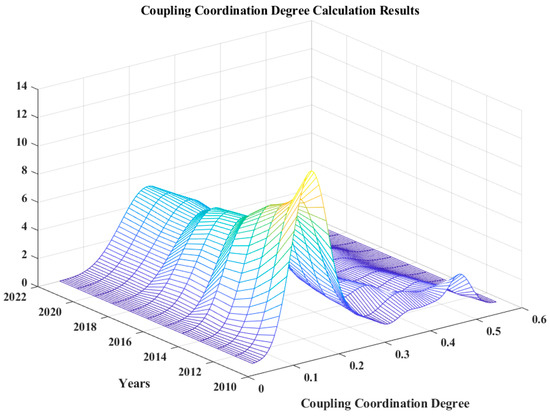
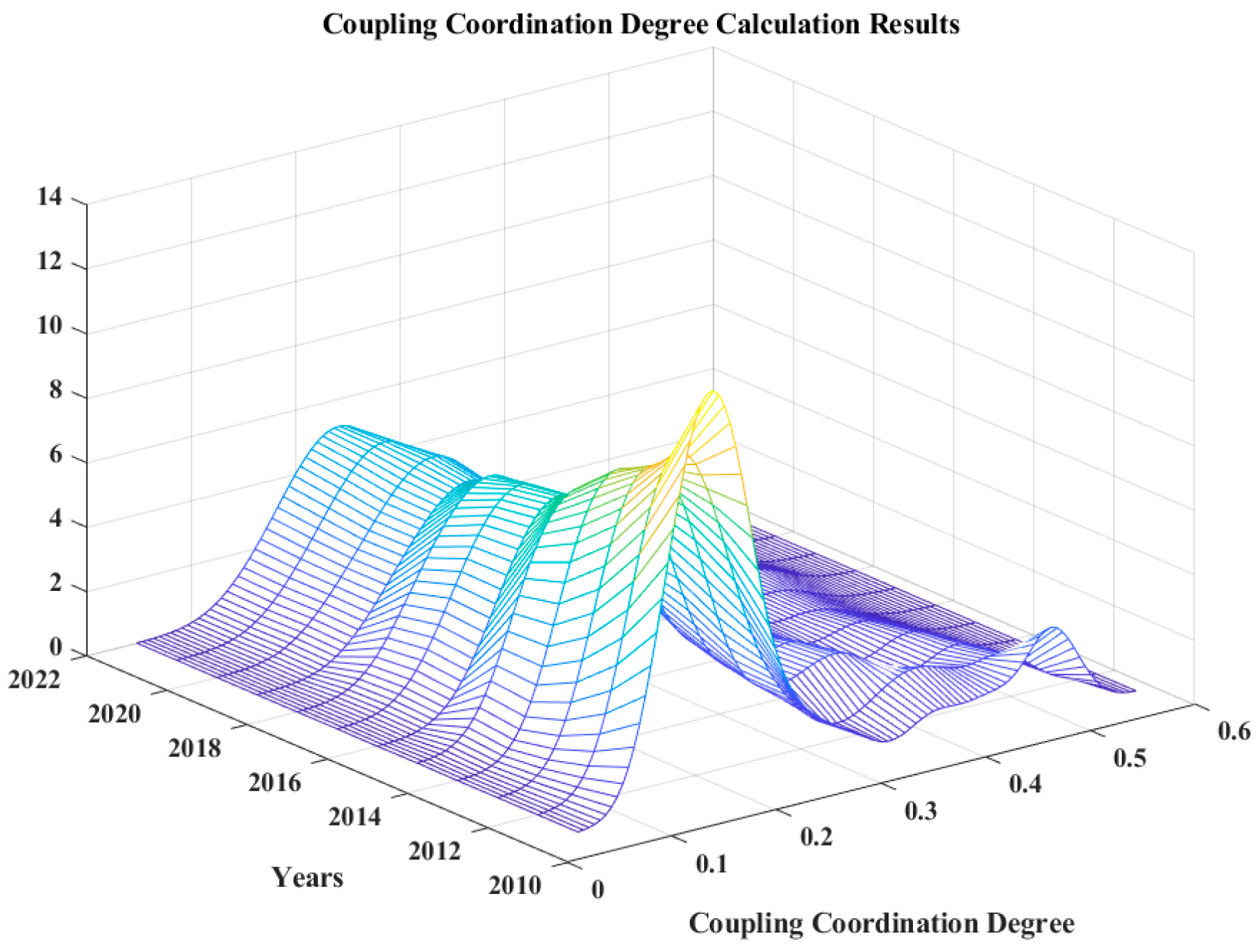
Figure 6 illustrates the dynamic evolution of the coupling coordination degree between DEI and CEI over 2011–2022 using KDE. To ensure comparability across years, the density values are evaluated on a common grid of 100 equally spaced CCD points spanning the overall sample range.
Figure 6.
Dynamic evolution of the coupling coordination degree between DEI and CEI, 2011–2022.
Overall, the coupling coordination degree shows noticeable temporal fluctuations. Coordination increases to a relatively high level during 2013–2016, then declines gradually, followed by a modest rebound after 2020. This pattern suggests that the interaction between digital-economy development and carbon emissions is time-varying and exhibits clear spatiotemporal heterogeneity. The observed volatility also implies that provinces face differentiated constraints and adjustment paths when pursuing digitalization and carbon-mitigation objectives simultaneously.
These results indicate that coordinated development does not proceed uniformly across regions, and persistent spatial disparities remain. Therefore, policy design may need to account for such spatiotemporal dynamics and regional heterogeneity, so as to support more targeted digital and low-carbon transition strategies.
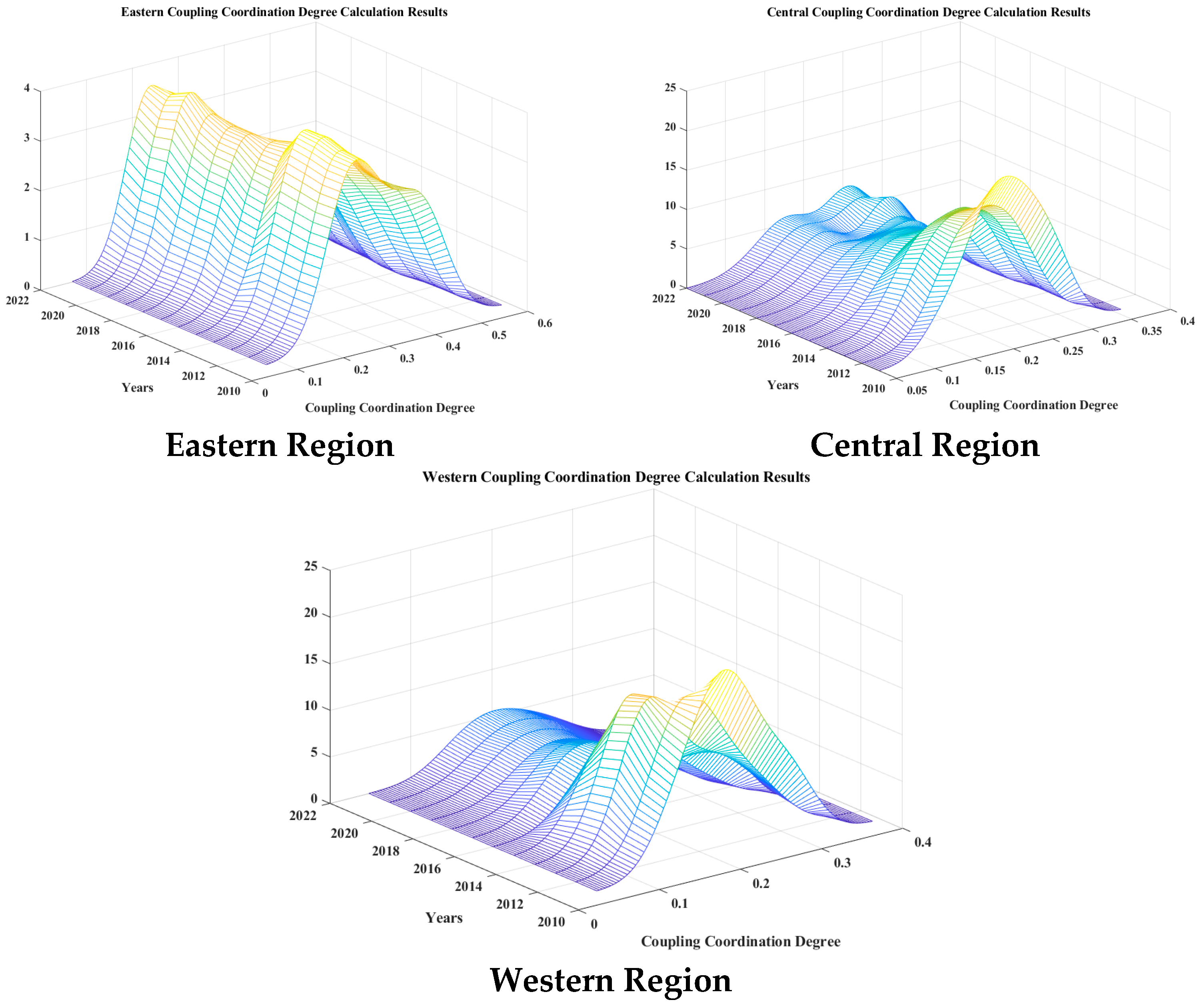
We further conduct heterogeneity analysis to clarify the differentiated evolution of coupling coordination across time and regions. Using the spatial Markov chain framework, we examine the transition dynamics in different subperiods and compare eastern, central, and western China, to reveal whether coordination upgrading is uneven and to provide more targeted policy implications.
Figure 7 depicts the spatiotemporal evolution of the coupling coordination degree between DEI and CEI across the eastern, central, and western regions during 2011–2022. Overall, the coupling coordination degree in all three regions shows an upward trend over time, indicating a general improvement in the coordinated development between the digital economy and carbon-emissions control. The eastern region remains at a relatively higher level throughout the study period, but its increase is less pronounced, suggesting that coordination in this region is comparatively stable and changes more moderately. By contrast, the central and western regions exhibit more visible improvement, with a clearer rightward shift in recent years, implying stronger catching-up dynamics and faster progress in coordination enhancement. In summary, while regional disparities persist in terms of overall levels, the temporal evolution suggests that the coordination gap between regions is gradually narrowing, especially due to the more significant improvements observed in the central and western regions.
Figure 7.
Heterogeneity analysis of the dynamic evolution of the coupling coordination degree between DEI and CEI.
4. Discussion
This section discusses the main findings of the study from three perspectives. We first interpret the overall statistical characteristics of the coupling coordination degree between the digital economy and carbon emissions. Then, we summarize its spatiotemporal evolution and regional heterogeneity. Finally, we reflect on the robustness and interpretability boundaries of the empirical results and highlight their policy relevance.
4.1. Discussion of CCD Results
To provide a more detailed interpretation of the coupling coordination degree between the digital economy and carbon emissions, we further examine the distributional characteristics and temporal dynamics of provincial CCD during 2011–2022. Specifically, we summarize each province’s average coordination level, dispersion, extreme values, and time-trend tendency, to clarify the extent of regional heterogeneity and the overall evolution direction of coordinated development. The descriptive statistics and trend estimates are reported in Table 10.
Table 10.
Descriptive statistics and temporal trend of provincial CCD (2011–2022).
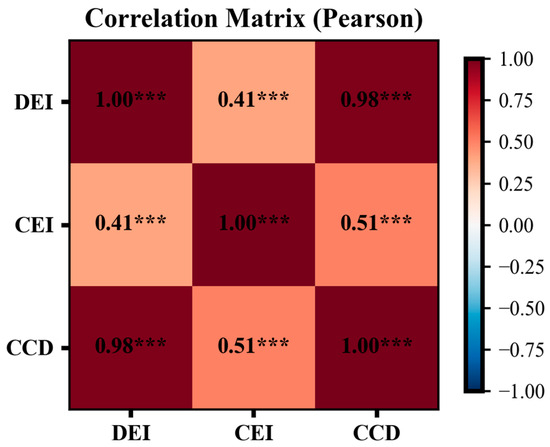
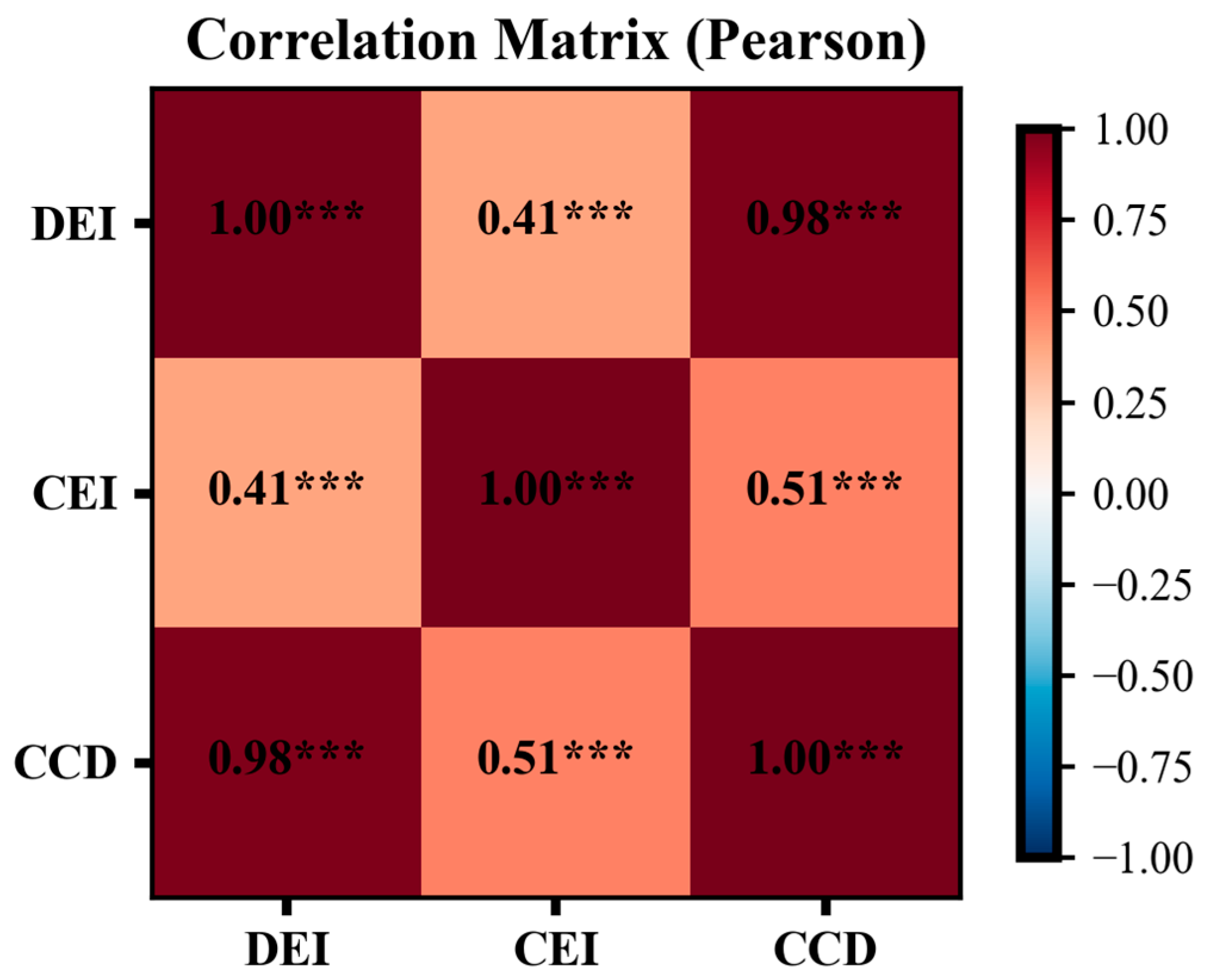
As shown in Table 10, substantial heterogeneity exists in provincial CCD levels over the study period. Beijing and Guangdong exhibit the highest mean CCD values, suggesting relatively stronger coordination between digital-economy development and carbon-emissions performance, whereas Ningxia, Xinjiang, and Inner Mongolia remain at comparatively low levels. Meanwhile, the standard deviations and min–max ranges indicate that several provinces experience marked fluctuations, implying that the coordination process is not stable but evolves with changing economic structures and emissions-related constraints. Importantly, the trend coefficients are positive across all provinces, indicating a broadly improving coordination tendency over time, although the magnitude of improvement varies notably by region. To further clarify the statistical linkage between the two subsystems and CCD, we next examine their pairwise correlations, as illustrated in Figure 8.
Figure 8.
Heatmap of correlation coefficients for CEI, DEI, and CCD (Statistical significance is indicated as follows: *** p-value < 0.01).
Figure 8 reports the Pearson correlation coefficients among DEI, CEI, and CCD. The results indicate an extremely strong and statistically significant association between the CCD and DEI (r = 0.98, p < 0.001), suggesting that provinces with higher levels of digital-economy development tend to exhibit markedly higher coupling coordination outcomes. By comparison, the CCD is also positively correlated with CEI (r = 0.51, p < 0.001), but the magnitude is substantially weaker, implying that carbon-emission performance contributes to coordination improvement to a more moderate extent. In addition, the DEI and CEI show a positive correlation (r = 0.41, p < 0.001), indicating that the two subsystems are not independent in their evolution; however, the correlation is far from perfect, reflecting that the digitalization progress does not automatically translate into proportional improvements in carbon-emission performance. Overall, this correlation structure suggests that cross-provincial differences in CCD are more closely aligned with variations in digital-economy development, while carbon-emission performance still plays an important but secondary role in shaping coordination levels.
4.2. Regional Disparities and Evolution of CCD
The results point to a persistent east–central–west gradient in coupling coordination, but the nature of this disparity is not simply a static ranking. At the level of long-run averages, provinces in the eastern region remain clustered at higher CCD values, which is consistent with the spatial autocorrelation patterns reported in Table 4 and Figure 5. Importantly, this regional dominance is accompanied by stronger “high-level lock-in”: once provinces reach upper-middle or high coordination states, the spatial Markov matrices show high probabilities of remaining there, particularly under H–H neighborhood contexts. In other words, the eastern region’s advantage is not only reflected in higher levels but also in stronger stability and persistence of coordination states. This persistence helps explain why regional differences can remain visible even when all provinces are improving, because provinces located within high-level clusters tend to reinforce each other through stable neighborhood regimes rather than frequently switching states.
Meanwhile, the evolution pattern highlights a more meaningful dynamic on the “catching-up” side. The central and western regions show a clearer rightward shift in the distribution over time, as illustrated by the heterogeneity trajectories in Figure 7 and the distributional change in Figure 6. This shift is not merely a uniform upward movement but is associated with more frequent transitions from lower states to middle states, especially under L–L and L–H neighborhood types. The spatial Markov heterogeneity results further indicate that upward mobility becomes more visible in later subperiods, implying that coordination improvement in lagging regions follows a gradual accumulation path rather than a sudden leap. Taken together, the evidence supports a two-layer interpretation of regional evolution: the eastern region largely reflects high-level stability with moderate incremental changes, whereas the central and western regions contribute more to the overall “movement of the distribution” through stronger upgrading momentum, which gradually narrows the coordination gap while leaving the spatial structure broadly intact.
4.3. Robustness, Interpretation Boundaries, and Policy Implications
The robustness checks provide consistent evidence that the main spatial conclusions are not driven by a particular modeling choice. First, the sensitivity analysis based on varying the weighting parameter α shows that although the absolute magnitude of CCD changes across alternative index-construction settings, the cross-provincial pattern remains broadly stable, indicating that the coordination assessment is not overly dependent on a single fixed weighting scheme. Second, replacing the contiguity matrix with distance-based and economic-distance matrices yields positive and statistically significant Moran’s I values across years, suggesting that the spatial dependence of CCD is not an artefact of adjacency-only neighborhood definitions. Third, the interval-perturbation test on the CCD state thresholds produces transition matrices that are highly similar to the baseline results, which implies that the persistence and upgrading structure captured by the spatial Markov chain is not sensitive to minor shifts in classification cutoffs. Taken together, these results strengthen confidence that the reported clustering, persistence, and regional upgrading tendencies reflect structural spatial regularities rather than parameter or specification noise.
At the same time, the interpretation of the CCD requires clear boundaries. The CCD is a synthetic measure that summarizes the joint configuration of digital-economy development and carbon-emissions performance, rather than a causal estimate of digitalization’s impact on emissions. A high CCD can emerge either because a province achieves simultaneous improvement in both subsystems, or because one subsystem advances faster while the other improves more slowly but remains consistent in direction. This implies that the CCD should be used primarily as a diagnostic indicator for regional coordination status and its spatial evolution, instead of being read as direct evidence of emission-reduction effects. From a policy perspective, the spatial persistence observed in high-level clusters suggests that provinces with strong digital foundations may benefit most from deepening green digital applications such as industrial upgrading, energy-system management, and data-driven efficiency improvements, to consolidate coordination advantages. For the central and western regions, where upgrading momentum is visible, but the initial levels remain lower, policies may need to focus on reducing structural constraints that hinder joint progress, including the reliance on carbon-intensive production, weaker green technology diffusion, and limited spillover channels. In this sense, coordinated development is likely to be strengthened not only through local digital investment but also through cross-regional linkages that allow latecomers to access cleaner technologies, digital governance capacity, and low-carbon industrial pathways.
5. Conclusions
This study analyzes the coupling coordination degree between the DEI and the CEI across 30 provincial-level regions in China, revealing pronounced spatial and temporal heterogeneity in the digital economy–carbon emissions nexus. In the eastern region, the coupling coordination degree exhibits a marked upward trend, especially during 2015–2022, indicating strong synergistic capacity and a progressive strengthening of coordination between digital-economy development and carbon-mitigation efforts. The central region shows a relatively steady increase with limited fluctuations, suggesting that coordination challenges persist, particularly in aligning digitalization with emissions control. The western region remains at a comparatively low coordination level, yet it also demonstrates gradual improvement, implying that under policy support and enhanced regional coordination, the synergy between digital-economy development and carbon emissions is steadily strengthening.
Further evidence indicates that the coupling coordination increases over time across regions, with particularly notable upward mobility in low and lower-middle areas, reflecting substantial transformation potential and room for improvement. The results from the spatial Markov chain analysis show strong persistence among high-value provinces in the eastern region, whereas provinces in the central and western regions exhibit higher upward transition potential, offering important implications for future policy design. Overall, the findings underscore significant regional disparities in coordinated development between the digital economy and carbon emissions in China, highlighting the need for region-differentiated policy interventions tailored to local conditions to advance sustainable development.
Author Contributions
Conceptualization, C.G., C.Z., Z.C. and Y.W.; methodology, C.G.; software, C.Z.; validation, C.Z.; formal analysis, Z.C.; investigation, Z.C.; resources, C.G.; data curation, C.Z.; writing—original draft preparation, C.G., C.Z. and Y.W.; writing—review and editing, C.G., C.Z., Z.C. and Y.W.; visualization, C.G.; supervision, Y.W.; project administration, Y.W.; funding acquisition, Y.W. All authors have read and agreed to the published version of the manuscript.
Funding
This research received no external funding.
Institutional Review Board Statement
Not applicable.
Informed Consent Statement
Not applicable.
Data Availability Statement
The following supporting information can be downloaded at https://github.com/KarlHeinrich-jpg/DEI-CEI (accessed on 25 December 2025).
Conflicts of Interest
The authors declare no conflict of interest.
Appendix A
Table A1.
DEI index weighting.
Table A2.
CEI index weighting.
Table A3.
Year-to-year rank correlations of DEI and CEI (Spearman ρ).
Table A4.
The descriptive statistics of DEI, CEI, and CCD.
Figure A1.
Heatmap of Spearman correlation coefficients for the CEI and DEI indicators (Statistical significance is indicated as follows: * p-value < 0.1, ** p-value < 0.05, *** p-value < 0.01).
References
- Pan, W.; Xie, T.; Wang, Z.; Ma, L. Digital economy: An innovation driver for total factor productivity. J. Bus. Res. 2022, 139, 303–311. [Google Scholar] [CrossRef] [Scilit]
- Litvinenko, V.S. Digital economy as a factor in the technological development of the mineral sector. Nat. Resour. Res. 2020, 29, 1521–1541. [Google Scholar] [CrossRef] [Scilit]
- Kumar, S.; Verma, A.K.; Mirza, A. Digitalisation, Artificial Intelligence, IoT, and Industry 4.0 and Digital Society, in Digital Transformation, Artificial Intelligence and Society: Opportunities and Challenges; Springer Nature: Singapore, 2024; pp. 35–57. [Google Scholar] [CrossRef] [Scilit]
- Liu, Z.; Feng, K.; Davis, S.J.; Guan, D.; Chen, B.; Hubacek, K.; Yan, J. Understanding the energy consumption and greenhouse gas emissions and the implication for achieving climate change mitigation targets. Appl. Energy 2016, 184, 737–741. [Google Scholar] [CrossRef] [Scilit]
- Erdoğdu, A.; Dayi, F.; Yanik, A.; Yildiz, F.; Ganji, F. Innovative Solutions for Combating Climate Change: Advancing Sustainable Energy and Consumption Practices for a Greener Future. Sustainability 2025, 17, 2697. [Google Scholar] [CrossRef] [Scilit]
- Si, Q.; Li, Y.; Sun, J.; Yu, X.; Li, J.; Wang, J.; Dong, X.; Guo, K. New Energy Vehicle Forecasting Based on Gray Forecasting and Random Forest. In Smart Applications and Sustainability in the AIoT Era; Al-Turjman, F., Ed.; Springer: Cham, Switzerland, 2024; pp. 634–646. [Google Scholar] [CrossRef] [Scilit]
- Xu, W.; Sun, D.; Dong, J.; Huang, S.; Yang, S. Technical pathways of dual carbon control in China’s buildings sector. Carbon Neutrality 2022, 1, 18. [Google Scholar] [CrossRef] [Scilit]
- Jia, L.; Hu, X.; Zhao, Z.; He, B.; Liu, W. How Environmental Regulation, Digital Development and Technological Innovation Affect China’s Green Economy Performance: Evidence from Dynamic Thresholds and System GMM Panel Data Approaches. Energies 2022, 15, 884. [Google Scholar] [CrossRef] [Scilit]
- Li, J.; Zhang, T.; Du, X.; Li, Y. How can the digital economy drive low-carbon city performance in China to achieve sustainable development goals? A multiple-output perspective. J. Clean. Prod. 2024, 454, 142316. [Google Scholar] [CrossRef] [Scilit]
- Ma, Z.; Xiao, H.; Li, J.; Chen, H.; Chen, W. Study on how the digital economy affects urban carbon emissions. Renew. Sustain. Energy Rev. 2025, 207, 114910. [Google Scholar] [CrossRef] [Scilit]
- Shi, G.; Li, Q.; Wei, Y.; Ali, M.; Lv, X. Does Digital Technology Advancement Promote Natural Resource Utilization Efficiency? Resour. Policy 2024, 94, 105088. [Google Scholar] [CrossRef] [Scilit]
- Huang, X.; Xie, Y.M.; Lu, G. Topology optimization of energy-absorbing structures. Int. J. Crashworthiness 2007, 12, 663–675. [Google Scholar] [CrossRef] [Scilit]
- Dong, F.; Hu, M.; Gao, Y.; Liu, Y.; Zhu, J.; Pan, Y. How does digital economy affect carbon emissions? Evidence from global 60 countries. Sci. Total Environ. 2022, 852, 158401. [Google Scholar] [CrossRef] [Scilit]
- Liu, J.-B.; Guo, J.-L.; Lee, C.-C. Spatial-temporal dynamics of digital economy and green low-carbon development in China: A coupling coordination perspective. Sustain. Futures 2025, 10, 101048. [Google Scholar] [CrossRef] [Scilit]
- Fornaciari, M.; Muscas, D.; Rossi, F.; Filipponi, M.; Castellani, B.; Di Giuseppe, A.; Proietti, C.; Ruga, L.; Orlandi, F. CO2 Emission Compensation by Tree Species in Some Urban Green Areas. Sustainability 2024, 16, 3515. [Google Scholar] [CrossRef] [Scilit]
- Chen, B.; Zhao, J.; Yao, Y.; Chen, W. Spatiotemporal Characteristics of Land Use Carbon Budget and Carbon Balance Capacity in Karst Mountainous Areas: A Case Study Using Social Network Analysis. Systems 2025, 13, 686. [Google Scholar] [CrossRef] [Scilit]
- Yu, H.; Zhu, Q. Impact and mechanism of digital economy on China’s carbon emissions: From the perspective of spatial heterogeneity. Environ. Sci. Pollut. Res. Int. 2023, 30, 9642–9657. [Google Scholar] [CrossRef] [Scilit]
- Yu, H.; Shen, S.; Han, L.; Ouyang, J. Spatiotemporal heterogeneities in the impact of the digital economy on carbon emission transfers in China. Technol. Forecast. Soc. Change 2024, 200, 123166. [Google Scholar] [CrossRef] [Scilit]
- Chen, Q.; Wang, J. The impact of digital economic growth and financial expansion on CO2 mitigation strategies in leading emitting countries. Sci. Rep. 2025, 15, 10515. [Google Scholar] [CrossRef] [Scilit] [PubMed]
- Zhai, J.; She, L.; Hao, S.; Liu, H. Projection of regional carbon emissions and analysis of emission reduction potential under multiple scenarios. Energy Rep. 2023, 9, 753–761. [Google Scholar] [CrossRef] [Scilit]
- Zheng, H.; Gao, X.; Sun, Q.; Han, X.; Wang, Z. The impact of regional industrial structure differences on carbon emission differences in China: An evolutionary perspective. J. Clean. Prod. 2020, 257, 120506. [Google Scholar] [CrossRef] [Scilit]
- Wang, W.; Tang, Q.; Gao, B. Exploration of CO2 emission reduction pathways: Identification of influencing factors of CO2 emission and CO2 emission reduction potential of power industry. Clean Technol. Environ. Policy 2023, 25, 1589–1603. [Google Scholar] [CrossRef] [Scilit]
- Chen, J.; Cheng, S.; Song, M.; Wu, Y. A carbon emissions reduction index: Integrating the volume and allocation of regional emissions. Appl. Energy 2016, 184, 1154–1164. [Google Scholar] [CrossRef] [Scilit]
- Yamada, H. Moran’s I for Multivariate Spatial Data. Mathematics 2024, 12, 2746. [Google Scholar] [CrossRef] [Scilit]
- He, H.; He, Z.; Nie, X. Analysis and Study of Digital Economy Level Measurement Index. J. Internet Digit. Econ. 2024, 4, 187–217. [Google Scholar] [CrossRef] [Scilit]
- Ding, N.; Guo, P.; Xi, Y.H.; Zhang, A.; Lei, X. Low-Carbon Development in Power Systems Based on Carbon Emission Analysis Models: A Comprehensive Review. Sustain. Energy Technol. Assess. 2024, 65, 103774. [Google Scholar] [CrossRef] [Scilit]
- Shi, W.; Li, F.; Jiang, L.; Zhou, J. Coupling and coordination between the digital economy and carbon emissions in the Yangtze River Economic Belt. Sci. Rep. 2025, 15, 43330. [Google Scholar] [CrossRef] [Scilit]
- Liao, Z.; Liang, S.; Wang, X. Spatio-temporal evolution and driving factors of green innovation efficiency in the Chinese urban tourism industry based on spatial Markov chain. Sci. Rep. 2024, 14, 10671. [Google Scholar] [CrossRef] [Scilit]
- Li, Y.; Wang, Z.; Yang, A.; Yu, X. Integrating Evolutionary Algorithms and Enhanced-YOLOv8+ for Comprehensive Apple Ripeness Prediction. Sci. Rep. 2025, 15, 7307. [Google Scholar] [CrossRef] [Scilit] [PubMed]
- Zhu, Z.; Liu, B.; Yu, Z.; Cao, J. Effects of the Digital Economy on Carbon Emissions: Evidence from China. Int. J. Environ. Res. Public Health 2022, 19, 9450. [Google Scholar] [CrossRef] [Scilit]
- Yi, M.; Liu, Y.; Sheng, M.S.; Wen, L. Effects of Digital Economy on Carbon Emission Reduction: New Evidence from China. Energy Policy 2022, 171, 113271. [Google Scholar] [CrossRef] [Scilit]
- Xia, H.; Yu, H.; Wang, S.; Yang, H. Digital Economy and the Urban–Rural Income Gap: Impact, Mechanisms, and Spatial Heterogeneity. J. Innov. Knowl. 2024, 9, 100505. [Google Scholar] [CrossRef] [Scilit]
- Zhang, Y.; Yu, Z.; Zhang, J.; Zhang, W. Research on China’s Regional Carbon Quota Allocation Based on the Entropy Weight-TOPSIS Method and CRITIC-VIKOR Model. Environ. Dev. Sustain. 2024, 26, 31947–31969. [Google Scholar] [CrossRef] [Scilit]
- Guo, C.; Song, Q.; Yu, M.-M.; Zhang, J. A Digital Economy Development Index Based on an Improved Hierarchical Data Envelopment Analysis Approach. Eur. J. Oper. Res. 2024, 316, 1146–1157. [Google Scholar] [CrossRef] [Scilit]
- Tan, L.; Yang, Z.; Irfan, M.; Ding, C.J.; Hu, M.; Hu, J. Toward Low-Carbon Sustainable Development: Exploring the Impact of Digital Economy Development and Industrial Restructuring. Bus. Strategy Environ. 2024, 33, 2159–2172. [Google Scholar] [CrossRef] [Scilit]
- Lee, S.I. Developing a Bivariate Spatial Association Measure: An Integration of Pearson’s r and Moran’s I. J. Geogr. Syst. 2001, 3, 369–385. [Google Scholar] [CrossRef] [Scilit]

Disclaimer/Publisher’s Note: The statements, opinions and data contained in all publications are solely those of the individual author(s) and contributor(s) and not of MDPI and/or the editor(s). MDPI and/or the editor(s) disclaim responsibility for any injury to people or property resulting from any ideas, methods, instructions or products referred to in the content. |
© 2026 by the authors. Licensee MDPI, Basel, Switzerland. This article is an open access article distributed under the terms and conditions of the Creative Commons Attribution (CC BY) license.