Does the Construction of Climate-Resilient Cities Promote Inclusive Green Growth? A Quasi-Natural Experiment in 280 Chinese Cities

Abstract
1. Introduction
2. Literature Review
3. Policy Background and Research Hypotheses
3.1. Policy Evolution
3.1.1. The Evolution of International Climate Policy
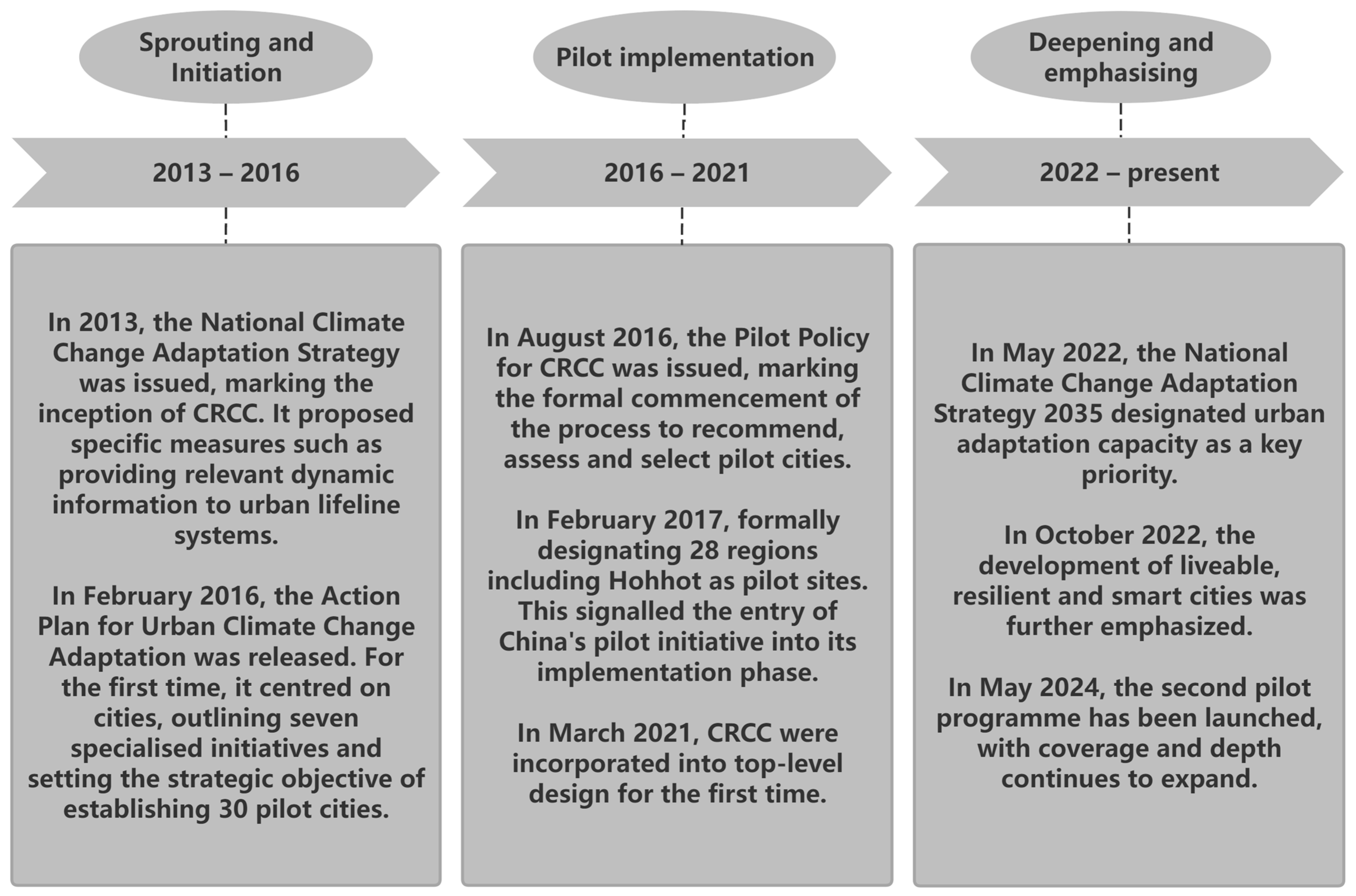
3.1.2. The Evolution of China’s Climate Policy
3.1.3. Typical Pilot City Construction Practice Cases
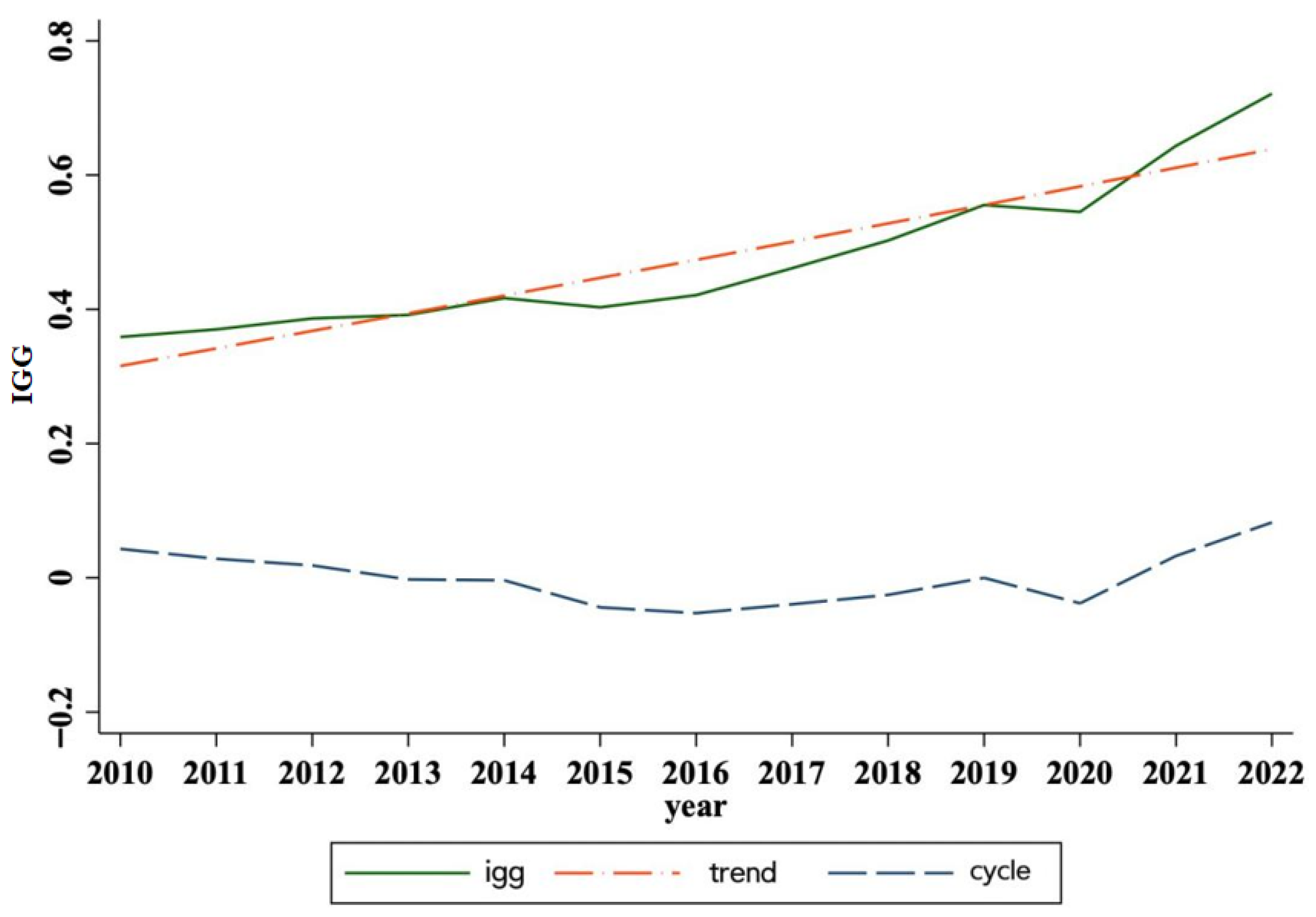
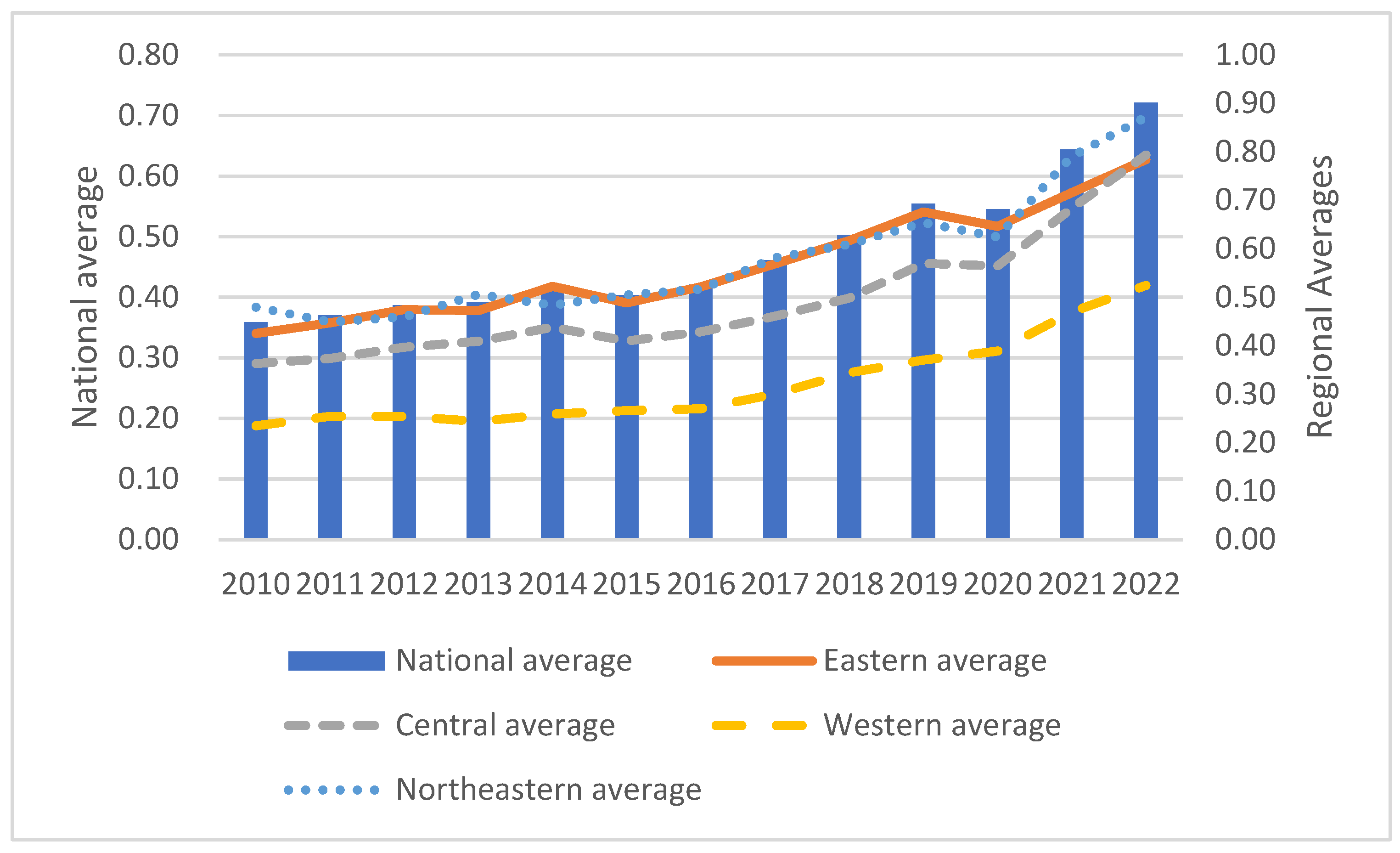
3.2. Stylized Facts
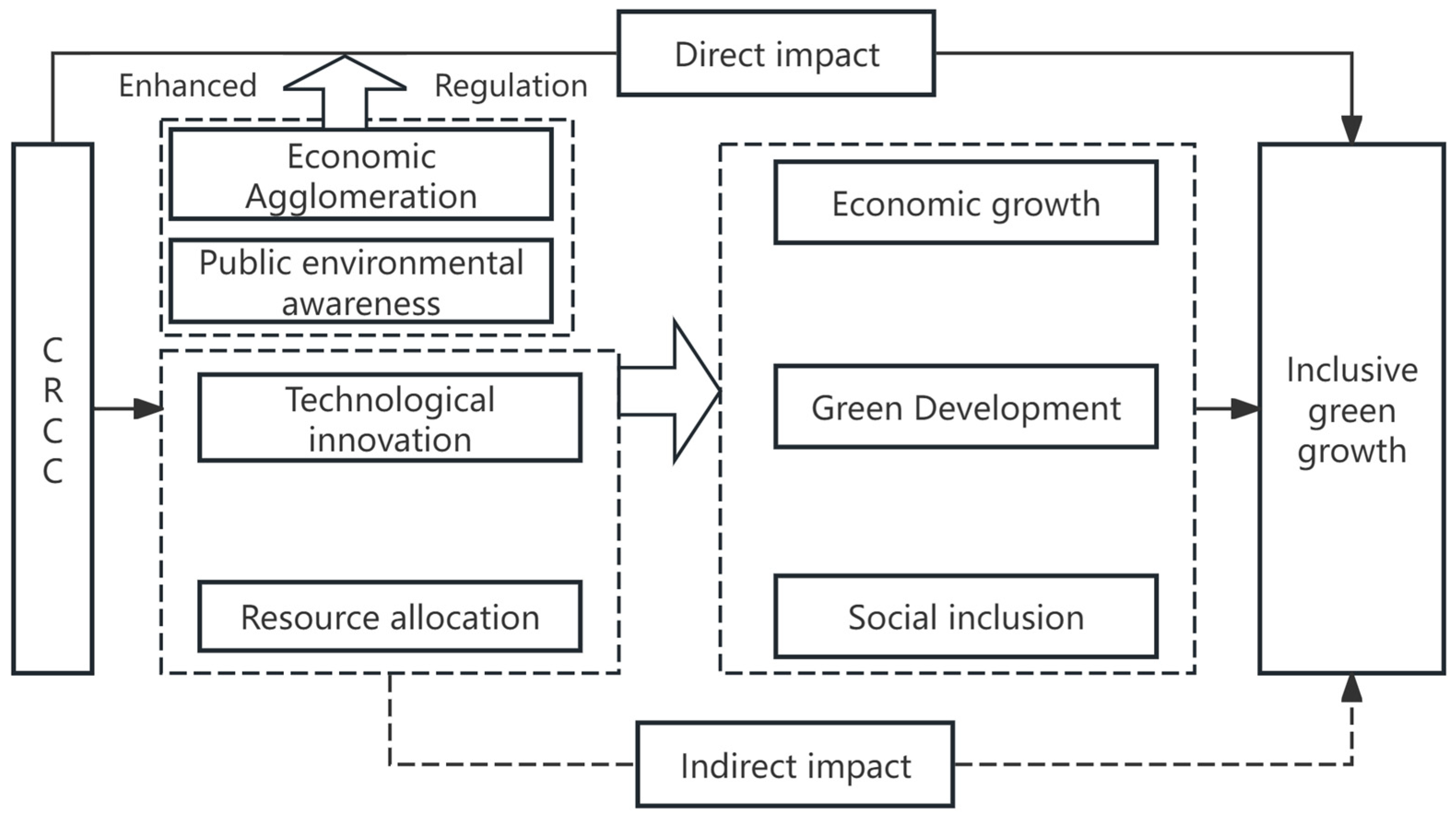
3.3. Theoretical Analysis and Research Hypotheses
4. Research Design
4.1. Empirical Setting
- (1)
- Baseline model
- (2)
- Mediation effect model
- (3)
- Moderation Effect Model
4.2. Variable Specification
4.2.1. Independent Variable
- (1)
- Input. Labor input: measured by the number of persons employed at year-end; capital input: represented by fixed asset stock, with asset stock estimated using the perpetual inventory method as per Zhang, J. et al. (2004) [48]; energy input: following Shi et al. (2020) [49], urban energy consumption is characterized by introducing night-time light data fitted to an energy consumption table.
- (2)
- Expected output. Output indicators encompass three dimensions: economic, social, and environmental. Expected outputs represent the economic and social benefits generated by inputs. Economic benefits are measured using actual GDP and fiscal revenue as indicators. Real GDP, adjusted for price fluctuations, accurately reflects the aggregate changes in urban production activities and the actual scale of economics. Fiscal revenue serves as a crucial indicator of economic growth quality, reflecting the sustainability of economics and governance capacity. It provides the essential foundation for environmental governance and social welfare enhancement. Together, these two metrics form the core for measuring economic growth. Social benefits are evaluated across four dimensions: household consumption, healthcare, social security, and educational services. These are quantified through retail sales of consumer goods, physicians per 10,000 population, pension scheme enrolment figures, and pupil–teacher ratios in primary and secondary schools. Residents’ consumption serves as a core indicator for measuring how economic development benefits people’s livelihoods, reflecting urban residents’ living standards, consumption capacities, and the vibrancy of the consumer market. Healthcare services are vital to residents’ health and well-being, demonstrating the sophistication of public health systems within CCRC. Social security serves as a critical pillar of inclusive growth, with pension insurance as a core coverage type, its enrollment directly reflects the scope of retirement’s inclusion and embodies the development goal of making welfare shared. The equity and quality of educational services represent the enduring manifestation of social benefits; a lower student–teacher ratio indicates greater investment and higher educational service quality.
- (3)
- Undesirable output, which encompasses both environmental and social damage. Environmental damage refers to pollution emissions generated by production activities, measured by urban waste discharge volumes: exhaust gases (sulphur dioxide), wastewater, and solid waste (industrial dust). The three pollutants represent the main types of contaminants in urban production activities, covering the three major pollution domains of air, water, and solid waste. Among them, sulfur dioxide serves as the signature pollutant of air pollution, with its emissions highly correlated to industrial energy consumption; wastewater discharge volumes reflect the damage caused by industrial and domestic sewage to water resources; and industrial dust directly impacts air quality. Together, these three pollutants form the fundamental evaluation dimensions for urban environmental quality. Social damage manifests as non-inclusive characteristics in the development process, primarily encompassing three dimensions: equality of opportunity, distributive fairness, and outcome sharing. These are represented by three indicators, respectively: unemployment rate, ratio of urban to rural disposable income, and ratio of urban to rural consumption expenditure. Changes in unemployment rates can measure whether employment inclusiveness is achieved. That is, whether large-scale unemployment is avoided and job opportunities for diverse groups are safeguarded. The ratio of disposable income between urban and rural residents can assess whether rural areas are benefited, and whether the income gap is narrowed. The ratio of consumption between urban and rural residents reflects disparities in living standards and measures whether the outcomes of CCRC are equitably shared across urban and rural areas, serving as a crucial factor for evaluating inclusiveness. Indicator selection and explanations are detailed in Table 2.
4.2.2. Core Explanatory Variable
4.2.3. Channel Variables
- (1)
- Mediating variables: Level of technological innovation (tec), measured by the number of patent applications per 10,000 population, is used as a proxy variable. Degree of resource misallocation (avg) using the resource misallocation index as proposed by Gao (2024) [50] assesses regional resource misallocation.
- (2)
- Moderating variables: Economic agglomeration (eag) is measured by employment density—the ratio of employed population to regional land area; public environmental awareness (pea) is assessed by taking the natural logarithmic form of the annual average Baidu search index for “environmental pollution” and “smog.”
4.2.4. Control Variables
4.3. Data Source
5. Results
5.1. Baseline Results
5.2. Robustness Test
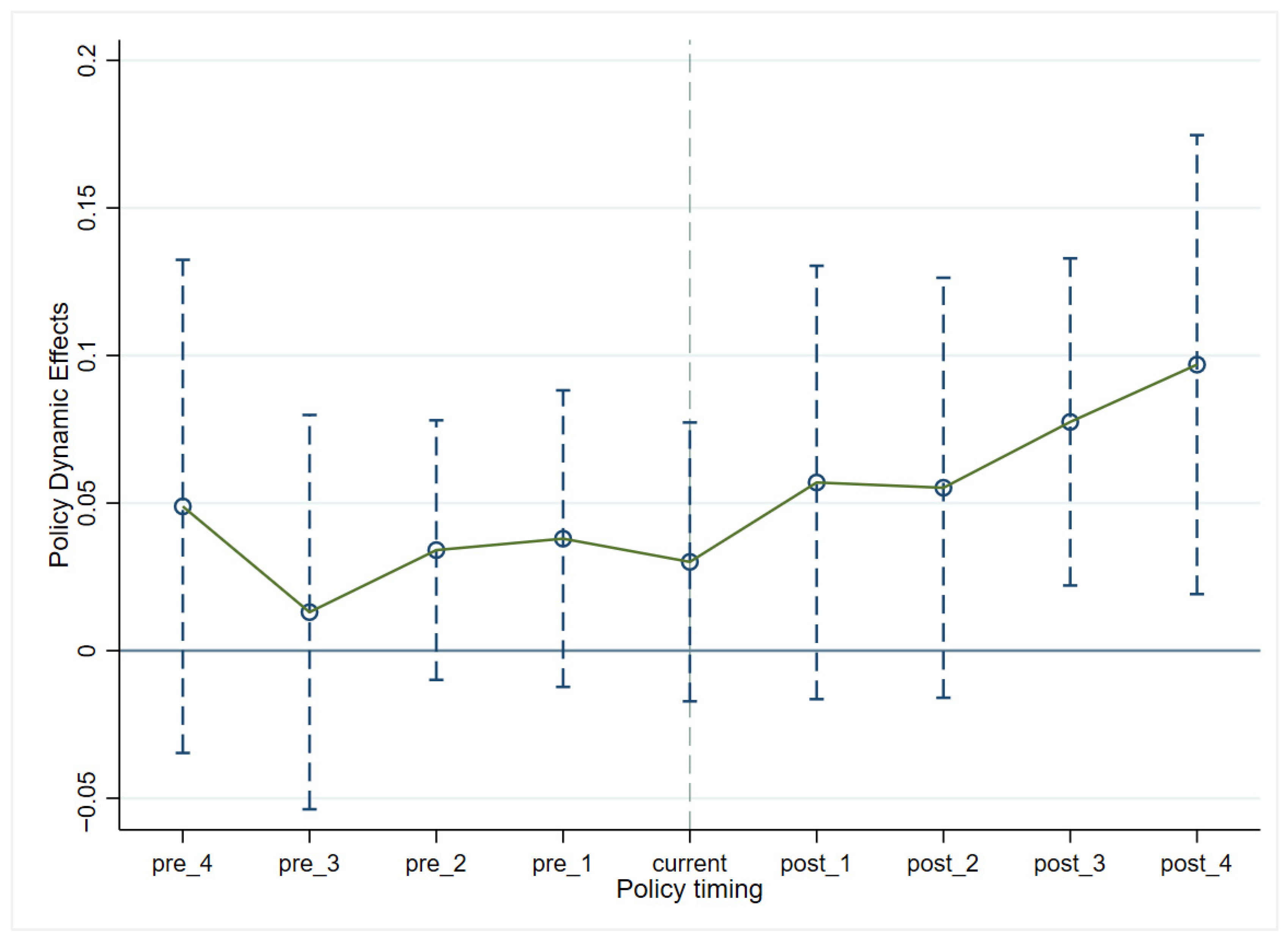
5.2.1. Parallel Trend Test
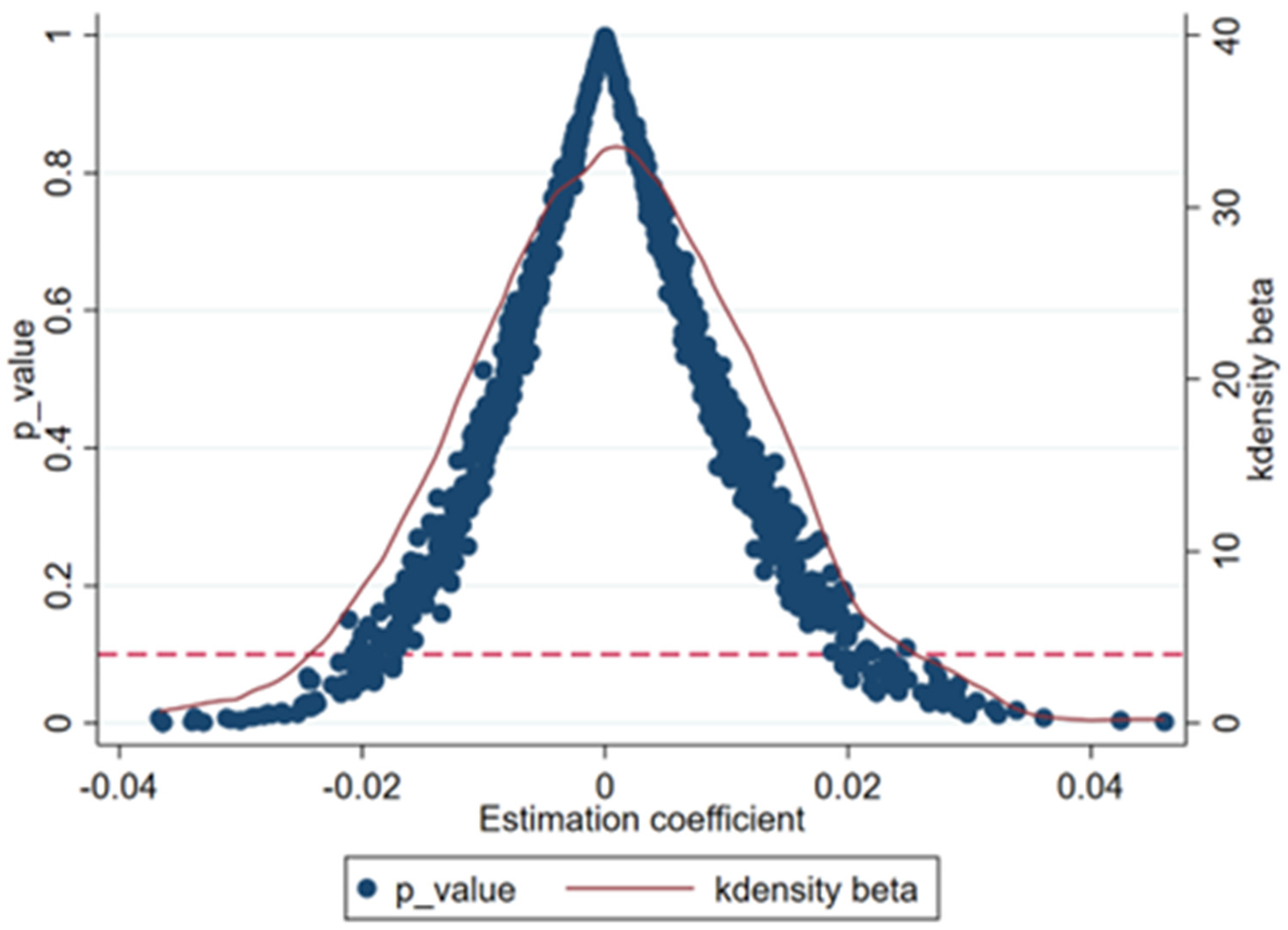
5.2.2. Placebo Test
5.2.3. Endogeneity Test
5.2.4. PSM-DID Test
5.2.5. Additional Robustness Checks
- (1)
- Exclude other policy disturbances. Throughout the sample adopted in this study, China also implemented other pilot policies that may have influenced inclusive green growth, potentially introducing extraneous factors into the regression results beyond the pilot policies themselves. Therefore, to assess the pure effect of CCRC while controlling for other concurrent policy disturbances, this study includes low-carbon city and smart city pilot programs into the model. We construct policy interaction variables (0–1) measuring low-carbon pilot (low carbon) and smart city (smart city) initiatives, respectively, and conduct multi-period DID regressions. The regression results in columns (2) and (3) of Table 6 show that the coefficients of the core explanatory variables are all significantly positive at the 1% level, confirming the robustness of the benchmark model’s empirical results.
- (2)
- Exclude municipalities. Due to significant disparities in population size, economic development levels, and infrastructure development between municipalities (Beijing, Shanghai, Tianjin, Chongqing) and ordinary prefecture-level cities, these differences may impact the regression results presented in this paper. Therefore, to eliminate this potential confounding factor, this study excludes municipalities directly under the central government in the robustness test, retaining only 276 prefecture-level cities for regression analysis. The results in column (4) of Table 6 show that the policy coefficient remains statistically significant at the 5% level and maintains the same direction as the baseline regression, further validating the reliability of the baseline regression results.
- (3)
- Replace the dependent variable. Drawing on the methodology of Li, Z. et al. (2023) [53], this study re-calculates the level of inclusive green growth using the entropy weight method and adopts it as the new dependent variable. We re-examine the relationship between CCRC and inclusive green growth using model (1), and the regression outcomes are reported in column (5) of Table 6. The results reveal that the coefficients and significance levels of key variables remain largely consistent with the benchmark regression findings. This further confirms CCRC’s promotional effect on inclusive green growth and underscores the robustness of the empirical conclusions presented earlier.
5.3. Heterogeneity Analysis
5.3.1. Regional Heterogeneity
5.3.2. Resource Endowment Heterogeneity
5.3.3. Urban Hierarchical Heterogeneity
5.4. Channel Analysis
5.4.1. Estimated Results of the Mediation Model
5.4.2. Estimated Results of the Moderation Model
5.5. Spatial Metric Analysis
6. Conclusions
7. Discussion
7.1. Recommendations
7.2. Limitations and Future Research Directions
7.2.1. Limitations
7.2.2. Future Research Directions
Author Contributions
Funding
Institutional Review Board Statement
Informed Consent Statement
Data Availability Statement
Conflicts of Interest
Appendix A
| Beijing Municipality | Beijing Municipality |
| Tianjin Municipality | Tianjin Municipality |
| Hebei Province | Shijiazhuang City, Tangshan City, Qinhuangdao City, Handan City, Xingtai City, Baoding City, Zhangjiakou City, Chengde City, Cangzhou City, Langfang City, Hengshui City |
| Shanxi Province | Taiyuan City, Datong City, Yangquan City, Changzhi City, Jincheng City, Shuozhou City, Jinzhong City, Yuncheng City, Xinzhou City, Linfen City, Lvliang City |
| Inner Mongolia Autonomous Region | Hohhot City, Baotou City, Wuhai City, Chifeng City, Tongliao City, Ordos City, Hulunbuir City, Bayannur City, Ulanqab City |
| Liaoning Province | Shenyang City, Dalian City, Anshan City, Fushun City, Benxi City, Dandong City, Jinzhou City, Yingkou City, Fuxin City, Liaoyang City, Panjin City, Tieling City, Chaoyang City, Huludao City |
| Jilin Province | Changchun City, Jilin City, Siping City, Liaoyuan City, Tonghua City, Baishan City, Songyuan City, Baicheng City |
| Heilongjiang Province | Harbin City, Qiqihar City, Jixi City, Hegang City, Shuangyashan City, Daqing City, Yichun City, Jiamusi City, Qitaihe City, Mudanjiang City, Heihe City, Suihua City |
| Shanghai Municipality | Shanghai City |
| Jiangsu Province | Nanjing City, Wuxi City, Xuzhou City, Changzhou City, Suzhou City, Nantong City, Lianyungang City, Huai’an City, Yancheng City, Yangzhou City, Zhenjiang City, Taizhou City, Suqian City |
| Zhejiang Province | Hangzhou City, Ningbo City, Wenzhou City, Jiaxing City, Huzhou City, Shaoxing City, Jinhua City, Quzhou City, Zhoushan City, Taizhou City, Lishui City |
| Anhui Province | Hefei City, Wuhu City, Bengbu City, Huainan City, Ma’anshan City, Huaibei City, Tongling City, Anqing City, Huangshan City, Chuzhou City, Fuyang City, Suzhou City, Lu’an City, Chizhou City, Xuancheng City |
| Fujian Province | Fuzhou City, Xiamen City, Putian City, Sanming City, Quanzhou City, Zhangzhou City, Nanping City, Longyan City, Ningde City |
| Jiangxi Province | Nanchang City, Jingdezhen City, Pingxiang City, Jiujiang City, Xinyu City, Yingtan City, Ganzhou City, Ji’an City, Yichun City, Fuzhou City, Shangrao City |
| Shandong Province | Jinan City, Qingdao City, Zibo City, Zaozhuang City, Dongying City, Yantai City, Weifang City, Tai’an City, Weihai City, Rizhao City, Linyi City, Dezhou City, Liaocheng City, Binzhou City, Heze City |
| Henan Province | Zhengzhou City, Kaifeng City, Luoyang City, Pingdingshan City, Anyang City, Hebi City, Xinxiang City, Jiaozuo City, Puyang City, Xuchang City, Luohe City, Sanmenxia City, Nanyang City, Shangqiu City, Xinyang City, Zhoukou City, Zhumadian City |
| Hubei Province | Wuhan City, Huangshi City, Shiyan City, Yichang City, Xiangyang City, Ezhou City, Jingmen City, Xiaogan City, Jingzhou City, Huanggang City, Xianning City, Suizhou City |
| Hunan Province | Changsha City, Zhuzhou City, Xiangtan City, Hengyang City, Shaoyang City, Yueyang City, Changde City, Zhangjiajie City, Yiyang City, Chenzhou City, Yongzhou City, Huaihua City, Loudi City |
| Guangdong Province | Guangzhou City, Shaoguan City, Shenzhen City, Zhuhai City, Shantou City, Foshan City, Jiangmen City, Zhanjiang City, Maoming City, Zhaoqing City, Huizhou City, Meizhou City, Shanwei City, Heyuan City, Yangjiang City, Qingyuan City, Dongguan City, Zhongshan City, Chaozhou City, Jieyang City, Yunfu City |
| Guangxi Zhuang Autonomous Region | Nanning, Liuzhou, Guilin, Wuzhou, Beihai, Fangchenggang, Qinzhou, Guigang, Yulin, Baise, Hezhou, Hechi, Laibin, Chongzuo |
| Hainan Province | Haikou, Sanya |
| Chongqing Municipality | Chongqing |
| Sichuan Province | Chengdu, Zigong, Panzhihua, Luzhou, Deyang, Mianyang, Guangyuan, Suining, Neijiang, Leshan, Nanchong, Meishan, Yibin, Guang’an, Dazhou, Ya’an, Bazhong, Ziyang |
| Guizhou Province | Guiyang, Liupanshui, Zunyi, Anshun |
| Yunnan Province | Kunming City, Qujing City, Yuxi City, Baoshan City, Zhaotong City, Lijiang City, Pu’er City, Lincang City |
| Shaanxi Province | Xi’an City, Tongchuan City, Baoji City, Xianyang City, Weinan City, Yan’an City, Hanzhong City, Yulin City, Ankang City, Shangluo City |
| Gansu Province | Lanzhou City, Jiayuguan City, Jinchang City, Baiyin City, Tianshui City, Wuwei City, Zhangye City, Pingliang City, Jiuquan City, Qingyang City, Dingxi City, Longnan City |
| Qinghai Province | Xining City |
| Ningxia Hui Autonomous Region | Yinchuan City, Shizuishan City, Guyuan City, Zhongwei City |
| Xinjiang Uygur Autonomous Region | Urumqi City |
References
- Ma, R.; Liu, H.; Li, Z.; Ma, Y.; Fu, S. Promoting sustainable development: Revisiting digital economy agglomeration and inclusive green growth through two-tier stochastic frontier model. J. Environ. Manag. 2024, 355, 120491. [Google Scholar] [CrossRef]
- Ofori, I.K.; Figari, F.; Ojong, N. Towards sustainability: The relationship between foreign direct investment, economic freedom and inclusive green growth. J. Clean. Prod. 2023, 406, 137020. [Google Scholar] [CrossRef]
- Sun, Y.; Ding, W.; Yang, Z.; Yang, J.; Du, J. Measuring China’s regional inclusive green growth. Sci. Total Environ. 2020, 713, 136367. [Google Scholar] [CrossRef]
- Song, Y.; Huang, H.; Li, Y.; Xia, J. Towards Inclusive Green Growth in China: Synergistic Roles and Mechanisms of New Infrastructure Construction. J. Environ. Manag. 2024, 353, 120281. [Google Scholar] [CrossRef]
- Aslam, A.; Ghouse, G. Targeting the New Sustainable Inclusive Green Growth: A Review. Clean. Responsible Consum. 2023, 11, 100140. [Google Scholar] [CrossRef]
- Verma, A.; Dandgawhal, P.S.; Giri, A.K. Impact of ICT Diffusion and Financial Development on Economic Growth in Developing Countries. J. Econ. Financ. Adm. Sci. 2023, 28, 27–43. [Google Scholar] [CrossRef]
- IPCC. Climate Change: The IPCC Impacts Assessment. In Contribution of Working Group II to the First Assessment Report of the Intergovernmental Panel on Climate Change; Cambridge University Press: Cambridge, UK, 1990. [Google Scholar]
- Van Buuren, A.; Driessen, P.P.; van Rijswick, M.; Rietveld, P.; Salet, W.; Spit, T.; Teisman, G. Towards adaptive spatial planning for climate change: Balancing between robustness and flexibility. J. Eur. Environ. Plan. Law 2013, 10, 29–53. [Google Scholar] [CrossRef]
- Bai, X.; Dawson, R.; Ürge-Vorsatz, D.; Delgado, G.; Salisu Barau, A.; Dhakal, S.; Dodman, D.; Leonardsen, L.; Masson-Delmotte, V.; Roberts, D.C.; et al. Six research priorities for cities and climate change. Nature 2018, 555, 23–25. [Google Scholar] [CrossRef] [PubMed]
- Fu, L.; Cao, Y.; Yang, X. Progress analysis and policy recommendation on climate adaptation city pilots in China. Clim. Change Res. 2020, 16, 770–774. [Google Scholar]
- Kou, J.; Gao, B.; Cao, W.; Dou, H. Develop climate-resilient cities tailored to local conditions. People’s Daily, 22 November 2023. [Google Scholar] [CrossRef]
- Wu, J. Upholding the Important Concept of “People-Centered Urban Development” and Steadily Promoting the Construction of Climate-Adaptive Cities. J. Explor. Free Views 2022, 5–8. [Google Scholar] [CrossRef]
- Sun, Y.; Liu, L. The Significance and Pathways of Building Resilient Cities in the Context of Climate Change. J. Gov. 2023, 63–66. [Google Scholar] [CrossRef]
- Zhang, Z.; Yao, M.; Zheng, Y. Impact of the pilot policy for constructing climate resilient cities on urban resilience. China Popul. Resour. Environ. 2024, 34, 1–12. [Google Scholar]
- Liu, W.; Zhu, L. Do climate change adaptation policies raise urban resilience?—Evidence from ‘climatic adaptive cities’ construction pilot. J. Resour. Ind. 2025, 27, 16–29. [Google Scholar]
- Yu, C.; Zhao, X.; Zhang, Z. The effect of pilot climate-adapted city policy on urban sustainability: An empirical analysis based on difference-in-differences model. J. Acta Ecol. Sin. 2025, 45, 10065–10076. [Google Scholar]
- Zhang, J.; Fang, S.; Tian, Y. Climate Governance and Urban Carbon Emission Reduction—A Quasi-Natural Experiment Based on the Pilot Policy of Climate-Resilient City Construction. J. Univ. Electron. Sci. Technol. China (Soc. Sci. Ed.) 2025, 27, 76–90. [Google Scholar]
- Li, Q.; Hu, K.; Yao, J. Climate Governance and Corporate Green Innovation: Empirical Evidence from China’s Climate Resilient City Pilot Program. Res. Financ. Econ. Issues 2025, 27–38. [Google Scholar] [CrossRef]
- Liu, C.; Xia, Q.; Sun, H. Climate-adapted Urban Construction, Corporate Resilience and Supply Chain Spillovers. J. Tech. Econ. Manag. 2025, 31–39. [Google Scholar] [CrossRef]
- Zhu, Y.; Li, S.; Niu, J.; Niu, J.; Wang, Y. Pilot Policies for Climate-Adaptive Urban Development and Corporate Greenwashing Behavior. Int. Rev. Econ. Financ. 2025, 104, 104741. [Google Scholar] [CrossRef]
- Liu, Y.; Zheng, Z.; Deng, N.; Li, T. Resilience and Efficiency: Assessing China’s Climate Adaptation Policy Impact on Urban Green Development. Sustain. Cities Soc. 2025, 134, 106923. [Google Scholar] [CrossRef]
- Spratt, S.; Griffithjones, S. Mobilising Investment for Inclusive Green Growth in Low-Income Countries; International Zusammenarbeit (GIZ) GmbH: Frankfurt, Germany, 2013. [Google Scholar]
- Bouma, J.; Berkhout, E. Inclusive green growth. In PBL Netherlands Environmental Assessment Agency; PBL Publication: Sydney, NSW, Australia, 2015; Volume 17. [Google Scholar]
- Rauniyar, G.; Kanbur, R. Inclusive growth and inclusive development: A review and synthesis of Asian Development Bank literature. J. Asia Pac. Econ. 2010, 15, 455–469. [Google Scholar] [CrossRef]
- Wang, F.; Wang, R.; Wu, J. Research Progress of Inclusive Green Growth and the Transformation of Its Driving Forces. Contemp. Econ. Manag. 2022, 44, 9–17. [Google Scholar]
- Li, H.; Dong, Y. China’s High-quality Economic Development Level and the Source of Differences: Based on the Inclusive Green TFP Perspective. J. Financ. Econ. 2021, 47, 4–18. [Google Scholar]
- Ma, Q.; Liao, M.; Zhang, H. Network Infrastructure Construction, Knowledge Flow and Inclusive Green Growth in Cities: Based on the Moderated and Serial Mediating Analysis Framework. J. Stat. Res. 2024, 41, 98–111. [Google Scholar]
- Zhou, X.; Wu, W. The Measurement and Analysis of the Inclusive Green Growth in China. J. Quant. Technol. Econ. 2018, 35, 3–20. [Google Scholar]
- Aminata, J.; Nusantara, D.I.K.; Susilowati, I. The analysis of inclusive green growth in Indonesia. J. Ekon. Studi Pembang. 2022, 23, 140–156. [Google Scholar]
- Ofori, I.K.; Gbolonyo, E.Y.; Ojong, N. Foreign direct investment and inclusive green growth in Africa: Energy efficiency contingencies and thresholds. Energy Econ. 2023, 117, 106414. [Google Scholar] [CrossRef]
- Zhang, T.; Li, J. Network Infrastructure, Inclusive Green Growth, and Regional Inequality: From Causal Inference Based on Double Machine Learning. J. Quant. Technol. Econ. 2023, 40, 113–135. [Google Scholar]
- Ren, S.; Li, L.; Han, Y.; Hao, Y.; Wu, H. The emerging driving force of inclusive green growth: Does digital economy agglomeration work? Bus. Strategy Environ. 2022, 31, 1656–1678. [Google Scholar]
- Wu, H.; Luo, S.; Li, S.; Xue, Y.; Hao, Y. Fostering urban inclusive green growth: Does corporate social responsibility (CSR) matter? J. Bus. Ethics 2024, 189, 677–698. [Google Scholar]
- Peng, X.; Zhang, J.; Song, P. Regional Differences and Spatial-temporal Evolution of Urban Inclusive Green Efficiency in China. Inq. Into. Econ. Issues 2025, 124–143. [Google Scholar] [CrossRef]
- Khan, K.A.; Kaya, E.; Çitil, M.; Pilatin, A.; Barut, A. Natural resource trade and financial technology as drivers of inclusive green growth in Belt and Road initiative countries. Energy Strategy Rev. 2025, 62, 101903. [Google Scholar]
- Fang, Y.; Wen, G. How does digital finance influence urban inclusive green growth? Empirical evidence from China. Sustain. Futures 2025, 9, 100737. [Google Scholar]
- Dong, Y.; Xu, Q. How does digital economy achieve inclusive economic growth with efficiency, equity and green? International evidence. Manag. Environ. Qual. Int. J. 2025, 36, 1283–1303. [Google Scholar] [CrossRef]
- Zhao, L.; Yuan, T.; Zhao, Z. Threshold effect between urbanization and green development performance. J. Arid Land Resour. Environ. 2019, 33, 10–16. [Google Scholar]
- Xie, W.; Ding, B. Green Growth with Equity: How Low-Carbon City Pilot Policy Builds Coordinated Development Pathways in China. Sustainability 2025, 17, 9679. [Google Scholar] [CrossRef]
- Ai, M.; Wang, P.; Bu, Y. Climate policy and inclusive green growth: The role of China’s low-carbon city pilot policy. J. Clean. Prod. 2025, 519, 145959. [Google Scholar]
- Wang, Q.; Chen, X. Can new quality productive forces promote inclusive green growth: Evidence from China. Front. Environ. Sci. 2024, 12, 1499756. [Google Scholar] [CrossRef]
- Zhou, R.; Wu, Y.; Song, J. Symbiosis and co-prosperity: Industrial intelligence development and inclusive green growth. China Popul. Resour. Environ. 2024, 34, 162–174. [Google Scholar]
- Wang, L.; Zhang, Y.; Gao, G. Environmental regulation, technological innovation and carbon productivity. J. Arid Land Resour. Environ. 2020, 34, 1–6. [Google Scholar]
- Jiang, T. Mediating Effects and Moderating Effects in Causal Inference. China Ind. Econ. 2022, 5, 100–120. [Google Scholar]
- Song, S.; Wei, X. Low-carbon C ity Construction, Green Technology Innovation and Inclusive Low-carbon Growth. J. Econ. Surv. 2023, 40, 14–25. [Google Scholar]
- Hu, Y.; Chen, Z.; Li, Y. The Impact of New Quality Productive Forces on Inclusive Green Growth in Cities. J. Reg. Econ. Rev. 2025, 99–108. [Google Scholar] [CrossRef]
- Yan, X.; Ding, C.; Xin, L. A Study on the Impact of Carbon Inclusion System on Inclusive Low-Carbon Development. J. Ecol. Econ. 2024, 40, 13–22+47. [Google Scholar]
- Zhang, J.; Wu, G.; Zhang, J. The Estimation of China’s provincial capital stock: 1952–2000. Econ. Res. J. 2004, 35–44. [Google Scholar] [CrossRef]
- Shi, D.; Li, S. Emissions Trading System and Energy Use Efficiency—Measurements and Empirical Evidence for Cities at and above the Prefecture Level. China Ind. Econ. 2020, 5–23. [Google Scholar] [CrossRef]
- Gao, S.; Xia, S.; Chen, Y.; Da, Y. Target Management of Local Economic Growth, Resource Misallocation and Market Integration: Empirical Evidence from Yangtze River Delta. J. Yunnan Univ. Financ. Econ. 2024, 40, 1–20. [Google Scholar]
- Jacobson, L.S.; LaLonde, R.J.; Sullivan, D.G. Earnings losses of displaced workers. Am. Econ. Rev. 1993, 83, 685–709. [Google Scholar]
- Bai, J.; Rui, J. Environmental Regulation, Economic Growth Target Management and China’s High-Quality Economic Development. J. Macro-Qual. Res. 2023, 11, 32–47. [Google Scholar]
- Li, Z.; Li, Z.; Sun, W. Digital Infrastructure Construction Enables Inclusive Green Growth: Internal Mechanism and Empirical Evidence. J. Zhejiang Soc. Sci. 2023, 15–24+156. [Google Scholar] [CrossRef]
- Zheng, S.; Wan, G.; Sun, W.; Luo, D. Public Demands and Urban Environmental Governance. J. Manag. World 2013, 72–84. [Google Scholar] [CrossRef]
- Elhorst, J.P. Matlab software for spatial panels. Int. Reg. Sci. Rev. 2014, 37, 389–405. [Google Scholar] [CrossRef]





| Pilot Cities | Core Measures |
|---|---|
| Yinchuan City (People’s Government of Yinchuan City: https://www.yinchuan.gov.cn/xwzx/mrdt/202512/t20251208_5101899.html, accessed on 10 January 2026.) |
|
| Lishui City (Lishui Municipal People’s Government: http://www.lishui.gov.cn/art/2024/5/20/art_1229218389_57360315.html, accessed on 10 January 2026.) |
|
| Shenzhen City (Shenzhen Municipal Bureau of Ecology and Environment: https://meeb.sz.gov.cn/isz/hbxw/content/post_12533552.html, accessed on 10 January 2026.) |
|
| Type | Primary Indicators | Secondary Indicators |
|---|---|---|
| Investment | Capital | Fixed capital stock |
| Labor | Year-end employment figures | |
| Energy | Total energy consumption | |
| Expected Output | Economic Benefits (Developmental) | Actual GDP |
| Local government revenue | ||
| Social Benefits (Developmental) | Total retail sales of consumer goods | |
| Number of doctors per 10,000 population | ||
| Number of persons covered by pension insurance | ||
| Teacher–pupil ratio in primary and secondary schools | ||
| Non-expected output | Social Harm (Equity) | Ratio of urban and rural residents’ disposable income |
| Ratio of urban and rural residents’ consumption expenditure | ||
| Registered urban unemployment rate | ||
| Environmental Pollution (Sustainability) | Industrial wastewater discharge volume | |
| Industrial SO2 emissions | ||
| Industrial smoke and dust emissions |
| Category | Variable | Meaning | Sample Size | Mean | Standard Deviation | Minimum | Maximum |
|---|---|---|---|---|---|---|---|
| Explanatory variable | policy | Pilot Policy for CCRC | 3640 | 0.040 | 0.195 | 0.000 | 1.000 |
| Dependent variable | igg | Inclusive Green Growth | 3640 | 0.475 | 0.259 | 0.046 | 1.774 |
| Mediating variable | tec | Technological Innovation | 3640 | 5.221 | 12.094 | 0.008 | 164.940 |
| avg | Resource Misallocation | 3640 | 1.061 | 0.592 | 0.175 | 5.650 | |
| Control variable | eag | Economic Agglomeration | 3640 | 0.347 | 0.837 | 0.002 | 17.018 |
| pea | Public Environmental Awareness | 3640 | 3.654 | 1.035 | 0.001 | 7.151 | |
| Control variables | lgc | Local Government Competition | 3640 | 0.452 | 0.221 | 0.056 | 1.541 |
| fdl | Financial Development Level | 3640 | 2.538 | 1.226 | 0.588 | 21.301 | |
| sti | Science and Technology Investment | 3640 | 0.017 | 0.018 | 0.001 | 0.207 | |
| ers | Environmental Regulation Intensity | 3640 | 78.560 | 23.280 | 0.240 | 160.700 | |
| cr | Cultural Resources | 3640 | 0.696 | 0.943 | 0.020 | 17.370 |
| Variable | Igg | |||||
|---|---|---|---|---|---|---|
| (1) | (2) | (3) | (4) | (5) | (6) | |
| policy | 0.052 *** | 0.053 *** | 0.049 *** | 0.049 *** | 0.049 *** | 0.050 *** |
| (0.019) | (0.019) | (0.019) | (0.019) | (0.019) | (0.019) | |
| lgc | 0.105 ** | 0.095 ** | 0.099 ** | 0.102 ** | 0.105 ** | |
| (0.046) | (0.046) | (0.046) | (0.047) | (0.047) | ||
| sti | 1.074 *** | 1.056 *** | 1.069 *** | 1.058 *** | ||
| (0.299) | (0.297) | (0.299) | (0.299) | |||
| ers | 0.001 *** | 0.001 *** | 0.001 *** | |||
| (0.000) | (0.000) | (0.000) | ||||
| fdl | 0.002 | 0.002 | ||||
| (0.004) | (0.004) | |||||
| cr | 0.008 | |||||
| (0.011) | ||||||
| Constant | 0.473 *** | 0.425 *** | 0.412 *** | 0.367 *** | 0.360 *** | 0.354 *** |
| (0.002) | (0.021) | (0.021) | (0.025) | (0.029) | (0.031) | |
| Time fixed effects | Y | Y | Y | Y | Y | Y |
| Individual fixed effects | Y | Y | Y | Y | Y | Y |
| N | 3640 | 3640 | 3640 | 3640 | 3640 | 3640 |
| R2 | 0.728 | 0.728 | 0.729 | 0.730 | 0.730 | 0.730 |
| Variable | 2SLS Estimation | |
|---|---|---|
| Phase One (Policy) | Phase Two (igg) | |
| (1) | (2) | |
| river | 6.809 *** | |
| (0.380) | ||
| policy | 0.049 ** | |
| (0.022) | ||
| Constant | −0.051 | 0.572 *** |
| (0.052) | (0.082) | |
| Control variables | Yes | Yes |
| Time fixed effects | Y | Y |
| Individual fixed effects | Y | Y |
| N | 3360 | 3360 |
| R2 | 0.864 | 0.731 |
| Kleibergen–Paap rk LM | 185.75 [0.000] | |
| Kleibergen–Paap Wald rk F | 320.41 {16.38} | |
| Variable | PSM-DID | Eliminate Other Policy Interference | Exclude Municipalities Directly Under the Central Government | Replace the Dependent Variable | |
|---|---|---|---|---|---|
| (1) | (2) | (3) | (4) | (5) | |
| policy | 0.053 *** | 0.047 ** | 0.050 *** | 0.047 ** | 0.013 *** |
| (0.019) | (0.019) | (0.019) | (0.019) | (0.003) | |
| low carbon | 0.031 *** | ||||
| (0.011) | |||||
| smart city | 0.009 | ||||
| (0.009) | |||||
| Constant | 0.292 *** | 0.344 *** | 0.352 *** | 0.353 *** | 0.130 *** |
| (0.033) | (0.031) | (0.031) | (0.030) | (0.005) | |
| N | 3613 | 3640 | 3640 | 3588 | 3640 |
| Control variables | Y | Y | Y | Y | Y |
| Time fixed effects | Y | Y | Y | Y | Y |
| Individual fixed effects | Y | Y | Y | Y | Y |
| R2 | 0.727 | 0.731 | 0.730 | 0.728 | 0.970 |
| Variable | Southern | Northern | Non-Resource-Based Cities | Resource-Based Cities | Economically Developed Cities | Economically Underdeveloped Cities |
|---|---|---|---|---|---|---|
| (1) | (2) | (3) | (4) | (5) | (6) | |
| policy | 0.0633 *** | 0.0329 | 0.047 ** | 0.038 | 0.115 *** | 0.019 |
| (0.0223) | (0.0307) | (0.022) | (0.035) | (0.030) | (0.022) | |
| Constant | 0.323 *** | 0.372 *** | 0.370 *** | 0.314 *** | 0.193 | 0.341 *** |
| (0.0495) | (0.0389) | (0.040) | (0.044) | (0.152) | (0.028) | |
| Control variables | Y | Y | Y | Y | Y | Y |
| Time fixed effects | Y | Y | Y | Y | Y | Y |
| Individual fixed effects | Y | Y | Y | Y | Y | Y |
| N | 1989 | 1651 | 2197 | 1443 | 637 | 3003 |
| R2 | 0.760 | 0.698 | 0.744 | 0.699 | 0.784 | 0.709 |
| Variable | tec | avg | igg | igg |
|---|---|---|---|---|
| (1) * | (2) | (3) | (4) | |
| policy | 1.522 | 0.038 *** | 0.049 *** | 0.035 * |
| (0.736) | (0.002) | (0.018) | (0.020) | |
| eag | 0.004 | |||
| (0.010) | ||||
| policy*eag | 0.118 *** | |||
| (0.041) | ||||
| pea | 0.015 | |||
| (0.010) | ||||
| policy*pea | 0.041 ** | |||
| (0.016) | ||||
| Constant | 5.522 ** | 0.419 *** | 0.348 *** | 0.298 *** |
| (2.394) | (0.029) | (0.031) | (0.047) | |
| Control variables | Y | Y | Y | Y |
| Time fixed effects | Y | Y | Y | Y |
| Individual fixed effects | Y | Y | Y | Y |
| N | 3640 | 3640 | 3640 | 3640 |
| R2 | 0.092 | 0.044 | 0.731 | 0.731 |
| Tine | Moran’s I | Z | p |
|---|---|---|---|
| 2010 | 0.188 | 10.278 | 0.000 |
| 2011 | 0.153 | 8.403 | 0.000 |
| 2012 | 0.185 | 10.112 | 0.000 |
| 2013 | 0.179 | 9.771 | 0.000 |
| 2014 | 0.184 | 10.063 | 0.000 |
| 2015 | 0.221 | 12.026 | 0.000 |
| 2016 | 0.229 | 12.444 | 0.000 |
| 2017 | 0.254 | 13.768 | 0.000 |
| 2018 | 0.182 | 9.900 | 0.000 |
| 2019 | 0.191 | 10.380 | 0.000 |
| 2020 | 0.166 | 9.023 | 0.000 |
| 2021 | 0.153 | 8.362 | 0.000 |
| 2022 | 0.163 | 8.897 | 0.000 |
| Test Method | Statistic | p-Value |
|---|---|---|
| LM-error | 682.150 | 0.000 |
| LM-lag | 339.677 | 0.000 |
| Robust-LM-error | 395.150 | 0.000 |
| Robust-LM-lag | 52.676 | 0.000 |
| LR-error | 17.13 | 0.009 |
| LR-lag | 18.94 | 0.004 |
| Wald-SEM | 17.11 | 0.009 |
| Wald-SLM | 18.97 | 0.004 |
| Huasman | 56.98 | 0.000 |
| Variable | SDM | Direct | Indirect | Total | SAR | SEM |
|---|---|---|---|---|---|---|
| (1) | (2) | (3) | (4) | (5) | (6) | |
| W × policy | 0.178 *** | 0.083 *** | 0.780 *** | 0.863 *** | 0.077 *** | 0.064 *** |
| (0.051) | (0.017) | (0.170) | (0.175) | (0.157) | (0.016) | |
| ρ | 0.716 *** | 0.747 *** | ||||
| (0.023) | (0.021) | |||||
| Sigma2_e | 0.018 *** | 0.822 *** | ||||
| (0.000) | (0.018) | |||||
| Control variables | Y | Y | Y | Y | 0.018 *** | 0.018 *** |
| Time fixed effects | Y | Y | Y | Y | (0.000) | (0.000) |
| Individual fixed effects | Y | Y | Y | Y | Y | Y |
| N | 3640 | 3640 | 3640 | 3640 | Y | Y |
| R2 | 0.251 | 0.251 | 0.251 | 0.251 | Y | Y |
Disclaimer/Publisher’s Note: The statements, opinions and data contained in all publications are solely those of the individual author(s) and contributor(s) and not of MDPI and/or the editor(s). MDPI and/or the editor(s) disclaim responsibility for any injury to people or property resulting from any ideas, methods, instructions or products referred to in the content. |
© 2026 by the authors. Licensee MDPI, Basel, Switzerland. This article is an open access article distributed under the terms and conditions of the Creative Commons Attribution (CC BY) license.
Share and Cite
Zhang, Y.; Lu, W.; Zhou, D.; Liu, Y. Does the Construction of Climate-Resilient Cities Promote Inclusive Green Growth? A Quasi-Natural Experiment in 280 Chinese Cities. Sustainability 2026, 18, 1274. https://doi.org/10.3390/su18031274
Zhang Y, Lu W, Zhou D, Liu Y. Does the Construction of Climate-Resilient Cities Promote Inclusive Green Growth? A Quasi-Natural Experiment in 280 Chinese Cities. Sustainability. 2026; 18(3):1274. https://doi.org/10.3390/su18031274
Chicago/Turabian StyleZhang, Youzhi, Wenya Lu, Duyang Zhou, and Yinke Liu. 2026. "Does the Construction of Climate-Resilient Cities Promote Inclusive Green Growth? A Quasi-Natural Experiment in 280 Chinese Cities" Sustainability 18, no. 3: 1274. https://doi.org/10.3390/su18031274
APA StyleZhang, Y., Lu, W., Zhou, D., & Liu, Y. (2026). Does the Construction of Climate-Resilient Cities Promote Inclusive Green Growth? A Quasi-Natural Experiment in 280 Chinese Cities. Sustainability, 18(3), 1274. https://doi.org/10.3390/su18031274