2.1. Conceptual Distinction Between Turnover Intention and Retention Intention
Although turnover intention and retention intention are often treated as conceptual opposites, research increasingly recognizes that they are distinct constructs driven by different psychological mechanisms. Turnover intention typically reflects a withdrawal-oriented process, shaped by negative job experiences such as stress, burnout, dissatisfaction, or perceived injustice [
15,
16]. Retention intention, in contrast, represents a commitment- and attachment-oriented process, influenced by positive experiences such as organizational support, well-being, meaningful work, and job embeddedness [
4,
17]. Because the antecedents of staying are not merely the inverse of the antecedents of leaving, scholars argue that turnover and retention should not be assumed interchangeable [
18,
19]. The educational workforce literature further reinforces this distinction: educators may choose to stay not only because they lack alternatives, but because they experience belonging, professional fulfillment, or relational stability [
20,
21,
22]. For this reason, retention intention reflects the motivational and resource-based aspects of persistence, making it especially relevant for understanding talent sustainability in early childhood education contexts. Focusing on retention therefore enriches the field by shifting attention from deficit-focused predictors of departure to resource-driven pathways that promote workforce stability, consistent with the JD-R gain cycle perspective.
2.2. Workplace Friendship and Retention Intention
Workplace friendship refers to non-romantic, voluntary, and informal relationships that develop among employees within organizational settings [
23]. Unlike formal work interactions, such relationships emphasize autonomy and emotional exchange between colleagues. Prior research indicates that workplace friendship fosters trust, mutual assistance, and emotional support among peers, cultivating a sense of belonging and connectedness [
24]. In addition, such friendships promote close and open communication, enabling employees to access greater social support and emotional comfort in the workplace, thereby contributing to a positive interpersonal climate [
25]. Overall, workplace friendship can be regarded as a critical informal social resource within organizations, playing an important role in interpersonal interactions and psychological need fulfillment.
A substantial body of literature suggests that workplace friendship positively influences both individuals and organizations. Specifically, higher levels of workplace friendship have been found to enhance employees’ work engagement, well-being, organizational identification, and organizational commitment, thus strengthening their positive attitudes toward work [
24,
26]. At the same time, workplace friendship can reduce burnout and stress, alleviate feelings of job insecurity, and effectively decrease turnover tendencies [
26]. Moreover, workplace friendship plays a meaningful role in employees’ turnover behaviors and organizational attachment. Several studies report that friendship among coworkers significantly reduces turnover intention [
27,
28], suggesting that it functions as a supportive resource that mitigates negative psychological responses arising from work-related stress or role conflict. However, empirical studies directly examining the impact of workplace friendship on retention intention remain relatively scarce. Only a limited number of studies have shown that such friendships enhance employees’ intention to stay through emotional support and a strengthened sense of belonging [
24,
29]. These findings indicate that although prior research has predominantly focused on reducing turnover intention, workplace friendship may also serve as a positive psychological resource that actively promotes employees’ desire to remain.
From the perspective of the JD-R model, job resources not only help buffer the adverse effects of job demands but also stimulate employees’ motivation, thereby promoting positive attitudes and behaviors [
30,
31]. As a social resource, workplace friendship provides emotional support, trust, and reciprocal assistance, which can enhance employees’ psychological capital and well-being. Building on this theoretical foundation, the present study argues that workplace friendship not only reduces turnover tendencies but also strengthens employees’ likelihood of staying through mechanisms related to resource conservation and motivational gains. Accordingly, this study proposes the following hypothesis:
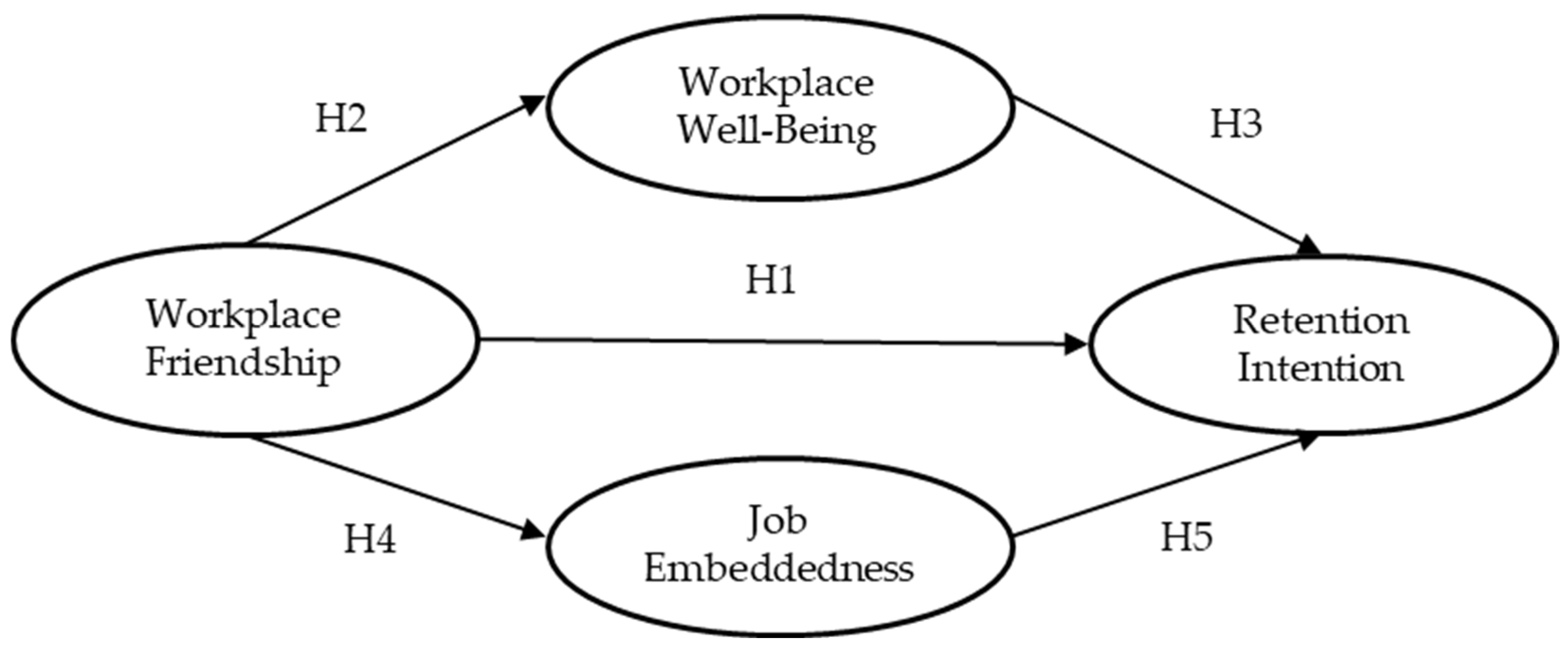
H1: Workplace friendship has a significant positive effect on retention intention.
2.3. The Mediating Role of Workplace Well-Being
Well-being is a multidimensional and broadly defined construct that has increasingly been recognized as a critical factor influencing employees’ attitudes and behaviors in organizational research. Employee well-being is commonly categorized into three major forms: workplace well-being, subjective well-being, and psychological well-being. Subjective well-being (SWB) reflects an individual’s overall evaluation of life quality based on personal standards and comprises emotional experiences and cognitive assessments of life satisfaction. In contrast, psychological well-being (PWB) emphasizes positive psychological functioning and the realization of one’s potential, including self-acceptance, purpose in life, environmental mastery, personal growth, and positive interpersonal relationships [
32]. Building on these perspectives, workplace well-being directly reflects employees’ sense of satisfaction with their work and their positive emotional experiences within the work environment, highlighting the contextualized nature of well-being in organizational settings [
33].
Bartels et al. [
34] conceptualized workplace well-being through two core dimensions: interpersonal workplace well-being and individual workplace well-being. The interpersonal dimension focuses on social aspects such as support and belonging, whereas the individual dimension centers on personal growth and goal fulfillment. Thus, workplace well-being represents employees’ subjective evaluation of their development and optimal functioning in the workplace, encompassing both personal and social aspects. It not only reflects psychological health but also embeds well-being within the specific context of work.
Recent studies suggest that workplace friendship enhances well-being, which subsequently reinforces employees’ positive organizational attitudes and behaviors. Çınar and Basım [
29] demonstrated that relational job crafting increases employees’ intention to stay primarily through enhanced workplace friendship, suggesting that social connections formed at work can transform proactive relational behaviors into stronger retention intentions. For instance, Chen et al. [
24] demonstrated that workplace friendship promotes organizational commitment through increased well-being, thereby strengthening employees’ willingness to maintain long-term relationships with the organization.
From the perspective of the JD-R model, workplace friendship constitutes a social job resource that fulfills employees’ emotional and social support needs, consequently enhancing their well-being. As a positive psychological resource, well-being fosters motivation, strengthens organizational attachment, and reduces the likelihood of negative behaviors [
35,
36]. Accordingly, workplace well-being is conceptualized as a key mediating mechanism through which workplace friendship shapes retention intention, transforming social resources into positive psychological and behavioral outcomes. Based on this reasoning, the following hypotheses are proposed:
H2: Workplace friendship has a significant positive effect on workplace well-being.
H3: Workplace well-being mediates the relationship between workplace friendship and retention intention.
2.4. The Mediating Role of Job Embeddedness
Job embeddedness (JE) refers to the combined forces that connect an individual to their organization and surrounding environment, making it difficult for them to detach or voluntarily leave their job or workplace [
37,
38]. Employees become “embedded” within an organization through three primary forces: links, fit, and sacrifice [
37,
39]. Links denote the quantity and quality of connections employees have with their job environment, organization, and interpersonal networks, such as interactions with colleagues and supervisors or roles and responsibilities held within the organization. Fit represents the degree to which employees’ values, career goals, and personal characteristics align with their job role, organizational culture, and work environment. Sacrifice refers to the perceived losses associated with leaving the organization, including compensation, benefits, social relationships, and developmental opportunities. Collectively, these forces strengthen employees’ attachment to both the organization and the broader community, thereby reducing the likelihood of turnover and promoting retention [
40].
In the context of early childhood education, these three components of job embeddedness manifest in distinct and highly salient ways. First, links often take the form of collegial relationships, mentoring ties, and team-based collaboration common in early childhood education and care (ECEC) settings [
41]. Early childhood educators typically work closely with co-teachers, assistants, administrative staff, and families, creating dense interpersonal networks that can strongly anchor them to the workplace. Second, fit is reflected in the alignment between educators’ beliefs about child development, their pedagogical philosophy, and the center’s educational approach or culture [
42]. A strong match between an educator’s values—such as play-based learning, developmental appropriateness, or family engagement—and the organizational culture enhances their sense of comfort and belonging in the center. Finally, sacrifice in ECEC settings extends beyond material or financial considerations. Leaving a kindergarten or childcare center often requires educators to relinquish established bonds with children, trust built with parents, familiarity with routines and teaching teams, and accumulated knowledge of classroom dynamics [
43]. These relational and emotional losses represent substantial sacrifices, making turnover more costly and retention more desirable.
Although job embeddedness is commonly conceptualized through three sub-dimensions—links, fit, and sacrifice—the present study employs the Global Job Embeddedness Scale (GJES) developed by Crossley et al. [
40]. This scale was intentionally designed as a unidimensional measure to capture employees’ overall psychological attachment to their job and organization. Prior validation studies have demonstrated that this global operationalization provides strong predictive validity for turnover and retention outcomes and helps avoid potential construct misspecification that may arise when the three elements are modeled as separate factors [
44,
45]. Therefore, the present study follows the original design of the GJES and adopts a global, unidimensional score of job embeddedness as the basis for subsequent analyses.
Extant research widely acknowledges that employees with higher levels of job embeddedness tend to form deeper emotional connections with their work and organization, which fosters more positive work attitudes and behaviors. Job embeddedness effectively enhances organizational attachment and increases employees’ willingness to remain when faced with external job opportunities [
13]. Empirical studies have consistently demonstrated stable positive relationships between job embeddedness, organizational loyalty, and retention intention [
12,
13,
14]. Although the effects of job embeddedness have been extensively supported, limited research has explored whether workplace environmental factors particularly a friendly and supportive social climate can further strengthen employees’ embeddedness.
Empirical studies indicate that organizational, supervisory, and coworker support can strengthen job embeddedness, which in turn reduces turnover intention [
46]. Workplace friendship provides a form of social and emotional support that operates similarly to coworker support but further deepens employees’ sense of belonging. Friendship enhances embeddedness across the dimensions of links, fit, and sacrifice by fostering strong interpersonal ties, value alignment, and perceived losses associated with leaving. Research also shows that friendships—more than family relationships—reinforce community attachment, thereby influencing organizational fit and perceived sacrifice and indirectly lowering turnover intention [
47]. Qualitative evidence from the hospitality sector likewise demonstrates that friendship cultivates interpersonal networks and contextual fit, ultimately reducing employees’ tendencies to leave [
48]. Overall, workplace friendship emerges as a salient social resource that contributes to job embeddedness through emotional and relational mechanisms.
From the perspective of the JD-R model, job resources help buffer the adverse effects of job demands and cultivate motivational processes that foster positive attitudes and behaviors [
35,
36]. As a social job resource, workplace friendship provides emotional support and mutual trust, enhances employees’ sense of fit and connection, and subsequently strengthens their job embeddedness. Through this mechanism, workplace friendship may indirectly increase employees’ retention intention, illustrating its role in resource conservation and motivational enhancement. Based on these arguments, the following hypotheses are proposed:
H4: Workplace friendship has a significant positive effect on job embeddedness.
H5: Job embeddedness mediates the relationship between workplace friendship and retention intention.
Grounded in the JD-R theoretical framework and supported by empirical evidence, this study integrates workplace friendship, workplace well-being, job embeddedness, and retention intention into a unified research model. The proposed research framework is presented in
Figure 1.