Article

Environmental Flow Regimes Shape Spawning Habitat Suitability for Four Carps in the Pearl River, China

1
Research Center for Eco-Environmental Engineering, Dongguan University of Technology, No. 1 Daxue Street, Dongguan 523808, China
2
Key Laboratory of Land Surface Pattern and Simulation, Institute of Geographic Sciences and Natural Resources Research, Chinese Academy of Sciences, Beijing 100101, China
*
Authors to whom correspondence should be addressed.
Sustainability 2026, 18(3), 1236; https://doi.org/10.3390/su18031236
Submission received: 9 December 2025 / Revised: 19 January 2026 / Accepted: 22 January 2026 / Published: 26 January 2026
(This article belongs to the Section Sustainability, Biodiversity and Conservation)

Abstract

The construction of reservoirs has undeniably provided numerous conveniences and benefits to human societies. However, it has also markedly altered downstream flow regimes, leading to essential fish habitat loss that directly undermines the ecosystem services provided by fish populations, thereby jeopardizing the long-term sustainability of fishery resources. Existing assessments of spawning suitability largely concentrate on static characteristics of available spawning grounds, while the dynamics of habitat suitability migration and contraction in response to changing environmental flows remain poorly understood. To address this gap, we classified hydrological years into wet, flat, and dry categories to reflect the varying environmental flow requirements during the fish-spawning period. Using the Mike21 hydraulic model together with a spatial suitability analysis for spawning habitats, we quantified spawning ground suitability from both temporal and spatial perspectives. Taking the four major Chinese carps (FMCC) and the Dongta spawning ground in the Pearl River as a case study, our findings reveal that the proportion of highly suitable habitats closely tracks the environmental-flow trajectories. Throughout the FMCC spawning period, the spatial pattern of high suitability zones undergoes a marked migration in response to flow variations across wet, flat, and dry years, consistently shifting upstream. Specifically, as discharge rises from low-flow to high-flow events, the most suitable areas move from downstream deep-pool sections toward upstream shallow riffle zones, which is crucial for the sustainable development of fishery resources.

1. Introduction

Spawning grounds serve as water zones where fish mate, lay eggs, incubate them, and rear the larvae, representing a critical habitat for fish survival and reproduction. As the most pivotal stage in the fish life-cycle, spawning grounds provide a suitable spatial structure and a suite of favorable abiotic factors, such as water depth, flow velocity, substrate type, and temperature, that support adult spawning, fertilization, and the adhesion and development of egg masses [1]. Early research primarily focused on the biological level, emphasizing the abundance distribution of spawning fish populations and the impact of egg predators [2,3]. With the rapid development of technologies such as echo sounders, flow meters, fish finders, three-dimensional seabed mapping, and hydrodynamic monitoring, researchers have begun to systematically depict the topography, sedimentary characteristics, and associated hydrological conditions of spawning grounds [4]. This progress has facilitated the establishment of a comprehensive integrated abiotic-environment assessment framework encompassing topographic features, flow fields, sediment characteristics, hydrological regimes, and meteorological influences. Building on this progression, fish spawning-ground suitability should be defined as the extent to which local hydraulic and thermal conditions can support successful reproduction, from spawning/fertilization to egg incubation and early larval development [5]. This definition is particularly relevant for the four major Chinese carps (bighead, black, grass, and silver carp), which typically spawn from late spring to early summer when rising water temperatures coincide with discharge pulses that provide hydrological cues. Because their eggs are semi-buoyant, spawning success generally requires sustained, moderately fast currents and appropriate depths/turbulence to keep eggs suspended while avoiding excessive shear or deposition in slack-water zones [6,7,8,9].
Within this framework, hydrodynamic models have been widely used to simulate key hydrodynamic indicators (such as flow velocity, depth-to-width ratio, Froude number, Reynolds number, shear stress, etc.) and assess their impacts on the suitability of spawning grounds [5,6,7]. A large number of studies consistently indicate that flow velocity and water depth are the dominant factors determining spawning timing, spawning location, and egg hatching success rates [8,9]. Based on this, scholars all around the world have successively conducted suitability assessments for specific target species. For example, research on the suitable areas for Chinese sturgeon (Acipenser sinensis) has shown that when runoff reaches approximately 15,000 m3/s, its comprehensive suitable space can be significantly expanded [10]. For the four major carp species (FMCC), researchers have constructed a habitat suitability model centered on flow velocity, water depth, and water level rise amplitude, clarified the suitability curves under different flow conditions, and pointed out that the optimal flow velocity range is approximately 0.9~1.0 m/s and the most suitable water depth is about 3~4 m [11].
However, the regulation of downstream hydrological processes by reservoirs after their construction has become the primary driving factor for the degradation of spawning ground suitability. Since the 1960s, European and American scholars have systematically evaluated the impacts of dams on fish spawning habitats [12,13]. In the Yangtze River Basin, the operation of cascade reservoirs (such as Wudongde, Baihetan, etc.) has led to a flattening of flood peak processes, significant decreases in flow velocity, duration, and flow increase amplitude, thereby delaying or weakening the first spawning signals of the four major carp species, resulting in an upstream migration of spawning areas and a significant decline in spawning volume [14]. Similar negative effects have also been observed in the habitats of Chinese sturgeon: high flow rates (≥15,000 m3/s) can significantly enhance its suitable space, but conventional reservoir operations often fail to achieve this flow rate, leading to a decline in natural spawning success rates [15,16].
To mitigate these impacts, the concept of environmental flow has been proposed and promoted in practice. Studies have shown that different flow pulse patterns, such as low-flow pulses, high-flow pulses, and small floods, can, respectively, stimulate fish migration, egg buoyancy, and spawning signal transmission [17,18,19]. Although there have been numerous studies on the suitability of single flow indicators (such as peak flow or average flow velocity), the spatial suitability of spawning grounds with the spatiotemporal migration of ecological flow processes still lacks systematic assessment, especially the suitability changes under three hydrological scenarios of wet, flat, and dry years have not been clarified.
Based on the aforementioned research gaps, this study aims to: (1) construct multi-scale environmental flow hydrographs (encompassing low-flow pulses, high-flow pulses, and small floods) and conduct hydrodynamic simulations under three hydrological scenarios (wet, flat, and dry years); (2) employ the Mike21 hydraulic model coupled with spatial suitability analysis for spawning habitats to quantify spawning ground suitability under distinct environmental flow hydrographs; and (3) utilize the FMCC as a case study to compare suitable areas, distribution migration paths, and potential conservation management thresholds across different environmental flow scenarios. This study will provide a quantitative basis for watershed ecological regulation, and thereby support the conservation and restoration of fish resources.

2. Materials and Methods

2.1. Calculate the Environmental Flow Requirement During Fish Spawning Period in Different Hydrological Years

To simulate the environmental flow requirement for fish spawning, we employ a commonly used approach at present, which posits that natural flow regimes best meet the needs of fish [20]. First, according to the annual runoff conditions, the hydrological years can be divided into wet, flat and dry year. The runoff series data usually follow a Pearson type III probability distribution, so frequency analysis is used to determine the statistical parameters and design values of each frequency, which are used to classify runoff into wet, flat and dry years. The probability density function of the P-III probability distribution is shown as following. Here, Pearson type III is abbreviated as P-III, and P denotes the cumulative frequency (non-exceedance probability) of runoff, not a statistical p-value.
f x = β α Γ α x b α 1 e β x b , b x
Γ α = 0 + t a q e t d t , α = 4 C s 2 , β = 2 E X C v C s , b = E X 1 2 C v C s
where f(x) is runoff sequence greater than x; Γ(α) is Gamma function; EX is arithmetic mean of runoff; Cv is variation coefficient of; Cs is skewness coefficient.
The classification of different hydrological years has no universally accepted classification method or standard. One approach employs the anomaly percentage as a criterion for distinguishing abundant, flat, and dry conditions [21]. A more prevalent methodology utilizes runoff frequency. For instance, hydrological years are frequently categorized into three types—abundant, flat, and dry—using frequency thresholds of 37.5% and 62.5%. Alternatively, thresholds of 25% and 75% are also applied to classify abundant, flat, and dry years [22]. Consequently, this study adopts the cumulative frequencies of 37.5% and 62.5%, arranged in ascending order, as demarcation points. The runoff series is thereby classified into: dry years (P ≤ 37.5%), flat years (37.5% < P ≤ 62.5%), and wet years (P > 62.5%) [22]. Then according to the Indicators of Hydrologic Alteration (IHA), this study quantifies the characteristics of the environmental flow regime using the following 12 statistical indicators of flow event characteristics [23,24]. The indicators and their definitions are presented in Table 1.

2.2. Hydrodynamic Model

Mike21 Hydrodynamic Model is a popular two-dimensional hydrodynamic numerical model developed by the Danish Hydraulic Institute (DHI) [25]. This model can be used to simulate flow and water level changes in water bodies such as rivers, estuaries, and coastlines, thereby predicting the development trends of hydro-meteorological phenomena such as floods, tides, and sea waves. Due to its high accuracy, strong reliability, and user-friendliness, the Mike21 Hydrodynamic Model has been widely applied in fields such as marine engineering, coastal engineering, water resources management, and environmental protection. Therefore, this study will use Mike21 to construct a two-dimensional hydrodynamic model.
Numerous discrete solution methods exist for numerical modeling, with four predominant approaches being widely employed: the Finite Volume Method (FVM), Finite Element Method (FEM), Finite Analytical Method (FAM), and Finite Difference Method (FDM). This study utilizes the Finite Volume Method for solving the governing equations during model construction. This selection is based on FVM’s inherent superior conservation properties for energy and mass, its flexibility in handling complex spatial geometries, and its capability for efficiently simulating both continuous and discontinuous flow regimes. Specifically, FVM is well-suited for addressing the complex terrain features characterizing the study area. The Mike21 model output module generates both graphical and data files. Regarding data types, outputs include the two-dimensional (2D) horizontal flow field within the model domain and runoff hydrographs at designated cross-sections. The present work focuses on outputting the 2D horizontal flow field information across the study area. Subsequently, specific point data, including water level, total water depth, still water depth, flow velocity, and flow direction, along with corresponding graphical representations, will be extracted from these results.

2.3. Spatial Suitability Assessment of Fish Spawning Grounds

To simulate the hydrodynamic characteristics of the spawning ground under different flow process scenarios, the Mike21 model constructed in 2.2 was used to simulate the environmental flow requirement of the FMCCs in the spawning period of 2.1 as input conditions. The flow field parameters of the Dongta spawning ground, including water depth, velocity and Froude number, are output. The suitability of the spawning ground was assessed as following.
To assess the suitability of spawning grounds for the FMCCs, this research employed the suitability curves for the spawning period of FMCC derived from our prior research [9]. The collected suitability curves include four parameters: water depth, flow velocity, Froude number, and water temperature. Suitability curves have been widely used in studies on the suitability of fish spawning grounds. They reflect the range of hydrological and hydrodynamic factors available to fish [9].
On this basis, by using the method of zonal division of spawning grounds and k-means clustering analysis, multiple flow field types of spawning grounds are determined. Combined with the calculation of suitability curves for different flow field types, the suitable flow field types for FMCC spawning and their spatial distribution are clarified. The k-means clustering method is used for cluster analysis, which is a commonly used unsupervised classification method. Its effectiveness lies in its independence and how accurately it can calculate all data. Euclidean distance is usually used to calculate distance. It can quickly group measurement point datasets into multiple clusters, each consisting of measurement points with similar hydrological and hydrodynamic characteristics. K-means clustering is suitable for clustering analysis of large amounts of data, which meets the clustering analysis requirements of the large number of measurement data points used in this study. In addition, before using k-means clustering, the number of clusters and cluster centers must be determined. We use the Davies-Bouldin Index (DBI) to evaluate the clustering analysis method [26], and its calculation is as follows:
D B I = 1 k i = = 1 , j i k max N i + N j M i . j
where k is the number of clusters; Ni and Nj are the average distances from all points in a cluster to its cluster center (within the cluster dispersion range); Mi,j is the distance between cluster centers. The smaller the DBI value, the more compact the clusters, and their centers will be more dispersed [9]. The number of clusters corresponding to the smallest DBI value is considered the optimal number of clusters.
Finally, the clusters formed by cluster analysis show different hydrological and hydrodynamic characteristics. By combining with the applicability curves, the applicability values of individual and total hydrological and hydrodynamic characteristics in each cluster can be calculated. The specific calculation method is referenced in the literature [9].

3. Study Area and Data

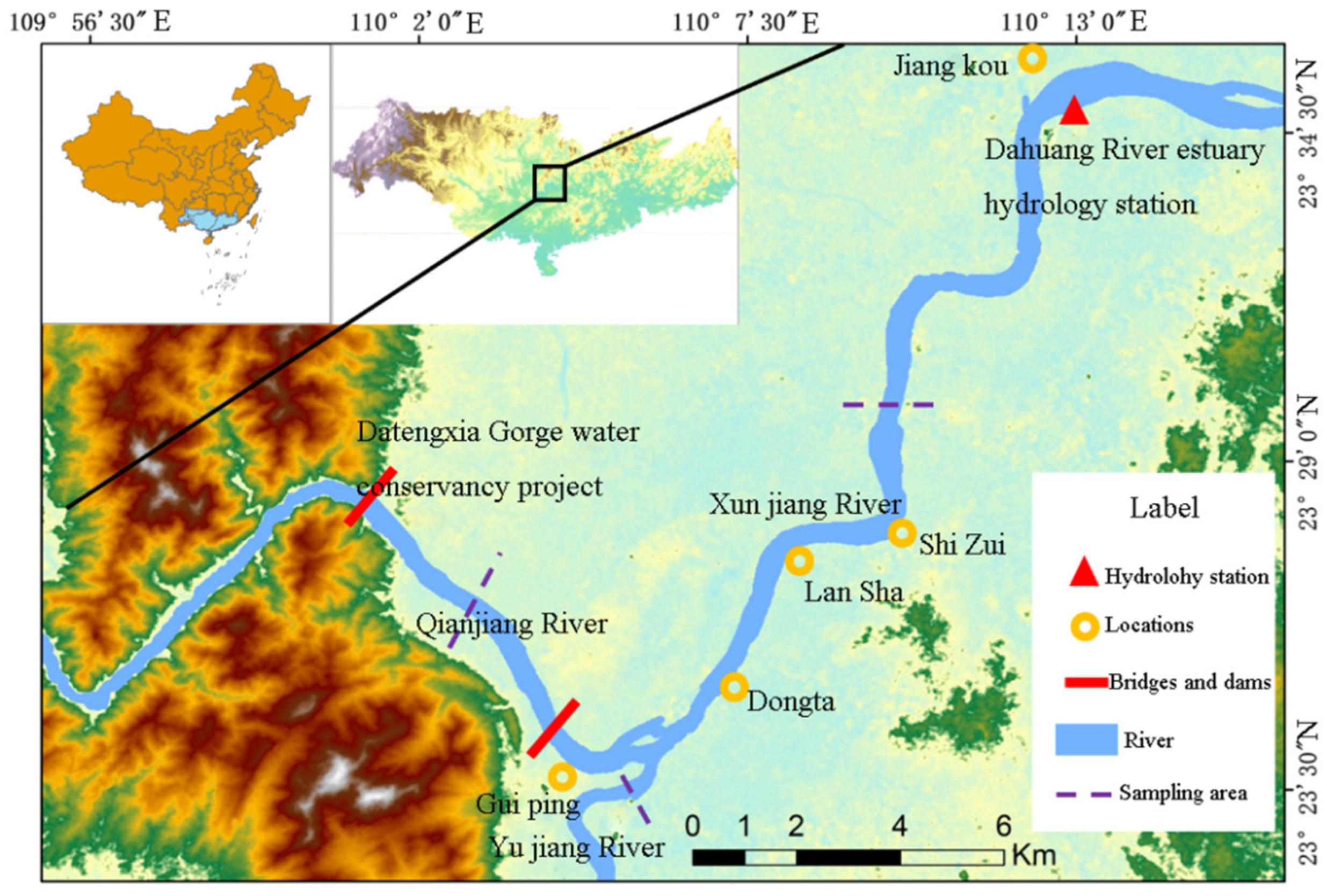
This paper takes the spawning ground at Dongta in the Xijiang River as the research area. According to existing studies, the Dongta spawning ground is the second-largest existing spawning area in China and an extremely important spawning ground for the FMCCs in the Pearl River [27]. Meanwhile, this river reach has been designated as an ecological protection zone by the local fisheries and fishery administration bureau, which holds significant importance for the breeding and conservation of fish in the Pearl River. The Dongta spawning ground is located in the midstream of the Pearl River Basin, at the confluence of the Yujiang, Xunjiang, and Qianjiang rivers (Figure 1). The terrain here is diverse, with deep pools and shoals alternating. The Dongta spawning ground boasts abundant water resources, with an average annual flow rate of 5266 m3/s and an average annual precipitation of 1717.5 mm. This unique geographical location provides fish with abundant food sources and suitable hydrodynamic conditions, among other benefits. The migration and spawning of fish during the spawning season primarily occur in the river reach below the Datengxia Reservoir. Therefore, we selected a point 4 km downstream of the Datengxia Dam as the starting point and a point 4 km downstream of Shizui as the ending point, covering a total distance of approximately 24 km, as the case study area.
FMCC represent the target species of this study, comprising four typical fish species: bighead carp, black carp, grass carp, and silver carp. These species exhibit rapid growth and robust disease resistance, positioning them as primary objectives in freshwater aquaculture and fisheries. The Dongta spawning ground constitutes one of the principal spawning grounds for FMCC in China. According to existing research, June represents the primary spawning period for these four fish species. To acquire hydrological and hydrodynamic data during this spawning period, 4 and 5 June 2019, were selected for field data collection, owing to minimal climatic and hydrological variations on both days. Terrain and hydrodynamic characteristics of the spawning ground were measured using an Acoustic Doppler Current Profiler (ADCP). No precipitation occurred during the sampling period. On 4 June, the runoff at the hydrological station near the mouth of the Xijiang River (approximately 20 km downstream of the sampling area) was 10,300 m3/s, with a corresponding water level of 25.05 m. On 5 June, the runoff at the Dahuangjiangkou Hydrological Station was 9340 m3/s, reflecting a reduction of 960 m3/s from the previous day and a change rate of 9.3%. Water depth, flow velocity, and water temperature were measured at 78 cross-sections extending from 4 km downstream of the Datengxia Dam to 4 km downstream of the Shizui Dam. Data were sourced from the China Meteorological Administration (https://weather.cma.cn/) and the Pearl River Water Resources Commission Hydrology and Water Resources Bureau (http://www.zwswj.com/cms/).

4. Results and Discussion

4.1. Flow Process Characteristics of FMCC During Spawning Period

This study employed daily runoff data from the Dahuangjiangkou Hydrological Station spanning the period 1980 to 2013. The P-III distribution was fitted to the data, with parameters estimated using the linear moment method. The resulting statistical parameters were: a mean daily runoff of 5267.04 m3/s, a coefficient of variation of 0.19, and a coefficient of skewness of 0.61. Based on the fitted runoff volume-frequency curve, the runoff thresholds corresponding to the classification standards for wet, flat, and dry years were determined. Consequently, a year is classified as wet if the mean annual runoff exceeds 5541 m3/s, dry if the mean annual runoff is below 4884.36 m3/s, and flat if the mean annual runoff falls between these thresholds. The classification results for wet, flat, and dry years are presented in Table 2.
To establish the environmental flow regime for the spawning period of FMCC, this study analyzed the hydrological characteristics at the Dahuangjiangkou station from 1980 to 2013. A total of 12 statistical indicators—covering frequency, duration, rate of change, and extreme values—were derived for low- and high-flow events occurring between late April and early July (21 April–10 July).
The statistical results provide a critical basis for designing the environmental flow regime. Specifically, the flow dynamics during the spawning period were categorized into three hydrological years (wet, flat, and dry), with their respective characteristics detailed as follows:
First, the flow process during the spawning period in wet years exhibited distinct patterns. Low-flow events occurred 2~6 times (mean = 3.8), primarily spanning 21~28 April, 10~29 May, 1~15 June, and 5~6 July. Conversely, high-flow events occurred 3–6 times (mean = 4.0), peaking between 26 April~21 May, 27 May~6 June, and 10 June~8 July. Table 3 summarizes the detailed statistical indicators for these events.
Next, the flow characteristics in flat years were analyzed and presented in Table 4. In this category, low-flow events occurred 2~5 times (mean = 3.4), while high-flow events occurred 3~5 times (mean = 3.8). The temporal distribution of these events showed slight variations compared to wet years, occurring from 21~27 April, 6~23 May, 6~24 June, and 1~7 July for low flows; and 27 April~18 May, 22 May~10 June, and 23 June~8 July for high flows.
Finally, the flow process in dry years was characterized by increased frequency of low-flow events (2~7 times, mean = 4.2) and high-flow events (2~7 times, mean = 3.9). The timing of these events aligned closely with the general spawning period but exhibited prolonged durations. Detailed statistical results for these specific hydrological conditions are listed in Table 4.

4.2. Environmental Flow Regime of FMCC Spawning Period

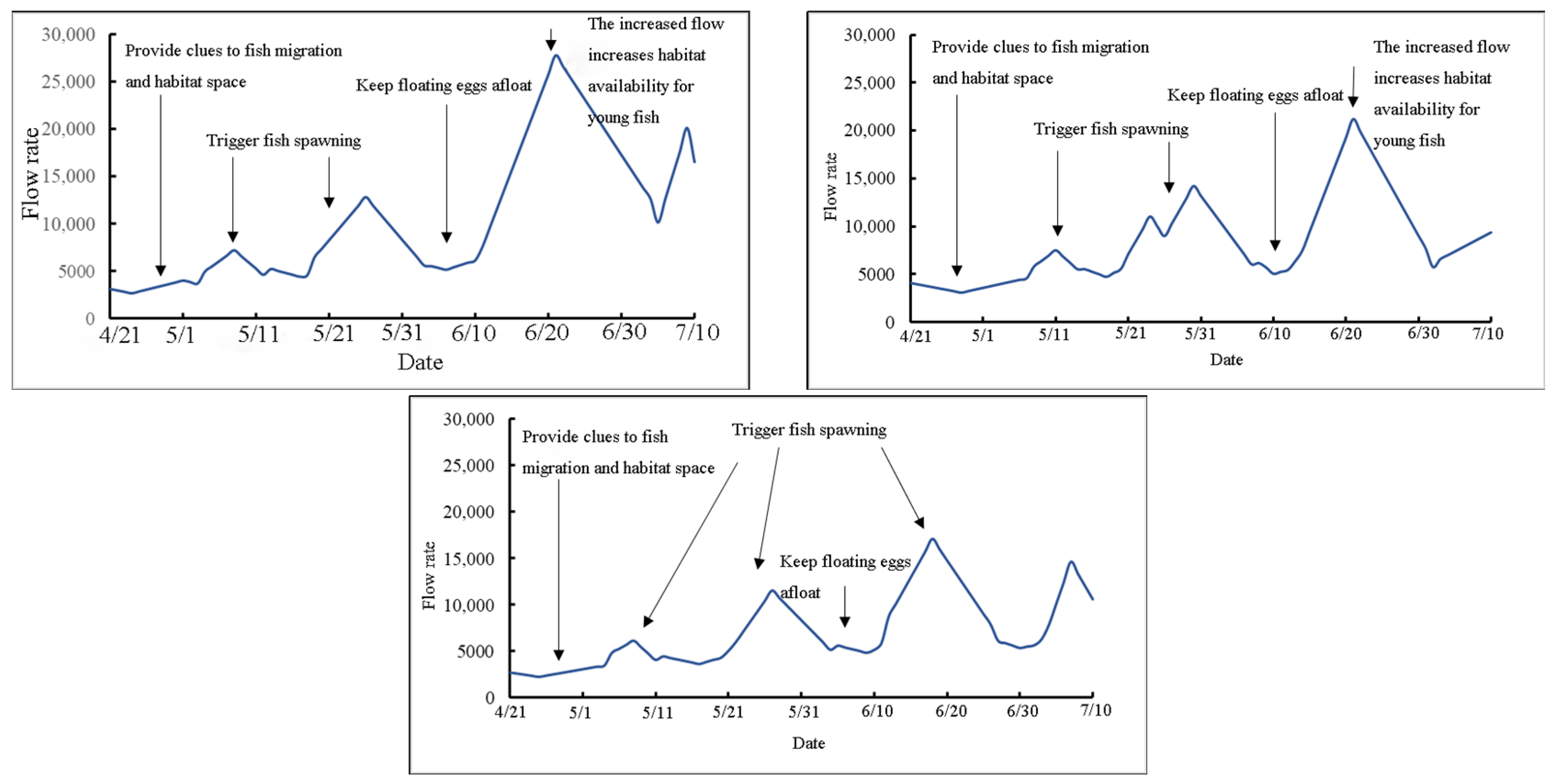
Based on the spawning requirements of fish at the lower Dongta of the Datengxia Water Conservancy Project and the statistical characteristics of FMCC flow processes derived in Section 4.1, the environmental flow regime for the spawning period was constructed.
The natural flow regimes at the Dahuangjiangkou Hydrological Station exhibit distinct variations under different inflow conditions (wet, flat, and dry years). Consequently, three specific environmental flow regimes were established as follows:
(1)
Environmental Flow Regime for wet Years
To satisfy the inflow demands of the Dongta spawning ground during high-water periods, the environmental flow regime was constructed based on the hydrological characteristics summarized in Table 3. This regime is illustrated in Figure 2.
(2)
Environmental Flow Regime for Flat Years
For the flat-year scenario, the environmental flow regime was similarly constructed by integrating the inflow requirements with the statistical features detailed in Table 4, as shown in Figure 2.
(3)
Environmental Flow Regime for Dry Years
Finally, the environmental flow regime for dry years was developed by aligning the inflow needs of the spawning ground with the specific hydrological data presented in Table 5. The resulting regime is also depicted in Figure 2.

4.3. Simulation and Verification of Hydrodynamic Model

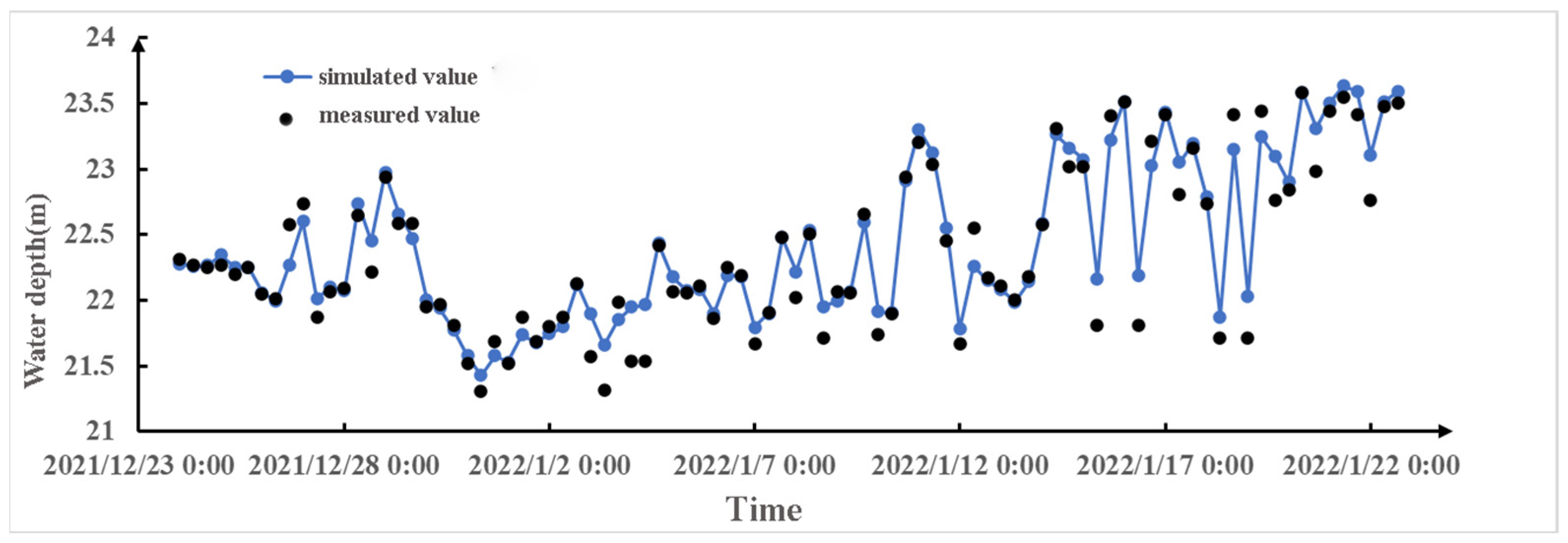
A two-dimensional hydrodynamic simulation model of the Dongta spawning ground was established using Mike 21. To ensure the reliability of the simulation results, the model was calibrated and verified using field data collected during two distinct hydrological periods: the non-flood period (December 2021–January 2022) and the flood period (June–July 2022).
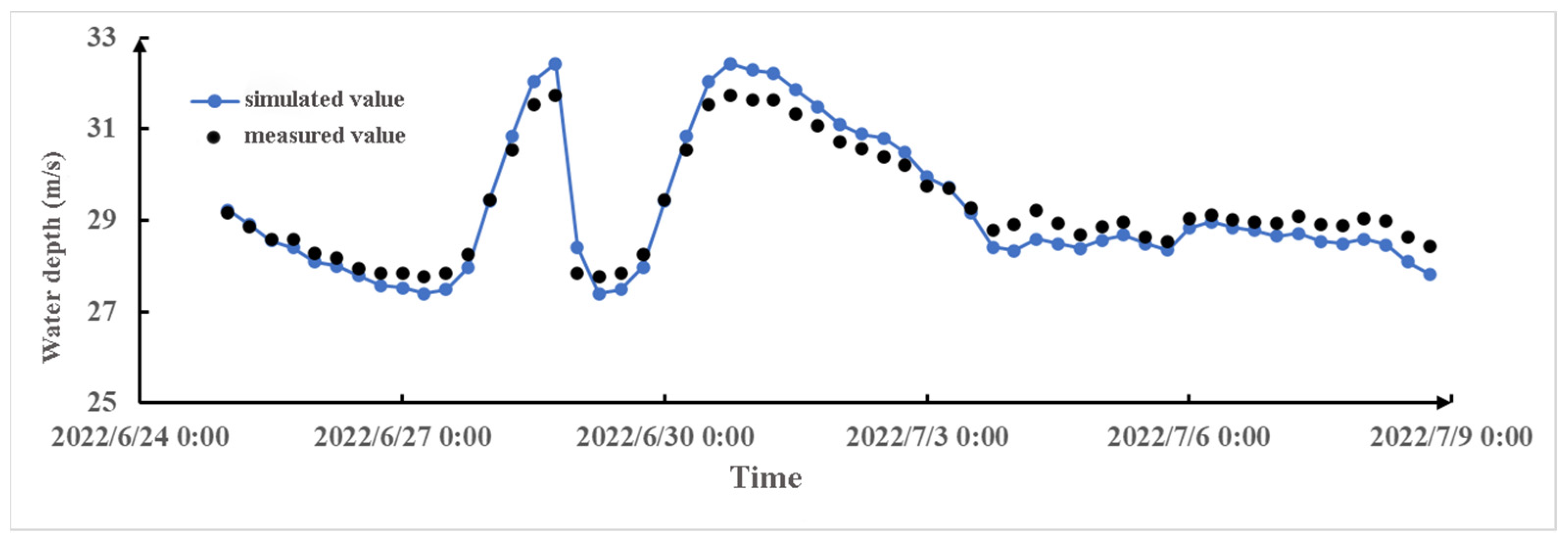
The validation focused on the Qianjiang Bridge section in Guiping, comparing simulated water levels and velocities against measured data. As illustrated in Figure 3 and Figure 4, the simulated trends closely matched the observed values, with the simulated water levels falling within the range of measured data.
Quantitative assessment of the model accuracy revealed maximum errors of 0.42 m (non-flood) and 0.66 m (flood), respectively. Furthermore, statistical indicators such as the Nash-Sutcliffe Efficiency (NSE) and coefficient of determination (R2) exceeded 0.8, confirming the model’s capability to accurately simulate hydrodynamic conditions in both scenarios.
(4)
Calibration and verification of flow velocity
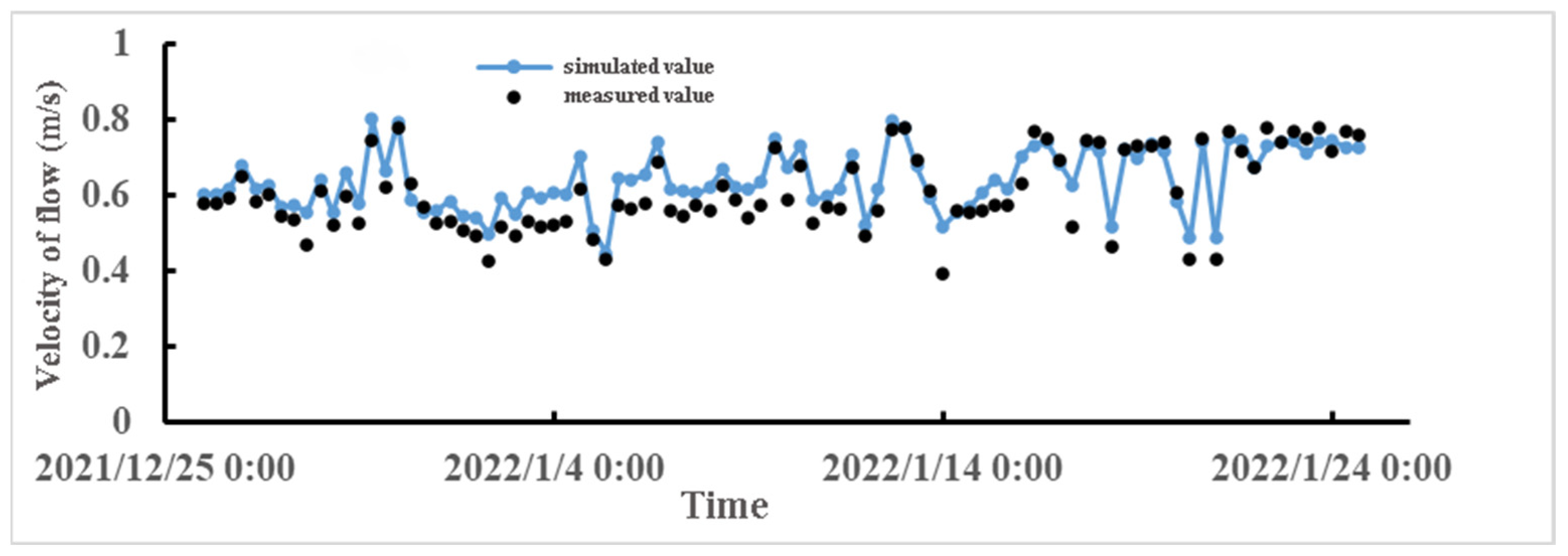
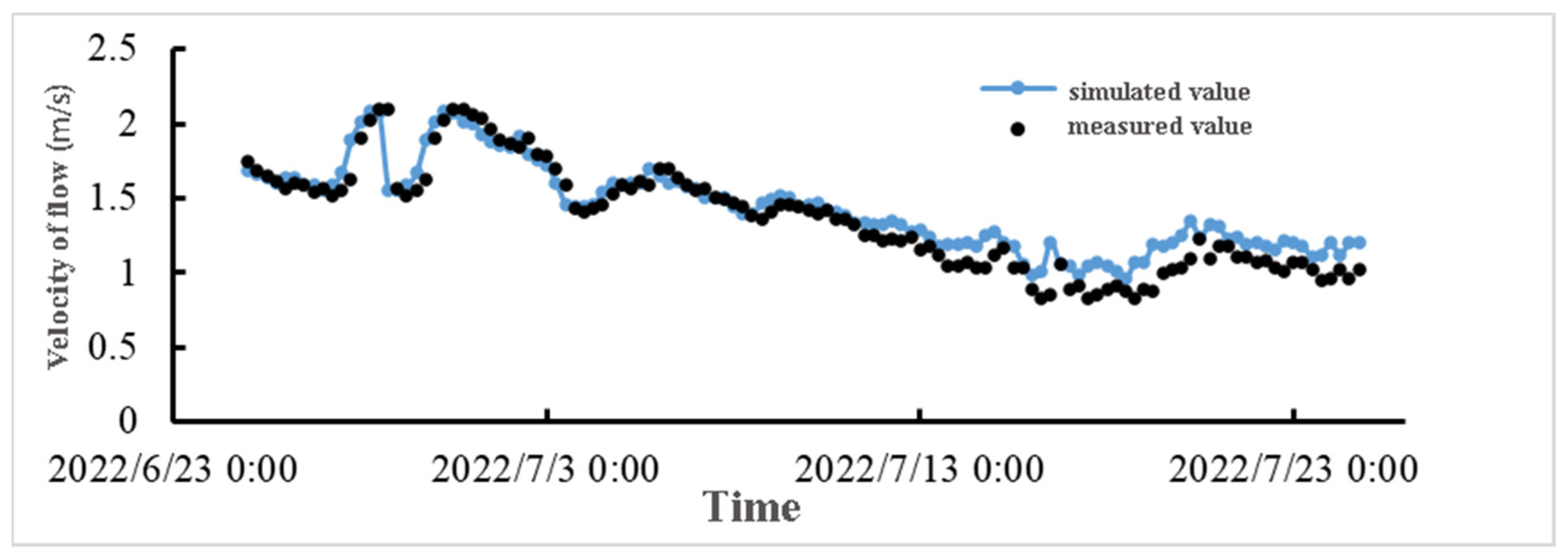
A comparison between simulated and measured velocity values was conducted to validate the model’s performance (Figure 5 and Figure 6). The results indicate that the model generally overestimates flow velocities, particularly during low-flow conditions.
During the non-flood period (December 2021–January 2022), the maximum velocity error was recorded at 0.15 m/s. In contrast, during the flood period (June–July 2022), while the initial half of the simulation showed good agreement with observations, discrepancies emerged as discharge declined. The peak error during this phase reached 0.23 m/s, suggesting a reduced accuracy in simulating low-flow velocity dynamics.
Despite these biases, statistical indicators such as the Nash-Sutcliffe Efficiency (NSE) and coefficient of determination (R2) remained above 0.7, confirming that the hydrodynamic model provides an acceptable representation of flow velocity patterns across both hydrological scenarios.

4.4. Hydrodynamic Simulation of Environmental Flow Regime During Spawning Period

The flow regime for FMCC spawning (Section 4.2) was applied as the input boundary condition to the two-dimensional hydrodynamic model to simulate the flow field dynamics within the Dongta spawning ground. The simulated discharge ranges during the spawning period for each hydrological scenario were as follows: wet Years: 2698.3~27,792.7 m3/s, flat Years: 3060.2~21,219.5 m3/s, and dry Years: 2225.4~17,063.8 m3/s. To systematically characterize the flow field, peak velocity values from both high-flow and low-flow events were extracted for each hydrological scenario. These representative flow conditions are summarized in Table 6.
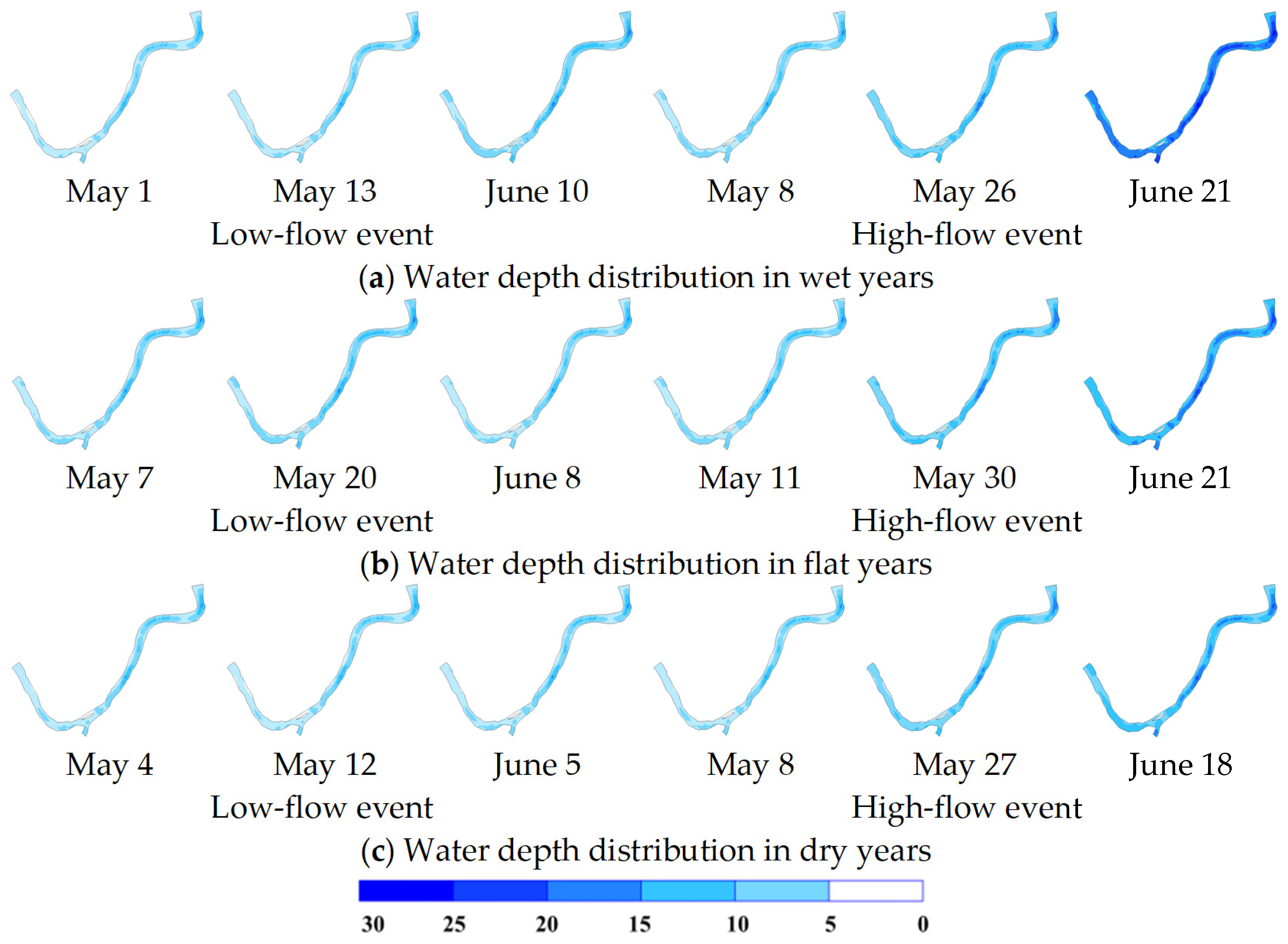
A direct relationship exists between water depth and the elevation of the Dongta spawning ground (Figure 7). Generally, areas exhibiting lower elevation values correspond to greater water depths. This correlation arises because regions of low topographic elevation are more subject to hydrodynamic forces, resulting in enhanced scouring and consequently increased water depth. Comprehending the variation patterns of spawning ground elevation and water depth is of critical importance for accurately assessing the hydrological environment of spawning grounds and formulating effective conservation measures.
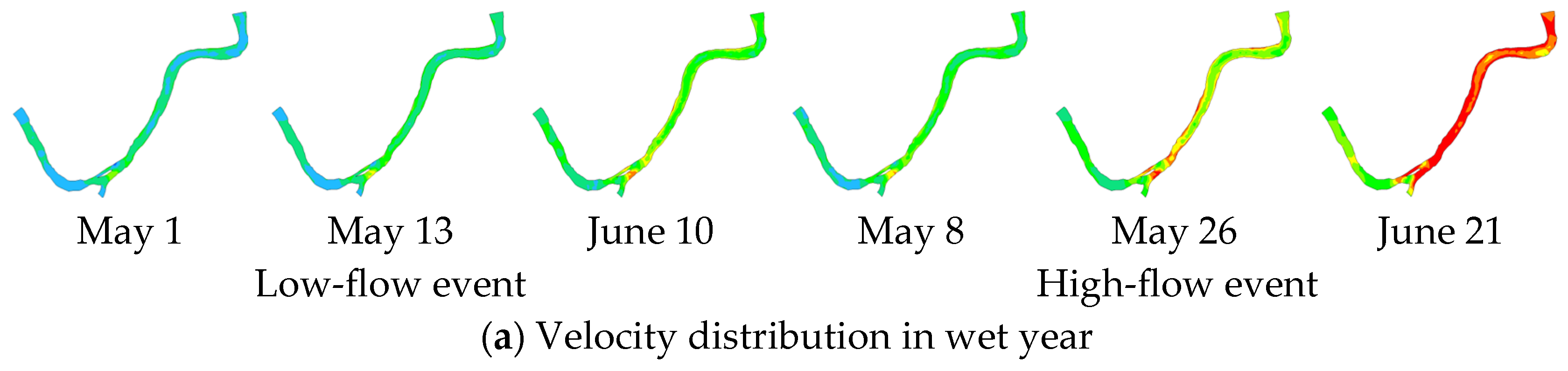
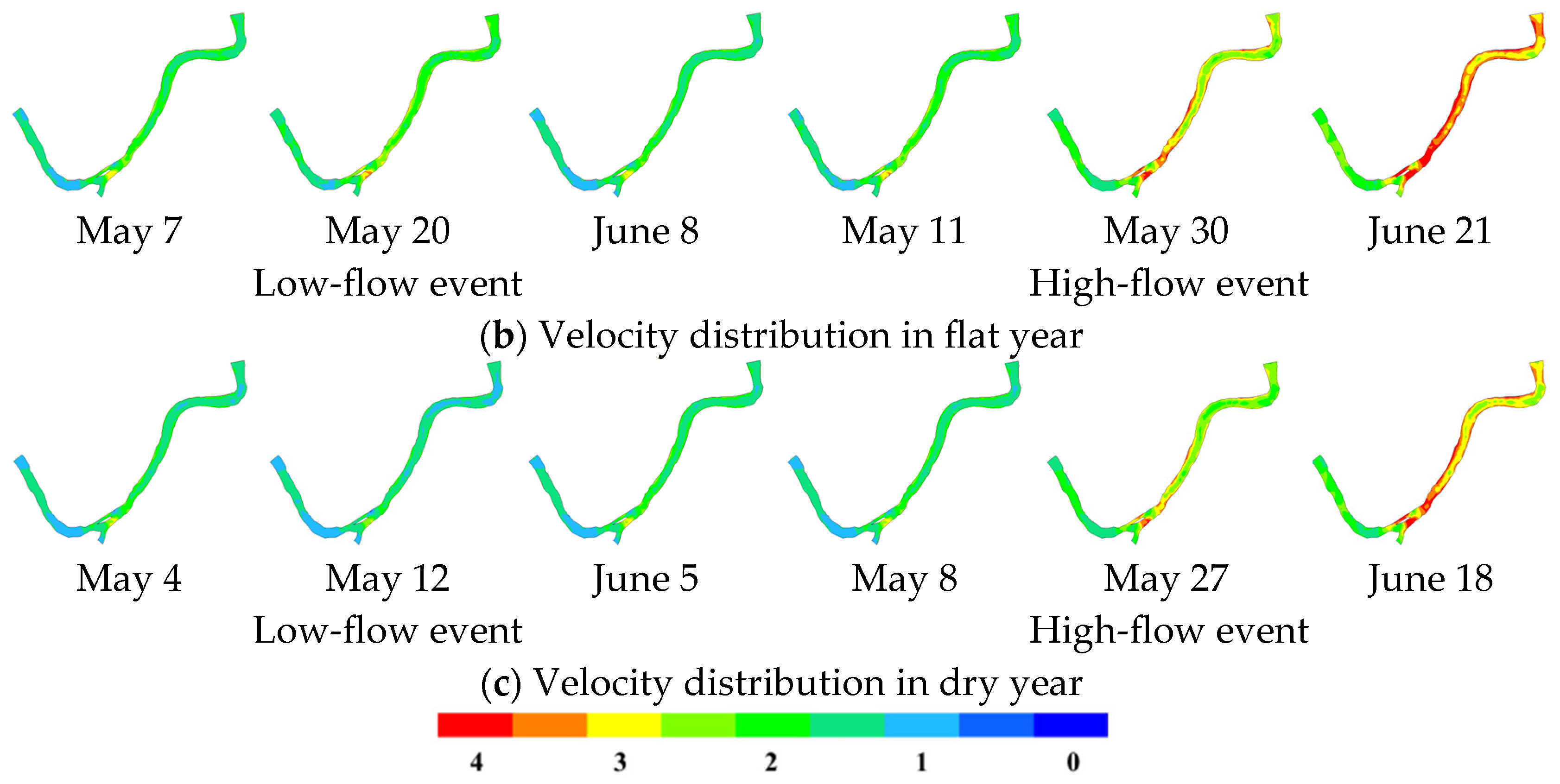
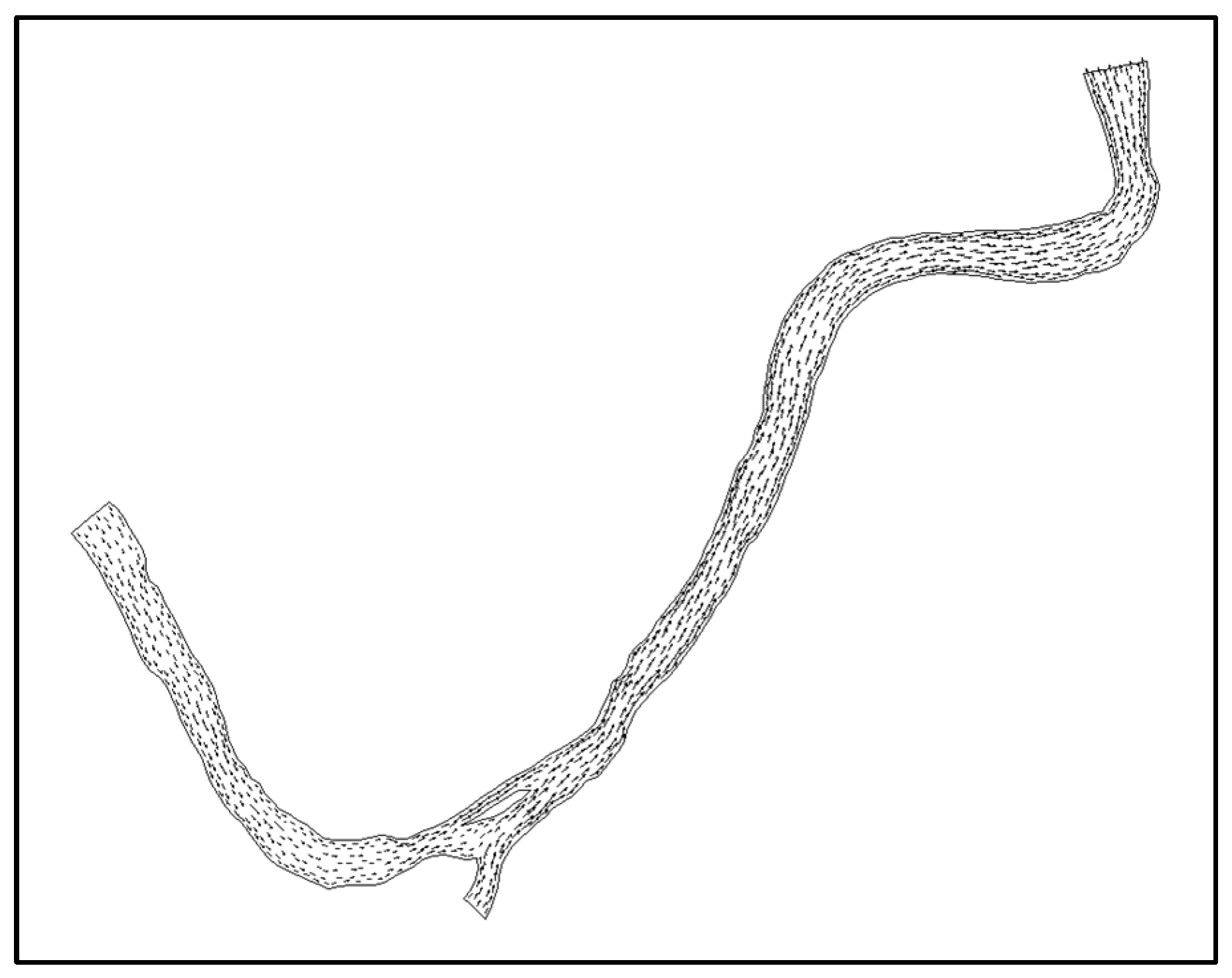
Meanwhile, as river discharge increases, the flow velocity at the Dongta spawning ground correspondingly increases. Elevated flow rates stimulate spawning behavior in FMCC, with the duration of increased flow exhibiting a positive correlation with spawning stimulation efficacy. Analysis of the simulated mean velocity distribution within the spawning ground (Figure 8) reveals that the velocity increase process differs from the homogenization observed during water depth increases. Notably, the velocity augmentation was more pronounced near the riverbanks. When flow transitions from a straight channel to a curved reach, centrifugal forces deflect the flow direction toward the concave bank. The primary flow direction of the river is predominantly governed by channel alignment, as illustrated in Figure 9. While variations in river discharge induce corresponding increases or decreases in flow velocity, the overall river direction remains largely unaltered. This stability arises because channel orientation constitutes a relatively invariant factor, rendering it resistant to significant modification even under fluctuating flow conditions.

4.5. Suitability Assessment of Environmental Flow Regime in Spawning Period of FMCC

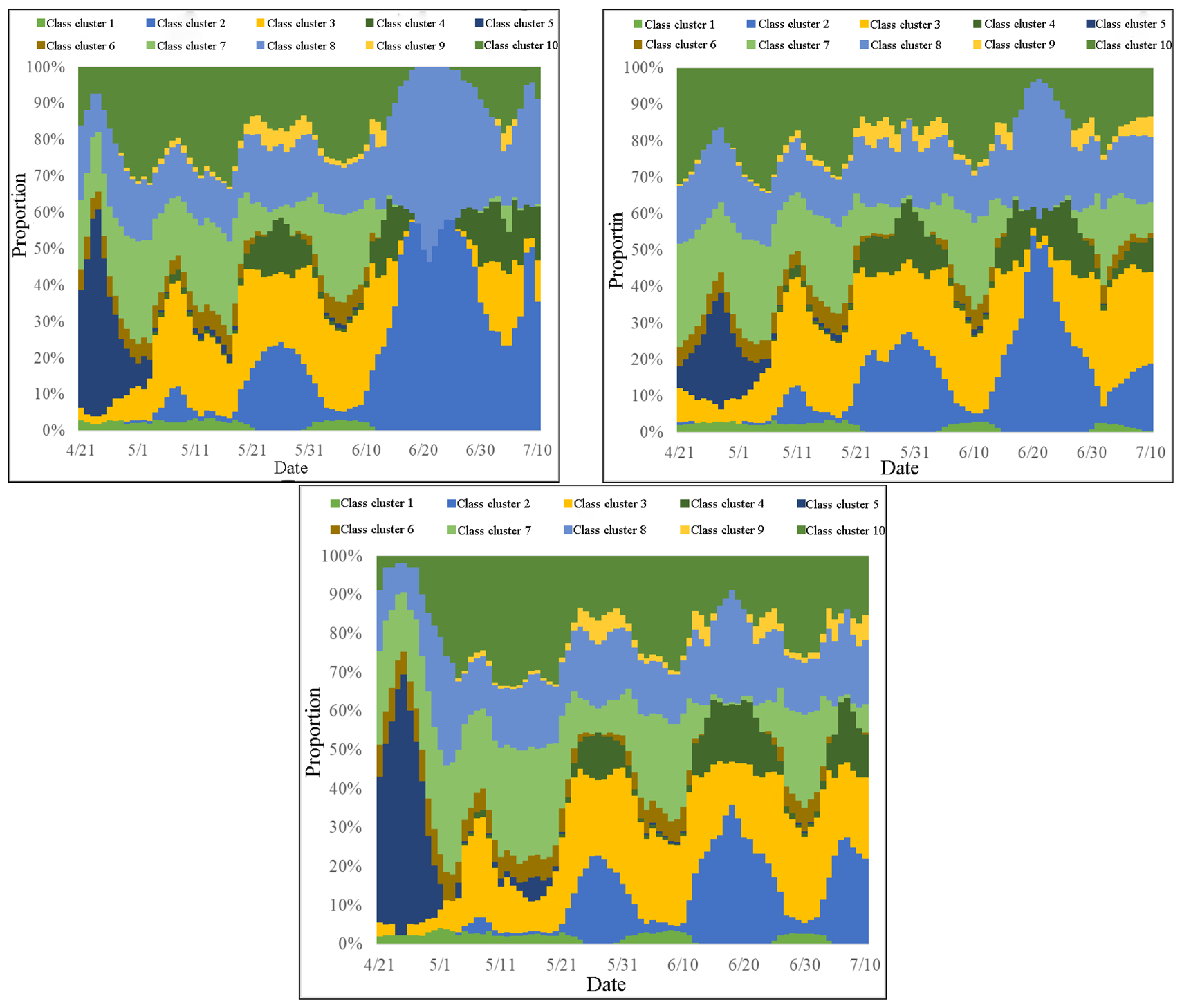
From a temporal perspective, the analysis of the environmental flow regime revealed distinct variations in the proportions of ten hydrodynamic characteristic clusters (Figure 10). Notably, compared to flat and dry years, the proportions of these clusters exhibited more pronounced fluctuations during wet years. This phenomenon is likely attributable to the more pronounced characteristics of peak flows, including their greater magnitude, larger flow increments, and longer duration of rising water levels, which are observed during the shift from low-flow to high-flow conditions in wet years.
It is important to note that not all flow scenarios encompassed the complete set of ten clusters throughout the spawning period. For instance, on 25 May during the wet year scenario, only seven distinct classes (Classes 2, 3, 4, 7, 8, 9, and 10) were identified.
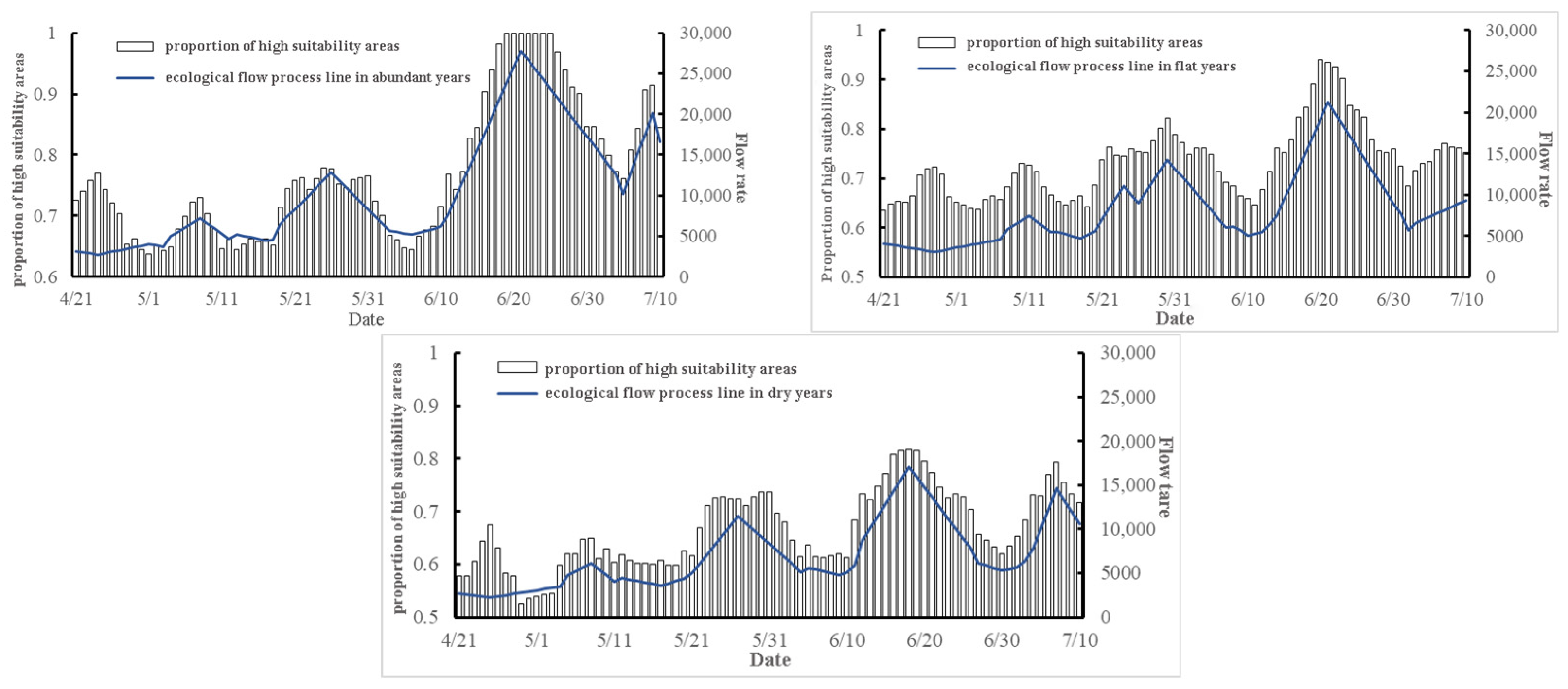
The temporal distribution of high-suitability clusters generally aligns with the environmental flow regime, as illustrated in Figure 11. However, distinct counter-trend periods were observed, predominantly occurring during low-flow events in early April across wet, flat, and dry years. These findings suggest that low-flow events in April play a crucial role in maintaining high spawning suitability, particularly when river discharge is naturally low during this period. April represents the pre-peak spawning window in the Xijiang River, when FMCC adults undergo final gonadal maturation and staging while temperatures are rising but large floods are not yet persistent [11,12,15]. Relatively stable low-flow conditions can maintain a favorable hydraulic template (moderate depths/velocities and reduced turbulence extremes), allowing adults to occupy and repeatedly use suitable microhabitats [8,17,20], and reducing the risk that eggs are either stranded in slack-water zones (under very low velocities) or transported too rapidly beyond downstream nursery areas (under abrupt high shear) [5,9]. In addition, stable baseflows may promote the development of planktonic food resources for early larvae [27]. Subsequent flow pulses in May-June then act as spawning cues and provide the drift conditions required for semi-buoyant eggs. However, this should be further validated using biological observations in the future.
To evaluate the impact of the environmental flow regime on spatial spawning suitability, a spatial suitability distribution map was generated for the Dongtai spawning ground. The methodology comprised three key stages: Firstly, hydrodynamic simulation results of the environmental flow regime were extracted. Secondly, point-based flow field parameters—specifically water depth, velocity, and Froude number—were obtained from the Dongta section, following the identical sampling (a total of 727 points were collected). Finally, these 727 hydrodynamic data points were classified into ten distinct clusters representing varying degrees of flow field suitability, based on the evaluation framework outlined in method. To facilitate further analysis of the spatial suitability dynamics during the spawning period, specific time points exhibiting significant hydrological changes were selected for detailed examination.
During the spawning period of the FMCC in wet, flat and dry years, nine critical mutation time points were selected based on the aforementioned criteria to analyze the spatial suitability of the spawning ground (Table 7). The results indicate that the spatial distribution of high-suitability areas exhibited distinct temporal variations corresponding to the hydrological regime.
(1)
Suitability during wet years
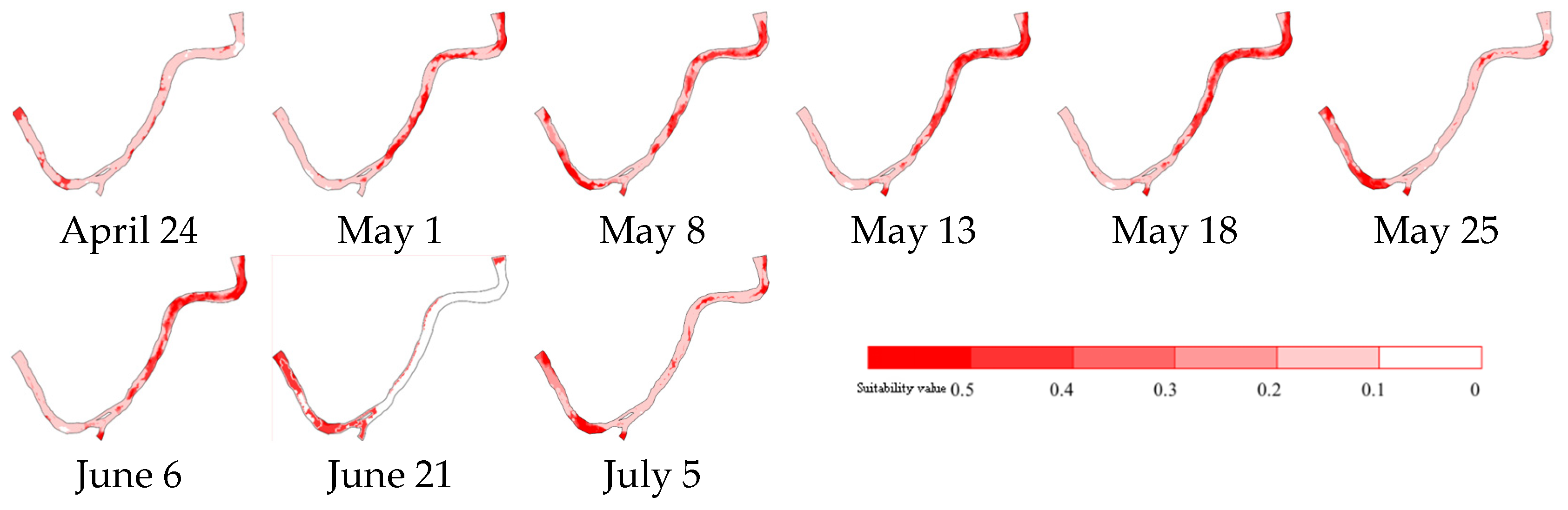
To characterize habitat suitability dynamics, several critical dates were analyzed (Figure 12). On 24 April, during a low-flow event (discharge: 2698.3 m3/s; water level: 20.9 m), the proportion of high-suitability habitat reached its maximum, although these patches were fragmented. By 1 May, as discharge increased to 4030.4 m3/s, the fragmented patches began to coalesce into contiguous blocks, particularly near the right bank within the reaches of Dongta Village, Lansha Village, and Shizui Town.
A significant high-flow event occurred on 8 May (peak discharge: 7229.7 m3/s; water level: 23.1 m), extending high-suitability zones further upstream into the upper reaches of the Sanjiang concourse and the bend reach. However, during the subsequent mid-May low-flow event on 13 May (discharge: 5249.2 m3/s), while downstream areas maintained high suitability, suitability declined in the upstream and the curved reach.
On 25 May, another peak flow event (discharge: 12,839.4 m3/s; water level: 25.9 m) concentrated the high-suitability area within the upper curved reach. Compared to 8 May, only small patches remained in the middle reaches of Lansha and Shizui Towns.
By 6 June, as discharge decreased to 5186.6 m3/s, suitability in the lower reaches (Dongta, Lansha, and Shizui) rebounded significantly, whereas suitability in the upper Sanjiang concourse decreased markedly. An extreme high-flow event occurred on 21 July (discharge: 27,792.7 m3/s; exceeding the warning level at Dahuangjiangkou station), which fragmented the spawning ground around the central island. Consequently, high-suitability areas were restricted to the upper reaches, rendering the lower reaches unsuitable for the four main fish species. Subsequently, on 5 July, the distribution pattern reverted to that observed on 25 May, albeit with a slight reduction in area.
(2)
Suitability during flat years
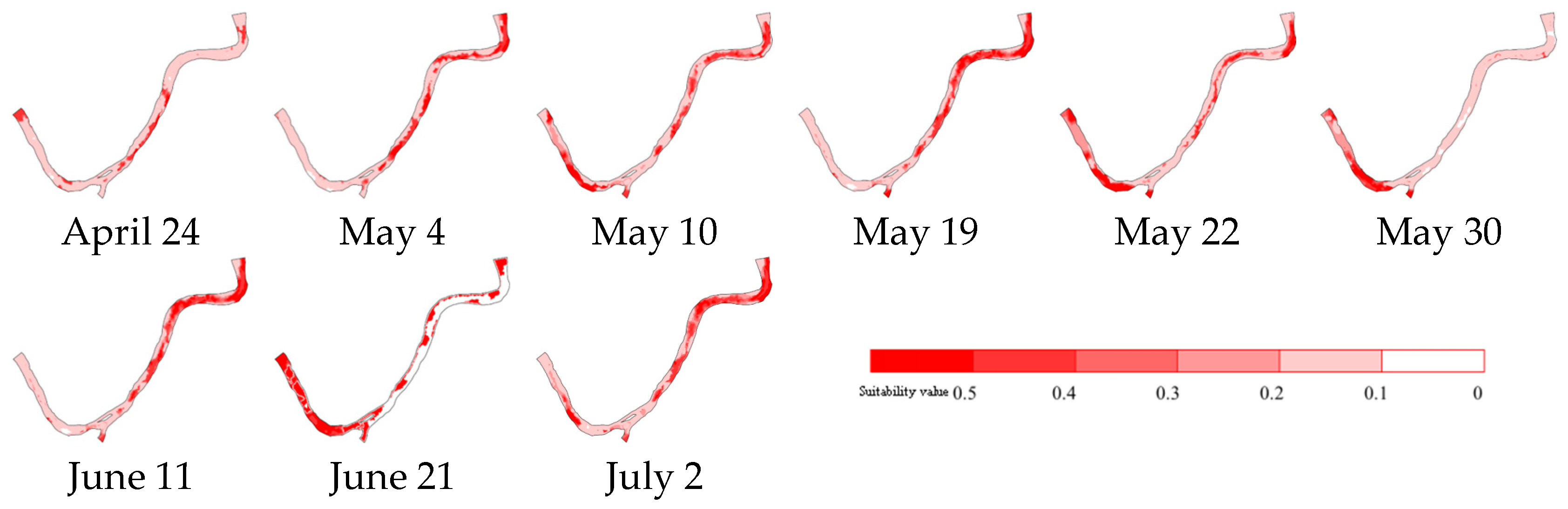
To analyze the spatial suitability of spawning grounds during the spawning period of FMCC in flat years, nine critical mutation time points were selected based on the flow regime (Table 7). The results indicate that the spatial distribution of high-suitability areas exhibited distinct temporal variations corresponding to the hydrological regime.
As shown in Figure 13, on 28 April, characterized by a low-flow event (discharge: 3060.2 m3/s; water level: 21.1 m), the proportion of high-suitability habitat was maximized, though these patches were fragmented. By 4 May, as the flow increased to 4064.0 m3/s, the scattered patches began to coalesce into contiguous blocks, particularly near the right bank of the Dongta Village reach, with an obvious expansion in coverage.
A significant high-flow event occurred on 10 May (peak discharge: 6918.3 m3/s; water level: 23.0 m), extending the high-suitability zones further upstream to the upper reaches of the Goose Egg Beach and bend reach. However, during the subsequent mid-May low-flow event on 19 May (discharge: 5132.7 m3/s), while the downstream areas remained highly suitable, a large area of high suitability disappeared upstream of the Sanjiang River confluence.
On 22 May, during the rising limb of the late-May high-flow event (discharge: 8402.7 m3/s; water level: 23.7 m), the high-suitability area reappeared in the upper reaches of the confluence and expanded compared to 10 May, while the lower reaches regained suitability observed on 19 May. On 30 May, the peak of this high-flow event was reached (discharge: 14,213.7 m3/s; water level: 26.6 m), concentrating the high-suitability area in the upper curved reach and Gogutan. Compared with 22 May, the high suitability in the upper confluence was uniformly distributed, but the lower reaches showed negligible suitability.
By 11 June, as the discharge dropped to 5032.5 m3/s, the high-suitability areas of the Dongta, Lansha, and Shizui reaches reappeared. However, on 21 June, the flow rose to a peak (discharge: 21,219.5 m3/s; water level: 30.0 m—the maximum value in the flat annual flow process), fragmenting the spawning ground from the central island. Consequently, high-suitability areas were restricted to the upstream, whereas the lower reaches were rendered unsuitable for the four main fish species. Finally, on 2 July, the flow decreased slightly to 5735.0 m3/s, yet a high suitability zone persisted on the right bank at Goose Egg Beach upstream.
(3)
Suitability during dry years
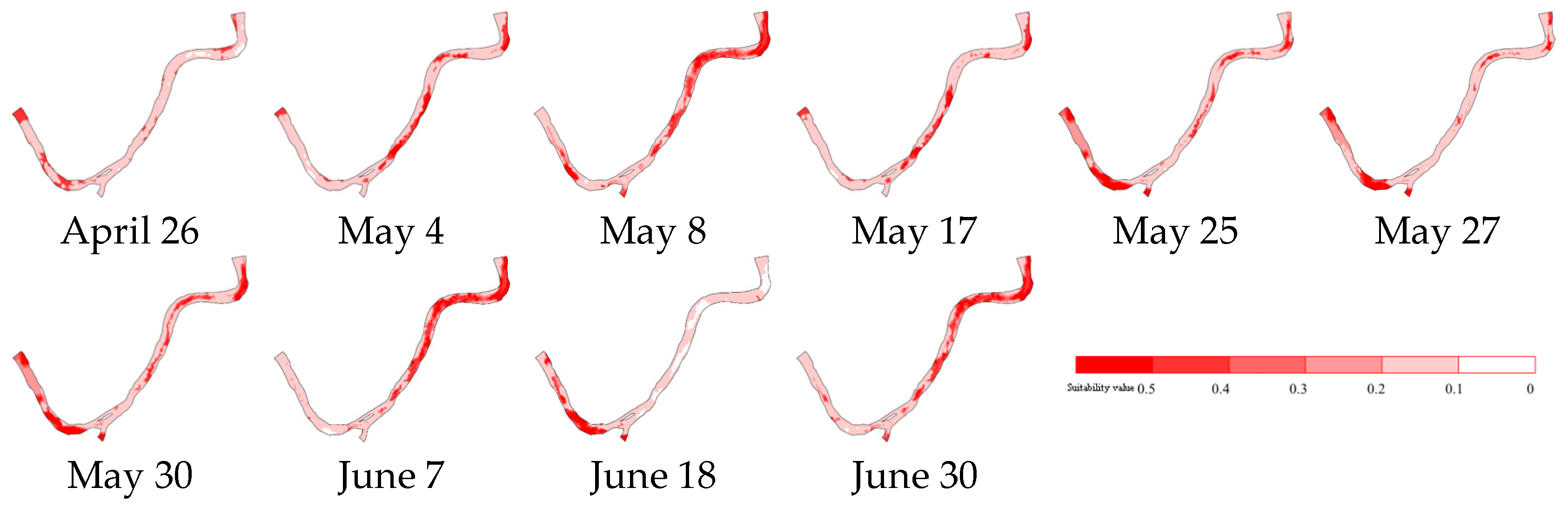
As shown in Figure 14, on 26 April, characterized by a low-flow event (discharge: 2362.3 m3/s; water level: 20.8 m), the high-suitability habitat patches were highly fragmented. By 4 May, as the flow increased to 3457.5 m3/s, these scattered patches began to coalesce into narrow, elongated blocks primarily along the right bank of the Dongta Village reach.
A significant high-flow event occurred on 8 May (peak discharge: 6114.1 m3/s; water level: 22.6 m), marking the peak proportion of high-suitability habitat for this event. The area expanded significantly, concentrating mainly in the Dongta, Lansha, and Shizui reaches, as well as near the upper Yoogutan right bank.
During the mid-May low-flow event on 17 May (discharge: 3613.5 m3/s), the flow and water level showed minimal variation compared to 4 May, resulting in a spatial distribution pattern similar to that observed previously.
In late May, three consecutive high-flow events occurred (25, 27, and 30 May), with discharges ranging from 9278.1 to 11,505.3 m3/s. Notably, while the discharge first increased and then decreased, the proportion of high-suitability habitat exhibited an inverse trend—first decreasing and then increasing. In the upper reaches of Gogutan and crooked reaches, the high-suitability area remained relatively stable; however, in the downstream reaches of Dongta, Lansha, and Shizuzhen, a distinct pattern of “decrease followed by increase” was observed along the mainstream direction.
On 7 June, during an early June low-runoff event (discharge: 5195.4 m3/s; water level: 22.1 m), the high-suitability area shifted downstream, with almost no suitable habitat present in the upper reaches of the Sanjiang River confluence. Conversely, on 18 June, a massive high-flow event reached its peak (discharge: 17,063.8 m3/s; water level: 28.0 m), achieving the maximum proportion of high-suitability habitat. Spatially, this event concentrated suitability in the upstream zones, whereas the downstream areas remained largely unsuitable.
Finally, on 30 June, during the subsequent low-flow event (discharge: 5331.8 m3/s; water level: 22.2 m), the high-suitability area reverted to a downstream concentration, specifically in the Dongta, Lansha, and Shizui reaches.
The environmental flow regime during the spawning period of FMCC demonstrated marked variations across different hydrological years, exerting significant influence on the spatial distribution of high-suitability habitats. An evident spatial migration pattern was observed within the Dongta spawning ground, characterized by a consistent downstream-to-upstream shift corresponding to increased discharge. Specifically, when flow rates remained below 3000 m3/s (e.g., 24 April in wet years and 26 April in dry years), suitable spawning areas were fragmented and spatially limited.
As the flow regime transitioned from low- to high-flow phases, distinct spatial dynamics emerged in high-suitability habitats. (1) Early Stage, the initial low-flow phase induced the aggregation of suitable areas primarily within the lower reaches, with minimal alterations observed upstream. (2) Middle Stage, the subsequent low-flow phase promoted the expansion of high-suitability zones throughout the study area, signifying a transition where the upper reaches exhibited substantial increases while suitability declined in the lower reaches. (3) Late Stage, the third low-flow phase further consolidated this trend, driving the spatial evolution of high-suitability areas predominantly from the lower to the upper reaches.
These results suggest that hydrologic variability is a primary driver of within-reach shifts in spawning-habitat suitability. Accordingly, the lack of persistent “fixed” spawning locations within the spawning ground is likely attributable to the inherent stochasticity of natural (and regulated) flow regimes, which continually reshapes local hydraulic templates. The selected ~24 km study reach spans the officially recognized Dongta spawning ground downstream of the Datengxia Reservoir and incorporates the dominant geomorphic units (deep pools, shoals/riffles, and bends) that generate hydraulic habitat heterogeneity in this section of the Xijiang River [9,27]. This reach-scale configuration is therefore well suited to examine spatial redistribution of suitability under contrasting environmental-flow regimes using coupled hydrodynamic–habitat suitability modeling and drift/connectivity concepts [1,3,4,5,11,17]. Nonetheless, our inferences should be interpreted as reach-scale patterns and may not be directly transferable to other Pearl River spawning reaches with different channel morphology or substrate conditions [2,24].
Field hydrodynamic measurements were obtained during a short survey (June 2019) to provide high-resolution bathymetry and support model setup. The Mike21 model was subsequently calibrated/validated using independent multi-period observations, consistent with established two-dimensional modeling practice [25], and was forced with long-term discharge statistics following standard hydrological information procedures [21,23]. Even so, temporal changes in bedforms, vegetation, and water temperature (potentially modulated by reservoir operations) may introduce additional uncertainty [14,24]. Future work should include repeated surveys across seasons/years, explicit incorporation of substrate and water-quality variables, and targeted biological observations (eggs/larvae) to better constrain suitability thresholds and reduce uncertainty [2,3,4,5].

5. Conclusions

Based on the runoff characteristics of the Xijiang River at the Dahuangjiangkou Hydrological Station, this study categorized annual runoff into wet, flat, and dry years. By quantifying natural flow characteristics and constructing environmental flow regimes for FMCC spawning periods using the Index of Hydrologic Alteration (IHA) and Natural Flow Regime (NFR) concepts, we integrated temporal and spatial dimensions to evaluate spawning suitability, aiming to contribute to the sustainability of fishery resources.
Combining a calibrated two-dimensional hydrodynamic model (MIKE 21) with spatial suitability calculation methods, our findings revealed a consistent correlation between the temporal evolution of high-suitability habitat clusters and the environmental flow regime. Specifically, as discharge increased from low- to high-flow events, a distinct spatial migration pattern emerged in the Dongta spawning ground. The high-suitability areas shifted systematically from downstream deep pools to upstream shallow reaches, highlighting the critical role of hydrological fluctuations in determining fish spawning positions, and thus influencing the sustainability of fish populations.
In general, to maintain high-suitability spatial areas for the spawning of FMCC and promote the sustainability of fishery resources, the Datengxia Reservoir should set different environmental flow thresholds for different hydrological years: In wet years, the flow should be close to 2698.3 m3/s during low-flow events in late April, the rise and fall of the flow should be reasonably regulated in May, and the water level should be controlled when the high flow reaches 27,792.7 m3/s in late June; In flat years, the minimum low flow is approximately 3060.2 m3/s in late April, the area should be expanded when the maximum high flow reaches about 6918.3 m3/s in early May, and attention should be paid to the upstream and downstream distribution when the maximum high flow reaches 21,219.5 m3/s in late June; In dry years, the minimum low flow is approximately 2362.3 m3/s in late April, high-suitability areas should be connected into patches and increased in early May, the concentrated distribution in the upstream should be maintained when the maximum high flow reaches 17,063.8 m3/s in late June, and overall, the flow changes should conform to the law of high-suitability areas migrating from downstream deep pools to upstream shoals.
Our study reveals a robust coupling between natural flow dynamics and the spatial configuration of Essential Fish Habitat (EFH). To safeguard the long-term sustainability of FMCC resources, we recommend a dynamic environmental flow management framework that adapts to annual hydrological scenarios (wet, flat, dry). By ensuring the spatial migration of high-suitability areas from downstream deep pools to upstream shallow reaches, this approach not only supports successful spawning but also enhances the overall ecological health and resilience of the river ecosystem.

Author Contributions

Conceptualization, C.Y. and H.Z.; methodology, Q.P.; software, H.Z.; validation, Q.P. and H.Z.; writing—original draft preparation, Y.Z. All authors have read and agreed to the published version of the manuscript.

Funding

This research was supported by the Guangdong Basic and Applied Basic Research Fund (No. 2022A1515140058), and National Natural Science Foundation of China (no. 42277488).

Institutional Review Board Statement

Not applicable.

Informed Consent Statement

Not applicable.

Data Availability Statement

The original contributions presented in this study are included in the article. Further inquiries can be directed to the corresponding authors.

Conflicts of Interest

The authors declare no conflict of interest.

References

  1. Yoshida, K.; Yajima, H.; Islam, M.T.; Pan, S. Assessment of spawning habitat suitability for Amphidromous Ayu (Plecoglossus altivelis) in tidal Asahi River sections in Japan: Implications for conservation and restoration. River Res. Appl. 2024, 40, 1497–1511. [Google Scholar] [CrossRef]
  2. Frost, M.; Diele, K. Essential spawning grounds of Scottish herring: Current knowledge and future challenges. Rev. Fish Biol. Fish. 2022, 32, 721–744. [Google Scholar] [CrossRef]
  3. Farò, D.; Wolter, C. Integrating habitat suitability and larval drift modeling for spawning-to-nursery functional habitat connectivity analysis in rivers. Water Resour. Res. 2024, 60, e2023WR036827. [Google Scholar] [CrossRef]
  4. Yuan, Y.; Li, R.; Wan, H.; Cai, Y.; Feng, J.; Lin, H. Coupled Model Development for Assessing Fish Spawning–Hatching Habitat Suitability and Ecological Connectivity. Ecosyst. Health Sustain. 2025, 11, 0409. [Google Scholar] [CrossRef]
  5. Zhang, P.; Liu, Q.; Wang, Y.; Li, K.; Qin, L.; Liang, R.; Li, J. Does drifting passage need to be linked to fish habitat assessment? Assessing environmental flow for multiple fish species with different spawning patterns with a framework integrating habitat connectivity. J. Hydrol. 2022, 612, 128247. [Google Scholar] [CrossRef]
  6. Yang, W.; Zhang, X.-B.; Li, G.; Qin, D.-M.; Li, W.-J.; Hu, Y.-P. Effects of collision shock on semi-buoyant fish egg hatchings in high-speed streams. Glob. Ecol. Conserv. 2024, 49, e02785. [Google Scholar] [CrossRef]
  7. Liu, X.; Ding, C.; Bond, N.; Sun, J.; Ding, L.; Chen, J.; Tao, J. Spawning cohort trade-offs of reproductive time and output in cyprinid fish along an elevation gradient. Ecol. Freshw. Fish 2024, 33, e12763. [Google Scholar] [CrossRef]
  8. Tennant, D.L. Instream flow regimens for fish, wildlife, recreation and related environmental resources. Fisheries 1976, 1, 6–10. [Google Scholar] [CrossRef]
  9. Zhou, H.; Yu, C.; Xu, Z.; Zheng, Y.; Hou, X. Spatial suitability evaluation of spawning reach revealing the location preference for fish producing drifting eggs. Front. Mar. Sci. 2022, 9, 947908. [Google Scholar] [CrossRef]
  10. Huang, A.; Yao, J.; Zhu, J.; Gao, X.; Jiang, W. Optimization of the flow conditions in the spawning ground of the Chinese sturgeon (Acipenser sinensis) through Gezhouba Dam generating units. Sci. Rep. 2021, 11, 14403. [Google Scholar] [CrossRef]
  11. Yu, L.; Lin, J.; Chen, D.; Duan, X.; Peng, Q.; Liu, S. Ecological flow assessment to improve the spawning habitat for the four major species of carp of the Yangtze River: A study on habitat suitability based on ultrasonic telemetry. Water 2018, 10, 600. [Google Scholar] [CrossRef]
  12. King, J.; Cambray, J.A.; Dean Impson, N. Linked effects of dam-released floods and water temperature on spawning of the Clanwilliam yellowfish Barbus capensis. Hydrobiologia 1998, 384, 245–265. [Google Scholar] [CrossRef]
  13. Besson, J.C.; Neary, J.J.; Stafford, J.D.; Dunn, C.G.; Miranda, L.E. Fish functional gradients along a reservoir cascade. Freshw. Biol. 2023, 68, 1079–1091. [Google Scholar] [CrossRef]
  14. Wang, Y.; Zhang, N.; Wang, D.; Wu, J. Impacts of cascade reservoirs on Yangtze River water temperature: Assessment and ecological implications. J. Hydrol. 2020, 590, 125240. [Google Scholar] [CrossRef]
  15. Ban, X.; Diplas, P.; Shih, W.; Pan, B.; Xiao, F.; Yun, D. Impact of Three Gorges Dam operation on the spawning success of four major Chinese carps. Ecol. Eng. 2019, 127, 268–275. [Google Scholar] [CrossRef]
  16. Wang, Q.; Zhong, Y.; Yu, G.A.; Li, Z.; Ouyang, L.; Zhang, W.; Yao, W. Exploring key drivers of Chinese sturgeon spawning sites fragmentation in the Yangtze River: Insights into spawning window. Ecol. Eng. 2025, 213, 107563. [Google Scholar] [CrossRef]
  17. Lv, X.; Yang, Z.; Hu, P.; Wang, W.; Zeng, Q.; Yan, X. Quantifying Environmental Flow in the Form of Pulse Flow for Fish Protection. Water 2023, 15, 2820. [Google Scholar] [CrossRef]
  18. Young, P.S.; Cech, J.J., Jr.; Thompson, L.C. Hydropower-related pulsed-flow impacts on stream fishes: A brief review, conceptual model, knowledge gaps, and research needs. Rev. Fish Biol. Fish. 2011, 21, 713–731. [Google Scholar] [CrossRef]
  19. King, A.J.; Tonkin, Z.; Mahoney, J. Environmental flow enhances native fish spawning and recruitment in the Murray River, Australia. River Res. Appl. 2009, 25, 1205–1218. [Google Scholar] [CrossRef]
  20. Baumgartner, L.J.; Conallin, J.; Wooden, I.; Campbell, B.; Gee, R.; ARobinson, W.; Mallen-Cooper, M. Using flow guilds of freshwater fish in an adaptive management framework to simplify environmental flow delivery for semi-arid riverine systems. Fish Fish. 2014, 15, 410–427. [Google Scholar] [CrossRef]
  21. GB/T 22482-2008; Standard for Hydrological Information and Hydrological Forecasting. Standardization Administration of the People’s Republic of China: Beijing, China, 2008.
  22. Wu, H.; Tu, X.; Du, Y.; Zhang, Q.; Chen, X.; Xie, Y. Multi-dimensional analysis of wetness-dryness encountering of streamflow based on the Copula function in Lake Poyang Basin. J. Lake Sci. 2019, 31, 801–813. (In Chinese) [Google Scholar]
  23. Richter, B.D.; Baumgartner, J.V.; Powell, J.; Braun, D.P. A method for assessing hydrologic alteration within ecosystems. Conserv. Biol. 1996, 10, 1163–1174. [Google Scholar] [CrossRef]
  24. Chen, Q.; Li, Q.; Lin, Y.; Zhang, J.; Xia, J.; Ni, J.; Cooke, S.J.; Best, J.; He, S.; Feng, T.; et al. River damming impacts on fish habitat and associated conservation measures. Rev. Geophys. 2023, 61, e2023RG000819. [Google Scholar] [CrossRef]
  25. Xu, C.; Ren, Z.; Huang, S.; Li, J.; Zi, Y.; Hu, X. Simulation study on the impact of water flow regulation based on the MIKE 21 model in a river water environment. Sustainability 2023, 15, 10313. [Google Scholar] [CrossRef]
  26. Jain, A.K. Data clustering: 50 years beyond K-means. Pattern Recognit. Lett. 2010, 31, 651–666. [Google Scholar] [CrossRef]
  27. Liu, Q.; Lai, Z.; Liu, E.; Wu, Z.; Gao, Y. Studies on influencing factors of phytoplankton functional groups composition and ecological status of the Dongta spawning grounds in the Pearl River, China. Appl. Ecol. Environ. Res. 2022, 20, 1477–1501. [Google Scholar] [CrossRef]
Figure 1. The location of Dongta spawning ground.
Sustainability 18 01236 g001
Figure 2. Environmental flow regime of FMCC spawning period in wet, flat, and dry years.
Sustainability 18 01236 g002
Figure 3. Comparison of water level model simulations and measurements from December 2021 to January 2022 (non-flood period).
Sustainability 18 01236 g003
Figure 4. Comparison of water level model simulations and measurements from June 2022 to July 2022 (flood period).
Sustainability 18 01236 g004
Figure 5. Comparison of flow velocity model simulations and measurements from December 2021 to January 2022 (non-flood period).
Sustainability 18 01236 g005
Figure 6. Comparison of flow velocity model simulations and measurements from June 2022 to July 2022 (flood period).
Sustainability 18 01236 g006
Figure 7. Water depth distribution of Dongta spawning ground in wet, flat, and dry years with low-flow events and high-flow events.
Sustainability 18 01236 g007
Figure 8. Velocity distribution of Dongta spawning ground in wet, flat and dry years with low-flow events and high-flow events.
Sustainability 18 01236 g008aSustainability 18 01236 g008b
Figure 9. Distribution of direction in Dongta spawning ground.
Sustainability 18 01236 g009
Figure 10. The characteristic proportion of ten types of environmental flow field in wet, flat, and dry years.
Sustainability 18 01236 g010
Figure 11. Environmental flow regime and characteristic proportion of high suitability flow field in wet, flat, and dry years.
Sustainability 18 01236 g011
Figure 12. Spatial suitability distribution map of environmental flow regime of FMCC during spawning period in wet years.
Sustainability 18 01236 g012
Figure 13. Spatial suitability distribution map of environmental flow regime of FMCC during spawning period in flat years.
Sustainability 18 01236 g013
Figure 14. Spatial suitability distribution map of environmental flow regime of FMCC during spawning period in dry years.
Sustainability 18 01236 g014
Table 1. Statistical results of flow process events during spawning period of FMCC.
Statistical IndexIndex Definition
Occurrence frequencyThe frequency of flow events during the spawning period of FMCCs each year
Time of occurrenceTime of the first day when the flow event occurs
Initial valueThe first day of flow of the flow event
End valueLast day of flow occurrence of the flow event
DurationDuration from the first day to the last day
of the flow event
MinimumThe maximum value in a flow event
Maximum valueThe minimum value in a flow event
Rate of increaseThe ratio of the difference between the rise in flow and the rise time in a flow event
Rate of declineThe ratio of the difference in flow decline to the decline time in a flow event
Rising timeThe duration of flow increase in a flow event
Descent timeThe duration of flow decline in a flow event
Rise timesThe number of flow increases during a flow event
Table 2. Xijiang River hydrological year runoff division standard.
The Division of Wet, Flat And DryThe Range of Frequency PRunoff Q (m3/s)
Wet yearsP > 62.5%Q > 5541.80
Flat years37.5% < P ≤ 62.5%4884.36 < Q ≤ 5541.80
Dry yearsP ≤ 37.5%Q < 4884.36
Table 3. Statistical results of flow process events during spawning period of FMCC in wet years.
Flow Event
Type
Statistical ParametersMean
April (Late)MayJuneJuly (Early)
Low
flow event
Initial value3148.35249.35548.65413.3
Duration11.34.73.91.3
Minimum2688.34464.65084.36120.0
Maximum4020.85293.15747.16640.0
Rate of increase190.3151.6247.5-
Rate of decline150.0200.8180.0260.0
High
flow events
Initial value4991.76489.07636.710,170.0
End value5123.37375.212,873.316,550.0
Duration7.314.124.84.0
Minimum4238.35402.96587.810,170.0
Maximum7245.013,352.928,033.319,100.0
Rate of increase559.5907.22015.62489.2
Rate of decline645.3901.81168.35100.0
Rise time4.06.511.03.5
Descent time3.37.613.80.5
Rise times1.21.62.01.0
The unit of runoff is m3/s.
Table 4. Table of statistical results of flow process events in spawning period of FMCC in flat years.
Flow Event
Type
Statistical ParametersMean
April (Late)MayJuneJuly (Early)
Low
flow event
Initial value4067.55510.06142.95735.0
Duration16.55.75.01.0
Minimum3256.34387.55032.55499.5
Maximum5227.55551.36335.06815.7
Rate of increase167.3229.6201.5-
Rate of decline143.9265.3249.7-
High
flow events
Initial value5783.37092.79950.06560.0
End value5191.76406.79805.76710.0
Duration6.017.316.46.0
Minimum5010.05988.77477.16490.0
Maximum7356.714,578.720,542.97510.0
Rate of increase567.51310.01963.2230.0
Rate of decline657.61024.51357.2400.0
Rise time2.77.17.43.0
Descent time3.310.19.03.0
Rise times1.0 1.7 1.6 1.5
The unit of runoff is m3/s.
Table 5. Table of statistical results of flow process events in spawning period of FMCC in dry years.
Flow Event
Type
Statistical ParametersMean
April (Late)MayJuneJuly (Early)
Low
flow event
Initial value2700.6 4416.0 5571.6 6113.3
Duration12.3 8.2 5.6 5.0
Minimum2223.8 3600.9 4868.2 5320.0
Maximum3300.6 5021.4 5849.4 6293.3
Rate of increase136.9 225.8 306.9 151.3
Rate of decline118.8 160.5 188.1 260.5
High
flow events
Initial value4798.3 5937.3 8700.4 7856.7
End value4176.7 5683.8 7937.0 9650.0
Duration5.5 13.0 12.9 5.7
Minimum3610.0 4681.5 6453.9 7856.7
Maximum6155.0 11,203.8 16,415.2 14,586.7
Rate of increase438.6 1113.6 1393.9 2246.7
Rate of decline689.0 796.5 1153.3 1342.2
Rise time2.85.55.32.7
Descent time2.77.57.63.0
Rise times1.01.51.31.0
The unit of runoff is m3/s.
Table 6. Flow maximum table of each low-flow event and high-flow event in wet, flat, and dry years.
Hydrologic YearLow-Flow EventHigh-Flow Event
DateFlow RateDateFlow Rate
Wet years5/14030.45/87229.7
5/135249.25/2612,839.4
6/106176.66/2127,792.7
Flat years5/74565.95/117485.8
5/205551.35/3014,213.7
6/86142.96/2121,219.5
Dry years5/43457.55/86114.1
5/124416.05/2711,505.3
6/55571.66/1817,063.8
Table 7. Data of flow rate and water level at the time point of sudden change in wet, flat and dry years.
Wet Years Flat Years Dry Years
Occurrence Time of Mutation PointFlow RateWater LevelOccurrence Time of Mutation PointFlow RateWater LevelOccurrence Time of Mutation PointFlow RateWater Level
4/242698.320.94/283060.221.14/262362.320.8
5/14030.421.65/44064.021.65/43457.521.3
5/87229.723.15/106918.323.05/86114.122.6
5/135249.222.25/195132.722.15/173613.521.4
5/184597.621.95/228402.723.75/259278.124.1
5/2512,839.425.95/3014,213.726.65/2711,505.325.2
6/65186.622.16/115032.522.15/309115.824.1
6/2127,792.733.26/2121,219.530.06/75195.422.1
7/510,17024.67/25735.022.46/1817,063.828.0
6/305331.822.2
The unit of flow rate and water level are m3/s and m, respectively.
Disclaimer/Publisher’s Note: The statements, opinions and data contained in all publications are solely those of the individual author(s) and contributor(s) and not of MDPI and/or the editor(s). MDPI and/or the editor(s) disclaim responsibility for any injury to people or property resulting from any ideas, methods, instructions or products referred to in the content.