1.6. Exporter Profiles and Challenges
In summary, Asia, as the largest importer, must manage its vulnerability to supply shocks; Europe combines importer and exporter roles but remains exposed because it relies on non-EU providers (e.g., Ukraine); and the Americas hold primary exporter status while facing climatic and sustainability risks. This situation supports the need for an in-depth analysis of the main exporting countries; to understand how market diversification and comparative advantage shape the resilience of global maize trade.
The following section examines the situation of the four largest maize-exporting countries, focusing on the problems and challenges they face in terms of market diversification and international competitiveness.
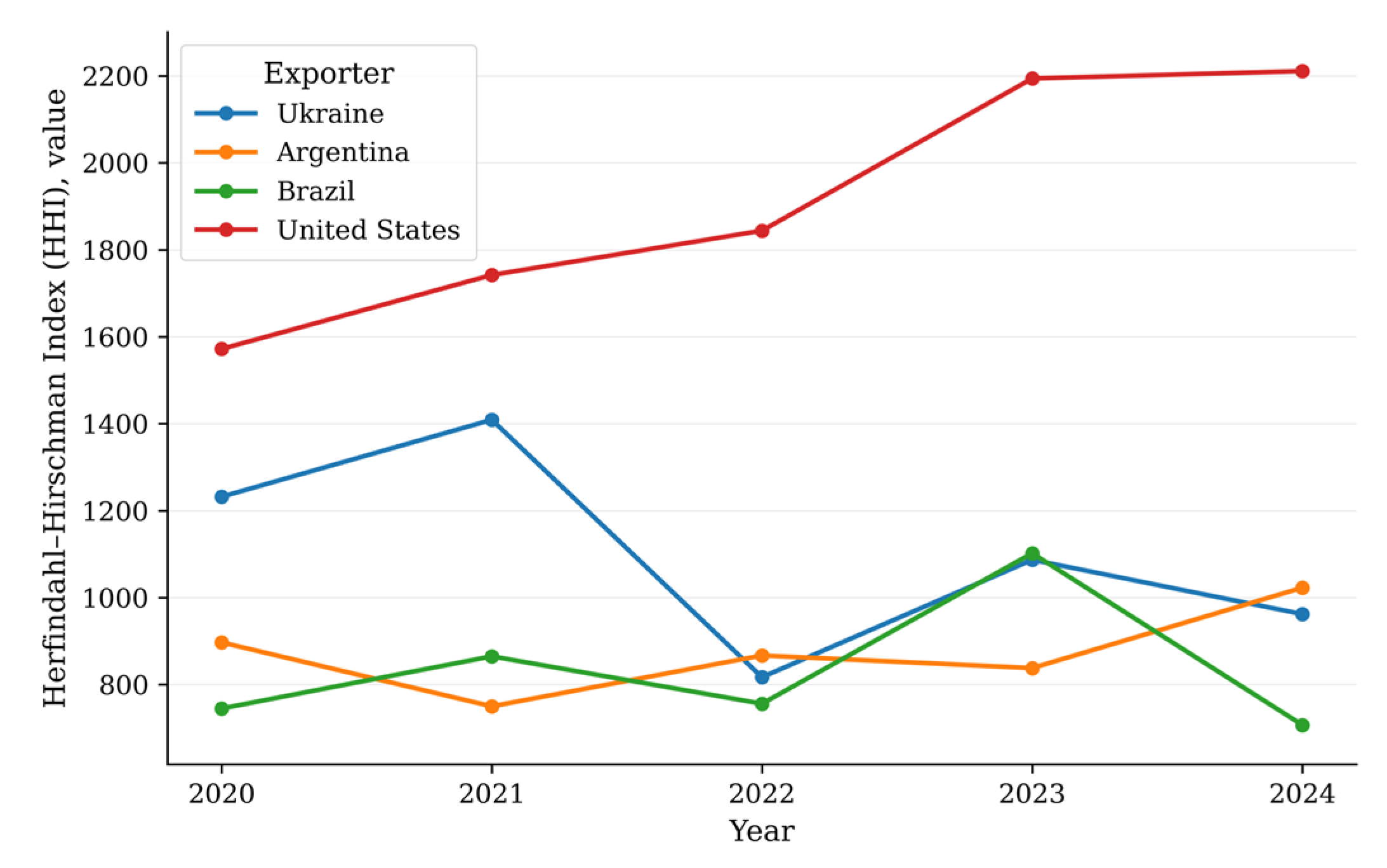
The United States has been the world’s leading maize exporter for decades, supported by high production levels (often about one-third of the global total) and efficient logistics infrastructure. It is also the largest maize exporter by export value worldwide [
21], contributing approximately 30–40% of global export volumes in recent years [
22]. This position creates challenges, including the need to diversify export destinations and strengthen product differentiation. Mexico, Japan, Colombia, South Korea, and China are among the main buyers of U.S. maize, which suggests relatively broad geographic diversification. However, several issues remain. In 2018–2019, trade disputes between the United States and China led to tariffs and other barriers that sharply reduced U.S. maize (and soybean) exports to China, revealing sensitivity to this emerging market [
23]. In addition, the United States allocates a large share of its maize crop to domestic ethanol production (around 30–40%); so, changes in energy policy and oil prices can affect exportable supply [
24]. A key challenge is to maintain cost-and-quality competitiveness against South American suppliers. In recent years, U.S. exporters have faced a strong dollar (which raises export prices) and, in some cases, lower logistics costs from Brazil to Asian markets through maritime transport routes [
25].
Brazil has shifted from being a marginal maize exporter to the world’s second-largest exporter in recent years. Driven by technological advances (such as safrinha production and no-till farming) and the expansion of its agricultural frontier, Brazil has multiplied export volumes over the last decade, reaching external sales of USD 12.150 billion in 2022 (43.4 million tons) [
22]. Brazil has built strong competitiveness in maize, supported by relatively low production costs and an exchange rate that has often favored agricultural exports (a depreciated Brazilian real against the U.S. dollar) [
26]. However, Brazil faces a challenging mix of logistics constraints and concentration in export markets. Much of its export maize is produced in the Center-West (Mato Grosso) and northern regions, far from ports, which increases inland freight costs. Traditional ports in the Southeast (Santos, Paranaguá) also compete for capacity with soybean exports, creating bottlenecks during peak periods [
27]. Although public and private investments have expanded new routes (Northern Arc ports such as Itaqui and Barcarena, and Amazonian waterways) to diversify logistics corridors, this remains an ongoing challenge for sustaining competitiveness [
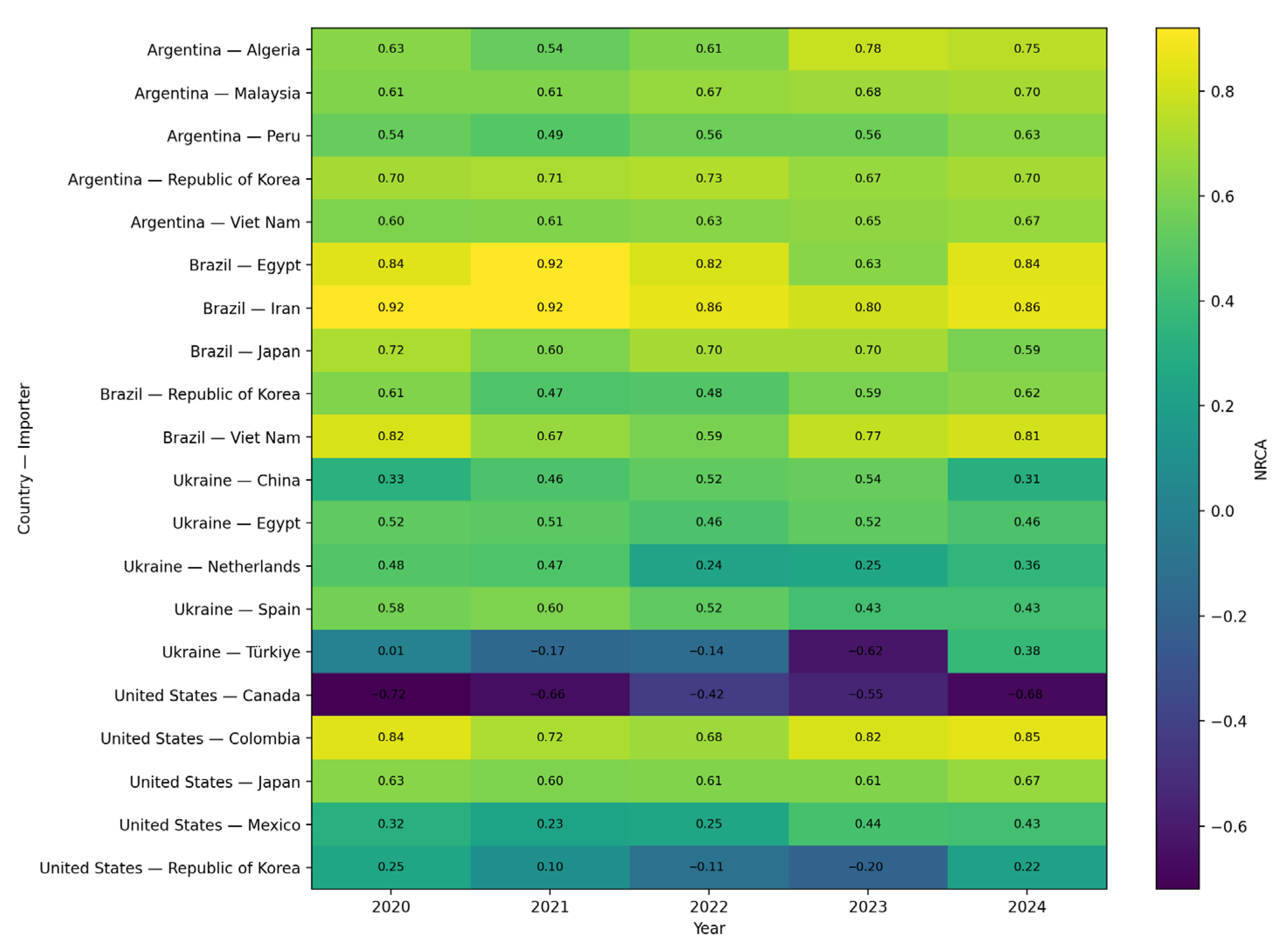
28]. In terms of market diversification, Brazil exports mainly to Asia and the Middle East. Its largest buyers typically include Iran, Japan, Egypt, and Viet Nam [
29], and more recently China, which authorized imports of Brazilian maize in 2022 and has become a key market [
26]. This customer concentration may increase risk if any large buyer reduces demand due to domestic conditions or stronger competition from lower-priced suppliers. Another critical issue is production instability: despite Brazil’s strong potential, the safrinha crop is vulnerable to climate variability and the early onset of rains, which can increase volatility in export availability [
30]. For example, drought in 2018 reduced production sharply and forced Brazil to import maize, while record harvests in 2019 and 2020 boosted exports [
31]. This volatility complicates planning for international buyers.
Argentina has long been a major agricultural exporter and ranks third in global maize export volumes [
17]. In 2022, it exported around USD 9.222 billion in maize (35.4 million tons), equivalent to roughly three out of every ten tons traded worldwide. Argentina holds a strong position in the maize export market, reflecting a high degree of specialization and competitiveness in this crop [
32]. Argentine maize production has achieved rising yields and relatively low costs due to fertile land (the Pampas), technological adoption (genetically modified seeds, efficient machinery), and economies of scale in large farms [
33]. However, Argentina faces challenges linked to macroeconomic conditions and domestic policies that can create uncertainty and concentration. First, Argentina applies export taxes (“retenciones”) on maize, often around 12–20% [
34]. Combined with foreign exchange controls, these measures can reduce producer incentives and affect supply stability: even if production is efficient, policy uncertainty may weaken margins and make export volumes less predictable [
35]. Another issue concerns timing and markets. Argentina ships much of its maize in the months after the main harvest (April–June), which can strain port capacity and market absorption during that period and then reduce availability later in the year [
36]. In terms of destinations, Argentina exports to a broad set of countries (Viet Nam, Algeria, Egypt, Malaysia, Peru, among others), but it depends heavily on several North African and Southeast Asian buyers that purchase large volumes. Diversification has been moderate and has also been shaped by quality requirements (e.g., moisture levels and specific standards). Still, improvements in port logistics around Greater Rosario (the main export hub) and the development of non-genetically modified maize for niche markets have helped broaden export offerings [
37]. A recent challenge was the severe 2022/23 drought, which reduced the maize harvest by nearly half, sharply lowering export volumes and weakening Argentina’s presence in global markets. This highlights climate vulnerability and the need for better risk management (for example, agricultural insurance remains underdeveloped) [
38]. Finally, Argentina faces growing competition from Brazil within Mercosur, as Brazil contests traditional Argentine markets, especially in Southeast Asia. As Brazil expands output, Argentina must work to retain customers through quality and reliable deliveries [
39].
Ukraine has consolidated its role as a major global maize exporter, representing around 13–16% of the world market. It has also managed to restore cereal export volumes to near pre-war levels, contributing to global food supply [
40]. Fertile black soils and relatively low production costs have supported Ukraine’s strong position in cereals, including maize [
32]. However, even before the war, Ukraine faced logistical constraints and regional instability. Black Sea ports (especially Odessa) were the main export channel, creating geopolitical exposure (tensions with Russia, potential naval blockades) and logistical limits (port capacity and reliance on safe-corridor arrangements) [
41]. These risks became reality during the war: in 2022 and 2023, Ukraine’s maize exports fell sharply, as shipments were blocked or restricted until the Black Sea Grain Initiative was implemented under international mediation [
42].
In addition to the disruption of maritime infrastructure and corridors, the conflict also constrained maize production and the formation of exportable surplus—through reduced access to land, damaged assets, labor displacement and input shortages—which reinforced the observed volatility in Ukraine’s destination profile and competitive position [
6,
7].
Many key importers (China, Spain, the Netherlands, Egypt) had to turn to alternative suppliers to cover the shortfall. Before the conflict, Ukraine had achieved notable market diversification. Beyond supplying the EU (mainly Spain and the Netherlands), it expanded strongly in China, which between 2019 and 2021 purchased about 30–40% of Ukraine’s maize exports. This concentration increased exposure to political decisions (e.g., China’s temporary purchase limitation in 2015) but also provided a relatively stable outlet while the trade relationship remained favorable [
43]. Ukraine also exported to North Africa and the Middle East, adding geographic breadth to its portfolio [
17]. Despite this, Ukraine’s central challenge today is how to sustain its export role during the war and in a post-conflict scenario. In the short term, it has relied more on land and river routes through the EU (solidarity corridors), which are costlier and less efficient than maritime shipping. This has raised Ukraine’s relative costs and weakened competitiveness compared with other suppliers [
44].
1.9. Literature Review
The literature contains numerous studies that have jointly applied the Herfindahl–Hirschman Index and revealed comparative advantage, or variants thereof, to analyze competitiveness and export diversification in agri-food products.
One study examined the competitiveness and diversification of global table grape exports using HHI and normalized RCA. It found significant differences across countries; for example, Peru and South Africa exhibited rapid export growth and high RCA in certain markets, but at the cost of a high concentration of destinations (elevated HHI) [
45]. Similarly, another study analyzed four South American coffee exporters (Brazil, Colombia, Peru, and Ecuador), concluding that Brazil and Colombia combine moderate diversification with strong comparative advantage, whereas Peru and Ecuador depend on a small number of buyers (high HHI) and display more limited comparative advantages [
46]. These studies show how leading Latin American economies in fruits and tropical commodities have implemented market diversification strategies to sustain their competitiveness.
In addition, another study assessed the sustainability of Peru’s blueberry exports using HHI and RCA, finding extraordinary growth in exported volume but a significant concentration in the United States market. Despite expansion into Europe and Asia, nearly half of Peru’s blueberry sales were destined for the United States, reflecting a high HHI and the need to continue diversifying destinations. Nonetheless, Peru’s RCA in blueberries turned out to be among the highest in the world, demonstrating its strong competitiveness in this niche. This duality—high RCA alongside persistently high HHI—is a pattern that can also be observed for some maize exporters, where a highly competitive country still faces the task of diversifying into a broader set of markets [
47].
Another contribution analyzed the competitiveness of India’s sorghum exports, using Balassa’s RCA, Markov chain analysis, and HHI to measure market concentration. The findings indicated that India possesses comparative advantage in sorghum (RCA > 1 for most of the study period), but its exports were regionally concentrated, making them unstable. This study recommends diversifying buyers in order to fully capitalize on India’s competitiveness in this minor cereal [
48]. In the same vein, Bashimov (2022) evaluated the comparative advantage of Kazakhstan’s cereals (wheat, barley, and maize) and found that Kazakhstan exhibits high RCA in wheat and barley, accompanied by robust competitiveness in those grains, although with a geographical concentration in neighboring markets (Central Asia and China) [
49]. Although that study focused on RCA and the related symmetric revealed comparative advantage index, it establishes a precedent for the analysis of countries with strong cereal specialization that, as in the case of Ukrainian or Argentine maize, depend on a limited set of destinations and thus face the need to diversify.
Another cereal-focused investigation examined global competitiveness in wheat, maize, and rice over a 20-year period. Although its main emphasis was on Turkey, the results indicated that Argentina held the highest comparative advantage in maize worldwide, followed closely by Brazil and the United States, whereas Turkey lacked competitiveness in this product. This study combined RCA indices, net trade ratios, and trade balances, although it did not apply HHI directly. Nonetheless, it constitutes a useful antecedent by highlighting the prominent position of South American countries in maize and the importance of domestic conditions for leveraging that advantage (in Turkey’s case, it did not translate into exports due to domestic consumption and local policies) [
32].
1.10. Theoretical Background/Conceptual Definitions
Trade resilience refers to an exporter’s capacity to absorb shocks and keep trade flows functioning with limited and temporary losses. In this logic, a higher HHI signals greater exposure because dependence on a few destinations reduces substitution options, while NRCA reflects the strength of revealed specialization that sustains market access. Thus, HHI and NRCA jointly describe how competitiveness and diversification shape resilience. From a sustainable food systems perspective, resilience matters because it supports the stability pillar of food security, alongside availability and access. When maize trade is concentrated, disruptions in a dominant route or buyer can translate into sharper volatility in volumes and prices, weakening stability in importing regions. Diversified, competitive networks improve the capacity to reroute supply and reduce systemic vulnerability.
The HHI–RCA pair has also been applied to processed products and specialized markets. One study analyzed the international market for sparkling wine from 2004 to 2018, calculating both the HHI of market structure and RCA for the main exporters (France, Italy, Spain, etc.). The authors found that France maintained a leading position, with a high market share and elevated RCA, while countries such as Italy and Spain improved their comparative advantage (increasing their revealed exports), but the market remained moderately concentrated among a small group of exporters (high HHI) [
50]. Although this is a different sector, the parallels are clear: even in concentrated markets, new participants can improve their revealed competitiveness (as Italy did in sparkling wine, or Brazil in maize), yet the overall structure continues to show dependence on a few key players.
Another study evaluated the structure and competitiveness of the global wine market (generic wine), including an analysis of the duration of comparative advantage over time. It confirmed that the export market for wine exhibits moderate concentration (medium-level HHI) and that “New World” countries (Chile, Australia, etc.) achieved high RCA, although few of these advantages were sustained over long periods [
51].
In summary, the existing evidence shows extensive use of concentration metrics (HHI) and revealed competitiveness indicators (RCA) in the analysis of agri-food exports. Researchers have investigated products as diverse as fruits (grapes, blueberries), beverages (wine), grains (wheat, sorghum), and spices (pepper), both in leading and emerging economies. Several common lessons emerge: typically, countries with high RCA tend to dominate markets but face the risk of elevated HHI (concentration), which they must manage; diversification is frequently recommended to strengthen export resilience without losing focus on the core area of competitive specialization.
These prior studies underscore the relevance of the present work, which applies similar tools to the case of maize in four exporting powers. By comparing its results with the existing literature, it becomes possible to determine whether maize follows patterns similar to other commodities or displays specific dynamics of its own. In any case, the accumulated evidence indicates that combining HHI and RCA analysis provides a more comprehensive understanding of a country’s position in the international market: not only whether it is competitive, but also how diversified—and therefore how robust—that competitiveness is in the face of external shocks.
Economic theory suggests that greater export diversification contributes to the stability and resilience of an economy by reducing dependence on a small set of products or markets [
52,
53]. Conceptually, diversification is linked to the idea of not “selling everything to a single actor or a single market,” thereby mitigating idiosyncratic risks (climate, conflict, regulatory changes) associated with specific destinations [
54]. A widely used index for quantifying diversification—or, inversely, export concentration—is the Herfindahl–Hirschman Index (HHI). Originally formulated for measuring industrial concentration, this indicator is defined as the sum of the squared market shares of each element [
55]. In the context of exports, the HHI can be calculated for a country’s exports by destination (measuring how concentrated they are in a few markets) [
56,
57,
58].
Although HHI is computed from destination shares and is therefore scale-invariant mechanically, the absolute scale of exports can still affect diversification through the extensive margin. When export programs expand, exporters can amortize fixed market-entry and compliance costs and serve additional destinations, while contractions can force a retreat toward core outlets and raise concentration. Accordingly, HHI movements should be interpreted jointly with the evolution of total export values in each table (which may also reflect price-quantity interactions), rather than as a purely compositional phenomenon [
52,
53,
54,
55,
56,
57,
58].
The concept of comparative advantage originates in classical theory (David Ricardo), which posits that each country tends to specialize in the goods it can produce relatively more efficiently [
59,
60]. However, the empirical measurement of this notion took shape with the revealed comparative advantage (RCA) index proposed by Béla Balassa [
61]. Balassa’s formula is built on a simple idea: comparing the relative importance of a product in a country’s exports with the importance of that same product in world exports. First, the share of a specific product in a country’s total exports is calculated. Next, the same share is computed at the global level—that is, how much that product represents within total world exports. Finally, the national share is divided by the global share [
62].
The resulting value reflects the export specialization of a country in that product. If the result is greater than one, the country is relatively more specialized in exporting that good than the world average, and this is interpreted as revealed comparative advantage. If the value is below one, the country does not exhibit comparative advantage in that good, since its relative importance is lower than in global trade.
There is also a normalized version of this index. Normalization aims to correct the fact that RCA values may range from zero to infinity, which complicates cross-country and cross-product comparisons [
63]. For clarity and consistency, this manuscript uses RCA to denote Balassa’s original revealed comparative advantage index and NRCA to denote its normalized (symmetric) transformation bounded between −1 and +1 [
64], computed from the Balassa index as in [
63]; therefore, any alternative labels (e.g., IB/BI) are avoided and the empirical results consistently report NRCA values [
57].
RCA summarizes multiple dimensions of competitiveness (relative costs, factor endowments, productivity, policies) into a single number based on effective trade outcomes (hence the term “revealed”, as it is derived from observed export/import patterns) [
65]. Theoretically, RCA is an ex post measure that reflects competitive performance: a high value suggests that the country has captured a larger share of the world market for that good than would be expected based on its economic size [
66,
67]. Trade theory indicates that countries with high comparative advantage in a good tend to export it in large volumes and to obtain gains from trade in that sector, although transport costs, subsidies, and policy interventions may modify this simple prediction [
68].
Finally, the integration of diversification and revealed competitiveness can be interpreted through trade resilience theory, understood as the capacity of trade systems to absorb shocks and sustain flows with limited losses. In this logic, a higher HHI indicates greater vulnerability due to dependence on a small number of destinations and reduced scope for substitution during disruptions, whereas a positive NRCA reflects a degree of specialization that helps maintain market access and regain participation in key outlets. From the perspective of sustainable food systems, such resilience is essential because it strengthens the stability dimension of food security: when maize trade becomes concentrated and is disrupted, volatility is more readily transmitted to prices and availability in importing regions, while more diversified and competitive networks help buffer these effects.






 ,
,