Article

Source Apportionment and Health Risk Assessment of Heavy Metals in Groundwater in the Core Area of Central-South Hunan: A Combined APCS-MLR/PMF and Monte Carlo Approach

1
Survey and Monitoring Institute of Hydrogeology and Environmental Geology of Hunan Province, Changsha 410129, China
2
Exploration Institute of Geological Engineering of Hunan Province Co., Ltd., Zhuzhou 412003, China
3
Engineering Research Center for Groundwater Resources and Environment of the Hunan Province, Changsha 410129, China
4
Chinese Research Academy of Environmental Sciences, Beijing 100012, China
5
Geospatial Survey and Monitoring Institute of Hunan Province, Changsha 410129, China
*
Author to whom correspondence should be addressed.
Sustainability 2026, 18(3), 1225; https://doi.org/10.3390/su18031225
Submission received: 23 December 2025 / Revised: 19 January 2026 / Accepted: 19 January 2026 / Published: 26 January 2026

Abstract

Groundwater, a critical resource for regional water security and public health, faces escalating threats from heavy metal contamination—a pressing environmental challenge worldwide. This study focuses on the central-south Hunan region of China, a mineral-rich, densely populated area characterized predominantly by non-point-source pollution, aiming to systematically unravel the spatial patterns, source contributions, and associated health risks of heavy metals in local groundwater. Based on 717 spring and well water samples collected in 2024, we determined pH and seven heavy metals (As, Cd, Pb, Zn, Fe, Mn, and Tl). By integrating hydrogeological zoning, lithology, topography, and river networks, the study area was divided into 11 assessment units, clearly revealing the spatial heterogeneity of heavy metals. The results demonstrate that exceedances of Cd, Pb, and Zn were sporadic and point-source-influenced, whereas As, Fe, Mn, and Tl showed regional exceedance patterns (e.g., Mn exceeded the standard in 9.76% of samples), identifying them as priority control elements. The spatial distribution of heavy metals was governed the synergistic effects of lithology, water–rock interactions, and hydrological structure, showing a distinct “acidic in the northeast, alkaline in the southwest” pH gradient. Combined application of the APCS-MLR and PMF models resolved five principal pollution sources: an acid-reducing-environment-driven release source (contributing 76.1% of Fe and 58.3% of Pb); a geogenic–anthropogenic composite source (contributing 81.0% of Tl and 62.4% of Cd); a human-perturbation-triggered natural Mn release source (contributing 94.8% of Mn); an agricultural-activity-related input source (contributing 60.1% of Zn); and a primary geological source (contributing 89.9% of As). Monte Carlo simulation-based health risk assessment indicated that the average hazard index (HI) and total carcinogenic risk (TCR) for all heavy metals were below acceptable thresholds, suggesting generally manageable risk. However, As was the dominant contributor to both non-carcinogenic and carcinogenic risks, with its carcinogenic risk exceeding the threshold in up to 3.84% of the simulated adult exposures under extreme scenarios. Sensitivity analysis identified exposure duration (ED) as the most influential parameter governing risk outcomes. In conclusion, we recommend implementing spatially differentiated management strategies: prioritizing As control in red-bed and granite–metamorphic zones; enhancing Tl monitoring in the northern and northeastern granite-rich areas, particularly downstream of the Mishui River; and regulating land use in brick-factory-dense riparian zones to mitigate disturbance-induced Mn release—for instance, through the enforcement of setback requirements and targeted groundwater monitoring programs. This study provides a scientific foundation for the sustainable management and safety assurance of groundwater resources in regions with similar geological and anthropogenic settings.

1. Introduction

Groundwater is a cornerstone for sustainable water supply, owing to its relative stability and lower vulnerability to contamination compared to surface water. However, rapid industrialization—driven by activities such as mining, metallurgy, and chemical production—has led to widespread heavy metal pollution, posing a severe and persistent threat to groundwater sustainability. Heavy metals, characterized by high toxicity, low degradability, and a strong propensity for bioaccumulation, can migrate into water systems and enter the human body primarily through ingestion of contaminated water and dermal contact. Chronic exposure to these contaminants is linked to substantial public health burdens, including neurological damage, organ dysfunction, and both carcinogenic and non-carcinogenic diseases [1], thereby directly undermining water security and impeding progress toward key Sustainable Development Goals (SDGs), notably SDG 6 (Clean Water and Sanitation) and SDG 3 (Good Health and Well-being) [2,3].
The sources of heavy metals in groundwater are complex, arising from an intricate interplay of natural geogenic processes and anthropogenic pressures [4,5]. In recent years, tracing the sources of pollution and assessing the attendant health risks have become major foci of environmental research [6,7,8]. Studies indicate that natural processes, such as rock weathering and soil leaching, primarily govern regional background concentrations of heavy metals [9]. Conversely, these levels are substantially elevated by anthropogenic activities, including industrial production, traffic emissions, agricultural non-point-source pollution, and mining and smelting operations [10,11,12]. Furthermore, local hydrogeochemical conditions, including pH, redox potential, and adsorption–desorption dynamics at mineral–water interfaces [13], jointly regulate the mobility, speciation, and ultimate fate of heavy metals, leading to their pronounced spatial heterogeneity across landscapes. To disentangle these mixed sources, receptor modeling techniques have been extensively applied. Methods such as principal component analysis (PCA), absolute principal component score–multiple linear regression (APCS-MLR), and positive matrix factorization (PMF) have proven effective in the qualitatively and quantitatively apportioning of heavy metals sources in soil [14], sediment [15], dust [16], and water bodies [17,18,19,20]. Concurrently, health risk assessment frameworks, notably the model developed by the U.S. Environmental Protection Agency (US EPA), have become the standard for evaluating potential hazards [21,22,23,24]. These models estimate the probability of adverse health effects by calculating the average daily dose of pollutants. To address the inherent uncertainties in parameter estimation, the Monte Carlo simulation is increasingly integrated to perform probabilistic risk characterization, offering a more robust and realistic assessment than traditional deterministic approaches [25].
Despite these methodological advances, significant regional and contextual gaps persist in systematic research on heavy metals in groundwater. Currently, the research paradigm that integrates receptor models (e.g., PCA, APCS-MLR, PMF) for heavy metal source apportionment with health risk assessment and Monte Carlo simulation for uncertainty analysis has been applied and has achieved important progress in several typical regions of China. For example, in the arid Zhangye Basin of Northwest China, research focused on the distribution and health risks of heavy metals in groundwater during crop irrigation in arid oasis areas, revealing that industrial–agricultural activities are the main contributors to health risks [1]. In Hainan Island, studies on large-scale island groundwater heavy metals quantified the distinct contributions of natural, mixed agricultural–traffic, and industrial sources to health risks, identifying Cr as a priority control heavy metal [26]. In the Pearl River Delta, research investigated the pollution characteristics, sources, and seasonal health risks of heavy metals in centralized drinking water sources in urbanizing areas, identifying Mn, Fe, and As as characteristic pollutants [27]. Studies in South Dongting Lake primarily assessed the pollution levels and health risks of elements such as Fe, Mn, and As, identifying concentration and exposure time as key sensitive factors [28]. At the same time, these methods have also been widely or selectively applied to analyze various well-defined point-source-contaminated sites (such as tailings ponds, chemical industrial parks, or abandoned smelters), with study objects covering multiple environmental media including groundwater, soil, and sediments [29,30,31,32]. However, a comprehensive review of existing research indicates that the focus remains largely confined to specific regions or sites with relatively singular pollution sources. For regional groundwater systems characterized by complex hydrogeological conditions and influenced by long-term, multi-source diffuse anthropogenic inputs (such as historical mining and agricultural activities) combined with high natural background values, comprehensive studies that systematically integrate quantitative source apportionment and probabilistic health risk assessment are still notably lacking. This limitation hinders a holistic understanding of the interactive mechanisms between natural background processes and widespread anthropogenic disturbances. More critically, it impedes the formulation of integrated, science-based management strategies that are essential for achieving long-term groundwater sustainability and securing water safety for the public.
The core area of central-south Hunan, located in the middle reaches of the Xiang River Basin, epitomizes this critical research gap. As a vital mineral resource base in China, abundant in deposits of Fe, Mn, Pb, Zn, Cu, and Sn, this region has a long history of mining and smelting activities [33]. While these industries have driven economic growth, they have also left a lasting legacy of potential contamination. The region faces a pronounced sustainability dilemma: it is economically dynamic and densely populated, with stringent demands for safe water, yet it is also prone to seasonal droughts [34], making groundwater an indispensable, yet vulnerable, resource. Despite this pressing context, a systematic, regional-scale understanding groundwater quality, particularly concerning source identification under conditions where obvious point sources are absent, is still lacking.
To bridge this gap, this study aims to clarify the source, driving mechanisms, and human health risks of heavy metals in groundwater within this critical region of central-south Hunan, with a focus on areas dominated by non-point-source influences. We implemented a strategic “source-avoidance” sampling design, specifically collecting spring and well water samples that reflect regional hydrogeological background conditions and diffuse anthropogenic inputs, thereby minimizing the masking effect of intense, localized point sources. The specific objectives were to (1) systematically analyze the spatial distribution patterns of seven key heavy metals (As, Cd, Pb, Zn, Fe, Mn, Tl) across defined hydrogeological units; (2) quantitatively apportion their sources and identify the dominant contributing source (i.e., the source with the highest contribution rate) for each metal by applying and comparing the results of two receptor models, namely the APCS-MLR and PMF models; (3) conduct a probabilistic human health risk assessment through the integration of the USEPA health risk assessment model with the Monte Carlo simulation.
The integrated findings are expected to provide a scientific foundation for the developing targeted, spatially differentiated strategies for groundwater protection and risk prevention, thereby supporting sustainable water resource management in the region and similar geological settings globally.

2. Materials and Methods

2.1. Study Area

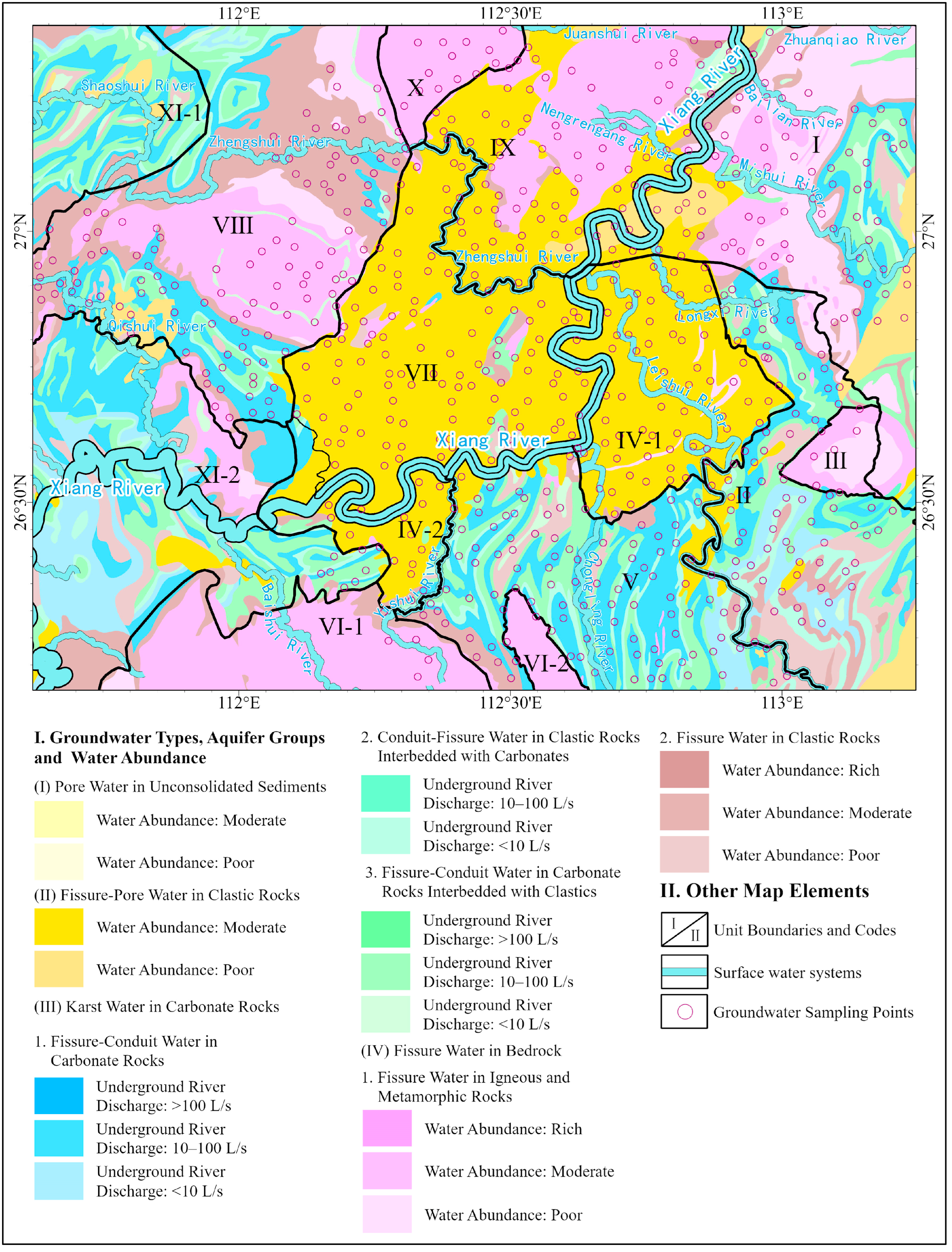
The study area is situated in the core region of central-south Hunan, characterized by a subtropical monsoon climate with distinct seasonal variations and synchronized rainfall–heat patterns. Mean annual precipitation exceeds 1300 mm yet exhibits notable spatiotemporal variability: heavy rainfall concentrates during the flood season (April–September), frequently causing flood events, while precipitation declines sharply from late August to mid-October, often leading to autumn drought conditions. The region possesses a dense river network within the Xiang River system, with major tributaries including the Chonglingshui, Zhengshui, Leishui, and Mishui Rivers. Geomorphologically, the area forms a typical basin structure, surrounded by ridges and mountains composed of ancient bedrock, whereas the interior consists of Cretaceous–Lower Tertiary red-bed hills and platforms. Stratigraphy ranges from the Sinian to Quaternary systems, with generally complete and well-exposed sequences [35]. Magmatic rocks are less widespread, represented mainly by intrusive granitic bodies of meso-plutonic facies. Based on aquifer media, groundwater in the region is classified into four main types: pore water in unconsolidated sediments, fissure–pore water in clastic rocks, karst water in carbonate rocks, and fissure water in bedrock (Figure 1).

2.2. Regional Zoning Rationale and Framework

To systematically investigate the spatial distribution and enrichment mechanisms of heavy metals in groundwater across diverse hydrogeological settings, and to establish a structured basis for subsequent source apportionment, the study area was delineated into 11 assessment units. This zoning framework integrated the provincial five-level groundwater resource division of Hunan Province with key environmental determinants, including formation lithology, geomorphology, and surface water systems (Figure 1). The defined units were as follows: (I) the granite–metamorphic rock area in the lower reaches of the Mishui River; (II) the karst area in the lower reaches of the Leishui River; (III) the granite area in the lower reaches of the Leishui River; (IV) the red-bed area on the right bank of the Xiang River; (V) the karst area in the lower reaches of the Chonglingshui River; (VI) the Yangmingshan–Dayishan granite–metamorphic rock area; (VII) the red-bed area on the left bank of the Xiang River; (VIII) the granite–metamorphic rock area on the right bank of the Zhengshui River; (IX) the granite–metamorphic rock area on the left bank of the Zhengshui River; (X) the Jiufengshan granite–metamorphic rock area; (XI-1) the karst area in the Shaoshui Basin; (XI-2) the karst area in the Qishui River Basin.

2.3. Data Sources and Preprocessing

From April to May 2024, a total of 717 groundwater samples were collected from springs and wells across the study area. Sampling sites were established using a grid-based approach in accordance with the Specification for Regional Groundwater contamination Investigation and Evaluation [36]. The sample collection procedures and quality control measures strictly followed the relevant requirements of the Technical Specifications for Environmental Monitoring of Groundwater [37]. On-site parameters such as pH were measured using a portable water quality analyzer. After collection, water samples for dissolved heavy metal analysis (excluding As) were immediately filtered through 0.45 μm membrane filters. As was analyzed for total concentration without filtration. All samples were then preserved with nitric acid and stored at 4 °C before being transported to the Geological Experiment and Testing Center of Hunan Province. The concentrations of elements were determined using inductively coupled plasma mass spectrometry (Thermo X2, Thermo Fisher Scientific, Waltham, MA, USA) and inductively coupled plasma optical emission spectrometry (ICAP 6300, Thermo Fisher Scientific, Waltham, MA, USA). The detection limits were as follows: As and Mn: 0.12 μg·L−1; Fe: 0.02 mg·L−1; Cd: 0.05 μg·L−1; Pb: 0.09 μg·L−1; Zn: 0.67 μg·L−1; Tl: 0.02 μg·L−1. During continuous analysis, the mid-concentration point of the calibration curve was measured after every 20 samples to verify instrument calibration. For each batch, 5% of the samples were randomly selected for duplicate analysis. Blank controls and spiked recovery tests were also conducted as part of the quality control procedures. The results met quality control requirements.
To address non-detects in the heavy metal datasets, a hierarchical interpolation strategy was applied: for As, Zn, and Mn, which had a low proportion of non-detects, simple substitution (detection limit/√2) was used as this method is computationally straightforward and introduces minimal bias; for Pb and Fe, maximum-likelihood estimation based on an optimal lognormal distribution was applied to best preserve the distributional characteristics of these elements; for Cd and Tl, which exhibited a high proportion of non-detects, undetected values were treated as left-censored data and interpolated using a survival analysis model to enhance data reliability. All interpolated values were maintained below the respective detection limits. Following interpolation, a 99.5% quantile tail reduction was performed to mitigate the influence of extreme values. The resulting complete and statistically robust dataset was used for all subsequent analyses.

2.4. Research Methods

2.4.1. APCS-MLR Model

To quantitatively identify the potential sources of heavy metals in groundwater and clarify their contribution rates, PCA was first employed to reduce dimensionality by transforming multiple original indicators into a few comprehensive principal components that reflected the main information. Subsequently, APCS-MLR model was applied for quantitative source resolution.
The computational procedure was as follows: First, original data were standardized using Z-score normalization to eliminate unit and magnitude differences. PCA was then performed to extract principal components and obtain normalized factor scores. A theoretical “zero-concentration” sample (all heavy-metal concentrations equal to zero) was introduced, and the PCA procedure repeated to calculate its factor scores. The absolute principal component score (APCS) for each actual sample was derived by subtracting the zero-concentration sample’s factor scores from the corresponding sample scores. Multiple linear regression (MLR) was then applied with the measured concentration of each heavy metal as the dependent variable and the calculated APCSs as independent variables to estimate regression coefficients (Equation (1)). Finally, the contribution rate of each source to each heavy metal was calculated (Equation (2)), completing the quantitative apportionment.
C i = b i + p = 1 n ( a i p × A P C S i p )
PC i p = a i p × A P C S i p ¯ p = 1 n a i p × A P C S i p ¯ × 100 %
where C i is the measured concentration of heavy metal i (mg·kg−1); b i is the intercept of the multiple regression for element i; a i p is the regression coefficient of source p for element i; A P C S i p is the absolute principal component score of source p for element i; A P C S i p ¯ is the mean absolute principal component score of source p for element i; and PC i p is the relative contribution rate of source p to heavy metal element i (%).

2.4.2. PMF Model

The positive matrix factorization (PMF) model, a widely recognized receptor model based on multivariate factor analysis, was applied to further analyze heavy metal sources. The model decomposes the input sample data matrix (X) into a factor contribution matrix (G), a factor profile matrix (F), and a residual matrix (E), thereby characterizing source profiles and quantitatively calculating the contribution of each source to individual samples. The fundamental equation is expressed as follows:
X i j = k = 1 p G i k F j k + E i j
where Xij is the measured concentration of the jth heavy metal in the ith sample; Gik is the contribution of the kth source to the ith sample; Fjk is the concentration of the jth heavy metal in the profile of the kth source; Eij is the residual for the jth element in the ith sample; and p is the total number of resolved factors (sources).
In the PMF solution, all elements of G and F are constrained to be non-negative, ensuring physically interpretable results.
The PMF model minimizes the objective function Q using a least-squares approach:
Q = i = 1 n j = 1 m X i j k = 1 p G i k F j k μ i j 2 = i = 1 n j = 1 m E i j μ i j 2
where Q is the objective function to be minimized and Eij is the residual for the jth heavy metal in the ith sample. μ i j represents the uncertainty associated with the concentration of the jth heavy metal in the ith sample, calculated as
μ i j = 5 6 × M D L , ( C i j M D L ) μ i j = C i j × θ 2 + ( 0.5 × M D L ) 2 , ( C i j > M D L )
where MDL is the method detection limit for the jth heavy metal; C i j is the measured concentration of the jth heavy metal in the ith sample; and θ is the relative error coefficient for the jth heavy metal (set to 0.05 in this study).

2.4.3. Health Risk Evaluation

The human health risk assessment model developed by the USEPA was employed to evaluate health risks posed by heavy metals in groundwater. This study assessed both carcinogenic risks (from As and Cd) and non-carcinogenic risks (from Tl, Pb, Zn, Fe, and Mn) for children and adults via two primary exposure pathways: drinking water ingestion and dermal contact. Pb (classified as a Group 2B carcinogen) was evaluated only for non-carcinogenic effects.
The average daily dose (ADD) for each exposure pathway was calculated using established USEPA equations [38]:
ADD i n g e s t i o n = c × I R × E F × E D B W × AT
ADD d e r m a l = c × S A × P C × E T × E F × E D × C F B W × AT
Non-carcinogenic and carcinogenic risk indices were then calculated as follows:
HI = HQ = ADD RFD = ADD ingestion RFD ingestion + ADD dermal RFD dermal
TCR = CR = A D D × S F = A D D ingestion × S F ingestion + A D D dermal × S F dermal
where c is the concentration of the pollutant (mg·L−1); ADD i n g e s t i o n and ADD d e r m a l are the average daily doses via the ingestion and dermal contact pathways, respectively (mg·kg−1·d−1); HQ is the non-carcinogenic risk for a single pollutant, and HI represents the cumulative non-carcinogenic risk from multiple pollutants; CR is the cancer risk for a single carcinogen, and TCR denotes the cumulative carcinogenic risk; RFD indicates the average daily exposure reference dose (mg·kg−1·d−1); and SF represents the carcinogenic slope factor (mg·kg−1·d−1).
The reference dose (RFD) and slope factor (SF) values used in this assessment are listed in Table 1, and other exposure parameters (e.g., ingestion rate, body weight, skin surface area) are detailed in Table 2. To address uncertainties inherent in deterministic risk assessment, a Monte Carlo simulation was integrated within the USEPA framework. This probabilistic approach incorporated parameter variability by repeatedly sampling input values from their respective probability distributions over 10,000 iterations. The results are expressed as probability distributions of risk outcomes, with 95% confidence intervals used to characterize uncertainty, providing a robust basis for evaluating health risks in a sustainability-oriented management context.
According to USEPA guidelines, a hazard index (HI) < 1 suggests that adverse non-carcinogenic health effects are unlikely, while an HI ≥ 1 indicates a potential risk of such effects. For carcinogenic risk [21], a total cancer risk (TCR) exceeding 1 × 10⁻⁴ is generally considered to represent a potential concern.

3. Results

3.1. Spatial Distribution Characteristics of Heavy Metal Concentration in Groundwater

The concentrations of seven heavy metals (As, Cd, Pb, Zn, Fe, Mn, and Tl) in groundwater exhibited striking spatial heterogeneity across the study area, with all elements showing high variability (coefficient of variation (CoV) > 1.2). Mn showed the most pronounced dispersion (CoV = 3.422), followed by Zn (CoV = 2.594) and Pb (CoV = 2.133), suggesting strong localization of influences, likely from point sources or intense geochemical differentiation. When evaluated against the Groundwater Quality Standard (GB/T 14848-2017 [44], Class III), As, Fe, Mn, and Tl consistently exceeded the threshold. Their over-standard rates (OSRs) remained unchanged at 2.37%, 2.09%, 9.76%, and 3.21%, respectively, both before and after statistical tail reduction, confirming their status as regionally pervasive “priority risk elements”. Notably, Mn was the most widespread contaminant. In contrast, the exceedances of Cd, Pb, and Zn were traceable to isolated extreme values; after removing outliers, their OSRs dropped to zero, pointing to localized, point-source regions rather than a diffuse regional trend (Table 3).
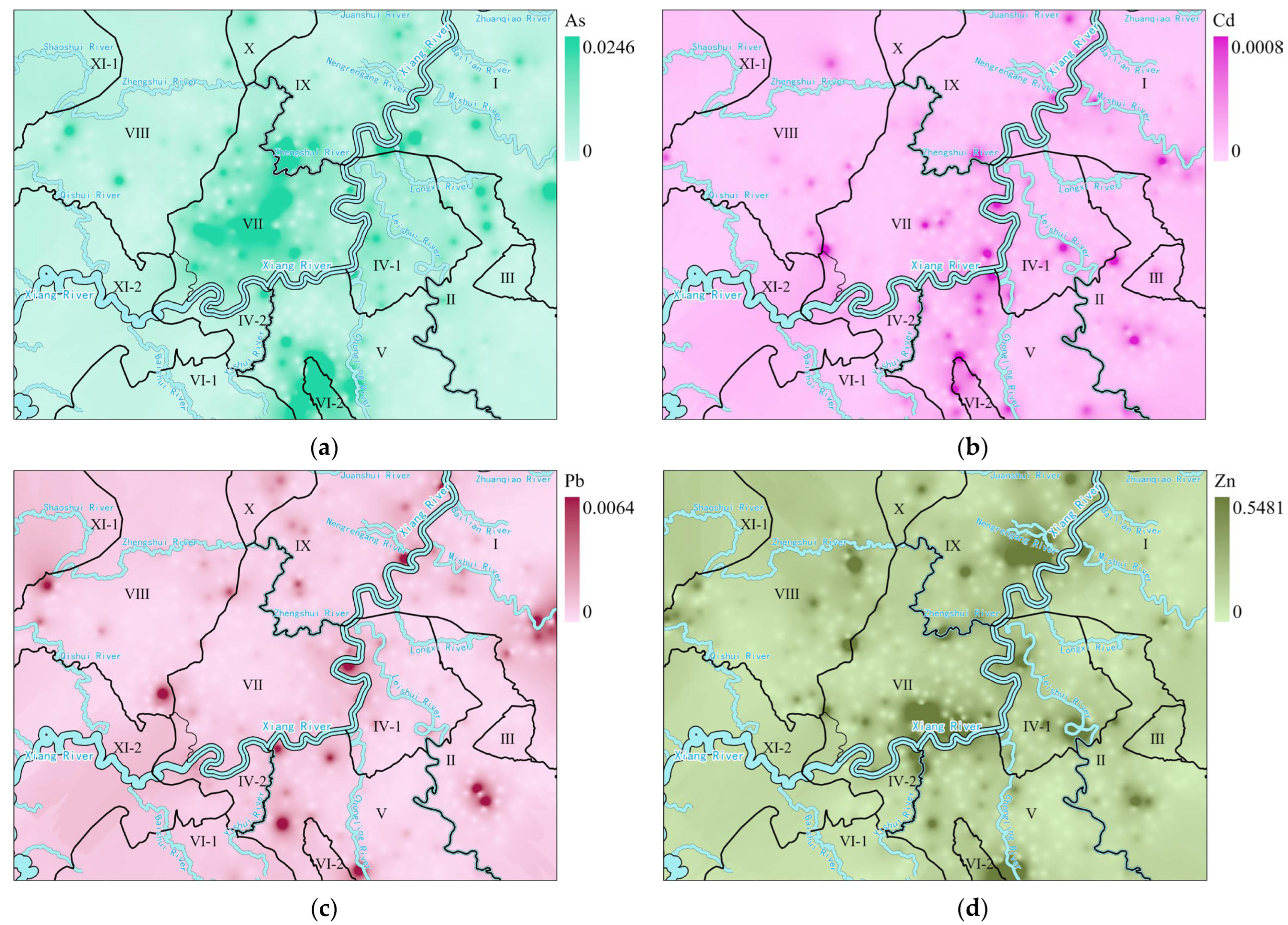
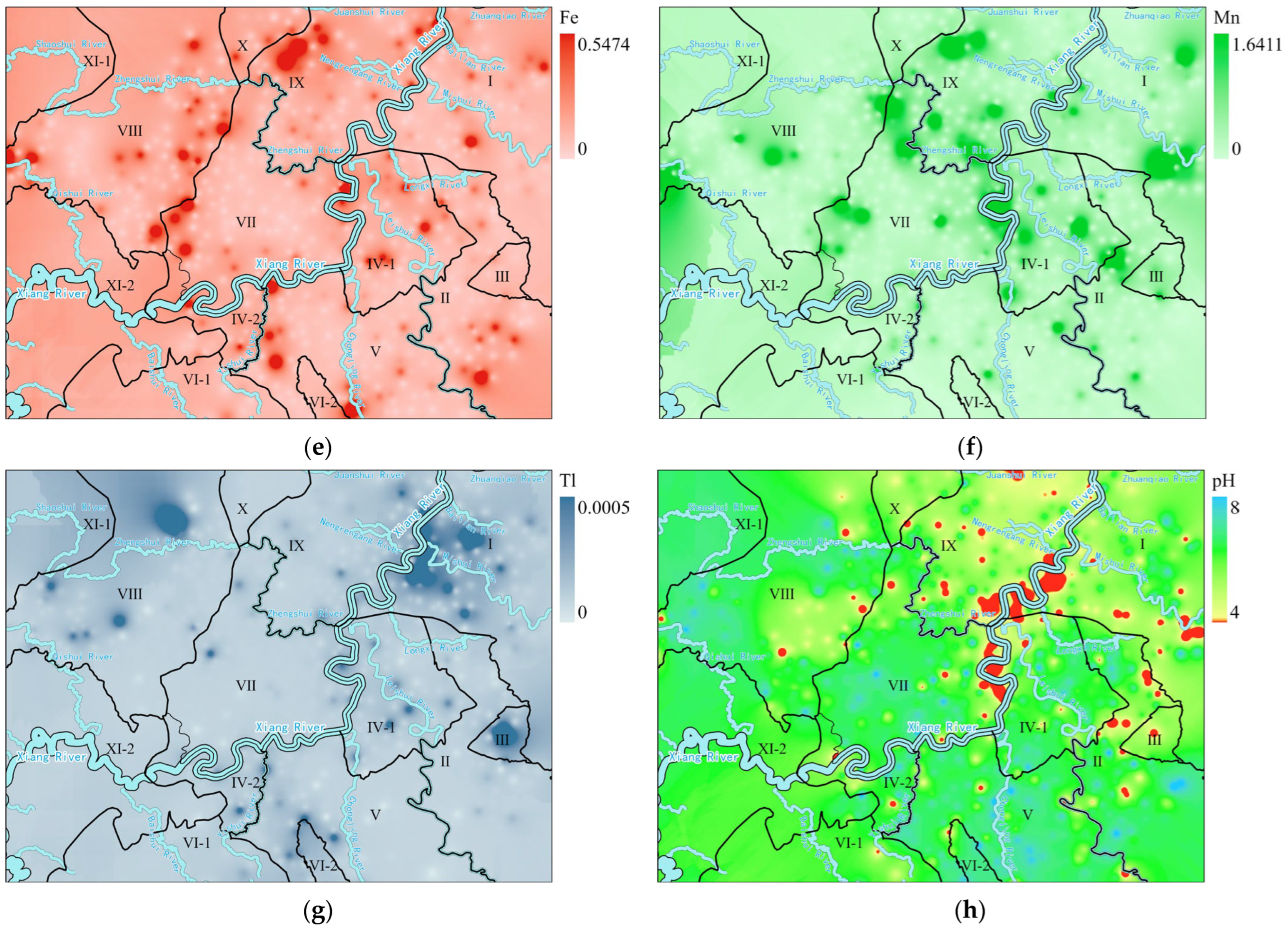
The spatial patterns, mapped across the 11 hydrogeochemical units (Figure 2), revealed distinct geochemical signatures. As hotspots were primarily concentrated in the red-bed area on the left bank of the Xiang River (Unit VII) and the Yangmingshan–Dayishan granite–metamorphic zone (Unit VI). This pattern suggests a possible explanation wherein As may be released through the reductive dissolution of iron oxide-rich clastic rocks in the red bed under reducing conditions [45,46] or from the weathering of As-bearing minerals in the bedrock [9]. Cd and Pb showed scattered, punctate high-value anomalies, suggesting sporadic anthropogenic inputs. Pb hotspots were often found in Quaternary deposits or laterite-covered karst zones. Zn displayed a distinct distribution, forming concentration corridors along major river, notably along the left bank of Xiang River (Unit VII, Unit IV) and in areas adjacent to Chonglingshui River (Unit VI). This pattern suggests a strong linkage to surface hydrological transport and potential runoff-derived inputs. Fe exhibited a near-continuous spatial band of elevated concentrations along key lithological boundaries, particularly at interfaces between red-bed units (e.g., Unit VII) and neighboring granite–metamorphic zones (e.g., Unit VIII), highlighting the control exerted by redox gradients at geological contacts. Mn contamination was most severe in the northwestern part of the study area, with pronounced enrichment in Quaternary sediments at the confluences of rivers in the red-bed area, such as near the Zhengshui River in Unit VII and along the Xiang River in Unit IV. Tl was tightly clustered within specific granite–metamorphic terrains, with notable high-concentration zones in the lower Mishui River (Unit I), the lower Leishui River (Unit III), and the right bank of the Zhengshui River (Unit VIII). A distinct concentration peak was observed at the confluence of the Mishui and Xiang Rivers. Additionally, a clear regional geochemical gradient was observed: groundwater pH transitioned from “acidic in the northeast to alkaline in the southwest.” Acidic zones (low pH) corresponded strongly with high Mn and Tl concentrations, favoring mineral dissolution, while alkaline zones (high pH) overlapped with As hotpots, promoting desorption from mineral surfaces. The spatial distribution of heavy metals in groundwater is collectively governed by interplay of formation lithology, water–rock interactions, and the overarching hydrological network structure. Each assessment unit exhibits unique geochemical fingerprints, thereby furnishing a critical basis for subsequent source apportionment analysis.

3.2. Source Apportionment of Heavy Metals

3.2.1. Correlation Analysis

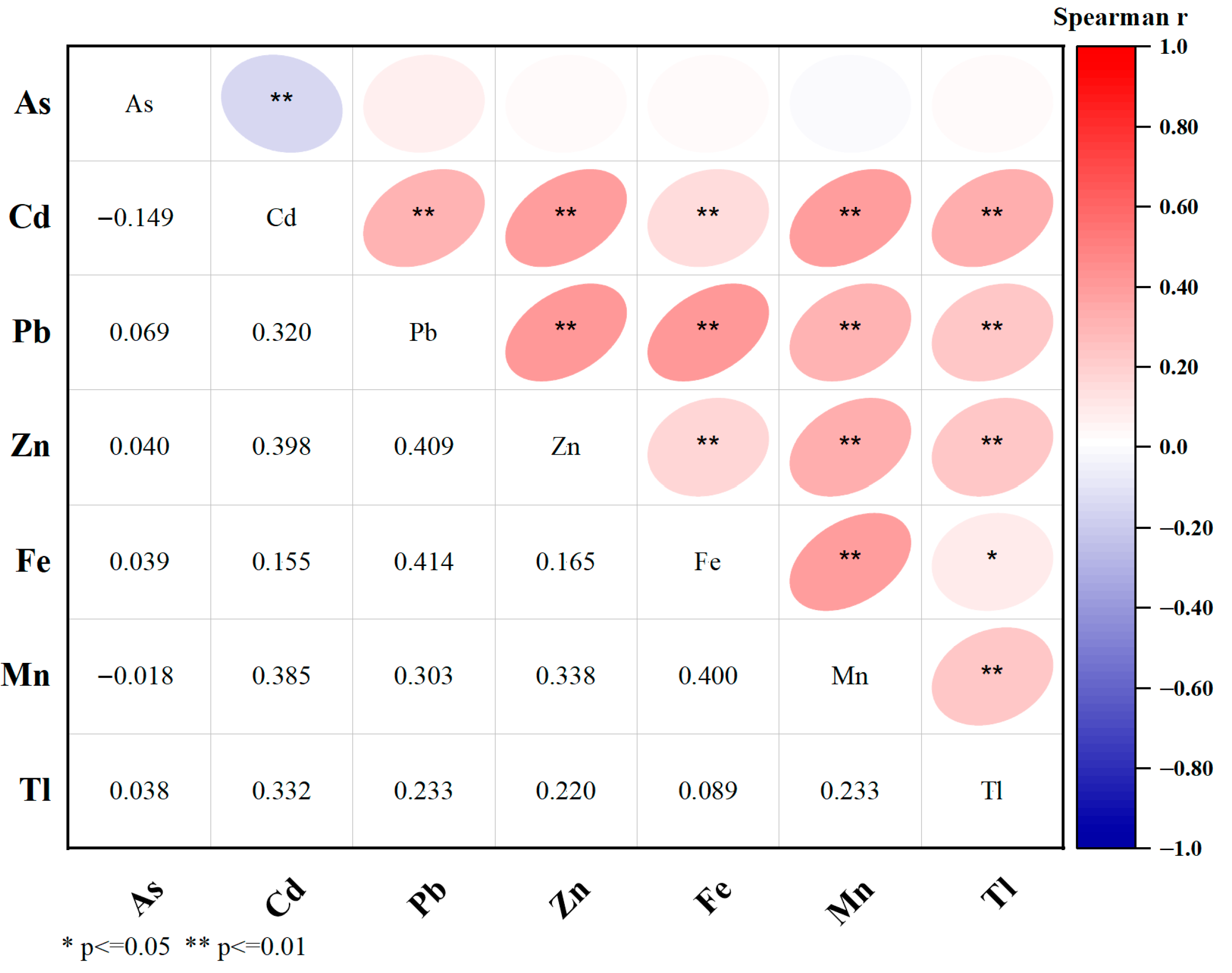
Spearman correlation analysis (Figure 3) revealed weak positive correlations (r = 0.303–0.414, p ≤ 0.1) among several element pairs: Cd–Zn, Cd–Mn, Cd–Pb, Cd–Tl, Pb–Zn, Pb–Fe, Pb–Mn, Fe–Mn, and Zn–Mn. These correlations suggest shared sources or common geochemical controls for these elements. In contrast, As showed no significant correlations with all other elements (|r| < 0.15), indicating a relatively independent source or transport pathway. To further quantify and identify the predominant pollution sources, indicating an independent source or migration pathway.

3.2.2. Source Analysis Based on APCS-MLR Model

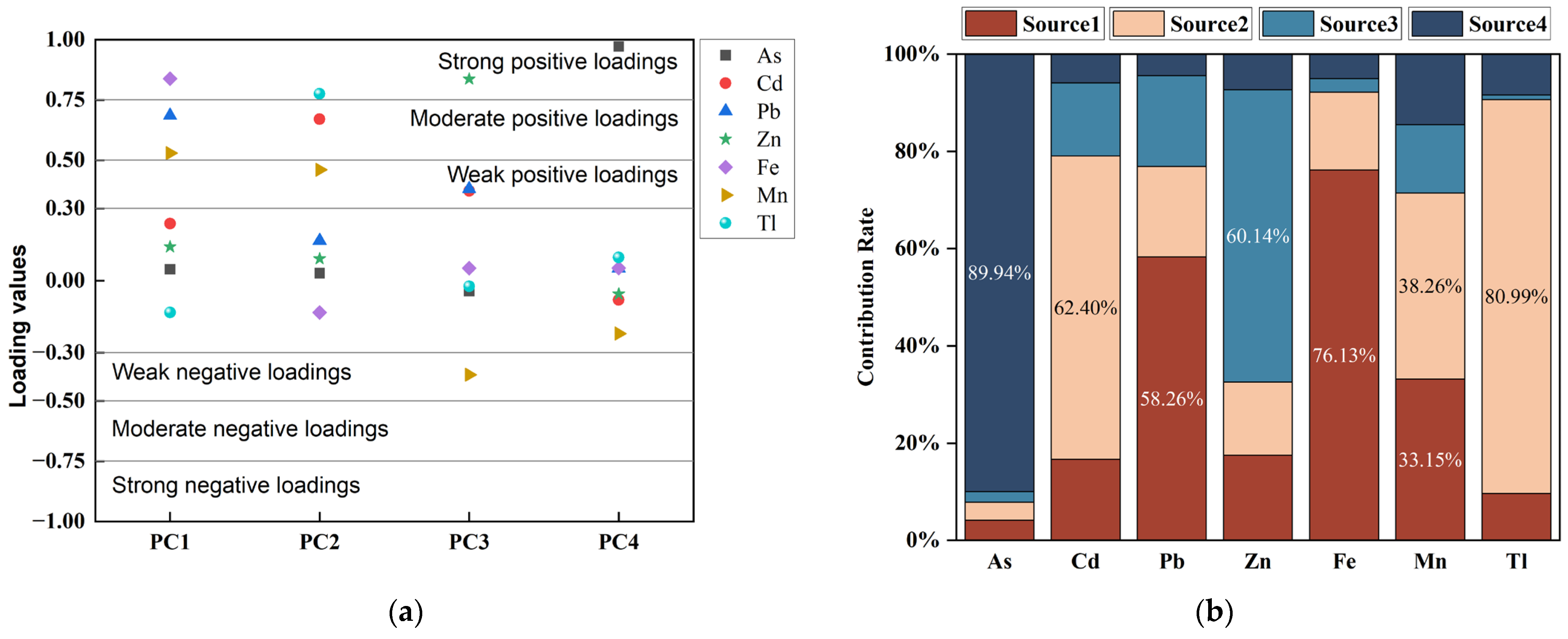
PCA was applicable (KMO = 0.559; Bartlett’s p < 0.001). Based on the criterion of eigenvalues greater than 1, four principal components (PCs) were extracted, which cumulatively explained 71.77% of the total variance. The factor loading patterns of each component are presented in Figure 4a. PC1, explaining 22.10% of the total variance, showed strong positive loadings on Fe (0.838), with moderate loadings on Pb (0.685) and Mn (0.529). PC2 accounted for 18.81% of the variance, exhibiting a strong positive loading on Tl (0.776) and a moderate loading on Cd (0.67). PC3 contributed 16.34% of the variance, dominated solely by a strong positive loading on Zn (0.837). PC4 represented 14.53% of the variance and was predominantly loaded on As (0.972), while the loadings of other elements were negligible. Subsequent APCS-MLR modeling (Figure 4b) provided quantitative source contributions with a good fit (R2 = 0.627–0.949).
Source 1 (contribution rate: 30.79%): This source is the dominant contributor to Fe and Pb, accounting for 76.13% and 58.26% of their respective concentrations, and also represents a significant source of Mn (33.15%). Fe, Pb, and Mn exhibit moderate positive correlations. Spatially, elevated Fe values are distributed continuously along red-bed boundaries, high Pb values appear as scattered points in Quaternary or laterite-covered karst areas, and elevated Mn concentrations are particularly notable in Quaternary sediments at river confluences. These spatially correlated patterns indicate that the release of Fe, Pb, and Mn is likely governed by a common set of hydrogeochemical conditions, specifically regional gradients in redox potential and pH. Considering their shared geochemical susceptibility to mobilization under acidic and reducing conditions [27], this source is interpreted as an “acid-reducing-environment-driven release mechanism.” Essentially, shifts in groundwater redox conditions jointly promote the release of naturally derived Fe and Mn, as well as anthropogenically influenced Pb.
Source 2 (contribution rate: 33.57%): This source is characterized by its dominant contributions to Tl (80.99%) and Cd (62.40%), with a notable secondary contribution to Mn (38.26%). Tl and Cd exhibit a moderate correlation, yet their spatial distributions are distinct. Elevated Tl concentrations are strongly clustered within granite–metamorphic units, with the highest values observed in the northeastern confluence zone of the Mishui and Xiang Rivers. This pattern indicates a clear spatial coupling between geological background and hydrological transport. In contrast, Cd exhibits a more dispersed hotspot pattern, which aligns with characteristics of diffuse, non-point anthropogenic input. Critically, the spatial distribution of these elements shows no significant correlation with localized industrial or smelting sites, suggesting that the anthropogenic influence likely stems from broader, non-industrial human activities rather than concentrated point sources. Therefore, this source is defined as a “composite source of geological background and anthropogenic influence,” reflecting the superimposed effects of natural geogenic carriers and widespread human activities.
Source 3 (contribution rate: 16.26%): This source is characterized by its dominant contribution to Zn (60.14%), with secondary contributions from Pb and Cd, while other elements show minimal influence. Zn is a typical multi-source element. Its high-value areas are not concentrated along major traffic arteries, within industrial zones, or across contiguous farmland. Instead, they are prominently distributed along river corridors and, in some cases, extend into remote mountainous areas. Previous studies have established an association between Zn and agricultural non-point-source activities [26,27], as it is commonly present in chemical fertilizers [47], pesticides, and livestock manure [48]. Considering the study area’s status as a significant agricultural region, it is inferred that these high-concentration zones likely correspond to agricultural practices such as pesticide application and dispersed livestock farming. Associated wastes (e.g., manure, pesticide residues) can be readily transported via surface runoff into adjacent water systems, leading to enrichment in riparian zones. This inference is further supported by the co-occurrence of Zn and Cd, a characteristic element combination indicative of agricultural inputs. Therefore, this source is identified as an “agricultural-activity-related input source.”
Source 4 (contribution rate: 19.38%): This source is almost exclusively contributed by As (89.94%). As shows no significant correlation with any of the other elements, underscoring its independent source and migration behavior. Spatially, elevated As concentrations are closely associated with regions of higher pH values, consistent with its known tendency to desorb and mobilize from mineral surfaces under alkaline-reducing conditions [49]. Consequently, this source is attributed to a “primary geological source,” predominantly representing the natural weathering and release processes of As-rich rocks and minerals within the region.
To summarize, the APCS-MLR model successfully identified four principal sources of heavy metals in the groundwater of the study area: (1) an acid-reducing-environment-driven Fe-Pb-Mn release source, (2) a composite Tl-Cd-Mn source influenced by both geological background and anthropogenic activities, (3) an agricultural-activity-related Zn-Cd-Pb input source, and (4) a primary geological As source. These results provide a clear quantitative foundation for understanding the key drivers of pollution in the region.

3.2.3. Source Analysis Based on PMF Model

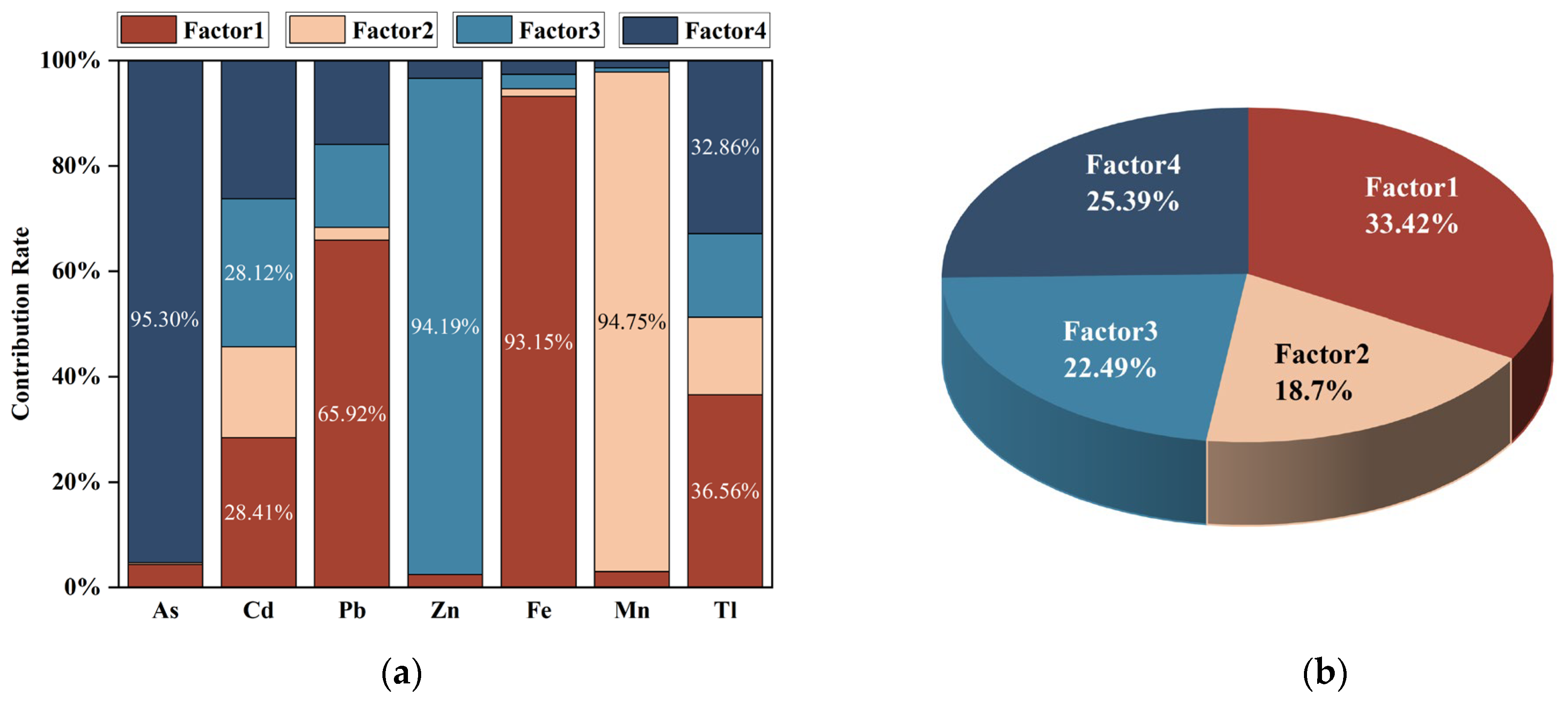
To further analyze the sources of groundwater heavy metals and validate the APCS-MLR findings, positive matrix factorization (PMF) was applied. Model inputs included the concentrations of the seven heavy metals and their respective method detection limits, from which measurement uncertainties were derived. The signal-to-noise (S/N) ratios of the heavy metals ranged from 1.1 to 9.8, indicating high data quality. Solutions with two to six factors were tested. After iterative runs, the four-factor solution was selected as it provided the best model fit. Model performance was robust, as indicated by determination coefficients (R2) exceeding 0.9 for key (“strong”) elements and residuals primarily distributed between −3 and 3. The four resolved factors and their relative contributions were as follows: Factor 1: 33.42%; Factor 2: 18.70%; Factor 3: 22.49%; Factor 4: 25.39% (Figure 5).
Factor 1 is dominated by a synergistic pair of Fe and Pb, which, respectively, account for 93.15% and 65.92% of their total apportioned concentrations, with Tl and Cd also contributing notably. This compositional profile aligns closely with the “acid-reducing-environment-driven release mechanism” identified by APCS-MLR, reconfirming the geochemical synergy in the release of Fe and Pb under such conditions.
Factor 2 exhibits an exceptionally singular profile, overwhelmingly defined by Mn, which constitutes 94.75% of the factor’s total apportioned concentration, rendering contributions from all other elements negligible. Mn is a trace mineral found in various forms in the earth’s crust and is present abundantly in terrestrial and aquatic environments, and it can be mobilized through anthropogenic disturbances, a mechanism supported by environmental studies [50]. Spatial analysis demonstrates a close correlation between the high-Mn-value area and the distribution of brick factories in the region, with the majority occurring in the red-bed Quaternary boundary zone along the river. The purple sandstone and shale formation is extensively developed in the Cretaceous Daijiaping Formation (K2d) and the Lower Tertiary area (E), constituting the primary source of brick-making material in this region. Based on this spatial correlation and geological context, we propose a hypothesis that this phenomenon could be attributed to a “human-made-disturbance-triggered natural-release source of Mn,” indicating that activities such as soil borrowing from brick factories did not introduce exogenous Mn but rather accelerated the dissolution and release of inherent Mn in red beds and Quaternary sediments by modifying the stratigraphic structure and hydrological path. This finding underscores that even in areas without traditional Mn mining, human intervention can act as a key trigger to activate the release of natural geological Mn sources, thereby contributing to environmental manganese pollution and associated risks.
Factor 3 is primarily characterized by Zn (94.19% of its apportioned concentration), a signature further supported by the concurrent presence of Cd (28.12%). This profile aligns clearly with the “agricultural-activity-related input source,” consistent with the APCS-MLR identification, highlighting the distinct contribution of agricultural non-point-source pollution to the regional groundwater system.
Factor 4 is distinctly characterized by As, which constitutes 95.30% of the total apportioned concentration of this element. This profile aligns closely with the “primary geological source” identified by APCS-MLR model, further confirming the natural release process of As from regional geological background.

3.2.4. Integrated Source Apportionment

The APCS-MLR and PMF models independently resolved four stable factors, each corresponding to four categories of pollution source contributors, and yielded highly consistent results in identifying the major pollution sources. Both clearly distinguished the agricultural source dominated by Zn and the geological source dominated by As. Their complementary strength was most evident for Mn: PMF isolated a distinct human-triggered release mechanism, whereas the APCS-MLR distributed Mn across multiple sources. This complementarity between the two models highlights the complex interplay between natural processes and anthropogenic activities in governing heavy metal occurrence. The observed discrepancy also reflects the distinct algorithmic responses of each model to the underlying data structure. Specifically, in our dataset, Mn exhibits a superimposed signal: a strong, localized anthropogenic signal from soil disturbance (as confirmed by the distinct “human-perturbation-triggered natural-release” source resolved by PMF and its spatial correlation with brick-making hotspots) is overlaid upon a widespread geogenic background. PMF’s strength in extracting stable endmembers allowed it to isolate this distinct factor. In contrast, Mn shows significant collinearity with other elements, as supported by positive correlations in the dataset. This data structure led APCS-MLR, which is sensitive to such collinearity, to apportion Mn’s contribution across multiple correlated natural source factors. Through comparative and complementary analysis, the factors identified by the two models were delineated and integrated, ultimately determining five key sources for the region: (1) acid-reducing-environment-driven release (Fe, Pb, Mn), (2) the geological–anthropogenic composite source (Tl, Cd, Mn), (3) human-perturbation-triggered Mn release (predominantly Mn), (4) agricultural-activity-related input (marked by Zn), and (5) the primary geological source (As).
The source apportionment discussed above should be interpreted within the context of the early flood season (April–May) sampling. This high-recharge period likely enhances the mobility and input of contaminants from surface sources (e.g., agricultural Zn) and influences redox-sensitive processes (e.g., Mn release). Therefore, the absolute contributions of sources linked to recent surface activities may be particularly pronounced in our dataset. Importantly, however, the identified spatial frameworks of pollution—such as the associations of As with red-bed formations, Tl with granite terrains, and disturbance-triggered Mn with riparian brick-making zones—are rooted in long-term geological and anthropogenic settings. These fundamental associations are expected to remain valid across seasons, even if the intensity of source signals fluctuates.

3.3. Human Health Risk Assessment

3.3.1. Probabilistic Health Risk Assessment

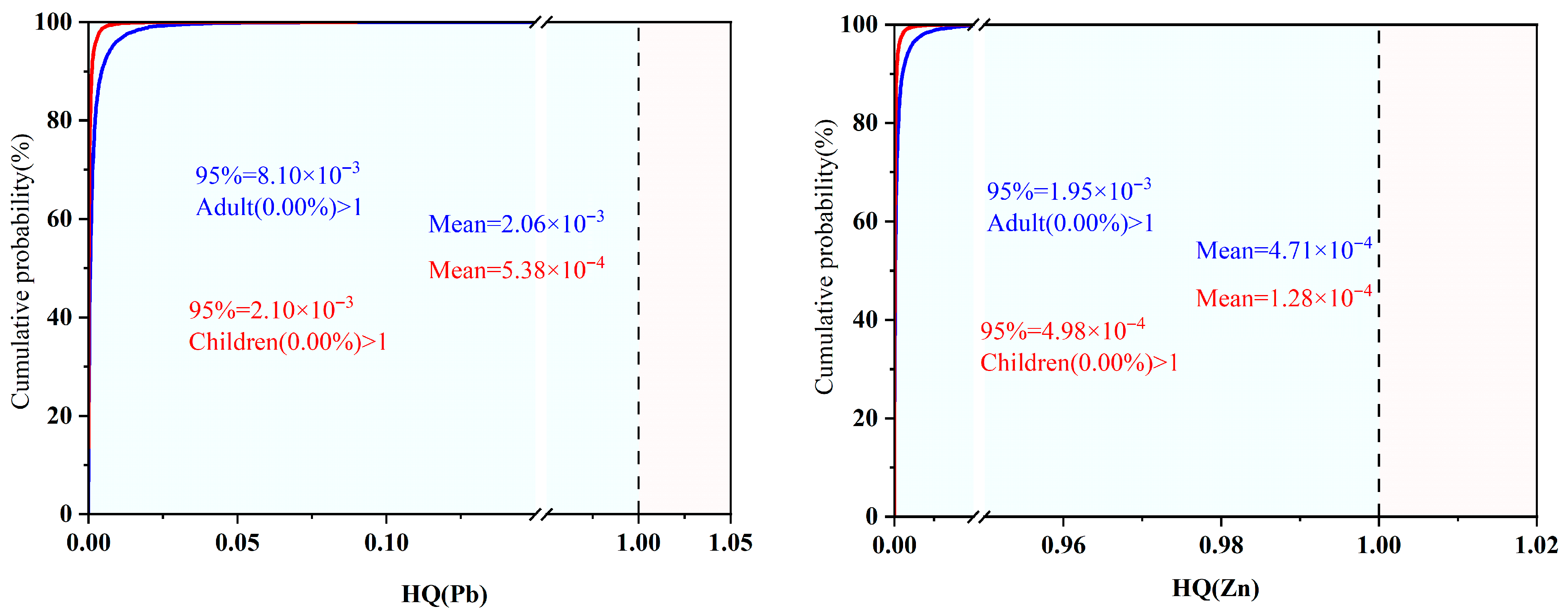
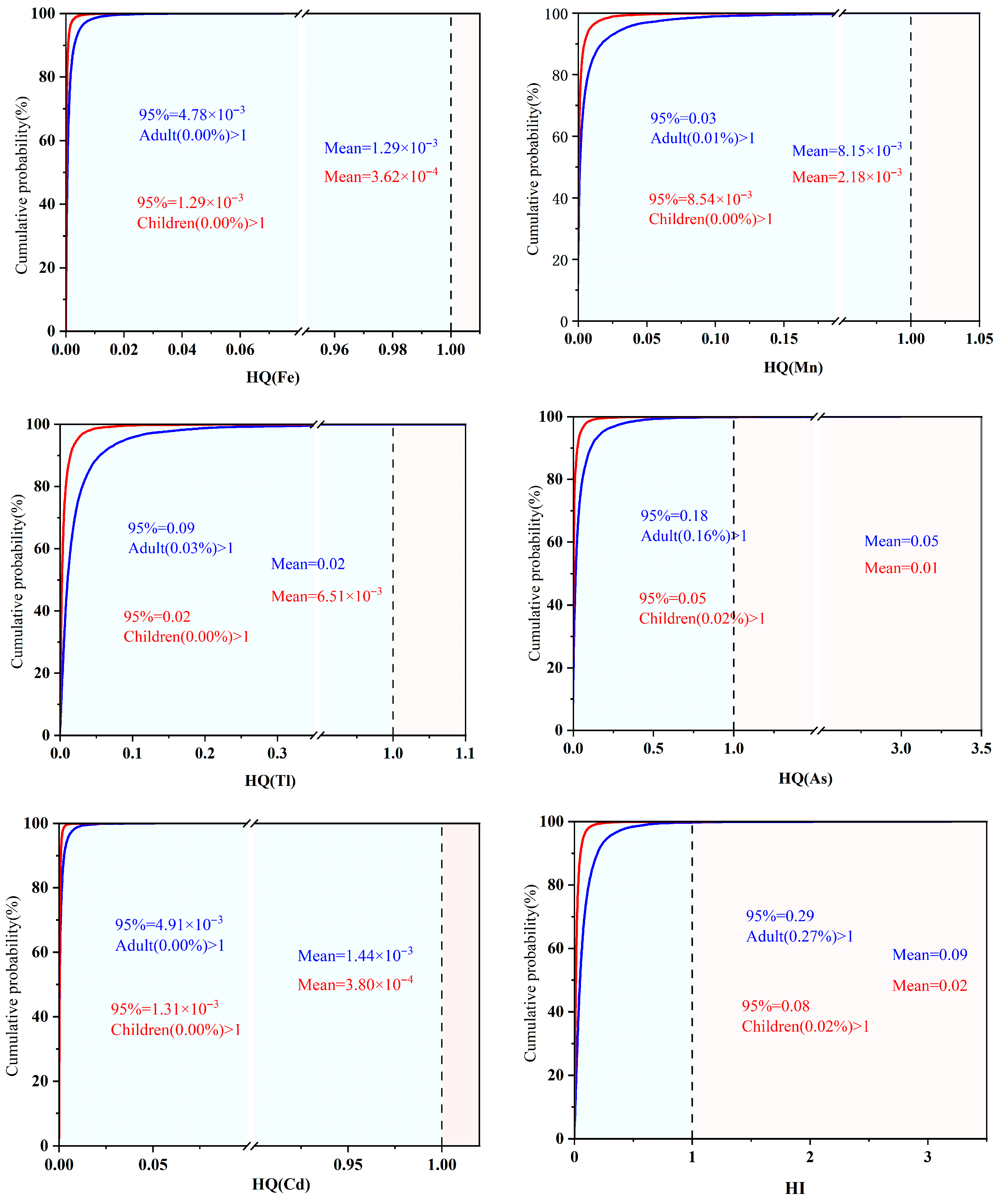
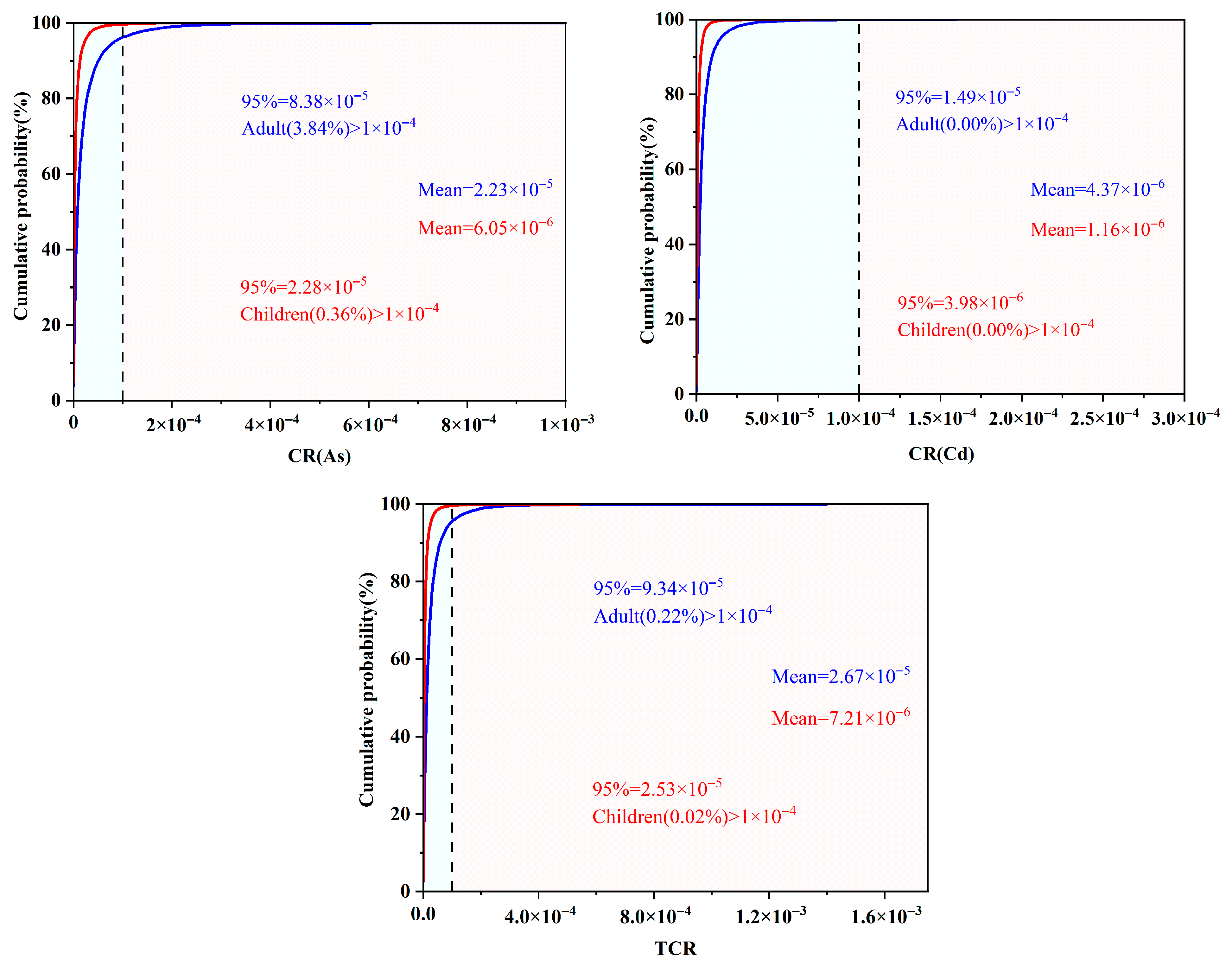
A probabilistic health risk was conducted using Monte Carlo simulation (10,000 iterations) to evaluate the risks for adults and children exposed via drinking water ingestion and dermal contact. The results showed that (Figure 6) the average non-carcinogenic risk index (HI) of the seven heavy metals (adults, 0.09; children, 0.05) was lower than the risk threshold; the 95th percentile values were 0.29 and 0.08, respectively; and the HI exceedance rates for adults and children were 0.27% and 0.02%, respectively. The mean TCR (Figure 7) of total cancer risk (adults: 2.67 × 10⁻⁵; children: 7.21 × 10⁻⁵) was also below the potential risk level (1.0 × 10⁻⁴); the 95th percentile values were 9.34 × 10⁻⁵ and 2.53 × 10⁻⁵, respectively; and the TCR exceedance rates for adults and children were 4.44% and 0.39%, respectively. Overall, these results suggest a low probability of potential non-carcinogenic and carcinogenic risks. Under general exposure scenarios, population health risks appear controllable, although localized potential risks remain.
Regarding carcinogenic risk, the risk posed by As via both ingestion and dermal pathways was significantly higher than that of Cd. The carcinogenic risk (CR) exceedance rate for As was 3.84% in adults and 0.36% in children, while for Cd it was 0.07% in adults and negligible in children. For non-carcinogenic risk, As and Tl were the primary contributing elements. In adults, the non-carcinogenic hazard quotient (HQ) exceedance rates for Tl, Mn, and As were 0.03%, 0.01%, and 0.16%, respectively; no other metals exceeded the threshold. In children, only As showed an HQ exceedance, with a rate of 0.02%. Overall, the health risks (HQ and CR) associated with the seven heavy metals were generally within acceptable levels. However, under extreme exposure scenarios, both non-carcinogenic HQ and carcinogenic CR values for As exceeded thresholds in adults and children, warranting specific attention—a finding consistent with previous research [51]. The higher risk values observed in adults may be attributed to their longer exposure duration and greater drinking water intake compared to children.

3.3.2. Sensitivity Analysis

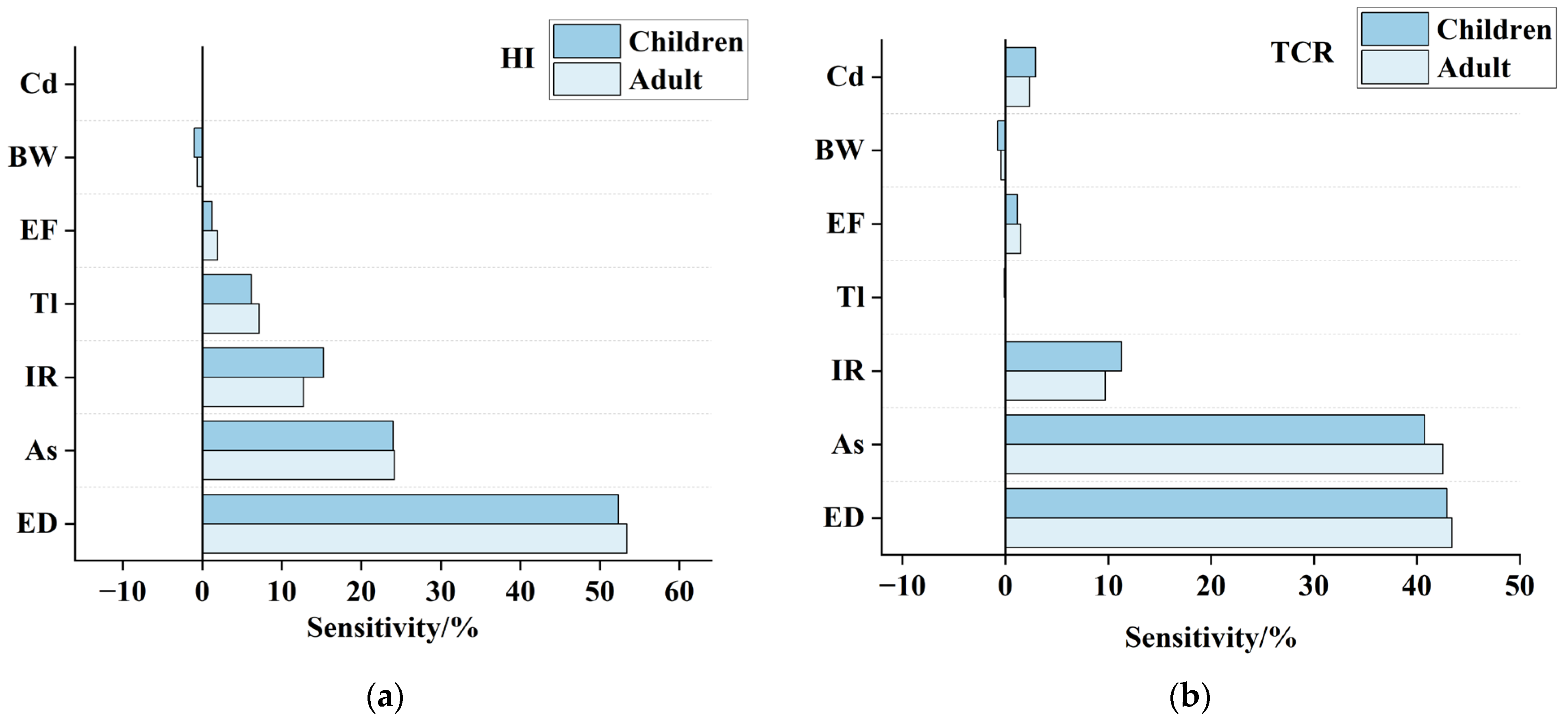
Sensitivity analysis was performed to quantify the influence of input parameters on health risk estimates, where higher sensitivity values indicate a greater impact on the final results [51]. First, the contribution of each heavy metal to overall health risk was examined. For non-carcinogenic risk, As and Tl were the primary sensitive indicators (sensitivity > 19%). For carcinogenic risk, As was the dominant sensitive factor, contributing over 90%, followed by Cd, with a sensitivity exceeding 5%.
Among the health-risk-influencing factors, sensitivity to heavy metal concentrations (As, Tl, Cd), average daily intake (IR), exposure frequency (EF), exposure duration (ED), and average body weight (BW) was assessed (Figure 8). With the exception of BW, the other factors generally showed a positive correlation with health risks, indicating that increased exposure to these factors elevates risk. For non-carcinogenic risk, ED emerged as the most sensitive parameter, with sensitivity values of 53.40% for adults and 52.32% for children, followed by IR, with sensitivities of 24.16% and 24.00%, respectively. Regarding carcinogenic risk, ED and As were likewise the key sensitive parameters, with ED sensitivities of 43.41% (adults) and 42.94% (children) and As sensitivities of 42.56% (adults) and 40.78% (children).
These results indicate that in the context of relatively low overall pollutant concentrations in the study area, managing exposure duration is the primary measure for mitigating health risks, followed by reducing the concentrations of key pollutants, particularly As.

4. Discussion

The findings of this study reveal that, while the overall health risks associated with the seven heavy metals in the groundwater of central-south Hunan remain within generally acceptable limits, significant localized and element-specific risks persist. This spatial and elemental heterogeneity underscores the critical need to move beyond aggregate risk assessments and instead develop spatially differentiated management strategies for effective and sustainable groundwater protection.
As and Tl emerged as the primary drivers of health risk, yet they exhibited distinct mechanistic and spatial patterns. As was the dominant contributor to both non-carcinogenic and carcinogenic risk. Its high-concentration zones were spatially concentrated in the red-bed area on the left bank of the Xiang River (Unit VII) and the Yangmingshan–Dayishan granite–metamorphic zone (Unit VI). Source apportionment consistently attributed As to a “primary geological source”, indicating mobilization via water–rock interactions under alkaline-reducing geochemical conditions from As-rich lithologies. This geogenic origin implies a persistent, low-dose exposure for residents in these specific geological units, leading to a higher long-term cumulative carcinogenic risk. This finding reveals that the natural geological background itself can constitute a dominant and enduring risk factor, even in the absence of active point-source pollution such as mining. This contrasts with the prevalent focus on industrial or mining-derived As in many previous studies, thereby highlighting a geological risk often underestimated in regional water quality assessments of similar terrains [23,51].
In contrast, Tl, while present at lower overall concentrations, contributed notably to non-carcinogenic risk, ranking as the second most sensitive element. Its elevated concentrations were tightly clustered in granite–metamorphic units, such as the lower Mishui River (Unit I), the middle–lower reaches of the Leishui River (Unit III), and the right bank of the Zhengshui River (Unit VIII), with a pronounced peak at the confluence of the Mishui and Xiang Rivers. This pattern, linked by our model to a “geogenic–anthropogenic composite source,” reveals a high degree of spatial coupling between Tl occurrence, specific geological settings, and hydrological pathways. It suggests that Tl enrichment in groundwater is not merely a function of background geology but can be exacerbated by diffuse anthropogenic activities within a conducive hydrogeological frame-work, warranting targeted monitoring in these identified high-risk units.
A particularly insightful finding concerns Mn. The PMF model isolated a distinct “human-perturbation-triggered natural-release” source, contributing 18.70% of the total apportionment. Spatial analysis demonstrated a clear correlation between Mn hotspots and areas of intensive brick-making activity, particularly in Quaternary-rich riparian zones. This correlation suggests a plausible mechanism whereby anthropogenic disturbance—such as soil excavation for brick manufacturing—does not introduce exogenous Mn but rather alters the stratigraphic structure and local hydrology, accelerating the dissolution and release of inherent Mn from red beds and Quaternary sediments. This mechanism fundamentally differs from the well-documented point-source Mn pollution from mining and represents a previously overlooked pathway where specific land-use changes can become key drivers of ground-water quality degradation.
The complementary application of the APCS-MLR and PMF models provided more than mere methodological validation; it offered layered insights crucial for environmental management. The consistency between models for the As-dominated geological source and the Zn-dominated agricultural source reinforces the robustness of these apportionments. The key difference—PMF resolved Mn as an independent disturbance-triggered source, while APCS-MLR distributed it across multiple sources—provides a nuanced understanding. This highlights the value of a multi-model approach: PMF’s result calls for distinct control measures targeting specific land-use activities, whereas APCS-MLR’s result reminds us that Mn release is also intertwined with broader geochemical processes, advocating for integrated management.
Furthermore, the health risk assessment identified exposure duration (ED) as the most sensitive parameter governing both non-carcinogenic (sensitivity > 52%) and carcinogenic risks (sensitivity > 43%). This critical finding indicates that for populations in high-risk hydrogeological units, chronic long-term exposure to even moderately elevated levels of pollutants like As constitutes the principal health threat. Consequently, the most effective risk mitigation strategy extends beyond source control to include interventions that limit exposure duration, such as providing alternative safe water supplies—a fundamental public health measure for sustainable groundwater management.
This study has several limitations that should be acknowledged. The strategic “source-avoidance” sampling design, while effective for characterizing regional background and non-point pollution, may underestimate the local impact of extreme point sources. Second, all samples were collected during the early flood season (April–May). This wet-period snapshot may not capture the full annual variability, particularly for elements like Zn and Mn whose concentrations and transport are sensitive to hydrological conditions. While this design effectively captures high-risk, high-mobility scenarios, it may underestimate peak dry-season concentrations (e.g., of As), and seasonal fluctuations in source contributions are also possible [27]. Third, the selection of analytes was focused on a suite of seven heavy metals based on regulatory priority and regional relevance; however, other elements such as Cu, Ni, and Sb were not included, which may limit a fully comprehensive assessment of metallic contamination. Fourth, the precise geochemical pathways and kinetics of the “anthropogenic-disturbance-triggered release” mechanism of manganese warrant further study. Finally, it should be noted that the health risk assessment employed generic exposure parameters. To improve accuracy, future studies could incorporate local survey data to refine risk estimates. Addressing these issues in future work will further strengthen the scientific foundation of management.
In summary, for the sustainable management of groundwater in central-south Hunan and similar regions, we advocate for a spatially explicit, source-informed strategy: (1) prioritizing long-term As monitoring and exposure mitigation (e.g., alternative water sources) in identified high-risk red-bed and granite–metamorphic zones; (2) enhancing Tl surveillance in the northern and northeastern granite-dominated areas (e.g., Units I, III, VIII), especially downstream of confluences; (3) implementing land-use controls in riparian zones with brick-making activities to prevent the activation of geogenic Mn. Key measures include the enforcement of setback requirements, which restrict brick-making disturbances (e.g., soil excavation and material stockpiling) within the designated buffer zones, along with implementing targeted monitoring requirements. This integrated approach addresses both inherent geological vulnerabilities and human-triggered release pathways, providing a scientifically grounded framework for safeguarding water security and public health.

5. Conclusions

This study provides an integrated assessment of heavy metal pollution in the groundwater of central-south Hunan. The spatial distribution of heavy metals (As, Cd, Pb, Zn, Fe, Mn, Tl) showed significant heterogeneity, governed by the coupling of regional geology and hydrology. As, Fe, Mn, and Tl were identified as regionally pervasive priority elements. Combined APCS-MLR and PMF modeling resolved five key pollution sources: an acid-reducing-environment-driven release; a geogenic anthropogenic composite source; a human-perturbation-triggered natural Mn release (specifically linked to brick-making activities); an agricultural input source; and a primary geological source for arsenic. Probabilistic health risk assessment indicated that while cumulative risks are generally acceptable, arsenic is the dominant risk driver for both non-carcinogenic and carcinogenic effects. Sensitivity analysis identified exposure duration as the most critical risk-governing parameter. Consequently, spatially differentiated management is essential. We recommend prioritizing arsenic control in red-bed and granite–metamorphic zones, enhancing thallium monitoring in northern granite terrains, and regulating land use in brick-factory-dense riparian areas through measures such as setback enforcement and targeted monitoring to mitigate manganese release. This targeted approach provides a scientific basis for protecting groundwater resources in similar regions.

Author Contributions

Conceptualization, S.L., H.Y., Y.J. and D.W.; methodology, S.L. and Y.L. (Yongqian Liu); software, Y.K.; validation, Y.L. (Yongqian Liu), Y.L. (Yaqian Liu) and H.S.; formal analysis, S.L., Y.K. and Y.L. (Yaqian Liu); investigation, H.S. and D.W.; resources, H.S., D.W., Y.J. and Y.K.; data curation, S.L., Y.L. (Yaqian Liu), Y.L. (Yongqian Liu) and D.W.; writing—original draft preparation, S.L., Y.L. (Yongqian Liu) and H.Y.; writing—review and editing, S.L., H.Y. and H.S.; visualization, S.L., Y.K. and Y.L. (Yaqian Liu); supervision, Y.J., H.S. and H.Y.; project administration, S.L.; funding acquisition, Y.J. All authors have read and agreed to the published version of the manuscript.

Funding

This research was funded by General Research Project of Geological Bureau of Hunan Province (Grant No. HNGSTP202415).

Institutional Review Board Statement

Not applicable.

Informed Consent Statement

Not applicable.

Data Availability Statement

The original contributions presented in this study are included in the article. Further inquiries can be directed to the corresponding author.

Conflicts of Interest

Authors Shuya Li, Huan Shuai, Yongqian Liu, Yingli Jing, Yizhi Kong and Yaqian Liu were employed by the Exploration Institute of Geological Engineering of Hunan Province Co., Ltd. The remaining authors declare that the research was conducted in the absence of any commercial or financial relationships that could be construed as a potential conflict of interest.

References

  1. Sheng, D.; Meng, X.; Wen, X.; Wu, J.; Yu, H.; Wu, M. Contamination Characteristics, Source Identification, and Source-Specific Health Risks of Heavy Metal(Loid)s in Groundwater of an Arid Oasis Region in Northwest China. Sci. Total Environ. 2022, 841, 156733. [Google Scholar] [CrossRef] [PubMed]
  2. Lu, S.; Jia, L.; Jiang, Y.; Wang, Z.; Duan, H.; Shen, M.; Tian, Y.; Lu, J. Progress and Prospect on Monitoring and Evaluation of United Nations SDG 6 (Clean Water and Sanitation) Target. Bull. Chin. Acad. Sci. 2021, 36, 904–913. [Google Scholar] [CrossRef]
  3. Raji, S.A.; Demehin, M.O. “Long Walk to 2030”: A Bibliometric and Systematic Review of Research Trends on the UN Sustainable Development Goal 3. Dialogues Health 2023, 2, 100132. [Google Scholar] [CrossRef]
  4. Qian, J.; Li, W.; Zhang, L.; Zhang, K.; Wang, S.; Li, S. Source and Research Status of Heavy Metal Pollution in Groundwater: A Review. Earth Environ. 2018, 46, 613–620. [Google Scholar] [CrossRef]
  5. Chen, W.; Yu, S.; Dong, Q.; Liao, J.; Wang, S.; Liu, G.; Zhang, W. Source Analysis and Health Risk Assessment of Heavy Metals in Groundwater in the Northeast of Changde City. Geol. China 2025, 1–20. Available online: https://link.cnki.net/urlid/11.1167.p.20250304.1000.002 (accessed on 18 January 2026).
  6. Chang, S.; Song, Y.; Chen, H.; Zhao, X.; Cui, J.; Zhang, L. Source Apportionment and Health Risk Identification of Heavy Metals in Groundwater for Typical District in North China. Environ. Monit. China 2024, 40, 172–182. [Google Scholar] [CrossRef]
  7. Ge, Q.; Zhang, H.; Mi, Z.; Shao, Z.; Li, X. Source and Health Risk Assessment of Heavy Metals in Groundwater of Datong Basin. Environ. Sci. 2024, 46, 239–252. [Google Scholar] [CrossRef]
  8. Jiang, X.; Peng, H.; Pan, Y.; Zeng, M.; Xue, Z.; Zhang, R. Source Determination and Health Risk Assessment of Heavy Metals in Groundwater of Guangzhou. Environ. Sci. 2025, 46, 6880–6893. [Google Scholar] [CrossRef]
  9. Duan, X.; Yuan, H.; Ye, T.; Huang, Y.; Li, J.; Yuan, G.; Albanese, S. Geostatistical Mapping and Quantitative Source Apportionment of Potentially Toxic Elements in Top- and Sub-Soils: A Case of Suburban Area in Beijing, China. Ecol. Indic. 2020, 112, 106085. [Google Scholar] [CrossRef]
  10. Li, K. Characteristics and Risk Assessment of Heavy Metals Pollution in Multi-media from the Cold Region River and Typical Riparian City. Ph.D. Thesis, Northeast Agricultural University, Harbin, China, 2023. [Google Scholar]
  11. Lu, J.; Wu, J.; Zhang, C.; Zhang, Y. Possible Effect of Submarine Groundwater Discharge on the Pollution of Coastal Water: Occurrence, Source, and Risks of Endocrine Disrupting Chemicals in Coastal Groundwater and Adjacent Seawater Influenced by Reclaimed Water Irrigation. Chemosphere 2020, 250, 126323. [Google Scholar] [CrossRef]
  12. Li, R.; Liu, Y.; Huang, Y.; Wu, H. Contamination Characteristics and Source Apportionment of Soil Heavy Metals in an Abandoned Pyrite Mining Area of Tongling City, China. Environ. Sci. 2023, 45, 407–416. [Google Scholar] [CrossRef]
  13. Zhang, Y.; Yang, P.; Wang, J.; Xie, S.; Chen, F.; Zhan, Z.; Ren, J.; Zhang, H.; Liu, D.; Meng, Y. Geochemical characteristics of lateral hyporheic zone between the river water and groundwater, a case study of Maanxi in Chongqing. Environ. Sci. 2016, 37, 2478–2486. [Google Scholar] [CrossRef]
  14. Shao, Y.; Yan, B.; Zhang, K.; Zhang, B.; Zhang, Y.; Li, B.; Chen, Y.; Xiang, F.; Zhuang, X.; Guo, S. Distribution, Environmental Risks, and Source Apportionment of Heavy Metals in the Lake Sediments and Riparian Soils in Bangong Co Lake of the Qinghai–Tibet Plateau in China. Sustainability 2025, 17, 11274. [Google Scholar] [CrossRef]
  15. Shang, T.; Ren, Y.; Mu, Y.; Zhang, J.; Wen, C.; Zhou, J.; Zhang, Y. Distribution Characteristics and Source Analysis of Heavy Metals in Sediments from the Tianshui Segment of the Weihe River. Res. Environ. Sci. 2025, 38, 2229–2239. [Google Scholar] [CrossRef]
  16. Wang, M.; Ma, W.; Sui, S.; Wang, M.; Wang, Y.; Jiang, F.; Guo, X.; Xing, M.; Han, Q.; Jia, B.; et al. Heavy Metals and Water-Soluble Inorganic Ions in Park Dust of a Chinese Megacity: Machine Learn-ing-Driven Source Assignment and Control Prioritization. J. Environ. Chem. Eng. 2025, 13, 117898. [Google Scholar] [CrossRef]
  17. Lei, M.; Zhou, J.; Zhou, Y.; Sun, Y.; Ji, Y.; Zeng, Y. Spatial distribution, source apportionment and health risk assessment of inorganic pollutants of surface water and groundwater in the southern margin of Junggar Basin, Xinjiang, China. J. Environ. Manag. 2022, 319, 115757. [Google Scholar] [CrossRef] [PubMed]
  18. Liu, Y.; Fei, Y.; Li, Y.; Bao, X.; Zhang, P. Pollution Source Identification Methods and Remediation Technologies of Groundwater: A Review. China Geol. 2024, 7, 125–137. [Google Scholar] [CrossRef]
  19. Peng, C.; Liang, J.; Ren, K.; Zeng, J.; Tang, W.; Pan, X. Quantitative identification of factors affecting groundwater quality in Dianchi Lake Basin based on PCA-APCS-MLR model. Res. Environ. Sci. 2024, 37, 1116–1126. [Google Scholar] [CrossRef]
  20. Yu, N.; Han, Y.; Liu, G.; Zhuang, F.; Wang, Q. The Hydrochemical Characteristics Evolution and Driving Factors of Shallow Groundwater in Luxi Plain. Sustainability 2025, 17, 6432. [Google Scholar] [CrossRef]
  21. Pan, Y.; Peng, H.; Hou, Q.; Peng, K.; Shi, H.; Wang, S.; Zhang, W.; Zeng, M.; Huang, C.; Xu, L.; et al. Priority Control Factors for Heavy Metal Groundwater Contamination in Peninsula Regions Based on Source-Oriented Health Risk Assessment. Sci. Total Environ. 2023, 894, 165062. [Google Scholar] [CrossRef]
  22. Liu, S.; Yi, B.; Liu, F.; Liu, C.; Yang, S.; Zhang, H.; Kang, W.; Jiang, K. Groundwater metal pollution and health risk assessment in river valley heavy industrial cities of arid regions in China. China Geol. 2025, 8, 526–539. [Google Scholar] [CrossRef]
  23. Pan, Y.; Han, W.; Shi, H.; Liu, X.; Xu, S.; Li, J.; Peng, H.; Zhao, X.; Gu, T.; Huang, C.; et al. Incorporating Environmental Capacity Considerations to Prioritize Control Factors for the Management of Heavy Metals in Soil. J. Environ. Manag. 2024, 351, 119820. [Google Scholar] [CrossRef] [PubMed]
  24. Jiang, F.; Wang, L.; Tang, Z.; Yang, S.; Wang, M.; Feng, X.; He, C.; Han, Q.; Guo, F.; Yang, B. Distribution, Assessment, and Causality Analysis of Soil Heavy Metals Pollution in Complex Contaminated Sites: A Case Study of a Chemical Plant. Environ. Geochem. Health 2024, 46, 526. [Google Scholar] [CrossRef]
  25. Meng, Y.; Wu, J.; Li, P.; Wang, Y. Distribution Characteristics, Source Identification and Health Risk Assessment of Trace Metals in the Coastal Groundwater of Taizhou City, China. Environ. Res. 2023, 238, 117085. [Google Scholar] [CrossRef] [PubMed]
  26. Shi, H.; Zeng, M.; Peng, H.; Huang, C.; Sun, H.; Hou, Q.; Pi, P. Health Risk Assessment of Heavy Metals in Groundwater of Hainan Island Using the Monte Carlo Simulation Coupled with the APCS/MLR Model. Int. J. Environ. Res. Public Health 2022, 19, 7827. [Google Scholar] [CrossRef]
  27. Hui, K.; Hu, W.; Xi, B.; Yuan, Y.; Lu, H.; Tan, W. Source Analysis of Heavy Metals in Groundwater of Centralized Drinking Water Sources and Seasonal Variations of Health Risks in Wuzhou City, Pearl River Delta, China. Environ. Chem. Ecotoxicol. 2025, 8, 392–407. [Google Scholar] [CrossRef]
  28. Zhang, S.; Ren, B. Groundwater Heavy Metal Contamination and Health Risk Assessment: A Case Study of South Dongting Lake, China. Water 2025, 17, 3036. [Google Scholar] [CrossRef]
  29. Zhu, S.; Zhang, Q.; Xu, G.; Ren, Y.; Su, Y.; Pan, Z.; Cao, Y. Characterization and source apportionment of heavy metal contamination in groundwater at industrial sites. Res. Environ. Sci. 2024, 38, 610–621. [Google Scholar] [CrossRef]
  30. Xia, J.; Gao, L.; Yang, J. Analysis of Heavy Metal Sources in Xutuan Mining Area Based on APCS-MLR and PMF Model. Appl. Sci. 2025, 15, 4249. [Google Scholar] [CrossRef]
  31. Li, X. Probabilistic Health Risk Assessment of Heavy Metals in Groundwater of Typical Industrial Remaining Sites. Environ. Sci. Technol. 2025, 48, 156–165. [Google Scholar] [CrossRef]
  32. Fan, Z.; Xu, X.; Wang, R.; Meng, Z.; Wang, L.; Cao, X.; Lou, Z. Distribution and Source Resolution of Heavy Metals in an Electroplating Site and Their Health Risk Assessment. Sustainability 2023, 15, 12166. [Google Scholar] [CrossRef]
  33. Liu, X.; Qin, J.; Wang, D.; Fan, Z.; Yang, X. Metallogenic Characteristics and Regularities of Hengyang Basin and Its Surrounding Areas. Geol. Surv. China 2024, 11, 78–91. [Google Scholar] [CrossRef]
  34. Zhang, T.; Ren, L.; Dong, Z.; Cui, C.; Wang, W.; Li, Z.; Han, Y.; Peng, Y.; Yang, J. Temporal Changes in Precipitation and Correlation with Large Climate Indicators in the Hengshao Drought Corridor, China. Ecol. Indic. 2024, 167, 112715. [Google Scholar] [CrossRef]
  35. Hengyang Municipal People’s Government. Landform Type. Available online: https://www.hengyang.gov.cn/hyly/hygk/zrdl/20200111/i45680.html (accessed on 17 December 2025).
  36. DZ/T 0288-2015; Specification for Regional Groundwater Contamination Investigation and Evaluation. Ministry of Natural Resources of the People’s Republic of China: Beijing, China, 2015.
  37. HJ164-2020; Technical Specifications for Environmental Monitoring of Groundwater. Ministry of Ecology and Environment of the People’s Republic of China: Beijing, China, 2020.
  38. Du, J.; Jia, C.; Ding, Y.; Yang, X.; Feng, K.; Wei, M. Advancing Wetland Groundwater Pollution Zoning: A Novel Integration of Monte Carlo Health Risk Modeling and Machine Learning. J. Hazard. Mater. 2025, 494, 138412. [Google Scholar] [CrossRef]
  39. Hunan Provincial Physical Fitness Monitoring Center. Bulletin of the Fifth National Physical Fitness Monitoring in Hunan Province. Available online: https://tyj.hunan.gov.cn/tyj/xxgk/tzgg/202211/t20221128_29139563.html (accessed on 28 November 2025).
  40. Zhao, X.; Duan, X.; Wang, B.; Chen, Y.; Cao, S.; Wang, L.; Jiang, Y.; Guo, J.; Li, T.; Ma, J.; et al. Highlights of the Chinese Exposure Factors Handbook (Adults); China Environmental Science Press: Beijing, China, 2014. [Google Scholar]
  41. Mao, K.; Li, H.; Ming, Q.; Liu, H.; Zhao, H.; Lu, B.; Hao, W. Health risk assessment in the groundwater of a certain mine in Hunan. North China Geol. 2023, 46, 57–66+88. [Google Scholar] [CrossRef]
  42. Zhao, X.; Duan, X.; Wang, B.; Zhao, L.; Cheng, H.; Cao, S.; Yu, D.; Ma, J.; Wang, D.; Wang, X.; et al. Report of Environmental Exposure Related Activity Patterns Research of Chinese Population (Children); China Environmental Science Press: Beijing, China, 2016. [Google Scholar]
  43. U.S. Environmental Protection Agency (EPA). Exposure Factors Handbook. Available online: https://www.epa.gov/expobox/exposure-factors-handbook-2011-edition (accessed on 17 November 2025).
  44. GB/T 14848-2017; Standard for Groundwater Quality. Standards Press of China: Beijing, China, 2017.
  45. Bábek, O.; Sracek, O.; Všianský, D.; Holá, M. Groundwater Red Beds in Holocene Fuvial Sediments as a Product of Iron and Manganese Redox Cycling; Morava River, Czechia. Sedimentology 2023, 70, 2220–2240. [Google Scholar] [CrossRef]
  46. Lu, S.; Su, X.; Feng, X.; Sun, C. Sources and influencing factors of arsenic in nearshore zone during river water infiltration. Earth Sci. Front. 2021, 29, 455–467. [Google Scholar] [CrossRef]
  47. He, S.; Rao, Z.; Wei, K.; Wang, J.; Huang, D.; Zhu, Q. Effects of long-term fertilization on the distribution of heavy metal profiles in double cropping paddy field. J. Agric. Resour. Environ. 2025. [Google Scholar] [CrossRef]
  48. Yuan, K.; Xiong, S.; Liang, J.; Li, Y.; Qiao, Y.; Li, H.; Chen, Q. Status and risk analysis of copper and zinc pollution in livestock manure. J. Agro-Environ. Sci. 2020, 39, 1837–1842. [Google Scholar] [CrossRef]
  49. Lei, M.; Zhou, J.; Zhou, Y.; Sun, Y.; Han, S.; Liu, J.; Lu, H.; Bai, F.; Yan, Z. Migration and Transformation Mechanism of High Arsenic Groundwater in Oasis Belt in Middle Part of Northern Piedmont of Tianshan Mountain. Earth Sci. 2022, 49, 253–270. [Google Scholar] [CrossRef]
  50. Dey, S.; Tripathy, B.; Kumar, M.S.; Das, A.P. Ecotoxicological Consequences of Manganese Mining Pollutants and Their Biological Remediation. Environ. Chem. Ecotoxicol. 2023, 5, 55–61. [Google Scholar] [CrossRef]
  51. Wang, L.; Chang, S.; Tu, X.; Wang, E.; Li, C. Spatial and Temporal Variations of Heavy Metals and Probabilistic Health Risks in Groundwater Drinking Water Source in the Yellow River Basin. Environ. Sci. 2025, 1–22. [Google Scholar] [CrossRef]
Figure 1. Hydrogeological map and unit division of the study area.
Sustainability 18 01225 g001
Figure 2. Spatial distribution of (a) As, (b) Cd, (c) Pb, (d) Zn, (e) Fe, (f) Mn, (g) Tl, and (h) pH in groundwater across the study area (mg/L).
Sustainability 18 01225 g002aSustainability 18 01225 g002b
Figure 3. Spearman correlation analysis of heavy metals. (Correlation strength is categorized as follows [25]: strong (0.75 ≤ |r| ≤ 1), moderate (0.5 ≤ |r| < 0.75), weak (0.3 ≤ |r| < 0.5), and not significant (|r| < 0.3)).
Sustainability 18 01225 g003
Figure 4. Rotated factor loadings for heavy metals in groundwater (a) and source apportionment of heavy metals based on the APCS-MLR model (b). (Source 1: acid-reducing-environment-driven release; Source 2: geological–anthropogenic composite source; Source 3: agricultural-activity-related input; Source 4: primary geological source).
Sustainability 18 01225 g004
Figure 5. Heavy metal source apportionment based on PMF model (a) and relative contributions of four factors (b). (Factor 1: acid-reducing-environment-driven release; Factor 2: human-perturbation-triggered Mn release; Factor 3: agricultural-activity-related input; Factor 4: primary geological source (As)).
Sustainability 18 01225 g005
Figure 6. Cumulative probability distribution of non-carcinogenic risk (dashed line represents risk threshold).
Sustainability 18 01225 g006aSustainability 18 01225 g006b
Figure 7. Cumulative probability distribution of carcinogenic risk (dashed line represents risk threshold).
Sustainability 18 01225 g007
Figure 8. Sensitivity analysis of health risks: (a) non-carcinogenic risk (HI); (b) carcinogenic risk (TCR).
Sustainability 18 01225 g008
Table 1. Values of dermal permeability coefficient (PC), reference dose (RFD), and slope factor (SF) for heavy metals.
Heavy Metal FactorPC/cm·h−1RFD/mg·(kg·d)−1SF/mg·(kg·d)−1
IngestionDermalIngestionDermal
Tl0.0010.000010.00001
As0.00180.00030.00031.53.66
Cd0.0010.00050.00056.10.38
Pb0.0000040.00140.00042
Zn0.00060.30.3
Fe0.00010.30.045
Mn0.00010.0460.0018
Note: “—” indicates no value.
Table 2. Health risk assessment parameter values.
No.SymbolParameterUnitDistributionAdultsChildren
1IRIngestion rateL·d−1Lognormal(1.23, 0.27) [17] (1.12, 0.27) [17]
2EFExposure frequencyd·a−1Triangular(180, 350, 365) [5] (180, 350, 365) [5]
3EDExposure durationaUniform(0, 70) [5] (0, 6) [5]
4BWBody weightkgNormal(62.58, 20.7) [39] (18.65, 4.05) [39]
5ATAveraging timedPoint25,550 [40] 25,550 [40]
6SASkin surface areacm2Point17,657 [41] 6500 [42]
7ETExposure timeh/dPoint0.25 [40]0.45 [42]
8CFUnit conversion factorL·cm−1Point0.001 [43]0.001 [43]
Notes: The values for the lognormal and normal distributions are expressed as (mean, variance). The triangular distribution parameters are given as (minimum, mode, maximum). Point values represent deterministic inputs in the Monte Carlo simulation.
Table 3. Statistical characteristics of heavy metal concentration in groundwater.
Heavy MetalUnitMaxMinAverageSDCoVOSR (%)
Before Tailing
OSR (%)
After Tailing
Standards
Class IIIClass IV
Asmg/L2.476 × 10−28.485 × 10−51.821 × 10−33.041 × 10−31.6702.3712.371≤0.010≤0.050
Cdmg/L8.588 × 10−41.503 × 10−59.142 × 10−51.131 × 10−41.2370.0000.000≤0.005≤0.010
Pbmg/L6.601 × 10−31.835 × 10−53.575 × 10−47.628 × 10−42.1330.2790.000≤0.010≤0.100
Znmg/L5.506 × 10−14.738 × 10−41.765 × 10−24.578 × 10−22.5940.4180.000≤1.000≤5.000
Femg/L5.584 × 10−14.071 × 10−34.859 × 10−27.546 × 10−21.5532.0922.092≤0.300≤2.000
Mnmg/L1.6448.485 × 10−54.893 × 10−21.674 × 10−13.4229.7639.763≤0.100≤1.500
Tlmg/L5.546 × 10−43.597 × 10−63.058 × 10−54.878 × 10−51.5953.2083.208≤0.0001≤0.001
Notes: Max: maximum; Min: minimum; SD: standard deviation; CoV: coefficient of variance; OSR: over standard rate; standards refer to the Groundwater Quality Standard (GB/T 14848-2017).
Disclaimer/Publisher’s Note: The statements, opinions and data contained in all publications are solely those of the individual author(s) and contributor(s) and not of MDPI and/or the editor(s). MDPI and/or the editor(s) disclaim responsibility for any injury to people or property resulting from any ideas, methods, instructions or products referred to in the content.