4.1. Summary Statistics
The data of this research is summarized in
Table 2, where the variable with the largest mean is LFOS (3.906086), followed by GDP (3.814211), LCH
4 (3.426426), LFER (1.636722), and LPOP (1.551582). For skewness, LFOS (−0.138144), LFER (−1.492625), LPOP (−0.104345), and LCH
4 (−0.000154) are negatively skewed, while GDP (0.148951) is positively skewed. In addition, all variables except LFER are normally skewed because they have the value of zero. Relating to kurtosis, LFOS (1.518698), LPOP (2.386623), and LCH
4 (2.080505) are platykurtic because the values are less than 3, while LFER (5.276859) and GDP (5.277634) are leptokurtic because the values are more than 3. Furthermore, as reported by the probability values of the JB test, LFOS (0.081503), LPOP (0.629071), and LCH
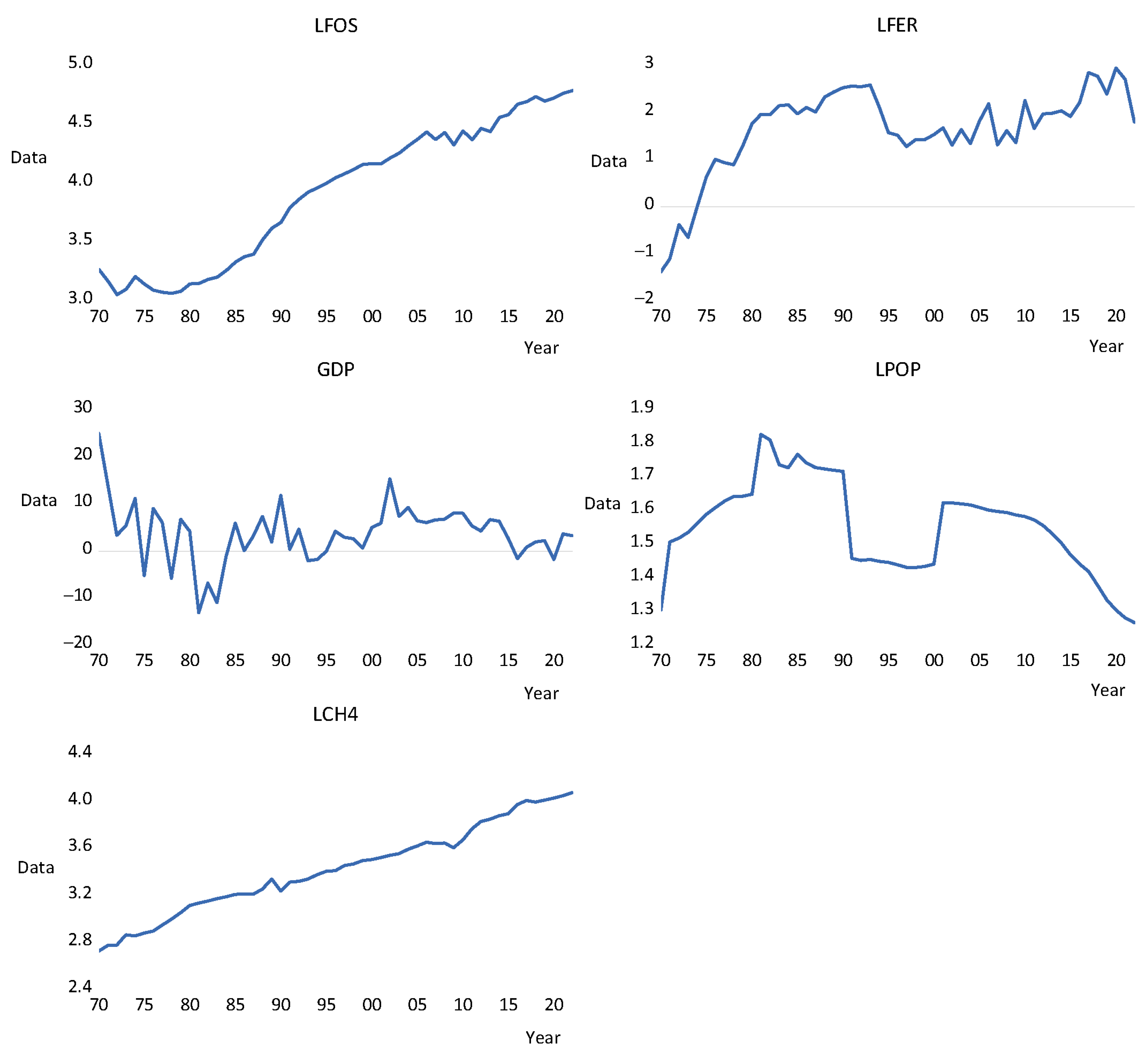
4 (0.393159) show evidence of normal distribution because the probability values are greater than 5%, while LFER (0.000000) and GDP (0.002950) are not normally distributed. The summary of statistics is further presented in a graphical form in
Figure 1. The graphs show that in recent times, LFOS and LCH
4 are upward sloping, while LFER, GDP, and LPOP are sloping downwards. It illustrates a steady upward trend in food production (LFOS) alongside methane emissions, while fertilizer use intensity (LFER) shows a relative decline in recent years, suggesting a widening gap between input availability and production needs.
4.5. Discussions
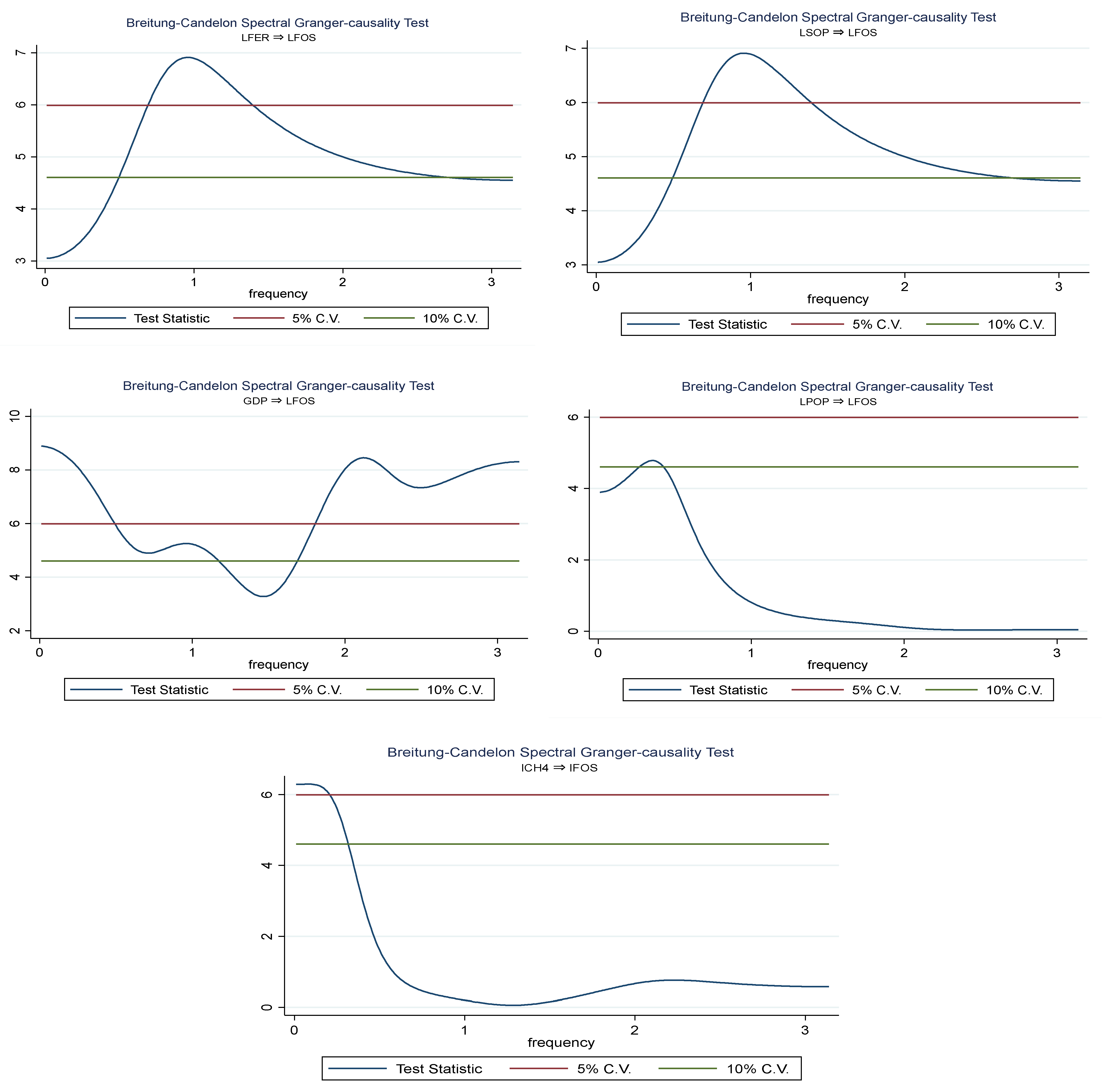
Figure 3 presents the Spectral Granger Causality results, illustrating how the causal relationship between the explanatory variables and food security varies across different frequencies. In this framework, low frequencies correspond to long-run or structural relationships, whereas high frequencies capture short-run or transitory dynamics. When the estimated causality curve exceeds the 5% critical value line, the null hypothesis of no causality is rejected at the corresponding frequency band. This approach, therefore, allows us to distinguish whether a variable influences food security primarily in the short run, the long run, or both. For instance, fertilizer use and methane emissions display stronger causal effects at higher frequencies, indicating predominantly short-term influences, while GDP exhibits more pronounced causality at lower frequencies, suggesting a dominant long-run relationship with food security in Nigeria.
For the LFER and LFOS nexus, this research ascertained that LFER drives LFOS positively in the short run. However, in the first lag, this association is negative. The immediate short-term positive impact demonstrates that fertilizers enhance the productivity of crops, leading to increased food availability. Ref. [
13] opined that fertilizers, both organic and inorganic, play a crucial role in global food security. Another reason for this result is that the Nigerian government supports the subsidization of fertilizers for its users, especially the farmers. This is evident in the subsidy scheme of 1976. Ref. [
27] asserted that the supply and consumption of fertilizer are positively associated with agricultural output. In addition, the subsidy level of the inputs also contributes to input utilization, which is favorably connected to agricultural output value (agricultural GDP). Furthermore, the timeliness of the rain and conducive atmospheric conditions positively contribute to food security. This means that if fertilizers are used in the right way and the atmospheric conditions are suitable, output grows tremendously. Concerning food security in Africa, ref. [
33] argued that significant enhancements in soil health are required to boost agricultural output and lower crop failure rates. Ref. [
68] also had a similar assertion for the Ethiopian economy. Ref. [
36] stated that global food security and agricultural productivity depend on fertilizers. Furthermore, agronomic factors can also enable LFER to spur LFOS. Agronomic mechanisms refer to the biological and physical processes that occur in the field to turn fertilizer into food. Since Nigeria’s soil structures are often depleted, fertilizers have a boosting impact on LFOS through various channels. First, they replenish essential nutrients like nitrogen and phosphorus, which act as a fuel for the plant to grow larger leaves and stronger roots. Second, they close the yield gap by allowing a single hectare of land to produce significantly more grain than it would naturally. Third, the use of fertilizer improves soil structure and water retention, making crops more resilient to Nigeria’s erratic rainfall.
However, it is essential to state that the excessive use of fertilizers can pollute the soil or lead to soil degradation. This impact is observed in the association between LFER and LFOS in the first lag, in the short run. Other factors responsible for this outcome include excessive dependency on fertilizers, poor quality of fertilizers, and delayed fertilizer distribution, which could sometimes be driven by fertilizer supply shocks. Ref. [
69] claimed that enterprises pass input costs on to consumers when supply shocks occur, leading to an instantaneous increase in the prices of outputs in both the local and international markets. Although the fertilizer subsidy scheme in Nigeria has been impactful, ref. [
27] stated that there are still challenges that need to be solved, such as rising import prices and the seeming incapacity of the federal and state budgets to cover these expenses, and the total absence of the initiative of the private sector in the acquisition and distribution of the input. Ref. [
70] claimed that support programs and subsidies helped businesses expand and ensure that farmers could afford a sufficient supply of fertilizers. However, the artificially cheap fertilizer prices also contributed to a national trend of fertilizer abuse, which resulted in nutrient contamination. Further studies that support this assertion include [
71,
72,
73].
In the long run, the impact is favorable, but insignificant. This shows that the impact of the policies implemented by the Nigerian government has not been fully effective in the long run. Some of the factors responsible for this include structural constraints, inequality in fertilizer access, inconsistencies in policies, and environmental impact. Structural challenges entail inadequate/poor rural infrastructure and inadequate access to markets. Regarding inequality in fertilizer access, the more connected or wealthier the farmers are, the easier it will be for them to have access to fertilizers. However, those who lack the connections will also lack access to the fertilizers they need, thus decreasing long-term aggregate gains. Inconsistencies in policies are sometimes driven by tribal or religious clashes and an unstable political climate or political instabilities, which are very prevalent within the Nigerian economy, especially in areas related to agriculture. These challenges lead to the suspension of policies in those farming areas, thus limiting the positive impact on food security. It is important to state that some of these policy failures can be attributed to corruption, and inadequate training on how the fertilizer will be used effectively. Furthermore, although this research used fertilizers used per area of cropland as a proxy for fertilizer use, some fertilizers are more dominant than others in the Nigerian context, such as nitrogen and phosphorus. This could also be one of the main causes of the insignificant relationship. For example, if a farmer keeps using the same type of fertilizer every year without variation, the soil eventually breaks down through several negative mechanisms. Also, fertilizer alone cannot boost yields without improved seeds, irrigation, and extension services, which are often missing in smallholder systems from developing countries; additionally, continuous synthetic fertilizer use without organic matter addition is known to degrade soil fertility, which could lead to an insignificant effect.
In the short and long run, the impact of LCH4 on LFOS is positive, and has the highest impact on LFOS in this study. It is important to emphasize that methane emissions are not a productive input into agriculture, but rather a by-product of agricultural activities, particularly livestock production and rice cultivation. Methane (CH4) emissions are used as a proxy for agricultural intensity due to agriculture being the dominant CH4 source in Nigeria. Therefore, the positive long-run association observed between CH4 emissions and food security should not be interpreted as methane improving food security per se. Instead, this relationship reflects scale effects in agricultural production, whereby increases in food output are accompanied by higher methane emissions. This interpretation aligns with the broader climate-food literature and avoids conceptual confusion regarding the role of greenhouse gases in food systems.
According to ref. [
74], agricultural methane’s shorter atmospheric duration makes it less likely to damage crops over time. Ref. [
12] found that LCH
4 improves LFOS, unlike other types of GHGs that negatively impact food security. In Nigeria, Ref. [
75] further established that LCH
4 improves the productivity of agriculture. This assertion is contrary to existing studies, which found that LCH
4 harms food security. Ref. [
76] stated that LCH
4 leads to agricultural productivity challenges. Ref. [
62], however, found a positive but insignificant link between LCH
4 and LFOS.
In the long run, it shows that GDP increases LFOS. Firstly, an economy that grows sustainably assists the Nigerian government in generating more revenue, while at the same time attracting Foreign Direct Investment (FDI). This equips the government to invest robustly in the agricultural sector, in the areas of improved inputs (such as fertilizers and access to high-quality seeds), mechanization, irrigation infrastructure, research and development (R&D), and improved market and food access. Aside from the government having to invest in the agricultural sector, economic growth also has an impact on the purchasing power of individuals. If the purchasing power is high, then the demand for food will increase, leading to food availability in Nigeria, thus contributing to guaranteed food security. These studies affirmed that economic growth can be seen as a crucial factor in addressing food security issues [
10,
11,
43]. On the other hand, some scholars disagree with this argument. Ref. [
45] stated that economic expansion may make food insecurity worse, suggesting that if economic disparities continue, growth by itself cannot end food insecurity. Ref. [
38] also argued that chronic food insecurity is not primarily due to economic growth or income distribution, but rather inflationary pressures, population growth, and inadequate food storage.
Lastly, food security is threatened because of the rising population in Nigeria. It is crucial to state that, in this research, the impact is not significant, which demonstrates the effectiveness of Nigerian government policies. It is, however, essential to examine the damages that a rising population can have on FOS. LPOP’s negative impact on LFOS is attributed to increased consumption of food resources, land competition, inequality, and ecological damage. Firstly, the demand for food may rise because of a rising population. Food supplies and infrastructure may be under stress as a result, particularly if agricultural productivity does not keep up with a growing population. It is important to note that the population in Nigeria is more than 200 million, and it is still growing [
64]. Ref. [
7] stated that even though the number of people who have escaped food insecurity has improved, Nigeria still has the largest number of people without food worldwide. Secondly, the demand for land for agriculture, as well as other uses like housing and development, rises in tandem with the population. Farmers may find it more challenging to operate and produce food if land prices rise. Third, a growing population may cause ecological damage through erosion of soil, contamination of water, and deforestation. Lower crop yields and damage to agricultural land are possible outcomes of this. Lastly, because the benefits of economic expansion might not be spread equally among the population, LPOP can worsen inequality. Some people will end up with enough food, while others will lack food. Furthermore, aside from the negative impact of a growing population, urban demographic pressure in Nigeria also creates a structural crisis that weakens the country’s farming capacity. First, it triggers a labor drain, where the youngest and most productive workers move to the cities, leaving an aging rural population to manage labor-intensive farms without the help of modern machinery. Second, a dietary shift towards urban staples like imported rice and wheat discourages local farmers from growing traditional crops because the national economy begins to prioritize foreign imports over fixing local supply chains. This research outcome agrees with the studies of refs. [
10,
15,
55,
77,
78], and is in contrast with the studies of refs. [
10,
19].