Policy Priorities Linking Seafood Supply Chain Stability and Seafood Food Security for Sustainable Food Systems: An IPA Case Study of Busan



Abstract
1. Introduction
2. Theoretical Background and Literature Review
2.1. Conceptualizing Food Security
2.2. Seafood Consumption and Food Security
2.3. Importance–Performance Analysis (IPA)
- Identify which attributes related to seafood food security citizens perceive as most important and which they consider relatively less important.
- Determine which attributes—such as supply chain stability, price stability, and safety and reliability—fall within each quadrant and thereby distinguish priority areas requiring improvement from areas perceived as current strengths.
- Present policy implications that local governments and policymakers may use in designing seafood food security and supply chain policies based on these findings.
2.4. Distinctiveness of This Study
3. Research Methodology
3.1. Research Framework
3.1.1. Definition of Attributes and Variables
3.1.2. Measurement of Importance and Performance
3.2. Survey Target and Data Collection
3.3. Analytical Methods
3.3.1. Data Cleaning and Preliminary Analysis
3.3.2. Procedure for Importance–Performance Analysis (IPA)
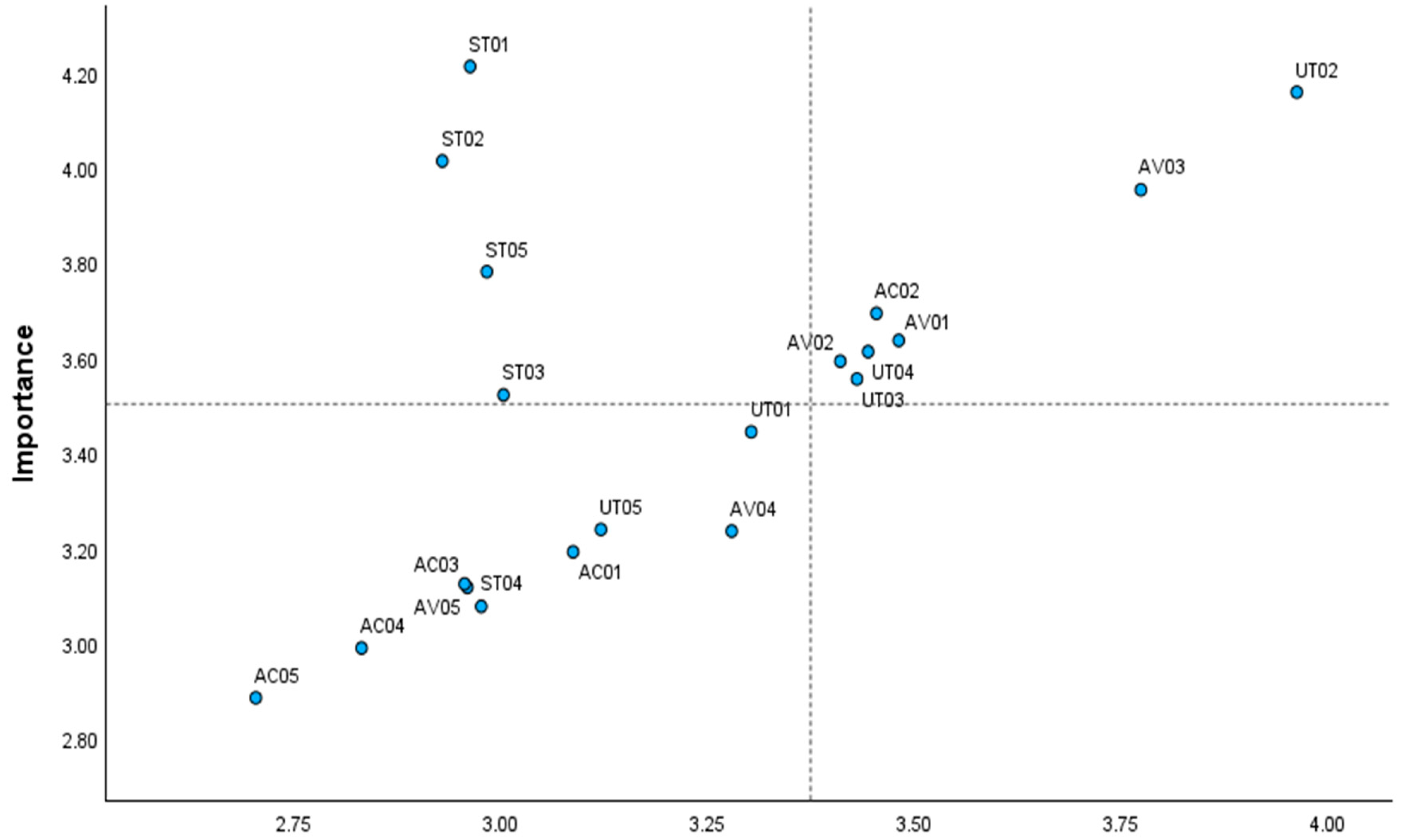
- Quadrant I (High Importance/Low performance): This quadrant comprises attributes that respondents perceive as highly important but for which current performance is low; it is interpreted as a core vulnerable area where concentrated improvement efforts are required (Concentrate Here);
- Quadrant II (High Importance/High performance): This quadrant includes attributes with both high importance and high performance, which are regarded as key strengths where the current level of performance should be maintained and managed (Keep up the Good Work);
- Quadrant III (Low Importance/Low performance): This quadrant consists of attributes with low importance and low performance, interpreted as a relatively low-priority domain that does not warrant substantial allocation of limited resources (Low Priority);
- Quadrant IV (Low Importance/High performance): This quadrant contains attributes that are rated low in importance but high in performance, and is regarded as a domain where potential over-allocation of resources should be examined (Possible Overkill).
3.3.3. Interpretation and Derivation of Policy Implications
4. Results
4.1. General Characteristics of Respondents
4.2. Descriptive Statistics and Reliability of Seafood Food Security Attributes
4.2.1. Subsubsection
4.2.2. Reliability Analysis of the Measurement Instrument
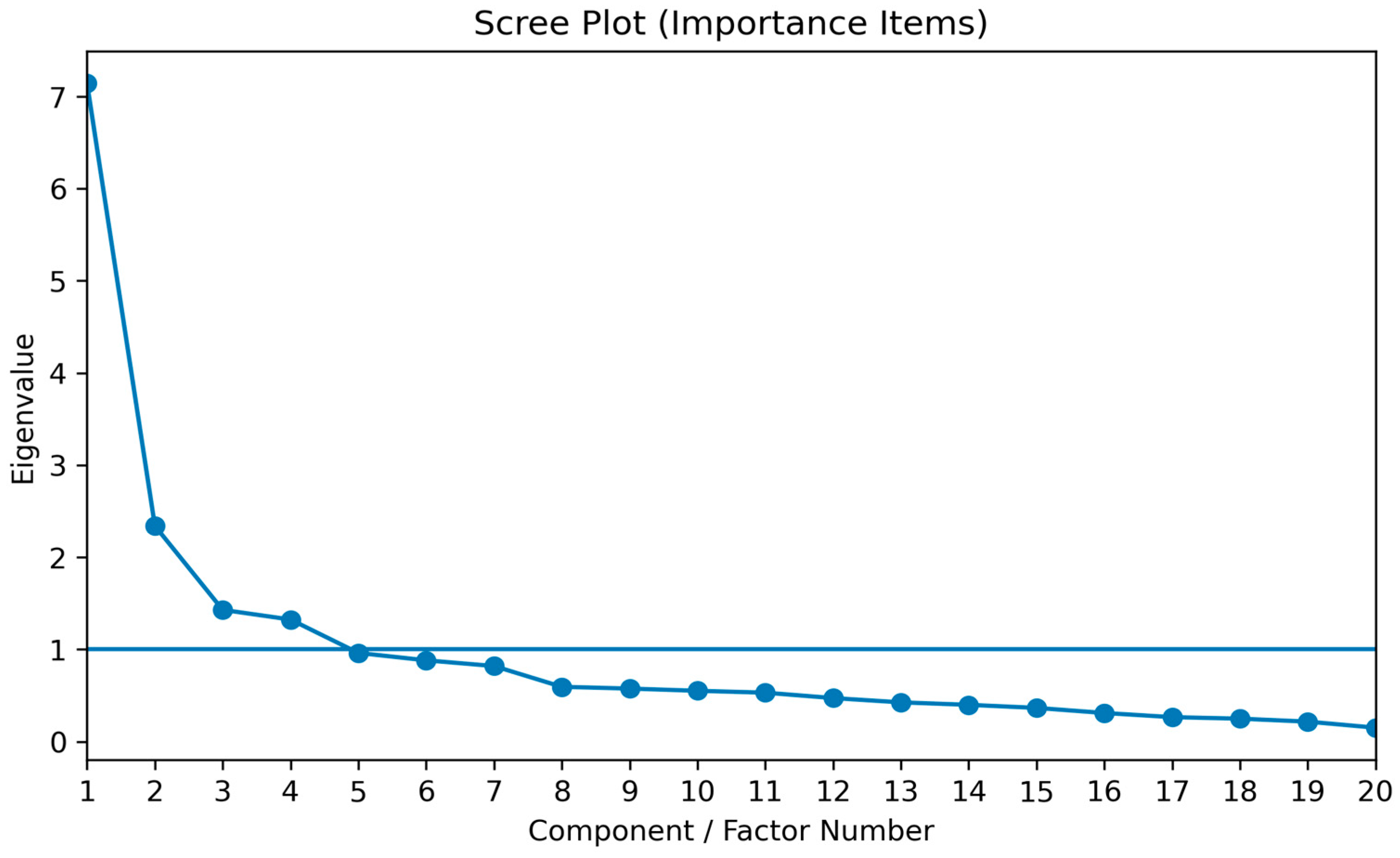
4.3. Exploratory Factor Analysis
4.3.1. Assessment of Factorability
4.3.2. Factor Extraction and Rotation Results
4.4. IPA Results
4.5. Key Findings
5. Discussion, Implications, and Limitations
5.1. Discussion
5.2. Policy Implications
5.3. Limitations and Future Research Directions
6. Conclusions
Author Contributions
Funding
Institutional Review Board Statement
Informed Consent Statement
Data Availability Statement
Acknowledgments
Conflicts of Interest
Abbreviations
| FAO | Food and Agriculture Organization of the United Nations |
| IPA | Importance–Performance Analysis |
| AV | Availability |
| AC | Access |
| UT | Utilization |
| ST | Stability |
| EFA | Exploratory Factor Analysis |
| KMO | Kaiser–Meyer–Olkin |
| KRW | Korean won |
| IUU | Illegal, Unreported and Unregulated (fishing) |
References
- Pingali, P.; Alinovi, L.; Sutton, J. Food Security in Complex Emergencies: Enhancing Food System Resilience. Disasters 2005, 29, 5–24. [Google Scholar] [CrossRef]
- Ding, Q.; Chen, X.; Hilborn, R.; Chen, Y. Vulnerability to Impacts of Climate Change on Marine Fisheries and Food Security. Mar. Policy 2017, 83, 55–61. [Google Scholar] [CrossRef]
- Clapp, J. Food Self-Sufficiency: Making Sense of It, and When It Makes Sense. Food Policy 2017, 66, 88–96. [Google Scholar] [CrossRef]
- Bellmann, C.; Tipping, A.; Sumaila, U.R. Global Trade in Fish and Fishery Products: An Overview. Mar. Policy 2016, 69, 181–188. [Google Scholar] [CrossRef]
- FAO. The State of World Fisheries and Aquaculture: Blue Transformation in Action; FAO: Rome, Italy, 2024; Available online: https://openknowledge.fao.org/server/api/core/bitstreams/1273bc36-339b-43d2-8163-af4d805f2ad2/content/cd0683en.html (accessed on 8 October 2025).
- Elzaki, R.M. Does Fish Production Influence the GDP and Food Security in Gulf Cooperation Council Countries? Evidence from the Dynamic Panel Data Analysis. Aquaculture 2024, 578, 740058. [Google Scholar] [CrossRef]
- Allison, E.H.; Perry, A.L.; Badjeck, M.-C.; Adger, W.N.; Brown, K.; Conway, D.; Halls, A.S.; Pilling, G.M.; Reynolds, J.D.; Andrew, N.L.; et al. Vulnerability of National Economies to the Impacts of Climate Change on Fisheries. Fish Fish. 2009, 10, 173–196. [Google Scholar] [CrossRef]
- FAO. Rome Declaration on World Food Security and World Food Summit Plan of Action; World Food Summit; FAO: Rome, Italy, 1996; Available online: https://www.fao.org/4/w3613e/w3613e00.htm (accessed on 8 October 2025).
- FAO. Food Security; Policy Brief, Issue 2, June 2006; FAO: Rome, Italy, 2006. [Google Scholar]
- Béné, C.; Arthur, R.; Norbury, H.; Allison, E.H.; Beveridge, M.; Bush, S.; Campling, L.; Leschen, W.; Little, D.; Squires, D.; et al. Contribution of Fisheries and Aquaculture to Food Security and Poverty Reduction: Assessing the Current Evidence. World Dev. 2016, 79, 177–196. [Google Scholar] [CrossRef]
- Hamad, A.; Tayel, A. Food 2050 Concept: Trends That Shape the Future of Food. J. Future Foods. 2025. in press. Available online: https://www.sciencedirect.com/science/article/pii/S2772566925001260 (accessed on 13 October 2025).
- Global Food Security Index (GFSI). Available online: https://impact.economist.com/sustainability/project/food-security-index/ (accessed on 12 October 2025).
- Jiao, X.; Zhu, J.; Ye, W.; Zou, H.; Yan, B.; Zhang, N.; Qiang, J.; Tao, Y.; Zhang, H.; Zhang, D.; et al. Artificial Intelligence in Smart Seafood Safety across the Supply Chains: Recent Advances and Future Prospects. Trends Food Sci. Technol. 2025, 163, 105161. [Google Scholar] [CrossRef]
- Kotb, A.A.; Aljohani, E.S.; Alamri, Y.; Aldakhil, A.I.; Alagsam, F.; Alobaid, M.A.; Alsultan, M. Fish Food Security: Analyzing the Economic and Environmental Variables. Discov. Food 2025, 5, 200. [Google Scholar] [CrossRef]
- Murshed-e-Jahan, K.; Pemsl, D.E. The impact of Integrated Aquaculture–Agriculture on Small-Scale Farm Sustainability and Farmers’ Livelihoods: Experience from Bangladesh. Agric. Syst. 2011, 104, 392–402. [Google Scholar] [CrossRef]
- Obiero, K.; Meulenbroek, P.; Drexler, S.; Dagne, A.; Akoll, P.; Odong, R.; Kaunda-Arara, B.; Waidbacher, H. The Contribution of Fish to Food and Nutrition Security in Eastern Africa: Emerging Trends and Future Outlooks. Sustainability 2019, 11, 1636. [Google Scholar] [CrossRef]
- An, J.-E.; Park, S.-H.; Jeong, H.-K. A Study on the Emergence of Sustainable Supply Chains and Response Types of Korean Seafood Exporters. J. Korea Trade 2024, 28, 61–82. [Google Scholar] [CrossRef]
- Cheung, W.W.L.; Lam, V.W.Y.; Sarmiento, J.L.; Kearney, K.; Watson, R.; Zeller, D.; Pauly, D. Large-Scale Redistribution of Maximum Fisheries Catch Potential in the Global Ocean under Climate Change. Glob. Change Biol. 2010, 16, 24–35. [Google Scholar] [CrossRef]
- An, J.-E.; Park, S.-H.; Lee, H.-D. Estimation of Consumer Value on Import Management of Seafood Obtained from IUU Fishing: Using Choice Experiment Method. J. Korea Trade 2023, 27, 115–129. [Google Scholar] [CrossRef]
- FAO. The State of World Fisheries and Aquaculture 2020: Sustainability in Action; FAO: Rome, Italy, 2020. [Google Scholar]
- Tacon, A.G.J.; Lemos, D.; Metian, M. Fish for Health: Improved Nutritional Quality of Cultured Fish for Human Consumption. Rev. Fish. Sci. Aquac. 2020, 28, 449–458. [Google Scholar] [CrossRef]
- Zhong, V.W.; Van Horn, L.; Greenland, P.; Carnethon, M.R.; Ning, H.; Wilkins, J.T.; Lloyd-Jones, D.M.; Allen, N.B. Associations of Processed Meat, Unprocessed Red Meat, Poultry, or Fish Intake with Incident Cardiovascular Disease and All-Cause Mortality. JAMA Intern. Med. 2020, 180, 503–512. [Google Scholar] [CrossRef] [PubMed]
- Akpalu, W.; Okyere, M.A. Fish Protein Transition in a Coastal Developing Country. Environ. Resour. Econ. 2023, 84, 825–843. [Google Scholar] [CrossRef]
- Mamdouh-Lotfy, M.; Samy-Kamal, M.; Nam, J.; Sim, S. Bioeconomic Analysis of Egyptian Mediterranean and Red Sea Fisheries: Implications for Sustainable Management. Reg. Stud. Mar. Sci. 2025, 89, 104277. [Google Scholar] [CrossRef]
- Carlucci, D.; Nocella, G.; De Devitiis, B.; Viscecchia, R.; Bimbo, F.; Nardone, G. Consumer Purchasing Behaviour towards Fish and Seafood Products: Patterns and Insights from a Sample of International Studies. Appetite 2015, 84, 212–227. [Google Scholar] [CrossRef]
- Lee, M.-K.; Nam, J. The determinants of live fish consumption frequency in South Korea. Food Res. Int. 2019, 120, 382–388. [Google Scholar] [CrossRef]
- Baumgartner, U.; Bürgi Bonanomi, E. Drawing the line between sustainable and unsustainable fish: Product differentiation that supports sustainable development through trade measures. Environ. Sci. Eur. 2021, 33, 93. [Google Scholar] [CrossRef]
- Korea Rural Economic Institute (KREI). Food Balance Sheet 2023; KREI: Naju, Republic of Korea, 2025. Available online: https://www.krei.re.kr/krei/page/53?biblioId=542946&cmd=view (accessed on 29 October 2025).
- Martilla, J.A.; James, J.C. Importance-Performance Analysis. J. Mark. 1977, 41, 77–79. [Google Scholar] [CrossRef]
- Jo, H.-J.; Sim, S.-H. A Study on the Response to Climate Change in Fisheries Using IPA Analysis. J. Fish. Bus. Adm. 2025, 56, 19–30. [Google Scholar] [CrossRef]
- Bacon, D.R. A Comparison of Approaches to Importance–Performance Analysis. Int. J. Mark. Res. 2003, 45, 55–71. [Google Scholar] [CrossRef]
- Jeong, J. A Study on Global IT Manufacturing Supply Chain Agility with Integrated AHP and IPA Approach. J. Korea Trade 2025, 29, 129–165. [Google Scholar] [CrossRef]
- Tzeng, G.-H.; Chang, H.-F. Applying Importance–Performance Analysis as a Service Quality Measure in Food Service Industry. J. Technol. Manag. Innov. 2011, 6, 106–115. [Google Scholar] [CrossRef]
- Gerbing, D.W.; Anderson, J.C. An Updated Paradigm for Scale Development Incorporating Unidimensionality and Its Assessment. J. Mark. Res. 1988, 25, 186–192. [Google Scholar] [CrossRef]
- Sever, I. Importance-performance analysis: A valid management tool? Tour. Manag. 2015, 48, 43–53. [Google Scholar] [CrossRef]
- Fisher, B.; Naidoo, R.; Guernier, J.; Johnson, K.; Mullins, D.; Robinson, D.; Allison, E.H. Integrating fisheries and agricultural programs for food security. Agric. Food Secur. 2017, 6, 1. [Google Scholar] [CrossRef]


| Variable | Category | Frequency (N) | Percentage (%) |
|---|---|---|---|
| Gender | Male | 164 | 55.2 |
| Female | 133 | 44.8 | |
| Age | 18–29 years | 41 | 13.8 |
| 30–39 years | 152 | 51.2 | |
| 40–49 years | 71 | 23.9 | |
| 50–59 years | 22 | 7.4 | |
| ≥60 years | 11 | 3.7 | |
| Educational attainment | Middle school or less | 3 | 1.0 |
| High school graduate | 44 | 14.8 | |
| College/University graduate | 182 | 61.3 | |
| Graduate school or higher | 68 | 22.9 | |
| Monthly household income | ≤2 million KRW | 8 | 2.7 |
| 2–<4 million KRW | 74 | 24.9 | |
| 4–<6 million KRW | 93 | 31.3 | |
| 6–<8 million KRW | 59 | 19.9 | |
| ≥8 million KRW | 63 | 21.2 | |
| Seafood consumption frequency (weekly) | Rarely consume | 56 | 18.9 |
| 1–2 times | 208 | 70.0 | |
| 3–4 times | 28 | 9.4 | |
| ≥5 times | 5 | 1.7 | |
| Experience of purchasing sustainable seafood | Yes | 199 | 67.0 |
| No | 98 | 33.0 |
| Domain | Code | Mean Importance | SD (Importance) | Mean Performance | SD (Performance) |
|---|---|---|---|---|---|
| Availability | AV_01 | 3.63 | 1.03 | 3.48 | 0.95 |
| AV_02 | 3.59 | 1.01 | 3.41 | 0.99 | |
| AV_03 | 3.95 | 1.09 | 3.77 | 1.10 | |
| AV_04 | 3.23 | 1.22 | 3.28 | 1.13 | |
| AV_05 | 3.11 | 1.07 | 2.96 | 0.96 | |
| Access | AC_01 | 3.19 | 1.08 | 3.09 | 0.98 |
| AC_02 | 3.69 | 1.01 | 3.45 | 0.95 | |
| AC_03 | 3.12 | 1.13 | 2.96 | 1.01 | |
| AC_04 | 2.99 | 1.18 | 2.83 | 1.10 | |
| AC_05 | 2.88 | 1.20 | 2.70 | 1.04 | |
| Utilization | UT_01 | 3.44 | 1.10 | 3.30 | 1.04 |
| UT_02 | 4.15 | 0.96 | 3.96 | 0.93 | |
| UT_03 | 3.55 | 1.08 | 3.43 | 1.03 | |
| UT_04 | 3.61 | 1.01 | 3.44 | 1.03 | |
| UT_05 | 3.24 | 1.08 | 3.12 | 1.06 | |
| Stability | ST_01 | 4.21 | 0.94 | 2.96 | 1.05 |
| ST_02 | 4.01 | 0.95 | 2.93 | 1.09 | |
| ST_03 | 3.52 | 1.01 | 3.00 | 1.03 | |
| ST_04 | 3.07 | 1.21 | 2.98 | 1.08 | |
| ST_05 | 3.78 | 1.09 | 2.98 | 1.07 |
| Domain | Type | Number of Items | Cronbach’s α |
|---|---|---|---|
| Availability | IMP_AV | 5 | 0.75 |
| PERF_AV | 5 | 0.71 | |
| Access | IMP_AC | 5 | 0.77 |
| PERF_AC | 5 | 0.70 | |
| Utilization | IMP_UT | 5 | 0.82 |
| PERF_UT | 5 | 0.82 | |
| Stability | IMP_ST | 5 | 0.57 |
| PERF_ST | 5 | 0.91 | |
| Total | IMP_Total | 20 | 0.89 |
| PERF_ Total | 20 | 0.91 |
| Statistic | Value |
|---|---|
| KMO measure of sampling adequacy | 0.88 |
| Bartlett’s test of sphericity χ2(df) | 2904.19 (df = 190) |
| Bartlett’s test of sphericity | p < 0.001 |
| Factor | Eigenvalue | Variance Explained (%) | Cumulative Variance (%) |
|---|---|---|---|
| 1 | 7.14 | 35.7 | 35.7 |
| 2 | 2.34 | 11.7 | 47.4 |
| 3 | 1.43 | 7.1 | 54.6 |
| 4 | 1.32 | 6.6 | 61.2 |
| Factor | Factor Label | Code | Summary of Item Content | Loading |
|---|---|---|---|---|
| 1 | Structural and institutional vulnerabilities and access | AV03 | Perception that the domestic seafood supply base will remain stable despite climate and environmental change | 0.72 |
| ST01 | Perception of the consistency and continuity of central and Busan municipal seafood supply and food security policies | 0.68 | ||
| AC01 | Perception of the household burden of seafood prices | 0.65 | ||
| 2 | Environmental, price, and supply chain risks | ST02 | Concern about seafood price instability due to international economic factors (exchange rates, oil prices, etc.) | 0.74 |
| ST03 | Concern about supply disruptions under high import dependence and international conflicts | 0.71 | ||
| ST05 | Perceived supply risks arising from disruptions in maritime transport, ports, and logistics networks | 0.69 | ||
| 3 | Household utilization and dietary habits | UT02 | Extent to which freshness and safety are considered when consuming seafood | 0.70 |
| UT03 | Level of knowledge and information on seafood cooking and storage | 0.67 | ||
| UT05 | Share of seafood in the household diet (consumption frequency) | 0.65 | ||
| 4 | Basic supply conditions and physical access | AV01 | Perceived sufficiency of seafood supply in the Busan area | 0.73 |
| AV02 | Perception of the smooth functioning of domestic seafood distribution and logistics systems | 0.69 | ||
| AC02 | Perceived accessibility of local markets and stores for purchasing seafood | 0.66 |
| Code | Item Description | Mean Importance | Mean Performance | GAP | Priority for Improvement |
|---|---|---|---|---|---|
| ST01 | Perception of seafood supply instability due to climate change | 4.21 | 2.96 | 1.25 | 1 |
| ST02 | Perception of seafood price instability caused by international economic factors | 4.01 | 2.93 | 1.08 | 2 |
| ST05 | Perception of supply risks arising from import dependence and international conflicts | 3.78 | 2.98 | 0.79 | 3 |
| ST03 | Perception of the continuity of central and Busan municipal seafood supply and food security policies | 3.52 | 3.00 | 0.52 | 4 |
| AC02 | Perception of the accessibility of seafood distribution networks in Busan | 3.69 | 3.45 | 0.24 | - |
| UT02 | Extent to which freshness and safety are considered when consuming seafood | 4.15 | 3.96 | 0.19 | - |
| AV02 | Perception of the stability of domestic seafood distribution and logistics systems | 3.59 | 3.41 | 0.18 | - |
| AV03 | Perception of seafood supply instability due to climate and environmental factors | 3.95 | 3.77 | 0.18 | - |
Disclaimer/Publisher’s Note: The statements, opinions and data contained in all publications are solely those of the individual author(s) and contributor(s) and not of MDPI and/or the editor(s). MDPI and/or the editor(s) disclaim responsibility for any injury to people or property resulting from any ideas, methods, instructions or products referred to in the content. |
© 2026 by the authors. Licensee MDPI, Basel, Switzerland. This article is an open access article distributed under the terms and conditions of the Creative Commons Attribution (CC BY) license.
Share and Cite
Jeong, H.K.; Park, S.H. Policy Priorities Linking Seafood Supply Chain Stability and Seafood Food Security for Sustainable Food Systems: An IPA Case Study of Busan. Sustainability 2026, 18, 1188. https://doi.org/10.3390/su18031188
Jeong HK, Park SH. Policy Priorities Linking Seafood Supply Chain Stability and Seafood Food Security for Sustainable Food Systems: An IPA Case Study of Busan. Sustainability. 2026; 18(3):1188. https://doi.org/10.3390/su18031188
Chicago/Turabian StyleJeong, Hyun Ki, and Se Hyun Park. 2026. "Policy Priorities Linking Seafood Supply Chain Stability and Seafood Food Security for Sustainable Food Systems: An IPA Case Study of Busan" Sustainability 18, no. 3: 1188. https://doi.org/10.3390/su18031188
APA StyleJeong, H. K., & Park, S. H. (2026). Policy Priorities Linking Seafood Supply Chain Stability and Seafood Food Security for Sustainable Food Systems: An IPA Case Study of Busan. Sustainability, 18(3), 1188. https://doi.org/10.3390/su18031188