


Abstract
Green production technology, serving as a core approach to coordinate agricultural production and ecological conservation, acts not only as a technological engine driving the transition towards sustainable agricultural models but also as a critical pathway to achieve environmental sustainability. To promote the adoption and diffusion of green production technologies, this study utilizes survey data from 2566 farm households in Jiangxi Province and employs an Ordered Probit model to thoroughly investigate how the application of digital technology enhances farmers’ adoption of green production practices. The findings indicate that the application of digital technology—measured through digital information acquisition, digital technology use, and digital online sales—significantly promotes the intensity of farmers’ adoption of green production technologies. Furthermore, the positive effect of digital technology application on the adoption of green production technologies strengthens with increased government intervention. The influence also varies significantly across households with different farm sizes and education levels, showing a more pronounced effect on medium- and large-scale farmers as well as those with higher education levels. This study provides new evidence on the mechanism through which digital technology application affects farmers’ adoption of green production technologies, and offers insights conducive to leveraging digital technologies in promoting sustainable environmental development.
1. Introduction
Agricultural Green Development as a sustainability-oriented development model aims to synergistically advance efficient production, environmental protection, and ecological balance. It constitutes a fundamental pathway for addressing the challenges of agricultural product quality, safety, and the ecological environment in China [1,2]. Green agricultural technologies, characterized by their core features of “resource-saving, low pollution, and modernity” [3,4], focus on resource conservation, pollution control, and enhancement of ecological benefits. Examples include soil testing and formula fertilization, green pest and disease control, and organic fertilizer application, which provide crucial support for building a Beautiful Countryside [5].
Farmers, as the primary agents of agricultural production and management, directly determine the adoption and implementation effectiveness of green production technologies through their production behavior decisions [6,7]. Despite China’s strong emphasis on agricultural green development, the actual adoption enthusiasm for green production technologies remains relatively low, and the application rate is still suboptimal, primarily due to farmers’ cognitive limitations, the complexity of the technologies, and imprecise policy support [8]. Promoting widespread adoption among farmers has thus become a critical issue demanding urgent resolution in the agricultural green transition [9]. Existing research has extensively explored the factors influencing farmers’ adoption of green production technologies, focusing primarily on theoretical model construction and empirical analysis of survey data. This body of work encompasses various factors, including individual farmer characteristics [10], household and production management characteristics, and internal cognitions [11,12,13,14], accumulating a relatively rich foundation of findings.
With the accelerated penetration and integration of digital technologies such as the internet, 5G communication, and artificial intelligence into the agricultural sector [15,16], the traditional rural information dissemination model based on geography and kinship is being disrupted. Digital technologies can exert influence through physical and direct means (e.g., GNSS parallel navigation and autonomous driving technology), direct information provision (e.g., crop pest and disease monitoring and early warning technologies), and indirect information channels (e.g., specialized agricultural technology applications) [17]. This substantially enhances the efficiency of agricultural information dissemination [18], thereby increasing the likelihood of farmers adopting green agricultural technologies. Furthermore, factors influencing farmers’ adoption of such digital–green solutions can be categorized as internal and external. Internal factors primarily include the farmers’ own production knowledge base, their pursuit of technical efficiency and economic benefits, and the accessibility and ease of use of the digital technologies themselves. External factors involve government subsidies and financial support, regulations or bans on traditional high-pollution production methods, and market-driven certification requirements for green products. Additionally, the rapid advancement and declining costs of digital technologies themselves have significantly lowered the barriers to their use, improving accessibility for ordinary farmers. Against this backdrop, an in-depth investigation into the mechanisms through which digital technology application influences farmers’ adoption of green production technologies not only contributes to promoting a low-carbon green transition in agriculture but also offers new technological pathways and practical foundations for ensuring national food security.
Currently, the impact of digital technology on farmers’ green production technology adoption behavior has become a focal point in academic research, yielding valuable insights. However, existing literature predominantly concentrates on the role of internet access and information acquisition, leaving the exploration of factors such as the actual use of digital technologies and digital online sales relatively insufficient [19]. Simultaneously, the government, acting as the organizer of farmer technical training, the promoter of digital technology information, and the formulator of relevant subsidy policies [20,21,22], plays an indispensable role in the digital technology promotion process. Existing studies often overlook the potential moderating effect of government intervention in the pathway from “digital technology application” to “farmers’ green technology adoption.”
To deepen the understanding of the mechanism through which digital technology application influences farmers’ green production technology adoption behavior, clarify the moderating role of government intervention within this mechanism, and thereby promote the effective dissemination of green production technologies in the agricultural sector to achieve both economic and environmental benefits, this study utilizes field survey data from 2566 farm households conducted by the research team in Jiangxi Province in 2024. It systematically constructs a digital technology application index system based on three dimensions: digital information acquisition, digital technology use, and digital online sales. The study empirically analyzes their impact on farmers’ adoption of green production technologies, with a specific focus on examining the moderating effect of government intervention. This research aims to provide theoretical foundations and decision-making references for the policy promotion and pathway optimization of agricultural green production technologies.
2. Theoretical Analysis and Research Hypothesis
2.1. The Impact of Digital Technology Application on the Adoption of Green Production Technologies
Digital technology exerts influence on farmers’ adoption of green production technologies across all stages of agricultural production: pre-production, during production, and post-production. Compared with traditional agricultural production technologies, green agricultural technologies are characterized by higher complexity and uncertainty. When farmers face information asymmetry, their technology adoption risks increase significantly, potentially leading to economic losses. Therefore, during the pre-production stage, digital information acquisition becomes a critical factor influencing farmers’ decisions to adopt green production technologies [23,24]. Leveraging its efficient and low-cost information dissemination capabilities, digital technology effectively reduces information search costs for farmers, enhances their information acquisition capacity, helps break down technical information barriers, and ultimately promotes the adoption of agricultural technologies [25].
In the production phase, digital technologies are also widely applied in actual agricultural practices, including big data, drones, artificial intelligence, etc. The digital technology use can break spatial and temporal constraints, enhance farmers’ social capital, broaden information channels, reduce agricultural production costs and technological uncertainties, and significantly improve agricultural productivity, thereby creating favorable conditions for farmers to adopt green production technologies [26]. Simultaneously, digital technology applications can improve the traceability and transparency of agricultural supply chains, which strengthens farmers’ awareness of environmental characteristics and enhances their consciousness of sustainable development. This ultimately forms an internal driving force that promotes the adoption of green production technologies.
In the post-production stage, the sales process is a critical component of agricultural product distribution. Compared with traditional sales models, digital online sales are more effective in promoting farmers’ adoption of green production technologies, primarily for four reasons: (1) Digital online sales significantly mitigate information asymmetry and sales bottlenecks in traditional agriculture, enhance market transparency, improve farmers’ price expectations, and thereby encourage the adoption of production technologies [27]. (2) They effectively reduce transaction costs in agricultural sales, increase farmers’ income, and provide financial support for the adoption of green production technologies [28,29]. (3) Digital online sales substantially alleviate information constraints on farmers, enhance their information acquisition capacity, and consequently influence resource allocation decisions, which in turn affects the adoption of green production technologies [30]. (4) They can shorten the distance between producers and consumers. Consumer feedback mechanisms encourage farmers to build a positive reputation and pursue favorable social evaluations, thereby compelling them to adopt green production technologies [28].
Based on the above analysis, this paper proposes the following research hypotheses:
Hypothesis 1 (H1).
The application of digital technology has a significant positive impact on farmers’ adoption behavior of green production technologies.
Hypothesis 1-1 (H1-1).
Digital information acquisition has a significant positive impact on farmers’ adoption behavior of green production technologies.
Hypothesis 1-2 (H1-2).
Digital technology use has a significant positive impact on farmers’ adoption behavior of green production technologies.
Hypothesis 1-3 (H1-3).
Digital online sales have a significant positive impact on farmers’ adoption behavior of green production technologies.
2.2. Analysis of the Moderating Role of Government Intervention
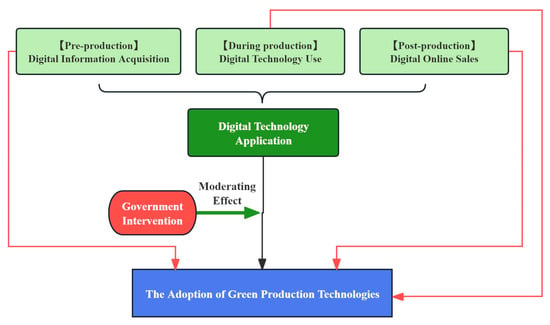
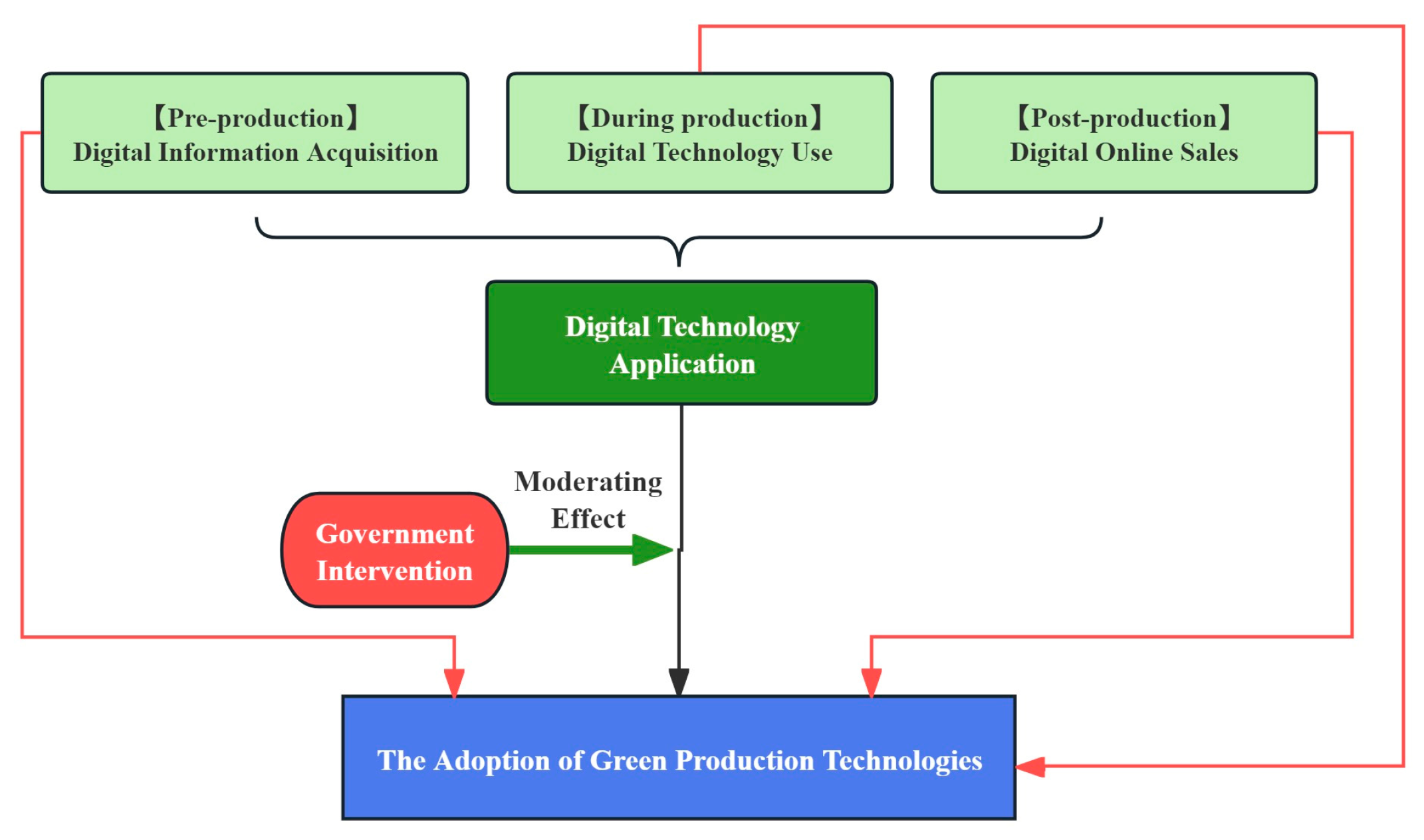
The government plays an irreplaceable role in the process of technology promotion, having invested substantial human, material, and financial resources to facilitate the diffusion of digital production technologies [31,32]. As the organizer of technical training programs for farmers, the government plays a crucial role in technology dissemination by delivering technical information through training. Given their dominant position in determining training content and objectives, the most critical manifestation of governmental involvement lies in whether they implement digital technology promotion initiatives and specialized training programs [8]. The government can quickly enhance farmers’ trust in new technologies through publicity and training [33]. Moreover, training enables farmers to proficiently master these technologies within a short period, thereby improving the adoption rate and effectiveness of new technologies. Thus, government-provided training significantly increases the likelihood of farmers using digital technologies. Additionally, subsidies for digital technology use offered by the government safeguard farmers’ expected returns and markedly elevate the probability of technology adoption [34]. In summary, government intervention can promote farmers’ use of digital technologies and exerts a moderating effect on the relationship between digital technology application and farmers’ adoption of green production technologies. Based on this, the study proposes the following hypothesis (Figure 1):
Figure 1.
The Analytical Mind Map for this paper.
Hypothesis 2 (H2).
Government intervention plays a positive moderating role in the process of digital technology application affecting farmers’ adoption of green production technologies.
3. Data Sources and Model Construction
3.1. Data Sources
The data for this study are derived from a farmer survey conducted in Jiangxi Province from May to September 2024. First, a stratified random sampling method was employed. Twenty-six counties (cities/districts) were selected based on their geographical location, level of economic development, and agricultural industry development. Within each selected county (city/district), four townships were randomly chosen. From each township, three administrative villages were randomly selected, and within each village, ten farm households were randomly sampled for paper-based questionnaire surveys. The survey covered a total of 104 townships, 312 administrative villages, and 3120 farm households. A one-on-one questionnaire survey was conducted with these farmers through offline interviews. During the survey process, all farmers were anonymized, and the content and purpose of the questionnaire were explained to them to ensure they could fully understand and provide truthful responses to the questions. The survey content primarily included household demographic characteristics, agricultural production and operation conditions, digital technology application, adoption of green production technologies, government intervention, and other relevant aspects. After removing samples with missing key variables or containing extreme outliers, the final valid sample consisted of 2566 farm households, resulting in a valid questionnaire response rate of 82.2%.
3.2. Variable Selection and Definition
Based on the consideration of existing research and data availability, this paper selects the following variables for empirical analysis:
1. Dependent variable. The dependent variable in this study is the average adoption number of green production technologies, which is used to characterize the adoption intensity of green production technologies. Based on the actual agricultural practices of farmers and in reference to prior studies [35,36,37], the following six green production technologies were selected as the focus of this research, categorized according to the three stages of crop production: pre-production, in-production, and post-production: soil testing and formula fertilization technology, green pest and disease control technology, organic fertilizer application, biopesticides, biodegradable mulch film technology, and straw crushing and returning technology. Through field surveys, farmers were asked whether they used these green production technologies [35]. The farmers’ adoption intensity for green production technologies is constructed as the mean adoption count across the six specified technologies. Survey results indicate that the average sample household adopted 1.212 green production technologies, reflecting a relatively low overall adoption intensity among farmers.
2. Independent Variables. The core independent variable in this paper is digital technology application. Digital technologies refer to a technical system that involves the digital collection, storage, processing, transmission, and application of information through devices such as computers, networks, and sensors. These include 5G, cloud computing, big data, the Internet of Things, artificial intelligence, drones, and more [38]. Based on the application of digital technologies across various stages of agricultural production, this study categorizes it into three types (As shown in Table 1): Digital information acquisition in the pre-production stage, digital technology use in the production stage and digital online sales in the post-production stage [39,40]. Digital technology application is measured by the sum of these three values obtained from the questionnaire surveys: digital information acquisition, digital technology use, and digital online sales. According to the statistics: 2125 households (82.8% of the sample) use the internet to search for agricultural information; 606 households (23.6%) utilize digital technologies such as IoT, drones, and AI in production; 286 households (11.1%) sell agricultural products through digital online sales.
Table 1.
Content of the Digital Technology Application.
3. Moderating Variable. The moderating variable in this paper is government intervention. Since the government primarily enhances farmers’ trust in new technologies, incentivizes their willingness to use them, and alleviates financial constraints through measures such as training, subsidies, and loan support, thereby increasing the probability of adoption [33], this paper constructs the moderating variable mainly based on whether the government provides funding support for digital technology, subsidies applicable to agricultural production, information support, and related professional assistance, among others. The constructed government intervention index system is presented in Table 2. Following the method outlined in Reference [41], an assignment and summation approach was adopted to measure government intervention, and principal component analysis was applied to determine factors based on the criterion of eigenvalues greater than 1, with a cumulative variance contribution rate of 76.73%. For the government intervention variable, the KMO test for factor analysis yielded a value of 0.872, and Bartlett’s test of sphericity showed a significance level of p = 0.000, indicating good reliability and validity of the variable measurement.
Table 2.
Measurement Indicators for Government Intervention.
4. Control Variables. Existing research indicates that farmers’ adoption of green production technologies is also influenced by individual characteristics, household characteristics and production operation characteristics. To ensure the scientific validity of the model and drawing on References [18,42,43], this paper introduces farmers’ individual, household, and production operation characteristics as control variables. Specifically, individual characteristics include the farmer’s gender, age, educational attainment, health status, risk preference, environmental awareness, and perception of ecological benefits [42]. Household characteristics encompass the total number of household laborers, household disposable income, social capital, and participation in cooperatives [18]. Production operation characteristics comprise farm size, soil fertility, and access to socialized services [42]. As shown in Table 3: at the individual level, the average age of household heads is 56.4 years, with education levels primarily concentrated in primary and junior secondary schools, and the overall health status was relatively good. The majority of farmers are risk-averse and exhibit a moderate level of environmental awareness, while demonstrating a relatively high understanding of the ecological benefits of green production technologies. At the household level, the average number of agricultural laborers per household is 1.75, with 24.3% of households participating in farmer cooperatives. Disposable income for most households falls within the range of 30,000–50,000 RMB or 50,000–80,000 RMB. At the production operation level, the average farm size is 3.51 hectares, soil fertility is generally good, and the average access to social services is 1.67 items.
Table 3.
Variable Definitions and Descriptive Statistics.
3.3. Model Construction
In statistics, the Ordered Probit model is a regression model that constructs a linear function of explanatory variables to fit a monotonic nonlinear relationship, typically used for analyzing ordinal discrete data [38]. As the count of adopted green production technologies is an ordered discrete variable, an Ordered Probit model is used to analyze the effect of digital technology application. The model is specified as follows:
where is a latent variable that refers to the farmers’ adoption behavior of green production technologies; DTA is the independent variable, referring to digital technology application; C refers to the control variables; are coefficients to be estimated; is the disturbance term, following a standard normal distribution, ~. Let , , , , and be the threshold parameters for farmers’ adoption behavior of green production technologies, with , defined as follows:
where degree represents farmers’ adoption behavior of green production technologies, which is an observed variable. is unobservable, but as long as the interval of value can be determined, it can be associated with the probability of the interval according to the known distribution, and then the estimation of parameters can be obtained by maximum likelihood estimation using the sample probability of each interval [36].
This paper not only analyzes the impact of digital technology application on farmers’ adoption behavior of green production technologies but also focuses on the moderating effect of government intervention on this impact. Therefore, an interaction effect model is established as follows:
where DTA represents digital technology application; GI represents government intervention; DTA∙GI represents the interaction term between digital technology application and government; , , , are coefficients to be estimated; is the disturbance term. To mitigate potential multicollinearity arising from the interaction term, the variable for government intervention was centered in this paper.
4. Results and Analysis
4.1. Parallel Trend Assumption Test
When employing ordered probability models (Ordered Probit/Logit) to assess the causal effect of digital technology application on green production technology adoption behavior, a potential concern is the presence of sample selection bias or unobservable confounding factors. That is, farmers who adopt digital technologies earlier or more readily may systematically differ from non-adopters in terms of their inherent willingness to adopt technologies, learning capacity, or resource endowments, and these differences could themselves directly influence their adoption of green production technologies. To enhance the reliability of the study’s conclusions, it is necessary to test whether the “parallel trends” assumption holds between digital technology application and farmers’ green production technology adoption behavior. This assumption requires that, prior to farmers beginning to apply digital technologies, the trends in green production technology adoption intensity between the treatment group (farmers applying digital technologies) and the control group (farmers not applying digital technologies) should not exhibit significant differences. If the assumption holds, subsequent observed differences in adoption intensity are more likely attributable to the digital technology application itself, rather than to pre-existing divergent trends between the two groups.
Given that this study utilizes cross-sectional data, a strict parallel trends test based on panel data cannot be directly conducted. Therefore, drawing on the concept of counterfactual analysis, this study constructs a quasi-experimental design using retrospective information provided by farmers. Based on the survey question “In which year did you begin using digital technology?”, the starting year in which each farmer “began applying digital technology” was identified. Using this event occurrence year (T = 0) as the baseline, the sample was divided into different periods: pre-event (T < 0) and post-event (T ≥ 0). The test was performed by constructing interaction terms between event-time dummy variables and treatment status.
The test results are presented in Table 4. Prior to the digital technology application event, the estimated coefficients for the interaction terms are 0.018 and 0.015, with corresponding t-values of 0.42 and 0.36, respectively, and p-values greater than 0.1, indicating statistical insignificance. This suggests that, before beginning to apply digital technologies, farmers in the treatment and control groups did not show significant differential trends in green production technology adoption intensity, satisfying the parallel trend assumption.
Table 4.
Results of the Parallel Trend Assumption Test.
4.2. Ordered Probit Regression Analysis
As shown in Table 5, Model 1 indicates that digital technology application has a positive impact on the intensity of farmers’ adoption of green production technologies, and this result is statistically significant at the 1% level, thus supporting Hypothesis H1. Models 2, 3, and 4 demonstrate that digital information acquisition, digital technology use, and digital online sales are all significant at the 1% level, with positive estimated coefficients. This suggests that digital information acquisition, digital technology use, and digital online sales significantly promote farmers’ adoption of green production technologies, providing support for Hypotheses H1-1, H1-2, and H1-3.
Table 5.
The Impact of Digital Technology Application on the Adoption Behavior of Green Production Technologies.
Regarding the individual characteristics among the control variables, both farmers’ risk preference and their perception of the ecological benefits of green production technologies exhibit a significant positive impact on the adoption intensity of these technologies. Farmers with a higher degree of risk tolerance are more accepting of potential losses arising from the uncertainties associated with new technologies, thus demonstrating a stronger willingness to adopt green agricultural production technologies. Meanwhile, cognitive behavioral theory suggests that an individual’s level of awareness regarding ecological benefits directly influences their behavioral decisions. The higher the farmers’ awareness of the environmental advantages of green production technologies, the more likely they are to adopt them. Furthermore, farmers’ educational attainment affects their understanding of the technologies and the associated risks. Higher educational levels correlate with a stronger willingness to adopt green production technologies, which is consistent with the results presented in Table 5, indicating a significant positive influence of education on the adoption intensity.
Secondly, from the perspective of family characteristics, the number of agricultural labor force and household disposable income have a significant role in promoting the adoption behavior of technologies. The higher the proportion of labor force in the family, the higher the dependence of the family economy on agricultural production, the stronger the pursuit of agricultural economic benefits, and the more inclined to use advanced technologies to achieve the purpose. Therefore, the number of labor forces can effectively promote the farmers’ adoption of green production technologies. In agricultural production, a certain amount of investment is needed in the early stage of using a new technology. When the disposable income of farm households is low, it will inhibit the adoption of new production technologies by farm households. Therefore, the higher the disposable income of farm households, the greater the probability of adopting green production technologies.
Finally, from the analysis of production and operation characteristics, according to the economic scale effect, the larger the planting scale of farmers, the more it can reduce the unit area cost of using green production technologies, so as to promote the probability of farmers’ adoption of green production technologies. The soil fertility of farmers’ land can effectively reduce the marginal cost of green production by reducing the improvement input. Social service organization is an important information channel for farmers to obtain agricultural information. It can improve farmers’ access to information on new production technologies, and then improve farmers’ adoption of green production technologies. Comprehensively, the planting scale, soil fertility and social services of farmers showed a significant positive impact, which was consistent with the results of Table 5.
To provide a more intuitive interpretation of the economic implications of digital technology application, this study further calculates the Average Marginal Effects (AME) based on the Ordered Probit model. The results indicate that a one-unit increase in the level of digital technology application significantly raises the probability of farmers adopting at least one green production technology by 3.2% (p < 0.01). Specifically, the marginal effects on the probabilities of adopting 0, 1, 2, and 3 or more technologies are −3.2%, 1.5%, 0.8%, and 0.9%, respectively. These findings demonstrate that digital technology application is not only statistically significant but also carries substantial economic relevance.
Given the heterogeneous nature of green production technologies, the influence of digital technology on the adoption intensity of different types of technologies varies considerably. To delve deeper into the extent of this influence, the regression results for six typical green production technologies (Models 5–10), as presented in Table 6, indicate that digital technology application has a significantly positive effect on the adoption of green pest and disease control technology, organic fertilizer application, bio-pesticides, and biodegradable mulching film technology. In contrast, its impact on soil testing and formula fertilization technology and straw crushing and returning technology was not statistically significant. This study systematically interprets these findings by integrating Rogers’ Diffusion of Innovations theory with the Theory of Planned Behavior (TPB).
Table 6.
The Impact of Digital Technology Application on the Adoption of Different Green Production Technologies.
From the perspective of diffusion of innovations theory, Rogers posits that the “relative advantage, compatibility, complexity, observability, and trialability” of a technology are the five core attributes determining its diffusion rate and adoption breadth within a target population [18]. The differential impact of digital technology application on various green production technologies essentially stems from varying degrees of alignment between these technological attributes and the enabling logic of digital technology. For technologies such as green pest and disease control, organic fertilizer application, bio-pesticides, and biodegradable mulching film, their high observability and low complexity are prominent features. Digital technology application can directly visualize the effects of these technologies, allowing farmers to intuitively perceive their relative advantages. Furthermore, the operational barriers for these technologies are low, and they exhibit strong compatibility with farmers’ existing production practices. Digital technologies, through forms like online guidance and short video tutorials, further reduce learning costs and accelerate technology diffusion. Consequently, their regression coefficients are significantly positive, validating the core propositions of diffusion theory. Conversely, technologies like soil testing and formula fertilization and straw crushing and returning are characterized by “high complexity” and “low trialability.” Soil testing and formula fertilization technology relies on specialized soil testing equipment, precise formula calculations, and customized agricultural input support. While digital technology can address issues of “information asymmetry,” it cannot overcome the hardware constraints of “lack of professional equipment and insufficient scale of services,” resulting in farmers’ weak “perceived behavioral control.” Straw crushing and returning technology is mandated by policy in most regions of China; its adoption decisions are primarily driven by “policy compliance” rather than “market benefits.” The moderating effect of digital technology is overshadowed by the powerful institutional environment. Therefore, the regression coefficients for these two technologies were not statistically significant, which is entirely consistent with the diffusion theory corollary that “high-complexity technologies face diffusion obstacles.”
From the perspective of the Theory of Planned Behavior, Ajzen asserts that individual behavioral decisions are jointly determined by three dimensions: “behavioral attitude, subjective norms, and perceived behavioral control” [41]. Digital technology differentially influences the adoption of various green production technologies by reshaping these three psychological mechanisms. Regarding behavioral attitude, for technologies like green pest and disease control and biodegradable mulching film, the green premium mechanisms on digital sales platforms enable farmers to clearly perceive the economic benefits of the technologies. Simultaneously, digital media exposure of agricultural non-point source pollution and publicity of ecological protection policies enhance farmers’ awareness of the environmental benefits of these technologies, forming a dual positive attitude combining economic gain and environmental responsibility, which drives adoption behavior. Concerning subjective norms, digital technology leverages channels such as social networks and farmer mutual aid groups to create social demonstration effects for technology adoption. The technology use cases of medium-to-large-scale farmers and highly educated farmers are widely disseminated, establishing group norms that pressure other farmers to follow suit. However, for straw crushing and returning technology, the dominant subjective norm is set by the government; the social transmission effect of digital technology is replaced by policy regulations, hence its influence is not significant. Regarding perceived behavioral control, soil testing and formula fertilization technology requires specialized knowledge and equipment support, resources often lacking for farmers, leading to weak perceived behavioral control. In contrast, technologies like green pest and disease control can be supported by systematic services accessible through digital technology, allowing farmers to adopt them without substantial additional resource investment, thereby enhancing perceived behavioral control and increasing the probability of adoption.
In summary, the enabling effect of digital technology on the adoption of green production technologies has clear applicability boundaries. Its core functions are manifested in compressing information costs, deepening perceived benefits, and enhancing behavioral control capacity. However, it struggles to surmount three major barriers: the inherent complexity characteristics of the technologies themselves, supply constraints of hardware infrastructure, and mandatory regulations at the institutional level.
4.3. Robustness Tests
To conduct robustness tests, two approaches were employed: model substitution and replacement of the dependent variable. The results are presented in Table 7. Model 11 replaces the Ordered Probit model with an Ordered Logit model, while Model 12 substitutes the dependent variable with “Adoption of Green Production Technologies (Did your household adopt green production technologies during the production process? Yes = 1, No = 0).” The regression results show that the estimated coefficient of digital technology application remains positive and significant, consistent with the results of Model 1 in Table 5, indicating the robustness of the findings.
Table 7.
Calculation Results of the Robustness Test.
To mitigate potential endogeneity bias (e.g., self-selection and omitted variables) between digital technology application and the adoption of green production technologies, this study further employs the Propensity Score Matching (PSM) method for robustness testing. PSM simulates a randomized experimental setting by matching the treatment group (farmers using digital technologies) with a control group (farmers not using digital technologies) that share similar observed characteristics, thereby providing a more accurate estimate of the Average Treatment effect on the Treated (ATT) of digital technology application on green production technology adoption.
In this paper, “digital technology application” is treated as the treatment variable and defined as a binary dummy variable: farmers with a digital technology application composite index above the sample median are assigned to the treatment group (D = 1), while the others constitute the control group (D = 0). The matching variables encompass farmers’ individual characteristics, household characteristics, and production operation characteristics, including age, educational attainment, health status, and others, consistent with the control variables in the baseline model. Three matching methods—nearest neighbor matching (1:1 without replacement), radius matching (caliper = 0.01), and kernel matching—are employed to ensure the robustness of the results.
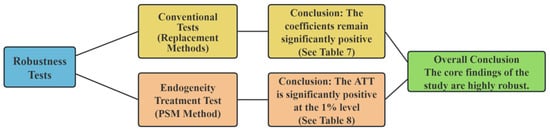
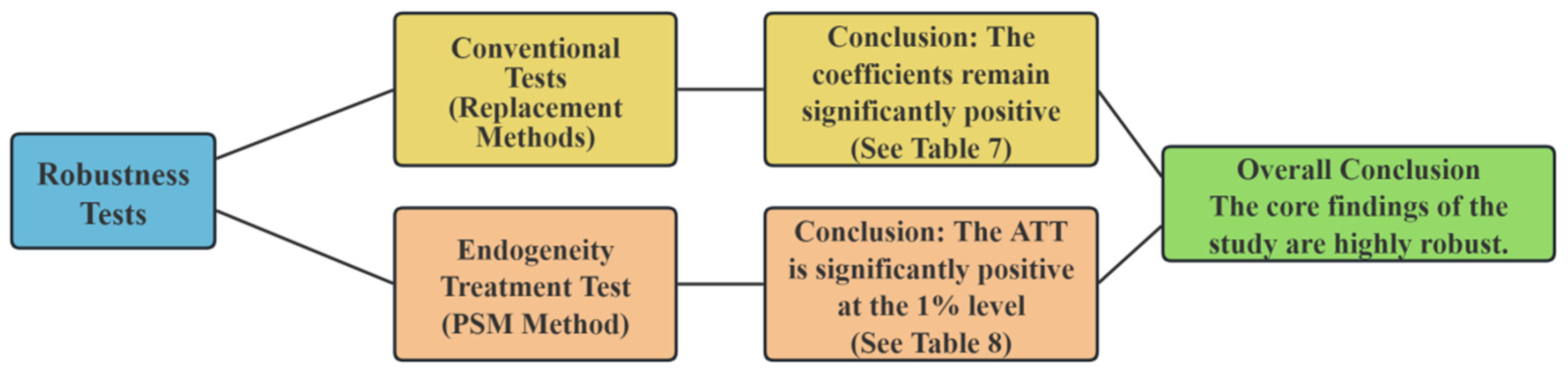
After matching, the standardized biases for all covariates were substantially reduced (all below 10%), and the biases for most variables were statistically insignificant, indicating a good matching quality and the absence of systematic differences in observed characteristics between the treatment and control groups. The balance test results support the validity of the PSM estimation. The PSM estimation results are presented in Table 8. Across all three matching methods, the ATT of digital technology application on green production technology adoption is significantly positive at the 1% level, with ATT values ranging between 0.21 and 0.24. This indicates that, even after controlling for selection bias, digital technology application still significantly promotes farmers’ adoption of green production technologies, which is consistent with the baseline regression findings and further validates the robustness of the study’s conclusions (Figure 2).
Table 8.
PSM Test Results.
Figure 2.
Schematic Diagram of Robustness Tests.
4.4. Regression Calculation of the Moderating Effect of Government Intervention
Model 13 in Table 9 presents the regression results of the interaction term between government intervention and digital technology application. The results show that the interaction coefficient between digital technology application and government intervention is significantly positive at the 1% significance level, confirming the positive moderating effect of government intervention on the relationship between digital technology application and farmers’ adoption of green production technologies, thereby validating Hypothesis H2. Specifically, with the government ‘s intervention, the farmers’ ability to apply digital technology is correspondingly enhanced. This synergistic effect further amplifies the role of digital technology application in promoting the adoption of green production technologies. This finding reveals the key regulatory mechanism of government intervention.
Table 9.
Regression Calculation Results of the Moderating Effect of Government Intervention.
4.5. Heterogeneity Analysis
The results in Table 5 indicate that farm size and educational attainment are two key factors influencing farmers’ adoption of green production technologies. Theoretical analysis suggests that expanding farm operation scale can reduce the per-unit-area cost of adopting green production technologies through economies of scale, thereby strengthening the economic incentives for farmers to adopt such technologies. To further investigate the heterogeneous impact of digital technology application on green production technology adoption behavior, the sample was divided into small-scale farmers (operation size < 50 mu) and medium-to-large-scale farmers (operation size ≥ 50 mu) [44], and subgroup regression analyses were conducted based on farm operation scale.
Concurrently, farmers with higher educational attainment generally have access to more diverse information channels, possess relatively stronger capabilities in information processing and applying new technologies, which in turn increases their likelihood of adopting new technologies. To further examine the heterogeneous impact of digital technology application on green production technology adoption behavior, the sample was categorized into low-education farmers (primary school education or below), medium-education farmers (junior high school education), and high-education farmers (senior high school education or above), and subgroup regression analyses were performed based on farmers’ educational attainment.
To rigorously test whether the impact of digital technology application on green production technology adoption exhibits statistically significant heterogeneity across different farmer groups (e.g., different operation scales, different educational levels) and to avoid judgments based solely on coefficient magnitude differences, this study employs the Chow test to examine coefficient differences across subgroup regression results. The null hypothesis of the Chow test is that the regression equations for the two subsamples are not significantly different. Rejecting the null hypothesis indicates that the subgroup division is necessary and that significant differences exist in the effect sizes across groups.
First, a test was conducted for the farm operation scale subgroups (small-scale vs. medium-to-large-scale farmers). A full model incorporating all samples was constructed, including a subgroup dummy variable and its interaction term with the digital technology application variable. The Chow test yields an F-statistic of 15.73, with a corresponding p-value less than 0.01, strongly rejecting the null hypothesis (see Table 10). This indicates that the impact of digital technology application on green production technology adoption exhibits statistically significant heterogeneity between farmers of different operation scales, supporting the conclusion that the promoting effect is greater for medium-to-large-scale farmers is not coincidental. Second, a likelihood ratio test (an extension of the Chow test) was performed for the educational attainment subgroups (low, medium, high). The test yields a χ2 statistic of 21.45, with a p-value less than 0.01 (see Table 10), also rejecting the null hypothesis of no difference across the three equations. This confirms that the heterogeneous pattern—where the promoting effect of digital technology application significantly increases with higher educational attainment—is robust.
Table 10.
Chow Test Results.
The regression results of Models 14 and 15 show that digital technology application has a significantly positive impact on the adoption of green production technologies for both small-scale and medium-to-large-scale farmers, with a more pronounced promoting effect observed for the latter (Table 11). This difference can be attributed to the following reasons: First, medium-to-large-scale farmers generally possess higher levels of human capital, enabling stronger digital technology application capabilities and more effective use of digital tools for optimizing production decisions. Second, due to their larger farmland area, the marginal cost of applying digital technologies is relatively lower for medium-to-large-scale farmers, thereby increasing the net benefits of technology adoption. This finding not only confirms the universal promoting effect of digital technology application on the adoption of green production technologies but also reveals the moderating role of farmland operation scale in shaping this effect.
Table 11.
Heterogeneity Analysis of the Scale of Farmers’ Operation.
The regression results of Models 16 to 18 show that digital technology application significantly promotes the adoption of green production technologies among all three farmer groups (low-, medium-, and high-education), with the strongest effect observed for high-education farmers, followed by medium-education farmers, and the weakest effect for low-education farmers (Table 12). This disparity can be attributed to the following reasons. First, higher educational attainment typically enhances farmers’ learning capacity, technological cognition, information acquisition, and processing abilities, thereby strengthening their digital technology application capabilities and enabling more effective utilization of digital tools. Second, improved education levels increase farmers’ awareness of the long-term benefits of technologies, effectively mitigating resistance to the complexities associated with adopting both digital and green technologies. This finding not only confirms the significant promoting effect of digital technology application on the adoption of green production technologies but also reveals the differential impact shaped by farmers’ educational attainment.
Table 12.
Heterogeneity Analysis of Farmers’ Educational Attainment.
5. Discussion
Based on 2566 valid questionnaires collected through one-on-one surveys, this paper thoroughly examines the impact of digital technology application on farmers’ adoption of green production technologies through three dimensions (digital technology acquisition, digital technology use, and digital online sales) while also investigating the moderating effect of government intervention on this relationship.
The aforementioned research findings indicate that digital technology application has significantly promoted farmers’ adoption of green production technologies overall, which aligns with some existing studies [18,39,45]. However, these studies have overlooked the differential impacts of internal dimensions of digital technology (digital technology acquisition, digital technology use, and digital online sales) on farmers’ adoption behaviors. This discovery carries profound underlying reasons. First, compared to traditional technologies, green production technologies often demonstrate greater complexity with delayed and uncertain outcomes, representing key psychological barriers hindering farmers’ adoption [18,46]. Digital information acquisition can break down information barriers in an intuitive and low-cost manner, substantially reducing farmers’ learning time. The predominant role of digital technology use primarily stems from its capacity to provide precise data feedback and visualized effectiveness demonstrations. This enables farmers to personally verify both economic and environmental benefits of green technologies, thereby significantly enhancing their adoption confidence. Furthermore, digital online sales establish a “green premium” market return mechanism, creating a closed-loop economic incentive system that offers direct and sustained economic motivation for the farmers’ adoption of green production technologies. The promotional effect of digital online sales demonstrated in our research conclusions substantiates this mechanism.
The enhancing effect of digital technology on farmers’ adoption of green production technologies shows significant variations: it demonstrates notable promotion for technologies such as green pest control and organic fertilizer application, while showing insignificant impact on formulated fertilization techniques based on soil testing and straw returning. This difference stems from the essential differences in the adoption barriers faced by different technologies. Technologies like pest control and organic fertilizer application primarily depend on knowledge and information updates [35,47], where digital technology can effectively overcome the “information-skill” barrier [44], facilitating rapid adoption by farmers. In contrast, formulated fertilization based on soil testing requires professional detection and specialized machinery, while straw returning is constrained by large-scale crushing equipment and economies of scale. Both technologies face substantial “capital constraints” and “service accessibility” bottlenecks. Although digital technology can provide information support, it struggles to directly resolve the underlying issues of physical equipment shortages and inadequate socialized services [23]. Consequently, promoting the widespread adoption of green production technologies necessitates not only digital information empowerment but also corresponding hardware support and service system construction.
Existing research on the impact of digital technology on farmers’ adoption of green production technologies has overlooked the factor of government intervention [18,39,45,48]. However, this paper reveals its significant positive moderating effect—a conclusion of substantial importance. This demonstrates that in integrating digital technology with agricultural green transformation, markets and governments maintain not a substitutional but a synergistic relationship. The government’s moderating function primarily manifests in three aspects: First, reducing initial costs. Through subsidies for smart sensor equipment and provision of green agricultural input vouchers, the government directly lowers the financial barriers for farmers to adopt digital and green technologies, thereby accelerating technological diffusion. Second, providing public goods and services. By investing in rural digital infrastructure such as 5G networks and IoT systems, the government paves the way for technology application while simultaneously enhancing farmers’ overall capabilities through training programs that integrate digital skills with green technology knowledge [32]. Third, establishing institutional frameworks and trust assurance mechanisms. Through certification of green agricultural products and development of official credible digital traceability platforms, the government addresses “trust” issues in markets, enabling the realization of “green premiums” promised through digital online sales [22]. These governmental interventions not only reinforce the effectiveness of digital technologies themselves but also compensate for limitations that cannot be resolved by market mechanisms alone.
6. Conclusions and Policy Recommendations
6.1. Conclusions
The promotion and application of agricultural green production technologies can effectively reduce environmental pollution and resource waste, playing a vital role in achieving the green transformation of agricultural development and even advancing the Beautiful Village Initiative. Farmers’ adoption of green production technologies directly determines the progress of China’s green agricultural development. Based on micro-survey data from 2566 farm households in Jiangxi province, China, this paper investigates the impact of digital technology application on the intensity of farmers’ adoption of green production technologies, examines the moderating effect of government intervention, and conducts robustness tests through methods such as model substitution. The main conclusions are as follows:
(1) The application of digital technology can significantly promote the adoption probability of farmers’ green production technologies. Notably, digital information acquisition, digital technology use, and digital online sales all demonstrate significant promoting effects.
(2) Digital technology application has a significantly positive impact on the adoption of green pest and disease control technology, organic fertilizer application, biopesticides, and biodegradable mulch film technology, whereas its positive effects on soil testing and formulated fertilization technology and straw crushing and returning technology are not statistically significant.
(3) Government intervention exerts a significant positive moderating effect on the relationship between digital technology application and farmers’ adoption of green production technologies. This is specifically reflected in the fact that government intervention significantly amplifies the promoting effect of digital technology application on farmers’ adoption behavior.
(4) Heterogeneity analysis reveals that digital technology application exerts a significantly positive impact on the adoption of green production technologies among both small-scale and medium-to-large-scale farmers, with a more pronounced effect observed for the latter. Furthermore, the enhancing effect of digital technology application on the adoption of green production technologies becomes more substantial as farmers’ educational attainment increases.
It should be noted that the data for this study were collected from multiple representative counties and cities within Jiangxi Province. As a typical southern hilly and mountainous agricultural province in China, Jiangxi also encompasses major grain-producing areas such as the Poyang Lake Plain, giving it certain unique characteristics in terms of agro-ecological types and economic development levels. Therefore, the main conclusions of this study should be applied with caution when directly extrapolated to other agro-ecological regions with significant differences. However, the value and some findings of this study still hold reference significance beyond regional boundaries. The analytical framework, econometric models, and the method of identifying key variables through questionnaire surveys developed in this research can be directly referenced and adapted for similar studies in other regions. The universal mechanisms revealed in this study, such as those related to behavioral decision-making psychology and social interactions, may also hold true in other agricultural regions with similar socio-cultural contexts, although their specific effect strengths and pathways may require revalidation. We plan to collect and analyze data from more provinces or countries in the future, extend the research to different agricultural regions for comparative studies, and further explore the micro-mechanisms of specific digital technology functions (e.g., blockchain, big data early warning) in relation to the adoption of particular green technologies.
6.2. Policy Recommendations
Based on the aforementioned conclusions and considering the economic cost constraints faced by farmers in specific production stages, the government should deepen the application of digital technologies to provide more effective and actionable digital support for farmers’ adoption of green production technologies, while emphasizing the moderating role of government intervention. Accordingly, this paper proposes the following recommendations:
(1) Given the particularly significant role of digital technology application in promoting farmers’ adoption of green production technologies, government agencies and agricultural extension departments should intensify digital skills training for farmers. This should prioritize hands-on guidance related to green production technologies, such as operating smart equipment and utilizing data analysis tools, to improve farmers’ digital literacy, thereby effectively advancing the implementation of green production practices.
(2) Given the differential impacts of digital technology on the adoption of various green production technologies, more targeted promotion measures should be developed. For technologies with significant promoting effects, such as green pest control and organic fertilizer application, publicity and service support should be enhanced through digital platforms. For technologies with non-significant effects, such as soil testing and formulated fertilization as well as straw returning, emphasis should be placed on providing material subsidies or mechanized services to reduce adoption costs for farmers.
(3) The government should actively intervene through subsidies, credit support, and digital infrastructure investment to enhance the promoting effect of digital technologies on the adoption of green production technologies, thereby accelerating the development of the “digital and green” agricultural operation model.
(4) While supporting small-scale farmers’ access to digital agricultural services, full play should be given to the leading role of medium- and large-scale farmers in adopting green technologies. By cultivating new business entities such as smart farms and family farms, replicable and scalable digital–green production models can be established to facilitate the integration of small-scale farmers into the green transformation process.
Author Contributions
Conceptualization, W.J.; methodology, W.J.; software, W.J.; validation, W.J. and Z.W.; formal analysis, W.J.; writing—original draft preparation, W.J.; writing—review and editing, W.J., W.C. and Z.W.; visualization, Z.W.; supervision, W.J. All authors have read and agreed to the published version of the manuscript.
Funding
This research received no external funding.
Institutional Review Board Statement
Our research, which utilizes anonymized information data, qualifies for exemption from ethical review under the current national regulations in China, specifically Article 32(2) of the Ethical Review Measures for Life Sciences and Medical Research Involving Human Subjects.
Informed Consent Statement
Informed consent was obtained from all subjects involved in the study.
Data Availability Statement
The data presented in this study are available on request from the corresponding author.
Conflicts of Interest
The authors declare no conflicts of interest.
References
- Zhao, Q.Q.; Pan, Y.H.; Xia, X.L. Internet can do help in the reduction of pesticide use by farmers: Evidence from rural China. Environ. Sci. Pollut. Res. 2021, 28, 2063–2073. [Google Scholar] [CrossRef] [Scilit]
- Donkor, E.; Onakuse, S.; Bogue, J.; De Los Rios-Carmenado, I. Fertiliser adoption and sustainable rural livelihood improvement in Nigeria. Land Use Policy 2019, 88, 104193. [Google Scholar] [CrossRef] [Scilit]
- Wang, H.; Mao, Y.; Zhou, M.; Li, X. Farmers’ digital literacy and its impact on agricultural green total factor productivity: Evidence from China. Sustainability 2025, 17, 9255. [Google Scholar] [CrossRef] [Scilit]
- Yin, X.; Li, W.; Tang, S.; Li, Y.; Zhao, J.; Tian, P. Pathways Through Which Digital Technology Use Facilitates Farmers’ Adoption of Green Agricultural Technologies: A Comprehensive Study Based on Grounded Theory and Empirical Testing. Sustainability 2025, 17, 9218. [Google Scholar] [CrossRef] [Scilit]
- Zhao, J.L.; Zhang, X.Y. Analysis of the evolution and driving factors of the coordinated development of digitalization and greening in central cities. Sci. Decis. Mak. 2024, 6, 32–50. [Google Scholar]
- Mao, H.; Zhou, L.; Ying, R.Y.; Pan, D. Time preferences and green agricultural technology adoption: Field evidence from rice farmers in China. Land Use Policy 2021, 109, 105627. [Google Scholar] [CrossRef] [Scilit]
- Luo, X.J.; Feng, S.Y.; Shi, X.P.; Qu, F.T. Farm households’ adoption behavior of environment friendly technology and the evaluation of their environmental and economic effects in Taihu basin-taking formula fertilization by soil testing technology as an example. J. Nat. Resour. 2013, 28, 1891–1902. [Google Scholar]
- Huang, Z.H.; Zhong, Y.Q.; Wang, X.L. The effects of different policies on farmers’ pesticide use practices. China Popul. Resour. Environ. 2016, 26, 148–155. [Google Scholar]
- Xie, X.B.; Wu, Y.; Feng, Z.L.; Hao, Z.T. Investigation of green behavior of resource-based enterprise in China. China Popul. Resour. Environ. 2015, 25, 5–11. [Google Scholar]
- Wang, L.; Chen, Y.; Ramsey, T.S.; Hewings, G.J.D. Will researching digital technology really empower green development? Technol. Soc. 2021, 66, 101638. [Google Scholar] [CrossRef] [Scilit]
- Tan, Y.F.; Zhang, S.X.; Lu, Q. Environmental regulation, technology selection and farmers’ green production transition: Empirical analysis based on endogenous transformation regression model. J. Arid Land Resour. Environ. 2021, 35, 69–76. [Google Scholar]
- Gao, Y.; Zhang, X.; Lu, J.; Wu, L.; Yin, S. Adoption behavior of green control techniques by family farms in China: Evidence from 676 family farms in Huang-Huai-Hai plain. Crop Prot. 2017, 99, 76–84. [Google Scholar] [CrossRef] [Scilit]
- Bougherara, D.; Gassmann, X.; Piet, L.; Reynaud, A. Structural estimation of farmers’ risk and ambiguity preferences: A field experiment. Eur. Rev. Agric. Econ. 2017, 44, 782–808. [Google Scholar] [CrossRef] [Scilit]
- Lewis, B.D.; Pattinasarany, D. Determining citizen satisfaction with local public education in Indonesia: The significance of actual service quality and governance conditions. Growth Change 2009, 40, 85–115. [Google Scholar] [CrossRef] [Scilit]
- Buehren, N.; Goldstein, M.; Molina, E.; Vaillant, J. The impact of strengthening agricultural extension services on women farmers: Evidence from Ethiopia. Agric. Econ. 2019, 50, 407–419. [Google Scholar] [CrossRef] [Scilit]
- Yu, L.L.; Zhao, D.Y.; Xue, Z.H.; Gao, Y. Research on the use of digital finance and the adoption of green control techniques by family farms in China. Technol. Soc. 2020, 62, 101323. [Google Scholar] [CrossRef] [Scilit]
- Bharadwaj, A.; Sawy, O.A.E.; Pavlou, P.A.; Venkatraman, N. Digital business strategy: Toward a next generation of insights. MIS Q. 2013, 37, 471–482. [Google Scholar] [CrossRef] [Scilit]
- Luo, J.X.; Sun, W.L. Research on the impact of internet use on farmers’ adoption of green agricultural technologies based on the survey data of 436 facility vegetable growers in Hebei province. Chin. J. Agric. Resour. Reg. Plan. 2023, 44, 97–105. [Google Scholar]
- Kai, L.I.; Yu, J.I.N.; Zhou, J. Are vulnerable farmers more easily influenced? Heterogeneous effects of Internet use on the adoption of integrated pest management. J. Integr. Agric. 2023, 22, 3220–3233. [Google Scholar] [CrossRef] [Scilit]
- Zhang, H.L.; Li, J.Y.; Teng, H.Q. Cognition, external environment and green agricultural technology adoption behavior for small-scale farmers. J. Arid Land Resour. Environ. 2020, 34, 8–13. [Google Scholar]
- Bahinipati, A.C.S.; Viswanathan, P.K. Incentivizing resource efficient technologies in India: Evidence from diffusion of micro-irrigation in the dark zone regions of Gujarat. Land Use Policy 2019, 86, 253–260. [Google Scholar] [CrossRef] [Scilit]
- Liu, D.; Sun, J.; Huang, M.S.; Hu, W.W. Research on cooperative effect of market and government on farmers’ adoption of integrated pest management technology. Resour. Environ. Yangtze Basin 2019, 28, 1154–1163. [Google Scholar]
- Xiao, Y.; Qi, Z.H.; Xu, S.; Yang, C.Y.; Liu, Y.X. Impact of social interaction and information acquisition ability on farmers’ adoption behavior of rice-shrimp co-cultivation technology. J. Ecol. Rural Environ. 2022, 38, 308–318. [Google Scholar]
- Yang, H.Y.; Li, X.G.; Zhang, C.Y.; Cai, W.C.; Huo, X.X. Information, social network and farmers’ purchasing channel choice of agricultural inputs: Based on the comparison between firm direct sales and store retails. Res. Agric. Mod. 2020, 41, 474–483. [Google Scholar]
- Khataza, R.R.B.; Doole, G.J.; Kragt, M.E.; Hailu, A. Information acquisition, learning and the adoption of conservation agriculture in Malawi: A discrete-time duration analysis. Technol. Forecast. Soc. Change 2018, 132, 299–307. [Google Scholar] [CrossRef] [Scilit]
- Benyam, A.A.; Soma, T.; Fraser, E. Digital agricultural technologies for food loss and waste prevention and reduction: Global trends, adoption opportunities and barriers. J. Clean. Prod. 2021, 323, 129099. [Google Scholar] [CrossRef] [Scilit]
- Parker, C.; Ramdas, K.; Savva, N. Is It Enough? Evidence from a natural experiment in India’s Agriculture Markets. Manag. Sci. 2016, 62, 2481–2503. [Google Scholar] [CrossRef] [Scilit]
- Zeng, Y.W.; Guo, H.D.; Jin, S.Q. Does e-commerce increase farmers’ income? Evidence from shuyang county, Jiangsu province, China. Chin. Rural Econ. 2018, 2, 49–64. [Google Scholar]
- Cheng, X.W.; Lin, L.F. Agricultural products e-commerce’s impact on efficiency of small-farmers with organic linkage to modern agricultural development. J. Hua Zhong Agric. Univ. Soc. Sci. Ed. 2020, 162, 37–47. [Google Scholar]
- Tang, L.Q.; Zhou, J. Social capital, information acquisition and farmers’ behavior of electronic commerce. J. South China Agric. Univ. Soc. Sci. Ed. 2018, 3, 49–64. [Google Scholar]
- Omotilewa, O.J.; Ricker, G.J.; Ainembabazi, J.H. Subsidies for agricultural technology adoption: Evidence from a randomized experiment with improved grain storage bags in Uganda. Am. J. Agric. Econ. 2019, 101, 753–772. [Google Scholar] [CrossRef] [Scilit]
- Yu, Y.L.; Li, H.; Xue, C.X.; Yao, S. Study on the influence of government support on farmers’ green production knowledge under the adjustment of farmers’ differentiation. J. Northwest A F Univ. Soc. Sci. Ed. 2019, 19, 150–160. [Google Scholar]
- Zheng, J.G.; Zhang, R.X. Cognitive conflict, policy tools and decision-making of straw returning technology. J. Arid Land Resour. Environ. 2021, 35, 65–69. [Google Scholar]
- Cortignani, R.; Severini, S. A constrained optimization model based on generalized maximum entropy to assess the impact of reforming agricultural policy on the sustainability of irrigated areas. Agric. Econ. 2012, 43, 621–633. [Google Scholar] [CrossRef] [Scilit]
- Chu, C.H.; Feng, S.Y.; Zhang, W.W. Empirical study on farm households’ behavior of adopting environmental-friendly farm technologies: A case study of organic fertilizer and formula fertilizer technologies. Chin. Rural Econ. 2012, 3, 68–77. [Google Scholar]
- Weng, Z.L.; Lan, D.W.; Tang, J.; Liao, Y. Risk preference, cooperative participation and adoption behavior of green rice production technology-Based on 520 surveys of rice growers in Jiangxi Province. Agric. Econ. Manag. 2023, 81, 13–22. [Google Scholar]
- Chen, S.S.; Wang, F.; Ke, Y.P.; Guo, J.C. How Internet information acquisition affects fruit Farmers’ Willingness of soil testing and formula fertilization-Evidence from the main banana producing areas in Hainan Province. For. Econ. 2022, 44, 44–59. [Google Scholar]
- Vial, G. Understanding digital transformation: A review and a research agenda. Manag. Digit. Transform. 2021, 28, 118–144. [Google Scholar] [CrossRef] [Scilit]
- Wang, C.C.; Xia, C.P.; Tong, Q.M.; Shi, M.M. Does participating in E-commerce promote farmers’ green production: An empirical study based on 812 fruit farmers in four counties of three provinces. China Popul. Resour. Environ. 2022, 32, 132–143. [Google Scholar]
- Zheng, Y.Y.; Zhu, T.H.; Jia, W. Does Internet use promote the adoption of agricultural technology? Evidence from 1449 farm households in 14 Chinese provinces. J. Integr. Agric. 2022, 21, 282–292. [Google Scholar] [CrossRef] [Scilit]
- Su, L.L.; Peng, Y.L. Farmers’ digital literacy, elite identity and participation in rural digital governance. J. Agrotech. Econ. 2022, 1, 34–50. [Google Scholar]
- Mao, H.; Luo, X.F.; Tang, L.; Huang, Y.Z. Adoption decisions of multiple agricultural green production technologies: Explanatory factors and correlation analysis. J. China Agric. Univ. 2021, 26, 231–244. [Google Scholar]
- Qiu, H.G.; Su, L.F.; Zhang, Y.T.; Tang, J.J. Risk Preference, Risk Perception and Farmers’ Adoption of Conservation Tillage. China Rural Econ. 2020, 7, 59–79. [Google Scholar]
- Ye, S.H.; Qi, Z.H.; Huang, W.H.; Liu, K. Operation scale, information acquisition and farmers’ ecological production behavior: Analysis on the difference of different production behaviors and farmers’ types. J. China Agric. Univ. 2019, 24, 173–186. [Google Scholar]
- Gao, T.Z.; Feng, H.; Lu, Q. Can digital agricultural extension services promote farmers’ green production technology choices: Based on micro-survey data from three provinces in the yellow river basin? J. Agrotech. Econ. 2023, 9, 23–38. [Google Scholar]
- Yu, W.Z.; Luo, X.F.; Li, R.R.; Xue, L.F.; Huang, L. The paradox between farmer willingness and their adoption of green technology from the perspective of green cognition. Resour. Sci. 2017, 39, 1573–1583. [Google Scholar]
- Guo, L.J.; Zhao, J. A study on farmers willingness of biological pesticide application from the perspective of cognitive conflict: An empirical analysis based on 639 rice farmers in Jiangsu. J. Nanjing Agric. Univ. Soc. Sci. Ed. 2017, 17, 123–133. [Google Scholar]
- Wang, Y.Q.; Wang, Z. Socialized service, information acquisition and farmer’s water-saving irrigation technology adoption behavior—Empirical analysis based on the survey data of 775 wheat-corn growers in Hebei province. Chin. J. Agric. Resour. Reg. Plan. 2024, 3, 49–58. [Google Scholar]

Disclaimer/Publisher’s Note: The statements, opinions and data contained in all publications are solely those of the individual author(s) and contributor(s) and not of MDPI and/or the editor(s). MDPI and/or the editor(s) disclaim responsibility for any injury to people or property resulting from any ideas, methods, instructions or products referred to in the content. |
© 2026 by the authors. Licensee MDPI, Basel, Switzerland. This article is an open access article distributed under the terms and conditions of the Creative Commons Attribution (CC BY) license.