1. Introduction
Rapid economic, technological, and social transformations are compelling higher education institutions worldwide to reassess their role in preparing graduates for an uncertain future. Within global sustainability agendas especially those targeting decent work (SDG 8), quality education (SDG 4), and economic resilience the traditional model of credential based education is increasingly inadequate [
1]. Consequently, entrepreneurship education has emerged as a strategic response, equipping learners with transferable competencies such as critical thinking, creativity, opportunity recognition, and adaptive problem-solving [
2,
3].
Conceptually, this form of education extends beyond business creation to encompass a broader entrepreneurial mindset vital for sustainable human capital development. It enhances graduates’ employability, fosters self reliance, and promotes lifelong learning. From a systemic perspective, entrepreneurship education serves as a pillar for sustainable economic growth by enabling job creation, reducing unemployment, and strengthening knowledge-based economies a critical function in regions facing youth unemployment and labor market volatility [
4,
5,
6].
Pedagogically, this approach represents a shift toward experiential and competency-based learning, emphasizing value creation, collaborative projects, and the integration of 21st-century skills. Despite its recognized importance, the institutional integration of entrepreneurship education varies significantly across national systems [
7,
8]. While some have developed coherent, policy driven models, others rely on fragmented initiatives with limited long-term impact and weak evaluation mechanisms [
9,
10].
From the perspective of sustainable development in higher education, entrepreneurial thinking constitutes a core mechanism for enhancing institutional resilience, adaptability, and long-term relevance. Sustainable higher education systems are increasingly defined not only by access and quality, but also by their capacity to equip graduates with the competencies required to navigate labor market uncertainty, contribute to innovation-driven economies, and generate sustainable social and economic value. In this context, entrepreneurship education functions as an enabling framework that supports the economic, social, and institutional dimensions of sustainability by aligning learning outcomes with employability, lifelong learning, and systemic responsiveness to societal change.
This study addresses a gap in the literature by moving beyond descriptive accounts of individual programs to offer a systematic, comparative analysis of institutional integration [
11,
12]. Focusing on five leading nations Finland, the United States, Canada, the United Kingdom, and South Korea we evaluate their approaches through a sustainability oriented framework that explicitly links entrepreneurship education to employability outcomes, systemic reform, and long-term alignment with SDG 4 and SDG 8. The analysis aims to derive actionable insights for developing coherent and scalable strategies in higher education systems, with particular relevance for Arab universities seeking to strengthen institutional capacity, enhance graduate employability, and align educational outcomes with sustainable development goals [
13].
2. Research Objectives
This study aims to examine the degree of institutional integration of entrepreneurial education within higher education systems across the selected countries. It seeks to compare national approaches to embedding entrepreneurial competencies, empowering faculty members, and developing entrepreneurial infrastructure within universities. In addition, the study aims to identify key strengths, gaps, and sustainability related challenges inherent in current international models of entrepreneurship education. Building on this comparative analysis, the study derives analytically grounded lessons to inform the development of sustainable entrepreneurship education frameworks, with particular relevance for higher education contexts in Arab countries.
3. Research Questions
To address these objectives, the study seeks to answer three interrelated research questions. The first examines how entrepreneurial education is integrated within the higher education systems of the selected countries. The second explores the similarities and differences that characterize national approaches to embedding entrepreneurial education as a sustainable institutional strategy. The third investigates the systemic mechanisms that are most critical for achieving the sustainable integration of entrepreneurial education within universities.
4. Research Problem
Despite the growing global emphasis on entrepreneurial education as a strategic lever for sustainable development, higher education systems particularly in Arab contexts continue to face persistent challenges related to fragmented implementation, weak institutional integration, and limited mechanisms for evaluating long-term educational and economic impact. While a substantial body of literature documents individual programs, courses, or policy initiatives, much of the existing research remains descriptive in nature and focuses on isolated practices rather than system level integration [
1,
2].
Moreover, comparative studies that examine entrepreneurial education through sustainability-oriented lenses such as policy coherence, curricular integration, faculty capacity building, institutional infrastructure, and impact assessment remain relatively scarce [
3,
4]. As a result, higher education institutions often lack analytically grounded frameworks that guide the systematic embedding of entrepreneurial education and the culture of self employment as core components of sustainable educational reform [
5,
6].
Accordingly, the central research problem addressed in this study is the absence of a comprehensive, evidence-based, and sustainability-oriented framework that enables higher education systems to institutionalize entrepreneurial education and the culture of self-employment in a coherent and scalable manner. This gap limits universities’ ability to move beyond fragmented or project-based initiatives toward integrated, long-term strategies that contribute to graduate employability, economic resilience, and sustainable development [
7,
8].
In response to this problem, the study seeks to address the following main research question:
How can entrepreneurial education models and programs implemented in leading global higher education systems be leveraged to develop a sustainable and systematic methodology for embedding entrepreneurial education and the culture of self-employment within universities?
To operationalize this overarching question, the study is guided by a set of interrelated sub-questions. These questions examine the institutional and pedagogical mechanisms that support the sustainable integration of entrepreneurial education within higher education systems, as well as the international practices that represent effective and sustainable university-level models of entrepreneurship education. The study further explores the standards and criteria that guide the implementation of entrepreneurship education in higher education within sustainability-oriented global frameworks. In addition, it investigates the current state of entrepreneurial education practices in Finland, the United States, Canada, the United Kingdom, and South Korea. Building on this comparative analysis, the study considers how international experiences can be analytically adapted to enhance a sustainable entrepreneurial culture and self-employment within higher education systems, and ultimately seeks to propose a sustainable, system-level methodology for institutionalizing entrepreneurship education within universities.
5. Research Proposition
This study is grounded in the proposition that the systematic and multi-level integration of entrepreneurial education is a critical enabler for sustainable higher education systems. Specifically, the study posits that when entrepreneurial education is coherently embedded through (1) aligned national and institutional policies, (2) competency-based curricula, (3) strategic faculty capacity building, and (4) robust institutional support mechanisms, it directly contributes to cultivating a pervasive entrepreneurial culture, enhancing graduate employability, and fostering self-employment. Consequently, this integration positions universities as central actors in driving sustainable economic and social development [
7,
8,
9,
10].
6. Significance of the Study
The significance of this research is threefold, offering distinct contributions at the theoretical, methodological, and practical levels to the field of sustainable higher education reform.
6.1. Theoretical Contribution
Theoretically, this study advances a systems level conceptualization of entrepreneurial education. It moves beyond viewing it as a standalone pedagogical intervention or a collection of courses, to framing it as a core institutional capability essential for educational, economic, and societal sustainability [
9,
10]. By explicitly linking entrepreneurial education to the development of sustainability-oriented competencies such as systems thinking, anticipatory thinking, and normative competence the study bridges the discourse on entrepreneurship education with the broader agenda of Education for Sustainable Development (ESD) and the Sustainable Development Goals (SDGs) [
6,
10]. This reframing positions universities not merely as knowledge disseminators but as active ecosystems fostering the human capital necessary for long-term resilience and value creation in a dynamic global economy [
8].
6.2. Methodological Contribution
Methodologically, the study provides a robust, comparative analytical framework for assessing the institutional integration of entrepreneurial education. Rather than presenting a descriptive inventory of programs or initiatives, the study adopts a structured comparative design based on systematic documentary analysis and an analytical matrix applied consistently across cases. Grounded in sustainability-related criteria such as policy coherence, transdisciplinary curriculum design, faculty capacity, and impact assessment mechanisms this framework enables a systematic, cross-national evaluation that transcends descriptive accounts [
2,
3]. The use of analytically derived criteria offers a transparent and replicable model for researchers, supporting evidence based benchmarking and longitudinal analysis of how higher education systems evolve to embed entrepreneurial and sustainable mindsets.
6.3. Practical Contribution
Practically, the findings deliver actionable insights for key stakeholders. For policymakers and educational leaders, the study identifies effective international practices and the systemic mechanisms that underpin them, offering a blueprint for strategic reform. For university administrators and faculty developers, it provides a grounded reference for designing integrated learning ecosystems that connect entrepreneurship pedagogy with innovation support structures and lifelong learning pathways. Most critically, for the Arab higher education context, the study offers a vital, evidence-based reference for adapting and contextualizing global models. It addresses specific regional challenges by proposing a scalable methodology to cultivate an entrepreneurial culture aligned with both local socio-economic needs and global sustainability imperatives.
7. Research Design and Methodology
7.1. Research Design
This study adopts a descriptive analytical research design situated within the field of comparative education. This design is appropriate for examining how entrepreneurial education and the culture of self-employment are institutionally embedded within higher education systems, with a particular focus on sustainability-oriented practices at the university level. The study relies on systematic document analysis and comparative interpretation rather than primary empirical data collection [
2,
3].
Documentary Corpus and Search Protocol
The documentary corpus was constructed through a systematic search of publicly available sources relevant to entrepreneurship education in higher education. The search process covered international academic databases (including Scopus and Web of Science), policy repositories and reports issued by international organizations (such as OECD, UNESCO, and the World Bank), as well as official national policy documents and governmental reports from the selected countries [
7,
8]. Search terms included combinations of “entrepreneurship education,” “entrepreneurial mindset,” “self employment,” “higher education,” and “sustainability,” and were applied primarily in English, reflecting the dominant language of international policy and scholarly communication.
Inclusion criteria comprised documents that explicitly addressed entrepreneurship education within higher education systems at the national or institutional level, while documents focused solely on primary or secondary education, or lacking relevance to institutional integration, were excluded. For each country, a comparable set of policy documents, strategic reports, and peer reviewed studies was reviewed to ensure balanced coverage. Where discrepancies across sources or time periods emerged, priority was given to the most recent and authoritative documents, and findings were interpreted through cross-source triangulation to enhance consistency and analytical reliability [
3,
7].
7.2. Contextual Differentiation in Case Selection
This study employs a purposive, analytically driven case selection strategy focusing on five higher education systems that demonstrate relatively mature and systemically integrated approaches to entrepreneurship education. Rather than treating these cases as a homogeneous group of “successful” models, the selection deliberately reflects contextual diversity within high-performing systems, enabling a more nuanced comparative analysis of differentiated pathways to institutional integration [
2,
9].
The selected cases represent distinct socio-economic, governance, and cultural contexts that shape the design and implementation of entrepreneurship education in higher education. Finland exemplifies a highly coordinated governance model embedded within a high-trust welfare society, where entrepreneurship education is closely aligned with national policy coherence and social sustainability objectives [
7,
9]. The United States reflects a market-driven, high-risk entrepreneurial culture characterized by strong private-sector engagement.
7.3. Case Selection and Data Sources
The study focuses on five countries: Finland, the United States, Canada, the United Kingdom, and South Korea, selected through purposive sampling. This selection is informed by their consistently strong performance in international indicators related to entrepreneurship, innovation, and higher education development (e.g., the Global Entrepreneurship Monitor and the Global Innovation Index) [
7,
9]. These countries are widely recognized as leaders in entrepreneurship education, making them suitable cases for comparative analysis and for deriving analytically transferable insights.
Importantly, while the selected countries are often collectively described as successful, they represent distinct institutional, socio-economic, and governance contexts through which entrepreneurship education is embedded within higher education systems. Acknowledging this contextual differentiation is essential for strengthening analytical generalization and avoiding a simplistic best practice transfer logic.
Finland represents a highly coordinated, high trust welfare state in which entrepreneurship education is systematically embedded through nationally aligned curricula, teacher education, and innovation policy frameworks. Its model emphasizes coherence, equity, and long term human capital development through strong state coordination.
The United States reflects a predominantly market driven system characterized by high risk tolerance, decentralized institutional autonomy, and strong private sector ecosystems. In this context, entrepreneurship education is closely linked to venture capital networks, university industry partnerships, and innovation hubs, although implementation varies considerably across institutions.
The United Kingdom represents a framework guided system marked by institutional autonomy and strong quality assurance mechanisms. While national guidance frameworks exist, entrepreneurship education is often implemented through localized initiatives, resulting in uneven levels of systemic integration beyond leading universities.
South Korea illustrates a technology driven developmental model with strong state intervention. Entrepreneurship education is closely aligned with national digitalization and innovation agendas, supported by substantial public investment in technological infrastructure and coordinated policy initiatives.
Canada occupies an intermediate position shaped by a diverse, immigration driven demographic structure and an economy transitioning from traditional resource dependence toward knowledge and innovation based sectors. Entrepreneurship education in Canada reflects this hybridity, combining policy coordination with decentralized institutional and regional initiatives.
Together, these cases do not represent a single pathway to success, but rather multiple context dependent trajectories of systemic integration. This differentiated case selection enables the study to examine how similar policy objectives, such as graduate employability, innovation capacity, and sustainability, are pursued through distinct institutional logics, thereby enhancing the external validity and interpretive depth of the comparative analysis.
The research population consists of publicly available national policy documents, governmental and international organization reports, and peer reviewed academic literature related to entrepreneurship education in higher education.
A qualitative content analysis framework was developed based on ten analytically derived criteria reflecting sustainability oriented dimensions of entrepreneurship education integration. These criteria encompass the presence of national policies supporting entrepreneurship education, the degree of curricular integration of entrepreneurial competencies, the strength of university industry partnerships, and the extent of faculty capacity building initiatives. They also include the availability of incubators and entrepreneurship centers, institutional support for entrepreneurial graduation projects, and the provision of funding mechanisms for student innovation. In addition, the framework considers the assessment of entrepreneurial and sustainability related impact, the adoption of competency based educational approaches, and the availability of digital infrastructure supporting entrepreneurship education. These criteria were derived from the relevant literature and applied consistently across all cases to ensure analytical comparability [
3,
6,
9].
7.4. Data Collection and Analysis (After Revision)
Data were collected through systematic document analysis of publicly available policy texts, national strategies, institutional plans, curricular guidelines, and evaluation reports, complemented by a structured review of peer-reviewed academic studies. The study adopts a qualitative, document-based comparative research design and does not involve primary data collection through interviews or surveys. Accordingly, the analysis focuses on patterns of documented institutional intent, structure, and implementation rather than on direct observation of practice [
2,
3].
The analysis employed a comparative analytical matrix grounded in ten analytically derived criteria. Each criterion was operationally defined prior to analysis to ensure conceptual consistency and transparency across cases. Documents were examined against these predefined criteria and assessed using a four-point ordinal scale (4 = Excellent, 3 = Good, 2 = Moderate, 1 = Weak), where each score corresponded to explicit qualitative descriptors reflecting the degree of institutional integration evidenced in the documentary corpus. Scores were assigned based on explicit documentary indicators, including the presence of formal policies, curricular mandates, institutional structures, implementation mechanisms, and evaluation practices relevant to each criterion.
Mean scores were calculated to provide a descriptive overview of cross-national variation. Given the ordinal nature of the scale, the use of mean values is explicitly framed as a heuristic benchmarking tool rather than as a form of statistical inference or interval measurement. The purpose of aggregation is to offer an indicative orientation of relative positioning across countries, not to establish precise quantitative rankings. To mitigate the limitations of ordinal aggregation, numerical summaries are consistently interpreted alongside criterion-level qualitative analysis, preserving contextual depth and avoiding decontextualized comparison.
The analysis was conducted by the authors through an iterative process of document review and analytical refinement. Formal inter-coder reliability statistics and robustness or sensitivity testing were not applied, as the study does not aim to produce replicable quantitative scores but rather to support analytically grounded comparison within a qualitative research paradigm. This methodological choice is acknowledged as a design limitation and is addressed explicitly in the Limitations section.
To enhance transparency and auditability, an evidence extraction
Appendix A documents the types of documentary sources used to justify scores by criterion and country, allowing readers to trace the analytical logic underlying the comparative assessment.
7.5. Limitations
This study is subject to a number of methodological and analytical limitations that should be acknowledged to ensure appropriate interpretation of the findings and to clarify the scope of the study’s contribution.
First, the study adopts a comparative qualitative case study design based exclusively on systematic document analysis. As such, it does not aim to establish direct causal relationships between entrepreneurship education interventions and student-level or labor market outcomes. Rather than testing causal effects or estimating their magnitude, the analysis focuses on identifying the constitutive dimensions of systemic integration and inferring the institutional mechanisms and supportive relationships through which these dimensions tend to co-occur in more mature systems. The findings should therefore be interpreted as providing analytically grounded explanations of how and why systemic integration matters, rather than as causal proof of impact.
Second, the reliance on publicly available policy documents, strategic plans, evaluation reports, and peer-reviewed literature means that the analysis reconstructs the declared institutional logic and reform intent of entrepreneurship education at the national and university-system levels. While this approach is essential for understanding official policy trajectories, governance arrangements, and system-level design thinking, it does not capture the full range of enacted practices or lived experiences at the classroom or student level. A gap may therefore exist between formal policy articulation and actual implementation, which cannot be resolved within the scope of documentary analysis alone.
Third, the study does not employ inter-coder reliability testing or statistical robustness checks. This reflects a deliberate methodological choice aligned with qualitative comparative analysis, where transparency, analytical consistency, and traceability of evidence are prioritized over statistical generalization. To enhance analytical rigor and auditability, the study documents the types of evidence used to justify assessments across criteria and cases, allowing readers to critically evaluate the interpretive judgments underlying the comparative analysis.
Fourth, the purposive selection of five internationally recognized, relatively high-performing systems limits the external validity of the findings. The cases were intentionally selected to examine mature and systemically integrated models, rather than to provide a globally representative sample. Consequently, the study does not claim generalizability across all higher education systems, nor does it include lower-performing or “negative” cases. Instead, it offers analytically informative insights into different paths and configurations of success, which may inform—but not prescribe reform efforts in other contexts.
Finally, while the study proposes the ADKAR model as a phased, implementation-oriented framework for institutional transformation, it does not empirically test the effects of individual ADKAR stages on educational or employment outcomes. ADKAR is used here as a pedagogically contextualized action framework, translated into educational mechanisms and institutional processes, rather than as a predictive or causal model.
Future research is therefore encouraged to build on this study by employing mixed-method designs, including interviews, surveys, classroom observations, and longitudinal student outcome tracking, to empirically examine how the declared institutional logics and mechanisms identified here translate into enacted practices and measurable outcomes across diverse higher education contexts.
8. Theoretical Framework
8.1. The Evolution of Entrepreneurship Education
Entrepreneurship education has evolved in response to broader economic and social transformations. Early initiatives, emerging in the mid-twentieth century at institutions like Harvard Business School, were predominantly situated within business schools and focused on venture creation [
6,
7]. Over time, it expanded beyond business disciplines, driven by recognition of the role of SMEs and innovation in economic growth and employment [
8,
9].
This expansion has been accompanied by growing scholarly debate regarding the effectiveness of entrepreneurship education, its methodological foundations, and the contextual conditions under which it produces meaningful educational and economic outcomes. A substantial body of research emphasizes that entrepreneurial learning outcomes are highly context-dependent and cannot be assumed to operate uniformly across institutional and national settings [
14,
15].
8.2. Policy Integration and Contemporary Shifts
In Europe, entrepreneurship education gained momentum through policy-driven reforms from the late 1990s onward, aimed at modernizing curricula and enhancing graduate employability, albeit with varying depth and coherence [
10,
11]. Contemporary scholarship now conceptualizes it as a systemic pedagogical transformation rather than a collection of isolated initiatives. Universities are viewed as central actors in cultivating entrepreneurial mindsets and innovation capacity, with effectiveness closely linked to experiential learning, institutional leadership, and sustained partnerships with external stakeholders [
13,
16,
17].
From this perspective, entrepreneurship education increasingly intersects with broader innovation systems and university industry engagement, reinforcing its role in regional development and knowledge-based economic growth [
18].
8.3. Competency-Based Models and Sustainability Alignment
Recent frameworks emphasize integrating entrepreneurial competencies across disciplines through competency based and experiential learning models, such as project-based and problem oriented learning. These approaches aim to move beyond knowledge transmission toward the development of transferable skills, including opportunity recognition, problem solving, and adaptive capacity. Such models align entrepreneurship education with broader sustainability objectives, including lifelong learning and the development of resilient human capital capable of navigating uncertain labor markets and societal change [
15,
19,
20,
21].
Empirical research further suggests that early and continuous exposure to entrepreneurship education enhances the cumulative development of entrepreneurial intentions and competencies over time, reinforcing the sustainability of learning outcomes [
22].
8.4. Persistent Gaps and the Arab Context
Despite conceptual and policy advances, significant implementation gaps persist. In Arab higher education contexts, challenges commonly include limited practical application of entrepreneurial competencies, insufficient faculty preparedness for experiential pedagogy, fragmented institutional support structures, and weak university industry linkages [
23,
24,
25]. These structural constraints often inhibit the translation of policy intentions into sustained educational practice and measurable outcomes.
This situation underscores a persistent gap between theory and practice, reflecting broader challenges related to institutional capacity, evaluation mechanisms, and contextual adaptation. It highlights the need for comparative, analytically grounded research capable of identifying system level integration mechanisms and informing context-sensitive reform pathways [
26,
27,
28].
9. Findings and Discussion
9.1. Response to Research Question 1: Key Integration Mechanisms
Analysis of the selected countries reveals a set of ten interdependent mechanisms that collectively constitute the foundational pillars for the sustainable integration of entrepreneurship education within higher education systems. The maturity, coherence, and systemic coordination of these mechanisms vary considerably across national contexts [
15,
23].
A central mechanism concerns the systemic integration of entrepreneurial competencies such as critical thinking, creativity, problem-solving, opportunity recognition, and lifelong learning—across disciplinary curricula. Rather than being confined to standalone elective courses, effective systems embed these competencies transdisciplinarily, ensuring that all students are exposed to entrepreneurial learning regardless of their field of study [
19,
20]. Closely related to this curricular approach is the adoption of experiential pedagogy. Mature systems emphasize project based learning and engagement with real-world problems, enabling students to translate theoretical knowledge into applied skills and innovation capacity.
Sustained institutional integration is also strongly linked to structured faculty development. Comparative evidence indicates that professional development programs are essential for equipping faculty members with innovation-oriented pedagogical skills, interdisciplinary instructional strategies, and the capacity to facilitate experiential learning [
16,
29]. Beyond formal training, faculty empowerment emerges as a critical mechanism. When educators adopt entrepreneurial mindsets themselves, they act as role models and change agents, fostering initiative, adaptability, and entrepreneurial thinking among students and within the broader institutional culture [
13].
The presence of a supportive institutional environment further underpins sustainable integration. Effective systems are characterized by coherent policy frameworks, strategic leadership commitment, aligned resource allocation, and governance structures that explicitly support entrepreneurship education over the long term [
10,
11]. This institutional foundation is reinforced by robust physical and digital infrastructure, including innovation laboratories, maker spaces, digital collaboration platforms, and advanced technological resources that enable experimentation, prototyping, and project development [
18,
30].
Another key mechanism involves the establishment of strategic external partnerships. University industry community collaborations provide mentorship opportunities, applied learning experiences, and exposure to real market dynamics, thereby strengthening the relevance and practical impact of entrepreneurship education [
28]. These partnerships are most effective when supported by dedicated financial and administrative mechanisms. Stable funding instruments—such as seed grants and venture funds—combined with streamlined administrative procedures reduce barriers to participation and enable student-led innovation to flourish [
26,
31,
32].
At the cultural level, fostering a campus-wide entrepreneurial culture plays a significant role in sustaining integration efforts. Activities such as innovation competitions, workshops, speaker series, and entrepreneurship events reinforce entrepreneurial values and normalize entrepreneurship as a legitimate academic and career pathway [
22]. Finally, the active showcasing of entrepreneurial success stories among alumni and students serves as a powerful legitimizing and motivational mechanism. By highlighting tangible outcomes and role models, institutions enhance students’ perceived self efficacy and demonstrate the feasibility and value of entrepreneurial career trajectories [
33].
Conclusion for RQ1:
Collectively, these mechanisms constitute an integrated institutional ecosystem. Their synergistic operation supports the development of entrepreneurial competencies, enhances graduate employability, and contributes to sustainable economic and societal development within knowledge-based economies [
19]. The comparative analysis indicates that the depth and systemic coordination of these mechanisms, rather than their mere presence, distinguish leading models like Finland’s from more fragmented approaches [
15].
9.2. Response to Research Question 2: Prominent Global Practices
The comparative analysis across the five selected countries reveals a convergent set of prominent global practices that underpin the sustainable development of entrepreneurial competencies in higher education. Collectively, these practices reflect a decisive shift toward experiential, system-oriented, and future-focused approaches that move beyond isolated course offerings toward integrated institutional strategies [
19].
A central global practice emerging from the analysis is the deep integration of theory with practice through experiential pedagogy. In Finland, project-based learning functions as a core pedagogical model in which students from diverse disciplines collaborate to address authentic challenges posed by local companies or municipalities [
7]. This approach enables learners to translate theoretical knowledge into projects with tangible social and economic value, thereby directly reinforcing sustainable development goals [
20]. A similar emphasis is observed in Canada, where innovation competitions and ecosystem simulations provide students with realistic environments to prototype ideas and develop applied skills under constraint-based conditions [
18].
Another prominent practice involves early, continuous, and cross-disciplinary exposure to entrepreneurship education. Leading systems conceptualize entrepreneurship as a mindset cultivated over time rather than a discrete skill set acquired at a single stage [
22]. In the United States, integrated programs ensure sustained exposure from undergraduate studies onward, with university-wide entrepreneurship centers and incubators embedded within curricula [
34]. This structure allows students from all majors to engage in startup simulations and industry-mentored challenges from their first year, normalizing entrepreneurship as a viable career pathway and strengthening long-term self-efficacy [
21]. Cross-disciplinary collaboration among students further enhances deep learning and innovation outcomes [
14].
The sustainability of entrepreneurship education reforms is also closely tied to strategic faculty empowerment and development. In the United Kingdom, the emphasis extends beyond basic training to empowering educators through innovative pedagogical approaches, such as challenge-based learning and reflective practices centered on learning from failure [
16,
29]. These approaches aim to build resilience and adaptability among both instructors and students, positioning faculty members as effective facilitators of entrepreneurial thinking even in the absence of rigid top-down curricular mandates [
13].
Digital transformation emerges as another key global practice supporting scalability and alignment with contemporary economic demands. South Korea exemplifies the strategic use of advanced digital infrastructure to enhance entrepreneurship education, employing artificial intelligence, augmented reality, and interactive platforms not only for content delivery but also to simulate complex market environments and personalize skill development [
12,
30]. This digital orientation enables flexible, scalable learning pathways and aligns entrepreneurial training with the needs of a technologically advanced economy [
15].
Finally, the most impactful practice identified in the comparative analysis is the systematic integration of entrepreneurship across the curriculum as part of national education policy, demonstrated most coherently by Finland [
19]. Rather than functioning as an ad hoc initiative, this approach reflects a structured, long-term institutional commitment in which entrepreneurial competencies are progressively embedded at all levels of education [
10,
11]. More broadly, international policy literature underscores the importance of strong integration between academic, research, and innovation systems to facilitate the translation of knowledge into sustainable economic and societal value [
28].
Conclusion for RQ2:
Collectively, these global practices demonstrate that sustainable entrepreneurship education is not defined by any single program. It is the result of a synergistic ecosystem that combines experiential pedagogy, curricular coherence, faculty development, digital tools, and strong university industry community partnerships [
19]. The effectiveness of each national model, as later detailed in the comparative matrix (
Table 1), depends significantly on the depth and strategic alignment of these interconnected practices [
15].
Table 1.
Quantitative and Qualitative Analytical Tool for Assessing the State of Entrepreneurship Education According to Global Best Practices.
Table 1.
Quantitative and Qualitative Analytical Tool for Assessing the State of Entrepreneurship Education According to Global Best Practices.
| Criterion/Country | United States | United Kingdom | Finland | South Korea | Canada |
|---|
| National policies supporting university-level entrepreneurship | 3 | 2 | 4 | 3 | 3 |
| Integration of entrepreneurial skills into curricula | 3 | 2 | 4 | 3 | 3 |
| Partnerships with the private sector | 4 | 3 | 3 | 3 | 3 |
| Faculty training in entrepreneurship education | 2 | 2 | 4 | 3 | 2 |
| Availability of university incubators and entrepreneurship centers | 4 | 3 | 4 | 3 | 3 |
| Support for entrepreneurial graduation projects | 4 | 3 | 4 | 3 | 3 |
| Funding for innovation and student entrepreneurial initiatives | 3 | 2 | 3 | 3 | 3 |
| Assessment of entrepreneurial ecosystem impact | 2 | 2 | 3 | 3 | 2 |
| Competency-based curriculum | 2 | 2 | 4 | 3 | 3 |
| Investment in digital infrastructure to support entrepreneurship education | 3 | 2 | 3 | 3 | 3 |
| Average | 3 (Good) | 2 (Moderate) | 4 (Excellent) | 3 (Good) | 3 (Good) |
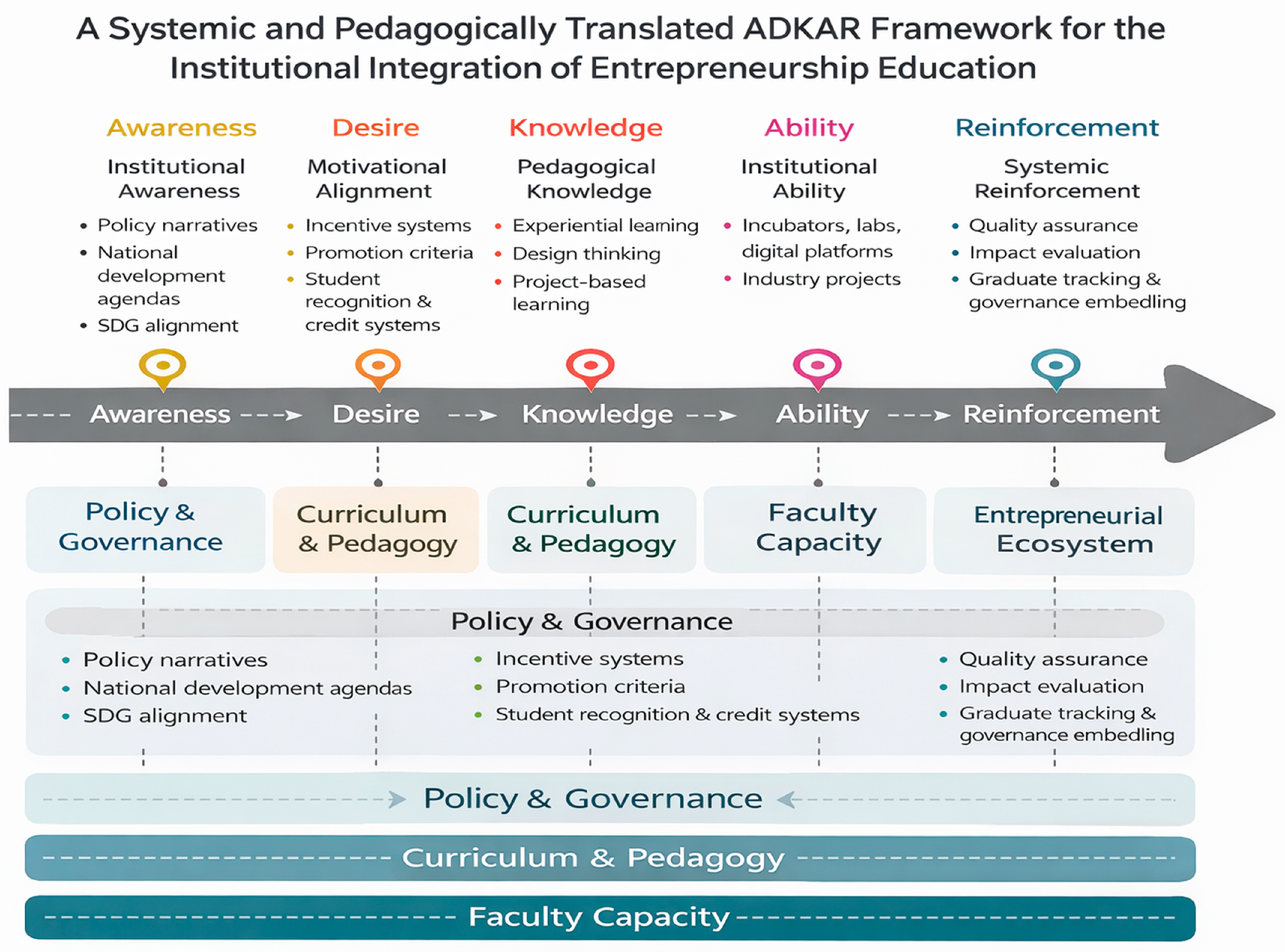
Figure 1.
A Systemic and Pedagogically Translated ADKAR Framework for the Institutional Integration of Entrepreneurship Education.
Figure 1.
A Systemic and Pedagogically Translated ADKAR Framework for the Institutional Integration of Entrepreneurship Education.
9.3. Response to Research Question 3: Global Implementation Standards
Building upon the recognized frameworks like EntreComp and the global practices identified, a system-level integration of entrepreneurship education requires adherence to a set of interdependent standards. These standards move beyond isolated program success and focus on creating a sustainable institutional ecosystem [
19].
9.3.1. Foundational Governance and Strategic Standards
Sustainable implementation of entrepreneurship education is fundamentally grounded in strong governance and strategic alignment at both national and institutional levels. Comparative evidence indicates that clear national and institutional policy mandates are essential for positioning entrepreneurship as a core educational and economic priority, supported by coherent legislative and financial frameworks [
23,
26]. Such policy coherence aligns with findings in the literature that well-designed entrepreneurship education functions as a strategic roadmap for long-term community development and sustainable economic growth agendas [
15].
Equally critical is the systematic and transdisciplinary integration of entrepreneurial competencies across academic curricula. Rather than being confined to elective or peripheral courses, effective models embed entrepreneurship progressively across all disciplines, ensuring that entrepreneurial learning is integrated into the core educational experience [
19]. This approach is exemplified by institutional models that incorporate entrepreneurship into fields such as design and STEM through embedded curricula, linking professional education with practical innovation and applied problem-solving [
18].
9.3.2. Core Pedagogical and Capacity Standards
Effective institutionalization of entrepreneurship education requires the adoption of experiential and active learning as the default pedagogical approach. Comparative evidence indicates that curricula grounded in learning by doing through projects, simulations, and real-world challenges—are essential for developing core entrepreneurial skills such as opportunity recognition, problem-solving, and risk management [
7,
20]. These competencies are difficult to cultivate through passive or lecture based instructional models, underscoring the importance of experiential pedagogy as a foundational standard [
19].
Equally critical is mandatory faculty capacity building as an institutional requirement rather than an optional enhancement. The literature consistently identifies a systemic gap in faculty preparation for entrepreneurship education, which limits the effectiveness of curricular integration [
16]. Structured and continuous professional development is therefore necessary to equip faculty members with innovative pedagogical approaches and to position them as facilitators of entrepreneurial mindsets, capable of guiding experiential and interdisciplinary learning processes [
13].
9.3.3. Enabling Infrastructure and Ecosystem Standards
The comparative analysis indicates that enabling infrastructure and ecosystem support constitute critical standards for the sustainable institutionalization of entrepreneurship education. A defining feature of mature systems is the presence of robust university–industry–community linkages. Strong partnerships with external economic actors provide students with mentorship opportunities, access to real-world projects, and exposure to market dynamics [
28]. The analysis identifies these partnerships along with university-based incubators as key drivers within the entrepreneurial education ecosystem, upon which the effectiveness of other institutional elements often depends [
18].
Equally important is the availability of integrated support infrastructure that combines both physical and digital components. Effective systems invest in university-based incubators and entrepreneurship centers that offer tangible resources and structured support for student innovation [
26]. These physical infrastructures are complemented by strategic investment in digital infrastructure, which enables scalable learning environments, business simulation, and access to broader innovation networks [
12,
30]. Empirical research confirms that well-developed digital infrastructure can promote entrepreneurship by reducing information barriers and creating flexible, technology-enabled learning contexts [
15]. Sustainable implementation further depends on the presence of dedicated and diversified funding mechanisms. Financial support through grants, seed funding, and competitive schemes plays a crucial role in lowering entry barriers and encouraging student experimentation and venture development [
32]. For such mechanisms to have lasting impact, they must be structured to support long-term sustainability rather than remaining limited to short-term or pilot-based initiatives [
34].
9.3.4. Accountability and Impact Standards
Comparative analysis highlights accountability and impact assessment as critical yet comparatively underdeveloped standards in the institutionalization of entrepreneurship education. Systematic evaluation of outcomes must extend beyond basic participation indicators to encompass the assessment of entrepreneurial competency acquisition, venture creation, and long-term graduate impact [
22,
35,
36,
37,
38]. Achieving this level of accountability requires the development of dedicated evaluation tools and the implementation of longitudinal tracking mechanisms capable of capturing sustained educational, economic, and societal outcomes [
14].
Equally important is the alignment of entrepreneurship education with broader sustainability agendas. The integration of entrepreneurial education within frameworks such as Education for Sustainable Development (ESD) and the Sustainable Development Goals (SDGs) positions entrepreneurial competence as a key driver of innovative and sustainable learning [
19]. This alignment enables higher education institutions to prepare graduates not only for economic success but also for generating long-term social, environmental, and economic value in response to complex 21st-century challenges [
20].
Conclusion for RQ3:
These nine standards constitute an integrated framework for systemic reform. Their effective adoption demonstrates that entrepreneurship education functions best not as an add-on but as a core institutional strategy woven into policy, pedagogy, partnerships, and impact measurement [
19], ultimately preparing graduates to contribute to sustainable and knowledge-based economies [
15].
9.4. Response to Research Question 4: The State of Evaluation Practices
The comparative analysis reveals a significant and revealing spectrum in the maturity of evaluation practices for entrepreneurship education across the five countries. While all nations have embedded entrepreneurship education to varying degrees, the systematic, longitudinal, and sustainability-oriented assessment of its impact remains the most challenging and least developed aspect globally [
35].
9.4.1. Finland: Advanced Systemic Integration with Recognized Refinement Needs
Finland demonstrates the most systemically integrated and coherent approach to evaluation. Evaluation mechanisms are embedded within broader education strategies and quality assurance systems, exemplified by the work of the Finnish Education Evaluation Centre (FINEEC) [
26]. FINEEC employs an enhancement-led evaluation approach focused on continuous improvement, utilizing diverse methods such as student questionnaires, thematic interviews, and stakeholder engagement to assess how entrepreneurship is taught, learned, and supported by institutional culture [
22].
However, even this advanced model faces critical challenges that reflect broader global gaps in entrepreneurship education systems. OECD evaluations identify the need for stronger causal evidence to inform policy decisions, moving beyond descriptive indicators toward clearer identification of which interventions drive successful outcomes [
23]. Long-term tracking of graduate entrepreneurial trajectories also remains limited, aligning closely with the findings of this study [
35].
9.4.2. United Kingdom: Framework-Driven but Fragmented Implementation
The UK presents a case of strong conceptual frameworks but fragmented execution. Nationally, evaluation is guided by established frameworks such as the Quality Assurance Agency (QAA) guidance and the European EntreComp framework, which provide structured bases for defining and assessing entrepreneurial competences [
19]. Organizations such as Advance HE further support institutional review through targeted change and impact programs [
29].
Despite this top-level guidance, evaluation practices remain comparatively fragmented at the institutional level. Implementation and assessment vary significantly between universities, leading to inconsistent evidence of long-term impact and limited system-wide learning [
39].
9.4.3. United States, Canada, and South Korea: Output-Focused and Ecosystem-Dependent
These three countries exhibit a moderate, output-oriented level of maturity in entrepreneurship education systems. Evaluation practices tend to prioritize short-term outputs and indicators of ecosystem vitality rather than longitudinal educational impact on students and graduates [
34].
In Canada and the United States, assessment commonly focuses on program-level metrics such as startup formation rates, participation in incubators, and engagement in innovation challenges [
18]. While these indicators provide valuable insights into ecosystem activity, they rarely capture the sustained development of entrepreneurial competencies or long-term career trajectories [
22].
In South Korea, documentation emphasizes strong institutional capacity in education and innovation systems; however, publicly available sources provide limited detail on specific frameworks used to evaluate entrepreneurship education outcomes. As a result, assessment practices prioritize indicators aligned with technological engagement and innovation output, while comprehensive longitudinal tracking of graduate outcomes remains underdeveloped [
15].
9.4.4. The Universal Challenge: The Impact Assessment Gap
A consistent finding across all five countries is the shared weakness in impact assessment frameworks for entrepreneurship education. Despite variation in institutional maturity, few systems have developed comprehensive mechanisms capable of systematically tracking entrepreneurial competency acquisition over time, long-term graduate outcomes, or broader socio-economic contributions such as sustainable development and community resilience [
22,
35]. The Finnish case, particularly the documented need for stronger causal evidence, further underscores this limitation [
23]. Collectively, this gap represents the most significant frontier for strengthening both the sustainability and the empirical credibility of entrepreneurship education at a global level.
Conclusion for RQ4:
The state of evaluation is not merely a technical concern but a reflection of how deeply entrepreneurship education is valued as a core institutional and national strategic priority. Finland leads in systemic integration, the UK in framework development, and the US, Canada, and South Korea in output measurement [
19,
34]. However, all are navigating the transition from measuring activities and short-term outputs to evaluating long-term competence development and societal impact a transition essential for transforming entrepreneurship education into a demonstrably sustainable component of higher education reform [
35].
10. Results of the Comparative Analysis
Based on the systematic analysis of the documentary corpus using the analytical matrix, the comparative analysis reveals a clear spectrum in the maturity and systemic integration of entrepreneurship education across the five national higher education systems. The scoring, grounded in the ten predefined analytical criteria, clusters the countries into three distinct tiers of performance, while also identifying critical, shared challenges.
10.1. Tier 1: The Systemically Integrated Model (Finland)
Finland stands apart as the exemplar of systemic integration among the five national cases, achieving an overall score of 4 (Excellent). Documentary evidence consistently indicates that the Finnish model is characterized by strong policy coherence and deep curricular integration. Entrepreneurial competencies are systematically embedded across disciplines through competency-based and phenomenon-based learning approaches, as articulated in national strategies and curriculum frameworks [
19,
20]. Policy documents and institutional reports further indicate the presence of a robust infrastructure for faculty development, in which entrepreneurship pedagogy is embedded within both initial teacher education and continuous professional development programs. In addition, the availability of well-established university incubators is consistently documented as a core component of this coherent institutional ecosystem [
16,
18].
At the same time, the documentary evidence highlights important contextual considerations that qualify interpretation of these findings. While Finland exhibits a high degree of systemic integration, evaluation reports indicate that challenges remain in generating causal evidence and conducting long-term impact assessments of graduate entrepreneurial outcomes [
35]. These limitations point to constraints in evaluation and measurement frameworks rather than deficiencies in institutional integration itself. Accordingly, the observed alignment between systemic integration and positive entrepreneurial conditions should be interpreted as an association rather than a direct causal relationship, recognizing the potential influence of broader contextual factors such as governance structures, social trust, and welfare arrangements [
15]. This underscores that systemic integration constitutes a necessary but not sufficient condition for demonstrating long-term impact.
Mechanism Elucidation—Finland
Finland’s high level of systemic integration operates through a distinct institutional mechanism. Strong state coordination, high institutional trust, and coherent policy transmission enable entrepreneurship education to be embedded as a transversal competence across curricula, teacher education, and quality assurance systems [
19,
26]. This alignment creates stable expectations for institutions and educators, supporting sustained pedagogical reform rather than isolated initiatives [
15].
Importantly, the effectiveness of this configuration appears closely linked to Finland’s broader governance culture, characterized by consensus-oriented decision-making and strong public sector legitimacy [
23]. These contextual conditions facilitate coordination and long-term policy coherence but also highlight why such mechanisms cannot be directly transplanted into systems with fragmented governance structures.
10.2. Tier 2: The Developed but Heterogeneous Models (United States, Canada, South Korea)
The United States, Canada, and South Korea each achieve an overall score of 3 (Good), reflecting well-developed yet uneven models of entrepreneurship education integration. Documentary evidence across these cases points to the presence of strong ecosystem components, alongside persistent challenges related to coherence and long-term evaluation [
34].
In the United States, the analyzed documents consistently highlight a vibrant ecosystem characterized by extensive university–industry partnerships, a high density of incubators, and diversified funding mechanisms that support research-driven innovation [
28,
34]. However, the documentary corpus also reveals substantial variation in implementation across institutions. Evidence of systematic curricular integration remains uneven, and standardized outcome evaluation beyond leading universities is limited, resulting in fragmented institutional impact [
15].
The documentary analysis for Canada indicates relatively consistent performance across the comparative criteria, with notable strengths in cohesive curricular initiatives and the presence of university-linked incubators [
18]. At the same time, policy and evaluation documents identify constraints related to inconsistent faculty training and underdeveloped systematic evaluation frameworks [
16]. These limitations restrict the scalability of entrepreneurship education initiatives and weaken the ability to demonstrate their long-term sustainability [
35].
In South Korea, national strategies and institutional reports demonstrate a clear strategic advantage in digital and technological infrastructure. Universities leverage advanced digital platforms to align entrepreneurship education with the demands of a technology-driven economy [
12,
30]. Nevertheless, similar to other countries within this tier, available evaluation documents point to underdeveloped long-term impact assessment mechanisms for graduate ventures and the retention of entrepreneurial competencies over time [
22].
10.2.1. Mechanism Elucidation—United States
The effectiveness of university–industry collaboration in the United States can be understood through a set of reinforcing institutional mechanisms. Strong intellectual property frameworks, flexible adjunct and practitioner-based teaching arrangements, and mature alumni and venture capital networks enable universities to efficiently couple academic knowledge with industry-defined problems, market channels, and external funding [
28,
34]. This ecosystem-oriented configuration allows experiential learning to occur extensively outside formal curricula [
18].
10.2.2. Mechanism Elucidation—Canada
Canada’s relatively balanced performance reflects a mechanism of moderated institutional coherence. National innovation strategies and university-linked incubators provide stable structural support, while curricular integration and faculty development progress more incrementally [
26]. This configuration allows for steady ecosystem engagement without imposing uniform curricular mandates, resulting in consistent but less accelerated system-wide transformation [
15].
10.2.3. Mechanism Elucidation—South Korea
In South Korea, digital and technological infrastructure functions as a central mediating mechanism for entrepreneurship education. Advanced platforms, simulation environments, and technology-driven innovation policies compensate for weaker longitudinal evaluation frameworks by enabling scalable participation and rapid prototyping [
12,
30]. However, this technology-centered mechanism prioritizes output and engagement over systematic assessment of long-term competency development [
22].
At the same time, the relative strength of market-based entrepreneurial opportunities may partially explain the weaker emphasis on systematic curricular integration across disciplines. Where robust external ecosystems already provide practical exposure, the perceived institutional urgency for comprehensive curriculum reform appears reduced, resulting in a model that is ecosystem-driven but comparatively light in core curricular embedding [
15].
10.3. Tier 3: The Framework-Rich but Fragmented Model (United Kingdom)
The United Kingdom demonstrates strong conceptual frameworks but limited systemic embedding. Fragmentation arising from decentralized implementation and constrained faculty preparation limits scalability and sustainability, illustrating the challenges of reform in the absence of strong coordination mechanisms [
16,
39].
Mechanism Elucidation—United Kingdom
The UK case illustrates a mechanism of framework-rich but driver-poor integration. While strong conceptual and quality assurance frameworks provide clear definitions and expectations [
19], the absence of a unified national implementation engine limits systemic curricular penetration [
15]. As a result, entrepreneurship education advances through localized institutional champions rather than through coordinated system-level momentum [
39].
Analytical Synthesis: Mechanisms of Systemic Integration
Across the three tiers, the comparative analysis demonstrates that systemic integration does not depend on the presence of individual elements (e.g., incubators or policies), but on how these elements are functionally coupled [
15].
Finland illustrates a coordination-driven mechanism, where policy coherence and institutional trust stabilize long-term pedagogical reform [
19].
The United States, Canada, and South Korea exemplify ecosystem-mediated mechanisms, in which external partnerships, technology, and funding compensate for weaker curricular coherence [
34].
The United Kingdom reflects a framework-driven but implementation-constrained mechanism, where strong conceptual guidance lacks sufficient system-level drivers [
39].
These mechanisms reinforce the conclusion that entrepreneurship education matures through aligned configurations rather than transferable best practices.
10.4. Cross-Cutting Challenges: Universal Gaps
A cross-case synthesis of the documentary evidence reveals two shared challenges across all national performance tiers:
The Impact Evaluation Deficit:
Across all five cases, evaluation reports indicate that no country achieved an “Excellent” level in assessing entrepreneurial impact. All systems exhibit limitations in longitudinal frameworks for tracking competency acquisition, graduate employability trajectories, venture sustainability, and socio-economic contribution over time [
35].
The Funding Coherence Gap:
Policy and funding documents consistently point to fragmented and project-based funding for student innovation. Evidence indicates that entrepreneurship education is more sustainable when funding is stable, curriculum-aligned, and embedded within a broader institutional support ecosystem, rather than reliant on short-term grants or competitions [
26].
10.5. Overall Synthesis
Drawing together the evidence-based findings, Finland emerges as the most integrated and sustainable model, primarily due to documented alignment between policy, curriculum, and faculty development [
19]. The United States, Canada, and South Korea demonstrate strong ecosystem components—such as partnerships, technology, and incubators—but documentary evidence indicates that these elements are not yet fully leveraged through coherent system-wide educational strategies [
34]. The United Kingdom illustrates the consequences of strategic decentralization without strong implementation drivers [
39]. Collectively, the evidence underscores that advancing entrepreneurship education requires addressing shared structural limitations in impact evaluation and long-term, coherent resourcing, rather than relying on isolated institutional excellence [
15].
Table 2 summarizes the key general observations emerging from the benchmarking comparison of the five countries, capturing shared trends and notable variations in the systemic integration of entrepreneurship education across higher education contexts.
Importantly, the tiered mechanisms identified above correspond closely to different stages of institutional change as conceptualized in the ADKAR framework. Highly integrated systems, such as Finland, demonstrate advanced progression across Awareness, Desire, and Reinforcement stages through stable governance and policy alignment. Ecosystem-driven models exhibit strong Ability and partial Reinforcement but weaker Knowledge standardization at the curricular level. Fragmented models, by contrast, often remain concentrated at the Awareness stage without sufficient institutional mechanisms to sustain transition toward full integration. This alignment provides the analytical bridge for operationalizing the comparative findings through the ADKAR-based institutional transformation model presented in the following section.
11. Response to Research Question Five
How can international experiences and global practices be leveraged to enhance higher education systems in fostering entrepreneurship and self-employment?
The comparative analysis positions international experiences not as transferable templates, but as analytically informative reference cases that illuminate how different higher education systems have structured and coordinated entrepreneurship education within their specific institutional and socio-economic contexts [
15]. Importantly, the study’s sustainability-oriented lens—explicitly aligning entrepreneurship education with the Sustainable Development Goals (SDGs)—provides a unifying interpretive framework for understanding how diverse global models can inform context-sensitive reform [
19].
Rather than advocating replication, the findings indicate that effective leverage of international experiences requires strategic adaptation grounded in clearly articulated principles and mechanisms [
26]. These principles operate as analytical levers that support institutional diagnosis, the identification of enabling conditions and constraints, and the design of contextually appropriate integration pathways [
23].
Strategic Levers for Adaptation
The analysis identifies a set of strategic levers that are critical for adapting international experiences in entrepreneurship education to diverse higher education contexts. A central lever involves adopting a holistic, sustainability-driven purpose that conceptualizes entrepreneurship not merely as business creation, but as a mechanism for addressing complex societal challenges [
19]. Transformative models embed sustainability principles—encompassing economic, social, and environmental dimensions—across educational activities. Finland’s systemically integrated approach illustrates how aligning entrepreneurship education with national innovation and sustainability agendas can generate a coherent and high-impact institutional model [
10,
11].
A second strategic lever relates to the cultivation of cross-cultural and digital fluency. In an increasingly globalized and digitally mediated economy, entrepreneurial success depends on the ability to operate across cultural boundaries and within advanced digital environments [
30]. Effective educational programs therefore intentionally create opportunities for students to acquire international digital experience, using technology to identify, access, and exploit global entrepreneurial opportunities [
18]. This form of digital internationalization prepares graduates to function as cultural brokers, strengthening not only individual ventures but also the broader innovation ecosystem [
22].
A third lever concerns the forging of mission-oriented partnerships with external stakeholders. Comparative evidence from the United States and South Korea demonstrates that deep integration with industry, government, and community actors is indispensable for sustainable entrepreneurship education [
34]. Such partnerships extend beyond financial support to include the co-creation of curricula, the provision of mentorship, and the facilitation of real-world project-based learning [
39]. This collaboration enhances relevance, enables resource sharing, and creates authentic pathways for students to apply sustainable entrepreneurial competencies in practice [
28].
Conclusion for RQ5:
Effectively leveraging global practices requires a paradigm shift. Higher education systems must move from implementing isolated initiatives to architecting integrated entrepreneurial ecosystems [
15]. This involves defining a clear, sustainability-aligned purpose, fostering cross-cultural and digital competencies, and building robust external partnerships to ensure education is relevant, applied, and impactful [
19].
12. Response to Research Question Six
What is the proposed methodology for integrating entrepreneurship and self-employment within university education systems?
Building on the comparative findings and the identified global practices, this study proposes a structured, institutionally embedded methodology for integrating entrepreneurship education and fostering a culture of self-employment within higher education systems [
19]. Entrepreneurship is conceptualized not as a standalone academic subject, but as a transformational educational practice that reshapes institutional culture, pedagogy, and learning outcomes in alignment with innovation-driven and knowledge-based economies [
15].
The proposed methodology is analytically derived from the comparative matrix, which identified six interrelated dimensions of institutional integration—policy alignment, curricular integration, faculty capacity, infrastructure, external partnerships, and impact evaluation [
34]. These dimensions provide the empirical foundation for mapping comparative findings onto a coherent framework for institutional change [
26].
To operationalize this translation, the study adopts the ADKAR change management model as a conceptual and implementation-oriented framework, rather than as a causal or predictive model. Within this study, ADKAR is used to organize and sequence institutional reform efforts across five interrelated stages: Awareness, Desire, Knowledge, Ability, and Reinforcement [
40]. Each ADKAR stage is interpreted through an educational reform lens. Awareness relates to building shared institutional understanding of entrepreneurship education as a strategic response to labor market transformation and sustainable development priorities [
19]. Desire concerns mobilizing stakeholder commitment through incentive-compatible mechanisms for faculty, students, and administrators [
29]. Knowledge and Ability correspond to faculty professional development, curricular redesign, and the establishment of pedagogical and infrastructural capacities that support experiential learning [
13,
16]. Reinforcement addresses long-term sustainability through quality assurance systems, impact evaluation mechanisms, and institutional feedback loops that embed entrepreneurship education within governance structures [
35].
Importantly, the study does not claim that progression through ADKAR stages produces deterministic outcomes. Rather, the framework functions as a heuristic device for aligning comparative dimensions of institutional integration under varying contextual conditions [
15].
12.1. The ADKAR Model for Institutional Transformation
ADKAR-Based Institutional Change Framework
The ADKAR model is employed in this study as a conceptual and implementation-oriented framework for guiding institutional change, rather than as a causal or predictive educational model [
40]. Its purpose is not to empirically estimate the marginal effects of individual stages on student competencies or employment outcomes, but to translate the comparative findings into a structured and coherent pathway for institutional transformation in entrepreneurship education [
15]. Within this scope, the alignment between the comparative dimensions and the ADKAR stages demonstrates how evidence from the comparative analysis can inform sequential phases of organizational and educational change at the university level [
19].
The first stage, awareness, focuses on building institutional understanding among key stakeholders, including university leadership, faculty members, students, and external partners, regarding the strategic importance of entrepreneurship education. Comparative evidence indicates that countries characterized by high policy coherence and strong national strategic alignment—such as Finland—exhibit more effective awareness-building mechanisms [
19]. In these contexts, entrepreneurship education is explicitly linked to labor market transformation, national development strategies, and knowledge economy indicators [
15].
The desire stage centers on cultivating motivation and institutional commitment among stakeholders. Universities foster engagement through incentives for student entrepreneurship, support for faculty participation via professional development and recognition mechanisms, and the establishment of strategic partnerships with private sector and innovation actors [
34]. Comparative findings suggest that sustained desire for institutional change is strongest where external partnerships and stable funding mechanisms reinforce commitment and reduce resistance to change [
26].
The knowledge stage involves equipping stakeholders with the pedagogical, organizational, and technological competencies required to implement entrepreneurship education effectively. This includes the design of integrated entrepreneurship curricula, systematic faculty training in experiential and active learning approaches, and the use of digital tools and innovation laboratories to support applied learning [
13,
16,
19]. This stage corresponds directly to the comparative dimensions of curricular integration and faculty capacity development, which emerged as key differentiators between systemically integrated and fragmented models.
The ability stage focuses on translating acquired knowledge into sustained practice. Universities operationalize entrepreneurship education through the establishment of university-based incubators, the support of project-based and challenge-driven learning, and the provision of institutional environments that enable students to develop market-oriented entrepreneurial projects. Comparative evidence demonstrates that strong physical and digital infrastructure, together with coordinated institutional support mechanisms, is essential for enabling this transition from competence acquisition to practical application [
30].
The final stage, reinforcement, addresses long-term sustainability and institutional continuity. Entrepreneurship education must be embedded within quality assurance systems, accreditation frameworks, and performance evaluation mechanisms to ensure its persistence beyond individual initiatives. The comparative analysis identified impact evaluation as a universal weakness across systems, underscoring the importance of reinforcement mechanisms that systematically monitor entrepreneurial competency development and graduate trajectories over time [
35].
12.2. Institutional Implementation Measures
The comparative findings and the proposed ADKAR-based methodology indicate that effective institutionalization of entrepreneurship education requires coordinated implementation measures at the university level. These measures translate the comparative dimensions into actionable institutional mechanisms aligned with the ADKAR stages, thereby ensuring coherence between analytical insights and practical application [
15].
12.3. Contextual Conditions for Adoption in Arab Higher Education Systems (After Revision)
The applicability of the proposed ADKAR-based methodology within Arab higher education systems is inherently context-dependent and contingent upon a set of institutional, cultural, and structural conditions identified through the comparative analysis. Key among these conditions are the degree of university autonomy, alignment between national education, labor market, and innovation policies, the sustainability of institutional funding, and the presence of incentive structures that recognize entrepreneurial teaching and learning practices [
26].
Accordingly, the proposed pathway does not assume direct transferability or universal applicability across Arab higher education contexts. Instead, it is deliberately positioned as a flexible and adaptive institutional roadmap intended to guide context-sensitive reform processes rather than prescribe standardized actions [
15]. Variations in governance arrangements, regulatory frameworks, organizational cultures, and resource capacities are therefore expected to influence both the pace and form of implementation [
39].
Within this framework, the ADKAR model supports phased and incremental adoption, enabling universities to align entrepreneurship education reform with institutional readiness and labor market needs [
40]. In this sense, ADKAR functions as a heuristic guide for institutional learning and adaptation rather than a deterministic change model.
Adaptive Experimentation as a Context-Sensitive Reform Strategy
Building on this contextualized understanding of reform, the study proposes adaptive experimentation as a viable strategy for advancing entrepreneurship education within Arab higher education systems. Rather than implementing comprehensive reform in a single step, adaptive experimentation emphasizes incremental change through small-scale pilot initiatives designed to generate institutional learning prior to scaling [
32].
Guided by the core design principles identified in this study, universities may initiate focused pilot interventions—such as interdisciplinary entrepreneurial minors or project-based capstones—while systematically embedding feedback mechanisms into pilot design. These mechanisms may include student competency assessments, faculty reflections, and partnership outcomes [
35].
The primary objective of such pilots is structured learning rather than immediate optimization: identifying what works, what does not, and under which institutional and cultural conditions [
15]. Through iterative evaluation and reflective practice, reform initiatives can be refined and gradually scaled.
Within this adaptive logic, the ADKAR model is reconceptualized not as a rigid blueprint, but as a reflective scaffold supporting the pilot–learning–scaling cycle [
40]. The ADKAR stages guide stakeholder engagement, capacity building, and institutional consolidation while allowing flexibility in sequencing according to local readiness.
12.3.1. Context Mapping and Barrier Analysis
To move beyond generalized calls for adaptation, this study undertakes a systematic context mapping and barrier analysis juxtaposing key success factors from international models with structural characteristics of Arab higher education systems [
39]. The comparative findings indicate that successful models are embedded within specific governance and cultural environments that cannot be directly replicated without functional adjustment.
For example, Finland’s strong state coordination is supported by high institutional trust and efficient policy transmission mechanisms [
19]. In many Arab contexts, multi-layered governance structures may constrain the transfer of centralized coordination models. Similarly, where private sector R&D engagement is limited, functional substitutes—such as state-backed venture funds or public–private hybrid incubators may represent more viable mechanisms for supporting entrepreneurial activity [
26].
This analysis underscores that adaptation does not imply lowering ambition, but reconfiguring mechanisms to align with institutional capacities and socio-cultural norms [
15]. Through such contextual recalibration, international experiences can inform locally grounded and institutionally feasible pathways for the sustainable integration of entrepreneurship education [
19].
12.3.2. Comparative Context Mapping of Success Factors and Adaptation Challenges
To operationalize the contextual analysis discussed above,
Table 3 presents a structured mapping that contrasts key success factors distilled from the comparative international cases with commonly observed structural and institutional characteristics of Arab higher education systems. Rather than assuming direct transferability, the table identifies typical adaptation challenges and proposes illustrative functional alternatives that may enable context-sensitive implementation. This mapping transforms the notion of “con-textual adaptation” from a general recommendation into a set of analytically grounded and practically actionable considerations for policymakers and institutional leaders.
By explicitly juxtaposing international success factors with contextual constraints and functional alternatives, this mapping clarifies that effective adaptation does not involve replicating institutional forms, but rather reconfiguring mechanisms to align with existing governance logics, resource conditions, and socio-cultural norms. This analytical approach strengthens the practical relevance of the proposed ADKAR-based methodology and provides a concrete basis for designing realistic, sustainable, and context-sensitive pathways for entrepreneurship education reform in Arab higher education systems.
Clarification of Analytical Scope and Causal Inference
Based on a comparative qualitative case study design, this research does not aim to establish direct causal relationships between entrepreneurship education interventions and student or labor market outcomes. Rather, its primary objective is to identify the key constitutive dimensions of systemic integration in entrepreneurship education and to infer the supportive relationships and potential pathways through which these dimensions interact to shape institutional effectiveness.
Through cross-national comparison, the study provides a theoretically grounded explanation of how and why certain configurations of policy alignment, curricular embedding, faculty capacity, infrastructure, ecosystem partnerships, and evaluation mechanisms tend to co-occur in more mature systems. These relationships are interpreted as indicative of underlying institutional mechanisms rather than as empirically verified causal effects.
Accordingly, the findings offer plausible mechanistic explanations and preliminary analytical evidence for the role of systemic integration in supporting entrepreneurial learning environments. However, the precise causal effects, their directionality, and their magnitude require further empirical testing through future research employing mixed-method designs, longitudinal tracking, and student-level outcome data.
13. Conclusions
This study sought to develop a shared, evidence-based understanding of how entrepreneurship education is institutionally configured within higher education systems, including innovation environments, business accelerators, startup incubation, and commercialization-related practices. Through a comparative analysis of international experiences in Finland, the United States, the United Kingdom, Canada, and South Korea, the findings indicate that the integration of entrepreneurship education cannot be achieved through isolated courses or fragmented initiatives. Rather, it requires comprehensive institutional and cultural arrangements in which strategic orientation, pedagogical practices, and organizational frameworks are coherently aligned [
15,
19,
34].
The comparative results indicate that higher levels of entrepreneurial integration, most notably in Finland and South Korea, are associated with systematic approaches that align national policies, university curricula, faculty development arrangements, institutional infrastructure, and evaluation mechanisms. These interrelated dimensions correspond conceptually to the stages of institutional change articulated in the ADKAR model, supporting its relevance as an analytical framework for interpreting processes of entrepreneurship education integration within higher education systems [
19,
30,
40].
Applying the ADKAR model in the university context offers a structured yet flexible lens for understanding institutional change processes. The model supports the development of shared awareness regarding the strategic importance of entrepreneurship and self-employment in addressing labor market challenges and advancing sustainable economic development. It also facilitates stakeholder engagement, capacity building, and the translation of entrepreneurial knowledge into applied practice through mechanisms such as incubators, innovation projects, and partnerships with industry and the wider community.
The findings further highlight that sustainability in entrepreneurship education does not depend merely on the availability of programs or initiatives, but on continuous institutional reinforcement through impact evaluation practices, quality assurance systems, and incentive structures that support long-term commitment. From this perspective, the ADKAR model provides a coherent analytical mechanism for examining how entrepreneurship education becomes embedded within institutional governance arrangements and aligned with national development priorities.
Overall, the study concludes that entrepreneurship education constitutes a strategic lever for higher education reform. When pursued as an integrated institutional strategy, it enables universities to cultivate entrepreneurial graduates, strengthen innovation ecosystems, and contribute more effectively to knowledge-based and sustainable economies. By combining comparative international insights with a structured, change-oriented analytical framework, this study contributes to policy reflection, institutional learning, and future research on sustainable entrepreneurship education in higher education. without advancing a transferable best practice model or a standardized implementation blueprint [
15,
35].
14. Research Recommendations and Core Design Principles for the Systemic Integration of Entrepreneurship Education
Building on the study’s findings and the comparative analysis of international experiences in entrepreneurship education, this section consolidates the research recommendations into a coherent set of higher-order design principles that support the sustainable and systemic integration of entrepreneurship and self-employment within higher education systems. Rather than presenting prescriptive or linear implementation steps, the recommendations are articulated as evidence-informed principles intended to guide context-sensitive reform, institutional learning, and long-term sustainability. This approach reflects the comparative nature of the study and avoids direct replication of specific national models.
At the strategic level, the findings emphasize the importance of alignment and strategic resonance between entrepreneurship education initiatives and broader national development agendas, as well as institutional missions of universities. Comparative evidence indicates that entrepreneurship education gains legitimacy, continuity, and policy support when its objectives are clearly aligned with priorities related to graduate employability, innovation, economic diversification, and sustainable development. In this context, the European Entrepreneurship Competence Framework (EntreComp) is strongly recommended as a methodological reference for defining entrepreneurial competencies and guiding their systematic integration into curricula and course design. As a comprehensive and internationally recognized framework, EntreComp provides a shared conceptual language that supports the alignment of learning outcomes, pedagogical approaches, and assessment practices within a coherent strategic vision across higher education institutions.
The analysis further demonstrates that sustainable integration depends critically on empowering faculty as institutional change agents. Entrepreneurship education is most effective when educators are positioned not merely as curriculum implementers, but as facilitators of experiential, interdisciplinary, and innovation-oriented learning. Continuous professional development programs that strengthen entrepreneurial pedagogy, mentoring capabilities, and understanding of self employment concepts are therefore essential. Such capacity-building initiatives enable faculty members to support student learning more effectively and to contribute to institutional and cultural transformation across disciplinary boundaries.
A third core principle concerns the development of connected and mission-oriented entrepreneurial ecosystems. The comparative findings highlight the importance of establishing structured, long term partnerships between universities, industry, community actors, alumni networks, and public agencies. Coordinated national networks of university-based business incubators, accelerators, and graduation project platforms developed in partnership with the private sector play a pivotal role in facilitating the transition of student projects into viable entrepreneurial ventures. When embedded within broader innovation ecosystems, these institutional structures strengthen linkages between higher education institutions, labor markets, and innovation systems, rather than functioning as isolated support mechanisms.
The study also confirms that experience centered learning constitutes the core educational logic of effective entrepreneurship education. Successful international models, particularly the Finnish approach, demonstrate the value of project-based learning, interdisciplinary teamwork, and challenge-driven coursework. Embedding such experiential pedagogies systematically across academic curricula rather than confining entrepreneurship education to standalone or elective courses ensures that entrepreneurial competencies are developed progressively within disciplinary learning pathways. This approach guarantees equitable access to entrepreneurial learning opportunities for students across all fields of study and positions “learning by doing” as a central mode of engagement in higher education.
At the institutional level, the findings recommend the establishment of university-based innovation units and accelerators explicitly linked to entrepreneurship-related coursework. These units support the commercialization and scaling of innovative student ideas and function as institutional bridges between education, research, and entrepreneurial practice, thereby reinforcing the applied impact and societal relevance of academic learning. Graduation projects addressing contemporary local and global challenges are identified as particularly significant entrepreneurial opportunities, especially when supported by institutional mechanisms that facilitate their transformation into startups with economic and social impact.
From a governance and policy perspective, strengthened collaboration with national entities responsible for small and medium enterprises, innovation policy, and research funding is essential. Such partnerships enhance access to financial, technical, and advisory support for student ventures, contribute to ecosystem-level sustainability, and support the scaling of entrepreneurship education initiatives beyond individual institutions.
Finally, the findings underscore learning-oriented evaluation and long-term reinforcement as foundational principles for sustainable integration. Systems that rely exclusively on short-term output indicators struggle to demonstrate enduring impact. In contrast, standardized and systematic evaluation frameworks that focus on entrepreneurial competency development, graduate trajectories, startup sustainability, and institutional learning support continuous improvement, accountability, and policy learning. Embedding entrepreneurship education within quality assurance systems, impact evaluation mechanisms, and long-term resourcing structures reinforces its position as a core institutional commitment rather than a temporary or project-based initiative.