Article

A Scenario-Robust Intuitionistic Fuzzy AHP–TOPSIS Model for Sustainable Healthcare Waste Treatment Selection: Evidence from Türkiye


by
Pınar Özkurt
Department of Management Information Systems, Faculty of Economics and Administrative Sciences, Tarsus University, 33400 Tarsus, Mersin, Türkiye
Sustainability 2026, 18(3), 1167; https://doi.org/10.3390/su18031167
Submission received: 9 December 2025 / Revised: 17 January 2026 / Accepted: 22 January 2026 / Published: 23 January 2026

Abstract

Selecting a sustainable healthcare waste treatment method is a complex multi-criteria problem influenced by environmental, economic, social and technological factors. This study addresses key gaps in the literature by proposing an intuitionistic fuzzy AHP–TOPSIS framework that explicitly models cognitive uncertainty and expert hesitation, while demonstrating its application through a real-world case study in Adana, Türkiye. In contrast to prior studies utilizing fewer criteria, our framework evaluates four treatment alternatives—incineration, steam sterilization, microwave, and landfill—across 17 comprehensive criteria that directly integrate circular economy principles such as resource recovery and energy efficiency. The results indicate that steam sterilization is the most sustainable option, demonstrating superior performance across environmental, economic, social, and technological dimensions. A 15-scenario sensitivity analysis ensures ranking resilience across varying decision contexts. Furthermore, a systematic comparative analysis highlights the methodological advantages of the proposed framework in terms of analytical granularity and robustness compared to existing models. The study also offers step-by-step operational guidance, creating a transparent and policy-responsive decision-support tool for healthcare waste management authorities to advance sustainable practices.

1. Introduction

Healthcare services, essential for societal well-being, generate significant volumes of waste that, if mismanaged, can threaten both environmental quality and public health. The rapid growth of populations, particularly in developing economies, has amplified the volume of healthcare waste, intensifying pressures on waste management systems [1,2].
Globally, healthcare waste is defined as any solid or liquid material produced during medical treatment, clinical diagnosis, pathological testing, and related medical research in hospitals or clinics [3]. In Türkiye, healthcare waste management is further regulated by the Medical Waste Control Regulation (Official Gazette No. 29959, 25 January 2017), which establishes requirements for collection, temporary storage, transportation, and disposal within healthcare institutions [4]. This waste often contain infectious pathogens, toxic chemicals, and heavy metals, which pose serious risks to ecosystems and human health [5].
Sustainable management of healthcare waste is therefore a critical challenge, requiring strategies that minimize environmental burdens, optimize resource use, and align with circular economy principles. Improper disposal of such waste not only contributes to greenhouse gas emissions, soil and water contamination, and energy inefficiency, but also undermines efforts to establish closed-loop, circular waste systems [6,7].
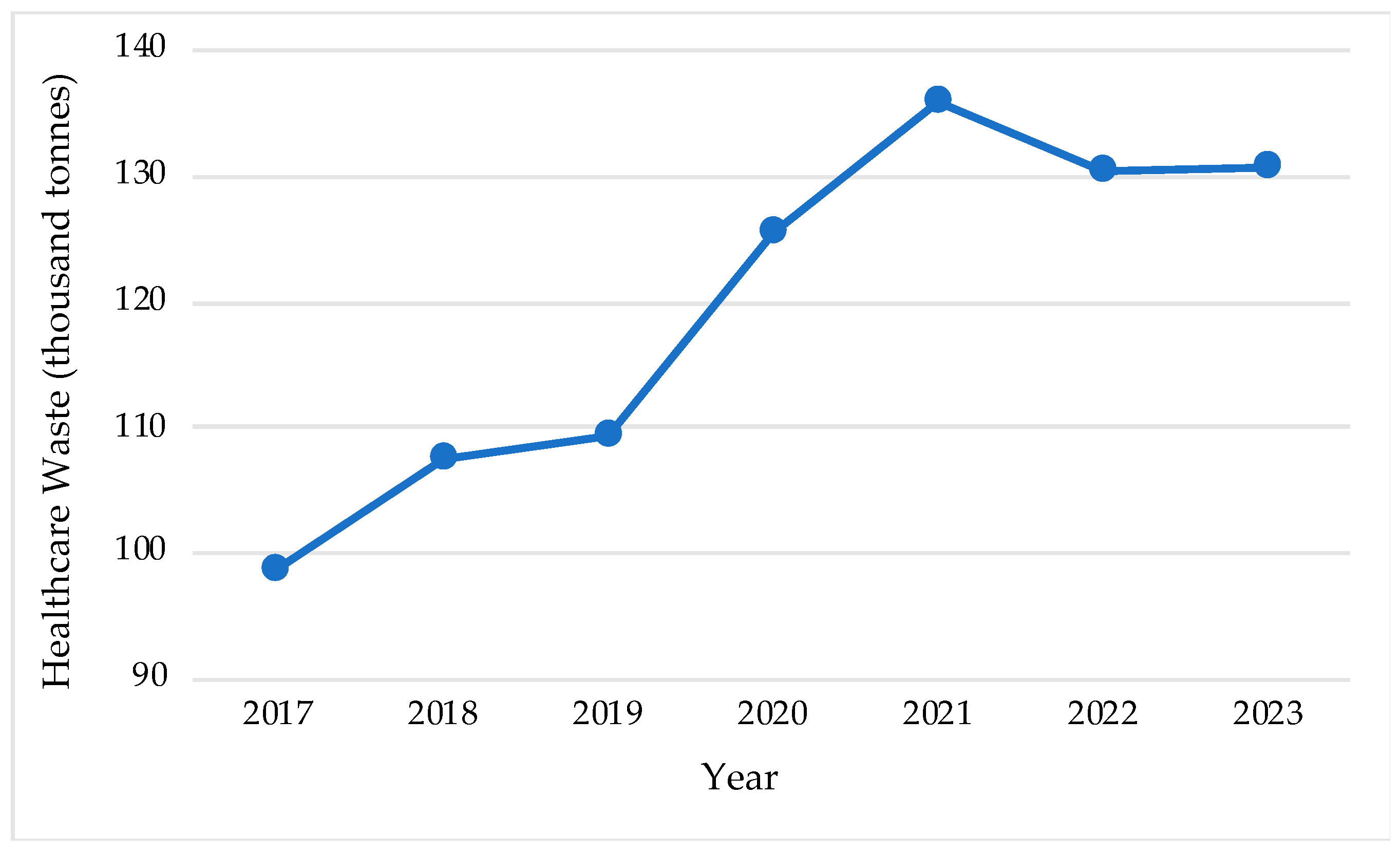
The World Health Organization emphasizes the importance of selecting treatment technologies suited to local conditions, monitoring practices, and effective governance to prevent pollution and disease transmission [3]. Despite regulatory frameworks, challenges persist, particularly in developing regions where co-disposal with municipal waste and insufficient infrastructure hinder sustainable management. Rising volumes of healthcare waste highlight the urgent need for integrated strategies that ensure environmental sustainability, operational efficiency, and public health protection. As summarized in Table 1 and illustrated in Figure 1, healthcare waste generation in Türkiye demonstrated an overall upward trend from 2017 to 2023, notwithstanding marginal fluctuations during the 2022–2023 period, underscoring the growing pressure on waste management systems and the need for efficient and sustainable treatment technologies.
Multi-criteria decision-making (MCDM) methods have emerged as essential tools for evaluating healthcare waste treatment alternatives, as they enable systematic consideration of environmental, economic, and technical criteria [9]. Conventional approaches, including the Analytic Hierarchy Process (AHP), Technique for Order Preference by Similarity to Ideal Solution (TOPSIS), VlseKriterijumska Optimizacija I Kompromisno Resenje (VIKOR), and Complex Proportional Assessment (COPRAS), offer valuable decision support but often struggle to incorporate expert uncertainty and hesitation inherent in real-world contexts [9,10,11,12,13,14,15,16,17]. The integration of intuitionistic fuzzy sets (IFSs) with MCDM techniques addresses these limitations by modeling both membership and non-membership degrees, providing more reliable assessments under uncertainty.
However, existing studies rarely integrate intuitionistic fuzzy (IF) extensions of both AHP and TOPSIS in a unified sustainability-oriented framework, nor do they examine the robustness of rankings under varying scenarios. Moreover, the explicit incorporation of circular economy considerations and uncertainty modeling remains limited in healthcare waste treatment selection. Thus, there is a clear need for comprehensive decision-making approaches that simultaneously account for uncertainty, sustainability, and robustness.
In this regard, this study develops a scenario-robust intuitionistic fuzzy AHP–TOPSIS framework for healthcare waste treatment selection, explicitly accounting for uncertainty, expert divergence, and variations in sustainability-oriented criteria weighting. A real-world case study in Adana, Türkiye, evaluates four treatment alternatives across 17 criteria, complemented by a 15-scenario sensitivity analysis. By linking methodological robustness to circular economy principles and sustainability goals, the proposed framework not only enhances decision reliability but also provides actionable guidance for policymakers and healthcare managers seeking environmentally and economically sustainable waste management solutions.
The objective of this study is twofold: (i) to propose an uncertainty-aware and sustainability-oriented decision-making framework that integrates IF-AHP and IF-TOPSIS with scenario-based sensitivity analysis, and (ii) to demonstrate its practical applicability to sustainable healthcare waste management.
The structure of this article is as follows: Section 2 presents existing studies on healthcare waste management and their evaluation methods; Section 3 details the integrated framework; Section 4 demonstrates the framework’s application, including sensitivity analyses and a comparative analysis highlighting the methodological advantages of the proposed approach; Section 5 interprets the findings and situates them within the broader literature; and Section 6 summarizes the study’s contributions, practical implications, limitations, and directions for future research.

2. Literature Review

The term decision-making refers to the process of selecting the most suitable course of action from a set of alternatives, guided by specific criteria. It plays a pivotal role across a wide range of domains—from everyday decisions to complex industrial and environmental challenges. Particularly in problems involving multiple and often conflicting criteria, the decision-making process becomes significantly more intricate. These problems can be classified into single-criteria and multi-criteria decision-making (MCDM) types, where conventional MCDM techniques such as AHP and TOPSIS have laid the foundation for evaluating alternatives under multiple criteria [18,19]. While the former focuses on optimizing one specific objective, MCDM addresses scenarios where alternatives must be evaluated against several potentially conflicting criteria [20]. Such complexity is especially pronounced when cost, performance, environmental impact, and sustainability considerations must be balanced concurrently. MCDM is particularly critical in domains such as environmental management, circular healthcare systems, urban planning, and healthcare waste management. In such cases, prioritizing and evaluating decision criteria becomes vital to identifying the most suitable alternative. MCDM methods offer a structured framework to tackle these complex problems and play a crucial role in guiding sustainable decision-making. Accordingly, MCDM has become a well-established analytical framework for addressing complex sustainability-oriented decision problems across various domains such as energy, environmental planning, logistics, and waste management [21,22].

2.1. Application of MCDM in Healthcare Waste Management

Healthcare waste management (HCWM) constitutes a multidimensional decision-making problem, particularly in developing economies where population growth, expansion of healthcare services, and aging populations drive rapid increases in waste generation [5]. Proper management of healthcare waste is crucial for preventing environmental pollution, safeguarding public health, and minimizing risks from pathogens, toxic chemicals, and heavy metals [3,10,23]. The inherent trade-offs among environmental, economic, technical, and operational factors make systematic and objective evaluation essential, motivating the adoption of MCDM approaches [24].
To address these complexities, previous studies have applied a variety of methods, including Life Cycle Assessment (LCA) [25,26,27,28], descriptive cross-sectional surveys [29], pre–post comparison [30], checklist methods [31], observation and laboratory tests [32], statistical analyses [33], cost–benefit analyses [34,35], and risk assessment methods [36,37,38]. While these approaches provide valuable insights, they often fail to capture the intrinsic uncertainty, expert hesitation, and sustainability requirements of HCWM decision-making.
Current healthcare waste treatment technologies exhibit substantial variation in environmental performance, operational requirements, and economic feasibility. Sustainability considerations—such as resource efficiency, circular waste practices, and compliance with environmental regulations—have therefore become central elements in assessing HCWM systems [6,7]. These multidimensional factors reinforce the need for analytical approaches capable of integrating environmental, technical, and economic trade-offs under uncertainty.

2.2. Intuitionistic Fuzzy Sets (IFSs) and Integrated MCDM Approaches

Given its multi-criteria nature, addressing HCWM as a decision-making problem necessitates the use of systematic and objective methods. Intuitionistic fuzzy sets (IFSs) extend classical fuzzy logic by incorporating not only membership and non-membership degrees but also a degree of hesitation, enabling a more nuanced representation of uncertainty. This capability allows decision-makers to model expert hesitation and uncertainty in criteria weighting and alternative evaluation, resulting in more reliable outcomes [24].
To leverage these advantages, this study employs an integrated methodology combining IF-AHP and IF-TOPSIS. IF-AHP is used for criteria weighting, capturing the relative importance of environmental, economic, social, and technology-related factors under uncertainty. IF-TOPSIS evaluates the alternatives against positive and negative ideal solutions, providing a robust ranking that accounts for both uncertainty and sustainability objectives.

2.3. Applications of IF-AHP and IF-TOPSIS in the Literature

Conventional MCDM methods—such as AHP [10,11,23], TOPSIS [12,13], VIKOR [14,15], and COPRAS [16,17]—have been extensively applied in HCWM for evaluating treatment technologies, environmental risks, and operational performance. Nonetheless, these methods generally assume stable preferences and deterministic evaluations, which are increasingly incompatible with modern sustainability-oriented decision contexts. Healthcare waste treatment decisions are shaped by multi-dimensional sustainability pressures, including environmental emissions, energy efficiency, regulatory compliance, life cycle impacts, circular resource flows, and operational resilience. In such settings, classical MCDM approaches struggle to adequately capture expert hesitation, scenario-driven uncertainty, and the trade-offs among environmental, economic, and technological sustainability criteria. This has driven growing interest in more expressive decision-making frameworks capable of handling uncertainty.
Building on these developments, intuitionistic fuzzy extensions of other classical MCDM methods—such as VIKOR [39], COPRAS [40], and MULTIMOORA [41]—have been increasingly used in sustainability-oriented decision problems. These methods are often integrated with group decision-making frameworks that incorporate hesitant or intuitionistic fuzzy preference relations and scenario-based sustainability analyses. Approaches based on best–worst methods and fuzzy preference relations under hesitant or intuitionistic environments have also been explored, reflecting a broader methodological diversification in uncertainty-aware MCDM. Examples include the hesitant multiplicative Best-Worst Method (BWM) [42] and intuitionistic fuzzy BWM [43], demonstrating how expert hesitation, multi-dimensional sustainability criteria, and robustness testing are systematically accommodated across various MCDM frameworks. These methods also hold significant potential for application in HCWM and other sustainability-oriented decision contexts, where uncertainty, multi-dimensional criteria, and scenario-based analyses are critical.
Within this context, intuitionistic fuzzy extensions of AHP and TOPSIS have emerged as prominent tools for sustainability-oriented evaluations. IF-AHP has been successfully applied to hazardous waste transporter selection [9], drilling fluid evaluation [44], reverse logistics outsourcing [45], and sustainability management in digitalized food supply chains [46], demonstrating its strength in criteria weighting under uncertainty. IF-TOPSIS has been utilized in project portfolio evaluation [47], wind farm siting automotive benchmarking [48], and sustainable supplier selection [49], revealing its suitability for ranking alternatives when sustainability criteria interact in complex ways. Notwithstanding these advances, the application of integrated IF-AHP and IF-TOPSIS in healthcare waste management remains comparatively sparse, particularly in studies that integrate both methods and incorporate scenario-based sustainability analyses. This gap highlights the need for robust frameworks that explicitly address uncertainty while aligning decision-making with environmental sustainability, circular economy principles, and operational feasibility.

2.4. Summary of MCDM Studies on HCWM

Table 2 provides a consolidated overview of existing MCDM applications in HCWM, including evaluation criteria, treatment alternatives, methodological frameworks, and the extent to which uncertainty is addressed. Prior studies have employed a wide range of techniques—such as the Decision-Making Trial and Evaluation Laboratory (DEMATEL), Step-Wise Weight Assessment Ratio Analysis (SWARA), BWM, and fuzzy set extensions, including intuitionistic, Pythagorean, and Fermatean fuzzy approaches—reflecting the growing methodological diversification in the field. Despite this progress, most studies still rely on single-stage models and fail to integrate robust uncertainty modeling with sustainability-oriented evaluation criteria.
Very few studies combine IF-AHP for criteria weighting with IF-TOPSIS for alternative ranking, and even fewer do so within a framework that explicitly incorporates sustainability considerations, circular economy objectives, and scenario-based uncertainty analysis. This reveals a persistent gap in the literature, where existing models either inadequately represent expert hesitation or lack a systematic approach to testing the stability of treatment rankings under varying sustainability priorities. Addressing this gap requires a more comprehensive, uncertainty-aware MCDM framework—precisely the contribution offered in this study.

2.5. Identified Research Gaps and Study Contributions

Despite the widespread use of MCDM methods in HCWM, several critical gaps remain:
  • Application of IF-AHP for criteria weighting is still scarce. While DEMATEL and BWM have been applied extensively, their integration within intuitionistic fuzzy environments remains limited.
  • TOPSIS and VIKOR are widely used for alternative evaluation, yet few studies provide comparative assessments using IF-TOPSIS.
  • Previous research rarely considers sustainability and circular economy principles explicitly, nor does it systematically evaluate the robustness of rankings under multiple scenarios.
Building upon these gaps, the present study contributes as follows:
  • Proposes an integrated IF-AHP and IF-TOPSIS framework for robust, uncertainty-aware evaluation of HCWM strategies;
  • Introduces a sustainability-oriented perspective, incorporating environmental, economic, social, and technology dimensions;
  • Evaluates alternatives in a real-world case study with 17 criteria and 4 treatment options;
  • Conducts sensitivity analyses to assess the stability of rankings under varying scenarios, ensuring reliability of recommendations;
  • Provides a methodological framework that is both scalable and adaptable for future research on sustainable HCWM under uncertainty.

3. Proposed Methodology Based on IF-AHP and IF-TOPSIS

3.1. Problem Definition: Selection of Sustainable Healthcare Waste Treatment Alternative

Sustainable healthcare waste treatment is a complex multi-criteria decision problem affected by environmental, social, economic, and technological factors. This study models the problem as a multi-criteria group decision-making (MCGDM) problem, synthesizing the judgments of three domain experts: a Municipal Waste Management Officer, an Environmental Engineer, and a Full Professor specializing in healthcare management and environmental engineering.
To address the uncertainty and hesitation inherent in expert evaluations, the study employs intuitionistic fuzzy sets (IFSs), which capture membership (μ), non-membership ( ν ), and hesitation (π) degrees to realistically represent uncertainty in expert sustainability assessments.
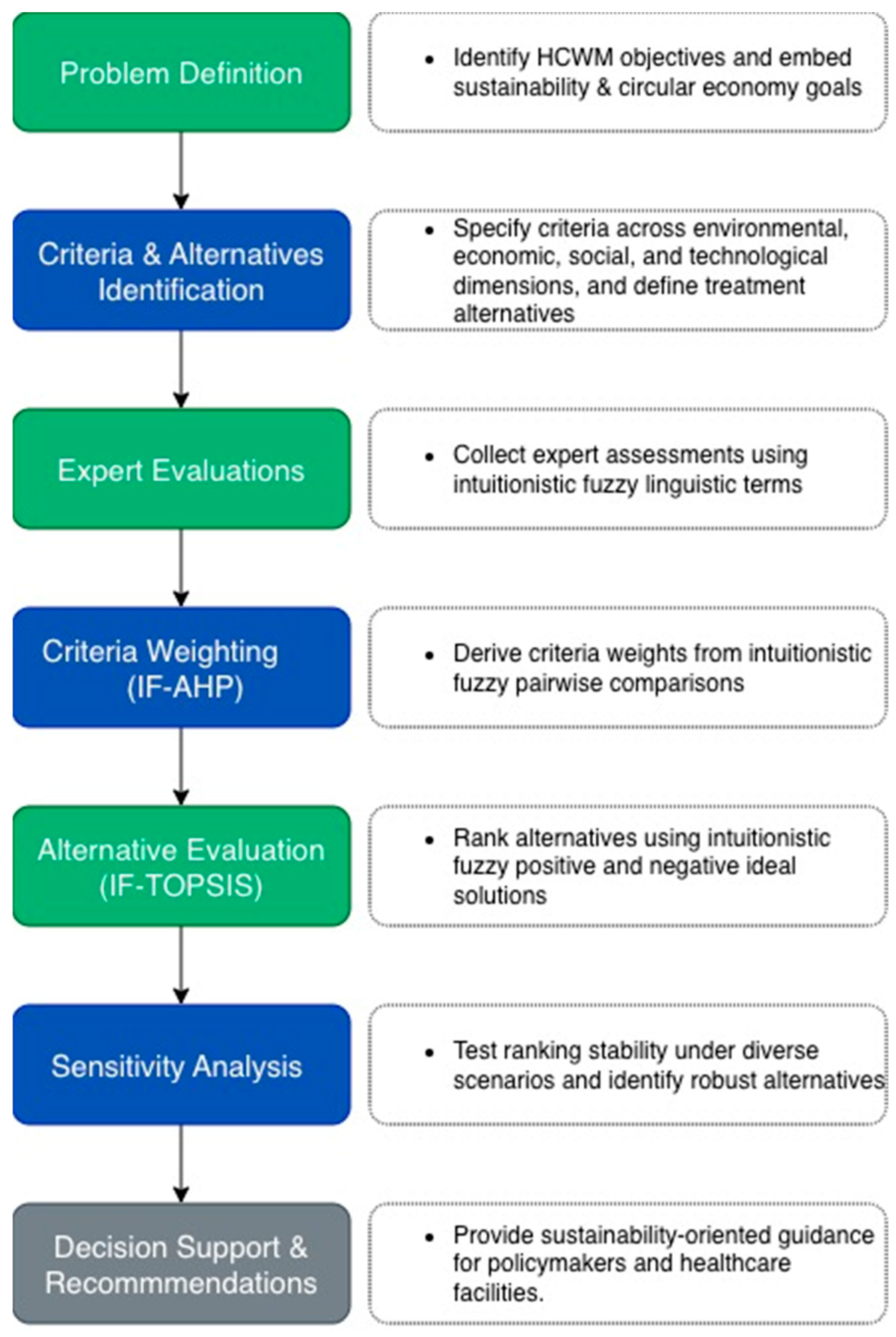
As illustrated in Figure 2, the proposed methodological framework for sustainable HCWM under uncertainty illustrates a two-stage workflow. In Stage 1, IF-AHP derives criteria weights embedding sustainability and circular economy considerations, such as energy efficiency, resource recovery, and public acceptance, ensuring that weights reflect both short- and long-term sustainability objectives under uncertainty. Stage 2 integrates these weights into IF-TOPSIS to evaluate and rank alternative HCWM strategies based on their proximity to the intuitionistic fuzzy positive ideal solution (IF-PIS) and distance from the negative ideal solution (IF-NIS).
To facilitate practical implementation, we outline how the integrated IF-AHP-IF-TOPSIS framework can be applied by HCWM authorities without requiring methodological simplification. Decision-makers first apply IF-AHP to derive criteria weights using linguistic scales and perform consistency checks. Once weights are obtained, IF-TOPSIS is used to rank alternative treatment strategies systematically. Key computational steps—such as group aggregation via intuitionistic fuzzy weighted averaging (IFWA) and closeness coefficient calculation—remain operationally interpretable for both local and national-level authorities.
Crucially, applying conventional AHP-derived weights directly to conventional TOPSIS can result in semantic inconsistencies. In contrast, the current study adopts IF-AHP to determine criteria weights expressed as intuitionistic fuzzy numbers, which are inherently compatible with IF-TOPSIS, thereby eliminating semantic inconsistencies and maintaining coherent criteria weighting and alternative ranking under the same fuzzy logic principles [9,24].
Consequently, the methodology enables reliable and sustainability-aligned decision making under uncertainty.

3.2. Intuitionistic Fuzzy Sets (IFSs)

In sustainability-oriented decision problems, criteria often depend on linguistic assessments rather than precise numerical information, and expert judgments contain substantial ambiguity and hesitation [69]. Classical fuzzy sets partially capture this uncertainty, yet they do not explicitly model the hesitation that arises in sustainability evaluations involving long-term ecosystem effects, social acceptance, or circularity-driven material recovery.
To better represent such ambiguity, this study employs intuitionistic fuzzy set (IFS) theory, introduced by Atanassov [70], which enhances classical fuzzy sets by defining three parameters: membership (μ), non-membership ( ν ), and hesitation (π). Let X denote the universe of discourse, and let A ~ be an intuitionistic fuzzy set defined as
A ~ = x , μ A x ,   ν A x | x X
subject to
0 μ A + ν A 1 ,     x X
The hesitation degree is given by
π A x = 1 μ A x ν A x
representing the level of uncertainty about the membership of x [71]. In the following definitions and equations, μ, ν , and π denote the membership, non-membership, and hesitation degrees, respectively, for each element x .
IFSs are particularly suitable for sustainability and circular economy assessments, where experts often hesitate due to incomplete data, technological variability, and long-term uncertainties. By capturing this hesitation explicitly, IFSs provide a more realistic representation of expert uncertainty, strengthening the robustness and validity of both the IF-AHP and IF-TOPSIS stages.

3.3. IF-AHP

The intuitionistic fuzzy analytic hierarchy process (IF-AHP) extends the classical AHP by enabling decision-makers to express judgments with intuitionistic fuzzy evaluations rather than precise pairwise ratios. Whereas conventional AHP relies on deterministic numerical comparisons, IF-AHP utilizes membership (μ), non-membership ( ν ), and hesitation (π) degrees, allowing uncertainty, hesitation, and cognitive ambiguity to be modeled explicitly. This leads to more robust and realistic prioritization of criteria in complex decision environments. In the IF-AHP procedure, μ, ν , and π values are used to capture the degree of confidence and uncertainty in experts’ pairwise comparisons.
This study uses IF-AHP to derive the weights of the criteria. The procedure follows the steps summarized below [72]:
  • Step 1: Hierarchical Structuring
The decision hierarchy is established by defining the alternatives A = A 1 ,   A 2 ,   ,   A m and the criteria X = X 1 ,   X 2 ,   ,   X n .
  • Step 2: Construction of Intuitionistic Fuzzy Pairwise Comparison Matrices
Decision-makers provide pairwise comparisons of criteria using intuitionistic fuzzy linguistic terms. These linguistic terms are mapped to intuitionistic fuzzy numbers (μ, ν , π) as defined in Table 3 below. μ and ν values are directly assigned by experts based on Saaty’s 0.1–0.9 importance scale [72], while π = 1 μ ν .
For each decision-maker k = 1 ,   2 ,   , l , an intuitionistic fuzzy pairwise comparison matrix is constructed.
  • Step 3. Consistency Adjustment of Intuitionistic Preference Matrices
Each intuitionistic fuzzy pairwise comparison matrix is checked for multiplicative consistency. Using Algorithm 1, the perfectly consistent intuitionistic preference matrix R ¯ = r ¯ i k n x n is generated. Here, r ¯ i k corresponds to adjusted consistent intuitionistic fuzzy value.
Algorithm 1. Computation of intuitionistic fuzzy aggregated values r ¯ i k in IF-AHP [72]
For k > i + 1 , let r ¯ i k = ( μ ¯ i k , ν ¯ i k ) , where
μ ¯ i k = t = i + 1 k 1 μ i t μ t k k i 1 t = i + 1 k 1 μ i t μ t k k i 1 + t = i + 1 k 1 ( 1 μ i t ) ( 1 μ t k ) k i 1
ν ¯ i k = t = i + 1 k 1 ν i t ν t k k i 1 t = i + 1 k 1 ν i t ν t k k i 1 + t = i + 1 k 1 ( 1 ν i t ) ( 1 ν t k ) k i 1
For k = i + 1 , let r ¯ i k = r i k .
For k < i + 1 , let r ¯ i k = ( ν ¯ k i , μ ¯ k i ) . i ,   k = 1 ,   2 ,   ,   n .
  • Step 4: Consistency Verification
The consistency degree between the original and adjusted matrices is computed using Equation (1).
d R , R ¯ = 1 2 ( n 1 ) ( n 2 ) i = 1 n k = 1 n ( μ ¯ i k μ i k + ν ¯ i k ν i k + π ¯ i k π i k )
If the distance measure for consistency verification d ( R , R ¯ ) < τ (consistency threshold, where τ = 0.1 ) , the matrix is considered consistent. If consistency is not achieved, the matrix is modified using Equations (2) and (3), where σ is a decision maker-defined control parameter:
μ ~ i k = ( μ i k ( p ) ) 1 σ ( μ ¯ i k σ ) μ i k p 1 σ ( μ ¯ i k ) σ + 1 μ i k p 1 σ ( 1 μ ¯ i k ) σ
ν ~ i k = ( ν i k ( p ) ) 1 σ ( ν ¯ i k σ ) ν i k p 1 σ ( ν ¯ i k ) σ + 1 ν i k p 1 σ ( 1 ν ¯ i k ) σ
  • Step 5: Derivation of Local Criteria Weights
Once consistency is ensured, intuitionistic fuzzy weights for each criterion are computed using Equation (4):
w i = k = 1 n μ i k i = 1 n k = 1 n 1 ν i k ,   1 k = 1 n ( 1 ν i k ) i = 1 n k = 1 n μ i k ,     i = 1,2 , , n
  • Step 6: Aggregation of Group Weights via IFWA
To obtain a single set of group weights, the intuitionistic fuzzy weighted averaging (IFWA) operator proposed by Xu (2007) is applied [73]:
w j = I F W A λ ( w j 1 ,   w j 2 ,   ,   w j l )
= 1 k = 1 l 1 μ i j k λ k ,   k = 1 l ν i j k λ k ,   k = 1 l 1 μ i j k λ k k = 1 l ν i j k λ k
Here, w j 1 ,   w j 2 ,   ,   w j l represent the individual intuitionistic fuzzy weights assigned to the j -th criterion by l individual decision-makers ( k = 1 ,   2 ,   ,   l ) , respectively, and λ k denotes the weight of the k -th decision maker, with k = 1 l λ k = 1 . The resulting weight vector W is then used as input for the IF-TOPSIS procedure. The IFWA operator aggregates individual intuitionistic fuzzy weights from multiple decision-makers into a single group weight, accounting for both consensus and hesitation.

3.4. IF-TOPSIS

The intuitionistic fuzzy TOPSIS (IF-TOPSIS) method, extended in intuitionistic fuzzy environments by Xu [73], provides a ranking mechanism based on the relative proximity of each alternative to the ideal and anti-ideal solutions. IF-TOPSIS evaluates alternatives based on their proximity to IF-PIS and distance from IF-NIS, with all ratings expressed as intuitionistic fuzzy numbers capturing μ, ν, and π. Unlike IF-AHP, which focuses on deriving criteria weights from pairwise judgments, IF-TOPSIS operates directly on the performance ratings of alternatives and evaluates them within the intuitionistic fuzzy domain by integrating decision- makers’ assessments through aggregation operators. This complementary role allows IF-TOPSIS to exploit the intuitionistic structure not to model the importance of criteria, but rather to refine the measurement of alternative performance under uncertainty [49,70]. Thus, the procedural implementation of the IF-TOPSIS framework in this study follows the sequential steps outlined below:
  • Step 1: Determination of Decision-Maker Weights.
Let the importance evaluation of decision-maker k be represented by the intuitionistic fuzzy number D k = ( μ k , ν k ,   π k ) . The qualitative descriptors and their corresponding intuitionistic fuzzy numbers used for these assessments follow the structure proposed in Ref. [74] but are reconstructed by the authors, as summarized in Table 4.
Following Xu (2007), the weight of each decision maker is computed as follows [73]:
λ k = ( μ k + π k ( μ k μ k + ν k ) ) k = 1 l ( μ k + π k ( μ k μ k + ν k ) ) ,     k = 1 l λ k = 1
This weighting scheme accounts for both membership strength and hesitation, thus preventing underestimation of partially confident evaluations.
  • Step 2. Aggregation of Individual Intuitionistic Fuzzy Decision Matrices.
Each decision maker k provides an individual intuitionistic fuzzy decision matrix, R k =   r i j k m x n , r i j k = ( μ i j k ,   ν i j k ,   π i j k ) , constructed using the linguistic terms defined in Table 5, which presents the intuitionistic fuzzy scale adopted for rating the performance of the alternatives.
To obtain the group decision matrix, the IFWA operator is applied [73]:
r i j = I F W A λ ( r i j 1 ,   r i j 2 ,   ,   r i j l )
= 1 k = 1 l 1 μ i j k λ k ,   k = 1 l ν i j k λ k ,   k = 1 l 1 μ i j k λ k k = 1 l ν i j k λ k
The resulting aggregated intuitionistic fuzzy decision matrix is R = ( r i j ) m x n .
  • Step 3. Adoption of Criteria Weights from IF-AHP.
The criteria weights required for the IF-TOPSIS procedure are directly adopted from the aggregated intuitionistic fuzzy weights w j derived through the IF-AHP method (Section 3.3). Formally, the aggregated weight vector is represented as
W = w 1 ,   w 2 ,   ,   w n ,           w j = μ j , ν j ,   π j ,     j = 1 ,   2 ,   ,   n .
These weights already reflect the consistency-adjusted intuitionistic preference matrices, aggregation across decision makers via the IFWA operator, and normalization respecting intuitionistic constraints.
By directly using IF-AHP-derived weights, no additional computation of criteria weights is performed within IF-TOPSIS. This approach ensures methodological consistency and eliminates redundancy between the two frameworks.
  • Step 4. Construction of the Weighted Intuitionistic Fuzzy Decision Matrix.
The aggregated intuitionistic fuzzy decision matrix R = ( r i j ) m x n is weighted using the intuitionistic fuzzy multiplication operator defined by Atanassov (1986) [70]. For each criterion   j with weight w j = ( μ j ,   ν j ,   π j ) and each aggregated intuitionistic fuzzy evaluation r i j = ( μ i j ,   ν i j ,   π i j ) , the weighted intuitionistic fuzzy value r i j is obtained as
μ i j = μ i j . μ j
ν i j = ν i j + ν j ν i j . ν j
π i j = 1 μ i j ν i j
Thus, the weighted intuitionistic fuzzy decision matrix is given by R = ( r i j ) m x n   ,   r i j = ( μ i j ,   ν i j ,   π i j ).
  • Step 5. Determination of the Intuitionistic Fuzzy Positive Ideal Solution (IF-PIS) and Intuitionistic Fuzzy Negative Ideal Solution (IF-NIS).
Let J 1 and J 2 denote the sets of benefit and cost criteria, respectively. The intuitionistic fuzzy positive ideal solution (IF-PIS) is denoted by A * = ( r 1 * ,   r 2 * ,   ,   r n * ), r j * = ( μ j * ,   ν j * ,   π j * ). Similarly, the intuitionistic fuzzy negative ideal solution (IF-NIS) is expressed as A = ( r 1 ,   r 2 ,   ,   r n ), r j = ( μ j ,   ν j ,   π j ).
The IF-PIS and IF-NIS are computed as follows:
μ j * = max i μ i j j J 1 , min i μ i j j J 2 ,
ν j * = min i ν i j j J 1 , max i ν i j j J 2 ,
μ j = min i μ i j j J 1 , max i μ i j j J 2 ,
ν j * = max i ν i j j J 1 , min i ν i j j J 2 ,
  • Step 6. Computation of Separation Measures.
To evaluate the distance between alternatives in the context of intuitionistic fuzzy sets, several distance metrics can be employed, including the generalized Hamming and Euclidean distances and their normalized forms [75,76,77]. Once a distance metric is selected, separation measures from the ideal solutions S i * and S i , representing the distance of each alternative from the intuitionistic fuzzy positive ideal solution and negative ideal solution, respectively, are computed.
This study adopts the normalized Euclidean distance proposed by [76]. The separation measures are calculated as follows:
S * = 1 2 n j = 1 n ( μ i j μ j * ) 2 + ( ν i j ν j * ) 2 + ( π i j π j * ) 2
S = 1 2 n j = 1 n ( μ i j μ j ) 2 + ( ν i j ν j ) 2 + ( π i j π j ) 2
  • Step 7: Determination of the Relative Closeness Coefficient to the Intuitionistic Ideal Solution.
The relative closeness of an alternative A i to the intuitionistic fuzzy positive ideal solution A * is computed using the separation measures obtained in Step 6. The relative closeness coefficient C i * is defined as
C i * = S i S i * + S i ,           0 C i * 1 ,     i = 1 ,   2 ,   ,   m
  • Step 8. Ranking the Alternatives.
Once the relative closeness coefficients C i * are computed for all alternatives, the alternatives are ranked in descending order. Alternatives with larger C i * values are considered more desirable, representing closer proximity to the intuitionistic fuzzy positive ideal solution.

4. Case Study: Application of the IF-AHP–IF-TOPSIS Framework and Results

To demonstrate the applicability and practical value of the proposed multi-criteria decision-making framework, a case study was conducted in Adana, Türkiye. The results illustrate how local authorities can interpret the ranking of healthcare waste treatment alternatives to inform decision-making, including prioritization of technologies, allocation of resources, and alignment with environmental, social, and economic sustainability objectives. Step-by-step calculations, as detailed later in this section, provide actionable insights that can be directly applied in real-world contexts.
Adana, the fifth most populous province in Türkiye, has experienced persistent demographic growth over the last decade. This growth has directly increased the demand for healthcare services and, consequently, the quantity of healthcare waste generated across the province.
Table 6 presents the annual population figures and healthcare waste volumes in Adana between 2016 and 2022. During this period, the population increased by 72,436 individuals, corresponding to an average annual growth of approximately 12,072 people. More critically, the amount of healthcare waste generated in the province rose from 3145.24 tons in 2016 to 4125.71 tons in 2022, representing an overall increase of 980.47 tons—or an average annual increase of 163.41 tons. This upward trend highlights the escalating pressure on the regional healthcare waste management infrastructure.
According to the 2024 Adana Province Zero Waste Management Plan, a total of 283 healthcare institutions operate within the province, generating an average of 305 tons of medical waste per month (approximately 3660 tons annually). This waste is collected and transported to the province’s Medical Waste Sterilization Facility. The sterilization process is carried out using pressurized steam, after which the treated waste is transferred to the Adana Solid Waste Landfill Site.
However, the sterilization facility has a daily operational capacity of approximately 6–8 tons. Assuming an average throughput of 6.5 tons per day, the facility’s maximum annual capacity is limited to around 2373 tons. When compared with the 3660 tons of waste generated annually, a substantial annual capacity deficit of approximately 1288 tons per year becomes evident [78]. This capacity gap underscores the insufficiency of existing infrastructure to manage the province’s increasing healthcare waste.
Adana thus provides a critical context for evaluating alternative healthcare waste treatment options. The rising healthcare waste load, coupled with infrastructure constraints, emphasizes the necessity of an evidence-based, multi-criteria decision-making framework to guide municipal authorities toward more sustainable and resilient waste management solutions.

4.1. Determining Criteria Weights via IF-AHP for Healthcare Waste Strategies

Step 1: A panel of three decision-makers (DMs) with expertise in healthcare management, environmental engineering, and sustainable waste processing was convened for the evaluation process. Their professional experience ranged from 10 to 23 years, ensuring informed assessments of both the criteria and alternatives. Interviews with these experts constituted the primary data source for determining criteria weights and evaluating healthcare waste treatment alternatives (see Table 7).
To clarify their contributions, the decision-makers were explicitly involved in
  • Criteria Weighting: Each expert assessed the importance of all 17 criteria using the linguistic scale, and their evaluations were aggregated via the IFWA operator to produce the final criteria weights.
  • Alternative Evaluation: Each expert scored all alternatives against every criterion, reflecting their professional knowledge and practical experience.
  • Ensuring Reliability: Aggregation and consistency checks were applied to minimize bias and maintain coherent results.
These steps render the decision-makers’ roles transparent and demonstrate that their inputs were systematically integrated, supporting the credibility and robustness of the evaluation process.
Based on expert input and the literature, seventeen evaluation criteria were identified, grouped under four dimensions: environmental (nine criteria), economic (three criteria), social (two criteria), and technological (three criteria). Environmental criteria assess the potential hazards, resource consumption, and residual impacts of each waste management strategy. Economic criteria evaluate costs and resource efficiency, while social criteria consider operator skills and public acceptance. Technological criteria address system reliability, treatment capacity, and effectiveness. Detailed definitions and literature sources are provided in Supplementary Materials (SM) Table S1. The study also evaluated four healthcare waste treatment alternatives, derived from expert opinions and prior studies (Table 8).
These criteria and alternatives provided the basis for the IF-AHP evaluation, ensuring that expert knowledge, literary evidence, and methodological rigor guided the weighting and ranking of alternatives.
Step 2: After identifying the criteria and alternatives, each decision-maker conducted pairwise comparisons, translating linguistic evaluations into numeric values using the 0.1–0.9 importance scale (Table 3). The complete intuitionistic preference matrices for decision-makers 1, 2, and 3 are presented in Supplementary Materials Tables S2–S4.
Step 3: The consistency of each decision-maker’s intuitionistic preference matrix is evaluated. Using Algorithm 1, the multiplicatively consistent intuitionistic preference matrices were derived (Supplementary Materials Tables S5–S7).
Step 4: Consistency was assessed using Equation (1), where a matrix is considered consistent if d ( R , R ¯ ) < 0.1 . As shown in Supplementary Materials Table S8, all decision-makers’ matrices fall below this threshold, confirming their consistency.
Step 5: After confirming the consistency of each decision-maker’s intuitionistic preference matrix, the criteria weights were calculated using Equation (4). The weights, expressed as intuitionistic fuzzy numbers (µ, ν , and π), are presented in Supplementary Materials Table S9. This procedure ensures that the relative importance of each criterion is quantified rigorously while preserving the uncertainty inherent in expert judgments.
Step 6: The IFWA operator (Equation (5)) was applied to aggregate the individual decision-maker weights, producing the final set of criteria weights used in the evaluation. Table 9 presents the aggregated weights for each criterion. These aggregated weights serve as the basis for the subsequent IF-TOPSIS analysis, ensuring that expert judgments and methodological rigor are incorporated into the ranking of healthcare waste treatment alternatives.

4.2. Evaluating Healthcare Waste Treatment Alternatives Using IF-TOPSIS

Step 1: The weights (importance) of the three DMs were determined using linguistic terms and subsequently converted into intuitionistic fuzzy numbers according to Equation (6). The calculated weights (λ), reflecting each DM’s influence on the group decision, are presented in Table 10. Incorporating these weights ensures that the subsequent aggregation of evaluations appropriately accounts for the expertise and judgment of each participant.
Step 2: Each decision-maker evaluated all alternatives against each criterion, producing an intuitionistic fuzzy decision matrix. This matrix is provided in Supplementary Materials Table S10. Subsequently, using Equation (7), the individual matrices were aggregated into a single group-level intuitionistic fuzzy decision matrix, presented in Supplementary Materials Table S11.
Step 3: Rather than recalculating criterion weights within IF-TOPSIS, the aggregated criteria weights obtained from the IF-AHP approach were administered. These weights, derived by combining individual decision-maker weights via the IFWA operator, ensure consistency between the weighting and ranking stages. The aggregated criteria weights were presented in Table 9.
Step 4: The aggregated weighted intuitionistic fuzzy decision matrix was constructed using Equations (8)–(10), and the results are provided in Supplementary Materials Table S12.
Step 5: The IF-PIS and the IF-NIS were determined according to Equations (11)–(14) in the methodology section. Among the 17 criteria, C E c 2 , C S 2 ,     C T 1 ,   C T 2 , and C T 3 were defined as benefit (maximization) criteria, while the remaining criteria were cost (minimization) criteria. The corresponding sets are J 1 = C E c 2 , C S 2 ,   C T 1 ,   C T 2 , C T 3 and J 2 = C E n 1 , C E n 2 ,   C E n 3 ,   C E n 4 , C E n 5 , C E n 6 ,   C E n 7 ,   C E n 8 ,   C E n 9 ,   C E c 1 ,   C E c 3 ,   C S 1 . The computed IF-PIS and IF-NIS are provided in Supplementary Materials Table S13.
Step 6–8: Using Equations (15) and (16), the separation measures S i * and S i were calculated for each alternative, representing the distances from the IF-PIS and IF-NIS, respectively. Subsequently, the relative closeness coefficients C i * were computed according to Equation (17). Finally, alternatives were ranked based on their C i * values, with higher values indicating better performance. The results are summarized in Table 11.
As illustrated in Table 11, A 2 steam sterilization is the best-performing healthcare waste treatment technology among the alternatives evaluated.

4.3. Sensitivity Analysis

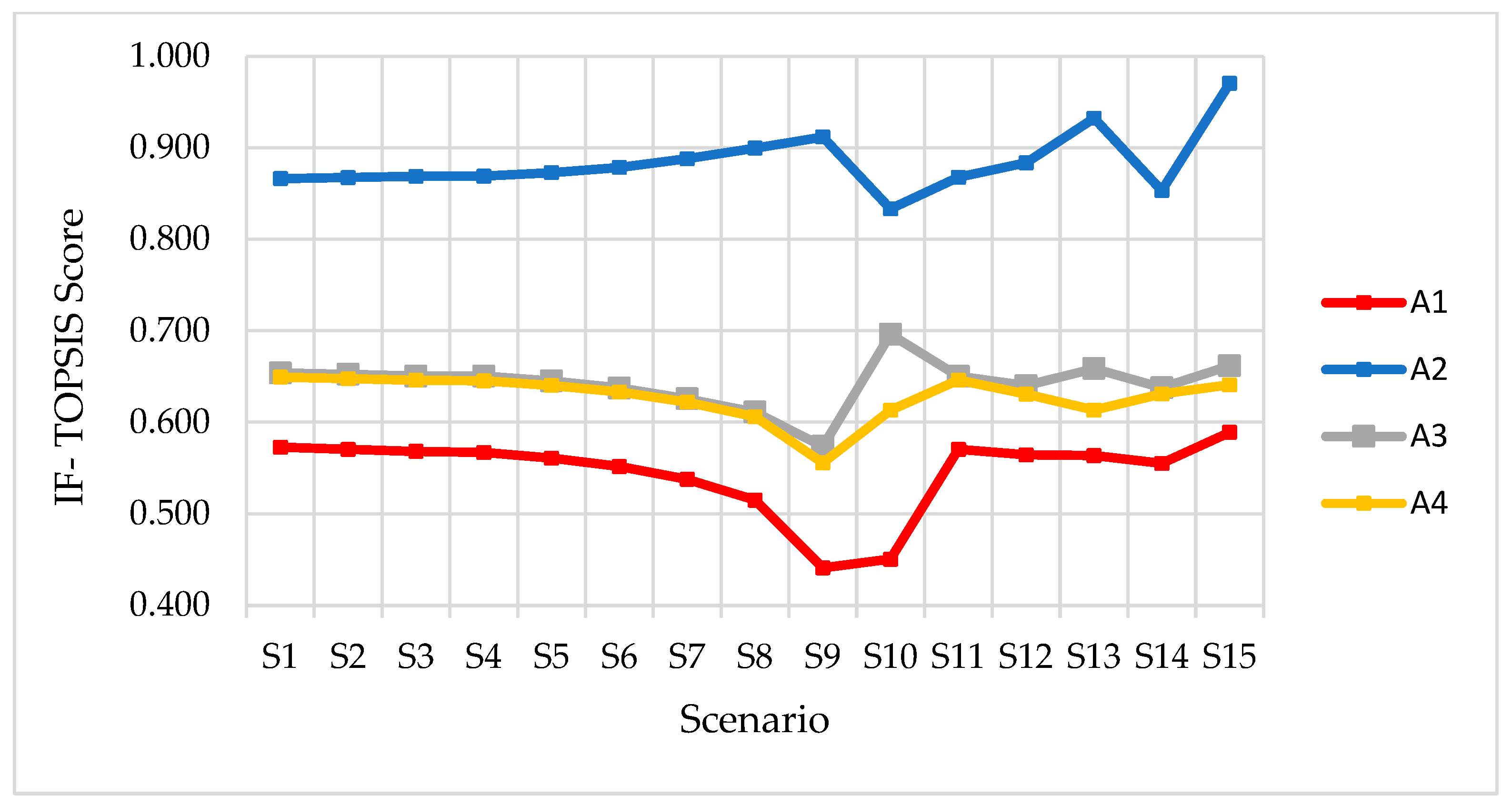
To evaluate the robustness of the proposed IF-AHP–TOPSIS framework, a sensitivity analysis was conducted by systematically varying the weights of the criteria across multiple scenarios. Scenarios S1–S10 explored gradual shifts in overall weight distribution among all criteria, ranging from a single dominant criterion (e.g., S1: (1.00, 0.00, 0.00)) to more balanced configurations (e.g., S10: (0.10, 0.90, 0.00)), representing varying levels of decision-maker certainty. Scenarios S11–S15 focused on theme-based weight variations, highlighting environmental, economic, social, and technological clusters individually or in combination.
The numerical results of all scenarios are presented in Supplementary Materials Table S14, while Figure 3 below visualizes the IF-TOPSIS scores for each alternative. In all scenarios, A 2   (steam sterilization) consistently attained the highest scores, validating its methodological robustness and minimal sensitivity to criteria weight fluctuations. A 1 exhibited substantial variation under certain scenarios, particularly when environmental criteria were deprioritized, indicating higher sensitivity. Meanwhile, A 3 and A 4 remained relatively stable, with minor fluctuations, and A 3 showed notable improvement under scenarios emphasizing minimal criteria weights (S10), suggesting conditional advantages.
These observations demonstrate that the proposed decision-making framework is robust, with A 2 emerging as the most resilient option under varying decision contexts. The sensitivity analysis underscores the critical influence of environmental and technological criteria clusters on alternative rankings, emphasizing the importance of adaptable decision-support tools capable of accommodating shifting stakeholder priorities.

4.4. Comparative Analysis and Methodological Advantages

To delineate the specific advantages of the proposed framework, this section conducts a comparative analysis between the current study and existing MCDM approaches in the literature. To contextualize the methodological contributions of this study, Table 12 contrasts the proposed IF-AHP–IF-TOPSIS framework with representative HCWM-related MCDM studies with respect to methodological structure, uncertainty modeling capability, sustainability scope, and analytical robustness.
As shown in Table 12, existing studies typically exhibit one or more of the following limitations:
(i)
Insufficient treatment of expert uncertainty;
(ii)
Fragmented methodological structures (e.g., single-stage or inconsistent integration);
(iii)
Limited sustainability or circular economy considerations;
(iv)
Lack of robustness verification through sensitivity or scenario analysis.
Accordingly, the proposed framework addresses these gaps through four key methodological advantages, which constitute the core distinctions of this study and are elaborated as follows:
  • Handling Cognitive Uncertainty and Expert Hesitation: Conventional MCDM methods—such as AHP, TOPSIS, and VIKOR—often rely on deterministic evaluations and struggle to adequately capture the expert uncertainty and hesitation inherent in real-world contexts [2,6,23]. To overcome these limitations, this study utilizes intuitionistic fuzzy sets (IFSs), which extend conventional fuzzy logic by explicitly modeling membership, non-membership, and hesitation degrees [70,73]. This approach allows for a more realistic representation of the ambiguity in sustainability evaluations compared to conventional single-layer fuzzy sets [22].
  • Methodological Coherence and Semantic Consistency: A significant gap in the existing HCWM literature is the reliance on single-stage models that focus only on ranking without integrated weighting [61]. This study addresses these gaps by integrating IF-AHP and IF-TOPSIS within a unified framework, as suggested by the need for coherent decision support systems [24]. This integration eliminates semantic inconsistency issues, often caused by mixing classical weights with fuzzy rankings, ensuring that the entire process remains within a consistent intuitionistic fuzzy environment [47,49].
  • Comprehensive Sustainability and Circular Economy Focus: Many previous studies evaluate treatment technologies based on limited operational or technical criteria without explicitly embedding long-term environmental goals [59]. This study addresses this limitation by evaluating alternatives across 17 comprehensive criteria, a set specifically developed in this study to incorporate circular economy principles, such as resource recovery and energy efficiency. While studies like Etim et al. (2021) have emphasized the need for sustainability-oriented assessment in healthcare waste management [11], this study operationalizes these goals through a more extensive and integrated criteria set directly linked to circularity objectives.
  • Evidence of Ranking Stability via Scenario Analysis: While existing studies rarely examine the stability of treatment rankings under varying priorities [52,59], a core advantage of this study is the inclusion of a 15-scenario sensitivity analysis. By testing the model’s robustness across extreme weight distributions from single-criterion dominance to balanced weighting, the study confirms that steam sterilization remains a resilient and stable option. This provides decision-makers with a higher degree of reliability and transparency compared to the limited assessment models discussed in prior research [11,61].

5. Discussion

The results indicate that steam sterilization consistently ranks as the most sustainable healthcare waste treatment technology under uncertainty when evaluated using the integrated IF-AHP–IF-TOPSIS framework. Its performance across environmental, economic, social, and technologic dimensions suggests a generally balanced sustainability profile, which remains stable across multiple weighting scenarios and diverse stakeholder priorities.
These findings correspond to prior empirical and technical research reporting lower emissions, effective pathogen neutralization, and reduced long-term risks for steam-based systems compared to incineration, microwave, and landfill disposal [14,16,51,52,56,57,58,64]. The consistency between our results and the existing literature reinforces the robustness of steam sterilization as a practical and sustainable option, particularly in regions with comparable infrastructure and regulatory contexts.
Methodologically, this study demonstrates how intuitionistic fuzzy logic enhances sustainability assessments by capturing hesitation and ambiguity in expert judgment. Conventional MCDM approaches using deterministic or single-layer fuzzy evaluations provide limited representation of cognitive uncertainty. Incorporating intuitionistic fuzzy sets into both criteria weighting and alternative ranking stages allows for a more nuanced reflection of complex, real-world decision environments where data may be incomplete or qualitative.
Although this study validates its outcomes against the prior empirical and technical literature, it is acknowledged that direct validation using site-specific operational data from existing healthcare waste management systems was not feasible. Access to detailed performance data at the facility or municipal level was limited, preventing a direct empirical comparison. Nevertheless, the observed alignment with previous studies provides indirect support for the framework’s potential applicability. Future work could extend this study by incorporating real-world operational datasets to strengthen empirical validation.
From a practical standpoint, the framework offers a transparent, adaptable decision-support tool for healthcare authorities and municipal waste managers. The robustness of steam sterilization supports its prioritization, especially where incineration presents environmental concerns or landfill practices pose long-term public health risks. Stakeholders can systematically evaluate alternatives and reconcile competing priorities, aligning decisions with regional sustainability goals.

6. Conclusions

This study represents a hybrid IF-AHP–IF-TOPSIS framework that integrates intuitionistic fuzzy logic in both criteria weighting and alternative ranking to support sustainable healthcare waste management decisions under uncertainty. By effectively capturing hesitation, imprecision, and conflicting stakeholder preferences, the model provides a realistic representation of complex decision environments.
The results consistently identify steam sterilization as the preferred treatment option, demonstrating strong performance across environmental, economic, social, and technological dimensions. Its stability across varying weighting scenarios underscores its resilience to shifts in stakeholder priorities. In the example of Adana, this technology aligns with existing infrastructure and regulatory conditions, offering a practical and low-impact solution for healthcare waste treatment.
This framework offers actionable guidance for local and national authorities, thereby facilitating a systematic evaluation of treatment technologies, investment prioritization, and alignment with broader sustainability objectives. By following the methodology and interpretation steps outlined in Section 3 and Section 4, healthcare waste management authorities can operationalize the IF-AHP–IF-TOPSIS framework to support evidence-based decision-making under uncertainty, ensuring that both scientific rigor and practical applicability are maintained.
Limitations include the reliance on a single regional case (Adana) and a limited expert pool, as well as the exclusion of spatial logistics and facility location considerations. Focusing on a single metropolitan context may influence the relative importance of certain criteria such as treatment capacity, energy consumption, operating costs, or public acceptance and may therefore affect the transferability of the ranking results to regions with different healthcare capacities, geographic characteristics, or waste generation profiles. Similarly, a limited number of experts may affect the dispersion of judgments and constrain the representation of institutional heterogeneity, although the use of intuitionistic fuzzy sets partially mitigates individual bias by explicitly modeling hesitation and uncertainty. These limitations can be mitigated by applying the proposed IF-AHP–IF-TOPSIS framework or other suitable methods across multiple regions and institutional contexts. Expanding expert participation to include a broader range of stakeholders and integrating spatial decision-support tools such as GIS can further capture transportation distances and facility location effects.
Furthermore, incorporating dynamic or real-time operational data and complementary sustainability assessment methods can enhance the robustness, adaptability, and policy relevance of the framework, enabling more context-sensitive and implementation-oriented decision support.

Supplementary Materials

The following supporting information can be downloaded at: https://www.mdpi.com/article/10.3390/su18031167/s1, Table S1. Comprehensive Evaluation Criteria: Definitions, Circular Economy Focus, and Supporting Literature. Table S2. Intuitionistic Preference Relation Matrix for Decision Maker 1. Table S3. Intuitionistic Preference Relation Matrix for Decision Maker 2. Table S4. Intuitionistic Preference Relation Matrix for Decision Maker 3. Table S5. Perfect Multiplicative Intuitionistic Preference Relation Matrix for Decision Maker 1. Table S6. Perfect Multiplicative Intuitionistic Preference Relation Matrix for Decision Maker 2. Table S7. Perfect Multiplicative Intuitionistic Preference Relation Matrix for Decision Maker 3. Table S8. Consistency Values d R , R ¯ Across All Criteria and Decision Makers. Table S9. Individual Criteria Weights for Each Decision Maker. Table S10. Intuitionistic Fuzzy Decision Matrix Based on Expert Evaluations. Table S11. Aggregated Intuitionistic Fuzzy Decision Matrix. Table S12. Aggregated Weighted Intuitionistic Fuzzy Decision Matrix. Table S13. Intuitionistic Fuzzy Positive ( A * ) and Negative ( A ) Ideal Solutions. Table S14. (a) Sensitivity Analysis Results: IFS-TOPSIS Scores under General Criterion Weight Scenarios (S1–S10). (b) Sensitivity Analysis Results: IFS-TOPSIS Scores under Theme-Based Criterion Cluster Weight Scenarios (S11–S15). References [14,16,41,42,43,44,47,48,50,51,52,55,57,59] are cited in Supplementary Materials.

Funding

This research received no external funding.

Institutional Review Board Statement

Ethical review and approval were waived for this study by Institution Committee due to Higher Education Council of Türkiye (YÖK)—Directive on Scientific Research and Publication Ethics.

Informed Consent Statement

Informed consent was obtained from all subjects involved in the study.

Data Availability Statement

The original contributions presented in this study are included in the article/Supplementary Materials.

Conflicts of Interest

The author declares no conflicts of interest.

References

  1. Thakur, V.; Ramesh, A. Healthcare Waste Management Research: A Structured Analysis and Review (2005–2014). Waste Manag. Res. 2015, 33, 855–870. [Google Scholar] [CrossRef] [PubMed]
  2. Aghajani Mir, M.; Taherei Ghazvinei, P.; Sulaiman, N.M.N.; Basri, N.E.A.; Saheri, S.; Mahmood, N.Z.; Jahan, A.; Begum, R.A.; Aghamohammadi, N. Application of TOPSIS and VIKOR Improved Versions in a Multi Criteria Decision Analysis to Develop an Optimized Municipal Solid Waste Management Model. J. Environ. Manag. 2016, 166, 109–115. [Google Scholar] [CrossRef]
  3. WHO. Basic Steps in the Preparation of Health Care Waste Management Plans for Health Care Establishments; WHO: Geneva, Switzerland, 2002. [Google Scholar]
  4. Republic of Türkiye, Official Gazette. Regulation on the Control of Medical Waste. 2017. Available online: https://www.resmigazete.gov.tr/eskiler/2017/01/20170125-2.htm (accessed on 15 October 2025).
  5. Ali, M.; Wang, W.; Chaudhry, N.; Geng, Y. Hospital Waste Management in Developing Countries: A Mini Review. Waste Manag. Res. 2017, 35, 581–592. [Google Scholar] [CrossRef]
  6. Aung, T.S.; Luan, S.; Xu, Q. Application of Multi-Criteria-Decision Approach for the Analysis of Medical Waste Management Systems in Myanmar. J. Clean. Prod. 2019, 222, 733–745. [Google Scholar] [CrossRef]
  7. Abd El-Salam, M.M. Hospital Waste Management in El-Beheira Governorate, Egypt. J. Environ. Manag. 2010, 91, 618–629. [Google Scholar] [CrossRef]
  8. Turkish Statistical Institute (TURKSTAT). Waste Statistics 2022. Available online: https://data.tuik.gov.tr/Bulten/Index?p=Waste-Statistics-2022-49570 (accessed on 15 November 2025).
  9. Büyüközkan, G.; Göçer, F.; Karabulut, Y. A New Group Decision Making Approach with IF AHP and IF VIKOR for Selecting Hazardous Waste Carriers. Measurement 2019, 134, 66–82. [Google Scholar] [CrossRef]
  10. Chauhan, A.; Singh, A. A Hybrid Multi-Criteria Decision Making Method Approach for Selecting a Sustainable Location of Healthcare Waste Disposal Facility. J. Clean. Prod. 2016, 139, 1001–1010. [Google Scholar] [CrossRef]
  11. Etim, M.-A.; Academe, S.; Emenike, P.; Omole, D. Application of Multi-Criteria Decision Approach in the Assessment of Medical Waste Management Systems in Nigeria. Sustainability 2021, 13, 914. [Google Scholar] [CrossRef]
  12. Salimian, S.; Mousavi, S.M. A Healthcare Assessment for Recycling Hazardous Waste by a New Intuitionistic Fuzzy Decision Method Based On an Assembled Proportionate Evaluation Approach. Adv. Ind. Eng. 2021, 55, 267–284. [Google Scholar] [CrossRef]
  13. Zlaugotne, B.; Pubule, J.; Gusca, J.; Kalnins, S.N. Quantitative and Qualitative Assessment of Healthcare Waste and Resource Potential Assessment. Environ. Clim. Technol. 2022, 26, 64–74. [Google Scholar] [CrossRef]
  14. Liu, H.-C.; Wu, J.; Li, P. Assessment of Health-Care Waste Disposal Methods Using a VIKOR-Based Fuzzy Multi-Criteria Decision Making Method. Waste Manag. 2013, 33, 2744–2751. [Google Scholar] [CrossRef]
  15. Hariz, H.A.; Dönmez, C.Ç.; Sennaroglu, B. Siting of a Central Healthcare Waste Incinerator Using GIS-Based Multi-Criteria Decision Analysis. J. Clean. Prod. 2017, 166, 1031–1042. [Google Scholar] [CrossRef]
  16. Mishra, A.R.; Mardani, A.; Rani, P.; Zavadskas, E.K. A Novel EDAS Approach on Intuitionistic Fuzzy Set for Assessment of Health-Care Waste Disposal Technology Using New Parametric Divergence Measures. J. Clean. Prod. 2020, 272, 122807. [Google Scholar] [CrossRef]
  17. Chaurasiya, R.; Jain, D. Pythagorean Fuzzy Entropy Measure-Based Complex Proportional Assessment Technique for Solving Multi-Criteria Healthcare Waste Treatment Problem. Granul. Comput. 2022, 7, 917–930. [Google Scholar] [CrossRef]
  18. Saaty, R.W. The Analytic Hierarchy Process—What It Is and How It Is Used. Math. Model. 1987, 9, 161–176. [Google Scholar] [CrossRef]
  19. Hwang, C.-L.; Yoon, K. Multiple Attribute Decision Making; Lecture Notes in Economics and Mathematical Systems; Springer: Berlin/Heidelberg, German, 1981; Volume 186. [Google Scholar]
  20. Triantaphyllou, E. Multi-Criteria Decision Making Methods: A Comparative Study; Springer: New York, NY, USA, 2010. [Google Scholar]
  21. Huang, I.B.; Keisler, J.; Linkov, I. Multi-Criteria Decision Analysis in Environmental Sciences: Ten Years of Applications and Trends. Sci. Total Environ. 2011, 409, 3578–3594. [Google Scholar] [CrossRef] [PubMed]
  22. Stojčić, M.; Zavadskas, E.K.; Pamučar, D.; Stević, Ž.; Mardani, A. Application of MCDM Methods in Sustainability Engineering: A Literature Review 2008–2018. Symmetry 2019, 11, 350. [Google Scholar] [CrossRef]
  23. Buyukozkan, G.; Gocer, F. Selection of Medical Waste Logistic Firms by Using AHP-TOPSIS Methodology. Int. J. Biol. Biomed. 2016, 1, 14–18. [Google Scholar]
  24. Yazdani, M.; Zarate, P.; Coulibaly, A.; Zavadskas, E.K. A Group Decision Making Support System in Logistics and Supply Chain Management. Expert Syst. Appl. 2017, 88, 376–392. [Google Scholar] [CrossRef]
  25. Hong, J.; Zhan, S.; Yu, Z.; Hong, J.; Qi, C. Life-Cycle Environmental and Economic Assessment of Medical Waste Treatment. J. Clean. Prod. 2018, 174, 65–73. [Google Scholar] [CrossRef]
  26. Camana, D.; Toniolo, S.; Manzardo, A.; Piron, M.; Scipioni, A. Life Cycle Assessment Applied to Waste Management in Italy: A Mini-Review of Characteristics and Methodological Perspectives for Local Assessment. Waste Manag. Res. 2021, 39, 1007–1026. [Google Scholar] [CrossRef]
  27. Nabavi-Pelesaraei, A.; Mohammadkashi, N.; Naderloo, L.; Abbasi, M.; Chau, K. Principal of Environmental Life Cycle Assessment for Medical Waste during COVID-19 Outbreak to Support Sustainable Development Goals. Sci. Total Environ. 2022, 827, 154416. [Google Scholar] [CrossRef]
  28. Nematollahi, H.; Ghasemzadeh, R.; Tuysserkani, M.; Aziminezhad, M.; Pazoki, M. Comparative Life Cycle Assessment of Hospital Waste Management Scenarios in Isfahan, Iran: Evaluating Environmental Impacts and Strategies for Improved Healthcare Sustainability. Results Eng. 2024, 24, 102912. [Google Scholar] [CrossRef]
  29. Awodele, O.; Adewoye, A.A.; Oparah, A.C. Assessment of Medical Waste Management in Seven Hospitals in Lagos, Nigeria. BMC Public Health 2016, 16, 269. [Google Scholar] [CrossRef]
  30. Moreira, A.M.M.; Günther, W.M.R. Assessment of Medical Waste Management at a Primary Health-Care Center in São Paulo, Brazil. Waste Manag. 2013, 33, 162–167. [Google Scholar] [CrossRef] [PubMed]
  31. Kumar, R.; Gupta, A.K.; Aggarwal, A.K.; Kumar, A. A Descriptive Study on Evaluation of Bio-Medical Waste Management in a Tertiary Care Public Hospital of North India. J. Environ. Health Sci. Eng. 2014, 12, 69. [Google Scholar] [CrossRef]
  32. Tsakona, M.; Anagnostopoulou, E.; Gidarakos, E. Hospital Waste Management and Toxicity Evaluation: A Case Study. Waste Manag. 2007, 27, 912–920. [Google Scholar] [CrossRef]
  33. Eker, H.H.; Bilgili, M.S. Statistical Analysis of Waste Generation in Healthcare Services: A Case Study. Waste Manag. Res. 2011, 29, 791–796. [Google Scholar] [CrossRef] [PubMed]
  34. Chandra, H.; Jamaluddin, K.; Masih, L.; Agnihotri, K. Cost-Benefit Analysis/Containment in Biomedical Waste Management: Model for Implementation. J. Financ. Manag. Anal. 2006, 19, 110. [Google Scholar]
  35. Jia, J.; Wang, W.; Yin, L.; Liu, J.; Nzioka, A.M.; Yan, C. Cost–Benefit Analysis of Introducing Custom-Made Small Thermal-Frictional Sterilization System to the Existing Hospital Waste Disposal System: A Case Study of Chinese Hospital. Sustainability 2022, 14, 12837. [Google Scholar] [CrossRef]
  36. Ferreira, V.; Teixeira, M.R. Healthcare Waste Management Practices and Risk Perceptions: Findings from Hospitals in the Algarve Region, Portugal. Waste Manag. 2010, 30, 2657–2663. [Google Scholar] [CrossRef]
  37. Akpieyi, A.; Tudor, T.L.; Dutra, C. The Utilisation of Risk-Based Frameworks for Managing Healthcare Waste: A Case Study of the National Health Service in London. Saf. Sci. 2015, 72, 127–132. [Google Scholar] [CrossRef][Green Version]
  38. Yang, T.; Du, Y.; Sun, M.; Meng, J.; Li, Y. Risk Management for Whole-Process Safe Disposal of Medical Waste: Progress and Challenges. Risk Manag Healthc. Policy 2024, 2024, 1503–1522. [Google Scholar] [CrossRef] [PubMed]
  39. Gul, M.; Celik, E.; Aydin, N.; Taskin Gumus, A.; Guneri, A.F. A State of the Art Literature Review of VIKOR and Its Fuzzy Extensions on Applications. Appl. Soft Comput. 2016, 46, 60–89. [Google Scholar] [CrossRef]
  40. Mishra, A.R.; Rani, P.; Mardani, A.; Pardasani, K.R.; Govindan, K.; Alrasheedi, M. Healthcare Evaluation in Hazardous Waste Recycling Using Novel Interval-Valued Intuitionistic Fuzzy Information Based on Complex Proportional Assessment Method. Comput. Ind. Eng. 2020, 139, 106140. [Google Scholar] [CrossRef]
  41. Zhang, C.; Chen, C.; Streimikiene, D.; Balezentis, T. Intuitionistic Fuzzy MULTIMOORA Approach for Multi-Criteria Assessment of the Energy Storage Technologies. Appl. Soft Comput. 2019, 79, 410–423. [Google Scholar] [CrossRef]
  42. Wan, S.-P.; Dong, J.-Y.; Chen, S.-M. A Novel Intuitionistic Fuzzy Best-Worst Method for Group Decision Making with Intuitionistic Fuzzy Preference Relations. Inf. Sci. 2024, 666, 120404. [Google Scholar] [CrossRef]
  43. Wan, S.-P.; Chen, X.-N.; Dong, J.-Y.; Gao, Y. Hesitant Multiplicative Best and Worst Method for Multi-Criteria Group Decision Making. Inf. Sci. 2025, 715, 122214. [Google Scholar] [CrossRef]
  44. Sadiq, R.; Tesfamariam, S. Environmental Decision-Making Under Uncertainty Using Intuitionistic Fuzzy Analytic Hierarchy Process (IF-AHP). Stoch. Environ. Res. Risk Assess. 2009, 23, 75–91. [Google Scholar] [CrossRef]
  45. Tavana, M.; Zareinejad, M.; Di Caprio, D.; Kaviani, M.A. An Integrated Intuitionistic Fuzzy AHP and SWOT Method for Outsourcing Reverse Logistics. Appl. Soft Comput. 2016, 40, 544–557. [Google Scholar] [CrossRef]
  46. Ortíz-Barrios, M.A.; Madrid-Sierra, S.L.; Petrillo, A.; Quezada, L.E. A Novel Approach Integrating IF-AHP, IF-DEMATEL and CoCoSo Methods for Sustainability Management in Food Digital Manufacturing Supply Chain Systems. J. Enterp. Inf. Manag. 2023, 38, 1281–1326. [Google Scholar] [CrossRef]
  47. Gerogiannis, V.C.; Fitsilis, P.; Kameas, A.D. Evaluation of Project and Portfolio Management Information Systems with the Use of a Hybrid IFS-TOPSIS Method. Intell. Decis. Technol. 2013, 7, 91–105. [Google Scholar] [CrossRef]
  48. Daneshvar Rouyendegh, B.; Yildizbasi, A.; Arikan, Ü.Z.B. Using Intuitionistic Fuzzy TOPSIS in Site Selection of Wind Power Plants in Turkey. Adv. Fuzzy Syst. 2018, 2018, 6703798. [Google Scholar] [CrossRef]
  49. Boran, F.E.; Genç, S.; Kurt, M.; Akay, D. A Multi-Criteria Intuitionistic Fuzzy Group Decision Making for Supplier Selection with TOPSIS Method. Expert Syst. Appl. 2009, 36, 11363–11368. [Google Scholar] [CrossRef]
  50. Karagiannidis, A.; Papageorgiou, A.; Perkoulidis, G.; Sanida, G.; Samaras, P. A Multi-Criteria Assessment of Scenarios on Thermal Processing of Infectious Hospital Wastes: A Case Study for Central Macedonia. Waste Manag. 2010, 30, 251–262. [Google Scholar] [CrossRef] [PubMed]
  51. Dursun, M.; Karsak, E.E.; Karadayi, M.A. A Fuzzy Multi-Criteria Group Decision Making Framework for Evaluating Health-Care Waste Disposal Alternatives. Expert Syst. Appl. 2011, 38, 11453–11462. [Google Scholar] [CrossRef]
  52. Liu, H.-C.; You, J.-X.; Lu, C.; Shan, M.-M. Application of Interval 2-Tuple Linguistic MULTIMOORA Method for Health-Care Waste Treatment Technology Evaluation and Selection. Waste Manag. 2014, 34, 2355–2364. [Google Scholar] [CrossRef]
  53. Voudrias, E.A. Technology Selection for Infectious Medical Waste Treatment Using the Analytic Hierarchy Process. J. Air Waste Manag. Assoc. 2016, 66, 663–672. [Google Scholar] [CrossRef] [PubMed]
  54. Qian, W.; Wang, Z.-J.; Li, K.W. Medical Waste Disposal Method Selection Based on a Hierarchical Decision Model with Intuitionistic Fuzzy Relations. Int. J. Environ. Res. Public Health 2016, 13, 896. [Google Scholar] [CrossRef]
  55. Nabizadeh, R.; Mahvi, A.H.; Khazaei, M.; Zamanzadeh, M.; Yari, A.R.; Jafari, A. A Fuzzy Multi-Criteria Decision Making Approach for Evaluating the Health-Care Waste Treatment Alternatives. Environ. Eng. Manag. J. 2018, 17, 2795–2805. [Google Scholar] [CrossRef]
  56. Xiao, F. A Novel Multi-Criteria Decision Making Method for Assessing Health-Care Waste Treatment Technologies Based on D Numbers. Eng. Appl. Artif. Intell. 2018, 71, 216–225. [Google Scholar] [CrossRef]
  57. Adar, T.; Delice, E.K. New Integrated Approaches Based on MC-HFLTS for Healthcare Waste Treatment Technology Selection. J. Enterp. Inf. Manag. 2019, 32, 688–711. [Google Scholar] [CrossRef]
  58. Li, H.; Li, J.; Zhang, Z.; Cao, X.; Zhu, J.; Chen, W. Establishing an Interval-Valued Fuzzy Decision-Making Method for Sustainable Selection of Healthcare Waste Treatment Technologies in the Emerging Economies. J. Mater. Cycles Waste Manag. 2020, 22, 501–514. [Google Scholar] [CrossRef]
  59. Ghram, M.; Frikha, H.M. Assessing Healthcare Waste Treatment Technologies in Tunisia within Fuzzy ARAS-H. In Proceedings of the 2020 IEEE 13th International Colloquium of Logistics and Supply Chain Management (LOGISTIQUA), Fez, Morocco, 2–4 December 2020; pp. 1–6. [Google Scholar]
  60. Rani, P.; Mishra, A.R.; Krishankumar, R.; Ravichandran, K.S.; Gandomi, A.H. A New Pythagorean Fuzzy Based Decision Framework for Assessing Healthcare Waste Treatment. IEEE Trans. Eng. Manag. 2022, 69, 2915–2929. [Google Scholar] [CrossRef]
  61. Manupati, V.K.; Ramkumar, M.; Baba, V.; Agarwal, A. Selection of the Best Healthcare Waste Disposal Techniques during and Post COVID-19 Pandemic Era. J. Clean. Prod. 2021, 281, 125175. [Google Scholar] [CrossRef]
  62. Pamučar, D.; Puška, A.; Stević, Ž.; Ćirović, G. A New Intelligent MCDM Model for HCW Management: The Integrated BWM–MABAC Model Based on D Numbers. Expert Syst. Appl. 2021, 175, 114862. [Google Scholar] [CrossRef]
  63. Beheshtinia, M.A.; Jafari Kahoo, S.; Fathi, M. Prioritizing Healthcare Waste Disposal Methods Considering Environmental Health Using an Enhanced Multi-Criteria Decision-Making Method. Environ. Pollut. Bioavailab. 2023, 35, 2218568. [Google Scholar] [CrossRef]
  64. Chen, W.; Zeng, S.; Zhang, E. Fermatean Fuzzy IWP-TOPSIS-GRA Multi-Criteria Group Analysis and Its Application to Healthcare Waste Treatment Technology Evaluation. Sustainability 2023, 15, 6056. [Google Scholar] [CrossRef]
  65. Yazar, E.A.; Adar, T.; Kilic-Delice, E. Comprehensive Evaluation of Hazardous Solid Waste Treatment and Disposal Technologies by a New Integrated AHP&MARCOS Approach. Int. J. Info. Technol. Dec. Mak. 2024, 23, 1229–1259. [Google Scholar] [CrossRef]
  66. Kokkinos, K.; Lakioti, E.; Moustakas, K.; Tsanaktsidis, C.; Karayannis, V. Sustainable Medical Waste Management Using an Intuitionistic Fuzzy-Based Decision Support System. Sustainability 2024, 16, 298. [Google Scholar] [CrossRef]
  67. Goldani, N.; Ishizaka, A. A Hybrid Fuzzy Multi-Criteria Group Decision-Making Method and Its Application to Healthcare Waste Treatment Technology Selection. Ann. Oper. Res. 2025, 353, 171–196. [Google Scholar] [CrossRef]
  68. Demir, A.T.; Moslem, S. A Novel Fuzzy Multi-Criteria Decision-Making for Enhancing the Management of Medical Waste Generated during the Coronavirus Pandemic. Eng. Appl. Artif. Intell. 2024, 133, 108465. [Google Scholar] [CrossRef]
  69. Bellman, R.E.; Zadeh, L.A. Decision-Making in a Fuzzy Environment. Manag. Sci. 1970, 17, B-141–B-164. [Google Scholar] [CrossRef]
  70. Atanassov, K.T. Intuitionistic Fuzzy Sets. Fuzzy Sets Syst. 1986, 20, 87–96. [Google Scholar] [CrossRef]
  71. Büyüközkan, G.; Güleryüz, S. Multi Criteria Group Decision Making Approach for Smart Phone Selection Using Intuitionistic Fuzzy TOPSIS. Int. J. Comput. Intell. Syst. 2016, 9, 709–725. [Google Scholar] [CrossRef]
  72. Xu, Z.; Liao, H. Intuitionistic Fuzzy Analytic Hierarchy Process. IEEE Trans. Fuzzy Syst. 2014, 22, 749–761. [Google Scholar] [CrossRef]
  73. Xu, Z. Intuitionistic Fuzzy Aggregation Operators. IEEE Trans. Fuzzy Syst. 2007, 15, 1179–1187. [Google Scholar] [CrossRef]
  74. Karagoz, S.; Deveci, M.; Simic, V.; Aydin, N.; Bolukbas, U. A Novel Intuitionistic Fuzzy MCDM-Based CODAS Approach for Locating an Authorized Dismantling Center: A Case Study of Istanbul. Waste Manag. Res. 2020, 38, 660–672. [Google Scholar] [CrossRef]
  75. Atanassov, K.T. Intuitionistic Fuzzy Sets; Physica Heidelberg: Heidelberg, Germany, 1999. [Google Scholar]
  76. Szmidt, E.; Kacprzyk, J. Distances between Intuitionistic Fuzzy Sets. Fuzzy Sets Syst. 2000, 114, 505–518. [Google Scholar] [CrossRef]
  77. Grzegorzewski, P. Distances between Intuitionistic Fuzzy Sets and/or Interval-Valued Fuzzy Sets Based on the Hausdorff Metric. Fuzzy Sets Syst. 2004, 148, 319–328. [Google Scholar] [CrossRef]
  78. Republic of Türkiye; Ministry of Environment, Urbanization and Climate Change. Available online: https://webdosya.csb.gov.tr/db/adana/menu/il-sifir-atik-yonetim-sistemi-plani-2024_20241025030552.pdf (accessed on 1 September 2025).
Figure 1. Trend of healthcare waste generation in Türkiye (2017–2023) [8].
Sustainability 18 01167 g001
Figure 2. Proposed methodological framework for sustainable HCWM under uncertainty.
Sustainability 18 01167 g002
Figure 3. Sensitivity analysis results: ranking stability of alternatives across scenarios S1–S15.
Sustainability 18 01167 g003
Table 1. Population and healthcare waste generation in Türkiye (2017–2023). Compiled by the authors based on TURKSTAT Waste Statistics 2023 [8].
YearPopulationHealthcare Waste Generation
(Thousand Tons)
201780,810.5398.729
201882,003.88107.400
201983,155.00109.478
202083,614.36125.566
202184,680.27135.869
202285,279.55130.401
202385,372.37130.882
Table 2. Overview of MCDM applications in healthcare waste management.
Author(s)YearEvaluation Criteria/Criteria SetAlternativesUncertaintyTypes of UncertaintyMCDM Method(s)
[50]201097No-AHP
[51]201144YesFuzzy Set TheoryAggregation Operator
[14]201364YesFuzzy Set TheoryVIKOR
[52]201444YesInterval 2-Tuple Linguistic VariablesMULTIMOORA
[53]201644No-AHP
[54]201645YesIntuitionistic Fuzzy SetIntuitionistic fuzzy values
[55]201864YesFuzzy Set TheoryTOPSIS
[56]201844YesD numbersD numbers
[57]201954YesHesitant Fuzzy Linguistic Term SetMABAC, MAIRCA
[16]202064YesIntuitionistic Fuzzy SetEDAS
[58]202054YesDEMATEL, Interval Valued Fuzzy SetTOPSIS
[59]202088YesFuzzy Set TheoryARAS
[60]202085YesPythagorean Fuzzy SetSWARA, ARAS
[61]202149YesFuzzy Set TheoryVIKOR
[62]202146YesD NumbersMABAC, BWM
[12]202144YesIntuitionistic Fuzzy SetTOPSIS
[63]2023411YesFuzzy Set TheoryAHP, VIKOR
[64]202344YesIntegrated Weighting Procedure, DEMATEL, Fuzzy Set TheoryTOPSIS, GRA
[65]202474No-AHP, MARCOS
[66]202474YesIntuitionistic Fuzzy Set, DEMATELTOPSIS, COPRAS
[67]202484YesBWM, Fuzzy Set TheoryMULTIMOORA
[68]202449YesFuzzy Set TheoryPSI, CRADIS
Note: Some studies report only main criteria, while others include sub-criteria. ARAS: Additive Ratio Assessment; CRADIS: Compromise Ranking of Alternatives from Distance to Ideal Solution; EDAS: Evaluation Based on Distance from Average; GRA: Gray Relational Analysis; MABAC: Multi-Attributive Border Approximation Area Comparison; MABAC-D: Multi-Attributive Border Approximation Area Comparison Based on D numbers; MAIRCA: Multi-Attributive Ideal–Real Comparative Analysis; MULTIMOORA: Multi-Objective Optimization on the basis of a Ratio Analysis plus the full MULTIplicative Form; PSI: Preference Selection Index.
Table 3. Intuitionistic fuzzy linguistic scale and corresponding descriptions.
Scale ValueImportance Description
0.1Extremely low importance
0.2Very low importance
0.3Low importance
0.4Moderately low importance
0.5Equal importance
0.6Moderately high importance
0.7High importance
0.8Very high importance
0.9Extremely high importance
Table 4. Weighting scale for evaluating the relative importance of decision-makers, constructed based on Ref. [74].
Qualitative DescriptorAbbreviationIntuitionistic Fuzzy Number Triplet ( μ ,   ν , π)
Very Low ImportanceVLI(0.10, 0.90, 0.00)
Low ImportanceLI(0.35, 0.60, 0.05)
Moderate ImportanceMI(0.50, 0.45, 0.05)
High ImportanceHI(0.75, 0.20, 0.05)
Very High ImportanceVHI(0.90, 0.10, 0.00)
Table 5. Linguistic evaluation scale for alternative performance, constructed based on Ref. [49].
Qualitative DescriptorAbbreviationIntuitionistic Fuzzy Number Triplet ( μ ,   ν , π)
Very Highly WeakVHW(0.10, 0.90, 0.00)
Highly WeakHW(0.10, 0.75, 0.15)
WeakW(0.25, 0.60, 0.15)
Moderately WeakMW(0.40, 0.50, 0.10)
ModerateM(0.50, 0.40, 0.10)
Moderately StrongMS(0.60, 0.30, 0.10)
StrongS(0.70, 0.20, 0.10)
Highly StrongHS(0.80, 0.15, 0.05)
Very Highly StrongVHS(0.85, 0.10, 0.05)
Exceptionally StrongES(1.00, 0.00, 0.00)
Table 6. Population and healthcare waste volumes in Adana (2016–2022). Compiled by the authors based on TURKSTAT Waste Statistics 2022 [8].
2016201720182019202020212022
Population (person)2,201,6702,216,4752,220,1252,237,9402,258,7182,263,3732,274,106
Healthcare waste (tons)3145.2403190.9903296.0833084.6793730.2563759.1154125.708
Table 7. Decision-makers participating in this study.
DM NoField of ExpertiseExperience
(Years)
TitleEducationRole Summary
1Waste management, local governance10Municipal Waste Management OfficerBachelorOversees waste collection and disposal
2Environmental engineering, medical waste management, sustainable waste processing methods16Environmental EngineerMasterDesigns and implements sustainable waste processing methods
3Healthcare management,
environmental engineering,
MCDM
23Full ProfessorPhDConducts research and analysis on medical waste strategies
Table 8. Healthcare waste treatment alternatives used in this study.
Alternative NoAlternative NameDescription
A 1 IncinerationHigh-temperature burning of waste to reduce volume and neutralize pathogens
A 2 Steam SterilizationAutoclaving process using saturated steam
A 3 MicrowaveDisinfection using microwave energy
A 4 Landfill Final disposal of treated or untreated waste in designated land areas
Sources: [14,16,51,52,56,57,58,64]. Studies that provide a detailed analysis of these four alternatives are listed here. Studies that reference these alternatives without a detailed discussion are not included in this section but are cited in the literature review.
Table 9. Aggregated criteria weights for each criterion.
Criteriaµ ν π Criteriaµ ν π
C E n 1 0.0950.8540.050 C E c 1 0.0960.8500.054
C E n 2 0.0900.8550.055 C E c 2 0.0940.8480.058
C E n 3 0.0840.8580.058 C E c 3 0.0820.8610.057
C E n 4 0.0860.8550.059 C S 1 0.0860.8590.055
C E n 5 0.0970.8510.052 C S 2 0.0920.8530.054
C E n 6 0.0980.8440.059 C T 1 0.0950.8580.047
C E n 7 0.0870.8530.061 C T 2 0.0960.8530.052
C E n 8 0.1030.8400.057 C T 3 0.1000.8500.050
C E n 9 0.0980.8420.060
Table 10. Weights of the decision-makers based on linguistic assessments.
DM 1DM 2DM 3
Linguistic TermMIHIVHI
Weight ( λ )0.2380.3560.406
Table 11. Separation measures, relative closeness coefficients, and ranking of alternatives.
Alternatives S i * S i C i * Ranking
A 1 0.0580.0100.1434
A 2 0.0090.0580.8601
A 3 0.0270.0370.5832
A 4 0.0360.0290.4463
Table 12. Comparative analysis of the proposed framework with the selected HCWM literature.
Comparison
Dimension
Liu et al. [52]Ghram et al. [59]Manupati et al. [61]Etim et al. [11]Current Study
(This Work)
MethodologyModified
MULTIMOORA
Fuzzy
ARAS-H
Fuzzy
VIKOR
AHP/Fuzzy AHPIntegrated IF-AHP and IF-TOPSIS
Uncertainty
Modeling
Interval 2-Tuple LinguisticLimitedLimitedLimitedIntegrated Intuitionistic Fuzzy Sets (IFSs)
Number of Criteria8810917 (Comprehensive)
Circular Economy
Consideration
LowLowLowLowHigh (Direct Integration)
Methodological IntegrationSingle StageSingle StageSingle StageSingle StageUnified Weighting and Ranking
Sensitivity /
Robustness Analysis
NoneNoneLimited7 Scenarios15 Robust Scenarios
Disclaimer/Publisher’s Note: The statements, opinions and data contained in all publications are solely those of the individual author(s) and contributor(s) and not of MDPI and/or the editor(s). MDPI and/or the editor(s) disclaim responsibility for any injury to people or property resulting from any ideas, methods, instructions or products referred to in the content.