Article

Settlement Model and State-Induced Demographic Trap: Hybrid Warfare Scenario and Territorial Transmutation in Spain


by
Samuel Esteban Rodríguez
1,
Zhaoyang Liu
2,* and
Júlia Maria Nogueira Silva
3
1
Spatial Planning Studies Group (GEOT), University Research Institute of Environmental Sciences of Aragon (IUCA), Department of Geography and Spatial Planning, University of Zaragoza, 50009 Zaragoza, Spain
2
Doctoral Programme in Spatial Planning and the Environment at the University of Zaragoza, 50009 Zaragoza, Spain
3
Departamento de Economia Rural, Universidade Federal de Viçosa, Viçosa 36570-900, MG, Brazil
*
Author to whom correspondence should be addressed.
Sustainability 2026, 18(3), 1162; https://doi.org/10.3390/su18031162
Submission received: 13 November 2025 / Revised: 12 December 2025 / Accepted: 18 December 2025 / Published: 23 January 2026
(This article belongs to the Section Health, Well-Being and Sustainability)

Abstract

This study investigates the demographic transformation of Spain’s settlement system from 2000 to the present, driven by intersecting forces of rural depopulation, metropolitan concentration, immigration, and welfare-state dynamics. Building on an integrated theoretical framework that combines Maslow’s hierarchy of needs, demographic accounting, territorial carrying capacity, and spatial centrality, the research aims to (1) identify the mechanisms governing population redistribution across Spanish municipalities, and (2) simulate future demographic trajectories under current policy regimes. Key findings reveal that all net population growth since 2000 stems exclusively from immigration and its demographic sequelae, while the native Spanish cohort has experienced a net decline of 5.5 million due to negative natural change. The analysis further uncovers a self-reinforcing “demographic trap,” wherein welfare eligibility tied to household size incentivizes higher fertility among economically vulnerable immigrant groups, even as native families delay childbearing due to economic precarity. These dynamics are accelerating a process of “territorial transmutation,” projected to culminate in a shift in de facto governance by 2045. The study concludes that immigration alone cannot reverse rural depopulation or ensure fiscal sustainability without structural reforms to welfare design, territorial incentives, and demographic foresight.

1. Introduction

This paper presents an extended version of the settlement model presented at the XXIX Congress of the Spanish Geography Association (AGE), “Challenges of Geography in the Face of Global Change”, held in Cáceres (University of Extremadura) from 14 to 17 October 2025 (Samuel, 2025).
The digital revolution and the expansion of e-commerce have catalyzed profound transformations in the global economy [1], giving rise to what scholars term the “New Rural Economy” [2]. Yet, paradoxically, many rural regions in Europe—including Spain—continue to experience persistent population decline, despite significant inflows of international migration [3]. This contradiction underscores a deeper reconfiguration of settlement systems: while some territories consolidate as nodes of economic and demographic attraction, others face abandonment, fragmentation, or functional obsolescence. At the same time, European metropolitan areas increasingly exhibit socio-spatial polarization, with the emergence of zones where state authority is weakened or contested [4], challenging traditional models of territorial governance and social cohesion.
Spain’s demographic trajectory since 2000 reveals a clear periodization shaped by macroeconomic shocks and policy responses. The early 2000s were marked by rapid population growth fueled by mass immigration, coinciding with a real estate boom. This phase ended abruptly with the 2008 financial crisis, triggering a period of adjustment and precariousness from 2012 onward, characterized by austerity, youth unemployment, and declining fertility among the native population. A third phase began after 2020, driven by the conditionalities of the Next Generation 2021recovery funds, which reshaped welfare access, housing policy, and municipal registration rules—thereby altering the demographic calculus of settlement viability.
Throughout this evolution, Spain’s population has become increasingly bifurcated by origin. The native population—defined here as Spanish nationals residing in Spain in 2002—has experienced sustained negative natural change: mortality has consistently exceeded births, with over nine million deaths recorded by 2025 and no compensatory increase in native fertility. By contrast, the non-native population (comprising foreign-born residents and their descendants) has grown steadily, driven by both immigration and higher fertility rates, particularly among certain immigrant-origin groups. Critically, these two populations exhibit divergent demographic behaviors: while native Spaniards overwhelmingly delay or forgo childbearing due to economic precarity—77.3% cite insufficient resources as the reason—foreign-born women have maintained or increased fertility despite high levels of labor market vulnerability.
This divergence is not merely statistical; it reflects differing relationships to welfare, housing, and legal frameworks. Policies such as Royal Decree-Law 11/2020 and Law 12/2023 (Right to Housing Act) [5,6] tie social protection to household composition and vulnerability indicators, inadvertently creating incentives that disproportionately benefit larger, lower-income households—many of which are foreign-born. Meanwhile, the native cohort that entered adulthood during the housing crisis now exceeds age 40, with diminished prospects for family formation under current economic conditions.
The divergent demographic behaviors between native and foreign-born populations in Spain are not anomalous but reflect deeply rooted sociocultural and institutional differences shaped in countries of origin. Demographic literature consistently documents that fertility patterns among immigrant groups often retain strong continuity with norms prevalent in their sending societies, particularly during the first and second generations [7,8]. For instance, women from Latin America—Spain’s largest immigrant group—typically exhibit higher fertility intentions and earlier childbearing than native Spaniards, a pattern linked to stronger pronatalist family values and extended kinship networks [9]. Similarly, North African immigrants, especially from Morocco, display elevated total fertility rates (TFR ≈ 2.0–2.5 in Spain vs. ~1.1 for natives), consistent with prevailing norms in Maghreb societies where large families remain socially valued despite urbanization. These behaviors persist even under conditions of economic precarity, as transnational family strategies prioritize social reproduction over immediate material constraints [10]. Crucially, such patterns are not static: longitudinal studies show gradual convergence toward host-country norms over time, though this process is moderated by legal status, gender regimes, and access to welfare [11]. Thus, the observed fertility divergence in Spain must be interpreted not as irrational behavior but as the outcome of intersecting origin-specific demographic cultures and destination-specific policy incentives.
Classical theories of spatial organization—such as Christaller’s [12] central place theory (1933)—assume hierarchical stability and functional integration. However, contemporary dynamics—marked by digital connectivity, transnational migration, fiscal decentralization, and crisis-driven policy interventions—have disrupted these equilibria. The result is not merely a shift in population distribution but a systemic transformation of the relationship between territory, resources, governance, and identity. In this context, existing models struggle to account for the coexistence of hyper-concentration in urban cores and accelerated rural hollowing, or to explain why increased resource availability does not necessarily translate into demographic renewal.
To address this gap, this study proposes an integrative model of settlement evolution grounded in four interlocking pillars: (i) human needs as articulated through Maslow’s hierarchy [13]; (ii) demographic dynamics formalized through the demographic accounting equation; (iii) territorial carrying capacity, as conceptualized by Beguin (1974) [14] and interpreted through Pascual Rubio’s (2010) notion of territorial homeostasis [15]; and (iv) spatial centrality reconceptualized beyond morphology to reflect access to income and services in a post-industrial economy. Building on the notion of the operational base and activity area, we link individual behavior to territorial structure by treating each place as a node embedded in a fluid network of resource flows.
The primary objective of this research is twofold: first, to identify and analyze the key processes driving demographic change in Spain since 2000, with particular attention to the differential roles of native and foreign-born populations; and second, to project future trajectories under the influence of recent institutional frameworks—including housing vulnerability criteria (Royal Decree-Law 11/2020) [5], the Right to Housing Act (Law 12/2023) [6], and the conditionalities attached to Next Generation EU funds. A central hypothesis guides the inquiry: population concentrates not simply where resources are abundant, but where unused carrying capacity exists—and where accessibility enables the conversion of those resources into welfare and opportunity.
This paper contributes to debates on demographic resilience, territorial justice, and the future of the European welfare state by demonstrating how policy design—however well-intentioned—can inadvertently reinforce demographic asymmetries. The implications extend beyond Spain, offering insights into broader patterns of urban-rural divergence, generational replacement failure, and the geopolitical dimensions of population change in aging democracies.

2. Model of Settlement Evolution

2.1. Human Needs, Resources, and Spatial Exchange

This chapter develops an integrative theoretical framework explicitly designed to address the central research question: how do differential demographic behaviors between the native-born and the foreign-born population interact with territorial carrying capacity and the resource reallocation induced by public policies to reconfigure Spain’s settlement system since 2000? To this end, it synthesizes four complementary theoretical strands—hierarchies of needs, carrying capacity, demographic accounting, territorial homeostasis, and centrality—not as abstract constructs but as operational tools calibrated to the empirical realities of post-crisis Spain. The model builds on the distinction between the residential base and the activity space, which is particularly relevant for analyzing how individuals navigate fragmented labor markets, digital connectivity, and welfare conditionality in contemporary Europe [16,17].

2.2. The Dual Spatial Structure: Operational Base and Activity Area

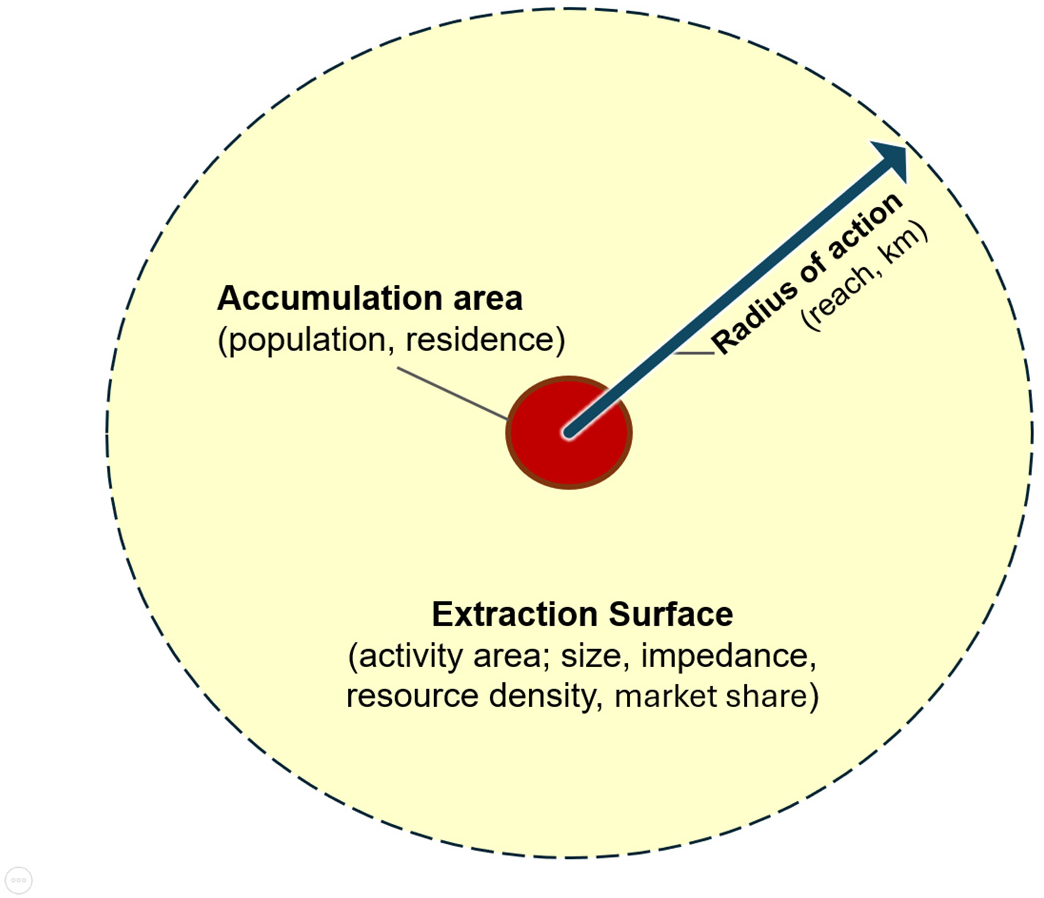
At the individual level, territorial organization can be conceptualized as comprising two complementary geographic components (Figure 1):
The operational base, which functions as a residential refuge and a repository for accumulated resources;
The activity area, which encompasses the set of locations where resources are generated, exchanged, and consumed. This activity area denotes a functional core of economic interaction rather than a strictly morphological downtown. It corresponds to the area of influence and encompasses all locations where exchanges occur and are, to some degree, appropriated by the inhabitants of the residential base.
Each resident exhibits a distinctive profile of needs and productive capacity, which conditions the dynamic equilibrium between these two spatial domains. The size and configuration of the activity area are not predetermined; rather, they emerge from the interaction among resource requirements, accessibility, the technological context, and the legal framework [18].

2.3. Governance, Sociocultural Identity, and Market Access

An operational base is defined by its geographic location, resident population, and prevailing sociocultural practices. It operates under a governance system shaped by the internal balance of power among social groups. In democratic settings, collective decisions often hinge on a majority threshold (e.g., 50% of votes). Bases may activate internal adjustment mechanisms to enhance efficiency, and the expansion of productive areas can generate synergies across functions.
Access to markets is mediated by territorial endowments, population size, and—critically—by the base’s market share, which can function as a right of exclusion. This share modulates spatial interactions with neighboring bases and shapes the permeability of the activity area’s boundaries, which are often diffuse and context-dependent.

2.4. Carrying Capacity and Territorial Homeostasis

The carrying capacity of a residential base extends Beguin’s approach [14] and is defined as the ratio between the resources accessible to its population and the minimum requirements for sustainable habitability, typically operationalized through expenditures on housing, transport, and subsistence. Following Pascual Rubio (2010) [15], a base’s capacity to generate wealth depends on its technological, sociocultural, and territorial context.
Internal adjustments may target productive efficiency, consumption patterns, redistribution mechanisms, or governance structures. In extreme cases, demographic corrections (e.g., out-migration or reduced fertility) may be triggered. Moreover, inter-base interactions involve not only the transfer of resources but also the offloading of burdens (e.g., environmental costs or social risks).

2.5. Demographic Accounting and Population Dynamics

Demographic equilibrium is modeled through the demographic accounting equation:
ΔP = BD + IE
where B = births, D = deaths, I = immigration, and E = emigration. This framework allows for the disaggregation of population flows by origin, enabling analysis of native versus immigrant groups and their differential contributions to territorial dynamics.

2.6. Centrality, Hierarchy, and Territorial Multifunctionality

Centrality—in the Christallerian sense (1933) [12]—is interpreted as the “excess importance” of a location, measured by the surplus of resources it provides to its inhabitants relative to its size. The hierarchical ordering of bases is determined by the net balance of bilateral resource transfers: bases with positive net inflows occupy higher positions in the settlement hierarchy.
To account for contemporary territorial complexity, Beguin’s original model is adapted to territorial multifunctionality. Rather than tying income to local productive activity, we consider the total declared income (from IRPF tax records) of all residents in a base, regardless of where or how that income is generated. This approach captures the decoupling of residence from production in the digital and service-based economy.

2.7. Operationalization and Empirical Calibration

The model is operationalized using municipal population data from Spain’s Nomenclátor (INE). Resources are categorized as natural yields (e.g., agricultural or extractive outputs) and social yields (e.g., wages, pensions, transfers). Minimum income thresholds—derived from household-level IRPF data—are used to define viability benchmarks for habitation.
The spatial reach from a given point (h) depends on the extent of the activity area, while the habitat excess cost captures the transportation expenditures required to perform essential activities from the residential location. The effective surface area (s) of the activity zone is calibrated to best fit observed demographic and economic series, ensuring empirical consistency.
In an idealized isotropic space (uniform transport costs), the model would generate circular activity areas—consistent with classical central place and urban economic models in which functional cores exhibit radially symmetric market areas (Azarnert, 2023) [17]; although isotropy is not a requirement of the model. The core variables are presented in Table 1.
With this framework Table 1, a coherent and operational model is obtained: the operational base ensures daily reproduction and governance; the activity area expands or contracts access to resources; carrying capacity and the compensatory equation govern internal adjustments; and centrality structures spatial hierarchies. The integration of these components enables the analysis of how bases and their activity areas evolve in response to changes in technology, the sociocultural environment, transportation costs, and resource availability—while avoiding overlaps and redundancies in the definition of the model’s components.
Collectively, this model provides a coherent analytical scaffold to test our central hypothesis: that population concentrates not merely where resources are abundant, but where unused carrying capacity intersects with policy-mediated accessibility. By embedding demographic accounting within a spatially explicit framework of needs, governance, and resource flows, the model enables us to trace how immigration—interacting with housing laws, welfare conditionality, and EU fund allocation—reshapes not only where people live, but who reproduces demographically and whose needs shape future territorial configurations. This directly supports the dual objectives outlined in the introduction: diagnosing the drivers of Spain’s bifurcated demography and projecting its institutionalized trajectories under current policy regimes.

3. Methodology

3.1. Conceptual and Analytical Framework

The analysis is grounded in a dynamic model of settlement evolution calibrated for Spain from 2000 onward. The model estimates habitat-related market shares and excess costs as a function of disposable income, transportation costs, and individual needs. It employs the demographic accounting equation—births, deaths, immigration, and emigration—disaggregated by nationality, linking variations in natural and migratory population growth to the carrying capacity and centrality of settlements. The approach integrates municipal-level time series on population, income, and economic activity to examine processes of concentration, depopulation, and resource redistribution. The spatial interpretation is grounded in the operational base and carrying-capacity framework, incorporating Beguin’s concept of agrarian population-density potential—adapted to territorial multifunctionality—together with Christaller’s (1933) central place theory [12] and Beguin’s (1974) contributions [14]. Within this framework, each municipality is treated as an operational base whose activity area expands or contracts according to resource density, excess habitat costs, and mobility constraints. Spatial change is interpreted as shifts in carrying capacity across bases, with equilibrium determined by the relationship among resident population, income, and expenditures.

3.2. Data Sources and Variable Construction

Demographic data are sourced from Spain’s National Statistics Institute (INE): the continuous municipal register, vital statistics on natural population movement, and official projections (INE, 2024) [19]. The native population is defined as Spanish nationals residing in Spain in 2002; their demographic trajectory is projected using average fertility and mortality rates specific to that nationality. The non-native population is derived as the residual difference between total annual population and the native group. Economic and fiscal data come from the Spanish Tax Agency’s records on declared personal income (IRPF) and from the INE’s National Accounts [20]. For international contextualization, World Development Indicators (World Bank) are used. Cartographic layers are drawn from the National Geographic Institute (IGN) and Eurostat.
While net migration is overwhelmingly positive due to high immigration inflows, emigration from Spain—though comparatively modest—remains a component of the demographic accounting equation. According to estimates from Spain’s National Statistics Institute (INE) and Eurostat, annual emigration ranged between approximately 250,000 and 530,000 while net migration turned positive from 2015 onward, driven by sustained immigration exceeding emigration (see Table 2). These figures confirm that emigration, while non-negligible, has been consistently lower than immigration since the mid-2010s, justifying its secondary role in our analytical focus.

3.3. Statistical Procedures and Model Validation

The methodological procedure includes normalization and cleaning of time series, with transformation into annual growth rates and relative proportions. Interannual municipal variations are modeled using simple and multiple linear regression and cross-validated against municipal register data. Model fit is assessed using the coefficient of determination (R2) and statistical significance. Validation covers the period 2012–2020; the best fits are observed between 2016 and 2019, with R2 values ranging from 0.46 to 0.74. To evaluate demographic behavior by origin, the population series is disaggregated into groups, and specific rates of fertility, mortality, and net migration are computed.

3.4. Institutional and Policy Context

Institutional variables are incorporated to capture the impact of recent regulatory frameworks on resource redistribution and settlement dynamics. These include the vulnerability criteria established under Royal Decree-Law 11/2020 [5], the Right to Housing Act (Law 12/2023), and Next Generation EU funds [6]. Survey data from the Centre for Sociological Research (CIS, 2024) [21] are used to contextualize reproductive decisions, particularly regarding childbearing. Additionally, legal instruments governing residency, registration, and nationality—including Organic Law 4/2000 [22] on rights and freedoms of foreigners and Royal Decree 1155/2024 [23]—are considered as structural factors shaping migratory flows and demographic adjustment.

3.5. Interpretation of Results and Adjustment Mechanisms

Results are presented qualitatively in relation to the theoretical framework and observed empirical patterns. Model performance is validated against municipal register data from 2012 to 2020. Adjustment mechanisms are analyzed by linking group-specific demographic trends (natural and migratory) with evidence from CIS surveys and the implementation of relevant public policies. The interplay between economic growth—measured by per capita disposable income—and demographic change is examined within this institutional and spatial context, emphasizing how policy interventions modulate the carrying capacity of operational bases through resource reallocation and access conditions.

4. Results

4.1. Territorial Model Performance

Application of the settlement evolution model reveals a sustained expansion of settlement influence areas alongside a decline in their market shares—consistent with intensified exchange flows driven by advances in transportation infrastructure and globalization [24]. Population continues to concentrate in metropolitan regions, while rural areas exhibit a dual dynamic: ongoing depopulation coexists with the consolidation of new economic activities that have expanded productive zones in certain interior territories.
The relationship between economic growth and demographic growth is strong yet mediated by additional behavioral and structural factors [25]. In numerous rural contexts, the dominant demographic trend is negative natural change, characterized by mortality exceeding births—a pattern exacerbated by persistently low fertility [5]. Notably, even where per capita resource availability is high, this does not necessarily translate into higher birth rates. Historically, episodes of rural depopulation have been closely linked to the absence of generational replacement.
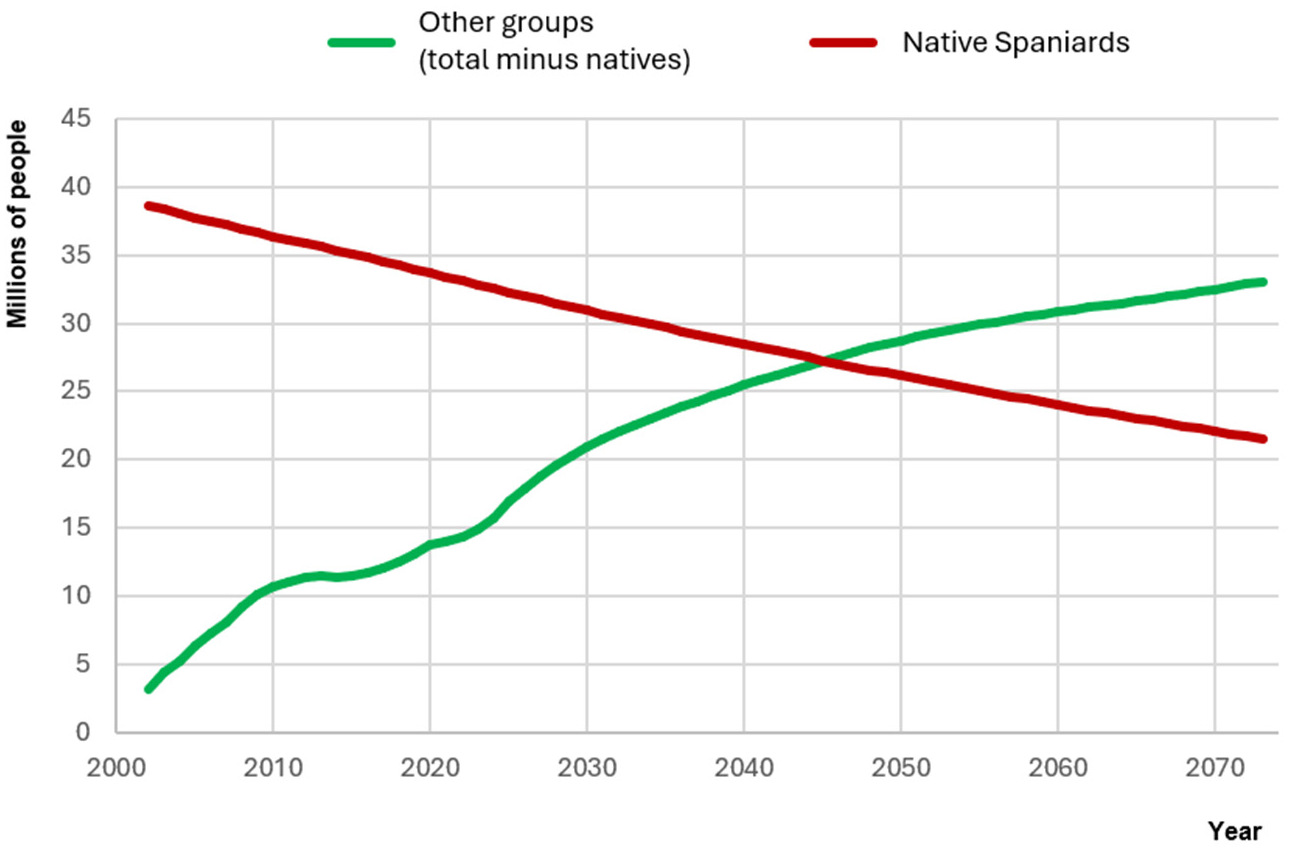
Disaggregation by origin shows that the cohort of Spanish nationals residing in Spain at the turn of the century has not achieved generational replacement. By 2025, more than nine million individuals from this group have died, resulting in a net decline of 5.5 million native residents. Nevertheless, total population has increased due to the substantial growth of non-native populations—those originating from bases outside Spain—and their descendants, particularly in and around urban centers. In metropolitan areas, despite higher resource density per unit area, per capita surplus has declined; since the financial crisis, society has become poorer overall. According to the Centre for Sociological Research (CIS, 2024) [21], 77.3% of Spaniards report forgoing additional children due to insufficient economic resources.

Model estimates consistently reproduce interannual municipal population variations across most years, with particularly high fit quality between 2016 and 2019 (R2 ranging from 0.46 to 0.74) and low mean absolute errors. Predictive capacity diminishes during periods of systemic crisis and exceptional disruption, such as the COVID-19 lockdown phase. Table 3 and Figure 2 summarize the key model fit indicators below:

4.2. Territorial Transmutation

The population in Spain is distributed across four major layers. The first corresponds to an elderly population that is progressively fading due to mortality and retains a stronger presence and rootedness in rural areas. The second layer consists of their descendants, numerous and mainly urban. The third group comprises successive generations with very few children, also settled in urban areas. The fourth layer is made up of a young foreign-born population concentrated in metropolitan environments, the northeast, and along the Mediterranean coast, experiencing sustained growth due to immigration and birth rates, with some presence in central rural nuclei.
Projections indicate a structural change in settlement patterns, demographic composition, and territorial governance, articulated in three phases known as Territorial Transmutation. The progressive expansion of the areas of influence of localities cannot be overlooked; it is linked to globalization, and without it the other processes analyzed could hardly have been set in motion.
The first phase combines two simultaneous processes: the passing of the elderly population, which generates rural depopulation and reduces settlement dispersion, and immigration from third countries towards metropolitan zones and central locations, concentrating the population spatially. Areas with higher resource density, primarily urban ones, expand their activity and market areas, while some rural bases tend to become uninhabited. The effect on habitats accumulates over time; although the total population varies little during this phase, spatial redistribution is profound.
The second phase is characterized by mechanisms of readjustment and rebalancing of the foundations. During the economic crisis, policies for the redistribution of resources were applied, yet birth rates declined. The relationship between population groups shows inverse behavior: while the Spanish population decreases, the foreign-born population increases. The resulting territorial configuration may not be optimal for maintaining the same lifestyle model, failing to preserve the balance between resources and needs. This phase particularly affects the composition of the young population and the functioning of the foundations. It concludes with the disappearance of the baby boom generation, though this transition may occur earlier in cities.
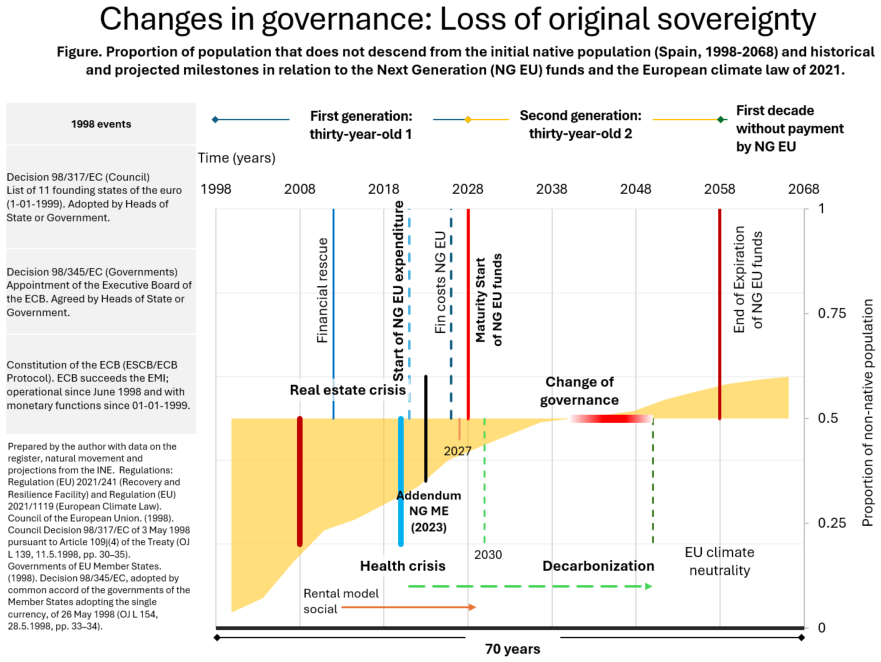
The third phase represents a rapid transition between governance regimes. Following the cohorts shaped by rural out-migration and the descendants of the baby boom, Spain’s birth rate decelerates and successive cohorts become progressively smaller. Over time, the rate of decline in the native-born population accelerates, producing an abrupt demographic shift. This phase culminates in a de facto transfer of sovereignty, as the Spanish population gradually loses control over its territory and—depending on the prevailing cultural context—over its decision-making capacity. The transition intensifies after 2030, with 2045 marking a demographic tipping point at which native-origin populations fall below the governance threshold required to sustain original sovereign.
The foreign-born population in Spain is heterogeneous, originating from diverse cultural and legal backgrounds. In certain urban districts, Spanish nationals have already become a numerical minority. For instance, Figure 3, according to Spain’s National Statistics Institute (INE, 2023) [19], in the Barcelona district of El Raval (Ciutat Vella), only 38.2% of residents held Spanish nationality as of 2023; similarly, in Usera (Madrid), the figure stood at 41.5%, with large communities from Latin America, North Africa, and Asia. Comparable trends are observable in other European capitals. In London, the share of residents who identify with the UK’s long-established majority population fell below 40% in the 2021 Census, and this group has been a minority for more than a decade in boroughs such as Newham (17%) and Brent (18%). While demographic composition alone does not equate to loss of sovereignty, sustained shifts in electoral majorities—coupled with differential fertility and naturalization rates—could, under current trajectories, lead to a reconfiguration of political representation and governance legitimacy by mid-century. If present trends persist without policy intervention, a transition in de facto decision-making power may materialize around 2045, particularly in metropolitan cores where native populations are both declining and aging.
Territorial transmutation describes a cumulative process of demographic, economic, and political transformation. The combination of aging, rural depopulation, urban concentration, and sustained immigration redefines the structure of settlement and leads to a reconfiguration of governance and internal territorial balances.

4.3. Demographic Trap

In Spain, parents have a legal obligation to provide financial support for their children. The evolution of the average fertility rate during the economic crisis is consistent with the fulfillment of this duty. However, the observed increase in births—occurring amid widespread unemployment and declining household income—constitutes an anomalous phenomenon within the rational framework of the demographic model. What emerges is a distinct population group exhibiting behavior contrary to what would be expected based on carrying capacity considerations Table 4.
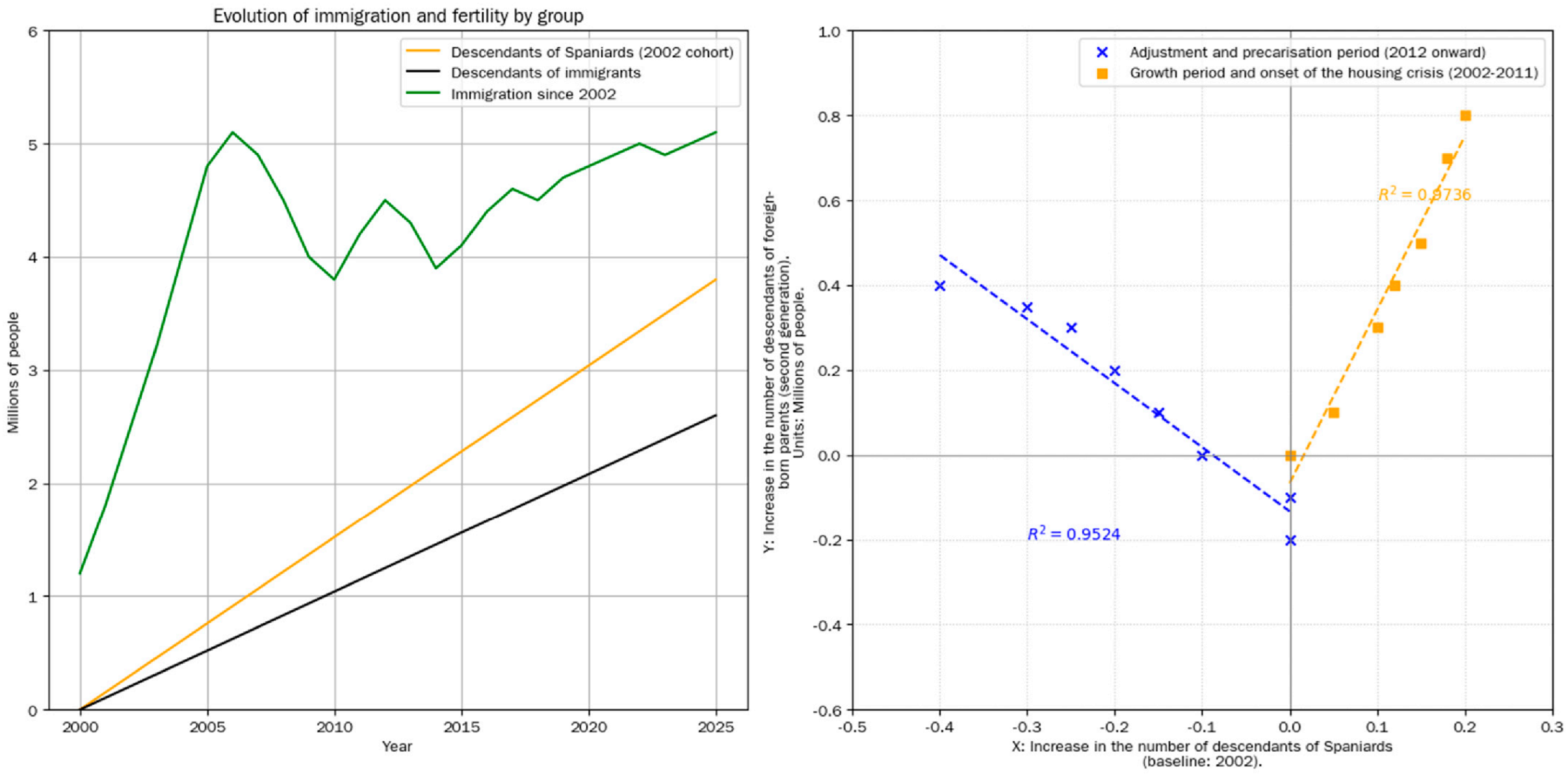
Since the housing crisis, the growth of the foreign-born population and that of descendants of Spanish nationals have followed inverse trajectories. The crisis did not affect all groups equally. Spain provides reinforced legal protection for children, and larger family responsibilities are recognized as indicators of heightened social vulnerability. These responsibilities—combined with the absence of income from economic activity and a lack of social support networks—determine objective vulnerability indicators as defined by the Civil Procedure Act and, more recently, by Royal Decree-Law 11/2020 [26].
The divergent fertility trends preclude the assumption of shared social norms. Since the crisis, fertility among most of the population has declined—a pattern consistent with both prevailing social principles and theoretical demographic models. This behavior helps individuals avoid short-term vulnerability; conversely, actions that run counter to this trend increase the risk of falling into precarious conditions.
The Public Income Indicator of Multiple Effects (IPREM) was introduced in 2004 to replace the minimum wage (SMI) as the benchmark for social benefits and related entitlements, and it has been maintained at a lower level. In 2025 it stands at around 600€ per month, as the 2023 General State Budget provisions—set out in Additional Provision 90 of Law 31/2022 of 23 December—remain unchanged [6]. By contrast, the statutory minimum wage currently in force is €1134 per month (Royal Decree 145/2024) [4]. The 2020 Royal Decree on COVID-19 [6] emergency measures defined vulnerability based on the simultaneous fulfillment of the following criteria:
(i)
total household income in the previous month does not exceed 3 × IPREM (≈€1800 in 2025), with this threshold increased by +0.1 × IPREM per child or person aged ≥65 (or +0.15 × IPREM for single-parent families) and raised to 4–5 × IPREM in cases of disability ≥ 33%, dependency, severe disability, or serious illness;
(ii)
rent plus essential utilities consume at least 35% of that income;
(iii)
no member of the household (tenant, partner, or children) owns or holds usufruct rights over another dwelling, except under strictly defined exceptions (e.g., undivided inheritance, unavailability, or inaccessibility).

Furthermore, under Article 1 bis (regarding suspension of evictions), additional conditions apply: the dwelling must be owned by a “large holder” (i.e., an entity owning more than 10 properties), and the occupants must be vulnerable due to dependency, gender-based violence, or cohabitation with dependents or minors.
The Universal Declaration of Human Rights (UN, 1948) [27] affirms the right to marry and found a family, as well as the right of all children to equal social protection. In Western countries, support mechanisms exist that shift the primary responsibility for child protection onto the state. The Spanish Constitution provides children with reinforced, comprehensive protection: it imposes on parents the duty to support their children (Art. 39.3) and obliges public authorities to ensure the social and economic protection of the family (Art. 39.1). In the case of minors, the state may even assume guardianship when necessary.
Table 4. Overview of Public Support Measures for Families in Spain.
Type of SupportDescription
Social Security Family BenefitsFinancial benefits for birth or adoption
Allowance per child or dependent minor
Minimum Living Income (IMV—Ingreso Mínimo Vital)
Parental leave and career breaks (excedencias)
Gender gap reduction supplement
Employment-Related AssistanceUnemployment benefits
Employment promotion programs
Tax BenefitsPersonal income tax (IRPF) deductions
Regional (autonomous community) tax deductions
Social Security contribution reductions or exemptions
Support for Large and Single-Parent FamiliesOfficial recognition as a “large family” (familia numerosa)
Specific benefits for large families
Enhanced protection for single-parent families
Social electricity and thermal energy subsidies
Public Social Services System BenefitsPrimary and specialized social care services
Social programs implemented in coordination with Autonomous Communities
Other Specific Assistance ProgramsSupport for non-professional caregivers and personal assistance services
Aid for non-payment of child support obligations
Scholarships and educational grants
Support for families with dependents in situations of dependency or disability
Source: Authors’ own elaboration based on Ministry of Social Rights, Consumer Affairs and 2030 Agenda (2024) [28]. Guide to Social Benefits and Services for Families.
In Spain, children benefit from reinforced legal protection, and greater family responsibilities are associated with heightened social vulnerability (Royal Decree-Law 11/2020) [6]. Since the housing crisis, fertility rates among the majority of the population have declined—a trend consistent with both the guiding principles of social life enshrined in the Spanish Constitution and theoretical demographic models, as it serves to avoid short-term economic vulnerability. In contrast to this general pattern and to trends among native-born Spaniards, the average fertility rate among foreign-born women has increased (Figure 4). This group exhibits high vulnerability, particularly due to the limited labor market integration experienced by certain subpopulations (Encuesta de Población Activa -Labour Force Survey-, 2025).
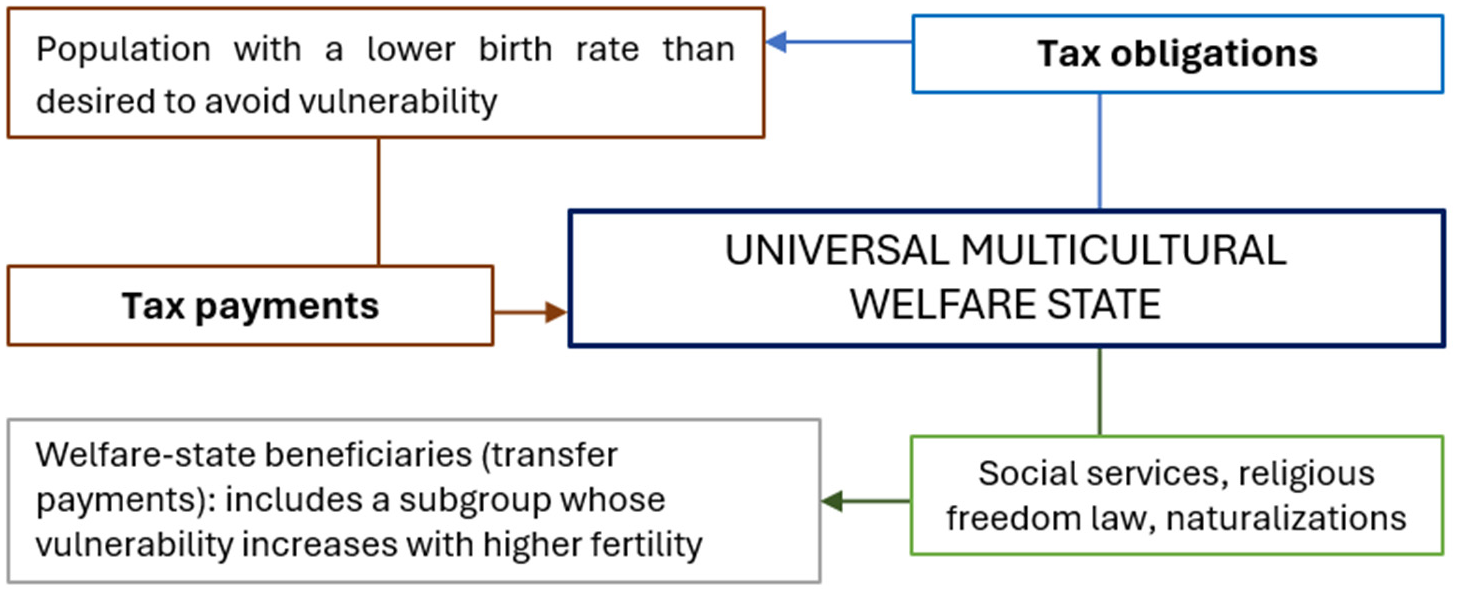
The divergent fertility trajectories reveal the existence of distinct social conventions. The population has decreased within the group that adjusted its reproductive behavior and increased within the group that did not. The former sought to avoid economic dependency; the latter did not. The welfare state covers the most essential needs of the most vulnerable populations, financed through taxation. Within the theoretical framework, a reduction in social benefits or an increase in fiscal pressure acts as a brake on demographic growth. The inverse relationship between these two population groups aligns with this redistributive mechanism. This shift began approximately with the 2012 financial bailout and was consolidated following the approval of the 2013 Housing Plan, which prioritized social rental housing for the most vulnerable groups.
Following the mortality associated with the COVID-19 pandemic and the activation of the Next Generation EU funds, Spain has experienced a rapid population increase—receiving approximately one million immigrants every two years. The conditionality associated with the Next Generation EU funds steers public investment and requires reforms across a wide range of legal and regulatory domains as a precondition for disbursement. In Spain, these requirements have included amendments affecting municipal registration (the padrón). Since 2024, individuals may register their place of residence even when they lack stable housing, provided they can receive official notifications (i.e., registration at an address “on the street”). Likewise, the conditionality required the establishment of a legally enforceable corpus of state-guaranteed social rights, including, for example, the right to housing (Law 12/2023) [6]. It also called for the strengthening of reception systems for asylum seekers and the expansion of employment programmes targeted at applicants, such as the TANDEM scheme, alongside prioritised measures for young people in rural areas.
Employment generated in the new sectors promoted by the recovery funds shows a higher proportion of open-ended contracts than in other sectors—particularly services—where the participation of women and Spanish-speaking populations is higher (EPA). This facilitates the incorporation of asylum seekers relocated to mainland Spain from areas where trafficking networks operate, such as the Canary Islands. Although most asylum applications are rejected, decisions are often issued only after the statutory period required to qualify for residence on the grounds of social ties (arraigo social). This opens a pathway to family reunification and, ultimately, citizenship. Under Spanish law, the parents of minors born in Spain may obtain nationality-related documentation within one year of the child’s birth.
During the real-estate crisis, dwellings financed through the 2012 bailout were transferred to SAREB. Following COVID-19, the Recovery Plan—aligned with Next Generation EU—has prioritised social rental housing: it funds rehabilitation and new construction and has already transferred 15,000 dwellings from SAREB (Royal Decree 903/2022) [29]. The plan also envisages the construction of thousands of social-rental units in rural and sparsely populated areas.
To curb rent inflation, a rent-limitation mechanism has been introduced that can be applied at neighbourhood level when housing costs exceed 30% of household income. This rule ensures that areas with a high concentration of large, low-income households benefit from lower rents.
Divergences in fertility make it difficult to assume shared social conventions. A decline is observed among the segment that adjusted its reproductive behaviour in line with prevailing social norms, while the segment that did not adjust is increasing. The former sought to avoid economic dependency; the latter did not.
Spain provides enhanced protection for minors, and greater family responsibilities are treated as an indicator of heightened vulnerability. These responsibilities, together with the absence of stable income and support networks, shape key vulnerability indicators. Since the crisis, fertility has declined for the majority—consistent with constitutional principles and with the theoretical model—as a short-term strategy to avoid economic vulnerability. By contrast, fertility among foreign-born women has increased. This group remains highly vulnerable due to limited labour-market integration (EPA).
The welfare state covers essential needs for the most vulnerable population, financed through taxation. An increase in the number of vulnerable individuals implies higher demand for resources, requiring either a greater tax burden or reallocation from other budgetary items.
According to the theoretical model, both benefit retrenchment and increased tax pressure exert downward pressure on demographic growth among the affected groups. The observed inverse relationship between the growth trajectories of the two segments is consistent with this redistributive scenario. Through the tax system, the state functions as a redistributive mechanism, transferring resources from the first group to the second. In Spain, in line with the model, the increase in fertility among foreign-born women has been sustained by the welfare state at the expense of demographic growth in the rest of the population (Figure 5).

5. Hybrid Warfare Scenario

Hybrid warfare combines disinformation with other elements—conventional or non-conventional—such as biological or financial instruments. The externalization of domestic socioeconomic pressures through emigration effectively shifts internal adjustment burdens onto host countries. Some immigrants originate from theocratic societies or states that refuse to repatriate their nationals. Since the onset of the COVID-19 pandemic, asylum applications have surged dramatically, coinciding with the implementation of social benefits and rights mandated by the conditionality of the Next Generation EU [30] funds (Reg. (EU) 2021/241; Council of the European Union, 2021). While these expenditures are currently financed through EU funds, they generate long-term fiscal obligations for member states.
Spain was severely impoverished by the housing crisis, requiring an international bailout and extensive austerity measures to meet its financial commitments. In the 1990s, the country privatized numerous public enterprises to comply with the deficit and debt criteria established by the Maastricht Treaty (1992), a prerequisite for adopting the euro.
The EU Taxonomy for Sustainable Activities is a relatively recent classification system: it was advanced in 2018 through the European Commission’s Action Plan on Financing Sustainable Growth and the associated legislative initiative, and it was subsequently established as binding EU law by Regulation (EU) 2020/852.Green bonds aligned with specific environmental objectives must demonstrably fulfill those objectives—functioning essentially as contractual commitments. The taxonomy centers on ecological and climate transition; however, “climate” itself is not explicitly defined. Instead, it defers to the methodology of 30-year climate projections issued by international scientific bodies. Thus, although the taxonomy imposes binding obligations on countries, its core object remains ambiguously specified.
Since the COVID-19 crisis, the European Commission has been empowered to propose multiannual net expenditure paths for each member state (Regulation (EU) 2024/1263) [28]. Under this regulation, public-sector wages and pensions are classified as expenditure. However, EU-funded grants are excluded from this calculation, thereby easing compliance with fiscal commitments to investors.
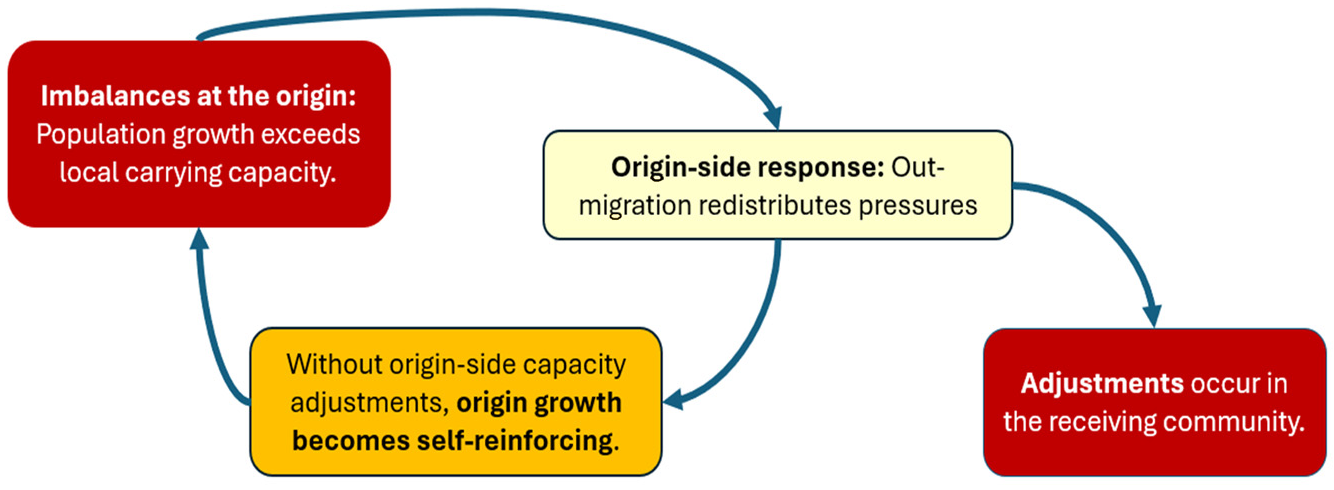
Figure 6 the offloading of socioeconomic burdens via migration transfers internal adjustment costs to receiving countries. Some migrants come from theocratic regimes or nations that reject the return of their citizens. Advances in transportation infrastructure further enable decentralized organizations to launch coordinated pressure from multiple geographic origins.
In 2024, jihadist terrorism was the leading driver of terrorist attacks in the European Union (Europol, 2025). A jihadist group that refrains from armed violence could still impose its norms through demographic and economic pressure, leveraging electoral mechanisms to gain influence—a form of hybrid warfare. Spain and Europe are particularly vulnerable to a large-scale attack targeting the welfare state’s administrative and financial infrastructure.
Global Demographic Trap. At the global level, a self-reinforcing loop has emerged: population movements shift adjustment pressures onto receiving societies, while origin countries preserve—and may even consolidate—social practices that sustain demographic and economic imbalances without undertaking internal reforms. By externalizing part of the social and economic costs through emigration, these societies can weaken the incentives to correct underlying drivers of instability, including irresponsible family-formation patterns and institutionalized arrangements such as polygamy, which are incompatible with Spain’s legal order. In Spain, polygamy is not permitted through a dual legal mechanism: (i) under civil law, it constitutes a marital impediment for anyone already bound by a subsisting marriage (Spanish Civil Code, Arts. 46(2) and 73(2)); and (ii) under criminal law, contracting a “second or subsequent marriage” while knowingly maintaining the prior one constitutes the offence of bigamy (Spanish Criminal Code, Art. 217), punishable by imprisonment from six months to one year. Notwithstanding this, a host-country legal framework that facilitates the continuation of the demographic loop—by enabling origin societies to avoid internal adjustment through migration—may be indirectly reinforcing, in third countries, social practices that are incompatible with the host country’s own legal order Figure 7.
Ulpian conceives justice as the constant and perpetual will to give each person what is due. The conditionality of these funds facilitates the arrival of millions of people to Spain, but it does not treat all foreigners equally; it excludes irregular migrants, many of whom enter as tourists and do not return. During the real estate crisis, an entire generation was left unemployed; currently, their average age is over 40. However, the conditionality of the funds prioritizes assistance mainly to young people under 30; even, in many cases, in rural areas. In total, Spain has been allocated 163 billion euros from the Next Generation funds (European Commission, 2025) [30], although the final disbursement has been lower. These investments increase GDP but also multiply spending on defense and weaponry. NATO has established the necessity of allocating 5% of GDP to defense at its summit in The Hague [31].
This context highlights a complex interplay between principles of justice, demographic challenges, economic recovery, and national security priorities. While aiming to foster growth and support certain segments of the population, the conditions attached to the recovery funds reflect broader geopolitical concerns, as well as the expectations of international investors who use the EU Green Taxonomy as a benchmark.

6. Discussion

The conditionality attached to Next Generation EU funds constitutes a policy architecture primarily oriented toward investor confidence and macroeconomic stabilization, rather than demographic sustainability or intergenerational equity for the host population. Strategic sectors such as the ecological transition and the circular economy—though broadly defined—channel investment toward specific green infrastructures. However, projecting current trends forward points to a loss of original sovereignty and a process of territorial transmutation, driven by a sharp contraction of the initial population. This dynamic resonates with broader patterns observed in other advanced democracies. In Denmark [32], it has been observed that the triad of of large-scale unskilled immigration, persistently higher immigrant fertility, and welfare incentives decoupled from economic self-sufficiency can erode human capital accumulation in host societies. Our findings confirm this mechanism in Spain: redistributive transfers—funded by a shrinking native tax base—sustain reproductive behavior among vulnerable foreign-born groups, even as native families delay or forgo childbearing due to precarity.
Similar “demographic traps” are emerging across Southern and Western Europe. In France, the banlieues exhibit parallel governance gaps and demographic shifts; in Germany, the 2015 refugee influx generated long-term fiscal commitments without a corresponding level of labor market integration. Although Next Generation EU funds currently facilitate labor-market participation, including for asylum applicants, these cases underscore a transnational challenge: when welfare systems prioritize immediate humanitarian obligations over long-term demographic and fiscal equilibrium, they may generate structural imbalances in public finances, overloading the system with unfounded applications that remain unresolved and multiply obligations. A similar imbalance dynamic, sharing some of these elements, has been documented in Denmark, where an official analysis by the Ministry of Finance of Denmark (2018) found that immigrants and descendants from MENAPT countries (Middle East, North Africa, Pakistan, and Turkey) generated a net fiscal cost of approximately DKK 24 billion in 2018, reflecting limited labor market integration despite access to social benefits [32].
Moreover, demographic transformations linked to international migration are observable beyond Spain. In the United Kingdom, recent census data indicate substantial compositional change in major cities such as London, Birmingham, and Manchester, alongside evolving patterns of political representation and cultural norms. While demographic diversity is not inherently destabilizing, asymmetries in fertility rates, naturalization timelines, and electoral participation can gradually reshape governance dynamics—particularly when reinforced by legal frameworks that facilitate rapid demographic incorporation, such as Spain’s arraigo social provisions (social-rootedness residence permit) or expedited documentation pathways for all children born on the national territory and their parents, regardless of their origin after a certain period of time.
Critically, the model reveals that technological connectivity and fiscal transfers do not reverse rural depopulation; they merely redistribute its consequences. New economic activities in interior regions—often subsidized by EU funds—fail to attract young native families because they do not address the core constraint [33]: perceived inability to raise children under current economic conditions. Thus, the settlement system evolves not through balanced multifunctionality, but through layered demographic change that increasingly influences local and national governance structures [34].
Finally, the linkage between demographic structure and hybrid vulnerability is not speculative. Cyberattacks targeting welfare databases, disinformation campaigns exploiting ethnic tensions, and legal asymmetries in residency rights all gain potency in contexts of rapid demographic flux [35]. Spain’s geographic position—bordering both the EU and North Africa—amplifies these risks, making demographic resilience a matter of national security. In this regard, it is important to consider the potential convergence between France and Morocco, given the sociocultural evolution of both countries.
In light of these findings, policy responses should include measures that facilitate return programs and accelerate the processing of asylum applications, thereby aligning humanitarian commitments with long-term demographic and fiscal sustainability [36].

7. Conclusions

This study substantiates a series of empirically grounded conclusions that collectively reframe the demographic trajectory of contemporary Spain:
First, the demographic collapse of the native population is not only evident but quantifiable: the cohort of Spanish nationals residing in Spain in 2002 has contracted by 5.5 million individuals by 2025, driven exclusively by negative natural change—amidst over nine million recorded deaths—without offsetting native births.
Second, all net population growth since 2000 is attributable to immigration and its demographic sequelae: increases in total population derive entirely from foreign-born residents and their descendants, whose settlement patterns are overwhelmingly concentrated in metropolitan cores and coastal peripheries, thereby intensifying spatial asymmetries.
Third, a self-reinforcing “demographic trap” is now operational: under the joint influence of Royal Decree-Law 11/2020 and the conditionalities embedded in the EU’s Next Generation EU (NGEU) framework, welfare eligibility tied to household size effectively subsidizes high fertility among economically inactive immigrant cohorts. This occurs against the backdrop of pervasive economic constraints on family formation among natives—77.3% of whom cite financial barriers to childbearing.
Fourth, a process of territorial transmutation is advancing through three discernible phases: initial spatial concentration of non-native populations, followed by institutional readjustment in service provision and political representation, and culminating in a projected governance transition. By 2045, these dynamics are expected to render native Spaniards demographic minorities.
Fifth, the analytical model underpinning these projections demonstrates robust empirical validity: the settlement evolution model achieves R2 values as high as 0.74 (for 2017 municipal-level data), confirming that population redistribution is systematically explained by the interplay of local carrying capacity, centrality metrics, and origin-specific demographic accounting.
Collectively, these findings decisively challenge the prevailing policy assumption that immigration alone can reverse rural depopulation or ensure long-term fiscal viability. Instead, they point to a redistributive feedback loop in which a contracting native tax base increasingly supports the demographic growth of groups with limited economic integration, thereby intensifying shifts in the population’s composition without corresponding improvements in societal resilience, productivity, or intergenerational equity; or that it is financed through debt—Spanish or European—and has a maturity date, as is the case with Next Generation EU funds. In that scenario, a third country could be financing certain demographic changes in Spain involving third-country nationals, originating from places different from those that provide the funds. The very name of the funds is suggestive in this latter respect.
Without systemic recalibration, Spain—and, by extension, comparable EU member states—faces not a sudden rupture but a cumulative inversion: the gradual erosion of intergenerational continuity, not through war or collapse, but through the quiet arithmetic of progressive impoverishment and the effects of differential fertility, selective migration, and institutional inertia.

Author Contributions

Conceptualization, S.E.R.; Methodology, S.E.R.; Software, S.E.R., Z.L.; Validation, S.E.R., Z.L., and J.M.N.S.; Formal analysis, S.E.R.; Investigation, S.E.R.; Resources, S.E.R.; Data curation, S.E.R.; Writing—original draft preparation, S.E.R., Z.L.; Writing—review and editing, S.E.R., Z.L., and J.M.N.S.; Translation, Z.L., J.M.N.S.; Visualization, S.E.R., Z.L.; Supervision, S.E.R.; Project administration, S.E.R. All authors have read and agreed to the published version of the manuscript.

Funding

This research received no external funding.

Institutional Review Board Statement

Not Applicable.

Informed Consent Statement

Not Applicable.

Data Availability Statement

The data presented in this study are publicly available from the data sources cited in the manuscript.

Conflicts of Interest

The authors declare no conflicts of interest.

References

  1. Martínez-Vérez, V.; Gil-Ruiz, P.; Montero-Seoane, A.; Cruz-Souza, F. Rural Depopulation in Spain from a Gender Perspective: Analysis and Strategies for Sustainability and Territorial Revitalization. Sustainability 2025, 17, 3027. [Google Scholar] [CrossRef]
  2. Pinilla, V.; Azcona, A.L.; Navarro, M.C.; Sáez, L.A. The Impact of Cultural Projects in Rural Spain. Eur. Countrys. 2025, 17, 259–288. [Google Scholar] [CrossRef]
  3. Andolz, P.; Bielsa, M.A.; Vila, J. Evolution of semen quality in North-eastern Spain: A study in 22 759 infertile men over a 36 year period. Hum. Reprod. 1999, 14, 731–735. [Google Scholar] [CrossRef] [PubMed][Green Version]
  4. von Sikorski, C.; Merz, P. No-go zone for Jews? Examining how news on anti-Semitic attacks increases victim blaming. Commun. Eur. J. Commun. Res. 2023, 48, 539–550. [Google Scholar] [CrossRef]
  5. Real Decreto-ley 11/2020, de 31 de Marzo, por el que se Adoptan Medidas Urgentes Complementarias en el Ámbito Social y Económico para Hacer Frente al COVID-19. Available online: https://www.boe.es/eli/es/rdl/2020/03/31/11/con (accessed on 10 November 2025).
  6. Ley 12/2023, de 24 de Mayo, por el Derecho a la Vivienda. Available online: https://www.boe.es/eli/es/l/2023/05/24/12/con (accessed on 10 November 2025).
  7. Okólski, M. Modernising impacts of emigration. Stud. Socjol. 2012, 206, 49–79. [Google Scholar]
  8. Kulu, H.; Milewski, N.; Hannemann, T.; Mikolai, J. A decade of life-course research on fertility of immigrants and their descendants in Europe. Demogr. Res. 2019, 40, 1345–1374. [Google Scholar] [CrossRef]
  9. Martín, T.C.; Rosero-Bixby, L. Maternidades y fronteras. La fecundidad de las mujeres inmigrantes en España. Rev. Int. Sociol. 2011, 69, 105–138. [Google Scholar] [CrossRef]
  10. Kofman, E. Gendered migrations, social reproduction and the household in Europe. Dialect. Anthropol. 2014, 38, 79–94. [Google Scholar] [CrossRef]
  11. Lee, J. A comparative study of eight European countries: How life course events affect female migrant labour market integration under the perspective of welfare and production regimes. J. Int. Comp. Soc. Policy 2022, 38, 254–274. [Google Scholar] [CrossRef]
  12. Christaller, W. Die Zentralen Orte in Süddeutschland; Gustav Fischer: Jena, Germany, 1933. [Google Scholar]
  13. Maslow, A.H. A theory of human motivation. Psychol. Rev. 1943, 50, 370–396. [Google Scholar] [CrossRef]
  14. Beguin, H. Densité de population, productivité et développement agricole. L’Espace Géogr. 1974, 3, 267–272. [Google Scholar] [CrossRef]
  15. Rubio Terrado, P. Modelización de los cambios y evolución reciente del sistema rural español. Bol. Asoc. Geógr. Esp. 2010, 54, 203–235. Available online: https://dialnet.unirioja.es/servlet/articulo?codigo=3605484 (accessed on 10 November 2025).
  16. Cansino Pozo, D.; Castro Bonaño, M. Economía ecológica: “Píldoras para abrir el apetito”. In Hacia Una Economía Más Justa: Manual de Corrientes Económicas Heterodoxas, 2nd ed.; Economistas Sin Fronteras: Madrid, Spain, 2020; pp. 5–50. [Google Scholar]
  17. Azarnert, L.V. Population sorting and human capital accumulation. Oxf. Econ. Pap. 2023, 75, 780–801. [Google Scholar] [CrossRef]
  18. Gruber, M.; Heinemann, F.; Brettel, M.; Hungeling, S. Configurations of resources and capabilities and their performance implications: An exploratory study on technology ventures. Strateg. Manag. J. 2010, 31, 1337–1356. [Google Scholar] [CrossRef]
  19. Instituto Nacional de Estadística (INE). Proyección de la Población de España; Instituto Nacional de Estadística (INE): Madrid, Spain, 2024; pp. 2024–2074. [Google Scholar]
  20. Agencia Estatal de Administración Tributaria. Estadística de los Declarantes del IRPF; Agencia Estatal de Administración Tributaria: Madrid, Spain, 2023.
  21. Centro de Investigaciones Sociológicas (CIS). Fecundidad, Familia e Infancia. Avance de Resultados (Estudio 3475); Centro de Investigaciones Sociológicas (CIS): Madrid, Spain, 2024. [Google Scholar]
  22. Ley Orgánica 4/2000, de 11 de Enero, Sobre Derechos y Libertades de los Extranjeros en España y su Integración Social. Available online: https://www.boe.es/buscar/act.php?id=BOE-A-2000-544 (accessed on 10 November 2025).
  23. Real Decreto 1155/2024, de 19 de Noviembre, por el que se Aprueba el Reglamento de la Ley Orgánica 4/2000. Available online: https://www.boe.es/buscar/act.php?id=BOE-A-2024-24099 (accessed on 10 November 2025).
  24. Dodman, D.; Hayward, B.; Pelling, M.; Castán Broto, V.; Chow, W.; Chu, E.; Dawson, R.; Khirfan, L.; McPhearson, T.; Prakash, A.; et al. Cities, settlements and key infrastructure. In Climate Change 2022: Impacts, Adaptation and Vulnerability. Contribution of Working Group II to the Sixth Assessment Report of the Intergovernmental Panel on Climate Change; Cambridge University Press: Cambridge, UK, 2023. [Google Scholar]
  25. Peng, Y.S.; Lin, S.S. National culture, economic development, population growth and environmental performance: The mediating role of education. J. Bus. Ethics 2009, 90, 203–219. [Google Scholar] [CrossRef]
  26. Barton, T.G. Our People, Our Resources: Supporting Rural Communities in Participatory Action Research on Population Dynamics and the Local Environment; IUCN: Gland, Switzerland, 1997. [Google Scholar]
  27. Jefatura del Estado. Ley 31/2022, de 23 de Diciembre, de Presupuestos Generales del Estado para el año 2023 (DA 90). 2022. Available online: https://www.boe.es/buscar/act.php?id=BOE-A-2022-22128 (accessed on 10 November 2025).
  28. Ministerio de Derechos Sociales, Consumo y Agenda 2030. 2024. Guía de Ayudas Sociales y Servicios para las Familias. Available online: https://www.dsca.gob.es/es/derechos-sociales/familias/guia-ayudas-sociales-y-servicios-para-las-familias (accessed on 10 November 2025).
  29. Real Decreto 903/2022, de 25 de Octubre, por el que se Modifica el Plan Estatal de Vivienda y se Amplían los Programas de Ayudas. Available online: https://www.boe.es/buscar/doc.php?id=BOE-A-2022-17474 (accessed on 10 November 2025).
  30. Organización de las Naciones Unidas (ONU). Declaración Universal de Derechos Humanos; Organización de las Naciones Unidas (ONU): San Francisco, CA, USA, 1948. [Google Scholar]
  31. Real Decreto 145/2024, de 6 de Febrero, por el que se Fija el Salario Mínimo Interprofesional Para 2024. Available online: https://www.boe.es/buscar/doc.php?id=BOE-A-2024-2251 (accessed on 10 November 2025).
  32. European Commission. NextGenerationEU: Repayment Schedule and Maturity; European Commission: Brussels, Belgium, 2025. [Google Scholar]
  33. Parlamento Europeo y Consejo. Reglamento (UE) 2024/1263 por el que se Refuerza el Marco de Gobernanza Económica de la Unión; Parlamento Europeo y Consejo: Strasbourg, France, 2024. [Google Scholar]
  34. NATO. The Hague Summit Declaration Issued by NATO Heads of State and Government; NATO: Brussels, Belgium, 2025. [Google Scholar]
  35. Azarnert, L.V. Immigration, fertility, and human capital: A model of economic decline of the West. Eur. J. Political Econ. 2010, 26, 431–440. [Google Scholar] [CrossRef]
  36. Økonomisk Analyse: Indvandreres Nettobidrag til de Offentlige Finanser i. 2018. Available online: https://fm.dk/udgivelser/2021/oktober/oekonomisk-analyse-indvandreres-nettobidrag-til-de-offentlige-finanser-i-2018/ (accessed on 15 November 2025).
Figure 1. Fundamental Elements of the Model.
Sustainability 18 01162 g001
Figure 2. Evolution of Population and Extraction Surface over Time. Average of municipalities. It is derived from the calibrated activity area in the model (see Table 1) and reflects the spatial footprint necessary to sustain the resident population’s consumption and production needs. Over time, this surface expands in urban centers due to increased resource demand and infrastructure connectivity, while it contracts or fragments in depopulating rural areas. The metric thus captures the dynamic interplay between demographic pressure and territorial resource access.
Sustainability 18 01162 g002
Figure 3. Spanish nationals present in 2002 and their descendants. Source: Authors owns elaboration based on data from Spain’s National Statistics Institute (INE).
Sustainability 18 01162 g003
Figure 4. Sociodemographic Composition: Natural Increase and Transformation.
Sustainability 18 01162 g004
Figure 5. Mechanism of economic pressure on the population. Cite: Authors’ own elaboration.
Sustainability 18 01162 g005
Figure 6. Changes in governance: Loss of original sovereignty: Share of the population not descended from the initial native population (Spain, 1998–2068) and historical and projected milestones in relation to Next Generation EU (NG EU) funds and the 2021 European Climate Law [30]. Projection based on INE demographic scenarios (2024) [18] and policy conditionality of NGEU funds, with 2033 identified as the central year of governance transition.
Sustainability 18 01162 g006
Figure 7. Cycle of Disequilibrium, Adjustment, and Migration.
Sustainability 18 01162 g007
Table 1. Definitions of Key Concepts and Symbols in the Settlement Evolution Model.
Element/SymbolSynthetic Definition
Operational baseResidential portion that serves as shelter and a locus of resource accumulation; defined by location, population, and sociocultural practices under a governance system.
Activity areaSet of places where exchange and production occur; characterized by spatial extent, market share, and resource density; with an adaptable boundary shaped by exclusion rights.
PRegistered resident population in the base (Municipal Register/Padrón, Nomenclátor, INE).
RTotal resources/income obtained by residents, regardless of where or by what type of activity it is generated (personal income tax data, IRPF).
cMarket share, defined as the proportion of the activity area’s resources to which the base’s inhabitants have access.
sProductive or resource-extraction area (km2) where residents carry out activities; aggregate of places where R is generated. Reference surface for measuring resource availability and habitat costs.
hRange from a point, determined by distance over area and transport costs. Proxy for the radius of activity.
LCarrying capacity. Ratio between obtainable resources and the requirements necessary to inhabit a place.
ZCentrality. A place’s surplus importance, measured by the excess resources to which it provides access (Christaller).
Excess habitat costTransport costs indispensable for carrying out activities from the base, calibrated on the reference surface s.
Table 2. Annual Emigration from Spain, 2013–2022 (in persons).
YearInmigrantes (Immigrants)Emigrantes (Emigrants)Saldo Migratorio (Net Migration)
2022728,941440,000+288,941
2021653,210380,000+273,210
2020457,890248,000+209,890
2019614,532296,000+318,532
2018587,120320,000+267,120
2017548,300350,000+198,300
2016492,700370,000+122,700
2015460,200400,000+60,200
2014425,600450,000−24,400
2013400,100532,000−131,900
Source: Instituto Nacional de Estadística (INE), Estadística de Migraciones, series 2013–2022. Net migration = Immigrants − Emigrants. Note: Emigration figures are rounded to nearest thousand as per Eurostat/INE harmonized estimates; immigration figures are exact annual totals from municipal register inflows by foreign nationality.
Table 3. Model Fit Statistics by Year.
Year201220132014201520162017201820192020
R20.110.310.260.090.610.740.460.600.10
Significance (p-value × 100)1.010.000.001.470.000.000.000.002.04
Note: The “Significance” row reports p-values multiplied by 100 (i.e., values < 1 indicate statistical significance at the 1% level). Values of 0.00 denote p < 0.001.
Disclaimer/Publisher’s Note: The statements, opinions and data contained in all publications are solely those of the individual author(s) and contributor(s) and not of MDPI and/or the editor(s). MDPI and/or the editor(s) disclaim responsibility for any injury to people or property resulting from any ideas, methods, instructions or products referred to in the content.