Tourism-Induced Livelihood Adaptive Process in Marine Protected Area Communities Under Socio-Ecological Changes: Evidence from the Pearl River Estuary, China

Abstract
1. Introduction
2. Literature Review
2.1. Sustainable Livelihood and Tourism
2.2. Actor–Network Theory, Tourism, and Livelihood
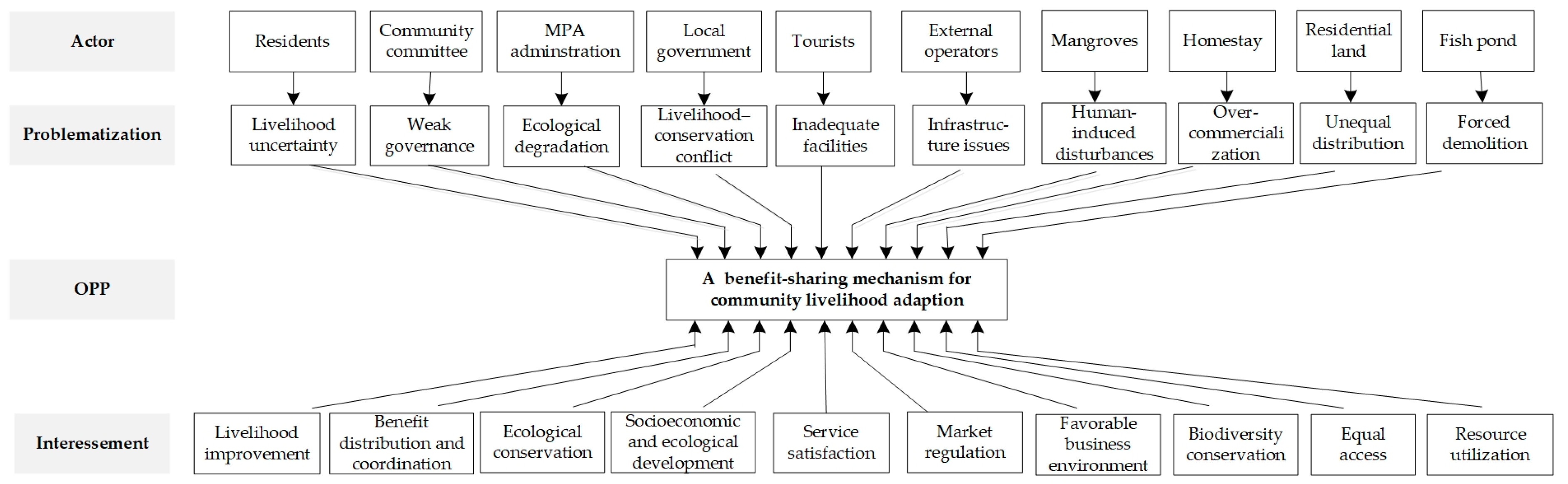
- Problematization: Key actors identify mutual interests and establish an obligatory passage point (OPP);
- Interessement: Strategies reinforce these shared interests, engaging additional actors;
- Enrollment: Actors define roles, with some taking on spokesperson functions;
- Mobilization: Roles are performed, stabilizing the network in a process called “ordering” or “black-boxing”.
3. Materials and Methods
3.1. Data Collection and Materials
3.2. Study Area and Livelihood Context
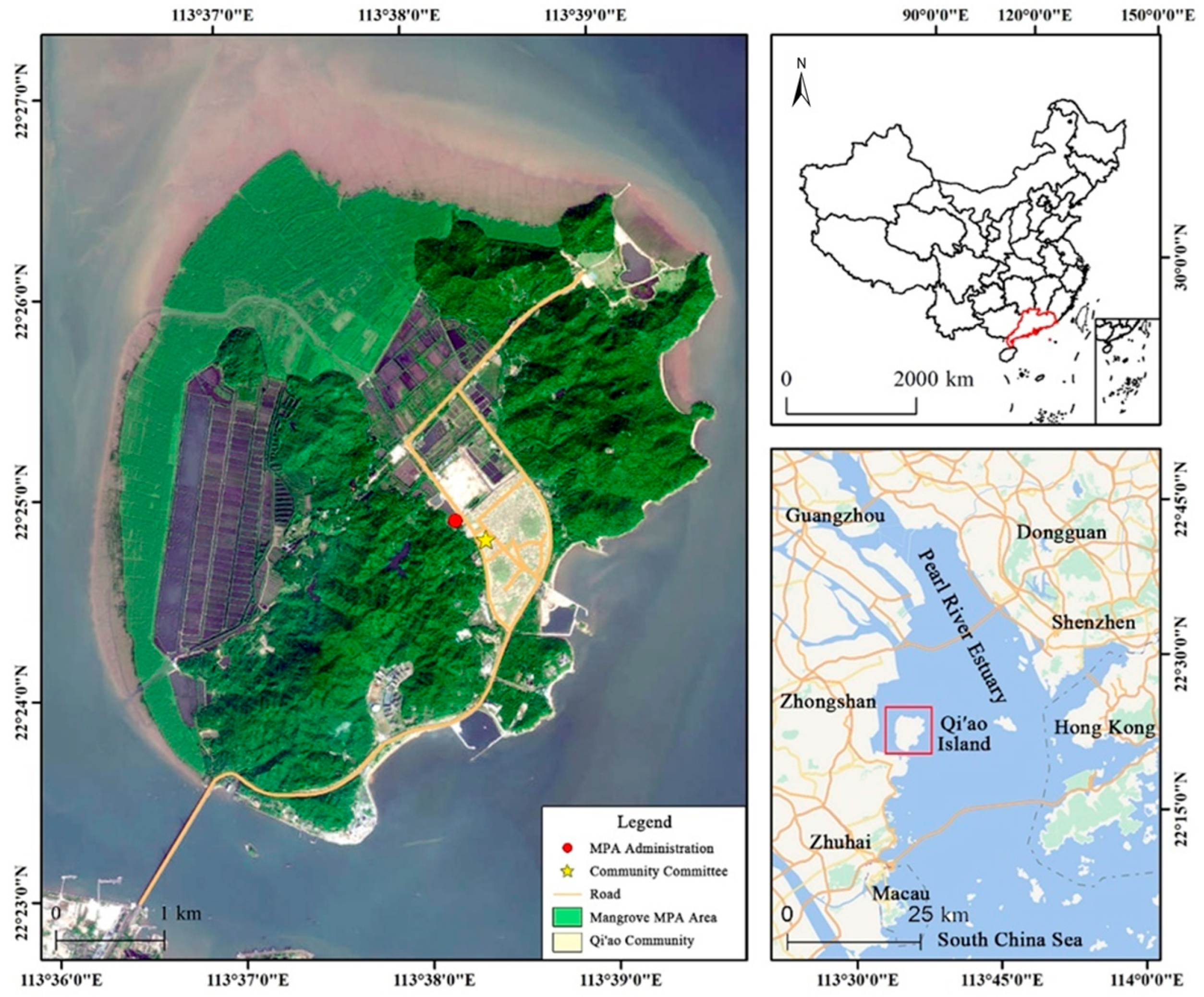
3.2.1. Study Area
3.2.2. Socio-Ecological Changes in Livelihood Context
3.3. Research Methods
3.3.1. Word Frequency Analysis and Visualization
3.3.2. Sentiment Analysis Method
3.3.3. Co-Occurrence Analysis of Main Actors
3.3.4. Thematic Analysis and Coding
4. Results
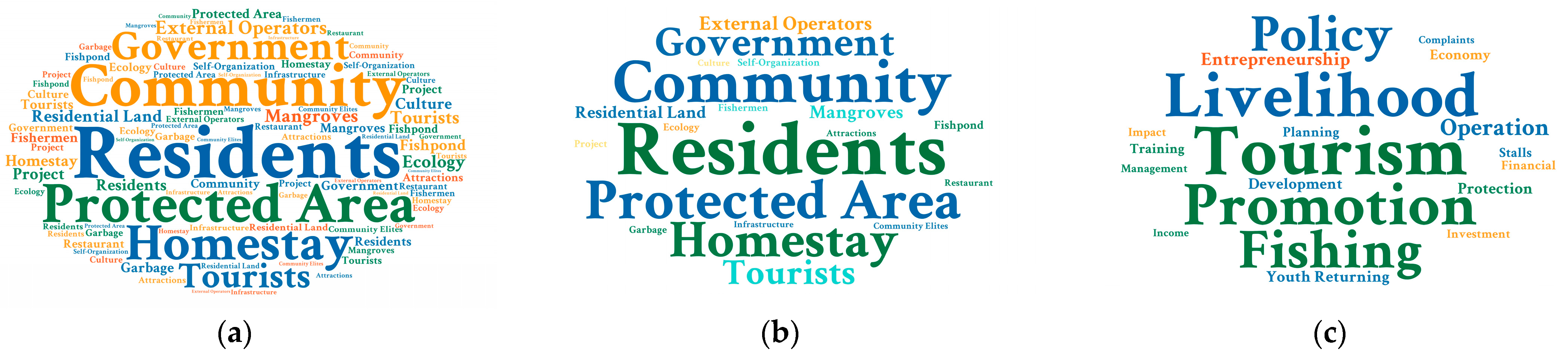
4.1. Composition of Actors and Actions
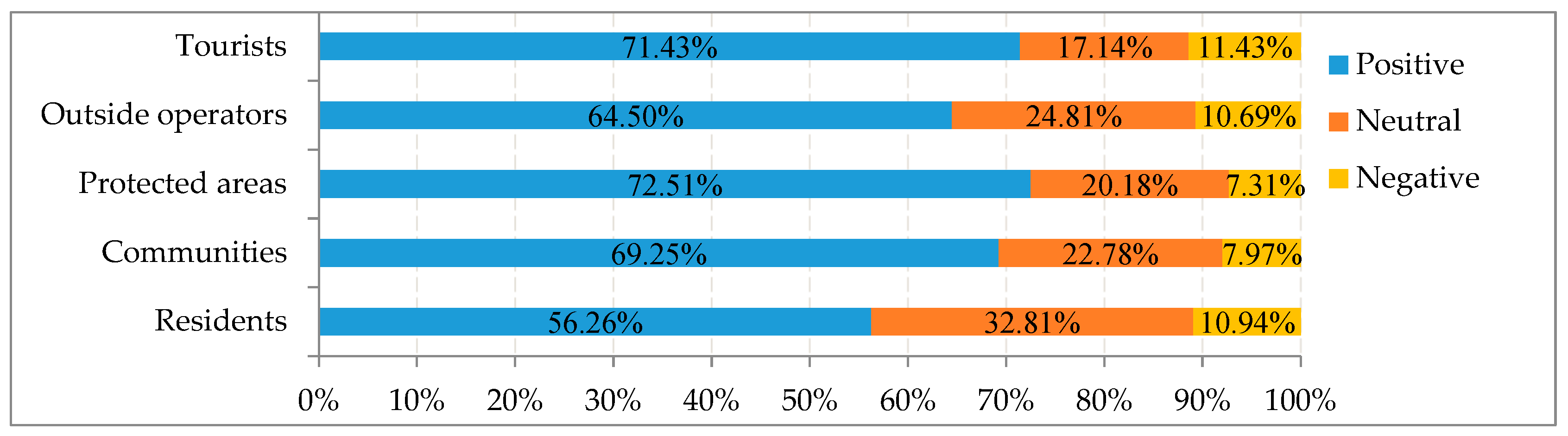
4.2. Sentiment Analysis of Different Actors
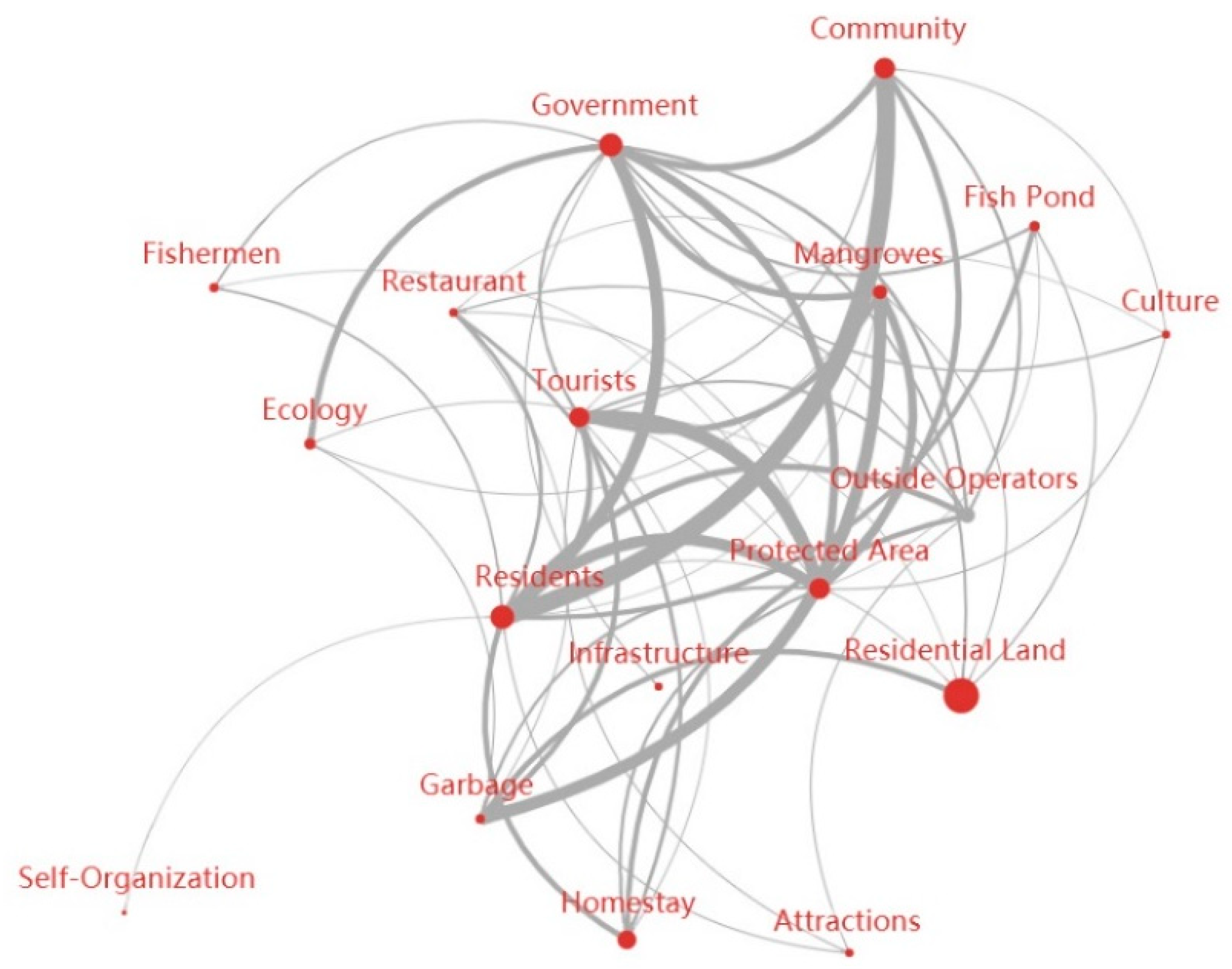
4.3. Co-Occurrence Analysis of Actors’ Interconnections
4.4. Livelihood Adaptation Process Analysis
4.4.1. Problematization and OPP
4.4.2. Interessement
4.4.3. Enrollment
“Previously, we lacked skills and steady jobs, but now at the Qi’ao Community College, I not only learned new skills but also found a stable job in a local business. After taking part in the first session of the Qi’ao Community College’s food heritage and innovation training, Ms. Liang, a Qi’ao resident working away from home, decided to start her own business. She now runs a tea and dessert shop in Bai Shi Street on Qi’ao Island. ‘Now I can increase my income and take care of my family.”(Resident interview, QA15)
4.4.4. Mobilization
“Twenty years ago, the mangroves here were almost decimated, clinging to a mere 32.2 hectares. Rebuilding them to the current 500 hectares was far more than just planting trees; it was a persistent negotiation with the landscape and local residents. Today, we have moved from conflict to a state of ‘co-existence with the sea.’ It is a shared victory of collaborative governance where the environment and the community now sustain each other.”(MPA stuff interview, QA9)
4.4.5. Objections and Negotiation in the Translation Process
“Our livelihood once revolved entirely around oyster farming. But everything changed with the new protected area; the management is so strict now, with constant patrols for illegal fishing, that nearly all the local villagers have had to give up fishing altogether. I’ve transitioned to working as a waitress in the restaurant. The work is certainly easier on my body, but the pay just doesn’t compare to what we used to earn.”(Resident interview, QA12)
5. Discussion
6. Conclusions
Author Contributions
Funding
Institutional Review Board Statement
Informed Consent Statement
Data Availability Statement
Acknowledgments
Conflicts of Interest
Appendix A
Appendix A.1

| Number | Key Words | Frequency | Weight | Proportion |
|---|---|---|---|---|
| 1 | Residents | 261 | 0.0156 | 2.33% |
| 2 | Communities | 187 | 0.0488 | 1.67% |
| 3 | Protected Areas | 156 | 0.0505 | 1.39% |
| 4 | Tourism | 144 | 0.0289 | 1.29% |
| 5 | Homestays | 130 | 0.0594 | 1.16% |
| 6 | Government | 120 | 0.0143 | 1.07% |
| 7 | Livelihood | 119 | 0.0076 | 1.06% |
| 8 | Tourist | 114 | 0.0226 | 1.02% |
| 9 | External Operator | 110 | 0.0007 | 0.98% |
| 10 | Promotion | 106 | 0.009 | 0.95% |
| 11 | Mangroves | 99 | 0.0271 | 0.88% |
| 12 | Fishing | 97 | 0.0093 | 0.87% |
| 13 | Policy | 83 | 0.0088 | 0.74% |
| 14 | Residential Land | 83 | 0.0047 | 0.74% |
| 15 | Business Management | 77 | 0.0065 | 0.69% |
| 16 | Entrepreneurship | 67 | 0.0093 | 0.60% |
| 17 | Youth Returning | 51 | 0.0004 | 0.46% |
| 18 | Protection | 50 | 0.0103 | 0.45% |
| 19 | External Stakeholders | 48 | 0.0066 | 0.43% |
| 20 | Economy | 42 | 0.0057 | 0.38% |
| 21 | Fishpond | 39 | 0.0145 | 0.35% |
| 22 | Planning | 38 | 0.0087 | 0.34% |
| 23 | Training | 37 | 0.0061 | 0.33% |
| 24 | Stalls | 36 | 0.0108 | 0.32% |
| 25 | Financial | 33 | 0.0064 | 0.29% |
| 26 | Self-organization | 30 | 0.0056 | 0.27% |
| 27 | Fishermen | 30 | 0.0098 | 0.27% |
| 28 | Ecology | 30 | 0.0085 | 0.27% |
| 29 | Investment | 30 | 0.0045 | 0.27% |
| 30 | Project | 30 | 0.0056 | 0.27% |
| 31 | Impact | 29 | 0.0044 | 0.26% |
| 32 | Garbage | 29 | 0.0089 | 0.26% |
| 33 | Restaurant | 26 | 0.0084 | 0.23% |
| 34 | Attraction | 26 | 0.0053 | 0.23% |
| 35 | Operation | 26 | 0.0049 | 0.23% |
| 36 | Income | 23 | 0.0046 | 0.21% |
| 37 | Culture | 23 | 0.0045 | 0.21% |
| 38 | Community Elites | 23 | 0.0046 | 0.21% |
| 39 | Infrastructure | 23 | 0.0063 | 0.21% |
| 40 | Conflict Manifestation | 23 | 0.0071 | 0.21% |
| 41 | Leadership | 22 | 0.0045 | 0.20% |
| 42 | Supporting Facilities | 21 | 0.0086 | 0.19% |
| 43 | Complaints Handling | 21 | 0.0046 | 0.19% |
| 44 | Problem-Solving | 20 | 0.0057 | 0.18% |
| 45 | Business Activities | 20 | 0.0051 | 0.18% |
| 46 | Tea Fruits | 20 | 0.004 | 0.18% |
| 47 | Reception | 19 | 0.0064 | 0.17% |
| 48 | Science Popularization | 19 | 0.004 | 0.17% |
| 49 | Facilities | 19 | 0.0055 | 0.17% |
| 50 | Environment | 18 | 0.0066 | 0.16% |
| 51 | Living Conditions | 18 | 0.0068 | 0.16% |
| 52 | Islands | 18 | 0.0035 | 0.16% |
| 53 | Development | 18 | 0.0056 | 0.16% |
| 54 | Weekends | 18 | 0.005 | 0.16% |
| 55 | Education Halls | 18 | 0.0071 | 0.16% |
| 56 | Outsiders | 18 | 0.0034 | 0.16% |
| 57 | Opportunities | 18 | 0.0058 | 0.16% |
| 58 | Epidemic Support | 18 | 0.006 | 0.16% |
| 59 | Bicycles | 18 | 0.0036 | 0.16% |
| 60 | Construction | 17 | 0.003 | 0.15% |
| 61 | Zhuhai | 17 | 0.0031 | 0.15% |
| 62 | Public Welfare | 16 | 0.0073 | 0.14% |
| 63 | Participation | 16 | 0.0049 | 0.14% |
| 64 | Relationships | 16 | 0.0031 | 0.14% |
| 65 | Engagement | 16 | 0.0043 | 0.14% |
| 66 | Parks | 16 | 0.0031 | 0.14% |
| 67 | Nature | 16 | 0.0036 | 0.14% |
| 68 | Plants | 15 | 0.0021 | 0.13% |
| 69 | Red Tourism | 15 | 0.0037 | 0.13% |
| 70 | Regulations | 14 | 0.0049 | 0.13% |
| 71 | Leasing | 14 | 0.0062 | 0.13% |
| 72 | Representatives | 13 | 0.0049 | 0.12% |
| 73 | Certification | 13 | 0.0028 | 0.12% |
| 74 | Location | 13 | 0.0032 | 0.12% |
| 75 | Collectives | 13 | 0.0031 | 0.12% |
| 76 | Factories | 13 | 0.0047 | 0.12% |
| 77 | Store Establishment | 13 | 0.0039 | 0.12% |
| 78 | Funding | 13 | 0.0037 | 0.12% |
| 79 | Hard Work | 13 | 0.0032 | 0.12% |
| 80 | Colleges | 13 | 0.0035 | 0.12% |
| 81 | Teams | 13 | 0.0023 | 0.12% |
| 82 | Future Development | 13 | 0.0026 | 0.12% |
| 83 | Consumption | 13 | 0.0027 | 0.12% |
| 84 | Services | 13 | 0.0059 | 0.12% |
| 85 | Cultural and Creative Industries | 13 | 0.0033 | 0.12% |
| 86 | Staff Members | 13 | 0.0054 | 0.12% |
| 87 | Public Education | 13 | 0.0027 | 0.12% |
| 88 | Collaboration | 12 | 0.0026 | 0.11% |
| 89 | Traditions | 12 | 0.0046 | 0.11% |
| 90 | Families | 12 | 0.0028 | 0.11% |
| 91 | Renting Out | 12 | 0.0042 | 0.11% |
| 92 | Costs | 12 | 0.0025 | 0.11% |
| 93 | Environmental Damage | 12 | 0.0036 | 0.11% |
| 94 | Parking Lots | 11 | 0.0024 | 0.10% |
| 95 | Integration | 11 | 0.0021 | 0.10% |
| 96 | Visiting | 11 | 0.0054 | 0.10% |
| 97 | Observation | 11 | 0.0022 | 0.10% |
| 98 | Traffic | 11 | 0.0025 | 0.10% |
| 99 | Dividends | 11 | 0.0030 | 0.10% |
| 100 | Schooling | 11 | 0.0024 | 0.10% |
Appendix A.2
| Number | Key Words | Frequency | Weight | Proportion |
|---|---|---|---|---|
| 1 | Residents | 261 | 0.0156 | 2.33% |
| 2 | Community | 187 | 0.0488 | 1.67% |
| 3 | Protected Area | 156 | 0.0505 | 1.39% |
| 4 | Homestay | 130 | 0.0594 | 1.16% |
| 5 | Government | 120 | 0.0143 | 1.07% |
| 6 | Tourists | 114 | 0.0226 | 1.02% |
| 7 | External Operators | 110 | 0.0007 | 0.98% |
| 8 | Mangroves | 99 | 0.0271 | 0.88% |
| 9 | Residential Land | 83 | 0.0047 | 0.74% |
| 10 | Fishpond | 39 | 0.0145 | 0.35% |
| 11 | Self-Organization | 30 | 0.0056 | 0.27% |
| 12 | Fishermen | 30 | 0.0098 | 0.27% |
| 13 | Ecology | 30 | 0.0085 | 0.27% |
| 14 | Project | 30 | 0.0056 | 0.27% |
| 15 | Garbage | 29 | 0.0089 | 0.26% |
| 16 | Restaurant | 26 | 0.0084 | 0.23% |
| 17 | Attractions | 26 | 0.0053 | 0.23% |
| 18 | Culture | 23 | 0.0045 | 0.21% |
| 19 | Community Elites | 23 | 0.0046 | 0.21% |
| 20 | Infrastructure | 23 | 0.0063 | 0.21% |
Appendix A.3
| Number | Key Words | Frequency | Weight | Proportion |
|---|---|---|---|---|
| 1 | Tourism | 144 | 0.0289 | 1.29% |
| 2 | Livelihood | 119 | 0.0076 | 1.06% |
| 3 | Promotion | 106 | 0.0090 | 0.95% |
| 4 | Fishing | 97 | 0.0093 | 0.87% |
| 5 | Policy | 83 | 0.0088 | 0.74% |
| 6 | Operation | 77 | 0.0065 | 0.69% |
| 7 | Entrepreneurship | 67 | 0.0093 | 0.60% |
| 8 | Youth Returning | 51 | 0.0004 | 0.46% |
| 9 | Protection | 50 | 0.0103 | 0.45% |
| 10 | Development | 48 | 0.0066 | 0.43% |
| 11 | Economy | 42 | 0.0057 | 0.38% |
| 12 | Planning | 38 | 0.0087 | 0.34% |
| 13 | Training | 37 | 0.0061 | 0.33% |
| 14 | Stalls | 36 | 0.0108 | 0.32% |
| 15 | Financial | 33 | 0.0064 | 0.29% |
| 16 | Investment | 30 | 0.0045 | 0.27% |
| 17 | Impact | 29 | 0.0044 | 0.26% |
| 18 | Management | 26 | 0.0049 | 0.23% |
| 19 | Income | 23 | 0.0046 | 0.21% |
| 20 | Complaints | 23 | 0.0071 | 0.21% |
Appendix B
| Respondent Type | Positive Term | Neutral | Negative | |||
|---|---|---|---|---|---|---|
| Frequency | Proportion | Frequency | Proportion | Frequency | Proportion | |
| Residents | 463 | 56.26% | 270 | 32.81% | 90 | 10.94% |
| Communities | 304 | 69.25% | 100 | 22.78% | 35 | 7.97% |
| Protected areas | 248 | 72.51% | 69 | 20.18% | 25 | 7.31% |
| Outside operators | 338 | 64.50% | 130 | 24.81% | 56 | 10.69% |
| Tourists | 250 | 71.43% | 60 | 17.14% | 40 | 11.43% |
Appendix C
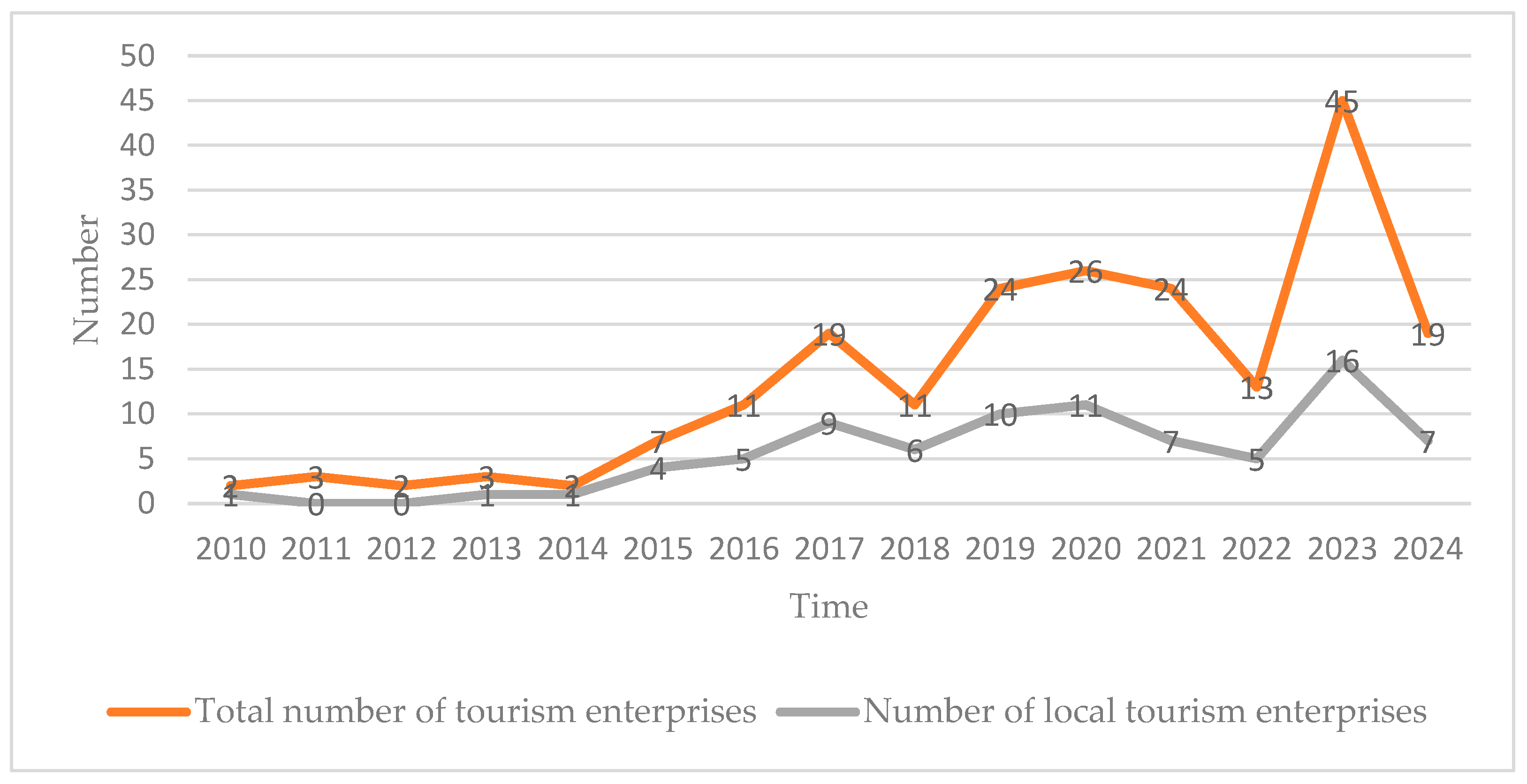
| Date of Establishment | Total Number of Tourism Enterprises | Number of Local Tourism Enterprises | Proportion of Local Tourism Enterprises |
|---|---|---|---|
| 2010 | 2 | 1 | 50% |
| 2011 | 3 | 0 | 0% |
| 2012 | 2 | 0 | 0% |
| 2013 | 3 | 1 | 33% |
| 2014 | 2 | 1 | 50% |
| 2015 | 7 | 4 | 57% |
| 2016 | 11 | 5 | 45% |
| 2017 | 19 | 9 | 47% |
| 2018 | 11 | 6 | 55% |
| 2019 | 24 | 10 | 42% |
| 2020 | 26 | 11 | 42% |
| 2021 | 24 | 7 | 29% |
| 2022 | 13 | 5 | 38% |
| 2023 | 45 | 16 | 36% |
| 2024 | 19 | 7 | 37% |
References
- Wang, W.; Liu, J.; Innes, J.L. Conservation equity for local communities in the process of tourism development in protected areas: A study of Jiuzhaigou Biosphere Reserve, China. World Dev. 2019, 124, 104637. [Google Scholar] [CrossRef] [Scilit]
- Zhang, J.; Ge, C.; Duan, X.; Wang, K.; Zhou, Q.; Hao, C. Integrating SDGs into China’s ecological civilization construction: Practical indicators and progress assessment. Ecol. Indic. 2024, 169, 112921. [Google Scholar] [CrossRef] [Scilit]
- Li, Y.; Yin, J.; Sun, M.; Kleisner, K.; Litsinger, E.; Jud, S.; Tang, Y.; Chen, Y. Examining the discrepancy and synergy between marine protected areas and fisheries management in the Bohai Sea, China. Ocean Coast. Manag. 2024, 258, 107409. [Google Scholar] [CrossRef] [Scilit]
- Zhao, Y.; Pikitch, E.K.; Xu, X.; Frankstone, T.; Bohorquez, J.; Fang, X.; Zheng, J.; Li, Y.; Chen, Z.; Lin, W.; et al. An evaluation of management effectiveness of China’s marine protected areas and implications of the 2018 reform. Mar. Policy 2022, 139, 105040. [Google Scholar] [CrossRef] [Scilit]
- Duggan, J.; Clement, S.; Cvitanovic, C.; van Putten, I. Incorporating sense of place into the management of marine protected areas: A case study from New South Wales, Australia. Ocean Coast. Manag. 2024, 258, 107417. [Google Scholar] [CrossRef] [Scilit]
- Guedri, S.E.; Djabi, A.H.; Yahiaoui, I. Pescatourism’s contribution to the management effectiveness of the Marine Protected Area (MPA) of Taza (Algeria, Southwestern Mediterranean). Mar. Policy 2025, 173, 106581. [Google Scholar] [CrossRef] [Scilit]
- Chen, C.; Lopez-Carr, D. The importance of place: Unraveling the vulnerability of fisherman livelihoods to the impact of marine protected areas. Appl. Geogr. 2015, 59, 88–97. [Google Scholar] [CrossRef] [Scilit]
- Pham, T.T.T. Tourism in marine protected areas: Can it be considered as an alternative livelihood for local communities? Mar. Policy 2020, 115, 103891. [Google Scholar] [CrossRef] [Scilit]
- Gupta, H.; Nishi, M.; Gasparatos, A. Community-based responses for tackling environmental and socio-economic change in mountain social–ecological systems. Ambio 2022, 51, 1123–1142. [Google Scholar] [CrossRef] [Scilit]
- Casimiro, D.; Ventura, M.A.; Botelho, A.Z.; Guerreiro, J. Ecotourism in Marine Protected Areas as a Tool to Valuate Natural Capital and Enhance Good Marine Governance: A Review. Front. Mar. Sci. 2023, 9, 1002677. [Google Scholar] [CrossRef] [Scilit]
- Forster, J.; Lake, I.R.; Watkinson, A.R.; Gill, J.A. Marine Dependent Livelihoods and Resilience to Environmental Change: A Case Study of Anguilla. Mar. Policy 2014, 45, 204–212. [Google Scholar] [CrossRef] [Scilit]
- Christie, P. Observed and Perceived Environmental Impacts of Marine Protected Areas in Two Southeast Asia Sites. Ocean Coast. Manag. 2005, 48, 252–270. [Google Scholar] [CrossRef] [Scilit]
- Aryal, S.; Cockfield, G.; Maraseni, T.N. Globalisation and traditional social–ecological systems: Impacts of tourism and labour migration in the Himalayas. Environ. Dev. 2018, 25, 73–84. [Google Scholar] [CrossRef] [Scilit]
- Chen, J.; Chen, W.; Wang, F.; Deng, M. Adaptation of tourism transformation in rural areas under regime shift: A social–ecological systems framework. Systems 2024, 12, 289. [Google Scholar] [CrossRef] [Scilit]
- Dash, B.; Balamurugan, G. Sustainable tourism, livelihood and coastal governance: Chilika Lake, India. Ocean Coast. Manag. 2024, 253, 107128. [Google Scholar] [CrossRef] [Scilit]
- Rifai, H.; Lukman, K.M.; Mar de Quevedo, J.; Francis, P.; Sjafrie, N.D.M.; Triyono, N.; Mckenzie, L.; Hidayat, R.; Nugraha, A.H.; Kuriandewa, T.E.; et al. Understanding stakeholders’ perception on developing seagrass-associated tourism: Evidence from marine protected areas of Bintan Island, Indonesia. Mar. Pollut. Bull. 2024, 209, 117063. [Google Scholar] [CrossRef] [Scilit] [PubMed]
- Masunungure, C.; Shackleton, S.E. Exploring Long-Term Livelihood and Landscape Change in Two Semi-Arid Sites in Southern Africa: Drivers and Consequences for Social–Ecological Vulnerability. Land 2018, 7, 50. [Google Scholar] [CrossRef] [Scilit]
- Hellsten, I.; Leydesdorff, L. Automated analysis of actor–topic networks on twitter: New approaches to the analysis of socio-semantic networks. J. Assoc. Inf. Sci. Technol. 2020, 71, 3–15. [Google Scholar] [CrossRef] [Scilit]
- Chambers, R. Poverty and livelihoods: Whose reality counts? Environ. Urban. 1995, 7, 173–204. [Google Scholar] [CrossRef]
- Scoones, I. Sustainable Rural Livelihoods: A Framework for Analysis; IDS Working Paper Issue 72; Institute of Development Studies: Brighton, UK, 1998; pp. 1–22. [Google Scholar]
- Manwa, H.; Manwa, F. Poverty Alleviation through Pro-Poor Tourism: The Role of Botswana Forest Reserves. Sustainability 2014, 6, 5697–5713. [Google Scholar] [CrossRef] [Scilit]
- Wang, Z.; Dong, F. Experience of Pro-Poor Tourism in China: A Sustainable Livelihood Perspective. Sustainability 2022, 14, 14399. [Google Scholar] [CrossRef] [Scilit]
- Widawski, K.; Krzemińska, A.; Zaręba, A.; Dzikowska, A. A Sustainable Approach to Tourism Development in Rural Areas: The Example of Poland. Agriculture 2023, 13, 2028. [Google Scholar] [CrossRef] [Scilit]
- Bires, Z.; Raj, S. Tourism as a pathway to livelihood diversification: Evidence from biosphere reserves, Ethiopia. Tour. Manag. 2020, 81, 104159. [Google Scholar] [CrossRef] [Scilit]
- Liu, J.; Zhu, J.; Lin, C.; Li, Y.; Wu, L. Farming versus tourism at a World Heritage Site in China. Tour. Econ. 2017, 23, 1581–1590. [Google Scholar] [CrossRef] [Scilit]
- Matiku, S.; Zuwarimwe, J.; Tshipala, N. Community-Driven Tourism Projects’ Economic Contribution to Community Livelihoods—A Case of Makuleke Contractual Park Community Tourism Project. Sustainability 2020, 12, 8230. [Google Scholar] [CrossRef] [Scilit]
- Shi, C.; He, Y.; Li, H. How does ecological poverty alleviation contribute to improving residents’ sustainable livelihoods?—Evidence from Zhejiang Province, China. Sustain. Prod. Consum. 2023; in press. [CrossRef] [Scilit]
- Lowe, J.; Tejada, J.F.C.; Meekan, M.G. Linking livelihoods to improved biodiversity conservation through sustainable integrated coastal management and community based dive tourism: Oslob Whale Sharks. Mar. Policy 2019, 108, 103630. [Google Scholar] [CrossRef] [Scilit]
- Boakes, Z.; Mahyuni, L.P.; Hall, A.E.; Cvitanovic, M.; Stafford, R. Can Coral Reef Restoration Programmes Facilitate Changes in Environmental Attitudes? A Case Study on a Rural Fisher Community in North Bali, Indonesia. Hum. Ecol. 2023, 51, 891–905. [Google Scholar] [CrossRef] [Scilit]
- Addinsall, C.; Glencross, K.; Scherrer, P.; Weiler, B.; Nichols, D. Agroecology and Sustainable Rural Livelihoods: A Conceptual Framework to Guide Development Projects in the Pacific Islands. Agroecol. Sustain. Food Syst. 2015, 39, 691–723. [Google Scholar] [CrossRef] [Scilit]
- Callon, M. Actor-network theory—The market test. Sociol. Rev. 1999, 47, 181–195. [Google Scholar] [CrossRef] [Scilit]
- Dedeke, A. Creating sustainable tourism ventures in protected areas: An actor-network theory analysis. Tour. Manag. 2017, 61, 161–172. [Google Scholar] [CrossRef] [Scilit]
- Dolwick, J.S. ‘The Social’ and Beyond: Introducing Actor-Network Theory. J. Marit. Archaeol. 2009, 4, 21–49. [Google Scholar] [CrossRef] [Scilit]
- Rodger, K.; Moore, S.A.; Newsome, D. Wildlife tourism and actor-network theory. Ann. Tour. Res. 2009, 36, 645–666. [Google Scholar] [CrossRef] [Scilit]
- Cresswell, K.M.; Worth, A.; Sheikh, A. Actor-Network Theory and its role in understanding the implementation of information technology developments in healthcare. BMC Med. Inform. Decis. Mak. 2010, 10, 67. [Google Scholar] [CrossRef] [Scilit] [PubMed]
- Oppenheim, R. Actor-network theory and anthropology after science, technology, and society. Anthropol. Theory 2007, 7, 471–493. [Google Scholar] [CrossRef] [Scilit]
- Jørgensen, M.T. Reframing tourism distribution—Activity Theory and Actor-Network Theory. Tour. Manag. 2017, 62, 312–321. [Google Scholar] [CrossRef] [Scilit]
- Wang, L.; Xiao, S. Tourism space reconstruction of a world heritage site based on actor network theory: A case study of the Shibing Karst of the South China Karst World Heritage Site. Int. J. Geoherit. Parks 2020, 8, 140–151. [Google Scholar] [CrossRef] [Scilit]
- Sarker, M.N.I. Vulnerability and livelihood resilience in the face of natural disasters: A critical conceptual revuew. Appl. Ecol. Environ. Res. 2019, 17, 12769–12785. [Google Scholar] [CrossRef] [Scilit]
- Deason, G.; Seekamp, E.; Barbieri, C. Actor-Network Theory and Organizational Resilience to Climate Change in Community-Based Tourism. J. Outdoor Recreat. Tour. 2022, 38, 100483. [Google Scholar] [CrossRef] [Scilit]
- Govindan, K.; Dua, R.; Anwar, A.M.; Bansal, P. Enabling net-zero shipping: An expert review-based agenda for emerging techno-economic and policy research. Transp. Res. Part E Logist. Transp. Rev. 2024, 192, 103753. [Google Scholar] [CrossRef] [Scilit]
- Reefke, H.; Sundaram, D. Key Themes and Research Opportunities in Sustainable Supply Chain Management–Identification and Evaluation. Omega 2017, 66, 195–211. [Google Scholar] [CrossRef] [Scilit]
- Ding, X.; Wang, L.; Tan, Y. Influence pathways of village livelihood capital on the idle homesteads reuse. Land Use Policy 2026, 160, 107834. [Google Scholar] [CrossRef] [Scilit]
- Miani, A.M.; Dehkordi, M.K.; Siamian, N.; Lassois, L.; Tan, R.; Azadi, H. Toward sustainable rural livelihoods approach: Application of grounded theory in Ghazni province, Afghanistan. Appl. Geogr. 2023, 154, 102915. [Google Scholar] [CrossRef] [Scilit]
- Begum, F.; de Bruyn, L.L.; Kristiansen, P.; Islam, M.A. Forest Co-Management in the Sundarban Mangrove Forest: Impacts of Women’s Participation on Their Livelihoods and Sustainable Forest Resource Conservation. Environ. Dev. 2022, 43, 100731. [Google Scholar] [CrossRef] [Scilit]
- Cai, H.; Yang, H.; Liu, J.; Niu, L.; Ren, L.; Liu, F.; Ou, S.; Yang, Q. Quantifying the impacts of human interventions on relative mean sea level change in the Pearl River Delta, China. Ocean Coast. Manag. 2019, 173, 52–64. [Google Scholar] [CrossRef] [Scilit]
- Duprey, N.N.; Wang, T.X.; Kim, T.; Cybulski, J.D.; Vonhof, H.B.; Crutzen, P.J.; Haug, G.H.; Sigman, D.M.; Matinez-Garcia, A.; Baker, D.M. Megacity development and the demise of coastal coral communities: Evidence from coral skeleton δ15N records in the Pearl River estuary. Glob. Change Biol. 2020, 26, 1338–1353. [Google Scholar] [CrossRef] [Scilit]
- Lai, H.; Bi, S.; Yi, H.; Guo, D.; Li, H.; Wang, G.; Liu, X.; Chen, Q.; Chen, J.; Zhang, Z. Seasonal variation in the functional structure of demersal fish communities and response to the environmental changes in the Pearl River Estuary, China. Ecol. Indic. 2022, 144, 109525. [Google Scholar] [CrossRef] [Scilit]
- Peng, Y.; Chen, G.; Tian, G.; Yang, X. Niches of plant populations in mangrove reserve of Qi’ao Island, Pearl River Estuary. Acta Ecol. Sin. 2009, 29, 357–361. [Google Scholar] [CrossRef] [Scilit]
- He, S.; Jiao, W. Conservation-compatible livelihoods: An approach to rural development in protected areas of developing countries. Environ. Dev. 2023, 45, 100797. [Google Scholar] [CrossRef] [Scilit]
- Wu, D.C.; Cao, C.; Liu, W.; Chen, J.L. Impact of domestic tourism on economy under COVID-19: The perspective of tourism satellite accounts. Ann. Tour. Res. Empir. Insights 2022, 3, 100055. [Google Scholar] [CrossRef] [Scilit]
- Lee, A.S.; Liebenau, J.; DeGross, J.I. (Eds.) Information Systems and Qualitative Research; Springer: New York, NY, USA, 1997. [Google Scholar]
- Manning, C.D.; Schütze, H. Foundations of Statistical Natural Language Processing; MIT Press: Cambridge, MA, USA, 1999. [Google Scholar]
- Beard, L.; Scarles, C.; Tribe, J. Mess and method: Using ANT in tourism research. Ann. Tour. Res. 2016, 60, 97–110. [Google Scholar] [CrossRef] [Scilit]
- Sayes, E. Actor–Network Theory and methodology: Just what does it mean to say that nonhumans have agency? Soc. Stud. Sci. 2014, 44, 134–149. [Google Scholar] [CrossRef] [Scilit] [PubMed]
- Battaglia, M.B.; Pittman, J.; Epstein, G.B.; Bernardi, G.; Armitage, D. Marine protected areas governance, social norms, and social networks. Mar. Policy 2025, 173, 106576. [Google Scholar] [CrossRef] [Scilit]
- Pascual, M.; Rossetto, M.; Ojea, E.; Milchakova, N.; Giakoumi, S.; Kark, S.; Korolesova, D.; Melià, P. Socioeconomic Impacts of Marine Protected Areas in the Mediterranean and Black Seas. Ocean Coast. Manag. 2016, 133, 1–10. [Google Scholar] [CrossRef] [Scilit]
- Dai, M.L.; Fan, D.X.F.; Wang, R.; Ou, Y.H.; Ma, X.L. Does Rural Tourism Revitalize the Countryside? An Exploration of the Spatial Reconstruction through the Lens of Cultural Connotations of Rurality. J. Destin. Mark. Manag. 2023, 29, 100801. [Google Scholar] [CrossRef] [Scilit]
- Christie, P.; White, A.; Deguit, E. Starting Point or Solution? Community-Based Marine Protected Areas in the Philippines. J. Environ. Manag. 2002, 66, 441–454. [Google Scholar] [CrossRef] [Scilit]
- McNeill, A.; Clifton, J.; Harvey, E.S. Attitudes to a Marine Protected Area Are Associated with Perceived Social Impacts. Mar. Policy 2018, 94, 106–118. [Google Scholar] [CrossRef] [Scilit]
- Wang, J.; Wang, Y.; He, Y.; Zhu, Z. Exploring the Factors of Rural Tourism Recovery in the Post-COVID-19 Era Based on the Grounded Theory: A Case Study of Tianxi Village in Hunan Province, China. Sustainability 2022, 14, 5215. [Google Scholar] [CrossRef] [Scilit]
- Simpson, M.C. Community benefit tourism initiatives—A conceptual oxymoron? Tour. Manag. 2008, 29, 1–18. [Google Scholar] [CrossRef] [Scilit]
- Gao, J.; Wu, B. Revitalizing Traditional Villages through Rural Tourism: A Case Study of Yuanjia Village, Shaanxi Province, China. Tour. Manag. 2017, 63, 223–233. [Google Scholar] [CrossRef] [Scilit]
- Su, M.; Sun, Y.; Min, Q.; Jiao, W. A Community Livelihood Approach to Agricultural Heritage System Conservation and Tourism Development: Xuanhua Grape Garden Urban Agricultural Heritage Site, Hebei Province of China. Sustainability 2018, 10, 361. [Google Scholar] [CrossRef] [Scilit]
- Gurney, G.G.; Cinner, J.; Ban, N.C.; Pressey, R.L.; Pollnac, R.; Campbell, S.J.; Tasidjawa, S.; Setiawan, F. Poverty and Protected Areas: An Evaluation of a Marine Integrated Conservation and Development Project in Indonesia. Glob. Environ. Change 2014, 26, 98–107. [Google Scholar] [CrossRef] [Scilit]
- Ban, N.C.; Gurney, G.G.; Marshall, N.A.; Whitney, C.K.; Mills, M.; Gelcich, S.; Bennett, N.J.; Meehan, M.C.; Butler, C.; Ban, S.; et al. Well-Being Outcomes of Marine Protected Areas. Nat. Sustain. 2019, 2, 524–532. [Google Scholar] [CrossRef] [Scilit]
- Su, M.M.; Wall, G.; Wang, Y.; Jin, M. Livelihood Sustainability in a Rural Tourism Destination—Hetu Town, Anhui Province, China. Tour. Manag. 2019, 71, 272–281. [Google Scholar] [CrossRef] [Scilit]
- Cai, X.; Xu, Y. Spatiotemporal Evolution and Influencing Factors of Tourism Economic Resilience under the Impact of COVID-19—A Case Study of Coastal Cities in China. Sustainability 2023, 15, 16668. [Google Scholar] [CrossRef] [Scilit]
- Ison, S.; Hills, J.; Morris, C.; Stead, S.M. Sustainable Financing of a National Marine Protected Area Network in Fiji. Ocean. Coast. Manag. 2018, 163, 352–363. [Google Scholar] [CrossRef] [Scilit]
- Mahajan, S.L.; Daw, T. Perceptions of Ecosystem Services and Benefits to Human Well-Being from Community-Based Marine Protected Areas in Kenya. Mar. Policy 2016, 74, 108–119. [Google Scholar] [CrossRef] [Scilit]
- Mozumder, M.M.H.; Wahab, M.A.; Sarkki, S.; Schneider, P.; Islam, M.M. Enhancing Social Resilience of the Coastal Fishing Communities: A Case Study of Hilsa Fishery in Bangladesh. Sustainability 2018, 10, 3501. [Google Scholar] [CrossRef] [Scilit]
- Rees, S.E.; Ashley, M.; Evans, L.; Mangi, S.; Sheehan, E.V.; Mullier, T.; Rees, A.; Attrill, M.J. An Evaluation of the Social and Economic Impact of a Marine Protected Area on Commercial Fisheries. Fish. Res. 2021, 235, 105819. [Google Scholar] [CrossRef] [Scilit]
- Cusack, C.; Sethi, S.A.; Rice, A.N.; Warren, J.D.; Fujita, R.; Ingles, J.; Flores, J.; Garchitorena, E.; Mesa, S.V. Marine Ecotourism for Small Pelagics as a Source of Alternative Income Generating Activities to Fisheries in a Tropical Community. Biol. Conserv. 2021, 261, 109242. [Google Scholar] [CrossRef] [Scilit]
- Suradja, I.; Asih, T.S.; Basir; Dyspriani, D.P.; Lionata, H.; Marsiyono, A.; Nugraha, B.A.; Palupi, T.I.; Salam, I.A.P.; Sierra Castillo, L.; et al. Alternating livelihoods and coping with shocks: An examination of coastal tourism in Indonesia amidst COVID-19. Mar. Policy 2024, 170, 106379. [Google Scholar] [CrossRef] [Scilit]
- Albasri, H.; Sammut, J. A Comparison of Vulnerability Risks and Conservation Perceptions between Mariculture, Fishery and Ecotourism Livelihood Groups in a Multi-Use MPA in Indonesia. Sustainability 2021, 13, 12897. [Google Scholar] [CrossRef] [Scilit]
- Uddin, M.M.; Schneider, P.; Asif, M.R.I.; Rahman, M.S.; Arifuzzaman; Mozumder, M.M.H. Fishery-Based Ecotourism in Developing Countries Can Enhance the Social-Ecological Resilience of Coastal Fishers—A Case Study of Bangladesh. Water 2021, 13, 292. [Google Scholar] [CrossRef] [Scilit]




| Key Informants | Gender | Age | Occupation | Local Resident or Not | Personal Characteristics |
|---|---|---|---|---|---|
| K 1 | Female | 50 | Traditional cooking studio manager | Yes | Has a certain level of community visibility and influence, passionate about public welfare, and key figure in local women’s organization. |
| K 2 | Female | 45 | Local Tourism Operator | Yes | Possesses extensive experience in tourism operations and a wide social network in the community. |
| K 3 | Female | 30 | Community Administrator | Yes | Familiar with community management work, previous collaborative work together, and established a trust relationship. |
| K 4 | Female | 52 | Local Homestay Operator; Community Museum Director | Yes | One of the first homestay operators, community volunteer, familiar with local culture, and extensive social relationships. |
| K 5 | Male | 38 | External Tourism Operator | No | Owns two souvenir shops and one homestay, actively involved in island public affairs, and one of the earliest outsiders to come to the island. |
| K 6 | Female | 36 | Protected Area Researcher | No | Familiar with protected area management systems and a mangrove expert. |
| K 7 | Male | 50 | Biodiversity Expert; Protected Area Volunteer | No | Senior volunteer, passionate about public welfare and environmental protection, and knowledgeable about the history of protected area development and biodiversity conservation. |
| K 8 | Male | 32 | Outside Tourism Operator | No | Familiar with the status of the community tourism operations, familiar with the island tourism resources, and passionate about public welfare. |
| Analysis Content | Overall Sentiment Score | Positive Score | Negative Score | Positive Words | Negative Words | Degree Words | Sentiment Judgment |
|---|---|---|---|---|---|---|---|
| I used to work outside the island, but after seeing the tourism industry in Qiao Island develop so well—and as my mother was aging and needed care—I returned last year and opened this snack shop using traditional culinary skills. Interacting with tourists makes me feel very happy, and I feel proud to promote the local food culture. However, many non-local operators have also opened shops here; they are more experienced, placing pressure on locals and even leading to unhealthy competition. | 2.5 | 4 | 1.5 | develop so well, happy, promote, proud | pressure, unhealthy, competition | very (2), some (0.5) | Positive |
| Meaning Unit | Condensed Meaning Unit | Code |
|---|---|---|
| “I originally had a job at a school. In my spare time, I participate in women’s self-organization activities, making tea snacks with my friends and selling them. Sometimes, I also teach tourists how to make tea snacks.” | Earning extra income through women’s self-organization and tea snack experience courses. | Part-time job, community self-organization |
| “The community has paid a lot of attention to elderly services in recent years. There is a community canteen where seniors can get lunch at an extremely low price. Additionally, there are door-to-door medical services, which are very friendly to elderly people.” | Community provides elderly care services, such as affordable meals and home medical visits. | Elder care |
| “In winter, I make local shrimp paste at home. When I cannot finish it, stores come to collect it. I have stable partners who sell it to tourists. I can earn twenty yuan(RMB) per jar.” | Homemade shrimp paste is sold to stores, creating stable income. | Income increase |
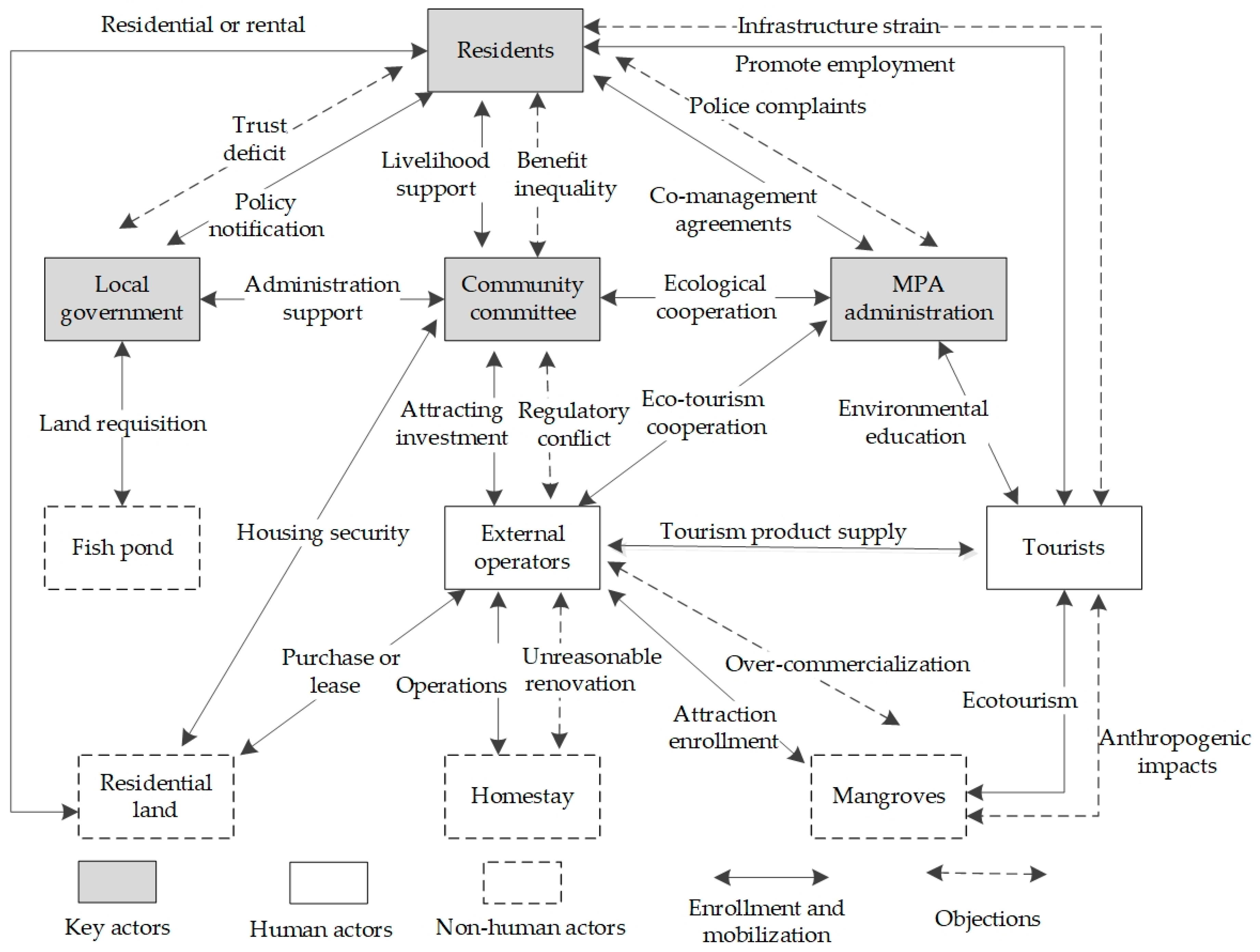
| Type | Category | Actor |
|---|---|---|
| Human Actors | Institutional Actors | Government, Protected Area, Community Committee |
| Community Actors | Residents, Fishers, Community Elites, Self-Organization | |
| Market Actors | Tourists, External Operators | |
| Non-human Actors | Resources and Environment | Mangroves, Ecology |
| Residential Land, Fishponds, Infrastructure | ||
| Tourism-Related Elements | Garbage, Facilities, Homestays, Attractions, Restaurants, Culture |
| Association Strength | Co-Occurrence Phrases and Frequency |
|---|---|
| High Intensity | Community—Residents 72; Protected Area—Tourist 54; Mangroves—Garbage 49; Residents—Government 49; Residents—Protected Area 45; Protected Area—Government 33; Protected Area—Mangroves 33. |
| Medium Intensity | Community—Government 28; Government—Mangroves 27; Government—Ecology 26; Residents—External Operators 25; Tourist—Mangroves 25; Community—Protected Area 24; Residents—Tourist 23; Residents—Homestay 22; Residential Land—Garbage 22; External Operators—Homestay 21; Tourist—Garbage 21; Residents—Fish Pond 20; Residents—Restaurant 15; Homestay—Restaurant 15; Government—External Operators 14; Community—External Operators 12; Protected Area—Homestay 12; Protected Area—Garbage 12; Government—Tourist 12; Government—Fish Pond 12; Government—Residential Land 11; External Operators—Tourist 10. |
| Low Intensity | Residents—Fishermen 9; Community—Tourist 8; Fishermen—Government 8; Government—Culture 8; External Operators—Restaurant 8; Residential Land—Fish Pond 7; Residents—Attractions 6; Protected Area—Culture 6; Attractions—External Operators 6; Attractions—Tourist 6; Government—Infrastructure 6; Residential Land—Mangroves 6; Ecology—Garbage 6; Community—Culture 5; Residents—Residential Land 5; Protected Area—Ecology 5; Protected Area—Restaurant 5; Tourist—Homestay 5; Restaurant—Garbage 5; Ecology—Mangroves 5; Restaurant—Mangroves 4; Tourist—Residential Land 4; Tourist—Culture 4; Protected Area—Fishermen 4; Protected Area—Fish Pond 4; Residents—Self—organization 4; Residents—Mangroves 4. |
| Theoretical Categories | Themes | Key Codes |
|---|---|---|
| Problematization and OPP | Ecological Deterioration | Fish Trap, Illegal Catching, Waste, Invasive Species, Fishing Shed |
| Livelihood Transition | Fishing, Oyster Farming, Risks, Hardship, Fishing Ban, Fishpond, Lack Skills | |
| Social Issues | Illegal Fishing, Officials, Public Resources, Benefit, Distribution, Corruption, Residential Land | |
| Infrastructure Issues | Planning, Traffic, Commercial Street, Parking, Electricity | |
| Interessement | Benefit Sharing | Insurance, Rental, Collective Dividend, Part-time Jobs Poverty Subsidy, Ecological Compensation, Income Increase |
| Community Participation | Representative, Collective Economy, Oversight, Voting, Election | |
| Employment Support | Law, Free, Training, Recruitment Information, Certification | |
| Cultural Identity | Baishi Street, Memorial, Temples, Celebrities, Festival, Community Workshop | |
| Enrollment | Institutional Constraints | Seizure, Inspection, Consultation |
| Advocacy | Notice Board, Activities, Waste Sorting, Legal, Education, Social Media | |
| Communication | Research, Voting, Consolation, Survey, Discussion | |
| Operation Management | Renovation, Shares, Contracts, Tourism Projects, Investment, Leasing | |
| Public Services | Children’s Programs, Welfare, Women’s Care, Vulnerable Groups, Elder Care | |
| Mobilization | Community Self-organization | Traditional Pastry, Entrepreneurship, Skills, Socialization |
| Youth Return | Innovation, Competence, Education, Resources | |
| Business Alliance | Cooperation, Feedback, Customers, Information Sharing | |
| Volunteering | Supervision, Guide, Volunteer |
Disclaimer/Publisher’s Note: The statements, opinions and data contained in all publications are solely those of the individual author(s) and contributor(s) and not of MDPI and/or the editor(s). MDPI and/or the editor(s) disclaim responsibility for any injury to people or property resulting from any ideas, methods, instructions or products referred to in the content. |
© 2026 by the authors. Licensee MDPI, Basel, Switzerland. This article is an open access article distributed under the terms and conditions of the Creative Commons Attribution (CC BY) license.
Share and Cite
Wang, H.; Charoenratana, S. Tourism-Induced Livelihood Adaptive Process in Marine Protected Area Communities Under Socio-Ecological Changes: Evidence from the Pearl River Estuary, China. Sustainability 2026, 18, 998. https://doi.org/10.3390/su18020998
Wang H, Charoenratana S. Tourism-Induced Livelihood Adaptive Process in Marine Protected Area Communities Under Socio-Ecological Changes: Evidence from the Pearl River Estuary, China. Sustainability. 2026; 18(2):998. https://doi.org/10.3390/su18020998
Chicago/Turabian StyleWang, Hui, and Sayamol Charoenratana. 2026. "Tourism-Induced Livelihood Adaptive Process in Marine Protected Area Communities Under Socio-Ecological Changes: Evidence from the Pearl River Estuary, China" Sustainability 18, no. 2: 998. https://doi.org/10.3390/su18020998
APA StyleWang, H., & Charoenratana, S. (2026). Tourism-Induced Livelihood Adaptive Process in Marine Protected Area Communities Under Socio-Ecological Changes: Evidence from the Pearl River Estuary, China. Sustainability, 18(2), 998. https://doi.org/10.3390/su18020998