Comparative Experimental Performance Assessment of Tilted and Vertical Bifacial Photovoltaic Configurations for Agrivoltaic Applications
Abstract
1. Introduction
1.1. Background
1.2. Agrivoltaic Systems
1.3. Study Aims
1.4. Recent Studies
1.5. Performance Evaluation
1.6. Agricultural Component
1.7. Energy Component
2. Materials and Methods
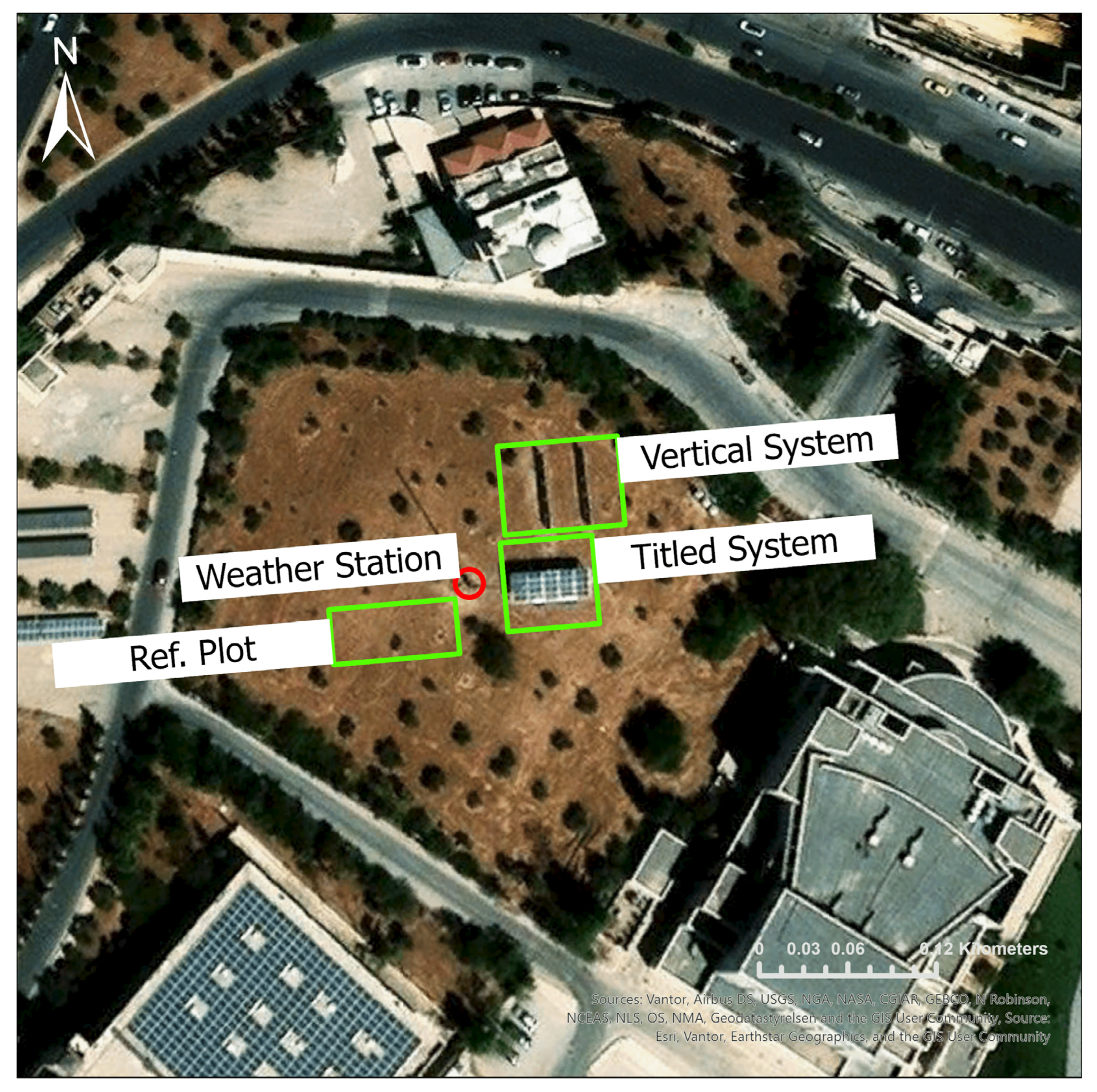
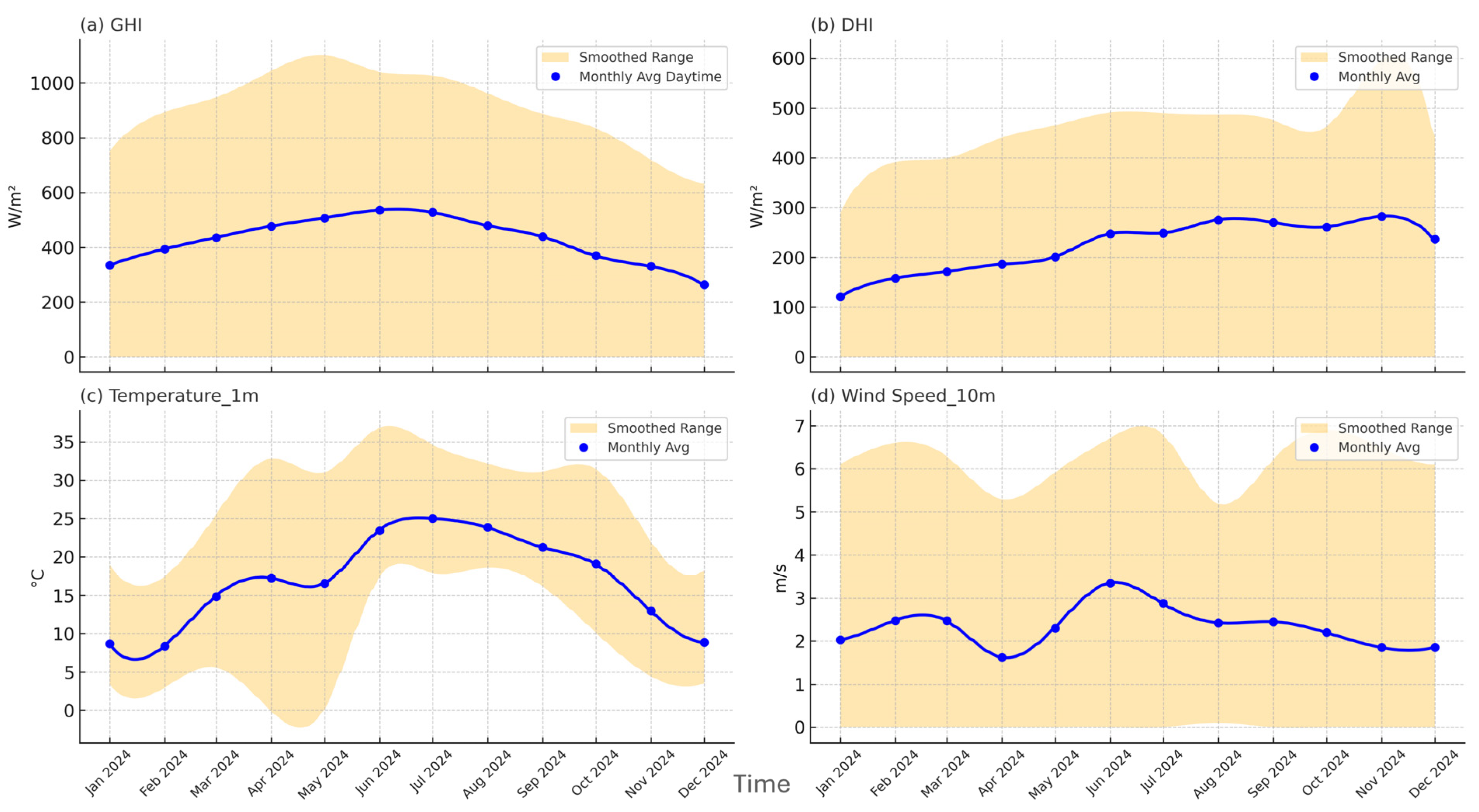
2.1. Site and Climatic Data
2.2. Configuration
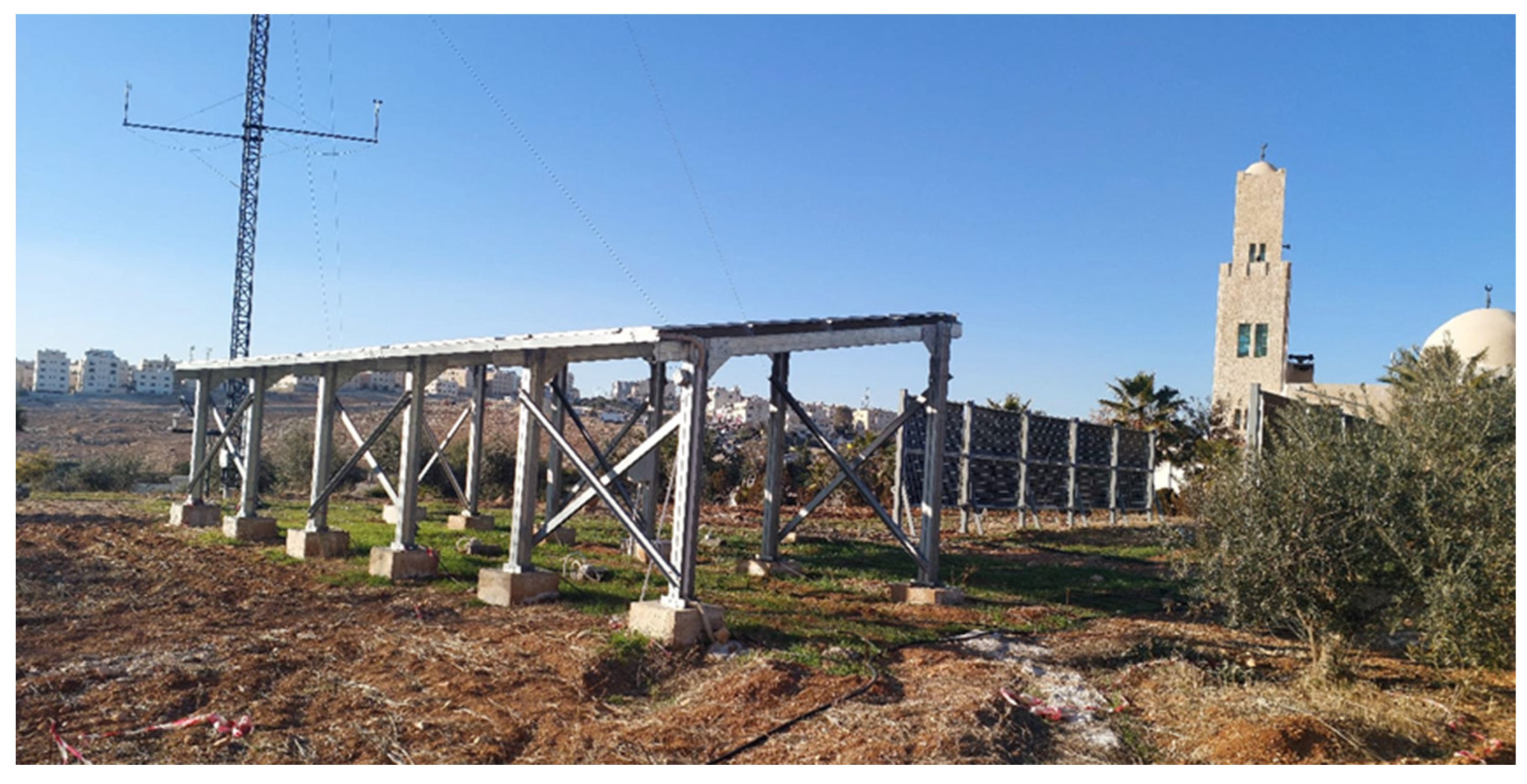
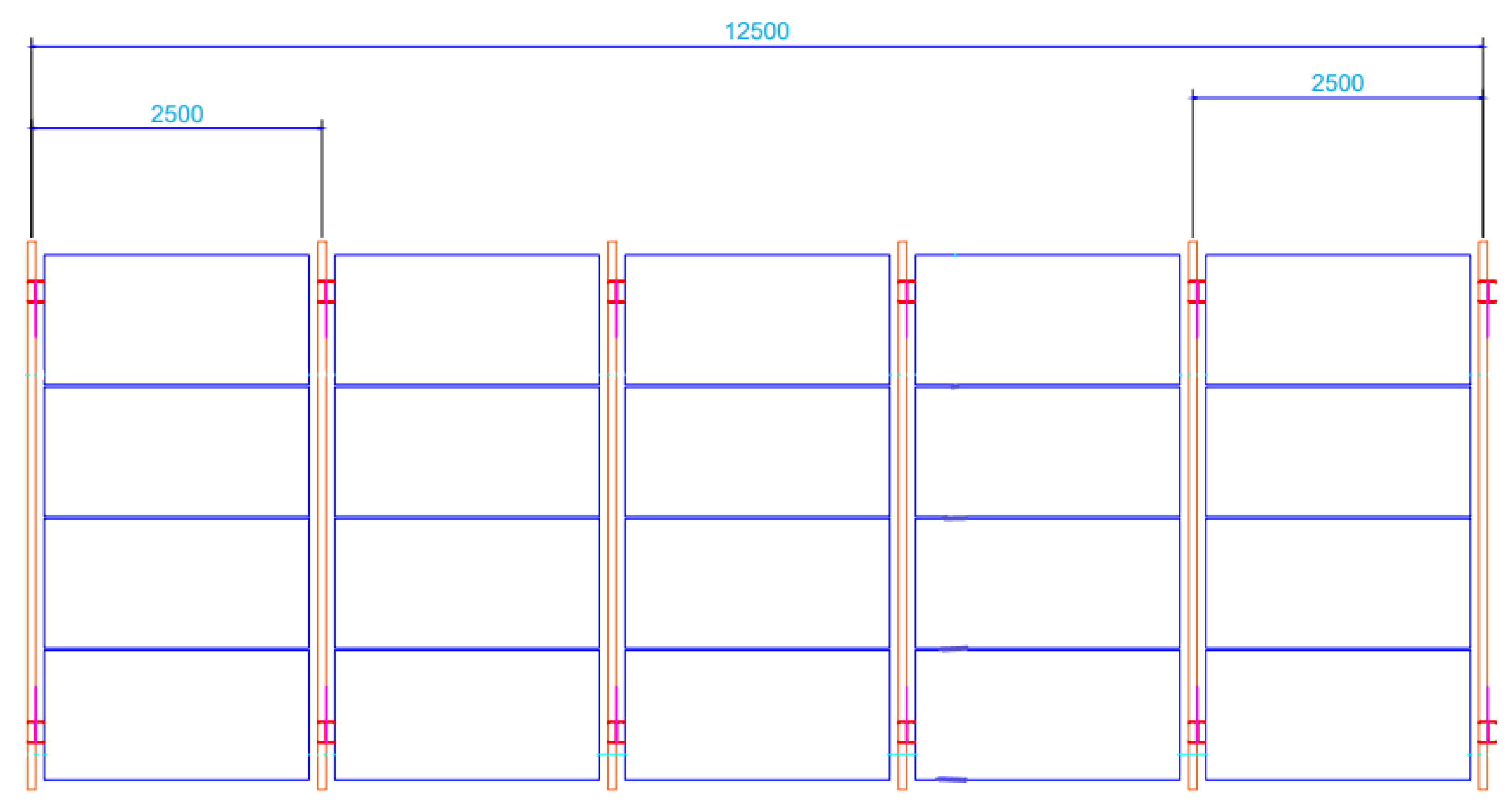
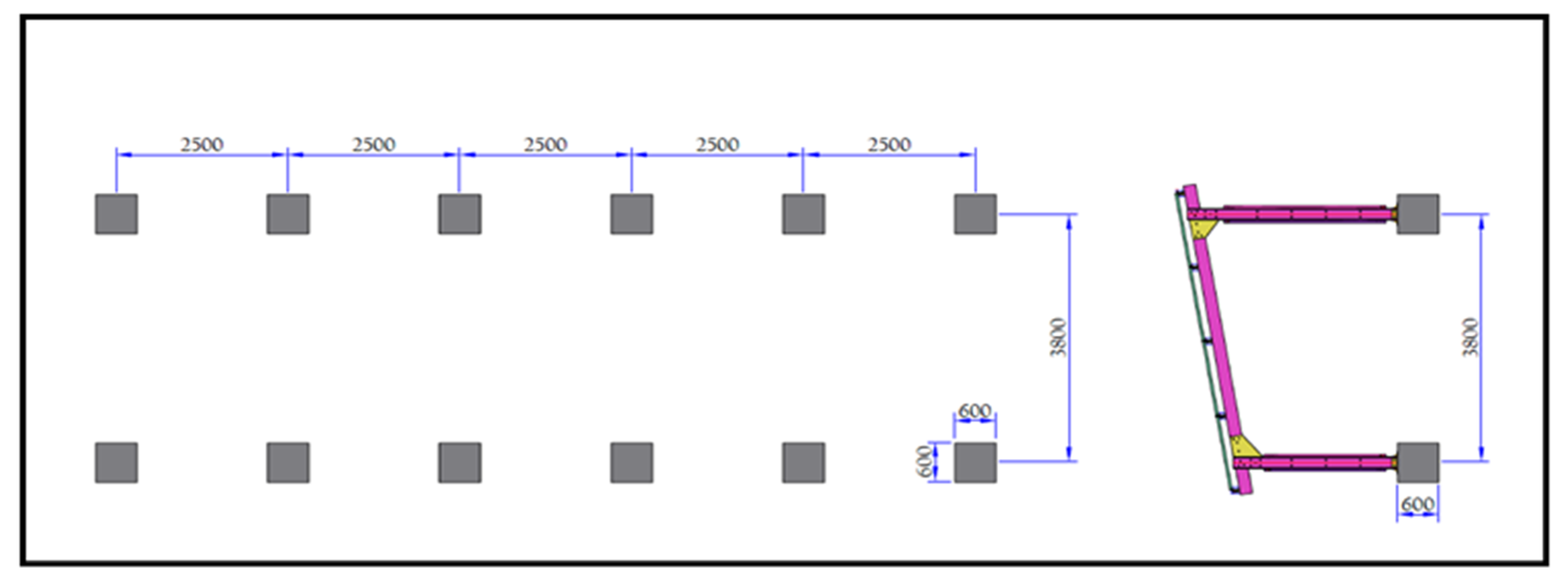
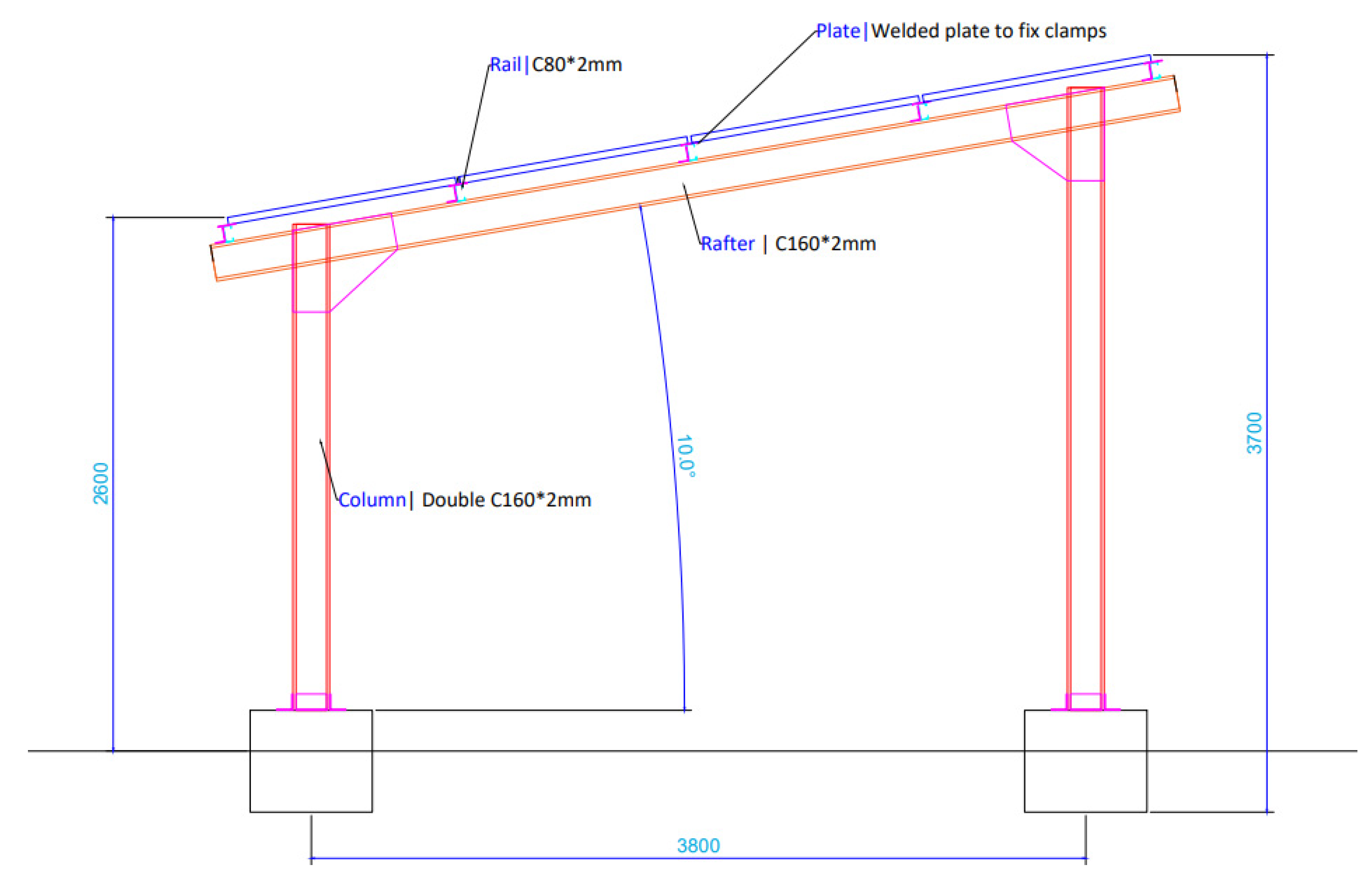
2.2.1. Fixed Tilted System
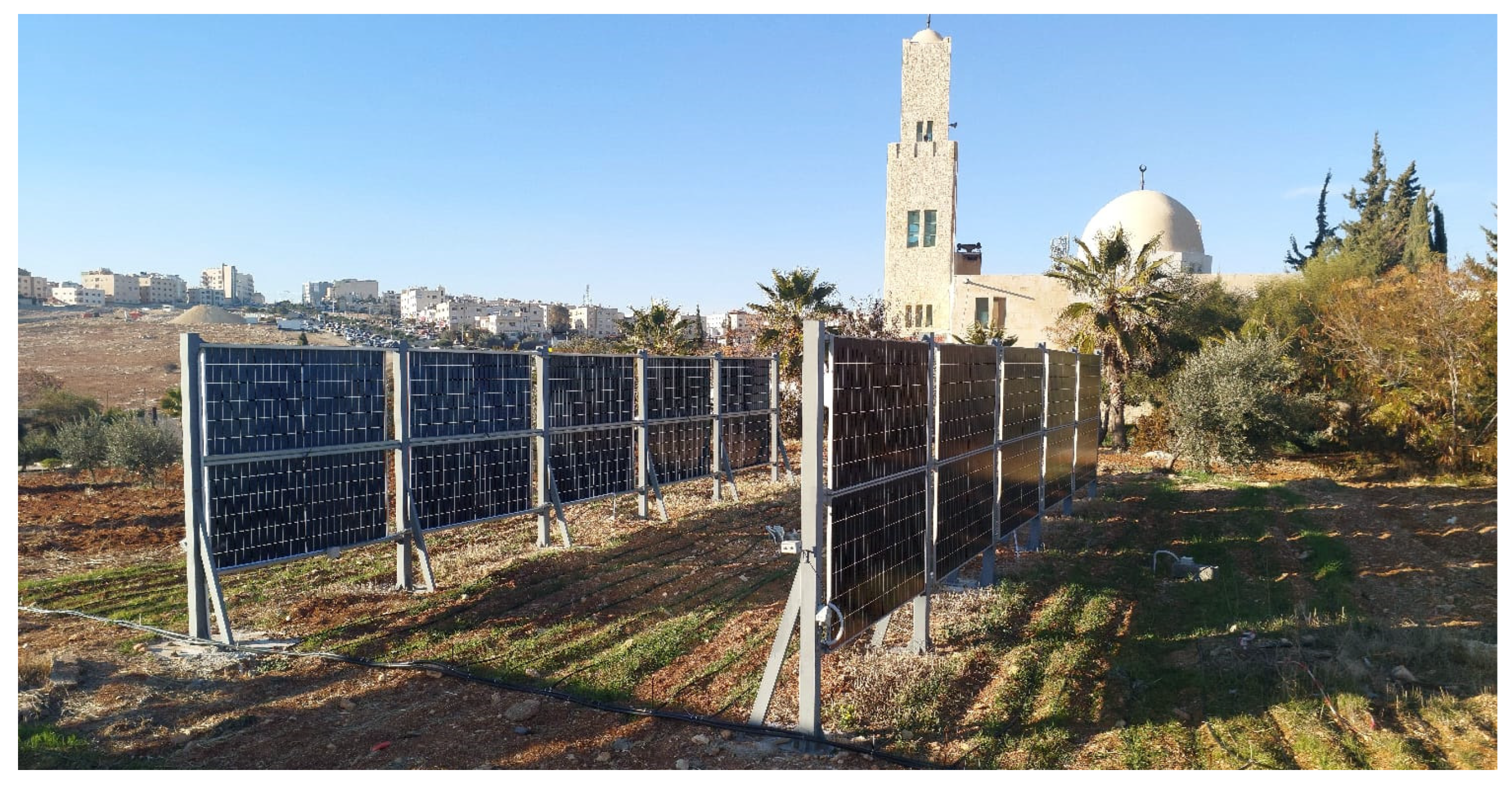
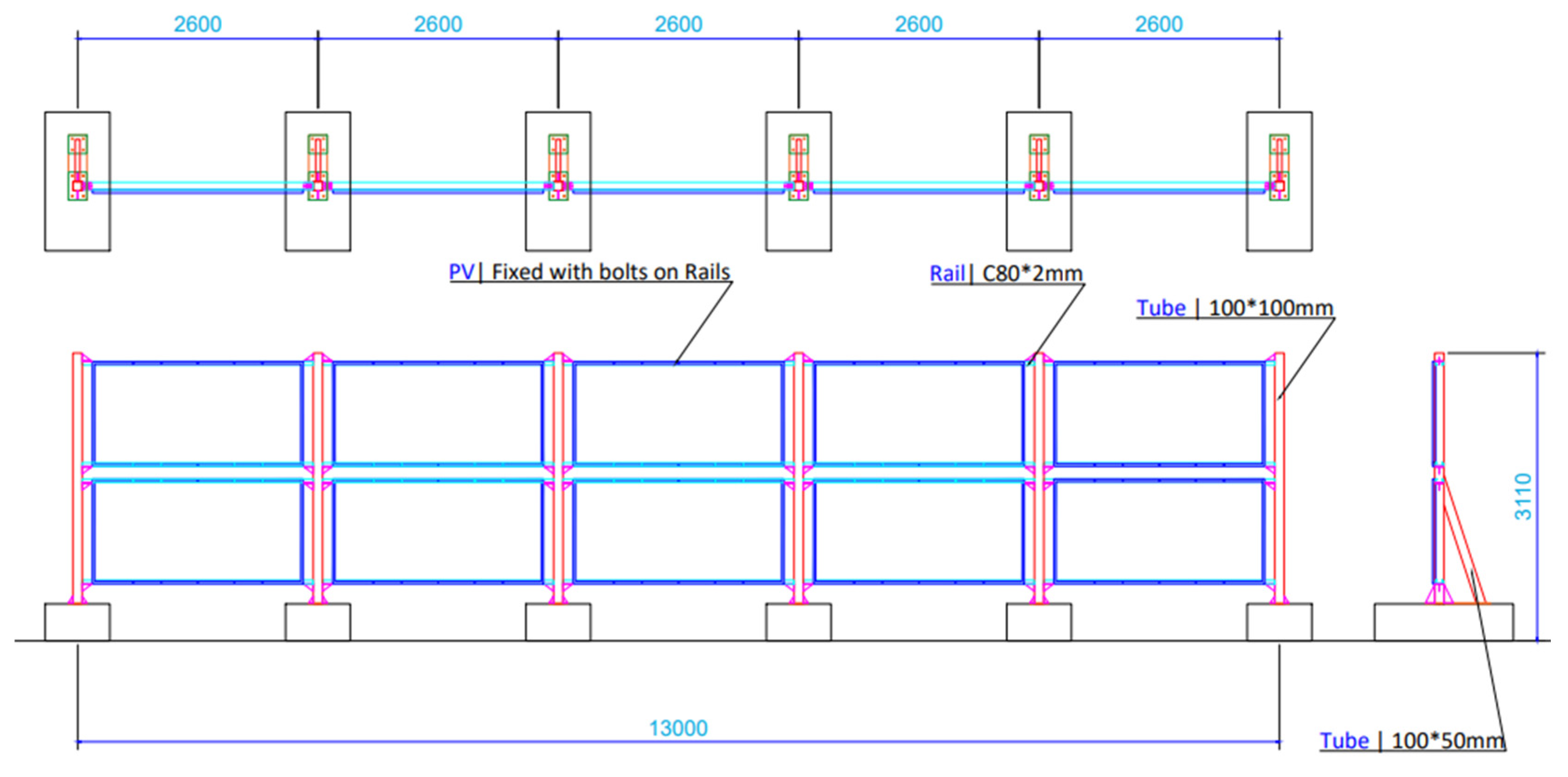
2.2.2. Vertical East–West System
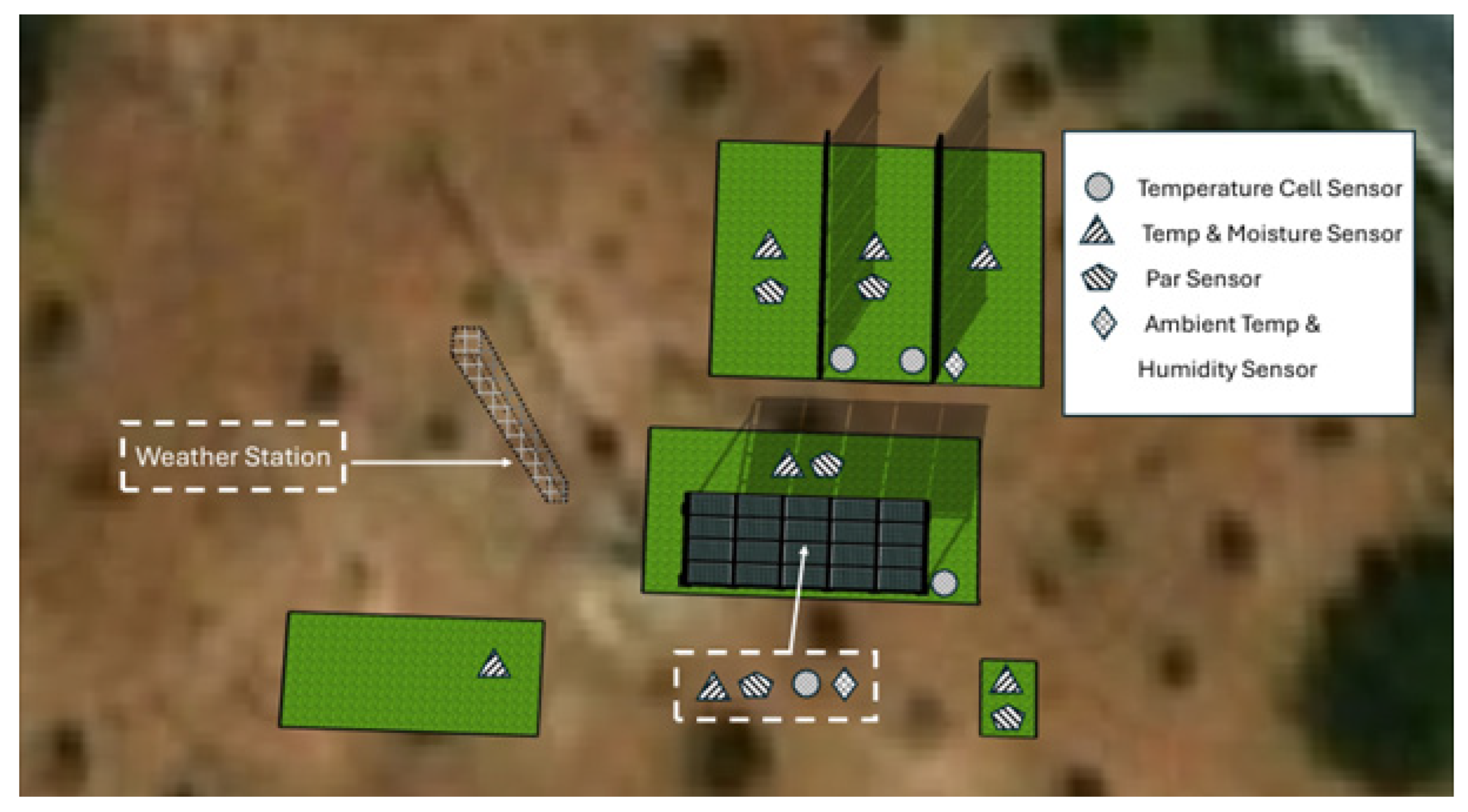
2.2.3. Monitoring System
2.3. Capital Cost
3. Results and Discussion
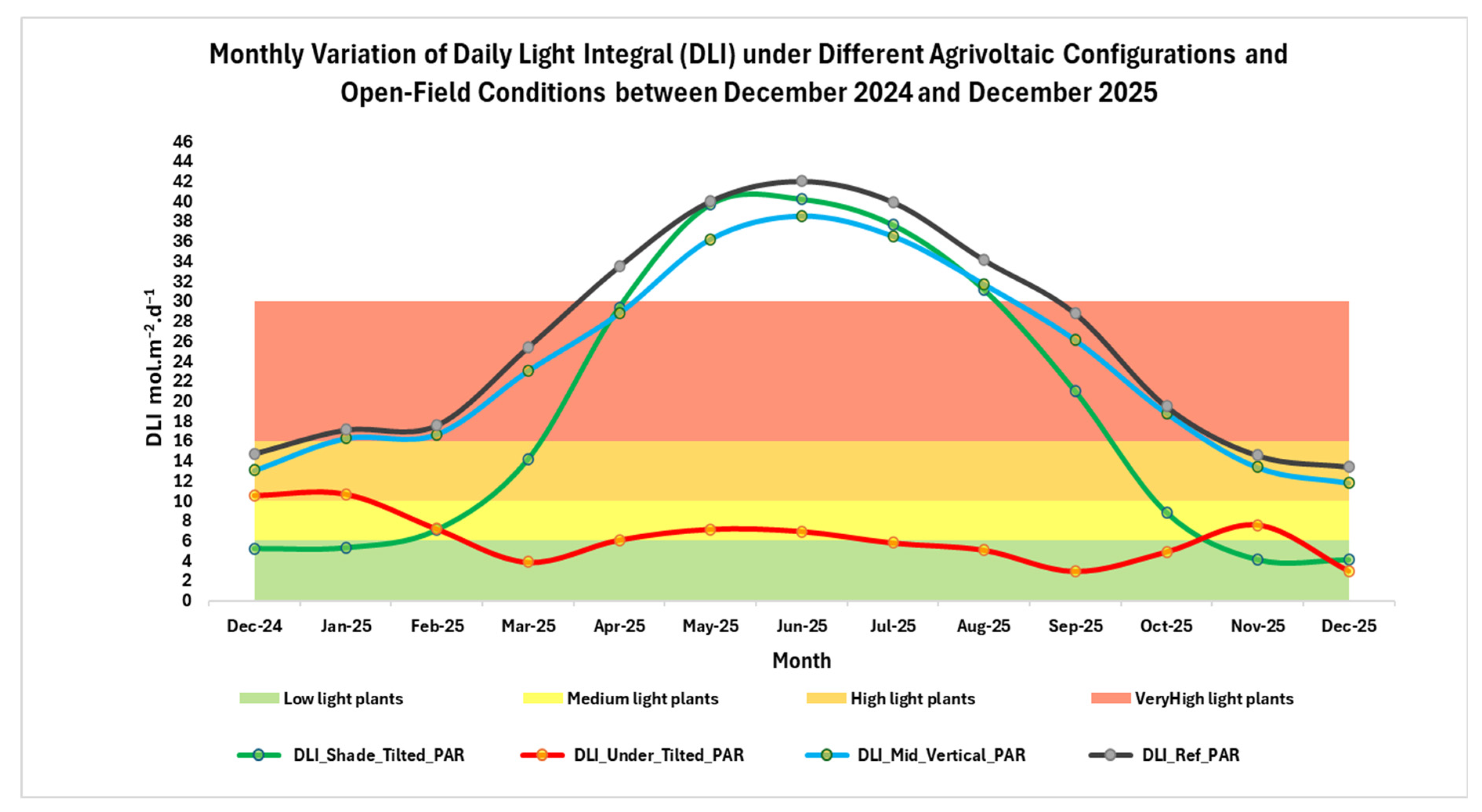
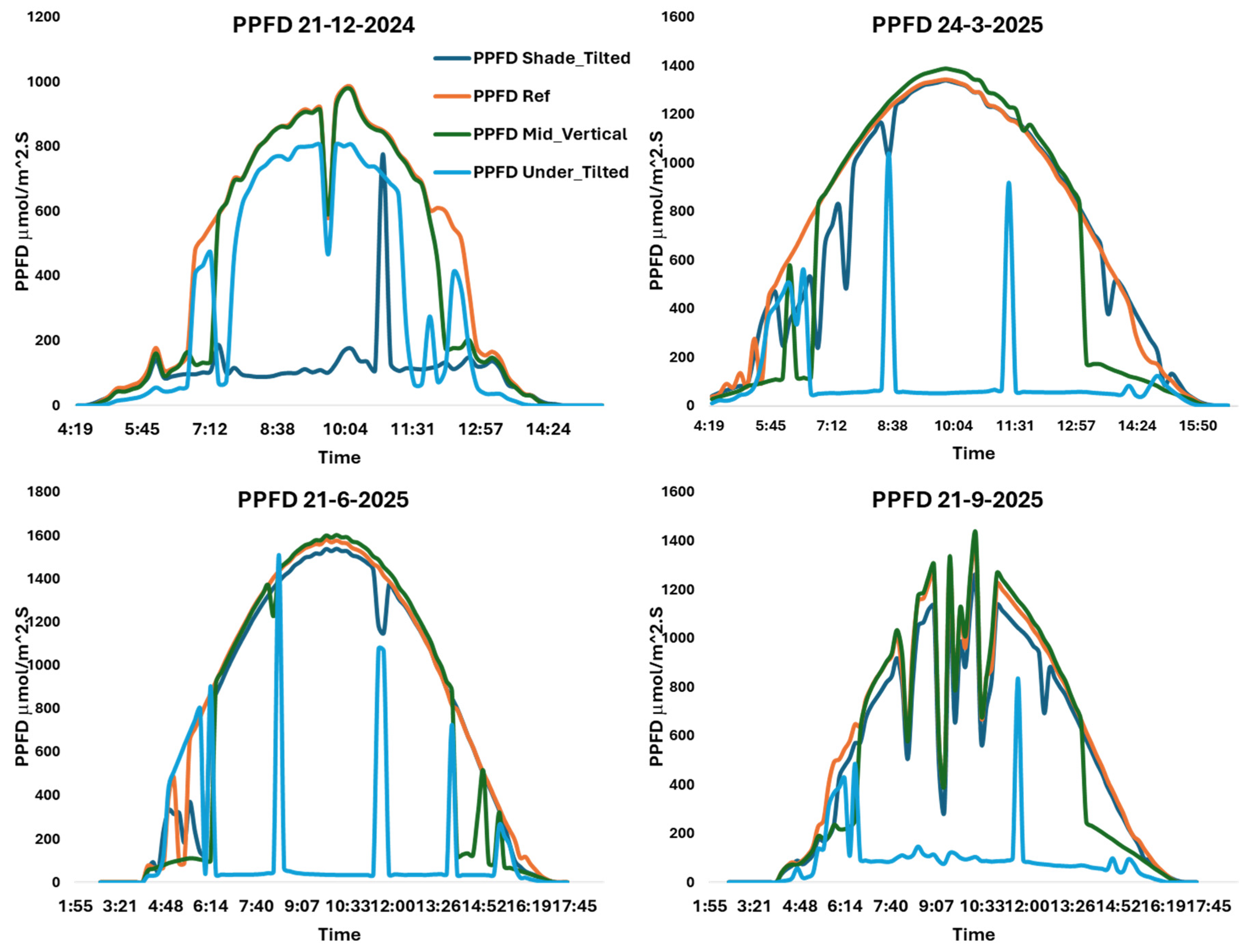
3.1. Agricultural Component Results
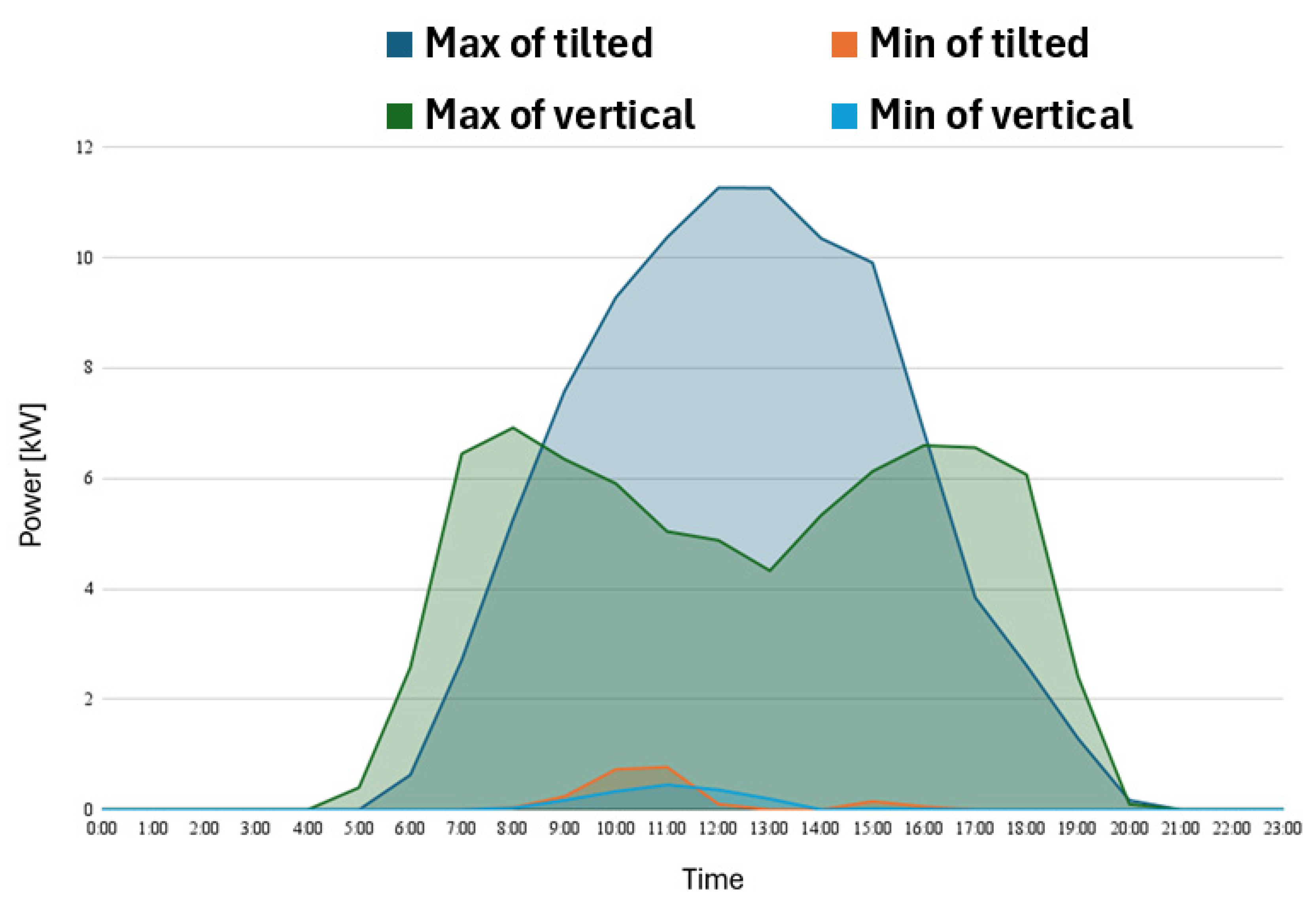
3.2. Energy Component Results
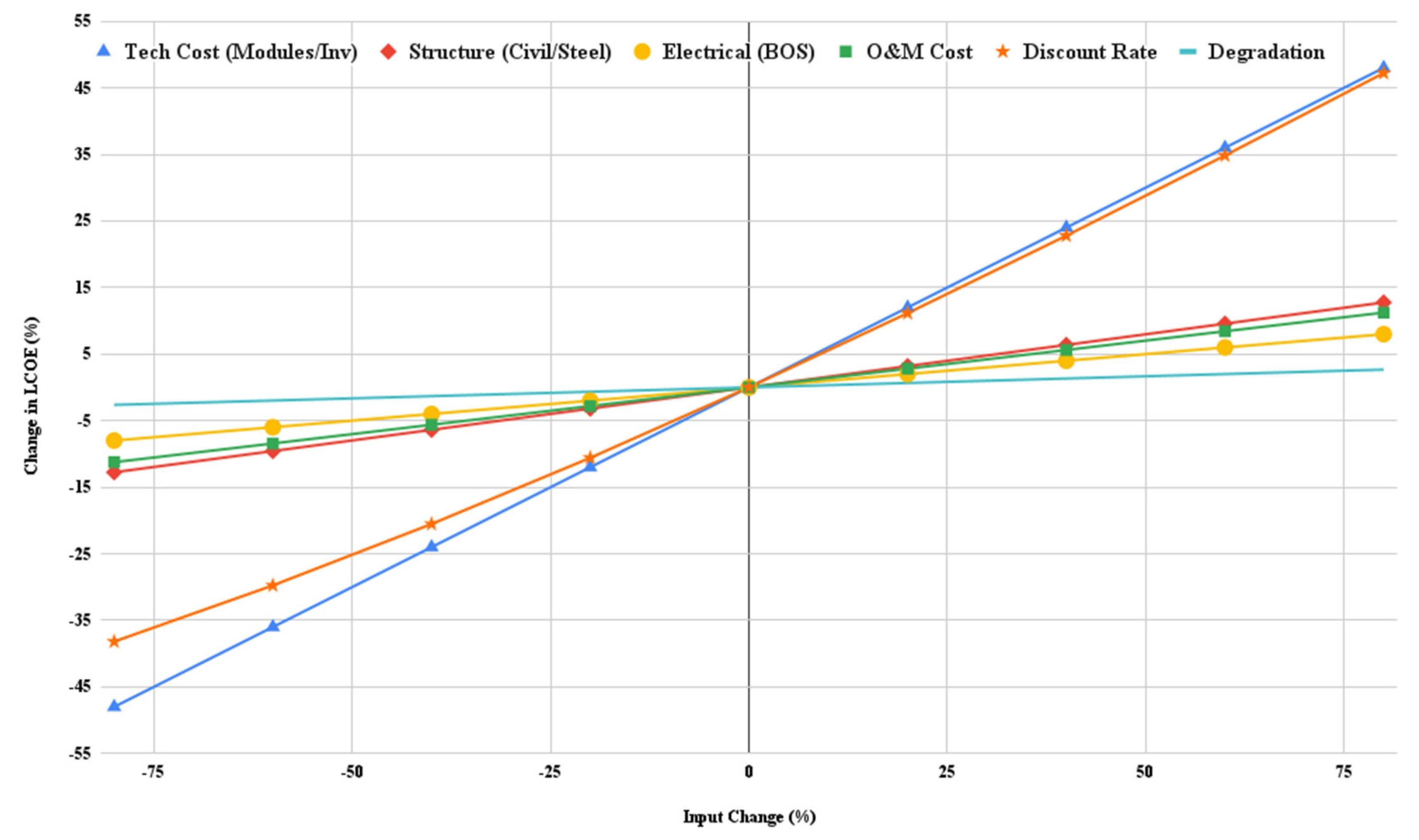
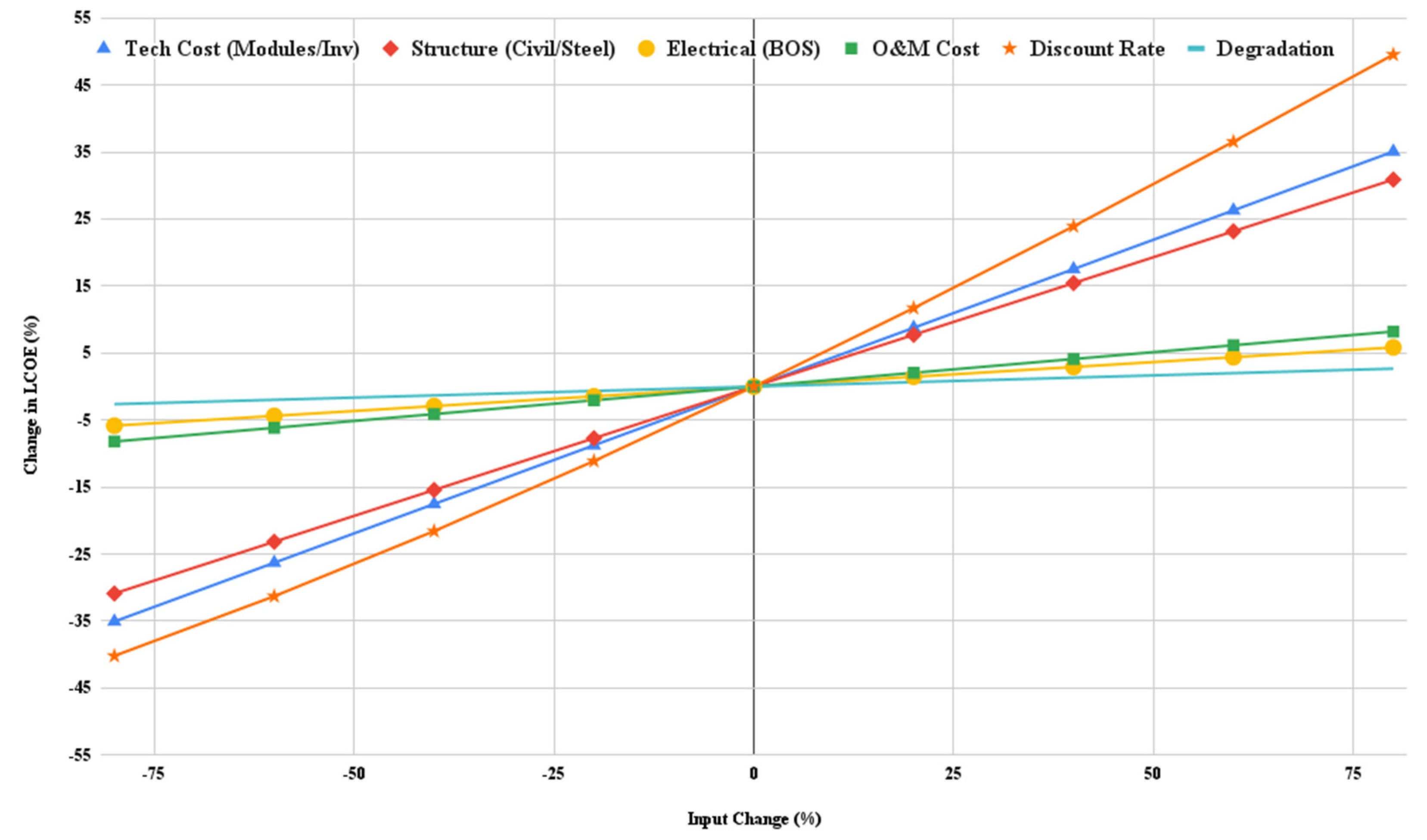
3.3. Economic Component Results
4. Conclusions and Recommendations
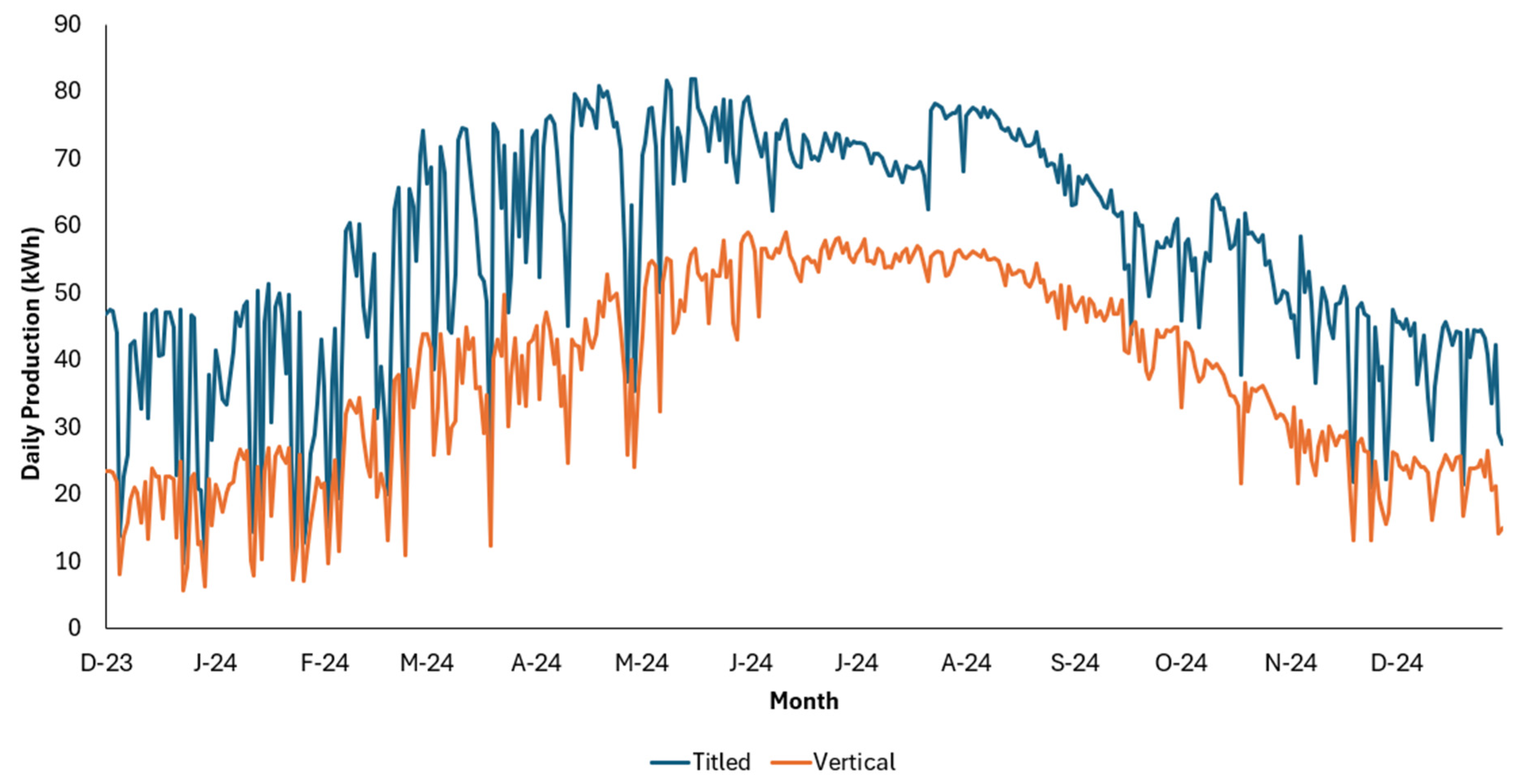
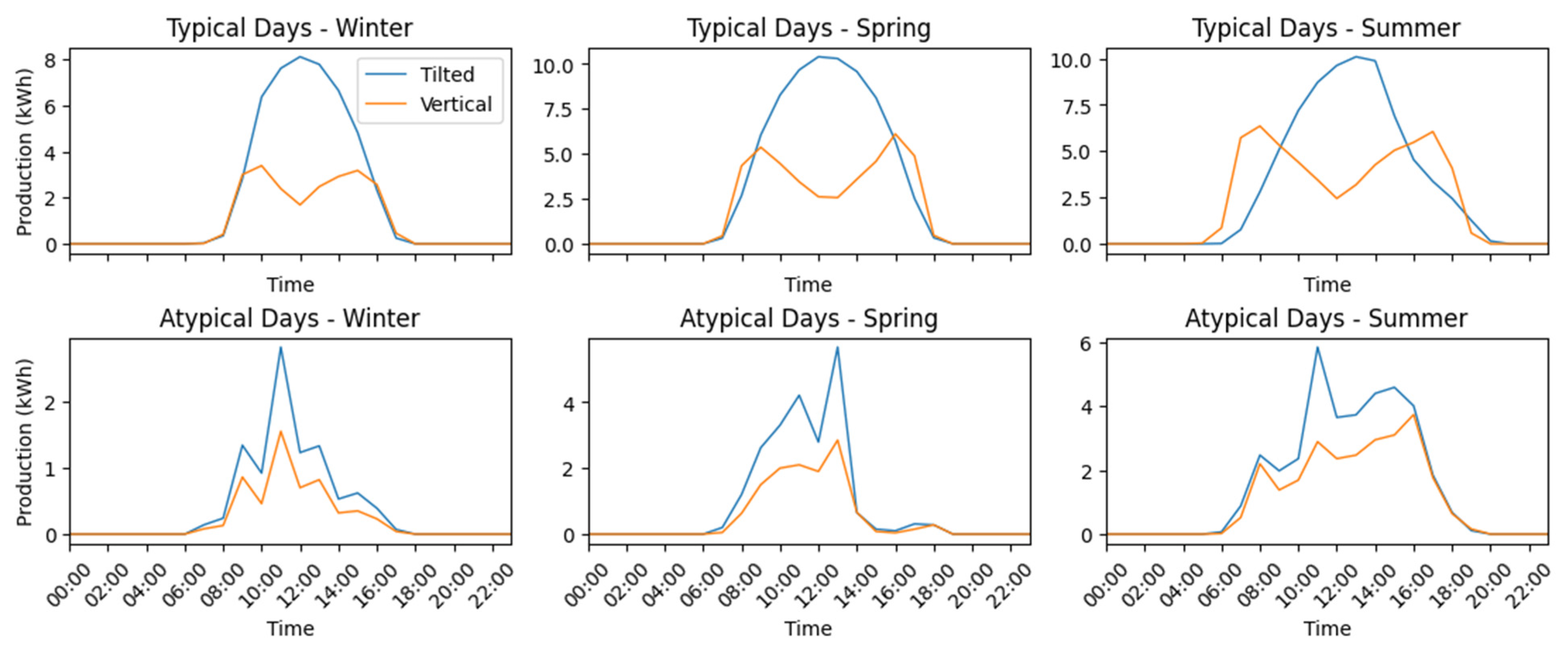
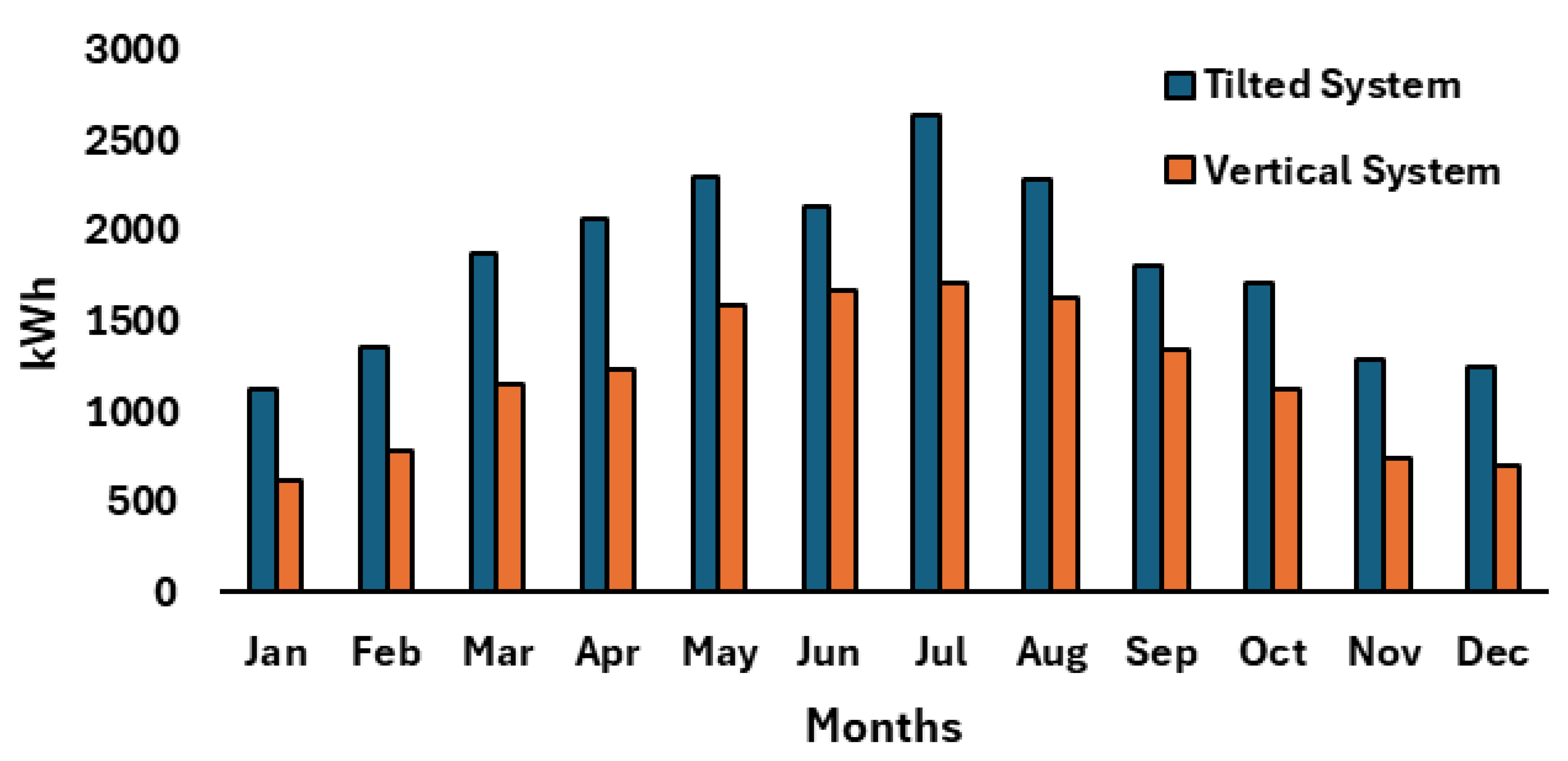
- The tilted system showed a higher energy yield compared to the vertical system by an annual average margin of 35.7%
- Considering the shading challenges of a vertical system, row spacing should be at least 6 m.
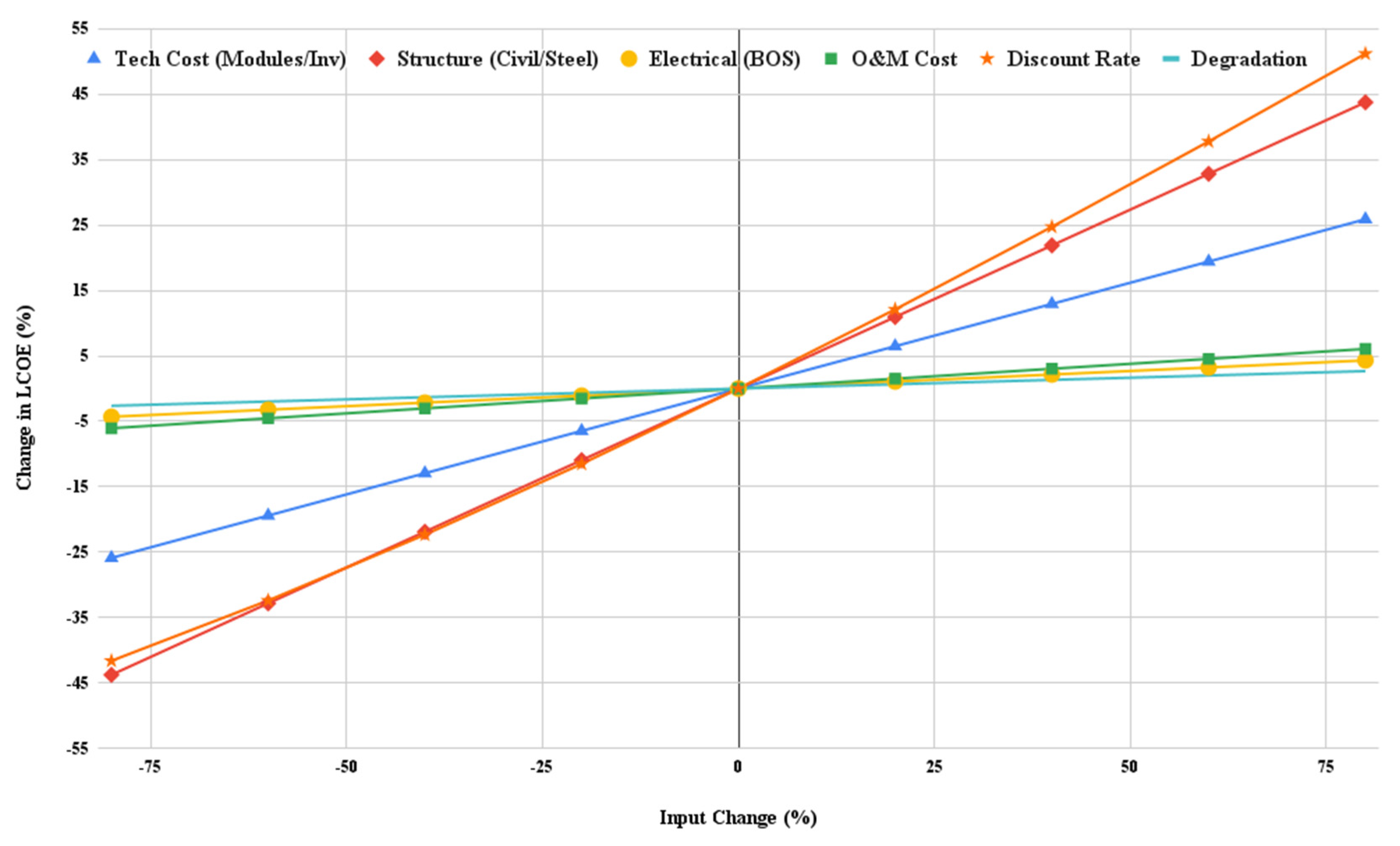
- There is a significant cost attached to increasing the elevation of the mounting structure compared to a ground-level installation. This increase is approximately double that of a standard project, although this may be abated by the economies-of-scale effect in future or larger projects.
- The tilted system’s initial cost may be reduced by decreasing the system’s height, although it will undoubtedly start affecting accessibility and logical crop choices.
- The results support the premise that agrivoltaics are a viable option for Jordan’s climate so far as the energy component is concerned.
- A landowner may allocate the equivalent of 50% of a cultivated plot for energy production, while maintaining agricultural use beneath and around the structure at a penalty of roughly 88% increase in LCOE compared to a conventional ground-mounted system due to elevated structural costs.
- A landowner may allocate the equivalent of 33% of a cultivated plot for energy production, while maintaining agricultural use beneath and around the structure without any increase in LCOE using a vertical configuration, but at the decreased margin mentioned previously compared to the titled system (35.7%).
Author Contributions
Funding
Institutional Review Board Statement
Informed Consent Statement
Data Availability Statement
Acknowledgments
Conflicts of Interest
References
- Water Scarcity in the Jordan River Valley—Ballard Brief. Available online: https://ballardbrief.byu.edu/issue-briefs/water-scarcity-in-the-jordan-river-valley (accessed on 28 April 2025).
- Rabboh, W.; Peters, B.; Dengerink, J.; Piters, B.d.S.; Fakhry, H.; Barois, Z.; Selten, M.P.H.; Nabulsi, A. An Overview of the Jordanian Food System: Outcomes, Drivers & Activities; Wageningen Centre for Development Innovation: Wageningen, The Netherlands, 2023. [Google Scholar] [CrossRef]
- Ministry of Energy and Mining Resources. Summary of Jordan Energy Strategy 2020–2030. Available online: https://www.memr.gov.jo/EBV4.0/Root_Storage/EN/EB_Info_Page/StrategyEN2020.pdf (accessed on 30 October 2024).
- Bank, W.; Jordan, G. Middle East and North Africa. 2022. Available online: www.worldbank.org (accessed on 28 April 2025).
- NEPCO. National Electric Power Company Public Shareholding Company. 2002. Available online: https://www.nepco.com.jo/store/DOCS/web/2022_EN.pdf (accessed on 15 April 2025).
- Jordan Strives for 50 Per Cent Electricity Generation from Renewables—Official|Jordan Times. Available online: https://www.jordantimes.com/news/local/jordan-strives-50-cent-electricity-generation-renewables-%E2%80%94-official (accessed on 28 April 2025).
- Ayadi, O.; Al-Bakri, J.T.; Abdalla, M.E.B.; Aburumman, Q. The potential of agrivoltaic systems in Jordan. Appl. Energy 2024, 372, 123841. [Google Scholar] [CrossRef]
- Gomez-Casanovas, N.; Mwebaze, P.; Khanna, M.; Branham, B.; Time, A.; DeLucia, E.H.; Bernacchi, C.J.; Knapp, A.K.; Hoque, M.J.; Du, X.; et al. Knowns, uncertainties, and challenges in agrivoltaics to sustainably intensify energy and food production. Cell Rep. Phys. Sci. 2023, 4, 101518. [Google Scholar] [CrossRef]
- Al-Kharabsheh, A. Challenges to Sustainable Water Management in Jordan. Jordan J. Earth Environ. Sci. 2019, 11, 38–48. [Google Scholar]
- World Bank. Climate-Smart Agriculture Action Plan for Jordan, 2nd ed.; Ministry of Agriculture and Ministry of Environment of the Hashemite Kingdom of Jordan and Partnership for Market Readiness (PMR); World Bank: Washington, DC, USA, 2021. [Google Scholar]
- Al Kilani, M.R. Evaluation of Remotely Sensed Precipitation Estimates from the NASA. Earth Syst. Environ. 2021, 5, 561–573. [Google Scholar] [CrossRef]
- Franceschini, G.; De Leo, E.; Muchoney, D. Jordan—Land Cover Atlas; FAO: Rome, Italy, 2019; p. 66. [Google Scholar]
- Al-Kilani, M.R.M. Agricultural land measures for climate change adaptation in arid regions: Can the farmers do it alone? J. Arid. Agric. 2024, 10, 82–93. [Google Scholar] [CrossRef]
- Grigorieva, E.; Livenets, A.; Stelmakh, E. Adaptation of Agriculture to Climate Change: A Scoping Review. Climate 2023, 11, 202. [Google Scholar] [CrossRef]
- El-Anis, I.; Poberezhskaya, M. Responding to Climate Change in Jordan: Understanding institutional developments, political restrictions and economic opportunities. Br. J. Middle East. Stud. 2025, 52, 335–353. [Google Scholar] [CrossRef]
- Farah, A.A.; Mohamed, M.A.; Musse, O.S.H.; Nor, B.A. The multifaceted impact of climate change on agricultural productivity: A systematic literature review of SCOPUS indexed studies (2015–2024). Discov. Sustain. 2025, 6, 397. [Google Scholar] [CrossRef]
- Victoria, M.; Pullens, J.W.M.; Torma, G.; Lindhardt, M.K.K.; Niazi, K.A.K.; Jahangirlou, M.R.; Khoury, Y.V.E.; Aschemann-Witzel, J.; Ottosen, C.-O.; Jørgensen, U. Vertical agrivoltaics in a temperate climate: Exploring technical, agricultural, meteorological, and social dimensions. Energy Nexus 2025, 19, 100526. [Google Scholar] [CrossRef]
- Asa’a, S.; Reher, T.; Rong’e, J.; Diels, J.; Poortmans, J.; Radhakrishnan, H.; Heide, A.V.D.; Poel, B.V.D.; Daenen, M. A multidisciplinary view on agrivoltaics: Future of energy and agriculture. Renew. Sustain. Energy Rev. 2024, 200, 114515. [Google Scholar] [CrossRef]
- Barron-Gafford, G.; Pavao-Zuckerman, M.; Sutter, L. Agrivoltaics provide mutual benefits across the food–energy–water nexus in drylands. Nat. Sustain. 2019, 2, 848–855. [Google Scholar] [CrossRef]
- Poonia, S.; Jat, N.; Santra, P.; Singh, A.; Jain, H.M.D. Techno-economic evaluation of different agri-voltaic designs for the hot arid ecosystem India. Renew. Energy 2022, 184, 149–163. [Google Scholar] [CrossRef]
- Reasoner, M.; Ghosh, A. Agrivoltaic Engineering and Layout Optimization Approaches in the Transition to Renewable Energy Technologies: A Review. Chall. J. Planet. Health 2022, 13, 43. [Google Scholar] [CrossRef]
- Chopdar, R.K.; Sengar, N.; Giri, N.C.; Halliday, D. Comprehensive review on agrivoltaics with technical, environmental and societal insights. Renew. Sustain. Energy Rev. 2024, 197, 114416. [Google Scholar] [CrossRef]
- Sarr, A.; Soro, Y.M.; Tossa, A.K.; Diop, L. Agrivoltaic, a Synergistic Co-Location of Agricultural and Energy Production in Perpetual Mutation: A Comprehensive Review. Processes 2023, 11, 948. [Google Scholar] [CrossRef]
- Uytterhaegen, B.; Leuven, K.U.; Ronsijn, B.; Herteleer, B.; Willockx, B.; Cappelle, J. A standardized classification and performance indicators of agrivoltaic systems. EU PVSEC Proc. 2020. [Google Scholar] [CrossRef]
- Niazi, K.; Victoria, M. Comparative analysis of photovoltaic configurations for agrivoltaic systems in Europe. Prog. Photovolt. Res. Appl. 2023, 31, 1101–1113. [Google Scholar] [CrossRef]
- Trommsdorff, M.; Kang, J.; Reise, C.; Schindele, S.; Bopp, G.; Ehmann, A.; Weselek, A.; Högy, P.; Obergfell, T. Combining food and energy production: Design of an agrivoltaic system applied in arable and vegetable farming in Germany. Renew. Sustain. Energy Rev. 2021, 140, 110694. [Google Scholar] [CrossRef]
- Khan, M.R.; Hanna, A.; Sun, X.; Alam, M.A. Vertical bifacial solar farms: Physics, design, and global optimization. Appl. Energy 2017, 206, 240–248. [Google Scholar] [CrossRef]
- Campana, P.E.; Stridh, B.; Amaducci, S.; Colauzzi, M. Optimisation of vertically mounted agrivoltaic systems. J. Clean. Prod. 2021, 325, 129091. [Google Scholar] [CrossRef]
- Katsikogiannis, O.A.; Ziar, H.; Isabella, O. Integration of bifacial photovoltaics in agrivoltaic systems: A synergistic design approach. Appl. Energy 2022, 309, 118475. [Google Scholar] [CrossRef]
- Asgharzadeh, A.; Marion, B.; Deline, C.; Hansen, C.; Stein, J.S.; Toor, F. A sensitivity study of the impact of installation parameters and system configuration on the performance of bifacial PV arrays. IEEE J. Photovolt. 2018, 8, 798–805. [Google Scholar] [CrossRef]
- Toledo, C.; Scognamiglio, A. Agrivoltaic Systems Design and Assessment: A Critical Review, and a Descriptive Model towards a Sustainable Landscape Vision (Three-Dimensional Agrivoltaic Patterns). Sustainability 2021, 13, 6871. [Google Scholar] [CrossRef]
- Imran, H.; Riaz, M.H. Investigating the potential of east/west vertical bifacial photovoltaic farm for agrivoltaic systems. J. Renew. Sustain. Energy 2021, 13, 033502. [Google Scholar] [CrossRef]
- Cho, J.; Park, S.M.; Park, A.R.; Lee, O.C.; Nam, G.; Ra, I.H. Application of Photovoltaic Systems for Agriculture: A Study on the Relationship between Power Generation and Farming for the Improvement of Photovoltaic Applications in Agriculture. Energies 2020, 13, 4815. [Google Scholar] [CrossRef]
- Kim, S.; Kim, S. Performance Estimation Modeling via Machine Learning of an Agrophotovoltaic System in South Korea. Energies 2021, 14, 6724. [Google Scholar] [CrossRef]
- Lu, S.M.; Camporese, M.; Ma, T.; Haworth, M.; Campana, P.E. Selective light transmission in agrivoltaics: Modeling light spectra and photosynthetic rate. Nexus 2025, 2, 100074. [Google Scholar] [CrossRef]
- Santra, P.; Meena, H.M.; Yadav, O.P. Spatial and temporal variation of photosynthetic photon flux density within agrivoltaic system in hot arid region of India. Biosyst. Eng. 2021, 209, 74–93. [Google Scholar] [CrossRef]
- Boruah, D.; Das, P.; Priyadarshi, A. Setting up of Optimum Design Parameters for Agrivoltaic Power Plants in Indian Geo-Climatic Conditions. In Proceedings of the ISES Solar World Congress 2023, SWC 2023, New Delhi, India, 30 October–4 November 2023; International Solar Energy Society: Freiburg, Germany, 2024; pp. 63–92. [Google Scholar] [CrossRef]
- Vu, N.-H.; Tien, T.Q.; Kieu, N.-M.; Nguyen, T.-P.; Tong, Q.C.; Shin, S. Development and optimization of red spectrum splitting concentrated agrivoltaic system for energy generation and sustainable agriculture. PLoS ONE 2025, 20, e0332865. [Google Scholar] [CrossRef]
- Tsuchida, S.; Tsuno, Y.; Sato, D.; Oozeki, T.; Yamada, N. Power generation characteristics of vertical bifacial photovoltaic arrays in heavy snow regions. EPJ Photovolt. 2024, 15, 32. [Google Scholar] [CrossRef]
- Kivambe, M.; Abdallah, A.; Figgis, B.; Scabbia, G.; Abdelrahim, M.; Lopez-Garcia, J. Assessing vertical east-west bifacial photovoltaic systems in desert environments: Energy yield and soiling mitigation. Sol. Energy 2024, 279, 112835. [Google Scholar] [CrossRef]
- Rinchi, B.; Dababseh, R.; Jubran, M.; Al-Dahidi, S.; Abdalla, M.E.; Ayadi, O. Global prediction of optimal solar panel tilt angles via machine learning. Appl. Energy 2025, 382, 125322. [Google Scholar] [CrossRef]
- Campana, P.E.; Macknick, J.; Croci, M.; Elkadeem, M.R.; Gorjian, S.; Pascaris, A.; Cuppari, R.I.; Amaducci, S.; Liu, W.; Trommsdorff, M.; et al. Scientific frontiers of agrivoltaic cropping systems. Nat. Rev. Clean Technol. 2025, 1, 801–821. [Google Scholar] [CrossRef]
- Alrbai, M.; Al-Ghussain, L.; Al-Dahidi, S.; Ayadi, O.; Al-naser, S. Techno-economic assessment of residential PV system tariff policies in Jordan. Util. Policy 2025, 93, 101894. [Google Scholar] [CrossRef]
- CSI Solar Co., Ltd. TOPBiHiKu6 (TOPCon) CS6W-TB-AG Bifacial. Data Sheet v2.0C2. 2025. Available online: https://static.csisolar.com/wp-content/uploads/sites/2/2025/03/07114732/CS-Datasheet-TOPBiHiKu6_CS6W-TB-AG_v2.0C2_AU-CEC.pdf (accessed on 21 November 2025).


| Source/Study | DLI Bands (mol·m−2·day−1) | Example Crops |
|---|---|---|
| [37] | Low: 3 < DLI < 6 | Herbs, Himalayan mushroom |
| Medium: 6 < DLI < 12 | Basil, carrot, cauliflower | |
| High: 12 < DLI < 18 | Lettuce, spinach, mint | |
| Very High: DLI > 18 | Pumpkin, watermelon | |
| [38] | Low: DLI < 10 | Rice is an example of a medium-light crop (15–25 mol m−2 day−1). |
| moderate: 10 < DLI < 20 | ||
| High: 20 < DLI < 30 | ||
| Very High: DLI > 30 |
| Specification | Value |
|---|---|
| Open circuit voltage (V) | 51.20 |
| Short circuit current (A) | 13.64 |
| Rated voltage at maximum power (V) | 42.10 |
| Rated current at maximum power (A) | 13.19 |
| Rated maximum power at STC (W) | 555 |
| Cell efficiency (%) | 21.5 |
| Sensor Type | Measured Parameter | Sensor Range | Accuracy | Installation Height/Depth |
|---|---|---|---|---|
| PAR Sensor | PAR (µmol m−2 s−1) | 0 ~ 2500 μmol/m2 s | ±1 μmol/m2 s | 0.2 m above ground |
| Soil Temp and Moisture Sensor | T (°C), VWC (m3/m3) | −40~80 °C 0~100% VWC | ±0.5 °C, ±3% VWC | 10 cm below surface |
| PV Cell Temperature Sensor | Cell Temperature (°C) | −55~125 °C | ±0.5 °C | Front and Rear of modules |
| Ambient Temp and RH Sensor | Air T (°C), RH (%) | −40~125 °C 0~100% RH | ±0.1 °C, ±1.5% RH | 1.5–2 m above ground |
| Description | Tilted System | Vertical System | ||
|---|---|---|---|---|
| Quantity | Price (USD) | Quantity | Price (USD) | |
| Canadian Solar CS6W-555TB-AG | 20 | 4373 | 20 | 4373 |
| Huawei inverter SUN2000-10KTL-M1 | 1 | 1996 | 1 | 1996 |
| Distribution panel | 1 | 35 | 1 | 35 |
| Galvanized Steel Structure | N/A | 9076 | N/A | 3918 |
| DC Cables 4 mm2 | N/A | 530 | N/A | 530 |
| Cable Tray | N/A | 70 | N/A | 70 |
| Cable Connectors | 4 | 19 | 4 | 19 |
| AC Cables | 15 m | 275 | 15 m | 275 |
| AC circuit breaker RCCB, 20 | 1 | 49 | 1 | 49 |
| AC circuit breaker MCB, 20 | 2 | 26 | 2 | 26 |
| Earthing Manhole | 1 | 21 | 1 | 21 |
| Electrical Rod | 1 | 16 | 1 | 16 |
| Structure earthling Cable 4 mm2 | N/A | 19 | N/A | 19 |
| Monitoring system | 22.2 kWp | 133 | ||
| All Miscellaneous Items | N/A | 1226 | ||
| Civil Work | N/A | 1692 | N/A | 1692 |
| All Main Systems | N/A | 2538 | ||
Disclaimer/Publisher’s Note: The statements, opinions and data contained in all publications are solely those of the individual author(s) and contributor(s) and not of MDPI and/or the editor(s). MDPI and/or the editor(s) disclaim responsibility for any injury to people or property resulting from any ideas, methods, instructions or products referred to in the content. |
© 2026 by the authors. Licensee MDPI, Basel, Switzerland. This article is an open access article distributed under the terms and conditions of the Creative Commons Attribution (CC BY) license.
Share and Cite
Ayadi, O.; Shadid, R.; Hamdan, M.A.; Aburumman, Q.; Bani Abdullah, A.; Abdalla, M.E.B.; Sa’deh, H.; Sakhrieh, A. Comparative Experimental Performance Assessment of Tilted and Vertical Bifacial Photovoltaic Configurations for Agrivoltaic Applications. Sustainability 2026, 18, 931. https://doi.org/10.3390/su18020931
Ayadi O, Shadid R, Hamdan MA, Aburumman Q, Bani Abdullah A, Abdalla MEB, Sa’deh H, Sakhrieh A. Comparative Experimental Performance Assessment of Tilted and Vertical Bifacial Photovoltaic Configurations for Agrivoltaic Applications. Sustainability. 2026; 18(2):931. https://doi.org/10.3390/su18020931
Chicago/Turabian StyleAyadi, Osama, Reem Shadid, Mohammad A. Hamdan, Qasim Aburumman, Abdullah Bani Abdullah, Mohammed E. B. Abdalla, Haneen Sa’deh, and Ahmad Sakhrieh. 2026. "Comparative Experimental Performance Assessment of Tilted and Vertical Bifacial Photovoltaic Configurations for Agrivoltaic Applications" Sustainability 18, no. 2: 931. https://doi.org/10.3390/su18020931
APA StyleAyadi, O., Shadid, R., Hamdan, M. A., Aburumman, Q., Bani Abdullah, A., Abdalla, M. E. B., Sa’deh, H., & Sakhrieh, A. (2026). Comparative Experimental Performance Assessment of Tilted and Vertical Bifacial Photovoltaic Configurations for Agrivoltaic Applications. Sustainability, 18(2), 931. https://doi.org/10.3390/su18020931