Article

From Words to Watts: How Green-Oriented Policy Narratives Affect Urban Energy Intensity

1
International Business School, Hunan University of Technology and Business, Changsha 410205, China
2
Department of Economics, University of Macau, Macau 999078, China
3
Business School, Hunan Normal University, Changsha 410081, China
*
Authors to whom correspondence should be addressed.
Sustainability 2026, 18(2), 924; https://doi.org/10.3390/su18020924
Submission received: 27 November 2025 / Revised: 4 January 2026 / Accepted: 7 January 2026 / Published: 16 January 2026
(This article belongs to the Section Energy Sustainability)

Abstract

Reducing energy intensity is critical for combating climate change, yet current progress remains insufficient to meet international targets. Green-oriented policy narratives hold significant potential for mitigating energy intensity, but existing research lacks regional-level quantitative analysis. This study examines how green-oriented policy narratives influence urban energy intensity. We analyze textual data from Chinese provincial Party newspapers using large language models and LDA topic modeling to measure narrative-related variables, then combine these measures with panel data from 288 Chinese cities spanning 2010–2022. The findings reveal that green-oriented policy narrative exposure significantly reduces urban energy intensity through promoting green credit development and stimulating green innovation, with the negative effect strengthening as the prominence of the public and narrativity of narratives increase. Heterogeneity analysis further shows that narrative effectiveness is amplified in cities with higher internet penetration and marketization levels. This study broadens research on energy intensity determinants beyond traditional policy instruments, extends green-oriented narrative effects from the micro to macro level, and offers insights for leveraging narratives and contextual conditions to promote energy conservation.

1. Introduction

Reducing energy intensity has become a critical imperative in the global effort to combat climate change. The energy sector accounted for 76% of global carbon emissions in 2022, with electricity and heat generation alone representing one-third of the total. In response, the international community has established ambitious targets for energy efficiency improvement. At the 28th United Nations Climate Change Conference (COP28) in late 2023, nearly 200 countries agreed to collectively double the global average annual rate of energy efficiency improvement from the present to 2030. However, current progress remains insufficient. According to the World Bank’s Tracking SDG 7: The Energy Progress Report 2025, global energy intensity declined by only 2.1% year-on-year in 2022, far below the required 4% annual improvement rate needed to achieve the 2030 targets. This significant gap underscores the urgent need to explore effective pathways for reducing energy intensity.
Addressing energy intensity requires not only technological innovation but also behavioral change among key energy consumers [1]. Policy narratives—strategic storytelling by governments about environmental goals and pathways—represent a potentially powerful yet underexplored tool for driving such change. According to Shiller’s (2020) Narrative Economics, narratives spread among economic actors like contagions, shaping expectations and decisions about investment, production, and consumption [2]. In energy contexts, such narratives operate by influencing economic actors’ expectations about future policy directions, thereby affecting their current energy-related investment and operational decisions [3]. When policymakers communicate green-oriented narratives, they may influence how stakeholders perceive the urgency and feasibility of energy efficiency improvements, thereby affecting energy consumption patterns [4]. Therefore, policymakers may be able to achieve regional-level energy conservation through green-oriented policy narratives.
Existing research on policy narratives and energy outcomes has two critical limitations. First, most studies focus on national-level analysis [5,6,7], offering limited guidance for urban policy practice where energy governance structures and implementation mechanisms differ substantially from the national context. Second, existing research predominantly employs qualitative methods, which may lack the generalizability needed to inform evidence-based policymaking across diverse contexts [5,6]. Addressing these gaps requires an empirical setting with measurable policy narratives and substantial variation in urban energy outcomes.
We address these gaps by conducting a large-scale quantitative analysis at the Chinese city level. Using data from 288 Chinese cities over 2010–2022, we leverage China’s unique empirical setting for three reasons. First, provincial Party newspapers serve as authoritative channels for policy communication, providing measurable narrative exposure unavailable in most other contexts. Second, China’s industrial energy consumption accounts for two-thirds of total use—substantially higher than the OECD average—making urban energy intensity reduction globally consequential. Third, China represents 30% of global energy consumption with ambitious carbon neutrality commitments, making findings relevant for other emerging economies. We extract green-oriented policy narrative variables from provincial Party newspapers and combine them with city-level energy intensity data to construct a panel dataset. This approach enables systematic empirical investigation of policy narrative effects at the urban level, extending narrative economics to the energy domain.
To systematically examine how green-oriented policy narratives influence urban energy intensity, we draw on existing narrative effects research to identify three specific dimensions. First, narrative exposure studies examine whether exposure to narratives affects behavior; for example, Gustafson et al. (2020) found that reading climate change stories significantly increased climate beliefs and risk perceptions [8]. Second, narrative character studies examine how portraying different actors influences responses; for example, Jones (2014) found that framing different actors as heroes in climate narratives differentially affected support for climate policy [9]. Third, narrative format studies focus on narrativity—the story-like quality of communication; for example, Morris et al. (2019) compared story-based versus fact-based presentations on pro-environmental behavior [10]. These three dimensions align with practical policy questions: whether to employ narratives, whose stories to tell, and in what format. We therefore address three research questions:
  • In what direction and through what mechanisms does green-oriented policy narrative exposure influence urban energy intensity?
  • How do narrative characters moderate the relationship between policy narrative exposure and urban energy intensity?
  • How does narrativity moderate the relationship between policy narrative exposure and urban energy intensity?
The paper proceeds as follows: Section 2 reviews literature on energy intensity determinants and green narrative effects; Section 3 develops theoretical perspectives and hypotheses; Section 4 describes data sources, model specifications, and variable measurements; Section 5 presents empirical results and robustness checks; Section 6 conducts further analysis examining heterogeneity in narrative effects; Section 7 discusses findings, implications, limitations, and future research directions.

2. Literature Review

Before developing our hypotheses, we review two streams of literature relevant to this study. First, since the green-oriented narratives examined here are policy tools strategically constructed by governments, we review existing research on how government behavior influences energy intensity. Second, we review research on the effects of green-oriented narratives. Green-oriented policy narratives are essentially green-oriented narratives, distinguished primarily by being disseminated by policymakers. As this study explores mechanisms through how green-oriented policy narratives affect energy intensity at the macro level, examining how green-oriented narratives shape cognition and behavior at the micro level offers crucial insights into the underlying causal pathways. Through this review, we identify gaps in existing literature and clarify our theoretical contributions.

2.1. Government Behaviors Influencing Energy Intensity

A substantial body of quantitative research has examined the determinants of energy intensity. This section reviews how government actions influence energy intensity, which can be grouped into two categories.
The first category focuses on policy innovation and pilot programs, which can be further divided into two directions: The first direction examines pilots related to digitalization. Guo et al. (2022), using a difference-in-differences approach and panel data for 231 prefecture-level and above cities in China from 2011 to 2018, show that smart city construction policies significantly reduced per capita CO2 emissions and improved energy efficiency [11]. Zhang et al. (2023), using a difference-in-differences model and panel data for 45 Chinese prefecture-level cities from 2004 to 2019, find that the establishment of green finance reform and innovation pilot zones significantly reduced industrial energy intensity [12]. Jiang et al. (2024), using a difference-in-differences model and panel data for 258 prefecture-level cities in China from 2009 to 2019, find that the digital government policy launched in China in 2014 significantly promoted urban energy sustainability [13]. Guo et al. (2025), using a staggered difference-in-differences method and data for 282 prefecture-level and above cities from 2015 to 2022, report that the establishment of artificial intelligence pilot zones significantly improved urban energy efficiency [14]. He et al. (2025), applying a multi-period propensity score matching difference-in-differences approach to panel data for 108 prefecture-level cities in the Yangtze River Economic Belt from 2014 to 2022, find that the Broadband China Pilot Policy significantly increased urban energy efficiency [15]. Xu et al. (2026), using a multi-period difference-in-differences method and panel data for 263 prefecture-level cities from 2006 to 2021, find that the new energy vehicle pilot city policy significantly increased the share of coal in urban energy intensity [16]. The second direction focuses on environmental protection and energy-saving pilots. Filippini et al. (2020), using a difference-in-differences approach and data on 5340 steel firms from the Chinese Annual Industrial Survey (CAIS) for 2003–2008, find that the Top 1000 Firms Energy Conservation Program significantly increased the annual total factor productivity (TFP) growth of regulated firms [17]. Cao et al. (2021), using a difference-in-differences model and data on 3018 coal-fired power plants from 2005 to 2017 provided by the China Electricity Council, show that China’s Emission Trading System pilots significantly reduced coal consumption among regulated power plants [18]. Xu et al. (2025), using a difference-in-differences approach and data from Chinese industrial enterprises from 2008 to 2014, find that the horizontal eco-compensation policy in the Xin’an River Basin significantly improved energy efficiency [19]. Hancevic and Sandoval (2022), using a two-way fixed effects model and panel data on single-family households served by the Gainesville Regional Utility in the United States from 2012 to 2018, find that low-income energy efficiency programs significantly reduce household electricity consumption [20]. Shen and Sun (2023), applying a difference-in-differences approach and combining city-level data from 2005 to 2015 with information on individual electricity use and fuel consumption from the China Labor Force Dynamics Survey (CLDS), show that the Low-Carbon City Pilot significantly reduces individual electricity consumption [21]. Ma et al. (2025), employing a staggered difference-in-differences method with data from the China Family Panel Studies (CFPS) covering 2012–2022, demonstrate that the China’s New Energy Demonstration City Construction policy significantly alleviates multidimensional household energy poverty [22].
Another category centers on policy targets and the use of policy instruments, which can be subdivided into three directions: The first direction focuses on policy targets. Chai et al. (2022), applying system GMM and regression methods to panel data for 30 Chinese provinces from 2006 to 2018, find an inverted U-shaped relationship between economic growth targets and both the scale and structure of energy intensity, as well as a U-shaped relationship with energy intensity [23]. Wang and Yang (2024), using a difference-in-differences approach with an unbalanced panel of prefecture-level and above cities in China from 2001 to 2010, find that energy-saving target policies significantly improved urban energy efficiency [24]. The second direction emphasizes environmental regulation. Proque et al. (2020), using an Urban Energy Footprint Model calibrated with data from five monocentric cities in Brazil, simulate that fuel efficiency regulations reduce energy intensity, although their effect is partially offset by urban sprawl [25]. Lin and Cheung (2024), constructing a climate policy uncertainty index and an energy transition indicator, show through OLS estimates based on panel data for 281 prefecture-level cities from 2010 to 2021 that climate policy uncertainty significantly hinders energy transition [26]. Chen et al. (2025), using a difference-in-differences approach with firm-level energy consumption data from 2001 to 2011 drawn from China’s Environmental Statistics Database, find that the Top 1000 Energy Conservation Program significantly reduced energy intensity among regulated firms, but this effect operated primarily through output contraction rather than improvements in energy efficiency [27]. The third direction explores tax policies. Gerster and Lamp (2024), applying regression discontinuity and difference-in-differences methods to German firm-level data from 2007 to 2017, find that the renewable energy levy exemption policy significantly increased plants’ electricity consumption [28]. Cui and Cao (2025), also using a difference-in-differences method and firm-level data from 2001 to 2014 compiled from the Annual Survey of Industrial Firms and Environmental Survey and Reporting, show that pollution tax reform significantly reduced firms’ energy intensity and lowered sulfur dioxide emissions [29].

2.2. Effects of Green-Oriented Narrative

A growing body of experimental research has explored the impact of green-oriented policy narratives. This section reviews green-oriented policy narratives’ influence at individual and policy levels, which can be classified into two categories:
The first category examines green-oriented policy narratives’ effects at the individual level, which can be subdivided into three directions: The first focuses on climate cognition and behavior. Bilandzic and Sukalla (2019) conducted experiments with German university students, finding that watching eco-dystopian science fiction narrative films significantly improved audiences’ climate protection behavioral intentions [30]. Baden (2019) conducted qualitative research with participants who were not initially environmentally oriented, showing that “solution-oriented” climate stories (vs. “disaster-oriented” climate stories) significantly improved readers’ self-efficacy and climate mitigation behavioral willingness [31]. Chen et al. (2024) conducted experiments with Chinese adults, finding that retrospective narratives (vs. prospective narratives) significantly shortened participants’ perceived psychological distance to climate issues [32]. Duong et al. (2025) conducted experiments with Australian consumers, showing that receiving narrative information significantly improved audiences’ purchase intentions for low-carbon meat products [33]. The second direction examines general environmental attitudes and behaviors. Shen et al. (2015) conducted experiments with American university students, finding that narrative-style environmental news (vs. informational environmental news) significantly enhanced audiences’ environmental attitudes [34]. Morris et al. (2019) conducted experiments with Danish participants, showing that story-based environmental information (vs. information-based) significantly increased the probability of audiences engaging in pro-environmental behaviors [10]. Moyer-Gusé et al. (2019) conducted experiments with American university students, finding that environmental stories alone were more effective than environmental stories combined with public service announcements in stimulating public environmental behavioral intentions [35]. Bosone et al. (2023) conducted experiments with drivers, showing that narrative format green information (vs. statistical format) significantly improved audiences’ environmental behavioral intentions [36]. Kim et al. (2022) conducted experiments with American participants, finding that high-narrativity green advertisements were more credible than low-narrativity ones and led consumers to more positive evaluations of brands’ environmental commitments [37]. The third direction examines flora and fauna protection. Bahk (2010) conducted experiments with American university students, finding that watching narrative films about deforestation significantly improved audiences’ positive attitudes toward forest protection and donation willingness [38]. McBeth et al. (2012) conducted secondary data analysis of YouTube ecological narrative videos, revealing a significant positive correlation between video narrativity and video views [39]. Dai et al. (2025) conducted experiments with Chinese participants, showing that story-type environmental information (vs. factual explanatory information) significantly increased tourists’ willingness to pay for wildlife tourism destinations [40].
The second category examines green-oriented policy narratives’ effects on policy support, which can be subdivided into two directions: The first focuses on climate policy support. Jang (2013) conducted experiments with non-Asian American adults, finding that climate narratives attributing responsibility to the United States (vs. to China) significantly weakened audiences’ climate concerns and policy support intensity [41]. Jones (2014) conducted experiments with American adults, showing that when a free-market think tank (vs. an international organization or environmental advocacy group) was framed as the hero, audiences showed significantly stronger support for cap-and-trade policy [9]. Gustafson et al. (2020) conducted experiments with American citizens, finding that listening to radio stories about climate disasters’ impact on personal lives significantly improved their beliefs about global warming, risk perception, and policy support [8]. Through experimental studies, Liu and Lei (2024) demonstrated that for nudge-based decarbonization policies, narratives featuring human victims (vs. wildlife) and fewer victims (vs. many) significantly enhanced public support [42]. Mai and von Sikorski (2025) conducted experiments with German adults, showing that story-based green news (vs. purely fact-based green news) significantly improved audiences’ support for climate protection measures [43]. Sabherwal and Shreedhar (2022) conducted experiments with British adults, finding that environmental stories featuring environmentalists driven by environmental motivations as protagonists (vs. those driven by status or health motivations) significantly improved climate policy support and individual and collective environmental action willingness [44]. The second direction examines general environmental policy support. Shanahan et al. (2014) conducted experiments with university students, showing that environmental narratives emphasizing that ecological problems stem from deliberate destruction (vs. unintentional destruction) significantly changed public perceptions of grassland grazing policies [45]. McBeth et al. (2014) conducted survey research with recycling managers, educators, and researchers, finding that recycling narratives with civic duty topic (vs. civic participation topic) gained more support from participants with different ideologies [46]. Cooper and Nisbet (2016) conducted experiments with American university students, showing that documentary-form narratives (vs. news-form narratives) significantly enhanced audiences’ perception of environmental risks and support for stricter environmental policies [47].
While existing research provides valuable insights into the government determinants of energy intensity and the effects of green-oriented narratives, two critical gaps remain. First, research on energy intensity drivers has focused predominantly on substantive policy instruments—such as energy conservation programs, environmental regulations, and tax policies, while overlooking policy narratives as instruments that shape environmental actors’ perceptions and behavioral expectations through discourse. Second, experimental evidence demonstrates that green-oriented policy narratives influence individual environmental cognition, attitudes, and behavioral intentions at the micro level, yet whether green-oriented policy narratives generate measurable impacts on regional-level environmental outcomes remains unexplored. We address these gaps by examining government-constructed green-oriented policy narratives and their effects on regional energy intensity using observational data. Our analysis extends the literature on energy intensity determinants beyond traditional substantive instruments to incorporate narrative mechanisms, and scales green-oriented policy narrative research from individual-level experimental outcomes to regional-level ecological impacts.

3. Theory and Research Hypotheses

Having identified gaps in existing literature, we now turn to the theoretical foundations that motivate our empirical investigation. To understand how green-oriented policy narratives influence urban energy intensity, we need a theoretical framework explaining how narratives translate into tangible energy outcomes. Narrative economics provides such a framework by elucidating how narratives shape collective cognition, alter expectations, and drive large-scale behavioral changes. This section reviews the core insights of narrative economics and develops our research hypotheses (Figure 1).

3.1. Narrative Economics

Narrative Economics was developed by Robert Shiller, winner of the 2013 Nobel Prize in Economics. Shiller (2020) defines “narrative” as “a simple story or easily expressed explanation of events”—a broad definition encompassing news, social media, and folklore [2]. He adapts epidemiology’s SIR model to analyze narrative transmission, conceptualizing economic narratives as contagious “thought viruses” that spread through populations.
Narratives influence economic decisions primarily by providing causal frameworks for understanding events. When individuals encounter a narrative, it explains not only “why this happened” but also shapes expectations about “what will happen next”. These expectations inform judgments about complex economic phenomena and translate into consumption, investment, and production decisions [48]. Shiller emphasizes the concept of “narrative constellations”: individual narratives typically have limited spread and weak influence. Only when multiple related narratives interweave and mutually reinforce each other do they generate powerful and lasting effects. These narratives provide mutual context and confirmation, enhancing credibility and profoundly influencing economic decisions and market expectations [2].

3.2. Research Hypotheses

According to the narrative constellation perspective in narrative economics, as narrative exposure increases, different narratives provide mutual context and confirmation, potentially producing increasing marginal effects on changes in economic actors’ cognition. It can be inferred that as green-oriented policy narrative exposure increases, urban energy consumption may be affected through changes in the cognition and behavior of different actors. Existing research supports this effect: Beattie (2025) found in an analysis of U.S. data that each additional environmental news report in a region reduced household fuel consumption by 0.34 gallons per day [49]. Chen et al. (2019) found that the number of climate change-related news reports in a region was significantly positively correlated with sustainable consumption levels [50]. However, no research has explicitly identified the mechanisms through how green-oriented policy narrative exposure influences urban energy intensity. Existing narrative research examining macro-level impacts reveals two primary mechanisms. Economic narrative research emphasizes capital market adjustments: narratives reshape investment flows and financial decisions by altering investor perceptions and risk assessments [48,51,52,53,54]. Energy narrative research emphasizes technological transformation: narratives shape technology adoption and innovation trajectories by aligning technological changes with cultural values and expectations [4,6,7,55]. Green-oriented policy narratives lie at the intersection of economic and energy domains, suggesting they may influence energy intensity through both pathways. Therefore, we propose that green-oriented policy narrative exposure influences urban energy intensity through two complementary mechanisms: facilitating capital reallocation via green credit (the economic narrative pathway) and promoting technological transformation via green innovation (the energy narrative pathway).
The first pathway operates through green credit development, linking narrative exposure to energy intensity via capital reallocation. In China’s governance system, intensive policy narrative dissemination by a given level of government signals that this government prioritizes the issue [56]. Lower-level governments perceive these signals and adjust their policy implementation accordingly [57]. Changes in lower-level government policy directions are further perceived by financial institutions in the market, which adjust investment strategies to avoid regulatory risks [58]. In this study’s context, intensive dissemination of green-oriented policy narratives by provincial governments transmits “green” signals to lower-level governments, prompting them to strengthen environmental regulation. Financial institutions respond by redirecting capital—primarily in the form of loans—toward low-pollution (typically low-energy-consumption) industries and projects, a strategy known as “green credit” [59,60]. As green credit develops, cities’ low-energy-consumption sectors expand while high-energy-consumption industries are suppressed, ultimately reducing urban energy intensity [61].
The second pathway operates through green innovation, linking narrative exposure to energy intensity via technological transformation. Policy narratives shape market actors’ expectations about future developments by providing interpretive frameworks for understanding policy directions [2]. Enterprises use these narratives as signals to anticipate regulatory changes and form expectations about the future policy environment. When enterprises perceive potential external changes and uncertainties, they adjust their strategic behaviors by evaluating alternative responses including relocation, lobbying, passive compliance, or innovation investment [62,63]. Existing research confirms that ESG-related news coverage prompts firms to increase energy innovation investment [64]. In this study’s context, intensive dissemination of green-oriented policy narratives by provincial governments transmits environmental priorities to enterprises, prompting them to engage in green innovation—investing in pollution prevention technologies, energy-saving processes, and clean production methods [65]. This innovation investment translates into measurable outcomes including increased green patent applications and adoption of energy-efficient technologies. Empirical evidence shows that green innovation enhances total factor energy productivity by enabling enterprises to produce more output with less energy input, with pollution prevention patents positively associated with environmental performance improvements [66]. As green innovation diffuses across enterprises within a city, the cumulative effect of energy-efficient technological adoption reduces urban energy consumption per unit of GDP. Based on the above analysis, we propose:
Hypothesis 1.
Green-oriented policy narrative exposure is negatively associated with urban energy intensity through enhanced green credit (H1a) and green innovation (H1b).
Beyond exposure levels, the characters portrayed within narratives also shape their effectiveness and may moderate the relationship between narrative exposure and energy outcomes. We argue that “the public” represents the most critical character in green-oriented narratives. For investors and enterprises—the key actors in green credit allocation and green innovation decisions—the public embodies the consumer base and signals market trends, making their prominence in narratives particularly significant. When green-oriented policy narratives prominently portray the public as increasingly concerned about environmental issues and demanding sustainable products, this portrayal sends powerful market signals to economic actors. Investors and producers interpret this prominent depiction of the public as evidence of growing demand for sustainable solutions, motivating them to allocate more capital through green credit and accelerate green innovation. Empirical evidence supports this mechanism. For instance, Ning et al. (2025) found that public environmental concern significantly promotes green bond issuance by Chinese A-share listed companies, demonstrating how public concern drives green finance allocation [67]. Similarly, Wang et al. (2025) found that public concern about environmental issues on the internet compels Chinese A-share listed companies to engage in green innovation [68]. The prominence of the public in narratives thus amplifies perceived market demand for sustainable solutions and creates pressure on investors and producers to pursue energy-reduction investments. Based on this theoretical analysis and empirical evidence, we propose:
Hypothesis 2.
As the prominence of the public in green-oriented policy narratives increases, the negative effect of narrative exposure on urban energy intensity strengthens.
In addition to character portrayal, the format through which narratives are presented also shapes their persuasive power. Research distinguishes between informational narratives that present facts and data, and story-based narratives that construct meaning through plotted events and characters [69]. This format distinction reflects varying levels of narrativity—the degree to which discourse embodies storytelling elements such as temporal sequencing, causal connections, and character-driven action [70,71]. Narrativity matters because narratives influence audiences by providing causal frameworks that explain not only why events occurred but also what may happen next and how individuals should respond [48]. Evidence demonstrates narrativity’s role in capturing attention and motivating action. McBeth et al. (2014) found a significant positive correlation between the narrativity of YouTube ecological videos and their viewership, indicating that story-rich content attracts broader audiences and spreads more effectively [46]. Morris et al. (2019) reinforced this finding experimentally, showing that participants reading story-based climate narratives were more likely to adopt environmentally friendly behaviors than those reading fact-based presentations [10]. These findings reveal a consistent pattern: narratives with stronger narrativity—characterized by coherent causal logic, vivid imagery, and emotional resonance—more effectively transform audience cognition and behavior. For energy conservation, high-narrativity narratives render abstract threats tangible and clarify how economic decisions affect energy outcomes, thereby amplifying the impact of narrative exposure on energy intensity reduction. We therefore propose:
Hypothesis 3.
As the narrativity of green-oriented policy narratives increases, the negative effect of narrative exposure on urban energy intensity strengthens.

4. Empirical Strategy

This section describes our empirical approach. We first introduce data sources and sample construction. We then specify our baseline model and models for testing mechanisms and moderation effects. Finally, we detail the measurements of all key variables.

4.1. Data

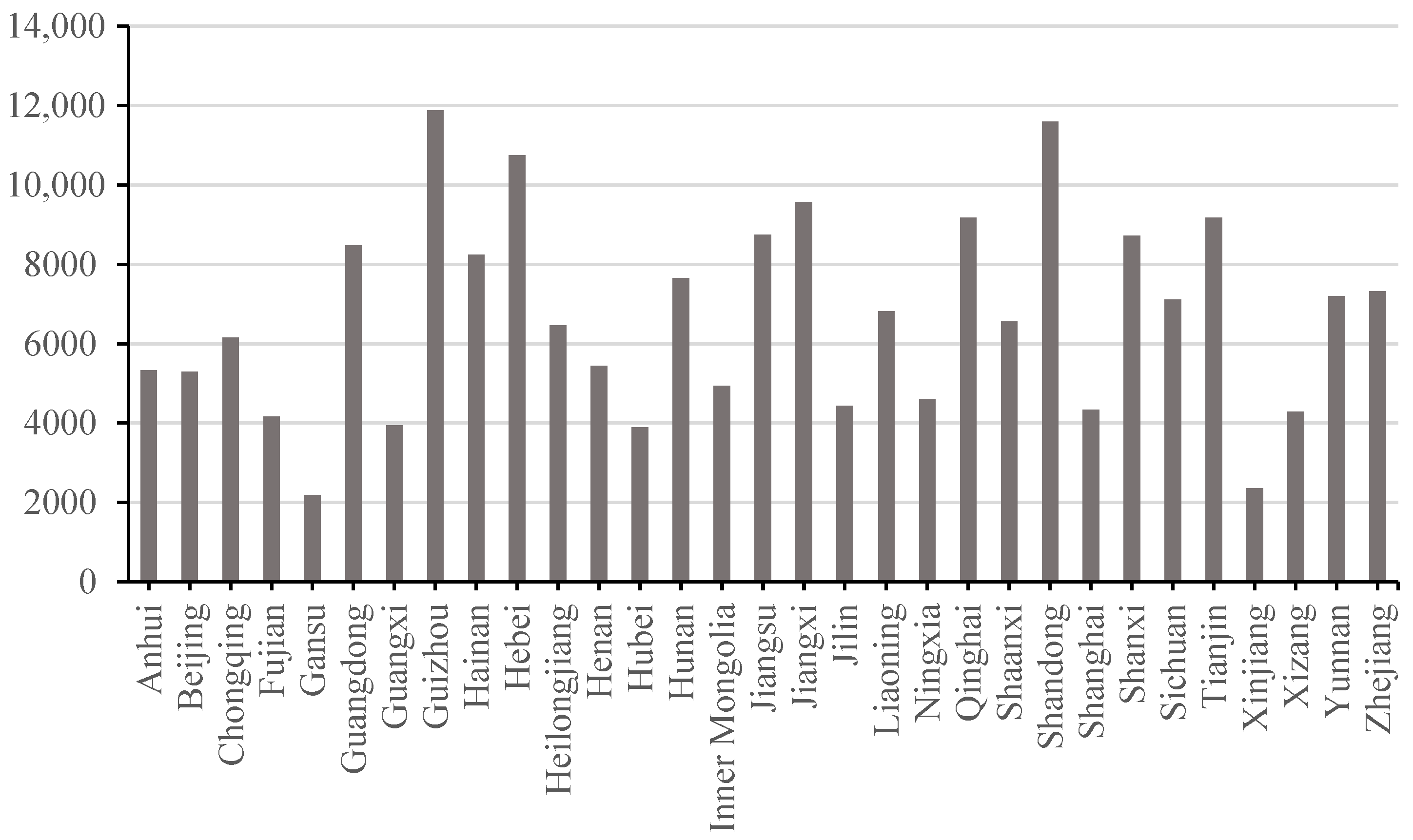
This study uses Chinese cities as the unit of analysis. We collect data on green-oriented policy narratives, energy intensity, mechanism variables, and controls. To measure green-oriented policy narrative variables, we follow existing research in using news media articles as the data source [54,72,73,74,75]. Specifically, we select Chinese provincial Party newspapers as our primary source. As official media, Party newspapers’ environment-related coverage directly reflects government-level green-oriented policy narratives, has high policy representativeness, and maintains relatively consistent standards in publication cycles and content positioning, providing cross-regional comparability. Party newspaper data are obtained through the WiseSearch database. To measure energy intensity, we obtain data from the China City Statistical Yearbook, provincial and municipal statistical yearbooks, and prefecture-level city statistical bulletins. To measure mechanism and control variables, we obtain data from various sources: green credit data from China Industrial Enterprise Database, green innovation data from the China Research Data Services Platform (CNRDS), and control variables from China City Statistical Yearbook. Our sample spans 288 Chinese prefecture-level and above cities from 2010 to 2022. Figure 2 presents the provincial variation in green-oriented policy narrative exposure.

4.2. Model Specification

4.2.1. Baseline Model

To examine the impact of green-oriented policy narrative exposure on urban energy intensity, this study constructs the following baseline regression model:
E N E _ I N T i t = α 0 + α 1 P O L _ N A R i , t 1 + k β k C o n t r o l s i t 1 + μ i + λ t + ε i t
where subscript i represents the city and t represents the year. E N E _ I N T i t represents the energy intensity level of city i in year t . P O L _ N A R i , t 1 represents the degree of green-oriented policy narrative exposure in the province where city i located in year t 1 , lagged one period to mitigate reverse causality issues. C o n t r o l s i t 1 represents a series of control variables affecting energy intensity. μ i represents city fixed effects, controlling for time-invariant characteristics at the city level; λ t represents year fixed effects, controlling for common time trends faced by all cities; ε i t represents the random error term. The coefficient α 1 is the core parameter of interest in this model, reflecting the net effect of green-oriented policy narrative exposure on urban energy consumption. The Hausman test results reject the random effects model at the 1% significance level, supporting the use of the fixed effects model (see Table S1 in Section S1). Additionally, variance inflation factor (VIF) tests show that all explanatory variables have VIF values below 10, indicating no significant multicollinearity issues in our model (see Table S2 in Section S1).

4.2.2. Mechanism Verification Model

To examine the mechanisms through which green-oriented policy narrative exposure influences urban energy consumption, we employ two complementary approaches: the traditional Baron and Kenny (1986) framework and the Double Machine Learning (DML) approach [76].
We first estimate the following framework:
M i t = γ 0 + γ 1 P O L _ N A R i , t 1 + k δ k C o n t r o l s i t 1 + μ i + λ t + ε i t  
E N E _ I N T i t = θ 0 + θ 1 P O L _ N A R i , t 1 + θ 2 M i t + k ϕ k C o n t r o l s i t 1 + μ i + λ t + ε i t
where M i t represents the mechanism variables, including green credit development level and green innovation level. The coefficient γ 1 in Equation (2) represents the effect of the independent variable on the mechanism variable, and the coefficient θ 2 in Equation (3) represents the impact of the mechanism variable on the dependent variable. If both γ 1 and θ 2 are significant, the mechanism is confirmed. The settings for other variables are the same as in Equation (1).
While the traditional mediation framework provides initial evidence for mechanism verification, Equation (2) may suffer from endogeneity concerns arising from the relationship between the independent variable (green-oriented policy narrative exposure) and mechanism variables (green credit and green innovation) [77]. Specifically, unobserved confounders may simultaneously influence both narrative exposure and the mechanism variables, and the functional forms of these confounding effects may involve high-dimensional interactions and nonlinearities that linear regression models cannot adequately capture. To address these issues, we additionally employ the Double Machine Learning (DML) approach proposed by Chernozhukov et al. (2018) to re-estimate the effect of green-oriented policy narrative exposure on mechanism variables [78]. DML addresses endogeneity by leveraging machine learning algorithms to flexibly model the complex relationships between confounders and both the independent variable and the mechanism variable, without imposing restrictive linear functional form assumptions. Traditional linear regression assumes that confounders X affect the independent variable and mechanism variable through simple linear relationships. However, in reality, these relationships often involve high-dimensional interaction effects and nonlinearities. DML employs nonparametric machine learning algorithms (such as Random Forest) to capture these complex patterns, thereby more accurately isolating the causal effect of the independent variable on the mechanism variable after controlling for confounders. This approach has been increasingly adopted in recent empirical research to enhance the credibility of mechanism testing by addressing potential endogeneity and model misspecification concerns [79].
Following Chernozhukov et al. (2018), we establish two sets of DML functional forms for mechanism verification [78]. First, to examine the effect of green-oriented policy narrative exposure on mechanism variables:
M i t = θ 1 P O L _ N A R i , t 1 + f 1 X i t 1 + U i t
P O L _ N A R i , t 1 = g 1 X i t 1 + V i t
where M i t represents the mechanism variable (green credit or green innovation), P O L _ N A R i , t 1 represents green-oriented policy narrative exposure, X i t 1 represents the set of control variables, and U i t and V i t represent random disturbances. The parameter θ reflects the causal effect of narrative exposure on the mechanism variable after flexibly controlling for confounders.
The estimation of θ using DML involves four steps: (1) The dataset is randomly divided into two subsets (Subset A and Subset B) to avoid overfitting; (2) Based on Subset A, machine learning algorithms (Random Forest) are employed to train predictive models for M i t and P O L _ N A R i , t 1 from X i t 1 ; (3) The predictive models are applied to Subset B to generate predictions, and residuals u ^ M and u ^ P O L _ N A R are calculated by comparing predicted and actual values. Regressing u ^ M on u ^ P O L _ N A R yields coefficient θ 1 for Subset B; (4) The roles of Subset A and Subset B are swapped, and steps 2–3 are repeated to obtain coefficient θ 2 for Subset A. The final estimate of θ is the average of θ 1 and θ 2 . If θ is significant in the DML framework, this provides more credible causal evidence that green-oriented policy narrative exposure influences urban energy intensity through the mechanism variable, complementing the traditional mediation analysis.

4.2.3. Moderating Effect Model

To test the moderating effects of public character prominence and narrativity on the main effect, this study constructs the following moderation effect model:
E N E _ I N T i t = π 0 + π 1 P O L _ N A R i , t 1 + π 2 M o d e r a t o r i , t 1 + π 3 P O L _ N A R i , t 1 × M o d e r a t o r i , t 1 + k ρ k C o n t r o l s i t 1 + μ i + λ t + ε i t
where M o d e r a t o r i , t 1 represents the moderating variables, including the prominence of the public in green-oriented policy narratives and the narrativity of green-oriented policy narratives. The coefficient π 3 of the interaction term P O L _ N A R i , t 1 × M o d e r a t o r i , t 1 reflects the magnitude and direction of the moderating effect. The settings for other variables are the same as in Equation (1).

4.3. Variable Measurements

4.3.1. Dependent Variable

Energy intensity (ENE_INT) is measured by total energy consumption in standard coal equivalent divided by regional GDP, representing energy consumption per unit of economic output [80]. Total energy consumption is calculated from three components: total electricity consumption, gas supply, and liquefied petroleum gas supply, converted using standard coal conversion coefficients. The measure is expressed as 10,000 tons of standard coal equivalent per 100 million yuan of GDP, capturing the energy efficiency of urban economic activity. Data are obtained from the China City Statistical Yearbook, provincial and municipal statistical yearbooks, and prefecture-level city statistical bulletins, which provide consistent and authoritative measurements across all Chinese cities.

4.3.2. Independent Variable

Green-oriented policy narrative exposure (POL_NAR) is measured by the annual number of green-oriented policy narrative articles published by each provincial Party newspaper. The key challenge lies in accurately identifying green-oriented policy narratives from large-scale newspaper text. Recent studies demonstrate that large language models (LLMs) can reliably identify specific types of text in economic and management research [81,82]. Research shows that LLMs, trained on massive text data, have developed human-like language comprehension abilities and perform text coding tasks with quality comparable to or exceeding human coding [83,84,85,86]. Building on this methodological foundation, we employ a two-stage process combining keyword-based retrieval and LLM-based classification.
Stage 1: Keyword-based retrieval. We retrieve articles from provincial Party newspapers using the Huike (WiseSearch) database. Articles are collected if their titles or full texts contain at least one green-related keyword from a list developed through expert interviews (e.g., “environmental protection,” “pollution,” “green,” “carbon,” “emission reduction”). This inclusive strategy yields 556,573 articles from 2010–2022 (see Section S2 for the complete keyword list and retrieval results).
Stage 2: LLM-based classification. Keyword-based retrieval inevitably introduces noise, as many articles contain green-related terms without substantively reflecting governmental green narratives. We employ LLMs to classify whether each article reflects official attention to green development. We develop the classification prompt through iterative optimization: First, two trained coders independently label 1000 randomly sampled articles, achieving high inter-rater reliability (Cohen’s Kappa = 0.91). Second, through multiple refinement rounds, we optimize the prompt until achieving excellent agreement with human coding (Cohen’s Kappa = 0.92). Third, we apply the validated prompt to the full corpus using the OpenAI API (GPT-4o, Temperature = 0), identifying 218,390 articles as green narratives. Validation on 1000 articles shows high classification performance: precision = 0.927, recall = 0.898, F1-score = 0.913, accuracy = 0.929 (see Section S2 for the complete prompt and validation results).
Finally, we aggregate identified green-oriented narratives at the province × year level, yielding our measure of green-oriented policy narrative exposure.

4.3.3. Mechanism Variables

Green credit (GRE_CRE) is measured using the green credit index, which captures regional green finance orientation. The green credit index is calculated as the proportion of interest expenditures from non-energy-intensive industries to total interest expenditures of industrial enterprises above designated size [87]. This measurement approach is theoretically grounded in the principle that a higher share of credit allocated to non-energy-intensive industries reflects stronger green finance orientation and more stringent environmental credit policies in the region. Energy-intensive industries are characterized by high energy consumption, substantial carbon emissions, and significant environmental impacts, making them primary targets for green credit restrictions. By excluding these sectors from the numerator, the green credit index effectively captures the extent to which financial institutions prioritize lending to environmental-friendly actors. The green credit index (GCI) is calculated through Equation (7):
G C I i t = I n t e r e s t i t I n t e r e s t i t H E I n t e r e s t i t
where I n t e r e s t i t represents the total interest expenditure of industrial enterprises above designated size in province i in year t , and I n t e r e s t i t H E represents the total interest expenditure of industrial enterprises above designated size in the major energy-intensive industries in province i in year t . The larger the value of this indicator, the higher the level of regional green credit.
Green innovation (GRE_INN) is quantified by the number of green invention patent applications at the province level. Green innovation represents an approach that integrates environmental-friendly technologies across the production lifecycle to enhance resource utilization efficiency while minimizing environmental hazards [88,89]. Patent counts serve as robust proxies for measuring innovation activities in China, with invention patents demonstrating the highest technological innovation value among green patent categories [90,91,92]. We use green invention patent grants rather than applications because granted patents can effectively exclude defensive patent applications that lack substantial technological innovation, thus providing a more accurate measure of genuine green innovation output by filtering out low-value filings and capturing only innovations that have passed rigorous examination.

4.3.4. Moderating Variables

The prominence of the public (PUB_PRO) is measured through a two-step approach following existing research [93,94,95]. The first step employs LDA topic modeling to identify latent topic structures within green-oriented policy narratives, where each topic represents a distinct thematic dimension focusing on specific policy domains and actions [96]. The second step identifies the primary characters portrayed in each topic through systematic analysis of feature words. This two-step procedure allows us to measure the extent to which green-oriented policy narratives feature the public as protagonists.
We use Python’s (3.10.8) gensim library to implement LDA modeling on green-oriented policy narrative articles, determining the optimal number of topics as 13 through coherence scores (see Figure S1 in Section S3). Three experts familiar with green-oriented policy and narrative analysis independently evaluate each topic’s feature words to identify the primary characters portrayed, achieving high agreement (Fleiss’ Kappa = 0.82). Character identification is based on systematic analysis of action verbs, subject positions, and thematic focus within feature words. Among the 13 topics, Topic 3 (Household Waste Sorting & Management) and Topic 9 (Environmental Publicity & Community Participation) prominently feature the public as primary characters, with feature words indicating citizen-centered actions, community engagement, and household-level behaviors (In contrast, other topics primarily feature enterprises (e.g., Topic 4: Green Industry & Economic Services; Topic 13: Green Industry Development), agricultural producers (e.g., Topic 12: Agricultural Development), or government departments (e.g., Topic 5: Environmental Inspection & Rectification; Topic 11: Environmental Protection System) as main characters (see Table S6 in Section S3 for detailed topic descriptions and feature words)).
For each green-oriented policy narrative article, the LDA model outputs its probability distribution across all 13 topics. We calculate each article’s public prominence score by summing its probabilities for Topics 3 and 9—the two topics where the public serves as the primary character. We then compute the average public prominence score across all green-oriented policy narrative articles published in each province each year, yielding a province-year measure of the extent to which green-oriented policy narratives emphasize the public as protagonists.
Narrativity (NAR_LEV) is measured using LLM annotation. Narrativity refers to the degree text presents a series of events, with high-narrativity texts containing rich details, clear causal logic, and vivid descriptions [70,71]. A growing body of economic research demonstrates that LLMs can effectively extract and quantify abstract theoretical concepts from policy documents, conference call transcripts, news, and website text [97,98,99,100]. These applications validate LLMs’ capability to capture nuanced textual constructs beyond simple keyword matching.
The measurement process involves several steps. First, we randomly select 500 green-oriented policy narrative articles, with two research assistants independently scoring each article’s narrativity on a 1–5 scale based on event completeness, causal clarity, and detail richness. Second, through iterative prompt optimization, we develop a prompt that instructs the LLM to score narrativity on the same 1–5 scale. We apply this prompt to the 500 sample articles using the OpenAI API (GPT-4o, Temperature = 0). To assess agreement, we convert both human and LLM scores into binary classifications (scores ≥ 4 as high-narrativity, scores < 4 as low-narrativity) and calculate Cohen’s Kappa, achieving excellent agreement (Kappa = 0.91). Third, using the validated prompt (see Section S4), we annotate all 218.390 green-oriented policy narrative articles. To verify classification quality, we conduct a post hoc validation by randomly sampling 1000 LLM-annotated articles and having trained coders independently score them. Converting both sets of scores to binary classifications, we find high consistency (Kappa = 0.90), confirming the reliability of the LLM annotations. Finally, we define articles scoring 4 or above as high-narrativity and calculate the proportion of high-narrativity articles among all green-oriented policy narrative articles in each province each year.

4.3.5. Control Variables

Drawing on existing research on energy consumption determinants, this study selects the following control variables [11,12,14,24]: Economic development level (ECO_DEV) is measured by the natural logarithm of per capita regional GDP, reflecting regional resource endowments and capacity for energy-efficient investments; Science and technology expenditure level (SCI_EXP) is measured by the proportion of science and technology expenditure to general government budgetary expenditure, reflecting government support for energy-saving technological innovation; Industrial structure (IND_STR) is measured by the ratio of tertiary industry value-added to secondary industry value-added, affecting regional energy consumption patterns and transformation pathways; Education expenditure level (EDU_EXP) is measured by the proportion of education expenditure to general government budgetary expenditure, affecting regional human capital quality and awareness of energy conservation; Financial development degree (FIN_DEV) is measured by the proportion of financial institution loan balances to GDP, affecting enterprise financing capacity for energy-efficient technologies; Openness level (OPE_LEV) is measured by the proportion of total import and export volume to regional GDP, affecting technology spillovers in energy-efficient practices and international competitive pressure. Descriptive statistics for each variable are shown in Table 1.

5. Empirical Results

5.1. Baseline Results

We investigate the relationship between green-oriented policy narrative exposure and urban energy consumption through the estimation model specified in Equation (1). The empirical findings are displayed in Table 2. Column (1) showcases the baseline estimation excluding control variables, revealing that the estimated coefficient of green-oriented policy narrative exposure (POL_NAR) is negative and achieves high statistical significance (β = −0.026, p < 0.01). When incorporating the full set of control variables in Column (2), the coefficient maintains its negative sign and remains significant at the 5% level (β = −0.012, p < 0.05). These estimates suggest that each additional thousand green-oriented policy narrative articles correspond to a decrease of 0.012 in energy consumption per unit of GDP (measured as 10,000 tons of standard coal equivalent per 100 million yuan). Given that the mean energy intensity in our sample is 0.10, this coefficient implies that increasing narrative exposure by one thousand articles reduces energy intensity by approximately 12% (0.012/0.10), representing a substantial policy impact. This empirical evidence lends preliminary support to Hypothesis 1, validating a negative linkage between green-oriented policy narrative exposure and urban energy intensity.

5.2. Robustness Checks

We conduct a comprehensive set of robustness checks, including alternative measurement of the independent variable, alternative measurements of the dependent variable, alternative sample specifications, instrumental variable approach, and alternative lag specifications. These checks are essential for establishing the reliability of our main results and the validity of subsequent mechanism and moderation analyses.

5.2.1. Alternative Measurement of Independent Variable

In the baseline regression, the measurement of green-oriented policy narrative exposure relies on text identification results from the OpenAI LLM. To test the robustness of the measurement method, this study employs another mainstream large language model (Alibaba’s Qwen LLM) to re-identify and code the Party newspaper articles, constructing an alternative green-oriented policy narrative exposure indicator (POL_NARX). Different LLMs vary in training data, algorithmic architecture, and semantic understanding capabilities. If results identified using different models still support the main effect, this indicates that research conclusions are insensitive to the choice of measurement tools and possess strong robustness.
Table 3 presents regression results using the alternative measurement method. Column (1) shows results without control variables, and Column (2) shows results with control variables. The results indicate that the coefficient of the alternative green-oriented policy narrative exposure indicator (POL_NARX) is significantly negative at the 5% level in both specifications (β = −0.020, p < 0.01 in column 1; β = −0.009, p < 0.05 in column 2), and the coefficient magnitudes are comparable to the baseline regression results (−0.026 and −0.012), demonstrating that the negative effect of green-oriented policy narrative exposure on urban energy intensity remains robust after changing the measurement method, further enhancing the credibility of the research conclusions.

5.2.2. Alternative Measurements of Dependent Variable

The baseline analysis uses energy intensity per unit of GDP, measured in 10,000 tons of standard coal equivalent per 100 million yuan. To test whether our findings are held across different measurement approaches, we employ two alternative measures of the dependent variable. First, following Hao and Peng (2017), we use per capita energy intensity (ENE_INTX1), calculated as total energy intensity divided by total population, measured in 10,000 tons of standard coal equivalent per 10,000 persons [101]. This measure accounts for population size and focuses on energy intensity from a demographic perspective rather than an economic output perspective. Second, we use satellite-based nighttime light data to estimate per capita energy intensity (ENE_INTX2), following Wu et al. (2014) [102]. This approach provides an independent, objective measurement that does not rely on statistical reporting systems.
Table 4 presents regression results using these alternative dependent variable measurements. Columns (1) and (2) report results for per capita energy intensity based on statistical data, while columns (3) and (4) report results for per capita energy intensity estimated from nighttime light data. The coefficient on green-oriented policy narrative exposure (POL_NAR) is negative and highly significant across all specifications. For statistical per capita energy intensity, the coefficients are β = −0.144 (p < 0.01) without controls and β = −0.126 (p < 0.01) with controls. For nighttime light-based per capita energy intensity, the coefficients are β = −0.270 (p < 0.05) without controls and β = −0.374 (p < 0.01) with controls. The consistency of findings across different measurement approaches—whether normalized by population or by economic output—strongly supports the robustness of our main conclusion.

5.2.3. Alternative Sample Specifications

The baseline analysis uses prefecture-level and above cities as the unit of analysis. To test whether our findings hold at different administrative levels, we re-estimate the model using provincial-level data. This alternative specification reduces sample size but provides a different aggregation level for testing the relationship. Provincial-level data may better capture policy narrative effects that operate through provincial government actions and coordination, as provincial Party newspapers primarily target provincial-level policymakers and stakeholders.
Table 5 presents regression results using provincial-level data. Column (1) shows results without control variables, and Column (2) shows results with control variables. The coefficient on green-oriented policy narrative exposure (POL_NAR) is negative and highly significant in both specifications (β = −0.102 in column 1; β = −0.101 in column 2, p < 0.01 in both columns). The coefficient magnitude is larger than in the city-level analysis (baseline: β = −0.026 and β = −0.012), suggesting that narrative effects may be more pronounced at the provincial level where policy coordination is stronger and narrative dissemination more concentrated. These results confirm that the negative impact of green-oriented policy narrative exposure on energy intensity remains robust across different administrative scales, further validating Hypothesis 1.

5.2.4. Instrumental Variable Approach

Although we lagged the independent variable in the baseline regression to mitigate reverse causality concerns, omitted variable bias may persist. To further address endogeneity issues, we employ an instrumental variable (IV) approach for robustness checks.
We construct instrumental variables using the average green-oriented policy narrative exposure of each province’s competitive learning targets (provinces ranked higher in economic development). The rationale for using competitive learning targets’ narrative exposure as an instrumental variable rests on satisfying both the relevance and exclusion restriction conditions. Regarding relevance, within China’s inter-governmental competition system, local governments tend to learn from and benchmark against regions with slightly higher economic development levels [103]. Consequently, the narrative strategies of these competitive learning targets systematically influence the narrative practices of the focal province. Regarding exogeneity (exclusion restriction), the narrative exposure of competitive learning targets is unlikely to directly affect energy intensity in the focal province’s cities. Competitive learning targets have no administrative affiliation with province i ’s cities, precluding direct influence. Moreover, since these targets are identified based on economic rankings rather than geographic proximity, they may not be spatially adjacent to province i , making spillover effects on energy intensity within province i ’s cities improbable. Thus, the instrumental variable satisfies the exclusion restriction.
Following this logic, we employ two alternative specifications to test the robustness of our IV strategy. In the first specification, the competitive learning target for province i is defined as the province ranked 1 position higher than province i in per capita GDP rankings in a given year. For example, if province i ranks 10th in per capita GDP, we use the green-oriented policy narrative exposure of the province ranked 9th as the instrumental variable (IV_1). In the second specification, we extend the definition to include provinces ranked 1 and 2 positions higher. Using the same example, if province i ranks 10th, we calculate the average narrative exposure of provinces ranked 8th and 9th as the alternative instrumental variable (IV_2).
Table 6 reports the estimation results using IV_1 (competitive learning targets ranked 1 position higher). Column (1) presents the first-stage regression, showing that the instrumental variable has a significantly positive effect on green-oriented policy narrative exposure (β = 0.160, p < 0.01), confirming the relevance of the instrument. The Cragg-Donald Wald F-statistic equals 129.86, substantially exceeding the rule-of-thumb threshold of 10, indicating that weak instrument concerns are not present. Column (2) presents the second-stage regression results. The coefficient on green-oriented policy narrative exposure (POL_NAR) remains significantly negative (β = −0.076, p < 0.01), and the magnitude is larger than the baseline estimate, consistent with the IV approach correcting for attenuation bias.
Table 7 reports the estimation results using IV_2 (competitive learning targets ranked 2 positions higher). Column (1) shows that this alternative instrumental variable also has a significantly positive effect on narrative exposure (β = 0.120, p < 0.01), confirming instrument relevance. The Cragg-Donald Wald F-statistic equals 34.24, still well above the threshold of 10, indicating adequate instrument strength. Column (2) presents the second-stage results, where the coefficient on green-oriented policy narrative exposure remains significantly negative (β = −0.145, p < 0.01).
The consistency of results across both IV specifications—with negative and significant coefficients in all second-stage regressions—strongly supports the robustness of our main finding that green-oriented policy narrative exposure reduces urban energy intensity, even after addressing potential endogeneity concerns through alternative instrumental variable strategies.

5.2.5. Alternative Lag Specifications

In the baseline regression, we lagged the independent variable by one period to mitigate reverse causality concerns. However, the effects of green-oriented policy narratives on urban energy intensity may not manifest immediately but could require longer time lags to fully materialize. To test whether our findings are sensitive to the choice of lag structure, we re-estimate the model using alternative lag specifications.
We examine two extended lag specifications: a two-period lag (L2.POL_NAR) and a three-period lag (L3.POL_NAR). These alternative specifications allow us to assess whether narrative effects persist or strengthen over longer time horizons, and whether our main conclusions remain robust across different temporal structures.
Table 8 reports the estimation results. Columns (1) and (2) present results using a two-period lag of green-oriented policy narrative exposure. Column (1) shows the baseline specification without control variables, where the coefficient on L2.POL_NAR is significantly negative (β = −0.028, p < 0.01). Column (2) adds the full set of control variables, and the coefficient remains significantly negative (β = −0.018, p < 0.01), indicating that narrative exposure from two periods prior continues to exert a negative effect on current urban energy intensity.
Columns (3) and (4) present results using a three-period lag. Column (3) shows the baseline specification, where the coefficient on L3.POL_NAR is significantly negative (β = −0.023, p < 0.01). Column (4) includes control variables, and the coefficient remains significantly negative (β = −0.016, p < 0.01). These results demonstrate that even with a three-year lag, green-oriented policy narrative exposure continues to significantly reduce urban energy intensity.

5.3. Mechanism Verification

Having established the negative effect of green-oriented policy narrative exposure on urban energy intensity, we now examine the underlying mechanisms proposed in our theoretical framework: green credit (H1a) and green innovation (H1b). Following the empirical strategy outlined in Equations (2) and (3), we employ a two-step procedure to verify these pathways, the results of which are presented below.
Table 9 presents results for the green credit mechanism. Columns (1) and (2) test the effect of green-oriented policy narrative exposure on green credit. The coefficient on green-oriented policy narrative exposure (POL_NAR) is positive and highly significant (β = 5.634, p < 0.01 in column 1; β = 4.982, p < 0.01 in column 2), indicating that green-oriented policy narrative exposure significantly promotes regional green credit development. Columns (3) and (4) test the effect of green credit on urban energy intensity, controlling for green-oriented policy narrative exposure. The coefficient on green credit (GRE_CRE) is negative and highly significant (β = −0.001, p < 0.01 in both specifications), indicating that higher regional green credit development is associated with lower urban energy intensity per unit of GDP. Notably, when green credit is included in the model, the direct effect of narrative exposure becomes weaker (β = −0.019, p < 0.01 in column 3) or statistically insignificant (β = −0.008, not significant in column 4), suggesting that green credit substantially mediates the narrative-energy relationship. These results indicate that the negative effect of green-oriented policy narrative exposure on urban energy intensity operates substantially through promoting green credit development, supporting Hypothesis 1a.
To quantify the magnitude of the mediation effect, we calculate the indirect effect as the product of the two coefficients from the fully specified model (columns 2 and 4): 4.982 × (−0.001) = −0.005. This indicates that for each additional thousand narrative articles, green credit development contributes to a reduction of 0.005 in energy intensity. Comparing this indirect effect with the total effect from the baseline regression (−0.012), the green credit mechanism accounts for approximately 41.67% of the total effect of narrative exposure on energy intensity.
Table 10 presents results for the green innovation mechanism. Columns (1) and (2) test the effect of green-oriented policy narrative exposure on green innovation. The coefficient on green-oriented policy narrative exposure (POL_NAR) is positive and highly significant (β = 0.230, p < 0.01 in column 1; β = 0.211, p < 0.01 in column 2), indicating that green-oriented policy narrative exposure significantly promotes regional green innovation. Columns (3) and (4) test the effect of green innovation on urban energy intensity, controlling for green-oriented policy narrative exposure. The coefficient on green innovation (GRE_INN) is negative and highly significant (β = −0.010, p < 0.01 in column 3; β = −0.011, p < 0.01 in column 4), indicating that higher regional green innovation is associated with lower urban energy intensity per unit of GDP. When green innovation is included in the model, the direct effect of narrative exposure remains negative and significant (β = −0.023, p < 0.01 in column 3; β = −0.010, p < 0.1 in column 4), suggesting partial mediation. These results indicate that the negative effect of green-oriented policy narrative exposure on urban energy intensity operates partially through promoting green innovation, supporting Hypothesis 1b.
To quantify the mediation effect, we calculate the indirect effect as the product of the two coefficients from the fully specified model (columns 2 and 4): 0.211 × (−0.011) = −0.002. This indicates that for each additional thousand narrative articles, green innovation contributes to a reduction of 0.002 in energy intensity. Comparing this indirect effect with the total effect from the baseline regression (−0.012), the green innovation mechanism accounts for approximately 16.67% of the total effect of narrative exposure on energy intensity.
To further strengthen the credibility of our mechanism findings and address potential endogeneity concerns in the relationship between narrative exposure and mechanism variables, we re-estimate the first-stage effects using the Double Machine Learning approach specified in Equations (4) and (5). Table 11 presents the DML estimation results. Column (1) shows that green-oriented policy narrative exposure has a significantly positive causal effect on green credit development, with a p-value less than 0.01, which is consistent with the traditional regression findings. Column (2) shows that narrative exposure has a significantly positive causal effect on green innovation, with a p-value of 0.017, closely aligned with the traditional regression results. The consistency between DML and traditional regression estimates indicates that our mechanism findings are robust to potential endogeneity arising from complex confounding relationships. Moreover, the DML approach, by flexibly modeling high-dimensional interactions and nonlinearities through machine learning algorithms, provides more credible causal evidence that green-oriented policy narrative exposure influences urban energy intensity through both green credit and green innovation pathways.

5.4. Moderation Analysis

Beyond establishing the direct effect and underlying mechanisms, we further investigate the boundary conditions under which green-oriented policy narrative exposure exerts differential impacts on urban energy intensity. Building on the theoretical framework developed in Section 3, we examine two key content characteristics that may amplify the narrative-energy relationship: the prominence of the public in narratives and the narrativity of narratives. Following the moderation effect model specified in Equation (6), the following presents the moderation test results.
Table 12 presents results for the moderating effect of the prominence of the public. Columns (1) and (2) report estimates without and with controls, respectively. The key coefficient is on the interaction term between green-oriented policy narrative exposure and the prominence of the public (POL_NAR × PUB_PRO). The interaction coefficient is negative and highly significant (β = −0.632, p < 0.01 in column 1; β = −0.507, p < 0.01 in column 2), indicating that the prominence of the public in green-oriented policy narratives negatively moderates the relationship between narrative exposure and urban energy intensity. More specifically, as the prominence of the public in narratives increases, the negative effect of narrative exposure on energy intensity strengthens. When green-oriented policy narratives more prominently portray the public as concerned about environmental issues and demanding sustainable products, this sends powerful market signals to investors and producers, motivating them to allocate more capital through green credit and accelerate green innovation, thereby amplifying energy reduction effects. These results support Hypothesis 2.
Table 13 presents results for the moderating effect of narrativity. Columns (1) and (2) report estimates without and with controls. The key coefficient is on the interaction term between green-oriented policy narrative exposure and narrativity (POL_NAR × NAR_LEV). The interaction coefficient is negative and highly significant (β = −0.094, p < 0.01 in column 1; β = −0.093, p < 0.01 in column 2), indicating that narrativity of green-oriented policy narratives negatively moderates the relationship between narrative exposure and urban energy intensity. More specifically, as narrativity increases, the negative effect of narrative exposure on energy intensity strengthens. When green-oriented policy narratives employ higher narrativity—containing richer details, clearer causal logic, and more vivid descriptions—they more effectively capture attention, clarify how investment and production choices affect energy outcomes, and paint compelling visions of sustainable futures, thereby amplifying energy reduction effects. These results support Hypothesis 3.
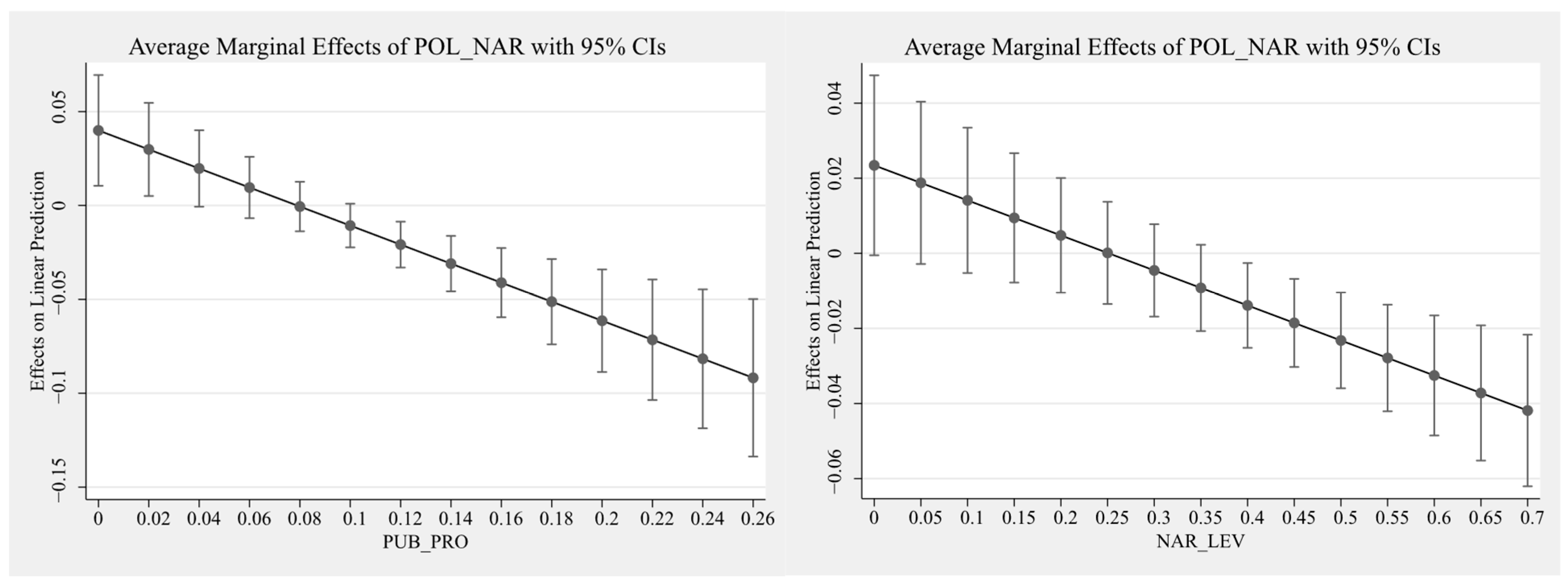
To further illustrate the policy significance of these moderating effects, we compute and visualize the marginal effects of narrative exposure at varying levels of the two moderators. Figure 3 presents these results. The left panel shows that as public prominence increases, the marginal effect becomes progressively more negative. When public prominence is at 0.10, the marginal effect is −0.011 (p < 0.10), and when it increases to 0.14, the marginal effect strengthens significantly to −0.031 (p < 0.01), representing a nearly three-fold amplification. The right panel reveals a similar pattern for narrativity. At the mean level of narrativity (0.35), the marginal effect is −0.009 (p < 0.05). When narrativity increases to 0.50, the marginal effect intensifies to −0.023 (p < 0.01), representing a more than two-fold strengthening. These findings underscore that strategically emphasizing the public as key protagonists and enhancing narrative quality through vivid storytelling can substantially magnify the impact of policy communications on energy conservation outcomes.

6. Further Analysis

Narrative influence on energy intensity operates through two sequential steps: dissemination and response. In the dissemination step, narratives must reach economic actors through various channels; in the response step, actors must interpret narrative signals and translate them into concrete decisions. This two-step process suggests that narrative effects may vary systematically across cities depending on their dissemination infrastructure and institutional conditions that shape actor responsiveness. To explore this heterogeneity, we examine two contextual factors that theoretically facilitate the narrative-energy relationship. First, in the digital era, the internet serves as a critical channel for narrative diffusion beyond traditional media, enabling broader and more rapid information transmission through online news portals, social media platforms, and digital communication networks. Cities with higher internet penetration may exhibit stronger narrative effects due to enhanced dissemination capacity that amplifies provincial Party newspaper messages. Second, market-oriented institutional environments shape economic actors’ responsiveness to policy signals embedded in narratives. In more marketized cities, enterprises operate with greater autonomy and face stronger competitive pressures, potentially heightening their sensitivity to official narratives about green development and energy conservation. We measure internet penetration (INT_PEN) as internet users per capita and marketization level (MAR_LEV) using the NERI Index of Marketization, following established research practices.
Table 14 presents the heterogeneity analysis results. Columns (1) and (2) test the moderating effect of internet penetration. The interaction term (POL_NAR × INT_PEN) is negative and statistically significant (β = −0.001, p < 0.01), indicating that higher internet penetration strengthens the negative effect of provincial Party newspaper narratives on energy intensity. This finding supports the dissemination amplification mechanism: in digitally advanced cities, online channels complement traditional official media by broadening narrative reach and accelerating information diffusion, thereby enhancing the energy reduction impact of green-oriented policy narratives. Columns (3) and (4) test the moderating effect of marketization level. The interaction term (POL_NAR × MAR_LEV) is also negative and significant (β = −0.010 and −0.009, both p < 0.01), suggesting that in more market-oriented environments, enterprises exhibit heightened responsiveness to government narratives when making energy-related decisions. This result indicates that market competition and autonomy enhance rather than diminish actors’ sensitivity to policy signals, as firms in marketized contexts actively scan the institutional environment for strategic guidance on energy efficiency investments. Together, these findings demonstrate that both higher internet penetration and higher marketization levels amplify the energy reduction effects of green-oriented policy narratives.

7. Conclusions and Implications

Reducing energy intensity is critical for combating climate change, yet current progress remains insufficient to meet international targets. Green-oriented policy narratives hold significant potential for mitigating energy intensity by influencing firms’ expectations and behavior. However, existing research remains limited by its focus on national-level analysis and predominant use of qualitative methods, offering limited guidance for evidence-based regional policymaking. Using Chinese provincial Party newspapers and panel data from 288 cities (2010–2022), we employ large language models and LDA topic modeling to examine how green-oriented policy narrative exposure influences urban energy intensity. Our findings reveal follow key results: green-oriented policy narrative exposure significantly reduces urban energy intensity through promoting green credit development and stimulating green innovation; the negative effect strengthens as the prominence of the public and narrativity of narratives increase; and narrative effectiveness is amplified in contexts with higher internet penetration and marketization levels.
Our findings offer four policy implications for promoting energy conservation through narrative-based governance. First, regarding narrative dissemination strategy, policymakers should strategically construct and disseminate green-oriented policy narratives through official media platforms. Our results show that narrative exposure reduces urban energy intensity by promoting green credit development and stimulating green innovation, suggesting that governments should utilize media channels to create narrative constellations fostering a social atmosphere conducive to energy conservation. Second, regarding narrative character design, governments should emphasize the public’s role in narrative construction by highlighting citizens’ environmental concerns, sustainable consumption demands, and community participation. This portrayal enhances market signals to investors and producers, amplifying energy conservation effects. Third, regarding narrative format optimization, policymakers should enhance narrativity by employing story-based presentation methods with concrete details, clear causal logic, and vivid descriptions. High-narrativity narratives strengthen credibility and emotional resonance, providing sustained motivation for energy conservation actions. Fourth, regarding contextual facilitation, governments should enhance cities’ digital infrastructure and market-oriented environments to amplify narrative effectiveness. Our heterogeneity analysis reveals stronger effects in cities with higher internet penetration and marketization levels, suggesting that policymakers should invest in improving digital infrastructure and promoting market-oriented reforms to create institutional conditions that facilitate narrative dissemination and enhance actor responsiveness.
This study contributes to existing literature in three ways. First, it expands research on the determinants of energy intensity. Existing research primarily focuses on substantive policy interventions while overlooking policy narratives as governance tools. We confirm that government-constructed green-oriented policy narratives can reduce urban energy intensity, providing a new policy instrument perspective for understanding energy conservation pathways. Second, it advances green-oriented narrative research from the micro-individual to the macro-regional level. Most existing research employs experimental methods focusing on individual-level environmental cognition and behavioral intentions. We use large-scale observational data to confirm the effects of green-oriented policy narrative exposure on urban energy intensity, expanding understanding of green-oriented narratives’ macro-level energy effects. Third, it deepens theoretical understanding of narrative influence mechanisms and boundary conditions in narrative economics. While narrative economics emphasizes that narratives influence behavior by shaping expectations, exploration of transmission pathways and moderating factors has been limited. We identify two mechanisms—promoting green credit development and stimulating green innovation—and demonstrate how the prominence of the public and narrativity moderate narrative effects, enriching narrative economics’ theoretical framework regarding influence pathways and boundary conditions.
Despite these contributions, our study has three limitations that open avenues for future inquiry. First, our measurement of green-oriented policy narrative sources has limitations. We use only provincial Party newspapers as our data source, which may not fully capture the complete narrative landscape. For example, central-level media such as People’s Daily also disseminate green-oriented policy narratives nationwide, potentially affecting cities across regions. Future research should explore measurement approaches that better reflect diverse narrative ecosystems, such as integrating green-oriented policy narrative data from multiple media channels, to more comprehensively capture dissemination patterns and impacts. Second, our mechanism analysis has room for expansion. Our mechanism hypotheses focus on two pathways: green credit and green innovation. However, narratives’ influence on energy intensity is multidimensional, potentially involving other pathways such as government officials’ attention allocation to energy issues, enterprises’ strategic shifts toward energy-efficient production, and changes in industrial structure planning. Future research can explore additional potential mechanisms through how green-oriented policy narratives influence urban energy intensity to construct a more complete theoretical framework. Third, the generalizability of our findings beyond the Chinese context warrants careful examination. Cross-national variation in media systems, government-business relationships, and energy governance institutions suggests that the narrative-energy intensity relationship may manifest with varying patterns and intensities across institutional settings. Future research should leverage cross-national comparative designs to assess both the universal elements and context-specific contingencies of this relationship, thereby identifying the institutional and cultural moderators that amplify or attenuate narrative effects on energy conservation.

Supplementary Materials

The following supporting information can be downloaded at: https://www.mdpi.com/article/10.3390/su18020924/s1, Section S1. Hausman Test and Variance Inflation Factor (VIF) Analysis. Section S2. Measurement of Green-Oriented Policy Narrative Exposure. Section S3. Topic Modeling Results. Section S4. Prompt Template for Assessing Narrativity.

Author Contributions

Methodology, S.S.; Software, S.S.; Validation, S.S.; Formal analysis, G.C.; Investigation, X.C.; Data curation, G.C.; Writing—original draft, G.C.; Writing—review & editing, X.C.; Supervision, X.C.; Project administration, X.C. All authors have read and agreed to the published version of the manuscript.

Funding

This research received no external funding.

Institutional Review Board Statement

Not applicable.

Informed Consent Statement

Not applicable.

Data Availability Statement

The data presented in this study are available on request from the corresponding author (the data are not publicly available due to the fact that they are part of an ongoing study).

Conflicts of Interest

The authors declare no conflict of interest.

References

  1. Zhou, S.; Wang, Y.; Yuan, Z.; Ou, X. Peak Energy Consumption and CO2 Emissions in China’s Industrial Sector. Energy Strateg. Rev. 2018, 20, 113–123. [Google Scholar] [CrossRef]
  2. Shiller, R.J. Narrative Economics: How Stories Go Viral and Drive Major Economic Events; Princeton University Press: Princeton, NJ, USA, 2020. [Google Scholar]
  3. Terzi, A. Crafting an Effective Narrative on the Green Transition. Energy Policy 2020, 147, 111883. [Google Scholar] [CrossRef]
  4. Vestrelli, R.; Fronzetti Colladon, A.; Fabiani, C.; Pisello, A.L. Energy Narratives in Europe: Exploring the Link between Online News and Renewable Energy Production. Energy Res. Soc. Sci. 2025, 128, 104345. [Google Scholar] [CrossRef]
  5. Mittlefehldt, S. Seeing Forests as Fuel: How Conflicting Narratives Have Shaped Woody Biomass Energy Development in the United States since the 1970s. Energy Res. Soc. Sci. 2016, 14, 13–21. [Google Scholar] [CrossRef]
  6. Hermwille, L. The Role of Narratives in Socio-Technical Transitions—Fukushima and the Energy Regimes of Japan, Germany, and the United Kingdom. Energy Res. Soc. Sci. 2016, 11, 237–246. [Google Scholar] [CrossRef]
  7. Malone, E.; Hultman, N.E.; Anderson, K.L.; Romeiro, V. Stories about Ourselves: How National Narratives Influence the Diffusion of Large-Scale Energy Technologies. Energy Res. Soc. Sci. 2017, 31, 70–76. [Google Scholar] [CrossRef]
  8. Gustafson, A.; Ballew, M.T.; Goldberg, M.H.; Cutler, M.J.; Rosenthal, S.A.; Leiserowitz, A. Personal Stories Can Shift Climate Change Beliefs and Risk Perceptions: The Mediating Role of Emotion. Commun. Rep. 2020, 33, 121–135. [Google Scholar] [CrossRef]
  9. Jones, M.D. Cultural Characters and Climate Change: How Heroes Shape Our Perception of Climate Science. Soc. Sci. Q. 2014, 95, 1–37. [Google Scholar] [CrossRef]
  10. Morris, B.S.; Chrysochou, P.; Christensen, J.D.; Orquin, J.L.; Barraza, J.; Zak, P.J.; Mitkidis, P. Stories vs. Facts: Triggering Emotion and Action-Taking on Climate Change. Clim. Chang. 2019, 154, 19–36. [Google Scholar] [CrossRef]
  11. Guo, Q.; Wang, Y.; Dong, X. Effects of Smart City Construction on Energy Saving and CO2 Emission Reduction: Evidence from China. Appl. Energy 2022, 313, 118879. [Google Scholar] [CrossRef]
  12. Zhang, Z.; Wang, J.; Feng, C.; Chen, X. Do Pilot Zones for Green Finance Reform and Innovation Promote Energy Savings? Evidence from China. Energy Econ. 2023, 124, 106763. [Google Scholar] [CrossRef]
  13. Jiang, Z.; Yuan, C.; Xu, J. The Impact of Digital Government on Energy Sustainability: Empirical Evidence from Prefecture-Level Cities in China. Technol. Forecast. Soc. Chang. 2024, 209, 123776. [Google Scholar] [CrossRef]
  14. Guo, J.; Wang, F.; Liu, S.; Wang, D. Artificial Intelligence Policies Empowering Urban Energy Efficiency Improvement. China Popul. Environ. 2025, 35, 24–37. [Google Scholar]
  15. He, K.; Li, S.; Shang, T. Can the Construction of Digital Infrastructure Promote Urban Energy Efficiency?: A Quasi-Natural Experiment Based on 108 Prefecture-Level Cities in the Yangtze River Economic Belt. Energy Build. 2025, 344, 116007. [Google Scholar] [CrossRef]
  16. Xu, T.; Jian, C.; Ahmed, A.D. The Dark Side of Green Innovation Policy on Energy Consumption: From Technology Substitution Effect Perspective. Energy Policy 2026, 208, 114894. [Google Scholar] [CrossRef]
  17. Filippini, M.; Geissmann, T.; Karplus, V.J.; Zhang, D. The Productivity Impacts of Energy Efficiency Programs in Developing Countries: Evidence from Iron and Steel Firms in China. China Econ. Rev. 2020, 59, 101364. [Google Scholar] [CrossRef]
  18. Cao, J.; Ho, M.S.; Ma, R.; Teng, F. When Carbon Emission Trading Meets a Regulated Industry: Evidence from the Electricity Sector of China. J. Public Econ. 2021, 200, 104470. [Google Scholar] [CrossRef]
  19. Xu, H.; Li, G.; Chen, B. Cross-Basin Horizontal Eco-Compensation Policy and Enterprise Pollution Emissions: Evidence from the Xin’an River Basin in China. Chin. Public Adm. Rev. 2025, 16, 286–301. [Google Scholar] [CrossRef]
  20. Hancevic, P.I.; Sandoval, H.H. Low-Income Energy Efficiency Programs and Energy Consumption. J. Environ. Econ. Manag. 2022, 113, 102656. [Google Scholar] [CrossRef]
  21. Shen, Y.; Sun, W. The Effect of Low-Carbon City Pilot on Energy Consumption Behavior: Evidence from China. Energy Econ. 2023, 127, 107047. [Google Scholar] [CrossRef]
  22. Ma, Y.; Wan, S.; Zhou, Y. Bridging Energy Gaps in Urbanizing Economies: Evidence from China’s New Energy Demonstration City Policy on Multidimensional Energy Poverty. Energy Econ. 2025, 149, 108767. [Google Scholar] [CrossRef]
  23. Chai, J.; Wu, H.; Hao, Y. Planned Economic Growth and Controlled Energy Demand: How Do Regional Growth Targets Affect Energy Consumption in China? Technol. Forecast. Soc. Chang. 2022, 185, 122068. [Google Scholar] [CrossRef]
  24. Wang, X.; Yang, C. Energy-Saving Target Policies and Regional Energy Efficiency. J. Quant. Technol. Econ. 2024, 41, 49–70. [Google Scholar] [CrossRef]
  25. Proque, A.L.; dos Santos, G.F.; Junior, A.A.B.; Larson, W.D. Effects of Land Use and Transportation Policies on the Spatial Distribution of Urban Energy Consumption in Brazil. Energy Econ. 2020, 90, 104864. [Google Scholar] [CrossRef]
  26. Lin, Y.; Cheung, A. Climate Policy Uncertainty and Energy Transition: Evidence from Prefecture-Level Cities in China. Energy Econ. 2024, 139, 107938. [Google Scholar] [CrossRef]
  27. Chen, Q.; Chen, Z.; Liu, Z.; Serrato, J.C.S.; Xu, D.Y. Regulating Conglomerates: Evidence from an Energy Conservation Program in China. Am. Econ. Rev. 2025, 115, 408–447. [Google Scholar] [CrossRef]
  28. Gerster, A.; Lamp, S. Energy Tax Exemptions and Industrial Production. Econ. J. 2024, 134, 2803–2834. [Google Scholar] [CrossRef]
  29. Cui, H.; Cao, Y. The Impact of Pollution Levies on Firms’ Energy Consumption and Production: Evidence from China’s Pollution Levy Standard Reform. Environ. Resour. Econ. 2025, 88, 1581–1620. [Google Scholar] [CrossRef]
  30. Bilandzic, H.; Sukalla, F. The Role of Fictional Film Exposure and Narrative Engagement for Personal Norms, Guilt and Intentions to Protect the Climate. Environ. Commun. 2019, 13, 1069–1086. [Google Scholar] [CrossRef]
  31. Baden, D. Solution-Focused Stories Are More Effective than Catastrophic Stories in Motivating Proenvironmental Intentions. Ecopsychology 2019, 11, 254–263. [Google Scholar] [CrossRef]
  32. Chen, M.; Wang, J.; Yin, Z. Identifying the Active Ingredients of Climate Change Narratives: A Model of Temporal Perspective, Narrator Perspective, and Psychological Distance. Sci. Commun. 2024, 46, 123–150. [Google Scholar] [CrossRef]
  33. Duong, C.; Sung, B.; Wang, X.; Wei, A.; Chong, C. Taking Action through Stories: Promoting Carbon-Neutral Meat Consumption with Narrative and Message Framing. Appetite 2025, 207, 107895. [Google Scholar] [CrossRef]
  34. Shen, F.; Ahern, L.; Baker, M. Stories That Count: Influence of News Narratives on Issue Attitudes. J. Mass Commun. Q. 2015, 91, 98–117. [Google Scholar] [CrossRef]
  35. Moyer-Gusé, E.; Tchernev, J.M.; Walther-Martin, W. The Persuasiveness of a Humorous Environmental Narrative Combined with an Explicit Persuasive Appeal. Sci. Commun. 2019, 41, 422–441. [Google Scholar] [CrossRef]
  36. Bosone, L.; Chevrier, M.; Martinez, F. When Narratives Speak Louder than Numbers: The Effects of Narrative Persuasion across the Stages of Behavioural Change to Reduce Air Pollution. Front. Psychol. 2023, 14, 1072187. [Google Scholar] [CrossRef]
  37. Kim, E.A.; Shoenberger, H.; Kwon, E.P.; Ratneshwar, S. A Narrative Approach for Overcoming the Message Credibility Problem in Green Advertising. J. Bus. Res. 2022, 147, 449–461. [Google Scholar] [CrossRef]
  38. Bahk, C. Environmental Education through Narrative Films: Impact of Medicine Man on Attitudes toward Forest Preservation. J. Environ. Educ. 2010, 42, 1–13. [Google Scholar] [CrossRef]
  39. McBeth, M.K.; Shanahan, E.A.; Arrandale Anderson, M.C.; Rose, B. Policy Story or Gory Story? Narrative Policy Framework Analysis of Buffalo Field Campaign’s YouTube Videos. Policy Internet 2012, 4, 159–183. [Google Scholar] [CrossRef]
  40. Dai, S.; Zhang, P.; Li, S.; Xu, H. Environmental Communication in Wildlife Tourism: Narrative Framing and Emotion Effect on the Willingness to Pay for a Destination. J. Sustain. Tour. 2025, 33, 1476–1492. [Google Scholar] [CrossRef]
  41. Jang, S.M. Framing Responsibility in Climate Change Discourse: Ethnocentric Attribution Bias, Perceived Causes, and Policy Attitudes. J. Environ. Psychol. 2013, 36, 27–36. [Google Scholar] [CrossRef]
  42. Liu, Z.; Lei, Y. Shaping Public Support for Nudge-Based Decarbonization Policies through Policy Narrative: The Role of Victim Type, Victim Number and Narrativity. J. Clean. Prod. 2024, 449, 141797. [Google Scholar] [CrossRef]
  43. Mai, L.; von Sikorski, C. Narratives Are Key: How Narratives Influence Solutions Journalism and Promote Climate-Friendly Behavior. Media Psychol. 2025, 1–26. [Google Scholar] [CrossRef]
  44. Sabherwal, A.; Shreedhar, G. Stories of Intentional Action Mobilise Climate Policy Support and Action Intentions. Sci. Rep. 2022, 12, 1179. [Google Scholar] [CrossRef]
  45. Shanahan, E.A.; Adams, S.M.; Jones, D.; Mcbeth, M.K. The Blame Game: Narrative Persuasiveness of the Intentional Causal Mechanism. In The Science of Stories: Applications of the Narrative Policy Framework in Public Policy Analysis; Jones, M.D., Shanahan, E.A., McBeth, M.K., Eds.; Palgrave Macmillan: New York, NY, USA, 2014; pp. 69–89. ISBN 9781137370129. [Google Scholar]
  46. McBeth, M.K.; Lybecker, D.L.; Husmann, M.A. The Narrative Policy Framework and the Practitioner: Communicating Recycling Policy. In The Science of Stories: Applications of the Narrative Policy Framework in Public Policy Analysis; Palgrave Macmillan US: New York, NY, USA, 2014; pp. 45–68. [Google Scholar]
  47. Cooper, K.E.; Nisbet, E.C. Green Narratives: How Affective Responses to Media Messages Influence Risk Perceptions and Policy Preferences about Environmental Hazards. Sci. Commun. 2016, 38, 626–654. [Google Scholar] [CrossRef]
  48. Goetzmann, W.N.; Kim, D.; Shiller, R.J. Crash Narratives. NBER Work. Pap. 2022, 30195. [Google Scholar] [CrossRef]
  49. Beattie, G. Measuring Social Benefits of Media Coverage: How Coverage of Climate Change Affects Behaviour. Econ. J. 2025, 135, 455–486. [Google Scholar] [CrossRef]
  50. Chen, Y.; Ghosh, M.; Liu, Y.; Zhao, L. Media Coverage of Climate Change and Sustainable Product Consumption: Evidence from the Hybrid Vehicle Market. J. Mark. Res. 2019, 56, 995–1011. [Google Scholar] [CrossRef]
  51. Mazzotta, S. Immigration Narrative Sentiment from TV News and the Stock Market. J. Behav. Exp. Financ. 2022, 34, 100666. [Google Scholar] [CrossRef]
  52. Paugam, L.; Stolowy, H.; Gendron, Y. Deploying Narrative Economics to Understand Financial Market Dynamics: An Analysis of Activist Short Sellers’ Rhetoric. Contemp. Account. Res. 2021, 38, 1809–1848. [Google Scholar] [CrossRef]
  53. Chen, W.; Prasad, E.S. Beyond the Fundamentals: How Media-Driven Narratives Influence Cross-Border Capital Flows. NBER Work. Pap. 2024, 33159. [Google Scholar] [CrossRef]
  54. Borup, D.; Hansen, J.W.; Liengaard, B.D.; Montes Schütte, E.C. Quantifying Investor Narratives and Their Role during COVID-19. J. Appl. Econom. 2023, 38, 512–532. [Google Scholar] [CrossRef]
  55. Franceschini, S.; Pansera, M. Beyond Unsustainable Eco-Innovation: The Role of Narratives in the Evolution of the Lighting Sector. Technol. Forecast. Soc. Chang. 2015, 92, 69–83. [Google Scholar] [CrossRef]
  56. Fan, Z.; Christensen, T.; Ma, L. Policy Attention and the Adoption of Public Sector Innovation. Public Manag. Rev. 2023, 25, 1815–1834. [Google Scholar] [CrossRef]
  57. Li, J. Multilevel Transmission of Policy Signals and Compliance of Lower-Level Governments: An Empirical Study Based on the Case of Environmental Information Disclosure. China Soft Sci. 2024, 188–196. [Google Scholar]
  58. Mueller, I.; Sfrappini, E. Climate Change-Related Regulatory Risks and Bank Lending. J. Int. Econ. 2025, 158, 104156. [Google Scholar] [CrossRef]
  59. Shen, M.; Ma, N.; Chen, Q. Has Green Finance Policy Promoted Ecologically Sustainable Development under the Constraints of Government Environmental Attention? J. Clean. Prod. 2024, 450, 141854. [Google Scholar] [CrossRef]
  60. Chen, H.; Deng, J.; Lu, M.; Zhang, P.; Zhang, Q. Government Environmental Attention, Credit Supply and Firms’ Green Investment. Energy Econ. 2024, 134, 107547. [Google Scholar] [CrossRef]
  61. Dong, B.; Chen, L.; Zhang, Y.; Xie, B. How Does Green Credit Supply Enhance the Efficiency of Forestry Ecological Development? Taking the Perspective of Ecological Total Factor Productivity. J. Clean. Prod. 2025, 488, 144643. [Google Scholar] [CrossRef]
  62. Li, G.; Hei, B.; Ma, Q.; Wang, H. Subjective Perception of Economic Policy Uncertainty and ESG Performance: Evidence from China. Invest. Anal. J. 2025, 54, 93–109. [Google Scholar] [CrossRef]
  63. Li, G.; He, T.; Chen, B.; Wang, F. Investor Attention and Corporate Greenwashing: Evidence from China. Appl. Econ. Lett. 2025, 32, 2244–2249. [Google Scholar] [CrossRef]
  64. Tan, W. Positive Press, Greener Progress: The Role of ESG Media Reputation in Corporate Energy Innovation. Sustain. Dev. 2025, 33, 5162–5184. [Google Scholar] [CrossRef]
  65. Yuan, D.; Wu, X.; Shang, D.; Pan, L. How Government Environmental Attention Influences Corporate Green Innovation: A Chain Mediating Model. Technol. Forecast. Soc. Chang. 2025, 218, 124195. [Google Scholar] [CrossRef]
  66. Cheng, Q.; Lin, A.P.; Yang, M. Green Innovation and Firms’ Financial and Environmental Performance: The Roles of Pollution Prevention versus Control. J. Account. Econ. 2025, 79, 101706. [Google Scholar] [CrossRef]
  67. Ning, J.; Zhao, W.; Yue, H.; Yin, S. Public Environmental Concern and Green Bond Issuance. Financ. Res. Lett. 2025, 85, 108259. [Google Scholar] [CrossRef]
  68. Wang, J.; Wu, H.; Liu, Y.; Wang, W. Corporate Green Technology Innovation under External Pressure: A Public and Media Perspective. J. Environ. Plan. Manag. 2025, 68, 1834–1857. [Google Scholar] [CrossRef]
  69. Bloomfield, E.F.; Manktelow, C. Climate Communication and Storytelling. Clim. Chang. 2021, 167, 34. [Google Scholar] [CrossRef]
  70. van Laer, T.; Escalas, J.E.; Ludwig, S.; van den Hende, E.A. What Happens in Vegas Stays on TripAdvisor? A Theory and Technique to Understand Narrativity in Consumer Reviews. J. Consum. Res. 2019, 46, 267–285. [Google Scholar] [CrossRef]
  71. Mukhopadhyay, S.; Kumar, V.; Sharma, A.; Chung, T.S. Impact of Review Narrativity on Sales in a Competitive Environment. Prod. Oper. Manag. Soc. 2022, 31, 2538–2556. [Google Scholar] [CrossRef]
  72. Debnath, R.; Darby, S.; Bardhan, R.; Mohaddes, K.; Sunikka-Blank, M. Grounded Reality Meets Machine Learning: A Deep-Narrative Analysis Framework for Energy Policy Research. Energy Res. Soc. Sci. 2020, 69, 101704. [Google Scholar] [CrossRef]
  73. Larsen, V.; Thorsrud, L.A. Business Cycle Narratives. CESifo Work. Pap. 2021, 7468. [Google Scholar] [CrossRef]
  74. Hong, Y.; Jiang, F.; Meng, L.; Xue, B. Forecasting Inflation Using Economic Narratives. J. Bus. Econ. Stat. 2025, 43, 216–231. [Google Scholar] [CrossRef]
  75. Jiang, F.; Li, K.; Meng, L.; Xue, B. Measuring Real-Time Economic Condition with Economic Narratives. J. Futur. Mark. 2025, 45, 2186–2207. [Google Scholar] [CrossRef]
  76. Baron, R.M.; Kenny, D.A. The Moderator–Mediator Variable Distinction in Social Psychological Research: Conceptual, Strategic, and Statistical Considerations. J. Pers. Soc. Psychol. 1986, 51, 1173–1182. [Google Scholar] [CrossRef]
  77. Jiang, T. Mediating Effects and Moderating Effects in Causal Inference. China Ind. Econ. 2022, 5, 100–120. [Google Scholar] [CrossRef]
  78. Chernozhukov, V.; Chetverikov, D.; Demirer, M.; Duflo, E.; Hansen, C.; Newey, W.; Robins, J. The Double/Debiased Machine Learning for Treatment and Structural Parameters. Econom. J. 2018, 21, 1–68. [Google Scholar] [CrossRef]
  79. Farbmacher, H.; Huber, M.; Lafférs, L.; Langen, H.; Spindler, M. Causal Mediation Analysis with Double Machine Learning. Econom. J. 2022, 25, 277–300. [Google Scholar] [CrossRef]
  80. Zhao, P.; Gao, Y.; Sun, X. Energy-Saving and Carbon-Reducing Effects of Industrial Intelligence under the ‘Dual Control’ System. China Popul. Environ. 2023, 33, 59–69. [Google Scholar]
  81. Fritsch, F.; Zhang, Q.I.; Zheng, X. Responding to Climate Change Crises: Firms’ Trade-Offs. J. Account. Res. 2025, 63, 2137–2179. [Google Scholar] [CrossRef]
  82. Li, G.; Guo, B.; He, T.; Xu, H. Artificial Intelligence and Corporate Green Development: The Role of Innovation Efficiency. Appl. Econ. Lett. 2025, 1–5. [Google Scholar] [CrossRef]
  83. Gilardi, F.; Alizadeh, M.; Kubli, M. ChatGPT Outperforms Crowd Workers for Text-Annotation Tasks. Proc. Natl. Acad. Sci. USA 2023, 120, e2305016120. [Google Scholar] [CrossRef] [PubMed]
  84. Churchill, A.; Pichika, S.; Xu, C.; Liu, Y. GPT Models for Text Annotation: An Empirical Exploration in Public Policy Research. Policy Stud. J. 2025, 1–17. [Google Scholar] [CrossRef]
  85. Vaswani, A.; Shazeer, N.; Parmar, N.; Uszkoreit, J.; Jones, L.; Gomez, A.N.; Kaiser, Ł.; Polosukhin, I. Attention Is All You Need. Adv. Neural Inf. Process. Syst. 2017, 30, 6000–6010. [Google Scholar] [CrossRef]
  86. Horton, J.J. Large Language Models as Simulated Economic Agents: What Can We Learn from Homo Silicus? NBER Work. Pap. 2023, 31122. [Google Scholar] [CrossRef]
  87. Xie, T.; Liu, J. How Does Green Credit Affect China’s Green Economy Growth? China Popul. Environ. 2019, 29, 83–90. [Google Scholar]
  88. Irfan, M.; Razzaq, A.; Sharif, A.; Yang, X. Influence Mechanism between Green Finance and Green Innovation: Exploring Regional Policy Intervention Effects in China. Technol. Forecast. Soc. Chang. 2022, 182, 121882. [Google Scholar] [CrossRef]
  89. Liu, Y.; Zhu, J.; Li, E.Y.; Meng, Z.; Song, Y. Environmental Regulation, Green Technological Innovation, and Eco- Efficiency: The Case of Yangtze River Economic Belt in China. Technol. Forecast. Soc. Chang. 2020, 155, 119993. [Google Scholar] [CrossRef]
  90. Cai, X.; Zhu, B.; Zhang, H.; Li, L.; Xie, M. Can Direct Environmental Regulation Promote Green Technology Innovation in Heavily Polluting Industries? Evidence from Chinese Listed Companies. Sci. Total Environ. 2020, 746, 140810. [Google Scholar] [CrossRef]
  91. Chen, Z.; Zhang, X.; Chen, F. Do Carbon Emission Trading Schemes Stimulate Green Innovation in Enterprises? Evidence from China. Technol. Forecast. Soc. Chang. 2021, 168, 120744. [Google Scholar] [CrossRef]
  92. Dang, J.; Motohashi, K. Patent Statistics: A Good Indicator for Innovation in China? Patent Subsidy Program Impacts on Patent Quality. China Econ. Rev. 2015, 35, 137–155. [Google Scholar] [CrossRef]
  93. Lange, K.; Schmidt, T.; Reccius, M.; Müller, H.; Roos, M. Narrative Shift Detection: A Hybrid Approach of Dynamic Topic Models and Large Language Models. In Proceedings of the Text2Story’25 Workshop, Lucca, Italy, 10 April 2025; pp. 67–80. [Google Scholar]
  94. Müller, H.; Schmidt, T.; Rieger, J.; Hufnagel, L.M.; Hornig, N. A German Inflation Narrative. How the Media Frame Price Dynamics: Results from a RollingLDA Analysis. DoCMA Work. Pap. 2022, 9. [Google Scholar] [CrossRef]
  95. Si, Y. Aggregating Narratives on Oil and Gas from Opposing Advocacy Groups: Revealing Temporal Shifts in Narratives through Text Mining and Network Analysis. Policy Stud. J. 2025, 1–25. [Google Scholar] [CrossRef]
  96. Blei, D.M.; Ng, A.Y.; Jordan, M.I. Latent Dirichlet Allocation. J. Mach. Learn. Res. 2003, 3, 993–1022. [Google Scholar] [CrossRef]
  97. Abraham, J.; Olbert, M.; Vasvari, F. ESG Disclosures in the Private Equity Industry. J. Account. Res. 2024, 62, 1611–1660. [Google Scholar] [CrossRef]
  98. Fang, H.; Li, M.; Lu, G. Decoding China’s Industrial Policies. NBER Work. Pap. 2025, 33814. [Google Scholar] [CrossRef]
  99. de Kok, T. ChatGPT for Textual Analysis? How to Use Generative LLMs in Accounting. Manage. Sci. 2025, 71, 7888–7906. [Google Scholar] [CrossRef]
  100. Siano, F. The News in Earnings Announcement Disclosures: Capturing Word Context Using LLM Methods. Manag. Sci. 2025, 71, 8995–9868. [Google Scholar] [CrossRef]
  101. Hao, Y.; Peng, H. On the Convergence in China’s Provincial per Capita Energy Consumption: New Evidence from a Spatial Econometric Analysis. Energy Econ. 2017, 68, 31–43. [Google Scholar] [CrossRef]
  102. Wu, J.; Niu, Y.; Peng, J.; Wang, Z.; Huang, X. Research on Energy Consumption Dynamic among Prefecture-Level Cities in China Based on DMSP/OLS Nighttime Light. Geogr. Res. 2014, 33, 625–634. [Google Scholar] [CrossRef]
  103. Zhu, X.; Zhang, Y. Diffusion of Marketization Innovation with Administrative Centralization in a Multilevel System: Evidence from China. J. Public Adm. Res. Theory 2019, 29, 133–150. [Google Scholar] [CrossRef]
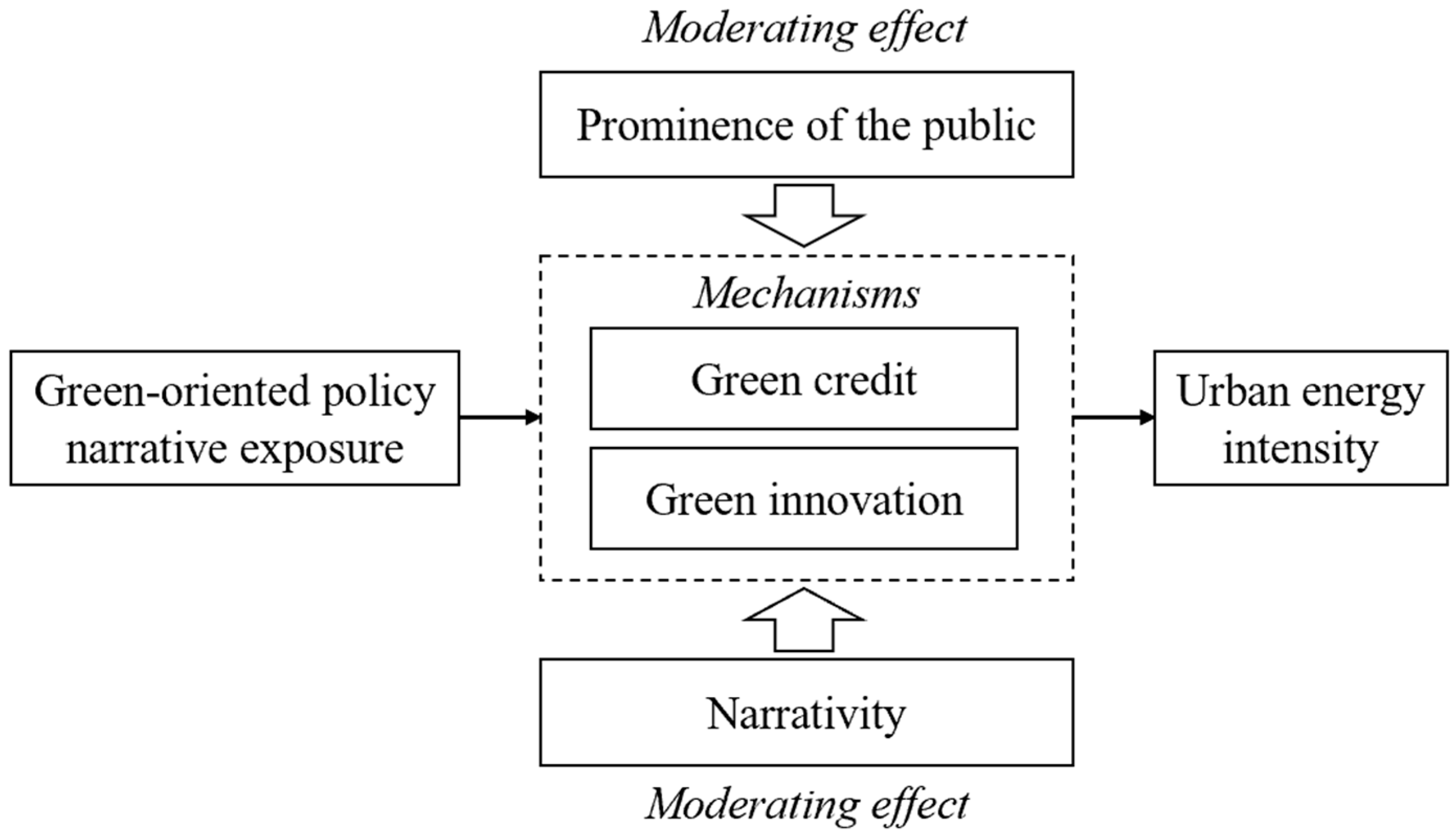
Figure 1. Theoretical framework linking green-oriented policy narratives to energy intensity.
Sustainability 18 00924 g001
Figure 2. Provincial variation in green-oriented policy narrative exposure.
Sustainability 18 00924 g002
Figure 3. Marginal effects of green-oriented policy narrative exposure on energy intensity. Notes: The (left) panel shows the marginal effect of narrative exposure at different levels of public prominence (0 to 0.26). The (right) panel shows the marginal effect at different levels of narrativity (0 to 0.70). Shaded areas represent 95% confidence intervals.
Sustainability 18 00924 g003
Table 1. Descriptive Statistics.
VariablesMeasurementMeanStdMinMax
ENE_INTEnergy consumption per unit GDP (10,000 tons of standard coal equivalent/100 million yuan)0.100.110.001.79
POL_NARNumber of green-oriented policy narrative articles (thousands)0.550.330.001.57
GRE_CREGreen credit index48.7513.589.4097.22
GRE_INNNumber of green invention patent grants (thousands)0.691.740.0022.84
PUB_PROMean probability of distribution of public-related topics0.090.050.000.26
NAR_LEVProportion of high-narrativity articles0.350.170.000.68
ECO_DEVNatural logarithm of per capita GDP10.740.598.6212.46
SCI_EXPScience and technology expenditure/Fiscal expenditure0.020.020.000.21
IND_STRTertiary industry value-added/Secondary industry value-added1.070.610.115.65
EDU_EXPEducation expenditure/Fiscal expenditure0.180.040.020.36
FIN_DEVLoan balance/GDP1.060.650.137.45
OPE_LEVTotal import and export volume/Regional GDP0.190.540.0028.37
Table 2. Baseline regression results.
VariablesENE_INT
(1)(2)
POL_NAR−0.026 ***
(0.005)
−0.012 **
(0.005)
ECO_DEV −0.061 ***
(0.008)
SCI_EXP −0.456 ***
(0.123)
IND_STR 0.005
(0.005)
EDU_EXP 0.074
(0.060)
FIN_DEV 0.006
(0.004)
OPE_LEV 0.001
(0.002)
Constant0.117 ***
(0.003)
0.746 ***
(0.087)
City FEYY
Year FEYY
Observations34563456
Adj-R20.6990.709
Notes: Parentheses contain standard errors; ***, ** denote p < 0.01, p < 0.05.
Table 3. Robustness check: alternative measurement of independent variable.
VariablesENE_INT
(1)(2)
POL_NARX−0.020 ***
(0.004)
−0.009 **
(0.004)
ECO_DEV
−0.061 ***
(0.008)
SCI_EXP
−0.457 ***
(0.123)
IND_STR
0.005
(0.005)
EDU_EXP
0.074
(0.060)
FIN_DEV
0.006
(0.004)
OPE_LEV
0.001
(0.002)
Constant0.116 ***
(0.003)
0.749 ***
(0.087)
City FEYY
Year FEYY
Observations34563456
Adj-R20.6990.709
Notes: Parentheses contain standard errors; ***, ** denote p < 0.01, p < 0.05.
Table 4. Robustness check: alternative measurements of dependent variable.
VariablesENE_INTXENE_INTX2
(1)(2)(3)(4)
POL_NAR−0.144 ***
(0.032)
−0.126 ***
(0.033)
−0.270 **
(0.134)
−0.374 ***
(0.138)
ECO_DEV
−0.236 ***
(0.049)

0.814 ***
(0.207)
SCI_EXP
−0.973
(0.762)

−9.491 ***
(3.225)
IND_STR
−0.166 ***
(0.029)

−0.098
(0.123)
EDU_EXP
1.526 ***
(0.373)

−1.589
(1.579)
FIN_DEV
−0.032
(0.026)

0.066
(0.110)
OPE_LEV
−0.001
(0.014)

−0.011
(0.058)
Constant0.715 ***
(0.018)
3.216 ***
(0.541)
3.405 ***
(0.078)
−4.832 **
(2.291)
City FEYYYY
Year FEYYYY
Observations3456345634563456
Adj-R20.8260.8290.8170.819
Notes: Parentheses contain standard errors; ***, ** denote p < 0.01, p < 0.05.
Table 5. Robustness check: alternative sample specifications.
VariablesENE_INT
(1)(2)
POL_NAR−0.102 ***
(0.032)
−0.101 ***
(0.035)
ECO_DEV
0.006
(0.005)
SCI_EXP
−0.702
(1.400)
IND_STR
−0.015
(0.044)
EDU_EXP
−0.685
(0.675)
FIN_DEV
−0.015
(0.016)
OPE_LEV
−0.240 **
(0.100)
Constant0.792 ***
(0.018)
0.980 ***
(0.148)
City FEYY
Year FEYY
Observations403403
Adj-R20.9340.936
Notes: Parentheses contain standard errors; ***, ** denote p < 0.01, p < 0.05.
Table 6. Robustness check: instrumental variable approach (competitive learning targets ranked 1 position higher).
VariablesPOL_NARENE_INT
First StageSecond Stage (2SLS)
(1)(2)
IV_10.160 ***
(0.014)

POL_NAR
−0.076 ***
(0.027)
ECO_DEV0.295 ***
(0.026)
−0.041 ***
(0.011)
SCI_EXP1.667 ***
(0.408)
−0.355 ***
(0.132)
IND_STR−0.052 ***
(0.016)
0.003
(0.005)
EDU_EXP0.167
(0.200)
0.086
(0.062)
FIN_DEV−0.019
(0.014)
0.004
(0.004)
OPE_LEV−0.016 **
(0.007)
−0.000
(0.002)
City FEYY
Year FEYY
Observations34443444
Adj-R20.1750.041
Cragg-Donald Wald F 129.86
Notes: Parentheses contain standard errors; ***, ** denote p < 0.01, p < 0.05. The sample size (N = 3444) is slightly smaller than the baseline regression (N = 3456) because provinces ranked first in per capita GDP have no competitive learning targets, resulting in missing instrumental variable values for those observations.
Table 7. Robustness check: instrumental variable approach (competitive learning targets ranked 2 positions higher).
VariablesPOL_NARENE_INT
First StageSecond Stage (2SLS)
(1)(2)
IV_20.120 ***
(0.021)

POL_NAR
−0.145 ***
(0.056)
ECO_DEV0.308 ***
(0.026)
−0.021
(0.019)
SCI_EXP1.685 ***
(0.414)
−0.248
(0.160)
IND_STR−0.053 ***
(0.016)
−0.001
(0.006)
EDU_EXP0.188
(0.203)
0.096
(0.066)
FIN_DEV−0.019
(0.014)
0.003
(0.005)
OPE_LEV−0.016 **
(0.007)
−0.002
(0.003)
City FEYY
Year FEYY
Observations34443444
Adj-R20.1700.049
Cragg-Donald Wald F 34.24
Notes: Parentheses contain standard errors; ***, ** denote p < 0.01, p < 0.05. The sample size (N = 3444) is slightly smaller than the baseline regression (N = 3456) because provinces ranked first in per capita GDP have no competitive learning targets, resulting in missing instrumental variable values for those observations.
Table 8. Robustness check: alternative lag specifications.
VariablesENE_INT
(1)(2)(3)(4)
L2.POL_NAR−0.028 ***
(0.005)
−0.018 ***
(0.005)
L3.POL_NAR −0.023 ***
(0.006)
−0.016 ***
(0.006)
ECO_DEV −0.056 ***
(0.008)
−0.051 ***
(0.010)
SCI_EXP −0.487 ***
(0.132)
−0.473 ***
(0.140)
IND_STR 0.007
(0.005)
0.009 *
(0.005)
EDU_EXP 0.099
(0.065)
0.082
(0.074)
FIN_DEV 0.004
(0.005)
0.008
(0.005)
OPE_LEV 0.000
(0.002)
0.000
(0.002)
Constant0.120 ***
(0.003)
0.698 ***
(0.095)
0.121 ***
(0.003)
0.645 ***
(0.108)
City FEYYYY
Year FEYYYY
Observations3168316828802880
Adj-R20.7140.7220.7210.728
Notes: Parentheses contain standard errors; ***, * denote p < 0.01, p < 0.1.
Table 9. Mechanism test: green credit.
VariablesGRE_CREENE_INT
(1)(2)(3)(4)
POL_NAR5.634 ***
(0.372)
4.982 ***
(0.380)
−0.019 ***
(0.005)
−0.008
(0.005)
GRE_CRE

−0.001 ***
(0.000)
−0.001 ***
(0.000)
ECO_DEV
2.231 ***
(0.571)

−0.059 ***
(0.008)
SCI_EXP
21.761 **
(8.885)

−0.438 ***
(0.122)
IND_STR
0.465
(0.339)

0.006
(0.005)
EDU_EXP
−23.317 ***
(4.349)

0.054
(0.060)
FIN_DEV
−1.621 ***
(0.304)

0.004
(0.004)
OPE_LEV
−0.371 **
(0.160)

0.000
(0.002)
Constant46.119 ***
(0.217)
27.470 ***
(6.311)
0.170 ***
(0.012)
0.770 ***
(0.087)
City FEYYYY
Year FEYYYY
Observations3456345634563456
Adj-R20.8930.8960.7010.710
Notes: Parentheses contain standard errors; ***, ** denote p < 0.01, p < 0.05.
Table 10. Mechanism test: green innovation.
VariablesGRE_INNENE_INT
(1)(2)(3)(4)
POL_NAR0.230 ***
(0.069)
0.211 ***
(0.068)
−0.023 ***
(0.005)
−0.010 *
(0.005)
GRE_INN

−0.010 ***
(0.001)
−0.011 ***
(0.001)
ECO_DEV
−0.589 ***
(0.102)

−0.067 ***
(0.008)
SCI_EXP
22.677 ***
(1.590)

−0.218 *
(0.125)
IND_STR
−0.198 ***
(0.061)

0.003
(0.005)
EDU_EXP
5.602 ***
(0.778)

0.133 **
(0.060)
FIN_DEV
0.112 **
(0.054)

0.007 *
(0.004)
OPE_LEV
−0.072 **
(0.029)

0.000
(0.002)
Constant0.603 ***
(0.040)
5.693 ***
(1.129)
0.123 ***
(0.003)
0.806 ***
(0.087)
City FEYYYY
Year FEYYYY
Observations3456345634563456
Adj-R20.7920.8100.7040.714
Notes: Parentheses contain standard errors; ***, **, * denote p < 0.01, p < 0.05, p < 0.1.
Table 11. Double Machine Learning estimation for mechanism pathways.
VariablesGRE_CREGRE_INN
(1)(2)
POL_NAR4.856 ***
(0.000)
0.136 **
(0.017)
Control variablesYesYes
Year FEYesYes
City FEYesYes
Observations34563456
Notes: Parentheses contain p-values; ***, ** denote p < 0.01, p < 0.05. Hyperparameters in the Random Forest algorithm are set at default options in DML estimation.
Table 12. Moderating effect of the prominence of the public.
VariablesENE_INT
(1)(2)
POL_NAR0.042 ***
(0.015)
0.040 ***
(0.015)
PUB_PRO0.073 *
(0.044)
0.087 **
(0.044)
POL_NAR × PUB_PRO−0.632 ***
(0.134)
−0.507 ***
(0.132)
ECO_DEV
−0.059 ***
(0.008)
SCI_EXP
−0.437 ***
(0.123)
IND_STR
0.005
(0.005)
EDU_EXP
0.063
(0.060)
FIN_DEV
0.006
(0.004)
OPE_LEV
0.001
(0.002)
Constant0.111 ***
(0.004)
0.724 ***
(0.087)
City FEYY
Year FEYY
Observations34563456
Adj-R20.7010.710
Notes: Parentheses contain standard errors; ***, **, * denote p < 0.01, p < 0.05, p < 0.1.
Table 13. Moderating effect of narrativity.
VariablesENE_INT
(1)(2)
POL_NAR0.011
(0.012)
0.023 *
(0.012)
NAR_LEV0.017
(0.012)
0.020 *
(0.012)
POL_NAR × NAR_LEV−0.094 ***
(0.028)
−0.093 ***
(0.028)
ECO_DEV
−0.061 ***
(0.008)
SCI_EXP
−0.453 ***
(0.122)
IND_STR
0.004
(0.005)
EDU_EXP
0.069
(0.060)
FIN_DEV
0.007
(0.004)
OPE_LEV
0.001
(0.002)
Constant0.113 ***
(0.004)
0.743 ***
(0.087)
City FEYY
Year FEYY
Observations34563456
Adj-R20.7000.710
Notes: Parentheses contain standard errors; ***, * denote p < 0.01, p < 0.1.
Table 14. Heterogeneity analysis: Internet penetration and marketization level.
VariablesENE_INT
(1)(2)(3)(4)
POL_NAR−0.006
(0.008)
0.008
(0.008)
0.061 ***
(0.020)
0.070 ***
(0.020)
INT_PEN0.001 **
(0.000)
0.001 ***
(0.000)
POL_NAR × INT_PEN−0.001 ***
(0.000)
−0.001 ***
(0.000)
MAR_LEV 0.004
(0.003)
0.007 ***
(0.003)
POL_NAR × MAR_LEV −0.010 ***
(0.002)
−0.009 ***
(0.002)
ECO_DEV −0.065 ***
(0.008)
−0.065 ***
(0.008)
SCI_EXP −0.424 ***
(0.123)
−0.414 ***
(0.123)
IND_STR 0.003
(0.005)
0.003
(0.005)
EDU_EXP 0.078
(0.060)
0.060
(0.060)
FIN_DEV 0.006
(0.004)
0.005
(0.004)
OPE_LEV 0.000
(0.002)
0.001
(0.002)
Constant0.104 ***
(0.007)
0.770 ***
(0.087)
0.087 ***
(0.023)
0.735 ***
(0.087)
City FEYYYY
Year FEYYYY
Observations3456345634563456
Adj-R20.7000.7100.7010.710
Notes: Parentheses contain standard errors; ***, ** denote p < 0.01, p < 0.05.
Disclaimer/Publisher’s Note: The statements, opinions and data contained in all publications are solely those of the individual author(s) and contributor(s) and not of MDPI and/or the editor(s). MDPI and/or the editor(s) disclaim responsibility for any injury to people or property resulting from any ideas, methods, instructions or products referred to in the content.