Article

Consumer Attitudes and Knowledge Regarding Functional Food as an Element of the Circular Economy

1
Department of Power Engineering and Transportation, Faculty of Production Engineering, University of Life Sciences in Lublin, 20-612 Lublin, Poland
2
Department of Biological Bases of Food and Feed Technologies, Faculty of Production Engineering, University of Life Sciences in Lublin, 20-612 Lublin, Poland
*
Author to whom correspondence should be addressed.
Sustainability 2026, 18(2), 881; https://doi.org/10.3390/su18020881
Submission received: 4 December 2025 / Revised: 8 January 2026 / Accepted: 11 January 2026 / Published: 15 January 2026
(This article belongs to the Special Issue Food Security, Food Recovery, Food Quality, and Food Safety)

Abstract

Functional food plays an increasingly important role in shaping healthy dietary habits by integrating health-promoting components into consumers’ everyday diets and helping reduce food waste. Products developed using by-products and raw material streams from food processing can support the principles of the circular economy (CE) by improving resource efficiency and lowering the environmental footprint of the food system. In Poland, as in many countries worldwide, functional food is a rapidly growing category that can contribute to public health and serve as a driver of economic development. However, the excessive and scientifically unsupported use of the term “functional food” for marketing purposes may mislead consumers and weaken trust in this product group. From a CE perspective, transparent communication and informed consumer choices are essential, as they promote environmentally responsible behaviors and support sustainable production models. The aim of this study was to assess the level of knowledge about functional food among residents of Eastern Poland, which is a less industrialized and predominantly agricultural region. The analysis focused on awareness of health benefits, consumption frequency, consumer attitudes, and interest in educational initiatives promoting functional food within CE principles. The study also examined whether consumers associate functional food with sustainability-oriented practices. The findings offer insights for educational and marketing strategies grounded in scientific evidence and highlight the potential of functional food in building a sustainable, resource-efficient food system.

1. Introduction

Nutrition is a fundamental element of human life, providing energy and physiological capacity necessary for daily functioning. Supplying the body with appropriate nutrients is essential for maintaining health and well-being. A properly balanced diet not only satisfies basic physiological needs but also supports disease prevention and improves overall quality of life [1].
Health and dietary habits are key elements of human life, and their mutual connection is confirmed in research on functional food. It is widely recognized that the relationship between nutrition and the emergence of diseases forms the basis of the concept of preventive nutrition [2,3].
Contemporary consumer awareness regarding nutrition and functional food plays a crucial role in shaping trends in the food market. Increased knowledge about the impact of diet on health leads to growing interest in products that offer not only basic nutritional value but also additional health benefits. Functional food, which introduces into the diet components with a proven positive impact on health, is gaining increasing popularity as consumer awareness of the role of diet in well-being and disease prevention rises. In recent years, functional food has also received growing interest from scientists and public health professionals due to its potential for physiological benefits that go beyond basic nutritional value [4]. Therefore, educating consumers about the impact of food on health and everyday functioning is becoming crucial.
In the context of contemporary environmental challenges, the concept of the circular economy (CE) gains particular importance. It assumes the rational use of resources, the minimization of waste and the maximization of product value at every stage of their life cycle. Functional food, especially food produced using by-products of food processing or raw materials with high bioactive potential, is becoming an important element of this model. Integrating CE principles with the functional food market supports the development of more sustainable food systems, reduces waste and promotes informed consumer choices. Thus, analyzing consumers’ knowledge and attitudes regarding functional food can provide valuable insights into their readiness to participate in the transformation towards a circular economy [5].
Despite the growing interest in functional food and its health-promoting potential, its role within the framework of the circular economy remains insufficiently explored from the consumer perspective. Existing studies tend to focus either on technological and nutritional aspects of functional food or on environmental sustainability issues, while rarely integrating these dimensions into a single analytical framework. In particular, there is a lack of empirical research examining how consumers perceive the relationship between functional food, sustainability, and circular economy principles, especially in regions where food production and resource efficiency play a significant role in local development. This gap highlights the need for research that combines consumer awareness, attitudes, and sustainability-oriented perspectives within the context of contemporary food systems.
Therefore, this article focuses primarily on assessing consumer attitudes and knowledge regarding functional food as an element of the circular economy. The research aims to explore how consumers perceive and understand functional food, and to identify the factors that influence their choices of products consistent with sustainable consumption principles. Functional food was treated as an example of an innovative product that can contribute to efficient resource use, waste reduction, and the promotion of healthier and more environmentally responsible consumption patterns. The study also looked at whether consumers recognize a link between choosing functional food and achieving Sustainable Development Goals, particularly regarding careful management of food resources and reducing environmental impacts.
The study fills a research gap, as previous publications usually focused either on the perception of functional food itself or on environmental aspects, while rarely combining these two areas into one coherent perspective. The study results therefore make it possible to better understand the relationship between consumer awareness and the acceptance of products that align with the principles of the circular economy, which represents an important contribution to the development of the subject literature.
The empirical analysis was conducted in Eastern Poland, a predominantly agricultural and less industrialized region, which provided a particularly relevant context for examining the transition towards circular “farm-to-fork” food systems. Due to its strong reliance on primary agricultural production, local food chains, and relatively lower industrial intensity, the region constituted an appropriate case study for analyzing consumer attitudes towards functional food within a circular economy framework.
The content of the article is divided into the following sections: Introduction (Section 1), Literature Review (Section 2), Materials and Methods (Section 3), Results and Discussion (Section 4), and Conclusions (Section 5).

2. Literature Review

2.1. Characteristics of Functional Food

The term “functional food” first appeared in Japan in the 1980s and referred to food products enriched with components that exert a positive effect on the body. This idea was publicized in 1984 by Japanese researchers analyzing the relationships between dietary habits, sensory perceptions, product fortification and their influence on physiological functions. In 1991, the Japanese Ministry of Health introduced regulations governing a new category of health-promoting food—FOSHU (Food for Specified Health Uses). These regulations also included guidelines for formulating specific health claims for such products [6,7,8].
Although many products are labeled as functional foods, the term has not been clearly defined, and there is no universally accepted definition for this category of products. Moreover, in most countries there are no legal definitions related to this area. Therefore, one should be cautious and avoid defining it only broadly as products that contain substances with an additional positive effect on health, because this would also include standard healthy foods (such as fish, beans, whole-grain products and nuts). An example can be the definition proposed by the Food and Agriculture Organization (FAO) of the United Nations, according to which functional food is food that, in addition to nutrients, contains other components that may be beneficial to health [9].
Temple (2022) [10] highlights problems in this area, pointing to additional issues related to commonly used definitions of functional food, such as
  • the unclear specification of nutrients considered “beyond basic nutrition” (e.g., carotenoids);
  • the ambiguous identification of which food components are responsible for the additional health benefits—Temple gives the example of whole grains, where it is not precisely known how much of the associated health benefits come from nutrients, how much from fiber, and how much from phytochemicals.
For this reason, researchers strive to clarify and refine these definitions, emphasizing key aspects of functional food. Temple (2022) [10] also proposed a definition for this category. According to him, functional food consists of novel foods developed to contain substances or live microorganisms that have potential health value or disease-preventing properties in concentrations that are on one hand safe and on the other sufficiently high to achieve the intended effect.
In recent years, many other definitions of functional food have been formulated. Diplock et al. (1998) [11] proposed one of the most widely recognized definitions, stating that a food can be considered functional if its positive effects on one or more specific body functions have been reliably demonstrated, going beyond standard nutritional effects, in a way that is significant for improving health, well-being, or reducing the risk of disease. Functional foods include many products developed using innovative technologies (such as enrichment, fortification, or composition modification) that allow the elimination of harmful substances and their replacement with health-promoting components.
Matriosyan et al. (2022) [8] define functional food as food that has been modified, enhanced, and enriched with additional components. These are natural or processed food products containing biologically active compounds that, in precisely determined, effective, and safe doses, provide clinically confirmed and documented health benefits. They support optimal body function, reduce the risk of chronic or viral diseases, and help alleviate their symptoms by targeting specific biomarkers.
According to the definition established by the European Consensus on the Scientific Concept of Functional Food, it must have the following characteristics [12,13]:
  • Functional food remains conventional food, meaning it consists of products intended for general, daily consumption and is part of a normal diet;
  • In addition to natural components, it contains an increased concentration of one or more active ingredients that are either absent or present only in minimal amounts in the food;
  • It has a positive effect on the health status of the body, scientifically documented based on research using appropriate indicators characteristic of specific metabolic processes;
  • It improves overall health and well-being.
According to the European Union, the adjective “functional” can be applied to food if it demonstrates beneficial effects on the body, whether in a simple or more complex manner, contributing to maintaining good health, enhancing well-being, and/or reducing the risk of disease development [14,15].
As already mentioned, the main goal of functional food is to improve health, well-being, and/or reduce the risk of disease. However, it should be noted that it must retain the sensory characteristics of traditional food and cannot be in the form of a powder, tablet, or similar [16].
The industrial production of health-promoting food opens up many opportunities for both producers and consumers. This process makes it possible to [17]
  • Provide consumers with products of consistent and guaranteed biological activity throughout the year, regardless of season;
  • Create innovative products whose market appeal increases due to emphasized health benefits;
  • Develop a lucrative and growing market;
  • Provide research institutions with funding for further studies and the development of new technologies in the field of functional food.
In the literature, functional food is divided into two main groups: based on specific composition and based on addressing particular physiological needs. The first group includes fortified, low-calorie, high-fiber, probiotic, reduced-sodium, and reduced-cholesterol foods [18].
Based on meeting the body’s specific needs, functional food can be categorized into products that [19] reduce the risk of cardiovascular diseases, lower the risk of cancer development, support osteoporosis prevention, are intended for individuals exposed to excessive stress, are dietary, designed for people with metabolic or digestive disorders, specifically created for infants, intended for athletes, adapted to the needs of older adults, and support the health of pregnant and breastfeeding women.
Examples of functional food include margarine and processed cheeses enriched with plant sterols and stanols, which help lower cholesterol levels and reduce the risk of heart disease. Other examples are spreads, yogurts or salad oils containing omega-3 and omega-6 unsaturated fatty acids, which not only aid in cholesterol reduction but also have antidepressant effects. Breakfast cereals enriched with folic acid contribute to reducing the risk of neural tube defects in newborns, while fiber added to bread and biscuits supports proper digestive system function. It is also worth mentioning phytochemicals such as flavonoids and anthocyanins, present in vegetables and fruits, which play a protective role and help prevent the development of various diseases [20,21].

2.2. Characteristics of Functional Additives

Functional additives are an integral component of functional food production. They are any substances added to a product during its manufacturing. Due to their specific but intentional technological role and their influence on the sensory properties of the product, they are referred to as functional additives [22].
The use of additives in the food industry brings benefits to both producers and consumers. For producers, they facilitate production and storage processes, while for consumers, they provide products of higher health quality, hygiene, and often greater nutritional value. In addition to health benefits, these additives are often used to give products the desired color and flavor. Their use has changed significantly since the early 19th century, when they were primarily applied to extend the shelf life of food. Today, these additives allow for a broader range of food products, contributing to a more varied diet and reducing the risk of diet-related diseases [19,23].
Food additives can be divided into three categories [13]: natural (present naturally in food and obtained exclusively from natural raw materials), nature-identical (substances with the same properties as those naturally occurring but obtained through chemical synthesis), and artificial (chemically synthesized compounds that do not occur in nature).
Current regulatory frameworks governing food additives do not differentiate between natural and synthetic compounds—all substances, irrespective of their origin, are required to undergo the same rigorous safety assessment procedures. This is justified by the fact that naturally occurring compounds are not inherently safe, and some may exhibit high toxicity. For this reason, additives of natural origin undergo the same evaluation procedures as their synthetic counterparts [24].
Food can be enriched with various components, such as [25] omega-3 polyunsaturated fatty acids, vitamins, trace elements, dietary fiber, oligosaccharides which belong to the prebiotic group and serve as a substrate for probiotic bacteria, probiotics, choline and lecithin, and phytochemicals.
A key legal act regulating the use of additives in food within the European Union is Regulation (EC) No 1333/2008 of the European Parliament and of the Council of 16 December 2008 [26]. It was introduced to ensure a high level of consumer health protection as well as fairness in food trade. This regulation defines food additives as substances that are not consumed as food in themselves but are added to food products to achieve a specific technological effect. The regulation also establishes a list of additives permitted for use in food, specifying the conditions of their use and maximum allowable levels. It requires that all additives undergo a rigorous safety assessment before being authorized for use. This assessment takes into account, among other factors, the acceptable daily intake (ADI), which specifies how much of a substance can be consumed daily over a lifetime without health risk.
The regulation also imposes obligations regarding the labeling of foods containing additives. Producers must clearly inform consumers about the presence of additives, using both their chemical names and E numbers (e.g., E100 for curcumin). Furthermore, the regulation provides for regular reviews of the list of additives and the conditions of their use, allowing the rules to be updated in light of new scientific evidence and changing market conditions.

2.3. The Circular Economy in the Context of Functional Food

In recent years, there has been a dynamic increase in interest in functional foods worldwide—products which, in addition to their basic nutritional value, have a beneficial effect on human health, e.g., they strengthen immunity, support the digestive system or help regulate cholesterol levels. This trend is driven by growing consumer awareness, an ageing population and the popularity of healthy lifestyles [20,21].
It is necessary to strengthen the theoretical framework by clearly indicating that the key challenge for the circular economy (CE) in the food sector is to change the paradigm of how by-products are perceived. They should not be treated solely as waste requiring management, but as a potential source of functional ingredients with high added value. In this sense, CE is not limited to minimizing losses and recycling, but encompasses the systemic transformation of by-product streams into secondary raw materials that can serve technological, nutritional, or health-promoting functions. Food industry by-products—such as pomace, bran, peel, seeds, or whey—are often high in dietary fiber, bioactive compounds, proteins, or natural pigments. Proper processing allows them to be used as functional ingredients, perceived not as an environmental burden but as innovative additives that support food quality and value [27]. It should be emphasized that such a transformation requires not only technological solutions, but also changes in regulatory, quality, and market approaches. Food safety, quality standardization, consumer acceptance, and the integration of these components into existing production systems are of key importance here. As a result, CE in the food sector becomes a tool for combining resource efficiency with product innovation, and by-products cease to be a cost and become a source of competitive advantage and an element of sustainable development in the food chain [28,29,30,31].
An example of this is innovative solutions that use by-products from food processing (e.g., fruit pomace, bran, or husks) as functional ingredients—rich in fiber, polyphenols, or other bioactive compounds [32].
The combination of the circular economy (CE) with the concept of functional food represents a modern approach to sustainable food production. Utilizing by-products and waste from the food industry as sources of bioactive components helps reduce raw material waste and create food with enhanced nutritional value. Applying CE principles also promotes the development of innovative bioprocessing technologies and the use of biodegradable packaging, which reduces the environmental impact of food production. Furthermore, promoting local and regenerative raw material sources supports the concept of short supply chains. The integration of CE and functional food therefore contributes to building a more responsible, healthy, and sustainable food system.
By combining CE with the functional food market, specific opportunities can be identified [5,27,29]:
  • Use of by-products/waste as bioactive ingredients (e.g., fruit and vegetable residues, husks, bran as sources of fiber, polyphenols, antioxidants, fermentation of organic waste or biomass as a source of probiotics or prebiotics);
  • Eco-design of packaging (use of biodegradable, compostable, and reusable packaging, plastic reduction, use of recycled materials);
  • Optimization of production processes (reducing raw material losses (e.g., during grinding or processing), recovering waste energy/heat);
  • Certification systems and quality standards (certificates confirming that a functional product is also “circular” or has a low environmental footprint, labels informing consumers about the product’s composition and which parts are recycled);
  • Innovative business models “product as a service” (e.g., subscriptions, returnable packaging, collaboration between companies, e.g., one produces waste, another uses it as raw material—industrial symbiosis).
The European Union has created a coherent policy framework supporting the development of a circular economy in the food sector, which is anchored in key strategic documents such as the European Green Deal, the Circular Economy Action Plan (CEAP) and the Farm to Fork Strategy. These initiatives set the direction for the transformation of the food system, emphasising the need to reduce food loss and waste, develop innovative and more sustainable business models, ensure the safe and controlled use of by-products, and support sustainable food production. From the perspective of functional foods, it is particularly important that the EU regulatory framework allows the use of by-products as food ingredients, provided that safety and quality requirements are met. At the same time, the novel food authorisation procedure remains a significant regulatory challenge, which may slow down the implementation of innovative solutions. Regardless of the source and nature of functional ingredients, all claims regarding the health properties of products must comply with the applicable regulations on nutrition and health claims, which are designed to protect consumers and ensure the reliability of market information [33,34,35].
The global market is seeing rapid growth in companies and initiatives that use food industry by-products as a source of functional ingredients, while also contributing to the circular economy. An example of this are companies specialising in the valorisation of fruit pomace, which is a rich source of polyphenols, dietary fibre and other bioactive compounds. This group includes, among others, producers of functional ingredients obtained from citrus, apple or grape pomace, which are then used in functional beverages, bakery products and dietary supplements. Solutions of this type are being developed by European and American companies supplying standardised plant extracts and fibre fractions to the food industry [36,37].
Another important area of upcycling is the utilisation of whey, a by-product of the dairy industry. Global dairy companies such as Arla Foods Ingredients and FrieslandCampina Ingredients have developed technologies to recover high-value whey proteins, bioactive peptides and minerals. These ingredients are widely used in functional foods, including sports products, foods for special nutritional purposes and protein drinks, providing an example of effective closed-loop recycling of raw materials in the dairy sector [38,39].
Another example are initiatives that utilise by-products of grain processing, in particular brewers’ grains and bran. Companies such as ReGrained (USA) and EverGrain (Europe/USA) are developing technologies that convert brewers’ grains into ingredients rich in fibre, protein and micronutrients, which are then used in functional snacks, bakery products and beverages. Such solutions are a model example of combining the Circular Economy with functional foods, where a by-product of low economic value is transformed into an ingredient with high biological added value [40,41].
It is also worth noting that in Poland, according to the “Roadmap for the Transformation towards a Circular Economy (CE)” from 2019, the CE concept includes maximizing the added value of raw materials and products while minimizing the amount of waste generated, following a hierarchy of actions: prevention, reuse, recycling, recovery, and disposal. The “Roadmap for the Transformation towards CE,” adopted by the Council of Ministers, serves as the basis for national initiatives in this area [42,43].
An increasing number of producers worldwide, including in Poland, recognize the potential of creating functional food in line with sustainable development principles. This translates into the implementation of environmentally friendly technologies, reduction of raw material waste, and the development of so-called eco-innovations, which meet both the needs of modern consumers and the objectives of the circular economy [44,45,46].
In Poland, there is a dynamic growth of initiatives related to the production and research of functional food, often linked to the circular economy and sustainable development. For example, Olimp Labs is investing over PLN 200 million in the development of modern functional food production, including probiotic products containing live bacterial cultures [47]. OrganikAgro Foods, a family company specializing in expanded grain products, is implementing a project co-financed by European Union funds worth approximately PLN 12.38 million, focused on introducing innovative solutions in ecological functional food [48]. Another significant initiative is the Functional Food Research Center (CBŻF), established in June 2023, which aims to develop a certification system, production, processing, and export of functional food, as well as the advancement of personalized nutrition [49]. The brand Dobra Kaloria offers a wide range of functional products—from breakfast items to snacks—enriched with fiber, vitamins, and unsaturated fatty acids [50]. Notable scientific projects include a program conducted by the University of Life Sciences in Poznań together with six research centers titled “New bioactive foods with programmed health-promoting properties,” funded by the National Centre for Research and Development with PLN 40.5 million. Within the project, innovative products—including groats, breads, soups, pâtés, and juices—were developed and tested with patient participation [51].
As observed, the functional food sector in Poland is increasingly developing, combining technological innovations with sustainable development and the circular economy. The examples of the aforementioned companies and institutions demonstrate the growing engagement of the Polish sector in the development of innovative health-promoting products. These activities contribute to increasing the competitiveness of the national food industry, promoting a healthy lifestyle, and strengthening Poland’s position as a leader in food innovation.

3. Materials and Methods

3.1. Research Aim and Objectives

The aim of the conducted study was to gain an in-depth understanding of consumers’ attitudes and level of knowledge regarding functional food in the context of the principles of the circular economy (CE). The research had a diagnostic and exploratory character and was oriented towards identifying the factors shaping consumer awareness and behaviors in the area of selecting food products whose characteristics align with the concept of sustainable consumption. Within the CE framework, functional food was treated as an example of an innovative product capable of supporting efficient resource use, minimizing waste, and promoting health-oriented and environmentally responsible consumption patterns.
The study also aimed to determine whether consumers perceive the relationship between choosing functional food and achieving the Sustainable Development Goals (SDGs), particularly with regard to the rational management of food and the reduction of negative environmental impacts.

3.2. Characteristics and Organization of the Study

The study was conducted using the diagnostic survey method with the application of an original online questionnaire (Google Forms). The use of an online technique enabled rapid access to a diverse group of respondents while ensuring anonymity and voluntary participation.
A total of 300 complete responses were collected and subsequently included in the statistical analysis. Respondents were recruited using a purposive (non-probability) sampling approach, appropriate for the exploratory nature of the study. Adult individuals who were food consumers and potentially encountered the concept of functional food in their everyday purchasing decisions were invited to participate. Recruitment was conducted through online channels, including social media and an online survey form. Participation in the study was voluntary and anonymous. The sampling procedure was purposive and encompassed adults who consciously participate in the consumption of functional food or are at least familiar with the concept. The research sample was diverse in terms of gender, age, education level, place of residence, and employment status, which allowed for between-group comparisons and the examination of the influence of demographic factors on knowledge and attitudes towards functional food.
The study was carried out between July and October 2025. Prior to beginning the questionnaire, respondents were informed about the purpose of the research, confidentiality principles, and the use of the results exclusively for scientific purposes.

3.3. Research Tool

The study employed an original survey questionnaire developed by the authors on the basis of a review of the literature concerning consumer behavior, functional food, and the concept of the circular economy. The questionnaire consisted of four logically connected sections.
The first section collected socio-demographic data, including gender, age, education level, place of residence, and employment status.
The second section assessed respondents’ awareness and knowledge of functional food. Knowledge was measured using three items: (1) prior encounter with the term “functional food” (yes/heard of it/no), (2) self-declared knowledge of the definition of functional food (yes/no), and (3) a self-assessed level of knowledge measured on a five-point scale ranging from 1 (very low) to 5 (very high).
The third section measured attitudes towards functional food and the circular economy using four original statements evaluated on a five-point Likert scale (1 = strongly disagree, 5 = strongly agree). The statements were as follows: (1) “My overall attitude towards functional food is positive”; (2) “I trust the health-related claims made about functional food products”; (3) “I associate functional food with sustainability and the circular economy (e.g., reducing food waste, using by-products)”; and (4) “Functional food can help reduce the negative environmental impact of the food system.” Higher scores indicated more positive attitudes towards functional food and its role within the circular economy framework.
The fourth section concerned purchasing behaviors and included questions on the frequency of functional food consumption, willingness to pay a higher price for functional food produced in accordance with circular economy principles, and interest in educational initiatives related to functional food and sustainability.
The questionnaire underwent pilot testing with a group of 20 respondents, after which minor modifications were introduced to improve clarity and comprehensibility of the items.

3.4. Research Procedure and Data Preparation

The collected data were exported to a CSV file and verified for completeness and logical consistency. Missing responses were supplemented using mean imputation, and descriptive data were coded as numerical variables.
Statistical analyses were conducted using Statistica 14 software. All significance tests were performed at the α = 0.05 level, and in borderline cases, empirical p-values were additionally reported.

3.5. Scope of Statistical Analyses

Comparative and correlational analyses were conducted to verify whether the level of knowledge regarding functional food and the principles of the circular economy (CE) differs across socio-demographic groups and whether it is associated with consumers’ attitudes and purchasing behaviors. The selection of variables for the analyses was based on previous studies indicating that nutrition-related knowledge and acceptance of functional food may vary depending on factors such as age, education level, and interest in health- and sustainability-related issues.
It was assumed that a higher level of consumer knowledge supports more informed and conscious food choices, which justified examining the relationships between declared knowledge, attitudes towards functional food, and actual consumption behaviors, including consumption frequency and willingness to pay a higher price for products manufactured in accordance with circular economy principles.
Three complementary groups of methods were applied in the analysis, enabling both the description of the population and the examination of relationships between variables.
  • Descriptive Analyses
In the first stage, a set of basic characteristics of the study group was compiled, including demographic structure (gender, age, education level, place of residence, employment status), awareness of the existence of functional food, level of knowledge, and the distribution of responses to questions concerning attitudes and behaviors.
In the interpretation, references to the concept of the circular economy were incorporated by examining the extent to which respondents associate the choice of functional food with actions aimed at reducing resource waste and environmental impact.
  • Comparative Analyses
The second stage of the research involved the examination of between-group differences, including gender and level of knowledge/attitudes, age and pro-environmental attitudes, education level and environmental awareness, as well as place of residence and purchasing behaviors.
The following statistical methods were applied: the chi-square (χ2) test for qualitative variables, Student’s t-test for comparisons between two groups, and analysis of variance (ANOVA) for variables with more than two categories.
These analyses made it possible to identify consumer groups most engaged in sustainable consumption practices.
  • Relationship Analyses (Correlations)
In the third stage, the strength and direction of relationships were assessed between the level of knowledge and attitudes towards functional food, attitudes and actual purchasing behaviors, and knowledge and willingness to pay a higher price for products manufactured in accordance with circular economy principles. The interpretation of the results made it possible to determine the extent to which consumers’ knowledge translates into pro-environmental choices and actual market behaviors.
The findings from these analyses may contribute to the development of a profile of the functional food consumer aligned with circular economy principles, which is of significant importance for producers’ marketing strategies and public policy in the field of sustainable development.
Additionally, a correlational analysis was conducted to explore the relationship between respondents’ educational attainment and their perception of the conceptual link between functional food and sustainability, measured by agreement with the statement “I associate functional food with sustainability and the circular economy.”

3.6. Research Limitations

It should be noted that the study is cross-sectional in nature and relies on respondents’ self-assessments, which may introduce the risk of declarative biases.
The sampling procedure was not fully representative of the entire consumer population; however, the demographic diversity of the respondents allows for the formulation of conclusions that reflect broader social tendencies.
Despite these limitations, the obtained results constitute a significant contribution to the understanding of the relationships between consumer awareness, attitudes towards functional food, and the implementation of circular economy principles in everyday purchasing decisions.

4. Results and Discussion

4.1. Characteristics of the Studied Sample

As already mentioned, the study involved 300 respondents representing diverse demographic, educational, and professional groups. The sample structure was selected to enable an analysis of the relationships between the level of knowledge about functional food, consumer attitudes, and the principles of the circular economy (CE).
In terms of gender, women predominated (62.7%), while men accounted for 37.3%. This result is consistent with previous studies indicating that women are more likely than men to engage in pro-health and pro-environmental behaviors, including the choice of functional food [12,49,52,53,54]. From the perspective of the circular economy, this may indicate that women constitute an important target group for educational activities related to sustainable consumption.
In terms of age, young individuals (18–25 years) dominated the sample at 40.9%, followed by respondents aged 26–40 (29.1%) and 41–60 (22.7%). The smallest group consisted of respondents over 60 years of age (7.3%). Younger age groups, particularly consumers from generations Y and Z, display a stronger pro-environmental attitude towards nutrition and, consequently, greater interest in environmental aspects and innovations in the area of food and health [55,56,57,58]. Therefore, in the context of the circular economy, these groups constitute a key target audience for sustainable development and may become potential leaders of change towards responsible consumption and reducing resource waste. This may result, among other things, from the fact that young people are still highly motivated and willing to learn. Moreover, they are flexible, which means that their behaviors can still be shaped and modified [59,60,61].
As noted by Naseer et al. (2025) [62], Dwidienawati et al. (2021) [63], and Sarakun (2022) [64], these generations will play a key role in shaping sustainable consumption patterns, as they hold an advantage over others in this area—they are proficient in using digital technologies, engage in personal and planetary well-being, and embrace progressive values.
Most respondents lived in large cities (53.6%), which may indicate easier access to innovative, certified, and ecological products. Rural residents accounted for 19.1%, and the remaining 27.3% were individuals from small and medium-sized towns. These results reflect spatial differences in the development of the functional food market and indicate a higher saturation of pro-environmental offerings in large urban agglomerations [65].
In terms of education, individuals with higher education dominated the sample (70.9%), while 25.5% had secondary education, and 3.6% had vocational or primary education. This structure supports reliable conclusions about consumer attitudes, as a higher level of education correlates with greater health and environmental awareness [20,66,67,68]. From a circular economy perspective, this indicates a greater potential for adopting circular principles in everyday dietary choices and greater engagement in nutrition-related behaviors within the context of a closed-loop system [69,70,71].
The largest group consisted of full-time employees (47.3%), followed by pupils and students (37.3%), entrepreneurs (8.2%), and retirees or pensioners (6.4%). The professional activity of the respondents supported reflection on the economic and social aspects of consumption, and their participation in the study can be seen as an example of growing interest in sustainable consumption patterns.
In summary, the structure of the studied sample allows us to conclude that the participants represented a social group particularly predisposed to adopt and implement the principles of the circular economy—young, educated, and aware consumers from large cities, for whom functional food represents not only an element of a healthy lifestyle but also a form of responsible choice in the face of environmental challenges.
From the perspective of systemic transformation towards sustainable and circular food systems, young and well-educated consumers can be considered key early adopters of such changes. Previous studies indicate that these groups are more open to innovation, demonstrate higher levels of environmental awareness, and are more willing to experiment with new consumption patterns, including functional and sustainable food products. Their greater familiarity with digital technologies and access to information further facilitates the diffusion of new concepts related to health, sustainability, and circular economy principles. As a result, young and educated consumers play a crucial role in initiating behavioral change and accelerating the broader social acceptance of innovative and sustainability-oriented food solutions.

4.2. Consumer Knowledge and Awareness of Functional Food in the Context of the Circular Economy

The analysis of respondents’ knowledge and awareness regarding functional food constitutes a key element in assessing the possibilities of incorporating dietary practices into the circular economy (CE) model. Knowledge and understanding of this category of products are important because informed consumer choices can help reduce waste, increase nutritional efficiency, and support a healthy lifestyle.
The first stage of the analysis was an assessment of the recognizability of the term ‘functional food’. The results showed that 47.3% of respondents had never encountered this term, which indicates a relatively low level of basic awareness. A total of 27.3% declared general familiarity with the concept, while 25.5% described their knowledge as complete. Thus, only one quarter of respondents were able to correctly associate this food category with its characteristics and functions. The obtained results are consistent with the findings of the study conducted by Szczepańska et al. (2024) [72]—where a similar proportion of respondents (42.5%) also declared familiarity with the definition of functional food. It is important to note that the study was carried out on a sample comparable in size (301 individuals) and within a similar geographical area (Poland). In contrast, Abd-Rabou and El-khalifa (2024) [73] found that respondents almost did not understand the term ‘functional food’ at all—however, it seems that the research area was significant here, since the study was conducted in Egypt.
The thesis regarding the low basic awareness of functional food and the need for further education is also confirmed by Di Talia et al. (2018) [74]. They conducted survey research in two areas with similar morphological and demographic characteristics but very different cultural contexts—namely in Germany and Italy—and concluded that the surveyed consumers had limited knowledge about functional food or were not familiar with it at all.
Interesting literature findings can also be found in Baker et al. (2022) [20], who analyzed numerous sources describing studies on the knowledge, acceptance, and awareness related to the concept of functional food in various geographical regions. They concluded that in most studies, the level of awareness and understanding of the concept of functional food ranged from 21 to 53%. It should be added that these studies were conducted in various countries with different levels of economic development, different cultures, and different consumption patterns—in Croatia [75]; the United States, Canada, and France [76]; Chile [77]; Lebanon [78]; and Montenegro [79].
In the context of the circular economy, this indicates a limited ability of consumers to consciously choose products that can contribute to improving health quality while ensuring more efficient use of resources.
As shown in Table 1, even greater knowledge gaps emerged in the question regarding familiarity with the definition of functional food. As many as 64.5% of respondents declared a lack of knowledge, while 35.5% confirmed that they possessed it. This result indicates that although some respondents recognize the general concept, a significantly smaller group understands it in a way consistent with the definition. From the perspective of the circular economy model, this knowledge is important, because only understanding the functionality of products (their health value, nutritional quality, and preventive role) enables choices that support reducing excessive consumption and minimizing waste.
Despite the limited declarative knowledge, the attitude towards functional food turned out to be clearly positive. A total of 50.0% of respondents rated their attitude at level 5, and another 30.9% at level 4 on a five-point Likert scale. This means that more than 80% of the surveyed individuals display a positive attitude towards this category of food. This result suggests that consumers, despite limited definitional knowledge, are open to products perceived as healthier and more valuable.
A similar conclusion was reached by Oraman (2019) [80], who argued that consumers interested in general health hold a positive attitude towards functional food and perceive it as necessary, worth consuming, and beneficial for health. He also added that one of the most important reasons why functional food is becoming increasingly popular among consumers is that it helps people choose healthier products without changing their eating habits. This thesis was also supported in studies by Dabo and Charles (2025) [81]—where positive attitudes of surveyed consumers towards functional products were likewise demonstrated. Many participants expressed interest in deepening their health-related knowledge in this area; most were also convinced that including such products in their diet leads to a healthier lifestyle.
This is particularly important in the context of the circular economy concept, which has the potential to revolutionize the food industry, since the creation and acceptance of innovative, improved, and personalized health-oriented products tailored to consumers’ health needs can support more conscious consumption models, promote sustainable consumption, and reduce pressure on resources. This aligns with the views presented by Rabbi and Amin (2024) [82], Ligarda-Samanez et al. (2025) [30] and Mortero at el. (2025) [83].
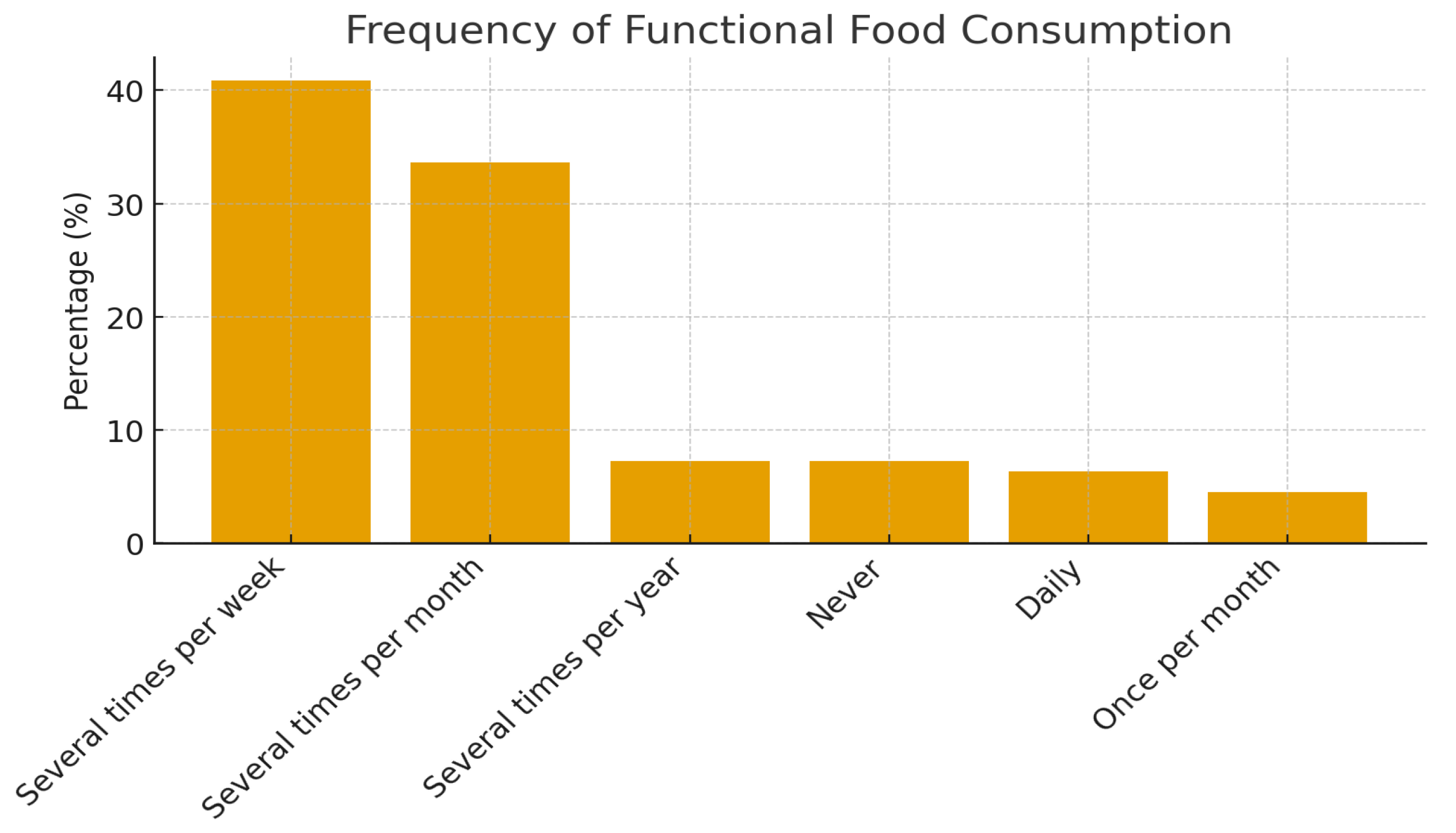
The percentage distribution of the responses obtained in the present study is shown in Figure 1, which clearly illustrates the dominance of answers indicating regular consumption of functional food. In the analysis of actual dietary behaviors, it was observed that 40.9% of respondents consume functional food several times a week, and 33.6% several times a month. This means that a total of 74.5% of participants regularly include functional products in their diet, which is a favorable indicator from the perspective of sustainable consumption. Only 7.3% declare that they do not consume such products at all. Such a high frequency of consumption indicates the potential for developing health-promoting and environmentally beneficial dietary habits.
The obtained results differ slightly from those reported by Szczepańska et al. (2024) [72], who concluded that as many as one-third of respondents do not consume functional food at all. In contrast, in the study by Nystrand et al. (2021) [52], most consumers declared consuming functional food on average 1 to 3 times per month, while in the research by Sgroi et al. (2024) [84], the average frequency reached approximately 2–3 times per week. Completely different findings were obtained by Dabo and Charles (2025) [81], who reported that the majority of participants consumed functional food daily (over 51%) or every other day (24%).
In summary, the analysis revealed significant differences between the level of declared knowledge and actual dietary practices. Although definitional awareness is low, the positive attitude and high consumption frequency indicate that consumers are open to functional products, which may serve as a starting point for further health education and the promotion of circular economy principles. Appropriate communication and informational activities can strengthen consumers’ ability to make choices that simultaneously bring health and environmental benefits.

4.3. Consumer Attitudes Towards Functional Food in the Context of the Circular Economy

Consumers’ attitudes towards functional food constitute a key element in assessing the potential for implementing the principles of the circular economy (CE) in the area of nutrition. According to the assumptions of the circular model, a positive consumer attitude supports making purchasing decisions that not only address health needs but also promote more efficient use of resources and reduce waste generation. The analysis of attitudes therefore makes it possible to assess the extent to which consumers are ready to adopt behaviors consistent with the idea of the CE, including, among others, choosing products with higher nutritional value, durable, natural, and produced using responsible production practices.
In the study, respondents evaluated their attitude towards functional food using a five-point Likert scale. The results indicate a clear dominance of positive evaluations. As many as 50.0% of the participants gave a score of 5 (the highest), and another 30.9% indicated a score of 4. This means that more than 80% of respondents declare a positive or very positive attitude towards functional food. Only a small proportion of respondents express a neutral or reluctant approach, which indicates a relatively high level of acceptance of this category of products. Erel and Oraman (2024) [21] also note that consumers who are positively inclined towards functional food are highly likely to consume functional food products.
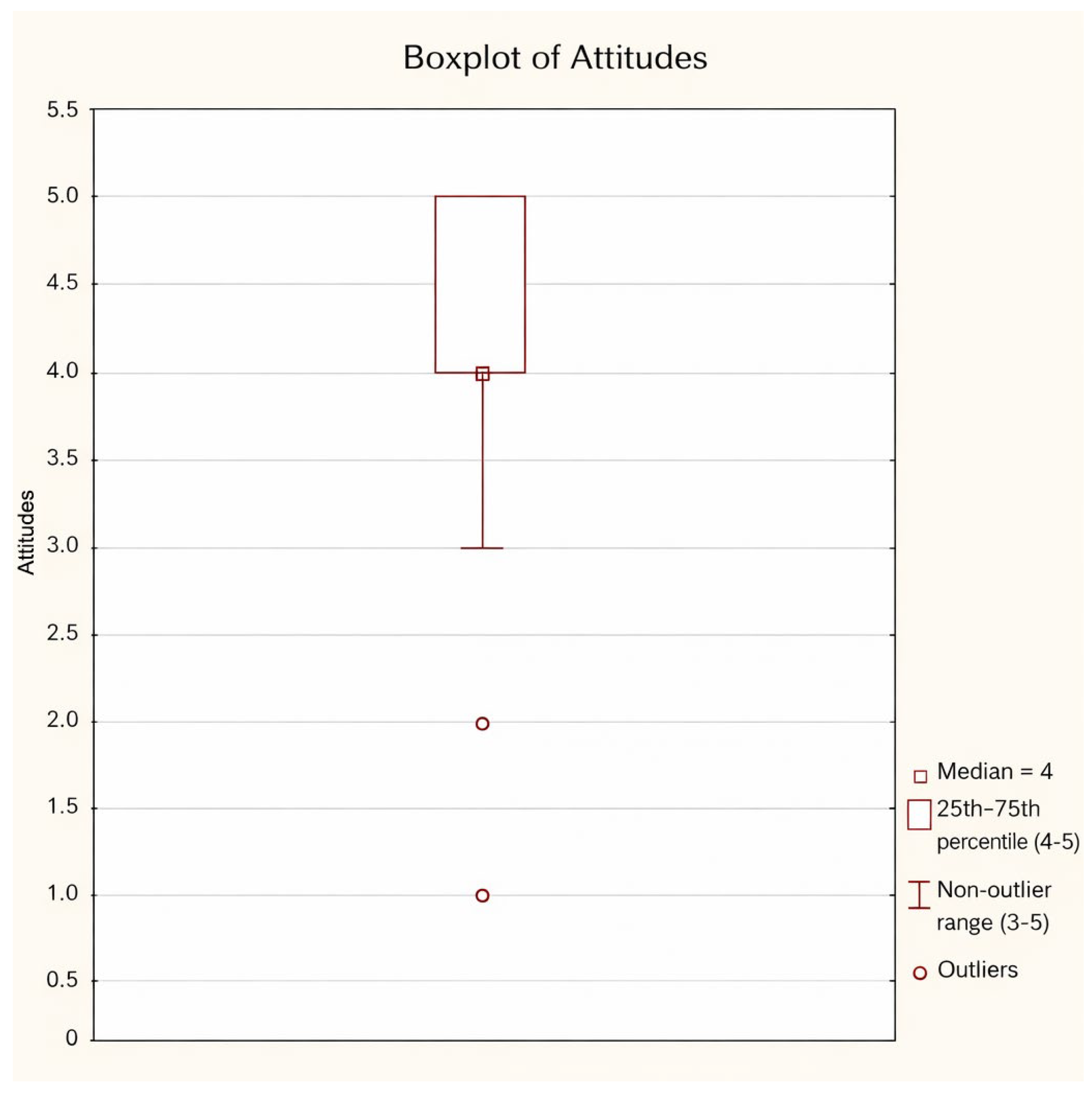
At the same time, in order to provide a more complete illustration of the diversity of attitudes, a box plot was prepared (Figure 2).
The boxplot indicates a strong concentration of ratings in the upper range of the scale—the median is at the level of 4, and the upper quartile includes only the rating 5. The distribution suggests little variation in attitudes and a lack of significant outliers, which indicates a high consistency of opinions among the respondents.
A high level of acceptance of functional food is important from the perspective of the circular economy (CE), because the stability and predictability of consumer attitudes increase the potential for implementing new product solutions that align with the principles of sustainable development. These products—thanks to a higher degree of functional processing, better health value, the ability to reduce excessive consumption, and the promotion of pro-health choices—can serve as a tool supporting CE goals.
Positive consumer attitudes may therefore facilitate the introduction of solutions that combine health value with environmental aspects, such as reducing food losses, using recyclable packaging, or incorporating ingredients derived from renewable sources.
It is also worth noting that the dominance of positive ratings appears despite the relatively low level of declarative knowledge, which may indicate an intuitive or sometimes emotional approach to functional food. Consumers, even without possessing full definitional knowledge, perceive such products as healthier, more valuable, and aligned with current dietary trends. From an educational perspective, this creates an opportunity to further strengthen ecological and health awareness through informational activities that could simultaneously promote circular economy principles.
This is consistent with the findings reported by Oliveira et al. (2025) [85]—only 37% of respondents declared familiarity with the term ‘functional food’, despite its widespread availability on the food market. At the same time, the study showed moderately positive perceptions of these products, even among individuals unfamiliar with the term, which may indicate a superficial and scientifically inaccurate understanding of the concept—many consumers are able to list examples of foods they consider ‘healthy’, but have difficulty defining functional food or distinguishing it from dietary supplements [12,86,87].
In summary, the analysis of attitudes reveals strong social acceptance of functional food, which may serve as an important foundation for shaping pro-environmental dietary behaviors. In line with the logic of the circular economy, the positive attitude of consumers increases the market’s capacity to adopt innovative and more sustainable products, thereby contributing to reducing environmental pressure and minimizing resource waste. This result also justifies the need to continue research on the relationship between attitudes, knowledge, and actual consumer behaviors, which will be discussed in the following subsections.

4.4. Comparative Analyses

Given that, as confirmed by numerous studies [77,88,89,90], socio-demographic characteristics of consumers play an important role in the acceptance of functional food, an in-depth analysis in this area was conducted.
The comparative analyses aimed to assess whether the demographic characteristics of respondents differentiate the level of knowledge, attitudes, and behaviors related to functional food in the case of the present study.
In accordance with methodological assumptions, both non-parametric and parametric tests were applied, taking into account the nature of the variables and the results of normality tests.

4.4.1. Verification of Assumptions and Selection of Statistical Tests

In the first stage, the Shapiro–Wilk test was conducted to assess whether the distribution of the variable ‘attitudes towards functional food’ conforms to a standard normal distribution.
The obtained result W = 0.92; p < 0.001 indicated a significant deviation from normality. For this reason, non-parametric tests (Mann–Whitney and Kruskal–Wallis) were used in the main analyses, and, as a complement in a robust analysis, parametric tests (Student’s t-test and ANOVA), in accordance with the common practice of treating Likert scales as quasi-quantitative data.

4.4.2. Gender and Knowledge and Attitudes Towards Functional Food

  • Knowledge of the definition—χ2 test
The obtained result χ2 = 0.00; p = 0.99 indicated no relationship between gender and the declared definitional knowledge.
  • Attitudes towards functional food—Student’s t-test
The differences in mean attitude scores between women and men were analyzed using the independent-samples Student’s t-test.
The following results were obtained: women: M = 4.22, Me = 5; men: M = 4.29, Me = 4.
Student’s t-test did not reveal statistically significant differences: t ≈ −0.04; p > 0.05, which was confirmed by the Mann–Whitney test (p ≈ 0.97).
This indicates that attitudes towards functional food are comparably positive among both women and men, which supports the even implementation of health-promoting practices consistent with the circular economy (CE).
This appears to be a promising trend, as just a few years ago gender was a significant factor differentiating consumer attitudes when making decisions about purchasing functional food [90,91,92]. This may have resulted from the fact that women were more focused on weight control and showed greater interest in healthy eating. On the other hand, studies with completely opposite results and conclusions can also be found—according to Urala and Lähteenmäki (2004) [93], women tended to doubt the possibility of counteracting an improper diet with the help of functional food and did not consider such products to be as important a part of a healthy diet as men did.
Currently, however, gender differences in the area of healthy eating and environmental awareness are clearly diminishing, as also indicated by the findings of Szczepańska et al. (2024) [72].

4.4.3. Age and Attitudes Towards Functional Food

The analysis was carried out using a one-way ANOVA, comparing four age groups: 18–25 years, 26–40 years, 41–60 years, and over 60 years. The obtained result, F(3,106) = 0.20; p = 0.89, indicates no significant differences in attitudes between the age groups.
It means that the positive attitude towards functional food is a generationally stable phenomenon. From a circular economy perspective, this suggests that functional food has the potential to reach all age groups without the need to differentiate educational activities.
Similar conclusions were reached by Ligarda-Samanez et al. (2025) [30] and Yadav et al. (2024) [94]—they found that global trends show that consumers, especially younger generations, increasingly seek functional and sustainable food products that align with the principles of the circular economy.
However, it should be noted that needs, preferences, and motivations related to attitudes towards functional food differ across life stages. While younger consumers often choose functional foods because they are open to trying new things and frequently seek out trends and nutritional innovations, older consumers demonstrate greater awareness and focus more on the functional health benefits of these products, as they are interested in maintaining or improving their health [45,87,92,95,96,97,98].

4.4.4. Education Versus Knowledge and Attitudes

The level of education is one of the key factors frequently identified in the literature as a variable determining nutritional awareness, readiness to undertake pro-health behaviours, and the tendency to accept innovative food products, including functional food. Therefore, in the next stage of the analysis, it was assessed whether education differentiates definitional knowledge and attitudes towards functional food. The study included three categories of education: primary/vocational, secondary, and higher.
  • Knowledge of the definition—χ2 test
The analysis of the relationship between the level of education and the declared knowledge of the definition revealed only a tendency that did not reach statistical significance: χ2 = 5.22; p = 0.16. This indicates that although individuals with higher education more often declare familiarity with the concept, this difference is not statistically confirmed.
  • Attitudes—ANOVA
The analysis of attitudes towards functional foods used ANOVA. The obtained test result, F(2,107) = 0.56; p = 0.57, also did not show statistically significant differences. Therefore, it can be stated that the positive attitude towards functional food is independent of the level of education, which suggests an egalitarian nature of consumer attitudes in this area.
This is contrary to many previous studies in this field, which demonstrated a strong relationship between education level and consumer acceptance of functional food. Specifically, many researchers concluded that a higher level of education determines a greater intention to purchase this type of food [67,90,91,96,99].
In the literature, completely different conclusions can also be found, such as those presented by Wortmann et al. (2018) [100], who reported that individuals with a higher level of education tended to reject the consumption of functional food.
However, in recent years, studies have begun to appear that support the notion that educational level does not influence the awareness or acceptance of functional food. An example is the work of Sulaimanet et al. (2025) [101], who found that education level, as well as other individual determinants such as age or employment status, were not statistically significant predictors of functional food awareness.
The same conclusion was reached by Tepavčević et al. (2025) [102], who stated that the consumption of functional food remains consistent across different demographic groups, and that, in particular, educational level does not play a significant role in the consumption of such products.
Additionally, a weak positive association was observed between respondents’ level of education and their perception of the conceptual link between functional food and sustainability. This indicates that individuals with respondents with higher educational attainment were slightly more likely to associate functional food with sustainability and circular economy principles, even though education did not significantly differentiate overall attitudes towards functional food.

4.4.5. Place of Residence and Purchasing Behaviors

The relationship between place of residence and the regular consumption of functional food (≥several times per month) was assessed using the χ2 test.
The result, χ2 = 1.99; p = 0.74, indicated no relationship between the analyzed variables. Interpretatively, this means that consumer behaviors related to functional food are similar regardless of the size of the place of residence, which confirms the equalizing access to functional and health-promoting products on the market.
In some studies on the functional food market, no statistically significant differences in the level of its consumption are observed depending on the size of the place of residence. Núnez-González et al. (2011) [103] did not identify a general significant relationship between the level of functional food consumption and the living environment (urban/rural)—differences concerned only selected product groups. Similar conclusions were drawn from a Polish study of a representative sample of adult consumers, in which the place of residence did not differentiate interest in functional sweets [104] and also concluded that the purchasing behaviors of young functional food consumers are largely similar across different types of localities, and that differences related to the place of residence are secondary and rather subtle.
The convergence of consumer behaviors across different types of localities is consistent with the process described in the literature, in which access to processed, health-promoting, and functional foods is becoming increasingly equalized. This results, among other factors, from the development of retail chains and supply chains, the integration of food systems, as well as improvements in infrastructure (roads, transportation) and better connections between rural, urban, and suburban areas [65,98].

4.4.6. Summary of Comparative Analyses

Comparative analyses showed no significant differences between demographic groups in terms of knowledge, attitudes, and behaviors related to functional food. At the same time, the following were observed:
  • High and stable acceptance of functional food across all examined groups;
  • Directional tendencies (e.g., more frequently declared consumption among women);
  • No demographic barriers to implementing consumption patterns consistent with the circular economy concept.
These findings indicate that functional food can serve as a widespread, egalitarian element of a sustainable consumption model, and that educational and environmental initiatives may be directed towards the general population without the need for significant segmentation of communication.

4.5. Dependency Analyses

In the third stage of the analysis, the focus was on evaluating the relationships between consumers’ level of knowledge, their attitudes towards functional food, and their actual purchasing behaviors. The aim was to determine whether more informed consumers choose functional products more frequently, and whether a positive attitude supports actions consistent with the principles of the circular economy (CE).
The analyses were carried out in accordance with the assumptions described in the methodological section (Section 3). Given the nature of the data, the following measures were applied: Pearson’s correlation coefficient (r) for quasi-quantitative variables (attitudes) and Spearman’s correlation coefficient (ρ) for ordinal variables (knowledge, consumption frequency).

4.5.1. Relationship Between Knowledge and Attitudes Towards Functional Food

The analysis revealed a significant positive relationship between the level of self-reported knowledge and attitudes towards functional food:
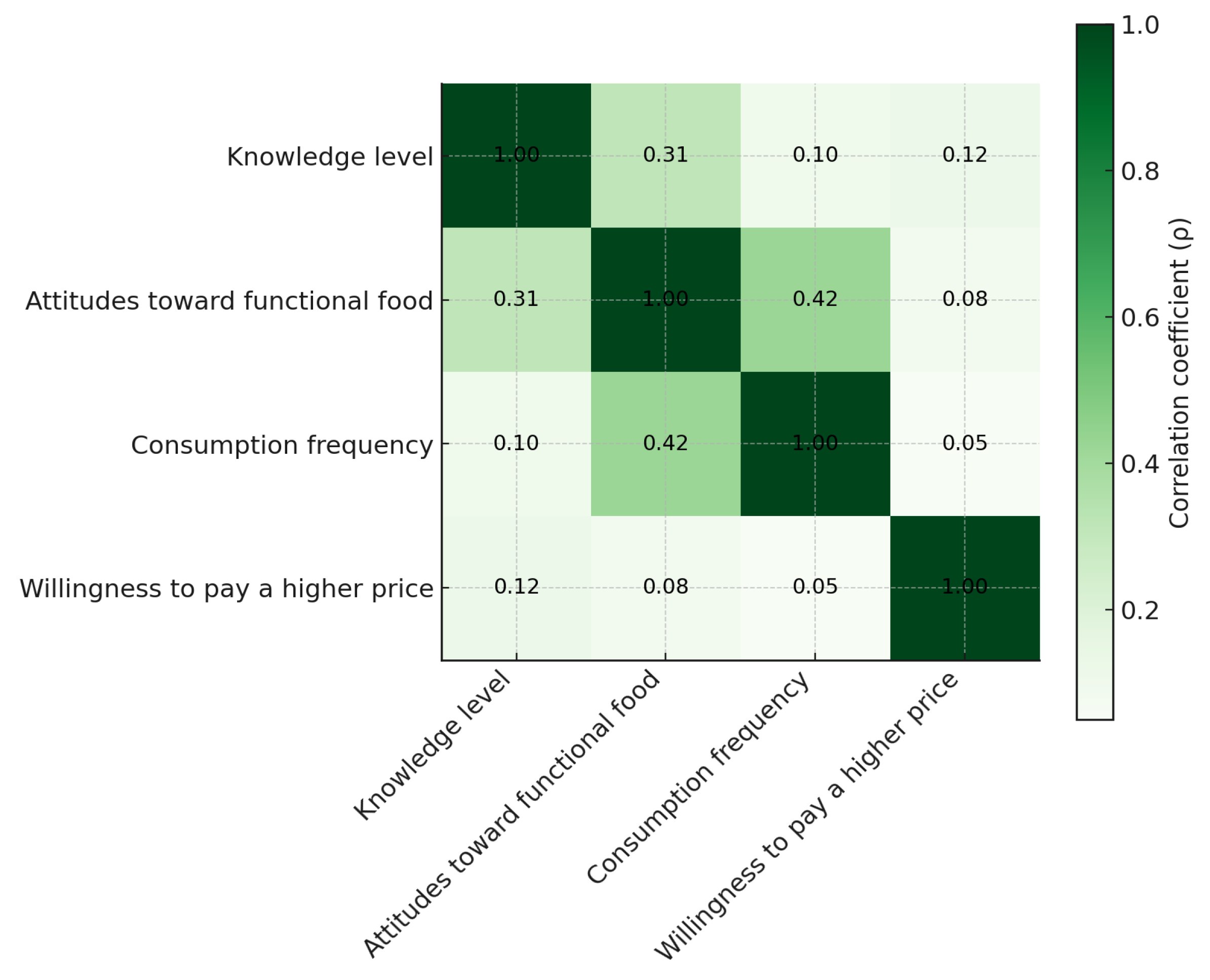
  • ρ = 0.31; p < 0.01
This means that individuals who are more familiar with the concept of functional food have a more positive attitude towards this category of products. In the context of the circular economy, this finding confirms that knowledge is one of the key factors shaping consumers’ readiness to make more informed and sustainable choices.
A positive correlation obtained (ρ = 0.31; p < 0.01) confirms that consumers’ level of knowledge about functional food has a significant impact on shaping their attitudes towards this category of products. This result is consistent with findings reported in the literature. Studies by Di Talia et al. (2018) [74] showed that individuals with higher awareness and a better understanding of the concept of functional food demonstrate greater openness, trust, and willingness to accept such products. Similar observations were made by Chammas et al. (2019) [78], who noted that knowledge reduces consumer uncertainty and lowers skepticism towards health-related claims made by producers.
A literature review conducted by Baker et al. (2022) [20] further indicates that awareness of the properties of functional foods is one of the key factors predisposing consumers to develop positive attitudes towards these products. The authors emphasize that knowledge enhances consumers’ ability to assess health benefits and distinguish functional foods from products merely marketed as “health-promoting.” Likewise, Oraman (2019) [80] pointed out that consumers who are more knowledgeable about healthy eating principles are more motivated to choose functional foods because they perceive them as supporting long-term health goals.
A comparison of the present findings with prior research clearly demonstrates that knowledge plays a reinforcing role—that is, it increases acceptance of functional food, reduces skepticism, and improves perceptions of its credibility. In the context of the circular economy, this is particularly important, as better-educated consumers are more likely to recognize connections between choosing functional food and the sustainable use of resources. Thus, knowledge not only enhances acceptance but also increases readiness to make more informed and environmentally responsible decisions aligned with circular economy principles.

4.5.2. Relationship Between Attitudes and Actual Purchasing Behaviors

The strongest relationship was observed between attitudes towards functional food and the frequency of its consumption:
  • ρ = 0.42; p < 0.001
This indicates that individuals with a positive attitude reach for functional food much more frequently in practice. This result is particularly important for the circular economy, as it confirms that changing consumers’ beliefs can directly influence their behaviors by encouraging more frequent selection of products with higher nutritional value, reducing food waste through more informed decisions, and promoting choices considered “better” in terms of health and environmental impact.
The relationship between attitudes towards functional food and the frequency of its consumption is consistent with findings from recent studies. Kowalska et al. (2024) [105] showed that a positive consumer attitude is one of the key factors driving regular choices of functional products, regardless of the level of nutritional knowledge. The authors highlight that the stronger the belief in health benefits, the greater the tendency to include such products in one’s daily diet.
Similar conclusions were presented by Mohammad (2024) [106], who found that positive emotions and health-related motivators are directly linked to actual purchasing behavior. Consumers with favorable attitudes both declare and demonstrate higher consumption frequency of functional food. This mechanism also works by reducing psychological barriers and increasing trust in products marketed as health-promoting.

4.5.3. Relationship Between Knowledge and Willingness to Pay a Higher Price

The results indicated that the relationship between the level of knowledge and the willingness to pay higher costs for functional products is weak and statistically insignificant:
  • ρ = 0.12; p = 0.18 (ns)
This may indicate that knowledge alone is not a sufficient factor to encourage consumers to accept a higher price. Emotional factors, individual health preferences, trust in producers, and general health-oriented attitudes are likely to play a more important role.
The lack of a significant relationship between knowledge level and willingness to pay a higher price is consistent with recent findings on consumer behavior towards products with enhanced health value.
Alsubhi et al. (2022) [107] noted that the decision to incur an additional cost stems primarily from perceived health benefits and individual motivation rather than from nutritional knowledge itself. This means that even well-informed consumers are not inclined to pay more if a product does not inspire trust or if they do not perceive a clear added value.
Similar conclusions were presented by Martin et al. (2024) [108], who observed that consumers are willing to pay a higher price when a product is perceived as sensorially appealing, credible, and capable of eliciting positive emotions. In their study, the role of knowledge was limited—respondents were willing to pay more only when health information aligned with their personal beliefs and perceived needs.

4.5.4. Summary of the Relationship Analyses

Based on the results presented in the correlation matrix in Figure 3, it can be concluded that the analyzed variables form a coherent model of relationships between consumers’ knowledge, attitudes, and behaviors.
The correlation analyses clearly indicate that:
  • Consumers’ attitudes are the strongest predictor of actual purchasing behaviors;
  • Knowledge influences attitudes, but to a lesser extent affects actions;
  • Willingness to pay more depends mainly on a positive attitude rather than on factual, definitional knowledge.
From the perspective of the circular economy, it can be concluded that consumer education should focus not only on knowledge but, above all, on shaping positive attitudes. Changing attitudes can lead to more sustainable eating habits, and marketing and educational activities based on health and environmental values can effectively support circular-economy goals.

5. Conclusions

The conducted research enabled a comprehensive assessment of the level of knowledge, attitudes, and consumer behaviors towards functional food, as well as their relationship with the concept of the circular economy. The results clearly indicate that consumers exhibit high acceptance and a positive attitude towards functional food, despite their definitional and substantive knowledge remaining limited. This finding is particularly significant, as it suggests that dietary decisions are based primarily on an intuitive perception of these products as “healthier,” rather than on an in-depth understanding of their properties or their impact on human health and the environment. Conducting the study in Eastern Poland, which is a predominantly agricultural and less industrialized region, allowed the observed consumer attitudes to be considered within the context of local food systems aligned with circular economy principles.
The applied statistical methods enabled the identification of fundamental relationships (or the absence thereof) between the examined variables. The Shapiro–Wilk test indicated a lack of normality in the distribution of attitudes, confirming a strong concentration of responses in the upper range of the scale. The Mann–Whitney, chi-square, and Student’s t-tests demonstrated that demographic variables such as gender do not significantly differentiate the level of knowledge or attitudes towards functional food. At the same time, the structure of the study sample—particularly the proportion of young and well-educated consumers—indicates that these groups exhibit the highest readiness to adopt new dietary and environmental practices. This may, in the future, facilitate the development of more conscious and sustainable consumption models.
The findings also confirm that functional food is perceived as a component of a healthy lifestyle; however, its role within the context of the circular economy remains largely unrecognized. Most consumers do not associate its consumption with issues related to the sustainable use of resources or the reduction of food waste. This indicates an educational gap that should be addressed in initiatives targeted at both consumers and producers. The potential of functional food as a tool supporting the objectives of the circular economy is considerable, particularly when taking into account the opportunities for utilizing by-products, the development of bioprocessing technologies, and the growing importance of eco-design in packaging.
In light of the obtained results, several key conclusions can be formulated:
  • The positive attitudes towards functional food are stable, consistent, and independent of the level of knowledge, as confirmed by distribution analyses and statistical tests.
  • The absence of significant differences between genders indicates a diminishing relevance of traditional divisions in health-related and dietary behaviors.
  • Younger consumers demonstrate the highest developmental potential in the areas of health-promoting and environmental education, which is consistent with findings reported in the literature.
  • Definitional knowledge regarding functional food remains limited, which hinders consumers’ ability to assess the quality of marketing information and make evidence-based decisions.
  • The relationship between functional food and the concept of the circular economy is not obvious to respondents, highlighting the need for strengthened informational efforts related to production, recycling, food waste reduction, and conscious purchasing decisions.
  • The food industry should strive for greater transparency, accuracy of health claims, and clear communication of both health-related and environmental values associated with its products.
Both producers and public institutions should recognize that the high level of acceptance of functional food provides a favorable starting point for shaping dietary habits that support sustainable development. Expanding communication to include environmental aspects, utilizing certification schemes, and promoting products manufactured in accordance with circular economy principles may further strengthen this potential.
From a practical perspective, the findings suggest that functional food may serve as an effective instrument for promoting sustainable consumption patterns without the need for extensive demographic segmentation. For food producers and retailers, this implies the importance of transparent communication strategies that simultaneously emphasize health benefits and environmental value, including resource efficiency, waste reduction, and the use of circular solutions in production and packaging.
From a policy perspective, the results highlight the need to better integrate functional food into public health and sustainability policies. Educational programs, labeling initiatives, and information campaigns supported by public institutions may help strengthen consumers’ understanding of the link between functional food, health promotion, and circular economy principles. Such measures could contribute to broader policy objectives related to sustainable food systems, reduced environmental pressure, and improved public health outcomes.
It should be emphasized that the present study focuses primarily on consumers’ attitudes and stated preferences towards functional food and its role within the circular economy, rather than on directly observed purchasing behavior. This distinction is well recognized in the academic literature as the Attitude–Behavior Gap, which refers to the divergence between declared intentions and actual consumer actions. Therefore, the findings of this study should be interpreted as an exploratory investigation of consumer perceptions and attitudinal tendencies rather than definitive evidence of behavioral change.
Future research should aim to bridge this gap by employing methodological approaches that capture actual purchasing behavior, such as experimental auctions, scanner data analysis, or longitudinal studies tracking consumer choices over time. The use of such methods would allow for a more robust validation of the relationships identified in the present study and provide deeper insights into the mechanisms through which attitudes towards functional food translate into concrete market behaviors within circular food systems.
The limitations of the study—such as the lack of full representativeness, the self-reported nature of the data, and the predominance of certain demographic groups—do not diminish the value of the obtained results, but rather indicate directions for further analysis. Future research should encompass broader segments of the population, include different regions of the country, and incorporate methods that capture actual purchasing behaviors. Complementing the study with experimental and qualitative approaches could further deepen the understanding of consumer decision-making mechanisms.
In conclusion, the study confirms that functional food holds genuine potential to support both public health and the transformation of the food system in accordance with the principles of the circular economy. However, fully realizing this potential requires coordinated efforts at the educational, regulatory, and market levels. The findings provide a valuable starting point for further research and a foundation for designing strategies that will promote conscious, health-oriented, and environmentally responsible consumer choices.

Author Contributions

Conceptualization, K.N.-M., W.S., E.O. and M.S.; methodology, K.N.-M. and M.S.; validation, K.N.-M., W.S., E.O. and M.S.; formal analysis, K.N.-M.; investigation, W.S. and E.O.; resources, K.N.-M., W.S., E.O. and M.S.; data curation, K.N.-M.; writing—original draft preparation, K.N.-M., W.S., E.O. and M.S.; writing—review and editing, W.S. and E.O.; visualization, K.N.-M. and M.S.; project administration, M.S. and E.O.; supervision, W.S. and K.N.-M. All authors have read and agreed to the published version of the manuscript.

Funding

This research received no external funding.

Institutional Review Board Statement

Ethical review and approval were waived for this study due to in Poland, EU REGULATION 536/2014 of 16 April 2014 [1] applies, which entered into force on 31 January 2022, and applies only to consent for clinical trials that we did not conduct.

Informed Consent Statement

Informed consent was obtained from all subjects involved in the study.

Data Availability Statement

The original contributions presented in this study are included in the article. Further inquiries can be directed to the corresponding author.

Conflicts of Interest

The authors declare no conflicts of interest.

References

  1. Lawrence, M. Fundamentals of a Healthy and Sustainable Diet. Nutr. J. 2024, 23, 150. [Google Scholar] [CrossRef] [PubMed]
  2. Çelekli, A.; Özbal, B.; Bozkurt, H. Challenges in Functional Food Products with the Incorporation of Some Microalgae. Foods 2024, 13, 725. [Google Scholar] [CrossRef] [PubMed]
  3. Marques-Vidal, P.; Tsampasian, V.; Cassidy, A.; Biondi-Zoccai, G.; Chrysohoou, C.; Koskinas, K.; Verschuren, W.M.M.; Czapla, M.; Kavousi, M.; Kouvari, M.; et al. Diet and Nutrition in Cardiovascular Disease Prevention: A Scientific Statement of the European Association of Preventive Cardiology and the Association of Cardiovascular Nursing & Allied Professions of the European Society of Cardiology. Eur. J. Prev. Cardiol. 2025, 32, 1540–1552. [Google Scholar] [CrossRef] [PubMed]
  4. Fekete, M.; Lehoczki, A.; Kryczyk-Poprawa, A.; Zábó, V.; Varga, J.T.; Bálint, M.; Fazekas-Pongor, V.; Csípho, T.; Rząsa-Duran, E.; Varga, P. Functional Foods in Modern Nutrition Science: Mechanisms, Evidence, and Public Health Implications. Nutrients 2025, 17, 2153. [Google Scholar] [CrossRef]
  5. Dudziak, A.; Stoma, M.; Derkacz, A.J. Circular Economy in the Context of Food Losses and Waste. Sustainability 2022, 14, 10116. [Google Scholar] [CrossRef]
  6. Burdock, G.A.; Carabin, I.G.; Griffiths, J.C. The Importance of GRAS to the Functional Food and Nutraceutical Industries. Toxicology 2006, 221, 17–27. [Google Scholar] [CrossRef]
  7. Alongi, M.; Anese, M. Re-Thinking Functional Food Development through a Holistic Approach. J. Funct. Foods 2021, 81, 104466. [Google Scholar] [CrossRef]
  8. Martirosyan, D.; Lampert, T.; Ekblad, M. Classification and Regulation of Functional Food Proposed by the Functional Food Center. Funct. Food Sci. 2022, 2, 25–46. [Google Scholar] [CrossRef]
  9. Entry Details|FAO Terminology Portal|Food and Agriculture Organization of the United Nations. Available online: https://www.fao.org/faoterm/viewentry/en/?entryId=170967 (accessed on 17 November 2025).
  10. Temple, N.J. A Rational Definition for Functional Foods: A Perspective. Front. Nutr. 2022, 9, 957516. [Google Scholar] [CrossRef]
  11. Diplock, A.T.; Charuleux, J.-L.; Crozier-Willi, G.; Kok, F.J.; Rice-Evans, C.; Roberfroid, M.; Stahl, W.; Vina-Ribes, J. Functional Food Science and Defence against Reactive Oxidative Species. Br. J. Nutr. 1998, 80, S77–S112. [Google Scholar] [CrossRef]
  12. Topolska, K.; Florkiewicz, A.; Filipiak-Florkiewicz, A. Functional Food—Consumer Motivations and Expectations. Int. J. Environ. Res. Public Health 2021, 18, 5327. [Google Scholar] [CrossRef]
  13. Banwo, K.; Olojede, A.O.; Adesulu-Dahunsi, A.T.; Verma, D.K.; Thakur, M.; Tripathy, S.; Singh, S.; Patel, A.R.; Gupta, A.K.; Aguilar, C.N. Functional Importance of Bioactive Compounds of Foods with Potential Health Benefits: A Review on Recent Trends. Food Biosci. 2021, 43, 101320. [Google Scholar] [CrossRef]
  14. Morán, J.; Kilasoniya, A. Application of the “Novel Foods” Regulation to Botanicals in the European Union. Laws 2024, 13, 10. [Google Scholar] [CrossRef]
  15. Hajzer, Z.E.; Alibrahem, W.; Kharrat Helu, N.; Oláh, C.; Prokisch, J. Functional Foods in Clinical Trials and Future Research Directions. Foods 2025, 14, 2675. [Google Scholar] [CrossRef] [PubMed]
  16. Intrasook, J.; Tsusaka, T.W.; Anal, A.K. Trends and Current Food Safety Regulations and Policies for Functional Foods and Beverages Containing Botanicals. J. Food Drug Anal. 2024, 32, 112. [Google Scholar] [CrossRef] [PubMed]
  17. Jose, J.; Ndang, K.; Chethana, M.B.; Chinmayi, C.S.; Afrana, K.; Gopan, G.; Parambi, D.G.T.; Munjal, K.; Chopra, H.; Dhyani, A.; et al. Opportunities and Regulatory Challenges of Functional Foods andNutraceuticals During COVID-19 Pandemic. CNF 2024, 20, 1252–1271. [Google Scholar] [CrossRef]
  18. Ospina-Maldonado, S.; Martin-Gómez, H.; Cardoso-Ugarte, G.A. From Waste to Wellness: A Review on the Harness of Food Industry by-Products for Sustainable Functional Food Production. Int. J. Food Sci. Technol. 2024, 59, 8680–8692. [Google Scholar] [CrossRef]
  19. Ahmad, M.H.; Safdar, S.; Kousar, S.; Nadeem, M.; Asghar, Z. Functional Foods and Human Health: An Overview. In Functional Foods: Phytochemicals and Health Promoting Potential; IntechOpen: London, UK, 2021; Volume 3. [Google Scholar]
  20. Baker, M.T.; Lu, P.; Parrella, J.A.; Leggette, H.R. Investigating the Effect of Consumers’ Knowledge on Their Acceptance of Functional Foods: A Systematic Review and Meta-Analysis. Foods 2022, 11, 1135. [Google Scholar] [CrossRef]
  21. Erel, F.P.; Oraman, Y. Tomorrow’s Choices: A Comprehensive Study of Consumer Perspectives on Functional Foods. Tekirdağ Ziraat Fakültesi Derg. 2024, 21, 1170–1186. [Google Scholar] [CrossRef]
  22. Wu, L.; Zhang, C.; Long, Y.; Chen, Q.; Zhang, W.; Liu, G. Food Additives: From Functions to Analytical Methods. Crit. Rev. Food Sci. Nutr. 2022, 62, 8497–8517. [Google Scholar] [CrossRef]
  23. Gruchelski, M.; Niemczyk, J. Substancje Dodatkowe w Żywności: Efektywność Rynku Żywnościowego versus Zdrowie Konsumentów. Postępy Tech. Przetwórstwa Spożywczego 2019, 2019, 108–112. [Google Scholar]
  24. Abedi-Firoozjah, R.; Salim, S.A.; Hasanvand, S.; Assadpour, E.; Azizi-Lalabadi, M.; Prieto, M.A.; Jafari, S.M. Application of Smart Packaging for Seafood: A Comprehensive Review. Comp. Rev. Food Sci. Food Safe 2023, 22, 1438–1461. [Google Scholar] [CrossRef]
  25. Witkowski, M.; Grajeta, H.; Gomułka, K. Hypersensitivity Reactions to Food Additives—Preservatives, Antioxidants, Flavor Enhancers. Int. J. Environ. Res. Public Health 2022, 19, 11493. [Google Scholar] [CrossRef] [PubMed]
  26. Regulation (EC) No 1333/2008 of the European Parliament and of the Council of 16 December 2008 on Food Additives (Text with EEA Relevance); 2008. Volume 354. Available online: https://eur-lex.europa.eu/eli/reg/2008/1333/oj/eng (accessed on 17 November 2025).
  27. Diaz, H.S.; Del Rio, R. Novel Functional Foods Based On Circular Economy. In Functional Foods and Bioactive Compounds: Modern and Medieval Approaches; Food Science Publisher: Dallas, TX, USA, 2023; Volume 275. [Google Scholar]
  28. Castro-López, C.; Sánchez-Alejo, E.J.; Saucedo-Pompa, S.; Rojas, R.; Aranda-Ruiz, J.; Martínez-Avila, G.C.G. Fluctuations in Phenolic Content, Ascorbic Acid and Total Carotenoids and Antioxidant Activity of Fruit Beverages during Storage. Heliyon 2016, 2, e00152. [Google Scholar] [CrossRef]
  29. Koszta, V.; Mierliță, D. Sustainable Valorization of Agri-Food Waste as a Source of Bioactive Compounds for Obtaining Functional Foods in the Context of the Circular Economy. In Analele Universitatii din Oradea, Fascicula Ecotoxicologie, Zootehnie si Tehnologii în Industria Alimentara; Zenodo: Genève, Switzerland, 2024; Volume 23. [Google Scholar]
  30. Ligarda-Samanez, C.A.; Huamán-Carrión, M.L.; Calsina-Ponce, W.C.; Cruz, G.D.l.; Calderón Huamaní, D.F.; Cabel-Moscoso, D.J.; Garcia-Espinoza, A.J.; Sucari-León, R.; Aroquipa-Durán, Y.; Muñoz-Saenz, J.C. Technological Innovations and Circular Economy in the Valorization of Agri-Food By-Products: Advances, Challenges and Perspectives. Foods 2025, 14, 1950. [Google Scholar] [CrossRef]
  31. Terenzi, C. Valorization of Agri-Food by-Products for Pharmaceutical, Cosmetic, and Nutraceutical Applications in a Circular Economy Perspective. Ph.D. Thesis, Alma Mater Studiorum Università di Bologna, Bologna, Italy, 2025. [Google Scholar]
  32. Meléndez-Martínez, A.J.; Böhm, V.; Borge, G.I.A.; Cano, M.P.; Fikselová, M.; Gruskiene, R.; Lavelli, V.; Loizzo, M.R.; Mandić, A.I.; Brahm, P.M.; et al. Carotenoids: Considerations for Their Use in Functional Foods, Nutraceuticals, Nutricosmetics, Supplements, Botanicals, and Novel Foods in the Context of Sustainability, Circular Economy, and Climate Change. Annu. Rev. Food Sci. Technol. 2021, 12, 433–460. [Google Scholar] [CrossRef] [PubMed]
  33. Jurgilevich, A.; Birge, T.; Kentala-Lehtonen, J.; Korhonen-Kurki, K.; Pietikäinen, J.; Saikku, L.; Schösler, H. Transition towards Circular Economy in the Food System. Sustainability 2016, 8, 69. [Google Scholar] [CrossRef]
  34. Fassio, F.; Chirilli, C. The Circular Economy and the Food System: A Review of Principal Measuring Tools. Sustainability 2023, 15, 10179. [Google Scholar] [CrossRef]
  35. Cifuentes-Faura, J. Environmental Policies to Combat Climate Change in Europe and Possible Solutions: European Green Deal and Circular Economy. Int. J. Sustain. Policy Pract. 2021, 17, 27. [Google Scholar] [CrossRef]
  36. Mihai, F.-C.; Ulman, S.-R.; Pop, V. Macro and Microplastic Pollution in Romania: Addressing Knowledge Gaps and Potential Solutions under the Circular Economy Framework. PeerJ 2024, 12, e17546. [Google Scholar] [CrossRef]
  37. Smol, M.; Marcinek, P.; Duda, J.; Szołdrowska, D. Importance of Sustainable Mineral Resource Management in Implementing the Circular Economy (CE) Model and the European Green Deal Strategy. Resources 2020, 9, 55. [Google Scholar] [CrossRef]
  38. Arla—Your Global Dairy Company. Available online: https://www.arla.com/ (accessed on 27 December 2025).
  39. Nourishing by Nature—FrieslandCampina Global—FrieslandCampina. Available online: https://www.frieslandcampina.com/ (accessed on 27 December 2025).
  40. Ever Grain Brewing Company. Available online: https://evergrainbrewing.com/ (accessed on 27 December 2025).
  41. Upcyccled Foods INC. Available online: https://upcycledfoods.com/ (accessed on 27 December 2025).
  42. Marcinek, P.; Marzena, S. Znaczenie Biogospodarki w Mapach Drogowych Gospodarki o Obiegu Zamkniętym (GOZ) w Wybranych Państwach Europejskich. In Strategie Wdrażania; Instytut Gospodarki Surowcami Mineralnymi i Energią PAN: Kraków, Poland, 2021; p. 20. [Google Scholar]
  43. Bączyk, A. Produktywność W Realizacji Założeń Gospodarki O Obiegu Zamkniętym W Polsce. Ewaluacja Gospod. Obiegu Zamkniętym 2021, 2021, 19. [Google Scholar]
  44. Wojnarowska, O. Żywność Funkcjonalna—Wymagający Rynek dla Renomowanych Dostawców. Available online: https://www.bikotech.pl/index.php/2024/06/21/zywnosc-funkcjonalna-wymagajacy-rynek-dla-renomowanych-dostawcow/ (accessed on 27 December 2025).
  45. Rzoska, A.A. Zrównoważona Konsumpcja Żywności Funkcjonalnej a Prozdrowotny Styl Życia. Mark. I Rynek 2022, 2022, 30–38. [Google Scholar] [CrossRef]
  46. Majcher, S. Zrównoważona Żywność: Trendy Konsumenckie i Ich Implikacje Ekonomiczne. Zarządzanie Proces. Podmiotach Lecz. Uwarunk. Stosow. 2025, 2025, 10. [Google Scholar]
  47. Żywność przyszłości będzie powstawać w Olimp Labs. Olimp Labs 2019. Available online: https://olimp-labs.pl/zywnosc-przyszlosci-bedzie-powstawac-w-olimp-labs/ (accessed on 27 December 2025).
  48. Dofinansowanie|Organikagro Foods. Available online: https://organikagrofoods.pl/ (accessed on 27 December 2025).
  49. Żywność Fukcjonalna. Centrum Badawcze Nad Żywnością Funkcjonalną. Available online: https://cbzf.pl/ (accessed on 27 December 2025).
  50. Zdrowe Posiłki. Available online: https://dobrakaloria.pl/54-zdrowe-posilki (accessed on 14 October 2025).
  51. Projekty—Zakład Technologii Owoców i Warzyw. Available online: https://www1.up.poznan.pl/ztoiw/projekty/ (accessed on 14 October 2025).
  52. Nystrand, B.T.; Olsen, S.O.; Tudoran, A.A. Individual Differences in Functional Food Consumption: The Role of Time Perspective and the Big Five Personality Traits. Appetite 2021, 156, 104979. [Google Scholar] [CrossRef] [PubMed]
  53. Bärebring, L.; Palmqvist, M.; Winkvist, A.; Augustin, H. Gender Differences in Perceived Food Healthiness and Food Avoidance in a Swedish Population-Based Survey: A Cross Sectional Study. Nutr. J. 2020, 19, 140. [Google Scholar] [CrossRef]
  54. Feraco, A.; Armani, A.; Gorini, S.; Camajani, E.; Quattrini, C.; Filardi, T.; Karav, S.; Strollo, R.; Caprio, M.; Lombardo, M. Gender Differences in Dietary Patterns and Eating Behaviours in Individuals with Obesity. Nutrients 2024, 16, 4226. [Google Scholar] [CrossRef]
  55. Vidal-Ayuso, F.; Akhmedova, A.; Jaca, C. The Circular Economy and Consumer Behaviour: Literature Review and Research Directions. J. Clean. Prod. 2023, 418, 137824. [Google Scholar] [CrossRef]
  56. Doan, M.H.; Drossel, A.-L.; Sassen, R. Sustainable Food Consumption Behaviors of Generations Y and Z: A Comparison Study. Clean. Responsible Consum. 2025, 17, 100272. [Google Scholar] [CrossRef]
  57. Agrawal, M.; Kalia, P.; Nema, P.; Zia, A.; Kaur, K.; John, H.B. Evaluating the Influence of Government Initiatives and Social Platforms on Green Practices of Gen Z: The Mediating Role of Environmental Awareness and Consciousness. Clean. Responsible Consum. 2023, 8, 100109. [Google Scholar] [CrossRef]
  58. Halicka, E.; Kaczorowska, J.; Rejman, K.; Plichta, M. Investigating the Consumer Choices of Gen Z: A Sustainable Food System Perspective. Nutrients 2025, 17, 591. [Google Scholar] [CrossRef]
  59. Fowler, L. The States of Public Opinion on the Environment. Environ. Politics 2016, 25, 315–337. [Google Scholar] [CrossRef]
  60. Sanchez-Sabate, R.; Sabaté, J. Consumer Attitudes towards Environmental Concerns of Meat Consumption: A Systematic Review. Int. J. Environ. Res. Public Health 2019, 16, 1220. [Google Scholar] [CrossRef]
  61. Fischer, D.; Böhme, T.; Geiger, S.M. Measuring Young Consumers’ Sustainable Consumption Behavior: Development and Validation of the YCSCB Scale. Young Consum. 2017, 18, 312–326. [Google Scholar] [CrossRef]
  62. Naseer, P.M.; Darzi, M.A.; Bhat, S.A.; Islam, S.B.; Mushtaq, N. Understanding Millennials and Gen Z’s Organic Food Buying Intentions: A Mediation and Segmentation Study. Clean. Waste Syst. 2025, 11, 100294. [Google Scholar] [CrossRef]
  63. Dwidienawati, D.; Abdinagoro, S.B.; Gandasari, D.; Tjahjana, D. Do Generation Y and Z Really Concern about Environmental Issues? IOP Conf. Ser. Earth Environ. Sci. 2021, 729, 012137. [Google Scholar] [CrossRef]
  64. Sarakun, L. Generation z as the Forerunner of the Future Planetary Civilization. Copernic. Political Leg. Stud. 2022, 1, 7–17. [Google Scholar]
  65. Fernández-Casal, L.; Karakaya Ayalp, E.; Öztürk, S.P.; Navas-Gracia, L.M.; Geçer Sargın, F.; Pinedo-Gil, J. The Quality Turn of Food Deserts into Food Oases in European Cities: Market Opportunities for Local Producers. Agriculture 2025, 15, 229. [Google Scholar] [CrossRef]
  66. Akay, A.; Akçaova, A. Measuring Environmental Awareness and Sensitivity of University Students: The Case of a Faculty of Architecture and Design. SAGE Open 2025, 15, 21582440251383809. [Google Scholar] [CrossRef]
  67. Meyer, A. Does Education Increase Pro-Environmental Behavior? Evidence from Europe. Ecol. Econ. 2015, 116, 108–121. [Google Scholar] [CrossRef]
  68. Fogarassy, C.; Nagy-Pércsi, K.; Ajibade, S.; Gyuricza, C.; Ymeri, P. Relations between Circular Economic “Principles” and Organic Food Purchasing Behavior in Hungary. Agronomy 2020, 10, 616. [Google Scholar] [CrossRef]
  69. Shams, H.; Ab Rahman, M.N.; Hishamuddin, H.; Rafique, M.Z. A Circular Consumption Behavior Model for Addressing and Reducing Product Demand and Disposal. Resources 2025, 14, 148. [Google Scholar] [CrossRef]
  70. Wensing, J.; Rubiconto, F.; Lazaro, A.; van Leeuwen, E. Diverse Paths to Circularity: Clusters of Circular Food Behaviors and Their Predictors. Sustain. Prod. Consum. 2025, 58, 91–99. [Google Scholar] [CrossRef]
  71. Despoudi, S.; Wu, K.; Nedelkou, E.; Zhu, J. Consumers’Attitudes and Behaviors Toward Circular Food Supply Chain Practices and Sustainable Food Purchase Intention: Evidence from China. Circ. Econ. Sust. 2025, 5, 4469–4486. [Google Scholar] [CrossRef]
  72. Szczepanska, E.; Liedtka, A.; Czech, E. Knowledge and Eating Habits Regarding Functional Food among Adults. Rocz. Państwowego Zakładu Hig. 2024, 75, 35–44. [Google Scholar] [CrossRef] [PubMed]
  73. Abd-Rabou, H.S.; El-khalifa, Z.S. Awareness and Consumption Patterns of Functional Foods among Residents in Alexandria, Egypt: Insights from a Community Survey. Open Access Libr. J. 2024, 11, 1–11. [Google Scholar] [CrossRef]
  74. Di Talia, E.; Simeone, M.; Scarpato, D. Consumer Acceptance and Consumption of Functional Foods. An Attempt of Comparison between Italy and Germany. Qual. Access Success. 2018, 19, 125–132. [Google Scholar]
  75. Brečić, R.; Gorton, M.; Barjolle, D. Understanding Variations in the Consumption of Functional Foods–Evidence from Croatia. Br. Food J. 2014, 116, 662–675. [Google Scholar] [CrossRef]
  76. Kolodinsky, J.; Labrecque, J.; Doyon, M.; Reynolds, T.; Oble, F.; Bellavance, F.; Marquis, M. Sex and Cultural Differences in the Acceptance of Functional Foods: A Comparison of American, Canadian, and French College Students. J. Am. Coll. Health 2008, 57, 143–149. [Google Scholar] [CrossRef]
  77. Schnettler, B.; Miranda, H.; Lobos, G.; Orellana, L.; Sepúlveda, J.; Denegri, M.; Etchebarne, S.; Mora, M.; Grunert, K.G. Eating Habits and Subjective Well-Being. A Typology of Students in Chilean State Universities. Appetite 2015, 89, 203–214. [Google Scholar] [CrossRef]
  78. Chammas, R.; El-Hayek, J.; Fatayri, M.; Makdissi, R.; Bou-Mitri, C. Consumer Knowledge and Attitudes toward Functional Foods in Lebanon. Nutr. Food Sci. 2019, 49, 762–776. [Google Scholar] [CrossRef]
  79. Stojanovic, Z.; Filipovic, J.; Mugosa, B. Consumer Acceptance of Functional Foods in Montenegro. Montenegrin J. Econ. 2013, 9, 65. [Google Scholar]
  80. Oraman, Y. The Consumers’ Functional Food Trend: Market Orientation, Market Opportunities. In Proceedings of the Joint Conference ISMC 2018—ICLTIBM 2018—14th International Strategic Management Conference & 8th International Conference on Leadership, Technology, Innovation and Business Management, Prague, Czech Republic, 12–14 July 2018; Volume 28, pp. 446–459. [Google Scholar]
  81. Dabo, A.S.; Charles, A.L. Consumers Knowledge and Awareness to Willingly Consume Functional Foods in The Gambia. Clean. Responsible Consum. 2025, 18, 100300. [Google Scholar] [CrossRef]
  82. Rabbi, M.F.; Amin, M.B. Circular Economy and Sustainable Practices in the Food Industry: A Comprehensive Bibliometric Analysis. Clean. Responsible Consum. 2024, 14, 100206. [Google Scholar] [CrossRef]
  83. Mortero, S.; Anuntagool, J.; Chandrachai, A.; Ekgasit, S. Transforming Agri-Waste into Health Innovation: A Circular Framework for Sustainable Food Design. Sustainability 2025, 17, 6712. [Google Scholar] [CrossRef]
  84. Sgroi, F.; Sciortino, C.; Baviera-Puig, A.; Modica, F. Analyzing Consumer Trends in Functional Foods: A Cluster Analysis Approach. J. Agric. Food Res. 2024, 15, 101041. [Google Scholar] [CrossRef]
  85. Oliveira, L.; Ferreira, J.; Esgalhado, M. Exploring the Relationship between Functional Food Perceptions and Mediterranean Diet Adherence in a Portuguese Adult Sample. Discov. Food 2025, 5, 385. [Google Scholar] [CrossRef]
  86. Ares, G.; Giménez, A.; Deliza, R. Influence of Three Non-Sensory Factors on Consumer Choice of Functional Yogurts over Regular Ones. Food Qual. Prefer. 2010, 21, 361–367. [Google Scholar] [CrossRef]
  87. Rojas-Rivas, E.; Espinoza-Ortega, A.; Martínez-García, C.G.; Moctezuma-Pérez, S.; Thomé-Ortiz, H. Exploring the Perception of Mexican Urban Consumers toward Functional Foods Using the Free Word Association Technique. J. Sens. Stud. 2018, 33, e12439. [Google Scholar] [CrossRef]
  88. Verbeke, W. Consumer Acceptance of Functional Foods: Socio-Demographic, Cognitive and Attitudinal Determinants. Food Qual. Prefer. 2005, 16, 45–57. [Google Scholar] [CrossRef]
  89. Ares, G.; Gámbaro, A. Influence of Gender, Age and Motives Underlying Food Choice on Perceived Healthiness and Willingness to Try Functional Foods. Appetite 2007, 49, 148–158. [Google Scholar] [CrossRef]
  90. Kraus, A.; Annunziata, A.; Vecchio, R. Sociodemographic Factors Differentiating the Consumer and the Motivations for Functional Food Consumption. J. Am. Coll. Nutr. 2017, 36, 116–126. [Google Scholar] [CrossRef]
  91. Çakiroğlu, F.P.; Uçar, A. Consumer Attitudes towards Purchasing Functional Products. Age 2018, 18, 494. [Google Scholar]
  92. Büyükkaragöz, A.; Bas, M.; Sağlam, D.; Cengiz, Ş.E. Consumers’ Awareness, Acceptance and Attitudes towards Functional Foods in T Urkey. Int. J. Consum. Stud. 2014, 38, 628–635. [Google Scholar] [CrossRef]
  93. Urala, N.; Lähteenmäki, L. Attitudes behind Consumers’ Willingness to Use Functional Foods. Food Qual. Prefer. 2004, 15, 793–803. [Google Scholar] [CrossRef]
  94. Yadav, S.; Malik, K.; Moore, J.M.; Kamboj, B.R.; Malik, S.; Malik, V.K.; Arya, S.; Singh, K.; Mahanta, S.; Bishnoi, D.K. Valorisation of Agri-Food Waste for Bioactive Compounds: Recent Trends and Future Sustainable Challenges. Molecules 2024, 29, 2055. [Google Scholar] [CrossRef] [PubMed]
  95. Horská, E.; Predanócyová, K.; Šedík, P.; Grunert, K.G.; Hupková, D. Consumer Perception of Functional Foods and Determinants of Functional Foods Consumption in the Slovak Republic. Br. Food J. 2023, 125, 2478–2492. [Google Scholar] [CrossRef]
  96. Szakos, D.; Ozsvari, L.; Kasza, G. Perception of Older Adults about Health-Related Functionality of Foods Compared with Other Age Groups. Sustainability 2020, 12, 2748. [Google Scholar] [CrossRef]
  97. Ponte, L.G.S.; Ribeiro, S.F.; Pereira, J.C.V.; Antunes, A.E.C.; Bezerra, R.M.N.; Da Cunha, D.T. Consumer Perceptions of Functional Foods: A Scoping Review Focusing on Non-Processed Foods. Food Rev. Int. 2025, 41, 1738–1756. [Google Scholar] [CrossRef]
  98. Carrillo, E.; Prado-Gascó, V.; Fiszman, S.; Varela, P. Why Buying Functional Foods? Understanding Spending Behaviour through Structural Equation Modelling. Food Res. Int. 2013, 50, 361–368. [Google Scholar] [CrossRef]
  99. Szakály, Z.; Kovács, S.; Pető, K.; Huszka, P.; Kiss, M. A Modified Model of the Willingness to Pay for Functional Foods. Appetite 2019, 138, 94–101. [Google Scholar] [CrossRef]
  100. Wortmann, L.; Enneking, U.; Daum, D. German Consumers’ Attitude towards Selenium-Biofortified Apples and Acceptance of Related Nutrition and Health Claims. Nutrients 2018, 10, 190. [Google Scholar] [CrossRef]
  101. Sulaiman, R.A.; Phuah, E.T.; Basri, A. Assessing Consumer Awareness and Perceptions of Functional Foods: A Survey Study in Brunei Darussalam. Food Humanit. 2025, 5, 100823. [Google Scholar] [CrossRef]
  102. Tepavčević, J.; Blešić, I.; Todorović, M.; Petković, T. Organic and Functional Food Consumption: A Sociodemographic Perspective. BizInfo Blace 2025, 16, 77–85. [Google Scholar] [CrossRef]
  103. Núñez-González, E.; Serra-Majem, L.; Fika-Hernándo, M.; Fernández-Vallhonrat, B.; Bravo-Martínez, J.; Martín-Ferrer, J.M.; Chas-Barbeito, C.; Bautista-Castaño, I. Determinants of Specific Food Consumption in the Canary Islands (Spain). Food Funct. 2011, 2, 627–632. [Google Scholar] [CrossRef] [PubMed]
  104. Platta, A.; Mikulec, A.; Radzymińska, M.; Suwała, G. Values In The Choice Of Functional Foods—Studies Of Selected Consumer-Related Quality Attributes. Żywność Nauka-Technol. Jakość 2025, 3, 94–113. [Google Scholar]
  105. Kowalska, A.; Leoniak, K.; Sołowiej, B.G. Consumers’ Attitudes and Intentions toward Functional Beverages: A Lesson for Producers and Retailers. Decision 2024, 51, 321–337. [Google Scholar] [CrossRef]
  106. Mohammad, M.; Malgwi, I.H.; Schiavon, S.; Szigeti, O. The Effect of Motivators and Barriers on Attitudes and Willingness to Consume Dairy Functional Foods in Hungary. Foods 2024, 13, 3364. [Google Scholar] [CrossRef]
  107. Alsubhi, M.; Blake, M.; Nguyen, T.; Majmudar, I.; Moodie, M.; Ananthapavan, J. Consumer Willingness to Pay for Healthier Food Products: A Systematic Review. Obes. Rev. 2023, 24, e13525. [Google Scholar] [CrossRef]
  108. Martin, C.; Harel-Oger, M.; Garric, G.; Marette, S. Impact of Sensory Properties and Their Appreciation on Willingness to Pay for Innovative Cheeses with Health Benefits. Food Qual. Prefer. 2024, 118, 105207. [Google Scholar] [CrossRef]
Figure 1. Percentage distribution of the frequency of functional food consumption among respondents.
Sustainability 18 00881 g001
Figure 2. Boxplot of consumer attitudes towards functional food.
Sustainability 18 00881 g002
Figure 3. Correlation matrix of the analyzed variables.
Sustainability 18 00881 g003
Table 1. Consumers’ knowledge and awareness regarding functional food.
Category of ResponsesNumber (N)
Recognition of the term
Never encountered it142
General familiarity82
Full familiarity76
Does not know the definition194
Knows the definition106
Disclaimer/Publisher’s Note: The statements, opinions and data contained in all publications are solely those of the individual author(s) and contributor(s) and not of MDPI and/or the editor(s). MDPI and/or the editor(s) disclaim responsibility for any injury to people or property resulting from any ideas, methods, instructions or products referred to in the content.