


Abstract
To investigate the impacts of the continuous application of urban sewage sludge on heavy metal pollution risks in wine grape orchards, this study conducted a five-year field plot experiment using wine grapes as the test crop. The experimental design included three sludge application rates and a control without sludge application. Soil physicochemical properties, the single-factor and integrated pollution indices (PI and NIPI) of heavy metals, potential ecological risk indices (EI and RI), and the safe application duration of sludge were analyzed. The results suggest that sludge application significantly increased soil organic matter, total nitrogen, total phosphorus, and available phosphorus by 39.99–46.56%, 59.37–73.69%, 83.57–143.19%, and 88.79%, respectively, while reducing soil bulk density by 8.70–27.92%. The PI and EI of Cd exhibited significant linear increases with the duration of sludge application, with annual increments of 0.010 and 0.31, respectively. Hg was influenced by both the application rates and duration, with annual increments of 0.013 and 0.52 for the PI and EI, respectively. These two elements collectively drove overall increases of 7.31–24.96% in NIPI and 32.51–59.90% in RI, with mean annual increases of 0.0064 and 0.84, respectively. In contrast, Cr, Pb, and As showed no significant changes. Based on the calculated environmental capacities of Cd and Hg, the safe application durations were estimated to be 46.99–126.93 and 48.58–131.21 years, respectively. These results demonstrate that under the current application intensity, sludge can improve soil fertility in the short term with controllable ecological risks. However, considering their potential environmental risks, the continuous accumulation of Cd and Hg necessitates vigilance.
1. Introduction
With the acceleration of urbanization and popularization of sewage treatment facilities in China, the amounts of sludge generated by municipal sewage treatment plants are increasing in a sharp and continuous manner. The data indicate that the annual output of urban sludge in China has exceeded 65 million tons (at 80% moisture) in recent years and is still on the rise. Safe treatment of sludge and resource utilization have become major challenges in environmental protection and resource recycling. Currently, the main methods of sludge disposal include incineration, sanitary landfill, and land use [1,2]. In many countries, landfills and incineration are being phased out. Simultaneously, people are increasingly recognizing sludge as a precious resource [3,4]. Sludge contains nutrients such as organic matter, nitrogen, phosphorus, and potassium [5,6], with particularly high organic matter. Its use as an organic modifying agent and fertilizer helps improve soil properties and enhance soil nutrients, thereby improving soil structure and boosting soil fertility [7,8]. This is regarded as an important approach with significant environmental and economic benefits and is recognized as a rational direction for the resource utilization of sludge [9,10]. However, sludge contains a variety of pollutants such as heavy metals, antibiotics, and pathogens [11,12,13,14]. In particular, heavy metals are toxic, cumulative, and bioaccumulate through the food chain [15,16], constituting a major constraint to the use of sludge in agriculture. Current research on municipal sludge for agricultural use focuses on balancing soil fertility enhancement with environmental risk control. While the potential of municipal sludge to improve soil fertility is widely acknowledged, the associated environmental and health risks have attracted significant attention, becoming a forefront and hotspot in current research. Numerous studies have been conducted to address this issue. Zhou et al. investigated the enrichment, pyrolytic biochar, and leaching characteristics of various heavy metals and also assessed the environmental risks posed by urban sludge and biochar [17]. Nahar studied the effects of sewage sludge application on soil properties, growth of carrot plants, and heavy metal uptake through pot experiments [18]. Sodaeizadeh monitored heavy metal levels in soil and plants following sludge application to prevent their entry into the food chain through the soil–plant system and posing risks to human and animal health [19]. Žaltauskaitė studied the influence of sewage sludge application on the annual growth of willow plants and their ability to accumulate heavy metals [20]. The results of these studies indicate that sludge application effectively enhances soil fertility levels. Although heavy metal content increases, it remains within a low-risk range and does not exceed control thresholds. To regulate and guide the safe land application of sludge, China has enacted the “Control Standards for Pollutants in Sludge for Agricultural Use” (GB 4284-2018) [21]. Promoting this aspect has become imperative to addressing the challenge of “sludge besieging cities” and achieving sustainable development. Despite its promising prospects, numerous challenges and issues remain in practice. For instance, what are the accumulation rates of heavy metals under different sludge application rates? What are the primary risk-driving elements? Based on the observed accumulation trends, what is the environmental capacity of the soil for key heavy metals? To address these questions, this study takes wine grapes as the experimental subject. By establishing different sludge application rates, we monitored and analyzed the dynamic accumulation of heavy metals in soil under continuous application conditions. The aim is to reveal the accumulation patterns, identify risk-driving factors, and determine the safe application duration, thereby providing a scientific basis for establishing safety thresholds and risk prevention and control for the land application of sludge.
2. Materials and Methods
2.1. Overview of the Experimental Site and Design
This experiment was carried out at the Grape Experiment Base in Huailai County, Hebei Province, China, with the wine grape cultivar “Cabernet Sauvignon” as the test plant. Prior to the experiments, the physicochemical properties and heavy metal contents of the 0–20 cm till layer of soil were ascertained. The values obtained were the following: soil organic matter (OM): 15.61 g/kg; total nitrogen (TN): 0.85 g/kg; total phosphorus (TP): 0.74 g/kg; total potassium (TK): 18.05 g/kg; pH: 7.90; and electrical conductivity (EC): 143.10 µS/cm. The heavy metal concentrations detected were 0.14 mg/kg for cadmium (Cd), 61.00 mg/kg for chromium (Cr), 17.13 mg/kg for lead (Pb), 0.02 mg/kg for mercury (Hg), and 5.94 mg/kg for arsenic (As).
This experiment employed a randomized complete block design with four treatments and three replicates. The plot had an area of 330.5 m2. The treatments were arranged as follows: T1 served as the conventional fertilization control, receiving annual applications of 30 t/ha organic fertilizer, along with chemical fertilizers supplying 270.75 kg/ha N, 48.75 kg/ha P2O5, and 93.75 kg/ha K2O, based on local practices. Treatments T2 to T4 involved the application of urban sewage sludge at dry matter rates of 15, 22.5, and 8.33 t/ha, respectively. To balance nutrient supply, the T4 treatment was supplemented with an additional 588.8 kg/ha of urea and 825.3 kg/ha of potassium sulfate. Fertilizers were applied in early April of each year using a trench application method. Trenches were dug 40–50 cm from the tree trunks, with dimensions of 20 cm in width and 25 cm in depth. After each fertilizer was applied evenly, the trenches were backfilled and compacted. The sewage sludge was provided by the Beijing Urban Drainage Group Co., Ltd.(Beijing, China) Its heavy metal content is shown in Table 1. All other management practices were consistent across treatments, and additional conventional agronomic operations were performed.
Table 1.
Heavy metal content of the urban sewage sludge added to the field.
2.2. Sample Collection
Soil samples from the 0–20 cm layer of each plot were collected during September 10–15 in 2020, 2022, and 2024. Five sampling points were identified in each plot and mixed to form one sample. Each sample was then sealed, preserved, and transported to the laboratory. The sample that passed through a 20-mesh sieve was used to determine the OM, TN, TP, TK, inorganic nitrogen, available phosphorus (AP), available potassium (AK), and pH value. The sample that passed through a 100-mesh sieve was utilized to determine the Cd, Cr, Pb, Hg, and As contents. Surface soil bulk density was also ascertained during the same period.
2.3. Determination Methods
The analyses of soil OM, TN, TP, TK, AP, and AK contents were conducted as described by Bao [22]. Soil inorganic nitrogen was estimated with a flow analyzer. Soil pH was measured in a deionized water extract (soil-to-water ratio of 2.5:1) using a pH meter. The cutting-ring method was employed to determine the soil bulk density.
Soil samples used for Cd and Pb analyses were digested following the National Standard GB/T 17141-1997 [23]. The products were analyzed using inductively coupled plasma mass spectrometry (ICP-MS). Hg and As levels were measured per National Standard GB/T 22105.1-2008 [24]. For estimating Cr contents, the samples were digested following the methodology described in “Soil and sediment—Determination of copper, zinc, lead, nickel and chromium—Flame atomic absorption spectrophotometry” (HJ 491-2019) [25], and the products were also analyzed by employing ICP-MS.
In this study, soil heavy metal pollution risk was assessed by applying single-factor pollution index (PI), Nemerow comprehensive pollution index (NIPI), and potential ecological risk index methods (RI) [26,27,28,29]. The equations used were (1), (2), and (3).
In Equation (1), Ci is the measured concentration of heavy metals in soil (mg/kg). Si denotes the pollution risk screening value of heavy metals in soil (mg/kg). This study adopts the risk screening values for other agricultural land under pH > 7.5, as stipulated in the “Soil Environmental Quality—Risk Control Standard for Soil Contamination of Agricultural Land” (GB 15618-2018) [30], which represents the legally mandated safety thresholds. The screening values for Cd, Cr, Pb, Hg, and As are 0.6, 250, 170, 3.4, and 25 mg/kg, respectively. PI < 1.0 indicates no pollution, 1.0 ≤ PI < 2.0 suggests mild pollution, 2.0 ≤ PI < 3.0 indicates moderate pollution, and PI ≥ 3.0 suggests heavy pollution [29,30,31,32].
In Equation (2), PIi, max and PIi, avg are the maximum and mean PIi for each sample site (mg/kg). Soil with an NIPI ≤ 0.7 is considered safe. An NIPI value between 0.7 and 1.0 indicates a warning level. Soils are classified as lightly polluted at 1.0 < NIPI ≤ 2.0, moderately polluted at 2.0 < NIPI ≤ 3.0, and heavily polluted when NIPI > 3.0 [29,33].
In Equation (3), EIi is the potential ecological risk index for the target heavy metal. Ti is the toxic response factor for the target heavy metal, with specific values of Cd = 30, Cr = 2, Pb = 5, Hg = 40, and As = 10 [34,35]. EI ≤ 40 and RI ≤ 150 represent low risk, 40 < EI ≤ 80 and 150 < RI ≤ 300 indicate medium risk, 80 < EI ≤ 160 and 300 < RI ≤ 600 suggest high risk, and EI > 160 and RI > 600 indicate very high risk [28,29,34].
For clarity, the key indices used in this study for pollution and ecological risk assessment are summarized in Table 2.
Table 2.
Summary of key indices used for heavy metal pollution and ecological risk assessment.
The safe application duration of sludge was evaluated using the static environmental capacity method and dynamic monitoring extrapolation method. The static capacity method defines the maximum loading capacity of soil for a specific heavy metal as a fixed value, calculated based on soil quality, risk control standards for soil environmental quality, and soil background values [36]. The safe application duration represents the time required to deplete this capacity, reflecting the maximum bearing capacity of the soil for heavy metal pollutants under static conditions [37,38]. The calculation formulas are provided in Equations (4) and (5).
In Equation (4), Ni denotes the safe sludge application duration, Qi is the static environmental capacity of soils for target heavy metal (kg/ha), A is the rate of sludge applied per year (kg), and Hi is the content of target heavy metal in the sludge (mg/kg).
In Equation (5), M represents the mass of the 0–20 cm soil layer per hectare, using a standard value of 2.25 × 10⁶ kg/ha. Si denotes the pollution risk screening value for heavy metal in soil (mg/kg), and C0 indicates the background concentration of the heavy metal in soil, i.e., the initial value at the start of the experiment (mg/kg).
The dynamic monitoring extrapolation method is based on the linear accumulation trend observed over five years of actual monitoring, with the calculation formula provided in Equation (6).
In Equation (6), Ni represents the safe application duration of sludge (years), Si denotes the pollution risk screening value for heavy metal in soil (mg/kg), C0 indicates the background concentration of the heavy metal (mg/kg), and k signifies its mean annual accumulation rate (mg/kg/year). This calculation relies on the following assumptions: heavy metal concentrations increase linearly over time, future sludge composition and application rates remain constant, and soil properties undergo no significant alterations.
2.4. Data Processing
Data were processed using Microsoft Excel 2010. All statistical analyses were performed using SPSS Statistics 20.0 (IBM, Armonk, NY, USA). Differences among treatments were examined via one-way analysis of variance (ANOVA). When a significant treatment effect was detected, Duncan’s multiple range test was applied for post hoc comparisons. The significance level for all statistical tests was defined as p ≤ 0.05. Pearson’s correlation analysis was employed to assess the linear relationships between soil parameters and the duration of fertilizer application. All graphs were plotted utilizing Origin (v2024b).
3. Results
3.1. Effects of Continuous Sludge Application on Soil Physicochemical Properties
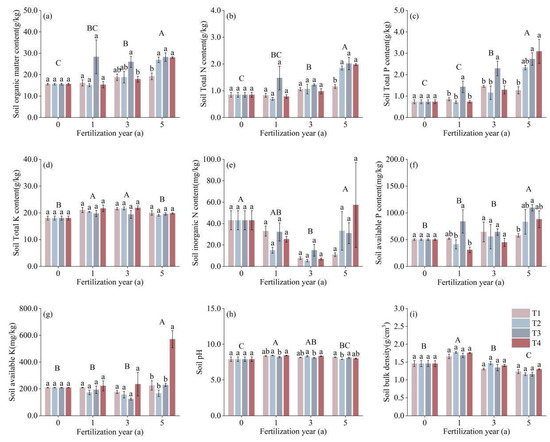
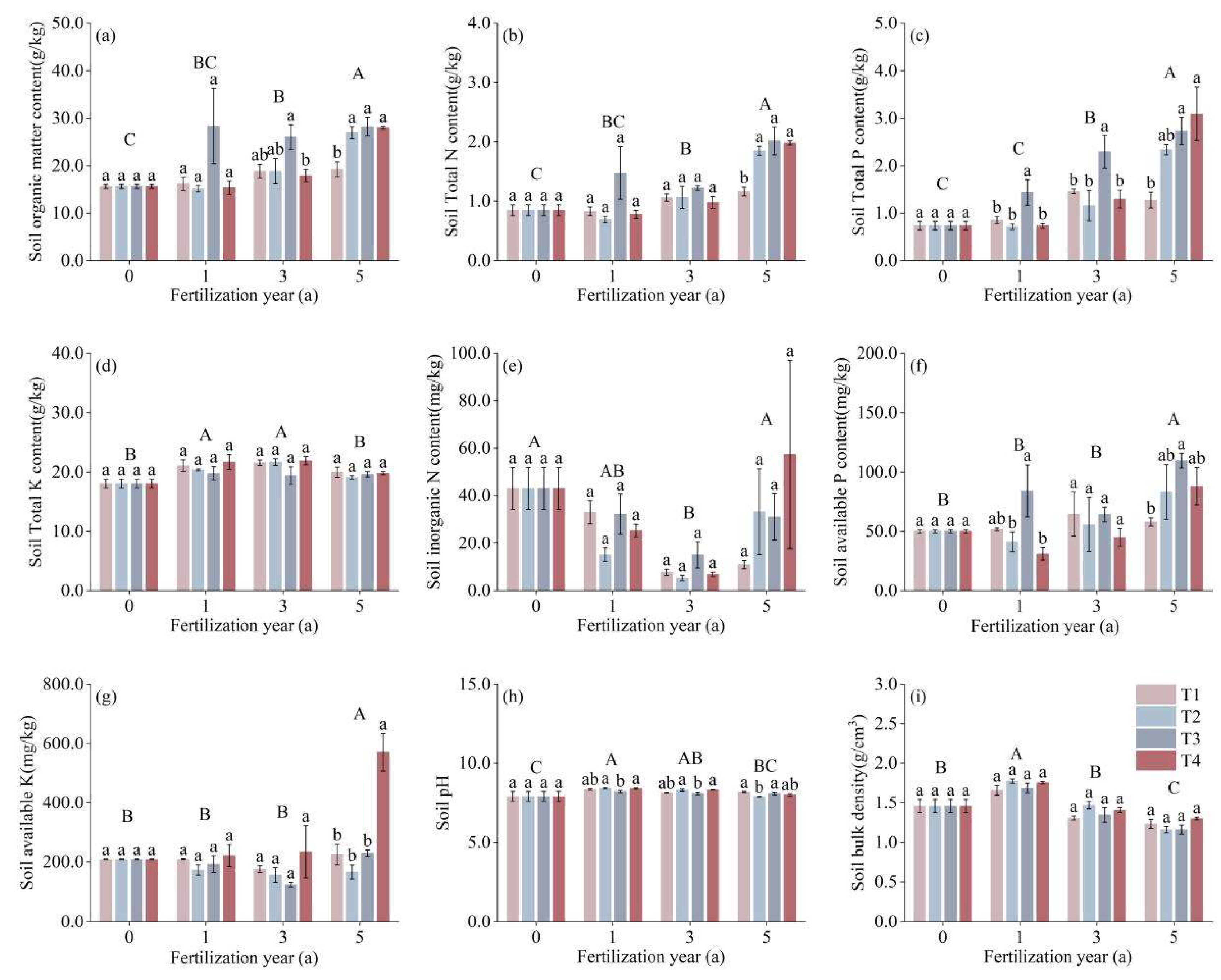
As shown in Figure 1a–c,f, different sludge application rates significantly increased soil OM, TN, TP, and AP contents, with the enhancing effect becoming more pronounced over time. In the first year of application, soil OM content did not differ significantly among treatments. By the third year, the T3 treatment had significantly increased OM by 38.26% compared to T1. After five years, the OM content under T2–T4 was significantly higher than under T1, with increases ranging from 39.99% to 46.56%. Soil OM also exhibited a significant linear growth trend with prolonged application (Table 3), showing a moderate positive correlation, at a mean annual rate of 2.19 g/kg. Soil TN content was not significantly affected by the sludge application rate in the first or third year. However, by the fifth year, T2–T4 had increased TN by 59.37–73.69% compared to T1. TN content also showed a significant linear increasing trend, showing a high positive correlation, with a mean annual increment of 0.21 g/kg. For soil TP, the T3 treatment increased content by 67.48% in the first year relative to T1, and this effect persisted into the third year, with an increase of 57.57%. By the fifth year, T2–T4 had significantly raised TP by 83.57–143.19% compared to T1. TP content also demonstrated a significant linear increase over the application period, showing a high positive correlation, rising at an average annual rate of 0.39 g/kg. In the case of soil AP, the T3 treatment significantly elevated AP levels by 62.03% in the first year compared to T1, reaching an 88.79% increase by the fifth year. Similarly, AP content followed a significant linear upward trend, showing a moderate positive correlation between the two, with a mean annual increase of 8.19 mg/kg. These results indicate that the continuous application of sludge exerts a clear time-dependent cumulative enhancement effect on soil nutrient levels.
Figure 1.
Effects of sludge application on the soil physicochemical properties. (a) soil OM content; (b) soil TN content; (c) soil TP content; (d) soil TK content; (e) soil inorganic nitrogen content; (f) soil AP content; (g) soil AK content; (h) soil pH; (i) soil bulk density. Note: Bars represent standard errors (n = 3). Different letters indicate significant differences among treatments (p < 0.05).
Table 3.
Correlations between sludge application duration and soil physicochemical properties.
As indicated in Figure 1d,e, no significant differences could be observed in the TK and inorganic nitrogen contents under varying sludge application rates. Furthermore, with increasing application duration, soil TK and inorganic nitrogen demonstrated no significant accumulation, and no positive correlation existed between the two. As shown in Figure 1g, under T4, the AK content was significantly higher than the other three treatments due to the additional application of potassium sulfate, with an increment of 149.20–243.09%.
T2 and T3 reduced the soil pH and bulk density, as presented in Figure 1h,i. During the first year of application, the pH post-T3 decreased by 0.20 units, compared to T4. This decline extended by 0.24 units by the third year. By the fifth year, the pH during T2 was 0.11 units lower than that post-T4. Although the pH exhibited a consistently declining trend throughout the experimental period, the extent of such a decrease did not reach statistically significant levels with increasing application duration. Although no significant differences were observed among the different sludge application rates, the soil bulk density demonstrated a significant decreasing trend with prolonged application duration (Table 2), and a moderate negative correlation existed. It decreased by 8.70% to 27.92% compared to the background value, with an average annual reduction of 0.073 g/cm3.
In this experiment, five consecutive years of sewage sludge application significantly enhanced soil fertility indicators. Specifically, the contents of soil OM, TN, TP, and AP increased by 39.99–46.56%, 59.37–73.69%, 83.57–143.19%, and 88.79%, respectively, compared to the background values. The corresponding average annual increases were 2.19 g/kg, 0.21 g/kg, 0.39 g/kg, and 8.19 mg/kg. Concurrently, a significant reduction in soil bulk density was observed, which decreased by 8.70–27.92% from the background value, with an average annual reduction of 0.073 g/cm3.
3.2. Effects of Continuous Sludge Application on PI and NIPI of Soil Heavy Metal Contents
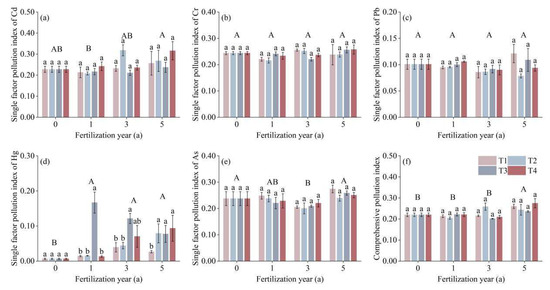
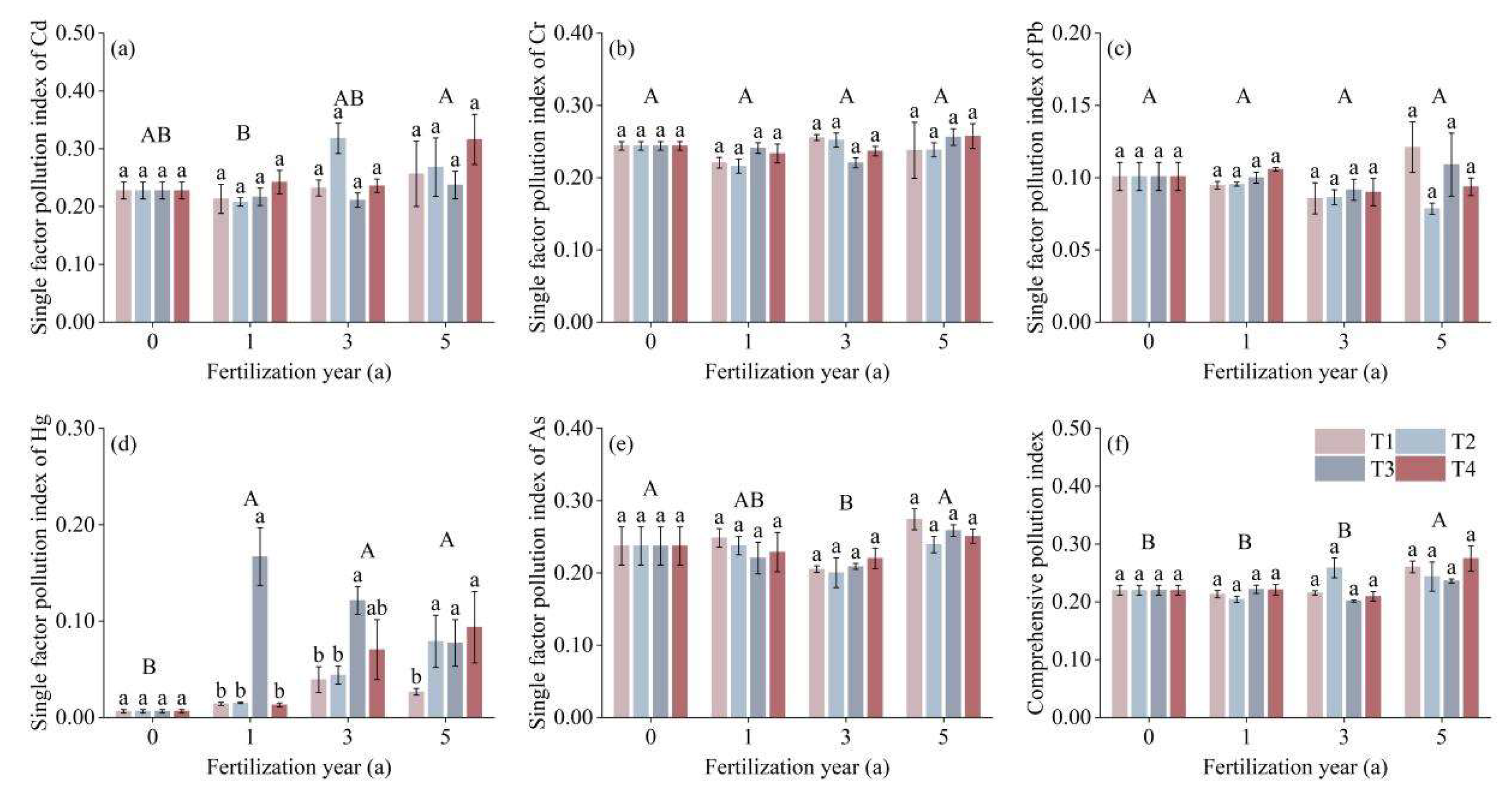
As shown in Figure 2, the PI values of the five heavy metals were below the warning threshold of 1.0, indicating a nonpolluted state. However, variations were observed among the different heavy metals.
Figure 2.
Effects of sludge application on single-factor and integrated pollution indices of heavy metals in soil. (a) PICd; (b) PICr; (c) PIPb; (d) PIHg; (e) PIAs; (f) NIPI. Note: Bars represent standard errors (n = 3). Different letters indicate significant differences among treatments (p < 0.05).
It is evident from Figure 2a that, although the effects of different sludge application rates on the PICd did not reach statistical significance, an overall trend of a linear increase was observed with prolonged application (Table S1), showing a low positive correlation. The mean annual increment was 0.010, equivalent to a Cd content of 0.0063 mg/kg.
In contrast, Figure 2d demonstrates that the sludge application rate markedly impacted the PIHg. During the first year, the PIHg values post-T3 were markedly higher—10.82-fold greater than with T1. By the third year, these values were 2.09-fold higher. By the fifth year, the PIHg values post-T2–T4 were elevated by 1.90–2.51 times compared to T1. Simultaneously, PIHg also indicated a remarkable, linearly increasing trend influenced by the application duration (Table S1), showing a low positive correlation, with a mean annual increment of 0.013, equivalent to a Hg content of 0.045 mg/kg.
Figure 2b,c,e show that the PICr, PIPb, and PIAs values were insignificantly influenced by the sludge application rate. Additionally, their accumulation levels showed no positive correlation with prolonged application.
This study employed a linear correlation analysis between the application duration and PI. However, it is noteworthy that this approach may not have fully accounted for the potential influence of annual variability in sludge composition. To enhance the analytical precision, the cumulative total sludge application was introduced as an alternative variable to re-evaluate its correlation with the PI. As shown in Table S1, the correlation trend between the cumulative sludge application and the PI is consistent with that observed for the application duration. This indicates that both parameters possess a similar indicative capacity for reflecting the cumulative effect of heavy metals. Consequently, the correlation analysis based on application duration, and the PI was retained for the subsequent discussion.
As shown in Figure 2f, the comprehensive PI value was well below the warning threshold of 0.7, indicating that the soil was not polluted. After 1 and 3 years of sludge application, the PI values did not vary markedly from the initial levels. However, after 5 years, the PI values post-T2–T4 treatments were elevated significantly by 7.31–24.96% compared to the initial levels, with a mean annual increment of 0.0064 (Table S1).
Following five consecutive years of sewage sludge application, the PI of Cd exhibited an increasing trend influenced solely by the application duration, with an annual average increase of 0.010. In contrast, the PI of Hg was affected by the combined influence of both application rate and duration, showing a higher annual average increment of 0.013. Consequently, the comprehensive pollution index rose by 7.31% to 24.96% from its initial level, with an average annual growth of 0.0064.
3.3. Effects of Continuous Sludge Application on the Potential Ecological Risk Indices of Heavy Metals in Soil
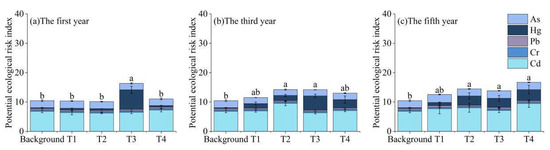
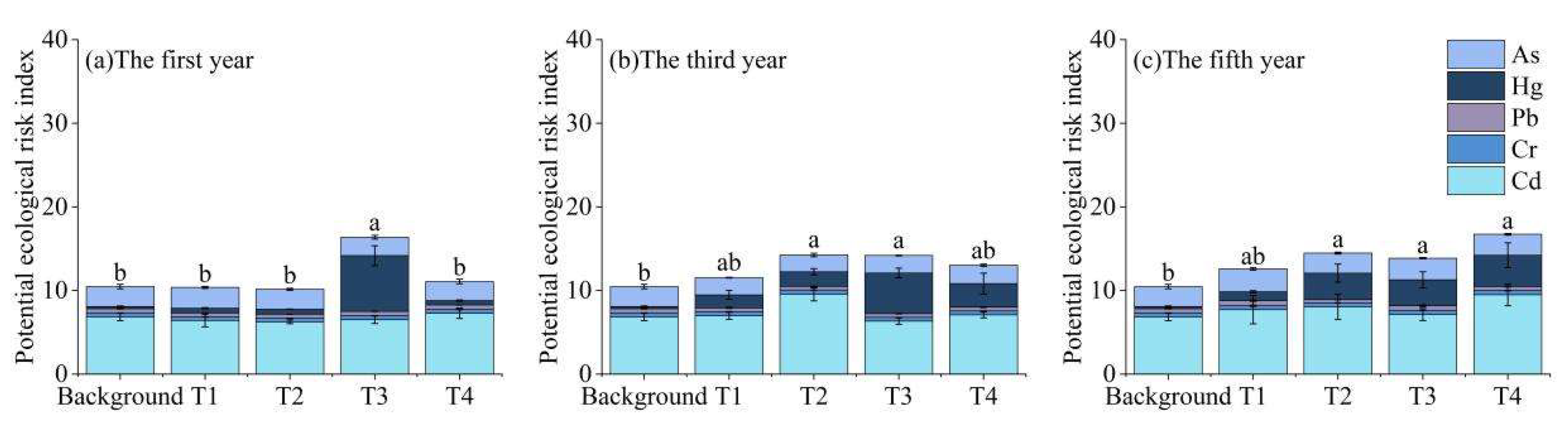
As can be seen in Figure 3, the EI for each heavy metal was well below 40, and the RI was below 150, indicating that, as a whole, the soil was low risk.
Figure 3.
Effects of sludge application on the potential ecological risk indices of heavy metals in soil. (a) RI for first year; (b) RI for third year; (c) RI for fifth year. Note: Bars represent standard errors (n = 3). Different letters indicate significant differences among treatments (p < 0.05).
Before sludge application, the RI and EI values were 10.46 and 6.83, accounting for 65.34% of the potential ecological risk contribution rate and identifying Cd as the main risk factor. This was followed by As, with an EI value of 2.38 and a rate of 22.71%, and then Cr, Pb, and Hg, with rates of 4.67%, 4.82%, and 2.47%, respectively.
After 1 year of sludge application (Figure 3a), the EIHg post-T3 increased rapidly to 6.68 and the contribution rate rose to 40.77%, exceeding that of Cd (39.75%), resulting in a markedly greater RI value for T3 compared to the other three treatments, with increment levels reaching 47.78–61.44%. In contrast, the EI values for T1, T2, and T4 remained the same as their initial levels.
After 3 years of application (Figure 3b), the RI values for T2 and T3 were enhanced significantly by 36.20% and 35.60%, respectively, compared to the initial levels. The EIHg post-T3 remained high at 4.86, with a contribution rate of 34.26%. Post-T4, however, both the EI value and contribution rate of Hg were gradually enhanced to 2.82 and 21.66%, respectively, surpassing those of As (contribution rate: 16.91%), making it the second most significant ecological risk factor, after Cd.
By the fifth year (Figure 3c), the RI values for the T2–T4 treatments increased by 32.51–59.90% compared to the initial levels. A moderately positive correlation was observed between RI and the application duration, with Table S2 showing a mean annual increment of 0.84. Cd remained the primary ecological risk factor. After T2–T4 treatments, the EI values were 7.12–9.48, representing an increase of 4.17–38.77% compared to the initial levels, with a contribution rate of 51.36–56.70%. Furthermore, EI demonstrated a significant linear increase with prolonged application (Table S2), exhibiting a low positive correlation with application duration, and a mean annual increment of 0.31. Hg was the second, most crucial risk factor. The EI values post-T2–T4 were 3.10–3.75, which were 10.96–13.48-times higher than the initial levels. The contribution rate stabilized between 21.85% and 22.34%. Moreover, PIHg also showed a significant linear upward trend with extended application duration (Table S2), indicating a low positive correlation as well as a mean annual increment of 0.52. The EICr, EIPb, and EIAs values after the four treatments did not alter significantly, indicating that sludge application minimally impacted the levels of these elements.
Following five consecutive years of sewage sludge application, the EI of Cd and Hg increased significantly. The EI for Cd rose by 4.17% to 38.77%, with an average annual increase of 0.31, while that for Hg increased by 10.96- to 13.48-fold, with a substantially higher annual average increment of 0.52. Consequently, these combined contributions drove a 32.51% to 59.90% overall increase in the total risk index RI.
3.4. Effects of Continuous Sludge Application on Soil Safety
The sludge storage capacity of the soil was calculated based on the static environmental capacity method, and the results are shown in Table 4. The safe application durations of sludge for Cd and Hg were relatively similar, at 46.99–126.93 (with a mean of 81.47 years) and 48.58–131.21 (with a mean of 84.22 years), respectively. In contrast, those for Cr, As, and Pb were substantially longer, requiring 316.37–854.54, 248.60–671.50, and 738.35–1994.33 years, respectively, to reach the standard heavy metal limits specified in “Soil Environmental Quality-Soil Pollution Risk Control Standards for Agricultural Land” (GB 15618-2018).
Table 4.
Safe application duration of domestic sewage sludge.
In addition, with prolonged sludge application, the soil contents of Cd and Hg exhibited a conspicuously linear, upward trend, with average yearly increases of 0.0063 and 0.045 mg/kg, respectively. Based on these results, it was estimated that 73.54 and 76.25 years would be required, respectively, to reach the values for Cd and Hg limits in soil at an annual application rate of 8.33–22.5 t/ha. These values were slightly lower than those calculated by employing the static environmental capacity method.
4. Discussion
4.1. Effects of Continuous Sludge Application on Soil Physicochemical Properties
Five years of field monitoring demonstrated significant linear increases in the contents of OM, TN, TP, and AP (Table 3, Figure 1), indicating that continuous application of urban sludge effectively enhanced soil fertility under the experimental conditions. This cumulative effect is likely driven by the direct input of organic matter and nutrients from the sludge, which consistently exceeded plant uptake and other loss pathways. The nutrient enrichment pattern observed in this study aligns with findings reported by Wu [39] in landscape plants, Eid [40] in spinach systems, and Boudjabi [41] under Mediterranean climate conditions, thereby reinforcing the robustness of this phenomenon across different cropping systems and environments.
The five-year observation data revealed that medium and high sludge application rates (T2 and T3), although not significantly altering soil pH, induced a significant linear decrease in soil bulk density (with an average annual reduction of 0.073 g/cm3). These results demonstrate that the continuous application of sludge effectively improved the physical structure. This improvement can be attributed to two main mechanisms. On one hand, the sludge itself acts as a substrate, and its powdery and sticky particles interact with soil particles, promoting the formation of aggregates. On the other hand, the sludge input significantly increased the soil organic carbon content (Figure 1a), which is a key cementing agent for forming stable soil aggregates and reducing bulk density. Although agricultural practices such as machinery trafficking and irrigation-induced settlement may exert opposing compaction effects, the soil structure improvement induced by sludge application dominated during the study period. The conclusion that sludge application significantly reduces soil bulk density is strongly supported by Hemmat et al. [42], who reported improved soil structure after seven consecutive years of sludge application in a wheat–maize system; Zhang et al. [43] also confirmed that soil organic carbon can ameliorate soil bulk density, finding that the conversion of grassland to cropland led to a significant decrease in micro-aggregates and organic carbon, accompanied by a slight increase in bulk density. In their long-term 30-year experiment, Börjesson et al. [7] applied sewage sludge every four years and observed an increase in soil organic carbon along with a reduction in soil bulk density, leading to marked improvements in soil fertility. Their findings demonstrate the long-term positive effects of sludge application on soil physical properties over an extended temporal scale.
In this study, physical properties of the sludge, such as organic carbon content and particle size distribution, were not monitored. Future studies should incorporate systematic monitoring of the physical properties of the sludge itself (e.g., particle size distribution, cohesiveness, water-holding capacity) before and after its application to more precisely elucidate and quantify its dynamic role in improving soil structure.
4.2. Effects of Continuous Sludge Application on the Risk of Soil Heavy Metal Pollution
While continuous sludge application significantly enhances soil nutrients, its associated risks of heavy metal accumulation and potential for bioaccumulation through the food chain [44] continue to constrain the safety of its land use. The accumulation potential of heavy metals from sludge in soil depends on their concentrations relative to soil background values [45]. When the two are similar, the migration and enrichment capacity are weak; however, if the concentration in sludge is significantly higher than the background level, it readily induces a pronounced accumulation effect. The results of this study show that Hg exhibited a clear cumulative effect in the pollution index, with an annual increment of 0.013. Cd also demonstrated a linear increase with prolonged application duration, showing an annual increment of 0.010. This phenomenon is primarily attributed to the considerably higher concentrations of Hg and Cd in the sludge (6.95 and 0.99 mg/kg, respectively) compared to the corresponding soil background values (0.02 and 0.14 mg/kg), resulting in a strong enrichment potential for these elements in the soil. In contrast, the pollution indices of Cr, Pb, and As did not show significant accumulation trends. This is because their concentrations in the sludge (55.67, 19.91, and 7.98 mg/kg, respectively) were relatively close to the soil background values (61.00, 17.13, and 5.94 mg/kg, respectively), leading to a low net input. Existing studies have reported considerable variation in the accumulation behavior of heavy metals following sludge application: Salim SA et al. observed a significant increase in soil Cd content with increasing sludge application rates [46], while Amal et al. reported a similar response for Cr concentration [4]; conversely, Ragonezi C et al. did not detect significant accumulation of Cd, Cr, Hg, Ni, or Pb after two years of continuous sludge application in a sweet potato cultivation system [47]. These discrepancies indicate that the physicochemical properties of sludge and its source heterogeneity are key factors influencing the accumulation behavior of heavy metals in soil.
The increase in single-factor pollution levels of Cd and Hg contributed to an overall enhancement of 7.31–24.96% within the comprehensive pollution levels, which also exhibited a significant, linearly increasing trend with prolonged application, showing a mean annual increment of 0.0064. In conclusion, differentiated and precise land use-associated risk control strategies should be implemented based on the sludge composition and regional natural conditions.
4.3. The Impact of Continuous Sludge Application on Potential Ecological Risk
To further assess the potential ecological risks posed by heavy metals to orchard soils due to continuous sludge application, the RI value was calculated. After 5 years of continuous sludge application, T2–T4 produced EI and RI values well below 40 and 150, respectively, indicating an overall low ecological risk level. Among the five heavy metals, Cd exhibited an EI value of 7.12–9.48, enhanced by 4.17–38.77% compared to the initial levels, with a contribution rate of 51.36–56.70%, indicating that it is the predominant ecological risk factor. The potential ecological risk index (EI) for mercury (Hg) ranged from 3.10 to 3.75, representing a 10.96- to 13.48-fold increase from the initial level. Its contribution rate rose from 2.47% to 21.85–22.34%, establishing Hg as the second most significant risk factor after cadmium (Cd). In contrast, the RI values for chromium (Cr), lead (Pb), and arsenic (As) showed no significant changes, indicating relatively stable risk levels for these elements. In summary, although continuous sludge application did not exceed the low-risk threshold, it significantly intensified the single-factor ecological risks of Cd and Hg, driving an overall increase in the comprehensive RI by 32.51–59.90%, with an average annual increment of 0.84. This trend aligns with the pattern of p-values, suggesting a synergistic effect in the risk characterization of these two metals.
The predominance of Cd and Hg as the major accumulating and risk elements observed in this study is consistent with the inherent properties of sewage sludge and findings from long-term studies in other agricultural systems. For example, analyses of municipal sludge from Huainan City by You et al. [48], from Portugal by Gomes et al. [49], and from Beijing by Meng et al. [50] all identified Cd as the element with the highest ecological risk, confirming its role as a primary risk source. Similarly, Zhou, A. et al. [17] concluded that Hg and Cd in municipal sludge and its pyrolytic biochar pose extremely high potential ecological risks. This consensus underscores the general necessity of prioritizing the monitoring and control of these two heavy metals in the risk management of sludge application in agriculture. Supporting this, Salim, S.A. et al. [46] reported a cumulative effect of Cd in soil after three consecutive years of sludge application in a wheat system. Furthermore, a long-term study initiated in 2007 by Gao et al. [51] on the North China Plain demonstrated significant increases in soil Cd and Hg contents following sludge application, with Hg exhibiting the greatest ecological risk.
The migration and transformation of heavy metals in soil is a slow and complex process. The five-year monitoring results, serving as an early warning study, reveal the accumulation characteristics of soil heavy metals from the initial to the middle stage of sludge application. Although only data pertaining to a five-year observation are available, they provide a quantitative reference benchmark for long-term risk management. To obtain a comprehensive and reliable environmental risk assessment, monitoring over a longer time scale (e.g., 10–20 years) is indispensable.
4.4. Impact of Continuous Sludge Application on Safe Application Duration and Analysis of Uncertainties in Long-Term Predictions
To further determine the environmental capacity of the soil for high ecological risk elements (Cd and Hg), the safe application duration of sludge was calculated. Results from the static environmental capacity method indicated that the safe application durations for sludge, based on Cd and Hg, were 46.99–126.93 years and 48.58–131.21 years, respectively. Findings from the dynamic monitoring experiments showed corresponding safe application durations of 73.54 years and 76.25 years. The results from both methods are consistent. In comparison, the safe application durations for Cr, Pb, and As were significantly longer, indicating a lower accumulation risk of these elements in the soil. Under the experimental conditions of this study, excessive inputs of Cd and Hg should be avoided.
This study estimated the safe application duration for Cd and Hg based on the linear extrapolation of five-year observation data and a static environmental capacity model, acknowledging inherent uncertainties in the results. Firstly, under continuous application, soil adsorption sites may approach saturation, heavy metal speciation could undergo transformation, and the dynamics of organic matter degradation may change, potentially causing the actual accumulation rate to deviate from the linear assumption. Secondly, monitoring data indicated a gradual decline in soil pH; if this trend continues, it could enhance the mobility and bioavailability of heavy metals, thereby influencing their accumulation behavior. Furthermore, soil microorganisms exert dual effects on heavy metals: they can reduce bioavailability through adsorption, precipitation, and valence transformation, yet may also facilitate dissolution and migration under specific conditions [52], thereby altering accumulation kinetics. Finally, future variations in heavy metal content of sludge—potentially resulting from improvements in wastewater treatment processes—could introduce additional uncertainty into the predictions. Therefore, the calculated safe application duration in this study should be regarded as an important risk early-warning indicator and decision-making reference under current sludge application practices, rather than an absolute value. Future work should focus on long-term in situ monitoring and the development of dynamic mechanistic models to reduce these uncertainties and enable more accurate risk forecasting.
4.5. Potential Risk Analysis of Heavy Metal Uptake by Crops
This study evaluated the impacts of continuous urban sludge application on the heavy metal pollution risks of orchard soils, with a primary focus on the soil medium itself. Although the risks of the five heavy metals are currently at a low level, it is undeniable that Cd and Hg exhibit an obvious cumulative trend in the soil. In the context of continuous sludge application in the future, the bioaccumulation effect of these two heavy metals in grape organs (e.g., fruits and leaves) cannot be overlooked. Therefore, future research will focus on investigating the migration patterns and accumulation characteristics of heavy metals in the soil–crop system. This will provide the most direct evaluation basis for the food safety of agricultural sludge application and improve the full-chain assessment system covering environmental risks to health risks.
5. Conclusions
In conclusion, this study provides a comprehensive insight into the effects of the continuous application of urban sewage sludge on heavy metal pollution risks in orchard soils. The application of sludge for five consecutive years improved soil fertility and promoted nutrient accumulation, with OM, TN, TP, and AP contents increasing, as well as leading to a year-on-year reduction in soil bulk density. For heavy metals, soil PI and NIPI values for Cd, Cr, Pb, Hg, and As were below the warning thresholds after five years. Specifically, the pollution levels induced by Cd were influenced solely by application duration, whereas those by Hg were affected by the sludge application rate and duration. The soil EI and RI values for Cd, Cr, Pb, Hg, and As suggested low-risk levels after five consecutive years of sludge application. Among them, Cd was the predominant ecological risk factor. Hg was the second-most significant risk factor. Through the application of the environmental capacity method, the safe sludge application durations for Cd and Hg were calculated to be 46.99–126.93 years. Therefore, Hg pollution must be prevented.
Supplementary Materials
The following supporting information can be downloaded at: https://www.mdpi.com/article/10.3390/su18020826/s1, Table S1: Correlations between sludge application duration/rate and soil heavy metal pollution index; Table S2: Correlation between sludge application duration/rate and the potential ecological risk indices of heavy metals in soil.
Author Contributions
J.X. (Junxiang Xu): conceptualization, methodology, software, validation, formal analysis, data curation, writing—original draft preparation, and funding acquisition. X.Z.: investigation, writing—original draft preparation, writing—review and editing, and funding acquisition. J.X. (Jianjun Xiong): conceptualization and methodology. Y.L.: investigation. Q.L.: investigation. L.Z.: investigation and writing—review and editing. Q.S.: conceptualization, methodology, writing—review and editing, and funding acquisition. All authors have read and agreed to the published version of the manuscript.
Funding
This research was funded by the Scientific and technological innovation capacity building project of Beijing Academy of Agriculture and Forestry Sciences (grant number KJCX20240407), the National Natural Science Foundation of China (grant number 42207034), and the China Agriculture Research System of MOF and MARA.
Institutional Review Board Statement
Not applicable.
Informed Consent Statement
Not applicable.
Data Availability Statement
Data are contained within the article.
Conflicts of Interest
Author Jianjun Xiong was employed by the company Beijing Urban Drainage Group Co., Ltd. The remaining authors declare that the research was conducted in the absence of any commercial or financial relationships that could be construed as a potential conflict of interest.
References
- Zhao, J.; Ning, P.; Li, K.; Wang, L.; Song, X.; Wang, C. The present situation and development trend of sludge disposal. Appl. Mech. Mater. 2015, 3830, 338–341. [Google Scholar] [CrossRef] [Scilit]
- Elkhalifa, S.; Al-Ansari, T.; Mackey, H.R.; McKay, G. Food waste to biochars through pyrolysis: A review. Resour. Conserv. Recycl. 2019, 144, 310–320. [Google Scholar] [CrossRef] [Scilit]
- Raheem, A.; Sikarwar, V.S.; He, J.; Dastyar, W.; Dionysiou, D.D.; Wang, W.; Zhao, M. Opportunities and challenges in sustainable treatment and resource reuse of sewage sludge: A review. Chem. Eng. J. 2018, 337, 616–641. [Google Scholar] [CrossRef] [Scilit]
- An-Nori, A.; El Mejahed, K.; El Fels, L.; Touhami, D.; Ezzariai, A.; El Gharous, M.; Hafidi, M. Assessment of the agronomic value of solar-dried sludge and heavy metals bioavailability based on the bioaccumulation factor and translocation index. Front. Environ. Sci. 2023, 1, 1163422. [Google Scholar] [CrossRef] [Scilit]
- Tyagi, V.K.; Lo, S.L. Sludge: A waste or renewable source for energy and resources recovery? Renew. Sustain. Energy Rev. 2013, 25, 708–728. [Google Scholar] [CrossRef] [Scilit]
- Samolada, M.C.; Zabaniotou, A.A. Comparative assessment of municipal sewage sludge incineration, gasification and pyrolysis for a sustainable sludge-to-energy management in Greece. Waste Manag. 2014, 34, 411–420. [Google Scholar] [CrossRef] [Scilit] [PubMed]
- Börjesson, G.; Kätterer, T. Soil fertility effects of repeated application of sewage sludge in two 30-year-old field experiments. Nutr. Cycl. Agroecosyst. 2018, 112, 369–385. [Google Scholar] [CrossRef] [Scilit]
- da Silva, W.R.; do Nascimento, C.W.A.; da Silva, F.B.V.; de Souza, A.A.B.; Fracetto, G.G.M.; de Sá Veloso Ximenes, D.H. Effects of sewage sludge stabilization processes on soil fertility, mineral composition, and grain yield of maize in successive cropping. J. Soil Sci. Plant Nutr. 2021, 21, 1076–1088. [Google Scholar] [CrossRef] [Scilit]
- Mao, L.X.; Wu, M.; Zhu, S.F.; Wang, X.F.; Zhang, J.; Qin, Y.H. Adsorption potential and mechanism of sludge-based activated carbon modified with fly ash for removal of heavy metals. Sustainability 2024, 16, 2972. [Google Scholar] [CrossRef] [Scilit]
- Shamsollahi, H.R.; Alimohammadi, M.; Momeni, S.; Naddafi, K.; Nabizadeh, R.; Khorasgani, F.C.; Masinaei, M.; Yousefi, M. Assessment of the health risk induced by accumulated heavy metals from anaerobic digestion of biological sludge of the lettuce. Biol. Trace Elem. Res. 2019, 188, 514–520. [Google Scholar] [CrossRef] [Scilit]
- Siebielska, I. Comparison of changes in selected polycyclic aromatic hydrocarbons concentrations during the composting and anaerobic digestion processes of municipal waste and sewage sludge mixtures. Water Sci. Technol. 2014, 70, 1617–1624. [Google Scholar] [CrossRef] [Scilit]
- Singh, S.; Kumar, V.; Dhanjal, D.S.; Datta, S.; Bhatia, D.; Dhiman, J.; Samuel, J.; Prasad, R.; Singh, J. A sustainable paradigm of sewage sludge biochar: Valorization, opportunities, challenges and future prospects. J. Clean. Prod. 2020, 269, 122259. [Google Scholar] [CrossRef] [Scilit]
- Werle, S.; Bisorca, D.; Katelbach-Woźniak, A.; Pogrzeba, M.; Krzyżak, J.; Ratman-Kłosińska, I.; Burnete, D. Phytoremediation as an effective method to remove heavy metals from contaminated area—TG/FT-IR analysis results of the gasification of heavy metal contaminated energy crops. J. Energy Inst. 2017, 90, 408–417. [Google Scholar] [CrossRef] [Scilit]
- Chilian, A.; Bancuta, O.R.; Bancuta, I.; Popescu, I.V.; Irina, G.A.; Tănase, N.M.; Tuican, M.; Zaharia, M.; Zinicovscaia, I. Extraction of heavy metals and phosphorus from sewage sludge with elimination of antibiotics and biological risks. Chem. Eng. J. 2022, 437, 135298. [Google Scholar] [CrossRef] [Scilit]
- Amoah, I.D.; Reddy, P.; Seidu, R.; Stenström, T.A. Concentration of soil-transmitted helminth eggs in sludge from South Africa and Senegal: A probabilistic estimation of infection risks associated with agricultural application. J. Environ. Manag. 2018, 206, 1020–1027. [Google Scholar] [CrossRef] [Scilit] [PubMed]
- Jin, J.W.; Li, Y.N.; Zhang, J.Y.; Wu, S.C.; Cao, Y.C.; Liang, P.; Zhang, J.; Wong, M.H.; Wang, M.Y.; Shan, S.D. Influence of pyrolysis temperature on properties and environmental safety of heavy metals in biochars derived from municipal sewage sludge. J. Hazard. Mater. 2016, 320, 417–426. [Google Scholar] [CrossRef] [Scilit] [PubMed]
- Zhou, A.; Yu, S.L.; Deng, S.H.; Mikulčić, H.; Tan, H.Z.; Wang, X.B. Enrichment characteristics and environmental risk assessment of heavy metals in municipal sludge pyrolysis biochar. J. Energy Inst. 2023, 111, 101417. [Google Scholar] [CrossRef] [Scilit]
- Nahar, N.; Shahadat Hossen, M. Influence of sewage sludge application on soil properties, carrot growth and heavy metal uptake. Commun. Soil Sci. Plant Anal. 2021, 52, 1–10. [Google Scholar] [CrossRef] [Scilit]
- Sodaeizadeh, H.; Karimian, A.; Jafari, S.H.; Arani, A.M. A preliminary study on heavy metal monitoring in soil and guar (Cyamopsis tetragonoloba) biomass amended with sewage sludge. Environ. Monit. Assess. 2024, 196, 201. [Google Scholar] [CrossRef] [Scilit]
- Žaltauskaitė, J.; Judeikytė, S.; Sujetovienė, G.; Dagiliūtė, R. Sewage sludge application effects to first year willows (Salix viminalis L.) growth and heavy metal bioaccumulation. Waste Biomass Valorization 2017, 8, 1813–1818. [Google Scholar] [CrossRef] [Scilit]
- GB 4284-2018; Agricultural Sludge Pollutant Control Standard. Standards Press of China: Beijing, China, 2018.
- Bao, S.D. Soil and Agricultural Chemistry Analysis, 3rd ed.; China Agriculture Press: Beijing, China, 2000. [Google Scholar]
- GB/T 17141-1997; Soil Quality-Determination of Lead, Cadmium-Graphite Furnace Atomic Absorption Spectrophotometry. Standards Press of China: Beijing, China, 1997.
- GB/T 22105.1-2008; Soil Quality-Analysis of Total Mercury, Arsenic and Lead Contents in Soils-Atomic Fluorescence Spectrometry—Part 1: Analysis of Total Mercury Contents in Soils. Standards Press of China: Beijing, China, 2008.
- HJ 491-2019; Soil and Sediment—Determination of Copper, Zinc, Lead, Nickel and Chromium—Flame Atomic Absorption Spectrophotometry. China Environmental Press: Beijing, China, 2019.
- Su, K.; Wang, Q.; Li, L.; Cao, R.; Xi, Y. Water quality assessment of Lugu Lake based on Nemerow pollution index method. Sci. Rep. 2022, 12, 13613. [Google Scholar] [CrossRef] [Scilit]
- Wang, N.; Luo, Y.; Liu, Z.; Sun, Y.Y. Spatial distribution characteristics and evaluation of soil pollution in coal mine areas in Loess Plateau of northern Shaanxi. Sci. Rep. 2022, 12, 16440. [Google Scholar] [CrossRef] [Scilit]
- Yan, F.; Li, N.; Wang, J.; Wu, H. Ecological footprint model of heavy metal pollution in water environment based on the potential ecological risk index. J. Environ. Manag. 2023, 344, 118708. Available online: https://www.sciencedirect.com/science/article/pii/S0301479723014962 (accessed on 5 January 2026). [CrossRef] [Scilit]
- Zhou, Z.K.; Wang, Y.P.; Teng, H.W.; Yang, H.; Liu, A.J.; Li, M.H.; Niu, X.Y. Historical Evolution of Sources and Pollution Levels of Heavy Metals in the Sediment of the Shuanglong Reservoir, China. Water 2020, 12, 1855. [Google Scholar] [CrossRef] [Scilit]
- GB 15618-2018; Soil Environmental Quality-Risk Control Standard for Soil Contamination of Agricultural Land. Standards Press of China: Beijing, China, 2018.
- Wang, Y.; Li, B.L.; Zhu, J.L.; Feng, Q.; Liu, W.; He, Y.H.; Wang, X. Assessment of heavy metals in surface water, sediment and macrozoobenthos in inland rivers: A case study of the Heihe River, Northwest China. Environ. Sci. Pollut. Res. 2022, 29, 35253–35268. [Google Scholar] [CrossRef] [Scilit] [PubMed]
- Tao, H.; Al-Hilali, A.A.; Ahmed, A.M.; Mussa, Z.H.; Falah, M.W.; Abed, S.A.; Deo, R.; Jawad, A.H.; Abdul Maulud, K.N.; Latif, M.T. Statistical and spatial analysis for soil heavy metals over the Murray-Darling river basin in Australia. Chemosphere 2023, 317, 137914. [Google Scholar] [CrossRef] [Scilit] [PubMed]
- Zhang, Z.Y.; Abuduwaili, J.; Jiang, F.Q. Heavy metal contamination, sources, and pollution assessment of surface water in the Tianshan Mountains of China. Environ. Monit. Assess. 2015, 187, 33. [Google Scholar] [CrossRef] [Scilit] [PubMed]
- Hakanson, L. An ecological risk index for aquatic pollution control. a sedimentological approach. Water Res. 1980, 14, 975–1001. [Google Scholar] [CrossRef] [Scilit]
- Williams, J.A.; Antoine, J. Evaluation of the elemental pollution status of Jamaican surface sediments using enrichment factor, geoaccumulation index, ecological risk and potential ecological risk index. Mar. Pollut. Bull. 2020, 157, 111288. [Google Scholar] [CrossRef] [Scilit]
- Pan, Y.; Ding, L.; Xie, S.; Zeng, M.; Zhang, J.; Peng, H. Spatiotemporal simulation, early warning, and policy recommendations of the soil heavy metal environmental capacity of the agricultural land in a typical industrial city in China: Case of Zhongshan City. J. Clean. Prod. 2021, 285, 124849. [Google Scholar] [CrossRef] [Scilit]
- Wang, M. Assessment of heavy metal pollution sources and environmental capacity of typical farmland soils in northwestern Zhejiang based on the geological background of black rock series. Front. Environ. Sci. 2025, 13, 1601205. [Google Scholar] [CrossRef] [Scilit]
- Han, S.; Wang, B.; Yao, Z.; Dai, L.; Wei, Y.; Niu, Y.; Qian, L. Heavy metals impact environmental capacity of oasis soils in Qinghai-Tibet Plateau dry zone. Sci. Rep. 2025, 15, 2176. [Google Scholar] [CrossRef] [Scilit]
- Wu, D.M.; Chu, S.S.; Lai, C.; Mo, Q.F.; Jacobs, D.F.; Chen, X.Y.; Zeng, S.C. Application rate and plant species affect the ecological safety of sewage sludge as a landscape soil amendment. Urban For. Urban Green. 2017, 27, 138–147. [Google Scholar] [CrossRef] [Scilit]
- Eid, E.M.; El-Bebany, A.F.; Alrumman, S.A.; Hesham, A.E.L.; Taher, M.A.; Fawy, K.F. Effects of different sewage sludge applications on heavy metal accumulation, growth and yield of spinach (Spinacia oleracea L.). Int. J. Phytoremediation 2017, 19, 340–347. [Google Scholar] [CrossRef] [Scilit]
- Boudjabi, S.; Chenchouni, H. On the sustainability of land applications of sewage sludge: How to apply the sewage biosolid in order to improve soil fertility and increase crop yield? Chemosphere 2021, 282, 131122. [Google Scholar] [CrossRef] [Scilit]
- Hemmat, A.; Aghilinategh, N.; Rezainejad, Y.; Sadeghi, M. Long-term impacts of municipal solid waste compost, sewage sludge and farmyard manure application on organic carbon, bulk density and consistency limits of a calcareous soil in central Iran. Soil Tillage Res. 2010, 108, 43–50. [Google Scholar] [CrossRef] [Scilit]
- Zhang, Y.; Li, Y.; Ma, Z.; Cui, Z.; Sheng, H.; Li, R. Different land-use effects on soil aggregates and aggregate-associated organic carbon in Eastern Qinghai–Tibet Plateau. Agronomy 2024, 14, 990. [Google Scholar] [CrossRef] [Scilit]
- Eid, E.M.; Hussain, A.A.; Taher, M.A.; Galal, T.M.; Shaltout, K.H.; Sewelam, N. Sewage sludge application enhances the growth of Corchorus olitorius plants and provides a sustainable practice for nutrient recirculation in agricultural soils. J. Soil Sci. Plant Nutr. 2020, 20, 149–159. [Google Scholar] [CrossRef] [Scilit]
- Arrobas, M.; Meneses, R.; Gusmão, A.G.; da Silva, J.M.; Correia, C.M.; Rodrigues, M.Â. Nitrogen-rich sewage sludge mineralized quickly, improving lettuce nutrition and yield, with reduced risk of heavy metal contamination of soil and plant tissues. Agronomy 2024, 14, 924. [Google Scholar] [CrossRef] [Scilit]
- Salim, S.A.; Al-Hadiethy, I.K.H.; Abed, I.A.; AlKubaisy, S.A. Effect of sewage sludge on heavy metals accumulation in soil and wheat, mung bean and quinoa crops. IOP Conf. Ser. Earth Environ. Sci. 2021, 761, 012013. [Google Scholar] [CrossRef] [Scilit]
- Ragonezi, C.; Nunes, N.; Oliveira, M.C.O.; de Freitas, J.G.R.; Ganança, J.F.T.; de Carvalho, M.Â.A.P. Sewage sludge fertilization—A case study of sweet potato yield and heavy metal accumulation. Agronomy 2022, 12, 1902. [Google Scholar] [CrossRef] [Scilit]
- You, M.; Hu, Y.; Yan, Y.; Yao, J. Speciation characteristics and ecological risk assessment of heavy metals in municipal sludge of Huainan, China. Molecules 2021, 26, 6711. [Google Scholar] [CrossRef] [Scilit] [PubMed]
- Gomes, L.A.; Gabriel, N.; Gando-Ferreira, L.M.; Góis, J.C.; Quina, M.J. Analysis of potentially toxic metal constraints to apply sewage sludge in Portuguese agricultural soils. Environ. Sci. Pollut. Res. 2019, 26, 26000–26014. [Google Scholar] [CrossRef] [Scilit] [PubMed]
- Meng, G.; Zha, T.; Zhang, X.; Liu, Z.; Su, G. Heavy metal pollution characteristics and ecological risk assessment of the sludge from wastewater treatment plants in Beijing. Ecol. Environ. Sci. 2017, 26, 1570–1576. (In Chinese) [Google Scholar] [CrossRef]
- Gao, S.; Dong, Y.; Jia, Q.; Wu, S.; Bai, J.; Cui, C.; Li, Y.; Zou, P.; An, M.; Du, X.; et al. Hazards of toxic metal(loid)s: Exploring the ecological and health risk in soil–crops systems with long-term sewage sludge application. Sci. Total Environ. 2024, 948, 174988. [Google Scholar] [CrossRef] [Scilit]
- Smith, S.R. A critical review of the bioavailability and impacts of heavy metals in municipal solid waste composts compared to sewage sludge. Environ. Int. 2009, 35, 142–156. [Google Scholar] [CrossRef] [Scilit]

Disclaimer/Publisher’s Note: The statements, opinions and data contained in all publications are solely those of the individual author(s) and contributor(s) and not of MDPI and/or the editor(s). MDPI and/or the editor(s) disclaim responsibility for any injury to people or property resulting from any ideas, methods, instructions or products referred to in the content. |
© 2026 by the authors. Licensee MDPI, Basel, Switzerland. This article is an open access article distributed under the terms and conditions of the Creative Commons Attribution (CC BY) license.