1. Introduction
On 23 February 2025, the Central Committee of the Communist Party of China and the State Council issued the Opinions on Further Deepening Rural Reform and Advancing Comprehensive Rural Revitalization, which for the first time formally proposed the concept of “developing agricultural new productive forces (ANPF) in accordance with local conditions.” From an economic perspective, new productive forces represent an evolution and innovation of Marxist productive force theory, signifying a qualitative leap in productivity driven by technological innovation and disruptive breakthroughs [
1,
2]. ANPFs embody a departure from traditional growth models, aligning with the imperatives of high-quality development in the digital era. They are characterized by integration, intelligence, and sustainability, reflecting a new paradigm of productivity with richer connotations [
3,
4]. The development of ANPFs relies fundamentally on science and innovation. Technological progress drives industrial transformation, while industrial upgrading cultivates new sources of competitive advantage and fosters emerging and future-oriented industries [
5,
6,
7,
8].
However, existing research has not yet sufficiently contextualized ANPFs within the broader sustainability agenda. Agricultural transformation should ultimately contribute to ecological resilience, climate adaptation, resource-use efficiency, food security, and long-term rural well-being [
9]. In this sense, ANPFs are not only technological engines for production upgrading but also key levers for sustainable agricultural development—helping reduce carbon emissions and chemical inputs, enhance circular resource utilization, safeguard farmland resources, and improve farmers’ livelihoods [
10,
11]. Therefore, deepening the understanding of how ANPFs promote sustainable provincial agricultural development is theoretically necessary and practically urgent.
As the foundational sector of the national economy, agriculture is currently undergoing a crucial transition from traditional to modern agriculture. Developing ANPFs tailored to local conditions is essential to improving the modern agricultural system and to realizing the strategic goal of constructing strong agricultural provinces [
12]. Unlike traditional productive forces, ANPFs extend the Marxist logic of productive forces and relations of production, representing a technological and structural reconfiguration of agricultural productivity. Their development depends on technological innovation, with total factor productivity improvement serving as a key indicator. Advancing ANPFs is thus a strategic pathway to overcoming the bottlenecks of agricultural modernization, rebuilding agricultural competitiveness, and achieving the national goal of agricultural strength at both the provincial and national levels [
13,
14,
15,
16,
17]. ANPFs inject transformative power into agricultural development, enabling the transition toward high-quality, efficient, and resilient agricultural systems [
9,
18,
19]. More importantly, ANPFs can play a pivotal role in sustainable rural revitalization by supporting clean production, digital-green synergy, low-carbon value chains, and inclusive agricultural growth, thereby aligning with United Nations Sustainable Development Goals (SDGs). This study explores how ANPFs drive the sustainable agricultural development (SAD) in Anhui and elucidates the mechanistic pathways through which this occurs. This study reveals how technological progress, infrastructure enhancement and digital agriculture jointly promote sustainable agricultural productivity and ecological efficiency. Such inquiry not only deepens understanding of the core tasks and strategic priorities of sustainable agricultural development, but also provides policy insights for enhancing the role of new productive forces in transforming traditional industries, developing emerging sectors, and advancing the modernization of agriculture.
As one of China’s major agricultural provinces and a key grain-producing region, Anhui bears a critical responsibility for ensuring national food security and promoting high-quality agricultural development. However, faced with tightening resource and environmental constraints, rising production costs, intensifying global competition, and escalating consumer demand for quality, traditional development models are increasingly inadequate for achieving agricultural modernization goals. The province must therefore seek new drivers and pathways for growth—an imperative both for its own sustainable development and for fulfilling national strategic responsibilities [
20]. In this context, studying the ANPF-SAD relationship in Anhui offers a representative case for understanding how new productive forces foster sustainable agricultural development under conditions of resource constraints, ecological pressure, and green transition. Accordingly, this study takes the logical relationship between ANPFs and the Anhui’s sustainable agricultural development as its analytical entry point. It constructs a multi-dimensional theoretical framework of ANPF-driven agricultural development, selects Anhui as a representative empirical case, and reconstructs indicator systems for both ANPFs and SAD. Employing panel data models, mediating-effect models, and spatial econometric models, the study empirically investigates the driving effects of ANPFs on SAD construction. Based on the findings, it proposes an implementation pathway for ANPF empowerment, offering strategic guidance for agricultural modernization in Anhui and China, and broader insights for regions worldwide facing similar development challenges.
2. Literature Review
In the context of building a strong agricultural nation, the development of new productive forces in agriculture requires breakthroughs in core agricultural technologies, integration of emerging agribusiness models, green productivity enhancement, optimal configuration of new agricultural factors, reconstruction of modern agricultural relations of production, and a substantial rise in total factor productivity [
21]. These goals align closely with the objectives of SAD construction. The innovation of agricultural productive forces reshapes the foundational elements of agricultural development, strengthening agricultural supply capacity, technological advancement, operational systems, industrial resilience, and competitiveness [
22]. By relying on both technological and qualitative innovation, new agricultural productive forces enhance the quality and efficiency of agriculture—symbolized by improvements in total factor productivity—and thus contribute to the realization of a strong agricultural nation [
13]. Moreover, ANPFs significantly enhance industrial resilience, exhibiting an inverted U-shaped relationship characterized by an initial promotion followed by marginal inhibition. Regional heterogeneity is evident: the effect is strongest in central China, followed by the northeast, east, and west [
23]. Importantly, research increasingly emphasizes that the upgrading of productive forces is also a pathway toward green transformation, ecological protection, and agricultural environmental governance, providing theoretical support for sustainable agricultural development.
New productive forces continuously and substantially empower agricultural and rural modernization, with this empowerment positively moderated by rural industrial integration. Factor allocation efficiency, industrial structure upgrading, and public service balance are the key mechanisms through which new productive forces advance modernization. Industrial integration is thus a critical dimension in building a strong agricultural nation [
24], while factor organization, industrial collaboration, value co-creation, and technological support play equally vital roles. In practice, digitalization, agricultural science and technology, industrial integration, and total factor productivity are becoming the main application fields of new agricultural productive forces [
13].
From a broader economic perspective, the development of new productive forces is strategically significant for fostering a modern industrial system, upgrading traditional industries, elevating industrial sophistication, advancing digital and green transformation, and achieving low-carbon development [
16]. Guided by new development concepts and driven by technological innovation and industrial cultivation, new productive forces enhance developmental capacity, restructure growth drivers, optimize production factors, and stimulate high-quality economic growth [
3]. Within this national framework, the deep integration and effective empowerment of new productive forces in agriculture have become key to the construction of SAD. Specifically, ANPFs serve as a crucial driving engine, accelerating agricultural modernization and strengthening provincial agricultural systems [
25]. As a new driving force in building agricultural power, ANPFs should fully rely on technological innovation and qualitative transformation to enhance the quality and efficiency of agricultural development, thereby contributing to the construction of a strong agricultural nation [
13].
Advancing the exploration and application of new productive forces in agriculture entails a fundamental transformation of agricultural productivity from traditional “old-quality” modes toward advanced “new-quality” forms, thereby realizing a qualitative leap in overall productive capacity [
26]. The organic integration of digital technologies with traditional factors of production fosters the emergence of digital agricultural productive forces, thereby optimizing resource allocation and promoting agricultural growth [
27]. The development of these new productive forces also necessitates corresponding new relations of production to ensure the effective transfer of modern production factors to agriculture, reducing institutional and structural barriers to the realization of SAD [
28]. In rural regions where market mechanisms remain underdeveloped, proactive government intervention serves as an essential driver for the formation of ANPFs and the acceleration of SAD. New productive forces thus act as an endogenous engine for rural revitalization, leveraging their innovative traction and green diffusion capacity to tailor localized development strategies, reshape agricultural production relations, and ultimately contribute to the construction of a strong agricultural nation [
29].
Existing literature exploring the relationship between ANPFs and SAD construction reveals several characteristics. First, most studies focus on the national level [
30,
31]. However, building a strong nation requires strong provinces, and interprovincial differences remain significant. This study therefore focuses on the provincial level, using Anhui Province as a case to examine the interaction between ANPFs and SAD construction. Second, current research largely emphasizes comparative analyses of regional success cases and their implications for national strategy, while few studies explore the intrinsic mechanisms and practical logic from the perspective of the dynamic relationship between productive forces and relations of production [
32]. This study constructs an indicator system of ANPFs grounded in this theoretical logic. Third, most existing studies approach the topic through the lens of new productive forces driving high-quality agricultural development or national agricultural strengthening, proposing general practical pathways [
33,
34]. However, few have specifically analyzed the driving effects of new agricultural productive forces on sustainable agricultural development. This study fills that gap by identifying the driving pathways of ANPFs in provincial strengthening. Finally, the majority of prior work remains qualitative, emphasizing conceptual interpretation, theoretical construction, and pathway analysis [
33,
35]. Systematic quantitative studies and empirical validations remain scarce, limiting the depth of findings. In contrast, this study empirically investigates the causal relationship between ANPFs and SAD in Anhui, with particular emphasis on the roles of technological innovation, agricultural digitalization, and new-type infrastructure as key mechanisms of empowerment.
3. Theoretical Mechanism and Research Hypotheses
To better align with global sustainability goals, the formation of ANPFs should not be understood merely as a technical or efficiency-enhancing process; rather, it represents a transformative pathway toward resource-efficient, low-carbon, and resilient agricultural systems. By integrating technological innovation, digital empowerment, and green production concepts, ANPFs help reduce input intensity, improve ecological efficiency, and strengthen food system resilience—thereby providing a micro-level mechanism for realizing agricultural sustainability under China’s rural revitalization strategy and the UN SDGs. This section systematically interprets how ANPFs reshape modern agricultural production infrastructure, innovation capacity, and digital governance, thus promoting not only agricultural modernization but also long-term environmental sustainability and rural socio-economic sustainability.
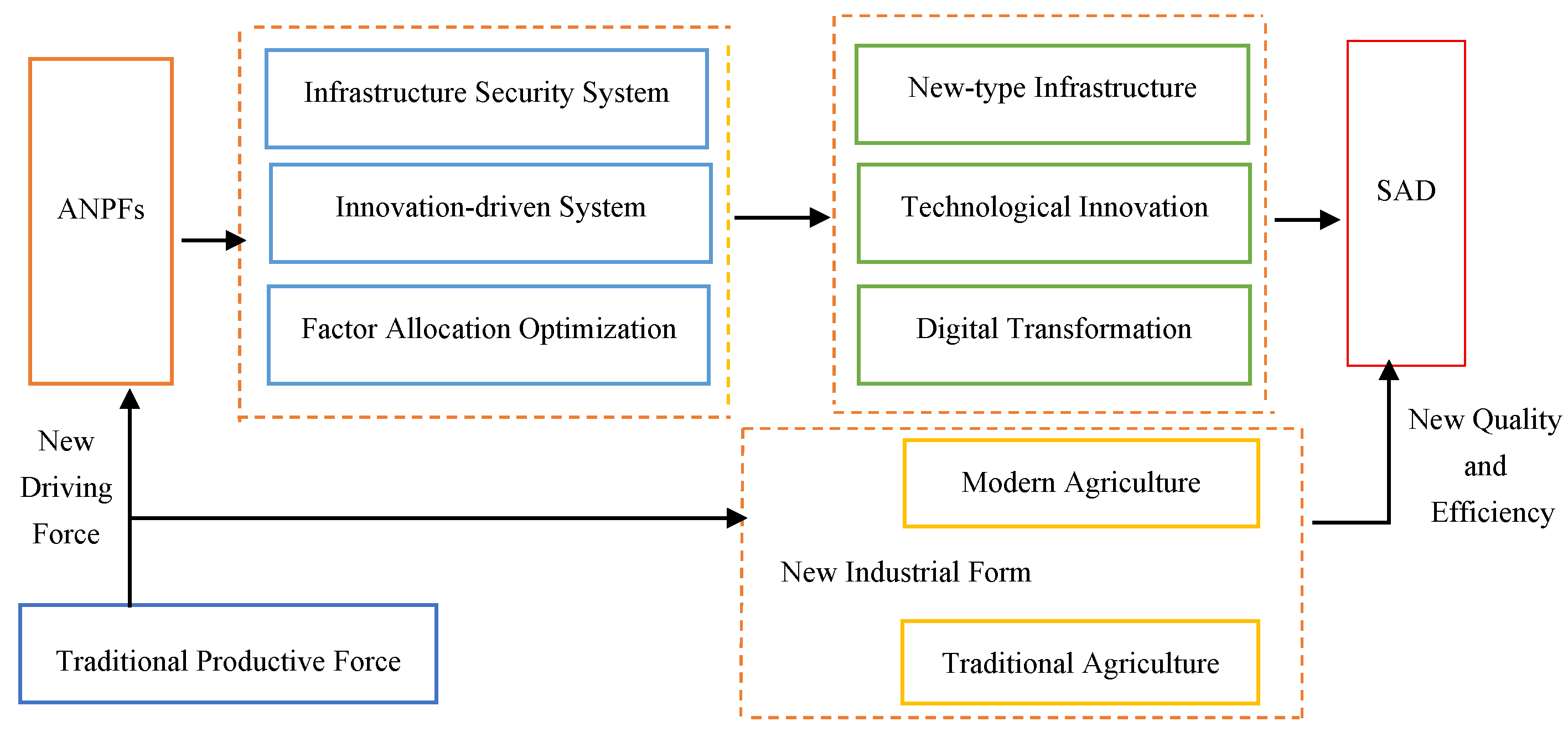
The transformation from traditional productive forces to new productive forces provides fresh momentum for agricultural development, driving the transition from traditional agriculture to modern agriculture, and from large agricultural provinces to SAD. This transformation requires infrastructure as the fundamental impetus, technological innovation as the driving force, and factor allocation optimization as the structural support. These processes depend critically on the improvement of new-type infrastructure, the enhancement of scientific and technological innovation capacity, and the advancement of agricultural digitalization [
29]. In brief, the development of ANPFs enhances new-type infrastructure, strengthens innovation capability, and promotes digital transformation in agriculture. By reconstructing the entire agricultural production chain through digitalization, intelligentization, and greening, it refines the modern agricultural industrial system and promotes the SAD. Accordingly, this study proposes an operational framework for the impact of ANPFs on SAD (see
Figure 1), emphasizing the sustainability-oriented transmission channels through infrastructure, innovation and digitalization.
3.1. Direct Effects of Agricultural New Productive Forces
The rise of ANPFs has brought unprecedented transformation to agricultural production, effectively enhancing the capacity for agricultural supply security [
36]. Under the paradigms of the Great Agriculture, Great Food, and Great Health concepts, a diversified food supply system has become an inevitable requirement for agricultural development and a practical necessity for meeting the growing demand for a better quality of life [
30,
37]. According to the laws of motion between productive forces and relations of production, innovation in productive forces inevitably requires adaptive adjustments in production relations. The core direction of building SAD lies in ecological and low-carbon development, making the development of green and low-carbon agriculture a necessary path. The essence of agricultural resilience lies in sustainable security, aligning closely with the principles of green development [
38]. Agricultural competitiveness—reflected in total factor productivity, cost–benefit structure, and international market share—is a crucial indicator of national agricultural strength. Enhancing such competitiveness is essential for economic growth, and new productive forces can strengthen it by shaping scale efficiency advantages, precision cost advantages, and technological standard advantages [
30,
39,
40,
41]. The emergence of ANPFs is propelling agriculture toward a more specialized, large-scale, and socialized development model, manifesting in three major dimensions:
First, Industrial coordination and modernization transformation
ANPFs act as the core engine for restructuring the modern agricultural industrial system. Their development has significantly stimulated the rural service sector, particularly through the formation and maturation of emerging industries such as e-commerce and agricultural big data platforms, which have diversified and streamlined agricultural product distribution channels [
12,
42]. The extensive application of digital technologies and smart equipment has improved production precision and efficiency, raised output and quality, and expanded the agricultural value chain through enhanced processing capacity—thereby increasing value-added and market competitiveness, while promoting the upgrading of the tertiary industry [
43]. Moreover, new productive forces have facilitated the deep application of modern agricultural technologies, advancing the conversion and recycling of agricultural waste such as straw and livestock manure, effectively reducing environmental pollution and ecological degradation. This shift has enhanced resource circularity and sustainability within agricultural systems [
44].
Second, Diversified entities and organizational innovation
The development of new productive forces has cultivated new industries and business models, such as rural tourism, livestream e-commerce, and health-oriented rural industries, accelerating the deep integration of primary, secondary, and tertiary industries [
45]. This integration promotes the expansion of production scale and the formation of new agricultural management entities—including leading agribusinesses, farmer cooperatives, and family farms. As key nodes within the new management system, these entities effectively organize fragmented smallholders, integrate resources, and embed them into modern production and market systems, thereby fostering socialized service systems and intensive production models. Meanwhile, new productive forces strengthen the linkages across the agricultural value chain, providing structural and operational support for specialized and efficient agricultural operations [
46]. By improving organizational and technological efficiency, new productive forces promote the spatial and industrial optimization of land, labor, and capital allocation. This integration enhances agricultural resilience and sustainability, enabling regionally adapted industrial layouts and production structures [
30,
47].
Third, Standardization and precision agriculture
Leveraging the Internet of Things (IoT), big data, and related technologies, new productive forces enable real-time monitoring and precise control over agricultural environments and production processes. This reduces non-point source pollution and carbon emissions, establishing a green and standardized production system that enhances resource efficiency and sustainability [
48]. Through big data analytics, producers can more accurately forecast market demand and price trends, dynamically adjust cropping structures before planting, and reduce risks of overproduction and decision-making costs. During production, smart sensors and precision agriculture technologies ensure on-demand input of resources, minimizing waste while simultaneously improving yield and quality. Post-production, digital supply chain platforms streamline distribution channels, reducing transaction and logistics costs, thus improving market competitiveness [
49].
In summary, ANPFs are restructuring the industrial landscape and fostering organizational innovation, driving the transformation of agricultural management systems toward large-scale, specialized, and socialized operations. This evolution not only supports the continuous advancement of productive forces but also refines the modern agricultural industrial system, thereby advancing the construction of SAD.
In summary, ANPFs drive the transformation of agricultural management toward large-scale, specialized, and socialized forms. This transformation not only enhances production efficiency but also reduces carbon emissions, improves resource-use efficiency, and strengthens circular agricultural systems, making ANPFs a fundamental engine for sustainable agricultural development.
3.2. Indirect Effects of Agricultural New Productive Forces
In addition to their direct impact, ANPFs exert a significant indirect driving effect on the construction of SAD. Guided by the principles of ecological and low-carbon development, ANPFs reinforce agricultural sustainability by improving infrastructure, enhancing science and technology innovation, and advancing digital transformation. These mechanisms collectively strengthen the foundations of agricultural security, improve resilience to risks, and enhance the capacity for long-term, stable, and adaptive development.
3.2.1. Driving Effect of Agricultural New-Type Infrastructure
With the evolution of ANPFs, the rise in agricultural mechanization has expanded production scales and transformed rural land-use patterns toward intensification and scale-oriented operations. The widespread adoption of intelligent agricultural machinery injects strong momentum into agricultural modernization, reducing production costs, improving productivity, and ensuring abundant harvests [
50]. The deployment of smart equipment, including agricultural robots and autonomous machinery, substitutes for manual labor on a large scale, significantly improving labor productivity. This effect is especially pronounced in labor-scarce contexts, where traditionally labor-intensive sectors such as planting, animal husbandry, and processing can leverage intelligent systems to achieve efficiency gains and transition from labor dependence to scale efficiency advantages, thus enhancing the global competitiveness of resource-constrained agricultural products [
51]. Moreover, the application of next-generation meteorological monitoring and remote sensing technologies reduces agriculture’s reliance on natural conditions by integrating climatic, geographic, and human factors, thereby strengthening disaster prevention and adaptive capacity [
52]. The expansion of production enabled by new technologies and equipment has also converted marginal lands—such as saline or sandy soils—into arable farmland, increasing the effective agricultural supply, enhancing comprehensive production capacity, and safeguarding food security and market stability. Mechanization and smart equipment adoption also promote precise input use and reduce environmental waste, strengthening agricultural ecological efficiency and climate resilience.
3.2.2. Driving Effect of Agricultural Science and Technology Innovation
Agricultural science and technology innovation provides a crucial foundation for agricultural modernization. Advanced agricultural machinery and equipment meet diverse production needs across plains, hills, and mountainous regions, covering the full spectrum of mechanized operations—from land preparation, seeding, and fertilization to irrigation, crop protection, and harvesting—thus supplying a robust technological foundation for modern agriculture [
53]. ANPFs prioritize breakthroughs in biological breeding, core components of intelligent machinery, and agricultural sensing technologies, establishing autonomous and controllable technological frontiers [
54]. Through targeted original innovation and incremental engagement in international standard-setting processes, China’s agricultural technology system has begun to establish localized competitive advantages in selected domains, such as smart agricultural equipment and e-commerce platforms. However, broader leadership along the agricultural value chain and the realization of technology-related premiums remain constrained by upstream technological bottlenecks, institutional misalignment, and uneven patterns of regional adoption. As “technology is the first productive force” and “innovation the primary driver,” scientific and technological progress remains pivotal to agricultural strength. The development of ANPFs accelerates innovation in precision agriculture technologies, thereby increasing product quality and value-added potential [
55]. Technological innovation not only improves productivity but also accelerates the development of low-carbon farming technologies, green varieties, and environmentally friendly inputs, providing a continuous source of green competitive advantage for sustainable provincial agricultural development.
3.2.3. Driving Effect of Agricultural Digital Transformation
The fourth technological revolution has accelerated the integration of genomic, information, and automation technologies into agriculture, promoting the transition toward intelligent, digital, and smart agriculture. These emerging models—such as smart farming, protected cultivation, and digital agriculture—enable precise environmental regulation, breaking the traditional dependence on natural resources such as soil, water, and climate, and enhancing stability, safety, and market competitiveness in agricultural production [
56]. The application of big data, remote sensing, and IoT-based sensing technologies enables multi-dimensional data collection and analysis of farmland environments, providing data-driven, customized cultivation strategies that optimize resource allocation and improve both quality and yield. Furthermore, ANPFs promote full-chain digitalization of the agricultural supply system, facilitating information sharing and interoperability across production, operation, management, and service stages [
57]. Digital and intelligent agricultural production reduces labor and time costs in plowing, sowing, fertilizing, and irrigation, while simultaneously increasing efficiency and productivity [
52]. Additionally, the integration of data analytics in market forecasting allows farmers to make scientifically informed decisions, plan production efficiently, and ensure sustainable agricultural growth. Digital agriculture also facilitates traceable supply chains and reduces information asymmetry, improving market stability and decreasing resource loss, thereby linking digital modernization with sustainable agri-food system governance.
Based on the above theoretical framework and mechanisms through which ANPFs influence SAD construction, the following hypotheses are proposed:
H1: The development of ANPFs promotes SAD.
H2: ANPFs advance SAD through the enhancement of agricultural new-type infrastructure.
H3: ANPFs promote SAD through the improvement of agricultural science and technology innovation.
H4: ANPFs facilitate SAD through the acceleration of agricultural digital transformation.
4. Research Design
4.1. Model Specification
This study adopts an empirical quantitative approach, constructing an econometric model to examine the relationship between ANPFs and SAD. By integrating the logical framework and intrinsic mechanisms linking these two domains, we reconstruct a multidimensional econometric model to assess how drivers of agricultural productivity contribute to sustainable agricultural development.
To test Hypothesis 1, which posits that the level of ANPFs influences the construction of an SAD, we establish the panel data model expressed in Equation (1):
In this equation, denotes the dependent variable representing the level of sustainable agricultural development (SAD) in Anhui Province; indexes the region, and indexes the year. The key explanatory variable captures the province’s agricultural new productive forces (ANPFs). comprises a set of control variables, and is the random error term. represents the constants, represents the impact coefficient of ANPFs on SAD. represents the impact coefficient of control variables on SAD.
To further explore the roles of agricultural new-type infrastructure, agricultural science and technology innovation, and agricultural digital transformation—and to test Hypotheses 2–4—we introduce a mediating-effects framework, expressed in Equations (2)–(4):
In these equations, represents the mediating variables corresponding to agricultural new-type infrastructure, agricultural science and technology innovation, and agricultural digital transformation, respectively. The coefficient captures the effect of ANPFs on the mediating variables, while represents the effects of the control variables on the mediating variables. The coefficient reflects the impact of the mediating variables on SAD. All remaining variables and parameters are defined consistently with those in Equation (1).
4.2. Variable Selection
4.2.1. Explained Variable: SAD
Following the policy directives of the No. 1 Document issued by the Anhui Provincial Party Committee, this study defines the concept of SAD in accordance with its intrinsic characteristics and its linkages to economic, social, and ecological dimensions [
58,
59,
60,
61,
62,
63]. Given the endowment of agricultural resources, the sustainable development of agriculture fundamentally depends on core natural elements such as soil and water quality, both of which directly influence crop productivity in terms of growth rates and yields. Accordingly, these factors should be incorporated into the construction of an indicator system for assessing agricultural sustainability. However, as soil and water quality are difficult to measure directly at the regional scale, this study employs proxy indicators to capture their effects indirectly.
Drawing upon prior research [
26,
54,
64,
65,
66,
67], we construct a comprehensive evaluation index system to measure the level of SAD in Anhui province. See
Table A1 in the appendix. This system adopts a six-dimensional framework encompassing agricultural product supply capacity, agricultural industrial competitiveness, agricultural science and technology innovation capacity, agricultural green development capacity, rural modernization level, and agricultural policy support intensity [
6]. By promoting the sustainable use of resources through enhanced supply capacity and green development capabilities, narrowing the urban–rural divide via rural modernization and targeted policy support, improving total factor productivity through technological innovation and industrial competitiveness, and pursuing an optimal balance among production–consumption coordination, resource-use efficiency, eco-economic performance, and social equity.
Each dimension is operationalized through a set of measurable indicators. Agricultural product supply capacity is captured by per capita grain output, per capita meat output, per capita oilseed output, and sown area of grain crops. Agricultural industrial competitiveness is represented by land productivity, labor productivity, and capital productivity. Agricultural science and technology innovation capacity is evaluated through grain yield per unit area, total research and development (R&D) personnel, and R&D expenditures. Agricultural green development capacity is measured by agricultural plastic film use per unit area, pesticide use per unit area, fertilizer input intensity, and afforested area. Rural modernization level is reflected by per capita disposable income of rural residents, average coverage rate of piped water, installed solar water heater area, and number of village health clinics. Agricultural policy support intensity is assessed using government expenditure share on agriculture, tax reductions for high-tech agricultural enterprises, R&D tax deductions for agricultural innovation, and rural assistance level.
To synthesize these multi-dimensional indicators into a composite measure, this study applies the Entropy Weight TOPSIS method, ensuring an objective and comprehensive assessment of Anhui’s progress in constructing an SAD.
4.2.2. Explanatory Variable: ANPF
According to Marxist theory of productive forces, production power consists of three fundamental components: means of labor, laborers, and objects of labor. As a new manifestation of productive forces, ANPFs retain these core elements but differ qualitatively from traditional forms of productivity. Through the transformation of these three components into new-type laborers, new-type means of labor, and new-type objects of labor, ANPFs represent a qualitative leap that emphasizes the synergistic interaction among production factors and promotes a fundamental shift in the mode of agricultural development [
20].
In constructing an indicator system for ANPFs—particularly within the agricultural sector—it is therefore essential to preserve the classical tripartite structure while advancing the dimensions of “newness” and “quality”. Drawing upon the frameworks proposed by Qiao et al. (2024) and Ma & Zhou (2024) [
68,
69], this study develops a comprehensive evaluation system comprising six primary indicators and seventeen secondary indicators, organized around new-type laborers, new-type means of labor, and new-type objects of labor. See
Table A2 in the appendix.
Specifically, labor quality is represented by the number of full-time teachers in higher education institutions, average years of schooling per capita, and number of agricultural R&D personnel. Labor efficiency is captured by per capita output of the agricultural industry. Tangible means of production are measured by, length of rural postal routes, sales revenue from new industrial products, and total volume of postal and telecommunications services. Intangible means of production are assessed through number of fixed broadband users in rural areas, conversion rate of agricultural scientific papers, and number of employees in digital industries. New-type industries are represented by number of high-tech agricultural enterprises, total retail sales of consumer goods in rural areas, and number of certified organic agricultural products. Ecological environment is evaluated through green coverage rate of built-up areas, centralized sewage treatment rate, and fiscal expenditure on energy conservation and environmental protection.
The Entropy Weight TOPSIS method is again employed to calculate composite scores, ensuring objective weighting and multidimensional comparability across indicators.
4.2.3. Mediating Variables
Three mediating factors are introduced to elucidate the pathways through which ANPFs influence SAD: agricultural new-type infrastructure, agricultural science and technology innovation, and agricultural digital transformation.
- (1)
Agricultural New-Type Infrastructure
The primary objective of agricultural new-type infrastructure is to enhance both the efficiency and quality of agricultural production. Mechanization level serves as a direct indicator of the diffusion of technical equipment in agricultural operations and thus reflects the modernization of basic infrastructure. It also indirectly captures the coordination and completeness of infrastructure systems. Although mechanization alone cannot fully represent the overall development of new-type agricultural infrastructure, it remains a rational and quantifiable proxy—particularly as one of the measurable dimensions of intelligent agricultural facilities.
- (2)
Agricultural Science and Technology Innovation
Agricultural technological innovation is measured by the number of authorized agricultural patents, a quantifiable and objective indicator that directly reflects the innovative output of agricultural R&D and indirectly indicates the vitality of research and innovation entities. Patents granted generally possess tangible application potential, contributing to productivity enhancement by linking technological transformation with production practices. This indicator therefore serves as an effective measure of regional competitiveness in agricultural science and technology innovation.
- (3)
Agricultural Digital Transformation
The digital transformation of agriculture relies on the integration of financial and technological infrastructures that support e-commerce, insurance, and credit services across the agricultural value chain. Digital inclusive finance plays a pivotal role in enabling this transformation by providing direct digital empowerment to various segments of the agricultural industry. The degree of development of digital inclusive finance thus serves as a rational proxy for assessing both the extent and equity of agricultural digital transformation [
70].
4.2.4. Control Variables
To enhance the robustness and validity of the regression results, this study controls for several additional factors that may influence SAD, drawing on insights from previous research. The control variables include urbanization rate, human capital, fiscal autonomy, industrial structure, and urban–rural income gap.
- (1)
Urbanization Rate
The acceleration of urbanization can affect SAD through multiple channels. On one hand, it promotes the outflow of rural labor, thereby reducing the agricultural labor supply. On the other, urbanization may facilitate the return flow of technology, capital, and other productive factors to rural areas. Hence, urbanization influences the allocation of agricultural resources and the transfer of rural labor, shaping the overall trajectory of agricultural development. In this study, the urbanization rate is measured by the ratio of urban population to total resident population.
- (2)
Human Capital
Human capital directly affects agricultural productivity and the level of agricultural modernization. A more educated workforce enhances innovation, technology adoption, and management efficiency in agricultural production. Here, human capital is represented by the proportion of the population with tertiary education or above.
- (3)
Fiscal Autonomy
Fiscal autonomy reflects the degree of independence local governments possess in managing revenues and expenditures, thereby influencing their capacity to invest in and support agricultural development. In this study, fiscal autonomy is measured by the ratio of local fiscal revenue to total fiscal expenditure.
- (4)
Industrial Structure
Optimization of the industrial structure can reshape the position and developmental potential of agriculture within the regional economy. A more balanced and service-oriented structure may contribute to agricultural modernization by fostering intersectoral linkages. The industrial structure level is measured by the proportion of tertiary industry value added to regional GDP.
- (5)
Urban–Rural Income Gap
The disparity between urban and rural incomes affects rural residents’ consumption capacity and their incentive to invest in agricultural production. A narrower income gap is generally conducive to sustainable agricultural development. The urban–rural income gap is quantified by the ratio of urban to rural per capita income.
The measurement methods for all variables are summarized in
Table 1.
4.3. Data Sources and Description
This study focuses on 16 prefecture-level cities in Anhui Province over the period 2010–2023, including Hefei, Huaibei, Bozhou, Suzhou, Bengbu, Fuyang, Huainan, Chuzhou, Lu’an, Maanshan, Wuhu, Xuancheng, Tongling, Chizhou, Anqing, and Huangshan. The data are drawn from the China Statistical Yearbook, the Anhui Statistical Yearbook, statistical yearbooks of individual cities in Anhui Province, and the EPS database. Missing values—accounting for less than 1% of the total dataset—were supplemented using linear interpolation, given the small proportion of missing data.
Table 2 presents the descriptive statistics for the main variables. The mean value of SAD construction index is 0.271, with a maximum of 0.619 and a minimum of 0.132, indicating substantial spatial variation in the level of agricultural development across Anhui province. The ANPF index shows even greater heterogeneity, ranging from 0.035 to 0.632, with a mean of 0.158, suggesting more pronounced regional disparities compared with SAD construction.
5. Empirical Results
5.1. Correlation Analysis
Table 3 presents the results of the Pearson correlation test for the main variables. The correlation coefficient between ANPFs and SAD is 0.745, significant at the 1% statistical level, indicating a strong positive association between the two. This provides preliminary evidence supporting Hypothesis 1. Moreover, the remaining variables are also correlated with the construction of an SAD. All control variables exhibit correlation coefficients below 0.5, suggesting that no serious multicollinearity problem exists in the model.
5.2. Baseline Model Estimation
The baseline regression results examining the impact of ANPFs on SAD are reported in
Table 4. The coefficient of ANPFs is 0.905 and significantly positive, confirming Hypothesis 1. To further investigate potential regional heterogeneity in the driving effect of ANPF, Anhui province was divided into northern, central, and southern regions. Across all three regions, ANPFs exert a significant positive impact on SAD, though the magnitude of this effect varies across regions (see
Table 4).
Among them, the central region exhibits the strongest effect and the coefficient is 0.965, followed by the southern region and the coefficient is 0.864, while the northern region shows the weakest impact and the coefficient is 0.802. This pattern can be attributed to two main factors. First, natural conditions and resource endowment. Agriculture is an industry highly dependent on natural resources. The northern region, characterized by plains and a temperate monsoon climate, experiences limited precipitation and frequent droughts and floods. The shortage of water resources restricts agricultural development. Although infrastructure has improved with the advancement of ANPFs, the capacity of new-type infrastructure still falls short of production needs. In contrast, the central region—situated in a subtropical transitional climate—benefits from more favorable hydrothermal conditions. This facilitates the adoption of diversified technologies such as precision agriculture and intelligent greenhouse systems, which have expanded rapidly. The southern region, dominated by hilly and mountainous terrain with a subtropical humid climate and abundant rainfall, is suitable for specialty crop cultivation. While fragmented topography constrains large-scale mechanization, strong willingness to adopt green technologies has stimulated the growth of characteristic and ecological agriculture.
Second, technological penetration and infrastructure differences. The density of 5G base stations and IoT devices in the central region is far higher than in the north. Proximity to the Hefei metropolitan area enhances its technological spillover and innovation transformation capacity. Although the northern region benefits from policy support under the Huai River Ecological Economic Belt, technology subsidies mainly target traditional agricultural machinery, with limited promotion of intelligent agricultural technologies. In contrast, the southern region has developed small-scale intelligent equipment for mountainous agriculture and strengthened digital marketing of ecological brands, promoting sustainable agricultural growth.
5.3. Endogeneity Test
A potential bidirectional causality may exist between ANPFs and SAD. The continuous advancement of SAD could expand market opportunities for developing new productive forces in agriculture, thereby introducing endogeneity into the model. To address this issue, two approaches were employed: the Generalized Method of Moments (GMM) estimation and a lagged variable test. First, in the GMM estimation, the number of express agricultural product deliveries was selected as the instrumental variable. This variable successfully passed the under-identification and weak-instrument tests, satisfying both relevance and exogeneity requirements. The estimation results are reported in
Table 5. After controlling for endogeneity, the impact of ANPFs on SAD construction remains significantly positive. The Wald χ
2 test yields χ
2(6) = 451.072,
p = 0.000, further confirming Hypothesis 1 and demonstrating the robustness of the results. Second, a lagged-variable test was conducted. The first-order lag of ANPFs has a significant positive effect, while the second-order lag is no longer significant, suggesting that the independent variable is likely exogenous. These findings indicate that the conclusions are robust and that endogeneity does not materially affect the results.
5.4. Robustness Tests
To ensure the robustness of the empirical findings, three approaches were employed. The results are shown in
Table 6.
5.4.1. Excluding Specific Sample
Given that Hefei, as the provincial capital, differs markedly from other cities in Anhui Province in terms of economic structure and development scale, it was excluded from the sample to test robustness. The results indicate that ANPFs continue to exert a significant positive effect on SAD and the impact coefficient is 0.991, confirming the robustness of the baseline results.
5.4.2. Two-Sided Winsorization
Winsorization is a common robustness test method used to mitigate the influence of outliers on regression estimates. By replacing extreme values at both ends of the continuous variable distribution with their corresponding percentile values, this method minimizes distortion in coefficient estimation. After winsorizing the data, the coefficient of the core variable—ANPF (0.954)—remains positive and statistically significant, consistent with the baseline direction, suggesting that the findings are not driven by extreme observations.
5.4.3. Quantile Regression
To further examine the distributional effects, quantile regressions were conducted at the 0.25, 0.50, and 0.75 quantiles. The results show that ANPFs have a significant positive impact on SAD across all quantiles, though the magnitude of the coefficients varies. Specifically, the coefficients are 0.877, 0.982, and 0.898 at the 0.25, 0.50, and 0.75 quantiles, respectively. The pattern—first rising and then falling—suggests that as the level of agricultural province construction increases, the marginal driving effect of new productive forces gradually declines but remains positive overall. These results collectively confirm the robustness of the study’s conclusions.
5.5. Mechanism Analysis
To further elucidate the pathways through which ANPFs influence SAD, Equations (2)–(4) were estimated, and the results are reported in
Table 7. Column (1) of
Table 7 shows that ANPFs exert a significant positive effect on SAD and the impact coefficient is 0.905. Column (2) demonstrates that ANPFs also have a significant positive impact on new-type agricultural infrastructure and the impact coefficient is 1.426. When both ANPFs and new-type infrastructure are included as explanatory variables (Column 3), the coefficient for ANPFs remains positive and significant and the impact coefficient is 0.619, but its magnitude declines relative to Column (1). This indicates that ANPFs promote the development of new-type agricultural infrastructure, which in turn enhances SAD. Hence, new-type infrastructure plays a mediating role, forming the transmission mechanism “ANPF → New-type Infrastructure → SAD.”
Similarly, Column (4) shows that ANPFs significantly enhance agricultural science and technology innovation and the impact coefficient is 2.797. When both variables are included as explanatory factors (Column 5), the coefficient of ANPFs on SAD remains significantly positive and the impact coefficient is 0.421, but again with a reduced magnitude. This demonstrates that ANPFs stimulate technological innovation, which subsequently drives agricultural strength. Thus, agricultural science and technology innovation serves as a mediating variable, consistent with the mechanism “ANPF → Agricultural Science and Technology Innovation → SAD.”
Column (6) reveals that ANPFs have a significant positive effect on agricultural digital transformation and the impact coefficient is 0.107. When both are included as explanatory variables (Column 7), the coefficient of ANPFs remains positive and significant and the impact coefficient is 0.849, though slightly lower than in Column (1). This suggests that agricultural digital transformation partially mediates the effect of new productive forces on SAD, forming the pathway “ANPF → Agricultural Digital Transformation → SAD.”
The results in
Table 7 and
Table 8 demonstrate that new-type infrastructure, agricultural science and technology innovation, and agricultural digital transformation each serve as mediating mechanisms through which ANPFs promote SAD, though with differing magnitudes. For new-type infrastructure, the direct effect (0.619) exceeds the indirect effect (0.286), with contribution rates of 68.40% and 31.60%, respectively, indicating partial mediation dominated by direct influence. For agricultural science and technology innovation, the indirect effect (0.484) surpasses the direct effect (0.421), accounting for 53.48% and 46.52% of the total, respectively, suggesting that innovation serves as the primary mediating pathway. For agricultural digital transformation, the indirect effect (0.056) accounts for only 6.19% of the total effect, while the direct effect (0.849) contributes 93.81%, implying that while digital transformation plays a role, its mediating influence remains relatively limited.
5.6. Further Analysis
To further examine whether ANPFs generate spatial spillover effects in promoting SAD, we employ a spatial econometric modeling framework. The corresponding estimation results are reported in
Table 9. Under conditions of spatial correlation, the ordinary least squares (OLS) estimator may suffer from bias and inconsistency; hence, the maximum likelihood estimation (MLE) or two-stage least squares (2SLS) method is typically applied. The model can be expressed as:
where
denotes the spatial adjacency matrix.
The results indicate that the empowerment of ANPFs exerts a significant positive spatial spillover effect on SAD. Regional improvements in ANPFs can radiate outward to neighboring areas through competitive and demonstration effects, thereby fostering the coordinated development of surrounding regions.
This finding can be attributed to two main mechanisms. First, technological innovation as the core driver. ANPFs reconstruct production modes through digitalization, intelligentization, and greening, and the diffusion of such technologies often transcends geographic boundaries. Neighboring regions may acquire these innovations through imitation, cooperation, or demonstration learning. Furthermore, research institutions, agricultural enterprises, and demonstration zones disseminate technological achievements across regions via training programs, joint projects, and digital platforms, thereby extending the spatial impact of ANPF. Second, the mobility of new production factors. New production elements, such as skilled agricultural labor and advanced technologies, tend to flow into resource-complementary adjacent regions, promoting technological diffusion through cross-regional employment and supply chain linkages. The collaborative dynamics within modern agricultural value chains enhance interregional productivity. Meanwhile, the widespread adoption of green agricultural technologies contributes to regional environmental improvements, indirectly elevating productivity in neighboring areas.
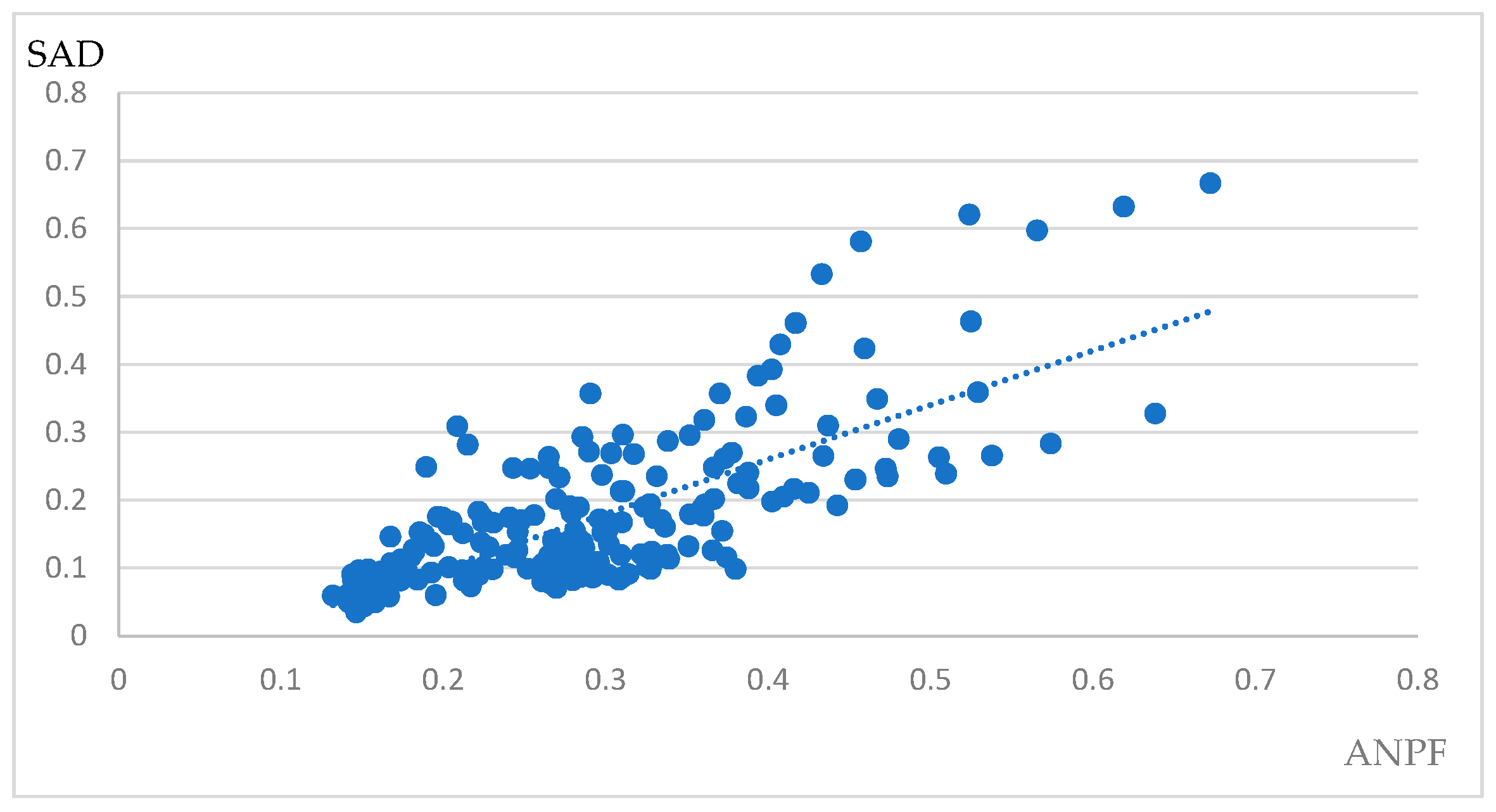
To assess potential nonlinear relationships between ANPFs and SAD, a quadratic curve was fitted, as illustrated in
Figure 2. The results reveal that the two variables exhibit a highly consistent and approximately linear relationship, supporting the validity of the model specification used in this study.
6. Discussion
6.1. Research Findings
Using panel data from 16 prefecture-level cities in Anhui province of China from 2010 to 2023, this study employed panel regression models, mediating-effect models, and spatial econometric models to empirically examine how ANPFs drive SAD. The key findings are as follows:
Firstly, the enhancement of agricultural new productive forces significantly promotes the SAD in Anhui, and this finding remains robust under multiple model specifications. As ANPFs develop, the pace of agricultural strengthening continues to accelerate.
Secondly, ANPFs exert significant positive effects across all three regions of Anhui—northern, central, and southern Anhui—but the magnitude of influence varies. The effect is strongest in central Anhui, followed by southern Anhui, and weakest in northern Anhui.
Thirdly, the impact of ANPFs on SAD operates through three mediating channels: new-type infrastructure, agricultural scientific and technological innovation, and agricultural digital transformation. Among these, technological innovation serves as the most potent mediating force, followed by new-type infrastructure, while the mediating effect of digital transformation is relatively modest.
Finally, agricultural new productive forces display significant positive spatial spillovers in empowering sustainable agricultural development. This means that the development of ANPFs not only strengthens the local agricultural economy but also generates radiative and demonstrative effects that benefit neighboring regions through competition, cooperation, and technological diffusion.
In summary, compared with prior studies that have predominantly focused on national-level theoretical discussions or qualitative assessments, this study shifts the analytical focus from the macro-national to the meso-provincial level, using Anhui as a representative case, thus revealing internal heterogeneity and development gradients within provinces. By integrating mediating and spatial econometric models, this research systematically identifies the mechanisms through which ANPFs drive SAD—bridging the theoretical gap between productive forces and relations of production in existing frameworks. The study provides quantitative validation of the transformative role of ANPF, offering concrete evidence for the multi-channel, spatially diffusive, and nonlinear nature of their impact. This not only strengthens the empirical foundation of the ANPFs framework but also provides policy-oriented insights for promoting balanced and sustainable agricultural modernization at the provincial level.
6.2. Theoretical Contributions
This study makes several theoretical contributions to understanding how ANPFs drive SAD. By analyzing the mechanisms through which ANPFs enhance agricultural modernization and competitiveness, the research provides a conceptual foundation for developing new productive forces adapted to regional, temporal, and industrial contexts, thereby advancing the theoretical understanding of agricultural transformation in China and offering broader insights for comparable regions worldwide.
First, this study introduces agricultural new productive forces as a central analytical entry point and embeds them within the framework of sustainable agricultural development. This integration identifies ANPFs as the core driving force behind agricultural modernization and provincial agricultural strengthening, extending previous theories that viewed agricultural productivity primarily through the lens of traditional factor accumulation or technological diffusion.
Second, it clarifies the strategic and theoretical position of ANPFs in the broader agenda of sustainable agricultural development. By conceptualizing ANPFs as a systemic innovation that combines technological, structural, and institutional transformation, the study deepens the theoretical connection between new productive forces and agricultural modernization. This provides a refined framework for understanding how innovation and quality transformation jointly promote industrial upgrading and structural resilience in agriculture.
Third, the research provides theoretical guidance for policy formulation, particularly in enhancing technological innovation capacity, agricultural talent cultivation, and the optimization of production relations. It establishes that the development of ANPFs can systematically modernize production modes, management systems, and organizational structures, thereby improving agricultural efficiency, product quality, and market competitiveness.
From a theoretical perspective, the study demonstrates that the evolution of ANPFs drives the modernization of agricultural production, operation, and management, promoting both efficiency enhancement and green transformation. Through the integration of new productive forces, agricultural resources are allocated more efficiently, ecological protection is strengthened, and sustainable green development is achieved. Moreover, by reshaping and optimizing the agricultural industrial chain, ANPFs increase value-added capacity, extend the value chain, and contribute to the comprehensive advancement of sustainable agricultural development.
6.3. Practical Implications
The process through which ANPFs drive SAD is a long-term and complex systemic endeavor, requiring sustained strategic planning rather than short-term interventions. To achieve enduring progress, attention must be directed toward strengthening foundational infrastructure, reinforcing technological innovation, advancing agricultural digital transformation, and reshaping production modes to promote sustainable agricultural development.
First of all, strengthening new-type infrastructure to enhance the agricultural industrial chain. Investment in new infrastructure should focus on improving the connectivity, efficiency, and value density of the agricultural industrial chain. Following the strategic orientation of “extending the primary industry upstream, expanding the secondary industry laterally, and elevating the tertiary industry toward advanced segments,” it is essential to address structural bottlenecks across stages of production, processing, and marketing. Continuous upgrading of industrial subsystems will raise the value-added capacity and integrated efficiency of the entire chain, thereby increasing the overall utility and competitiveness of agricultural production.
Furthermore, reinforcing technological innovation to advance frontier agricultural science. Technological innovation is the primary driver of ANPFs development. Efforts should focus on building innovation platforms such as smart agriculture valleys and national agricultural science and technology zones, concentrating research on biological breeding, intelligent agricultural machinery, and digital agriculture. Policy support should encourage leading enterprises to form innovation consortia, fostering close collaboration between industry, academia, and research institutions. Specific initiatives should include developing high-quality crop varieties, establishing germplasm resource banks, and promoting the application of precision agriculture technologies, such as digital farmlands and unmanned aerial plant protection systems. These innovation pathways contribute to sustainable agriculture by improving yield per unit resource, promoting low-pesticide and low-fertilizer production modes, and enhancing climate adaptability of crops, thus enabling agricultural growth with minimized ecological costs.
In addition, cultivating a new generation of agricultural professionals to transform production models. The success of agricultural digital transformation depends critically on the emergence of “new farmers.” Capacity-building initiatives should integrate universities, enterprises, and vocational institutions to provide specialized training in digital and precision technologies. “Science and technology commissioners” can conduct field-based instruction in smart irrigation, precision fertilization, and other intelligent techniques. Joint training programs between enterprises and vocational colleges should produce multi-skilled professionals proficient in both technology and management. Meanwhile, the establishment of online expert consultation platforms and case-based learning systems can accelerate talent diffusion. Parallel efforts should promote ecological production models, reduce chemical input dependency, and further advance the transformation of agricultural production methods toward sustainability. Cultivating green-oriented agricultural talent ensures that environmental stewardship, carbon-reduction awareness, and sustainable farming philosophies are embedded in long-term agricultural practices.
Last but not the least, enhancing policy incentives to foster the evolution of new productive forces. The cultivation and development of ANPFs must align with the specific conditions and development stages of different regions. Policy formulation should therefore adhere to the principles of local adaptation, timeliness, and flexibility, establishing a resilient long-term mechanism for comprehensive rural revitalization. Policymakers should emphasize differentiated guidance, encouraging local governments to explore pathways suited to their unique resource endowments and to form demonstration zones with replicable success models. Governments at all levels should issue targeted incentive policies, including continued support for farmer skill enhancement, enterprise R&D investment, and financial innovation. Financial institutions should be guided to design green financial instruments that fund low-carbon and sustainable agricultural projects, forming a multi-actor innovation ecosystem led by skilled farmers, technology-driven enterprises, and green finance institutions. Furthermore, establishing a dynamic monitoring and feedback mechanism—structured as “feedback–adjustment–refinement–reapplication”—will ensure adaptive policy implementation and continuous system optimization.
6.4. Limitations and Future Directions
While this study provides a systematic exploration of how ANPFs drive the SAD in Anhui, several limitations should be acknowledged. First, this analysis is subject to regional constraints. The empirical results are derived from provincial-level data from Anhui Province, which may limit their direct generalizability to other institutional or geographical contexts. While the findings provide meaningful insights for regions with comparable agricultural structures and development trajectories, their applicability to areas characterized by different institutional arrangements, ecological conditions, or industrial structures remains constrained. Future research should therefore extend the analytical framework to multi-provincial or national scales, enabling comparative assessments across diverse regional conditions. Second, the measurement of key variables is subject to indicator limitations. Some dimensions of ANPFs were captured through composite or proxy indicators due to gaps in the existing statistical system. In particular, certain core indicators—such as those reflecting the qualitative transformation of productive forces or the spatial differentiation of agricultural strength—lack direct, standardized measurement. Future studies could strengthen sustainability evaluation by incorporating micro-scale digital farm data, remote-sensing information on farmland ecological change, or life-cycle analysis of agricultural inputs and outputs, thereby improving the precision of sustainability assessment and its link to ANPF development. Moreover, subsequent studies should incorporate dynamic and spatial-temporal empirical analyses to validate and extend the present findings, ultimately providing a more comprehensive understanding of how ANPFs contribute to agricultural modernization across varying contexts. Beyond empirical expansion, interdisciplinary research could further explore the long-term sustainability pathways of ANPF—especially their roles in climate resilience, biodiversity protection, rural livelihood improvement, and circular agricultural economies. Scenario simulations, system dynamics modelling, and policy experiments could help examine how ANPFs interact with low-carbon transitions, SDGs, and rural revitalization goals under different policy environments. Strengthening comparative studies between provinces or across countries would also help clarify how institutional design, innovation ecosystems, and green governance frameworks shape the sustainability effects of ANPF.
7. Conclusions
First, the SAD fundamentally depends on the empowerment of ANPF. The core of this transformation lies in building an integrated ANPFs system founded on technological innovation, digital empowerment, industrial-chain resilience, and the accumulation of modern human capital. Such a system represents not only a new stage in agricultural modernization but also a structural reconfiguration of how productivity, innovation, and sustainability intersect within China’s agricultural economy. Second, China’s industrial development continues to face multiple structural constraints—insufficient industrial resilience, weak linkages between value chains and innovation chains, uneven digital-physical integration, and pressures from green and low-carbon transition requirements. These challenges imply that the development of ANPFs also encounters persistent barriers, including inadequate investment, a fragile industrial base, an imperfect institutional environment, and limited human capital support. Building a robust foundation of modern human capital, capable of integrating technological advancement, digital transformation, and sustainable development, will be pivotal to realizing the long-term goal of sustainable agricultural development and ultimately advancing the vision of a modern agricultural power. Third, ANPFs are an essential pathway to sustainable agricultural development. Agricultural infrastructure, innovation capacity, and digital transformation jointly enhance the environmental performance of the agricultural system, which aligns with the goals of rural revitalization and the United Nations SDGs. Therefore, the contribution of ANPFs extends beyond productivity improvement; it represents a long-term supporting force for ecological security, food security, and rural sustainability. By embedding sustainability into the evolution of new productive forces, strong agricultural provinces can not only achieve economic growth but also secure ecological resilience and intergenerational agricultural viability.