1. Introduction
The relatively new field of responsible leadership (RL) has established itself in academia over the past two decades. A recent review of the field highlighted that despite multiple contributions from earlier reviews [
1,
2,
3], “
key gaps remain in the RL literature, particularly, regarding the integration of social and environmental concerns and the need for a more comprehensive conceptual framework” [
4]. As a consequence, the established literature often treats RL as an extension of traditional leadership theories, such as ethical, servant, or transformational leadership, without clearly defining it as a distinct construct. In addition, RL contributions are typically located on an individual level, a team level, or an organizational level, not on a societal level. They address individuals, groups or organizational outcomes, not societal impacts. They are related to very different theories and organizational approaches, spanning psychological to organizational and strategic approaches; however, they do not extend to theories on a societal level.
When considering social and environmental concerns, we are on a societal level where sustainability issues are located and debated. But we must also consider where sustainability leadership resides and where it is needed to achieve sustainable outcomes. Here, we look at societal issues such as climate change, water scarcity, poverty, corruption, and economic or health issues. As societal issues have become increasingly interconnected with business issues, and business decisions have begun to influence sustainability issues, sustainability management and, hence, RL has gained practical importance. For example, companies are being challenged to achieve societal goals like climate neutrality and to transform their global supply chains by making circularity of their products and worker’s rights work globally. Managing such complex relations goes far beyond traditional leadership qualities and requires many of the competencies that define responsible leadership. Examples include the ability to deal with ambiguity during innovation, developing trust with new stakeholders, and dealing with either conflicting or contradicting third-party interests [
5,
6]. The capacity to be guided by principles of ethics and values and a deep understanding of the system and one’s own role in it and, thus, to embrace a sense of being virtuous, or achieving the best of the human potential, is broadened in this context [
7].
In this broader context, leadership not only considers business in its traditional borders, but also includes its interactions with society and its effects on and its role in society. Leadership takes on a societal or public dimension. RL has helped to measure what society expects of business leaders [
8]. Indeed, sustainability leaders such Danfoss in Denmark have shown that a crisis can offer a chance to demonstrate a company’s sustainability vision, rather than being a reason to stop its implementation [
9]. In its broadest definition, RL includes leadership at the organizational as well as the individual level [
10]. This is what sustainability management as a management discipline is all about [
11]. And this is also what RL or impact leadership as a leadership discipline is all about. Both areas are clearly very close and interconnected. They have developed in parallel to each other and they continue to interact and develop together.
The world has changed. Investors’ responses to how the media covers corporate scandals (such as the South-east Asian factory scandals, the North American opioid scandal, or the Australian Juukan Gorge debacle), has shaped how society thinks about business responsibility [
12,
13,
14,
15]. There is increasing proof that advanced sustainability organizations perform better than traditional firms [
16]. And even traditional businesses have taken important steps towards integrating aspects of sustainability into their day-to-day business [
17,
18,
19]. Sustainability challenges have become so complex that no single actor can solve them alone [
20]. As a result, Business Sustainability (BS) must become more effective in order to make a relevant contribution to the environment and society. It has become insufficient adapt a “refined shareholder value management” by reducing the companies’ negative impacts on society. Even an improved version of BS, namely “managing for the triple bottom line,” by which companies manage their financial, social and environmental risks, obligations and opportunities, no longer has the much-needed positive impact. Companies need to become “truly sustainable” so they can make significant contributions. Or, in other words, “
Truly sustainable business shifts its perspective from seeking to minimize its negative impacts to understanding how it can create a significant positive impact in critical and relevant areas for society and the planet. It looks first at the external environment within which it operates and then asks itself what it can do to help overcome critical challenges that demand the resources and competencies it has at its disposal” [
21].
As a result, truly sustainable businesses see themselves as responsive citizens of society. We call such purpose-driven businesses “Positive Impact Organizations” (PIOs). They create products and services aimed at solving societal and environmental challenges while giving themselves a competitive edge and securing their financial sustainability. Such organizations are led by impact leaders, who understand that creating a positive impact in society may be the best way to ensure economic viability. Such organizations also tend to attract the talent of future generations who seek purpose in their work [
22].
This article reinforces the bridge between responsible leadership and business sustainability by mapping RL impact areas inside organizations. In this way, it shows the RL research field specific impact areas inside organizations, which are directed at relevant societal impacts outside the organization. It thus creates a bridge between the organization and society, the environment, society, and the economy that can be used to create a path forward. The map builds on previous work by the authors identifying different mindsets for the transformation of traditional to positive impact organizations. It explores how responsible leadership competencies of individual actors support organizational sustainability transformation. And it connects measurable individual skills and competencies of managers and leaders with strategies for integrating sustainability into an organization.
Section 2 outlines the methodology, approach, and the models and terms used in this article.
Section 3 of this article clarifies the competencies of impact leaders for a changing world.
Section 4 defines the relevant strategic impact areas in organizations.
Section 5 clarifies the direct impact of RL in organizations by relating the impact leader competencies to the strategic impact areas in organizations, closing with a short discussion.
Section 6 presents the conclusions and recommendations, implications, suggestions for validation, and limitations of this article.
2. Methodology, Approach, Models, and Terms
In this article, we identify the leadership competencies of individual leaders and connect them with strategic impact areas of a PIO. The aim is to create a map which will allow impact leaders and their educators to navigate the changing landscape of new competencies and skills needed to manage and create societal impact. Continuous professional development will be a critical enabler to succeed in the business and ecosystem transformations that we are facing. To achieve this, we explore the following research questions in this article: What is the contribution and relevance of responsible leadership competencies to accelerate the sustainable development of organizations? And how can these help impact leaders, educators and leadership development specialists in their transformational work?
To answer the question, we use the following research approach. We compare relevant competencies from the field of RL with a developmental model of BS. For this, we need two models that use the same underlying worldview and developmental approach, identifying sustainability not just as a risk, but as a business impact opportunity. We use our own experience with both models to establish a conceptual map, matching RL competencies with strategic differentiators of advanced sustainability organizations. Our approach is purely conceptual at this stage. The suggested impact map opens the field to a new research agenda, which must include an empirical validation of the model as well as testing for boundaries, limitations, and hurdles preventing implementation.
Initially, the following three questions must be clarified:
Which RL model is most suitable for this exercise?
Which BS model is most suitable given the RL model chosen?
What conceptual foundation exists to bridge RL with BS?
Is a new term needed for the type of leader we describe here?
In the field of responsible leadership, existing models such as Goleman’s six leadership styles model [
23] and the Dulewicz and Higgs leadership competency model [
24] may appear to be excellent choices for measuring leadership competencies. Both models conceptualize leadership as a set of individual competencies or styles associated with effective performance within organizations. Dulewicz and Higgs frame leadership effectiveness through a competency-based structure encompassing intellectual, managerial, and emotional domains, emphasizing a leader’s cognitive capacity, execution capability, and emotional intelligence as predictors of organizational performance. Goleman’s model similarly centers on individual capability, conceptualizing leadership effectiveness as the situational application of six leadership styles derived from emotional intelligence competencies, with a particular focus on shaping organizational climate and short- to medium-term performance outcomes.
By contrast, the Competency Assessment for responsible leadership (CARL) differs from both models in its underlying logic and scope. While it also adopts a competency-based approach, CARL explicitly integrates ethical orientation, stakeholder relations, and systems thinking as core leadership competencies, thereby extending beyond performance- and climate-oriented effectiveness. Moreover, CARL introduces a developmental structure through the action domains of knowing, doing, and being, which allows leadership competencies to be examined not only as observable behaviors, but also as underlying knowledge bases and value orientations. In contrast to the findings reported by Dulewicz and Higgs and to Goleman, CARL is explicitly positioned in relation to sustainable development, framing leadership competencies in terms of their relevance for influencing organizational transformation toward sustainability. While all three models address leadership effectiveness at the individual level, only CARL explicitly refers to responsible leadership competencies and links these to broader societal and environmental concerns via the organization, thereby moving the analytical focus beyond individual performance and internal organizational outcomes.
In the field of business sustainability, several established approaches could be considered. Reporting standards such as those developed by the Global Reporting Initiative (GRI) provide a structured basis for identifying and measuring economic, environmental, and social aspects with the aim of providing comparability across organizations [
25]. By contrast, assessment systems such as the B-Lab Impact Assessment evaluate organizational practices across governance and stakeholder dimensions, which can be benchmarked against defined performance thresholds [
26]. Strategy-oriented concepts such as Porter and Kramer’s shared value creation theory frame selected social and environmental issues as opportunities for competitive advantage [
27]. These approaches serve important analytical purposes, as they focus on classification, reporting, assessment, or strategic alignment. Can they, however, be of help in understanding how an organization advances to become more sustainable? Furthermore, Bansal and Song consider the conceptual distinctions of related concepts of corporate sustainability and corporate responsibility, clarifying differences in scope, intent, and organizational focus [
28]. None of the mentioned studies offer a developmental typology that differentiates sustainability based on underlying value-creation logics or explains how organizations progress toward higher levels of societal contribution.
For this article, we require a framework that distinguishes traditional organizations from those focused on creating a positive impact, and it must allow organizational transformation to be analyzed as a progression rather than as a static condition. The Positive Impact Organization (PIO) model fulfills this role by conceptualizing organizations according to how they integrate societal and environmental challenges into their core purpose, governance, culture, and value creation processes. The model builds on the Business Sustainability Typology [
21] and introduces a developmental logic that shows the shift from an inside-out orientation focused on managing negative impacts toward an outside-in orientation in which societal needs define strategic priorities. This perspective is central to the argument of this article, as it enables us to analyze how organizations evolve toward a positive impact and how individual leaders can influence and accelerate this transformation by aligning leadership competencies with the requirements of impact-oriented organizations.
Conceptual foundation for bridging RL with BS. Haque and Ntim highlight a growing interest in understanding the effects sustainability initiatives have on measurable company results [
29]. Sustainability initiatives are driven by leaders, and Abraham points to a growing need to define the impact of a broader triple-bottom-line value creation, hence the expression of the need for an impact map that can be used by leaders [
30]. Most recently, Lopez, Pérez, and Garcia have conducted a systemic review of organizational transformation, positioning sustainable leadership as a catalyst of ESG governance and pointing to the centrality of leadership [
31]. Wihler, Nolan, and Zheng have explored this growing leadership focus by expanding the concept of leadership with regard to sustainability and the related leadership skills [
32]. Such work also includes an understanding that a transformation of an organization towards sustainability requires a mindset shift both at the leader and organizational levels [
33]. Early empirical studies linking responsible leadership with green innovation have pointed to competencies including “Higher Purpose” and “Transformative Sustainability”, suggesting that there are ways to validate a connection between competencies and strategic business [
34]. Another study suggests that competencies such as “Self-Awareness” and “Ethics” translate into a “Culture of Sustainability” [
35]. There is no overarching conceptual framework for all future-relevant leadership skills so that a leader can understand where to best apply their strengths to create a positive impact via their organization. And yet, the above brief overview demonstrates that the field is getting ready for this, as interest in this topic is growing.
We end up with a new type of leadership. We shall call leaders of PIOs “impact leaders.” Impact leaders seek not only to ensure that their organizations are behaving responsibly and that they are ethically compliant, but they also have a positive impact on society, the environment, and the economy. In other words, through their actions, impact leaders contribute to solving societal issues. They go beyond reducing the negative effects of their organization’s activities, and thereby reducing their organization’s exposure to risk. Their ambition is to have a real impact on society and to leave visible traces. The extended collaboration related to innovations in value chains or whole ecosystems goes beyond traditional competencies. It is necessary to establish broader responsible leadership competencies that allow us to effectively engage with a broader set of stakeholders and rely more on collaboration than on competition.
By contrast, RL primarily addresses leadership behavior and competencies, focusing on how leaders act in relation to stakeholders, values, and systemic awareness, without requiring an explicit linkage to societal outcomes [
2]. Concepts like sustainable leadership and leadership for sustainability both emphasize ethical conduct, stakeholder consideration, and long-term orientation. Avery & Bergsteiner address the aspect of organizational resilience, which is achieved through continuity, learning, and responsible resource use in their foundational work defining sustainable leadership [
36,
37,
38]. Within this framing, sustainability is largely treated as a condition for enduring organizational success rather than as an externally defined contribution to societal problem-solving. This differs from the definition of
impact leadership used in this article. While impact leadership builds on responsible and sustainable leadership competencies, it introduces an explicit outcome orientation by linking leadership to the transformation of organizational purpose, governance, and innovation toward the creation of positive societal and environmental impact. Impact leaders are therefore not defined by long-term orientation, stakeholder consideration, or resilience alone, but by their role in enabling organizations to contribute substantively to addressing material sustainability challenges through their core activities. Conceptually, impact leadership builds on responsible leadership competencies while extending them by linking individual leadership capacities to the transformation of organizations toward a positive impact orientation.
As a result, we provide recommendations to the individual leader, the business educator and the leadership development specialist to identify and strengthen an individual’s contribution to the sustainability transformation of organizations, and highlight an effective learning journey. The contributions of this article can be summarized as follows:
It builds a bridge between responsible leadership competencies and business sustainability to allow for positive developments.
This article offers a new research field of leadership impact by combining sustainability and leadership with a genuinely new mapping of competencies.
It provides a relevant strategic impact area for responsible leadership theory to explore.
It supports the development of future, emerging and current leaders who are seeking to advance their positive impact potential.
It contributes to the further development of the Competency Assessment for Responsible Leadership tool to measure and improve responsible leadership development.
It provides concrete learning and development suggestions in the sustainable impact field for responsible leaders, students, and business educators.
3. Measuring Competencies of Impact Leaders—The Competency Assessment for Responsible Leadership (CARL)
To move beyond traditional change management competencies and address innovations along extended value chains, much broader leadership competencies are required from management. It is necessary to establish competencies that embrace effective stakeholder relations, authenticity, and a systemic perspective, but that are also more reliant on collaboration than on competition. This is where RL competencies come into play.
The Competency Assessment for Responsible Leadership (CARL) online tool was created to systematically analyze and develop RL competencies, both in business and educational practice [
39]. It is freely available and has helped to advance RL insights based on theory and practice. It delivers an RL profile which can be used to identify development needs and track progress. A comprehensive analysis of the first 10,000 completed surveys highlights the global relevance of the tool [
40].
The CARL is built on the following definition of responsible leadership:
“A responsible leader demonstrates a deep understanding of the inter-dependencies of the system and the own person, is distinguished by an ethical and values-based attitude, and is able to build long-term relations with different stakeholders embracing their needs, while initiating change towards sustainable development” [
41].
The CARL consists of two aspects—RL competencies and action domains. First, the RL competencies encompass five core areas:
Ethics and values: consistent and integer behavior in dilemma situations and values related to fairness [
42,
43,
44].
Self-awareness: adopting one’s communication to the receiver and sharing lessons learned during one’s personal growth journey [
45,
46,
47].
Stakeholder relations: cultivating trusting relationships that honor diversity and lead consensus-oriented stakeholder dialogue [
37,
48,
49].
Change and innovation: the ability to lead change and innovation towards sustainable development [
50,
51].
Systems thinking: a good understanding of the interdependencies within a larger and connected system [
52,
53].
Second, the CARL offers a developmental perspective by considering three action domains that allow a deeper understanding and more granular definition of the five competency dimensions. The three action domains are
knowing, doing, and being [
54]. In pedagogy, they are also known as knowledge, skills, and attitudes [
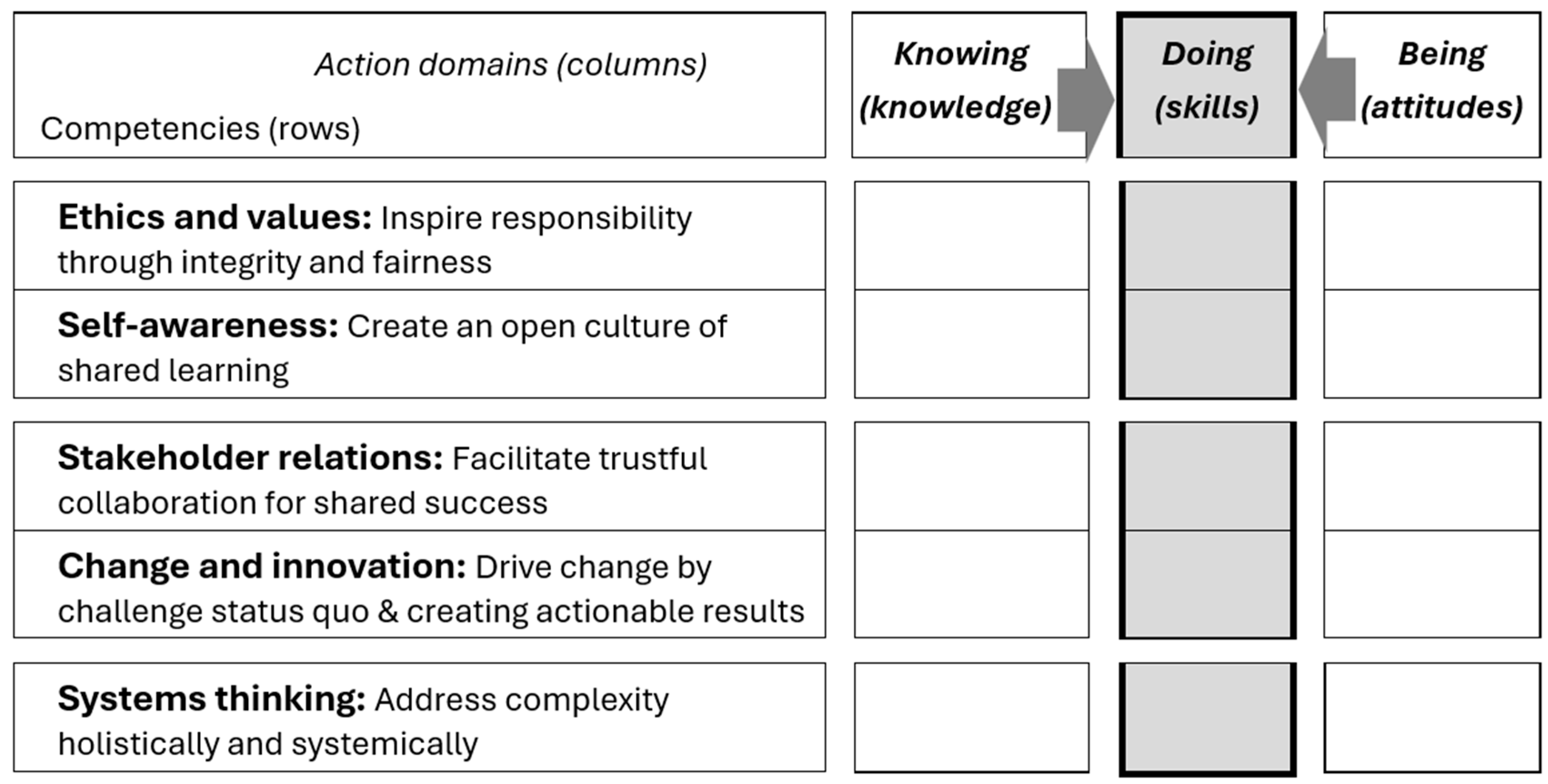
55]. Putting together the competency dimension and the action domains provides a two-dimensional framework, the “Responsible Leadership Grid”, which consists of 15 RL elements (
Figure 1).
When considering the RL competencies, we prioritize the skills or doing domain in each of the five dimensions. They represent the externally visible actions and observable behaviors that can be associated with integrating sustainability into an organization. Knowledge and attitudes also matter as they contribute to, support, and enrich the skills.
“Ethics and Values: Inspiring responsibility through integrity and fairness
Demonstrating ethical leadership involves critically questioning and adapting values while consistently acting in alignment with them. It is also about acting as a role model by making decisions that are grounded in fairness and integrity, balancing personal values with societal responsibilities. This visible commitment to a common good inspires trust and accountability by emphasizing the importance of ethical behavior in achieving sustainable outcomes.
Self-Awareness: Creating an open culture of shared learning
Exemplifying self-awareness in leadership is about the ability to adapt one’s communication style to different contexts and openly reflecting on one’s behavior. It includes the ability to share personal learnings and to visibly engage in reflective practices connected to a continuous improvement. Together, these actions create credibility and result in stronger connections with others.
Stakeholder Relations: Facilitating trustful collaboration for shared success
Fostering meaningful stakeholder relations requires actively initiating and moderating dialogue to address diverse interests while striving for consensus. By respecting varied perspectives and recognizing the value of diversity, leaders build trust and establish long-term relationships. These skills are complemented by an ability to integrate legitimate stakeholder groups and turn conflicts into opportunities for creativity while ensuring collaborative outcomes that benefit all parties.
Change and Innovation: Driving change by challenging the status quo and creating actionable results
The capacity to drive sustainable change and innovation results in meaningful solutions that effectively address societal challenges. This capacity requires the ability to question the status quo and to translate creative ideas into actionable solutions. This ability to challenge norms and to implement steps toward a sustainable transformation includes proactive and visionary approaches.
Systems Thinking: Addressing complexity holistically and systemically
Navigating complexity involves seeing the broader picture and understanding the interdependencies within systems. It leads to the ability to resolve sustainability challenges by anticipating the consequences of decisions. Systems thinking includes the recognition and appreciation of interdisciplinary collaboration. It also requires an ability to embrace ambiguity while integrating diverse perspectives” [
39].
These five broad RL competencies with their three action domains outline the leadership requirements of organizations involved in working along their value chain, both with suppliers as well as with clients, customers, and end-users. These competencies are becoming increasingly critical for organizations. The next section will map the different development areas in organizations where transformation takes place so that we can map the competencies to these transformation areas.
4. Strategic RL Impact Areas in Organizations
We typically associate impact with a societal or environmental contribution that an organization achieves. When considering leadership impact, it is important to note that leaders can influence their organization internally. Such an impact may result in the organization gaining the ability to have an external impact on society. Hence, leaders have an indirect influence on society or the environment, in or through their organization. In other words, we see an impact cascade, first from the leader to their organization, and then from the organization to society. Our focus here is on leadership impact in organizations.
Building on the strategic impact areas of Positive Impact Organization [
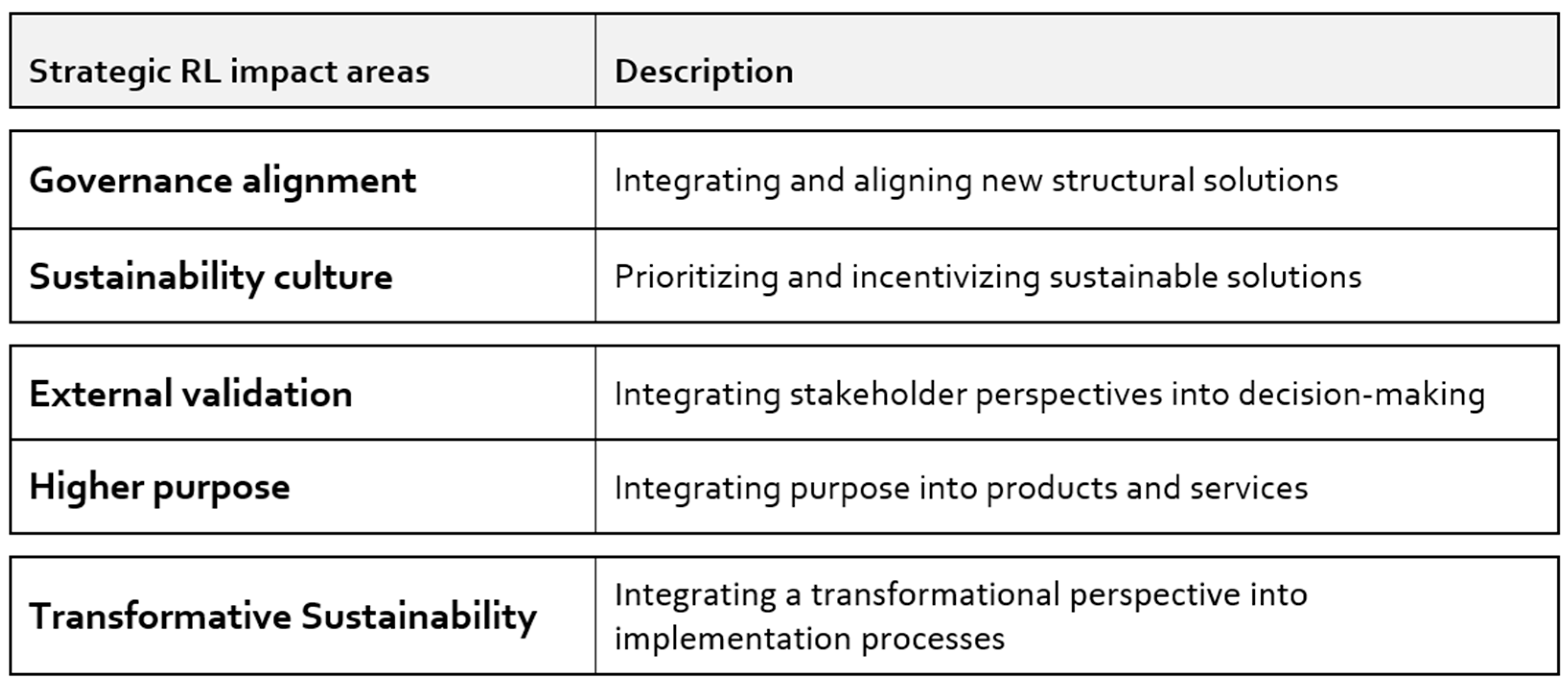
22], we distinguish the following five strategic RL impact areas in organizations:
In the following overview, we explain the impact area’s contents and then explain how they progress (
Figure 2).
Governance alignment ensures that sustainability is embedded in organizational structures and decision processes. It formalizes sustainability obligations in the rules, roles, and accountability systems that determine how decisions are made. Integration becomes visible when sustainability criteria are applied in strategic planning, capital allocation, risk management, and performance reviews, particularly when trade-offs influence decision outcomes. In such moments, defined mandates, escalation pathways, and decision rights clarify responsibilities and prevent diffusion of accountability. Transparency complements this integration: clear indicators, verifiable data, and documented rationales enable stakeholders to assess performance and learning. Independent assurance strengthens the credibility of disclosures, particularly when it includes areas of shortfall. Governance thus provides structural continuity, ensuring that sustainability persists across leadership changes and budget cycles. When integration and transparency advance together, sustainability becomes a stable basis for organizational decision-making rather than a parallel or episodic concern.
Progress in governance becomes visible as organizations expand the basis on which decisions are evaluated. Early on, governance focuses on internal compliance and reputation protection. As alignment advances, sustainability becomes part of strategic and financial decision rules, and responsibilities are distributed beyond a central team. At the most advanced stage, governance integrates external perspectives and impact criteria into accountability structures. Decisions are assessed not only by internal success but by their contribution to societal and environmental outcomes, with targets and incentives guiding all leaders toward measurable positive impact.
- 2.
Sustainability culture: Prioritizing and incentivizing sustainable solutions
A sustainability-oriented culture supports the practical implementation of sustainability objectives by guiding how priorities are interpreted, conflicts are addressed, and actions are taken across organizational boundaries. Cross-functional collaboration connects strategic intent with operational realities, ensuring that employees understand their contribution to material sustainability issues and have the mandate and resources to act accordingly. Leadership reinforces this culture by legitimizing long-term considerations in daily choices and treating sustainability as a core element of good management. Incentives and learning processes align expectations, helping sustainability endure through shifts in leadership or external pressure. Culture, therefore, functions as a stable behavioral norm: it embeds sustainability in everyday practices and strengthens organizational capacity to respond constructively to emerging challenges.
Cultural progress begins with awareness but limited responsibility for sustainability. It is often located in expert roles. Over time, expectations widen as learning and incentives encourage departments to coordinate beyond functional boundaries. A more mature culture treats sustainability as part of what defines good performance, enabling employees to address issues proactively. The most advanced cultures are externally oriented: material sustainability challenges provide the reference point for priorities and collaboration. Such organizations normalize cross-sector learning and adaptation, making sustainability the organizing logic of how work is approached rather than a separate initiative.
- 3.
External validation: Integrating stakeholder perspectives into decision-making
Authentic engagement with external stakeholders is essential for establishing the legitimacy of sustainability efforts. It reflects a shift from perceiving stakeholders as audiences to recognizing them as knowledgeable actors who experience the organization’s impact and can therefore inform better decisions. Engagement gains meaning when materially affected voices are identified and included, and when listening is designed as part of governance rather than a peripheral activity. The influence of stakeholder input must be visible in decision outcomes to avoid symbolic consultation. Transparency complements inclusion by providing reliable information on performance, trade-offs, and uncertainties, enabling stakeholders to assess progress and credibility. Together, structured engagement and transparency create a learning relationship that strengthens adaptability and places the organization as one contributor within broader societal systems, rather than the sole protagonist of sustainability.
The trajectory of stakeholder integration shifts from reactive consultation to structured co-creation. Initially, organizations respond selectively to stakeholder concerns to protect legitimacy. As engagement matures, organizations proactively include relevant stakeholders in decision preparation and assessment. The most advanced approach is built on continuous learning relationships: stakeholders help define material issues and shape the organization’s strategic contributions. Transparency evolves in parallel—moving from selective reporting to communicating how decisions address societal needs and where limits remain—grounding credibility in shared evidence rather than claims.
- 4.
Higher Purpose: Integrating purpose into products and services innovation
Organizations with a higher purpose integrate societal and environmental goals into their strategies, products, and services. Purpose drives decisions and shapes value creation by aligning organizational capabilities with clearly defined sustainability challenges. It functions not only as a guiding vision but as a measurable standard of contribution to outcomes that matter. A central element is the reframing of products and services through a broader understanding of needs and impacts, based on careful analysis of the sustainability issues at hand. This reframing guides purpose-driven product and service innovation, often co-developed with stakeholders and partners beyond traditional sector boundaries. Such a positioning shifts value creation toward positive societal and environmental contribution. Purpose thus serves both as a compass for strategic orientation and as a benchmark against which progress can be assessed.
Progress on purpose reflects increasing operational relevance. In early stages, purpose exists as an aspirational statement with limited influence on choices. As progress takes hold, purpose informs the development and positioning of products and services within existing markets. Ultimately, purpose reframes how the organization defines its business: societal needs become the reference for innovation and partnership decisions. In this advanced state, purpose sets clear priorities for resource allocation and evaluation, enabling offerings that generate positive societal and environmental contribution and may challenge or redefine existing market structures.
- 5.
Transformative Sustainability: Integrating a transformational perspective into implementation processes
A transformational perspective reinforces implementation by ensuring that sustainability progresses from incremental improvements to meaningful contributions to societal and environmental needs. Transformation is not a separate strategic area but a systemic competence that is applied across all impact domains. It enables organizations to question existing assumptions, address structural causes of unsustainability, and design change processes that influence how value is created. Central to this is the progression to higher levels of BS [
33]. It outlines the development from efficiency-driven, risk-focused improvements to broader stakeholder value creation and, ultimately, to outside-in impact orientation. This reinforces two essential shifts: from an internal to an external perspective and from risk management to impact generation. Transformation therefore ensures that sustainability efforts consistently prioritize outcomes that matter beyond the organization itself.
Progress toward transformative sustainability becomes visible as organizations redirect their focus from internal optimization to external contribution. At early stages, improvements remain tied to reducing the organization’s own negative effects and protecting its performance. Advancement involves engaging actors across the value chain and incorporating broader stakeholder expectations into change processes. Ultimately, purpose and governance are oriented toward societal issues as the reference point for priorities, innovation, and accountability. In this mature stage, impact becomes the guiding lens: performance is evaluated by the organization’s contribution to resolving material sustainability challenges, demonstrating its relevance as a proactive actor within wider systems.
In the next section, we map how a leader can impact these areas and by using what competencies.
5. Relating Impact Leader Competencies to Strategic RL Impact Areas
Analyzing the underlying success factors of PIOs has led to two underlying mindsets that drive business transformation: the leadership mindset and the organizational mindset. The leadership mindset is required to successfully achieve governance alignment and develop a sustainability culture. The organizational mindset enables activities to achieve an external validation and implement a higher purpose into products and services [
33]. The systemic mindset is a third mindset that relates to systems thinking and is required both at the individual and the organizational level. It enables addressing complex developments holistically and systemically and reaching higher levels of sustainability [
56].
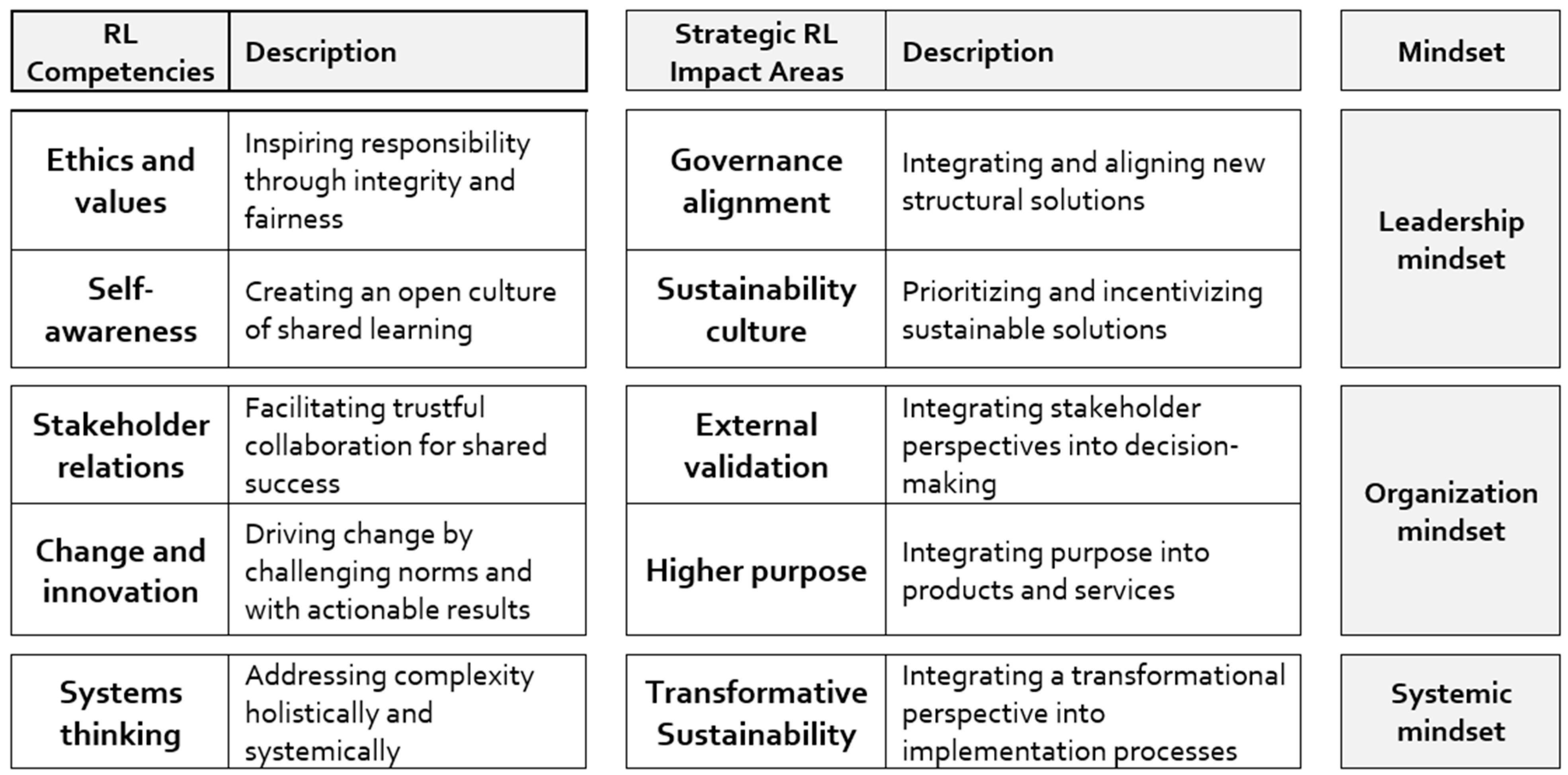
The RL competencies of an impact leader can be mapped against strategic impact areas of advanced sustainability organizations. We call these Strategic RL Impact Areas, as they are the direct impact areas of responsible leaders. Let us recall that a leader’s impact within their organization is mostly indirect, which in turn has a direct impact on society or on the environment.
The RL field has long identified a need to outline a framework that describes the impact areas of responsible leaders. Mapping RL competencies with strategic impact areas is the first attempt to provide such a framework (see
Figure 3). This is of interest—we believe—for practice as much as for theory.
- 1.
The competency “Ethics and Values” impacts “Governance Alignment”
Trust is the key currency of governance alignment. Ethics- and values-based decisions create such trust and inspire other leaders to embrace their responsibility. The ability to act with integrity and fairness drives governance alignment in organizations and creates accountable decision-making processes. When leaders act as role models, they build trust in governance structures and reinforce the organization’s commitment to sustainability. A good way to embed fairness and integrity into policies and practices is by critically questioning, broadly discussing, and potentially adapting values to align with sustainable impact goals. When new structural solutions are embedded in the organization, we may assume that the leaders have successfully impacted their organization’s governance in alignment with their personal ethics and values.
- 2.
The competency “Self-Awareness” impacts “Sustainability Culture”
A continuous learning attitude is the signpost of a sustainability culture. Nothing enables this more than self-awareness. Self-aware leaders across an organization help to create and maintain an environment of continuous learning and adaptability, which are essential aspects of sustainability culture. In fact, the ability to create an open culture of shared learning is a core competency that will impact the transformation towards a sustainability culture. Such a culture is anchored in an organization’s ability to prioritize and incentivize sustainable solutions. Responsible leaders who openly reflect on their behavior and communicate transparently inspire others to integrate purpose and meaning into their work. By engaging diverse teams, responsible leaders model the collaborative and innovative mindset essential for sustainability. This openness encourages employees to resolve conflicts constructively and engage across boundaries. Through their observable self-awareness and learning, responsible leaders empower teams to embrace change and align their economic, environmental, and social goals in everyday actions.
Both “ethics and values” and “self-awareness” are core attributes of the individual leadership mindset. This individual mindset was highlighted when interviewing advanced sustainability organizations and defining what differentiates them from traditional organizations.
At the individual level, the traditional mindset reflects a primarily internal focus: leaders see their role in terms of personal or organizational performance, guided mostly by economic priorities. Their concerns are centered on what happens within the boundaries of their organization, and relationships with others are often framed in terms of comparison and competitive success. This mindset emphasizes control, efficiency, and achievement in service of organizational goals.
The mindset shift for individuals consists of expanding identity and responsibility from “
me” to “
we.” Leaders begin to see themselves as part of a wider societal system, where their actions contribute to shared outcomes. This “we” mindset is expressed through a purpose that serves more than internal success, openness to external perspectives, and an orientation toward creating value together with others. It enables leaders to act from a broader sense of responsibility for society and the planet [
22].
- 3.
The competency “Stakeholder Relations” impacts “External Validation”
Nothing speaks louder than an endorsement of an external stakeholder. When a stakeholder defends and explains an organization’s choices, they have been listened to and consider themselves a part of the organization’s decision-making process. Stakeholder relations are central to achieving an external validation of a company’s sustainability vision. The ability to facilitate trustful collaboration for shared success is a core competency that will ensure this. This is achieved by responsible leaders at all levels of the organization, who know how to reach outside of organizational boundaries to connect to relevant current and new stakeholders. Such leaders can initiate dialogue and moderate diverse perspectives which result in trustful collaboration and meaningful external engagement. Integrating legitimate stakeholders into co-creation processes and respecting diverse interests contributes to building long-term relationships rooted in trust. This collaborative approach transforms stakeholder engagement into an ongoing, transparent process that bridges external insights with innovation. The ideal result is broader triple-bottom-line reporting, sharing not just outcomes but also dilemmas. Such reporting highlights how the input of stakeholders affect decisions and report back on these externally. Effective stakeholder relations include the ability to address conflicts constructively by emphasizing a shared higher vision. Such skills help ensure that the organization’s role as a highly regarded societal stakeholder is increasingly credible and supported.
- 4.
The competency “Change and Innovation” impacts “Higher Purpose”
Purpose-driven innovation is the hallmark of sustainable business. A skilled approach to change and innovation enables an organization to translate a higher purpose into transformative solutions that address societal challenges. The competency to drive change is a given. What is insightful is the explicit need for a capacity to challenge existing norms so that innovation builds on listening with new ears. Responsible leaders involved in innovation processes are skilled at translating creative ideas into actionable steps. Such skills are critical to focus the organization’s innovation process on integrating its purpose into its products and services. A higher purpose that aligns business strategies with environmental and social goals needs to become tangible and visible in the organization’s products and services. These actions help reframe the company’s understanding of its current markets and lead to the co-creation of new markets and offerings.
The competencies “stakeholder relations” and “change and innovation” represent the essence of the organizational mindset discovered during the process of researching organizations’ positive impacts.
At the organizational level, a sustainability mindset is defined by a clear sense of purpose rooted in creating value for society. The organization sees itself as part of a wider societal system—one stakeholder among many. It directs strategy, governance, culture, and innovation toward addressing external needs. Rather than interpreting sustainability as an internal risk to be managed, the organization adopts an outside-in perspective that positions societal challenges as opportunities for better products, services, and business models. Collaboration replaces competition as the basis for strategic advancement and long-term success.
The organizational mindset shift replaces competitive logic with a
collaborative and
co-creative orientation. The business understands itself as one actor among many in a broader societal system and recognizes that major challenges cannot be solved alone. Working with diverse stakeholders becomes a strategic necessity for innovation and positive impact. This outside-in orientation strengthens the organization’s ability to create value for society and the planet through its products, services, and partnerships—the defining characteristic of a PIO [
57].
- 5.
The competency “Systems Thinking” impacts “Transformative Sustainability”
Understanding the complexity of transformations to avoid unintended consequences is a highly demanding quality of sustainability organizations and their leaders. Systems thinking is essential for a company’s transformation toward true sustainability and positive impact. The ability to address complexity holistically and systemically is a core competency for both an organization and its leaders. Leaders skilled in systems thinking can guide their organization to navigate complex challenges and thereby address obvious or hidden interdependencies. As transformation advances into the co-creative space of multi-stakeholder collaboration, these leaders help create true partnerships by shifting from antagonistic to participatory perspectives. This is the foundation of co-created solutions that integrate diverse viewpoints and address systemic challenges effectively. A visible outcome is the integration of a transformative perspective in implementation processes. The transformative sustainability as a mindset becomes increasingly vital as the organization transitions from a risk-based approach to a positive impact orientation. By promoting inclusion and focusing on systemic solutions, they enable the organization to transform internally while amplifying its ability to create meaningful societal impact.
The systemic mindset reflects an understanding that organizations are embedded in wider social and ecological systems and that their success depends on these systems’ long-term health. It connects the micro level of internal decisions with the macro level of societal needs and planetary boundaries. Rather than optimizing isolated activities, a systemic mindset focuses leadership attention on interdependencies, shared challenges, and the broader consequences of organizational action. It enables organizations to uncover structural causes of unsustainability and to frame value creation as a contribution to the resilience and prosperity of the larger system. In this view, sustainability becomes an integral part of strategy, and impact becomes the reference point for organizational relevance.
The shift toward a systemic mindset is fundamental to the transition from managing sustainability risks to creating a measurable positive impact. It marks a progression from inside-out thinking toward an outside-in perspective where societal challenges define strategic priorities. This shift demands a reorientation from isolated improvements within the organization to collaborative action with diverse stakeholders to address system-level issues no single actor can solve alone. As this mindset takes hold, purpose, governance, innovation, and accountability align with system outcomes, enabling the move from a traditional to a positive impact organization. The organization thus evolves into a proactive societal actor, designing its success through its contribution to addressing the world’s most material sustainability challenges.
Discussion
What is the value of this impact map that suggests that one RL competency matches one distinct strategic business impact area? Can it really be so simple that a RL competency perfectly matches just one impact area? It is important to state that the proposed one-to-one mapping of competencies to impact areas is a simplified view of a leader’s effectiveness. There are, without a doubt, numerous other inter-relationships and overlaps between the various competencies and impact areas that go beyond the simplified model described above. This is more relevant to some competencies. In particular, the competency “Systems Thinking” affects other strategic areas, as its different, higher-level perspective has something to offer to impact areas such as “Governance Alignment” or “Higher Purpose”. In parallel, the competency “Self-Awareness” is not just essential for the impact area “Sustainability Culture” but—depending on the leader’s role in the organization—also may contribute to “Governance Alignment” In our impact map, we consider these secondary or tertiary impacts and, as a result, do not feature them. Our impact map is possibly best considered as a heat map, not a complete and detailed overview of all interconnections and overlaps.
Furthermore, there may well be contextual factors that are likely to moderate or hinder the application of this proposed impact map. We anticipate that such factors will be both internal and external. Internal factors relate to a leader’s personal journey and consist of any personal issues that impact their professional life, both at work and, of course, in their private life. External factors may include, for example, a prevailing organizational culture, a geographical context, a specific industry sector, and emerging new geopolitical issues which may well influence a leader’s ability to deploy their competencies and, hence, to develop their impact. Such barriers to implementation will need to be empirically observed and assessed.
It is important to point out that the developed impact map is at this point a purely conceptual proposal that will need to be validated empirically. In the next section, we propose a research agenda addressing both the limitations and the opportunities this new model provides.
6. Conclusions, Recommendations, Implications, and Limitations
6.1. Conclusions
In this article, we map the leadership competencies that are required for an organization to successfully navigate the new demands from a changing business, sustainability, and geopolitical landscape. These competencies highlight the need to consider the external collaboration with stakeholders up and down the value chain as something as important as the collaboration inside an organization. Competencies, skills, and even mindsets can and must be developed [
58,
59]. Current business education, however, still mostly focuses on skills development within traditional business boundaries, often in functional silos. Extending the definition of traditional leadership competencies to include the need to effectively collaborate outside traditional business boundaries is an essential aspect of upgrading skills to be ready for facing the future.
This expanded context has been an important foundation of how the theory of RL has been developing over the last two decades. To achieve the massive business transformations induced by the new environmental and societal challenges, we need leaders who are capable of not just transforming their business, but also collaborating to transform the ecosystem in which their business operates.
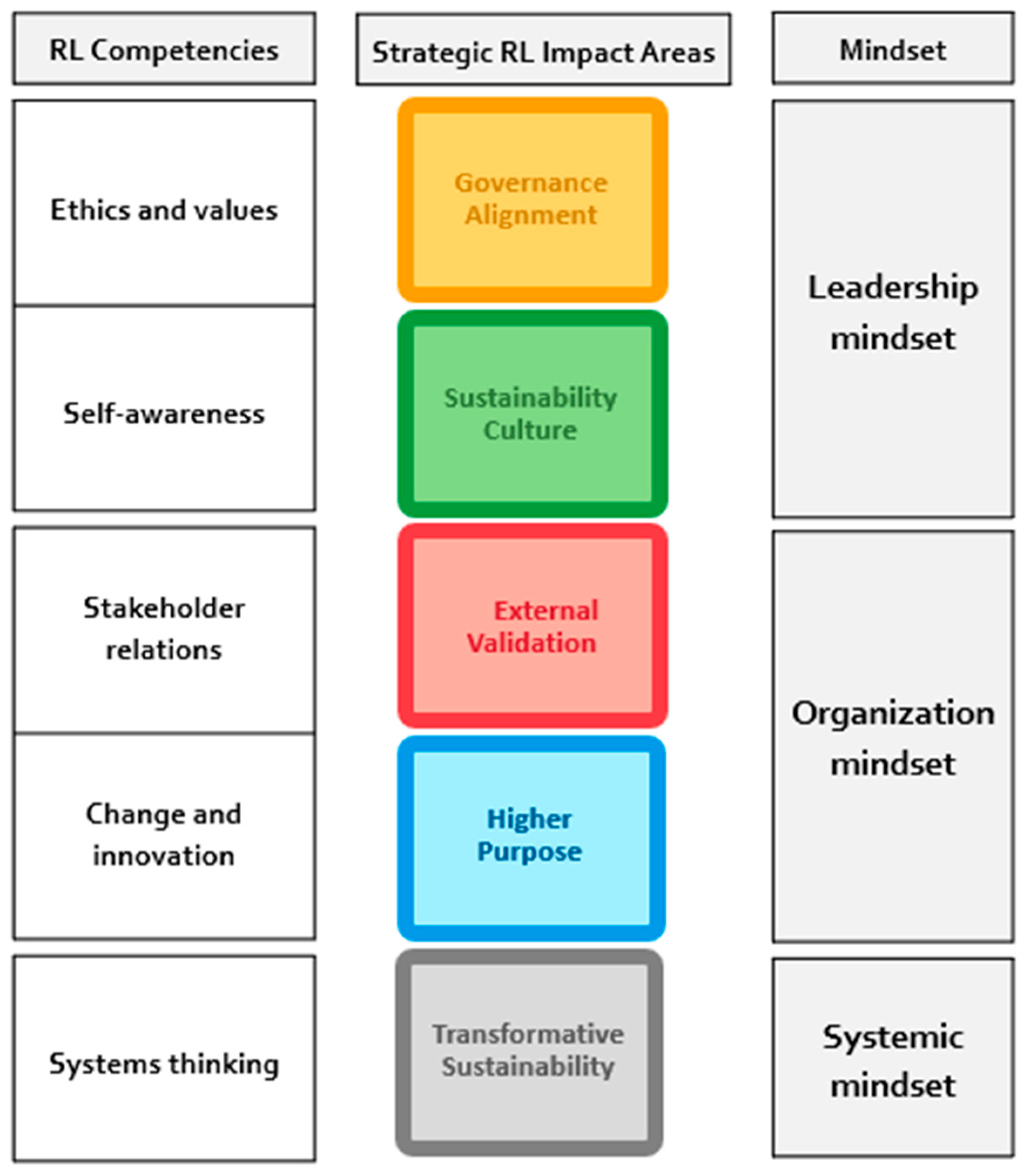
Connecting these leadership skills with strategic business areas of highly effective positive impact organizations provides a map that allows us to understand the concrete impact of leaders with these expanded competencies. RL researchers, leaders, and educators have struggled to understand how to map the impact of responsible leadership. The map developed in this article offers an attempt to frame the impact by mapping leadership competencies with strategic fields of change. The map consists of the key competency areas established in the Competency Assessment of Responsible Leaders (the RL competencies) on one hand, and the strategic impact areas of PIO (Strategic RL Impact Areas) and their related mindsets on the other hand (
Figure 4).
6.2. Recommendations
Educators and leadership development specialists may benefit from these insights when designing learning journeys for students or managers. The RL competencies provide an overview of the status quo of a leader and can be used when clarifying the impact focus of a student or leader. A strength-based approach suggests that leaders have their biggest impact in the area that connects with their strongest competency. A developmental approach will help leaders who need a competency they may not be fluent or effective in to pro-actively search for and identify sources for support.
The resulting learning opportunities can be addressed with relevant developmental tools as deemed appropriate by the learning designer. To offer a basis for reflection, below, we have provided a range of suggestions for leadership development in the five RL competency dimensions (
Table 1). The recommendations focus primarily on the development of skills, which are directly reflected in the action of a leader, while also covering the aspect of knowledge and attitudes.
6.3. Implications
This article can be applied to all organizations that are on a journey of integrating sustainability into their structure. It is not limited to one type of business or another. Moreover, this is an article that is written for individuals who are seeking to identify where to best apply their strength in order to create a positive impact. As we have pointed out, in our article, we investigate how such an impact is achieved via organizational engagement. An individual engages in an organization and, via their positive impact, they enable the organization to in turn increase and scale its positive impact for society, the planet, and the economy.
6.4. Limitations
We realize that our contribution has its limitations. For example, the article builds on our belief that an individual person or leader can make a difference in an organization. This may not be simple or easy. Also, the choice of tools must be considered as a limitation. We know these tools and the frame of thinking behind these tools very well, as we have actively contributed to their development. While this deep knowledge allows us to ensure that the underlying logics of the used concepts match, we have most certainly overlooked other models or insights that could also have been used. We hope that the gain outweighs the limitations. A further limitation is the choice to connect each of the identified RL competencies with its most directly connected strategic business area. This is something that will need to be verified in the empirical validation.
6.5. Validation Suggestions
This work opens the door to a potential new research agenda. Given that the proposed model is purely conceptual, the empirical validation has a multitude of avenues that can be pursued. For one, the one-to-one mapping of a competency to an impact area may need to be reviewed and adapted. Also, as pointed out above, it is important to isolate internal and external factors from mapping these competencies to impact areas. This can be achieved in a series of case studies focusing on a group of leaders at a comparable stage of their development, or a group of leaders in the same industry or the same geographic location. It may also be opportune to conduct comparative studies, whereby leaders in different types of organizational settings are assessed for their impact to better understand the cultural influence of an organization. Finally, a longitudinal study of leaders in comparable situations would be another avenue in this potential research roadmap. Ultimately, a combination of these elements can be used as a roadmap for the empirical validation of the impact map.
We wish to conclude with a sense of hope and optimism. In a world where sustainable development is experiencing increasing competition from other global and business concerns, we want to encourage and enable those managers and leaders that choose to continue contributing to addressing sustainability and societal challenges. We are convinced that these challenges will not disappear, as the underlying problems have not been solved. Also, we have always had to balance different societal challenges and demands, and it is no surprise that this is still the case. We contribute by offering an impact map and suggestions of how to make their impacts effective. Maybe more importantly, we hope that this contribution will be of service to business educators, RL researchers, and leadership development specialists as they expand and further develop their educational and training approaches. We hope the map and related suggestions will serve as useful tools in the actual territory of the uncertain era that lies ahead of us.