Living Lab Assessment Method (LLAM): Towards a Methodology for Context-Sensitive Impact and Value Assessment †

 , , , and
Abstract
1. Introduction
2. Methodology
2.1. Co-Creation and Co-Design with Lead Users
2.2. Multiple Case Study Research
2.3. Participatory Action Research
3. Results
3.1. Use Cases and Iterative Development of the LLAM
- Use Case 1: Collections of Ghent (2020–2023)
- Context
- LLAM operationalisation
- Key-insights/findings and adaptations for the LLAM
- The first version of the LLAM was developed and tested in the specific context of the CoGhent project.
- The combination of participatory methods and a Theory of Change proved to be a balanced and context-sensitive evaluation approach.
- Early and continuous involvement of local stakeholders was essential to ground the framework, increase its relevance, and strengthen its legitimacy.
- Stakeholders played a central role in identifying meaningful indicators and shaping both the impact/value framework and the evaluation process.
- The project confirmed the practical usefulness of structured causal reasoning (Theory of Change) as a core methodological principle for the LLAM.
- A phased and participatory assessment approach enabled iterative refinement of the evaluation model.
- Qualitative methods were necessary to capture neighborhood-level changes in interaction, social cohesion, and the use and appreciation of cultural heritage.
- Co-development increased shared ownership and improved the quality and usability of the evaluation.
- The work showed that a context-specific framework can remain adaptable and scalable, forming a foundation for later iterations of the LLAM.
- Use Case 2: Comon—Cycle One (Making Healthcare More Understandable, 2020–2022)
- Context
- LLAM Operationalization
- Key-insights/findings and adaptations for the LLAM
- Through 20 in-depth interviews across all four helices, the Comon project introduced a stakeholder-centered assessment method grounded in participants’ motivations and perceived value.
- The Comon project provided the empirical basis for identifying seven overarching value dimensions of an Urban Living Lab.
- The project established a shared vocabulary of value dimensions, including entrepreneurial capacity, connective capacity, knowledge capacity, instrumental capacity, agenda setting, hedonism, and altruism.
- These seven categories were incorporated into the LLAM as a deductive framework for assessing broad, diverse, and holistic forms of impact and value creation in LLs.
- By synthesizing 10 initial dimensions into seven structured categories, the Comon project delivered a clear, evidence-based lens for interpreting both tangible and intangible outcomes.
- This integration helped bridge practice-based insights with emerging theoretical perspectives on value creation in ULLs.
- Use Case 3: City of Ghent—Living Lab Community of Practice (2021–2023)
- Context
- LLAM Operationalization
- Focus Group 1
- Focus Group 2
- Key-insights/learning and adaptations for the LLAM
- The framework received its formal name: Living Lab Assessment Method (LLAM).
- Iterative refinement through repeated application within the Community of Practice strengthened both robustness and usability.Peer-based co-validation improved conceptual clarity and ensured contextual relevance across diverse Living Lab settings.
- Theoretical impact concepts were aligned with practitioners’ experiential knowledge, resulting in more appropriate and realistic value dimensions.
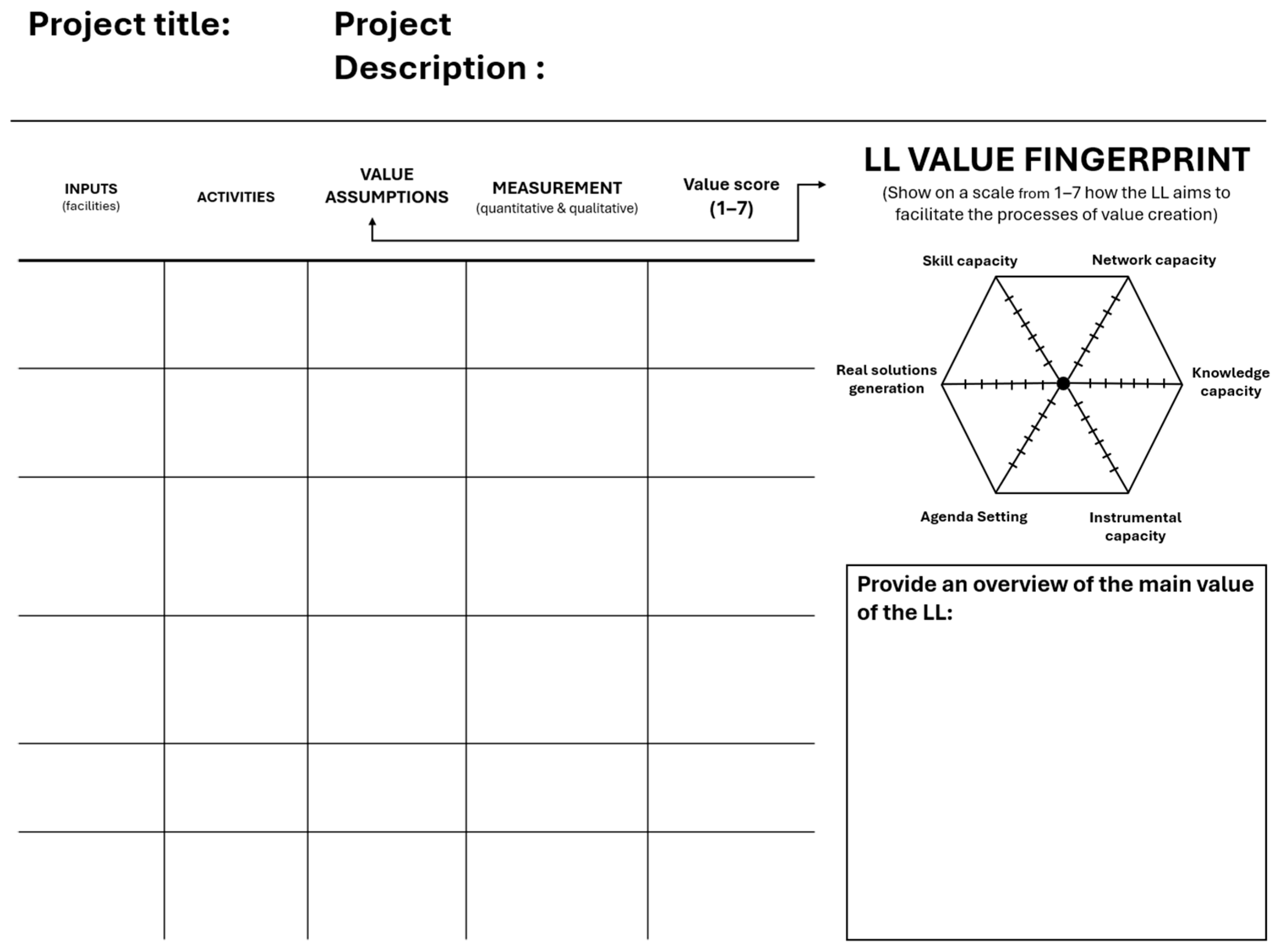
- The Living Lab Value Fingerprint was developed as a practical tool to visualise the value a project intends to generate or has achieved, while a complementary step-by-step application guide was created to support operational use and improve applicability of the LLAM.
- Cross-project learning was reinforced, creating a shared evaluative language and increasing practitioner ownership of the method.
- Use Case 4: Ghent Labour Pact—Six Experimental Living Lab Projects (2023–2024)
- Context
- LLAM Operationalization
- Project-Level operationalisation
- Cross-Project Operationalisation
- Key insights/findings and adaptations for the LLAM
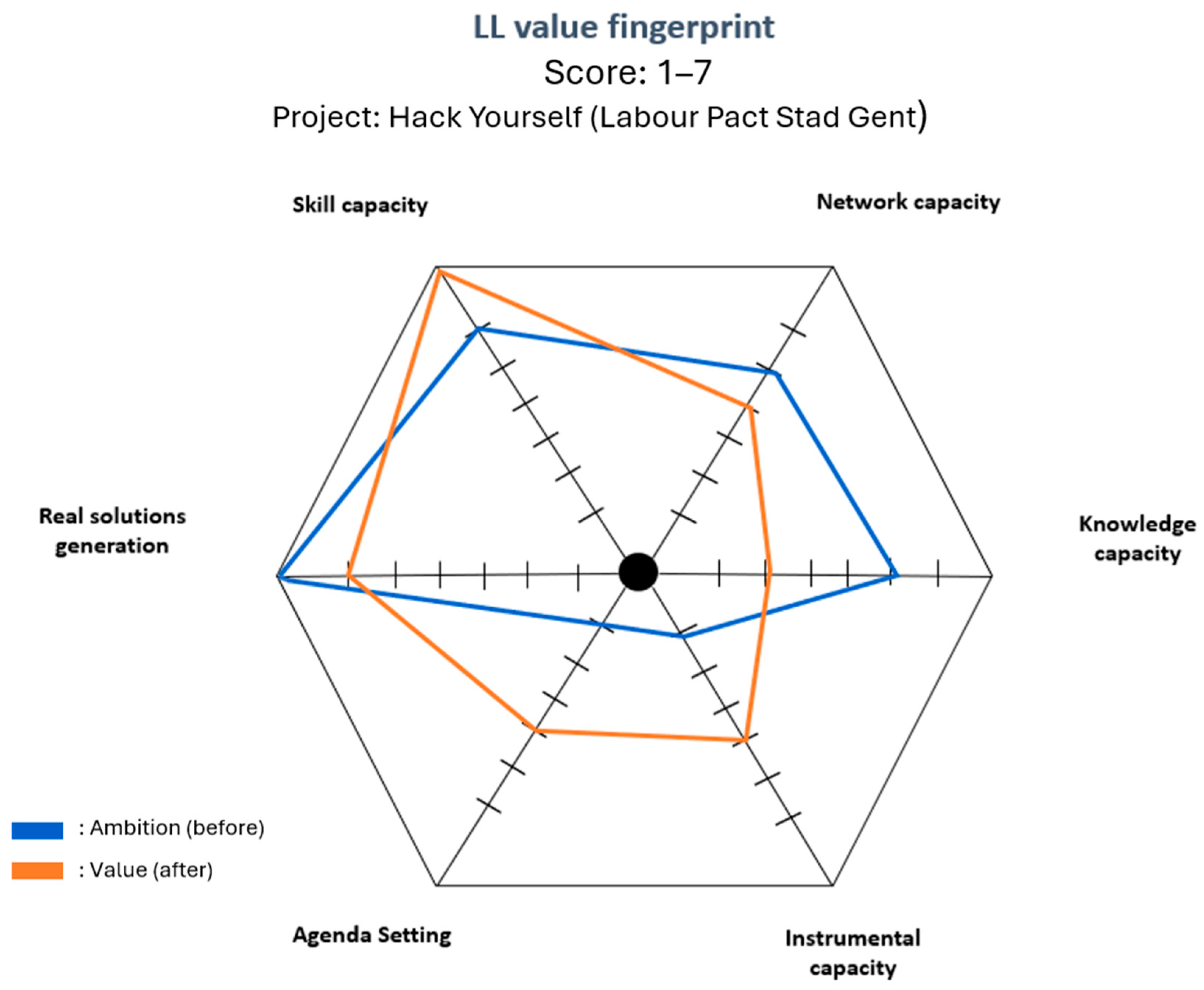
- The LLAM showed that it can be used not only for evaluation, but also for reflection and learning. It helped teams clarify their assumptions, strengthen their Theory of Change, and adjust activities to improve value creation.
- The method captured a broad range of value, including knowledge development, stronger networks, better collaboration, and learning effects, even when projects did not reach full implementation.
- The LLAM provided a shared language and structure that made it easier to compare projects and to discuss types of value that are not covered by traditional metrics.
- The pilot confirmed that the LLAM can be applied in a new policy domain (employment and social inclusion), demonstrating its flexibility across different innovation contexts.
- Cross-project comparison supported strategic learning by showing where value accumulated across initiatives and where extra support or coordination was needed.
- The exercise encouraged deeper reflection on the role of local government in the innovation ecosystem, encouraging the City of Ghent to reconsider how it enables, supports, and evaluates experimental projects.
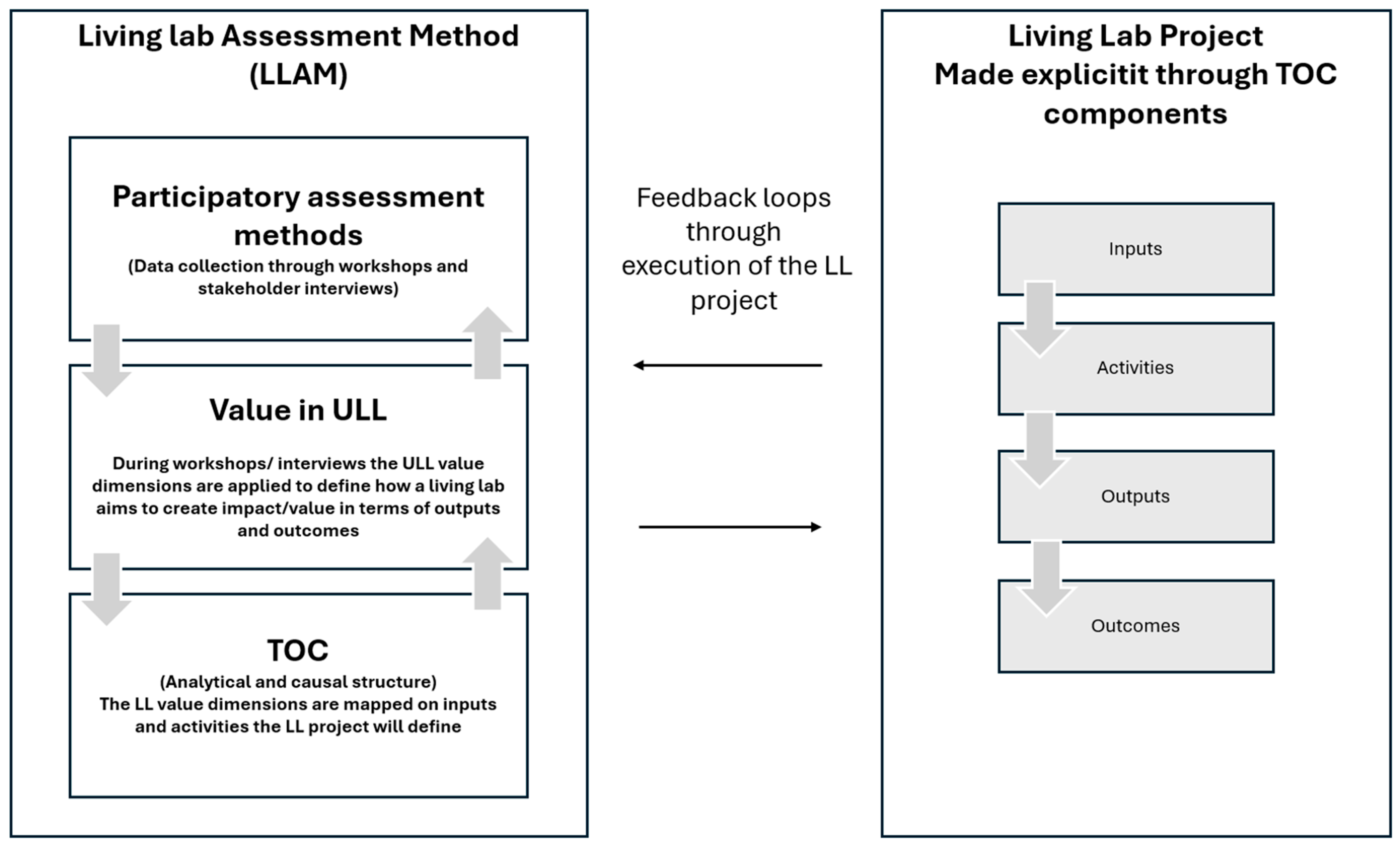
3.2. The LLAM and Its Components
3.2.1. Theoretical Foundations of the LLAM and Their Synergy
3.2.2. Application Purposes of the LLAM
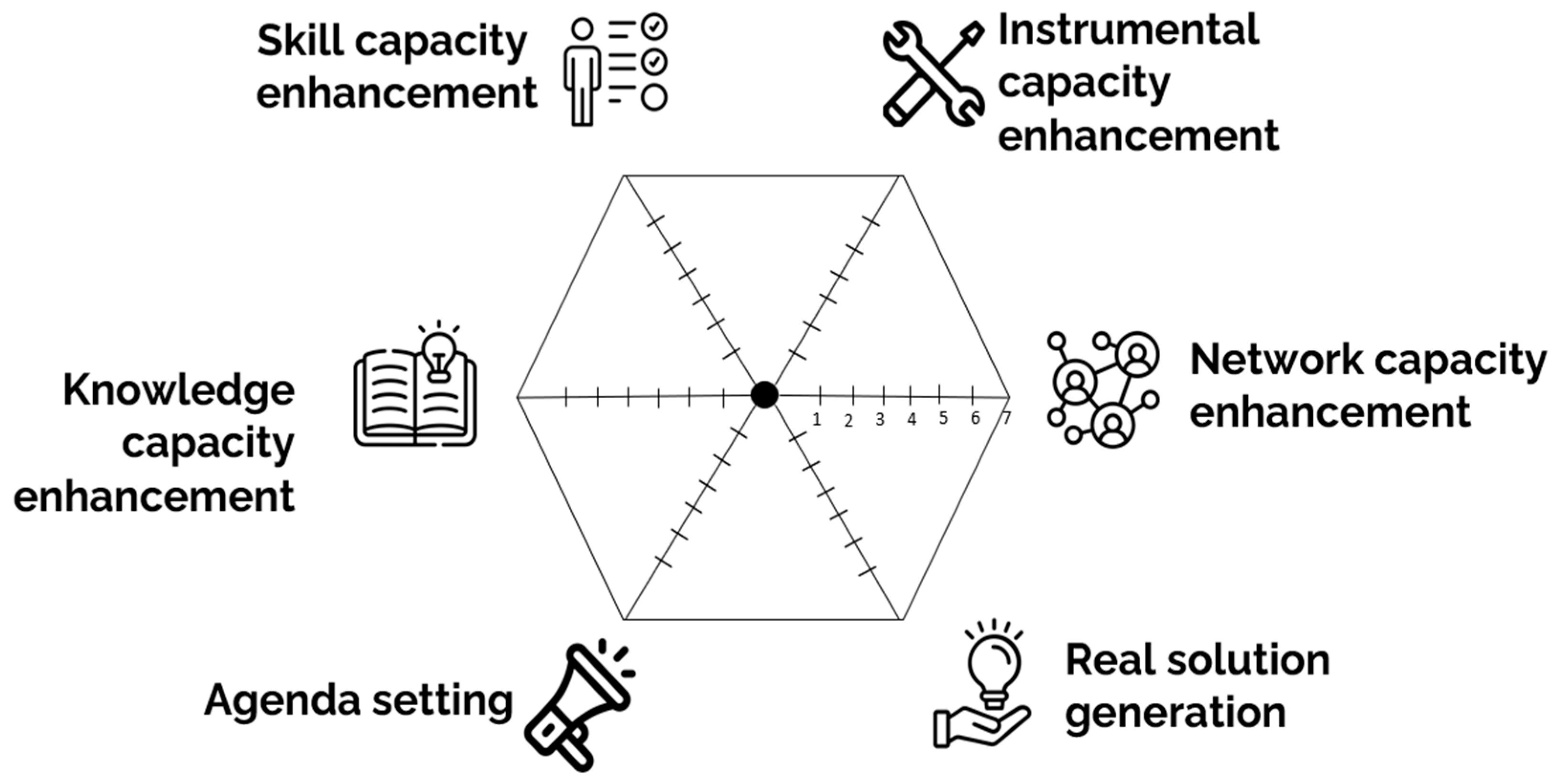
3.2.3. LLAM Impact/Value Dimensions
- Skill capacity development
- Example of measurement
- Network capacity improvement
- Example of measurement
- Knowledge capacity enhancement
- Example of measurement
- Instrumental capacity
- Example of measurement
- Societal agenda-setting
- Example of measurement
- Real solutions generation
- Example of measurement
3.2.4. LLAM Tools and Operationalisation
- Operational Phases of LLAM Application
- A. Initial Phase, before the LL project: Design, Alignment, and Baseline
- Develop a shared and testable Theory of Change.
- Align stakeholder expectations across the six value dimensions.
- Define governance, decision-making, and data stewardship practices.
- Establish a baseline for later comparison.
- B. Mid-Project Phase: Reflective Monitoring and Steering
- Assess progress relative to plans and the baseline.
- Evaluate emerging value creation.
- Revalidate the Theory of Change.
- Identify risks, bottlenecks, and contextual changes.
- Adjust goals, activities, or processes where needed.
- Strengthen alignment among stakeholders.
- C. Post-Project Phase: Assessment, Comparison, and Learning
- Consolidate and interpret all available evidence.
- Compare intended, evolving, and realised value creation.
- Identify success mechanisms, limitations, and failure points.
- Distinguish project-specific insights from system-level lessons.
- Produce communicable outputs for governance, funding, and dissemination.
4. Discussion
5. Conclusions
Supplementary Materials
Author Contributions
Funding
Institutional Review Board Statement
Informed Consent Statement
Data Availability Statement
Conflicts of Interest
References
- Chesbrough, H.; Vanhaverbeke, W.; West, J.; Chesbrough, H.; Vanhaverbeke, W.; West, J. (Eds.) New Frontiers in Open Innovation; Oxford University Press: Oxford, UK; New York, NY, USA, 2014; ISBN 978-0-19-968246-1. [Google Scholar]
- Angrisani, M.; Dell’Anno, D.; Hockaday, T. From Ecosystem to Community. Combining Entrepreneurship and University Engagement in an Open Innovation Perspective. Int. J. Technol. Manag. 2022, 88, 71. [Google Scholar] [CrossRef] [Scilit]
- Ahn, J.M.; Roijakkers, N.; Fini, R.; Mortara, L. Leveraging Open Innovation to Improve Society: Past Achievements and Future Trajectories. RD Manag. 2019, 49, 267–278. [Google Scholar] [CrossRef] [Scilit]
- Bigliardi, B.; Ferraro, G.; Filippelli, S.; Galati, F. The Past, Present and Future of Open Innovation. Eur. J. Innov. Manag. 2020, 24, 1130–1161. [Google Scholar] [CrossRef] [Scilit]
- Anderies, J.M.; Barfuss, W.; Donges, J.F.; Fetzer, I.; Heitzig, J.; Rockström, J. A Modeling Framework for World-Earth System Resilience: Exploring Social Inequality and Earth System Tipping Points. Environ. Res. Lett. 2023, 18, 095001. [Google Scholar] [CrossRef] [Scilit]
- Schuurman, D. Bridging the Gap between Open and User Innovation?: Exploring the Value of Living Labs as a Means to Structure User Contribution and Manage Distributed Innovation. Ph.D. Thesis, Ghent University, Gent, Belgium, 2015. [Google Scholar]
- Huang, J.; Iakovleva, T.; Bessant, J. FOSTERING USER INVOLVEMENT IN COLLABORATIVE INNOVATION SPACES: INSIGHTS FROM LIVING LABS. Int. J. Innov. Manag. 2024, 28, 2450032. [Google Scholar] [CrossRef] [Scilit]
- Akasaka, F.; Mitake, Y.; Watanabe, K.; Tsetsui, Y.; Shimomura, Y. Development of a Self-Assessment Tool for the Effective Management of Living Labs. J. Eng. Technol. Manag. 2023, 70, 101783. [Google Scholar] [CrossRef] [Scilit]
- McPhee, C.; Bancerz, M.; Mambrini-Doudet, M.; Chrétien, F.; Huyghe, C.; Gracia-Garza, J. The Defining Characteristics of Agroecosystem Living Labs. Sustainability 2021, 13, 1718. [Google Scholar] [CrossRef] [Scilit]
- Evans, J.; Jones, R.; Karvonen, A.; Millard, L.; Wendler, J. Living Labs and Co-Production: University Campuses as Platforms for Sustainability Science. Curr. Opin. Environ. Sustain. 2015, 16, 1–6. [Google Scholar] [CrossRef] [Scilit]
- Stuckrath, C.; Rosales-Carreón, J.; Worrell, E. Conceptualisation of Campus Living Labs for the Sustainability Transition: An Integrative Literature Review. Environ. Dev. 2025, 54, 101143. [Google Scholar] [CrossRef] [Scilit]
- Følstad, A. Living labs for innovation and development of information and communication technology: A literature review. Electron. J. Virtual Organ. Netw. 2008, 10, 99. [Google Scholar]
- Molinari, M.; Anund Vogel, J.; Rolando, D.; Lundqvist, P. Using Living Labs to Tackle Innovation Bottlenecks: The KTH Live-In Lab Case Study. Appl. Energy 2023, 338, 120877. [Google Scholar] [CrossRef] [Scilit]
- Coyne, R. Wicked Problems Revisited. Des. Stud. 2005, 26, 5–17. [Google Scholar] [CrossRef] [Scilit]
- Brons, A.; van der Gaast, K.; Awuh, H.; Jansma, J.E.; Segreto, C.; Wertheim-Heck, S. A Tale of Two Labs: Rethinking Urban Living Labs for Advancing Citizen Engagement in Food System Transformations. Cities 2022, 123, 103552. [Google Scholar] [CrossRef] [Scilit]
- Rizzo, A.; Ståhlbröst, A.; Habibipour, A. Transformative Thinking and Urban Living Labs in Planning Practice: A Critical Review and Ongoing Case Studies in Europe. Eur. Plan. Stud. 2021, 29, 1739–1757. [Google Scholar] [CrossRef] [Scilit]
- Scholl, C.; de Kraker, J.; Dijk, M. Enhancing the Contribution of Urban Living Labs to Sustainability Transformations: Towards a Meta-Lab Approach. Urban Transform. 2022, 4, 7. [Google Scholar] [CrossRef] [Scilit]
- Living Lab Origins, Developments, and Future Perspectives—Knowledge Hub—ENoLL. Available online: https://knowledgehub.enoll.org/publication/living-lab-origins-developments-and-future-perspectives (accessed on 15 December 2025).
- Steen, K.; van Bueren, E. The Defining Characteristics of Urban Living Labs. Technol. Innov. Manag. Rev. 2017, 7, 21–33. [Google Scholar] [CrossRef]
- von Wirth, T.; Fuenfschilling, L.; Frantzeskaki, N.; Coenen, L. Impacts of Urban Living Labs on Sustainability Transitions: Mechanisms and Strategies for Systemic Change through Experimentation. Eur. Plan. Stud. 2018, 27, 229–257. [Google Scholar] [CrossRef] [Scilit]
- Leminen, S.; Westerlund, M.; Nyström, A.-G. Living Labs as Open-Innovation Networks. Innov. Netw. 2012, 2, 6–11. [Google Scholar] [CrossRef]
- Veeckman, C.; Temmerman, L. Urban Living Labs and Citizen Science: From Innovation and Science towards Policy Impacts. Sustainability 2021, 13, 526. [Google Scholar] [CrossRef] [Scilit]
- Voytenko, Y.; McCormick, K.; Evans, J.; Schliwa, G. Urban Living Labs for Sustainability and Low Carbon Cities in Europe: Towards a Research Agenda. J. Clean. Prod. 2016, 123, 45–54. [Google Scholar] [CrossRef] [Scilit]
- Cohen, W.; Levinthal, D. Absorptive Capacity: A New Perspective on Learning and Innovation. Adm. Sci. Q. 1990, 35, 128–152. [Google Scholar] [CrossRef] [Scilit]
- Sanders, E.; Stappers, P.J. Co-Creation and the New Landscapes of Design. CoDesign 2008, 4, 5–18. [Google Scholar] [CrossRef] [Scilit]
- Fenger, M.; Bekkers, V. Creating Connective Capacities in Public Governance: Challenges and Contributions. In Beyond Fragmentation and Interconnectivity; IOS Press: Amsterdam, The Netherlands, 2012; pp. 3–16. [Google Scholar]
- Ansell, C.; Torfing, J. (Eds.) Public Innovation Through Collaboration and Design; Routledge: London, UK, 2014; ISBN 978-0-203-79595-8. [Google Scholar]
- Hossain, M.; Leminen, S.; Westerlund, M. A Systematic Review of Living Lab Literature. J. Clean. Prod. 2019, 213, 976–988. [Google Scholar] [CrossRef] [Scilit]
- Gascó, M. Living Labs: Implementing Open Innovation in the Public Sector. Gov. Inf. Q. 2017, 34, 90–98. [Google Scholar] [CrossRef] [Scilit]
- Ersoy, A.; Bueren, E. van Challenges of Urban Living Labs towards the Future of Local Innovation. Urban Plan. 2020, 5, 89–100. [Google Scholar] [CrossRef] [Scilit]
- Ballon, P.; Van Hoed, M.; Schuurman, D. The Effectiveness of Involving Users in Digital Innovation: Measuring the Impact of Living Labs. Telemat. Inform. 2018, 35, 1201–1214. [Google Scholar] [CrossRef] [Scilit]
- Paskaleva, K.; Cooper, I. Are Living Labs Effective? Exploring the Evidence. Technovation 2021, 106, 102311. [Google Scholar] [CrossRef] [Scilit]
- Aniche, L.Q.; Edelenbos, J.; Gianoli, A.; Enseñado, E.M.; Makousiari, E.; DeLosRíos-White, M.I.; Caruso, R.; Zalokar, S. Boosting Co-Creation of Nature-based Solutions within Living Labs: Interrelating Enablers Using Interpretive Structural Modelling. Environ. Sci. Policy 2024, 161, 103873. [Google Scholar] [CrossRef] [Scilit]
- Willems, O.; Schuurman, D. Internet of Water Flanders: Case Study on Living Lab Impact. In Proceedings of the ISPIM Innovation Symposium, Tallinn, Estonia, 9–12 June 2024; The International Society for Professional Innovation Management (ISPIM): Manchester, UK, 2024; pp. 1–11. [Google Scholar]
- Robaeyst, B.; Baccarne, B. Living Lab Assessment Method (LLAM): Towards a Methodology for Context-Sensitive Value Assessments. In Proceedings of the XXXV ISPIM Innovation Conference, Tallinn, Estonia, 9–12 June 2024. [Google Scholar]
- Carayannis, E.G.; Grigoroudis, E.; Campbell, D.F.J.; Meissner, D.; Stamati, D. The Ecosystem as Helix: An Exploratory Theory-Building Study of Regional Co-Opetitive Entrepreneurial Ecosystems as Quadruple/Quintuple Helix Innovation Models. RD Manag. 2018, 48, 148–162. [Google Scholar] [CrossRef] [Scilit]
- Von Hippel, E. Lead Users: A Source of Novel Product Concepts. Manag. Sci. 1986, 32, 791–805. [Google Scholar] [CrossRef] [Scilit]
- Hollweck, T. Robert K. Yin. (2014). Case Study Research Design and Methods (5th ed.). Thousand Oaks, CA: Sage. 282 Pages. Can. J. Program Eval. 2016, 30, 1–5. [Google Scholar] [CrossRef] [Scilit]
- Eisenhardt, K.M. Building Theories from Case Study Research. Acad. Manag. Rev. 1989, 14, 532–550. [Google Scholar] [CrossRef] [Scilit]
- Reason, P.; Bradbury, H. (Eds.) Handbook of Action Research: Participative Inquiry and Practice; SAGE: Thousand Oaks, CA, USA, 2001; ISBN 978-0-7619-6645-6. [Google Scholar]
- Reason, P.; Bradbury, H. Handbook of Action Research: Concise Paperback Edition; SAGE: Thousand Oaks, CA, USA, 2006; ISBN 978-1-4129-2030-8. [Google Scholar]
- Reason, P.; Bradbury, H. (Eds.) The SAGE Handbook of Action Research: Participative Inquiry and Practice, 2nd ed.; SAGE: London, UK, 2013; ISBN 978-1-4129-2029-2. [Google Scholar]
- Schon, D. The Reflective Practitioner: How Professionals Think in Action. J. Contin. High. Educ. 2011, 34, 29–30. [Google Scholar] [CrossRef] [Scilit]
- Robaeyst, B.; Van Hansewyck, N.; Baccarne, B.; Schuurman, D. A Qualitative Analysis of the Value Creation of Urban Living Labs. Int. J. Innov. Mgt. 2023, 27, 2340007. [Google Scholar] [CrossRef] [Scilit]
- Maguire, P. Doing Participatory Research: A Feminist Approach; University of Massachusetts Amherst: Amherst, MA, USA, 1987; Volume 5, ISBN 978-0-932288-79-0. [Google Scholar]
- Hisschemöller, M.; Cuppen, E. Participatory Assessment: Tools for Empowering, Learning and Legitimating? In The Tools of Policy Formulation; Jordan, A.J., Turnpenny, J.R., Eds.; Edward Elgar Publishing: Cheltenham, UK, 2015; ISBN 978-1-78347-704-3. [Google Scholar]
- Weiss, C.H. How Can Theory-Based Evaluation Make Greater Headway? Eval. Rev. 1997, 21, 501–524. [Google Scholar] [CrossRef] [Scilit]
- Connell, J.P.; Kubisch, A.C. Applying a Theory of Change Approach to the Evaluation of Comprehensive Community Initiatives: Progress, Prospects, and Problems. New Approaches Eval. Community Initiat. 1998, 2, 1–16. [Google Scholar]
- Demirkan, H.; Spohrer, J.C. Cultivating T-Shaped Professionals in the Era of Digital Transformation. Serv. Sci. 2018, 10, 98–109. [Google Scholar] [CrossRef] [Scilit]
- Fauth, J.; De Moortel, K.; Schuurman, D. Living Labs as Orchestrators in the Regional Innovation Ecosystem: A Conceptual Framework. J. Responsible Innov. 2024, 11, 2414505. [Google Scholar] [CrossRef] [Scilit]
- Bronson, K.; Devkota, R.; Nguyen, V. Moving toward Generalizability? A Scoping Review on Measuring the Impact of Living Labs. Sustainability 2021, 13, 502. [Google Scholar] [CrossRef] [Scilit]




| Method | Motivation | Reference |
|---|---|---|
| Co-creation and Co-design with Lead Users | To co-create an impact assessment framework attuned to the needs and local context of Ghent’s social innovation ecosystem through collaboration with Living Lab practitioners. | von Hippel, 1986 [37] |
| Multiple Case Study Research | To validate and refine the framework through multiple case studies across diverse Ghent-based Living Lab projects, enabling iterative learning and enhancing the framework’s robustness and transferability. | Yin, 2014 [38]; Eisenhardt, 1989 [39] |
| Participatory Action Research (PAR) | To ensure that the framework’s development remained grounded in real-world practice, fostering mutual learning between researchers and practitioners and allowing continuous adaptation of the method through reflexive, context-sensitive engagement. | Reason & Bradbury, 2008 [40,41,42] |
| Use Case and Period | Context/Location | Participants (Respondents) | LLAM Operationalization | Key Iterative Findings for LLAM Development |
|---|---|---|---|---|
| Collections of Ghent (2020–2023) | Neighbourhood-level Living Lab in Ghent, focused on digitized cultural heritage as a catalyst for social cohesion. | Local community workers, social organizations, and neighbourhood residents (lead users and stakeholders). | Co-creation of an initial impact assessment framework using a participatory Theory of Change logic. Also defining concrete indicators following the participatory logic. Applied the framework in three pilot neighbourhoods, supported by continuous stakeholder consultations (focus groups, interviews, observations). | Initial LLAM version developed and tested within the CoGhent context. Combining participatory methods with Theory of Change created a balanced, context-sensitive evaluation framework. Early and continuous stakeholder involvement ensured relevance and legitimacy. Stakeholders co-defined indicators and shaped the impact/value framework and evaluation process. Theory of Change proved effective as a core principle for structured causal reasoning. A phased, participatory approach enabled iterative model refinement. Qualitative methods were essential to capture neighbourhood-level social and heritage effects. Co-development strengthened ownership and improved applicability. The framework showed adaptability and scalability for future LLAM iterations. |
| Comon—Cycle 1 (2020–2023) | City-wide Urban Living Lab in Ghent, focused on making healthcare more understandable for citizens (a “wicked” urban challenge). | Quadruple helix stakeholders: local government, knowledge institutions, companies, schools, and citizens (20 in-depth interviewees from these groups). | Used a participatory evaluation approach to identify value outcomes. Conducted 20 interviews to capture stakeholders’ perceived added value, leading to a deductive framework of ten value dimensions of Living Lab impact. Findings were documented in the public Comon Cycle 1 Report and further analyzed in Robaeyst et al. [44]. | Twenty interviews yielded a stakeholder-centred assessment method based on motivations and perceived value. The project identified seven core value dimensions for Urban Living Labs. It established a shared vocabulary: entrepreneurial, connective, knowledge, instrumental, agenda-setting, hedonistic, and altruistic capacities. These dimensions became a deductive LLAM framework for holistic impact and value assessment. Synthesising ten dimensions into seven created a clear, evidence-based structure for interpreting outcomes. The work connected practice-based insights with emerging theoretical perspectives. |
| Ghent Living Lab Community of Practice (2021–2022) | City of Ghent’s cross-project Community of Practice (CoP), connecting multiple Living Lab initiatives (urban, educational, and campus-based) for collective learning. | Living Lab practitioners from diverse Ghent-based projects (e.g., healthcare, cultural heritage, campus labs). 8 participants in the first workshop, 6 in the second, representing more than five distinct Living Lab projects. | Co-creation and validation of LLAM as a shared framework through two focus group workshops using a Theory of Change approach. Practitioners collaboratively defined inputs, activities, outputs, and outcomes for impact across projects and co-created common impact indicators. Developed practical tools: a step-by-step LLAM guide and the Living Lab Value Fingerprint visualization. | The framework was formally named the Living Lab Assessment Method (LLAM). Iterative use within the Community of Practice strengthened its robustness and usability. Peer co-validation improved conceptual clarity and contextual relevance. Impact concepts were aligned with practitioners’ experiential knowledge, refining value dimensions. The Living Lab Value Fingerprint and a step-by-step guide were developed to support practical application. Cross-project learning increased shared evaluative language and practitioner ownership. |
| Ghent Labour Pact—Six Living Lab Projects (2023–2024) | City-funded experimental Living Lab projects in the Labour and Activation domain in Ghent. Assessment of six small-scale innovation projects addressing work reactivation, burnout, skills gaps, and related challenges. | Three dedicated workshops with 16 participants in total (project leaders, coaches, city representatives, and external experts). | Applied the LLAM framework across multiple projects. In workshops 1 and 2: practitioners and coaches used Theory of Change templates and the Value Fingerprint to map each project’s inputs, activities, outcomes and value creation. In workshop 3: stakeholders conducted a cross-project meta-analysis and reflected on the city’s role. | LLAM functioned as an evaluation, reflection, and learning tool, helping clarify assumptions and strengthen Theories of Change. It captured varied value types—knowledge, networks, collaboration, and learning—even in partially implemented projects. The method offered a shared structure for comparing projects and discussing non-traditional forms of value. The pilot demonstrated LLAM’s flexibility in a new policy domain. Cross-project insights supported strategic learning and highlighted needs for additional support or coordination. The exercise prompted reflection on the local government’s role in enabling and assessing experimental initiatives. |
| ID | Project Name | Living Lab Type | Primary Setting | Thematic Focus | FG1 | FG2 |
|---|---|---|---|---|---|---|
| 1 | Comon | Urban Living Lab | City of Ghent | Healthcare innovation | Yes | Yes |
| 2 | Comon (second representative) | Urban Living Lab | City of Ghent | Healthcare innovation | Yes | Yes |
| 3 | Collections of Ghent (CoGhent) | Urban Living Lab | Three city neighborhoods | Cultural heritage and social cohesion | Yes | No |
| 4 | HoGent LL (University Campus) | Campus Living Lab | University campus | Urban planning and community use | Yes | Yes |
| 5 | HoGent LL (second representative) | Campus Living Lab | University campus | Urban planning and community use | Yes | No |
| 6 | 3ID Labs (Innovation in Education) | Urban Living Lab | University campus | Educational innovation | Yes | Yes |
| 7 | LL Development & Diversity | Urban Living Lab | City of Ghent | Educational innovation | Yes | No |
| 8 | LL Labour and Activation | Living Lab (City-led) | City of Ghent | Labour market activation | No | Yes |
| 9 | Living Lab Coordination (City of Ghent) | Meta Living Lab support | City of Ghent | Living Lab processes (general) | Yes | Yes |
| Workshop | Focus of Session | Participants | Purpose of Workshop |
|---|---|---|---|
| 1 | LLAM application to first three projects | 9 participants (6 practitioners + 3 city coaches) | Reconstruct each project’s Theory of Change and create its Value Fingerprint; facilitate reflection. |
| 2 | LLAM application to next three projects (ongoing) | 7 participants (5 practitioners + 2 city coaches) | Continue framework application; address operational challenges; prepare for cross-comparison. |
| 3 | Cross-project meta-analysis (all six projects) | 10 participants (Labour Dept. heads, 4 city coaches, 4 external experts) | Compare impacts; draw general lessons; discuss city’s strategic role and support mechanisms. |
| Process of ULL Value Creation | Description |
|---|---|
| Entrepreneurial capacity | Development of entrepreneurial skills such as design thinking, prototyping, and pitching. |
| Connective capacity | Expansion of networks and collaborations; empowerment of community groups. |
| Knowledge capacity | Generation of both domain-specific and methodological knowledge. |
| Instrumental capacity | Attainment of instrumental benefits such as exposure, knowledge sharing, and performance indicators. |
| Agenda setting | Ability to place societal or political issues on public, policy, or academic agendas. |
| Hedonism | Opportunities for informal, enjoyable, and self-developing engagement. |
| Altruism | Collective action and experimentation aimed at solving societal challenges. |
| Application of the LLAM | Description |
|---|---|
| Assessment (Summative) | Identification of both visible and invisible forms of value creation within Living Labs, as well as the definition of corresponding measurement metrics. The framework should enable the distinction between apparent and latent value, and provide a structure for monitoring and tracking potential value creation across different LL initiatives. |
| Co creation (formative) | Guiding the development of LL projects. The framework should serve as a formative tool that supports strategic planning before the start of a project—helping stakeholders define objectives, methods, and desired outcomes (“What do we want to achieve?”). |
| Reflection | Facilitating critical reflection on completed and ongoing LL projects. The framework should support LL experts and practitioners in learning from previous experiences and refining their approaches to develop more robust and sustainable Living Lab initiatives. |
| Communication | Enabling clear and valid communication of the impact and generated value of LL projects. The framework should strengthen the ability to communicate results and outcomes effectively to a range of stakeholders, including funders, government agencies, industry representatives, and the broader public. |
Disclaimer/Publisher’s Note: The statements, opinions and data contained in all publications are solely those of the individual author(s) and contributor(s) and not of MDPI and/or the editor(s). MDPI and/or the editor(s) disclaim responsibility for any injury to people or property resulting from any ideas, methods, instructions or products referred to in the content. |
© 2026 by the authors. Licensee MDPI, Basel, Switzerland. This article is an open access article distributed under the terms and conditions of the Creative Commons Attribution (CC BY) license.
Share and Cite
Robaeyst, B.; Van Nieuwenhove, T.; Schuurman, D.; Bourgonjon, J.; Van Hove, S.; Baccarne, B. Living Lab Assessment Method (LLAM): Towards a Methodology for Context-Sensitive Impact and Value Assessment. Sustainability 2026, 18, 779. https://doi.org/10.3390/su18020779
Robaeyst B, Van Nieuwenhove T, Schuurman D, Bourgonjon J, Van Hove S, Baccarne B. Living Lab Assessment Method (LLAM): Towards a Methodology for Context-Sensitive Impact and Value Assessment. Sustainability. 2026; 18(2):779. https://doi.org/10.3390/su18020779
Chicago/Turabian StyleRobaeyst, Ben, Tom Van Nieuwenhove, Dimitri Schuurman, Jeroen Bourgonjon, Stephanie Van Hove, and Bastiaan Baccarne. 2026. "Living Lab Assessment Method (LLAM): Towards a Methodology for Context-Sensitive Impact and Value Assessment" Sustainability 18, no. 2: 779. https://doi.org/10.3390/su18020779
APA StyleRobaeyst, B., Van Nieuwenhove, T., Schuurman, D., Bourgonjon, J., Van Hove, S., & Baccarne, B. (2026). Living Lab Assessment Method (LLAM): Towards a Methodology for Context-Sensitive Impact and Value Assessment. Sustainability, 18(2), 779. https://doi.org/10.3390/su18020779