1. Introduction
Equitable access to ecologically grown, nutrient-dense food remains one of the most persistent challenges at the intersection of public health and environmental justice in the United States (U.S.) [
1,
2]. Urban, low-income communities—especially in large cities—continue to face disproportionately high rates of food insecurity. These inequities are rooted not only in limited physical access to fresh produce but also in long-term underinvestment in healthy food infrastructure, and structural barriers within the retail environment [
3,
4,
5]. Although regenerative and organic agriculture can support environmental sustainability and nutrient-rich diets, their benefits are not equally distributed; for many families experiencing economic hardship, such foods are often priced out of reach, reinforcing disparities in diet quality and participation in sustainable food systems [
6,
7].
Historically, U.S. responses to food insecurity have focused on calories—pantries, emergency distributions, and other stop-gap measures [
8]. These strategies matter, yet they rarely transform the system itself. More recently, research and practice point towards integrated approaches that combine food access, culturally grounded food and nutrition education (nutrition education), environmental stewardship, and community co-design—principles aligned with community-based participatory research (CBPR) and with food-systems perspectives on climate and health [
2,
9,
10,
11,
12]. Emerging work in urban U.S. settings suggests that localized, culturally responsive interventions, such as subsidized Community Supported Agriculture (CSA) models, home-gardening supports, and food literacy programs, can improve diet and related psychosocial outcomes at the household level, though rigorous prospective evaluations remain limited [
13,
14,
15,
16,
17,
18].
This paper presents findings from Stone Barns Center’s Leading an Ecological and Accessible Food System (LEAF) program, a community-led initiative that pairs regeneratively grown produce with culturally responsive nutrition education and home-growing support in the South Bronx of New York City (NYC) [
19].
1.1. Background: A Systems Approach to Food Equity
The LEAF program operates within a broader regional strategy to transform food systems through multi-sector collaboration [
20]. The Stone Barns Center for Food & Agriculture (Stone Barns Center) launched the initiative, building on over 15 years of community engagement and implementation experience, including pandemic-era efforts such as the Kitchen Farming Project and ResourcED [
21,
22,
23]. In 2022, Stone Barns Center convened its board, philanthropic funders, and South Bronx organizers to form the LEAF Task Force. This collaborative team laid the groundwork for a community-centered program focused on nutrition security and food system resilience [
19].
To support research and evaluation efforts, Stone Barns Center invited Columbia University to join the initiative. The Columbia Climate School—serving as the lead research institution—partnered with Teachers College and other affiliated Columbia schools to co-develop and assess the program. Together, the academic and practitioner teams employed a CBPR approach, equity-focused evaluation methods, and a shared mission to foster climate-resilient and just food systems [
10,
11,
12].
1.2. The Bronx Context
The South Bronx, particularly ZIP code 10454, provides a compelling setting for food system intervention. The neighborhood experiences some of NYC’s highest burdens of poverty, food insecurity, and chronic diseases [
24,
25]. As of the 2019–2023 American Community Survey (ACS), the median household income in ZIP code 10454 was USD 27,500, compared to USD 77,700 citywide [
24,
26]. Educational attainment remains low—only about 14% of adults in the South Bronx hold a bachelor’s degree or higher [
24]. Recent community health assessments estimate that 17.5% of Bronx residents—and 23.5% of children—experience food insecurity, among the highest rates in the city [
25]. Local food pantries and community kitchens report sustained, high demand for meals and fresh produce, underscoring the need for durable, community-rooted strategies [
24,
25].
1.3. Community-Driven Research and Partnership Structure
From its inception, the LEAF program relied on community-based organizations to shape and deliver the program through a participatory model.
Community partner sites were selected using purposive, CBPR-aligned criteria [
10,
11]. Partners were chosen because they were trusted organizations with longstanding engagement in the South Bronx and demonstrated commitments to food justice, mutual aid, youth programming, community organizing, or neighborhood-led green space stewardship. These groups served populations most affected by food insecurity and were already embedded in local networks, making them well positioned to support recruitment, program implementation, and iterative feedback. The LEAF program coordinator—whose professional background includes extensive food justice work in the Bronx—supported the identification and engagement of these partners.
Five South Bronx partners served as core recruitment and implementation sites: (1) La Morada Community Kitchen, which combines a mutual aid model that provides free meals with a dine-in restaurant open to the community; (2) Upbeat NYC, a free afterschool music program for children; (3) Word Up Community Bookshop Libreria Comunitaria, a volunteer-run bookstore and community hub; (4) the Brook Park Community Garden, a longstanding green space led by residents; and (5) the Bruckner Mott Haven Community Garden, another longstanding residents-led green space.
In collaboration with these partners, the evaluation team co-developed measurement tools and feedback loops to keep the intervention grounded in local expertise—consistent with CBRP principles of shared governance, bidirectional learning, and equity-focused action [
10,
11]. Partners also identified key barriers to food security—including the cost of ecologically grown food, gaps in culturally relevant produce, and limited awareness or uptake of federal nutrition support programs such as the Supplemental Nutrition Assistance Program (SNAP) and the Special Supplemental Nutrition Program for Women, Infants, and Children (WIC) [
6,
7,
27,
28]. This data helped inform program design and benefits navigation.
1.4. Problem Statement, Study Purpose, and Research Questions
Persistent food insecurity in historically under-resourced communities reflects a convergence of structural inequities, rising living costs, and constrained access to healthy, affordable foods [
3,
4,
5]. While emergency programs provide essential relief, few efforts address dietary health, environmental sustainability, and community empowerment—especially during early implementation [
5,
8,
9,
10,
13].
This study evaluates the LEAF program during its first two years in the South Bronx. Specifically, it examines whether distributing regeneratively grown produce on a biweekly (every other week) schedule for 17 weeks—together with gardening kits, culturally responsive nutrition education, and rotating community-based distribution sites—leads to shifts in the following factors: (a) household fruit and vegetable consumption; (b) comfort with and enjoyment of growing food; (c) perceived affordability and access; (d) awareness and use of SNAP/WIC; (e) usual sources for purchasing produce and remaining unmet needs; and (f) contributions to climate-aligned regional food systems.
Despite the documented benefits of regenerative agriculture and nutrition education, household-level evaluations of integrated, community-led interventions in urban U.S. contexts remain scarce [
13,
14,
15,
16,
17,
18]. Addressing this gap is essential for informing practice and policies that reduce health disparities while advancing climate-resilient food systems. By assessing household outcomes in the LEAF program, this study contributes evidence on how regeneratively grown food, home-growing supports, and culturally responsive nutrition education—delivered through community partnerships—can promote nutrition equity and support climate-aligned regional food systems [
2,
9,
13,
15,
16,
17,
18].
This evaluation was guided by a CBPR framework, which emphasizes shared decision-making, local expertise, and equitable research–community partnerships [
10,
11]. CBPR served not only as an implementation model but also as an analytic lens for interpreting findings, based on the premise that trust, culturally grounded engagement, and community stewardship can strengthen program uptake, retention, and behavioral change. In addition, the interpretation of results draws on mechanisms identified in the literature, including (1) ecological systems perspectives on food access [
3,
4,
5], (2) self-efficacy theory as it relates to gardening skills and emotional connection to growing food [
18], and (3) evidence on short regenerative supply chains enhancing affordability and dietary opportunities in under-resourced communities [
13,
15,
16,
17,
18]. These frameworks collectively shaped how we understood changes in diet, gardening comfort, and food access across the first two years of the intervention.
2. Materials and Methods
This study received ethical approval from the Teachers College, Columbia University Institutional Review Board (Protocol #24-521) on 13 November 2024. No financial or material incentives were provided for completing surveys; participation in the evaluation was voluntary, and survey completion did not influence receipt of program benefits.
2.1. Study Design and Overview
We conducted a longitudinal observational study using a repeated cross-sectional survey design, grounded in a CBPR approach [
10,
11]. The study assessed the first two years of the LEAF program in the South Bronx. The LEAF program ran from April to November in both 2023 and 2024, while household surveys were administered at three consistent timepoints each year—April (program launch), June (mid-season), and August (late-season). Each of the six surveys administered over the two-year period was completed by one respondent per household, capturing the shared experiences of that family unit. No interviews were conducted for this analysis; all data were derived from household surveys completed by an adult (≥18 years) household member. Surveys assessed changes in fruit and vegetable consumption, gardening comfort, emotional well-being, and food access. Community partners participated in all stages of study design, recruitment, implementation, and data interpretation.
This evaluation did not include a control group or comparison neighborhood, and therefore observed changes cannot be causally attributed to the LEAF program. In addition, because the survey design relied on repeated cross-sectional data rather than individual-level longitudinal tracking, we were unable to assess within-household changes over time.
2.2. Participant Recruitment
Participants were recruited through the five LEAF program community partners described in
Section 1.3. For recruitment purposes, the two community gardens functioned as a single entity. During monthly task force meetings, each organization committed to recruiting 20 participant families from their networks to fill the 80 available program slots, the maximum number supported by the program’s budget.
Recruitment flyers—designed as party invitations—were posted at partner sites, on light poles throughout ZIP code 10454, and within each organization’s WhatsApp group. Because demand exceeded available spaces, partners prioritized households based on perceived need and prior engagement with their services. When more than 20 families expressed interest at a given site, additional names were added to a shared waitlist; if fewer than 20 enrolled, remaining spaces were filled from that waitlist to ensure full program capacity.
Because recruitment occurred through community partner networks rather than through random sampling, participating households reflected those already connected to partner organizations or identified as having food access needs. Eligible households were those residing or working in the five LEAF program partner neighborhoods (ZIP code 10454) and able to participate in program distributions. This fixed program capacity of 80 families per year further shaped the composition of the final sample.
2.3. Intervention Overview
The LEAF program provided families with resources to support food access, self-sufficiency, and community connections. Enrollment took place each April at Bruckner Mott Haven Community Garden. On that day, participants signed informed consent forms, completed baseline surveys (Surveys 1 and 4), and received gardening kits, household supplies, and a starter nutrition education guide. They also began receiving biweekly produce distributions of regeneratively grown produce, which continued through November (17 per year). During the season, families were offered additional nutrition education guides, child-friendly activities, and translation support. Each year, all participants were invited to a Family Day at Stone Barns Center. The following sections describe each component of the intervention in more detail.
2.3.1. Gardening Kits and Growing Instruction
Each household received a home gardening kit to support engagement in growing food. Kits included a growing pouch, organic soil, a trowel, clippers, watering can, gloves, and two seedling trays (“six-packs”) with a total of nine salad green seedlings. Participants also received written and video instructions—available in English and Spanish—and a live demonstration on how to transplant seedlings.
Seedlings were distributed three times per year: April, June, and August. The sequence of seedlings was scaffolded to build knowledge and confidence. In Year 1, the April distribution included lettuce varieties (Ezflor, Rhone, and Hampton); June included parsley, cilantro, and basil; and August included Winter Bloomsdale spinach and Lacinato kale. In Year 2, the same sequence was followed, with substitutions based on participant feedback, including mustard greens, lunch box peppers (small sweet peppers), Jedi peppers (spicy jalapeño peppers), and marigolds, as well as additional cilantro. Each round emphasized practical skills like harvesting, pruning, and protecting plant health. If participants’ seedlings failed before the next scheduled distribution, they were provided with replacement seedlings to ensure continued engagement and learning.
To mirror Stone Barns Center’s own crop rotation, seedling varieties and timelines were aligned with seasonal growing practices. Companion planting concepts were introduced in Year 2. All participants received fresh organic potting mix and a new pot annually. Participants in temporary housing who were unable to keep growing kits at home were invited to garden at either of the two community garden partners, Brook Park Community Garden or Bruckner Mott Haven Community Garden.
2.3.2. Biweekly Produce Distribution and Community Integration
Starting in April and continuing through November, participants received biweekly distributions of regeneratively grown organic produce, totaling 17 per program year (34 in total). Produce was harvested and packaged at Stone Barns Center and transported to South Bronx distribution sites within 24 hours.
To support relationship-building and community engagement, distribution rotated across four of the five community partner sites: La Morada Community Kitchen, Upbeat NYC, Brook Park Community Garden, and Bruckner Mott Haven Community Garden. Produce not picked up was transported to La Morada Community Kitchen for preparation and redistribution through community meals.
2.3.3. Educational Materials and SNAP/WIC Support
At each produce distribution, participants received a bilingual educational guide that included information about the foods in that week’s bundle, culturally relevant preparation tips, and simple, family-friendly recipes. These recipes were created and tested by chefs from Blue Hill, the restaurant located at Stone Barns Center, to reflect the cultural preferences of the participating community and matched to the seasonal produce provided.
The handouts also included nutrition-focused activity sheets for children, such as games, coloring pages, and conversation prompts to support intergenerational engagement with food and health topics. Materials were designed to align with the produce items distributed that week and to reinforce concepts like variety, balance, and seasonality in the diet (
Supplementary Materials). They were also developed to be culturally relevant, simple, and practical, while making vegetable consumption exciting and desirable.
Additionally, the handouts provided information about how to enroll in federal nutrition assistance programs, specifically SNAP and WIC. Contact details for bilingual program staff were listed so participants could request individualized assistance or troubleshooting support. This component was designed to help families enroll more easily and to encourage greater use of food benefits that strengthen household food security.
2.3.4. Family Day at the Farm
Participants were invited to attend a Family Day at Stone Barns Center, held in September 2023 and in August 2024. Transportation was arranged from La Morada Community Kitchen and coordinated using WhatsApp. The event itinerary included guided tours of the farm, educational activities focused on sustainable agriculture, visits to the bakery and farm store, and hands-on experiences for children. Participants also received breakfast upon arrival and a communal meal; there was also an additional distribution of produce and back-to-school items.
In 2023, families were asked in the June survey if they were interested in attending a Family Day at the farm. Based on the high level of interest expressed, Stone Barns Center subsequently established a cap of 100 participants. In 2024, because this cap was already in place, the intent-to-attend question was not included on Survey 5. Instead, families signed up through a program-managed registration sheet, which limited attendance to 100 participants and allowed for up to 25 additional family members on a waitlist. Families who were unable to attend due to capacity limits were invited to return to Stone Barns Center at a later date through any available Open House programming.
2.4. Data Collection
Data were collected at three timepoints per year—April, June, and August—for a total of six survey rounds between April 2023 and August 2024 (Surveys 1 through 6). Surveys were administered in person at distribution events and were paper-based, bilingual (English and Spanish), and standardized across participants at each timepoint. Each questionnaire required approximately 10–20 min to complete, including for participants who received assistance from program staff. While each household completed one survey per timepoint, the content of the surveys varied by month: all April surveys used the same set of questions, all June surveys used a different but consistent set, and the same applied to August. Not all questions were repeated across timepoints; each survey was designed to reflect the specific goals and activities of that phase in the program. Survey content was developed collaboratively by the research team and the program coordinator to ensure alignment with both evaluation objectives and on-the-ground implementation.
The bilingual program coordinator manually entered all survey responses into Google Sheets. Spanish responses were translated into English prior to analysis. The research team received de-identified data only after receiving IRB approval (Protocol number #24-521, approved on 13 November 2024). All data were stored securely on Stone Barns Center’s Google drive and analyzed at the household level.
2.5. Data Collection Instrument
The survey instrument was co-developed by the research team, Stone Barns Center staff, and community partners to align with the program’s goals and reflect culturally relevant measures. Surveys included Likert-type scales [
29], multiple-choice, and open-ended questions. All participants received the same version of the survey at each designated timepoint.
The instrument assessed the following domains: household fruit and vegetable consumption; access and affordability of produce; comfort and confidence with growing food; emotional impact of gardening; SNAP and WIC enrollment; and perceived program benefits and challenges. A complete list of questions is included in the
Supplementary Materials.
2.6. Data Analysis
Because the LEAF program enrolls families but collects responses at the household level, all analytic units in this evaluation refer to households rather than individual family members. Family enrollment counts and household survey counts therefore differ slightly in terminology but represent the same participant group.
We analyzed quantitative data using descriptive and inferential statistics. Descriptive statistics summarized household demographics, participation patterns, and program outcomes. For changes across time, we used one-way ANOVAs with Tukey’s Honestly Significant Differences (HSD) post hoc test for multiple comparisons. These analyses examined three primary outcomes: (1) household-level fruit and vegetable consumption; (2) comfort with and frequency of growing food; and (3) the emotional impact of gardening. Statistical assumptions of normality and homogeneity of variance were checked prior to conducting tests.
To assess changes in outcomes across survey rounds, we used one-way ANOVA. Although Likert-type responses are ordinal, 1–5 scales are commonly treated as approximately continuous in public health and behavioral nutrition research, particularly when sample sizes are sufficiently large, and distributions approximate normality. Across the three core outcomes analyzed—fruit and vegetable intake (
n = 476 observations), comfort with growing food (
n = 314), and emotional response to gardening (
n = 397)—sample sizes satisfied the central limit theorem. Tests of skewness, kurtosis, Q–Q plots, and residual histograms indicated values within accepted thresholds for approximate normality, supporting the use of ANOVA over non-parametric alternatives [
30,
31]. Normality diagnostics were conducted in R (Version 4.5.2). Missing item-level survey data were handled using listwise deletion; given high household response rates at each timepoint, missingness was minimal and unlikely to influence results. Analyses were performed using Microsoft Excel for Mac (Version 16.79.1).
Qualitative responses were analyzed using thematic analysis [
32]. Two researchers independently coded responses, using both inductive (emerging themes) and deductive (pre-specified categories such as affordability, food access, and participant experience) approaches. Coding discrepancies were discussed and resolved through consensus. Results were summarized into themes to capture common experiences and perspectives.
3. Results
3.1. Demographics
We enrolled 80 families in the LEAF program in both 2023 and 2024, filling all available slots each year. Of the original 2023 cohort, 79 families (99%) returned in 2024. Survey participation was consistently high: 79 families (99%) completed Surveys 1–4 (April–August 2023, and April 2024), and all 80 families (100%) completed Surveys 5–6 (June and August 2024). Analyses for Surveys 1–4 used available case data (n = 79); the one household that did not complete these rounds was excluded from analysis for those analyses, and no imputation was performed.
Household-level demographic data were collected at program enrollment each year (Surveys 1 and 4). Although the number of enrolled families remained consistent (
n = 80 each year), the total number of individuals represented increased from 308 in 2023 to 356 in 2024, reflecting natural shifts in household composition. In 2023, household sizes ranged from two to seven members (mean = median = 4); in 2024, sizes ranged from one to eight members (mean = median = 5) (
Table 1).
Age distributions were recorded in April 2023 and 2024 (Surveys 1 and 4). Due to survey design, which asked participants to circle applicable age ranges without noting frequency per category, results may underestimate the number of individuals per age bracket (
Table 1). Education level and occupation were not collected due to survey length constraints and household-level focus of the evaluation.
Most participants identified as Latino and/or Hispanic (
Table 1). In April 2023, 71 (90%) identified as Latino/Hispanic, 5 (6%) as African American, and 3 (4%) as mixed. The proportions remained similar in April 2024.
Nearly all participants, 78 (99%), were open to receiving text messages, based on the April 2023 survey. While participants were asked to submit identifying information, only 10 provided accurate name and phone number data. As a result, all analysis was conducted anonymously at the group level.
3.2. Fruit and Vegetable Consumption
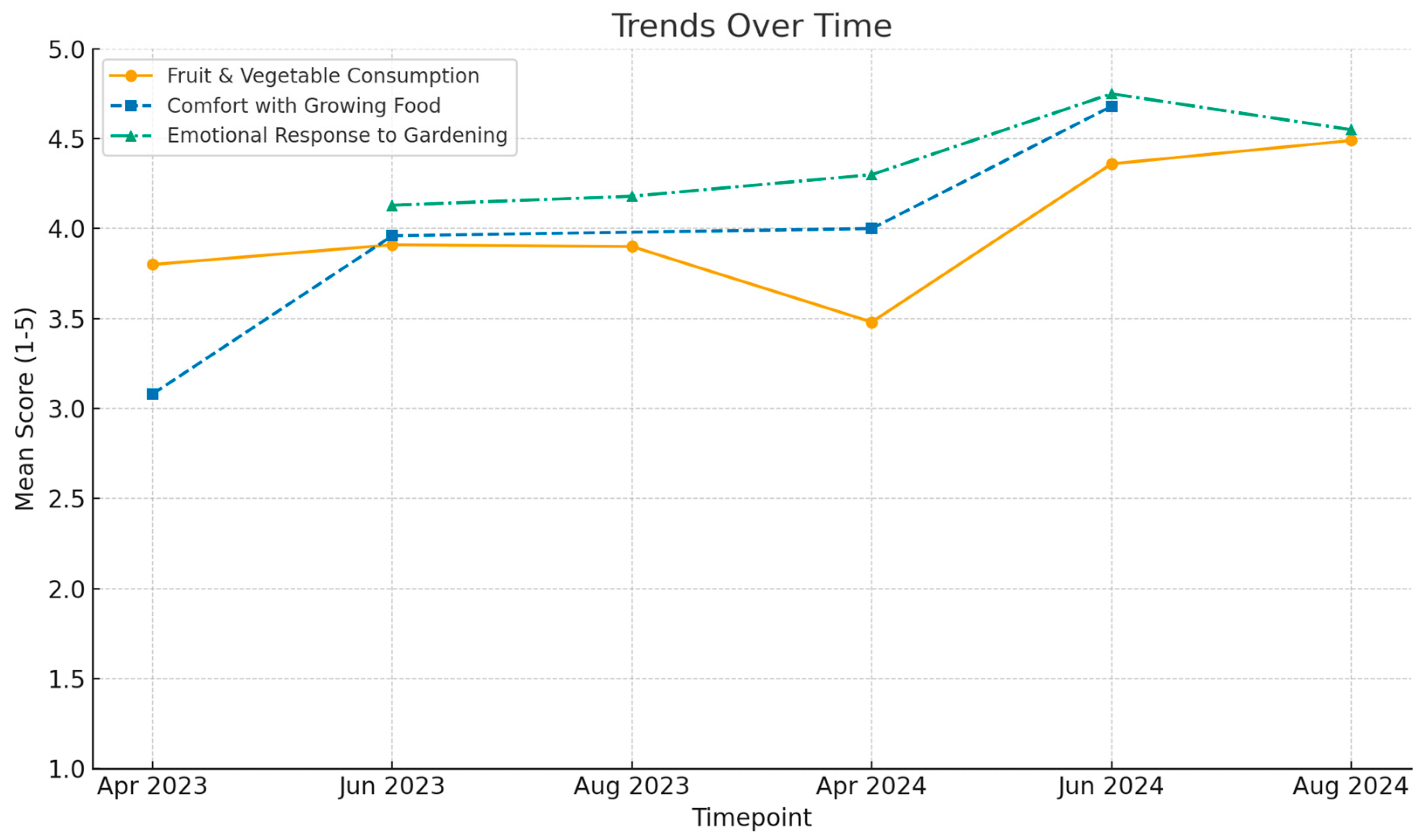
Participants rated their household’s fruit and vegetable consumption on a 5-point Likert scale (1 = “rarely or never,” 5 = “every day”). Reported mean scores across six timepoints, from April 2023 to August 2024, were 3.80, 3.91, 3.90, 3.48, 4.36, and 4.49.
A one-way ANOVA revealed significant differences across all six time points (
p < 0.05). Tukey’s Honestly Significant Differences (HSD) post hoc test showed that June and August 2024 scores were significantly higher than all earlier surveys (
p < 0.05), with the largest increase from April 2023 to August 2024 (
p = 0.000003). No significant differences were found among the earlier timepoints, suggesting relatively stable consumption patterns before June 2024. These results are presented in
Table 2 and
Figure 1. A temporary dip in reported consumption was observed in April 2024 (
Table 2,
Figure 1), the reason for which is further explored in
Section 4.
3.3. Comfort with Growing Food
Participants rated their comfort with growing food on a 5-point Likert scale (1 = “not at all comfortable,” 5 = “very comfortable”) across four timepoints. Mean scores were 3.08, 3.96, 4.00, and 4.68.
Comfort with growing food increased significantly over time (ANOVA,
p < 0.05). Tukey’s Honestly Significant Differences (HSD) post hoc comparisons revealed in April 2023 participants were significantly less comfortable than they were at all later timepoints: June 2023 (
p = 0.0001), April 2024 (
p = 0.000003), and June 2024 (
p = 0.000000000000001). While comfort levels between June 2023 and April 2024 did not differ significantly, both were significantly lower than June 2024, which marked the highest reported comfort level (
p = 0.00000001). This pattern suggests a steady and meaningful increase in participants’ comfort with growing food, culminating in a notable rise by June 2024. These results are presented in
Table 2 and
Figure 1.
In a question not reported in the table, participants were asked whether they had ever grown food prior to the program. In April 2023, 38 participants (48%) answered yes, while 41 (52%) had not. By April 2024, all 79 respondents (100%) reported having grown their own food.
3.4. Emotional Response to Gardening
Participants rated how growing food made them feel on five of the six surveys using a 5-point Likert scale (1 = “very bad,” 5 = “very good”). Mean scores were 4.13, 4.18, 4.30, 4.75, and 4.55.
A one-way ANOVA showed a statistically significant difference in emotional response over time (
p = 0.00002). Tukey’s HSD post hoc analysis confirmed that scores in June 2023, August 2023, and April 2024 were statistically similar, while scores in both June and August 2024 were significantly higher than those earlier timepoints. The strongest contrasts were between June 2023 and June 2024 (
p = 0.00007) and between August 2023 and June 2024 (
p = 0.00001), with other comparisons also reaching significance (
p < 0.05). The largest gain in emotional response was observed by June 2024 and remained stable through August. These results are presented in
Table 2 and
Figure 1.
3.5. Financial Assistances Participation
Participants reported enrollment in SNAP and WIC in April 2023 and April 2024. As shown in
Table 3, SNAP participation (including households enrolled in both SNAP and WIC) increased from 15.2% (
n = 12 of 79 households) in 2023 to 32.9% (
n = 26 of 79 households) in 2024. WIC participation (including dual enrollment) rose from 7.6% (
n = 6 of 79 households) to 10.1% (
n = 8 of 79 households) over the same period. The number of households not enrolled in either program declined from 79.7% (
n = 63 of 79 households) in 2023 to 60.8% (
n = 48 of 79 households) in 2024, reflecting increased engagement with federal nutrition benefits over time.
3.6. Fruit and Vegetable Purchasing Patterns
Participants identified all the neighborhood sources from which they usually purchase fruits and vegetables. Supermarkets were the primary source in both years, reported by nearly all participants. Use of street vendors and farmers markets declined by 36% and 57%, respectively. Grocery store use also fell modestly from 27% to 19%, while bodega purchases—previously unselected—emerged as a new source in 2024. These results are presented in
Table 3.
3.7. Perceived Affordability of Fruits and Vegetables
Participants rated how affordable it was to purchase fruits and vegetables in their neighborhood using a 5-point Likert scale, where 1 = “Not accessible” and 5 = “Very affordable.” This question was asked in April 2023 and April 2024. A total of 79 participants responded at each timepoint.
Observed: Trends
- -
Ratings of “Some” (3) affordability increased from 27 (34%) to 32 (41%) participants, representing the most selected response in 2024.
- -
The number of participants who rated produce as “Affordable” (4) or “Very affordable” (5) declined between years.
- -
The proportion of participants indicating lower affordability (ratings 1 or 2) remained consistent at 36 out of 79 (46%) across both years, though slightly more participants rated produce as “Not accessible” in 2024.
These results are presented in
Table 3.
3.8. Unmet Food Needs and Preferences
Participants identified food types they were unable to obtain in their neighborhood. In April 2023, the most commonly reported unmet needs were vegetables (27%), fruit (23%), and organic produce (18%). Smaller proportions cited meat and fish (8%), prepared foods and miscellaneous items (4%), and dairy (3%), while 10% responded “anything” and 27% provided no answer. By April 2024, unmet needs shifted: vegetables (44%) became the most frequently reported, followed by fruit (23%) and meat and fish (23%). Reports of organic produce as an unmet need dropped to zero, while prepared foods (9%) and dairy (11%) increased. These results are presented in
Table 3.
3.9. Participant-Identified Support Needs
When asked what additional support from LEAF would be most helpful, participants in April 2024 most frequently requested produce (80%), plants (63%), hygiene packages (46%), and clothing (41%). A smaller proportion (28%) requested cooked meals. No participants selected “no answer.” These results are presented in
Table 3.
3.10. Trip to Stone Barns Center for Food and Agriculture
In June 2023 (Survey 2), 65 families (n = 214 individuals) indicated interest in attending Family Day at Stone Barns Center. However, actual attendance was capped at 100 people due to funding constraints, which represented 32% of the 308 individuals enrolled that year.
In 2024, the survey item on intent was removed because the cap had already been established. Attendance was managed through a program sign-up sheet that filled immediately, with all 100 Bronx slots taken and an additional 25 families on a waitlist. On the day of the event, 100 Bronx participants attended (28% of the 356 enrolled individuals). These results are presented in
Table 3.
Wait-listed families who were not able to attend the Family Day at Stone Barns Center were invited to attend later Stone Barns Center Open House events.
4. Discussion
This study evaluated the first two years of the LEAF program in the South Bronx, showing how a community-led, multi-sector approach can influence household food behaviors, access, and perceptions. The findings suggest that when regeneratively grown produce is combined with gardening kits, nutrition education, and local delivery, families can see improvements in dietary patterns, food-growing confidence, and awareness of support services such as SNAP and WIC. In this way, the LEAF program adds to a growing body of evidence that community-designed food system programs can advance environmental sustainability, equity, and household empowerment [
1,
2,
5,
10,
13,
17]. These findings also demonstrate that community-based interventions can extend beyond transactional food access to foster agency, collective action, and social cohesion.
Several mechanisms help explain these observed changes. Improvements in gardening comfort are consistent with self-efficacy processes, in which gaining practical skills and repeated exposure can build confidence and promote behavior change [
11,
13,
14]. The combination of regeneratively grown produce, culturally familiar foods, and recurring community-based engagement reflects ecological systems perspectives on food access, suggesting that supportive environments can shape dietary opportunities and perceived affordability [
3,
4,
5,
9]. Additionally, the LEAF program’s use of a short, local supply chain may have reduced logistical and cost barriers, contributing to higher demand satisfaction and shifts in purchasing behavior [
2,
13,
17]. Together, these mechanisms help explain
why LEAF participants experienced dietary and psychosocial improvements despite the absence of a comparison group.
4.1. Research Implications
The results highlight several contributions to research on food systems interventions. Fruit and vegetable consumption was stable throughout 2023 but rose significantly in 2024, underscoring the importance of consistent and sustained exposure to healthy food [
2,
22]. The temporary decline between November 2023 and April 2024, when the program was paused, illustrates how quickly dietary gains can be lost when access is disrupted [
3,
4].
Equally important, participants grew more confident and found more enjoyment in food growing. These experiences reflect earlier studies showing that home gardening can improve self-efficacy, reduce stress, and support ecological literacy [
13,
15,
17]. The LEAF program’s flexibility in responding to participants’ requests—such as adding cilantro, peppers, and rye grains—shows how community feedback can make interventions more relevant. This mirrors findings from research on culturally tailored programs, which emphasize that when participants see their input reflected, engagement and effectiveness increase [
15,
16].
Finally, the program achieved nearly complete retention, with most families returning in the second year. Peer-to-peer exchanges—such as sharing seedlings, posting gardening updates in WhatsApp groups, and picking up distributions for participants who could not attend—were not formally planned but became an important part of the experience. Families in temporary housing maintained their growing pouches at one of the two community garden partner sites, returning regularly to care for them. These relational practices, though unplanned, reinforce trust and highlight how CBPR approaches can sustain engagement and build cohesion [
10,
11,
17,
18].
These emergent peer networks also operated as a mechanism of change, supporting retention, strengthening social resilience, and helping participants sustain food-growing behaviors within and beyond the program.
4.2. Practice Implications
For practitioners, the LEAF program demonstrates how pairing access to healthy food with support for home growing and education can work in practice [
13,
14]. Families did not just receive produce; they were given seedlings, tools, and recipes, and their feedback was incorporated into distributions [
13,
14]. This combination made the program both practical and engaging.
The decline in farmers market and street vendor use suggests that the LEAF program functioned as a substitute for other food sources during a period of rising food prices [
32]. Participants frequently reported that LEAF distributions offered greater quality and freshness than other neighborhood alternatives, reducing reliance on more expensive and inconsistent vendors. Together, these findings indicate that community-based programs can ease financial pressure while maintaining access to healthy foods.
The LEAF program also shows the value of creating formal and informal spaces for participants to share knowledge. WhatsApp groups, community gardens, a visit to Stone Barns, and simple acts like picking up bi-weekly distributions for neighbors became organic extensions of the program [
17]. Practitioners designing similar interventions may benefit from intentionally encouraging these kinds of exchanges, which can deepen trust and broaden impact without requiring major resources.
Shifts in unmet food needs—particularly increases in reported difficulty obtaining vegetables and meat/fish—may reflect heightened expectations as participants became more familiar with a reliable produce source. As the LEAF program increased access to regeneratively grown foods, families may have become more aware of gaps in neighborhood food availability, especially when items were not culturally preferred or consistently stocked. This “aspirational shift” has been documented in other food security interventions as participants gain exposure to higher-quality foods [
15,
16].
4.3. Policy Implications
The LEAF program model highlights several policy-relevant lessons on regional food systems, access to nutrition assistance, and community-based food interventions.
First, building short, regenerative supply chains—such as the 25-mile link between Stone Barns Center and the South Bronx—can reduce emissions, support regional agriculture, and provide reliable access to healthy food [
2,
9]. Surplus redistribution to La Morada Community Kitchen further demonstrated how local programs can reduce food waste and promote circularity [
7]. Because the evaluation did not include direct environmental or emissions-related metrics—such as greenhouse gas emissions, life-cycle analyses, or transport energy use—any climate-related contributions of the LEAF program’s short, regenerative supply chain should be interpreted as conceptual pathways rather than demonstrated environmental impacts.
Second, increases in SNAP and WIC enrollment show that food distribution sites can be powerful entry points for raising awareness of entitlements. Embedding benefits navigation within trusted community programs could be a scalable strategy for reducing food insecurity [
3,
28,
33]. Multiple mechanisms likely contributed to these increases. Repeated exposure to benefits information at distribution sites, bilingual staff support, and trust built through CBPR relationships helped reduce administrative and psychological barriers to enrollment. The LEAF program distributions also became spaces where participants regularly asked program staff about affordable food sources, positioning the program as an accessible bridge to federal nutrition benefits.
Third, the persistence of affordability concerns—even with SNAP, WIC, and free produce distributions—points to the limits of household-level interventions [
4,
5]. Broader policy changes in food pricing, subsidies, and procurement are required to address structural inequities. The shift towards more participants selecting “somewhat affordable,” alongside a decline in high affordability rating, likely reflects broader economic conditions during 2023–2024 [
34]. Even with consistent distributions from the LEAF program, inflation in neighborhood grocery stores may have eroded perceived affordability. This suggests that community-based interventions can buffer—but not fully mitigate—the impact of food prices [
34].
Although the LEAF program has since expanded to an additional site outside of New York City, this evaluation focused on a single urban context and did not include multi-site or cross-regional comparisons. As such, implications for generalizability remain suggestive and warrant further study. Beyond the local South Bronx context, several design elements of the LEAF program may be transferable to other urban settings, while others remain inherently context-specific. Core components—such as pairing regeneratively grown produce with home-growing supports, embedding benefits navigation into nutrition education at distribution sites, and using recurring touchpoints to build familiarity and trust—represent broadly adaptable strategies for improving food access and engagement. However, the success of the LEAF program was also shaped by hyperlocal factors, including longstanding relationships between community partners and residents, culturally grounded food preferences, and neighborhood-specific barriers to food affordability. These contextual elements underscore that while the LEAF program model offers a framework that can guide replication, effective implementation elsewhere would require local adaptation, authentic partnerships, and alignment with regional food system structures.
Finally, the LEAF program illustrates how CBPR approaches can transform food programs from isolated projects into parts of a neighborhood support system [
10,
11]. Policy frameworks that encourage partnerships across food, health, housing, climate, and other sectors may replicate this integrative impact on a larger scale.
4.4. Limitations
Findings should be interpreted in light of several limitations. First, all outcomes were assessed using self-reported, Likert-scale survey items, which are subject to recall and social desirability bias and cannot be independently verified. The evaluation did not include objective environmental or climate-related indicators—such as greenhouse gas emissions or life-cycle impacts—preventing quantification of the program’s potential contributions to climate resilience or emissions reduction. The study also did not incorporate objective health indicators, such as anthropometric or cardiometabolic measures, dietary biomarkers, or food purchase data, limiting the ability to triangulate reported changes in diet, gardening, and perceived affordability. In addition, data were collected at the household level rather than from individual members, which precluded analysis of child-specific outcomes or within-household variation. Education level and occupation were not collected, constraining the extent to which socioeconomic gradients in participation or impacts can be examined.
Second, because households were recruited through partner organizations networks rather than through random sampling, participants may differ systematically from non-participating households in the same neighborhoods, which limits external validity. This recruitment strategy, combined with the program’s fixed capacity of 80 families per year, may introduce selection bias and limit the representativeness of the sample relative to all households in the South Bronx that could benefit from similar interventions.
Third, the evaluation was designed as a repeated cross-sectional study rather than a quasi-experimental design, without a comparison group or neighborhood. As a result, causal inference is limited, and we cannot rule out the influence of broader contextual factors—such as seasonal patterns, citywide food policy changes, or shifts in local food access—on the observed trends. Longitudinal tracking of the same individuals or households, alongside an external comparison group, would strengthen future evaluations.
Seasonality also represents an important contextual factor influencing results. Because the LEAF program activities occurred from April through November, changes in fruit and vegetable consumption, gardening comfort, and emotional response may partially reflect natural seasonal patterns rather than program effects alone. Produce availability, quality, and variety typically increase during summer and early fall, and opportunities for home gardening expand as the growing season progresses. These seasonal cycles may contribute to upward trends observed in 2023 and 2024, independent of the intervention.
Finally, although surveys were translated and data entry was carefully monitored, minor translation or entry errors may still have occurred. The study also did not include qualitative interviews or focus groups, which would have provided deeper insight into participants’ experiences and mechanisms of change. Future iterations of the LEAF program could incorporate mixed-methods designs and objective health assessments—for example, Veggie Meter™ readings, digitally validated dietary recalls, and community health fair screenings of body mass index, blood pressure, and other biomarkers—to provide a more comprehensive understanding of program impacts.
4.5. Future Research
Future research should build on these findings in several ways. Longitudinal mixed-methods studies could track individuals over time and capture the lived experiences behind dietary change and gardening confidence.
Incorporating objective measures of diet quality would complement self-reported data and provide stronger evidence. Testing LEAF-like models in other urban neighborhoods would clarify whether the integration of regenerative agriculture, culturally tailored food support, and CBPR can be adapted across contexts. The LEAF program has already expanded to a second site, Sleepy Hollow, a Westchester County, NY, neighborhood approximately 10 miles from Stone Barns, creating opportunities for future studies to compare and contrast the experiences of families across sites.
In addition, incorporating health outcomes could strengthen evaluation. For example, future iterations of the LEAF program may include anthropometrics and cardiometabolic screenings through community health fairs at distribution sites. Similar approaches have been tested in gardening interventions such as in a study by Litt et al. (2023), which paired community gardening with measures of BMI, blood pressure, and cardiometabolic risk factors [
18]. Embedding such screenings within the LEAF program would allow the program to assess physical health impacts alongside dietary and psychosocial outcomes, providing a more comprehensive understanding of benefits.
Evaluating basic food safety practices related to produce handling, storage, and distribution is another important area for exploration, ensuring that increased access to raw, minimally processed foods is paired with safe utilization.
Future studies should also focus on children, who may experience program benefits differently due to developmental windows in which dietary habits, food preferences, and ecological understanding are rapidly forming. Gardening and hands-on food education have been shown to enhance sensory learning, STEM engagement, and long-term vegetable acceptance, suggesting that the LEAF program may influence children through distinct cognitive and behavioral pathways [
35,
36]. Clarifying these child-specific mechanisms would help guide age-appropriate program adaptations and inform family-level intervention design.
Future studies could also integrate bilingual digital survey tools to minimize translation challenges and reduce data entry errors, strengthening the reliability of household-level responses. Finally, policy-focused research is needed to explore how community-based food interventions can be embedded within municipal food systems to ensure sustainability and scale.
5. Conclusions
As climate change, food insecurity, and public health inequities converge, integrated models like the LEAF program provide a promising blueprint for community-led food systems transformation [
11,
12]. Findings from the first two years of the LEAF program indicate that combining regeneratively grown produce, home gardening supports, and culturally responsive nutrition education—delivered through trusted community partnerships—was associated with improvements in household dietary patterns, gardening confidence, and awareness of support services such as SNAP and WIC.
Although the program’s strong engagement suggests potential for adaptation in other contexts, the evaluation reflects a single community setting and did not include multi-site or cross-regional comparisons. As such, the generalizability of the LEAF program model remains an open empirical question and a priority for future research.
Future research should examine how LEAF-like approaches can be adapted across diverse settings, incorporate objective dietary and health indicators, and explore policy mechanisms that support long-term sustainability of community-designed food system interventions [
10,
37].




 ,
,