Graduation Towers and Pan Salt Production in Various Aspects—Case Study


Abstract
1. Introduction
- to characterize the last saltwork with graduation towers and compile the knowledge and know-how associated with the salt activity,
- apply a broad approach to the topic, present salt production in detail, and document it well,
- to show the values of the safeguarding of salt heritage in various aspects of sustainable development,
- to find out the problems connected with sustainable salt use.
2. Materials and Methods
2.1. Query
2.2. On-Site Study
3. The Salt Production Line with the Graduation Towers vs. Solar and Evaporation Vacuum System and Rock Salt
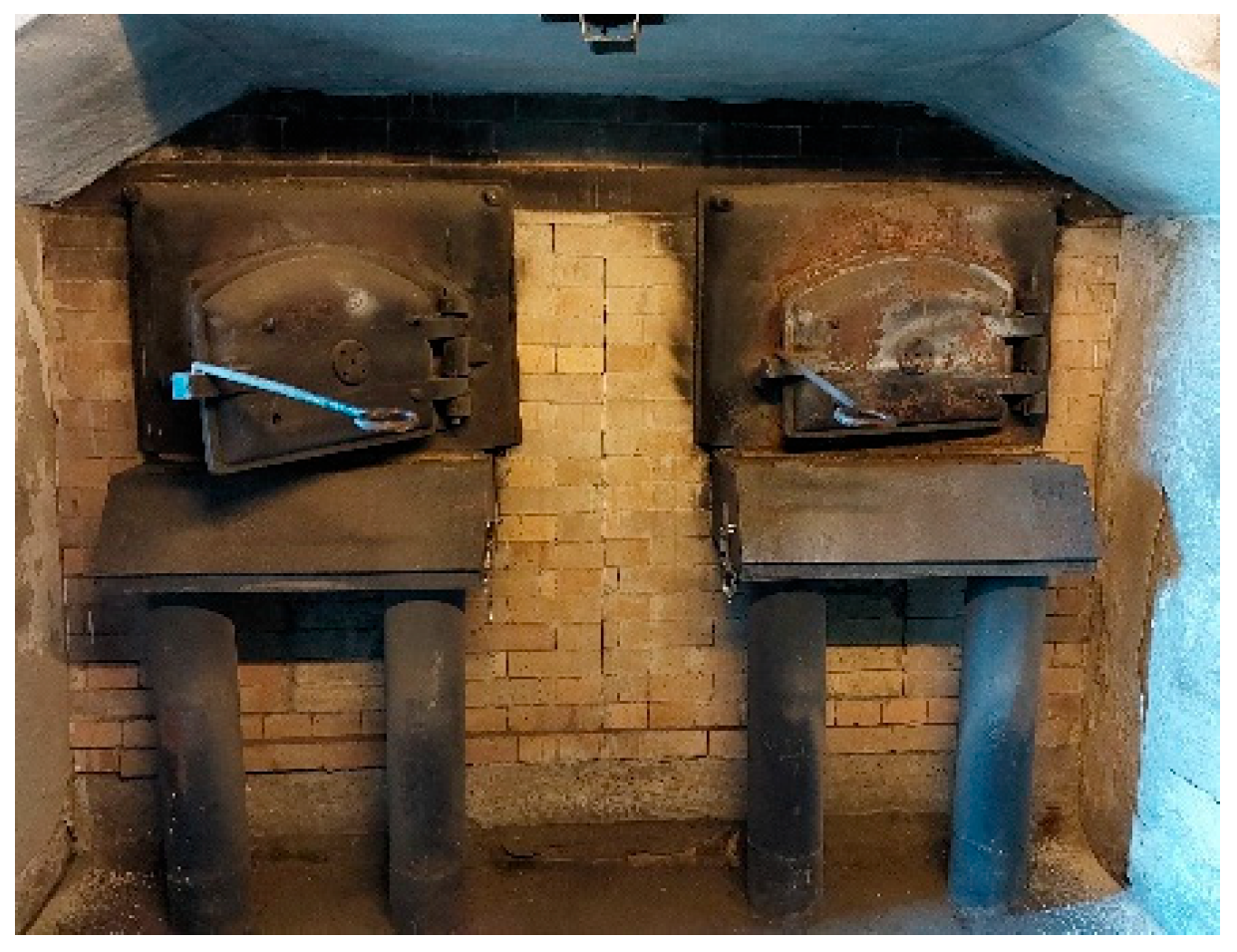
- Combustion of coal to generate heat (for brine evaporation and salt crystallization). Producing 1 ton of salt requires 6 tons of hard coal. Direct CO2 emissions during the combustion of hard coal are 2.73 kg CO2/kg hard coal [22].
- 2.
- Indirect emissions from electricity include electricity used for transporting brine (pumping) and drying salt before packaging. In Poland, 70% of energy comes from fossil fuels. Electricity consumption translates into CO2 emissions. To calculate CO2 emissions (kg) from electricity, multiply the consumption in kWh by the average emission factor, which is approximately 0.597 kg CO2/kWh (for the Polish energy sector) [23].
- cessation or irreversible decline of production,
- activation (usually by non-governmental organizations or public administration),
- professionalization, in which the heritage asset/landscape is cared for by people or organizations with expertise in this topic,
4. Salt Production as an Important Factor in the Development of Many Other Sectors of the Economy
5. Striving for Sustainable Salt Consumption, Its Production, and Export
6. Negative Impact of Salt on the Environment
7. Conclusions
- To preserve material heritage, efforts should be made to manage aging saltworks. Salines may change, but they do not have to disappear.
- To increase the profitability of saltworks operations and reduce CO2 emissions, a change in legislation is needed. With both industrial heritage and the environment in mind, opportunities for changes in the operation of historical monuments should be introduced (in this case, changes to the saltworks’ brine heating system), and each case should be considered individually.
- Understanding conflict issues and necessary compromises is crucial to the success of sustainable development efforts worldwide. Adapting educational messages and legal procedures to local circumstances is crucial.
- Disused salt mines are being converted into museums, sanatoriums, radioactive waste storage sites, etc. There is a need to verify whether they can be adapted for use as shelters and/or food storage facilities.
- There is a need to promote the use of eco-friendly packaging in the food industry, including the salt industry.
- Due to the increasing salinity of land and water, there is a growing need to find a replacement for sodium chloride used in road construction.
Author Contributions
Funding
Institutional Review Board Statement
Informed Consent Statement
Data Availability Statement
Acknowledgments
Conflicts of Interest
References
- Hofmeier, C. The Salt of Diplomacy: EU Salt’s Collaborative Approach to Industry Advancement in the EU’s Changing Environment. Available online: https://imformed.com/salt-supply-demand-insights-new-developments/ (accessed on 27 October 2024).
- North America Salt Market Size. Available online: https://www.wm-strategy.com/news/north-america-salt-market-trends-and-size (accessed on 27 October 2025).
- Sale Marino di Trapani. Available online: https://ec.europa.eu/agriculture/eambrosia/geographical-indications-register/details/EUGI00000014021 (accessed on 23 October 2025).
- Grasby, S.E. Brine springs of northern Alberta. In Potential for Carbonate-hosted Lead-Zinc Mississippi Valley-Type Mineralization in Northern Alberta and Southern Northwest Territories: Geoscience Contributions. Targeted Geoscience Initiative; Hannigan, P.K., Ed.; Bulletin 591; Geological Survey of Canada: Ottawa, ON, Canada, 2006; pp. 241–254. [Google Scholar]
- Rezaei, M.; Zarasvandi, A.; Azhdari, A.; Heidari, M. Geology and hydrochemistry of brine springs in the Zagros Fold and Thrust Belt (ZFTB), Iran: A review on origin, environmental aspects, and economic potentials. Appl. Geochem. 2021, 130, 104985. [Google Scholar] [CrossRef]
- Marques, A.; Teixeira, R.; Lorena, A.; del Pino, V.; del Valle-Inclan, Y.; Navalho, J.; Domingos, T. Sustainability assessment of traditional solar salt. In Proceedings of the 2nd International Conference on the Ecological Importance of Solar Saltworks (CEISSA, 2009, March), Merida, Mexico, 26–28 March 2009; pp. 26–29. [Google Scholar]
- Bednarczyk, J.; Jaworska, J.; Marciniak, A.; Ruiz Del Arbol Moro, M. Ancient salt exploitation in the Polish lowlands: Recent research and future perspectives. In Archaeology of Salt. Approaching an Invisible Past; Brigand, R., Weller, O., Eds.; Sidestone Press: Leiden, The Netherlands, 2015; pp. 103–121. [Google Scholar]
- Gaweł, J.; Kuczaj, P. W cieniu tężni. Wszechświat 2012, 113, 128–131. [Google Scholar]
- Engelhardt, H.J.; Borstel, L. The graduation tower of Bad Kösen (Germany)—Its history and the formation of thornstone. Przegląd Solny 2015, 11, 98–108. [Google Scholar]
- Codex Alimentrius, Codex Standars for Food Grade Salt. CXSTAN 150-1985. Available online: https://www.fao.org/fao-who-codexalimentarius/sh-proxy/zh/?lnk=1&url=https%253A%252F%252Fworkspace.fao.org%252Fsites%252Fcodex%252FStandards%252FCXS%2B150-1985%252FCXS_150e.pdf (accessed on 25 October 2025).
- Food Grade (Table or Cooking) Salt Regulations 2019. Nation Agency for Food and Drug Administration and Control. Available online: https://www.nafdac.gov.ng/wp-content/uploads/Files/Resources/Regulations/All_Regulations/Food-Grade-Table-Cooking-Salt-Regulations-2019.pdf (accessed on 25 October 2025).
- Shulpekova, Y.; Nechaev, V.; Kardasheva, S.; Sedova, A.; Kurbatova, A.; Bueverova, E.; Kopylov, A.; Malsagova, K.; Dlamini, J.C.; Ivashkin, V. The concept of folic acid in health and disease. Molecules 2021, 26, 3731. [Google Scholar] [CrossRef]
- Modupe, O.; Siddiqui, J.; Jonnalagadda, A.; Diosady, L.L. Folic acid fortification of double fortified salt. Sci. Rep. 2021, 11, 14561. [Google Scholar] [CrossRef] [PubMed]
- Kılıc, Ö.; Kılıc, A.M. Recovery of salt co-products during the salt production from brine. Desalination 2005, 186, 11–19. [Google Scholar] [CrossRef]
- Vicari, F.; Randazzo, S.; López, J.; de Labastida, M.F.; Vallès, V.; Micale, G.; Tamburini, A.; D’Alì Staiti, G.; Cortina, J.L.; Cipollina, A. Mining minerals and critical raw materials from bittern: Under-standing metal ions fate in saltwork ponds. Sci. Total Environ. 2022, 847, 157544. [Google Scholar] [CrossRef]
- Gomariz, M.; Martínez-García, M.; Santos, F.; Rodriguez, F.; Capella-Gutiérrez, S.; Gabaldón, T.; Rosselló-Móra, R.; Meseguer, I.; Antón, J. From community approaches to single-cell genomics: The discovery of ubiquitous hyperhalophilic Bacteroidetes generalists. ISME J. 2015, 9, 16–31. [Google Scholar] [CrossRef]
- Boujelben, I.; Gomariz, M.; Martínez-García, M.; Santos, F.; Peña, A.; López, C. Spatial and seasonal prokaryotic community dynamics in ponds of increasing salinity of Sfax solar saltern in Tunisia. Antonie Van Leeuwenhoek 2012, 101, 845–857. [Google Scholar] [CrossRef]
- Prabawa, F.Y.; Bramawanto, R. The intensification of industrial salt production using the salt production house concept. In IOP Conference Series: Earth and Environmental Science, Proceedings of the 3rd International Conference on Maritime Sciences and Advanced Technology, Online, 5–6 August 2021; IOP Publishing: Bristol, UK, 2021; Volume 925, p. 012031. Available online: https://iopscience.iop.org/article/10.1088/1755-1315/925/1/012031/pdf (accessed on 29 October 2025). [CrossRef]
- Pambudi, N.A.; Yusafiadi, J.; Biddinika, M.K.; Estriyanto, Y.; Sarifudin, A. An experimental investigation of salt production improvement by spraying and heating. Case Stud. Therm. Eng. 2022, 30, 101739. [Google Scholar] [CrossRef]
- Salt. Available online: https://pubs.usgs.gov/periodicals/mcs2025/mcs2025-salt.pdf (accessed on 29 October 2025).
- Available online: https://agriculture.ec.europa.eu/system/files/2021-08/egtop-organic-salt-report_en_0.pdf (accessed on 12 December 2025).
- Lewandowski, I.; Kicherer, A.; Vonier, P. CO2-balance for the cultivation and combustion of Miscanthus. Biomass Bioenergy 1995, 8, 81–90. [Google Scholar] [CrossRef]
- Available online: https://www.kobize.pl/uploads/materialy/materialy_do_pobrania/wskazniki_emisyjnosci/Wska%C5%BAniki_emisyjno%C5%9Bci_dla_energii_elektrycznej_grudzie%C5%84_2024.pdf (accessed on 15 December 2025).
- Hueso-Kortekaas, K.; Iranzo-García, E. Salinas and “Saltscape” as a Geological Heritage with a Strong Potential for Tourism and Geoeducation. Geosciences 2022, 12, 141. [Google Scholar] [CrossRef]
- Zafeiropoulos, G.; Drinia, H.; Antonarakou, A.; Zouros, N. From geoheritage to geoeducation, geoethics and geotourism: A critical evaluation of the Greek region. Geosciences 2021, 11, 381. [Google Scholar] [CrossRef]
- Raczyński, M. Materiały do Historii Ciechocinka od Zapoczątkowania Budowy Warzelni Soli do Wybuchu Wielkiej Wojny; Drukarnia i Litografia Jan Cotty: Warsow, Poland, 1935; pp. 47–73. [Google Scholar]
- Marcinek, R.; Myczkowski, Z. Ocalić wiatr. Potrzeba zmian w ochronie krajobrazu kulturowego Ciechocinka. Wiadomości Konserw. 2023, 73, 148–162. [Google Scholar] [CrossRef]
- Kamińska, M.; Krusiec-Świdergoł, B. Wykorzystanie terapeutycznych właściwości soli w profilaktyce i leczeniu chorób układu oddechowego. Państwo I Społeczeństwo 2023, 23, 135–149. [Google Scholar] [CrossRef]
- Petersen, B.W.; Arbuckle, H.A.; Berman, S. Effectiveness of saltwater baths in the treatment of epidermolysis bullosa. Pediatr. Dermatol. 2015, 32, 60–63. [Google Scholar] [CrossRef] [PubMed]
- Rogula-Kozłowska, W.; Badyda, A.; Rachwał, M.; Rogula-Kopiec, P.; Majder-Łopatka, M.; Kostrzon, M.; Mathews, B. Graduation Towers Impact on the Concentration and Chemical Composition of Ambient Aerosol: A Case Study from Wieliczka Salt Mine in Poland. Atmosphere 2022, 13, 1576. [Google Scholar] [CrossRef]
- Zajac, D. Inhalations with thermal waters in respiratory diseases. J. Ethnopharmacol. 2021, 281, 114505. [Google Scholar] [CrossRef]
- Marciniak, K. Warunki klimatyczne Ciechocinka. Jantarowe Szlaki. Kwart. Tur. Kraj. Województw Północnych 1986, 1, 10–14. [Google Scholar]
- Kalwasińska, A.; Deja-Sikora, E.; Burkowska-But, A.; Szabó, A.; Felföldi, T.; Kosobucki, P.; Krawiec, A.; Walczak, M. Changes in bacterial and archaeal communities during the concentration of brine at the graduation towers in Ciechocinek spa (Poland). Extremophiles 2018, 22, 233–246. [Google Scholar] [CrossRef]
- Bodziacki, S.; Wolny-Koładka, K. Microbiological contamination of brine feeding a closed-cycle graduation tower and its potential human exposure. Processes 2023, 11, 966. [Google Scholar] [CrossRef]
- Burkowska-But, A.; Swiontek Brzezinska, M.; Walczak, M. Microbiological contamination of water in fountains located in the city of Torun, Poland. Ann. Agric. Environ. Med. 2013, 20, 645–648. [Google Scholar] [PubMed]
- Budzińska, K.; Pyrc, N.; Szejniuk, B.; Pasela, R.; Traczykowski, A.; Michalska, M.; Berleć, K. Microbiological Contamination of Water in Fountains Located in the Ciechocinek Health Resort. Rocz. Ochr. Sr. 2017, 19, 181–199. [Google Scholar]
- Nag, R.; Monahan, C.; Whyte, P.; Markey, B.K.; O’Flaherty, V.; Bolton, D.; Fenton, O.; Richards, K.G.; Cummins, E. Risk assessment of Escherichia coli in bioaerosols generated following land application of farmyard slurry. Sci. Total Environ. 2021, 791, 148189. [Google Scholar] [CrossRef] [PubMed]
- Ladeiro, B. Saline agriculture in the 21st century: Using salt contaminated resources to cope food requirements. J. Bot. 2012, 2012, 310705. [Google Scholar] [CrossRef]
- Tołoczko, W.; Szmidt, A.; Fijałkowski, R. Wpływ tężni solankowych na właściwości gleb miasta Ciechocinek. Acta Universitatis Lodziensis. Folia Geogr. Phys. 2023, 22, 85–100. [Google Scholar] [CrossRef]
- Zastosowanie Soli Kamiennej. Available online: https://www.pgi.gov.pl/psg-1/psg-2/informacja-i-szkolenia/wiadomosci-surowcowe/10711-zastosowanie-soli-kamiennej.html (accessed on 29 October 2025).
- Langer, P. Dziedzictwo Kulturowe w Stymulowaniu Rozwoju Miast Solnych. Cultural Heritage in Stimulation of Salt Towns’ Development. Studia KPZK 2011, 211–227. Available online: https://journals.pan.pl/Content/96658/mainfile.pdf (accessed on 9 November 2025).
- Wolańska, A. Rzeźbiarstwo w soli. Przegląd Solny 2018, 14, 132–144. Available online: http://psgs.agh.edu.pl/wp-content/uploads/2023/04/PS6-Wolanska.pdf (accessed on 1 September 2025).
- Hallett, D. The Wieliczka salt mine. Geol. Today 2002, 18, 182–185. [Google Scholar] [CrossRef]
- Brown, I.J.; Tzoulaki, I.; Candeias, V.; Elliott, P. Salt intakes around the world: Implications for public health. Int. J. Epidemiol. 2009, 38, 791–813. [Google Scholar] [CrossRef]
- Bochud, M.; Marques-Vidal, P.; Burnier, M.; Paccaud, F. Dietary salt intake and cardiovascular disease: Summarizing the evidence. Public Health Rev. 2011, 33, 530–552. [Google Scholar] [CrossRef]
- WHO Guideline: Sodium Intake for Adults and Children. Available online: https://iris.who.int/bitstream/handle/10665/77985/9789241504836_eng.pdf?sequence=1 (accessed on 2 August 2025).
- Where’s the Salt? Available online: https://content.sph.harvard.edu/wwwhsph/sites/21/2014/05/Wheres-the-salt.pdf (accessed on 2 November 2025).
- Salt Consumption by Country 2025. Available online: https://worldpopulationreview.com/country-rankings/salt-consumption-by-country (accessed on 2 November 2025).
- Available online: https://www.tendata.com/blogs/export/6646.html (accessed on 12 November 2025).
- Torkelis, A.; Dvarionienė, J.; Denafas, G. The factors influencing the recycling of plastic and composite packaging waste. Sustainability 2024, 16, 9515. [Google Scholar] [CrossRef]
- Li, Z.; Liang, Y.; Zhou, J.; Sun, X. Impacts of de-icing salt pollution on urban road greenspace: A case study of Beijing. Front. Environ. Sci. Eng. 2014, 8, 747–756. [Google Scholar] [CrossRef]
- Hintz, W.D.; Fay, L.; Relyea, R.A. Road salts, human safety, and the rising salinity of our fresh waters. Front. Ecol. Environ. 2022, 20, 22–30. [Google Scholar] [CrossRef]
- Charola, A.E.; Rousset, B.; Bläuer, C. Deicing salts: An overview. In Proceedings of the 4th International Conference on Salt Weathering of Buildings and Stone Sculptures SWBSS 2017, Potsdam, Germany, 20–22 September 2017; Verlag der Fachhochschule Potsdam: Potsdam, Germany, 2017. Available online: https://repository.si.edu/bitstream/handle/10088/34482/Charola%20etal.%20Deicing%20salts%20SWBSS_2017.pdf?sequence=1&isAllowed=y (accessed on 1 January 2025).
- Kim, S.; Koretsky, C. Effects of road salt deicers on sediment biogeochemistry. Biogeochemistry 2013, 112, 343–358. [Google Scholar] [CrossRef]
- Pieper, K.J.; Tang, M.; Jones, C.N.; Weiss, S.; Greene, A.; Mohsin, H.; Parks, J.; Edwards, M.A. Impact of road salt on drinking water quality and infrastructure corrosion in private wells. Environ. Sci. Technol. 2018, 52, 14078–14087. [Google Scholar] [CrossRef] [PubMed]
- Szklarek, S.; Górecka, A.; Wojtal-Frankiewicz, A. The effects of road salt on freshwater ecosystems and solutions for mitigating chloride pollution-A review. Sci. Total Environ. 2022, 805, 150289. [Google Scholar] [CrossRef]
- Kelting, D.L.; Laxon, C.L. Review of Effects and Costs of Road De-Icing with Recommendations for Winter Road Management in the Adirondack Park; Adirondack Watershed Institute, Paul Smith’s College: Paul Smiths, NY, USA, 2010; p. 1. [Google Scholar]
- Mann, G. Melting Ice: How do Common Household Items–such as Coffee grinds and Sand Compare to Rock Salt and Calcium Chloride as Melting Agents? Expedition 2021, 11, 1–18. [Google Scholar]
- Okur, B.; Örçen, N. Soil salinization and climate change. In Climate Change and Soil Interactions; Elsevier: Amsterdam, The Netherlands, 2020; pp. 331–350. [Google Scholar] [CrossRef]
- Feld, C.K.; Lorenz, A.W.; Peise, M.; Fink, M.; Schulz, C.J. Direct and indirect effects of salinisation on riverine biota: A case study from river Wipper, Germany. Hydrobiologia 2023, 850, 3043–3059. [Google Scholar] [CrossRef]
- Hagage, M.; Abdulaziz, A.M.; Elbeih, S.F.; Hewaidy, A.G.A. Monitoring soil salinization and waterlogging in the northeastern Nile Delta linked to shallow saline groundwater and irrigation water quality. Sci. Rep. 2024, 14, 27838. [Google Scholar] [CrossRef]
- Alberti, F.; Mosto, N.; Sommariva, C. Salt production from brine of desalination plant discharge. Desalination Water Treat. 2009, 10, 128–133. [Google Scholar] [CrossRef]


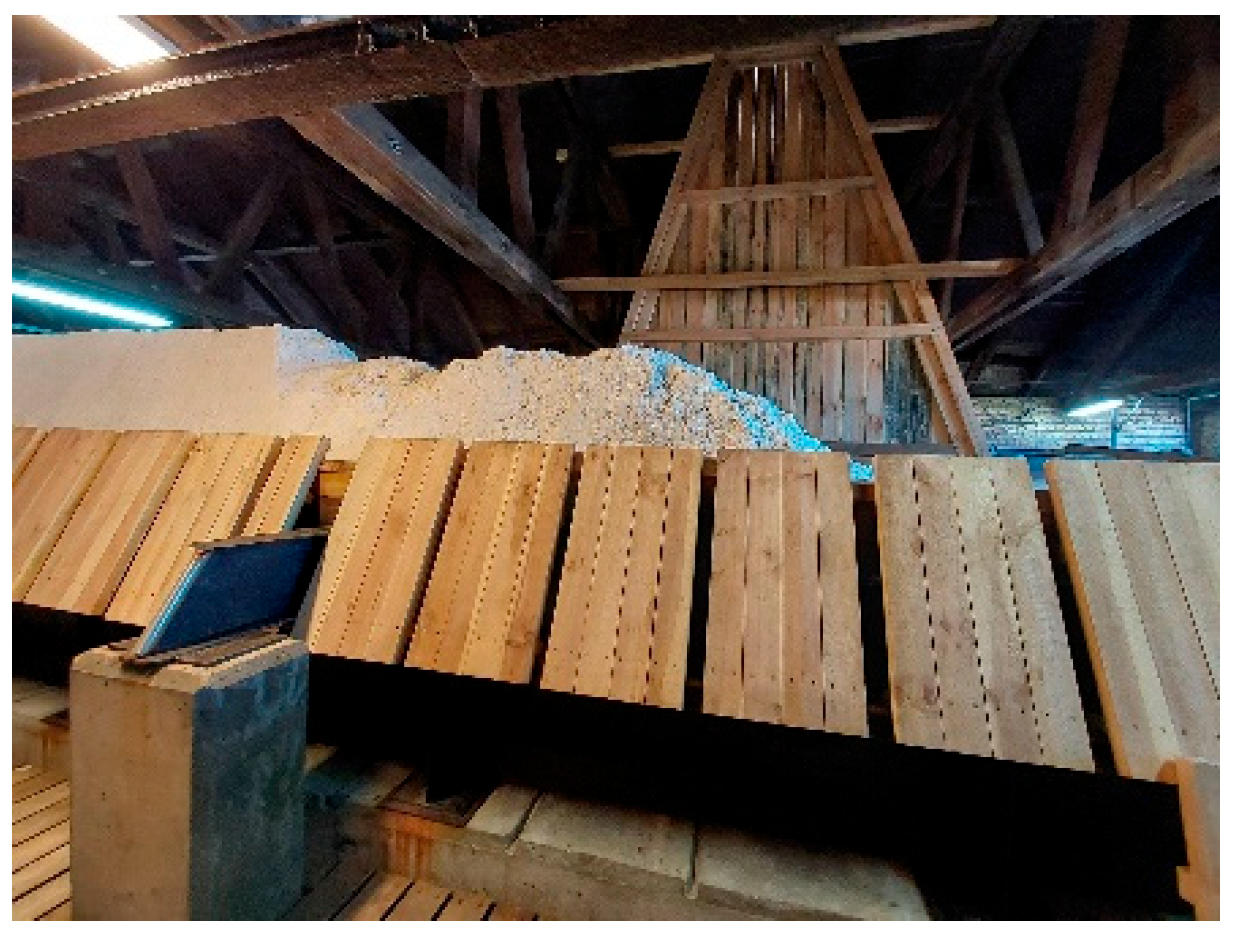



| Characteristics of Production Conditions | Versus Fact |
|---|---|
| High process costs | Heritage, desire for museum development, tourism, and education |
| CO2 production | Historical monument and the inability to implement ecological and energy-saving changes |
| Natural conditions limiting the operation time of graduation towers due to frost | Population growth of an average of 0.85% per year induces an increase in food production (including salt) |
| Large surface area of the entire production line | Trend of increasing production efficiency due to decreasing production areas |
Disclaimer/Publisher’s Note: The statements, opinions and data contained in all publications are solely those of the individual author(s) and contributor(s) and not of MDPI and/or the editor(s). MDPI and/or the editor(s) disclaim responsibility for any injury to people or property resulting from any ideas, methods, instructions or products referred to in the content. |
© 2026 by the authors. Licensee MDPI, Basel, Switzerland. This article is an open access article distributed under the terms and conditions of the Creative Commons Attribution (CC BY) license.
Share and Cite
Chudy, S.; Kowalski, R.; Makowska, A. Graduation Towers and Pan Salt Production in Various Aspects—Case Study. Sustainability 2026, 18, 710. https://doi.org/10.3390/su18020710
Chudy S, Kowalski R, Makowska A. Graduation Towers and Pan Salt Production in Various Aspects—Case Study. Sustainability. 2026; 18(2):710. https://doi.org/10.3390/su18020710
Chicago/Turabian StyleChudy, Sylwia, Ryszard Kowalski, and Agnieszka Makowska. 2026. "Graduation Towers and Pan Salt Production in Various Aspects—Case Study" Sustainability 18, no. 2: 710. https://doi.org/10.3390/su18020710
APA StyleChudy, S., Kowalski, R., & Makowska, A. (2026). Graduation Towers and Pan Salt Production in Various Aspects—Case Study. Sustainability, 18(2), 710. https://doi.org/10.3390/su18020710