1. Introduction
As global sustainable development progresses, the United Nations Sustainable Development Goals (SDGs) offer a coherent framework guiding industrial transformation. In particular, SDG 3 (Good Health and Well-being), SDG 9 (Industry, Innovation, and Infrastructure), and SDG 12 (Responsible Consumption and Production) are especially pertinent to the pharmaceutical manufacturing sector, emphasizing public health protection, innovation-driven growth, and environmentally responsible production. Consequently, green transformation and corporate social responsibility have become central to industrial development [
1], prompting firms to increasingly incorporate ESG considerations into strategic decision-making and allocate greater resources to ESG enhancement [
2]. Owing to its strategic significance for public health, the pharmaceutical manufacturing industry exerts a profound influence on ecological security [
3] and is therefore subject to heightened sustainability expectations.
From an environmental perspective, production processes such as raw material synthesis and formulation manufacturing are energy-intensive and highly polluting [
4]. Regulatory frameworks, including the EU environmental annex to Good Manufacturing Practice for Active Pharmaceutical Ingredients and China’s Pharmaceutical Industry Air Pollutant Emission Standards, mandate continuous equipment upgrades and long-term emissions monitoring [
5], imposing sustained financial burdens. On the social dimension, drug accessibility remains a persistent concern. The development of innovative drugs typically involves lengthy development cycles and substantial investment [
6], encouraging firms to prioritize high-profit products and contributing to shortages of affordable and orphan drugs [
7,
8,
9]. Conflicts between patent protection and drug accessibility further exacerbate inequities in the global distribution of health resources [
10]. From a governance standpoint, issues such as ineffective independent directors [
11] and ESG disclosures that are superficial rather than substantive [
12] undermine decision-making efficiency and increase governance risks, constraining the industry’s long-term sustainable development and diverging from the principles of fairness and sustainability in global health governance [
13].
Against this backdrop, patient capital—characterized by long-term investment horizons and value-oriented decision-making—has garnered increasing attention as a potential mechanism for addressing ESG challenges in the pharmaceutical industry. By withstanding short-term market fluctuations and emphasizing long-term value creation [
14], patient capital closely aligns with the sector’s sustainability imperatives. Prior research suggests that patient capital can enhance ESG performance by translating ESG commitments into tangible green actions [
15], optimizing resource utilization and supporting social initiatives [
16], enabling early-stage investments in novel technologies [
17], and redirecting managerial focus from short-term gains toward long-term development through strengthened governance and internal controls [
18,
19,
20]. Nevertheless, the mechanisms and effects of patient capital may differ substantially across industries, particularly in sectors characterized by strong public welfare considerations and high regulatory intensity.
Accordingly, this study examines listed pharmaceutical manufacturing firms in China’s Shanghai and Shenzhen A-share markets from 2015 to 2024 to address two central research questions: First, does patient capital influence ESG performance in pharmaceutical firms, and through which channels? Second, does this effect vary across firms with different ownership structures, sizes, and market positions?
The pharmaceutical industry provides a distinctive context for examining patient capital due to three salient characteristics: stringent regulatory constraints, long-cycle and high-risk R&D processes, and pronounced public welfare orientation. These features amplify the tension between short-term profitability and long-term sustainable investment, rendering the industry an ideal setting to investigate how patient capital reconciles business objectives with broader social goals.
An integrated framework connects patient capital to ESG performance through two primary mechanisms: alleviating ESG-related financing constraints and fostering ESG-oriented R&D. By absorbing short-term losses and maintaining a long-term perspective, patient capital mitigates short-term performance pressures, thereby enabling the allocation of greater resources to green production and improving drug accessibility. Additionally, it sends positive signals to the market, reducing external financing costs and ensuring stable funding for ESG-oriented R&D, ultimately enhancing both environmental and social performance.
This study shifts the emphasis from short-term financial returns to long-term value creation that integrates both business objectives and social welfare. It makes two key theoretical contributions. First, it advances sustainable finance theory by demonstrating that long-term, risk-tolerant capital can alleviate financing constraints imposed by high environmental compliance costs and limited drug accessibility, highlighting the role of patient capital in supporting ESG-oriented investment in resource-intensive industries. Second, it enriches stakeholder-oriented capital theory by showing that patient capital enables firms to balance the interests of governments, the public, vulnerable populations, employees, and investors, thereby mediating the alignment of corporate objectives with social responsibility in sectors characterized by strong public welfare orientation. Together, these contributions clarify how long-term, value-oriented capital bridges the gap between financial performance and social sustainability.
The remainder of this paper is structured as follows.
Section 2 provides a review of the literature and develops research hypotheses.
Section 3 outlines the data, variables, and empirical methodology.
Section 4 presents empirical results along with robustness checks. Finally,
Section 5 concludes by summarizing the key findings, discussing limitations, and suggesting directions for future research.
2. Theoretical Basis and Research Hypotheses
2.1. Patient Capital and ESG Performance
Patient capital refers to equity or debt funds in which providers seek long-term returns and are willing to maintain their investments despite short-term adversities [
21]. As a distinctive form of capital, patient capital forgoes short-term gains to generate long-term value [
22], and its extended investment horizon, high tolerance for uncertainty, and limited sensitivity to short-term financial pressures enable it to actively support ESG-oriented development strategies. By providing stable and continuous funding, patient capital alleviates the short-term cost pressures faced by firms in ESG investments, thereby ensuring the continuity of long-term value creation [
23]. Given that ESG emphasizes non-financial and long-term value objectives [
2], it is well aligned with the low short-term return expectations of patient capital, forming the basis for its influence through corporate governance mechanisms. Drawing on principal–agent theory [
24], patient capital integrates ESG performance into long-term evaluations and participates in strategic governance, mitigating agency conflicts [
14], aligning the interests of principals and agents, and constraining opportunistic behaviors, thereby continuously enhancing corporate ESG performance.
In the pharmaceutical manufacturing industry, which is characterized by lengthy R&D cycles, stringent regulation, and substantial public health externalities, the impact of patient capital on ESG performance is particularly pronounced. Stable funding allows firms to sustain continuous and effective ESG investments despite high R&D intensity and regulatory demands, while also facilitating transparent and systematic ESG disclosure. Such disclosure further amplifies the positive effects of patient capital on ESG performance across multiple dimensions: it reduces regulatory uncertainty at the compliance level, diminishes information asymmetry and enhances trust among investors, medical institutions, and patients at the stakeholder level, and clarifies long-term sustainability objectives while mitigating short-term profit-driven decision biases at the internal governance level.
Based on the preceding discussion, we propose the following hypothesis:
H1: Patient capital enhances the ESG performance of pharmaceutical manufacturing enterprises.
2.2. The Mediating Effect of Financing Constraints
Pharmaceutical manufacturing requires substantial R&D investment with long payback periods, often generating intangible assets such as patents and technologies that are difficult to pledge as collateral [
25]. Traditional financing, which prioritizes short-term returns, frequently conflicts with the long-term investment needs of pharmaceutical firms [
22]. Consequently, ESG initiatives often face a “good intentions but limited capacity” dilemma, necessitating sustained financial support.
From a theoretical perspective, signaling theory suggests that patient capital can mitigate financing constraints by signaling strong technological capabilities and growth potential to investors and financial institutions [
26,
27]. This signaling enhances trust, broadens financing channels, lowers financing costs [
28], and alleviates short-term cash flow pressures, thereby enabling firms to allocate resources more strategically.
In practical terms, easing financing constraints through patient capital supports ESG performance in the pharmaceutical manufacturing industry by facilitating sustained investment in initiatives with long-term social and environmental impact. Specifically, firms can maintain green R&D for innovative drug development, invest in public health initiatives such as medical aid or community healthcare programs, and enhance internal governance practices, including employee training and compliance with stringent regulatory requirements [
29,
30]. Such investments are crucial for ensuring sustainable corporate development and maximizing social value in a highly regulated, high-risk, and public-welfare-sensitive sector.
Building on the above analysis, the following hypothesis is formulated:
H2: Patient capital enhances ESG performance by alleviating financing constraints in pharmaceutical manufacturing enterprises.
2.3. The Mediating Effect of R&D Investment Intensity
The pharmaceutical industry, as a strategic sector for public health, relies heavily on R&D to maintain competitive advantage. R&D is inherently long-term, resource-intensive, and high-risk, which complicates conventional financing [
31]. Patient capital, with its long-term orientation, is well suited to these characteristics, alleviating financial and short-term performance pressures and enabling firms to allocate resources toward long-term value creation [
30].
Theoretical evidence suggests that increased R&D investment enhances ESG performance by aligning corporate activities with stakeholder needs. According to stakeholder theory, R&D initiatives respond to the expectations of governments, consumers, and other relevant stakeholders [
32]. Investments in green technologies and optimized production processes address environmental regulations and societal demands, while R&D focused on disease prevention and public health improves product accessibility and generates broader social benefits. These efforts also produce technology spillovers that facilitate industry chain upgrades and strengthen corporate social responsibility [
33].
In practice, higher R&D intensity in pharmaceutical manufacturing reflects a firm’s commitment to long-term value, fostering governance optimization, scientific innovation, and robust internal controls. Integrating ESG considerations into R&D and management ensures coordinated improvements across environmental, social, and governance dimensions, ultimately enhancing overall ESG performance.
Building on the above analysis, the following hypothesis is formulated:
H3: Patient capital enhances ESG performance by increasing the intensity of R&D investments in pharmaceutical manufacturing enterprises.
2.4. Heterogeneous Effects of Patient Capital on Corporate ESG Performance
The impact of patient capital on ESG performance may vary across firms due to differences in size and market position. In the pharmaceutical manufacturing industry, innovation activities are characterized by long R&D cycles, high capital intensity, and stringent regulatory requirements. Firm size and market position represent two key dimensions that may moderate the effectiveness of patient capital.
- (1)
Market position.
Market-leading firms typically possess stronger bargaining power within the value chain and face heightened expectations regarding environmental responsibility and contributions to public health. Patient capital can more effectively support these firms by enabling long-term ESG-oriented R&D, facilitating green supply chain coordination, and absorbing compliance-related costs. In contrast, market-following firms often operate under intense competitive pressure and prioritize short-term survival, which limits their ability to translate patient capital into sustained ESG improvements.
- (2)
Firm size.
Large pharmaceutical firms usually have mature R&D pipelines, well-established compliance systems, and foundational ESG governance structures. These resources enable them to leverage patient capital’s long-term support and tolerance for delayed returns, converting capital inputs into sustained enhancements in environmental governance, regulatory compliance, and public health–oriented innovation. Small and medium-sized enterprises (SMEs), by contrast, often face constraints in R&D capacity, governance, and resource availability, which restrict the effectiveness of patient capital in generating ESG performance gains.
Based on the above analysis, the following heterogeneity hypotheses are proposed:
H4: The positive effect of patient capital on ESG performance is more pronounced among large pharmaceutical manufacturing firms.
H5: The positive effect of patient capital on ESG performance is more pronounced among market-leading pharmaceutical manufacturing firms.
3. Research Design
3.1. Data Sources
This study examines pharmaceutical manufacturing companies listed on the Shanghai and Shenzhen A-share markets in China from 2015 to 2024. The starting year of 2015 was chosen because the signing of the Paris Agreement heightened the prominence of ESG-related issues in the biopharmaceutical sector. Since then, pharmaceutical manufacturing firms have increasingly emphasized ESG principles, and the demand for ESG practices and disclosures has gradually grown, providing an appropriate context for studying ESG performance in this industry.
The sample was processed as follows:
- (1)
Removal of ST, PT, and *ST samples;
- (2)
Exclusion of observations with missing data;
- (3)
Winsorization of continuous variables at the 1st and 99th percentiles to mitigate the influence of extreme values on regression analyses.
The final valid sample comprised 1894 observations. Composite ESG performance scores were obtained from the Huazheng Index Information Rating Database. Institutional investor shareholding data were extracted from company annual reports, and firm-level financial and operational data were sourced from the CSMAR database. The empirical analysis was performed using Stata 18.0.
3.2. Indicator Design
- (1)
Independent Variable: Patient Capital
In this study, patient capital is measured using relational debt and strategic equity, following prior research [
34,
35]. Relational debt, defined as the ratio of long-term debt to total debt, captures stable funding that supports cross-cycle strategic planning under conditions of information asymmetry. This measure aligns the investment horizons of investors and firms, thereby reducing short-term financial pressures. Strategic equity is measured as the ratio of institutional investor shareholding to its standard deviation over the past three years, reflecting the stability and governance influence of long-term institutional investors, which has been associated with improved long-term corporate decision-making.
The two indicators are combined using the entropy weighting method, which accounts for their relative importance, mitigates subjective bias, and ensures both the objectivity and international comparability of the patient capital measure.
- (2)
Dependent Variable: ESG Performance
This study employs Hua Zheng ESG ratings, which are based on a multidimensional evaluation framework classifying listed companies’ ESG performance into nine levels: C, CC, CCC, B, BB, BBB, A, AA, and AAA. These ratings comprehensively capture environmental, social, and governance dimensions, incorporating industry-specific indicators such as “active pharmaceutical ingredient pollution control” and “stability of drug supply in medical insurance,” which closely reflect the ESG challenges faced by China’s pharmaceutical manufacturing sector.
Hua Zheng ratings also utilize local disclosure platforms to access non-internationally disclosed data, including regional environmental penalties and insurance supply assessments, with timely updates that accurately capture dynamic ESG practices. Nevertheless, relying solely on a region-specific rating may limit cross-country comparability due to differences in methodology and disclosure standards relative to international ESG rating agencies.
Following standard practice, ESG levels are quantified on a 1-to-9 scale in ascending order, and the annual average over the sample period is used as a proxy for corporate ESG performance. This approach ensures a robust and comparable measure for empirical analysis. ESG performance essentially reflects a firm’s continuous capacity for sustainable development. The nine-level gradient of the Hua Zheng ESG rating, achieved through indicator weighting and scoring rules, ensures that each successive level captures marginal improvements in ESG practices. This justifies treating an ordinal variable as continuous [
36], an approach widely supported by empirical evidence in prior studies [
37].
Table 1 presents three widely cited ESG rating tools in academic literature, each with distinct evaluation logic. Their transparent data sources and methodologies support the academic credibility of comparative analyses. Moreover, this comparison addresses the pharmaceutical industry’s core concern regarding the balance between “local adaptation” and “international alignment” in ESG evaluation.
- (3)
Control Variables
To more accurately capture the core relationship between patient capital and ESG performance, this study follows the variable selection logic of prior research [
38] and incorporates a series of control variables that may influence corporate ESG outcomes. Specifically, control variables include board governance characteristics, such as board size (Board), proportion of independent directors (Indep), and ownership concentration (Top1). These variables directly affect corporate decision-making efficiency, oversight effectiveness, and resource allocation, aligning with the theoretical frameworks of agency theory and corporate governance research. Their inclusion helps mitigate estimation bias arising from differences in governance structures. Additionally, firm-level characteristics—firm size (Size), firm age (Age), and leverage ratio (Lev)—are considered. Firm size captures resource availability, firm age reflects operational maturity, and leverage ratio indicates financial risk exposure. These factors indirectly influence ESG practices by affecting resource accessibility and risk-taking capacity. Including these controls ensures that the estimated relationship between patient capital and ESG performance is not confounded by extraneous factors, thereby enhancing the reliability and robustness of the empirical results. Detailed definitions of all variables are provided in
Table 2.
3.3. Research Model
To investigate the relationship between patient capital and corporate ESG performance, this study first performs an F-test and a Hausman test. The results provide strong support for the use of a fixed effects model. Accordingly, Model (1) is specified to test the proposed relationships.
where i and t denote the firm and year, respectively. The dependent variable is ESG, the independent variable is patient capital (PC), and Controls represent the series of control variables described above.
is a constant term,
is the random error term, and Ind and Year denote firm and year fixed effects, respectively. The expected coefficient
is hypothesized to be significantly positive, indicating that the involvement of patient capital can substantially enhance the ESG performance of listed pharmaceutical firms.
The expected value ranges of each variable are as follows: the core explanatory variable, patient capital (PC), is constructed by integrating the proportion of long-term debt (value range: 0–1) and the strategic equity ratio normalized by the standard deviation of institutional shareholdings over the past three years (value range: 0–3) using the entropy weighting method, yielding an expected range of approximately [−0.5, 2.5]. The dependent variable, ESG performance (ESG), follows the 9-level Huazheng ESG rating and has a fixed range of [1, 9]. Both firm-specific and year fixed effects are included as binary dummy variables {0, 1}, consistent with standard panel data regression practices.
To examine the mechanisms through which patient capital influences corporate ESG performance, this study focuses on two channels: alleviating financing constraints and increasing research and development (R&D) investment intensity. Recognizing that the traditional “three-step” approach to mediation analysis may introduce bias due to its sequential regression design, this study adopts the improved mediation testing method proposed by Jiang Ting in Mediation and Moderation Effects in Empirical Causal Inference [
39]. Jiang’s simulations demonstrate that the conventional stepwise mediation method has notable limitations: it conflates correlation analysis with causal identification, assumes mediator exogeneity without addressing endogeneity, and is susceptible to biased estimates of direct and indirect effects due to omitted confounders or reverse causality. Furthermore, the traditional approach suffers from low statistical power, redundant sequential logic, and potential misjudgments (e.g., failing to detect mediation when total effects offset each other or falsely detecting mediation when none exists), undermining the rigor required for causal inference in economics.
Given that the primary objective of this study is to verify the causal link from the independent variable to the mediator, and that the theoretical analysis has already established the logical relationship between the mediator and the dependent variable, it is appropriate to focus on testing the significance of the effect of patient capital on the mediator.
The mediation model specified in this study is as follows:
where i and t denote the firm and year, respectively; M represents the mediating variable, specifically financing constraints (SA) and R&D intensity (RD);
is the constant term, and
is the primary coefficient of interest in this study. The definitions of all other variables are consistent with those provided earlier.
4. Empirical Analysis
4.1. Descriptive Statistics
The descriptive statistics are presented in
Table 3. The average ESG performance of the sampled companies is 4.108, indicating a moderate overall level of ESG engagement. The maximum and minimum values are 6.750 and 1.500, respectively, reflecting considerable variation in ESG performance across firms. The standard deviation of 0.986 suggests that most companies’ ESG practices are moderately dispersed around the mean, with only a few firms significantly outperforming or underperforming relative to the sample average.
Regarding patient capital, the minimum and maximum values are −0.415 and 2.018, respectively, indicating substantial heterogeneity in the level of long-term, stable capital support across firms. The mean value of 0.070, which is relatively low and close to zero, suggests that the majority of firms in the sample possess limited patient capital.
The descriptive statistics for the remaining variables are generally consistent with prior studies in the literature; therefore, detailed discussion of these statistics is omitted.
4.2. Benchmark Regression
The results of the baseline regression are presented in Column (1) of
Table 4. The coefficient for patient capital on ESG performance is 0.091 and is statistically significant at the 5% level, supporting the first hypothesis of this study: that the presence of patient capital can enhance corporate ESG performance. This result aligns with the core characteristics of patient capital, including long-term investment horizons and a focus on value co-creation. By providing stable, long-term financial resources and strategic support, patient capital enables firms to implement ESG-related initiatives, thereby fostering the continuous improvement of their ESG performance.
4.3. Robustness Tests
Columns (2) and (3) of
Table 4 present the results of robustness tests using alternative measures of patient capital. To ensure the reliability of the findings, patient capital is remeasured using two alternative indicators—relational debt and strategic equity—based on prior research [
8]. The regression results indicate that, regardless of the alternative measure employed, the estimated coefficient for patient capital remains positive and statistically significant, consistent with the baseline regression results. This provides additional support for the robustness of the conclusion that patient capital enhances corporate ESG performance, mitigating potential estimation bias arising from differences in the measurement of the core variable and strengthening support for the research hypothesis.
Given the significant economic and political characteristics of China’s municipalities directly under the central government [
40], which could potentially influence regression outcomes, the analysis was repeated after excluding samples from the four municipalities—Beijing, Tianjin, Shanghai, and Chongqing. The results, shown in Column (4) of
Table 4, indicate that the coefficient of patient capital on corporate ESG performance is 0.092 and remains statistically significant at the 5% level. This test confirms that, even after controlling for the unique influence of these municipalities, the positive effect of patient capital on ESG performance persists, further reinforcing the credibility of the study’s core conclusion.
4.4. Endogeneity Test
To further address potential sample selection bias that might affect the study’s conclusions, this research employs the propensity score matching (PSM) framework [
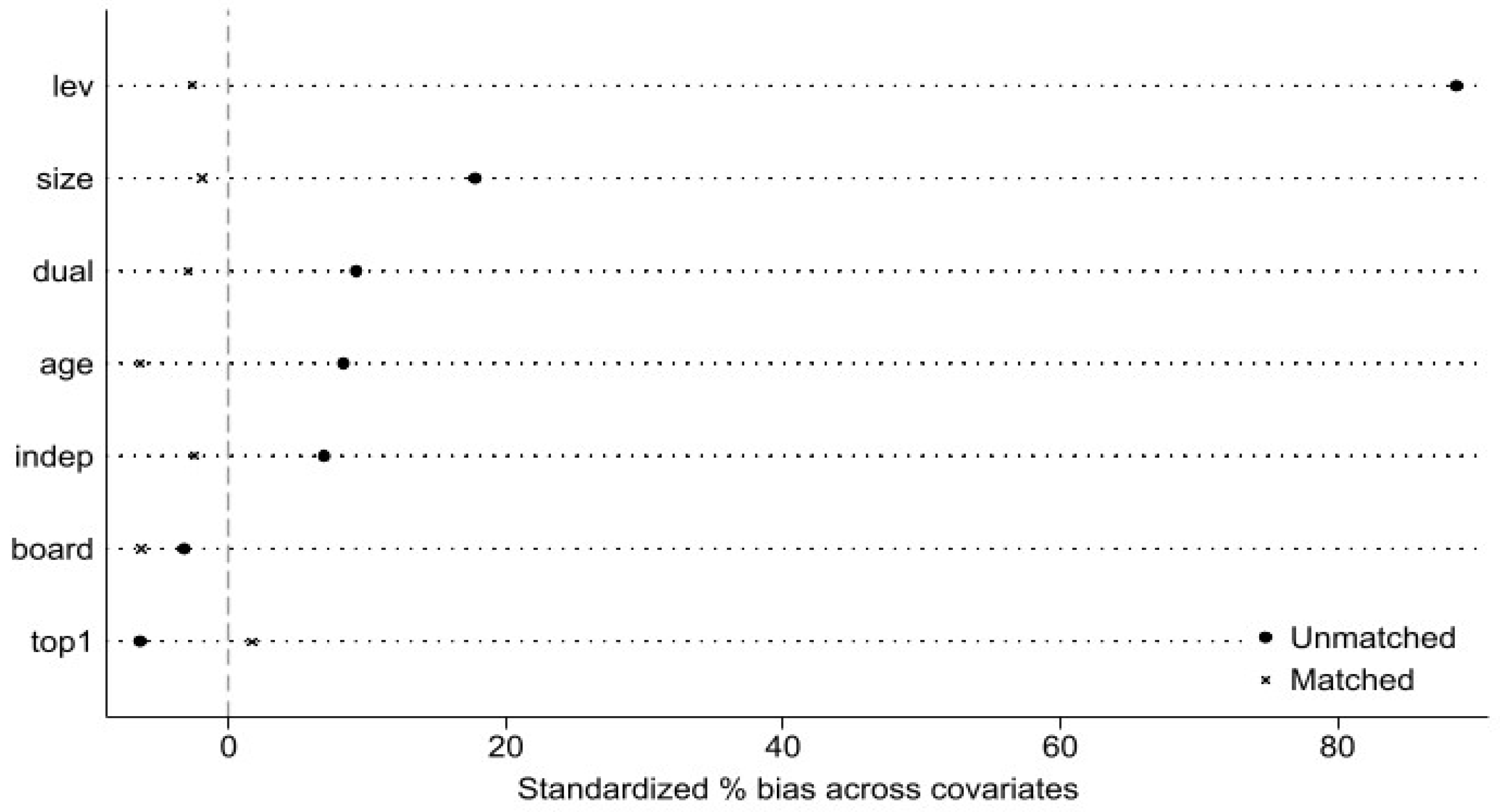
41], using board size, proportion of independent directors, ownership concentration, dual roles, firm size, firm age, and leverage ratio as matching covariates for robustness testing. A binary dummy variable is constructed to indicate whether a firm has patient capital, using the median value of patient capital as the threshold. The application of PSM mitigates sample selection bias and ensures comparability between the treatment and control groups.
Figure 1 illustrates that the standardized bias for each variable is substantially reduced after matching.
Regression results based on the matched sample are presented in Column (5) of
Table 4. The coefficient of patient capital on ESG performance increases to 0.098 and remains statistically significant at the 5% level, further confirming the reliability and robustness of the study’s core conclusion.
Finally, regarding the relationship between patient capital and ESG performance, the interaction is potentially bidirectional. On one hand, the presence of patient capital can enhance corporate ESG performance by providing long-term financial support, strategic guidance, and other resources. On the other hand, firms with strong ESG performance may attract greater attention and investment from patient capital due to their long-term development potential and effective risk management. This bidirectional relationship complicates the identification of the true causal effect using ordinary regression models. To address this potential endogeneity, this study employs the instrumental variable (IV) approach. Specifically, the one-period lag of patient capital is used as an instrument, and the two-stage least squares (2SLS) method is applied to test endogeneity.
The lagged patient capital satisfies both relevance and exogeneity requirements. Due to the path-dependent nature of patient capital, its lagged value influences the current level only through the inertia of capital structure, without directly affecting ESG performance, which is determined by contemporaneous resource allocation, policy responses, and other current factors.
As shown in the first-stage IV regression in Column (1) of
Table 5, the coefficient of lagged patient capital on current patient capital is 0.703, significant at the 1% level, with an F-statistic of 159.382, well above the empirical threshold of 10. This indicates strong instrument relevance and rules out weak instrument concerns. In the second-stage regression (Column 2), the estimated coefficient of patient capital on ESG performance is 0.280, significant at the 1% level. These results demonstrate that, after accounting for endogeneity, the core conclusion remains robust: patient capital significantly promotes corporate ESG performance, further reinforcing the reliability of the study’s findings.
4.5. Mechanism Regression
To examine the mediating role of financing constraints, this study considers multiple approaches to measure financing limitations. The SA index, constructed from the exogenous variables of firm age and firm size, offers superior exogeneity relative to alternative measures [
42]. Accordingly, the SA index is employed to assess a firm’s financing capacity. As shown in Column (1) of
Table 6, the regression results indicate that patient capital significantly alleviates financing constraints, supporting the second hypothesis that patient capital enhances ESG performance by easing financial limitations.
To investigate the mediating effect of R&D investment intensity, the ratio of R&D expenditure to operating revenue is used as a proxy for a firm’s R&D intensity [
43]. The results in Column (2) of
Table 6 reveal a coefficient of 0.783 for the effect of patient capital on R&D intensity, significant at the 1% level. These findings support the third hypothesis, suggesting that patient capital promotes ESG performance by increasing the intensity of R&D investment.
4.6. Further Research
Building on the previous analysis of patient capital and its overall impact on ESG performance, this section investigates whether and how this effect differs across firms with distinct characteristics, focusing on two key dimensions: market position and firm size.
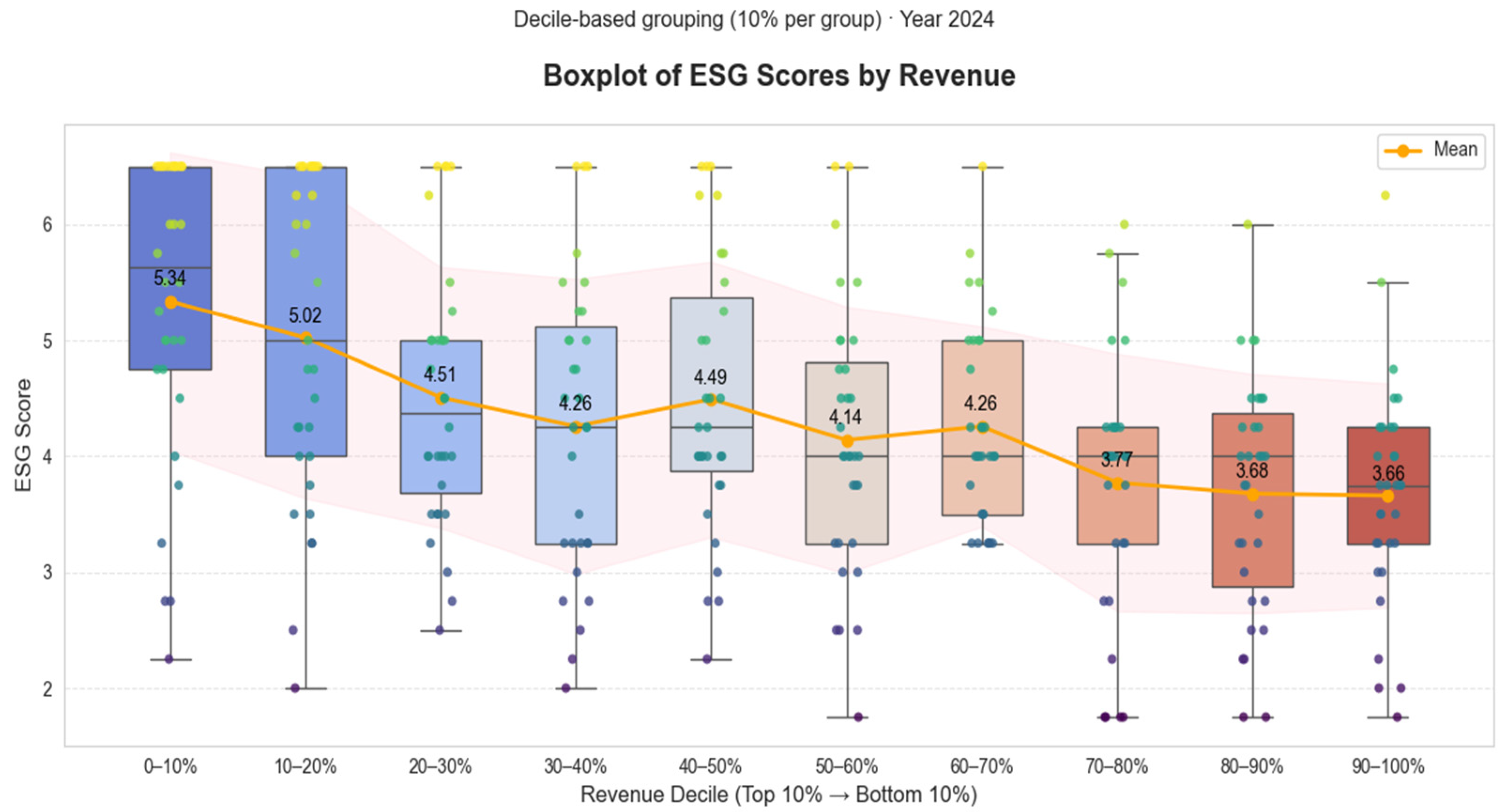
This section examines whether the effect of patient capital on ESG performance varies by market position, measured by annual operating revenue. Firms in the top 30% of revenue each year are classified as market leaders, with the rest as market followers [
44]. Regression results in Columns (1) and (2) of
Table 7 show that patient capital significantly improves ESG performance for market-leading firms, while the effect is not significant for market followers. These findings indicate that market-leading firms, with stronger governance and stakeholder expectations, are better able to leverage patient capital, supporting Hypothesis H4. In contrast, market-following firms face resource and competitive constraints that limit the impact of patient capital.
Figure 2 illustrates this heterogeneity, highlighting the significant effect for market leaders and the negligible effect for followers.
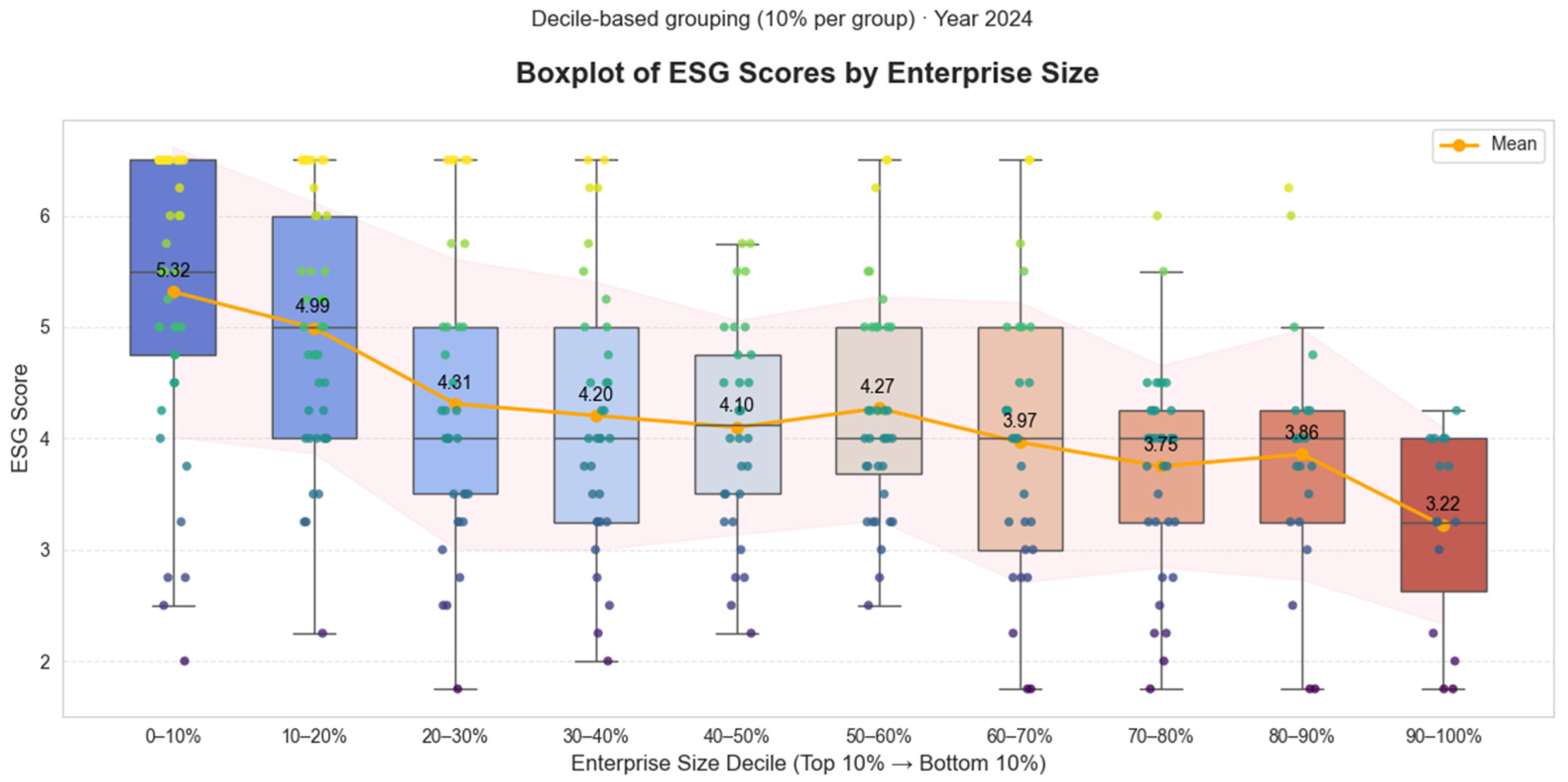
Companies in the top 50% of total assets each year are classified as large enterprises, with the remainder considered small and medium-sized enterprises (SMEs) [
45]. Regression results in Columns (3) and (4) of
Table 7 show that patient capital significantly enhances ESG performance for large enterprises (coefficient = 0.133,
p < 0.01), while the effect for SMEs is not significant. These results indicate that large firms, with abundant resources and mature governance structures, can effectively leverage patient capital to improve environmental, social, and governance outcomes, supporting Hypothesis H5. In contrast, SMEs face resource and execution constraints, limiting the impact of patient capital.
Figure 3 illustrates this heterogeneity, highlighting the significant effect for large firms and the negligible effect for SMEs.
5. Discussion
5.1. Research Conclusions
This study examines Chinese pharmaceutical manufacturing firms listed on the Shanghai and Shenzhen A-share markets from 2015 to 2024, focusing on the impact of patient capital on ESG performance, its underlying mechanisms, and heterogeneity across firms. The main conclusions are as follows:
Positive impact of patient capital: Patient capital substantially improves ESG performance by balancing short-term profit pressures with long-term value creation. These results are consistent with recent international studies [
19,
23], which demonstrate that long-term, value-oriented investments can foster corporate sustainable development.
Mechanisms: The effects primarily operate through alleviating financing constraints and increasing R&D investment. Patient capital mitigates information asymmetry and provides sustained support, enabling firms to engage in high-risk, long-cycle R&D projects.
Heterogeneity: The positive effect is significant mainly in large, market-leading firms, highlighting that resource endowments and governance structures are key determinants of patient capital effectiveness.
Overall, the findings enrich empirical evidence on the relationship between patient capital and corporate ESG performance in the pharmaceutical industry, offering practical insights for integrating capital market resources with sustainable development objectives. The results closely align with the core aims of the United Nations Sustainable Development Goals (SDGs): supporting R&D of affordable drugs and primary healthcare initiatives addresses “Good Health and Well-being” (SDG 3); promoting green technology R&D contributes to “Industry, Innovation, and Infrastructure” (SDG 9); and fostering long-term value creation aligns with “Responsible Consumption and Production” (SDG 12). Furthermore, the heterogeneity results regarding firm resource endowments and market position provide guidance for better matching capital allocation with ESG priorities, thereby supporting balanced sustainable development across the industry.
5.2. Practical Implications
Based on the derived empirical findings, this study provides practical implications for pharmaceutical enterprises, patient capital providers, and policymakers.
For pharmaceutical manufacturing firms, the introduction of patient capital should align with firm-specific development characteristics. Large and market-leading firms can leverage patient capital to support long-term ESG investments, including:
Environmental technology upgrading (e.g., energy-efficient production lines, chemical waste reduction, water recycling systems)
Rare disease drug development and innovative therapeutics
Sustainable supply chain management (e.g., eco-friendly raw material sourcing, low-emission logistics)
These initiatives enable firms to convert financial advantages into sustainable ESG competitiveness. For SMEs and market-following firms, it is crucial to first strengthen internal governance, technological capabilities, and regulatory compliance to enhance their capacity to absorb patient capital. Gradual implementation of targeted ESG projects—such as improving occupational safety, waste management, or local community healthcare initiatives—can lay the foundation for broader long-term ESG investments.
For patient capital providers, investment decisions should extend beyond short-term financial returns and prioritize firms’ ESG potential and long-term development value, particularly in sustainable technological innovation. Post-investment, capital providers should actively engage in corporate governance, support enhancements in ESG disclosure quality, and promote long-term evaluation mechanisms, thereby directing capital toward substantive ESG areas such as green production and public health.
For policymakers, targeted institutional arrangements are essential to facilitate the integration of patient capital and ESG practices in the pharmaceutical manufacturing sector. Policy tools such as tax incentives and fiscal subsidies can lower investment costs and mitigate risks, encouraging greater participation of long-term capital. Simultaneously, strengthening ESG disclosure standards and regulatory enforcement can help curb formalistic practices, ensure that capital is directed toward genuinely sustainable projects, and provide reliable information for patient capital investment decisions.
5.3. Research Limitations and Future Prospects
This study has several limitations. First, although the findings indicate that patient capital positively influences ESG performance, caution is warranted when generalizing these results to other samples or industries. In addition, patient capital may entail potential negative effects, such as path dependency, resource misallocation, or increased innovation risk associated with long-term, uncertain projects. Second, potential endogeneity issues may exist, as unobserved firm characteristics could simultaneously influence patient capital and ESG outcomes. Third, the analysis primarily focuses on financing constraints and R&D intensity, leaving other mechanisms, such as governance dynamics and supply chain collaboration, unexplored. Fourth, ESG performance is measured solely using the Huazheng ESG score, which may not fully capture qualitative or industry-specific sustainability practices, and its subjective evaluation criteria may limit international comparability. Fifth, the heterogeneity analysis is restricted to market position and firm size, excluding factors such as ownership, firm age, industry segmentation, and regulatory context, potentially introducing institutional context bias. Finally, the sample consists exclusively of Chinese pharmaceutical firms from 2015 to 2024, which may limit the generalizability of the findings.
Future research could expand cross-nationally, explore digital sustainability, carbon reduction, and SME access to patient capital, providing a more balanced assessment of both the benefits and potential risks of patient capital in regulated sectors.