Article

The Common Prosperity Effect of Integrated Urban Rural Development: Evidence from China
1
College of Economics and Management, Henan Agricultural University, Zhengzhou 450046, China
2
Institute of Rural Economy and Development, Chinese Academy of Agricultural Sciences, Beijing 100081, China
*
Author to whom correspondence should be addressed.
Sustainability 2026, 18(2), 683; https://doi.org/10.3390/su18020683
Submission received: 17 November 2025 / Revised: 31 December 2025 / Accepted: 7 January 2026 / Published: 9 January 2026

Abstract

Common prosperity is an essential requirement of socialism with Chinese characteristics for a new era. Problems caused by the urban rural dual structure, such as resource misallocation, ecological-economic imbalance, and insufficient farmer income growth, not only hinder common prosperity but also conflict with the sustainable development strategy. As the core path to break the dual structure and narrow gaps, the multi-dimensional impact and mechanism of urban rural integrated development on common prosperity need systematic verification. Based on panel data of 31 Chinese provinces from 2014 to 2023, this paper uses fixed-effects and mechanism test models to examine its direct, indirect, and spatial spillover effects, focusing on transmission mechanisms of wage, property, and operating incomes. Findings show: First, it exerts significant positive direct and cross-regional spillover effects on common prosperity; Second, wage and property incomes are key transmission paths, while operating income’s mediating effect is unclear; Third, effects vary geographically, stronger in eastern/central China, weaker in northeast China and insignificant in west China; Fourth, economic and spatial integration play prominent roles, social service integration has inhibitory effect, and ecological integration’s effect is under-released. Accordingly, this paper puts forward countermeasures to optimize resource allocation, tackle the rural operating income dilemma, advance regional coordination, and enhance equal social services, providing references for improving common prosperity policies and rural sustainable development.

1. Introduction

Common prosperity constitutes a core tenet of socialism with Chinese characteristics and Chinese modernization [1]. Currently, the most arduous task in advancing common prosperity for all remains in rural areas, focusing on improving the income level and development capacity of low-income rural households [2]. Sustained growth in farmers’ income and an enhanced sense of gain are core goals of rural common prosperity, making expanding farmers’ income channels and boosting income growth crucial for achieving common prosperity. Urban rural integration development is an indispensable path to the strategic goal of common prosperity in the new era and a key link in advancing sustainable rural development [3], aiming to address the long-standing urban rural development gap [4] rather than following traditional paths. General Secretary Jinping Xi emphasized at the Central Rural Work Conference that the top priority in building a strong agricultural country [5] is to remove institutional barriers restricting the free flow of factors such as land, capital, and technology between urban and rural areas; promote factor flow to rural regions; and break the urban rural dual structure [6,7]. Against this backdrop, exploring the mechanism of urban rural integration development in promoting common prosperity from multiple dimensions and proposing rational policy recommendations based on the inherent logical connection between common prosperity and urban rural integration development, and focusing on the contemporary goals of advancing common prosperity and building a strong agricultural country, is of great practical significance.
Against the backdrop of urban rural integration and sustainable development, residents’ wage income, property income, and operational income exert a significant impact on common prosperity. The core of common prosperity lies in the organic unity of equal opportunities, rights protection, and shared achievements, and the coordinated development of these three types of income is precisely the economic embodiment of this concept. Based on this, this paper uses the panel data of 31 provinces in China from 2014 to 2023 to explore the important significance of urban rural integration development for the realization of common prosperity and focuses on discussing the key role of farmers’ income growth in the process of urban rural integration to achieve common prosperity from the perspectives of wage income, property income, and operational income.

2. Literature Review

2.1. Research on Common Prosperity

In recent years, academic circles have conducted systematic research on the topic of common prosperity. Based on macro-level data, some scholars have constructed an evaluation index system for farmers’ and rural areas’ common prosperity and measured its development level, all pointing out that the overall level of common prosperity for farmers and rural areas in China remains low, with significant inter-regional disparities [8,9]. Other studies have explored the realization paths and influencing factors of common prosperity, revealing that emerging agricultural productive forces [10], digital technology application [11], return-home entrepreneurship [12], digital rural construction [13], characteristic agriculture development [14], rural industrial integration [15], and digital inclusive finance [16] all exert a significant facilitating effect on common prosperity.

2.2. Common Prosperity and Urban Rural Integration Development

Scholars have adopted quantitative research methods, including the global principal component analysis [17], spatial autocorrelation analysis [18], and entropy-weighted composite index method [19] to measure and evaluate the development level of urban rural integration across different regions. Combined with dimensions such as the era background of new-type urbanization and rural revitalization [20], the era requirement of digital technology empowerment [21], and the era task of policy supply and institutional reform [22], they have systematically expounded the realistic foundation and practical paths of urban rural integrated development.
On this basis, some studies have further focused on the inherent correlation between urban rural integration development and common prosperity, covering aspects such as the enabling mechanism of urban rural integration on common prosperity [23], the reverse impact of common prosperity process on urban rural integrated development [24], the inherent logical consistency between the two [25], the mediating role of Chinese-type modernization [26], and empowerment of common prosperity through narrowing the urban rural income gap [27].
However, most relevant studies remain at the level of theoretical interpretation. Few studies have empirically examined the moderating role of farmers’ income in the coordinated allocation of urban rural factors based on theoretical analysis. Meanwhile, systematic empirical exploration of the transmission mechanism through which urban rural integration promotes common prosperity remains limited.

3. Theoretical Analysis

3.1. Direct Effect of Urban Rural Integration on Common Prosperity

The core logic of the dual economic transformation theory lies in breaking the factor segmentation between traditional agriculture and modern non-agricultural industries and realizing integrated urban rural development through resource flow and productivity convergence [28]. The direct effect of urban rural integration on common prosperity is achieved by dismantling the dual-system barriers and facilitating a shift toward a unified economy. This is specifically reflected in the following four dimensions: First, the economic development dimension. In promoting urban rural integration, eliminating institutional barriers helps activate rural resources and assets, foster new industries and business formats [29], extend agricultural industrial chains, create employment opportunities, and expand farmers’ income channels [30]. It drives common prosperity by deepening urban rural industrial connections, upgrading agricultural labor, transforming the small-scale farming model, and promoting balanced economic development. Second, the ecological environment dimension. Central to urban rural ecological integration is the realization of a harmonious human-nature relationship. It optimizes resource allocation [31] and shares green well-being. Its core goal is to build an urban rural human settlement environment. This environment is integrated between urban and rural areas, ecologically livable, and features the coexistence of forests and waters. By strategically coordinating urban and rural ecological spaces, we can integrate urban capital and technology with rural ecological endowments. This guides green industries to rural areas, thus ensuring that “lucid waters and lush mountains” are continuously transformed into the “gold and silver mountains” of common prosperity. Third, the social services dimension. Urban rural integration serves as an effective means to extend public services to rural areas [32]. This not only accelerates the unification and integration of core social security systems (such as basic medical insurance, endowment insurance, and critical illness insurance) for urban and rural residents, but also expands the reach of high-quality educational resources. Fourth, the spatial integration dimension. To forge an urban rural whole with complementary functions, coordinated interests, and harmonious coexistence necessitates the integration required to transform the current dual economic structure. Its core lies in breaking the institutional barriers of the urban rural dual system through strengthening connections and promoting spatial integration [33], enabling urban and rural residents to share development achievements, and further advancing the process of common prosperity. Based on the above analysis, this paper proposes Research Hypothesis 1:
H1: 
Urban rural integration substantially advances common prosperity.

3.2. Indirect Effect of Urban Rural Integration on Common Prosperity

3.2.1. Concept Definition

Wage income refers to the labor remuneration obtained by residents through providing labor services, which is the direct return from the participation of labor factors in the production process.
Property income refers to non-labor income gained by residents through holding or disposing of property.
Operational income refers to the net income acquired by residents through independently engaging in production and business activities.

3.2.2. Mechanism of Wage Income

According to the Lewis Model, the core characteristic of a dual economy is the existence of a large surplus of labor with zero marginal product in the traditional agricultural sector [34]. The modern industrial sector can absorb this surplus labor through capital accumulation and offer remuneration higher than the subsistence wage in agriculture, thereby driving the transformation of the economic structure [35]. However, China’s urban rural dual structure features both productivity disparities and institutional attributes [36], which leads to impeded factor mobility and imbalanced income distribution. The key role of urban rural integration is to break institutional rigidity and activate the Lewis-style labor transfer mechanism. By eliminating household registration-related price discrimination and disparities in employment security, it accelerates the transfer of surplus agricultural labor to high-productivity modern sectors. This creates opportunities for farmers to obtain higher and more stable wage income, thereby increasing the share of such income in residents’ total income and improving the pattern of primary income distribution. At the same time, the integration of the labor market drives the convergence of wage levels for identical or similar jobs in urban and rural areas, narrowing both the absolute and relative gaps in wage income between urban and rural workers. This is not only a key manifestation of common prosperity. It also supports two goals by improving overall economic efficiency. One is achieving universal growth of wage income in the high-quality development stage; the other is laying a foundation for common prosperity.

3.2.3. Mechanism of Property Income

The long-standing urban rural dual structure in China impedes connections between developed and underdeveloped regions and between the urban and small-scale peasant economies. This severely constrains improvements in resident well-being and sustainable socioeconomic development [37,38]. Land has dual attributes as both a spatial carrier and a production factor, and its capacity to support human needs has long been debated [39]. Moreover, due to ambiguous property rights and inadequate circulation channels, rural land and other assets fail to effectively link up with capital in modern sectors, directly resulting in much lower returns on agricultural assets than on urban assets, which constitutes the core cause of persistent gaps in factor returns between urban and rural areas. Urban rural integration addresses this by deepening the reform of the property rights system. Measures such as the “three-right separation” of rural residential land and the market entry of collectively owned commercial construction land endow farmers with more complete property rights. This enables farmers to convert “idle assets” into tradable capital through leasing, equity participation, and mortgages. Meanwhile, it releases surplus rural labor, attracts the inflow of urban capital, and promotes the integration and circulation of urban and rural resources [40,41,42]. Based on this, farmers can not only expand income channels through property income but also realize the capitalization of rural resources by leveraging the synergy between property rights empowerment and transaction cost reduction. This allows them to obtain land value-added returns and equity dividends, optimize their income structure, secure income rights, and narrow the urban rural income gap [43]. This constitutes a crucial path to achieving common prosperity.

3.2.4. Mechanism of Operating Income

From the perspective of dual economic transformation, the Ranis-Fei model points out that “low agricultural productivity leads to low marginal output, thereby resulting in meager operating income”. This indicates that the fundamental reason for the low level of rural operating income lies in the low productivity of the traditional agricultural sector. Urban rural integration facilitates the free flow of capital, technology, and information between regions [44], creating conditions for increasing rural operating income and improving operational efficiency. However, due to the “phased characteristics” of dual economic transformation, the improvement of agricultural productivity often relies on long-term and continuous factor input. Meanwhile, modern agriculture has relatively high requirements on the capital and technology thresholds of business entities. Efficient production, risk resistance, and integration into the modern industrial chain require substantial capital investment, which poses an expansion barrier for small and micro business entities with weak financial strength and restricts their ability to take advantage of opportunities and policies to improve their operational level. More importantly, inherent characteristics of agriculture itself—such as fluctuations in agricultural product prices, natural risks, and asymmetric market information—render agricultural income highly volatile. This makes it difficult for business entities to formulate stable plans and conduct continuous investment, weakening the substantive effect of urban rural integration on increasing rural operating income.
Therefore, this paper proposes the following three hypotheses:
H2: 
Urban rural integration boosts wage income, advancing common prosperity.
H3: 
Urban rural integration raises property income, supporting common prosperity.
H4: 
Urban rural integration lifts operating income, yet its contribution to common prosperity remains limited.

3.3. The Spatial Spillover Effect of Urban Rural Integration on Common Prosperity

From a spatial perspective, regional economic development features both polarization and backwash effects as well as trickle-down and diffusion effects. Thus, the economic activities of a region can exert positive or negative impacts on neighboring areas as an exogenous factor through externalities [45]. The enabling effect of urban rural integration development on promoting common prosperity in surrounding regions, realized through cross-regional factor flows, industrial collaborative radiation, public service sharing, institutional innovation diffusion, and other channels, is defined as a positive spatial spillover effect. Conversely, if it fails to boost or even hinders common prosperity in neighboring regions, it is regarded as a negative spatial spillover effect.
A large body of literature in spatial economics and new economic geography has confirmed that the positive spillover of economic growth in adjacent regions has become a crucial external driver of a region’s economic growth [46,47]. Based on the diffusion theory and trickle-down effect theory of spatial economics, urban rural integration development breaks down regional and urban rural development barriers, facilitating the gradient transmission of development dividends from core regions to surrounding areas, and thereby driving and empowering common prosperity in these surrounding regions.
Accordingly, this paper proposes Research Hypothesis 5:
H5: 
The positive spatial spillover effect of urban rural integration on common prosperity.
On one hand, while dismantling institutional barriers such as household registration restrictions and capital mobility constraints, urban rural integration also induces the agglomeration of production factors (e.g., high-quality labor, scarce capital, and advanced technologies) in surrounding regions toward core areas, resulting in factor outflow from the periphery. In the absence of effective mechanisms for equal participation in development and shared access to the fruits of growth, the growth dividends generated by urban rural integration fail to spill over to surrounding areas. Instead, they exacerbate regional development gaps through spatial transmission.
On the other hand, despite boosting industrial coordination, core regions leverage their advantages in technology, capital, and branding to seize high-end links in the industrial chain and establish monopolies. This locks surrounding regions into supporting functional zones characterized by low value-added and high resource consumption. Meanwhile, industrial upgrading in core regions exerts a crowding-out effect on homogeneous industries in neighboring areas, hindering the cultivation of local characteristic industries and the upgrading of their value chains, which further widens the income gap across regions.
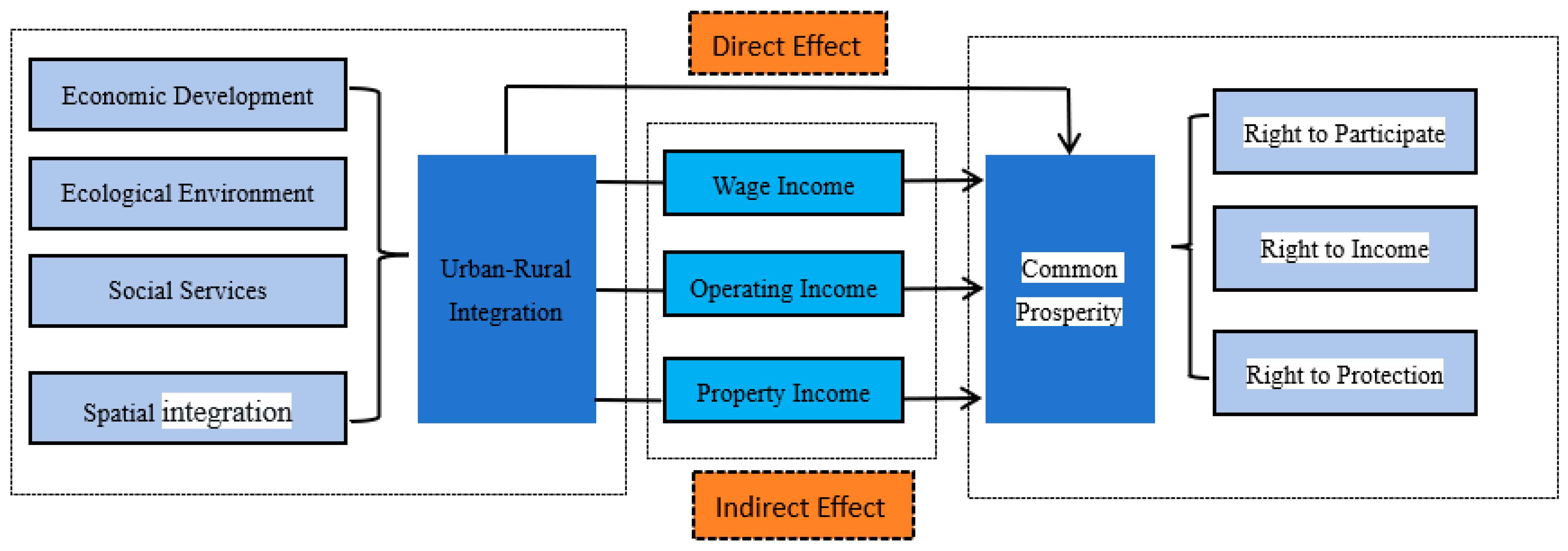
Accordingly, this paper proposes Research Hypothesis 6 (Figure 1):
H6: 
The negative spatial spillover effect of urban rural integration on common prosperity.

4. Research Design

4.1. Model Specification

To test the direct effect of urban rural integration development on common prosperity, a baseline regression model is constructed, with the specific formula as follows:
C p it = α 0 + α 1 U r b a n i t + α j X j i t + V t + ε i t
In the aforementioned model, C p i t represents the level of common prosperity in the region i during the period t ; U r b a n i t denotes the level of urban rural integration development in the region i during the period t ; X i t refers to the set of selected control variables; α 1 is the regression coefficient reflecting the impact of urban rural integration development on common prosperity; V t controls for the individual heterogeneity across provinces; ε i t stands for the random error term.
Furthermore, to test the mediating role of wage income, property income, and operational income in the relationship between urban rural integration development and common prosperity, additional mechanism models (Equations (2) and (3)) are constructed for verification:
M i t = β 0 + β 1 U r b a n i t + β j X j i t + V t + ε i t
C p i t = γ 0 + γ 1 U r b a n i t + γ 2 M i t + γ j X j i t + V t + ε i t
Among them, M represents the mediating variables, which are wage income, property income, and operational income, respectively. Equations (1)–(3) together constitute a complete mediating effect model. If α 1 in Equation (1) is significant, and both β 1 in Equation (2) and γ 1 in Equation (3) are significant, it indicates that the mediating effect exists.

4.2. Variable Definition

4.2.1. Dependent Variable: Common Prosperity

Numerous studies have shown that common prosperity is closely related to the rights allocation in terms of production performance, income, consumption, and basic public services. From the perspective of rights allocation, this paper draws on existing research [48] to construct an indicator system for measuring common prosperity, covering three key dimensions: right to participation, right to income, and right to security. Participation rights are measured by the input of labor and capital in production. Centering on three core areas—labor employment, human capital, and agricultural infrastructure—these indicators focus on measuring laborers’ participation opportunities and capabilities, capital investment levels, and rural residents’ agricultural production capacity so as to comprehensively reflect the depth and breadth of various production factors involved in economic activities. The selection of income rights indicators focuses on income distribution and consumer demand, adopting the total wage index of employed persons, per capita GDP, and the month-on-month growth rate of total retail sales of consumer goods as the measurement metrics. The selection of security rights indicators takes safeguarding the basic subsistence and development rights of all citizens as the core. From the dimension of public service supply, it includes five categories of tertiary indicators covering cultural education, mobile communications, and environmental greening. Among these, the right to participation and the right to income serve as direct drivers for improving the overall level of prosperity, while the right to income and the right to protection directly affect the degree of sharing, determining the effectiveness of achieving common prosperity. Details are presented in Table 1. On this basis, the entropy method is used to conduct dimensionality reduction and objective weighting for each indicator, thereby calculating the level of common prosperity.

4.2.2. Explanatory Variable: Urban Rural Integration Development

Drawing on relevant studies [26], this paper constructs an evaluation index system for measuring urban rural integration development from four dimensions—economic development, ecological environment, social services, and spatial integration—using the entropy method. The specific index system is presented in Table 2.
First, the economic development dimension selects four indicators: the proportion of non-agricultural output value, urbanization level, per capita private car ownership, and the urban rural household consumption ratio. The output value of non-agricultural industries measures the degree of industrial structure upgrading and economic transformation, serving as the core driver of integrated urban rural economic development. The urbanization level reflects the urbanization process from a demographic perspective, directly embodying the dynamic changes in the urban rural structure. Per capita private car ownership indirectly indicates the level of urban rural economic development, the connectivity of infrastructure, and residents’ income capacity. The urban rural household consumption ratio intuitively reveals the gap in living standards and market vitality between urban and rural residents. Second, the ecological environment dimension includes forest coverage rate, harmless treatment rate of domestic waste, the proportion of environmental protection expenditure in GDP, and green coverage rate of built-up areas. Forest coverage rate and green coverage rate of built-up areas represent the level of urban rural natural ecology and the quality of living environments. The harmless treatment rate of domestic waste reflects the balance of environmental infrastructure and management capacity between urban and rural areas. The proportion of environmental protection expenditure reflects the government’s investment intensity and policy orientation for ecological conservation. In addition, the social service dimension focuses on two indicators: the urban rural endowment insurance coverage rate and the urban rural per capita medical security comparison coefficient. Endowment insurance and medical insurance are key components of basic public services, and their coverage scope and benefit levels are directly related to the vital interests of urban and rural residents and social equity. Finally, the spatial integration dimension focuses on two aspects: urban spatial expansion and urban rural transportation and communication. Urban spatial expansion reflects the changes in land use during urbanization and its spatial impact on surrounding rural areas. Urban rural transportation and communication reflect the level of infrastructure connectivity, which directly affects the efficiency of factor flow and the frequency of urban rural interactions.

4.2.3. Mechanism Variables

Based on the theoretical analysis above, wage income, property income, and operational income are selected as the mechanism variables. The levels of wage income, property income, and operational income are measured by the logarithmically transformed per capita wage income, per capita property income, and per capita operational income of residents, respectively.

4.2.4. Control Variables

Drawing on existing studies [49,50] and considering data availability, this study selects educational level, foreign direct investment, education expenditure, industrial structure, and health human capital as control variables. These variables control for key dimensions influencing common prosperity, including human capital, capital input, public services, and industrial development. They have reasonable theoretical connections with the core explanatory variable (urban rural integration) and can effectively mitigate omitted variable bias. Furthermore, this study employs the econometric software packages StataMP17 and StataMP18 to conduct empirical estimations on the theoretical model.

4.3. Variable Description and Descriptive Statistics

The study employs panel data covering 31 Chinese provincial-level regions (excluding Hong Kong, Macao, and Taiwan) from 2014 to 2023, sourced from the National Bureau of Statistics and the EPS Data Platform. Missing values were supplemented using linear interpolation. Descriptive statistics are presented in Table 3. The common prosperity index has a mean of 0.278 (range: 0.178–0.497), reflecting a generally favorable national level. The urban rural integration index averages 0.163 (range: 0.0504–0.806), indicating substantial regional disparities across China.

5. Empirical Results and Analysis

5.1. Benchmark Regression Analysis

The direct effect is tested empirically using Equation (1), with results shown in Table 4. Columns (1) and (2) present the OLS regression estimates. The regression coefficient for urban rural integration is positive and statistically significant at the 1% level, confirming its substantial role in promoting common prosperity. Due to significant inter-provincial disparities in both urban rural integration and common prosperity, this study further conducts regression analyses using both fixed-effects and random-effects models. The Hausman test results indicate that the urban rural integration coefficient remains significant at the 1% level regardless of controls, suggesting potential bias in the random-effects model. Therefore, the fixed-effects model is selected for further analysis. The regression results in Column (3) show that the regression coefficient of urban rural integration is significantly positive (0.7035) at the 1% level, indicating that urban rural integration can significantly promote common prosperity. After adding control variables in Column (4), the regression coefficient of urban rural integration still passes the significance test at the 1% level, with a positive coefficient (0.3040), so Hypothesis 1 is initially established. Among the control variables, the regression coefficients of educational level and educational expenditure pass the significance test at least at the 5% level, and the coefficients are positive, indicating that the improvement of educational level and the increase in educational expenditure can promote the realization of common prosperity. This may be because reducing the educational costs of disadvantaged families through fiscal transfer payments and special subsidies reduces the intergenerational transmission of poverty, enhances the fairness of education, and helps to solidly advance common prosperity. The regression coefficient for foreign direct investment (FDI) is significantly positive at the 10% level, indicating that FDI contributes to common prosperity. This is primarily because FDI directly stimulates GDP growth through capital investment, technology transfer, and industrial upgrading, which lays the economic foundation for achieving common prosperity. The regression coefficients of industrial structure and human capital do not pass the significance test. The possible reasons are that regional heterogeneity has not been decomposed and the time span is insufficient, resulting in a short data time window.

5.2. Mechanism Test

To test the mediating effects of wage income, property income, and operating income mentioned above, this section uses the stepwise regression method with the mechanism model shown in Formulas (2) and (3) for testing. Since the results of regressing each equation individually are biased, the mediating effect model also needs to be tested using the bootstrap method. The results are shown in Table 5.
Regressions (1) and (2) show the test results for wage income, regressions (3) and (4) for property income, and regressions (5) and (6) for operating income. Regression (1) shows that urban rural integration has a significantly positive effect on wage income (0.5202). Regression (2) further indicates that wage income significantly promotes common prosperity (0.1422). These results jointly demonstrate that urban rural integration fosters common prosperity through its positive impact on wage growth. Combining the results of regressions (1) and (2), it is not difficult to find that urban rural integration directly increases wage income by promoting the integration and optimization of the labor market, thereby promoting the realization of common prosperity. Regression (3) shows that urban rural integration significantly increases property income (0.6235). Regression (4) further confirms that property income promotes common prosperity (0.1703). Combining regressions (3) and (4), it can be concluded that urban rural integration increases property income by promoting industrial integration and value-added, thereby promoting the realization of common prosperity. Regressions (5) and (6) reflect the mechanism of operating income in the common prosperity effect of urban rural integration. The regression coefficient of urban rural integration on operating income in regression (5) is not significant, indicating that the mediating role of operating income has not yet been manifested. This may be due to the combined effect of structural imbalance in the urban rural factor market and institutional frictions. On the one hand, vague rural land property rights, financial repression, and backward digital infrastructure form rigid constraints, making it difficult for business entities to break vicious cycle of low profit returns caused by low capital accumulation; on the other hand, the deep division of the industrial value chain and factor misallocation exacerbate transmission blockages, making it difficult for operating income to effectively undertake the value-added potential of urban rural factor flow. In conclusion, Hypothesis 2, Hypothesis 3, and Hypothesis 4 are verified.

5.3. Heterogeneity Test

5.3.1. Regional Heterogeneity Test

Regional disparities in economic, social, and cultural conditions lead to varying levels of urban rural integration, thus likely resulting in differentiated effects on common prosperity across regions. To verify the existence of regional heterogeneity, based on the classification standards of China’s National Bureau of Statistics, this study categorizes the 31 provincial-level administrative regions into four major areas: Eastern, Central, Western, and Northeast. The regression results, presented in Table 6, indicate that the effect of urban rural integration on common prosperity exhibits significant regional heterogeneity.
Against the backdrop of China’s in-depth implementation of the regional coordinated development strategy, eastern and central regions have unleashed robust development momentum by virtue of their resource endowments, steadily elevating the level of balanced regional economic development. Relevant policy orientations and institutional designs have effectively activated the endogenous drivers of urban rural integration in these two regions. They not only advance the coordinated implementation of the new-type urbanization and rural revitalization strategies but also significantly narrow gaps in urban rural infrastructure, public services, and income levels. This has effectively enhanced the sense of gain and happiness of low- and middle-income groups, laying a solid practical foundation for common prosperity. Thus, urban rural integration exerts a statistically significant facilitating effect on common prosperity in eastern and central regions. In the northeastern region, insufficient vitality of county-level economies and the long-standing population siphoning effect have aggravated the conflicts of the urban rural dual structure, impeding the two-way flow and optimal allocation of urban rural factors. As a result, the facilitating effect of urban rural integration on common prosperity here is relatively weak.
For the western region, the regression coefficient of urban rural integration on common prosperity fails to pass the significance test, attributable to two factors. First, western rural areas are dominated by traditional agriculture, with underdeveloped integrated industries such as agricultural product processing and digital agriculture. Lacking stable industrial carriers, urban rural integration cannot drive rural residents’ income growth and narrow urban rural gaps through industrial chain coordination. Moreover, affected by unbalanced regional development, high-quality factors like a young labor force and private capital are continuously siphoned by eastern developed areas and provincial central cities, further undermining the positive supporting role of urban rural integration in local common prosperity. Second, most western areas face rigid eco-protection constraints, with some being ethnic minority regions or underdeveloped counties. The precision and implementation efficiency of urban rural integration policies are constrained by insufficient financial input and poor policy adaptability. In addition, the improvement of common prosperity relies on long-term factor accumulation and institutional improvement, and the policy effect of urban rural integration may not have formed a sustained transmission during the sample period. All these ultimately lead to the insignificant regression coefficient of urban rural integration on common prosperity.

5.3.2. Dimensional Heterogeneity Test

This paper explores the common prosperity effect of integrated urban rural development from four sub-dimensions: economic development, ecological environment, social services, and spatial integration. Each sub-dimension is calculated using the entropy method. The specific results are shown in Table 7.
The results of the fixed-effect model show that the impact coefficients of the two sub-dimensions of economic development and spatial integration in urban rural integration on common prosperity are positive and pass the significance test at the 1% level, indicating that both economic development and spatial integration can promote the realization of common prosperity, and the promoting effect of economic development on common prosperity is stronger.
The impact coefficient of social services on common prosperity is significantly negative at the 5% level; that is, the social service sub-dimension inhibits the realization of common prosperity. Specifically, its mechanism of action is mainly reflected in the following three aspects: First, there are significant urban rural disparities in the quality of educational resources. The inadequate basic education for rural children and the slow update of labor skills have directly widened the intergenerational income gap, making it difficult for low-income groups to achieve sustained income growth by improving human capital. Second, the cost-sharing mechanism for medical and elderly care services is unbalanced, and the bottom-line guarantee function of social security is insufficient. Accordingly, a significant portion of disposable income for low-income rural households is directed toward essential public services, severely crowding out resources for productive investment and development, which in turn deepens the cycle of poverty. Third, the supply of productive social services in rural areas is inadequate. Meanwhile, the “siphon effect” formed by the concentration of high-quality public services in cities not only inhibits the improvement of agricultural production efficiency and rural industrial integration but also accelerates the outflow of the young and middle-aged labor force, further intensifying the problem of rural hollowing-out. This means that rural residents face difficulties in accessing high-quality public services and resources, which objectively widens the urban rural development gap [51].
The impact coefficient of the ecological environment on common prosperity fails to pass the significance test. This may be because the public good attribute of ecological environment governance leads to strong spillover effects of its effects, which are difficult to be directly converted into income growth or welfare improvement perceivable by residents in the short term, and there is a certain spatial mismatch between ecological environment governance and economic development [52,53].

5.4. Endogeneity Test and Robustness Test

5.4.1. Endogeneity Test

To mitigate endogeneity, this study employs a system GMM model, using the dependent variable with a one-period lag. The test results show that the significance levels of the Hansen over-identification test are all higher than 10%, indicating that instrumental variables meet the exogeneity condition and the selection of instrumental variables is valid. At the same time, there is significant first-order autocorrelation in the model residuals. The above test results together prove that the system GMM model setting is reasonable. The results are shown in Table 8. The estimated impact of urban rural integration on common prosperity aligns with the baseline regression results, confirming the robustness of our earlier findings.

5.4.2. Robustness Test

To ensure robustness, this study conducts robustness tests by recalculating the core variable and excluding municipalities directly under the Central Government.
First, replace the calculation method. Re-estimation is carried out using the Least Squares Dummy Variable (LSDV) method. The results are shown in Table 8. The impact directions and significance of the regression coefficients of each variable are consistent with the previous results, indicating that the results of the benchmark regression model have strong robustness.
Second, excluding the samples of municipalities directly under the Central Government. Since the level of urban rural integration and common prosperity in provincial capitals and prefecture-level cities is relatively high, which may affect the identification results, the samples of the four municipalities directly under the Central Government (Beijing, Tianjin, Shanghai, and Chongqing) are excluded. Table 8 presents consistent results after excluding centrally administered municipalities, which align with the baseline regression. This confirms that urban rural integration robustly promotes common prosperity.

5.5. Test of Spatial Spillover Effect

Given the potential spatial fragmentation among provinces, this study draws on the research approach of Wang et al. [54] and conducts an empirical test by constructing a spatial weight matrix. The results show that under the spatial geographical distance matrix during 2014–2023, the Moran’s I indices of common prosperity and urban rural integration are significantly positive at least at the 10% significance level, indicating a potential spatial correlation between urban rural integration and common prosperity.
This paper determines the appropriate spatial econometric model specification through a series of tests. First, the LM test confirms significant spatial dependence in both the error term and the lagged term at the 1% level, supporting the use of a spatial model. Second, the Hausman test (0.000) and the LR test favor the double fixed-effects specification. Finally, LR and Wald tests both reject the null hypothesis that the Spatial Durbin Model (SDM) can be simplified to either the SAR or the SEM. Therefore, the individual fixed-effects SDM is selected for empirical analysis.
As shown in Table 9, the spatial autocorrelation coefficient is significantly positive (0.351), which strongly supports the presence of spatial spillover effects. Verifying the spatial agglomeration feature of common prosperity, that is, the higher the level of common prosperity in neighboring provinces, the higher the level of common prosperity in this province. From the perspective of effect decomposition, first, the direct effect is significantly positive (0.074), indicating that local urban rural integration directly improves the local level of common prosperity through mechanisms such as factor mobility and equalization of public services. Second, the indirect effect is significantly negative (−0.548), reflecting the negative spillover of urban rural integration in neighboring provinces on local common prosperity. Regions with a higher degree of urban rural integration in the vicinity attract the outflow of high-quality local labor and capital, inhibiting local rural development and income growth. Third, the total effect is significantly negative (−0.473), suggesting that although local urban rural integration exerts a positive impact, the negative spillover from neighboring regions is stronger, resulting in an overall negative effect. Therefore, Hypothesis 5 is not supported, while Hypothesis 6 is validated. The above results are consistent with the current development reality of urban rural integration in China, revealing the spatial imbalance in the process of urban rural integration promoting common prosperity and providing empirical evidence for the subsequent optimization of regional coordinated development policies.

6. Conclusions, Discussion, and Policy Recommendations

6.1. Conclusions

Taking 31 provincial-level administrative regions in China (excluding Hong Kong, Macao, and Taiwan) as the research sample, this paper tests the direct effect, indirect effect, and spatial spillover effect of integrated urban rural development on common prosperity and analyzes the mediating mechanisms of wage income, property income, and operating income. The results show the following:
First, integrated urban rural development has a significant promoting effect on common prosperity, but the roles of different income types are differentiated. Urban rural integration promotes common prosperity by increasing wage income and property income; however, due to factors such as unbalanced allocation of urban rural resources and differences in the market competition environment, operating income has not yet exerted its mechanism role.
Second, there exists regional heterogeneity in the common prosperity effect of urban rural integration: its impact on common prosperity is stronger in the eastern and central regions, relatively weaker in the northeastern region, and not yet manifested in the western region.
Third, there exists dimensional heterogeneity in the promoting effect of urban rural integration on common prosperity: economic development and spatial layout can facilitate the realization of common prosperity, social services inhibit it, and the impact of the ecological environment has not yet manifested in the short term.
Fourth, urban rural integration exerts a negative spatial spillover effect on common prosperity. While urban rural integration significantly promotes the development of local common prosperity, it simultaneously inhibits that of adjacent regions.
Urban rural integration development provides key support for sustainable development by advancing common prosperity. The theoretical and empirical findings above indicate that urban rural integration can effectively promote common prosperity, thereby contributing to the achievement of the Global Sustainable Development Goals. In this process, farmers’ wage income, property income, and operational income serve as core mediating variables, and their growth directly affects the effectiveness of urban rural integration in promoting common prosperity. It is worth noting that the impact of urban rural integration on common prosperity exhibits spatial heterogeneity, with local effects differing from inter-regional spillover effects. Therefore, policy design should emphasize the role of the aforementioned three types of income and implement differentiated strategies and cross-regional coordination based on the resource endowments and development foundations of different regions (e.g., eastern and western China). These empirically based findings can provide solid support for formulating specific policies and fully realizing the Sustainable Development Goals.

6.2. Further Discussion

This paper empirically examines the impact and transmission channels of urban rural integration development on common prosperity, with its core conclusions highly consistent with existing studies on urban rural coordinated development and inclusive growth at home and abroad.
Regarding the positive driving effect and spatial spillover effect of urban rural integration on common prosperity, the findings of this paper are in full alignment with the mainstream consensus worldwide. Domestic studies have generally confirmed that the unimpeded flow of urban rural factors significantly narrows urban rural gaps and facilitates common prosperity [26], with spatial spillover effects observed at the provincial level. Although there is no direct equivalent for “common prosperity” in international academia, studies focusing on urban rural integration and inclusive growth have verified that breaking urban rural dual barriers promotes regional income equalization, and the factor radiation effect of core regions on surrounding areas is universally applicable across countries [55].
In terms of transmission channels via income structure, this paper validates the core mediating role of wage income and property income, which is consistent with domestic and international research consensus. Meanwhile, the finding that “the mediating effect of operating income has not yet emerged” provides a differentiated supplement to existing literature. Domestic studies mostly hold that wage income driven by non-agricultural employment and property income empowered by land system reform are key paths for urban rural integration to increase rural incomes. International evidence also indicates that the rise in non-agricultural income brought by urban rural integration is a common path to narrowing urban rural gaps [56]. The non-verified mediating effect of operating income in this paper is attributed to practical constraints such as the low added value of smallholder scattered management and the unbalanced distribution of premiums in agricultural product circulation. This finding supplements the boundary conditions of operating income’s transmission role and improves the mechanism chain of urban rural integration, facilitating income equity.
In conclusion, the findings of this study not only confirm the international common law of urban rural integration promoting regional equity but also highlight the uniqueness of the Chinese context, thus providing experience references from a major developing country for global urban rural coordinated development.

6.3. Policy Recommendations

Urban rural integration is a process of breaking the dual urban rural structure and promoting the free flow and equal exchange of urban rural factors, which plays a fundamental role in realizing common prosperity. Based on the above conclusions, to better stimulate the vitality of the two-way flow of urban rural factors and solidly promote common prosperity, the following policy recommendations are put forward:
First, optimize resources and the environment to solve the dilemma of rural operating income. Strengthen policy support for rural business entities, promote the tilt of agricultural subsidies, credit, technology, and other resources to rural areas, and formulate differentiated support policies according to the needs of different rural business entities; standardize the rural market competition environment, improve the market service system, establish a monitoring and early warning mechanism for agricultural product prices, release market supply and demand information in a timely manner, guide business entities to adjust production plans reasonably, and avoid income risks caused by blind planting. At the same time, promote the establishment of rural industry associations, formulate industry standards, and promote fair competition and harmonious development among operators.
Second, promote regional urban rural integration in a targeted manner to narrow regional gaps. For the western and northeastern regions, emphasis should be placed on improving the quality of urban rural integration and advancing industrial transformation and upgrading. Based on their resource endowments and development weaknesses, the western region should focus on optimizing the equalized supply of public services and fostering integrated carriers for characteristic industries so as to strengthen the enabling role of urban rural integration in promoting common prosperity. For the northeastern region, leveraging its agricultural resource advantages, efforts should be made to accelerate the transformation of traditional agriculture toward modernization. For eastern and central regions, sustained investment in urban rural integration is essential. Efforts should focus on advancing transport and water conservancy infrastructure, strengthening industrial support, and further leveraging integration’s role in promoting common prosperity.
Third, improve the supply level of social services to break through the practical difficulties hindering common prosperity. Promote the sinking of high-quality resources, improve the social service supply mechanism, solve the weak problems of rural education, medical care, and elderly care facilities, and establish a mechanism for urban high-quality service resources to support rural areas. Organize key urban schools to carry out “school-to-school” cooperation with rural schools, and share educational resources through teacher rotation and distance education; arrange experts from top-tier urban hospitals to regularly go to rural areas for diagnosis and teaching to improve the level of rural medical teams; guide urban elderly care institutions to provide professional guidance for rural elderly care services through trusteeship and cooperation, so that rural residents can enjoy high-quality services nearby, improve the fairness and accessibility of social services, and help realize common prosperity.

6.4. Limitations and Future Research

While this paper makes contributions to existing research, it still has certain limitations, as follows.
First, this paper adopts a provincial-level panel data framework, which may mask the heterogeneous effects of urban rural integration on common prosperity at the county or township level. For instance, the mechanisms through which industrial integration and equalization of public services drive common prosperity may differ significantly between developed suburban counties and underdeveloped rural areas within the same province, and such micro-level heterogeneities cannot be fully captured by aggregated provincial data.
Second, this paper uses data from 2014 to 2023. Time lags may exist in policy responses within the sample period, thus leading to notable variations in the regional heterogeneity identified herein. Extending the research timeframe to include post-2023 data would enable an assessment of the long-term sustainability of the effects.
Finally, the research scope should extend to cross-national comparisons. Leveraging international practices in urban rural integration and common prosperity (e.g., rural development policies of Europe, Japan, and South Korea) offers valuable insights for refining China’s regional development strategies. Such comparisons can enrich the theoretical literature on common prosperity and provide practical implications for global balanced and sustainable development.

Author Contributions

Methodology, J.H.; Writing—original draft, Y.J.; Writing—review & editing, J.H., J.W. and J.D. All authors have read and agreed to the published version of the manuscript.

Funding

This research was funded by National Social Science Foundation Project, “Research on the Impact of Monetary Policy on Heterogeneous Household Income Disparities and Countermeasures”, grant number [21CJL006]; The General Project of Philosophy and Social Sciences of Henan Province, “Research on the Agricultural Ecological Compensation Incentive Mechanism in Major Agricultural Product Producing Areas”, grant number [2023BJJ044]. And The APC was funded by Juan Wang.

Institutional Review Board Statement

Not applicable.

Informed Consent Statement

Not applicable.

Data Availability Statement

The data presented in this study are available on request from the corresponding author.

Conflicts of Interest

The authors declare no conflict of interest.

References

  1. Xie, T.; Zhang, Y.; Song, X. Research on the spatiotemporal evolution and influencing factors of common prosperity in China. Environ. Dev. Sustain. 2024, 26, 1851–1877. [Google Scholar] [CrossRef]
  2. Zhang, Q.Z.; Ye, Z.Y. Coordinating Regional Development as a Solid Foundation for Common Prosperity. China Econ. 2022, 17, 26–49. [Google Scholar]
  3. Liu, Y.; Li, Y. Revitalize the world’s countryside. Nature 2017, 548, 275–277. [Google Scholar] [CrossRef]
  4. Ma, L.; Liu, S.; Fang, F.; Che, X.; Chen, M. Evaluation of urban-rural difference and integration based on quality of life. Sustain. Cities Soc. 2020, 54, 101877. [Google Scholar] [CrossRef]
  5. Geng, P.P.; Luo, B.L. Building an agricultural powerhouse in the New Journey of Chinese Path to Modernization: Transformation of Development Model from Product Production to Social welfare. South China J. Econ. 2023, 42, 1–14. (In Chinese) [Google Scholar] [CrossRef]
  6. Peng, J.; Hu, Y.; Liu, Y.; Ma, J.; Zhao, S. A new approach for urban-rural fringe identification: Integrating impervious surface area and spatial continuous wavelet transform. Landsc. Urban Plan. 2018, 175, 72–79. [Google Scholar] [CrossRef]
  7. Chen, K.; Long, H.; Liao, L.; Tu, S.; Li, T. Land use transitions and urban-rural integrated development: Theoretical framework and China’s evidence. Land Use Policy 2020, 92, 104465. [Google Scholar] [CrossRef]
  8. Ma, X.J.; Wang, M.Y.; Yu, Y.B.; Fan, W.J. Research on the Regional Differences and Spatial-temporal Evolution Characteristics of Common Prosperity Level of Farmers and Rural Areas in China. Issues Agric. Econ. 2024, 2, 35–51. (In Chinese) [Google Scholar] [CrossRef]
  9. Zhang, G.H.; Deng, Y. Research on the Measurement of Common Prosperity Levels among Farmers and Rural Areas, Regional Differences and Spatial Convergence. Rural. Econ. 2024, 3, 1–15. (In Chinese) [Google Scholar] [CrossRef]
  10. Ma, Y.T.; Tan, W.Q.; Gao, Q. How does the Development of New Quality Productive Forces in Agriculture Promote Common Prosperity for Farmers and Rural Areas? J. Macro-Qual. Res. 2025, 1–16. Available online: https://link.cnki.net/urlid/42.1848.c.20251125.1702.016 (accessed on 20 December 2025). (In Chinese).
  11. Xin, H.; Wan, B.; Luo, K. The Influence of Digital Technology on Rural Common Prosperity and Its Spatial Spillover Effect. Emerg. Mark. Financ. Trade 2025, 61, 3797–3820. [Google Scholar] [CrossRef]
  12. Yang, M.; Peng, H.T.; Yue, S. How Returning Home for Entrepreneurship Affects Rural Common Prosperity. Int. Rev. Econ. Financ. 2025, 98, 103871. [Google Scholar] [CrossRef]
  13. Chen, W.; Shi, X.J.; Zhou, H.; Fang, S. Digital Village Construction and Common Prosperity in Rural Areas: Based on the Dualistic Perspective of Circumstances and Efforts. J. Zhejiang Univ. Humanit. Soc. Sci. 2025, 55, 36–52. (In Chinese) [Google Scholar]
  14. Yang, X.R.; Wang, S.R. The County-Level Common Prosperity Effect of the Development of Characteristic Agriculture. Chin. Rural. Econ. 2025, 3, 81–100. (In Chinese) [Google Scholar] [CrossRef]
  15. Lu, J.Y.; Guo, J.H. Integration of Agriculture, Industry and Service Sector Promotes the Common Prosperity of Farmers in Rural Areas: Logical Mechanism and Practical Path. Issues Agric. Econ. 2023, 11, 105–117. (In Chinese) [Google Scholar] [CrossRef]
  16. Wei, L.; Di, J.; Zhou, Q. What is the role of digital divide between digital inclusive finance and common prosperity? Evidence from 245 cities in China. Humanit. Soc. Sci. Commun. 2025, 12, 1764. [Google Scholar] [CrossRef]
  17. Zhou, J.N.; Qin, F.C.; Liu, J.; Zhu, G.; Zou, W. Measurement, spatial-temporal evolution and influencing mechanism of urban-rural integration level in China from a multidimensional perspective. China Popul. Resour. Environ. 2019, 29, 166–176. (In Chinese) [Google Scholar]
  18. Xie, S.H.; Zhou, F.B.; Wu, T.L.; Kong, F. Evaluation and Spatial Pattern Evolution of Urban and Rural Integrated Development in the Yangtze River Delta. Urban Dev. Stud. 2020, 27, 28–32. (In Chinese) [Google Scholar]
  19. Guo, X.M.; Ding, Y.W. Strategic thinking on promoting common prosperity through urban-rural integration. Econ. Rev. J. 2023, 3, 8–16. (In Chinese) [Google Scholar]
  20. Zhang, M.H.; Ye, J.Z. The Internal Mechanism and Realization Path of Urban-Rural Integrated Development Promoting Common Prosperity. Rural. Econ. 2022, 11, 1–10. (In Chinese) [Google Scholar]
  21. Hu, W.W.; Liu, C. The Value Implications, Limit and Innovative Paths of Digital Governance from the Perspective of Urban-Rural Integration Development. J. Beijing Univ. Technol. Soc. Sci. Ed. 2023, 23, 132–143. (In Chinese) [Google Scholar]
  22. Qin, D.Z.; He, M.D. Research on the Multidimensional Coordination of the Urban-Rural Integration Development Policies between the Central and the Local Governments. Contemp. Econ. Manag. 2023, 45, 64–74. (In Chinese) [Google Scholar] [CrossRef]
  23. Yang, W.S.; Duan, M.M. Explore Ways to Empower Common Prosperity through Integrated Urban and Rural Development. Econ. Probl. 2024, 10, 22–31. (In Chinese) [Google Scholar] [CrossRef]
  24. Wang, T.W.; Wu, X.L. The Impact Effect of Resource and Element Allocation on Urban-Rural Integrated Development in the Process of Common Prosperity: An Empirical Test Based on Provincial Panel Data from 2002 to 2022. Rural. Econ. 2024, 7, 67–78. (In Chinese) [Google Scholar] [CrossRef]
  25. Wang, F.; Zhang, D. The Evolution of Thought on Urban-Rural Relations in New China and the Practical Path to Common Prosperity. Jiangxi Soc. Sci. 2023, 43, 140–154. (In Chinese) [Google Scholar]
  26. Ji, X.F. The Impact of Urban-Rural Integration on Common Prosperity: The Mediating Role of Chinese-Style Modernization Construction. Enterp. Econ. 2023, 42, 46–56. (In Chinese) [Google Scholar] [CrossRef]
  27. Kong, X.Z.; Xie, D.D. On Narrowing Income Gap, Integrated Urban-Rural Development and Common Prosperity. China Econ. Transit. = Dangdai Zhongguo Jingji Zhuanxing Yanjiu 2022, 5, 94–113. [Google Scholar] [CrossRef]
  28. Li, Y. Urban–rural interaction patterns and dynamic land use: Implications for urban–rural integration in China. Reg. Environ. Change 2012, 12, 803–812. [Google Scholar] [CrossRef]
  29. Zhang, H.Y. Path Exploration of China’s Characteristic Urbanization Road: The Macroeconomic Effect Triggered by Land System Innovation. Seeker 2022, 3, 124–133. (In Chinese) [Google Scholar] [CrossRef]
  30. Wang, J.; Peng, L.; Chen, J.; Deng, X. Impact of rural industrial integration on farmers’ income: Evidence from agricultural counties in China. J. Asian Econ. 2024, 93, 101761. [Google Scholar] [CrossRef]
  31. Deng, X.; Wang, G.; Song, W.; Chen, M.; Liu, Y.; Sun, Z.; Dong, J.; Yue, T.; Shi, W. An analytical framework on utilizing natural resources and promoting urban–rural development for increasing farmers’ income through industrial development in rural China. Front. Environ. Sci. 2022, 10, 65883. [Google Scholar] [CrossRef]
  32. Liu, Y.; Cheng, J.; Li, J.Y. Study on the differentiation of coupling and coordination of rural public service systems in the perspective of urban-rural integration—The case of 22 counties in Yunnan Province. Inq. Into Econ. Issues 2022, 6, 181–190. (In Chinese) [Google Scholar]
  33. Duan, L.L.; Ye, Z.R. The Logical Connection and Realization Path of ‘Counter-Urbanization’ Promoting China’s Urban-Rural Integrated Development. Contemp. Econ. Res. 2022, 3, 88–97. (In Chinese) [Google Scholar]
  34. Chan, K.W. A China paradox: Migrant labor shortage amidst rural labor supply abundance. Eurasian Geogr. Econ. 2010, 51, 513–531. [Google Scholar] [CrossRef]
  35. Li, Q.S.; Fu, Q.; Liu, X.C. Labor transfer, ownership of agricultural machinery and farmers’ productivity. J. Chin. Agric. Mech. 2024, 45, 294–302. (In Chinese) [Google Scholar] [CrossRef]
  36. Zou, W.; Zhang, Z.L. The key test and structural change of urban-rural integration under the goal of common prosperity. Economist 2023, 11, 120–128. (In Chinese) [Google Scholar] [CrossRef]
  37. Jia, K.; Huang, X.; Qiao, W.; Zhong, S. Unpacking divergent rural-urban land use dynamics in county urbanization: A comparative socio-spatial analytics approach. Cities 2024, 154, 105343. [Google Scholar] [CrossRef]
  38. Ma, X.; Komatsu, S. Trade unions and the wage gap between rural migrant and local urban workers in China. China Econ. Q. Int. 2024, 4, 133–150. [Google Scholar] [CrossRef]
  39. Guo, B.; Jin, G. Heterogeneity of urban‒rural responses to multigoal policy from an efficiency perspective: An empirical study in China. Habitat Int. 2025, 158, 103341. [Google Scholar] [CrossRef]
  40. Zhang, H.H.; Hu, Q.Y.; Zhang, Y. New Urbanization Development and the Coordination with Industrialization—The Dual Perspective of Urbanization and Townization. Reform Econ. Syst. 2021, 4, 66–73. (In Chinese) [Google Scholar]
  41. Sun, X.T.; Yu, T.; Yu, F.W. The impact of new urbanization on common prosperity and its based on the analysis of 281 cities in China. J. Guangdong Univ. Financ. Econ. 2022, 37, 71–87. (In Chinese) [Google Scholar] [CrossRef]
  42. Wang, B.; Wang, Y.H. Rural revitalization and common prosperity in county: Internal logic, driving mechanism and path. Issues Agric. Econ. 2022, 12, 73–81. (In Chinese) [Google Scholar] [CrossRef]
  43. Liu, J.; Zhao, S.C.; Xu, J. The impact of part-time business on peasants’ non-farm income: A micro evidence from CFPS. J. Financ. Econ. 2017, 43, 45–57. (In Chinese) [Google Scholar] [CrossRef]
  44. Niu, B.; Ge, D.; Sun, J.; Sun, D.; Ma, Y.; Ni, Y.; Lu, Y. Multi-scales urban-rural integrated development and land-use transition: The story of China. Habitat Int. 2023, 132, 102744. [Google Scholar] [CrossRef]
  45. Zhu, P.H.; Zheng, Y.Z. Common Prosperity Effect and Mechanism of the New Urbanization. Inq. Into Econ. Issues 2024, 10, 25–44. (In Chinese) [Google Scholar]
  46. López-Bazo, E.; Vayá, E.; Artis, M. Regional externalities and growth: Evidence from European regions. J. Reg. Sci. 2004, 44, 43–73. [Google Scholar] [CrossRef]
  47. Ertur, C.; Koch, W. Growth, technological interdependence and spatial externalities: Theory and evidence. J. Appl. Econom. 2007, 22, 1033–1062. [Google Scholar] [CrossRef]
  48. Zhang, L.; Deng, Z.Q.; Zhang, C.C. China’s common prosperity: Logic, profile and regional difference. Chin. J. Popul. Sci. 2023, 37, 113–128. (In Chinese) [Google Scholar]
  49. Zhao, Z.; Du, Y.X.; Zhang, X.C. An empirical study on the impact of green total factor productivity on urban-rural income gap—Evidence from three provinces of Northeast China. Chin. J. Agric. Resour. Reg. Plan. 2024, 45, 169–182. (In Chinese) [Google Scholar]
  50. Zhou, X.G.; Wang, C.H. Influence of digital economy and new urbanization on urban-rural income gap: An empirical analysis based on spatial Dubin Model. J. Agro-For. Econ. Manag. 2023, 22, 780–791. [Google Scholar] [CrossRef]
  51. Allawi, A.H.; Al-Jazaeri, H.M.J. A new approach towards the sustainability of urban-rural integration: The development strategy for central villages in the Abbasiya District of Iraq using GIS techniques. Reg. Sustain. 2023, 4, 28–43. (In Chinese) [Google Scholar] [CrossRef]
  52. Peng, K.; He, X.; Lu, Y. Study on spatial mismatch and influencing factors of tourism industry-regional economy-ecological environment system in Yangtze River economic belt. Geogr. Geo-Inf. Sci. 2021, 37, 117–123. (In Chinese) [Google Scholar]
  53. Chen, H.; Liu, L.; Fang, J.; Li, C.; Wang, L.; Quan, Q.; Liu, J. Spatio-temporal analysis of the coupling relationship between urbanization and eco-environment in backward regions of China. Environ. Sci. Pollut. Res. 2022, 29, 7406–7423. [Google Scholar] [CrossRef] [PubMed]
  54. Wang, W.; Lin, L.B.; Renmende. Study on the influence of rural infrastructure on agricultural green total factor productivity-based on the perspective of spatial spillover effect. Chin. J. Agric. Resour. Reg. Plan. 2024, 45, 35–42. (In Chinese) [Google Scholar]
  55. LI, D.P.; Mi, J.; Zhou, H. Policies and practices of promoting rural revitalization through territory development and urban-rural integration in Japan. Acta Geogr. Sin. 2024, 79, 337–351. (In Chinese) [Google Scholar]
  56. Reardon, T.; Taylor, J.E.; Stamoulis, K.; Lanjouw, P.; Balisacan, A. Effects of non-farm employment on rural income inequality in developing countries: An investment perspective. J. Agric. Econ. 2000, 51, 266–288. [Google Scholar] [CrossRef]
Figure 1. Theoretical analysis framework.
Sustainability 18 00683 g001
Table 1. Evaluation index system for common prosperity.
Target LayerFirst-Level IndicatorsSecond-Level IndicatorsIndicator MeaningUnitAttribute
Common Prosperity LevelRight to ParticipateAgricultural FoundationTotal power of agricultural machinery, etc.10,000 kwPositive
EmploymentUrban registered unemployment rate, etc.%Negative
Human CapitalRatio of education expenditure to GDP, etc.%Positive
Right to IncomeIncomeTotal wage index of employed persons (previous year = 100)——Negative
Per Capita GDPYuanPositive
ConsumptionMonth-on-month growth rate of social consumer goods——Negative
Right to ProtectionPublic ServicesStudent-teacher ratio in ordinary middle schools——Positive
Mobile phone penetration rateUnits per 100 peoplePositive
Per capita fiscal education expenditureYuanPositive
Per capita public library collectionVolumesPositive
Per capita park green space areaSquare metersPositive
Table 2. Evaluation index system for urban rural integration development.
Target LayerFirst-Level IndicatorsSecond-Level IndicatorsIndicator MeaningUnitAttribute
Urban Rural Integration Development LevelEconomic DevelopmentProportion of non-agricultural output valueThe added value of the secondary industry and the added value of the tertiary industry/regional GDPComparative typePositive
Urbanization LevelUrban population/total populationStatus typePositive
Per Capita Private Car OwnershipThe number of private cars owned by urban and rural residents/the total populationStatus typePositive
Urban Rural Household Consumption RatioUrban residents’ consumption expenditure/rural residents’ consumption expenditureComparative typeNegative
Ecological EnvironmentForest Coverage Rate-Status typePositive
Harmless Treatment of Domestic Waste-Dynamic typePositive
Proportion of Environmental Protection ExpenditureLocal fiscal environmental protection expenditure/regional GDPDynamic typePositive
Green Coverage Rate of Built-Up Areas-Status typePositive
Social ServicesUrban Rural Endowment Insurance Coverage RateThe number of participants in the social endowment insurance for urban and rural residents/the total populationDynamic typePositive
Urban Rural Per Capita Medical Security Comparison CoefficientPer capita healthcare consumption expenditure of urban residents/Per capita healthcare consumption expenditure of rural residentsComparative typeNegative
Spatial integrationUrban Spatial ExpansionBuilt-up area/total sown area of cropsStatus typePositive
Urban Rural Transportation and CommunicationPer capita transportation and communication consumption expenditure of urban residents/Per capita transportation and communication consumption expenditure of rural residentsComparative typeNegative
Table 3. Variable description and descriptive statistics.
Variable TypeVariable NameVariable DefinitionMeanStandard DeviationMinimumMaximum
Dependent VariableCommon ProsperityIt was calculated by the entropy method0.2780.05960.1780.497
Independent VariableUrban Rural IntegrationIt was calculated by the entropy method0.1630.09130.05040.806
Control VariablesEducational Levelthe logarithm of the number of college and university students per 10,000 people0.02210.006140.009180.0444
Foreign Direct Investmentthe logarithm of the total import and export volume of foreign-invested enterprises3.0880.6871.1144.989
Educational Expenditurethe ratio of government educational expenditure to general budget expenditure0.2190.04280.1170.343
Industrial Structurethe logarithm of the proportion of the secondary and tertiary industries in the total output value1.9570.02461.8741.999
Health Human Capitalthe number of beds in medical and health institutions per 1000 rural residents4.8061.3482.5659.787
Mediating VariablesWage IncomeTake the logarithm of the per capita wage income of residents4.1710.1883.7174.726
Operating IncomeTake the logarithm of the per capita operating income of residents3.6400.1852.9094.028
Property IncomeTake the logarithm of the per capita property income of residents3.2680.2962.6574.096
Table 4. Impact of urban rural integration on common prosperity.
Ordinary Least SquaresFixed-Effect ModelRandom-Effect Model
(1)(2)(3)(4)(5)(6)
Urban Rural Integration0.2655 ***
(7.8160)
0.2338 ***
(6.6421)
0.7035 ***
(10.7844)
0.3040 ***
(6.3240)
0.5495 ***
(9.9691)
0.2846 ***
(6.2392)
Educational Level −4.5043 ***
(−7.5544)
5.1621 ***
(6.1478)
2.8333 ***
(3.6016)
Foreign Direct Investment 0.0263 ***
(4.6876)
0.0119 ***
(2.6850)
0.0134 ***
(2.9566)
Educational Expenditure −0.2144 ***
(−2.8205)
0.1802 **
(2.1065)
0.1608 *
(1.9568)
Industrial Structure 0.6657 ***
(5.3675)
0.3650
(1.5725)
0.2797
(1.4162)
Health Human Capital 0.0180 ***
(7.1830)
0.0031
(1.4106)
0.0087 ***
(4.0504)
Constant Term0.2348 ***
(36.9398)
−1.0840 ***
(−4.5348)
0.1632 ***
(15.1204)
−0.6912
(−1.5318)
0.1884 ***
(15.2336)
−0.4972
(−1.2980)
Observations310310310310310310
R20.1660.3930.2950.707
Note: Values in parentheses are t-values; ***, **, and * indicate significance levels of 1%, 5%, and 10%, respectively.
Table 5. Mechanism test results.
(1)(2)(3)(4)(5)(6)
Wage IncomeCommon ProsperityProperty IncomeCommon ProsperityOperating IncomeCommon Prosperity
Urban Rural Integration0.5202 ***
(4.8644)
0.1422 ***
(3.9234)
0.6235 ***
(4.6357)
0.1703 ***
(4.2557)
0.0602
(0.5630)
0.2935 ***
(6.6016)
Wage Income 0.3110 ***
(15.8038)
Property Income 0.2144 ***
(12.3703)
Operating Income 0.1730 ***
(6.8821)
Bootstrap Test (Direct Effect)0.1765 ***
(5.1416)
0.1788 ***
(4.1848)
−0.0377 *
(−1.9339)
Bootstrap Test (Indirect Effect)0.0573 *
(1.9271)
0.0550
(1.3921)
0.2715 ***
(6.6635)
Constant Term−1.5219
(−1.5159)
−0.2179
(−0.6649)
−7.1898 ***
(−5.6943)
0.8506 **
(2.2236)
0.4281
(0.4263)
−0.7652 *
(−1.8337)
Observations310310310310310310
R20.8100.8470.7710.8130.7400.751
Note: Values in parentheses are t-values; ***, **, and * indicate significance levels of 1%, 5%, and 10%, respectively.
Table 6. Regional heterogeneity test results.
Eastern RegionCentral RegionWestern RegionNortheastern Region
Urban Rural Integration0.2673 ***
(4.9162)
1.5572 ***
(4.0101)
0.1957
(0.9863)
0.4912 **
(2.6026)
Educational Level14.4478 ***
(6.3783)
−1.7584
(−0.9438)
2.5811 **
(2.3091)
5.2575 ***
(4.5582)
Foreign Direct Investment−0.0077
(−0.8389)
0.0108
(0.8665)
0.0198 ***
(3.5087)
0.0159
(1.2911)
Educational Expenditure0.1080
(0.7159)
0.4800 **
(2.0187)
−0.2848 *
(−1.8219)
−0.4652 **
(−2.7690)
Industrial Structure1.7537 **
(2.2048)
−0.3486
(−0.5320)
0.2777
(0.6209)
−0.2132
(−1.2659)
Health Human Capital−0.0123 **
(−2.4333)
0.0108 *
(1.9494)
0.0097 ***
(3.5193)
−0.0009
(−0.2713)
Constant Term−3.4794 **
(−2.2404)
0.5704
(0.4615)
−0.3905
(−0.4473)
0.4797
(1.3550)
Observations1006012030
R20.7450.8990.6990.974
Note: Values in parentheses are t-values; ***, **, and * indicate significance levels of 1%, 5%, and 10%, respectively.
Table 7. Dimension heterogeneity test results.
Economic DevelopmentSpatial IntegrationSocial ServicesEcological Environment
Urban Rural Integration0.2617 ***
(15.8175)
0.1958 ***
(5.6992)
−0.0959 **
(−2.0128)
−0.0107
(−0.2006)
Educational Level0.3771
(0.5140)
5.7913 ***
(6.8976)
6.6540 ***
(7.1237)
6.0600 ***
(6.7161)
Foreign Direct Investment−0.0012
(−0.3416)
0.0115 **
(2.5544)
0.0181 ***
(3.7682)
0.0158 ***
(3.3601)
Educational Expenditure0.1740 ***
(2.6464)
0.1371
(1.5944)
0.0914
(1.0073)
0.1054
(1.1009)
Industrial Structure−0.0002
(−0.0012)
0.4172 *
(1.7800)
0.4237 *
(1.7007)
0.5099 **
(2.0613)
Health Human Capital−0.0021
(−1.1783)
0.0034
(1.5118)
0.0035
(1.5011)
0.0034
(1.4464)
Constant Term0.1191
(0.3363)
−0.7675 *
(−1.6831)
−0.7255
(−1.4819)
−0.9379 *
(−1.9482)
Observations310310310310
R20.8250.7000.6690.664
Note: Values in parentheses are t-values; ***, **, and * indicate significance levels of 1%, 5%, and 10%, respectively.
Table 8. Robustness test results.
System GMM ModelLeast Squares Dummy Variable MethodExcluding Municipalities Directly Under the Central Government
Lagged Common Prosperity (t−1)0.992 ***
(0.041)
Urban Rural Integration0.028 **
(0.012)
0.304 ***
(0.048)
0.8347 ***
(6.1158)
Educational Level−0.480
(0.457)
5.162 ***
(0.840)
2.3275 ***
(2.7207)
Foreign Direct Investment−0.001
(0.004)
0.012 ***
(0.004)
0.0066
(1.6028)
Educational Expenditure−0.010
(0.038)
0.180 **
(0.086)
0.1556 *
(1.8327)
Industrial Structure0.148
(0.094)
0.365
(0.232)
0.1117
(0.5263)
Health Human Capital0.003 *
(0.002)
0.003
(0.002)
0.0072 ***
(2.8887)
Constant Term−0.277
(0.184)
−0.616
(0.445)
−0.2055
(−0.5018)
Hansen p value0.206
AR(1) p value0.033
AR(2) p value0.802
Observations279310270
R2 0.9030.751
Note: Values in parentheses are t-values; ***, **, and * indicate significance levels of 1%, 5%, and 10%, respectively.
Table 9. Spatial spillover effect test results.
VariableCommon ProsperityDirect EffectIndirect EffectTotal Effect
Urban Rural Integration0.083 ***
(3.01)
0.074 ***
(2.67)
−0.548 ***
(−2.64)
−0.473 **
(−2.24)
Spatial Autoregressive Coefficient0.351 **
(2.21)
Control VariablesYESYESYESYES
IndividualYESYESYESYES
TimeYESYESYESYES
Observations310310310310
R20.2130.2130.2130.213
Note: Values in parentheses are t-values; ***, ** indicate significance levels of 1%, 5%, respectively.
Disclaimer/Publisher’s Note: The statements, opinions and data contained in all publications are solely those of the individual author(s) and contributor(s) and not of MDPI and/or the editor(s). MDPI and/or the editor(s) disclaim responsibility for any injury to people or property resulting from any ideas, methods, instructions or products referred to in the content.