Article

A Novel Hybrid Model for Groundwater Vulnerability Assessment and Its Application in a Coastal City


1
Technical Centre for Soil, Agriculture and Rural Ecology and Environment, Ministry of Ecology and Environment, Beijing 100012, China
2
Beijing District Heating Group Co., Ltd., Beijing 100028, China
3
Aimoli (Hebei) Technology Co., Ltd., Shijiazhuang 050000, China
*
Authors to whom correspondence should be addressed.
Sustainability 2026, 18(2), 674; https://doi.org/10.3390/su18020674
Submission received: 9 November 2025 / Revised: 26 December 2025 / Accepted: 31 December 2025 / Published: 9 January 2026
(This article belongs to the Section Sustainable Water Management)

Abstract

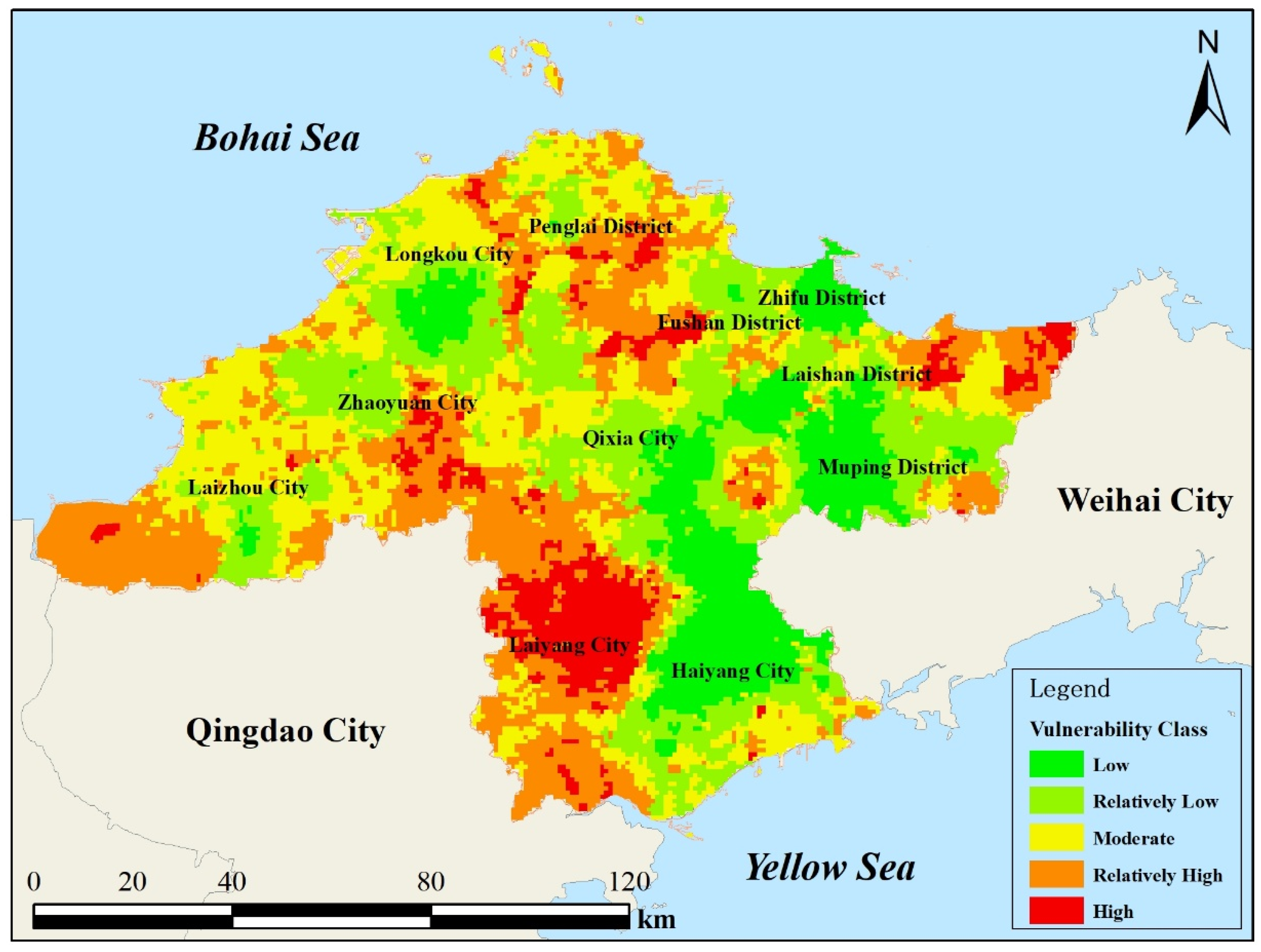
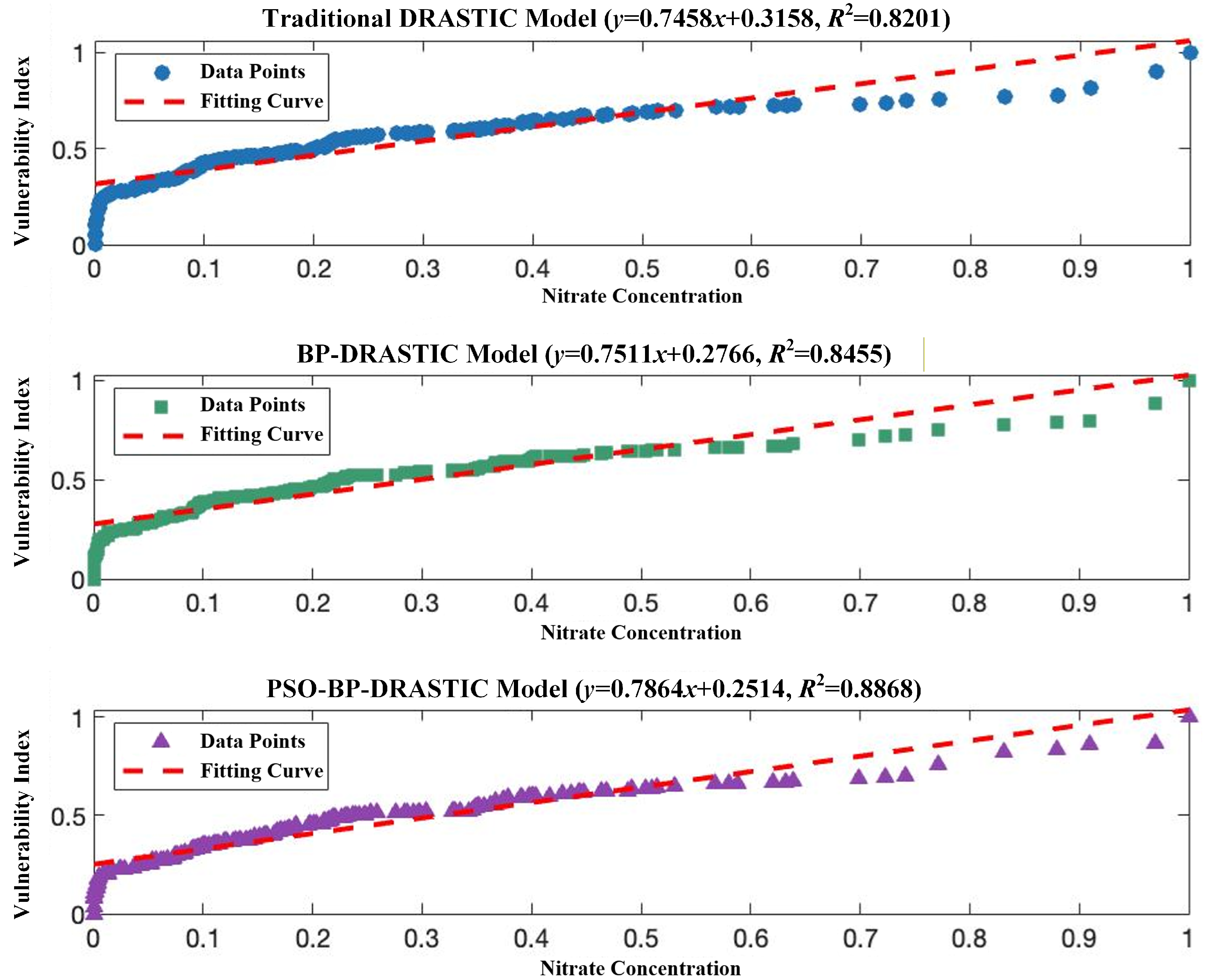
Groundwater vulnerability assessments serve as essential tools for sustainable groundwater management, particularly in regions with intensive anthropogenic activities. However, improving the objectivity and predictive reliability of vulnerability assessment frameworks remains a critical scientific challenge in groundwater science, especially for coastal aquifer systems characterized by strong heterogeneity and complex hydrogeological processes. The traditional DRASTIC model is a widely recognized method but suffers from subjectivity in assigning parameter ratings and weights, often leading to arbitrary and potentially inaccurate vulnerability maps. This limitation also restricts its applicability in areas with complex hydrogeological conditions. To enhance the accuracy and adaptability of the traditional DRASTIC model, a hybrid PSO-BP-DRASTIC framework was developed and applied it to a coastal city in China. Specifically, the model employs a backpropagation neural network (BP-NN) to optimize indicator weights and integrates the particle swarm optimization (PSO) algorithm to refine the initial weights and thresholds of the BP-NN. By introducing a data-driven and globally optimized weighting mechanism, the proposed framework effectively overcomes the inherent subjectivity of conventional empirical weighting schemes. Using ten-fold cross-validation and observed nitrate concentration data, the traditional DRASTIC, BP-DRASTIC, and PSO-BP-DRASTIC models were systematically validated and compared. The results demonstrate that (1) the PSO-BP-DRASTIC model achieved the highest classification accuracy on the test set, the highest stability across ten-fold cross-validation, and the strongest correlation with the nitrate concentrations; (2) the importance analysis identified the aquifer thickness and depth to the groundwater table as the most influential factors affecting groundwater vulnerability in Yantai; and (3) the spatial assessments revealed that high-vulnerability zones (7.85% of the total area) are primarily located in regions with intensive agricultural activities and high aquifer permeability. The hybrid PSO-BP-DRASTIC model effectively mitigates the subjectivity of the traditional DRASTIC method and the local optimum issues inherent in BP-NNs, significantly improving the assessment accuracy, stability, and objectivity. From a scientific perspective, this study demonstrates the feasibility of integrating swarm intelligence and neural learning into groundwater vulnerability assessment, providing a transferable and high-precision methodological paradigm for data-driven hydrogeological risk evaluation. This novel hybrid model provides a reliable scientific basis for the reasonable assessment of groundwater vulnerability. Moreover, these findings highlight the importance of integrating a hybrid optimization strategy into the traditional DRASTIC model to enhance its feasibility in coastal cities and other regions with complex hydrogeological conditions.
Keywords: groundwater vulnerability assessment; DRASTIC model; back propagation neural network; particle swarm optimization groundwater vulnerability assessment; DRASTIC model; back propagation neural network; particle swarm optimization