


Abstract
From a configuration perspective, by using 99 prefecture-level cities in the Yellow River basin as a sample, this paper reveals a variety of pathways through which digital and intelligent technologies, in synergy with multiple factors, strengthen the resilience of agricultural industrial chains. The research findings are as follows: First, none of the antecedent conditions are essential for strengthening the resilience of the high agricultural industrial chain in the Yellow River Basin. Nevertheless, digital and intelligent technologies and digital infrastructure are central conditions in all four configurations that enhance the resilience of the agricultural industrial chain. Second, the four configurations that produce high agricultural industrial chain resilience are enabled by technology, driven by information, facilitated through multi-stakeholder collaboration, and guided by policy, and there are certain complementary and substitutive relationships among these conditions. Third, the configuration which is empowered by technology fits regions with well-developed digital infrastructure and established goose-formation agricultural entities; the configuration that is driven by information fits areas with limited fiscal support but robust digital infrastructure; the multi-stakeholder collaborative configuration fits regions with strong economic foundations, robust fiscal support, and advanced digital infrastructure; and the configuration which is guided by policy fits areas with weaker economic foundations but advanced digital infrastructure and diverse agricultural entities. The above conclusions, by revealing the diverse pathways by means of which digital technologies strengthen the resilience of the agricultural industrial chain in the Yellow River Basin, demonstrate that regional development must adopt tailored methods which are suited to local conditions. They also provide novel solutions for sustainable agricultural development.
1. Introduction
The change in global climate, frequent geopolitical conflicts, and the volatility of heightened market demand have posed severe challenges to food security and the stability of agricultural supply chains [1,2,3]. It has become essential to enhance the resilience and security of industrial chains with the purpose of countering both internal and external disruptions [4]. It is crucial to enhance the resilience of the agricultural industrial chain not only for food security and the transition from an agricultural giant to an agricultural powerhouse [5,6,7], but also for achieving sustainable development goals in agriculture. Indeed, at present, China is at a pivotal juncture in its transition from traditional to modern agriculture [8]. The challenges which are posed by Baumol’s disease [9,10] and the phenomenon of “small-scale farming in a large country” [11,12] are especially salient. The economic share of agricultural sector is reducing, production costs are rising, and market competitiveness is weakening. Agriculture has been deeply rooted in a pattern of long-term, extensive growth, which makes transformation a challenging process. Therefore, it is urgent to find new drivers to promote qualitative, efficient, and dynamic transformations within the agricultural industrial chain.
Digital and intelligent technologies, which focus on “digitalisation and smart solutions”, are emerging as a key breakthrough for new momentum within the agricultural industry chain [13]. Digital and intelligent technologies, taking advantage of data-driven empowerment, intelligent decision-making, and information sharing, strengthen the efficiency of agricultural production and resource allocation while providing technical approaches to strengthen risk early warning and safeguard industrial chain security. This has enormous significance for improving the quality, efficiency, and competitiveness of agricultural development [14]. In developed nations such as Europe and America, agricultural informatisation and scale are relatively advanced, which are primarily driven by intelligent equipment and precision farming technologies. On the other hand, the fundamental agricultural reality which confronts China is that it is a “large country with small-scale farming”. It is necessary for the digital and intelligent transformation of the agricultural sector to resolve the following two fundamental challenges: First, there is an urgent need to integrate smallholder farmers into the existing economic structure. Second, it is required to achieve coordination across the whole industrial chain. The Digital Agriculture and Rural Development Plan (2019–2025), which was published by the Ministry of Agriculture and Rural Affairs, reveals that the proportion of China’s agricultural digital economy within the sector’s value added has increased from 7.3% in 2018 to 9.7% in 2021. Projections indicate that this figure will reach 15% by 2025 [15], which reflects the sustained advancement of agricultural digitalisation. However, compared to the industrial and service sectors, the digitalisation gap in agriculture is markedly pronounced. Data from the China Academy of Information and Communications Technology reveals that in 2023, the penetration rates of digital economy for industry and services stood at 25% and 45.6%, respectively [16], which is significantly higher than that of agriculture. This discrepancy indicates that the digital transformation of agriculture has yet to achieve significant progress, and that it has objectively constrained the enhancement of resilience within the agricultural supply chain. The question of how to make use of digital and intelligent technologies to boost the resilience of the agricultural supply chain has become a crucial issue in advancing agricultural modernisation.
2. Literature Review
At present, research on digital and intelligent technologies and the resilience of the agricultural industry chain primarily focuses on three aspects:
Hereby, this paper presents a study of the resilience of agricultural industrial chains. Agricultural industrial chains consist of numerous segments, such as research and development, production, processing, storage and transportation, sales, and services. These chains are marked by their high dynamism and interconnectedness [17]. It is commonly understood that resilience is the capacity of an agricultural system to maintain its fundamental functions, recover swiftly, and achieve sustainable development when encountering internal or external shocks such as natural disasters, market fluctuations, or policy adjustments [18]. This capability not only concerns the sustainable development of agriculture, but also profoundly affects national food security and social stability [19].
Second, research into digital and intelligent technologies is needed. These technologies focus on data as their core element, which generate significant amplification and multiplier impacts on traditional production factors through real-time, efficient data flow [20]. With the help of the integration and sharing of data elements, information asymmetry can be effectively mitigated, resource allocation efficiency can be enhanced, and integration of the digital economy with the real economy can be deeply driven [21]. Meanwhile, technological paradigms are reconfigured by digital and intelligent technologies. By means of the integration of data and the transfer of knowledge, they have been verified to stimulate business model innovation and breakthrough innovations [22,23]. Therefore, they have the power to strengthen value connections across industries and accelerate the digital and intelligent transformation of entire industrial chains [24].
Third, it is required to conduct research on the effect of digital and intelligent technologies on the resilience of agricultural supply chains. By using their strengths in the transmission of information, the circulation of goods, and the allocation of capital, these technologies have been promoting the digital and intelligent transformation of conventional agriculture, extending industrial chains [25] and giving rise to a variety of novel business formats and models [26]. By means of optimisation of agricultural production systems and digital and intelligent transformation of the entire industrial chain, the agricultural industrial chain is being restructured [25,26,27]. In terms of information transmission, commodity circulation, and capital allocation, the advantages of this system promote the intelligent upgrading of traditional agriculture and the extension of industrial chains [28], while developing various new business formats and innovative models [29]. Specifically, technologies such as remote sensing monitoring, IoT sensors, and blockchain traceability have enormously strengthened the quality and yield of agricultural products [30]. Specifically, the application of technologies such as remote sensing monitoring, IoT sensors, and blockchain traceability has significantly enhanced the quality and yield of agricultural products [31]. Nevertheless, owing to different levels of digitalisation across different segments of the industrial chain, there exists a mismatch between technological supply and demand [32]. Additionally, the application of technologies such as drones and cloud computing is impacted by several factors, such as policy, market conditions, and cultural considerations. As a result, it is necessary that the digital transformation of the agricultural supply chain must be based on market demand and result from coordinated support from government policies and institutional frameworks.
Although existing research has obtained findings on the relationship between digital and intelligent technologies and the resilience of agricultural industrial chains, there still remain certain limitations. First, the research angle tends to be rather macro-level. Existing quantitative analyses mainly focus on the internal–provincial level and pay no sufficient attention to the actual operational status and digitalisation levels of industrial chains at the prefecture-level city level. Second, there is not enough consideration of multi-factor synergies. It involves the interaction of multiple links and stakeholders to strengthen the resilience of agricultural industrial chains; a single factor cannot fully explain its complex mechanisms [33], while the configurational effects of multi-factor synergies are often ignored. Third, the applied research methodologies have their limitations. The present tendency in contemporary research is the utilisation of linear regression analysis, which is inherently limited in its capacity to adequately capture the intricate causal relationships that emerge from multiple concurrent pathways.
In light of this, this paper adopts a configuration perspective and introduces the Technology–Organisation–Environment (TOE) framework to analyse the complex relationships—both necessary and sufficient—between different combinations of digital and intelligent technology elements and the enhancement of agricultural industrial chain resilience. It aims to address the following questions: First, it investigates whether and to what extent digital and intelligent technologies constitute a necessary condition for achieving high agricultural industrial chain resilience. Second, the paper explores how different regions can enhance the resilience of agricultural supply chains through the development of digital and intelligent technologies. The potential contributions of this paper are as follows: Firstly, it broadens the research perspective on the relationship between the digital economy and the resilience of agricultural industrial chains. Existing studies predominantly adopt a single-factor independent analysis approach, overlooking the interactions and combined effects of multiple factors. This paper adopts a configuration perspective to explore how combinations of multiple factors influence the enhancement of agricultural industrial chain resilience, thereby expanding the research horizon on the interplay between the digital economy and agricultural industrial chain resilience. Secondly, with regard to the research scope, the present paper employs empirical analysis using data from 99 prefecture-level cities within the Yellow River basin. A comparison of this approach with provincial-level data is provided, since the former is considered to better reflect the operational status of grassroot agricultural industrial chains. Thirdly, in terms of research conclusions, this study identifies four distinct pathways through which different combinations of digital and intelligent technologies empower agricultural industrial chains to enhance resilience. These findings provide a basis for local governments to formulate policies and may also serve as a reference for other countries and regions exploring pathways to strengthen agricultural industrial chain resilience.
3. Research Framework
3.1. Conceptual Definition
3.1.1. Digital and Intelligence Technology
The current continuous progression of the contemporary technological revolution and industrial transformation has caused the rapid dissemination of digital and intelligent technologies on a global scale. The core value of the organisation is to support efficient corporate management and scientific decision-making by means of the mining and analysis of vast data sets. The China Digital Economy Development Research Report (2023) [34], which was published by the China Academy of Information and Communications Technology, suggests that digital and intelligent technologies show high diffusivity and pervasiveness. Predictions indicate that by the year 2030, these technologies will make the global GDP increase by 1.2% annually and hence continuously catalyse the emergence of new products, new business models, and new modes of operation. The SenseTime Institute for Intelligent Industry assumes that digital intelligence technology constitutes a comprehensive technological framework which underpins the development of the information industry among multiple domains, such as big data, artificial intelligence, cloud computing, blockchain, and the Internet of Things [35]. Dai Kui et al. (2025) argue that digital–intelligent technology constitutes a technical framework which integrates big data and artificial intelligence on a digital foundation [36]. Gao Jing et al. (2025) argue that digital–intelligent technology constitutes an integrated concept which encompasses digital, networked, and intelligent technologies [37]. In general, despite the fact that scholars provide a variety of definitions of digital–intelligent technology, there is unanimous consensus among them in terms of the fundamental nature of this technology, which is defined by the profound integration of digitisation and intelligence. This paper provides a definition for digital–intelligent technology as a technological system which is underpinned by digital, networked, and intelligent technologies. It is supported by data-driven approaches and intelligent algorithms, and it is aimed to reconstruct and optimise elements within the agricultural industrial chain.
3.1.2. Resilience of the Agricultural Supply Chain
The notion of the agricultural industrial chain was initially put forward by the German economist Hirschman, who was referring to the organic connections formed across stages from production to processing and sales of agricultural products [38]. This concept has been explained by scholars home and abroad from different perspectives, with a popular viewpoint that the agricultural industrial chain constitutes an interdependent network system which is formed by multiple production sectors based on shared interests [17,39,40]. This integration of multidimensional structures includes value chains, supply chains, benefit chains, and spatial chains [41]. The concept of resilience has originated from engineering resilience, ecological resilience, and evolutionary resilience. The concept of engineering resilience was first put forward by Holling (1973), who emphasised a system’s ability to revert to its original equilibrium state following a disturbance [42]. Based on this foundation, Martin and Sunley (2015) introduced the concept of ecological resilience, which focuses on a system’s capacity to maintain functional and structural stability under external shocks, while exploring its adaptive and threshold-modulating mechanisms [43]. When applied to the field of agriculture, the aforementioned theory was defined by Chen Junya (2019) as the capacity of an agricultural system to resist and recover when confronted with risk [44]. It was further suggested that higher levels of resilience are indicative of greater strength in both these capacities [45]. He Yali et al. (2021) further note that, supported by modern technology, the resilience of agricultural industrial chains manifests as the capacity to effectively disperse, absorb, and transfer external shocks within uncertain environments, while achieving fast self-repair and renewal [46]. The popular academic understanding of industrial chain resilience has evolved from a static recovery model to a dynamic adaptation paradigm, which gradually evolves into a multidimensional conception encompassing shock resistance, adaptability, and regeneration. On this basis, the present paper defines the resilience of the agricultural industrial chain as follows: a comprehensive capacity of the agricultural system which can maintain structural stability, ensure functional continuity, and achieve developmental advancement within complex and volatile environments through risk mitigation, adaptive responses to change, and innovative regeneration.
3.2. Technology–Organisation–Environment Analysis Perspective
The Technology–Organisation–Environment (TOE) framework, proposed by Tornatzky and Fleischer in 1990, tests the interactions between technological adoption behaviour within and outside organisations [47]. The TOE framework has been extensively used in agricultural and rural sectors, owing to its strong operationality and broad applicability. The effect of digital and intelligent technologies on the resilience of agricultural supply chains results not only from multi-level technological applications but also from an evolutionary process of deep integration between digital innovation elements and traditional industrial systems. The process is not only contingent on the availability of digital and intelligent technologies themselves but also constrained by external factors such as agricultural operators, policy support, and institutional environments. As a result, the employment of the TOE framework for the analysis of the effectiveness of digital and intelligent technologies in enhancing agricultural industrial chain resilience is a highly appropriate endeavour.
3.3. Logical Analysis Framework
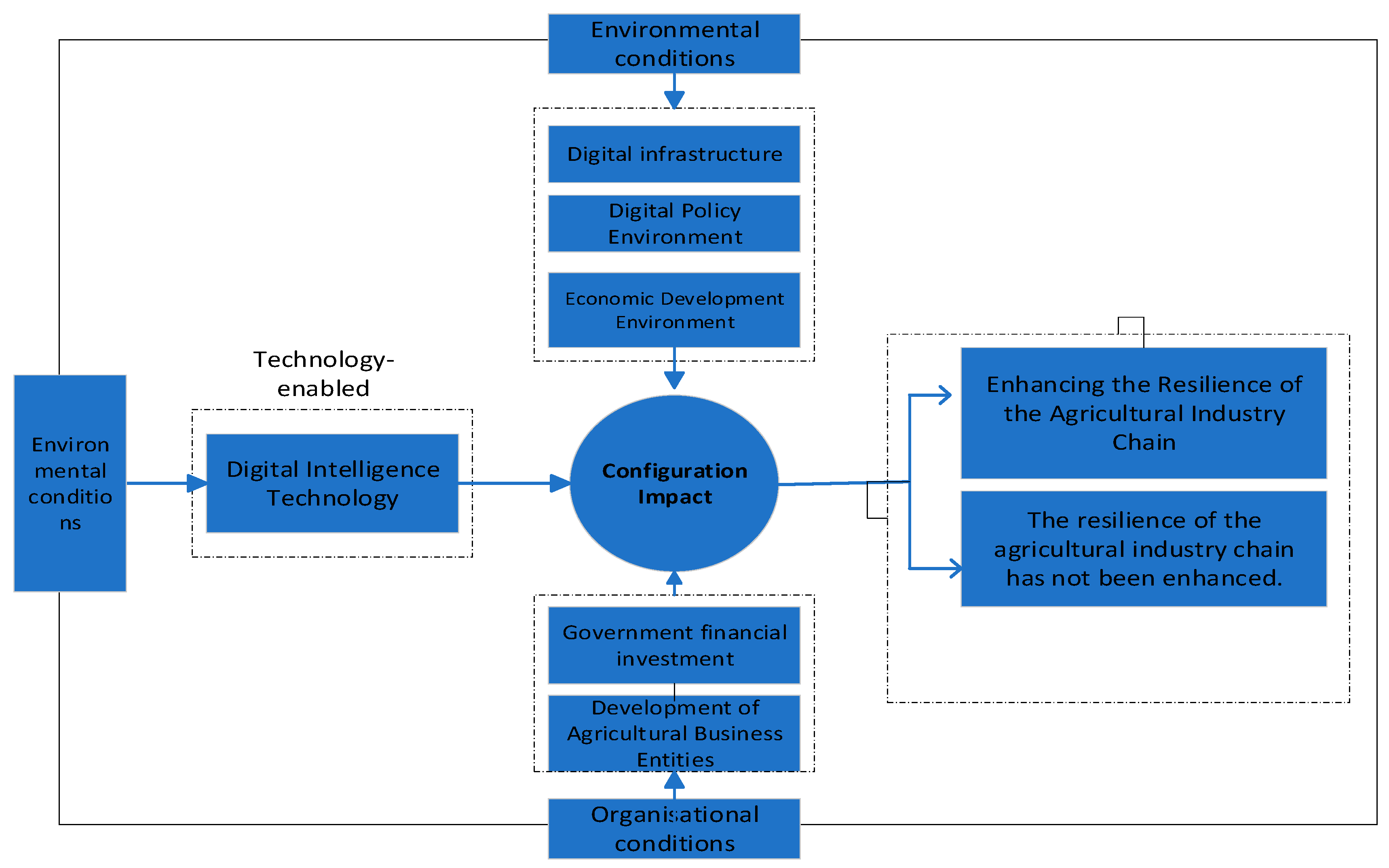
The enhancement of agricultural industrial chain resilience is not only contingent on regional resource endowments and industrial foundations but also influenced by a number of factors, such as the application level of digital and intelligent technologies, organisational coordination capabilities, and policy environments. It is apparent that a solitary condition is inadequate for reflecting the intricacies of its formation mechanism. The current study applies the TOE model and introduces the fuzzy set qualitative comparative analysis (fsQCA) to explore the mechanism through which digital and intelligent technologies impact agricultural industrial chain resilience. The construction of a logical analytical framework for the effect of digital and intelligent technologies on agricultural industrial chain resilience is illustrated in Figure 1.
Figure 1.
Logical analysis framework.
3.3.1. Technical Specifications
Technological capabilities form the bedrock for enhancing the resilience of the agricultural supply chain. The integration of digital and intelligent technologies across all stages of agricultural production, processing, storage, and distribution ensures the efficient operation of the agricultural supply chain. Within the production phase, precise sensing and real-time monitoring strengthen operational efficiency and product quality while mitigating risks from natural disasters and market fluctuations. In the context of processing, storage, and distribution, intelligent coordination and supply chain optimisation have been shown to promote logistics efficiency and market responsiveness. Furthermore, the data sharing has been demonstrated to boost collaboration among different entities along the value chain, thereby increasing the adaptability and stability of the entire agricultural system.
3.3.2. Organisational Conditions
The secondary factors that comprise organisational conditions are government investment and the capacity of agricultural operators. Academic research in this field typically examines the factors that influence technology adoption from organisational and managerial perspectives. Government financial support has been demonstrated to enhance agricultural infrastructure, facilitate the implementation of digital and intelligent agricultural projects, and provide financial and institutional safeguards for supply chains to withstand external shocks. Agricultural operators, such as leading enterprises, cooperatives, and family farms, serve as vital catalysts for the implementation of digital and intelligent technology. The integration of resources and organisation of innovations has been demonstrated to increase the efficiency of technology adoption and diffusion, thereby driving overall optimisation across the industrial chain.
3.3.3. Environmental Conditions
Environmental conditions, which are seen as the external safeguards for digital and intelligent technology empowerment, include three secondary conditions: digital infrastructure, digital policy environment, and level of economic development. Digital infrastructure, such as broadband, 5G networks, and agricultural big data platforms, affects the effectiveness of digital and intelligent technology adoption by agricultural operators. The digital policy environment provides institutional support for technological innovation and dissemination; for instance, the Digital Agriculture and Rural Development Plan (2019–2025) [15] advocates accelerating the speed of the integration of agriculture with digital technologies, while local measures like “Digital Agriculture Enhancement” programmes and specialised subsidies create favourable policy conditions. Regional economic development levels directly influence the capacity to implement and the extent of diffusion of digital and intelligent technologies.
4. Research Design
4.1. Research Methodology
The employment of the fsQCA analytical method in this study is predicated on the following rationales: It is evident that the enhancement of agricultural industrial chain resilience is not determined by a single factor. Rather, it is the result of the intertwined and synergistic effects of multiple conditions. While traditional regression approaches are capable of testing the “net effect” of individual variables, they show certain limitations when dealing with complex phenomena such as interactions between conditions, non-linear relationships, and the coexistence of multiple pathways [48]. In contrast, fsQCA, founded on set theory, demonstrates a particular ability for analysing how a multitude of conditions collectively engender an outcome, thus providing a more accurate reflection of the intricacies inherent in agricultural supply chains as complex systems. Second, this paper integrates multiple dimensions—including digital intelligence technologies, organisational conditions, and policy environments—within a unified analytical framework. By constructing condition sets and truth tables, fsQCA reveals the synergistic and substitutive effects of these multidimensional conditions, thereby finding high-resilience configuration pathways. Compared to traditional statistical methods, fsQCA more effectively reflects the diverse realisation mechanisms under varying combinations of conditions.
4.2. Research Sample
This study selected 99 prefecture-level cities across nine provinces within the Yellow River basin—Qinghai, Sichuan, Gansu, Ningxia, Inner Mongolia, Shaanxi, Shanxi, Henan, and Shandong—as research samples, primarily based on the following considerations: Firstly, this region possesses strong representativeness. The Yellow River basin spans eastern, central, and western China, which serves as a primary production area for grain and speciality agricultural products. The diverse agricultural types within the basin reflect the typical characteristics of different agricultural industrial chains, which make it valuable for promoting best practices. Second, the basin has relatively well-developed digital infrastructure. In recent years, provinces within the Yellow River basin have actively implemented strategic initiatives such as “Digital Villages” and “Smart Agriculture”. Projects including agricultural IoT, intelligent equipment, and e-commerce have accelerated their implementation speed, laying a solid foundation for the digital and intelligent transformation of the agricultural industrial chain. Third, significant disparities exist across the basin. Regions within the Yellow River basin show distinctive differences in their application of digital and intelligent technologies, policy responsiveness, and resource endowments. This diversity provides a valuable testing ground for exploring how agricultural industrial chain resilience can be boosted under varying combinations of conditions.
4.3. Variable Measurement
4.3.1. Prerequisite Conditions
Drawing upon existing research and guided by the TOE framework, this paper selects digital and intelligent technologies, government fiscal investment, new types of business entities, policy environment, digital infrastructure, and regional economic development as prerequisite conditions for measurement. The specific variable composition and indicator design are presented in Table 1:
Table 1.
Measurement specifications for antecedent conditions.
① Digital and intelligent technologies. Drawing upon Wang Linhui’s (2022) [49] research methodology, this paper applies artificial intelligence enterprise data to represent regional development levels in digital and intelligent technologies, which effectively reflects technological agglomeration and diffusion potential. ② Government fiscal investment. Following the approach of Li Xuhui and Chen Mengwei (2023) [50], local government support is measured by fiscal expenditure on science and technology. ③ Agricultural business entities. Drawing upon the research of Cai Xiaohui (2025) [51], this study assesses organisational foundations from three aspects: agricultural processing enterprises, family farms, and farmers’ cooperatives. ④ Digital infrastructure. Following Li Xuhui and Chen Mengwei (2023) [50], this study applies two indicators—“internet penetration rate” and “telecommunications services volume per capita”—to reflect regional digital infrastructure development and network support capabilities. ⑤ Digital policy environment. Following Jiang Xu (2023) [52], this study applies text analysis to conduct word frequency statistics on municipal government work reports across the Yellow River Basin. Keywords such as “digital economy”, “information economy”, and “internet” are prioritised to gauge local governments’ policy-level attention and support intensity for digital transformation. ⑥ Economic development environment. Drawing upon the research of Li Xia and Zhang Yulong (2024) [53], this study applies per capita GDP as the metric to reflect the supporting conditions for promoting the continuous optimisation and resilience enhancement of agricultural industrial chains at the regional level.
4.3.2. Outcome Variable
To scientifically measure the resilience level of the agricultural industrial chain in the Yellow River Basin, this paper draws upon the research of Lü Yanhui et al. (2025) and Hao Aimin et al. (2024) [54,55]. An integrated evaluation framework is built across the three aspects—resilience capacity, recovery capacity, and innovation capacity—which include 15 indicators (Table 2). Resilience denotes the capacity of the agricultural industrial chain to maintain core functions following external shocks; recovery capability reflects the speed and efficiency with which the chain returns to normal operations; and innovation capacity has the potential for the agricultural system to promote continuous upgrading through technological advancement, structural optimisation, and model innovation. This framework comprehensively captures the dynamic resilience of the agricultural industrial chain in risk response, operational recovery, and long-term development, thereby providing a basis for empirical analysis.
Table 2.
Explanation of resilience indicator selection for the agricultural industry chain.
4.4. Variable Calibration
With the purpose of ensuring the comparability of the variables and the robustness of the analytical outcomes, this study applies the entropy weighting method to objectively allocate weights to each indicator. The primary indicators are derived, and a direct calibration approach is then applied to align antecedent conditions with outcome variables. The calibration process was conducted on the basis of three anchor points: complete membership, maximum fuzzy point, and complete non-membership. The 75th, 50th, and 25th percentile values of the variable data were designated as thresholds for complete membership, the crossover point, and complete non-membership, respectively. The calibrated data range extends from 0 to 1, where values approaching 1 signify higher membership degree and values approaching 0 denote lower membership degree. When the value is 0.5, it signifies that the case lies at the intersection between complete membership and complete non-membership, resulting in the case being excluded from fuzzy set analysis. In order to circumvent this issue, the values of 0.5 are adjusted by the present study by incrementing them by 0.001. The calibrated results are presented in Table 3.
Table 3.
Variable calibration.
4.5. Data Source
The data presented in this paper has been sourced from a variety of reliable publications and databases, including the China Statistical Yearbook, China Rural Statistical Yearbook, China Financial Yearbook, China Insurance Yearbook, China Regional Economic Statistical Yearbook, and China Population and Employment Statistical Yearbook, as well as provincial statistics bureaus, the China National Intellectual Property Administration, Wind Database, Guotai Junan Database, and the CCAD (China Agricultural Development) Database from Zhejiang University’s Carter-Qiyan China Agricultural Research. In cases where individual data points were missing, estimates and supplements were made based on relevant trends in order to ensure data integrity and research reliability.
5. Empirical Analysis Results
5.1. Necessity Analysis of Individual Conditions
Before conducting a configuration analysis of the conditions, the necessity of each antecedent condition is tested individually to determine whether the set of outcome variables consists of a subset of a given set of conditional variables. The necessity analysis is based on the identification of conditions that are present in all high-outcome cases, with its statistical criterion based on aggregated consistency.
In the case that the consistency level of a given condition exceeds 0.9, it is considered a necessary condition for the outcome variable [56]. As shown in Table 4, the consistency levels of all antecedent conditions are below 0.9, which indicates that no single condition alone suffices as a necessary prerequisite for agricultural industrial chain resilience. The formation of such resilience is contingent on the interplay of numerous factors, as opposed to being driven by any individual element. When the adjustment distance is less than 0.2, dynamic QCA aggregation has been shown to yield higher consistency precision and provide stronger support for the judgement outcomes [57]. As shown in Table 4, seven sets of conditions showed inter-group consistency exceeding 0.2, which necessitates further examination of their consistency and coverage. The results of the study are presented in Table 5. However, as nearly one-third of case points lie above the diagonal line, or the majority are distributed to the right of the diagonal, none passed the independence test. As a result, this study still does not deem it necessary. In the following part, the aforementioned antecedent conditions are incorporated into a multi-condition combination framework. This is conducted in order to further explore the diverse pathways that influence the resilience of high-level agricultural industrial chains.
Table 4.
Necessity analysis.
Table 5.
Between-group analysis.
5.2. Sufficiency Analysis of Condition Configuration
The present paper is an extension of the former study, insofar as it analyses the sufficiency of the condition configurations. This analysis is based on the establishment of the necessary conditions. It is obvious that academic circles demonstrate variations in the standards for setting case frequency, original consistency thresholds, and PRI consistency thresholds, due to different data characteristics and research objectives. When taking into account factors such as sample size, the number of configurations, and the heterogeneous effects of antecedent conditions, this paper sets the case frequency, raw consistency threshold, and PRI consistency threshold at 1, 0.8, and 0.65, respectively. A comparison of intermediate and simplified solutions can promote the identification of the core or peripheral role of each variable within the configuration [58]. The present study found four typical configuration pathways for achieving high agricultural industrial chain resilience, with specific results presented in Table 6. In terms of the overall fitting results, the model showed a consistency of 0.893 and an overall PRI of 0.865, both of which exceeded the minimum standards. This finding suggests that the proposed configuration adequately explains the sufficiency of enhancing agricultural industrial chain resilience. Meanwhile, the overall coverage rate of 0.588 demonstrates that the identified configuration pathways can explain approximately 58.8% of the cases, exhibiting strong explanatory power and practical representativeness.
Table 6.
Configuration analysis.
5.2.1. Configuration 1
Technology-enabled configuration. In Configuration 1, digital intelligence technologies, agricultural operators, and the digital information environment are seen as fundamental prerequisites, while government fiscal investment, digital policy frameworks, and economic conditions are considered as negligible variables. The path consistency metric reaches a value of 0.927, including approximately 47.0% of the observed cases, with 6.9% of this percentage exclusively attributable to this configuration. This pathway reveals that digital and intelligent technologies offer precision-driven, efficient operational methods for the agricultural industrial chain. Agricultural operators, as key contributors to the chain, directly influence technological implementation and resource integration. The digital information environment is featured by the facilitation of unobstructed information flow and responsive efficiency across all chain segments. Collectively, these three elements constitute the fundamental support for improving the resilience of the Yellow River Basin’s agricultural industrial chain.
The core mechanism of technology-enabled configuration lies in digital and intelligent technologies driving end-to-end operations through data elements. New agricultural operators serve as transformative agents within this framework, which converts technological tools into standardised production processes and intensive resource allocation. By means of organised learning, they promote technological diffusion, thereby establishing resilient organisational vehicles. Meanwhile, the comprehensive digital infrastructure serves as the “neural network” underpinning system operations, which can ensure high-speed data flow and real-time system responsiveness to provide foundational support for resilience. The synergistic interaction of these three elements significantly boosts information circulation capacity and resource allocation efficiency within the Yellow River Basin’s agricultural industrial chain, thereby increasing its overall resilience.
5.2.2. Configuration 2
Information-driven configuration. In Configuration 2, digital intelligence technologies and the digital information environment are found as fundamental prerequisites. However, government fiscal investment is seen to be slightly deficient, and the digital policy environment is found to be fundamentally lacking. The pathway consistency score is 0.858, covering approximately 13.1% of cases, with 1.9% of cases exclusively explainable by this configuration. This pathway shows that even in scenarios of limited government financial investment and relatively weak digital policy support, the deep application of digital and intelligent technologies, as well as the enhancement of digital infrastructure, can still greatly improve the stability and adaptability of the agricultural industrial chain in the Yellow River Basin. This pathway shows that even under conditions of limited government financial investment and weak digital policy support, the deep application of digital and intelligent technologies alongside improvements in the digital information environment can still have a positive effect on the resilience of the Yellow River Basin’s agricultural industrial chain. This phenomenon can be attributed to the compensatory role that technological and informational factors can play when policy support is inadequate.
The core characteristics of configuration driven by information are “technology-based, data-centric, and collaboration-driven”. This shows that when formal institutional support is relatively weak, digital intelligence technologies and digital infrastructure can be synergistically embedded within production scenarios, which serves as an “external substitute factor” to replace policy and fiscal support. This method not only optimises factor allocation and process management in agricultural production but also activates functions such as data-driven risk early warning, emergency response, and decision support. It promotes the transformation of agricultural production in the Yellow River Basin from experience-driven to data-driven practices, thereby achieving the goal of improving the resilience of the agricultural industrial chain.
5.2.3. Configuration 3
Multidimensional synergistic configuration. In Configuration 3, digital intelligence technologies, government fiscal investment, digital information environments, and economic conditions all play the role of core prerequisites, while agricultural operators and digital policy environments remain insignificant variables. Path consistency stands at 0.909, covering approximately 37.9% of cases, with 5.7% of the cases exclusively explainable by this configuration. This pathway demonstrates the synergistic effects of multidimensional factors: within a favourable economic environment, government finance provides strong financial backing for the digital and intelligent transformation of agricultural supply chains. This creates favourable external conditions for the development of the supply chain, which fosters a correspondingly adapted digital information environment. The combined action of these diverse factors further strengthens the supply chain’s capacity to withstand risks and recover from setbacks.
The core mechanism of a multifaceted, synergistically driven configuration lies in the complementary and collaborative interplay of its constituent elements, which represents the most ideal model for enhancing efficiency. Building upon a sound economic foundation, government fiscal investment and digital infrastructure have built a “public goods platform”. This underpins the large-scale integrated application of digital and intelligent technologies, which can significantly enhance the operational efficiency, market responsiveness, and risk resilience of the agricultural industrial chain within the Yellow River Basin. This promotes a transformative leap from fragmented growth towards systemic resilience enhancement.
5.2.4. Configuration 4
Policy-guided configuration. In Configuration 4, agricultural operators, the digital information environment, and the digital policy environment play the role of core enabling conditions. Government fiscal investment is seen as a core deficiency, while the economic environment shows a slight deficiency. Pathway consistency stands at 0.870, covering approximately 14.2% of cases, with 3.1% of cases exclusively explained by this configuration. This pathway shows that in scenarios of insufficient government fiscal investment and relatively weak economic foundations, the agency of agricultural business entities and the guidance of the digital policy environment can become key driving factors for enhancing industrial chain resilience. By making full use of their own organisational resource integration capabilities, business entities can choose appropriate operational decisions in alignment with the digital policy environment. Then, they can standardise their development direction by meeting the institutional requirements of the environment. The synergy between these two factors compensates for shortcomings at the economic and fiscal levels.
Policy-guided configuration embodies the leveraged effect of “guidance and mobilisation”. Its mechanism emphasises that in regions which are constrained by fiscal and economic conditions, forward-looking and guiding industrial policies can serve as a pivotal lever. By developing a favourable institutional environment and building incentive mechanisms, such policies can mobilise and integrate market and social resources to solve technological and market deficiencies. The resulting collaborative mechanism of “policy guidance–stakeholder response–technological support” has charted a course for underdeveloped regions to enhance the resilience of their agricultural supply chains by means of policy incentives and stakeholder innovation.
5.3. Inter-Group Result Analysis
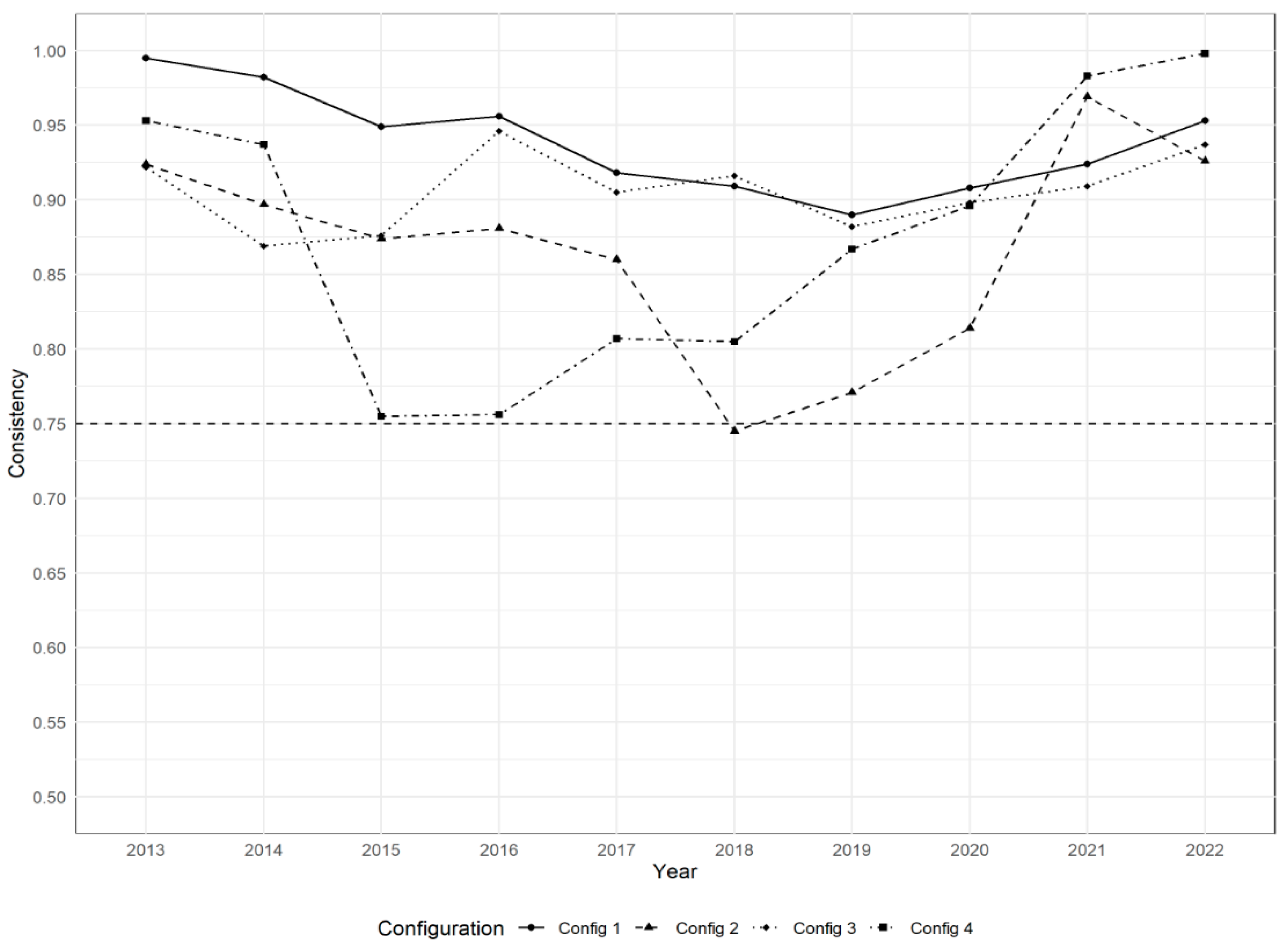
As shown in Figure 2, the inter-group consistency of most configurations shows a dynamic pattern of decline followed by recovery. Overall, between 2013 and 2019, inter-group consistency in most configurations fluctuated downward. This may be due to the fact that this period coincided with the early stages of digitalisation within the agricultural industrial chain of the Yellow River Basin. Due to varying resource endowments across the regions, the synergistic effects of key factors were relatively weak, which rendered the chain less resilient to risks. Post-2020, configuration consistency has shown a recovery trend. This indicates that in recent years, driven by national policies such as the Digital Rural Development Strategy Outline and the 14th Five-Year Plan for National Green Agricultural Development, which is coupled with advancing agricultural technological innovation, the Yellow River Basin’s agricultural sector has progressively realised digital transformation. Synergistic effects among factors have become more apparent, with the explanatory power of configuration consistency across configurations generally maintaining at a high level.
Figure 2.
Inter-group consistency trends.
5.4. Analysis of Results Within the Group
By statistically aggregating the coverage rates of Configurations 1–4 across the case study cities, it is obvious that the explanatory power of different configurations varies significantly across each case. For example, Changzhi City shows coverage rates which exceed 0.9 for Configurations 1–3, whereas its coverage rate for Configuration 4 is only slightly above 0.5. The variation in coverage across cases may be due to disparities in the developmental levels of core elements that are required for each of the four configurations within different cases, which are coupled with differing levels of synergy among these elements. This finding indicates that improving the resilience of the agricultural industrial chain in the Yellow River Basin necessitates the tailoring of approaches to regional agricultural development realities, specifically by strengthening the allocation and matching mechanisms of core elements. In view of the considerable number of cases examined in this study, coverage data for 20 representative cities is presented here for reference, as shown in Table 7.
Table 7.
Intra-group coverage.
5.5. Robustness Analysis
In order to strengthen the robustness of the findings, this study applies an adjusted original consistency threshold to verify the configuration results. It was assumed that if the original consistency threshold and PRI threshold were maintained, and the case frequency increased to 2, then it would be observed that the number of new configuration paths, overall coverage, and consistency values would remain largely unchanged. This finding reveals that the research outcomes demonstrate a high degree of robustness, as shown in Table 8.
Table 8.
Robustness test.
6. Research Findings and Policy Recommendations
6.1. Research Findings
How digital and intelligent technologies interact synergistically with organisational and environmental conditions to improve the resilience of agricultural supply chains constitutes a critical issue for advancing agricultural modernisation and safeguarding food security. This also directly affects the achievement of sustainable development goals in agriculture. The current study applies a configurational angle, integrating the entropy weight method, and applies the fsQCA method to examine 99 prefecture-level cities within the Yellow River basin. Hence, this study explains the multifaceted pathways through which digital and intelligent technologies strengthen the resilience of agricultural supply chains in this region. The following conclusions are reached:
First, none of the previous conditions are necessary prerequisites for improving the resilience of the agricultural industrial chain in the Yellow River Basin. Digital and intelligent technologies, as well as digital infrastructure, play a vital role in improving resilience. Technological and informational factors pose a substitution effect, thereby supporting the stable operation of the industrial chain. Second, the four configurations that generate high agricultural industrial chain resilience are technology-enabled, information-driven, multi-stakeholder collaborative, and policy-guided. These four configurations develop a hierarchical complementary relationship in achieving high agricultural industrial chain resilience, which implies that institutional design and policy incentives must consider the balance and optimisation of multiple resources. Third, technology-enabled configurations are well-suited to regions that possess well-developed digital infrastructure and established agricultural business entities that operate in a geese-formation pattern. Information-driven configurations are considered appropriate for areas with limited fiscal support but vigorous digital infrastructure. Multifaceted collaborative models are optimally suited to regions that possess vigorous economic foundations, substantial fiscal backing, and advanced digital infrastructure. It is obvious that policy-guided approaches are especially well-suited to regions characterised by a weaker economic base but equipped with well-developed digital infrastructure and a diverse array of agricultural business entities. This finding reflects the diverse pathways for improving agricultural industrial chain resilience across different regions of the Yellow River Basin, which is based on varying digital and intelligent technologies, organisational conditions, and policy environments. It also emphasises that regional development varies, necessitating customised approaches adapted to local circumstances.
6.2. Policy Recommendations
First, it is urgent for governments to build bespoke governance models that are in line with the predominant configuration types within their respective regions. In regions that are enabled by technology and driven by information, policy priorities should focus on overcoming smallholder farmers’ technical application bottlenecks by building a “Digital Intelligence Technology Application Subsidy Scheme”. By means of fiscal funding guidance, this scheme would cooperate with leading enterprises to provide farmers with support for purchasing smart equipment and skills training. In multi-collaborative and policy-guided regions, government should focus efforts on optimising factor allocation and innovating institutional frameworks, implementing differentiated regional investment strategies: in areas with vigorous economic foundations and fiscal strength, prioritise support for end-to-end digital integration projects across entire industrial chains; in regions with weaker foundations, assign resources towards “shortfall-addressing” infrastructure such as 5G networks and cold-chain logistics.
Second, for agricultural operators, it is necessary to undertake digital and intelligent practices that are in line with their inherent resource endowments. In regions that are driven by technology and information, operators such as family farms, cooperatives, and leading enterprises should actively incorporate technologies like the Internet of Things and blockchain to promote standardisation and precision in production processes. In the meantime, they should actively take part in training programmes that are organised by government bodies or leading enterprises to enhance technical operational and data analysis capabilities, while making use of data platforms to optimise production decisions and mitigate risks. In regions that are characterised by multi-stakeholder collaboration and policy guidance, leading enterprises must spearhead efforts by establishing intensive production and supply chain networks through models such as “company + cooperative + base”. Cooperatives and family farms should actively integrate with e-commerce platforms and smart supply chains to extend sales channels, while making use of policy instruments including government subsidies and tax incentives to reduce the costs of digital and intelligent transformation.
Third, for agricultural technology companies, it is essential to develop products and services that meet regional development needs. Technology providers may offer tailored, cost-effective solutions that are based on the distinct characteristics of different regions within the Yellow River basin. For example, in technology-enabled areas, the focus should be put on developing straightforward, low-maintenance one-stop solutions to reduce the adoption threshold for smallholder farmers. In multi-stakeholder collaborative regions, efforts should centre on creating middleware systems which feature open interfaces that seamlessly integrate with regional data platforms, thereby promoting data interconnectivity and operational synergy among diverse entities.
6.3. Shortcomings and Future Prospects
This paper still has certain limitations and requires further deepening and expansion in the future. First, in terms of the research methodology, while the fsQCA method has the capacity to reveal the sufficiency and multi-path characteristics of different condition combinations, it remains inadequate in characterising the causal mechanisms between conditions and their dynamic evolutionary processes. Meanwhile, in terms of indicator weighting, this study applies entropy-based weighting with the purpose of circumventing subjectivity. Nevertheless, it should be noticed that the results of the study are dependent on sample structure and quality, which may limit its generalisability. It is recommended that future research consider the introduction of a comprehensive weighting method that combines objective and subjective approaches. Second, in terms of scope, the current study uses a sample of 99 prefecture-level cities across nine provinces in the Yellow River basin, hence demonstrating strong regional representativeness. Nevertheless, it must be noted that generalising conclusions to other river basins or countries may bring certain challenges. It is recommended that subsequent research be conducted in order to validate the universality and dynamic adaptability of these findings. Such validation should be achieved by means of cross-regional comparisons, thereby enriching the empirical research framework on digital and intelligent technologies. This would enhance agricultural industrial chain resilience.
Author Contributions
Conceptualization, H.W. and H.Y.; investigation, Y.L.; data curation, S.W. All authors have read and agreed to the published version of the manuscript.
Funding
This research was funded by High-level Cultivation Project of Shandong Women’s University (No. 2023GSPGJ05) and Ministry of Education Humanities and Social Sciences Research Project (No. 23YJA790072).
Institutional Review Board Statement
Not applicable.
Informed Consent Statement
Not applicable.
Data Availability Statement
The original contributions presented in this study are included in the article. Further inquiries can be directed to the corresponding author.
Conflicts of Interest
The authors declare no conflict of interest.
References
- Guo, Y.F.; Zhang, C.Y. Industrial Digitalization, Green Technology Innovation and Agricultural Industry Chain Resilience. Res. Technol. Econ. Manag. 2023, 117–122. [Google Scholar]
- Keating, B.A.; Carberry, P.S. Sustainable Production, Food Security and Supply Chain Implications. Food Secur. 2010, 1, 7–19. [Google Scholar]
- Sadati, A.K.; Sadati, A.K.; Nayedar, M.; Zartash, L. Challenges for Food Security and Safety: A Qualitative Study in an Agriculture Supply Chain Company in Iran. Agric. Food Secur. 2021, 10, 41. [Google Scholar] [CrossRef] [Scilit] [PubMed]
- Hong, Y.X.; Wang, K.Y. Research on Industrial and Supply Chain Resilience and Security from the Perspective of New Quality Productive Forces. Econ. Res. 2024, 59, 4–14. [Google Scholar]
- Pelletier, B.; Hickey, G.M.; Bothi, K.L.; Mude, A. Linking Rural Livelihood Resilience and Food Security: An International Challenge. Food Secur. 2016, 8, 469–476. [Google Scholar] [CrossRef] [Scilit]
- Luo, B.L. On New Quality Productive Forces in Agriculture. Reform 2024, 19–30. [Google Scholar]
- Yudhatama, P.; Nurjanah, F.; Diaraningtyas, C.; Revindo, M.D. Food Security, Agricultural Sector Resilience, and Economic Integration: Case Study of ASEAN+3. J. Ekon. Stud. Pembang. 2021, 22, 89–109. [Google Scholar] [CrossRef] [Scilit]
- Donaldson, J.A.; Zhang, F.Q. Rural China in Transition: Changes and Transformations in China’s Agriculture and Rural Sector. Contemp. Chin. Polit. Econ. Strateg. Relat. Int. J. 2015, 1, 51. [Google Scholar]
- Zhang, P.; Ye, T.; Qiao, X.; Zhu, H. Service-Manufacturing Integration and the “Baumol’s Disease” Trap: Experience from China and Global Patterns. China Finance Econ. Rev. 2025, 14, 24–44. [Google Scholar] [CrossRef] [Scilit]
- Wang, L.; Chen, Y. Determinants of China’s Health Expenditure Growth: Based on Baumol’s Cost Disease Theory. Int. J. Equity Health 2021, 20, 213. [Google Scholar] [CrossRef] [Scilit]
- Prosterman, R.; Hanstad, T.; Li, L. Large-Scale Farming in China: An Appropriate Policy? J. Contemp. Asia 1998, 28, 74–102. [Google Scholar] [CrossRef] [Scilit]
- Wang, S.; Bai, X.; Zhang, X.; Reis, S.; Chen, D.; Xu, J.; Gu, B. Urbanization Can Benefit Agricultural Production with Large-Scale Farming in China. Nat. Food 2021, 2, 183–191. [Google Scholar] [CrossRef] [Scilit]
- Boruah, T.; Kalita, M.; Hasnu, S.; Das, K.S.; Singh, R.; Nayik, G.A. Role of Digital Technologies in the Field of Horticultural Science and Technology. In Novel Approach to Sustainable Temperate Horticulture; CRC Press: Boca Raton, FL, USA, 2024; pp. 116–148. [Google Scholar]
- Stupina, A.A.; Rozhkova, A.V.; Olentsova, J.A.; Rozhkov, S.E. Digital Technologies as a Tool for Improving the Efficiency of the Agricultural Sector. In Proceedings of the International Conference on Agricultural Science and Engineering; IOP Publishing: Bristol, UK, 2021; Volume 839, p. 022092. [Google Scholar]
- Ministry of Agriculture and Rural Affairs; Cyberspace Administration of China. Digital Agriculture and Rural Development Plan (2019–2025); Ministry of Agriculture and Rural Affairs: Beijing, China, 2019. [Google Scholar]
- China Academy of Information and Communications Technology (CAICT). China Digital Economy Development Research Report (2024); China International Big Data Industry Expo: Guiyang, China, 2024. [Google Scholar]
- Qiu, H.H. Measurement and Improvement Pathways of Agricultural Industry Chain Resilience in Shanxi Province. China Agric. Resour. Reg. Plan. 2025. Available online: https://link.cnki.net/urlid/11.3513.S.20250715.1101.008 (accessed on 19 November 2025).
- Zhang, Y.M.; Long, W.J. Challenges and Countermeasures for Agricultural Industry Chain Resilience under the “Great Food Perspective”. Zhongzhou Acad. J. 2023, 54–61. [Google Scholar]
- Jiang, H.; Zhang, C.; Jiang, H.P. Impact and Mechanisms of China’s Agricultural Economic Resilience on High-Quality Agricultural Development. Agric. Econ. Manag. 2022, 20–32. [Google Scholar]
- Zhang, J.; Zhang, W. Harnessing Digital Technologies for Rural Industrial Integration: A Pathway to Sustainable Growth. Systems 2024, 12, 564. [Google Scholar] [CrossRef] [Scilit]
- Ouyang, R. Data as a Factor of Production Promoting the Deep Integration of the Digital Economy and the Real Economy: Theoretical Logic and Analysis Framework. Front. Econ. China 2024, 19, 129–153. [Google Scholar]
- Cai, H.B.; Han, J.R. Digital Technology Application and Firm Export Performance: Evidence from Zhongguancun National Independent Innovation Demonstration Zone. Manag. World 2024, 58–75. [Google Scholar]
- Zhou, P.; Wang, Z.; Tan, C.C.; Song, M. The Value of Digital Technology Innovation: Analysis Based on M&A Perspective and Machine Learning. China Ind. Econ. 2024, 137–154. [Google Scholar] [CrossRef]
- Ma, X.J.; Song, Y.Q.; Yu, Y.B.; Xu, X.Q. How Can Industrial Digitalization Advance from “Virtual” to “Deep”? Logic and Measurement of Digital Factor Spillovers across Whole Industry Chains. Stat. Res. 2024, 29–47. [Google Scholar]
- Zhao, L.B.; Lin, H. Can Digital Village Development Policies Promote New Agricultural Entrepreneurship in Old Revolutionary Base Areas? China Rural Econ. 2024, 141–160. [Google Scholar]
- Ibidoja, O.J.; Shan, F.P.; Sulaiman, J.; Ali, M.K.M. Detecting Heterogeneity Parameters and Hybrid Models for Precision Farming. J. Big Data 2023, 10, 130. [Google Scholar] [CrossRef] [Scilit]
- Zaman, J.; Shoomal, A.; Jahanbakht, M.; Ozay, D. Driving Supply Chain Transformation with IoT and AI Integration: A Dual Approach Using Bibliometric Analysis and Topic Modeling. IoT 2025, 6, 21. [Google Scholar] [CrossRef] [Scilit]
- Dhal, S.B.; Kar, D. Transforming Agricultural Productivity with AI-Driven Forecasting: Innovations in Food Security and Supply Chain Optimization. Forecasting 2024, 6, 925–951. [Google Scholar] [CrossRef] [Scilit]
- Gebresenbet, G.; Bosona, T.; Patterson, D.; Persson, H.; Fischer, B.; Mandaluniz, N.; Chirici, G.; Zacepins, A.; Komasilovs, V.; Pitulac, T.; et al. A Concept for Application of Integrated Digital Technologies to Enhance Future Smart Agricultural Systems. Smart Agric. Technol. 2023, 5, 100255. [Google Scholar] [CrossRef] [Scilit]
- Liu, S.Y.; Zheng, X.Y.; Liu, C.F. Rural Transactions and Industrial Transformation under the Digital Economy. China Rural Econ. 2024, 2–24. [Google Scholar]
- Yi, F.M.; Gu, F.T.; Kang, C.P. How Innovative Public Service Provision Promotes Digital Marketing of Agricultural Business Entities: Evidence from Guangdong’s “12221” Market System Initiative. China Rural Econ. 2023, 148–167. [Google Scholar]
- Costa, F.; Frecassetti, S.; Rossini, M.; Portioli-Staudacher, A. Industry 4.0 Digital Technologies Enhancing Sustainability: Applications and Barriers in the Agricultural Industry of an Emerging Economy. J. Clean. Prod. 2023, 408, 137208. [Google Scholar] [CrossRef] [Scilit]
- Li, X.D.; Rao, M.X. Configurational Paths of Digital Economy Empowering Urban Scientific and Technological Innovation. Sci. Res. Manag. 2023, 41, 2086–2097. [Google Scholar]
- China Academy of Information and Communications Technology (CAICT). China Digital Economy Development Research Report (2023); CAICT: Beijing, China, 2023. Available online: https://www.caict.ac.cn/english/research/whitepapers/ (accessed on 19 November 2025).
- Shangtang Intelligent Industry Research Institute. Digital Transformation White Paper: Intelligent Technologies Driving Smart Manufacturing; Shangtang Intelligent Industry Research Institute: Shanghai, China, 2021; Available online: https://www.sensetime.com (accessed on 19 November 2025).
- Dai, K.Z.; Huang, Z.; Liang, Y.D. Digital-Intelligent Technologies, Technology Factor Markets and Service-Oriented Manufacturing. China Ind. Econ. 2025, 137–155. [Google Scholar]
- Gao, J.; Li, D.; Chen, F.; Feng, H. Artificial Intelligence Technology and County-Level Income Inequality: Inhibitor or Accelerator? J. Zhejiang Univ. (Humanit. Soc. Sci.) 2025, 55, 5–26. [Google Scholar]
- Mighell, R.L.; Jones, L.A. Vertical Coordination in Agriculture. Agric. Econ. Rep. 1963, 74–125. [Google Scholar]
- Meng, F.P. Application of Alliance Games in Agricultural Industry Chain Cooperation. Issues Agric. Econ. 2004, 53–55. [Google Scholar]
- Li, J.Y. Mechanisms and Policy Recommendations for Urban–Rural Extension of Agricultural Industry Chains. Zhongzhou Acad. J. 2009, 65–68. [Google Scholar]
- Hu, Y.S.; Lou, R.K.; Zhang, H.F. Conceptual Differentiation of Value Chain, Supply Chain and Industrial Chain. Mod. Prop. Manag. 2010, 9, 22–23. [Google Scholar]
- Holling, C.S. Resilience and Stability of Ecological Systems. Annu. Rev. Ecol. Syst. 1973, 4. [Google Scholar] [CrossRef] [Scilit]
- Martin, R.; Sunley, P. On the Notion of Regional Economic Resilience: Conceptualization and Explanation. J. Econ. Geogr. 2015, 15, 1–42. [Google Scholar] [CrossRef] [Scilit]
- Chen, J.Y. Resilient Smallholders: Historical Continuity and Modern Transformation. China Soc. Sci. 2019, 82–99. [Google Scholar]
- Liu, X.W.; Ma, M.X.; Tan, X.X. Digital Finance Empowering Agricultural Modernization: New Quality Productive Forces and Industry Chain Resilience Perspective. Agric. Econ. 2024, 9–11. [Google Scholar]
- He, Y.L.; Yang, S.C. Forging Agricultural Industry Chain Resilience under the “Dual Circulation” Context. Issues Agric. Econ. 2021, 78–89. [Google Scholar]
- Tornatzky, L.G.; Fleischer, M. The Processes of Technological Innovation; Lexington Books: Lexington, MA, USA, 1990; pp. 45–46. [Google Scholar]
- Rihoux, D.B.; Ragin, C.C. Configurational Comparative Methods: Qualitative Comparative Analysis (QCA) and Related Techniques; Sage: Thousand Oaks, CA, USA, 2009. [Google Scholar]
- Wang, L.H.; Jiang, H.; Dong, Z.Q. Will Industrial Intelligence Reshape Corporate Geography? China Ind. Econ. 2022, 137–155. [Google Scholar] [CrossRef]
- Li, X.H.; Chen, M.W. China’s Rural Digital Transformation: Measurement, Regional Differences and Policy Paths. Issues Agric. Econ. 2023, 89–104. [Google Scholar] [CrossRef]
- Cai, X.H. The Impact of Agricultural Insurance on China’s Food System Resilience. Master’s Thesis, Shandong University of Finance and Economics, Jinan, China, 2025. [Google Scholar] [CrossRef]
- Jiang, X. Review and Prospect of Rural Digital Economy Construction since the 18th CPC National Congress: A CiteSpace-Based Visualization. J. Southwest Univ. Natl. (Humanit. Soc. Sci.) 2023, 44, 234–240. [Google Scholar]
- Li, X.; Zhang, Y.L. Digital Economy, Rural Labor Migration and Common Prosperity. Stat. Decis. 2024, 40, 5–10. [Google Scholar] [CrossRef]
- Lü, Y.H.; Yuan, J.W.; Zhang, S.Q.; Shi, J.N. Agricultural Industry Chain Resilience, Regional Differences and Dynamic Evolution. Stat. Decis. 2025, 41, 87–93. [Google Scholar] [CrossRef]
- Hao, A.M.; Xie, M.H.; Liu, Y.T. Measurement and Spatiotemporal Evolution of Agricultural Industry Chain Resilience. Stat. Decis. 2024, 40, 95–100. [Google Scholar] [CrossRef]
- Verweij, S.; Noy, C. Set-Theoretic Methods for the Social Sciences: A Guide to Qualitative Comparative Analysis. Int. J. Soc. Res. Methodol. 2013, 16, 165–169. [Google Scholar] [CrossRef] [Scilit]
- Jing, L.L.; Huang, H.L. Spatiotemporal Dual-Dimension Effects of Digital Innovation Ecosystems on Regional Innovation Capabilities: A Dynamic QCA Analysis. Sci. Technol. Prog. Policy 2024, 41, 13–23. [Google Scholar]
- Tan, H.B.; Fan, Z.T.; Du, Y.Z. Technology Management Capability, Attention Allocation and Local Government Website Construction: A TOE-Framework-Based Configuration Analysis. Manag. World 2019, 35, 81–94. [Google Scholar] [CrossRef]

Disclaimer/Publisher’s Note: The statements, opinions and data contained in all publications are solely those of the individual author(s) and contributor(s) and not of MDPI and/or the editor(s). MDPI and/or the editor(s) disclaim responsibility for any injury to people or property resulting from any ideas, methods, instructions or products referred to in the content. |
© 2026 by the authors. Licensee MDPI, Basel, Switzerland. This article is an open access article distributed under the terms and conditions of the Creative Commons Attribution (CC BY) license.