Article

Urban Oases: The Critical Role of Green and Blue Spaces in Mental Well-Being

1
School of Earth, Environment & Sustainability, Georgia Southern University, Statesboro, GA 30460, USA
2
School of Earth, Environment & Sustainability, Georgia Southern University, Savannah, GA 31419, USA
*
Authors to whom correspondence should be addressed.
Sustainability 2026, 18(2), 642; https://doi.org/10.3390/su18020642
Submission received: 12 October 2025 / Revised: 20 December 2025 / Accepted: 5 January 2026 / Published: 8 January 2026

Abstract

Urbanization has significantly affected the availability and quality of urban green and blue spaces (UGBSs), which may affect mental health. In the United States, rates of anxiety and depression continue to rise, particularly in urban regions. This study examined the relationship between UGBS exposure and mental health, measured by Frequent Mental Distress (FMD), across major cities in the contiguous United States (CONUS) from 2015 to 2017. UGBS exposure was estimated using remote sensing and GIS, and its association with FMD was assessed using Ordinary Least Squares (OLS) regression and Geographically Weighted Regression (GWR). The analyses also included smoking, binge drinking, median income, and educational attainment as covariates. OLS results indicated statistically significant but spatially uniform associations, whereas GWR revealed considerable spatial variation in UGBS and covariate effects across cities. Median income and educational attainment consistently showed inverse relationships with FMD, while smoking showed direct relationships across all years. Binge drinking exhibited both direct and inverse relationships. Additionally, both green space and blue space showed different relationships with FMD depending on location and year. The beneficial effect of UGBS on FMD was not observed in every instance. These findings help clarify the relationship between environmental, behavioral, and socioeconomic factors and mental health in urban settings, providing information that may support informed urban planning and public health decisions.

1. Introduction

Urbanization is closely linked to population growth and economic development, yet it also contributes to health problems [1]. Over half of the world’s population currently resides in urban areas, a figure projected to rise to 68% by 2050 [2]. Amid this rapid urbanization, natural environments, particularly green spaces (e.g., parks, forests, vegetation) and blue spaces (e.g., rivers, lakes, aquatic areas), are increasingly recognized for their positive impacts on human well-being [3]. Urban green and blue spaces (UGBSs) are integral to the urban landscape [4]. The therapeutic effects of UGBS are especially pertinent in cities, where the fast-paced lifestyle and limited exposure to natural environments can exacerbate health issues [5]. UGBSs provide spaces for recreation, relaxation, and social interaction, which help alleviate stress, enhance mood, and promote overall psychological recovery [6]. Mental health is a leading cause of long-term medical care and a major driver of healthcare and other social costs worldwide [7]. According to the World Health Organization (WHO), mental health encompasses emotional, psychological, and social well-being. It affects how we think, feel, and act and helps determine how we handle stress, relate to others, and make healthy choices. More than 1 in 5 US adults live with a mental illness [8]. Poor mental health is an important precursor to many chronic conditions and adverse physical health outcomes [9,10].
Frequent Mental Distress (FMD), a mental health measure developed by the U.S. Centers for Disease Control (CDC) through the Behavioral Risk Factor Surveillance System (BRFSS), has been widely used in previous health studies [11,12,13,14]. FMD classifies individuals reporting 14 or more days of poor mental health in the past 30 days as experiencing frequent distress [8,15,16]. This measure provides a consistent, population-based indicator for examining the relationship between environmental exposure and mental health across large urban areas.
Numerous studies have demonstrated the significance of UGBS in mitigating mental health issues in urban environments [11,17,18,19,20,21]. Research consistently shows that exposure to natural environments supports both physical and psychological health [22,23]. UGBSs have been linked to a range of health outcomes, including general physical health, mortality, obesity, birth weight, physical well-being, cardiovascular disease (CVD), and mental health [5,24,25,26,27,28]. While green spaces show protective associations with several conditions, such as a negative relationship with CVD, similar benefits are not always observed for blue spaces [26].
Research also shows a positive correlation between proximity to green spaces and improved mental health outcomes, including reduced anxiety, depression, and psychological distress [11,28]. Similarly, living near blue spaces, such as coastal or waterfront areas, has been linked to improved mental well-being, with those residing near the coast or having views of it reporting lower levels of psychological distress [9]. However, the evidence for blue spaces is more mixed, with some studies reporting weak or inconsistent associations with mental health [29,30].
Psychological theories offer insight into these relationships. The Attention Restoration Theory (ART) by Kaplan [31,32] proposes that UGBS help restore cognitive functioning by providing a break from mentally taxing activities, improving focus, and reducing physical and mental fatigue [33]. The Stress Reduction Theory (SRT) by Ulrich [34] posits that UGBS reduces physiological stress and anxiety by creating a calming environment, which in turn improves emotional well-being [11].
Unfortunately, the healthcare system often falls short in providing adequate treatment, as evidenced by the number of designated mental health professional shortage areas [28,35]. To address this, nature-based mental health care has been identified as an effective means to prevent human rights violations and deliver better recovery outcomes for people with mental health conditions [7,36]. While several existing studies emphasize green spaces in relation to mental health, further investigation is required to integrate blue spaces as an essential part of the urban natural environment [6,21,22]. Because green and blue spaces often coexist, it is crucial to study blue spaces separately to understand their distinct impact on mental health, which may differ significantly from that of green spaces [30,37]. Further, most recent UGBS studies focus on individual cities, states, or communities. The relationship between UGBS and mental health is highly heterogeneous and varies significantly across socioeconomic, geographic, and cultural contexts, yet national-scale evidence remains limited [20,38,39]. Despite the growth of research in this field, important gaps remain regarding how both green spaces and blue spaces jointly relate to mental health across diverse urban systems [12,21,40].
This study explored the relationship between exposure to UGBS and mental health in 185 major cities at the census tract level across the contiguous United States from 2015 to 2017, and selected two cities as case studies. The specific objectives were to (1) analyze the extent of potential exposure to green and blue spaces in major cities, (2) determine the relationship between exposure to UGBS and mental health while controlling for socioeconomic and behavioral factors, and (3) examine how this relationship varies across geographic areas and over time.

2. Materials and Methods

2.1. Study Area

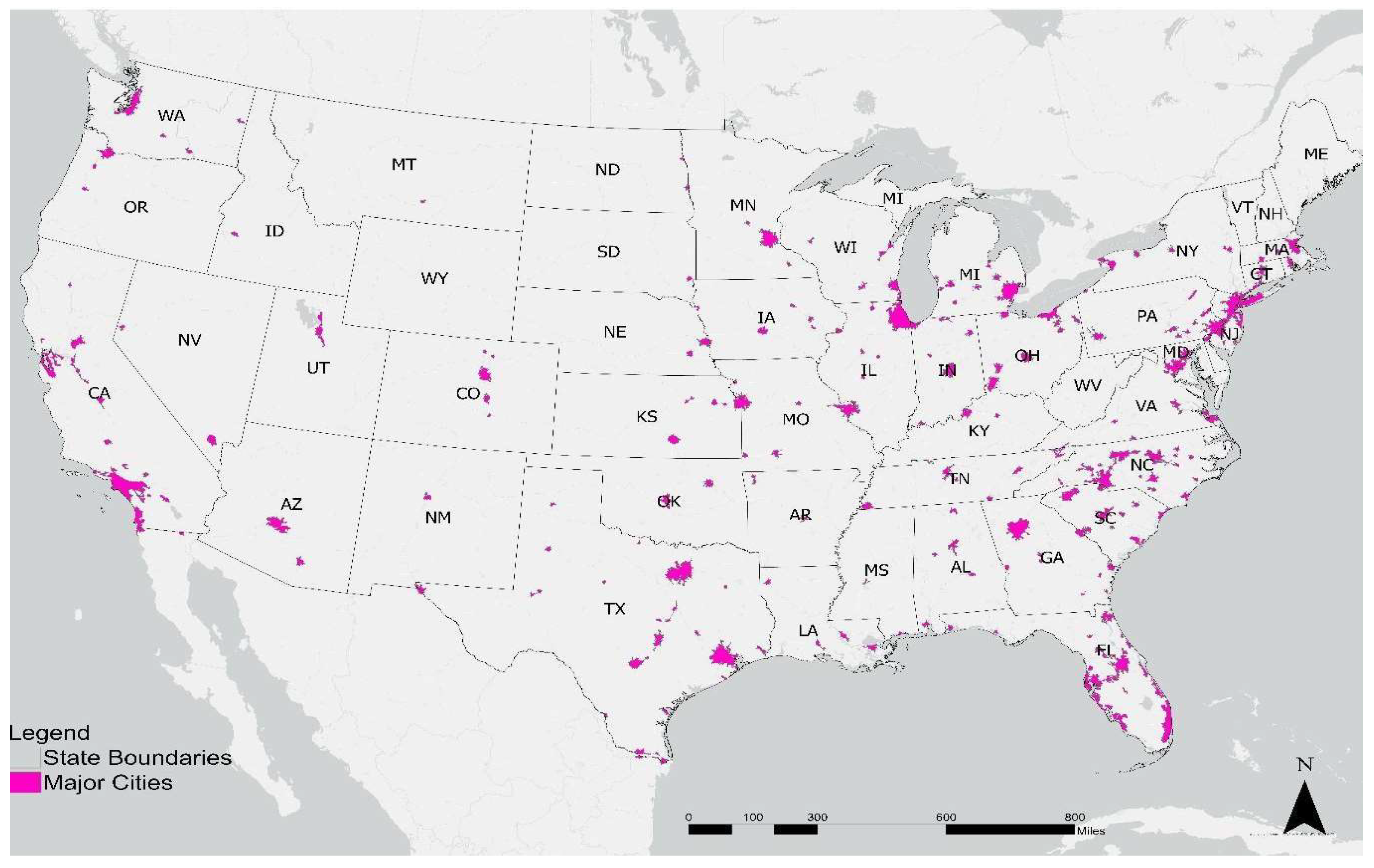
The study area is the contiguous United States (CONUS), which refers to the 48 states that are connected without being separated by a body of water or another country, excluding Alaska and Hawaii [41]. According to the 2020 census, the population of CONUS was 328,571,074, which accounted for 99.13% of the total population of the United States [42]. In this study, major cities (or urban areas) in CONUS (Figure 1) are defined as those with populations greater than 250,000 residents [8]. Major cities are characterized by high economic contributions [43], distinct social characteristics [11], and diverse populations [44]. Disparities in access to healthcare, UGBS, and social services are also common in major cities [1]. To provide more detailed insights beyond the national-scale analysis, we also selected two cities as case studies based on their distinct spatial patterns, regional contexts, and levels of urbanization. The cities considered are Atlanta, Georgia, with a population of 512,550 [42], and Los Angeles, California, with a population of 3.97 million [42].

2.2. Data Sources

2.2.1. Major Cities

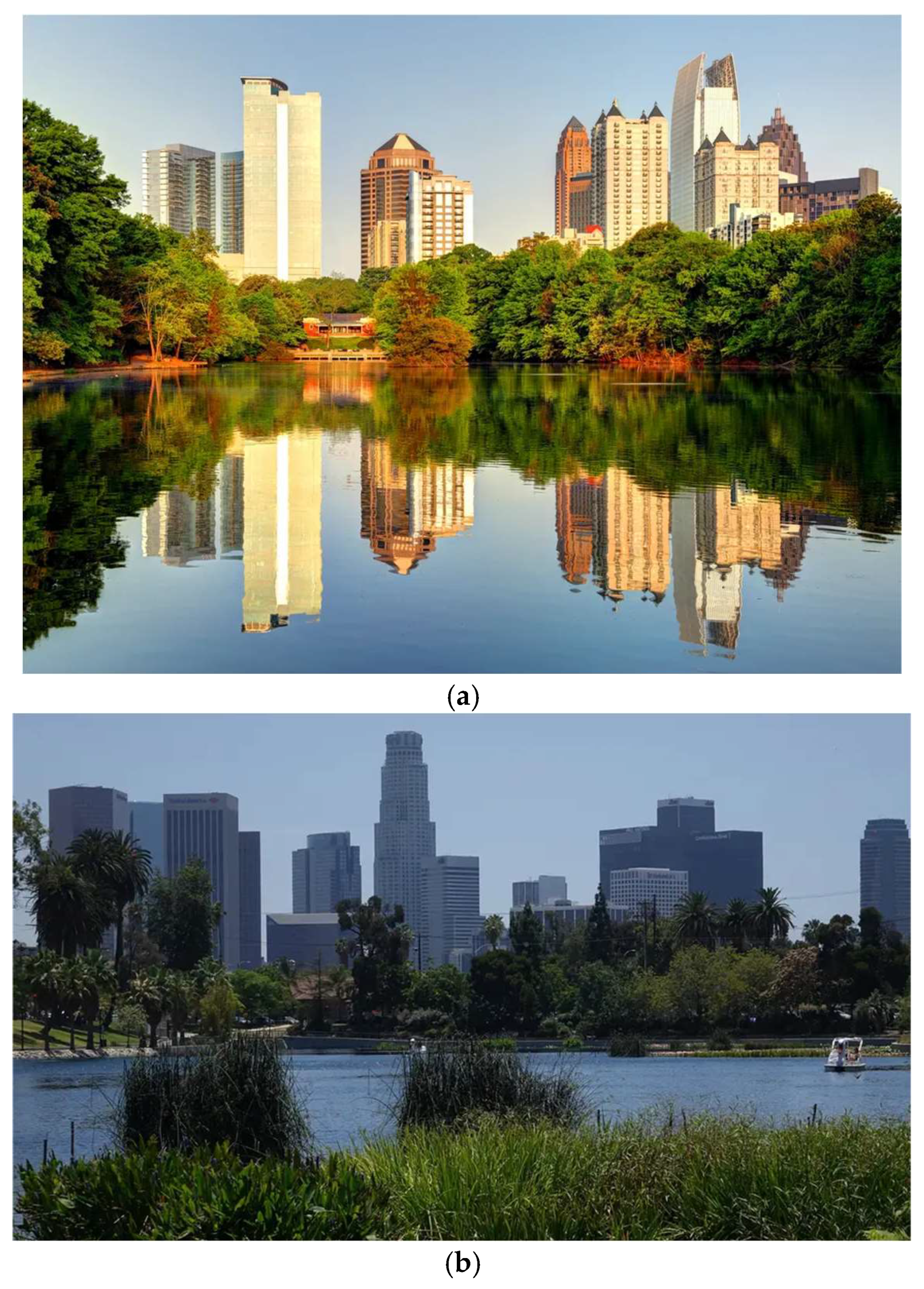
The major cities in this study were derived from the global multi-temporal urban boundary dataset developed by Li et al. [45]. The dataset shows strong agreement with high-resolution data from Google Earth images [46]. We focus on major cities because they contain the highest concentrations of the U.S. population, experience the most intense forms of urbanization, and face the greatest pressures on natural environments. These areas also exhibit substantial heterogeneity in green and blue space distribution, making them well suited for exploring spatial variation in UGBS exposure. In addition, major cities provide more complete, comparable, and consistently reported tract-level environmental, behavioral, and socioeconomic data, allowing for reliable cross-city analyses at a national scale. A total of 185 major cities within CONUS were included (Figure 1). Representative examples of UGBS are shown in Figure 2a,b.

2.2.2. UGBS Coverage

Green space coverage data for 2015–2017 were obtained from Wu et al. [46] and were originally generated using the linear spectral unmixing model described in Wu et al. [46].
Blue space coverage for 2015–2017 was derived from the Normalized Difference Water Index (NDWI) using 10 m Sentinel-2 Multi-Spectral Instrument (MSI) surface reflectance data. NDWI is one of the most widely used multiband spectral water indices [46,49]. NDWI values range from −1.0 to 1.0. Positive NDWI values are identified as water, while negative values are classified as non-water. NDWI is calculated as Equation (1).
NDWI = G r e e n N I R G r e e n + N I R

2.2.3. Population Density Data

The population density dataset in this study was sourced from WorldPop for the years 2015 to 2017, representing spatial and temporal population dynamics in CONUS [7,41]. WorldPop provides global annual demographic datasets, including population density, age and sex structures, and urban growth, typically at a 1 km resolution. For this analysis, we used the finer 100 m resolution WorldPop gridded population data generated using a random forest regression tree-based mapping technique [50]. These data were resampled and aligned with the UGBS layers before computing exposure metrics.

2.2.4. Mental Health Data

Frequent Mental Distress (FMD) was used as the mental health indicator in this study. This dataset is available only at the census tract level for 2015–2017 through the CDC’s 500 Cities project [51]. FMD identifies adults reporting 14 or more days of poor mental health in the past 30 days, and tract-level estimates represent the proportion of residents meeting this criterion in each census tract.

2.2.5. Covariates

As highlighted by Du et al. [52], key drivers of mental health include behavioral factors (smoking and binge drinking) and socioeconomic factors (median household income and educational attainment). These variables are available at the census tract level for 2015–2017 (Table 1).

2.3. Population-Weighted Exposure Framework

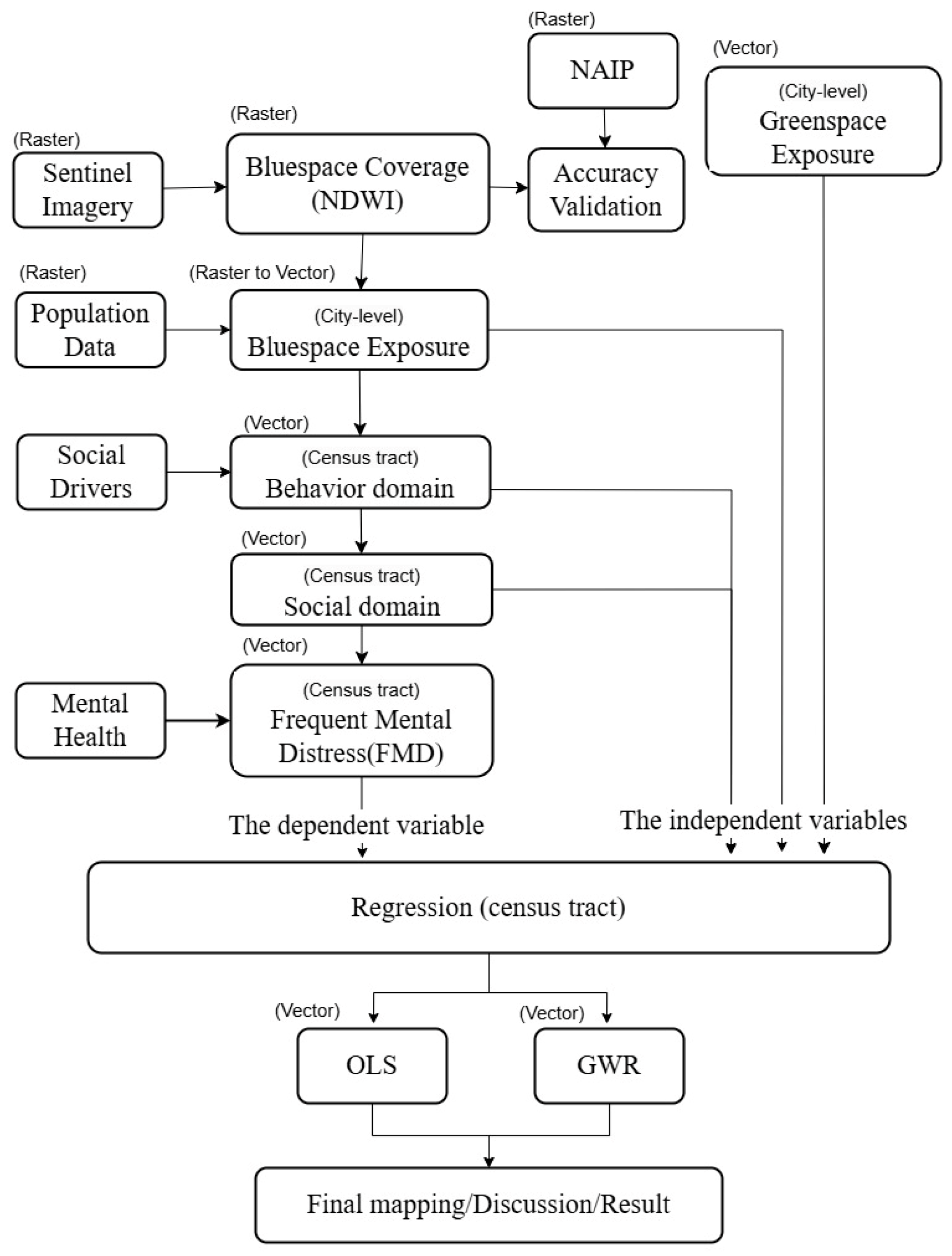
The population-weighted exposure framework [37,49] was adopted using a 500 m radius buffer around each city. This buffer aligns with the National Recreation and Park Association’s (NRPA) 10 min walk campaign [53,54,55]. This framework models the spatial interaction between UGBS and population density (Figure 3). Wu et al. [46] previously calculated green space exposure using this framework, and it was used in this study for 2015–2017 using this framework, and we directly employed their green space exposure estimates for the 185 cities in our analysis. Following the same methodology, blue space exposure was calculated using the Sentinel 2 NDWI dataset.
The population-weighted exposure framework is mathematically represented as Equation (2).
G E d   = i = 1 M     P i   ×     G i d i = 1 M   P i  
where
  • P i   represents the population density of pixel i,
  • G i d represents the fractional green space or blue space coverage of pixel i that considers both the central and nearby environment within a buffer size of d (500 m),
  • M is the total pixel number within the city, and
  • G E d is the population-weighted green space or blue space exposure at the city level.
The blue space exposure was estimated using this population-weighted exposure framework. It models the relationship between blue space coverage and population density within a 500 m buffer. The resulting exposure values were exported in CSV format for the 185 major cities included in the study. This workflow indicates that the population-weighted exposure framework uses raster inputs and generates a city-level vector dataset (Figure 3). Blue space exposure data for 2015, 2016, and 2017 were imported into ArcGIS Pro version 3.3 [56] using their geographic coordinates. Green space exposure data from Wu et al. [46] were also imported into the GIS environment.
While mental health and covariates were available at the census tract level, UGBS exposure was initially calculated at the city level. To integrate these datasets, we assigned the city-level green space and blue space exposure values to all census tracts within each corresponding city using the Spatial Join tool in ArcGIS Pro. This step enabled tract-level regression modeling, while preserving the original spatial resolution of the mental health and covariate variables.

2.4. Statistical Analysis

Statistical analysis was conducted to quantify the relationship between UGBS exposure and mental health. Ordinary Least Squares (OLS) regression was used to evaluate the effects of multiple independent variables, including UGBS exposure, on the dependent variable (FMD) [33,37,43]. This allows for the assessment of variable contributions while controlling for relevant behavioral and socioeconomic covariates [11]. To ensure that the independent variables were not collinear, a multicollinearity test was performed in R 4.4.1 using the variance inflation factor (VIF), with a cutoff value of 5 [3,54]. The OLS model is shown in Equation (3) [57].
y = β 0 + β 1 X + ε
where:
  • y is the dependent variable (mental health, measured as FMD);
  • β 0 is the intercept;
  • β 1 is the vector of regression coefficients;
  • x is the vector of independent variables;
  • ε is the error term.
In addition to OLS, Moran’s I statistic was used as a model diagnostic to assess whether mental health and independent variables were spatially clustered or randomly distributed. A Moran’s I value near +1 suggests strong positive spatial autocorrelation (clustered), while values near −1 suggest a dispersed pattern, and values near zero indicate total spatial randomness [58].
Geographically weighted regression (GWR) [59] was also used to account for geographical variation in the estimated coefficients (Figure 3). GWR captures local variations in the impact of UGBS on mental health, offering insights that OLS may overlook. OLS assigns a single global value to each coefficient, whereas GWR estimates location-specific regression coefficients by weighting nearby observations more heavily than distant ones [40,43]. The GWR analysis was carried out using the “GWmodel” library in R [60]. The GWR model is represented by Equation (4).
y =   β 0 u j , v j + i = 1 k     β 1 u j , v j x i j     ε j
where:
  • y is the dependent variable (mental health, measured as FMD);
  • u j , v j denotes the coordinates of the centroid of each census tract;
  • β 0 u j , v j is the local intercept;
  • β 1 u j , v j represents the local estimated coefficient that indicates spatial variation;
  • x i j   represents the independent variables;
  • k represents the number of independent variables;
  • ε is the error term.
Spatial weights are crucial in GWR, as they determine the influence of nearby observations on local parameter estimates, ensuring that spatial relationships are properly modeled. We adopted a k-nearest neighbors (KNNs) approach to define the spatial weights, because it maintains a constant number of neighbors for each location regardless of data density. This makes it suitable for large, unevenly distributed datasets such as the multi-city census tract data used in this study [60].

3. Results

3.1. Summary Statistics

NAIP imagery was used as a benchmark to validate the blue space coverage estimated from Sentinel-2 imagery. Both datasets were processed to extract water masks using NDWI thresholds, followed by sampling and overlay analysis to compare pixel-level classifications. A confusion matrix was generated to assess classification accuracy. The results showed an overall accuracy of 82.5% and a Kappa coefficient of 0.65, indicating good agreement between Sentinel-2 and NAIP reference data [61].
The summary statistics (Table 2) outline the key variables analyzed in this study. Mental health values (FMD) show a slight increase, with mean values rising from 13.22 days in 2015 to 14.16 days in 2017. Blue space exposure remains relatively stable, with mean values ranging from 37% to 38%, while green space exposure increases, with the mean rising to 60% from about 53% in 2015. The behavioral covariates indicate that, on average, about 18% of adults report binge drinking or having smoked at least 100 cigarettes. Median household income notably increases in 2017, with the mean reaching $68,010 compared to $52,210 in 2015, and educational attainment remains consistently high, with mean values above 80% from 2015 to 2017.

3.2. OLS Regression

Although all variables were statistically significant and exhibited acceptable multicollinearity (VIF < 5) across the three years, the OLS results in Table 3 indicate the need for spatial analysis to capture localized variation in green space and blue space exposure effects.
Furthermore, spatial autocorrelation test of the OLS residuals showed strong and statistically significant clustering in all three years. Moran’s I values were high and positive (0.75 in 2015, 0.64 in 2016, and 0.61 in 2017; p < 0.001), indicating that the OLS model did not sufficiently account for spatial dependence in the data. These findings point to the need for spatial modeling to account for geographic variation in environmental exposure and mental health [40].

3.3. Geographically Weighted Regression (GWR)

A GWR model was fitted using a bisquare kernel, with bandwidth selection optimized based on the corrected AIC. The results revealed significant spatial heterogeneity in the coefficients of key explanatory variables, indicating that the strength and direction of their associations with mental health vary across geographic locations.
The GWR results (Table 4, Table 5 and Table 6) revealed substantial spatial variation in the relationships between mental health outcomes and the independent variables, which were not fully captured by the OLS model. Coefficients varied across geographic areas, with both negative and positive associations appearing depending on local context. Model performance metrics are summarized in Table 7. Compared to the OLS models (e.g., 2015, R2 = 0.90, AIC = 64,748.03), the GWR models (e.g., 2015, R2 = 0.96, AIC = 44,889.85), produced lower AIC values and higher R-squared values, indicating improved model fit and greater explanatory power. Because lower AIC values reflect a more efficient model with better goodness of fit, these results support the use of GWR for capturing spatially varying relationships in the data.

3.4. Case Study

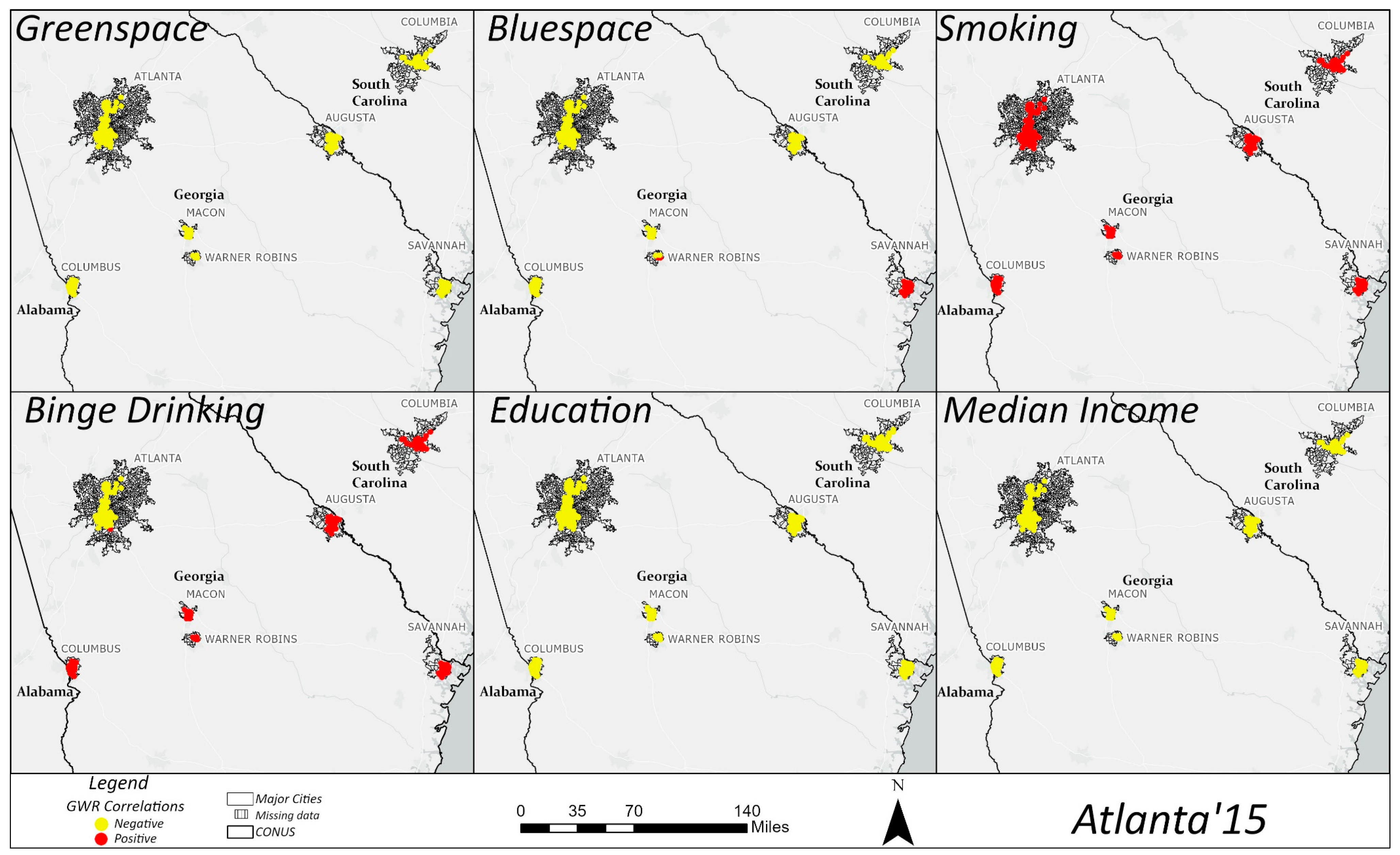
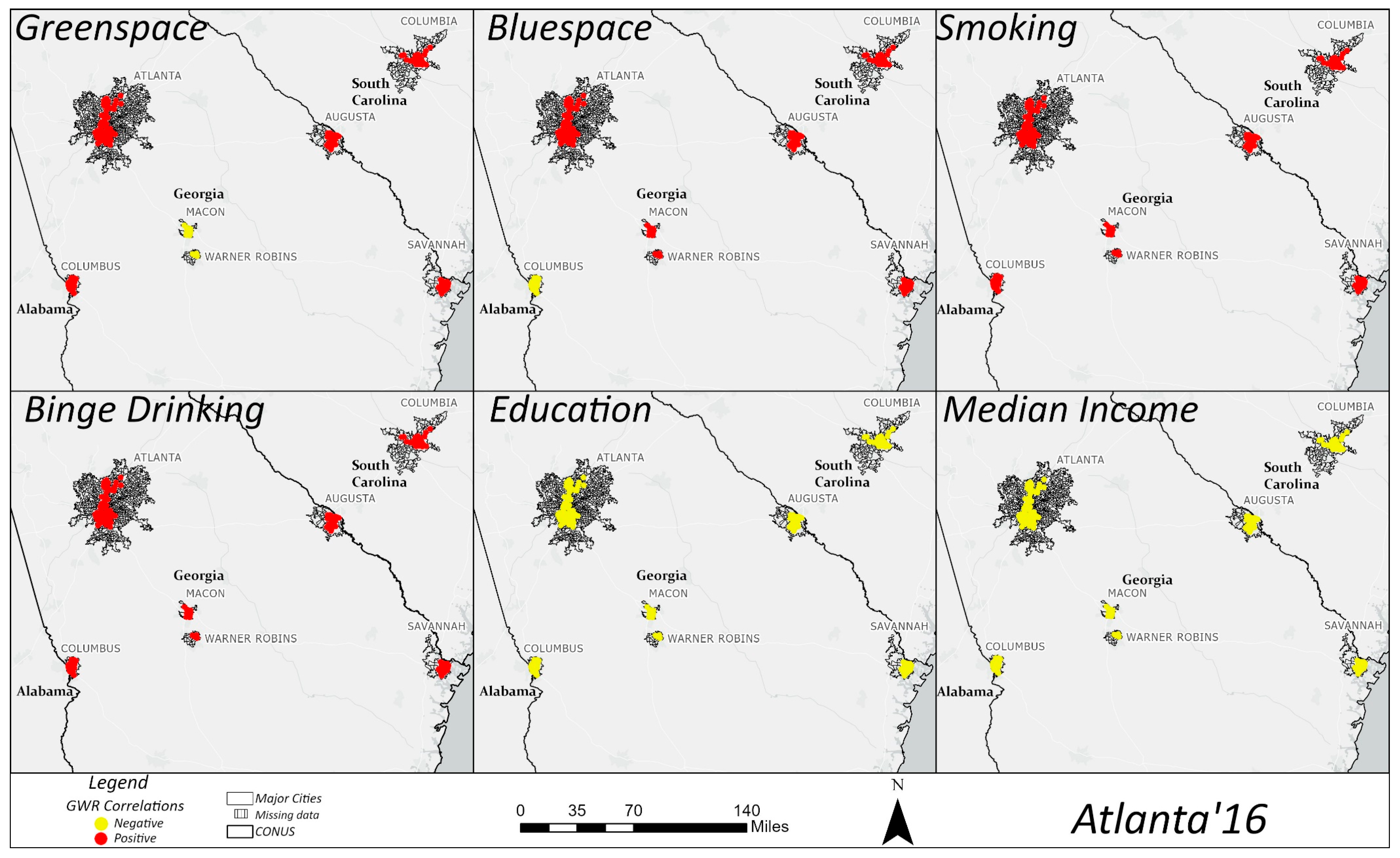
Figure 4 presents a six-panel GWR map for Atlanta in 2015, providing a detailed look at the spatial relationships between mental health and the explanatory factors. Panel 1 (green space exposure) and Panel 2 (blue space exposure) are largely shaded yellow, indicating inverse relationships with mental health, which aligns with the expectation that higher environmental exposure is associated with improved mental health. Panel 3 (smoking) is shaded red across most areas, reflecting a direct relationship in which higher smoking rates correspond to worse mental health outcomes. Panel 4 (binge drinking) appears yellow within Atlanta but shifts to red in nearby cities such as Macon and Warner Robins, suggesting that the association between alcohol use and mental health varies by location. Panels 5 and 6 (educational attainment and median income) are predominantly yellow, indicating inverse relationships consistent with higher socioeconomic status being associated with fewer mental health issues.
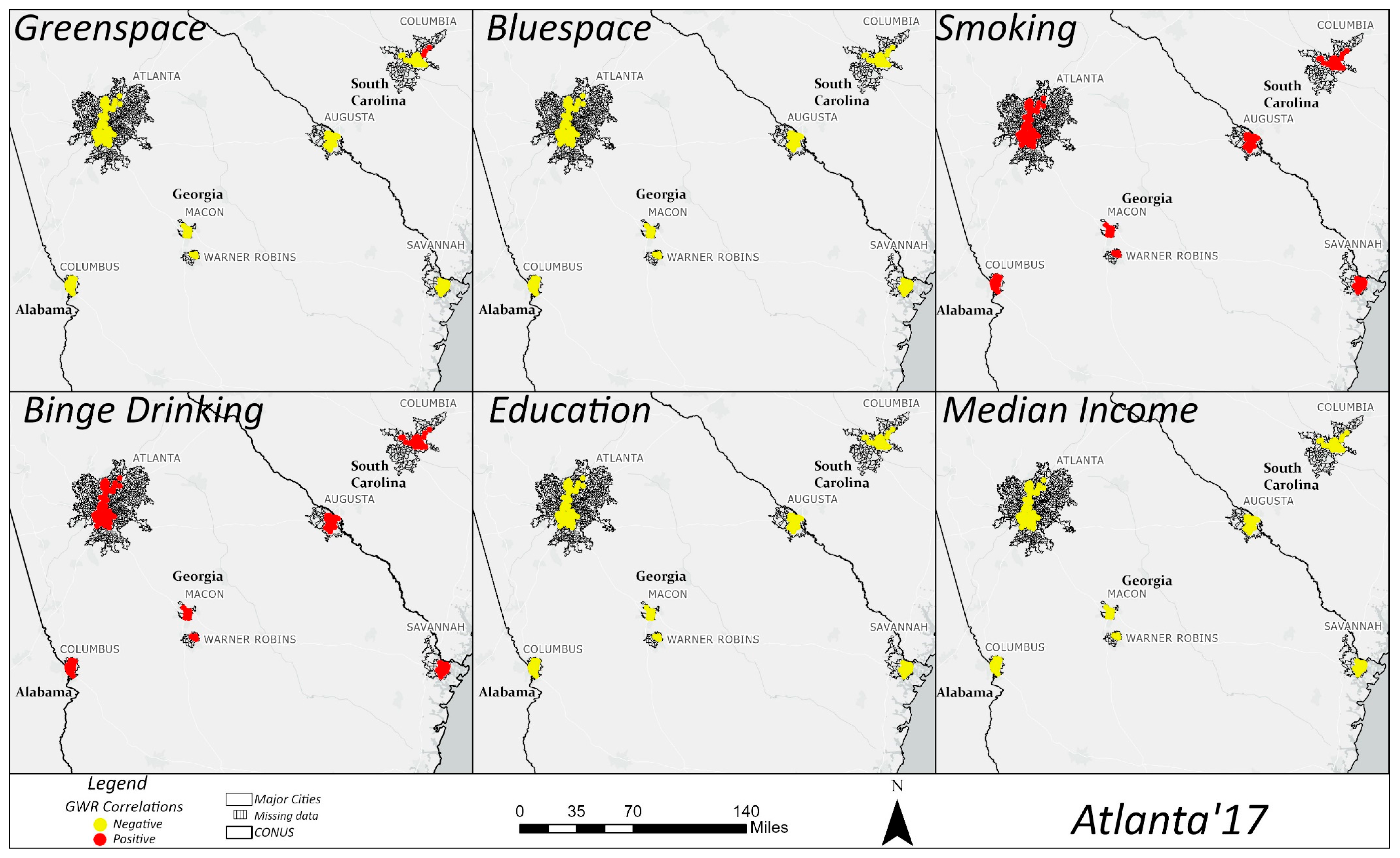
In 2016, the GWR results for Atlanta (Figure 5) show a noticeable shift. Panels 1 and 2 now display red, indicating a direct relationship of UGBS with mental health. Smoking (Panel 3) remains red, consistent with 2015, while binge drinking (Panel 4) now appears red across the broader region, showing a more uniform direct relationship than in the previous year. Educational attainment and median income (Panels 5 and 6) continue to show yellow shading.
By 2017, the spatial patterns shift again (Figure 6). Panels 1 and 2 return to yellow, reaffirming the inverse UGBS–mental health relationship observed in 2015. Panels 3 and 4 (smoking and binge drinking) remain red, indicating sustained direct associations with poor mental health. Educational attainment and median income (Panels 5 and 6) remain yellow, maintaining their inverse association.
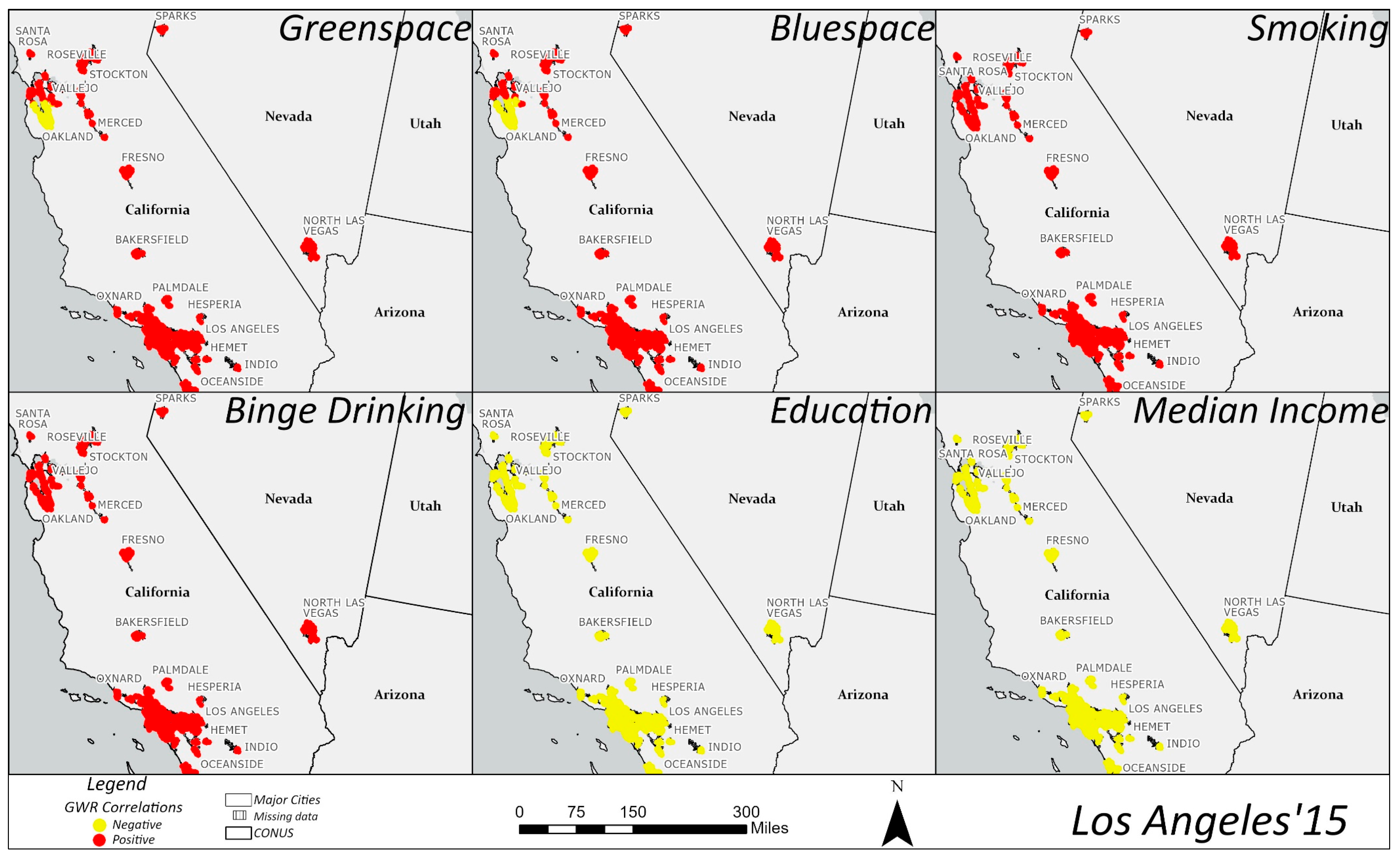
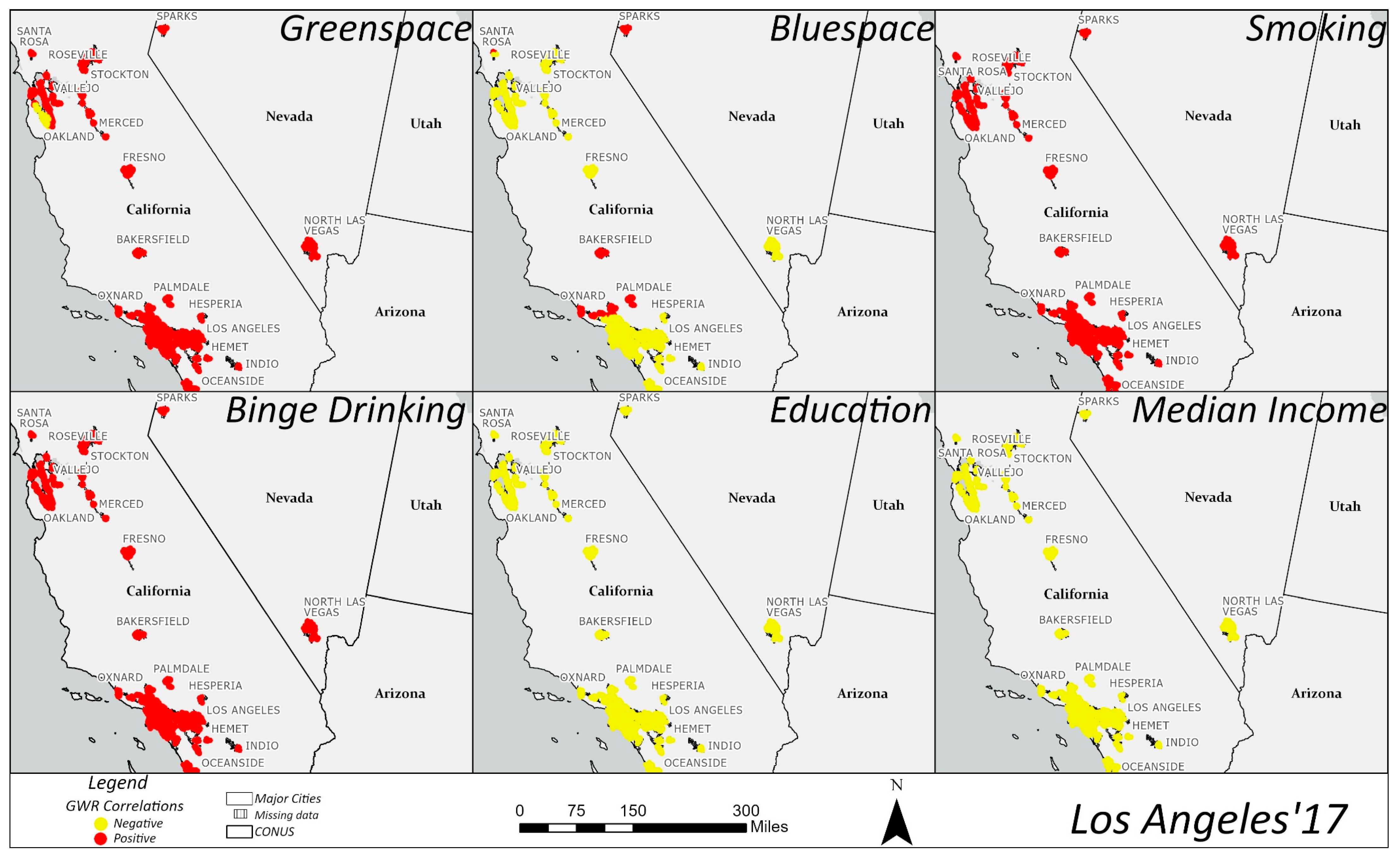
Figure 7 shows the 2015 GWR results for Los Angeles and nearby regions. Panel 1 (green space exposure) shows predominantly red shading, indicating a direct relationship with mental health, an unexpected finding. In contrast, the neighboring city of Oakland displays yellow shading, suggesting an inverse relationship and highlighting spatial variability within the same state. Panel 2 (blue space exposure) also shows red in Los Angeles but yellow in Oakland, again demonstrating regional differences. Panel 3 (smoking) and Panel 4 (binge drinking) show red shading across the region, reflecting strong direct relationships with poor mental health. Panels 5 and 6 (educational attainment and median income) are consistently yellow, indicating inverse relationships and reinforcing the protective effects of higher socioeconomic status.
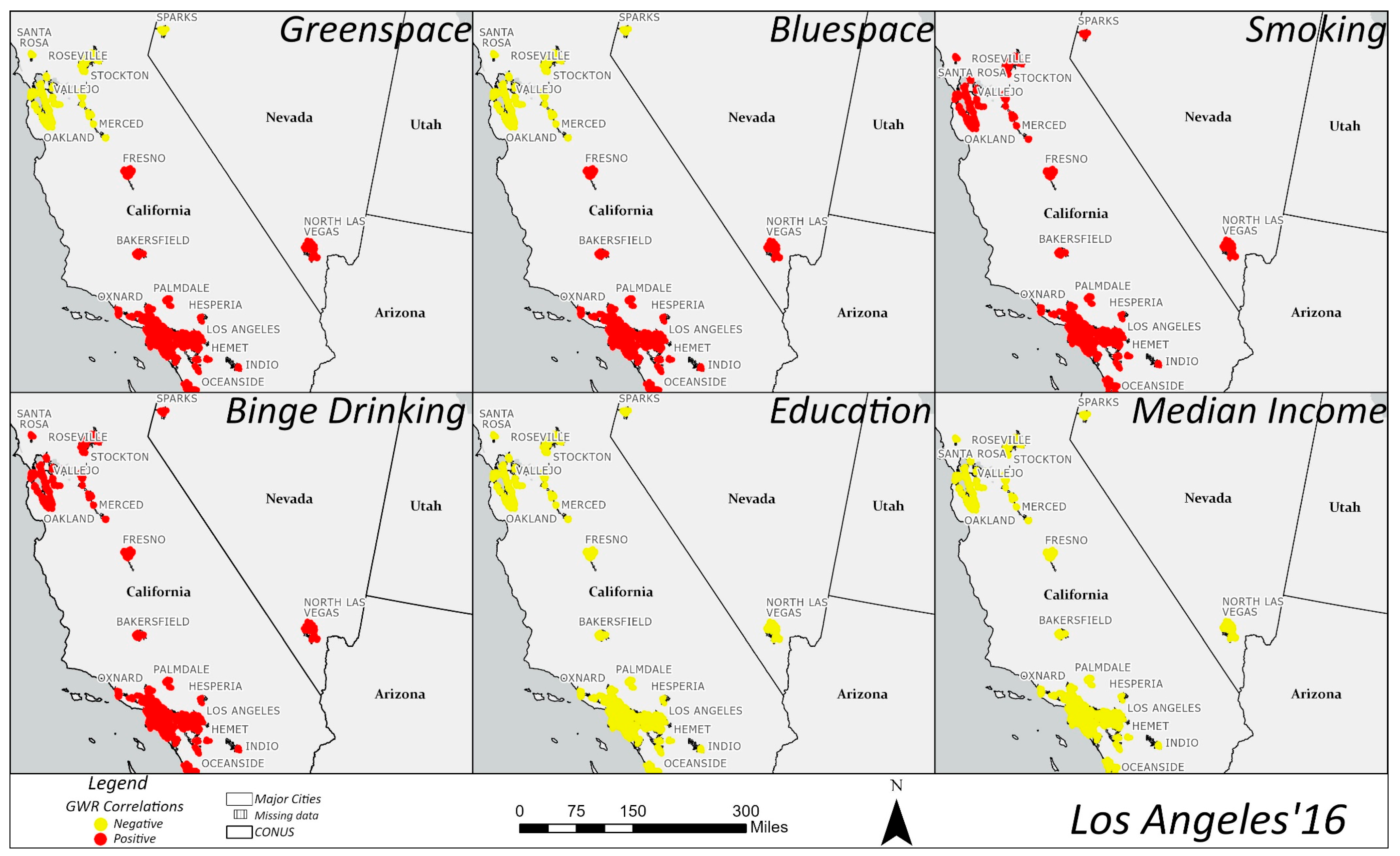
Figure 8 shows the 2016 GWR results, which generally follow the same pattern. Panels 1 and 2 (green space and blue space exposure) again show red correlations in Los Angeles, indicating persistent direct relationships with mental health. However, cities further north display yellow shading, suggesting spatially varying effects. Smoking and binge drinking (Panels 3 and 4) remain directly related to poor mental health (red shading), while educational attainment and income (Panels 5 and 6) continue to show inverse relationships (yellow shading).
Figure 9 presents the 2017 results. Green space exposure (Panel 1) continues to show a direct relationship with mental health (red). Blue space exposure (Panel 2) shifts to yellow, suggesting an inverse relationship in Los Angeles, unlike in previous years. However, surrounding cities such as Oxnard, Palmdale, and Bakersfield maintain red shading, highlighting continuing regional variation. Smoking and drinking (Panels 3 and 4) persist as direct risk factors, while educational attainment and median income (Panels 5 and 6) remain inversely related to mental health.

4. Discussion

Mental health is shaped by a complex interplay of environmental, behavioral, and socioeconomic factors [52,62], and the findings of this study reinforce this understanding. Across all three years (2015–2017), smoking consistently showed the strongest association with poor mental health (Figure 4, Figure 5, Figure 6, Figure 7, Figure 8 and Figure 9 and Table 3, Table 4, Table 5 and Table 6), reinforcing findings from prior studies [20,46]. Binge drinking showed a weaker but still significant association with mental health. Its correlations varied by location, appearing positive in some areas and negative in others, reflecting its dual role as both a contributor to mental health problems (Figure 5, Figure 6, Figure 7, Figure 8 and Figure 9 and Table 6) and, in some cases, a coping mechanism (Figure 4 and Table 3, Table 4 and Table 5) for mental health. As noted by Suh and Ressler [63], the unexpected negative correlations may stem from the complex bidirectional relationship between alcohol use disorders (AUD) and mental health disorders (MHD), in which each condition can cyclically influence and exacerbate the other. Gender-based differences in alcohol use for coping, with women more likely to use alcohol in response to anxiety or stress [64,65], may also affect these patterns.
Socioeconomic factors, median income, and educational attainment, were consistently negatively correlated with mental health (Figure 4, Figure 5, Figure 6, Figure 7, Figure 8 and Figure 9 and Table 3, Table 4, Table 5 and Table 6). This is in line with Baranova et al. [66], despite their study being conducted in the United Kingdom, and the pattern was consistent across major cities in CONUS.
The inconsistent relationships between UGBS exposure and mental health across the OLS model and GWR models (Table 4, Table 5 and Table 6) may be attributed to confounding and suppression effects [44,67]. These occur when other variables (e.g., smoking or median income) in the model may influence the strength or direction of the UGBS–mental health relationship. For example, green spaces may be more prevalent in higher-income areas, where better socioeconomic conditions already support improved mental health. Conversely, blue spaces may be more common in lower-income areas where higher smoking rates and greater mental health challenges are more prevalent, which may inflate the positive association observed in some OLS results (Table 3). These inconsistencies point to deeper, location-specific dynamics that cannot be fully captured by global models like OLS.
Although the OLS models revealed statistically significant associations between UGBS exposure and poor mental health, these coefficients were small in magnitude. This reflects both the scale of the variables used and the large sample size of the analysis, which increases statistical power and can result in modest effects achieving statistical significance. It is important to interpret these coefficients in context: the mental health outcome represents the percentage of adults reporting poor mental health, meaning that even a one percent point change corresponds to substantial population-level impacts across large urban areas. Therefore, while the effect sizes are modest, they remain meaningful for public health planning. Consistent with best practices, the study emphasizes effect sizes and practical relevance rather than relying solely on statistical significance in interpreting these findings.
The GWR analysis helped address complexities by revealing that the effects of UGBS exposure vary significantly by location [68]. In some areas, UGBS exposure may not be beneficial and may even contribute to stress, potentially due to factors such as perceived safety, maintenance quality, or gentrification-related pressures [69]. Unlike studies that focus exclusively on green space [70,71], this study emphasizes the importance of considering both green space and blue space in tandem [72]. The results align with the findings of Vegaraju and Amiri [11], who reported associations between UGBS exposure and general health in Washington, United States, from 2011 to 2019. Benefits of UGBS exposure are not limited to the United States alone [26] and have been documented in Bulgaria [73], Wales [43], New Zealand [9], and China [5]. The attention on green space exposure is not just for public spaces like parks and recreation centers [74] but also for housing construction with minimal gardens, which has adverse impacts on health [75]. Similarly, recent studies advocate for incorporating blue space exposure into assessments of environmental health benefits [6,9,29,30,70]. Since blue spaces are often embedded within green spaces (e.g., lakes in parks or riverfront trails), their combined influence adds further complexity to the analysis and interpretation [4]. Overall, these findings collectively highlight the need for integrated planning strategies when addressing urban mental health through natural environment design [5,27,54,66].
The spatial variability observed in the GWR results may stem from differences in urban form, accessibility, or other underlying social context [19,38,64,73]. Cities with well-maintained parks and recreational areas are more likely to experience more favorable mental health outcomes. In contrast, poorly managed, unsafe, or inaccessible spaces may fail to provide mental health benefits or may even contribute to stress [22,23,70]. Additionally, inequalities in access to high-quality green space and blue space, often shaped by socioeconomic and racial disparities, may contribute to the uneven benefits observed in the study area [3,26,76,77,78]. These findings highlight the need for spatially adaptive urban planning policies [79] that take locational dynamics into account when designing and maintaining UGBS to support mental health and well-being [7,80].

5. Study Limitations and Recommendations

First, the mental health dataset was only available at the census tract level for 2015, 2016, and 2017. Additionally, the dataset was collected through telephone surveys, which may introduce reporting biases. Respondents are randomly selected each year, and they might underreport or overreport their mental health status due to social desirability [81]. To address this, future studies could adopt a mixed-methods approach combining telephone [11], online [5], and in-person surveys [82] to enhance accuracy and sample representativeness.
Second, the NDWI classification is conservative and has been found to underestimate water area [60,83]. Surface water detail provided by the Landsat Level-3 Dynamic Surface Water Extent (DSWE) Science Product [84] includes six acquisition-based raster layers accounting for cloud cover, shadows, and snow from 1982 to 2025. However, DSWE was not readily available in the Google Earth Engine catalog at the time of analysis. Future research should consider incorporating DSWE or similar products to improve the accuracy and temporal sensitivity of blue space measurements. Furthermore, UGBS exposure was estimated using remote sensing data, which does not capture direct human interaction. Incorporating survey data or mobile-based tracking could provide a more nuanced understanding of how these spaces are experienced by residents [85].
Third, the study focused exclusively on major cities over a three-year period, excluding smaller cities and rural areas. As a result, the findings may not be generalizable to less urbanized regions [86]. Future research should aim for broader geographic and temporal coverage to better understand mental health dynamics across urban-rural gradients [23].
Fourth, assigning a single city-level UGBS exposure value to all census tracts within each city is a major simplification that reduces intra-city variability and may obscure meaningful neighborhood-level differences in accessibility, quality, and use of green and blue spaces [44,69]. This limitation reflects the national, cross-city comparative scope of the study, which required a consistent exposure metric across all cities. Accordingly, the findings should be interpreted at the city scale rather than the neighborhood scale. Future studies should incorporate fine-resolution accessibility measures, including plot-level metrics, street-network walkability, or 10 min walk accessibility, mobility-based or individualized exposure data, and qualitative assessments of UGBS quality to better identify within-city disparities and enhance the precision and explanatory power of the regression models.
Finally, although GWR offers a spatially adaptive framework, it still relies on linear relationships. Nonlinear effects and interaction terms may remain unmodeled, potentially limiting the explanatory power of the results. Future studies can investigate advanced modeling techniques, such as machine learning [5] or nonlinear spatial models like Geographically Weighted Multivariate t Regression (GWTR) to help capture these complex dynamics while integrating temporal effects [87].

6. Conclusions

This study examined the relationships between urban green and blue space (UGBS) exposure and mental health across major U.S. cities from 2015 to 2017. The results show that UGBS effects are not uniform across locations. In some cities, poor mental health outcomes persist even where green space or blue space exposure is high, indicating that UGBS quantity alone is not sufficient; quality and accessibility also matter. Behavioral and socioeconomic factors, particularly smoking, binge drinking, income, and educational attainment, showed consistent associations with mental health across all years. The spatial variation revealed by the GWR models highlights the need to consider local conditions rather than relying on a single global relationship. Overall, this study shows that both green space and blue space contribute to mental health outcomes, but their impacts vary by location and are influenced by broader social and behavioral contexts.

Author Contributions

Conceptualization, O.I. and M.L.; methodology, O.I., M.L., C.H. and W.T.; software, O.I. and M.L.; validation, M.L., C.H. and W.T.; formal analysis, O.I.; investigation, O.I. and M.L.; resources, O.I., M.L., C.H. and W.T.; data curation, O.I. and M.L.; writing—original draft preparation, O.I.; writing—review and editing, O.I., M.L., C.H. and W.T.; visualization, O.I.; supervision, M.L.; project administration, M.L., C.H. and W.T. All authors have read and agreed to the published version of the manuscript.

Funding

This research received no external funding.

Institutional Review Board Statement

Not applicable.

Informed Consent Statement

Not applicable.

Data Availability Statement

The mental health (FMD) and covariate datasets are available from the CDC at https://data.cdc.gov/browse?q=500+Cities%3A+Census+Tract+Boundaries&sortBy=relevance&page=1&pageSize=20 (accessed on 11 October 2024). The GEE script used to derive blue space exposure data is accessible at: https://code.earthengine.google.com/17d55860b809394615ccca051ba4af78 (accessed on 11 October 2024). Green space exposure data from Wu et al. [46] are available at https://datahub.hku.hk/projects/GreenExposureEquality/176019 (accessed on 11 October 2024).

Acknowledgments

We thank the anonymous reviewers and the editor for their constructive feedback.

Conflicts of Interest

The authors declare no conflicts of interest.

References

  1. Kuddus, M.A.; Tynan, E.; McBryde, E. Urbanization: A problem for the rich and the poor? Public Health Rev. 2020, 41, 1. [Google Scholar] [CrossRef] [PubMed]
  2. UN. Cities—United Nations Sustainable Development Action 2015. United Nations Sustainable Development. 2023. Available online: https://www.un.org/sustainabledevelopment/cities/ (accessed on 11 October 2024).
  3. Lin, M.; Van Stan, J.T. Impacts of urban landscapes on students’ academic performance. Landsc. Urban Plan. 2020, 201, 103840. [Google Scholar] [CrossRef]
  4. Hu, L.; Li, Q. Greenspace, bluespace, and their interactive influence on urban thermal environments. Environ. Res. Lett. 2020, 15, 034041. [Google Scholar] [CrossRef]
  5. Zhang, J.; Li, D.; Ning, S.; Furuya, K. Sustainable Urban Green Blue Space (UGBS) and Public Participation: Integrating Multisensory Landscape Perception from Online Reviews. Land 2023, 12, 1360. [Google Scholar] [CrossRef]
  6. Gascon, M.; Zijlema, W.; Vert, C.; White, M.P.; Nieuwenhuijsen, M.J. Outdoor blue spaces, human health and well-being: A systematic review of quantitative studies. Int. J. Hyg. Environ. Health 2017, 220, 1207–1221. [Google Scholar] [CrossRef] [PubMed]
  7. World Health Organization. Mental Health. Available online: https://www.who.int/news-room/fact-sheets/detail/mental-health-strengthening-our-response (accessed on 11 October 2024).
  8. CDC. About Mental Health. Available online: https://www.cdc.gov/mental-health/about/index.html (accessed on 20 May 2024).
  9. Nutsford, D.; Pearson, A.L.; Kingham, S.; Reitsma, F. Residential exposure to visible blue space (but not greenspace) associated with lower psychological distress in a capital city. Health Place 2016, 39, 70–78. [Google Scholar] [CrossRef]
  10. Lachowycz, K.; Jones, A.P. Greenspace and obesity: A systematic review of the evidence. Obes. Rev. 2011, 12, e183–e189. [Google Scholar] [CrossRef]
  11. Vegaraju, A.; Amiri, S. Urban green and blue spaces and general and mental health among older adults in Washington state: Analysis of BRFSS data between 2011–2019. Health Place 2024, 85, 103148. [Google Scholar] [CrossRef]
  12. Tsai, W.-L.; McHale, M.; Jennings, V.; Marquet, O.; Hipp, J.; Leung, Y.-F.; Floyd, M. Relationships between Characteristics of Urban Green Land Cover and Mental Health in U.S. Metropolitan Areas. Int. J. Environ. Res. Public Health 2018, 15, 340. [Google Scholar] [CrossRef] [PubMed]
  13. Liu, J.; Jiang, N.; Fan, A.Z.; Weissman, R. Alternatives in Assessing Mental Healthcare Disparities Using the Behavioral Risk Factor Surveillance System. Health Equity 2018, 2, 199–206. [Google Scholar] [CrossRef]
  14. Liu, Y.; Croft, J.B.; Wheaton, A.G.; Perry, G.S.; Chapman, D.P.; Strine, T.W.; McKnight-Eily, L.R.; Presley-Cantrell, L. Association between perceived insufficient sleep, frequent mental distress, obesity and chronic diseases among US adults, 2009 behavioral risk factor surveillance system. BMC Public Health 2013, 13, 84. [Google Scholar] [CrossRef]
  15. Moriarty, D.G.; Zack, M.M.; Holt, J.B.; Chapman, D.P.; Safran, M.A. Geographic Patterns of Frequent Mental Distress. Am. J. Prev. Med. 2009, 36, 497–505. [Google Scholar] [CrossRef]
  16. Burris, J.L.; Andrykowski, M.A. Physical and Mental Health Status and Health Behaviors of Survivors of Multiple Cancers: A National, Population-Based Study. Ann. Behav. Med. 2011, 42, 304–312. [Google Scholar] [CrossRef][Green Version]
  17. Bhui, K.; Cipriani, A. Understanding and responding to the drivers of inequalities in mental health. BMJ Ment. Health 2023, 26, e300921. [Google Scholar] [CrossRef]
  18. Hazlehurst, M.F.; Muqueeth, S.; Wolf, K.L.; Simmons, C.; Kroshus, E.; Tandon, P.S. Park access and mental health among parents and children during the COVID-19 pandemic. BMC Public Health 2022, 22, 800. [Google Scholar] [CrossRef] [PubMed]
  19. Aghabozorgi, K.; Van Der Jagt, A.; Bell, S.; Brown, C. Assessing the impact of blue and green spaces on mental health of disabled children: A scoping review. Health Place 2023, 84, 103141. [Google Scholar] [CrossRef]
  20. Reid, C.E.; Rieves, E.S.; Carlson, K. Perceptions of green space usage, abundance, and quality of green space were associated with better mental health during the COVID-19 pandemic among residents of Denver. PLoS ONE 2022, 17, e0263779. [Google Scholar] [CrossRef]
  21. Geneshka, M.; Coventry, P.; Cruz, J.; Gilbody, S. Relationship between Green and Blue Spaces with Mental and Physical Health: A Systematic Review of Longitudinal Observational Studies. Int. J. Environ. Res. Public Health 2021, 18, 9010. [Google Scholar] [CrossRef] [PubMed]
  22. McDougall, C.W.; Quilliam, R.S.; Hanley, N.; Oliver, D.M. Freshwater blue space and population health: An emerging research agenda. Sci. Total Environ. 2020, 737, 140196. [Google Scholar] [CrossRef]
  23. Alcock, I.; White, M.P.; Lovell, R.; Higgins, S.L.; Osborne, N.J.; Husk, K.; Wheeler, B.W. What accounts for ‘England’s green and pleasant land’? A panel data analysis of mental health and land cover types in rural England. Landsc. Urban Plan. 2015, 142, 38–46. [Google Scholar] [CrossRef]
  24. Twohig-Bennett, C.; Jones, A. The health benefits of the great outdoors: A systematic review and meta-analysis of greenspace exposure and health outcomes. Environ. Res. 2018, 166, 628–637. [Google Scholar] [CrossRef]
  25. Van Den Berg, M.; Wendel-Vos, W.; Van Poppel, M.; Kemper, H.; Van Mechelen, W.; Maas, J. Health benefits of green spaces in the living environment: A systematic review of epidemiological studies. Urban For. Urban Green. 2015, 14, 806–816. [Google Scholar] [CrossRef]
  26. Klompmaker, J.O.; Laden, F.; Browning, M.H.E.M.; Dominici, F.; Ogletree, S.S.; Rigolon, A.; Hart, J.E.; James, P. Associations of parks, greenness, and blue space with cardiovascular and respiratory disease hospitalization in the US Medicare cohort. Environ. Pollut. 2022, 312, 120046. [Google Scholar] [CrossRef]
  27. Thomson, R.M.; Igelström, E.; Purba, A.K.; Shimonovich, M.; Thomson, H.; McCartney, G.; Reeves, A.; Leyland, A.; Pearce, A.; Katikireddi, S.V. How do income changes impact on mental health and wellbeing for working-age adults? A systematic review and meta-analysis. Lancet Public Health 2022, 7, e515–e528. [Google Scholar] [CrossRef]
  28. Wang, P.S.; Aguilar-Gaxiola, S.; Alonso, J.; Angermeyer, M.C.; Borges, G.; Bromet, E.J.; Bruffaerts, R.; de Girolamo, G.; de Graaf, R.; Gureje, O.; et al. Use of mental health services for anxiety, mood, and substance disorders in 17 countries in the WHO world mental health surveys. Lancet 2007, 370, 841–850. [Google Scholar] [CrossRef]
  29. Pearson, A.L.; Shortridge, A.; Delamater, P.L.; Horton, T.H.; Dahlin, K.; Rzotkiewicz, A.; Marchiori, M.J. Effects of freshwater blue spaces may be beneficial for mental health: A first, ecological study in the North American Great Lakes region. PLoS ONE 2019, 14, e0221977. [Google Scholar] [CrossRef]
  30. White, M.P.; Elliott, L.R.; Gascon, M.; Roberts, B.; Fleming, L.E. Blue space, health and well-being: A narrative overview and synthesis of potential benefits. Environ. Res. 2020, 191, 110169. [Google Scholar] [CrossRef]
  31. Kaplan, R.; Kaplan, S. The Experience of Nature: A Psychological Perspective; Cambridge University Press: Cambridge, UK, 1989. [Google Scholar]
  32. Kaplan, S. The restorative benefits of nature: Toward an integrative framework. J. Environ. Psychol. 1995, 15, 169–182. [Google Scholar] [CrossRef]
  33. Wilderman, A.; Lam, M.; Yin, Z.-Y. A pilot study exploring the relationship between urban greenspace accessibility and mental health prevalence in the City of San Diego in the context of socioeconomic and demographic factors. Open Health 2021, 2, 50–70. [Google Scholar] [CrossRef]
  34. Ulrich, R.S. Effects of interior design on wellness: Theory and recent scientific research. J. Health Care Inter. Des. 1991, 3, 97–109. [Google Scholar]
  35. Richman, B.D.; Sloan, F.A.; Grossman, D. Fragmentation in Mental Health Benefits and Services: A Preliminary Examination into Consumption and Outcomes. SSRN Electron. J. 2012, 279–300. [Google Scholar] [CrossRef]
  36. Allen, J.; Balfour, R.; Bell, R.; Marmot, M. Social determinants of mental health. Int. Rev. Psychiatry 2014, 26, 392–407. [Google Scholar] [CrossRef]
  37. Ha, J.; Kim, H.J.; With, K.A. Urban green space alone is not enough: A landscape analysis linking the spatial distribution of urban green space to mental health in the city of Chicago. Landsc. Urban Plan. 2022, 218, 104309. [Google Scholar] [CrossRef]
  38. Sun, Y.; Saha, S.; Tost, H.; Kong, X.; Xu, C. Literature Review Reveals a Global Access Inequity to Urban Green Spaces. Sustainability 2022, 14, 1062. [Google Scholar] [CrossRef]
  39. Chen, K.; Zhang, T.; Liu, F.; Zhang, Y.; Song, Y. How Does Urban Green Space Impact Residents’ Mental Health: A Literature Review of Mediators. Int. J. Environ. Res. Public Health 2021, 18, 11746. [Google Scholar] [CrossRef]
  40. Huang, C.; Xu, N. Climatic factors dominate the spatial patterns of urban green space coverage in the contiguous United States. Int. J. Appl. Earth Obs. Geoinf. 2022, 107, 102691. [Google Scholar] [CrossRef]
  41. World Population Review. Contiguous States. Available online: https://worldpopulationreview.com/state-rankings/contiguous-states (accessed on 11 October 2024).
  42. U.S. Census Bureau. US Census Demographic Data Map Viewer. Census.Gov. 2020. Available online: https://www.census.gov/library/visualizations/2021/geo/demographicmapviewer.html (accessed on 12 October 2024).
  43. Geary, R.S.; Thompson, D.A.; Garrett, J.K.; Mizen, A.; Rowney, F.M.; Song, J.; White, M.P.; Lovell, R.; Watkins, A.; Lyons, R.A.; et al. Green and blue space and mental health. In Green–Blue Space Exposure Changes and Impact on Individual-Level Well-Being and Mental Health: A Population-Wide Dynamic Longitudinal Panel Study with Linked Survey Data; No. 11; National Institute for Health and Care Research: Southampton, UK, 2023. Available online: https://www.ncbi.nlm.nih.gov/books/NBK597114/ (accessed on 11 October 2024).
  44. Rigolon, A.; Browning, M.H.E.M.; McAnirlin, O.; Yoon, H. Green Space and Health Equity: A Systematic Review on the Potential of Green Space to Reduce Health Disparities. Int. J. Environ. Res. Public Health 2021, 18, 2563. [Google Scholar] [CrossRef]
  45. Li, X.; Gong, P.; Zhou, Y.; Wang, J.; Bai, Y.; Chen, B.; Hu, T.; Xiao, Y.; Xu, B.; Yang, J.; et al. Mapping global urban boundaries from the global artificial impervious area (GAIA) data. Environ. Res. Lett. 2020, 15, 094044. [Google Scholar] [CrossRef]
  46. Wu, S.; Chen, B.; Webster, C.; Xu, B.; Gong, P. Improved human greenspace exposure equality during 21st century urbanization. Nat. Commun. 2023, 14, 6460. [Google Scholar] [CrossRef]
  47. Available online: https://www.cntraveler.com/gallery/the-greenest-cities-in-the-us (accessed on 11 October 2024).
  48. Available online: https://www.rand.org/pubs/commentary/2020/02/green-infrastructure-in-los-angeles-an-olympian-feat.html (accessed on 11 October 2024).
  49. Wulder, M.A.; Roy, D.P.; Radeloff, V.C.; Loveland, T.R.; Anderson, M.C.; Johnson, D.M.; Healey, S.; Zhu, Z.; Scambos, T.A.; Pahlevan, N.; et al. Fifty years of Landsat science and impacts. Remote Sens. Environ. 2022, 280, 113195. [Google Scholar] [CrossRef]
  50. Stevens, F.R.; Gaughan, A.E.; Linard, C.; Tatem, A.J. Disaggregating Census Data for Population Mapping Using 330 Random Forests with Remotely-Sensed and Ancillary Data. PLoS ONE 2015, 10, e0107042. [Google Scholar] [CrossRef]
  51. Centers for Disease Control and Prevention. Data.CDC.gov. 2018. Available online: https://data.cdc.gov/browse?q=500+Cities%3A+Census+Tract+Boundaries&sortBy=relevance&pageSize=20&page=1 (accessed on 11 October 2024).
  52. Du, S.; Yao, J.; Shen, G.C.; Lin, B.; Udo, T.; Hastings, J.F.; Wang, F.; Wang, F.; Zhang, Z.; Ye, X.; et al. Social Drivers of Mental Health: A U.S. Study Using Machine Learning. Am. J. Prev. Med. 2023, 65, 827–834. [Google Scholar] [CrossRef]
  53. Shupler, M.; Klompmaker, J.O.; Leung, M.; Petimar, J.; Drouin-Chartier, J.-P.; Modest, A.M.; Hacker, M.; Farid, H.; James, P.; Hernandez-Diaz, S.; et al. Association between density of food retailers and fitness centers and gestational diabetes mellitus in Eastern Massachusetts, USA: Population-based study. Lancet Reg. Health—Am. 2024, 35, 100775. [Google Scholar] [CrossRef]
  54. Ashburn. Americans Agree: Every Person Deserves Access to a Great Park Within a 10-Minute Walk|National Recreation and Park Association. 2018. Available online: https://www.nrpa.org/about-national-recreation-and-park-association/press-room/americans-agree-every-person-deserves-access-to-a-great-park-within-a-10-minute-walk/ (accessed on 11 October 2024).
  55. Layton, R. Walkability Standards: Test of Common Assumptions-Colorado Landscape Architecture Firm|Design Concepts. 2017. Available online: https://www.dcla.net/blog/walkability-standards (accessed on 11 October 2024).
  56. ESRI. FAQ: What Is the Difference Between Add Spatial Join and Spatial Join in ArcGIS Pro? 2025. Available online: https://support.esri.com/en-us/knowledge-base/faq-what-is-the-difference-between-add-spatial-join-and-000031318 (accessed on 11 October 2024).
  57. Buteikis, A. Practical Econometrics & Data Science. 2024. Available online: https://web.vu.lt/mif/a.buteikis/wp-content/uploads/PE_B1/ (accessed on 11 October 2024).
  58. Koh, E.-H.; Lee, E.; Lee, K.-K. Application of geographically weighted regression models to predict spatial characteristics of nitrate contamination: Implications for an effective groundwater management strategy. J. Environ. Manag. 2020, 268, 110646. [Google Scholar] [CrossRef]
  59. Lu, B.; Harris, P.; Charlton, M.; Brunsdon, C.; Nakaya, T. GWmodel: Geographically-Weighted Models. Version 2.4-1. 2024. Available online: https://cran.r-project.org/web/packages/GWmodel/index.html (accessed on 11 October 2024).
  60. Fotheringham, A.; Brunsdon, C.; Charlton, M. Geographically Weighted Regression: The Analysis of Spatially Varying Relationships. 2002. Available online: https://www.researchgate.net/publication/27246972_Geographically_Weighted_Regression_The_Analysis_of_Spatially_Varying_Relationships (accessed on 11 October 2024).
  61. Su, Z.; Xiang, L.; Steffen, H.; Jia, L.; Deng, F.; Wang, W.; Hu, K.; Guo, J.; Nong, A.; Cui, H.; et al. A New and Robust Index for Water Body Extraction from Sentinel-2 Imagery. Remote Sens. 2024, 16, 2749. [Google Scholar] [CrossRef]
  62. Compton, M.T.; Shim, R.S. The Social Determinants of Mental Health. Focus 2015, 13, 419–425. [Google Scholar] [CrossRef]
  63. Suh, J.; Ressler, K.J. Common Biological Mechanisms of Alcohol Use Disorder and Post-Traumatic Stress Disorder. Alcohol Res. Curr. Rev. 2018, 39, 131–145. [Google Scholar] [CrossRef]
  64. Milani, R.M.; Perrino, L. Chapter 4—Alcohol and mental health: Co-occurring alcohol use and mental health disorders. In The Handbook of Alcohol Use; Frings, D., Albery, I.P., Eds.; Academic Press: Cambridge, MA, USA, 2021; pp. 81–106. [Google Scholar] [CrossRef]
  65. Grella, C.E. Effects of Gender and Diagnosis on Addiction History, Treatment Utilization, and Psychosocial Functioning Among a Dually-Diagnosed Sample in Drug Treatment. J. Psychoact. Drugs 2003, 35, 169–179. [Google Scholar] [CrossRef]
  66. Baranova, A.; Cao, H.; Zhang, F. Exploring the influences of education, intelligence and income on mental disorders. Gen. Psychiatry 2024, 37, e101080. [Google Scholar] [CrossRef]
  67. MacKinnon, D.P.; Krull, J.L.; Lockwood, C.M. Equivalence of the Mediation, Confounding and Suppression Effect. Prev. Sci. 2000, 1, 173–181. [Google Scholar] [CrossRef]
  68. Foderaro, L.; Klein, W. The Power of Parks to Promote Health. Trust for Public Land. 2023. Available online: https://www.tpl.org/parks-promote-health-report (accessed on 11 October 2024).
  69. Wolch, J.R.; Byrne, J.; Newell, J.P. Urban green space, public health, and environmental justice: The challenge of making cities ‘just green enough’. Landsc. Urban Plan. 2014, 125, 234–244. [Google Scholar] [CrossRef]
  70. Barton, J.; Rogerson, M. The importance of greenspace for mental health. BJPsych Int. 2017, 14, 79–81. [Google Scholar] [CrossRef]
  71. Markevych, I.; Schoierer, J.; Hartig, T.; Chudnovsky, A.; Hystad, P.; Wuhambov, A.M.; De Vries, S.; Triguero-Mas, M.; Brauer, M.; Nieuwenhuijsen, M.J.; et al. Exploring pathways linking greenspace to health: Theoretical and methodological guidance. Environ. Res. 2017, 158, 301–317. [Google Scholar] [CrossRef]
  72. Tate, C.; Wang, R.; Akaraci, S.; Burns, C.; Garcia, L.; Clarke, M.; Hunter, R. The contribution of urban green and blue spaces to the United Nation’s Sustainable Development Goals: An evidence gap map. Cities 2024, 145, 104706. [Google Scholar] [CrossRef]
  73. Dzhambov, A.M. Residential green and blue space associated with better mental health: A pilot follow-up study in university students. Arch. Ind. Hyg. Toxicol. 2018, 69, 340–349. [Google Scholar] [CrossRef]
  74. Chen, C.; Luo, W.; Li, H.; Zhang, D.; Kang, N.; Yang, X.; Xia, Y. Impact of Perception of Green Space for Health Promotion on Willingness to Use Parks and Actual Use among Young Urban Residents. Int. J. Environ. Res. Public Health 2020, 17, 5560. [Google Scholar] [CrossRef]
  75. Brindley, P.; Jorgensen, A.; Maheswaran, R. Domestic gardens and self-reported health: A national population study. Int. J. Health Geogr. 2018, 17, 31. [Google Scholar] [CrossRef]
  76. Chimah, C.F. Examining Spatial Inequities in Green Space Distribution and Access Around the Historic City of Savannah, Georgia. Master‘s Thesis, Georgia Southern University, Statesboro, GA, USA, 2020. [Google Scholar]
  77. Mitchell, B.C.; Chakraborty, J. Landscapes of thermal inequity: Disproportionate exposure to urban heat in the three largest US cities. Environ. Res. Lett. 2015, 10, 115005. [Google Scholar] [CrossRef]
  78. Gao, S.; Zhai, W.; Fu, X. Green space justice amid COVID-19: Unequal access to public green space across American neighborhoods. Front. Public Health 2023, 11, 1055720. [Google Scholar] [CrossRef]
  79. Eakin, H.; Keele, S.; Lueck, V. Uncomfortable knowledge: Mechanisms of urban development in adaptation governance. World Dev. 2022, 159, 106056. [Google Scholar] [CrossRef]
  80. Bressane, A.; Pinto, J.P.D.C.; Medeiros, L.C.D.C. Countering the effects of urban green gentrification through nature-based solutions: A scoping review. Nat.-Based Solut. 2024, 5, 100131. [Google Scholar] [CrossRef]
  81. Latkin, C.A.; Edwards, C.; Davey-Rothwell, M.A.; Tobin, K.E. The relationship between social desirability bias and self-reports of health, substance use, and social network factors among urban substance users in Baltimore, Maryland. Addict. Behav. 2017, 73, 133–136. [Google Scholar] [CrossRef]
  82. Wu, W.-H.; Chiou, W.-B. Exposure to pictures of natural landscapes may reduce cigarette smoking. Addiction 2019, 114, 1849–1853. [Google Scholar] [CrossRef]
  83. Pan, F.; Xi, X.; Wang, C. A Comparative Study of Water Indices and Image Classification Algorithms for Mapping Inland Surface Water Bodies Using Landsat Imagery. Remote Sens. 2020, 12, 1611. [Google Scholar] [CrossRef]
  84. USGS. Landsat Dynamic Surface Water Extent Science Products|U.S. Geological Survey. Available online: https://www.usgs.gov/landsat-missions/landsat-dynamic-surface-water-extent-science-products (accessed on 13 December 2022).
  85. Guan, C.; Song, J.; Keith, M.; Zhang, B.; Akiyama, Y.; Da, L.; Shibasaki, R.; Sato, T. Seasonal variations of park visitor volume and park service area in Tokyo: A mixed-method approach combining big data and field observations. Urban For. Urban Green. 2021, 58, 126973. [Google Scholar] [CrossRef]
  86. Morales, D.A.; Barksdale, C.L.; Beckel-Mitchener, A.C. A call to action to address rural mental health disparities. J. Clin. Transl. Sci. 2020, 4, 463–467. [Google Scholar] [CrossRef]
  87. Sugiarti, H.; Purhadi; Sutikno; Purnami, S.W. Parameter estimation of geographically weighted multivariate t regression model. J. Theor. Appl. Inf. Technol. 2016, 92, 45–51. [Google Scholar]
Figure 1. Geographic locations of the 185 major cities across CONUS, as identified by the Global Urban Boundary dataset. Pink areas indicate city boundaries [45].
Sustainability 18 00642 g001
Figure 2. (a) Piedmont Park, Atlanta, Georgia. Source: Getty image, Condé Nast Traveler. Reprinted/adapted with permission from Ref. [47]. Copyright 2025, Condé Nast. (b) Echo Park Lake with the Los Angeles skyline in the background. Reprinted/adapted with permission from Ref. [48]. Copyright 2025, RAND Corporation.
Sustainability 18 00642 g002
Figure 3. Methodology flow chart illustrating the input data and analytical workflow used in this study (adapted from Wu et al. [46] and Du et al. [52]).
Sustainability 18 00642 g003
Figure 4. GWR results for Atlanta in 2015. Shading shows correlations with mental health: yellow for negative and red for positive relationships. Black polygons denote missing or null values.
Sustainability 18 00642 g004
Figure 5. GWR results for Atlanta in 2016. Shading shows correlations with mental health: yellow for negative and red for positive relationships. Black polygons denote missing or null values.
Sustainability 18 00642 g005
Figure 6. GWR results for Atlanta in 2017. Shading shows correlations with mental health: yellow for negative and red for positive relationships. Black polygons denote missing or null values.
Sustainability 18 00642 g006
Figure 7. GWR results for Los Angeles in 2015. Shading shows correlations with mental health: yellow for negative and red for positive relationships. Black polygons denote missing or null values.
Sustainability 18 00642 g007
Figure 8. GWR results for Los Angeles in 2016. Shading shows correlations with mental health: yellow for negative and red for positive relationships. Black polygons denote missing or null values.
Sustainability 18 00642 g008
Figure 9. GWR results for Los Angeles in 2017. Shading shows correlations with mental health: yellow for negative and red for positive relationships. Black polygons denote missing or null values.
Sustainability 18 00642 g009
Table 1. Description and data sources for all variables included in the study.
Data TypeVariableDescriptionSource
Mental
health
Frequent Mental
Distress (FMD)
Tract-level estimates of adults reporting ≥14 days of poor mental health in the past 30 days, based on CDC BRFSS model–based data.BRFSS; CDC 500 Cities Project
UGBS
exposure
Green space
exposure
Population-weighted exposure to green space, derived from NDVI-based green space coverage.Wu et al. [46]
Blue space
exposure
Population-weighted exposure to blue space, derived using NDWI from the 10 m Sentinel-2 MSI product.Sentinel-2 MSI
PopulationPopulation
density
Gridded population density at 100 m spatial resolution.WorldPop
Behavioral
covariates
SmokingEstimated percentage of adults who have smoked ≥100 cigarettes and currently smoke every day or some days.CDC PLACES
Binge drinkingEstimated percentage of adults reporting ≥5 drinks (men) or ≥4 drinks (women) on one occasion in the past 30 days.CDC PLACES
Socioeconomic
covariates
Median household
income
Median household income for each census tract.U.S. Census Bureau (ACS)
Educational
attainment
Percentage of residents with a college, professional, or post-college degree.U.S. Census Bureau (ACS)
Table 2. Summary statistics for all variables in 2015, 2016, and 2017 across census tracts in major CONUS cities.
Variable2015 (N = 17,875)2016 (N = 17,910)2017 (N = 17,779)
MinMeanMaxS.D.MinMeanMaxS.D.MinMeanMaxS.D.
Mental
Health (%)
5.5013.2229.803.495.4013.3829.403.425.2014.16303.60
Blue space
Exposure (%)
0.1236.9645.676.423037453.493138452.89
Green space
Exposure (%)
16.6252.6177.2014.4217537814.5816607814.67
Binge
Drinking (%)
2.4016.6136.403.773.5017.4636.804.082.8017.8836.803.91
Smoking (%)4.5018.8248.206.544.9018.4344.506.092.8018.3045.906.17
Median
Income ($1000)
4.1752.2125027.875.2253.8125028.786.3568.0125038.64
Educational
Attainment (%)
25.2081.9610013.6123.4082.3710013.3813.2082.7610013.14
Table 3. OLS regression results for the pooled dataset with year dummy variables, showing coefficients, significance levels, and VIF values for UGBS exposure and all covariates.
VariableCoefficientsStd. Errort ValuePr (>|t|)VIF
Intercept10.990.09119.78<2 × 10⁻¹⁶ ***
Green space Exposure−0.010.13−22.81<2 × 10⁻¹⁶ ***1.99
Blue space Exposure0.050.6831.84<2 × 10⁻¹⁶ ***1.77
Smoking0.380.00284.70<2 × 10⁻¹⁶ ***2.92
Binge Drinking−0.010.00−9.48<2 × 10⁻¹⁶ ***1.34
Median Income−0.010.00−64.31<2 × 10⁻¹⁶ ***2.61
Educational Attainment−0.060.00−122.11<2 × 10⁻¹⁶ ***1.89
Dummy 20160.360.0129.50<2 × 10⁻¹⁶ ***1.34
Dummy 20171.410.01110.44<2 × 10⁻¹⁶ ***1.46
*** p < 0.001.
Table 4. Coefficient estimates from the OLS and GWR models for 2015. OLS coefficients represent global estimates, while GWR coefficients reflect spatially varying local relationships.
Regression ModelOLSGWR
ParametersMinMedianMax
Intercept13.22 ***−229.937.12127.40
Green space
Exposure
−1.89 ***−438.120.68391.08
Blue space
Exposure
4.21 ***−34.214.13295.00
Smoking0.36 ***0.320.430.58
Binge
Drinking
−0.03 ***−0.220.040.10
Median
Income
−0.17 ***−0.33−0.11−0.03
Educational
Attainment
−0.07 ***−0.08−0.060.00
*** p < 0.001.
Table 5. Coefficient estimates from the OLS and GWR models for 2016. OLS coefficients represent global estimates, while GWR coefficients reflect spatially varying local relationships.
Regression ModelOLSGWR
ParametersMinMedianMax
Intercept11.97 ***−31.530.24107.90
Green space
Exposure
−1.57 ***−30.004.6223.00
Blue space
Exposure
3.83 ***−235.1116.1774.17
Smoking0.38 ***0.340.460.62
Binge
Drinking
−0.02 ***−0.280.030.12
Median
Income
−0.21 ***−0.38−0.17−0.08
Educational
Attainment
−0.06 ***−0.07−0.040.03
*** p < 0.001.
Table 6. Coefficient estimates from the OLS and GWR models for 2017. OLS coefficients represent global estimates, while GWR coefficients reflect spatially varying local relationships.
Regression ModelOLSGWR
ParametersMinMedianMax
Intercept11.05 ***−163.984.94296.72
Green space
Exposure
−0.46 ***−52.235.4349.93
Blue space
Exposure
2.82 ***−717.44−1.71387.07
Smoking0.42 ***0.330.510.66
Binge
Drinking
0.01 ***−0.230.060.17
Median
Income
−0.13 ***−0.51−0.08−0.02
Educational
Attainment
−0.06 ***−0.08−0.050.01
*** p < 0.001.
Table 7. Comparison of OLS and GWR model performance using diagnostic metrics, including R-squared, AIC, and residual sum of squares (RSS).
OLSGWR
YearR2AICRSSR2AICRSS
20150.9064,748.0325,579.980.9644,889.8510,045.66
20160.8954,609.2422,102.280.9444,175.7312,278.77
20170.8956,492.0729,629.280.9447,181.9814,698.32
Disclaimer/Publisher’s Note: The statements, opinions and data contained in all publications are solely those of the individual author(s) and contributor(s) and not of MDPI and/or the editor(s). MDPI and/or the editor(s) disclaim responsibility for any injury to people or property resulting from any ideas, methods, instructions or products referred to in the content.