How Wasta Practiced by HRM Employees Hampers Entrepreneurs’ Innovation and Sustainable Development: The Case of the MENA Region


Abstract
1. Introduction
2. Literature Review
2.1. The Global Innovation Index Versus the MENA Region Countries’ Ranking
2.2. Wasta in the MENA and Human Resource Management Practices
2.3. Human Resource Management Wasta Practices Versus Employee Behavior and Entrepreneurial Innovation
2.4. How Wasta Influences Entrepreneurs’ Creativity, Innovation, and Sustainable Development
3. Materials and Methods
3.1. Research Design
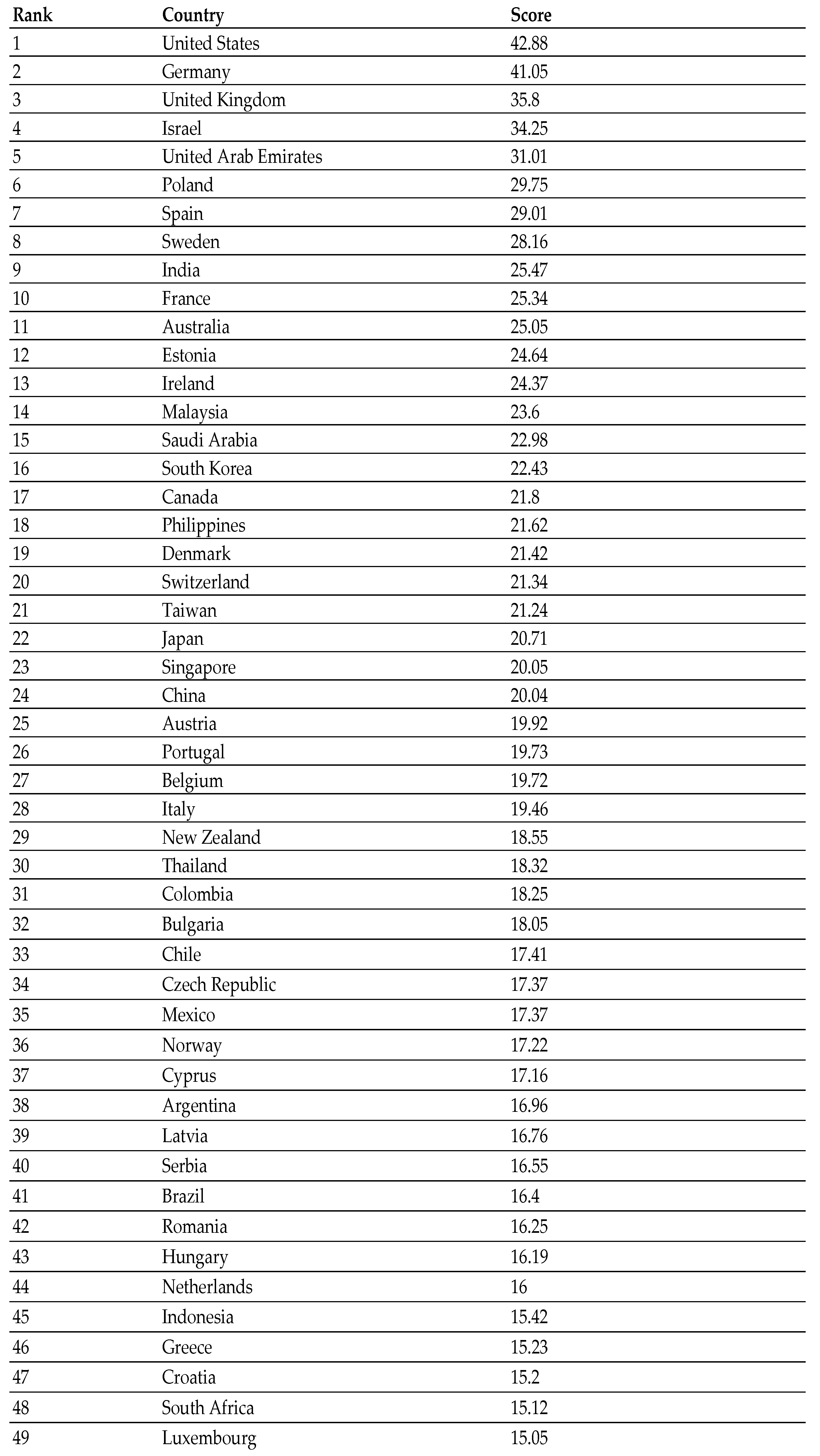
3.2. Secondary Data Collection
3.3. Exploring Ranking Indices
- Institutions (institutional environment, regulatory environment, business environment).
- Human capital and research (education, tertiary education, research and development).
- Infrastructure (information and communication technologies, general infrastructure, ecological sustainability).
- Market sophistication (credit, investment, trade, diversification, and market scale).
- Business sophistication (knowledge workers, innovation linkages, knowledge absorption). Innovation input pillars capture areas of the economy that foster innovation. The idea is that today’s innovation inputs create the basis for tomorrow’s innovation outputs. On the other hand, the key innovation output indicators are the following, as defined by the GII:
- (1)
- Knowledge and technology outputs (knowledge creation, knowledge impact, knowledge diffusion).
- (2)
- Creative outputs (intangible assets, creative goods and services, online creativity). Innovation outputs (knowledge, technology, and creative outputs) reflect the results of economic innovation activities. The general GII innovation score is the average of input and output scores, based on which the GII ranks countries worldwide.
3.4. Choosing Constant Comparison Analysis Technique
- To construct a theory as opposed to examining it;
- To equip investigators with analytic instruments for dissecting data;
- To help researchers comprehend numerous implications from the dataset(s) presented;
- To deliver researchers with a methodical and creative technique for interpreting dataset(s);
- To aid researchers in pinpointing, creating, and interpreting relationships among dataset components when forming a theme. Constant comparison analysis has been revised to examine data collected in a single round and a single document from a single case, making it an exceptionally adaptable analytical technique.
3.5. Data Analysis and Procedures
4. Results
5. Conclusions
Funding
Institutional Review Board Statement
Informed Consent Statement
Data Availability Statement
Conflicts of Interest
Appendix A

| Number | Rank | Country | Score |
|---|---|---|---|
| 1 | 15 | Israel | 52.7 |
| 2 | 32 | United Arab Emirates | 42.8 |
| 3 | 37 | Turkey | 39.0 |
| 4 | 47 | Saudi Arabia | 33.9 |
| 5 | 49 | Qatar | 33.9 |
| 6 | 64 | Iran | 28.8 |
| 7 | 66 | Morocco | 28.8 |
| 8 | 71 | Kuwait | 28.1 |
| 9 | 72 | Bahrain | 27.6 |
| 10 | 73 | Jordan | 27.5 |
| 11 | 74 | Oman | 27.1 |
| 12 | 81 | Tunisia | 25.4 |
| 13 | 86 | Egypt | 23.7 |
| 14 | 94 | Lebanon | 21.5 |
| 15 | 115 | Algeria | 16.2 |
| 16 | 127 | Mauritania | 13.2 |
| 17 | NA | Iraq | NA |
| 18 | NA | Yemen | NA |
| 19 | NA | Sudan | NA |
| 20 | NA | Syria | NA |
| 21 | NA | Libya | NA |
Appendix B

Appendix C
| Rank | Country | Total Patents Grants/Number of Patents |
|---|---|---|
| 19 | Israel | 5358 |
| 22 | Turkey | 3449 |
| 23 | Saudi Arabia | 2684 |
| 26 | Iran | 2250 |
| 37 | United Arab Emirates | 1048 |
| 43 | Algeria | 610 |
| 46 | Morocco | 579 |
| 48 | Egypt | 495 |
| 56 | Bahrain | 197 |
| 73 | Syria | 65 |
| 75 | Jordan | 61 |
| 98 | Oman | 23 |
| 99 | Kuwait | 19 |
Appendix D
- Conditions to start a business based on Global Entrepreneurship Monitor’s National Entrepreneurship Context Index (GEM NECI) in (2023). https://www.gemconsortium.org/reports/latest-global-report (accessed on 14 December 2023).
- The Most Entrepreneurial Countries. https://www.usnews.com/news/best-countries/rankings/entrepreneurial (accessed on 14 December 2023).
- Global Innovation Index by Country 2023. https://www.wipo.int/en/web/global-innovation-index/2023/index (accessed on 14 December 2023).
- The World’s Most Innovative Companies Index (Forbes) https://www.forbes.com/innovative-companies/list/#tab:rank (accessed on 14 December 2023).
- Top 100 Global Innovators 2024 Rankings Report (Clarivate) In this report, we rank the top 100 organizations leading the world in technology research and innovation. We measured global innovation by combining modern analytical architecture with our 60 years of experience to identify the top innovators transforming the world as we know it. https://clarivate.com/top-100-innovators/ (accessed on 14 December 2023).
- The World’s Most Entrepreneurial Countries, 2024. https://ceoworld.biz/2024/04/05/worlds-most-entrepreneurial-countries-2024/ (accessed on 14 December 2023).
- Patents by Country/Number of Patents Per Country 2024. https://worldpopulationreview.com/country-rankings/patents-by-country (accessed on 14 December 2023).
References
- Khalfan, S. Wasta in business management: A critical review of recent developments and future trends in the tourism sector. Humanit. Soc. Sci. Commun. 2024, 11, 207. [Google Scholar] [CrossRef]
- Talib, A.A. WASTA: The good, the bad and the ugly. Middle East J. Bus. 2017, 12, 3–9. [Google Scholar] [CrossRef]
- Ta’Amnha, M.; Sayce, S.; Tregaskis, O. Wasta in the Jordanian context. In Handbook of Human Resource Management in the Middle East; Edward Elgar Publishing: Cheltenham, UK, 2016; pp. 393–411. [Google Scholar]
- Morrar, R. Innovation in the MENA Region. In IEMed Mediterranean Yearbook 2019; Strategic Sectors: Economy & Territory; IEMed: Barcelona, Spain, 2018. [Google Scholar]
- Glaser, B.G. Theoretical Sensitivity; The Sociology Press: Mill Valley, CA, USA, 1978. [Google Scholar]
- Amabile, T.M. The social psychology of creativity: A componential conceptualization. J. Personal. Soc. Psychol. 1983, 45, 357. [Google Scholar] [CrossRef]
- Amabile, T.M. From individual creativity to organizational innovation. In Innovation: A Cross-Disciplinary Perspective; Grønhaug, K., Kaufmann, G., Eds.; Norwegian University Press: Oslo, Norway, 1988. [Google Scholar]
- Dutta, S.; Lanvin, B.; Wunsch-Vincent, S. (Eds.) The Global Innovation Index 2018: Energizing the World with Innovation; Cornell University: Ithaca, NY, USA; INSEAD: Fontainebleau, France; World Intellectual Property Organization: Geneva, Switzerland, 2018. [Google Scholar]
- Alenezi, M.; Hassan, S.; Abdelrahim, Y.; Albadry, O. Wasta and Favoritism: The Case of Kuwait. In Proceedings of the International Conference on Business and Technology, Istanbul, Turkey, 6–7 November 2021; Springer: Cham, Switzerland, 2023; pp. 705–716. [Google Scholar]
- Cunningham, R.B.; Sarayrah, Y.K. Wasta: The Hidden Force in Middle Easternsociety; Praeger Publishers: Westport, CT, USA, 1993. [Google Scholar]
- Barakat, H. The Arab World: Society, Culture, and State; University of California Press: Oakland, CA, USA, 1993. [Google Scholar]
- Alsarhan, F. Grasping the concept of Wasta and its place in HRM in the Middle East (ME). In International HRM and Development in Emerging Market Multinationals; Routledge: Oxford, UK, 2021; pp. 192–211. [Google Scholar]
- Gesteland, R. Cross-Cultural Business Behavior: Negotiating, Selling, Sourcing and Managing Across Cultures, 4th ed.; Copenhagen Business School Press: Copenhagen, Denmark, 2005. [Google Scholar]
- Cunningham, R.B.; Sarayrah, Y.K.; Sarayrah, Y.E. Taming “wasta” to achieve development. Arab. Stud. Q. 1994, 16, 29–41. [Google Scholar]
- Huang, J.; Xiang, Y.; Zhang, Z. Corporate low carbon governance: Examining the influence of female executive power on carbon performance in Chinese listed companies. Humanit. Soc. Sci. Commun. 2025, 12, 1161. [Google Scholar] [CrossRef]
- Hofstede, G. The cultural relativity of organizational practices and theories. J. Int. Bus. Stud. 1983, 14, 75–89. [Google Scholar] [CrossRef]
- Aldossari, M.; Robertson, M. The role of wasta in shaping the psychological contract: A Saudi Arabian case study. In Proceedings of the 74th Annual Meeting of the Academy of Management, Philadelphia, PA, USA, 1–5 August 2014. [Google Scholar]
- Hutchings, K.; Weir, D. Understanding networking in China and the Arab World: Lessons for international managers. J. Eur. Ind. Train. 2006, 30, 272–290. [Google Scholar] [CrossRef]
- Matsumoto, D. Culture and Psychology: People Around the World; Wadsworth Thomson Learning: Ferny Grove, Australia, 2000. [Google Scholar]
- Yahchouchi, G. Employees’ perceptions of Lebanese managers’ leadership styles and organizational commitment. Int. J. Leadersh. Stud. 2009, 4, 127–140. [Google Scholar]
- Iles, P.; Almhedie, A.; Baruch, Y. Managing HR in the Middle East: Challenges in the public sector. Public Pers. Manag. 2012, 41, 465–492. [Google Scholar] [CrossRef]
- Ramady, M.A. (Ed.) The Political Economy of Wasta: Use and Abuse of Social Capital Networking; Springer: Cham, Switzerland, 2016; p. vii. [Google Scholar]
- Abdelrahim, Y. Wasta and Corruption: The Case of Sudan. Humanit. Nat. Sci. J. 2023, 4, 1157–1168. [Google Scholar] [CrossRef]
- Jaganjac, J.; Nikolić, J.L.; Lazarević, S. The importance of green human resource management practices for sustainable organizational development: Evidence from Serbia and Bosnia and Herzegovina. JEEMS J. East Eur. Manag. Stud. 2024, 29, 157–180. [Google Scholar] [CrossRef]
- Stefanidis, A.; Banai, M.; Dagher, G.K. Socio-cultural capital in the Arab workplace: Wasta as a moderator of ethical idealism and work engagement. Empl. Relat. Int. J. 2022, 45, 21–44. [Google Scholar] [CrossRef]
- Barnett, A.; Yandle, B.; Naufal, G. Regulation, trust, and cronyism in Middle Eastern societies: The simple economics of “wasta”. J. Socio-Econ. 2013, 44, 41–46. [Google Scholar] [CrossRef]
- Bentham, J. The Collected Works of Jeremy Bentham: An Introduction to the Principles of Morals and Legislation; Clarendon Press: Oxford, UK, 1996. [Google Scholar]
- Routledge, B.R.; Von Amsberg, J. Social capital and growth. J. Monet. Econ. 2003, 50, 167–193. [Google Scholar] [CrossRef][Green Version]
- Xin, K.K.; Pearce, J.L. Guanxi: Connections as substitutes for formal institutional support. Acad. Manag. J. 1996, 39, 1641–1658. [Google Scholar] [CrossRef]
- Wunderle, W.D. A Manual for American Servicemen in the Arab Middle East: Using Cultural Understanding to Defeat Adversaries and Win the Peace; Skyhorse Publishing Inc.: New York, NY, USA, 2008. [Google Scholar]
- Budhwar, P.; Mellahi, K. Introduction: Human resource management in the Middle East. Int. J. Hum. Resour. Manag. 2007, 18, 2–10. [Google Scholar] [CrossRef]
- Metcalfe, B.D. Gender and human resource management in the Middle East. Int. J. Hum. Resour. Manag. 2007, 18, 54–74. [Google Scholar] [CrossRef]
- Assad, S.W. Sociological analysis of the administrative system in Saudi Arabia: In search of a culturally compatible model for reform. Int. J. Commer. Manag. 2002, 12, 51–82. [Google Scholar] [CrossRef]
- Idris, A.M. Cultural barriers to improved organizational performance in Saudi Arabia. SAM Adv. Manag. J. 2007, 72, 36. [Google Scholar]
- Aldossari, M.; Robertson, M. The role of wasta in repatriates’ perceptions of a breach to the psychological contract: A Saudi Arabian case study. Int. J. Hum. Resour. Manag. 2016, 27, 1854–1873. [Google Scholar] [CrossRef]
- Branine, M.; Pollard, D. Human resource management with Islamic management principles: A dialectic for a reverse diffusion in management. Pers. Rev. 2010, 39, 712–727. [Google Scholar] [CrossRef]
- Alsarhan, F.; Valax, M. Conceptualization of wasta and its main consequences on human resource management. Int. J. Islam. Middle East. Financ. Manag. 2021, 14, 114–127. [Google Scholar] [CrossRef]
- Alagaraja, M. Mobilizing organizational alignment through strategic human resource development. Hum. Resour. Dev. Int. 2013, 16, 74–93. [Google Scholar] [CrossRef]
- Easa, N.F.; Orra, H.E. HRM practices and innovation: An empirical systematic review. Int. J. Disruptive Innov. Gov. 2021, 1, 15–35. [Google Scholar] [CrossRef]
- Alsarhan, F.; Ali, S.A.; Weir, D.; Valax, M. Impact of gender on use of wasta among human resources management practitioners. Thunderbird Int. Bus. Rev. 2021, 63, 131–143. [Google Scholar] [CrossRef]
- Seeck, H.; Diehl, M.R. A literature review on HRM and innovation–taking stock and future directions. Int. J. Hum. Resour. Manag. 2017, 28, 913–944. [Google Scholar] [CrossRef]
- Loewenberger, P. Human resource development, creativity and innovation. In Human Resource Management, Innovation and Performance; Palgrave Macmillan: London, UK, 2016; pp. 48–65. [Google Scholar]
- Kassab, E. Influence of Wasta Within Human Resource Practices in Lebanese Universities. Doctoral Dissertation, CQUniversity, Rockhampton, Australia, 2016. [Google Scholar]
- Aladwan, K.; Bhanugopan, R.; Fish, A. Managing human resources in Jordanian organizations: Challenges and prospects. Int. J. Islam. Middle East. Financ. Manag. 2014, 7, 126–138. [Google Scholar] [CrossRef]
- Branine, M.; Analoui, F. Human resource management in Jordan. In Managing Human Resources in the Middle-East; Routledge: Oxford, UK, 2006; pp. 145–159. [Google Scholar]
- Alkhanbshi, A.S.; Al-Kandi, I.G. The religious values and job attitudes among female Saudi bank employees: A qualitative study. J. WEI Bus. Econ. 2014, 3, 28–35. [Google Scholar]
- Fawzi, N.; Almarshed, S. HRM context: Saudi culture, “Wasta” and employee recruitment postpositivist methodological approach, the case of Saudi Arabia. J. Hum. Resour. Manag. Labor Stud. 2013, 1, 25–38. [Google Scholar]
- Avnimelech, G.; Zelekha, Y.; Sharabi, E. The effect of corruption on entrepreneurship in developed vs non-developed countries. Int. J. Entrep. Behav. Res. 2014, 20, 237–262. [Google Scholar] [CrossRef]
- Madrid-Guijarro, A.; Garcia, D.; Van Auken, H. Barriers to innovation among Spanish manufacturing SMEs. J. Small Bus. Manag. 2009, 47, 465–488. [Google Scholar] [CrossRef]
- Amabile, T.M.; Amabile, T.M. The case for a social psychology of creativity. In The Social Psychology of Creativity; Springer: New York, NY, USA, 1983; pp. 3–15. [Google Scholar]
- Amabile, T.M. Social psychology of creativity: A consensual assessment technique. J. Personal. Soc. Psychol. 1982, 43, 997. [Google Scholar] [CrossRef]
- Amabile, T.M. A model of organizational innovation. In Research in Organizational Behavior; Staw, B.M., Cummings, L.L., Eds.; JAI Press: Greenwich, CT, USA, 1988; Volume 10. [Google Scholar]
- Aidt, T.S. Corruption and sustainable development. In International Handbook on the Economics of Corruption; Edward Elgar Publishing: Cheltenham, UK, 2010; Volume 2, pp. 1–52. [Google Scholar]
- Tytko, A.; Smokovych, M.; Dorokhina, Y.; Chernezhenko, O.; Stremenovskyi, S. Nepotism, favoritism and cronyism as a source of conflict of interest: Corruption or not? Amaz. Investig. 2020, 9, 163–169. [Google Scholar] [CrossRef]
- Waheed, A.; Miao, X.; Waheed, S.; Ahmad, N.; Majeed, A. How new HRM practices, organizational innovation, and innovative climate affect the innovation performance in the IT industry: A moderated-mediation analysis. Sustainability 2019, 11, 621. [Google Scholar] [CrossRef]
- Von Coombs, H. The Complex Identities of International Student-Athletes Competing in the NCAA: An Exploratory Qualitative Case Study. Doctoral Dissertation, Northcentral University, Scottsdale, AZ, USA, 2022. [Google Scholar]
- Glaser, B.; Strauss, A. Discovery of Grounded Theory: Strategies for Qualitative Research; Routledge: Oxford, UK, 2017. [Google Scholar]
- Strauss, A.L. Qualitative Analysis for Social Scientists; Cambridge University Press: Cambridge, UK, 1987. [Google Scholar]
- Strauss, A.; Corbin, J. Basics of Qualitative Research; Sage: Newbury Park, CA, USA, 1990; Volume 15. [Google Scholar]
- Frels, R.K. The Experiences and Perceptions of Selected Mentors: The Dyadic Relationship in School-Based Mentoring. Doctoral Dissertation, Sam Houston State University, Huntsville, TX, USA, 2010. [Google Scholar]
- Overton, J. Why Do Some Wine Regions Not Succeed? In Fermented Landscapes: Lively Processes of Socio-Environmental Transformation; University of Nebraska Press: Lincoln, NE, USA, 2020; Volume 57. [Google Scholar]
- Abdelrahim, D.Y. The influence of culture on rates of innovation: Re-examining Hofstede’s cultural dimensions. Int. J. Manag. 2020, 11, 999–1009. [Google Scholar]

| Themes | Factors Identified | |
|---|---|---|
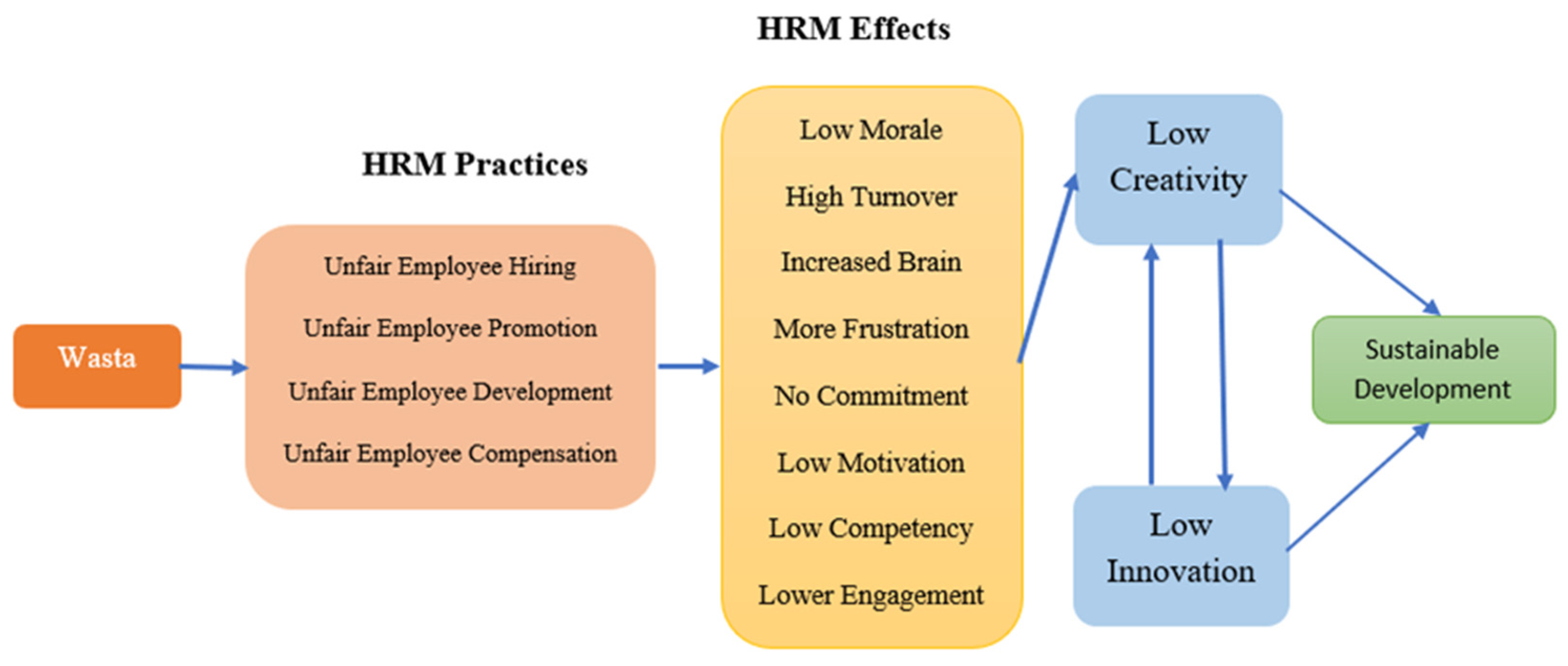
| Literature Reviewed Articles | Theme 1: Culture Theme 2: HRM Practices Theme 3: HRM Impacts Theme 4: HRM Impacts Theme 5: Innovation | 1. PD, COL, HAR, UAE 1. Wasta 2. Unfair Hiring 2. Unfair Promotion 2. Unfair Development 2. Unfair Compensation 3. Low Morale 3. High Turnover 3. More Frustration 3. No Commitment 3. Low Motivation 3. Low Competency 3. Lower Engagement 4. Creativity 4. Innovation 5. Sustainable Development |
| Conditions to start a business based on Global Entrepreneurship Monitor’s National Entrepreneurship Context Index (GEM NECI) in (2023). | Theme 1: the quality of a particular economy’s entrepreneurial environment that fosters innovation in a country Theme 2: Factors that enhance, hinder, or hinder entrepreneurial creativity and innovation. | 1. Creativity 2. Innovation |
| The GEM’s National Entrepreneurial Context Index (NECI) | Theme 1: Entrepreneurial conditions. | Innovation |
| Global Innovation Index by Country 2024 | Theme 1: Innovation inputs. | Innovation outputs (patents, knowledge creation, knowledge diffusion, patents, technical and scientific publications) |
| The World’s Most Innovative Companies Index (Forbes) | Theme 1: Innovation impact ranking. | Innovative companies |
| The World’s Most Entrepreneurial Countries, 2024 | Theme 1: Easy access to capital for entrepreneurs, Skilled workforce, and competitive business environment. Theme 2: Entrepreneurial environment. | Innovation |
| Patents by Country/Number of Patents Per Country 2024 | Theme 1: requirements, Patent laws, procedures, national laws, procedures. | Creativity Patents |
Disclaimer/Publisher’s Note: The statements, opinions and data contained in all publications are solely those of the individual author(s) and contributor(s) and not of MDPI and/or the editor(s). MDPI and/or the editor(s) disclaim responsibility for any injury to people or property resulting from any ideas, methods, instructions or products referred to in the content. |
© 2026 by the authors. Licensee MDPI, Basel, Switzerland. This article is an open access article distributed under the terms and conditions of the Creative Commons Attribution (CC BY) license.
Share and Cite
Abdelrahim, Y. How Wasta Practiced by HRM Employees Hampers Entrepreneurs’ Innovation and Sustainable Development: The Case of the MENA Region. Sustainability 2026, 18, 606. https://doi.org/10.3390/su18020606
Abdelrahim Y. How Wasta Practiced by HRM Employees Hampers Entrepreneurs’ Innovation and Sustainable Development: The Case of the MENA Region. Sustainability. 2026; 18(2):606. https://doi.org/10.3390/su18020606
Chicago/Turabian StyleAbdelrahim, Yousif. 2026. "How Wasta Practiced by HRM Employees Hampers Entrepreneurs’ Innovation and Sustainable Development: The Case of the MENA Region" Sustainability 18, no. 2: 606. https://doi.org/10.3390/su18020606
APA StyleAbdelrahim, Y. (2026). How Wasta Practiced by HRM Employees Hampers Entrepreneurs’ Innovation and Sustainable Development: The Case of the MENA Region. Sustainability, 18(2), 606. https://doi.org/10.3390/su18020606