Multi-Objective Collaborative Allocation Strategy of Local Emergency Supplies Under Large-Scale Disasters

Abstract
1. Introduction
2. Literature Review
3. Construction of a Local Emergency Supply Allocation Model for Large-Scale Disasters
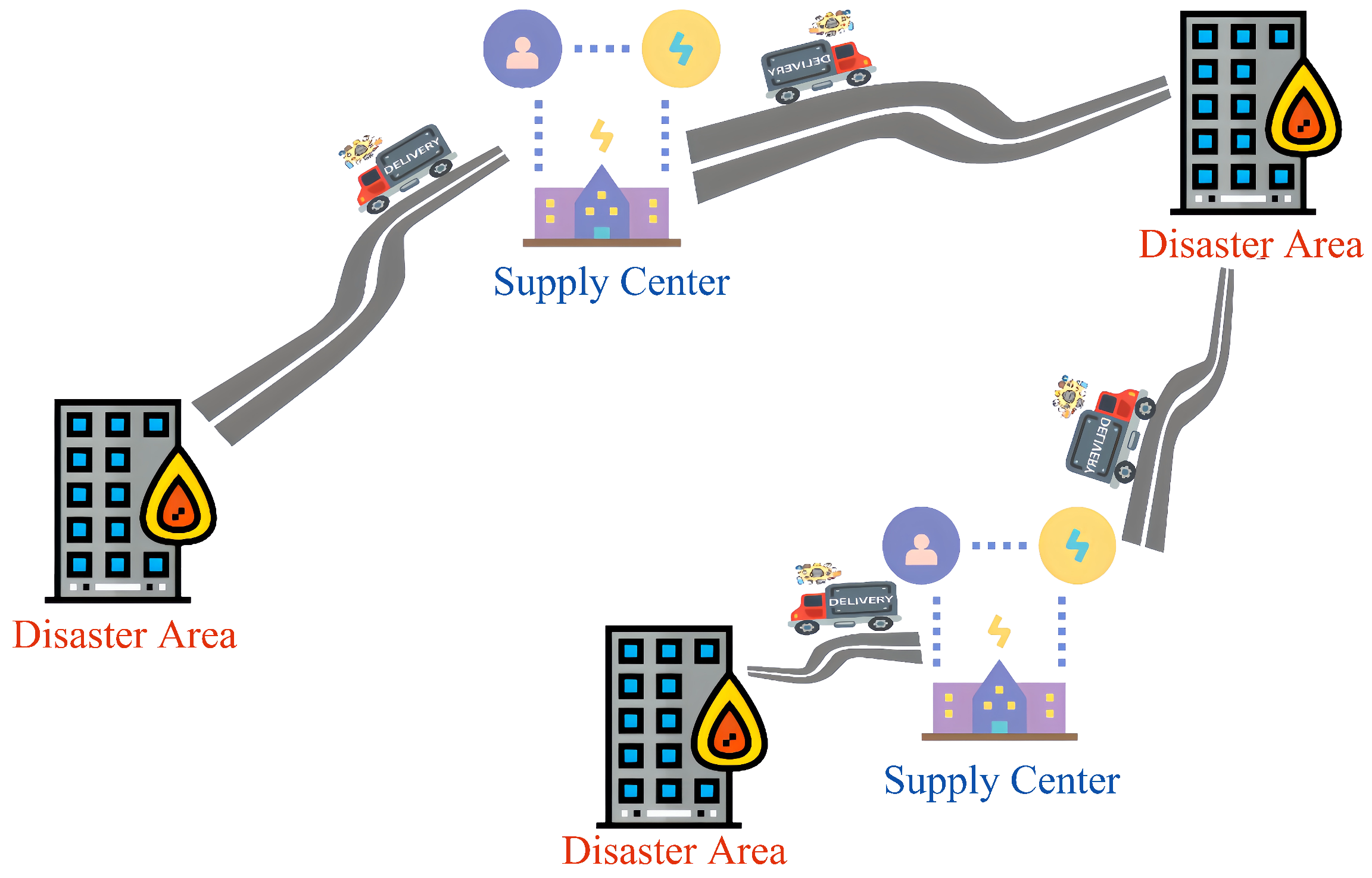
3.1. Problem Description
3.2. Basic Explanations
3.3. Local Emergency Supply Allocation Model
3.3.1. Symbol Explanation
3.3.2. Construction of the Local Emergency Supply Allocation Model
4. Solution of the Local Material Allocation Model
4.1. Overall Solution Process of the Model
| Algorithm 1 Genetic algorithm for emergency supplies allocation |
| Require: Supply points (n), Demand points (m), Supply capacity (); |
| 1: Demand (), GA parameters: PopSize = 50, MaxGen = 100; |
| 2: Crossover probability () = 0.8, Mutation probability () = 0.05. |
| Ensure: Optimized emergency supplies allocation plan (matrix ) with maximum fitness , where . |
| 3: Begin |
| 4: Initialize Population: |
| 5: for to PopSize do |
| 6: Generate allocation matrix (each represents supply from j to k); |
| 7: Ensure (satisfy supply capacity constraint); |
| 8: Calculate fitness: |
| 9: where is the maximum delivery time of , and is the total unmet demand rate. |
| 10: end for |
| 11: GA Iteration: |
| 12: |
| 13: while do |
| 14: Selection: |
| 15: Select PopSize parents based on (higher fitness → higher selection probability). |
| 16: Crossover: |
| 17: Pair parents randomly; |
| 18: for each pair do |
| 19: if rand(0,1) then |
| 20: Select row indices ; |
| 21: ; |
| 22: Adjust to satisfy supply capacity constraint. |
| 23: end if |
| 24: end for |
| 25: Mutation: |
| 26: for each offspring do |
| 27: if rand(0,1) then |
| 28: Mutate ; |
| 29: Clip to range . |
| 30: end if |
| 31: end for |
| 32: Update Population: |
| 33: Combine parents and offspring; |
| 34: Select top PopSize individuals by as the new population; |
| 35: |
| 36: end while |
| 37: Output Optimal Solution: |
| 38: Select with maximum from the final population; |
| 39: Return |
| 40: End |
4.2. Model Solution Process Analysis
5. Empirical Analysis—Taking the Emergency Rescue of the Ya’an Earthquake as an Example
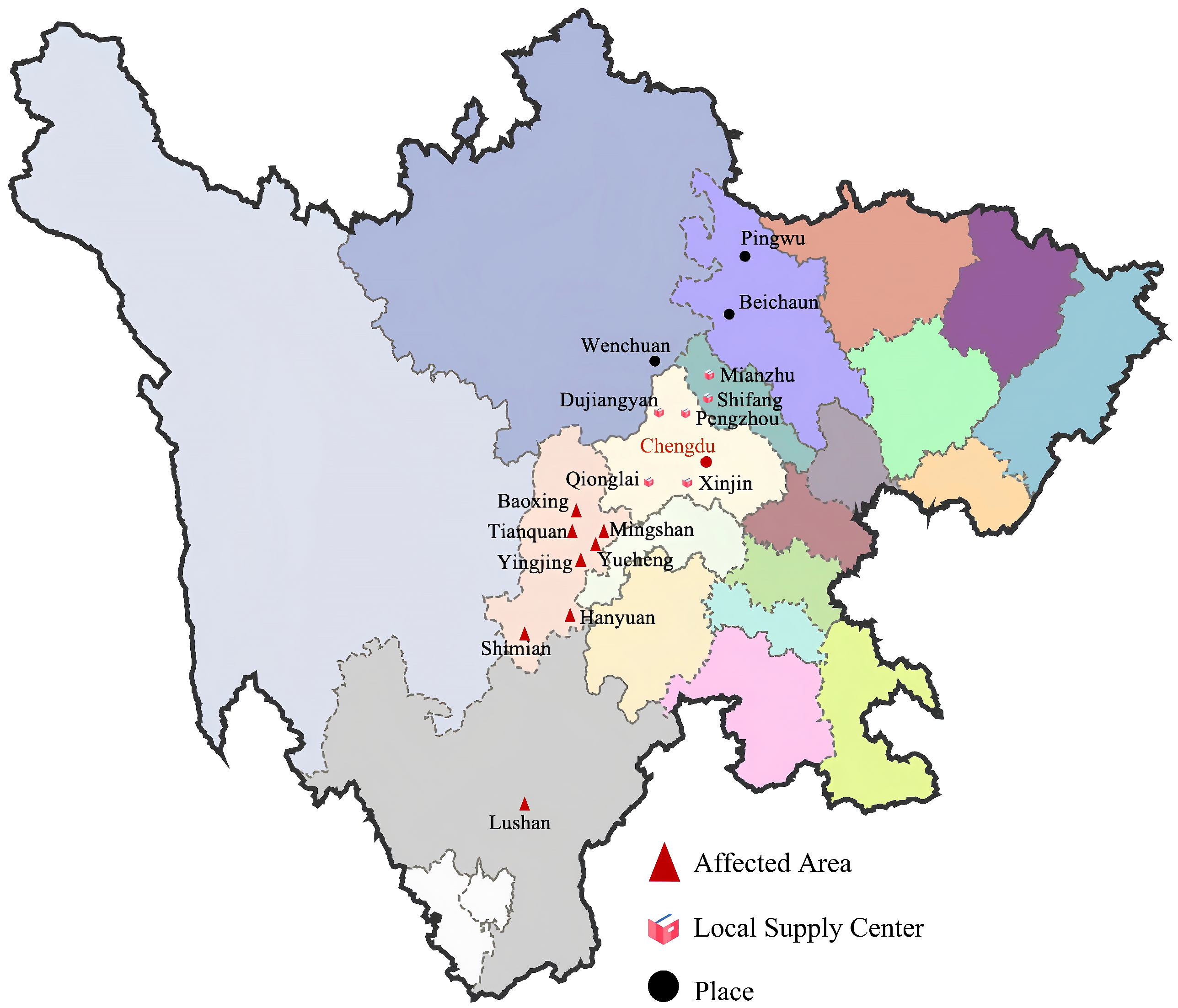
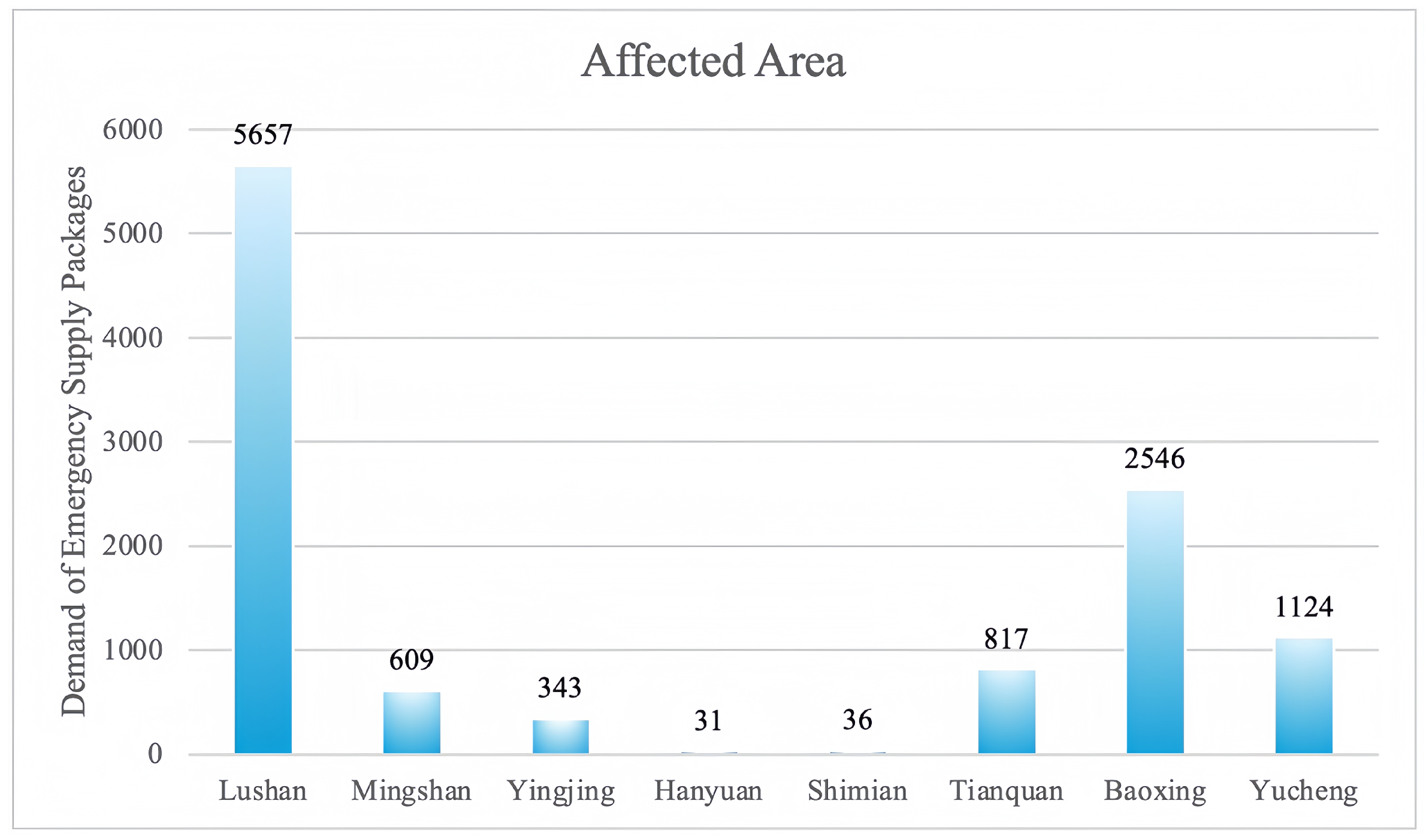
5.1. Case Background and Disaster Impact
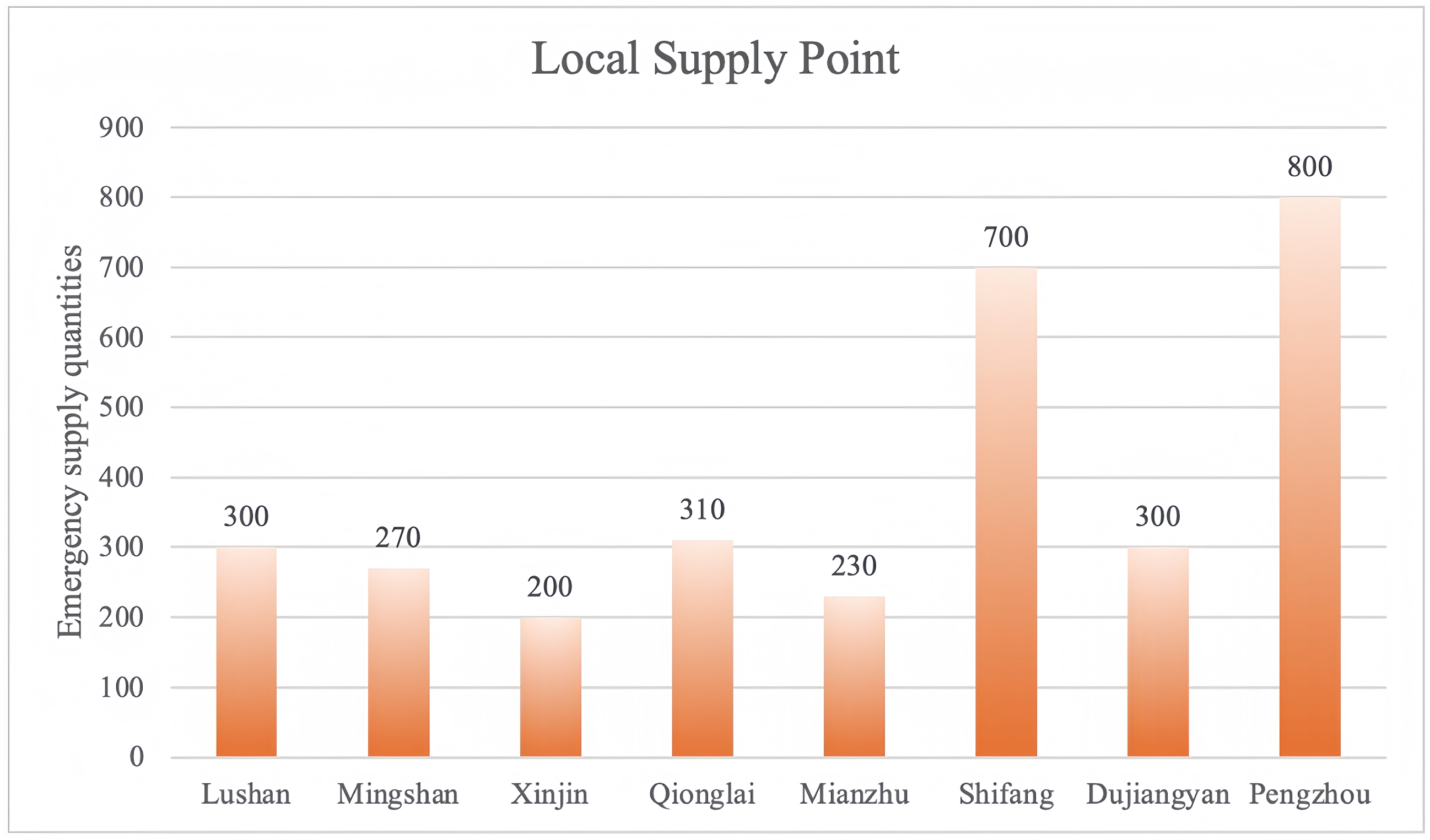
5.2. Data Collection and Simulation Parameterization
5.3. Comparative Analysis of Simulation Results
5.3.1. Comparison of Demand Satisfaction and Shortage Rate Equity
5.3.2. Comparison of Timeliness and Alignment with Operational Constraints
5.3.3. Expert Scoring Method for Weight Determination
5.4. Allocation Results
5.5. Result Analysis
5.5.1. Analysis of Local Allocation Simulation Results
5.5.2. Analysis of Actual Allocation Results
6. Conclusions and Future Work
6.1. Conclusions
6.2. Future Work
Author Contributions
Funding
Institutional Review Board Statement
Informed Consent Statement
Data Availability Statement
Conflicts of Interest
References
- Huang, L.; Yu, Z.; Wang, W.; Song, Y.; Wang, Y. Multiobjective programming model for a class of flood disaster emergency material allocation. J. Flood Risk Manag. 2025, 18, e12918. [Google Scholar] [CrossRef]
- Mukhopadhyay, A.; Pettet, G.; Vazirizade, S.M.; Lu, D.; Jaimes, A.; El Said, S.; Baroud, H.; Vorobeychik, Y.; Kochenderfer, M.; Dubey, A. A review of incident prediction, resource allocation, and dispatch models for emergency management. Accid. Anal. Prev. 2022, 165, 106501. [Google Scholar] [CrossRef] [PubMed]
- Gu, J.; Zhou, Y.; Das, A.; Moon, I.; Lee, G.M. Medical relief shelter location problem with patient severity under a limited relief budget. Comput. Ind. Eng. 2018, 125, 720–728. [Google Scholar] [CrossRef]
- Zhang, L. Emergency supplies reserve allocation within government-private cooperation: A study from capacity and response perspectives. Comput. Ind. Eng. 2021, 154, 107171. [Google Scholar] [CrossRef]
- Sakiani, R.; Seifi, A.; Khorshiddoust, R.R. Inventory routing and dynamic redistribution of relief goods in post-disaster operations. Comput. Ind. Eng. 2020, 140, 106219. [Google Scholar] [CrossRef]
- Huang, K.; Rafiei, R. Equitable last mile distribution in emergency response. Comput. Ind. Eng. 2019, 127, 887–900. [Google Scholar] [CrossRef]
- Jana, R.K.; Sharma, D.K.; Mehta, P. A probabilistic fuzzy goal programming model for managing the supply of emergency relief materials. Ann. Oper. Res. 2022, 319, 149–172. [Google Scholar] [CrossRef]
- Wang, B.; Qian, Q.; Gao, J.; Tan, Z.; Zhou, Y. The optimization of warehouse location and resources distribution for emergency rescue under uncertainty. Adv. Eng. Inf. 2021, 48, 101278. [Google Scholar] [CrossRef]
- Wang, Z.; Leng, L.; Ding, J.; Zhao, Y. Study on location-allocation problem and algorithm for emergency supplies considering timeliness and fairness. Comput. Ind. Eng. 2023, 177, 109078. [Google Scholar] [CrossRef]
- Baharmand, H.; Comes, T.; Lauras, M. Bi-objective multi-layer location–allocation model for the immediate aftermath of sudden-onset disasters. Transp. Res. Part E Logist. Transp. Rev. 2019, 127, 86–110. [Google Scholar] [CrossRef]
- Oksuz, M.K.; Satoglu, S.I. A two-stage stochastic model for location planning of temporary medical centers for disaster response. Int. J. Disaster Risk Reduct. 2020, 44, 101426. [Google Scholar] [CrossRef]
- Zhou, Y.; Lee, G.M. A bi-objective medical relief shelter location problem considering coverage ratios. Int. J. Ind. Eng. 2020, 27, 971–988. [Google Scholar]
- U.S. Department of Homeland Security; Federal Emergency Management Agency. National Incident Management System; Technical Report FEMA-712; FEMA: Washington, DC, USA, 2017. [Google Scholar]
- Yang, J.; Xu, X.; Feng, J.; Tang, Z.; Tian, J.; Song, Y. The two-stage integrated allocation model for local emergency supplies. J. Data Inf. Manag. 2023, 5, 317–331. [Google Scholar] [CrossRef]
- Seraji, H.; Tavakkoli-Moghaddam, R.; Asian, S.; Kaur, H. An integrative location-allocation model for humanitarian logistics with distributive injustice and dissatisfaction under uncertainty. Ann. Oper. Res. 2022, 319, 211–257. [Google Scholar] [CrossRef]
- Hong, J.D.; Jeong, K. Humanitarian supply chain network design using data envelopment analysis and multi-objective programming models. Eur. J. Ind. Eng. 2019, 13, 651–680. [Google Scholar] [CrossRef]
- Wang, F.; Xie, Z.; Liu, H.; Pei, Z.; Liu, D. Multiobjective emergency resource allocation under the natural disaster chain with path planning. Int. J. Environ. Res. Public Health 2022, 19, 7876. [Google Scholar] [CrossRef]
- Wang, Q.; Liu, Y.; Pei, H. Modelling a bi-level multi-objective post-disaster humanitarian relief logistics network design problem under uncertainty. Eng. Optim. 2023, 56, 1220–1254. [Google Scholar] [CrossRef]
- Liu, C.; Ji, Y.; Wahab, M.I.M.; Peng, Z.; Li, X.; Qu, S. Multi-objective mixed integer programming modelling for closed-loop supply chain network design: An enhanced Benders decomposition algorithm. Eng. Optim. 2024, 56, 2478–2521. [Google Scholar] [CrossRef]
- Wang, H.; Ma, X. Research on multiobjective location of urban emergency logistics under major emergencies. Math. Probl. Eng. 2021, 2021, 5577797. [Google Scholar] [CrossRef]
- Sarma, D.; Das, A.; Bera, U.K.; Hezam, I.M. Redistribution for cost minimization in disaster management under uncertainty with trapezoidal neutrosophic number. Comput. Ind. 2019, 109, 226–238. [Google Scholar] [CrossRef]
- Liang, J.; Zhang, Z.; Zhi, Y. Supply distribution center planning in UAV-based logistics networks for post-disaster supply delivery. Smart Cities 2024, 8, 5. [Google Scholar]
- Wang, Y.; Sun, B. Multiperiod optimal emergency material allocation considering road network damage and risk under uncertain conditions. Oper. Res. 2022, 22, 2173–2208. [Google Scholar] [CrossRef]
- Cao, C.; Liu, Y.; Tang, O.; Gao, X. A fuzzy bi-level optimization model for multi-period post-disaster relief distribution in sustainable humanitarian supply chains. Int. J. Prod. Econ. 2021, 235, 108081. [Google Scholar] [CrossRef]
- Li, J.; Fu, H.; Lai, K.K.; Zhang, R.; Iqbal, M.B. Scheduling optimization of mobile emergency vehicles considering dual uncertainties. J. Appl. Sci. 2023, 13, 10670. [Google Scholar] [CrossRef]
- Zhang, L.; Wang, J.; Wang, X.; Wang, W.; Tian, X. Research on cross-regional emergency materials intelligent dispatching model in major natural disasters. PLoS ONE 2024, 19, e0305349. [Google Scholar] [CrossRef] [PubMed]
- Wang, F.; Xie, Z.; Pei, Z.; Liu, D. Emergency relief chain for natural disaster response based on government-Enterprise coordination. Int. J. Environ. Res. Public Health 2022, 19, 11255. [Google Scholar] [CrossRef]
- Peng, S.; Liu, Q.; Hu, J. Green distribution route optimization of medical relief supplies based on improved NSGA-II algorithm under dual-uncertainty. Sustainability 2023, 15, 11939. [Google Scholar] [CrossRef]
- Zhu, J.; Shi, Y.; Venkatesh, V.; Islam, S.; Hou, Z.; Arisian, S. Dynamic collaborative optimization for disaster relief supply chains under information ambiguity. Ann. Oper. Res. 2024, 335, 1303–1329. [Google Scholar] [CrossRef]
- Zhou, Y.; Cheng, J.; Wu, C.; Teo, K.L. Multi-objective two-stage emergent blood transshipment-allocation in COVID-19 epidemic. Complex Intell. Syst. 2023, 9, 4939–4957. [Google Scholar] [CrossRef]
- Wang, S.; Wu, Y.J.; Li, R. An improved genetic algorithm for location allocation problem with grey theory in public health emergencies. Int. J. Environ. Res. Public Health 2022, 19, 9752. [Google Scholar] [CrossRef] [PubMed]
- Yang, H.; Zhang, P.; Zhang, P.; Zhang, C.; Yan, X. Optimization of a two-stage emergency logistics system considering public psychological risk perception under earthquake disaster. Sci. Rep. 2024, 14, 31983. [Google Scholar] [CrossRef] [PubMed]
- Yan, T.; Lu, F.; Wang, S.; Wang, L.; Bi, H. A hybrid metaheuristic algorithm for the multi-objective location-routing problem in the early post-disaster stage. J. Ind. Manag. Optim. 2023, 19, 1. [Google Scholar] [CrossRef]
- Wang, B.; He, C.; Guo, Y. Building Disaster Resilience: A Sustainable Approach to Integrated Road Rehabilitation and Emergency Logistics Optimization in Extreme Events. Sustainability 2025, 17, 10591. [Google Scholar] [CrossRef]



| Sets | |
|---|---|
| M | Set of m local affected points , |
| N | Set of n local supply points , |
| Index | |
| i | Index of the i-th local affected point (corresponding to set M, where i = 1, 2,..., m) |
| j | Index of the j-th local supply point (corresponding to set N, where j = 1, 2,..., n) |
| Parameters | |
| Maximum delay time allowed for the i-th local affected point to receive emergency supplies | |
| Stockpile level of emergency supplies at the j-th local supply point | |
| Emergency supplies requirement of the i-th local affected point | |
| Distance from the j-th local supply point to the i-th local affected point | |
| Transport speed of emergency material vehicles from the j-th local supply point to the i-th local affected point | |
| Time required to deliver emergency supplies from the j-th local supply point to the i-th local affected point ; indicates supplies are allocated from to ; indicates no allocation | |
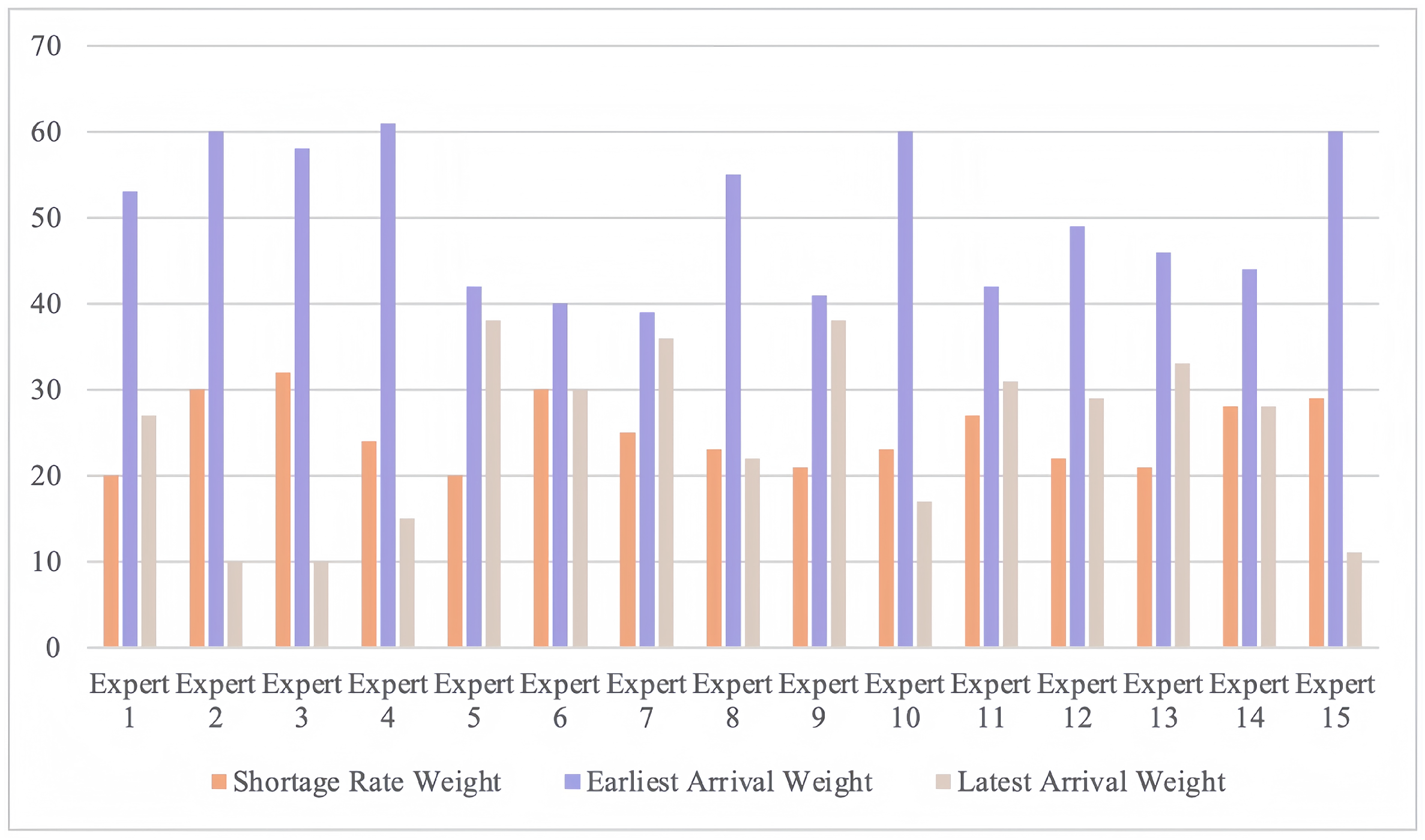
| Weight corresponding to the sum of shortage rates across all local affected points | |
| Weight corresponding to the sum of the earliest arrival times of emergency supplies (from supply points to affected points) | |
| Weight corresponding to the sum of the latest arrival times of emergency supplies (from supply points to affected points) | |
| Hierarchical weight of the i-th affected point | |
| Demand satisfaction rate of each local affected point | |
| Decision variables | |
| Quantity of emergency supplies allocated from the j-th local supply point to the i-th local affected point | |
| 0–1 decision variable, where = 1 signifies that emergency supplies are allocated from the j-th local supply point to the i-th local affected point , and = 0 indicates no such allocation | |
| ⋯ | ||||
|---|---|---|---|---|
| Quantity from supply point 0 to affected point 0 | Quantity from supply point 1 to affected point 0 | ⋯ | Quantity from supply point n − 1 to affected point m | Quantity from supply point n to affected point m |
| Affected Point 1 | Affected Point 2 | Affected Point 3 | Affected Point 4 | Affected Point 5 | |
|---|---|---|---|---|---|
| Supply Point 1 | 2 | 3 | 0 | 1 | 1 |
| Supply Point 2 | 2 | 5 | 8 | 0 | 0 |
| Supply Point 3 | 1 | 9 | 5 | 7 | 8 |
| Affected Point | Lushan | Mingshan | Xinjin | Qionglai | Mianzhu | Shifang | Dujiangyan | Pengzhou |
|---|---|---|---|---|---|---|---|---|
| Result | 0.5267 | 0.4717 | 0.4580 | 0.4383 | 0.4546 | 0.4760 | 0.4901 | 0.4946 |
| Rank | 1 | 5 | 6 | 8 | 7 | 4 | 2 | 3 |
| Affected Point | Lushan | Mingshan | Xinjin | Qionglai | Mianzhu | Shifang | Dujiangyan | Pengzhou |
|---|---|---|---|---|---|---|---|---|
| Shortage Rate | 0.8690 | 0.1018 | 0.0087 | 0 | 0 | 0.2179 | 0.7922 | 0.7802 |
| Affected Point | Lushan | Mingshan | Xinjin | Qionglai | Mianzhu | Shifang | Dujiangyan | Pengzhou |
|---|---|---|---|---|---|---|---|---|
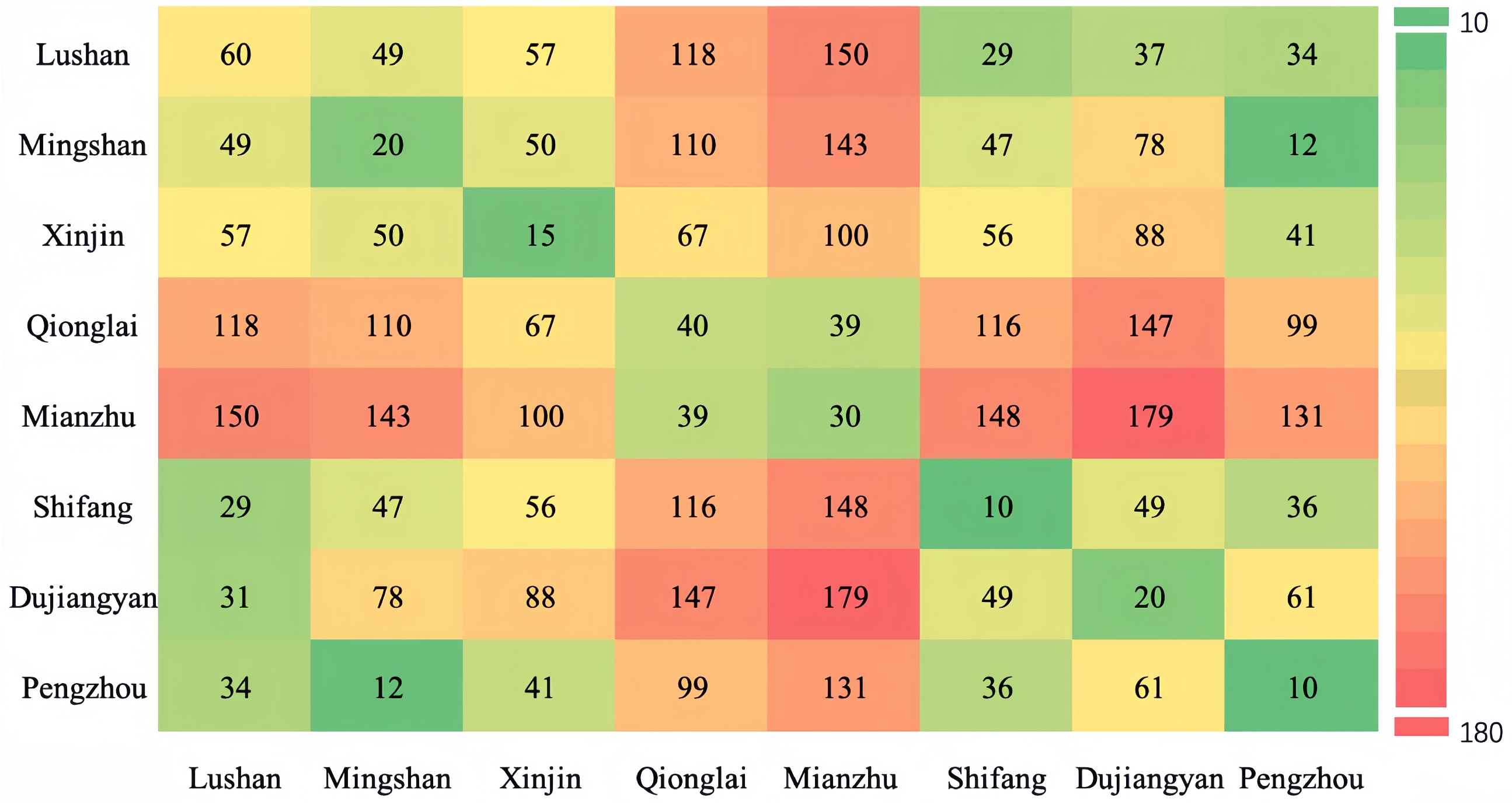
| Earliest Arrival Time | 29 | 12 | 15 | 39 | 30 | 10 | 20 | 10 |
| Affected Point | Lushan | Mingshan | Xinjin | Qionglai | Mianzhu | Shifang | Dujiangyan | Pengzhou |
|---|---|---|---|---|---|---|---|---|
| Latest Arrival Time | 80 | 69 | 51 | 70 | 79 | 27 | 56 | 21 |
| Lushan | Mingshan | Xinjin | Qionglai | Mianzhu | Shifang | Dujiangyan | Pengzhou | |
|---|---|---|---|---|---|---|---|---|
| Lushan | 4033 | 141 | 310 | 0 | 2043 | 0 | 141 | 1741 |
| Mingshan | 59 | 0 | 0 | 0 | 85 | 53 | 33 | 55 |
| Xinjin | 09 | 26 | 0 | 18 | 11 | 04 | 34 | 33 |
| Qionglai | 22 | 20 | 0 | 22 | 20 | 02 | 03 | 33 |
| Mianzhu | 62 | 20 | 0 | 18 | 02 | 83 | 23 | 33 |
| Shifang | 82 | 20 | 0 | 29 | 02 | 75 | 39 | 66 |
| Dujiangyan | 102 | 153 | 10 | 09 | 712 | 712 | 395 | 55 |
| Pengzhou | 111 | 0 | 0 | 0 | 0 | 12 | 12 | 22 |
| Total Supplied | 300 | 270 | 200 | 310 | 230 | 700 | 300 | 800 |
| Disaster Area | Lushan | Mingshan | Xinjin | Qionglai | Mianzhu | Shifang | Dujiangyan | Pengzhou |
|---|---|---|---|---|---|---|---|---|
| Allocation Time | 60 | 20 | 15 | 40 | 30 | 10 | 20 | 10 |
| Disaster Area | Lushan | Mingshan | Xinjin | Qionglai | Mianzhu | Shifang | Dujiangyan | Pengzhou |
|---|---|---|---|---|---|---|---|---|
| Shortage Rate | 0.947 | 0.567 | 0.4169 | 0.9 | 0.5 | 0.1 | 0.8822 | 0.2883 |
Disclaimer/Publisher’s Note: The statements, opinions and data contained in all publications are solely those of the individual author(s) and contributor(s) and not of MDPI and/or the editor(s). MDPI and/or the editor(s) disclaim responsibility for any injury to people or property resulting from any ideas, methods, instructions or products referred to in the content. |
© 2026 by the authors. Licensee MDPI, Basel, Switzerland. This article is an open access article distributed under the terms and conditions of the Creative Commons Attribution (CC BY) license.
Share and Cite
Zhang, Y.; Li, Y. Multi-Objective Collaborative Allocation Strategy of Local Emergency Supplies Under Large-Scale Disasters. Sustainability 2026, 18, 573. https://doi.org/10.3390/su18020573
Zhang Y, Li Y. Multi-Objective Collaborative Allocation Strategy of Local Emergency Supplies Under Large-Scale Disasters. Sustainability. 2026; 18(2):573. https://doi.org/10.3390/su18020573
Chicago/Turabian StyleZhang, Yi, and Yafei Li. 2026. "Multi-Objective Collaborative Allocation Strategy of Local Emergency Supplies Under Large-Scale Disasters" Sustainability 18, no. 2: 573. https://doi.org/10.3390/su18020573
APA StyleZhang, Y., & Li, Y. (2026). Multi-Objective Collaborative Allocation Strategy of Local Emergency Supplies Under Large-Scale Disasters. Sustainability, 18(2), 573. https://doi.org/10.3390/su18020573