Article

A Life Cycle AI-Assisted Model for Optimizing Sustainable Material Selection

1
Architectural Engineering Department, Faculty of Engineering, The British University in Egypt, El Sherouk City 11837, Egypt
2
Sustainable Engineering Design and Construction Programme, Faculty of Engineering, The British University in Egypt, El Sherouk City 11837, Egypt
*
Author to whom correspondence should be addressed.
Sustainability 2026, 18(2), 566; https://doi.org/10.3390/su18020566
Submission received: 18 November 2025 / Revised: 25 December 2025 / Accepted: 26 December 2025 / Published: 6 January 2026
(This article belongs to the Section Green Building)

Abstract

This research has successfully addressed the challenges attributed with SMS, including the fragmented data, heavy reliance on experience, and lack of life cycle integration. This study presents the development and validation of a novel sustainable material selection (SMS) model using Artificial Intelligence (AI). The proposed model structures the process around four core life cycle phases—design, construction, operation and maintenance, and end of life—and incorporates a dual-interface system. This includes a main credits interface for high-level tracking of 100 total credits to trace the dynamics of SMS in relation to energy efficiency, indoor air quality, site selection, and efficient use of water. Further, it includes a detailed credit interface for granular assessment of specific material properties. A key innovation is the formalization of closed-loop feedback mechanisms between phases, ensuring that practical insights from construction and operation inform earlier design choices. The model’s functionality is demonstrated through a proof of concept for SMS considering thermal properties, showcasing its ability to contextualize benchmarks by climate, map properties to building components via a weighted networking system, and rank materials using a comprehensive database sourced from the academic literature. Automated scoring aligns with green building certification tiers, with an integrated alert system flagging suboptimal performance. The proposed model was validated through a structured practitioner survey, and the collected responses were analysed using descriptive and inferential statistical analysis. The result presents a scalable quantitative AI-assisted decision-making support model for optimizing material selection across different project phases. This work paves the way for further research with additional assessment criteria and better integration of AI and Machine Learning for SMS.

1. Introduction

The building and construction sector is a dominant consumer of raw materials, responsible for an estimated 40–50% of global annual resource extraction and 37% of global energy and process-related CO2 emissions in 2023 [1]. Furthermore, the built environment causes enormous strain on ecosystem services, contributing directly to climate change, resource depletion, biodiversity loss, and pollution [2,3]. Thus, the strategic selection of building materials extends beyond being just a design consideration to a major contributor to sustainable development, and a main factor to minimize buildings’ environmental impact [4]. Sustainable material selection (SMS) is receiving rising worldwide attention from scholars from different backgrounds. This indicates its multidisciplinary nature and its significance in many domains related to sustainable buildings, e.g., reducing buildings’ environmental impact [5], optimizing building energy performance [6,7], and improving air quality [8,9], as well as advancement in material science and innovation [10].
SMS has been set as the main sustainable criterion in many green building rating and certification systems (GBRSs). An example of this is that it is emphasized as a core category, “Materials and Resources (MR)”, in Leadership in Energy and Environmental Design (LEED). This is in addition to other sustainable categories: Location and Transportation (LT), Sustainable Sites (SS), Water Efficiency (WE), Energy and Atmosphere (EA), and Indoor Environmental Quality (IEQ). It is noted that GBRSs’ requirement for SMS is continuously evolving to cope with the latest scientific findings, i.e., moving from prescriptive requirements of procuring rapidly renewable, recycled, reused materials (Old LEED version 3.0), to robust performance requirements of applying Life Cycle Assessment (LCA) to assess and compare alternatives based on their environmental impact (the new LEED version 4.1) [11].
Despite this complexity, research gaps in SMS include technical, methodological, and practical challenges [12,13,14]. This is due to the fact that it includes multi-objective complexity of often conflicting objectives [15]. Thus, this research addresses the challenges associated with SMS, including the fragmented data, heavy reliance on experience, and lack of life cycle integration.
Research questions include:
(Q1) How to shift from complex tools to simple and practically oriented decision-support models for SMS;
(Q2) How to develop multi-criteria decision analysis frameworks that effectively and consistently weigh often competing SMS indicators across different project life cycle phases;
(Q3) How to develop a dynamic assessment mechanism for SMS across different project phases.
To help respond to these rising research questions, this research develops a life cycle-based SMS using Artificial Intelligence (AI) to act as a structured decision-support framework. This accounts for the interdependencies between material selection and other core sustainability categories across various project phases: namely, SS, IEQ, EA, and WE. To ensure alignment with internationally recognized green-building rating and certification systems, the research refers to the latest LEED BD+C version 4.1 rating system categories and credit weightings.

2. Literature Review

This literature review synthesizes existing research on SMS, pinpointing its significance in project management and associated risk assessment and management. Advanced tools and methods used for SMS are also discussed, pointing to their benefits and limitations. Finally, this section discusses advancements in the use of AI and Machine Learning (ML) for the prediction and optimization of sustainable building performance.

2.1. Principles of SMS

According to previous studies and international standards, proper material selection should apply the principles of durability, disassembly, reuse, recyclability, and non-toxicity [16]. Selecting durable, long-lasting materials reduces the frequency of replacement and associated waste generation. Selecting recycled and/or reused materials closes the material loop, thus reducing the need for raw materials and resources [14,17]. Considering human health, favouring materials with low or zero volatile organic compound (VOC) emissions is pivotal to ensure healthy indoor air quality [18,19]. Using regional materials reduces the use of energy for transportation and, accordingly, its accompanying emissions. Using rapidly renewable materials reduces the stress on the agricultural ecosystem [20]. Furthermore, SMS should consider material availability, initial and life cycle cost, and maintenance requirements, as well as their embodied energy and embodied carbon [15].

2.2. SMS Within Project Management: Scrutinizing Risk Assessment and Mitigation

Project management for green projects should start with setting clear, measurable sustainability targets with defined roles and responsibilities [21,22]. This plan should account for SMS during early project phases [23,24,25], treating SMS as a core sustainable project objective. In this regard, the design phase sets the base vision, mission, and technical targets for the project’s sustainable performance, demonstrating an iterative and integrated workflow for critical activities and decisions [15]. This includes setting sustainable material specifications and procurement requirements that balance low environmental impact, cost-effectiveness, durability, and end-of-life recyclability or reuse potential [22]. During the construction phase, practical constraints, precise calculations, and on-site verification often necessitate design adjustments and revisiting material and product selection and procurement decisions in an iterative feedback loop [25]. The operation and maintenance (O&M) phase focuses on optimizing building performance, ensuring ongoing functionality, and validating the long-term effectiveness of the material and system selections made in earlier phases. The end of life (EOL) phase focuses on minimizing waste, maximizing material reuse, recycling, and recovery in alignment with circular economy principles [17].
Effective project scheduling for SMS includes allocating time for research, supplier evaluation, and the procurement of non-standard or innovative green materials [26,27], carrying out LCA and Life Cycle Costing (LCC) studies, examining environmental product declarations (EPDs), and securing samples for inspection and testing [28,29,30]. Studies indicate that failing to account for these extended timelines is a primary cause of schedule overruns in green building projects [31]. Further, a link between procuring building materials with construction and waste management plan should be established early to minimize waste landfill and pave the way for material reuse and recycling [15].
SMS constitutes several embedded risks (e.g., change orders and perceived high upfront costs) that must be systematically identified and managed, each within its specific project phase [32]. Factors of cost, scope, and quality management plans should be considered in parallel [21].

2.3. Advanced Decision-Making Tools and Methods for SMS

Noting that material selection involves long-term performance, an LCA is used to evaluate the environmental impacts of materials from raw material extraction to disposal [33]. Similarly, LCC is a crucial economic evaluation tool, balancing environmental and financial benefits [34], moving beyond capital cost to operational cost, thus quantifying long-term savings [35]. Nevertheless, they are perceived as complex, time-consuming and needing specialized skills [36,37]. This is why it is challenging to integrate them during early project phases due to limited data availability and accuracy, challenging scope definition, integration, and uncertainty [38].
To investigate the multifaceted effect of SMS on other sustainable parameters, scholars have used sophisticated analytical methods for multicriteria decision-making (MCDM) analysis [18,37,39]. These frameworks provide structured procedures for defining criteria, assigning weights, and ranking alternatives, thereby enhancing objectivity and transparency in the decision process. Techniques such as the Analytical Hierarchy Process (AHP), Technique for Order of Preference by Similarity to Ideal Solution (TOPSIS), and Elimination and Choice Translating Reality (ELECTRE) are used to weight different selection criteria and rank material alternatives [4].
For instance, an AHP model was used to quantitatively weigh the importance of cost versus carbon footprint and durability [40]. Some previous studies have developed an incremental elicitation approach to choose informative pairs of choices for material selection [24] and used the exchange constant chart for SMS-based MCDM [41]. Another study developed a model for SMS, where six criterion weights were computed using the entropy method, and the ranking of seven material alternatives was computed using the TOPSIS method [42]. Some relevant studies combined AHP and TOPSIS to evaluate the sustainability of roof insulation materials under varying climatic scenarios [43,44]. Another study integrated Building Information Modelling (BIM) with MCDM (TOPSIS) to enhance building envelope material selection by considering cost, in addition to embodied and operational energy [45]. Collectively, these studies establish that MCDM structured models have become fundamental tools in SMS, allowing practitioners to evaluate complex trade-offs systematically and transparently [46].
Also, system dynamics modelling was used to understand the complex, non-linear, and time-dependent interactions within the SMS process. This is beneficial to investigate their high-leverage point on building performance, investigate their iterative behaviour, and guide the decision-making process across all stages of a project’s life cycle [14,15]. At each stage, practitioners must navigate a complex matrix of factors, from the initial planning and design through construction, operation, and eventually, EOL decommissioning or adaptive reuse. A relevant study investigated the effect of proper material selection on the rate and pattern of point-gaining for green-certified projects [15], noting that suboptimal material selection may result in a reduction in the building’s performance as a result of a lack of understanding of the system’s behaviour, structure, or interrelations [47,48].
Structural Equation Modelling (SEM) is a statistical technique that has been used to test and validate conceptual models of the relationships between latent variables. This method moves beyond identifying the factors affecting SMS to quantifying the strength of their relationships, providing an evidence-based understanding of associated parameters [49]. Researchers have used SEM to analyse eco-rehabilitation and adaptive reuse plans of cultural heritage buildings—complying with LEED sustainable categories, e.g., MR, IEQ, EA—and ranked them to prioritize action [3]. Another study used SEM to develop a decision support system, incorporating four hierarchical levels of assessment for achieving an indoor air quality-based sustainable building renovation plan, noting how material selection affects IEQ [50].

2.4. The Use of Artificial Intelligence and Machine Learning for SMS

AI and ML can execute multiple multi-objective optimization, statistical analysis, performance prediction, and simulation in a life cycle-based domain [51,52]. Their key applications for SMS include generative design and material discovery, automated compliance and specification checking, and streamlining LCA and circular economy [21]. An AI-driven optimization algorithm can navigate the complex trade-offs between multiple design goals [53]. ML models, particularly supervised learning algorithms, can be trained on vast datasets to predict complex material behaviours [51]. Automated compliance and specification checking can be performed using Natural Language Processing (NLP), a subfield of AI that can be used for quality checking and control [54]. Furthermore, an AI platform can integrate with BIM to streamline and enhance the accuracy of LCA by predicting the environmental impact of materials during early design stages, and across a building’s life cycle [55].
This review indicates that previous research on building material selection has primarily focused on developing decision-support models based on MCDM techniques and their hybrid forms [37,46]. These have demonstrated strong methodological rigour, clear sustainability focus, and applicability to specific components or cases, demonstrating their usefulness at the component level and validating their computational logic through case studies [43]. Some tools include the use of LCA and LCC to explore SMS-associated environmental and economic benefits; others are statistically based, e.g., the use of SEM [3], and a few point to its dynamic and long-term effect on building performance [15].
Despite these contributions, the literature exhibits several recurring limitations, including the isolated life cycle perspective, static and non-interactive frameworks, limited integration with certification systems, and minimal use of AI or intelligent automation. Furthermore, these methods are used in isolation—often not in a user-friendly interface—which makes it challenging for real-life applications. Thus, this research argues that the use of AI and ML can present a paradigm shift from traditional, often heuristic-based methods to a data-driven, performance-oriented SMS approach.

3. Materials and Methods

3.1. Developing the Proposed AI SMS Assisted Model

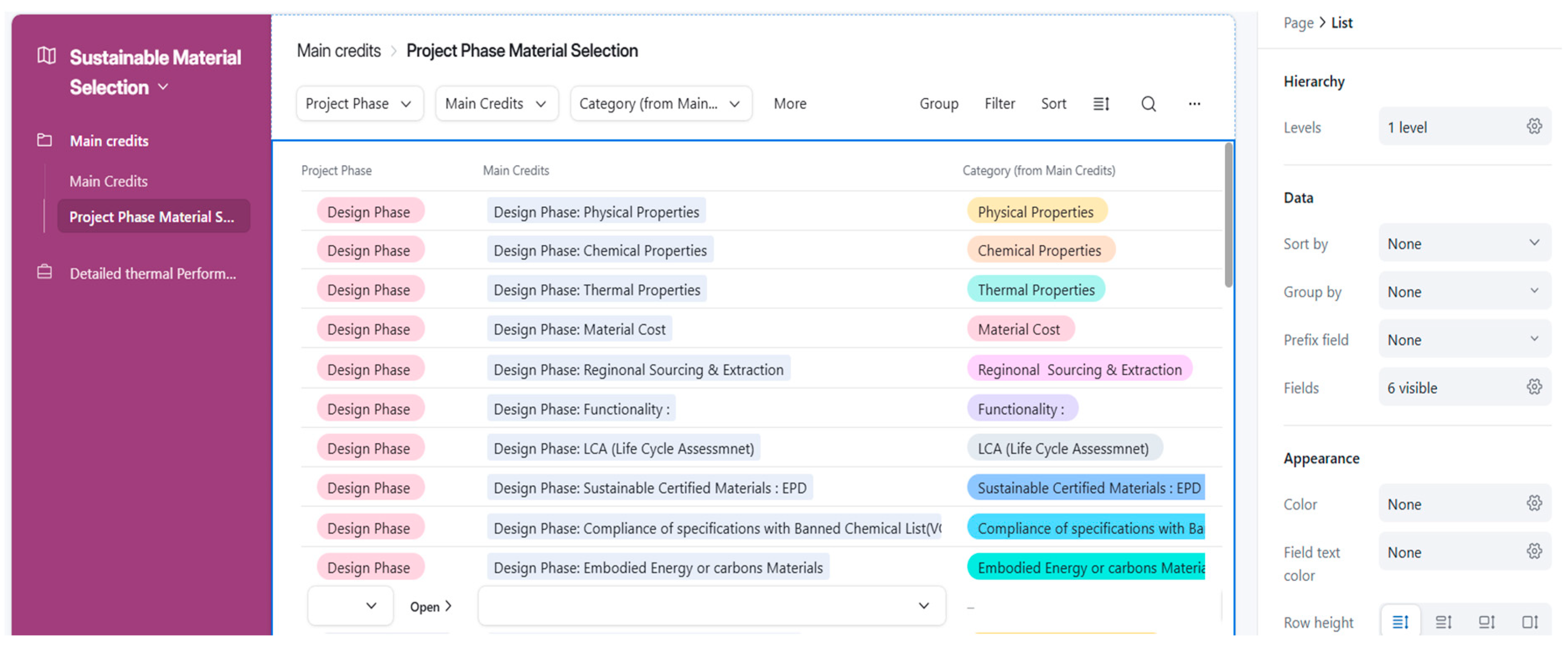
The proposed AI SMS assisted model is developed as a comprehensive Excel sheet that can be used directly or inserted into any dedicated “Spreadsheet to App” platforms for a user-friendly interface. The model constitutes three sequential phases: (1) Gantt chart, (2) main credits interface, and (3) detailed credit interface. For the purpose of this study, the model’s interface has been developed using Airtable (2025) [56] to support a data repository and visualization backend. This is a cloud-based platform that serves as a flexible tool, combining the spreadsheet features with the power of a database [56]. The full model can be found in the Supplementary Materials. This consists of 35 main credits’ records, distributed into 10, 9, 11, and 5 records corresponding to the design, construction, operation and EOL phases, respectively, as shown in Figure 1.
Data sources were rigorously curated from peer-reviewed academic literature, internationally recognized standards, and manufacturer technical datasheets to ensure reliability and traceability. Each data entry is linked to its source reference within the database, allowing transparency in how material performance values were derived and enabling future verification. The database covers commonly used architectural and structural materials across major building components, including exterior and interior walls, roofs and ceilings, floors, windows and glazing systems, and doors and finishes. It is organized into material families and subcategories. Typical material samples include reinforced concrete, precast concrete, structural steel, aluminium, timber and engineered wood products, masonry units, insulation materials (e.g., mineral wool, expanded and extruded polystyrene), glazing systems (single-, double-, and triple-pane), and interior finishes. For each material, a standardized set of attributes is stored, such as thermal properties, e.g., thermal conductivity (U-value), thermal resistance (R-value), solar heat gain coefficient (SHGC), and visible light transmittance (VLT). This is in addition to durability indicators, recyclability and reuse potential, indicative cost ranges, and market availability. Furthermore, credits’ contribution towards LEED sustainable credit compliance and point accrual is also pinpointed.
To maintain relevance and accuracy, the database was designed with a modular update mechanism. New materials and updated performance data can be incorporated without altering the core model logic. Periodic updates are envisioned through (i) the incorporation of newly published research, (ii) the revision of manufacturer specifications, and (iii) alignment with evolving green building certification criteria. The AI-assisted structure of the model facilitates automated recalculation of credits when data are updated, ensuring that material rankings and sustainability scores remain current.

3.2. Gantt Chart Development

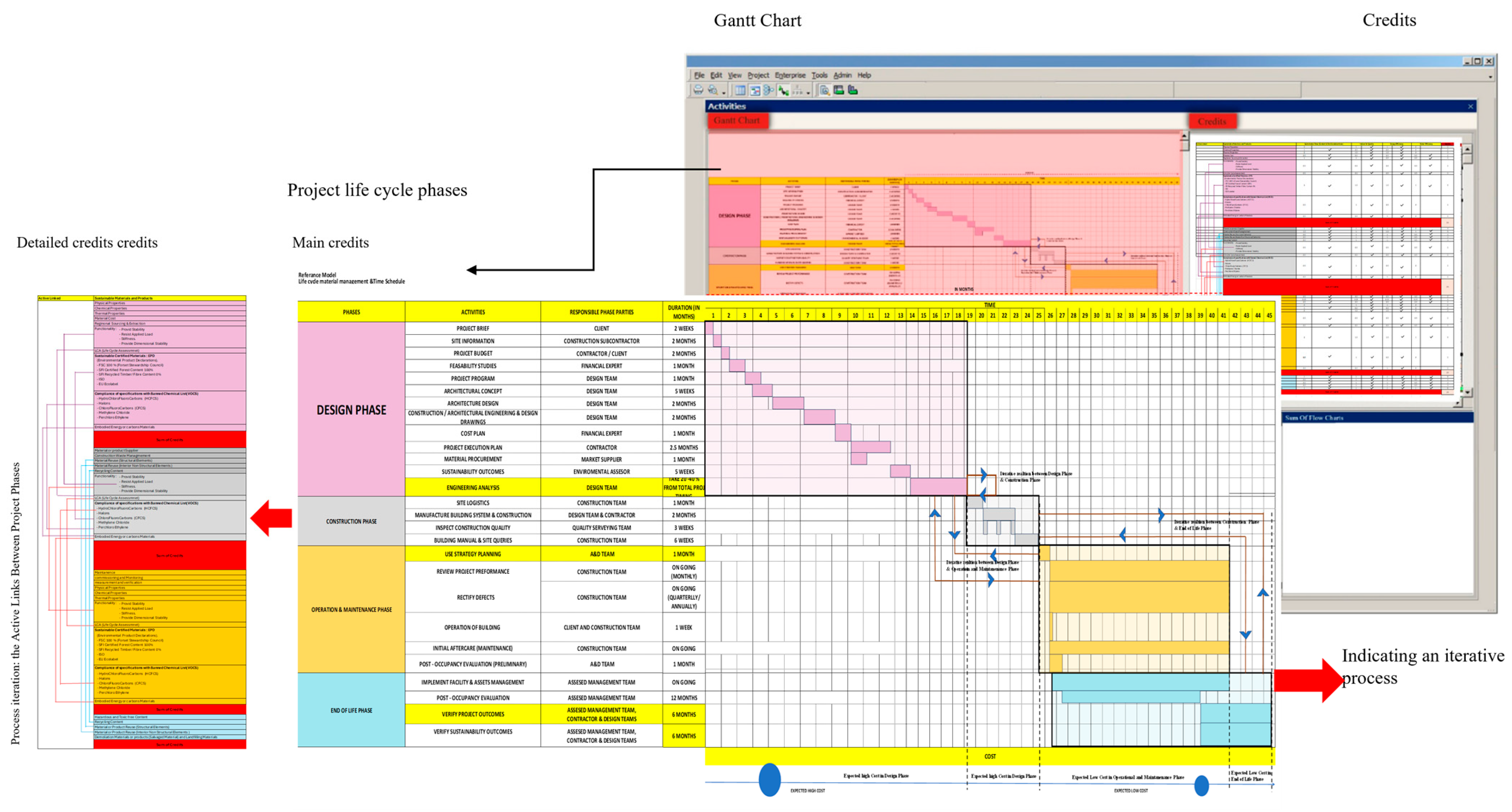
An integrated Gantt chart maps the project timeline, resource allocation, and critical interdependencies as shown in Figure 2. The chart is structured based on a set of clearly defined parameters, including (i) life cycle phase definition, (ii) activity identification, (iii) duration estimation, (iv) responsibility assignment, and (v) cost progression over time. This emphasizes the four primary life cycle phases (design, construction, O&M, and EOL) following previous studies [15]. Each life cycle phase is represented by a distinct colour, with a total project duration of 45 months for the simulated project.
The Gantt chart is structured into three primary divisions. The former lists the project phases and their corresponding material-related activities. The second one indicates roles and activities related to material selection. The latter specifies the estimated time allocation (in months) for each material-selection-related activity. The x-axis of the chart represents two fundamental variables: time (in months) and a projected cost curve. The chart delineates the duration of each individual activity within its respective phase, revealing that the design phase, for instance, is the most critical for defining sustainability outcomes and typically accounts for 20 to 40 per cent of the project’s total timeline, as stated in past studies [57]. The cost curve illustrates a typical expenditure pattern, commencing high during initial capital outlay in the design and construction phases and tapering off through the O&M and EOL phases [58].
This integrated visual tool is critical for project planning, as it enables comprehensive time estimation, deadline mapping, and proactive time management. By clearly sequencing tasks and assigning ownership, the chart helps to prevent change orders and activity overlap, thereby mitigating associated risks, redundant efforts, and unnecessary costs. Furthermore, it can be used to quantify the project’s alignment with sustainability targets.

3.3. Main Credits Interface

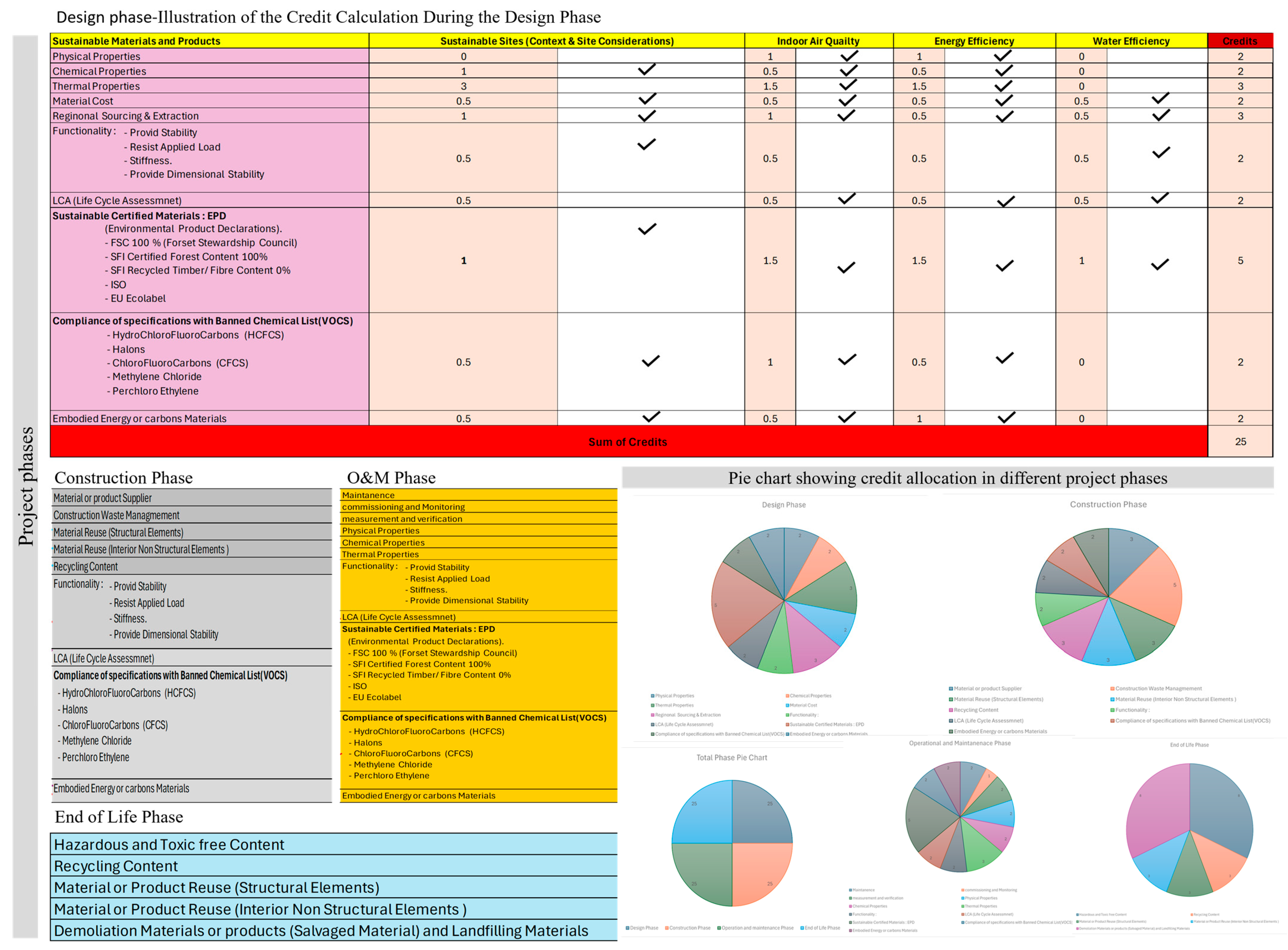
The four stages of the project life cycle are shown in the main credit interface. The sustainable performance of the project is affected by the choice of building materials made at each phase. A pairwise comparison is developed between the relation of material selection and sustainable aspects following LEED categories and credit scorecard (SS, IEQ, EA, and WE), noting that the link between SMS and these defined sustainable categories has already been established in the literature [15]. This step transforms the assessment from a qualitative to a quantitative method, which presents a credit system to assist users in selecting materials with the appropriate features and criteria at each phase. This ensures that the model reflects the integrated nature of sustainable design, where a single material choice can impact multiple categories across the building life cycle and eventually affect the project’s overall sustainability performance.
To quantitatively evaluate material performance across all project phases, a structured credit-based system was implemented. The model allocates a total of 100 credits across the four life cycle phases, assigning equal weight of 25 credits to each phase to maintain a balanced consideration of sustainability throughout the project’s duration. Within each phase, these 25 credits are distributed to assess the relationship between specific material selection criteria and the core sustainable aspects they impact.
A weighted allocation approach was implemented using the AHP. Expert judgments were elicited through in-person, structured interviews conducted in May 2025 with ten specialized practitioners, who were selected through a purposive invitation process based on their expertise in sustainable building design and material selection. Detailed information regarding participant selection, interview protocol, and pairwise comparison procedures is provided in the Supplementary Materials. Each expert independently performed pairwise comparisons between material selection criteria within the same life cycle phase, evaluating their relative importance with respect to phase-specific sustainability objectives (e.g., EA, IEQ, MR and SS). Comparisons were expressed using Saaty’s fundamental scale (1–9), where a value of 1 indicates equal importance and 9 indicates extreme importance of one criterion over another [59].
The individual comparison matrices obtained from the practitioners were first examined for logical consistency by calculating the Consistency Ratio (CR) for each matrix. Only matrices with a CR ≤ 0.10 were accepted, ensuring that expert judgments were coherent and scientifically reliable. To reduce individual bias and enhance robustness, the validated matrices were then aggregated using the geometric mean, producing a single consensus comparison matrix for each project phase. The aggregated matrices were normalized, and the principal eigenvector was computed to derive the final weighting coefficients for each material criterion. These coefficients represent the relative contribution of each criterion to the sustainability performance of the respective life cycle phase. The resulting weights were subsequently multiplied by the total credits considered in that phase (25 credits) to determine the final credit allocation per criterion.
For criterion-level weighting, each material criterion i within a phase is assigned a weighting factor w i , derived from the normalized principal eigenvector of the aggregated AHP pairwise comparison matrix. The weighting factors satisfy Equation (1), where n is the number of criteria in that phase, and C i is the maximum attainable credit for criterion i as shown in Equation (2):
i = 1 n w i = 1
C i = w i × 25
For each criterion, quantitative performance benchmarks are defined based on standards, the literature, or certification thresholds (e.g., LEED requirements). The performance of a selected material is compared against these benchmarks and transformed into a normalized performance score S i , bounded between 0 and 1 to ensure comparability across heterogeneous criteria with different physical units, following Equation (3):
S i = 0 ,     i f   P i < P m i n P i P m i n P o p t P m i n ,   i f   P m i n P i P o p t 1 ,     i f   P i P o p t
where:
P i = actual material performance value;
P m i n = minimum acceptable performance threshold;
P o p t = optimal or best-practice benchmark.
This acknowledges that certain material criteria are more significant and exert a greater influence on the phase’s sustainability goals than others. Consequently, high-impact criteria receive a greater share of the available credits, ensuring that the assessment model accurately reflects their relative importance and provides a more nuanced evaluation of material choices. The specific weighting for each criterion is indicated, and the distribution of credits among the criteria at each phase is shown in Figure 3.
A key research finding was the identification of strong iterative, closed-loop dynamic feedback mechanisms between phases. A design-construction closed-loop system is constructed, noting that the construction phase serves as a critical validation step for design assumptions. This necessitates design alterations, creating an iterative dialogue that ensures practical feasibility and reduces errors before they are fully realized. A design—O&M closed loop system emphasizes that the materials and systems selected during the design phase directly dictate long-term operational performance and maintenance requirements. A decision to specify high-efficiency, higher-cost materials may increase initial capital expenditure but significantly reduce long-term operating expenses. This loop emphasizes the life cycle cost perspective inherent in SMS. A construction-EOL closed-loop system indicates that the quality and techniques employed during the construction phase determine the future potential for material reuse and recycling. This facilitates a circular economy model, reducing the environmental impact and cost of sourcing new materials at the building’s end-of-life.
These closed loops formalize the iterative nature of sustainable project delivery, ensuring that decisions in one phase are continuously informed by their consequences in subsequent phases. This interdependency results in several key material and product criteria being recurrent evaluation points across multiple life cycle stages, and the model actively maps these critical interdependencies, showing an iterative, closed-loop process between phases.

3.4. Detailed Credit Interface

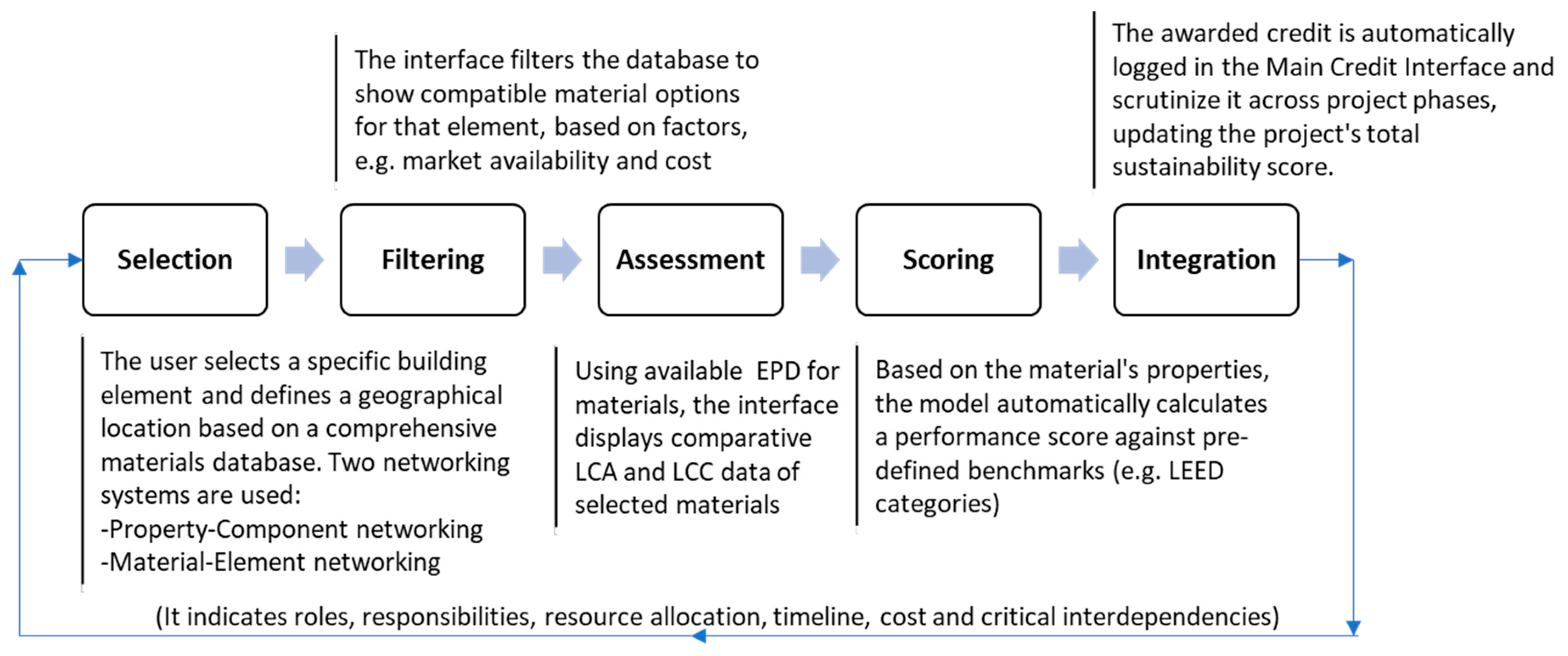
To operationalize the assessment of these cross-phase criteria, the model features an interactive interface. Double-clicking on any material or product criterion within the model launches a detailed credit interface. This sub-menu provides a transparent breakdown of the credit calculation methodology, including the specific metrics, benchmarks, and data required for assessment. It also provides the detailed guidance and data required to rate a selected material for various architectural and structural elements, directly linking material properties to quantifiable sustainability outcomes. This process is repeated for every material point in each phase, following the below sequence: “Selection, Filtering, Assessment, Scoring and Integration”, as shown in Figure 4.
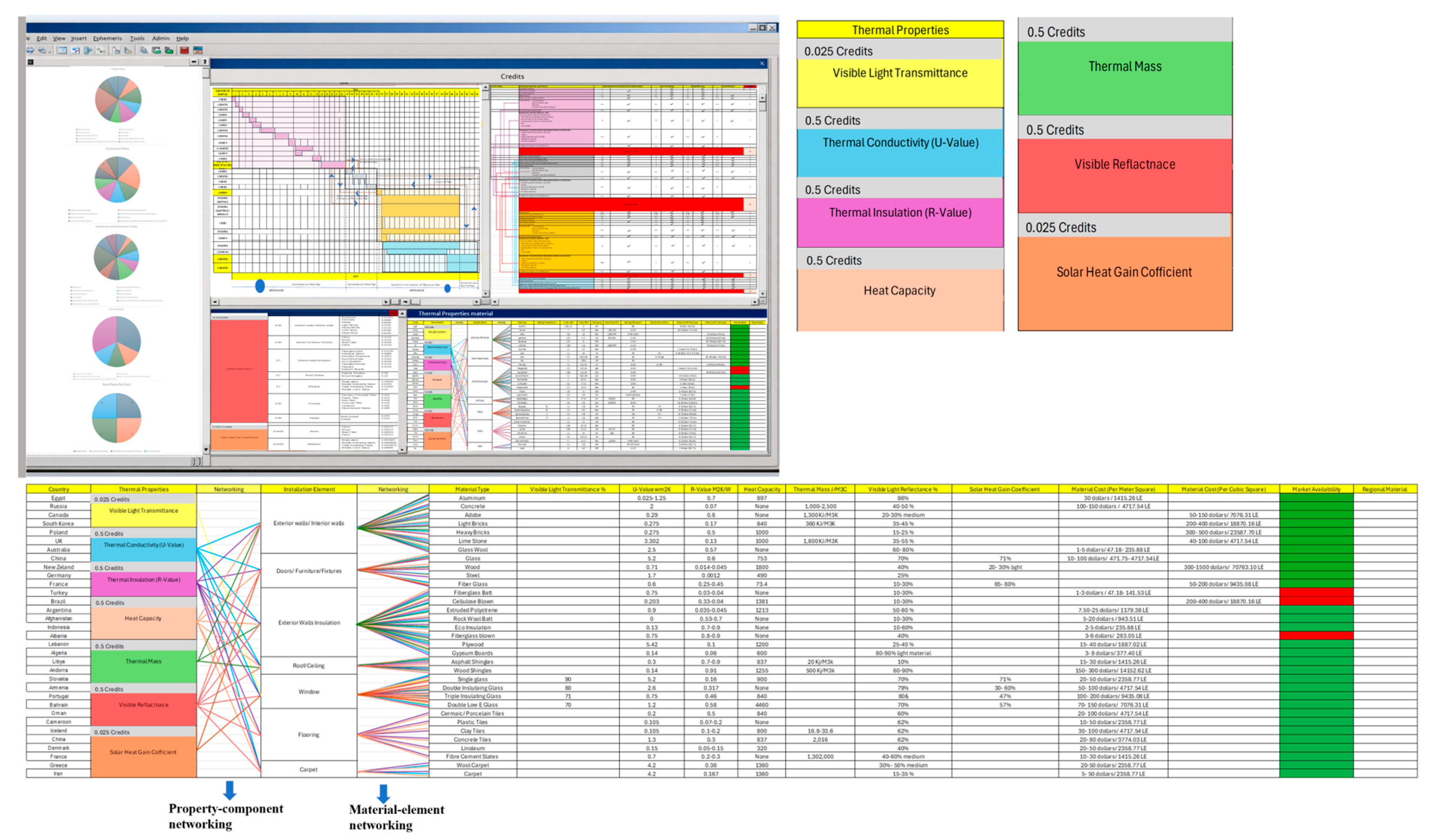
The initial step requires the practitioner to select the project’s geographical location (country/region), contextualizing the assessment by aligning material performance benchmarks with local climatic demands. Selecting the location unlocks a pre-filtered list of contextually suitable materials and defines the specific performance thresholds for credit achievement.
To illustrate this process, the interface for evaluating thermal properties is scrutinized as a representative case study. This criterion was selected for its significant cross-impact on two pivotal sustainability categories, EA and IEQ, as highlighted in previous studies [60,61]. Once the user selects a material for a project, the credit score is automatically calculated based on the weighted system and recorded in the main credits interface.
A critical function of the interface is its integrated networking methodology, shown in Figure 5, which explicitly maps the relationships between specific thermal properties and the architectural elements where they are functionally applied. This networking system ensures that material selection criteria are evaluated within their proper architectural context, preventing misapplication. The visual mapping transforms abstract material data into actionable design intelligence. For example, VLT property is exclusively relevant to glazing systems. Thus, the model connects this property directly to the “Windows” element, signifying its specific application. Consequently, the entire credit allocation for VLT is assigned to the “Windows” component. Similarly, the U-value property is a critical performance metric for multiple building envelopes and interior elements. Thus, the blue lines connect the U-value property to all relevant components, including exterior walls, interior walls, doors, roofs/ceilings, windows, and floor coverings. In this case, its total credit allocation is distributed across the six relevant components where it applies: exterior walls, interior walls, doors/furniture, roof/ceiling, windows, and flooring.
The proposed AI-assisted SMS model applies credit allocation via property–component networking. Thus, the point distribution is weighted based on the relative impact of each component on the building’s overall thermal performance. For example, exterior walls and the roof/ceiling, being primary interfaces with the external environment, may receive a higher share of the available U-value credits (e.g., 0.1 each), while components like windows and flooring, though still important, may receive a smaller allocation (e.g., 0.05 each) due to their comparatively smaller surface area or different functional role. For the purpose of this study, the weighting was based on LEED credits’ calculation.
However, this property–component network represents only the first tier of the assessment. To determine the actual credit value of a specific material selected for a component, a second network is essential. Thus, the material-specific credit calculation using a material–element network is used to enable the transition from theoretical credit potential to actual performance assessment. This involves a comprehensive materials database that catalogues the available market options for each architectural element and their precise thermal property values. The model’s algorithm then cross-references the selected material’s properties against the performance benchmarks for its component to calculate the final earned credit. The property–component network establishes the framework for credit allocation, but the actual credit value is contingent upon the specific material selected for each architectural element. This final calculation is facilitated by a secondary network that maps suitable materials to each installation element. For example, the VLT property, linked to the “Windows” component, is subsequently connected to specific glazing material options such as single-pane, double-pane, or triple-pane glass.
The model’s algorithm synthesizes these two networks. When a user selects a specific material (e.g., double-pane glass for a window), the system cross-references the material’s stored property data against the performance benchmarks defined for that element and property. It then calculates the exact credit earned based on how the material’s performance meets or exceeds the established benchmarks, providing a precise, quantitative evaluation of the sustainability impact of each material choice.
When a criterion applies to multiple building components (e.g., U-value across walls, roofs, and windows), the criterion credit C i is subdivided among components using component-specific weighting factors α i j , following Equation (4), where m represents the number of relevant components. Also, the component-level score is calculated following Equation (5), with S i being the normalized performance score of the selected material for component j .
j = 1 m α i j = 1
C i j e a r n e d = C i × α i j × S i j

3.5. Scoring and Certification

The total earned credit score C for a phase is obtained by summing the earned credits across all criteria and components, following Equation (6):
C p h a s e = i = 1 n j = 1 m C i j e a r n e d
The overall project sustainability score is then computed following Equation (7), where k corresponds to the four life cycle phases.
C t o t a l = k = 1 4 C p h a s e k
The proposed AI SMS assisted model adopts the established certification tiers of the LEED BD+C rating system v4.1, thus, the overall project score, which is automatically calculated by the model’s interface, corresponds to the LEED certification levels, i.e., a minimum of 40 points for the Certified Level, 50 points for the Silver Level, 60 points for the Gold Level, and 80 points for the Platinum Level.
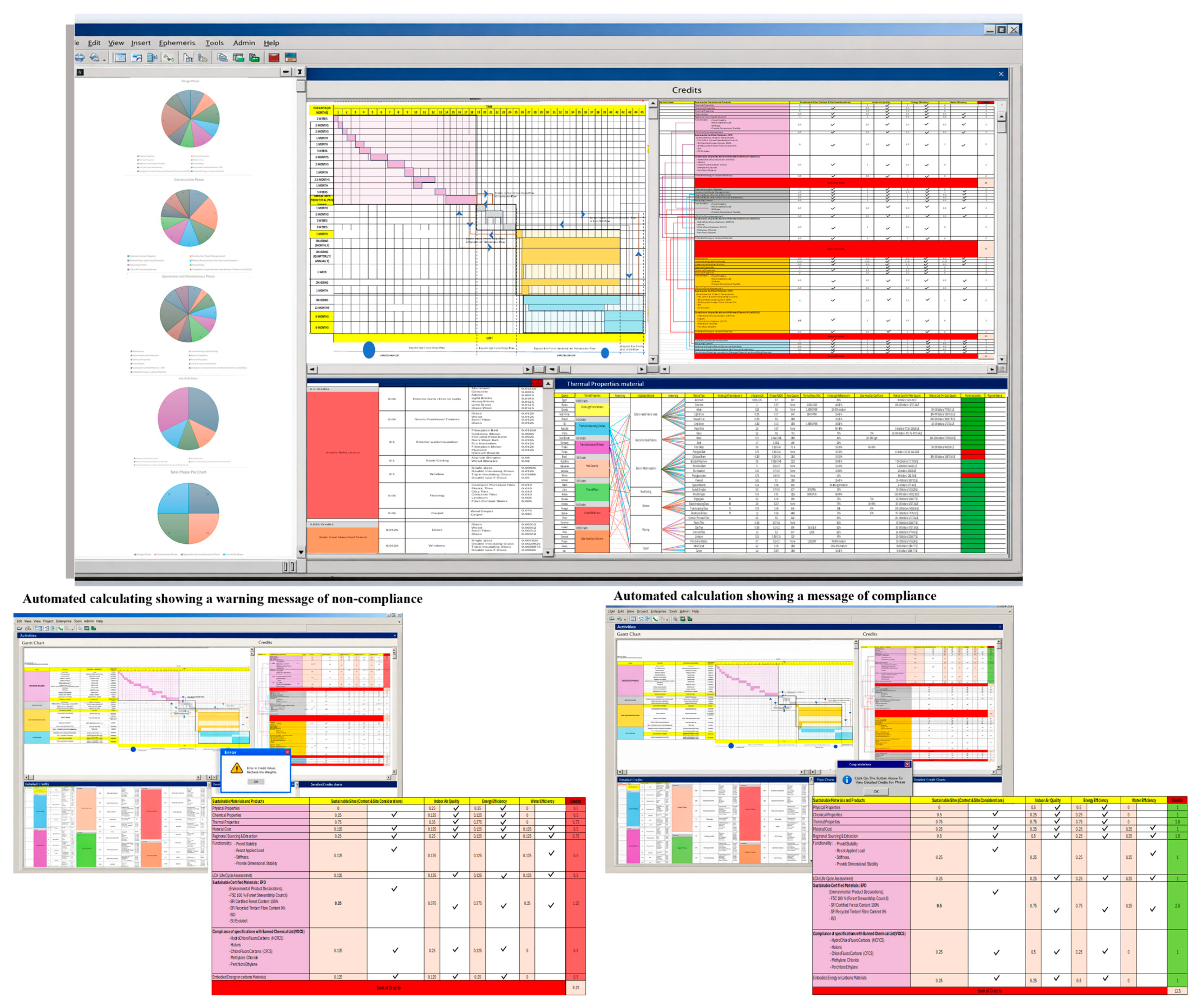
The model features an interactive validation system. Upon completing a phase, the achieved credits are displayed in a column marked with a colour code: green for satisfactory performance and red for suboptimal performance. An alert warns the user if achieved credits are less than the sustainable target, e.g., LEED threshold, indicating that material selections are not sufficiently sustainable. Conversely, achieving the required number of available points triggers a congratulatory message, permitting progression to the next phase. Finally, a total project score is calculated numerically and can be visualized through an automated flowchart to aid in project assessment, as shown in Figure 6.

4. Testing and Discussion

The discussion part includes a survey testing and statistical analysis as well as a comparison against previous work.

4.1. Validation Using Survey Testing and Statistical Analysis

A structured questionnaire was developed to assess the proposed SMS model in practice. The survey was administered between January and October 2025 through the following link https://forms.gle/MTCtSvAQ6v1h8Sgf8, with access date starting 2 January 2025, and yielded approximately 60 complete responses and 18 partially completed responses, which were excluded from the quantitative analysis.
The questionnaire consisted of four main sections, combining closed-ended questions, Likert-scale items, and ranking tasks. Several questions required respondents to rank project life cycle phases (design, construction, O&M, EOL) according to their relative importance in influencing material sustainability outcomes. Additional ranking questions were used to elicit practitioners’ perspectives on point-weighting for phases and credits attributed to material selection within sustainability assessments.
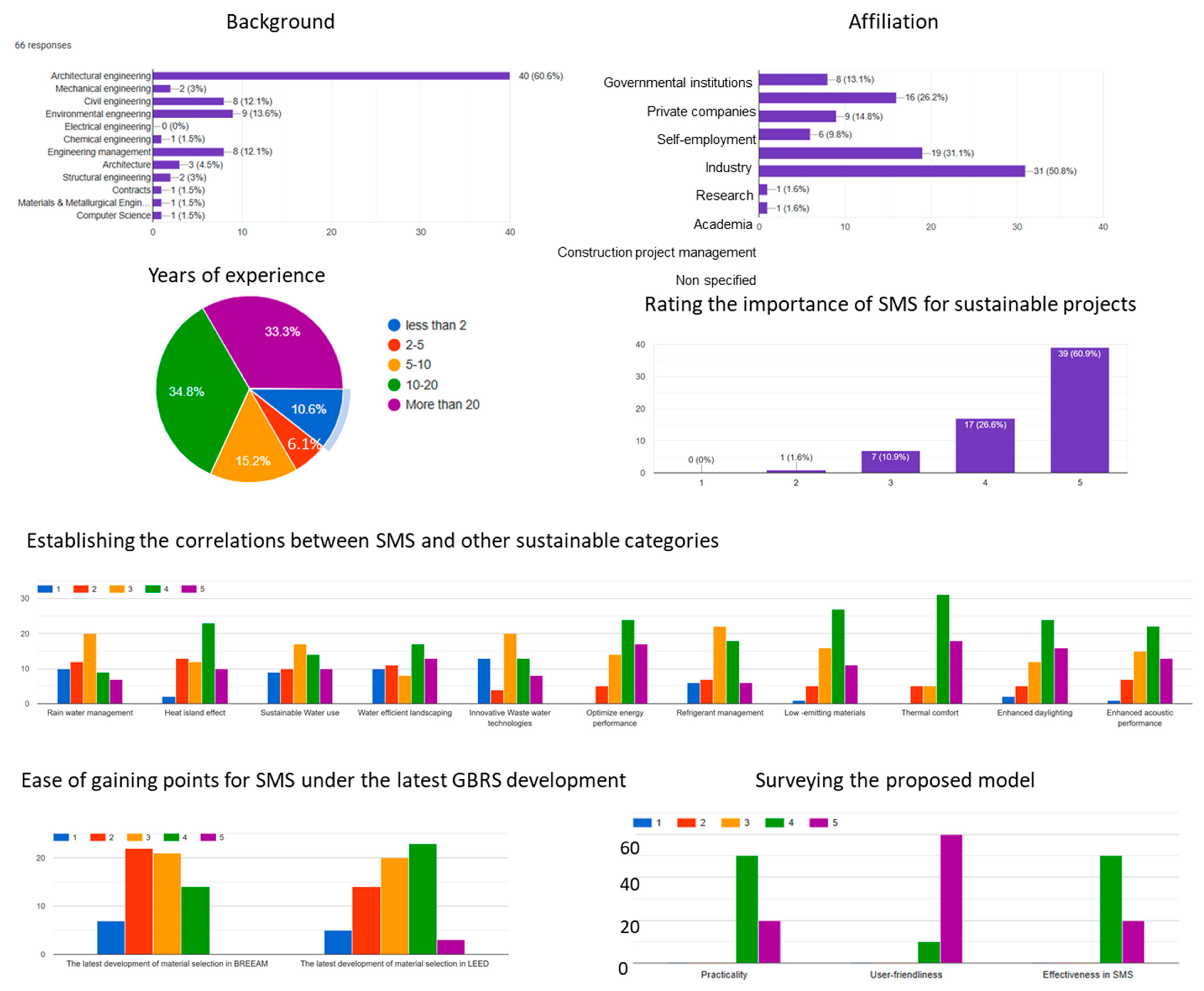
The former section investigated participants’ profiles and collected demographic and professional background information. The second section investigated the perceived importance of material selection in sustainable buildings. Questions in this section assessed (1) the influence of material selection on overall building sustainability, (2) the relationship between material selection and core sustainability categories (energy, indoor environmental quality, water efficiency, and site sustainability), and (3) the timing of critical material decisions across different life cycle phases. The third section investigated the methods and tools currently used by practitioners for SMS, including (1) reliance on codes, standards, or certification systems; (2) the use of digital tools, databases, or LCA software; (3) the degree of reliance on experience-based judgment versus data-driven methods; and (4) challenges encountered in integrating material sustainability considerations into practice. In the final section, practitioners assessed the proposed model based on a list of success parameters, including practicality, user-friendliness, and effectiveness in SMS, following the work of previous studies [17,55]. A summary of the key findings is presented in Figure 7.
To strengthen the analytical rigour of the survey results, both descriptive and inferential statistical methods were employed. The analyses were conducted using the complete responses dataset of a certain sample size (n ≈ 60). The researchers performed a reliability analysis of survey constructs to assess the internal consistency of the questionnaire sections, evaluating the proposed model. Thus, Cronbach’s alpha was calculated for each construct. The results indicated acceptable to strong reliability (α > 0.70), thus validating the survey instrument and supporting the robustness of subsequent statistical analyses. Then, the research performed hypothesis testing for key constructs of model evaluation (H1: practicality; H2: user-friendliness; and H3: effectiveness in improving SMS), and the One-Sample t-Test was used to evaluate the practitioners’ responses.
Respondents rated the practicality, user-friendliness, and effectiveness of the proposed model as (n = 7, M = 4.29, SD = 0.49, t(6) = 6.97, p = 0.00043), (n = 7, M = 4.86, SD = 0.38, t(6) = 13.00, p = 1.28 × 10⁻⁵), and (n = 7, M = 4.29, SD = 0.49, t(6) = 6.97, p = 0.00043), respectively, where n is the sample size, M is the mean, SD is the standard deviation, t represents the t-test, and p is the probability value. This indicates the positive assessment feedback of participants, noting that the perceived user-friendliness of the model received the highest overall ratings. All three hypotheses—regarding practicality, user-friendliness, and effectiveness—were statistically supported at the p < 0.001 level. In addition to p-values, effect sizes (Cohen’s d) were calculated to quantify the magnitude of observed differences. Medium to large effect sizes were obtained for all three evaluated constructs, indicating that the results are not only statistically significant but also practically meaningful.
To investigate relationships between key variables, Spearman’s rank correlation coefficients were calculated. A strong positive correlation was observed between the perceived importance of SMS and model effectiveness (ρ > 0.6, p < 0.01). Moderate positive correlations were identified between years of experience and perceived practicality, indicating that more experienced practitioners were particularly receptive to the proposed approach. Significant correlations were also found between SMS and multiple sustainability categories (energy performance, thermal comfort, daylighting, and acoustic performance), supporting the model’s integrative life cycle premise.

4.2. Comparing the Results Against Previous Work

Table 1 summarizes the key methodological and functional differences between existing material selection models and the proposed AI-assisted SMS model. This indicates that while prior studies provide robust theoretical foundations, the current study advances the state of the art through full life cycle integration, automated credit-based scoring, and explicit closed-loop feedback mechanisms.

5. Conclusions and Directions for Future Research

Previous studies have laid a solid foundation for structured material selection using MCDM techniques; nevertheless, they remain largely static, phase-limited, and weakly integrated with practice-oriented tools. The current study addresses these gaps by introducing a life cycle-based, AI-assisted, interactive, and certification-aligned decision-support model.
In this regard, the research has responded to the previously raised questions. The development of the proposed model provides a novel, structured framework that moves from intuitive, experience-based selection to a holistic optimization, evidence-based, scored, ranked, and benchmarked process, noting the complexity of the SMS process (Q1). This enhances project team collaboration, front-loads critical sustainability intelligence, and paves the way for a data-driven, closed-loop culture in sustainable construction.
The proposed model provides a visual interface, critical for project planning and proactive time management, defining roles and responsibilities, sequencing tasks, and pinpointing critical iterative decisions across different project phases, factoring in different sustainable categories. Furthermore, it can be used to quantify the project’s alignment with sustainability targets.
The model is structured around four core life cycle phases: design, construction, O&M, and EOL, to provide a life cycle account of SMS. By formalizing closed-loop feedback mechanisms between these phases, the model captures the iterative reality of construction projects, where practical insights from later stages can inform earlier decisions.
The model operationalizes sustainability assessment through a dual-interface system to address the level of detail required by users. The former provides a main credits interface that allocates 100 total credits equally across the four phases (25 credits/phase), providing a high-level overview of project performance. This establishes a link between SMS and defined sustainable categories (Sustainable Sites, Indoor Air Quality, Energy Efficiency, and Water Efficiency) (Q2). This phase applies credit allocation and weighting methodology and pinpoints the iterative process and cross-phase criteria and decision iteration of SMS. It should be noted that the model can be tailored to consider only one phase, and can accommodate changes in the assigned weights of each phase, according to users’ preferences and pre-set priorities. This dual-interface system makes sophisticated life cycle assessment accessible. The latter provides a detailed credit interface that enables the assessment of specific material selection criteria against defined sustainability benchmarks. This detailed assessment workflow was fully implemented and tested for the thermal properties criterion to serve as a successful proof of concept, validating the model’s underlying architecture, data integration, and computational logic. The interface successfully contextualizes material performance benchmarks based on the project’s geographic location and climatic conditions.
Property–component networking and material–element networking effectively map thermal properties (e.g., U-value, VLT, SHGC) to their relevant architectural components (e.g., windows, walls, roof). This results in assigning different priority weights to thermal properties for different building components, and accordingly, distinct, ranked lists for each component.
The model incorporates a dynamic assessment mechanism with an automated scoring and certification output (Q3). Thus, the model automatically aggregates credits from all phases to generate a final project score, prompting the user to reassess material choices. This ensures that the model acts not only as an assessment tool but also as a proactive guide for improving sustainability outcomes.
Future research can include other material attributes, where the model shall be in a continuous state of development (Machine Learning) with more data input. Also, it should be noted that the model’s effectiveness is contingent on the accuracy and comprehensiveness of its underlying database. Thus, the efficacy of this work is dependent on developing open, curated databases for material properties. This would help advance explainable AI to make models customized, transparent, and trustworthy, fostering interdisciplinary collaboration between computer scientists, material scientists, architects, and structural engineers. Furthermore, the proposed model should be implemented on live pilot projects to test its practicality, user-friendliness, and effectiveness on final project outcomes against conventional methods.

Supplementary Materials

The following supporting information can be downloaded at: https://www.mdpi.com/article/10.3390/su18020566/s1, S1: Excel sheet; S2: Pairwise comparison; S3: Model link and interface; S4: Video explaining the proposed model.

Author Contributions

Conceptualization, W.S.E.I. and J.S.; methodology, W.S.E.I. and J.S.; software, J.S.; validation, W.S.E.I. and J.S.; formal analysis, W.S.E.I.; investigation, J.S., R.A. and A.S.; resources, J.S., R.A. and A.S.; data curation, J.S., R.A. and A.S.; writing—original draft preparation, W.S.E.I. and J.S.; writing—review and editing, W.S.E.I.; visualization, J.S.; supervision, W.S.E.I. All authors have read and agreed to the published version of the manuscript.

Funding

This research received no external funding.

Institutional Review Board Statement

The study was conducted in accordance with the Declaration of Helsinki and approved by the Faculty of Engineering Ethics Committee (1 January 2025).

Informed Consent Statement

Informed consent was obtained from all subjects involved in the study. This research involved human participants through an online survey among building and construction practitioners to assess the efficiency of the proposed model. It was conducted in accordance with the academic ethical standards and has been revised and approved by the Ethics committee at the Faculty of Engineering in the British University in Egypt. Informed consent was obtained from all participants prior to their involvement. The consent process involved providing a detailed information sheet outlining the study’s purpose, the voluntary nature of participation, the right to withdraw at any time, and the measures guaranteeing anonymity and data confidentiality. Consent was implied by the completion and submission of the online survey. The study protocol ensured participant anonymity, as no personally identifiable information was collected. All data are stored securely and handled confidentially by the authors for the sole sake of the research process.

Data Availability Statement

The original contributions presented in this study are included in the article/Supplementary Material. Further inquiries can be directed to the corresponding author.

Conflicts of Interest

Authors declare no conflict of interest.

Abbreviations

The following abbreviations are used in this manuscript:
AIArtificial Intelligence
AHPAnalytical Hierarchy Process
EAEnergy and Atmosphere
EOLEnd of Life
ELECTREElimination and Choice Translating Reality
EPDsEnvironmental Product Declarations
IEQIndoor Environmental Quality
LCALife Cycle Assessment
LCCLife Cycle Costing
LEED BD+CLeadership in Energy and Environmental Design-Building Design and Construction
LTLocation and Transportation
MCDMMulticriteria Decision Making
MLMachine Learning
MRMaterials and Resources
O&MOperations and Maintenance
R-valueThermal Resistance
SEMStructural Equation Modelling
SHGCSolar Heat Gain Coefficient
SMSSustainable Material Selection
SSSustainable Sites
TOPSISTechnique for Order of Preference by Similarity to Ideal Solution
U-valueThermal Conductivity
VLTVisible Light Transmittance
VOCVolatile Organic Compound
WEWater Efficiency

References

  1. United Nations Environment Programme. Global Status Report for Buildings and Construction; United Nations Environment Programme: Nairobi, Kenya, 2024. [Google Scholar]
  2. Barbhuiya, S.; Das, B.B. Life Cycle Assessment of Construction Materials: Methodologies, Applications and Future Directions for Sustainable Decision-Making. Case Stud. Constr. Mater. 2023, 19, e02326. [Google Scholar] [CrossRef]
  3. Ismaeel, W.S.E.; Mohamed, A.G. A Structural Equation Modelling Paradigm for Eco-Rehabilitation and Adaptive Reuse of Cultural Heritage Buildings. Build. Environ. 2023, 242, 110604. [Google Scholar] [CrossRef]
  4. Balali, A.; Valipour, A.; Zavadskas, E.K.; Turskis, Z. Multi-Criteria Ranking of Green Materials According to the Goals of Sustainable Development. Sustainability 2020, 12, 9482. [Google Scholar] [CrossRef]
  5. Ottele, M.; Perini, K.; Fraaij, A.L.A.; Haas, E.M.; Raiteri, R. Comparative Life Cycle Analysis for Green Facades and Living Wall Systems. Energy Build. 2011, 43, 3419–3429. [Google Scholar] [CrossRef]
  6. Kang, Y.; Chang, S.J.; Kim, S. Energy & Buildings Hygrothermal Behavior Evaluation of Walls Improving Heat and Moisture Performance on Gypsum Boards by Adding Porous Materials. Energy Build. 2018, 165, 431–439. [Google Scholar] [CrossRef]
  7. Nicolae, B.; George-Vlad, B. Life Cycle Analysis in Refurbishment of the Buildings as Intervention Practices in Energy Saving. Energy Build. 2015, 86, 74–85. [Google Scholar] [CrossRef]
  8. Mishra, N.; Bartsch, J.; Ayoko, G.A.; Salthammer, T.; Morawska, L. Volatile Organic Compounds: Characteristics, Distribution and Sources in Urban Schools. Atmos. Environ. 2015, 106, 485–491. [Google Scholar] [CrossRef]
  9. Senitkova, I. Impact of Indoor Surface Material on Perceived Air Quality. Mater. Sci. Eng. C 2014, 36, 1–6. [Google Scholar] [CrossRef]
  10. Rahmadina, M.; Kusuma, N.R.; Arvanda, E. Wall Finishing Materials and Heritage Science in the Adaptive Reuse of Jakarta Heritage Buildings. IOP Conf. Ser. Mater. Sci. Eng. 2019, 523, 012055. [Google Scholar] [CrossRef]
  11. Elakkad, N.; Ismaeel, W.S.E. Coupling Performance-Prescriptive Based Daylighting Principles for Office Buildings: Case Study from Egypt. Ain Shams Eng. J. 2021, 12, 3263–3273. [Google Scholar] [CrossRef]
  12. Crawford, R.H.; Bunster, V. A Web-Based Tool for Streamlining Environmental Decision-Making in Building Design. IOP Conf. Ser. Earth Environ. Sci. 2020, 588, 022075. [Google Scholar] [CrossRef]
  13. Sandanayake, M.; Gunasekara, C.; Law, D.; Zhang, G.; Setunge, S.; Wanijuru, D. Sustainable Criterion Selection Framework for Green Building Materials—An Optimisation Based Study of Fly-Ash Geopolymer Concrete. Sustain. Mater. Technol. 2020, 25, e00178. [Google Scholar] [CrossRef]
  14. Sahlol, D.G.; Elbeltagi, E.; Elzoughiby, M.; Abd Elrahman, M. Sustainable Building Materials Assessment and Selection Using System Dynamics. J. Build. Eng. 2021, 35, 101978. [Google Scholar] [CrossRef]
  15. Ismaeel, W.S.E. The Dynamics of Sustainable Material Selection for Green-Certified Projects. Buildings 2023, 13, 2077. [Google Scholar] [CrossRef]
  16. Zoghi, M.; Rostami, G.; Khoshand, A.; Motalleb, F. Material Selection in Design for Deconstruction Using Kano Model, Fuzzy-AHP and TOPSIS Methodology. Waste Manag. Res. 2022, 40, 410–419. [Google Scholar] [CrossRef]
  17. Ismaeel, W.S.E.; Kassim, N. An Environmental Management Plan for Construction Waste Management. Ain Shams Eng. J. 2023, 14, 102244. [Google Scholar] [CrossRef]
  18. Rahim, A.A.A.; Musa, S.N.; Ramesh, S.; Lim, M.K. Development of a Fuzzy-TOPSIS Multi-Criteria Decision-Making Model for Material Selection with the Integration of Safety, Health and Environment Risk Assessment. Proc. Inst. Mech. Eng. Part L J. Mater. Des. Appl. 2021, 235, 1532–1550. [Google Scholar] [CrossRef]
  19. Ismaeel, W.S.E.; Alamoudy, F.O.; Sameh, R. How Renovation Activities May Jeopardize Indoor Air Quality: Accounting for Short and Long-Term Sick Building Syndromes in Educational Buildings. J. Archit. Eng. Des. Manag. 2022, 19, 360–377. [Google Scholar] [CrossRef]
  20. USGBC. LEED v4 for Building Design and Construction—Current Version|U.S. Green Building Council. Available online: http://www.usgbc.org/resources/leed-v4-building-design-and-construction-current-version (accessed on 1 January 2025).
  21. Ammar, M.; Haleem, A.; Javaid, M.; Walia, R.; Bahl, S. Improving Material Quality Management and Manufacturing Organizations System through Industry 4.0 Technologies. Mater. Today Proc. 2021, 45, 5089–5096. [Google Scholar] [CrossRef]
  22. Hariyani, D.; Hariyani, P.; Mishra, S.; Sharma, M.K. A Literature Review on Green Supply Chain Management for Sustainable Sourcing and Distribution. Waste Manag. Bull. 2024, 2, 231–248. [Google Scholar] [CrossRef]
  23. Gobbi, S.; Puglisi, V.; Ciaramella, A. A Rating System for Integrating Building Performance Tools in Developing Countries. Energy Procedia 2016, 96, 333–344. [Google Scholar] [CrossRef]
  24. Castro-Lacouture, D.; Sefair, J.A.; Flórez, L.; Medaglia, A.L. Optimization Model for the Selection of Materials Using a LEED-Based Green Building Rating System in Colombia. Build. Environ. 2009, 44, 1162–1170. [Google Scholar] [CrossRef]
  25. Akadiri, P.O. Understanding Barriers Affecting the Selection of Sustainable Materials in Building Projects. J. Build. Eng. 2015, 4, 86–93. [Google Scholar] [CrossRef]
  26. Syal, M.G.; Mago, S.; Moody, D. Impact of LEED-NC Credits on Contractors. J. Archit. Eng. 2007, 13, 174–179. [Google Scholar] [CrossRef]
  27. Cai, G.; Waldmann, D. A Material and Component Bank to Facilitate Material Recycling and Component Reuse for a Sustainable Construction: Concept and Preliminary Study. Clean Technol. Environ. Policy 2019, 21, 2015–2032. [Google Scholar] [CrossRef]
  28. Simões, C.L.; Costa Pinto, L.M.; Simoes, R.; Bernardo, C.A. Integrating Environmental and Economic Life Cycle Analysis in Product Development: A Material Selection Case Study. Int. J. Life Cycle Assess. 2013, 18, 1734–1746. [Google Scholar] [CrossRef]
  29. Jrade, A.; Jalaei, F. Integrating Building Information Modelling with Sustainability to Design Building Projects at the Conceptual Stage. Build. Simul. 2013, 6, 429–444. [Google Scholar] [CrossRef]
  30. Giama, E.; Papadopoulos, A.M. Sustainable Building Management: Overview of Certification Schemes and Standards. Adv. Build. Energy Res. 2012, 6, 242–258. [Google Scholar] [CrossRef]
  31. Qureshi, S.M.S.M.; Kang, C.W. Analysing the Organizational Factors of Project Complexity Using Structural Equation Modelling. Int. J. Proj. Manag. 2015, 33, 165–176. [Google Scholar] [CrossRef]
  32. Keane, P.; Sertyesilisik, B.; Ross, A.D. Variations and Change Orders on Construction Projects. J. Leg. Aff. Disput. Resolut. Eng. Constr. 2010, 2, 89–96. [Google Scholar] [CrossRef]
  33. ISO-14040; Life Cycle Assessment. Principles and Framework. International Organization for Standardization: Geneva, Switzerland, 2006. Available online: https://www.iso.org/standard/37456.html (accessed on 1 May 2025).
  34. Han, G.; Srebric, J.; Enache-Pommer, E. Variability of Optimal Solutions for Building Components Based on Comprehensive Life Cycle Cost Analysis. Energy Build. 2014, 79, 223–231. [Google Scholar] [CrossRef]
  35. Hoogmartens, R.; Van Passel, S.; Van Acker, K.; Dubois, M. Bridging the Gap between LCA, LCC and CBA as Sustainability Assessment Tools. Environ. Impact Assess. Rev. 2014, 48, 27–33. [Google Scholar] [CrossRef]
  36. Basbagill, J.; Flager, F.; Lepech, M.; Fischer, M. Application of Life-Cycle Assessment to Early Stage Building Design for Reduced Embodied Environmental Impacts. Build. Environ. 2013, 60, 81–92. [Google Scholar] [CrossRef]
  37. Mukhamet, T.; Kobeyev, S.; Nadeem, A.; Memon, S.A. Ranking PCMs for Building Façade Applications Using Multi-Criteria Decision-Making Tools Combined with Energy Simulations. Energy 2021, 215, 119102. [Google Scholar] [CrossRef]
  38. Abdel, A.; Ali, M.; Negm, A.; Bady, M.; Gamal, M.; Ibrahim, E. Towards an Integrated Tool to Estimate Carbon Emissions from Life Cycle Assessment of Building Materials in Egypt. Int. J. Res. Eng. Technol. 2014, 2, 2321–8843. [Google Scholar]
  39. Giudice, F.; La Rosa, G.; Risitano, A. Materials Selection in the Life-Cycle Design Process: A Method to Integrate Mechanical and Environmental Performances in Optimal Choice. Mater. Des. 2005, 26, 9–20. [Google Scholar] [CrossRef]
  40. Jato-Espino, D.; Castillo-Lopez, E.; Rodriguez-Hernandez, J.; Canteras-Jordana, J.C. A Review of Application of Multi-Criteria Decision Making Methods in Construction. Autom. Constr. 2014, 45, 151–162. [Google Scholar] [CrossRef]
  41. Sirisalee, P.; Ashby, M.F.; Parks, G.T.; Clarkson, P.J. Multi-Criteria Material Selection in Engineering Design. Adv. Eng. Mater. 2004, 6, 84–92. [Google Scholar] [CrossRef]
  42. Kumar, R.; Jagadish; Ray, A. Selection of Material for Optimal Design Using Multi-Criteria Decision Making. Procedia Mater. Sci. 2014, 6, 590–596. [Google Scholar] [CrossRef]
  43. Solís-Guzmán, J.; Marrero, M.; Montes-Delgado, M.V.; Ramírez-de-Arellano, A. A Spanish Model for Quantification and Management of Construction Waste. Waste Manag. 2009, 29, 2542–2548. [Google Scholar] [CrossRef]
  44. Chen, C.H. A Novel Multi-Criteria Decision-Making Model for Building Material Supplier Selection Based on Entropy-AHP Weighted TOPSIS. Entropy 2020, 22, 259. [Google Scholar] [CrossRef] [PubMed]
  45. Jangam, P.; Sakhare, V.; Ingole, R. Enhanced Building Envelope Material Selection: A BIM—MCDM Integrated Approach. Discov. Civ. Eng. 2025, 2, 89. [Google Scholar] [CrossRef]
  46. Ur, A.; Bajwa, R.; Siriwardana, C.; Shahzad, W.; Ahmad, M. Material Selection in the Construction Industry: A Systematic Literature Review on Multi—Criteria Decision Making. Environ. Syst. Decis. 2025, 45, 8. [Google Scholar] [CrossRef]
  47. Sterman, J.D.; John, D. Sterman System Dynamics: Systems Thinking and Modeling for a Complex World. Proc. ESD Intern. Symp. 2002, 147, 248–249. [Google Scholar] [CrossRef]
  48. Thompson, B.P.; Bank, L.C. Use of System Dynamics as a Decision-Making Tool in Building Design and Operation. Build. Environ. 2010, 45, 1006–1015. [Google Scholar] [CrossRef]
  49. Hauashdh, A.; Jailani, J.; Rahman, I.A.; AL-fadhali, N. Structural Equation Model for Assessing Factors Affecting Building Maintenance Success. J. Build. Eng. 2021, 44, 102680. [Google Scholar] [CrossRef]
  50. Ismaeel, W.S.E.; Mohamed, A.G. Indoor Air Quality for Sustainable Building Renovation: A Decision-Support Assessment System Using Structural Equation Modelling. Build. Environ. 2022, 214, 108933. [Google Scholar] [CrossRef]
  51. Pan, G.; Wang, F.; Shang, C.; Wu, H.; Wu, G.; Gao, J.; Wang, S.; Gao, Z.; Zhou, X.; Mao, X. Advances in Machine Learning- and Artificial Intelligence-Assisted Material Design of Steels. Int. J. Miner. Metall. Mater. 2023, 30, 1003–1024. [Google Scholar] [CrossRef]
  52. Zhang, Y.; Chen, Y.; Su, Q.; Huang, X.; Li, Q.; Yang, Y.; Zhang, Z.; Chen, J.; Xiao, Z.; Xu, R.; et al. The Use of Machine and Deep Learning to Model the Relationship between Discomfort Temperature and Labor Productivity Loss among Petrochemical Workers. BMC Public Health 2024, 24, 3269. [Google Scholar] [CrossRef]
  53. Yan, H.; Yan, K.; Ji, G. Optimization and Prediction in the Early Design Stage of Office Buildings Using Genetic and XGBoost Algorithms. Build. Environ. 2022, 218, 109081. [Google Scholar] [CrossRef]
  54. Wang, X.Q.; Chen, P.; Chow, C.L.; Lau, D. Artificial-Intelligence-Led Revolution of Construction Materials: From Molecules to Industry 4.0. Matter 2023, 6, 1831–1859. [Google Scholar] [CrossRef]
  55. Ismaeel, W.S.E.; Lotfy, R.A.E.R. An Integrated Building Information Modelling-Based Environmental Impact Assessment Framework. Clean Technol. Environ. Policy 2022, 25, 1291–1307. [Google Scholar] [CrossRef]
  56. Liu, H.; Ofstad, A.; Nicholas, E. Airtable.com. Available online: https://airtable.com (accessed on 1 May 2025).
  57. Othman, A.A.E.; Abdelrahim, S.M. Achieving Sustainability through Reducing Construction Waste during the Design Process: A Value Management Perspective. J. Eng. Des. Technol. 2020, 18, 362–377. [Google Scholar] [CrossRef]
  58. Konior, J. Methodology of Planning the Course of the Cumulative Cost Curve in Construction Projects. Sustainability 2020, 12, 2347. [Google Scholar] [CrossRef]
  59. Saaty, T. How to make a decision: The analytic hierarchy process. Eur. J. Oper. Res. 1990, 48, 9–26. [Google Scholar] [CrossRef]
  60. Wu, F.; Alkandari, S.; Ma, J.; Dhillon, P.; Liu, H.; Braun, E.; Karava, P.; Ziviani, D.; Horton, W.T.; Performance, H.; et al. Energy & Buildings Wall-Embedded Micro Heat Pump for Radiant Heating in Buildings: Evaluation of Energy and Thermal Comfort Performance Coefficient of Performance. Energy Build. 2024, 310, 114075. [Google Scholar] [CrossRef]
  61. Vivek, T.; Balaji, K. Heat Transfer and Thermal Comfort Analysis of Thermally Activated Building System in Warm and Humid Climate—A Case Study in an Educational Building. Int. J. Therm. Sci. 2023, 183, 107883. [Google Scholar] [CrossRef]
  62. Hammad, A. A Hybrid Multi-Criteria Decision Support System for Selecting the Most Sustainable Structural Material for a Multistory Building Construction. Sustainability 2023, 15, 3128. [Google Scholar] [CrossRef]
  63. Siksnelyte-Butkiene, I.; Streimikiene, D.; Balezentis, T.; Skulskis, V. A Systematic Literature Review of Multi-Criteria Decision-Making Methods for Sustainable Selection of Insulation Materials in Buildings. Sustainability 2021, 13, 737. [Google Scholar] [CrossRef]
  64. Emovon, I.; Oghenenyerovwho, O.S. Application of MCDM Method in Material Selection for Optimal Design: A Review. Results Mater. 2020, 7, 100115. [Google Scholar] [CrossRef]
Figure 1. The proposed AI-assisted SMS model.
Sustainability 18 00566 g001
Figure 2. The model’s Gantt chart interface.
Sustainability 18 00566 g002
Figure 3. The model’s main credits interface.
Sustainability 18 00566 g003
Figure 4. The iterative process for material selection.
Sustainability 18 00566 g004
Figure 5. The model’s detailed credit interface.
Sustainability 18 00566 g005
Figure 6. The model’s scoring and certification interface.
Sustainability 18 00566 g006
Figure 7. Surveying the proposed AI-assisted SMS model.
Sustainability 18 00566 g007
Table 1. Comparing key methodological and functional differences between past relevant studies and the current study.
AspectPrevious StudiesThis Study
Core approachMainly using MCDM-based ranking models (AHP, TOPSIS, fuzzy methods) [46,62,63]. A few studies used system dynamics [15] and SEM [3].AI-assisted quantitative decision-support model, combining expert-weighted credits, automated scoring, and networking logic
Life cycle scopeMostly design phase [43,64]Full life cycle (design, construction, O&M, EOL)
Phase interactionLinear or phase-isolated [17] Explicit closed-loop feedback between phases
Assessment structureSingle-layer evaluation [42]Dual-interface (main credit interface and detailed property-level assessment)
Criteria handlingFixed or case-specific criteria sets; often component-specific [37,45] Flexible, extensible criteria mapped to sustainability categories (EA, IEQ, SS, WE) across phases
Weighting methodEqual or expert-based MCDM [18]Expert pairwise comparison (AHP) with phase-specific weighting
Component mappingLimited or implicit [3]Weighted property–component networking
Context sensitivityGeneric benchmarks [45]Climate and location-specific benchmarks
Automation levelManual or semi-manual [50] Automated scoring, aggregation, and alerts
Certification alignmentConceptual or indirect [3]Direct alignment with green building certification credits and performance tiers
ValidationCase studies or theoretical examples [16]Proof-of-concept and practitioner survey validated by descriptive and inferential statistics
Disclaimer/Publisher’s Note: The statements, opinions and data contained in all publications are solely those of the individual author(s) and contributor(s) and not of MDPI and/or the editor(s). MDPI and/or the editor(s) disclaim responsibility for any injury to people or property resulting from any ideas, methods, instructions or products referred to in the content.