1. Introduction
In the manufacturing sector, prioritizing green practices for competitive gain has moved from a reputation bonus to an essential business strategy. Due to stricter regulations, more environmentally conscious consumers, and increasing environmental costs, firms are making sustainability a key part of their strategies [
1]. Green initiatives at the corporate level save energy and material costs, help face challenges with resources and rules, and distinguish companies in markets where buyers value products with a low carbon footprint [
2]. Such initiatives help control industrial emissions and waste, supporting the country’s carbon reduction targets and the United Nations Sustainable Development Goals. Recent studies indicate that manufacturers employing sustainable human-resource systems, green monitoring, and circular design achieve better financial results and visible environmental benefits, supporting the notion that being green provides businesses a competitive advantage (GCA) [
1]. However, pursuing GCA is challenging due to the dual externalities associated with green innovation, including complexity, uncertainty, and the lengthy process of GI, which makes many firms hesitant or encounter difficulties [
3].
The resource-based view (RBV) and the knowledge-based view (KBV) hold that resources, whether tangible (e.g., green technology) or intangible (e.g., knowledge sources), play a crucial role in enabling enterprises to attain sustainable competitive advantage [
4,
5]. In this context, green information technology capital (GITC) offers a unique and comparable set of benefits that contribute to reducing energy waste, minimizing electronic waste, and providing timely ecological data to support better environmentally conscious decisions [
6]. The effective use of such resources enables organizations to lower their costs and emissions, thereby signaling regulators and consumers that their activities are environmentally responsible [
7]. The competitive advantage is largely reliant on how an organization can use both internal and external sources of knowledge [
8]. GITC resources are particularly beneficial in the creation of an efficient knowledge management system [
9,
10], and the combination of GITC with various knowledge sources enables GI, which the literature highlights is needed to convert resource gains into competitive gains, strong compliance, and a stronger reputation [
11,
12]. Organizational resources are considered significant to GCA [
3,
13], yet little research has examined their effects on GCA [
14] from the combined perspective of GITC and knowledge sources. Therefore, to address this research gap and contribute to a better understanding of how resource-oriented factors influence a firm’s competitiveness, the current study examines the impact of GITC and knowledge sources on GCA.
As environmental challenges grow, organizations are increasingly likely to go beyond individual sustainability efforts and implement strategic plans that integrate ecological objectives into their innovation efforts. In this regard, ambidextrous green innovation approaches (AGIS), balancing efficiency-driven and exploratory green initiatives, have become critical in attaining competitiveness and environmental responsiveness [
15]. GITC development helps companies to gain access to real-time data, sophisticated analytics, and collaboration tools that increase eco-efficiency and directly implement environmental opportunities and risks into digital systems [
6,
16]. Concurrently, the development of various internal and external knowledge using green knowledge management, employee expertise, and interfirm partnerships increases the learning capability, which leads to new eco-solutions and finding new green opportunities [
3]. In light of RBV and KBV perspectives, these factors imply that resources are just inert in the absence of strategic integration. Knowledge diversity and GITC are complementary sources of AGIS that convert passive resources into active capabilities of generating incremental and radical green innovations [
14]. The existing literature suggests that green capital, coupled with knowledge bases, is beneficial in complementing AGIS, environmental legitimacy, cost-effectiveness, and first-mover benefits, especially when operating in changing regulations [
15,
17]. Nevertheless, although Hameed et al. [
6] and Guckenbiehl et al. [
8] discovered that organizations with strong digital and knowledge infrastructure produce more compliant and innovative green solutions, the mediating effect of AGIS between organizational resources (GITC and knowledge diversity) and green competitive advantage (GCA) is insufficiently researched. This research fills this theoretical gap by explaining how these resource-based factors contribute to the green competitiveness of firms.
Integrating GITC and knowledge sources helps spark AGIS [
15,
16]. The AGIS approach enables organizations to become more efficient by enhancing existing green initiatives and gradually adapting through the development of new sustainable processes [
14]. A company’s strategic orientation toward technology significantly influences the effectiveness of converting organizational GI into tangible advantages and benefits [
18]. Technology orientation (TO), characterized by proactive use, exploration, and application of emerging technologies, can maximize the effective use of organizational resources in global innovation [
6]. Empirical research indicates that a firm’s capital can either amplify or mitigate the impact of resources on ambidexterity [
15]. Conversely, digital cultures facilitate knowledge absorption, blend ideas, and aid in scaling green solutions [
19]. Recent findings by Wang et al. [
20] highlight that when firms deal with significant technological change, TO becomes a key strategy for the organization. Moreover, organizational capabilities, including resource orchestration capability [
21], green absorptive capacity [
14], and combinative capability [
22], are widely recognized as playing a crucial role in supporting innovation. However, Wang and Juo [
23] point out that TO is rarely studied concerning its impact on the relationship between organizational resource-oriented factors and AGIS. Given the significance of TO, it may either hinder or strengthen the role of GITC and knowledge sources for AGIS. Therefore, this research seeks to determine whether TO positively or negatively moderates the relationships between GITC, knowledge sources, and AGIS.
Given the identified research gaps, this study seeks to address the following research questions:
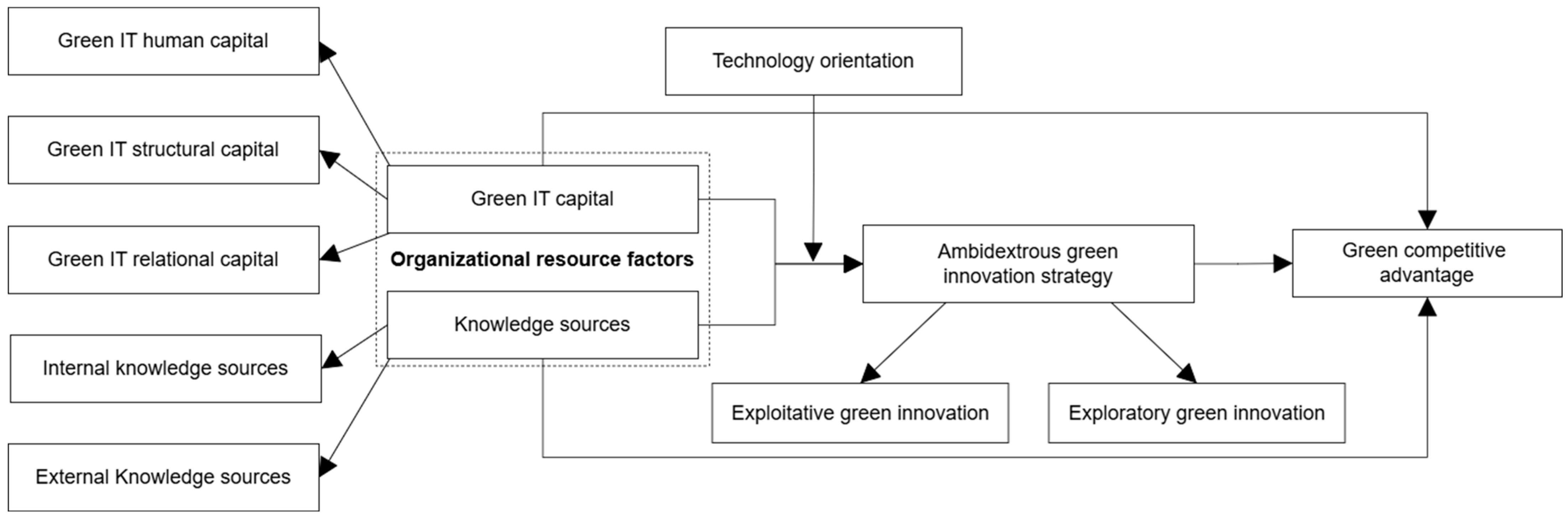
RQ1: Do organizational resource factors (GITC and knowledge sources) significantly influence firms’ GCA, and to what extent do AGIS mediate this relationship?
RQ2: Does technology orientation moderate the relationship between organizational resource factors and AGIS?
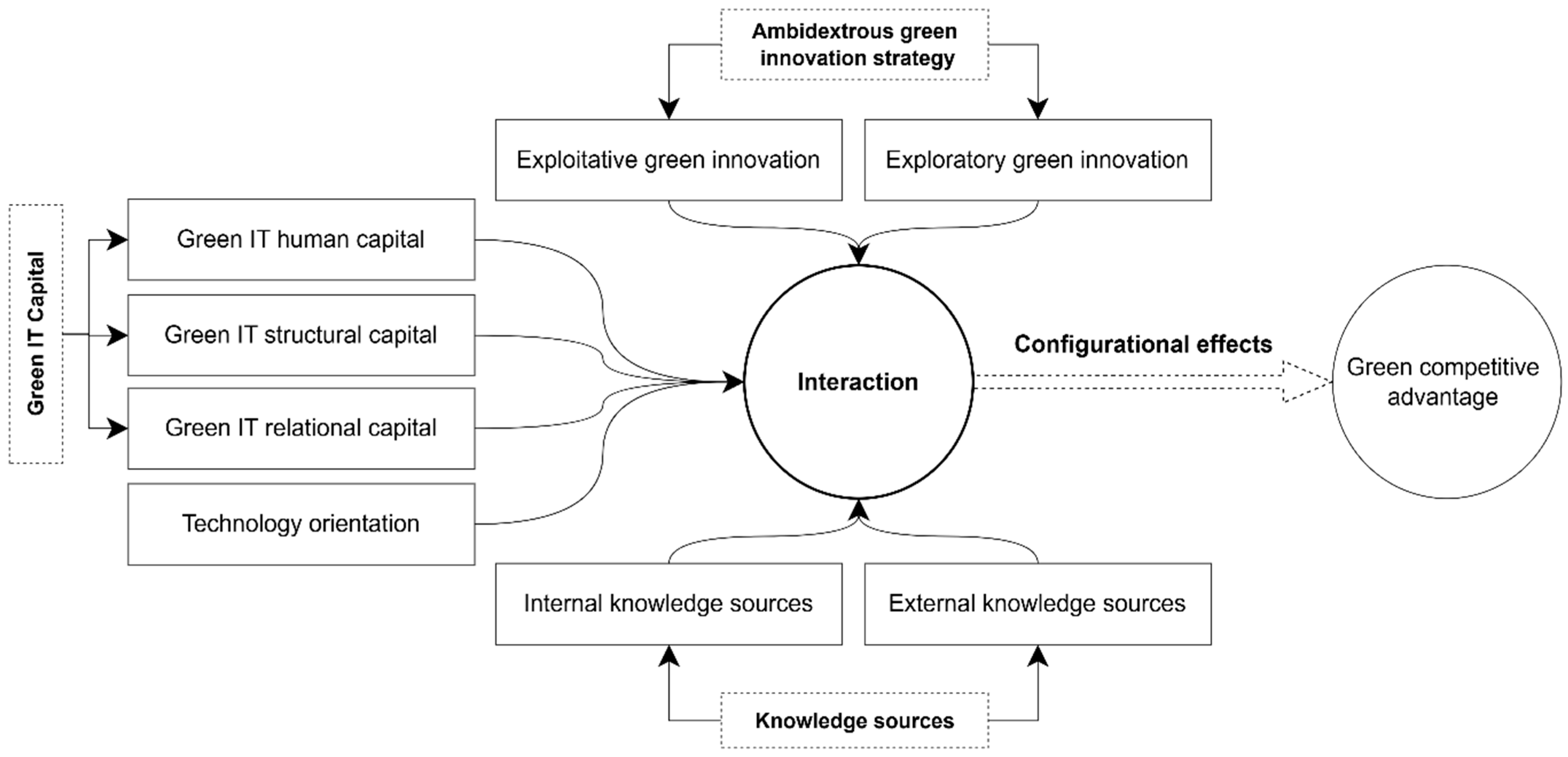
RQ3: What are the numerous pathways to attaining a higher level of GCA?
This study fills research gaps in the GI and strategic management literature by proposing a framework grounded in the RBV [
24] and the KBV [
25]. In particular, this study analyzes how organizational resources (GITC and knowledge sources), combined with an AGIS, affect a firm’s competitive edge in the eco-conscious environment, while also examining the impact of TO. The PLS-SEM method is used to analyze the direct, mediating, and moderating relationships proposed in the study model. Coupled with the PLS-SEM approach, fsQCA is employed to investigate how various combinations of key antecedents contribute to firms achieving a high level of GCA. By integrating PLS-SEM and fsQCA, this study aims to provide valuable insights and practical guidance for firms seeking to enhance GCA by establishing key resources and capabilities that stimulate AGIS.
3. Data Collection and Procedure
The quantitative research approach is best suited when the most important aim of the study is the identification of the influential relationship of variables [
43]. The methodological approach of the study is deductive because its main purpose is to test the hypothesis developed on the grounds of the existing theory [
44]. A structured questionnaire was used to gather cross-sectional data of Chinese manufacturing companies and explore the research model hypothesis. We utilized Qualtrics through the internet and paper packets through the post to achieve the highest possible number of responses and more valuable feedback. In order to analyze green competitive advantage, we selected the manufacturing industry of China, as it constitutes over half of the entire national economy and a significant portion of the job market [
45]. Based on the earlier research, our sample incorporated a set of ISO-certified companies listed on the Shanghai and Shenzhen Stock Exchanges, to which separate manufacturing processes were applied [
46]. With certification, environmental management systems became similar across firms and assisted in eradicating certain sources of noise. We sampled broad industry groups using a sample of 1140 firms, so that we could have a representative sample.
The senior sustainability or operations managers of each company were the respondents. These executives are knowledgeable about organizational practices and are well-equipped to realize green IT capital, knowledge-sharing practices, and innovation strategies. Further, the English version of the questionnaire was translated into Chinese and back into English to ensure there was no difference in meaning [
47]. A pilot study with 18 managers helped refine the wording and showed that the scale is not difficult to comprehend.
Data collection took place over four months (January to April 2025). Participants received a letter first, which guaranteed confidentiality, stated that there was no right or wrong answer, and said the results would be presented in group form. Each of the questionnaire attachments was delivered to responders via email, WeChat, WhatsApp, and social media links. The companies that did not choose to participate were eliminated, and 389 out of the 723 returned the questionnaires. The 21 surveys that had excessive missing data were not analyzed further, and this left 367 responses and an effective response rate of 50.76. In order to determine the early and late reactions, Armstrong and Overton’s [
48] procedure was used, and no differences (
p > 0.10) were found between early and late respondents on all factors of the study.
Table 1 gives the demographic profile of respondents.
Instrument Development
We operationalized constructs by using questions from established research. We measured GITC (as a higher-order construct) through green-IT human, structural, and relational capital, and 10 items were adapted from Chuang and Huang [
28]. The 13 items for knowledge source are drawn from Laursen and Salter [
30], who measured internal knowledge sources with 7 items and external sources of knowledge with 6 items. Moreover, the study adapted 8 items from Shehzad et al. [
21] to measure AGIS (exploitative and exploratory GI). The four items for GCA are derived from Chen and Chang [
26], while the four items for technological orientation were drawn from Hameed et al. [
6]. All statements were adjusted for the chosen level of analysis and were scored between 1 and 5 on a Likert scale.
It is essential to check for common method bias (CMB) before commencing the empirical analysis, as this is a common issue in survey-based research [
21]. We used Harman’s single-factor test [
49] and Kock’s method for comprehensive collinearity analysis [
50] to evaluate CMB. The main varimax factor explained 27.16% of the total variance, which is well below the threshold of 40% suggested by Hair et al. [
51]. A thorough collinearity check using SmartPLS, a widely used tool in social science, revealed that all VIFs were below 3.3, indicating no sign of common method bias [
50].
5. Discussion
This research investigates how GITC and knowledge sources contribute to achieving a GCA and also explores how the firm’s participation in an AGIS and its TO affect this relationship. By doing so, this research has significantly enhanced and contributed to broadening the understanding of theoretical and practical initiatives in GITC, sources of knowledge, AGIS, and competitiveness in various ways.
First, this study’s findings indicated that the GCA of a firm is strongly dependent on the possession of green IT resources. Recent studies indicate that the presence of green IT-human, infrastructure, and relational resources helps a firm to incur savings, readily adjust to changes in regulations and reputation that are difficult to imitate by competitors [
6,
17]. The most probable cause of the study results is that the environmental analysis of green IT systems can help organizations to recognize waste problems. The availability of the IT experts and green partners to assist in green IT also enables the firms to embrace low-carbon technologies faster, save the cost of abatement, and gain additional stakeholder confidence. In the same way, there is a strong and positive association between sources of knowledge (both internal organization and external partners) and GCA. Recent research suggests that the successful use of green knowledge in business extends the number of green solutions to problems and increases the speed at which green products are produced [
14,
62]. The reason could be that the presence of a rich information network assists the firms in noticing developments in regulations or markets, and they learn promptly and are the first to seize opportunities in sustainability niches.
Second, the results imply that companies that use an AGIS (both exploration and exploitation of eco-innovations) partly mediate the correlation between the organizational resource factor (GITC and knowledge sources) and competitive advantage. Consistent with previous research, the results indicate that companies with AGIS can effectively leverage organizational resources (i.e., GITC and knowledge sources) to increase GCA [
3,
14]. The most probable reason is that green IT analytics and a variety of inputs can only work at the strategy level when businesses integrate them into two streams: one stream of immediate gains (exploitation) and the other of future discoveries (exploration), which together provide both short-term and long-term benefits. Semi-mediations indicate that demonstrating effort in green IT and knowledge investments may lead to a better reputation until innovation methods are fully applied. The results also show that the partial mediation of AGIS implies that expressing a commitment to green IT and knowledge through investments directly contributes to a company developing a reputation before the entire routine of innovation can be established.
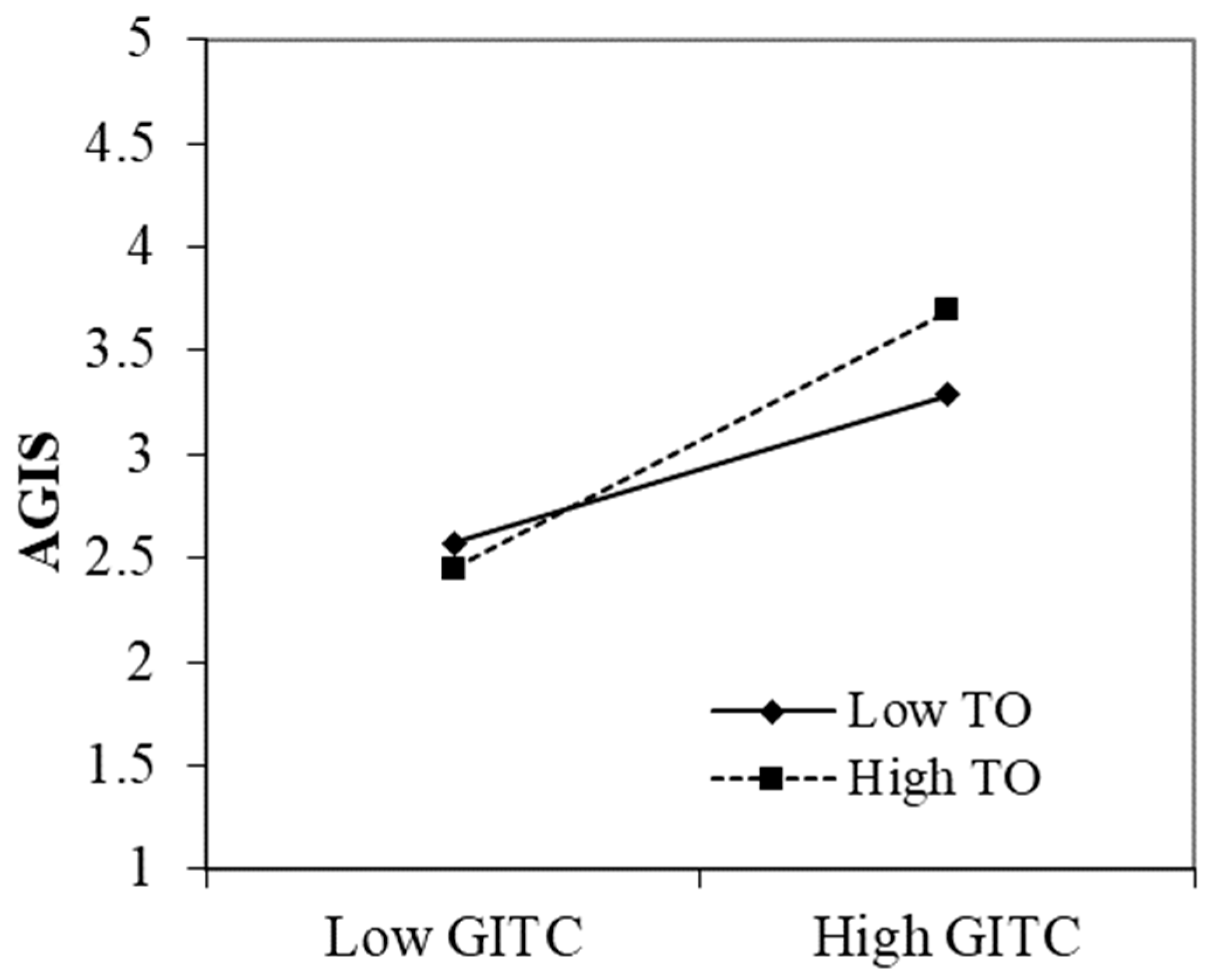
Third, the research results showed that focusing more on TO improves green IT’s ability to support AGIS, while it does not significantly impact the knowledge source–AGIS relationship. In line with prior research, findings demonstrate that when companies focus on new technologies, they are more successful in creating green process and product solutions using IT resources [
6,
40]. A possible justification is that the culture supports technology, encouraging the testing of digital solutions, reducing resistance to change, and enabling IT experts to combine digital assets into two streams of innovation. The insignificant impact of the TO on sourcing knowledge and AGIS relationship highlights that it may be the firm’s capacity to integrate various knowledge sources, rather than its usual technology preferences, that matters most in effective knowledge recombination [
63]. Probably, the breadth of knowledge within an organization already adds cognitive diversity, so having only a strong technology culture is not enough for diverse thinking to be directed towards successful green initiatives.
Lastly, the analysis of fsQCA shows that alone, none of the eight antecedent conditions (GITHC, GITSC, GITRC, ISK, ESK, EXGI, ERGI, and TO) could predict a high degree of GCA. Instead, the best empirical path to a high GCA (Configuration 1 in
Table 9) shows this finding, with GITHC, GITSC, GITRC, ISK, ESK, and both EXGI and ERGI present in 51.4% of cases. The finding indicates that more firms gain a superior green advantage when applying dual GI and having a wide range of IT skills and knowledge. In non-high GCA (Configuration 7), the solution leading is supported by 41.5 percent of the cases, and it is worth noting that both GI modes are absent, as well as all GIT abilities and knowledge bases. This shows that it is because of a lack of innovation. In each of the two configurations, EXGI and ERGI are present in two of six high-GCA pathways and are not observed in all three non-high-GCA pathways. In addition, other factors change in order of importance, demonstrating that many combinations can lead to achievement only when GI is included. Such results are the continuation of the previous research as they reveal that dual GI, accompanied by the appropriate IT and knowledge resources, is the key to high GCA [
3,
14].
5.1. Theoretical Contributions
By integrating RBV and KBV, this study provides valuable theoretical insights into the strategic management literature. First, using both RBV and KBV approaches, this research redefines GITC (human, structural, and relational) and knowledge sources (internal storage and external links) as a single ecological VRIN bundle. Previously, these resources were studied individually [
6,
14]; however, we have found that combining them leads to better green-competitive performance. Second, this study contributes to the literature by considering AGIS as a key mediating mechanism in enhancing the relationship between green IT capital and knowledge sources, as well as competitive advantage. This finding embeds RBV/KBV frameworks in the logic of dynamic capabilities, demonstrating that firms only obtain value from resource stocks when such stocks are activated through routines that integrate both exploratory and exploitative eco-innovation [
21].
Third, this paper further develops the resource-based view (RBV) in terms of the asymmetric moderating effect of TO that serves as a boundary condition determining the value realization of organizational resources. Notably, the results show that TO enhances the effects of IT-based resources on AGIS but not the impact of knowledge-sourced capabilities [
40]. This asymmetric aspect of the study narrows RBV by showing that the efficiency of various forms of resources depends on their alignment with particular contextual orientations. Whereas IT-based resources do well in technology-driven cultures that encourage experimentation and digital integration, knowledge-based resources seem to rely more on integrative processes like absorptive capacity to make productive use of them.
Finally, the configurational findings complement the RBV, as they demonstrate that AGI is a non-substitutable hub capability, supporting the notion that sustainable competitive advantage can result from resource complementarity and situational fit, but not from monolithic assets. The different impact of IT and knowledge aspects of configurations highlights dynamism in the relationship among organizational, technological, and environmental factors [
40]. Collectively, these contributions address mounting academic predilections to unpack the interactions among various resource domains to create green competitive advantage, thereby advancing the RBV toward a more refined, systems-based conceptualization of resource integration in the context of environmental innovation.
5.2. Practical Implications
Based on the empirical findings, there are three main implications for managers to help firms increase GCA by utilizing GITC, knowledge sources, and configurational strategies. First, companies should unify their investments by linking green IT infrastructure (including eco-analytics, eco-friendly IT employees, and connections with green technology businesses) with well-structured knowledge-sharing processes both within and outside the organization [
17,
62]. Companies may establish interdepartmental centers to collect environmental data and share insights with R&D, operations, and supply chain departments. Second, since AGIS plays a mediating role in the relationship between resources and advantage, companies should design their corporate governance to encompass both the search for new opportunities and the utilization of existing assets [
14]. For instance, firms can (a) establish different budgets and targets for new eco-projects and ongoing process improvements, (b) allow people to work in different roles in both innovation and operations, and (c) include environmental assessment in decisions about moving forward in product development. As a result of these governance and incentive changes, organizations ensure that their green IT and knowledge assets are consistently leveraged in both immediate and long-term ways to benefit the environment.
Finally, configurational analysis highlights that various combinations of resources and capabilities can yield similarly high levels of GCA [
61]. Therefore, managers should conduct internal reviews to identify their strengths, such as GITC, knowledge sources, or TO focus, and then determine the pathway that best fits their available resources. Firms with abundant resources may choose to develop both IT and knowledge resources. For companies short on resources, focusing on TO can help compensate for weak IT capabilities. Taking a flexible approach enables practitioners to develop sustainability activities tailored to their specific business context, rather than applying a one-size-fits-all approach.
5.3. Study Limitations
Despite the research’s significance, this study is subject to some limitations. First, the cross-sectional survey method does not allow for causal conclusions; a longitudinal study could discover the mutual development of resource bundles and ambidextrous routines over time. Second, the study only includes Chinese manufacturing firms, which may limit its applicability to other sectors and regions, including other industries and countries, and expand the generalizability of the findings. Third, the study also relies on subjective measures of how companies perform on green issues, rather than concrete performance data. Therefore, future research might involve using both financial and environmental audit data to verify the findings. Finally, this study model explores GITC, knowledge sources, ambidextrous strategy, and TO. However, it omits other organizational factors, such as environmental leadership, green dynamic capabilities, or regulatory pressure, that might influence AGIS and affect GCA [
64].