Sustainable Community Marketing for Probabilistic Goods: The Paradox of Brand Love and Jealousy in a Dual Emotional Engagement Model


Abstract
1. Introduction
2. Theoretical Framework and Hypotheses
2.1. Online Community Marketing for Probabilistic Goods
2.2. Online Community Marketing and Purchase Intention
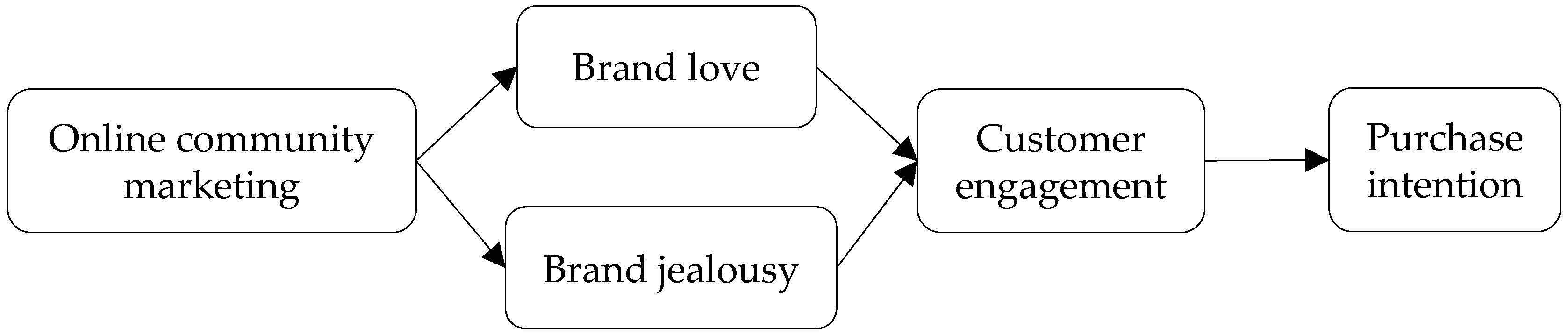
2.3. The Dual Mechanisms of Brand Love and Brand Jealousy
2.4. Brand Emotions and Customer Engagement
3. Methods
3.1. Sample and Data Collection
3.2. Measures
4. Results
4.1. Measurement Model
4.2. Hypotheses Testing
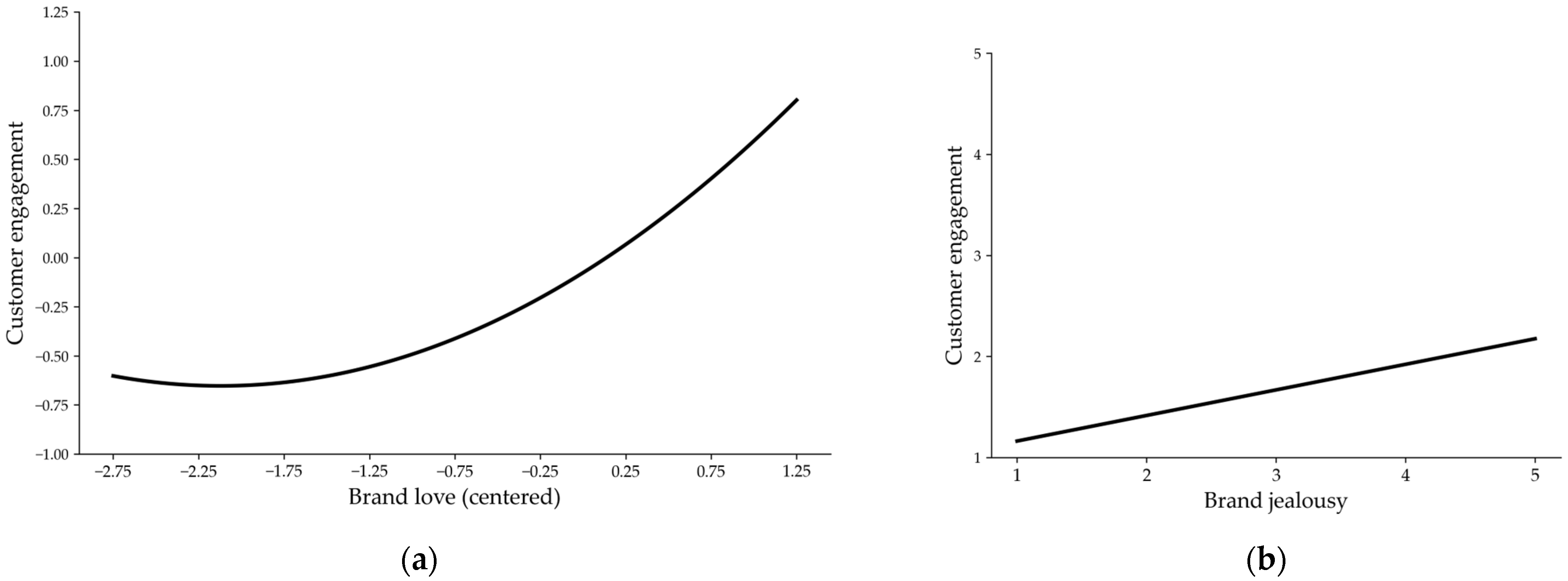
4.3. Post Hoc Analysis
5. Discussion
5.1. Theoretical Contributions
5.2. Practical Implications
5.3. Limitations and Future Directions
Author Contributions
Funding
Institutional Review Board Statement
Informed Consent Statement
Data Availability Statement
Acknowledgments
Conflicts of Interest
References
- Hoskins, J.; Gopinath, S.; Verhaal, J.C.; Yazdani, E. The influence of the online community, professional critics, and location similarity on review ratings for niche and mainstream brands. J. Acad. Mark. Sci. 2021, 49, 1065–1087. [Google Scholar] [CrossRef]
- Muniz, A.M.; O’Guinn, T.C. Brand Community. J. Consum. Res. 2001, 27, 412–432. [Google Scholar] [CrossRef]
- Zheng, J.; Liu, R.; Zhang, R.; Xu, H. How do firms use virtual brand communities to improve innovation performance? Based on consumer participation and organizational learning perspectives. Eur. J. Innov. Manag. 2024, 27, 894–921. [Google Scholar] [CrossRef]
- Skandalis, A. Transitional space and new forms of value co-creation in online brand communities. J. Bus. Res. 2023, 155, 113392. [Google Scholar] [CrossRef]
- Wahyuningtyas, R.; Disastra, G.; Rismayani, R. Toward cooperative competitiveness for community development in Economic Society 5.0. J. Enterprising Communities People Places Glob. Econ. 2023, 17, 594–620. [Google Scholar] [CrossRef]
- Yang, S.; Tang, J.; Cai, J.; Guo, G. Effects of online brand community rituals on customer citizenship behavior: Exploring the sequential mediation mechanism. J. Prod. Brand Manag. 2022, 32, 393–405. [Google Scholar] [CrossRef]
- Zhou, L.; Mu, J.; Yang, C. The Dual-Driven Mechanism of “Value and Need” Influencing Consumers’ Continuous Purchase Behavior in Blind Box Consumption. Sustainability 2025, 17, 8452. [Google Scholar] [CrossRef]
- Chakraborty, U.; Biswal, S.K. Is Digital Social Communication Effective for Social Relationship? A Study of Online Brand Communities. J. Relatsh. Mark. 2024, 23, 94–118. [Google Scholar] [CrossRef]
- Hao, R.; Liang, X.; Meng, H. Brand engagement and community user behaviors in online interest communities: Exploring a moderated mediation model. Asia Pac. J. Mark. Logist. 2024, 36, 512–530. [Google Scholar] [CrossRef]
- Wang, X.-W.; Cao, Y.-M.; Park, C. The relationships among community experience, community commitment, brand attitude, and purchase intention in social media. Int. J. Inf. Manag. 2019, 49, 475–488. [Google Scholar] [CrossRef]
- Wang, Z.; Yang, X. Building brand loyalty through value co-creation practices in brand communities: The role of affective commitment and psychological brand ownership. J. Res. Interact. Mark. 2025, 19, 201–220. [Google Scholar] [CrossRef]
- Guo, X.; He, Y.; Wang, Y.; Zhou, Z. Influence of brand community social responsibility on consumer citizenship behaviors: Mediating role of collective self esteem. J. Prod. Brand Manag. 2025, 34, 297–319. [Google Scholar] [CrossRef]
- Fay, S.; Xie, J. Probabilistic Goods: A Creative Way of Selling Products and Services. Mark. Sci. 2008, 27, 674–690. [Google Scholar] [CrossRef]
- Buechel, E.C.; Li, R.; Wood, S.; Kyung, E.J. Mysterious Consumption: Preference for Horizontal (vs. Vertical) Uncertainty and the Role of Surprise. J. Consum. Res. 2023, 49, 987–1013. [Google Scholar] [CrossRef]
- Huang, T.; Yu, Y. Sell Probabilistic Goods? A Behavioral Explanation for Opaque Selling. Mark. Sci. 2014, 33, 743–759. [Google Scholar] [CrossRef]
- Miao, J.; Jain, S. Designing Loot Boxes: Implications for Profits and Welfare. Mark. Sci. 2024, 43, 1242–1259. [Google Scholar] [CrossRef]
- Miao, X.; Niu, B.; Yang, C.; Feng, Y. Examining the gamified effect of the blindbox design: The moderating role of price. J. Retail. Consum. Serv. 2023, 74, 103423. [Google Scholar] [CrossRef]
- Mousavi, S.; Roper, S. Enhancing Relationships Through Online Brand Communities: Comparing Posters and Lurkers. Int. J. Electron. Commer. 2023, 27, 66–99. [Google Scholar] [CrossRef]
- Zhang, Y.; Zhang, T. The effect of blind box product uncertainty on consumers’ purchase intention: The mediating role of perceived value and the moderating role of purchase intention. Front. Psychol. 2022, 13, 946527. [Google Scholar] [CrossRef] [PubMed]
- Onofrei, G.; Filieri, R.; Kennedy, L. Social media interactions, purchase intention, and behavioural engagement: The mediating role of source and content factors. J. Bus. Res. 2022, 142, 100–112. [Google Scholar] [CrossRef]
- Vernuccio, M.; Pagani, M.; Barbarossa, C.; Pastore, A. Antecedents of brand love in online network-based communities. A social identity perspective. J. Prod. Brand Manag. 2015, 24, 706–719. [Google Scholar] [CrossRef]
- Chen, Y. Possession and Access: Consumer Desires and Value Perceptions Regarding Contemporary Art Collection and Exhibit Visits. J. Consum. Res. 2009, 35, 925–940. [Google Scholar] [CrossRef]
- Wu, J.; Huang, L.; Zhao, J.L.; Hua, Z. The deeper, the better? Effect of online brand community activity on customer purchase frequency. Inf. Manag. 2015, 52, 813–823. [Google Scholar] [CrossRef]
- Zainuri, A.; Huda, M. Empowering Cooperative Teamwork for Community Service Sustainability: Insights from Service Learning. Sustainability 2023, 15, 4551. [Google Scholar] [CrossRef]
- Attari, A.; Chatterjee, P.; Singh, S.N. Taking a chance for a discount: An investigation into consumers’ choice of probabilistic vs. sure price promotions. J. Bus. Res. 2022, 143, 366–374. [Google Scholar] [CrossRef]
- Chen, T.; Yang, F.; Guo, X. Probabilistic selling in a distribution channel with vertically differentiated products. J. Oper. Res. Soc. 2023, 75, 1076–1091. [Google Scholar] [CrossRef]
- Shen, T.; Downs, J.; Hou, X.; Wang, Y. Digital marketplace: The role of probabilistic selling strategies in the travel industry. J. Econ. Technol. 2023, 1, 75–93. [Google Scholar] [CrossRef]
- Gârdan, D.A.; Epuran, G.; Paștiu, C.A.; Gârdan, I.P.; Jiroveanu, D.C.; Tecău, A.S.; Prihoancă, D.M. Enhancing Consumer Experience through Development of Implicit Attitudes Using Food Delivery Applications. J. Theor. Appl. Electron. Commer. Res. 2021, 16, 2858–2882. [Google Scholar] [CrossRef]
- Festinger, L. A Theory of Social Comparison Processes. Hum. Relat. 1954, 7, 117–140. [Google Scholar] [CrossRef]
- Stapel, D.A.; Koomen, W. Competition, cooperation, and the effects of others on me. J. Pers. Soc. Psychol. 2005, 88, 1029–1038. [Google Scholar] [CrossRef]
- Lanzetta, J.T.; Englis, B.G. Expectations of cooperation and competition and their effects on observers’ vicarious emotional responses. J. Personal. Soc. Psychol. 1989, 56, 543–554. [Google Scholar] [CrossRef]
- Ghorbanzadeh, D.; Saeednia, H.; Rahehagh, A.; Wright, L.T. Antecedents and consequences of brand passion among young smartphone consumers: Evidence of Iran. Cogent Bus. Manag. 2020, 7, 1712766. [Google Scholar] [CrossRef]
- Sanz-Blas, S.; Buzova, D.; Otero Gómez, M.C. “Brand love goes through the interactive brand community”: The role of member-to-member emotional bonds. J. Res. Interact. Mark. 2025, ahead of print. [Google Scholar] [CrossRef]
- Wong, A. How social capital builds online brand advocacy in luxury social media brand communities. J. Retail. Consum. Serv. 2023, 70, 103143. [Google Scholar] [CrossRef]
- Coelho, A.; Bairrada, C.; Peres, F. Brand communities’ relational outcomes, through brand love. J. Prod. Brand Manag. 2019, 28, 154–165. [Google Scholar] [CrossRef]
- Junaid, M.; Hou, F.; Hussain, K.; Kirmani, A.A. Brand love: The emotional bridge between experience and engagement, generation-M perspective. J. Prod. Brand Manag. 2019, 28, 200–215. [Google Scholar] [CrossRef]
- Manthiou, A.; Hickman, E.; Klaus, P. Beyond good and bad: Challenging the suggested role of emotions in customer experience (CX) research. J. Retail. Consum. Serv. 2020, 57, 102218. [Google Scholar] [CrossRef]
- Adam, M.T.P.; Astor, P.J.; Krämer, J. Affective Images, Emotion Regulation and Bidding Behavior: An Experiment on the Influence of Competition and Community Emotions in Internet Auctions. J. Interact. Mark. 2016, 35, 56–69. [Google Scholar] [CrossRef]
- Ludwig, N.L.; Barnes, D.C.; Gouthier, M. Observing delightful experiences of other customers: The double-edged sword of jealousy and joy. J. Serv. Theory Pract. 2017, 27, 145–163. [Google Scholar] [CrossRef]
- Tandon, A.; Dhir, A.; Mäntymäki, M. Jealousy due to social media? A systematic literature review and framework of social media-induced jealousy. Internet Res. 2021, 31, 1541–1582. [Google Scholar] [CrossRef]
- Chen, H.-T.; Yuan, J. Blind savings or unforeseen costs? How consumers perceive the benefits and risks of using opaque travel selling Web sites. J. Vacat. Mark. 2014, 20, 309–322. [Google Scholar] [CrossRef]
- Bhandari, M.P.; Bhattarai, C.; Mulholland, G. Online brand community engagement and brand evangelism: The role of age, gender and membership number. J. Prod. Brand Manag. 2024, 33, 301–313. [Google Scholar] [CrossRef]
- Zhang, S.; Zhang, L. The Influence of Brand Social Interaction on Purchase Intention: A Perspective of Social Capital. Sage Open 2023, 13, 21582440231169933. [Google Scholar] [CrossRef]
- Zhou, Z.; Wang, Y.; Zheng, Y.; Liu, S. Effects of brand community social responsibility: Roles of collective self-esteem and altruism. J. Brand Manag. 2023, 30, 347–366. [Google Scholar] [CrossRef]
- Elmachtoub, A.N.; Hamilton, M.L. The Power of Opaque Products in Pricing. Manag. Sci. 2021, 67, 4686–4702. [Google Scholar] [CrossRef]
- Bıçakcıoğlu, N.; Ögel, İ.Y.; İlter, B. Brand jealousy and willingness to pay premium: The mediating role of materialism. J. Brand Manag. 2016, 24, 33–48. [Google Scholar] [CrossRef]
- Fathy, D.; Elsharnouby, M.H.; AbouAish, E. Fans behave as buyers? Assimilate fan-based and team-based drivers of fan engagement. J. Res. Interact. Mark. 2021, 16, 329–345. [Google Scholar] [CrossRef]
- Lange, J.; Crusius, J. Dispositional envy revisited: Unraveling the motivational dynamics of benign and malicious envy. Pers. Soc. Psychol. Bull. 2015, 41, 284–294. [Google Scholar] [CrossRef] [PubMed]
- Carlson, J.; Rahman, S.M.; Rahman, M.M.; Wyllie, J.; Voola, R. Engaging Gen Y Customers in Online Brand Communities: A Cross-National Assessment. Int. J. Inf. Manag. 2021, 56, 102252. [Google Scholar] [CrossRef]
- Hu, M.; Chaudhry, S.S. Enhancing consumer engagement in e-commerce live streaming via relational bonds. Internet Res. 2020, 30, 1019–1041. [Google Scholar] [CrossRef]
- Nusair, K.; Karatepe, O.M.; Okumus, F.; Alfarhan, U.F.; Shi, F. Exploring the pivotal role of community engagement on tourists’ behaviors in social media: A cross-national study. Int. J. Inf. Manag. 2024, 74, 102701. [Google Scholar] [CrossRef]
- Habachi, S.; Matute, J.; Palau-Saumell, R. Gamify, engage, build loyalty: Exploring the benefits of gameful experience for branded sports apps. J. Prod. Brand Manag. 2023, 33, 57–75. [Google Scholar] [CrossRef]
- Hsu, C.-L. Enhancing brand love, customer engagement, brand experience, and repurchase intention: Focusing on the role of gamification in mobile apps. Decis. Support Syst. 2023, 174, 102701. [Google Scholar] [CrossRef]
- Fernandes, T.; Inverneiro, I. From fandom to fad: Are millennials really engaged with and loyal to their loved brands on social media? J. Prod. Brand Manag. 2020, 30, 320–334. [Google Scholar] [CrossRef]
- Kujur, F.; Singh, S. Emotions as predictor for consumer engagement in YouTube advertisement. J. Adv. Manag. Res. 2018, 15, 184–197. [Google Scholar] [CrossRef]
- Lee, C.T.; Hsieh, S.H. Can social media-based brand communities build brand relationships? Examining the effect of community engagement on brand love. Behav. Inf. Technol. 2021, 41, 1270–1285. [Google Scholar] [CrossRef]
- Fortune, E.A.; Akasreku, F.; Mensah, K.; Hinson, R.E. Examining the effect of brand experience on brand love and brand jealousy: Does Consumer-Brand identification play a role? Afr. J. Bus. Econ. Res. 2025, 20, 373. Available online: https://hdl.handle.net/10520/ejc-aa_ajber_v20_n2_a16 (accessed on 1 January 2026).
- Kim, J.W.; Choi, J.; Qualls, W.; Han, K. It takes a marketplace community to raise brand commitment: The role of online communities. J. Mark. Manag. 2008, 24, 409–431. [Google Scholar] [CrossRef]
- Zhang, Z.; Zheng, L. Consumer community cognition, brand loyalty, and behaviour intentions within online publishing communities: An empirical study of Epubit in China. Learn. Publ. 2020, 34, 116–127. [Google Scholar] [CrossRef]
- Baxi, B.; Panda, R.; Karani, A. Community Marketing: An effective Marketing Strategy. Rom. J. Mark. 2016, 3, 2–11. [Google Scholar]
- McAlexander, J.H.; Schouten, J.W.; Koenig, H.F. Building Brand Community. J. Mark. 2002, 66, 38–54. [Google Scholar] [CrossRef]
- Swimberghe, K.; Darrat, M.A.; Beal, B.D.; Astakhova, M. Examining a psychological sense of brand community in elderly consumers. J. Bus. Res. 2018, 82, 171–178. [Google Scholar] [CrossRef]
- Kim, S.H.; Yang, K.H.; Kim, J.K. Finding critical success factors for virtual community marketing. Serv. Bus. 2009, 3, 149–171. [Google Scholar] [CrossRef]
- Thakur, R. Community marketing: Serving the base of the economic pyramid sustainably. J. Bus. Strategy 2015, 36, 40–47. [Google Scholar] [CrossRef]
- Chang, C.-W.; Ko, C.-H.; Huang, H.-C.; Wang, S.-J. Brand community identification matters: A dual value-creation routes framework. J. Prod. Brand Manag. 2019, 29, 289–306. [Google Scholar] [CrossRef]
- Shi, J.; Renwick, R.; Turner, N.E.; Kirsh, B. Understanding the lives of problem gamers: The meaning, purpose, and influences of video gaming. Comput. Hum. Behav. 2019, 97, 291–303. [Google Scholar] [CrossRef]
- Zhang, Z.; Joseph, K.; Subramaniam, R. Probabilistic Selling in Quality-Differentiated Markets. Manag. Sci. 2015, 61, 1959–1977. [Google Scholar] [CrossRef]
- Zheng, Q.; Pan, X.A.; Carrillo, J.E. Probabilistic Selling for Vertically Differentiated Products with Salient Thinkers. Mark. Sci. 2019, 38, 442–460. [Google Scholar] [CrossRef]
- Kuchmaner, C.A.; Wiggins, J.; Grimm, P.E. In it together: Brands benefit after a transgression when perceived as co-owners of the brand community. J. Mark. Manag. 2023, 40, 190–216. [Google Scholar] [CrossRef]
- Sarkar, A.; Krishna, G.R.; Rao, K.S.V.G. Brand desire and brand jealousy: Routes to persuasion. Mark. Rev. 2014, 14, 265–278. [Google Scholar] [CrossRef]
- Faullant, R.; Dolfus, G. Everything community? Destructive processes in communities of crowdsourcing competitions. Bus. Process Manag. J. 2017, 23, 1108–1128. [Google Scholar] [CrossRef]
- Hoffmann, W.; Lavie, D.; Reuer, J.J.; Shipilov, A. The interplay of competition and cooperation. Strateg. Manag. J. 2018, 39, 3033–3052. [Google Scholar] [CrossRef]
- Liu, R. Cooperation, competition and coopetition in innovation communities. Prometheus 2013, 31, 91–105. [Google Scholar] [CrossRef]
- Ricciardi, F.; Zardini, A.; Czakon, W.; Rossignoli, C.; Kraus, S. Revisiting the cooperation–competition paradox: A configurational approach to short- and long-term coopetition performance in business networks. Eur. Manag. J. 2022, 40, 320–331. [Google Scholar] [CrossRef]
- Hollebeek, L.D.; Macky, K. Digital Content Marketing’s Role in Fostering Consumer Engagement, Trust, and Value: Framework, Fundamental Propositions, and Implications. J. Interact. Mark. 2019, 45, 27–41. [Google Scholar] [CrossRef]
- Hamby, A.; Jones, N. The Effect of Affect: An Appraisal Theory Perspective on Emotional Engagement in Narrative Persuasion. J. Advert. 2021, 51, 116–131. [Google Scholar] [CrossRef]
- Juárez, F. Community strategic relationship and marketing to foster the development of communities and the sustainability of organizations. Int. J. Psychol. Res. 2016, 9, 113–125. [Google Scholar] [CrossRef]
- Hunt, S.D.; Kleinaltenkamp, M.; Arnett, D.B.; Madhavaram, S. The explanatory foundations of relationship marketing theory. J. Bus. Ind. Mark. 2006, 21, 72–87. [Google Scholar] [CrossRef]
- Tiruwa, A.; Yadav, R.; Suri, P.K. Moderating effects of age, income and internet usage on Online Brand Community (OBC)-induced purchase intention. J. Adv. Manag. Res. 2018, 15, 367–392. [Google Scholar] [CrossRef]
- Luongo, S.; Sepe, F.; Del Gaudio, G. Regional innovation systems in tourism: The role of collaboration and competition. J. Open Innov. Technol. Mark. Complex. 2023, 9, 100148. [Google Scholar] [CrossRef]
- Xie, L.; Liu, C.; Li, Y.; Zhu, T. How to inspire users in virtual travel communities: The effect of activity novelty on users’ willingness to co-create. J. Retail. Consum. Serv. 2023, 75, 103448. [Google Scholar] [CrossRef]
- Mandl, L.; Hogreve, J. Buffering effects of brand community identification in service failures: The role of customer citizenship behaviors. J. Bus. Res. 2020, 107, 130–137. [Google Scholar] [CrossRef]
- Cova, B.; Melewar, T.C.; Pace, S.; Park, D.J. Global brand communities across borders: The Warhammer case. Int. Mark. Rev. 2007, 24, 313–329. [Google Scholar] [CrossRef]
- Andrade, E.B. Behavioral Consequences of Affect: Combining Evaluative and Regulatory Mechanisms. J. Consum. Res. 2005, 32, 355–362. [Google Scholar] [CrossRef]
- Rosenbaum, M.S.; Massiah, C.A. When Customers Receive Support From Other Customers: Exploring the Influence of Intercustomer Social Support on Customer Voluntary Performance. J. Serv. Res. 2007, 9, 257–270. [Google Scholar] [CrossRef]
- Andrade, E.B.; Cohen, J.B. On the Consumption of Negative Feelings. J. Consum. Res. 2007, 34, 283–300. [Google Scholar] [CrossRef]
- Carroll, B.A.; Ahuvia, A.C. Some antecedents and outcomes of brand love. Mark. Lett. 2006, 17, 79–89. [Google Scholar] [CrossRef]
- Hafez, M. The impact of social media marketing activities on brand equity in the banking sector in Bangladesh: The mediating role of brand love and brand trust. Int. J. Bank Mark. 2021, 39, 1353–1376. [Google Scholar] [CrossRef]
- Batra, R.; Ahuvia, A.; Bagozzi, R.P. Brand Love. J. Mark. 2012, 76, 1–16. [Google Scholar] [CrossRef]
- Babić-Hodović, V.; Mujkić, A.; Arslanagić-Kalajdžić, M. We need both brand love and emotional attachment: A serial mediation framework toward addictive buying and loyalty. J. Brand Manag. 2022, 30, 9–33. [Google Scholar] [CrossRef]
- Trivedi, J.; Sama, R. Determinants of consumer loyalty towards celebrity-owned restaurants: The mediating role of brand love. J. Consum. Behav. 2020, 20, 748–761. [Google Scholar] [CrossRef]
- Rodrigues, C.; Rodrigues, P. Brand love matters to Millennials: The relevance of mystery, sensuality and intimacy to neo-luxury brands. J. Prod. Brand Manag. 2019, 28, 830–848. [Google Scholar] [CrossRef]
- Mugerman, Y.; Rooz, R. Exploring the impact of identity fusion on managerial decision-making in eponymous firms. J. Behav. Exp. Financ. 2025, 47, 101094. [Google Scholar] [CrossRef]
- Song, S.; Kim, H.-Y. Is social media marketing worth it for luxury brands? The dual impact of brand page satisfaction and brand love on word-of-mouth and attitudinal loyalty intentions. J. Prod. Brand Manag. 2022, 31, 1033–1046. [Google Scholar] [CrossRef]
- Tran, T.P.; Muldrow, A.; Ho, K.N.B. Understanding drivers of brand love—The role of personalized ads on social media. J. Consum. Mark. 2020, 38, 1–14. [Google Scholar] [CrossRef]
- Fulk, J.; Steinfield, C.W.; Schmitz, J.; Power, J.G. A Social Information Processing Model of Media Use in Organizations. Commun. Res. 2016, 14, 529–552. [Google Scholar] [CrossRef]
- Zeigler-Hill, V.; Cosby, C.A.; Vrabel, J.K.; Southard, A.C. Narcissism and mate retention behaviors: What strategies do narcissistic individuals use to maintain their romantic relationships? J. Soc. Pers. Relatsh. 2020, 37, 2737–2757. [Google Scholar] [CrossRef]
- Palusuk, N.; Koles, B.; Hasan, R. ‘All you need is brand love’: A critical review and comprehensive conceptual framework for brand love. J. Mark. Manag. 2019, 35, 97–129. [Google Scholar] [CrossRef]
- Gandolfi, E.; Ferdig, R.E.; Krause, K.; Soyturk, I.; Morris, G.; Delahanty, S. An exploration of why gaming communities may make younger and non-normative gamers vulnerable to Internet Gaming Disorder. New Media Soc. 2023, 27, 2807–2825. [Google Scholar] [CrossRef]
- Siddique, S.; Rajput, A. Self-expressiveness and hedonic brand affect brand love through brand jealousy. Future Bus. J. 2022, 8, 23. [Google Scholar] [CrossRef]
- Wallace, E.; Torres, P.; Augusto, M.; Stefuryn, M. Do brand relationships on social media motivate young consumers’ value co-creation and willingness to pay? The role of brand love. J. Prod. Brand Manag. 2021, 31, 189–205. [Google Scholar] [CrossRef]
- Mathes, E.W.; Severa, N. Jealousy, romantic love, and liking: Theoretical considerations and preliminary scale development. Psychol. Rep. 1981, 49, 23–31. [Google Scholar] [CrossRef]
- Pfeiffer, S.M.; Wong, P.T.P. Multidimensional Jealousy. J. Soc. Pers. Relatsh. 1989, 6, 181–196. [Google Scholar] [CrossRef]
- Sharpsteen, D.J. Romantic Jealousy as an Emotion Concept: A Prototype Analysis. J. Soc. Pers. Relatsh. 1993, 10, 69–82. [Google Scholar] [CrossRef]
- Sharpsteen, D.J.; Kirkpatrick, L.A. Romantic jealousy and adult romantic attachment. J. Personal. Soc. Psychol. 1997, 72, 627–640. [Google Scholar] [CrossRef] [PubMed]
- White, G.L. A model of romantic jealousy. Motiv. Emot. 1981, 5, 295–310. [Google Scholar] [CrossRef]
- Hupka, R.B.; Buunk, B.; Falus, G.; Fulgosi, A.; Ortega, E.; Swain, R.; Tarabrina, N.V. Romantic Jealousy and Romantic Envy:A Seven-Nation Study. J. Cross-Cult. Psychol. 1985, 16, 423–446. [Google Scholar] [CrossRef]
- Kashif, M.; Korkmaz Devrani, T.; Rehman, A.; Samad, S. Love is not blind: Investigating a love-hate transition among luxury fashion brand consumers. J. Fash. Mark. Manag. Int. J. 2021, 25, 625–643. [Google Scholar] [CrossRef]
- Sarkar, A.; Sreejesh, S. Examination of the roles played by brand love and jealousy in shaping customer engagement. J. Prod. Brand Manag. 2014, 23, 24–32. [Google Scholar] [CrossRef]
- Protasi, S. ‘I’m not envious, I’m just jealous!’: On the Difference Between Envy and Jealousy. J. Am. Philos. Assoc. 2017, 3, 316–333. [Google Scholar] [CrossRef]
- Van de Ven, N.; Zeelenberg, M.; Pieters, R. The Envy Premium in Product Evaluation. J. Consum. Res. 2011, 37, 984–998. [Google Scholar] [CrossRef]
- Hancock, T.; Adams, F.G.; Breazeale, M.; Lueg, J.E. Exploring jealousy and envy in communal relationship revenge-seeking. J. Consum. Mark. 2020, 37, 687–699. [Google Scholar] [CrossRef]
- Parrott, W.G.; Smith, R.H. Distinguishing the experiences of envy and jealousy. J. Pers. Soc. Psychol. 1993, 64, 906–920. [Google Scholar] [CrossRef] [PubMed]
- Belk, R. Benign envy. AMS Rev. 2011, 1, 117–134. [Google Scholar] [CrossRef]
- Park, J.; Li, W. “I got it FIRST”: Antecedents of competitive consumption of a new product. J. Retail. Consum. Serv. 2023, 73, 103367. [Google Scholar] [CrossRef]
- Ijams Spaid, B. Exploring consumer collecting behavior: A conceptual model and research agenda. J. Consum. Mark. 2018, 35, 653–662. [Google Scholar] [CrossRef]
- Shimul, A.S.; Sung, B.; Phau, I. Effects of luxury brand attachment and perceived envy on schadenfreude: Does need for uniqueness moderate? J. Consum. Mark. 2021, 38, 709–720. [Google Scholar] [CrossRef]
- Ghorbanzadeh, D. The role of brand love and brand jealousy in the formation of brand addiction. Curr. Psychol. 2023, 43, 2832–2846. [Google Scholar] [CrossRef]
- Duan, J. The Impact of Positive Purchase-Centered UGC on Audience’s Purchase Intention: Roles of Tie Strength, Benign Envy and Purchase Type. J. Internet Commer. 2021, 21, 393–417. [Google Scholar] [CrossRef]
- Wu, Y.; Xin, L.; Li, D.; Yu, J.; Guo, J. How does scarcity promotion lead to impulse purchase in the online market? A field experiment. Inf. Manag. 2021, 58, 103283. [Google Scholar] [CrossRef]
- Hollebeek, L. Exploring customer brand engagement: Definition and themes. J. Strateg. Mark. 2011, 19, 555–573. [Google Scholar] [CrossRef]
- Fournier, S. Consumers and their brands: Developing relationship theory in consumer research. J. Consum. Res. 1998, 24, 343–373. [Google Scholar] [CrossRef]
- Ahuvia, A.C. Beyond the Extended Self: Loved Objects and Consumers’ Identity Narratives. J. Consum. Res. 2005, 32, 171–184. [Google Scholar] [CrossRef]
- Goyal, A.; Verma, P. The relationship between brand engagement, brand loyalty, overall brand equity and purchase intention. J. Strateg. Mark. 2024, 32, 65–79. [Google Scholar] [CrossRef]
- Lucas, K.; Sherry, J.L. Sex Differences in Video Game Play. Commun. Res. 2016, 31, 499–523. [Google Scholar] [CrossRef]
- Jones, J.L.; Davis, W.D.; Thomas, C.H. Is Competition Engaging? Examining the Interactive Effects of Goal Orientation and Competitive Work Environment on Engagement. Hum. Resour. Manag. 2017, 56, 389–405. [Google Scholar] [CrossRef]
- Utz, S.; Muscanell, N.; Khalid, C. Snapchat elicits more jealousy than Facebook: A comparison of Snapchat and Facebook use. Cyberpsychol. Behav. Soc. Netw. 2015, 18, 141–146. [Google Scholar] [CrossRef] [PubMed]
- Thomson, M.; MacInnis, D.J.; Whan Park, C. The Ties That Bind: Measuring the Strength of Consumers’ Emotional Attachments to Brands. J. Consum. Psychol. 2005, 15, 77–91. [Google Scholar] [CrossRef]
- Del Ponte, A.; Li, L.; Ang, L.; Lim, N.; Seow, W.J. Evaluating SoJump.com as a tool for online behavioral research in China. J. Behav. Exp. Financ. 2024, 41, 100905. [Google Scholar] [CrossRef]
- Gutiérrez-Cillán, J.; Camarero-Izquierdo, C.; San José-Cabezudo, R. How brand post content contributes to user’s Facebook brand-page engagement. The experiential route of active participation. Bus. Res. Q. 2017, 20, 258–274. [Google Scholar] [CrossRef]
- Algesheimer, R.; Dholakia, P.; Herrmann, A. The social influence of brand community: Evidence from european car clubs. J. Mark. 2005, 69, 19–34. [Google Scholar] [CrossRef]
- Baron, R.M.; Kenny, D.A. The moderator-mediator variable distinction in social psychological research: Conceptual, strategic, and statistical considerations. J. Pers. Soc. Psychol. 1986, 51, 1173–1182. [Google Scholar] [CrossRef]
- Preacher, K.J.; Hayes, A.F. SPSS and SAS procedures for estimating indirect effects in simple mediation models. Behav. Res. Methods Instrum. Comput. 2004, 36, 717–731. [Google Scholar] [CrossRef]
- Aiken, L.S.; West, S.G.; Reno, R.R. Multiple regression: Testing and interpreting interactions; SAGE: Newcastle upon Tyne, UK, 1991. [Google Scholar]
- Hayes, A.F.; Preacher, K.J. Quantifying and Testing Indirect Effects in Simple Mediation Models When the Constituent Paths Are Nonlinear. Multivar. Behav. Res. 2010, 45, 627–660. [Google Scholar] [CrossRef] [PubMed]
- Shimp, T.A.; Madden, T.J. Consumer-Object Relations: A Conceptual Framework Based Analogously on Sternberg’s Triangular Theory of Love. Adv. Consum. Res. 1988, 15, 163–171. [Google Scholar]
- Mvondo, G.F.N.; Jing, F.; Hussain, K. What’s in the box? Investigating the benefits and risks of the blind box selling strategy. J. Retail. Consum. Serv. 2023, 71, 103189. [Google Scholar] [CrossRef]
- Alba, J.W.; Williams, E.F. Pleasure principles: A review of research on hedonic consumption. J. Consum. Psychol. 2012, 23, 2–18. [Google Scholar] [CrossRef]
- Kaur, J.; Lavuri, R.; Parida, R.; Singh, S.V. Exploring the Impact of Gamification Elements in Brand Apps on the Purchase Intention of Consumers. J. Glob. Inf. Manag. 2023, 31, 1–30. [Google Scholar] [CrossRef]
- Dawood, F.; Kashif, M. My love, I hate you: Rethinking brand jealousy to investigate emotional transition among rural customers. Strateg. Change 2021, 30, 45–52. [Google Scholar] [CrossRef]
- Attridge, M. Jealousy and Relationship Closeness. Sage Open 2013, 3, 2158244013476054. [Google Scholar] [CrossRef]
- Brodie, R.J.; Ilic, A.; Juric, B.; Hollebeek, L. Consumer engagement in a virtual brand community: An exploratory analysis. J. Bus. Res. 2013, 66, 105–114. [Google Scholar] [CrossRef]
- Ku, G.; Malhotra, D.; Murnighan, J.K. Towards a competitive arousal model of decision-making: A study of auction fever in live and Internet auctions. Organ. Behav. Hum. Decis. Process. 2005, 96, 89–103. [Google Scholar] [CrossRef]
- Pool, E.; Brosch, T.; Delplanque, S.; Sander, D. Stress increases cue-triggered "wanting" for sweet reward in humans. J. Exp. Psychol. Anim. Learn. Cogn. 2015, 41, 128–136. [Google Scholar] [CrossRef]
- Cordes, S.; Dertwinkel-Kalt, M.; Werner, T. What drives demand for loot boxes? An experimental study. J. Econ. Behav. Organ. 2024, 228, 106755. [Google Scholar] [CrossRef]
- Podsakoff, P.M.; MacKenzie, S.B.; Lee, J.Y.; Podsakoff, N.P. Common method biases in behavioral research: A critical review of the literature and recommended remedies. J. Appl. Psychol. 2003, 88, 879–903. [Google Scholar] [CrossRef] [PubMed]
- Lee, Y.H.; Qiu, C. When Uncertainty Brings Pleasure: The Role of Prospect Imageability and Mental Imagery. J. Consum. Res. 2009, 36, 624–633. [Google Scholar] [CrossRef]
- Wilson, T.D.; Centerbar, D.B.; Kermer, D.A.; Gilbert, D.T. The pleasures of uncertainty: Prolonging positive moods in ways people do not anticipate. J. Pers. Soc. Psychol. 2005, 88, 5–21. [Google Scholar] [CrossRef] [PubMed]
- Guschwan, M. Fandom, brandom and the limits of participatory culture. J. Consum. Cult. 2012, 12, 19–40. [Google Scholar] [CrossRef]



| Mean | SD | 1 | 2 | 3 | 4 | 5 | |
|---|---|---|---|---|---|---|---|
| 1. Online community marketing | 3.79 | 0.74 | (0.85) | ||||
| 2. Brand love | 3.75 | 0.74 | 0.63 ** | (0.87) | |||
| 3. Brand jealousy | 3.45 | 0.97 | 0.45 ** | 0.54 ** | (0.84) | ||
| 4. Customer engagement | 3.36 | 0.80 | 0.58 ** | 0.65 ** | 0.51 ** | (0.86) | |
| 5. Purchase intention | 3.85 | 0.81 | 0.56 ** | 0.64 ** | 0.44 ** | 0.64 ** | (0.84) |
| Brand Love | Brand Jealousy | Customer Engagement | Purchase Intention | ||||||||
|---|---|---|---|---|---|---|---|---|---|---|---|
| M1 | M2 | M3 | M4 | M5 | M6 | M7 | M8 | M9 | M10 | M11 | |
| Control variables | |||||||||||
| Gender | 0.07 | 0.03 | 0.07 | 0.02 | 0.14 ** | 0.11 ** | 0.09 ** | 0.08 | 0.05 | 0.03 | 0.00 |
| Age | 0.05 | 0.03 | 0.05 | 0.03 | 0.08 | 0.06 | 0.04 | 0.02 | −0.01 | −0.02 | −0.04 |
| Education | −0.02 | 0.01 | −0.02 | −0.05 | −0.05 | −0.03 | −0.02 | −0.04 | −0.01 | −0.01 | −0.01 |
| Income | 0.15 ** | 0.08 | 0.15 ** | 0.07 | 0.05 | −0.01 | −0.06 | 0.14 * | 0.08 | 0.04 | 0.06 |
| Independent variable | |||||||||||
| Community marketing | 0.61 *** | 0.43 *** | 0.56 *** | 0.24 *** | 0.54 *** | 0.24 *** | 0.16 *** | ||||
| Mediating variables | |||||||||||
| Brand love | 0.40 *** | 0.43 *** | 0.30 *** | ||||||||
| Brand jealousy | 0.19 *** | 0.10 ** | 0.04 | ||||||||
| Customer engagement | 0.33 *** | ||||||||||
| ∆R2 | 0.05 | 0.36 | 0.03 | 0.18 | 0.04 | 0.31 | 0.16 | 0.04 | 0.29 | 0.14 | 0.05 |
| ∆F | 7.53 *** | 355.95 *** | 4.61 ** | 137.80 *** | 6.94 *** | 281.71 *** | 93.91 *** | 5.63 *** | 253.14 *** | 76.56 *** | 66.39 *** |
| Effect | Boot SE | Boot LLCI | Boot ULCI | |
|---|---|---|---|---|
| Total effect | 0.60 | 0.04 | 0.522 | 0.669 |
| Direct effect | 0.26 | 0.04 | 0.179 | 0.348 |
| Total indirect effect | 0.33 | 0.04 | 0.247 | 0.420 |
| OCM → BL → PI | 0.29 | 0.05 | 0.200 | 0.381 |
| OCM → BJ → PI | 0.05 | 0.02 | 0.005 | 0.088 |
| Difference (BL-BJ) | 0.24 | 0.06 | 0.133 | 0.354 |
| Effect | Boot SE | Boot LLCI | Boot ULCI | |
|---|---|---|---|---|
| OCM → BL → CE → PI | 0.11 | 0.02 | 0.061 | 0.151 |
| OCM → BJ → CE → PI | 0.06 | 0.01 | 0.039 | 0.094 |
| Effect | Boot SE | Boot LLCI | Boot ULCI | |
|---|---|---|---|---|
| OCM → CE → BL → PI | 0.08 | 0.02 | 0.041 | 0.130 |
| OCM → CE → BJ → PI | 0.00 | 0.01 | −0.012 | 0.029 |
| Brand Love | Estimate | SE | Boot LLCI | Boot ULCI |
|---|---|---|---|---|
| Min | −0.10 | 0.17 | −0.422 | 0.231 |
| −1SD | 0.21 | 0.06 | 0.105 | 0.329 |
| Mean | 0.33 | 0.05 | 0.247 | 0.422 |
| +1SD | 0.44 | 0.07 | 0.317 | 0.590 |
| Max | 0.52 | 0.10 | 0.343 | 0.718 |
Disclaimer/Publisher’s Note: The statements, opinions and data contained in all publications are solely those of the individual author(s) and contributor(s) and not of MDPI and/or the editor(s). MDPI and/or the editor(s) disclaim responsibility for any injury to people or property resulting from any ideas, methods, instructions or products referred to in the content. |
© 2026 by the authors. Licensee MDPI, Basel, Switzerland. This article is an open access article distributed under the terms and conditions of the Creative Commons Attribution (CC BY) license.
Share and Cite
Huang, Y.; Chen, C.H. Sustainable Community Marketing for Probabilistic Goods: The Paradox of Brand Love and Jealousy in a Dual Emotional Engagement Model. Sustainability 2026, 18, 560. https://doi.org/10.3390/su18020560
Huang Y, Chen CH. Sustainable Community Marketing for Probabilistic Goods: The Paradox of Brand Love and Jealousy in a Dual Emotional Engagement Model. Sustainability. 2026; 18(2):560. https://doi.org/10.3390/su18020560
Chicago/Turabian StyleHuang, Yilin, and Caleb Huanyong Chen. 2026. "Sustainable Community Marketing for Probabilistic Goods: The Paradox of Brand Love and Jealousy in a Dual Emotional Engagement Model" Sustainability 18, no. 2: 560. https://doi.org/10.3390/su18020560
APA StyleHuang, Y., & Chen, C. H. (2026). Sustainable Community Marketing for Probabilistic Goods: The Paradox of Brand Love and Jealousy in a Dual Emotional Engagement Model. Sustainability, 18(2), 560. https://doi.org/10.3390/su18020560