Article

The Impact of Green Banking Practice on Service Quality: Mediating Effect of Green Awareness and Green Image

by
Grace Iyi Ibeenwo
Business Administration Department, Faculty of Economics and Administrative Sciences, Cyprus International University, Nicosia 99040, Cyprus
Sustainability 2026, 18(2), 559; https://doi.org/10.3390/su18020559
Submission received: 15 September 2025 / Revised: 1 November 2025 / Accepted: 17 December 2025 / Published: 6 January 2026

Abstract

Based on the assumptions and framework of relationship marketing, this research examines green banking methods. The present study is pertinent to management as it aims to improve customer expectations and maximize service quality, given that an increasing number of customers are becoming more eco-friendly, more environmentally conscious, and increasingly interested in green products and services. The present study investigated the impact of green banking (GB) practices on green awareness (GA), green image (GI), and service quality (SQ). Additionally, the study investigates how a positive GI and GA mediate the relationship between GB practices and SQ. This research utilized results from a quantitative survey administered to 470 consumers of the commercial banking industry in Nigeria. The relationship between the study’s variables was analyzed using a structural equation modeling technique. The result of this study showed a direct and significant link between GB and GI, GB and GA, and GB and SQ, respectively. Furthermore, confirmed the mediating influence of GI and GA in the link between GB and SQ. This study offers valuable insights to researchers, policymakers, and organizations.

1. Introduction

Service quality (SQ) factors have a disproportionate impact on financial services because banks need distinctiveness to thrive in a highly competitive market and establish an edge. Meeting consumers’ service encounter and delivery quality expectations may increase their willingness to adopt green banking (GB) as an alternative customer interaction channel [1,2,3]. Hence, customer assessments of banks’ overall SQ are vital in determining whether they will implement GB services.
Emerging economies have implemented a wide range of green banking services in support of environmentally friendly lifestyles in response to the global call to protect the planet [4]. Banks’ internal activities and the enormous diversity of financial goods and services they provide all contribute to the sustainability of environmental and ecological systems, which is at the heart of GB’s environmental and social responsibility [5,6]. These activities include implementing energy-efficient practices within their facilities, such as using renewable energy sources, paperless solutions, and reducing overall energy consumption [7,8]. These internal activities result in a reduction in environmental footprints, which promotes banking sustainability objectives and also creates awareness of the sector’s commitment to environmental stewardship [9,10]. Green banking not only helps the planet, but it also gives customers more options when it comes to the delivery of banking services [11].
Nonetheless, technology is an essential part because it is used extensively in the creation and distribution of financial services [12,13,14]. The main goals of the change are to broaden the client base, improve the green image (GI) and green awareness (GA) the brand has in the minds of consumers, and encourage them to become loyal to the new channels of distribution [15]. The correlation between green practice and SQ is rarely studied [2]. However, actual data on how GB practice affects SQ, GA, and GI remains scarce, despite the strategy’s growing importance. However, empirical studies have not yet explored the connection between GB practice, awareness, image, and SQ despite the importance of green practices for achieving SQ in the banking industry [16,17]. This study helps to close several knowledge gaps in the fields of GB and green marketing. For instance, much research into green practice has concentrated on the topic’s potential for bolstering the clean energy industry or for bringing about global sustainability [6,18]. By taking a dynamic approach to examining the drivers and roles of GA and GI and their relationship to SQ, this research will also add to the research concept of GB. By elucidating the connections between GB practices, GA, GI, and SQ, the findings of this study will provide valuable insights for management, enabling them to enhance customer expectations and optimize service quality strategies in alignment with environmental and sustainability objectives. As shown by prior research, implementing a GB practice in the banking sector is crucial to enhancing green image (GI), GA, and SQ, and this study will shed light on this topic [19,20,21,22,23,24]. Also, businesses in a wide range of sectors will benefit from the study, since it will examine how to gain an edge in the market through the application of GB principles and methods.
The banking sector in Nigeria is one area where the GB approach has been particularly successful. As the idea gains acceptance around the world, the top banks of today have included sustainability in their overall strategy plans. Banks and other financial institutions should consider environmental sustainability for many reasons. Causes include rising consumer demand for eco-friendly options and stricter rules for businesses to follow [25]. Two specific aims were aimed for with this research: (1) to examine GB’s influence on GA, GI, and SQ, and (2) to examine the mediating influence of GA and GI on the link between GB and SQ.
The research questions associated with the abovementioned aims will make two inquiries: “What is the effect of green banking practices on levels of green awareness, green image, and service quality within the Nigerian banking sector?” and “How do green awareness and green image mediate the relationship between green banking practices and service quality?” These questions aim to provide insight into the mechanisms through which green banking practices influence perceptions of environmental responsibility and service quality in the Nigerian banking industry.
The following chapters detail Section 1 as the introduction, Section 2 as the literature review, Section 3 as the methodology, data, and model, and Section 4 as the data analysis and results. Finally, Section 5 entails the conclusion, implications, and recommendations.

2. Theoretical Framework and Hypothesis

2.1. Stimulus–Organism–Response (S-O-R) Framework

According to [26] Stimulus–Organism–Response (S-O-R) framework, consumers’ emotional states are affected by stimuli (as antecedents). Also, their subsequent behaviors (such as those toward the surrounding environment) are the manifestations of these changes [27]. According to the S-O-R model, firms’ stimuli were broken down into a set of characteristics that affected customers’ opinions [28]. Between external stimuli and consumer reactions, there is an internal process known as the organism, which includes consumers’ perception, such as GI and GA [29]. The responses are attitudes and results attained from the formulation of the stimuli, such as SQ [29]. The S-O-R paradigm illustrates the three stages by which people react to their surroundings: observing an external stimulus (S), forming opinions about that stimulus (O), and acting on those responses (R). This connection between stimuli (S) and reactions (R) can be modified by the individual’s mental state or judgments (O) [28].
Previous studies’ application of the S-O-R paradigm focused mostly on investigating causal relationships between variables [30]. This prior research offered us a new avenue of inquiry into the link between sustainability and SQ to market GB to a sizable number of banks. Consumer-related criteria such as GI, GA, and green equity in the S-O-R paradigm have also gained widespread support among academics and professionals [31]. Researchers found that GA significantly affects SQ when used as an evaluation variable in the S-O-R paradigm [32]. Using the S-O-R paradigm, this research examined the connection between GB and SQ by selecting GA, GI, and green equity as mediating consumer assessment criteria. In summary, according to the current research framework, consumers’ innate states and evaluations of GA and GI (organism) are influenced by GB (Stimuli), which in turn leads to the SQ of banks (Responses). This study addresses this gap by integrating GI and GA as mediators within the Nigerian banking context, providing a more nuanced understanding of how GB practices influence SQ through both cognitive and affective consumer responses—a perspective not sufficiently explored in earlier work. Table 1 summarizes the research findings with future work related to GB practices.
GB practices serve as external stimuli that activate internal consumer states: GA reflects cognitive aspects such as awareness and knowledge about environmental issues. At the same time, GI captures the affective dimension, encompassing emotional attachment and favorable impressions of the bank’s green identity. These distinct mediating roles influence service quality differently; GA shapes rational evaluations, whereas GI drives emotional engagement, leading to loyalty and satisfaction. By explicating these underlying psychological processes, this study moves beyond treating mediators as a “black box” and aligns with [26] original S-O-R conceptualization, providing a richer explanation of how green initiatives translate into improved service outcomes in the Nigerian banking sector.

2.2. Green Banking Effect

GB is an initiative to create green industries and restore natural environments, providing green safety and maintaining ecological balance [35,45]. Financial institutions (both banks and non-banks) use green finance and green internal reforms as part of the GB initiative [5,17]. Under the GB framework by the Central Bank of Nigeria (CBN) [46] guideline, a company can only apply for a loan if it satisfies all environmental safety standards. These standards are in line with the performance standards of [47]. The banking sector, the manufacturing sector, and the economy as a whole can all benefit from this notion [48]. Through economic stability, green banking practices not only mitigate environmental risks but also foster sustainable growth and innovation [33,49,50,51]. This plays a crucial role in promoting environmental sustainability by ensuring that firms adhere to standards of responsible behavior, given the outsized impact banks have as project financiers in a variety of sectors [44,52,53]. A value-driven banking system that satisfies the requirements of its clients by safeguarding their savings, assets, and the environment is what a GB strategy aims to achieve, making its implementation crucial for risk reduction. Banks that focus on green initiatives are called “green banks,” and their major mission is to foster the growth of commercially viable, low-risk green technologies that can act as a catalyst for generating returns for investors [31,34]. In contrast to traditional banks, green banks employ operational strategies that enhance GA, GI, and SQ while also benefiting the environment.
Claims are made about the GA that a pro-environment stance is required to build a GB structure, which in turn helps to establish a positive reputation for being environmentally aware [6,36,37,38,39,54]. The usage of GB by a financial institution exemplifies how GB develops a GI and increases others’ familiarity with the institution, hence decreasing the inspection process with the government and other non-governmental entities [40,41,43]. To a great extent, GB affects both GA and GI, as has been shown.
Quality is also crucial in the business world because it can help keep customers happy and reduce potential dangers [55,56]. Quality, as defined by [57], is the yardstick by which all aspects of service are judged. However, service quality (SQ) is the organization’s ability to meet consumers’ expectations, as described by [58,59]. Hence, SQ in the context of GB refers to a company’s ability to provide products or services that are in line with or go above and beyond what consumers anticipate in terms of environmental friendliness and long-term viability.
Academics in the field of marketing have stressed the importance of SQ in achieving successful marketing outcomes, which may be accomplished via the implementation of eco-friendly policies [60]. This is especially important in the banking sector, as companies are currently competing to provide services that meet customer expectations [61]. Researchers claim that for banks to maintain their competitive edge and raise their SQ standards, they must use GB strategies that are specific to the needs of their clientele [2,62].
As this is the case, it is interesting to assess how GB practices affect GI, GA, and SQ in financial institutions. As a result, we can form the following hypotheses:
H1: 
GB practices positively impact SQ.
H2: 
GB practices positively impact GA.
H3: 
GB practices positively impact GI.

2.3. The Mediating Role of GA and GI

Competition in the banking industry has increased in recent years due to the near-identical offerings of most major banks [63,64]. Improving a bank’s public perception is a sensible tactic for setting it apart from its rivals [65]. A company’s image is “the collective recollections that customers have of the organization”. The authors of this study, drawing from [66]’s definition of image, described GI as “a succession of impressions about a firm, each perception tied to environmental commitments and worries that result from the firm’s associations in consumers’ memory.” Many scholars in the field of consumer behavior have stressed the importance of branding and packaging [67,68]. Many studies [38,39] explore consumer awareness, looking at a wide range of issues and topics, as well as the elements that affect consumers’ choices while shopping for green products. Studies have also focused on how introducing eco-friendly practices affects consumers’ perceptions of green goods [69,70]. Data collection and analysis revealed the extent of knowledge and buying habits. The study did not look into where people’s interest in eco-friendly goods came from, though. Another study [71] on GA among consumers was insightful. It was found that most people believe that things labeled as “eco-friendly” are made with sturdy materials that last a long time. To determine if GA influences consumer spending, ref. [72] conducted an analysis. The younger generation and women were identified as promising new customers in Malaysia. Most people have heard of green products, with men being more knowledgeable about them than women. Also, the study found that consumers believe green products to be superior in quality and environmentally helpful.
GA and GI are established when customers associate a brand with environmental friendliness and longevity after being exposed to such features [73,74,75]. Banks that follow British business standards are more likely to be seen favorably by customers because of their reputation as ethical organizations. Therefore, on the one hand, people can worry about the safety of their savings and assets, and on the other, they might think about how they can better the world around them. In this way, consumers see eco-friendly goods and services as trustworthy and premium [76,77]. Time-consuming as it may be, for any company serious about making a name for itself in the market, providing high-quality green products and services is essential [36]. Businesses can gain a lot by projecting the right image. They provide a solid foundation upon which to build a lasting advantage over competitors in the market [78].
These results show that both GA and GI act as mediators in the association between GB and service quality. As a result, we can form the following hypotheses:
H4: 
GA mediates the relationship between GB practices and SQ.
H5: 
GI mediates the association between GB practices and SQ.

3. Methodology

3.1. Research Design

Commercial banking customers in Nigeria were the subject of this research. As a result, the commercial banking sector in Nigeria has adopted GB practices. The Google Form platform was utilized to adapt and reuse questions from existing, relevant research to create the study’s questionnaire. The questionnaire was divided into three parts: background information, demographic questions, and a Likert scale question for GB, GA, GI, and SQ. Age, gender, education level, and years of service at the bank were some of the variables mentioned in the demographics section. Five questions drawn from a previous study were included in the section about GB practices [79]. Four items were considered for the evaluation of GA [72]. Five items used to measure GI were adopted from [80]. There are twenty-one items adopted from [81] to measure SQ.
This study employed a convenience sampling method, targeting Nigerian commercial bank customers who interacted with the banks’ social media pages (Facebook, Instagram, and Twitter) through likes, shares, or comments. Approximately 960 customers were contacted via personal messages containing the study’s purpose and a survey link. However, this approach introduces sampling bias, as it excludes customers who do not use social media, resulting in a sample skewed toward younger, more tech-savvy individuals. Consequently, this limits the external validity of the findings, as they may not be generalizable to the broader Nigerian banking population. The researcher ensured respondent anonymity and got rid of questions that could only be answered with a yes or no in order to reduce the possibility of common technique bias and boost response rates. The questionnaire items were tested for clarity and comprehension in a small pilot study with 50 participants. From an initial pool of 620 responses, 470 were deemed usable. The 470 responses are justified in this study as they are free from anomalies and missing data. In order to express their thoughts, respondents used a 5-point Likert scale ranging from 1 (strongly disagree) to 5 (strongly agree).
Table 2 shows the results generated using the Statistical Package for the Social Sciences (SPSS) version 30. The survey had a response rate of 56.8% from females and 43.2% from males. Further, 12.9 percent of participants in this study were younger than 25, while 42.6 percent were between the ages of 26 and 35, 29.8 percent were between the ages of 35 and 45, 10.9 percent were between the ages of 46 and 55, and 3.8 percent were older than 56. Respondents’ highest level of education ranged from a bachelor’s to a doctorate (6.1%), with 34.5% holding a master’s, 53.4% holding a bachelor’s, and 6% holding some other type of degree or certification. Customers who had been with their bank for more than 10 years made up 7.9% of the total, while 19.1% of customers had been with their bank for less than 3 years. Customers who had been with their bank for 4–6 years made up 40.2%, and customers for 7–9 years made up 32.8%.

3.2. Analytical Techniques

Partial least squares (PLS), a type of SEM commonly used in the social sciences literature, was used to process the data [82]. As part of the model’s assessment, the PLS technique is employed to make a close approximation of the causal relationship between latent variables. Differential validity and composite validity were also implemented using the measurement model’s use of a confirmatory factor analysis [83]. The route coefficients were calculated using the Bootstrap technique, which was also applied to the interaction and mediation studies.

4. Result

4.1. Convergent Validity

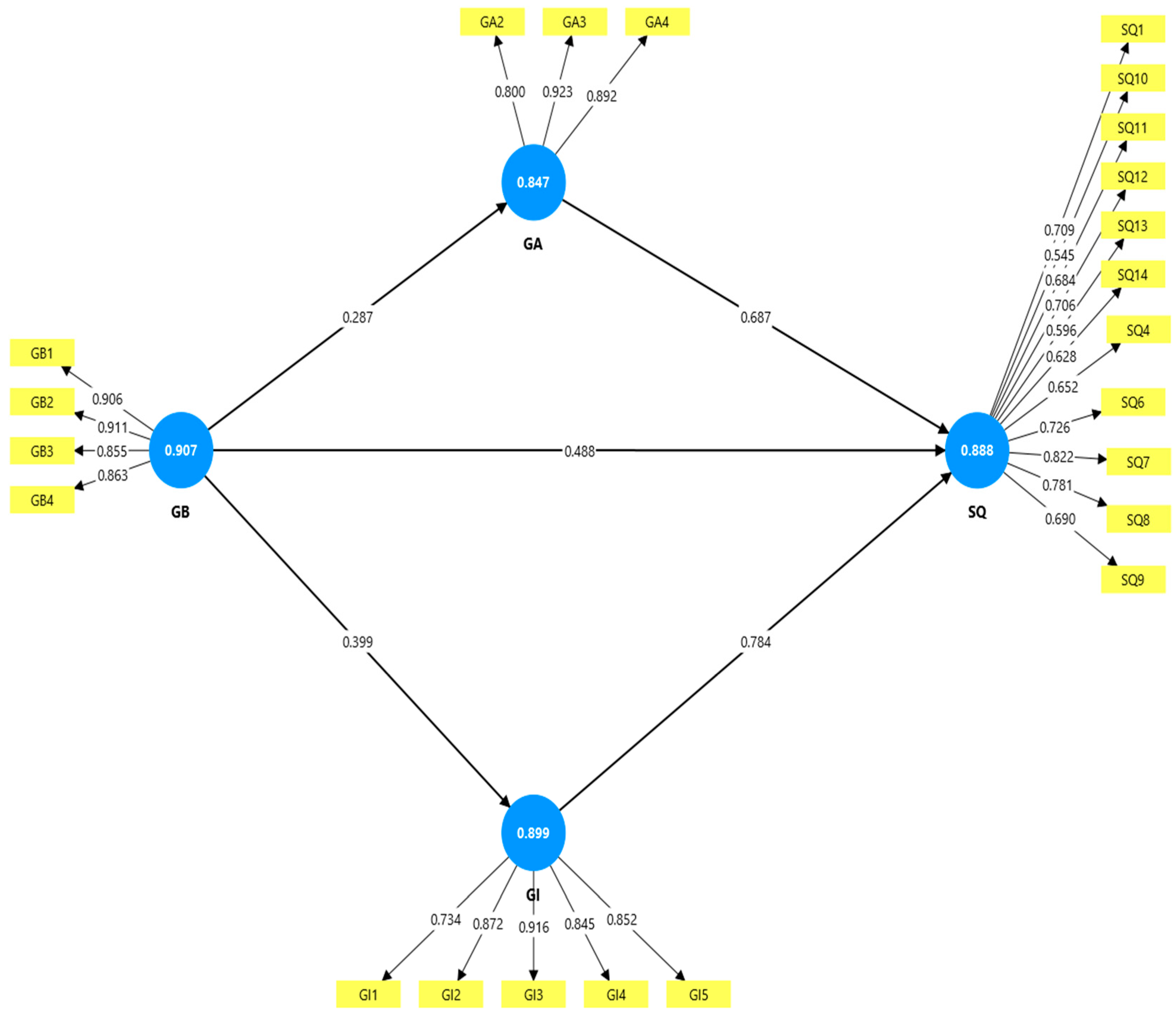
A reasonable level of convergent validity is shown in Table 3. Cronbach’s alpha for all of the constructs was between 0.812 and 0.905, and research indicates that this number should be at least 0.7 as documented in [83]. All factor loadings on items was between 0.545 to 0.923, over the threshold of 0.50 (as seen in Figure 1). Typically, a loading of 0.50 is regarded as the practical significance threshold and a common cut-off and a fair loading in structural equation modeling (SEM) and confirmatory factor analysis (CFA) [84]. Indicators with factor loadings below 0.50 were removed in this study, and the analysis was rerun iteratively until all remaining indicators met the required threshold. All CR values were over the threshold of 0.70, which is considered minimally acceptable. This has been shown to be the case [85]. All AVEs were significantly higher than the minimum requirement of 0.6 [86].

4.2. Measurement and Validation

Table 4 and Table 5 display the correlation matrix of the components, which demonstrates the Fornell–Larker criterion (Table 4) and the Heterotrait–Monotrait ratio (HTMT) (Table 4) as the discriminant validity of the measurement. The Fornell–Larcker criterion in Table 3 assesses discriminant validity by comparing the square root of each construct’s Average Variance Extracted (AVE), shown on the diagonal, with the correlations between that construct and others, shown off-diagonal [87]. For discriminant validity to be established, the diagonal values must be greater than the off-diagonal ones in the same row and column, indicating each construct shares more variance with its own indicators than with others. In this table, values such as 0.873 for GA and 0.848 for GB on the diagonal are higher than their correlations with other constructs, confirming the sufficient distinctiveness among the constructs GB, BI, GA, and SQ. The rule of thumb for the HTMT is that a value below 0.90 indicates acceptable discriminant validity. A score higher than this threshold suggests a potential problem with discriminant validity, meaning the constructs are not sufficiently distinct [88]. For this study, as seen in Table 5, all values are within the acceptable threshold. Measurement model results showed strong discriminant validity and Model Fit. Table 6 presents the model fit indices for both the saturated and estimated models used in the analysis. The Standardized Root Mean Square Residual (SRMR) values are 0.082 for the saturated model and 0.80 for the estimated model, indicating an acceptable fit, as values below 0.10 are generally considered satisfactory. The discrepancy measures, d_ULS and d_G, are slightly lower in the estimated model (1.733 and 0.706, respectively) compared to the saturated model, suggesting improved model parsimony without substantial loss of fit. The Chi-square statistic decreases in the saturated model as compared to the estimated model, reflecting a better fit with fewer parameters. Additionally, the Normed Fit Index (NFI) shows a modest improvement from 0.760 to 0.770, indicating a slightly better comparative fit in the estimated model [89,90]. Collectively, these indices suggest that the estimated model provides a reasonably good fit to the data while maintaining greater simplicity.

4.3. Hypothesis Testing

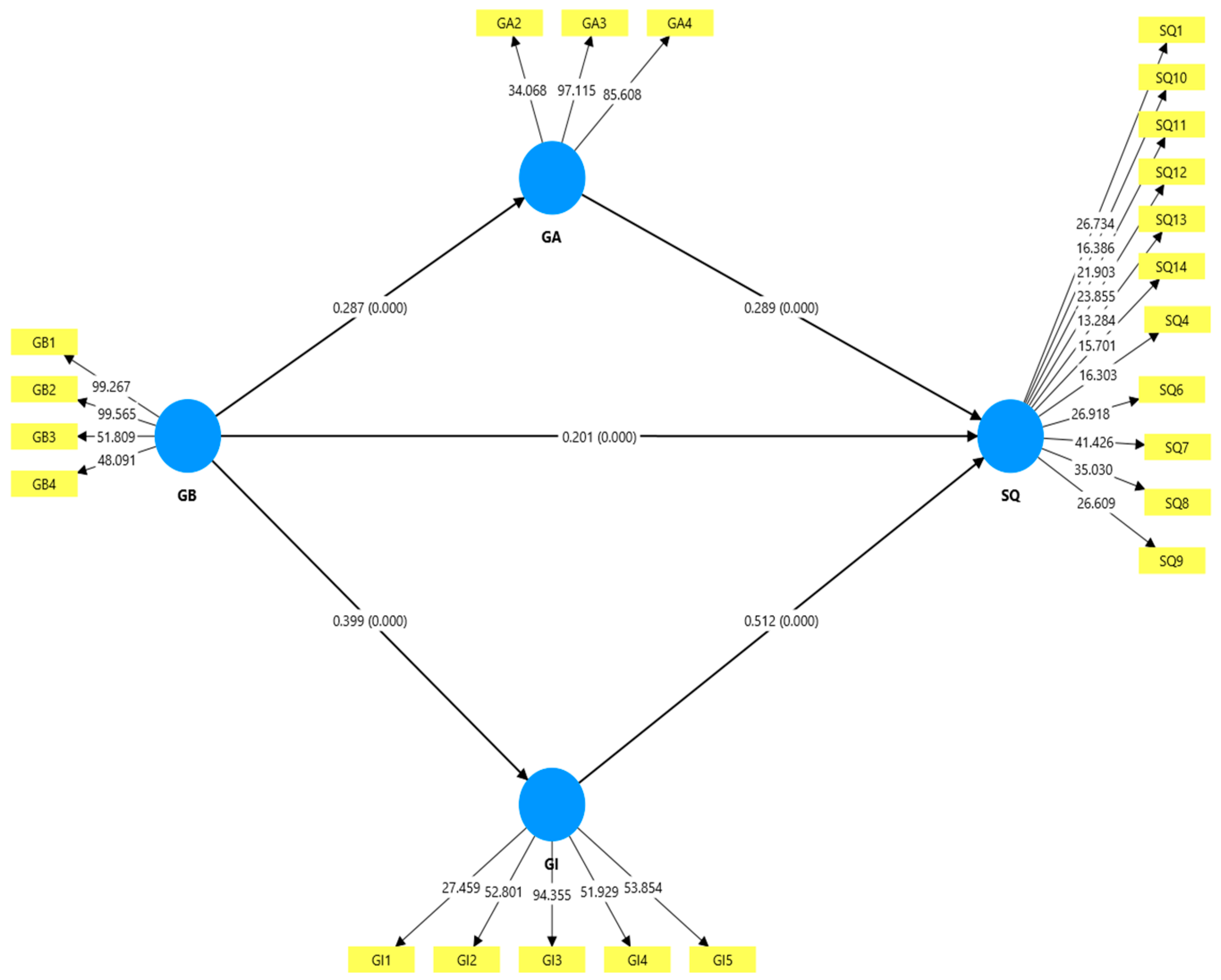
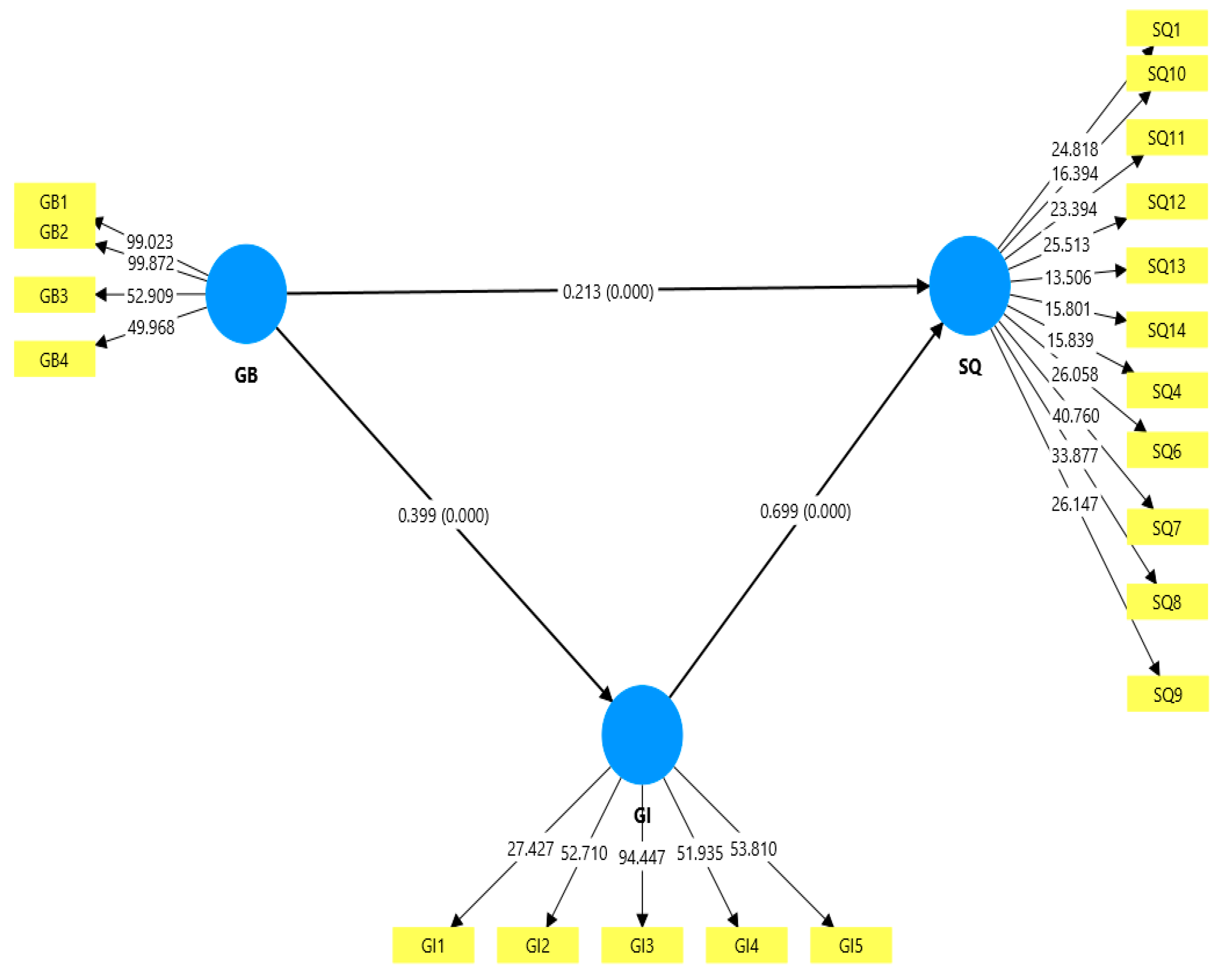
The findings of this study, derived from bootstrapping with one thousand subsamples, were that path coefficients of above 0.1, t-values greater than 1.96, and p-values with a significance level of 0.05 and less are considered statistically significant [83]. This study’s results (as seen in Table 7 and Figure 2) indicate GB practices have a statistically significant effect on service quality (SQ) (β = 0.201, p < 0.001, t = 6.64). Thus, Hypothesis 1 is supported. This is a result of the implementation of green practices and standards in the Nigerian banking sector, which has extended to the attainment of quality services.
Similarly, GB practices significantly influence GI (β = 0.399, p < 0.001. Furthermore, the study demonstrates a substantial impact of GB practices on green awareness (GA) (β = 0.287, p < 0.001, t = 6.59). Thus, Hypotheses 2 and 3 are supported.
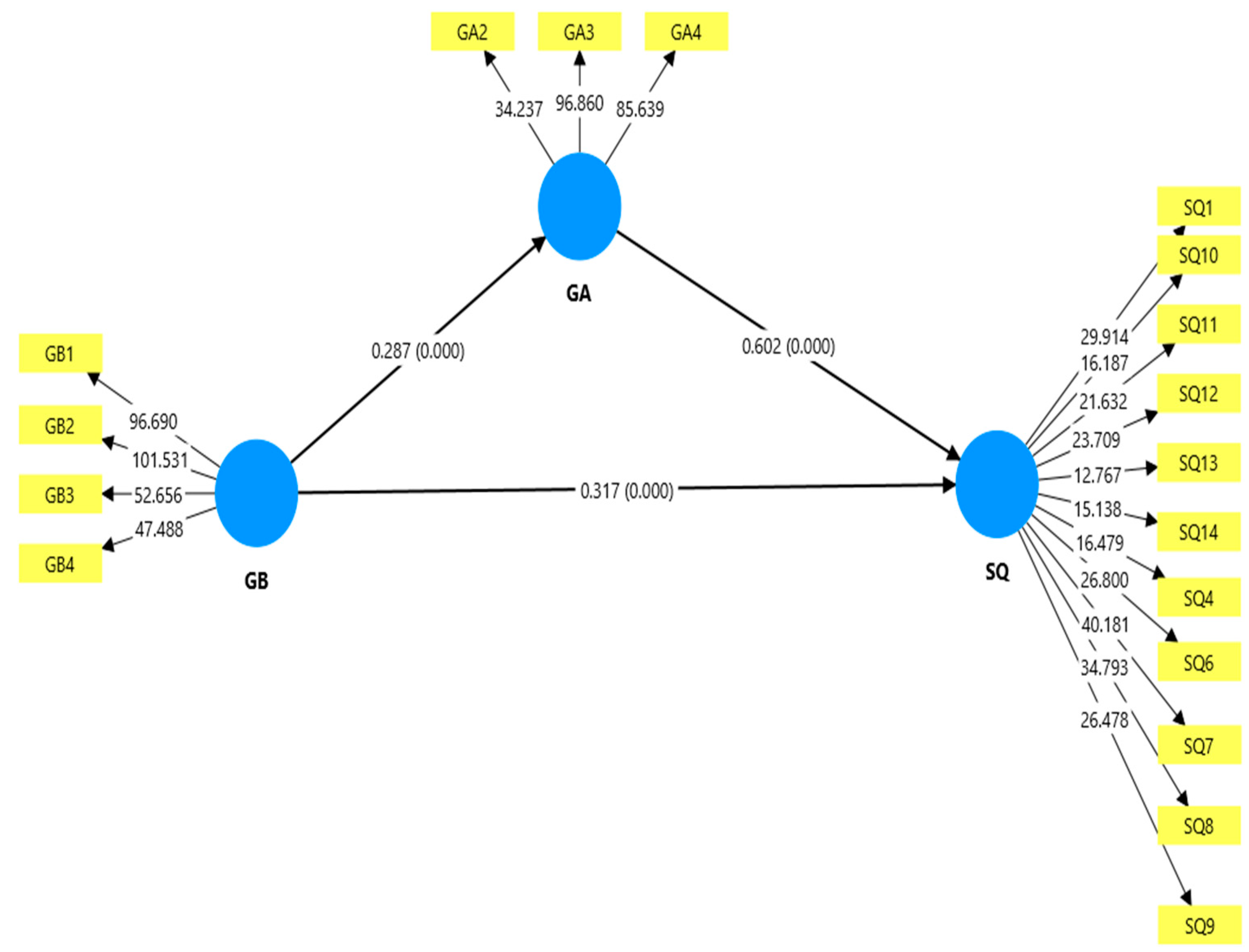
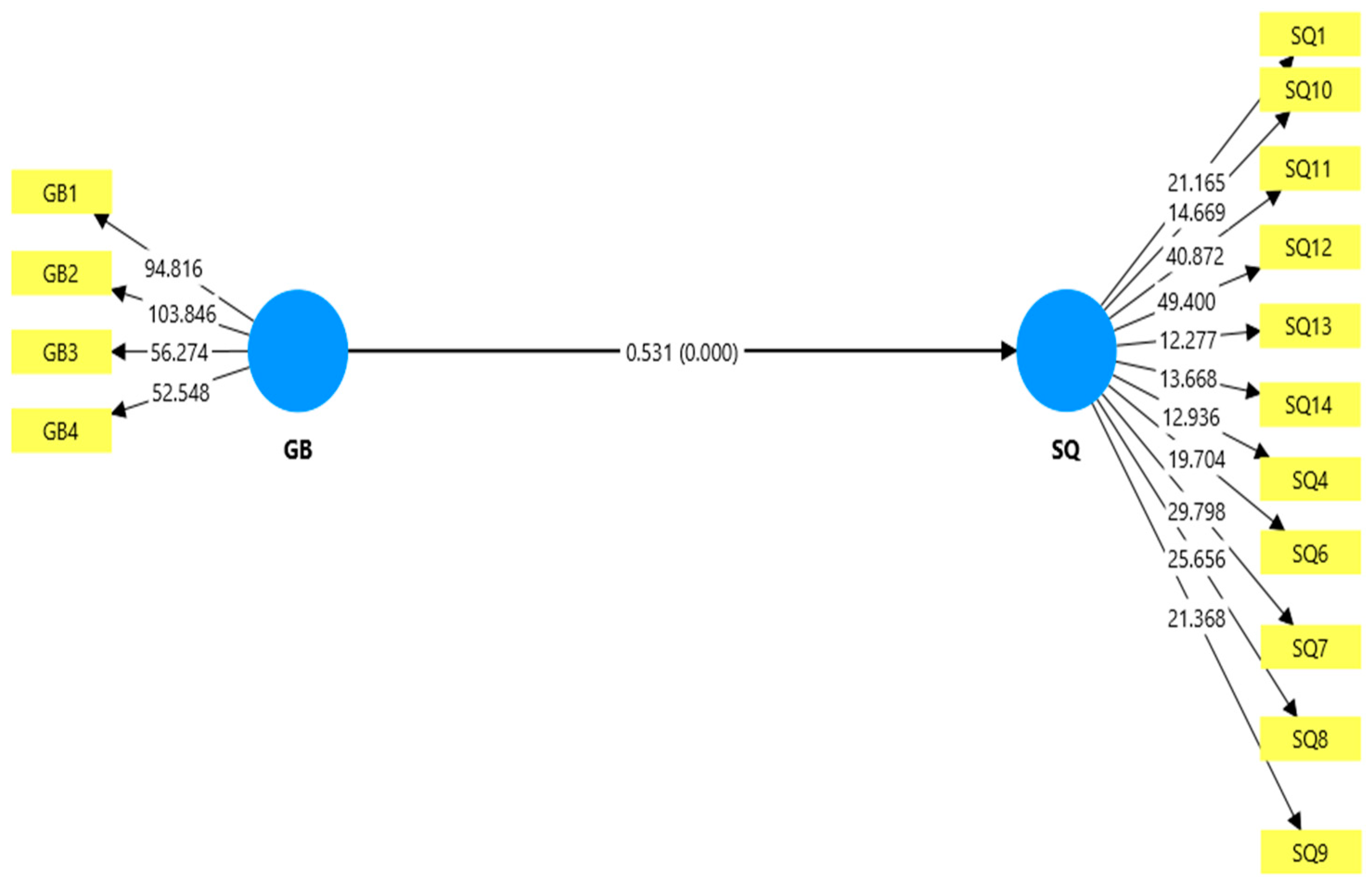
Additionally, the examination of the mediating role of GI and GA reveals a decrease in the direct path between GB practices and SQ, as shown in Figure 3, Figure 4 and Figure 5. In Figure 3, there is a significant direct effect of GB and SQ without the mediators. As shown in Figure 4 and Figure 5, the direct effect remains but is reduced when mediators are added, indicating a partial mediation. Specifically, the indirect path coefficients of GB → GI → SQ (β = 0.278, p < 0.001, t = 9.30) and GB → GA → SQ (β = 0.173, p < 0.001, t = 6.30) underscore the essential mediating role of GI and GA in the relationship between GB practices and SQ. Thus, Hypotheses 4 and 5 are supported.

4.4. Discussion

The statistically significant influence of GB on green image and green awareness further corroborates previous findings by [54,70], confirming that sustainability efforts in banks translate into greater environmental consciousness and positive brand image. These results reflect how sustained adoption of GB fosters customer perceptions rooted in environmental responsibility, positioning the banks advantageously in a socially and environmentally aware market, consistent with findings from Nigerian banking studies on green banking’s role in profitability and environmental performance [43].
Moreover, the mediation analysis emphasizes the critical role of GI and GA as partial mediators that enhance the relationship between GB practices and SQ, indicated by reduced direct effects when including these mediators and significant indirect paths. This partial mediation echoes findings by [74,75] who highlighted how environmental image and awareness amplify service quality outcomes in the banking context. The mediation effect suggests that the adoption of GB practices alone is insufficient to maximize service quality without concurrently fostering green image and awareness. This reinforces the strategic importance of embedding sustainability communication and customer engagement within green initiatives to strengthen service quality and overall customer satisfaction in Nigerian banks, a conclusion supported by similar research advocating green practices as a driver of both environmental and performance gains in banking institutions [36,43,70].

5. Conclusions, Implications, and Recommendations

5.1. Conclusions

One of the tools for ensuring a future where economic activity has no negative effects on the environment is GB. For example, Nigeria is one of several countries where people’s health is deteriorating as a result of the world’s increasing carbon dioxide emissions. Banking industry pollution persists even as the global economy expands. Recent years have seen the introduction of safeguards, such as GB practices, to protect the environment from potentially damaging human activities. The effects of GI and GA, in addition to the direct effect of GB practice, on SQ are investigated. As awareness of environmental issues grows, so does demand for products and services that tread lightly on the planet. Many studies have demonstrated that addressing customers’ green needs while bolstering an institution’s green image and green awareness can boost sales and the institution’s competitive edge.
Researchers found that GB practices significantly improved GI, GA, and SQ. This is a result of the green regulations of the Nigerian banking sector, which have helped the banking industry gain credibility in sustainable practices such as lowering carbon footprints, paperless solutions, improving energy efficiency, and transparency. These green banking practices demonstrate the bank’s efforts in green operational excellence, which will extend to the attainment of quality services and standards. This study’s results have shown that the sustainability effort shown by the banks has also elevated their GI and GA among their environmentally conscious consumers, which has led the industry into an environmentally and socially oriented future. As financial institutions adopt GB practices, their GI, GA, and SQ metrics all improve, which is in line with previous empirical studies [3,38]. The use of green banking practices could drive their reputation and image as a green organization [22]; thus, customers may have positive perceptions of the bank’s commitment to sustainability. This could also subsequently lead to increased awareness of GB practices among its customers and their expectations for the bank’s green practices. The increased expectation leads to more prioritization of these sustainability initiatives, which require infrastructure upgrades and employee training aimed at delivering better service experiences aligned with environmental values. Thus, this explains this study’s result on the mediation effect of GI and GA in the relationship between GB practices and SQ. This result is also in line with previous studies [37,38,39,41], which indicated that greening financial institutions can be attributed to rising public interest in eco-friendly goods and services and higher expectations for banks’ environmental responsibilities. Hence, banks in Nigeria are compelled to embrace GB practices that will create SQ due to the need for banks to advance GI and GA.

5.2. Theoretical Contribution

This study builds on previous research that identifies green initiatives as strong predictors of green image (GI) and crucial contributors to service quality (SQ) [20,22,23,75]. Unlike prior work that examined these relationships separately, this study advances the literature by incorporating both GI and green awareness (GA) as mediating variables between green banking (GB) and SQ, specifically in the Nigerian banking context. While [2] noted the predictive role of environmentally conscious customers in linking GB to SQ, our findings extend this by empirically demonstrating that GI and GA significantly mediate this relationship, reflecting a more nuanced understanding of how green initiatives translate into enhanced service quality through consumer perceptions [74,75]. Furthermore, applying the S-O-R paradigm provides theoretical rigor and extends its applicability in emerging markets like Nigeria, where this integrative framework remains underexplored. This multidimensional approach enriches theoretical models by demonstrating the interconnected pathways through which GB influences SQ and customer perceptions via GI and GA, offering more robust insights into sustainable banking operations.
To translate these findings into actionable strategies for Nigerian banks, specific green banking practices should be emphasized, such as expanding mobile and online banking platforms to reduce carbon footprints and enhance convenience, which resonate with the green-aware customer segment. Implementing energy-efficient infrastructure, such as solar-powered branch offices and automated cheque processing systems, can serve as tangible green initiatives that enhance banks’ environmental credibility and operational sustainability [4,6]. Additionally, banks should invest in customer education programs focused on green banking benefits to elevate green awareness, particularly targeting older and less tech-savvy segments often excluded in social media sampling, a noted limitation of this study. By combining technological upgrades with targeted awareness campaigns, Nigerian banks can leverage GB practices not only to improve service quality but also to build stronger green images that foster customer loyalty and satisfaction, aligning with prior research linking green practices to enhanced environmental performance and customer relations [22,35]. These specific, context-sensitive recommendations can help banks operationalize sustainability goals while addressing distinct market challenges.

5.3. Managerial Implication

These empirical findings are practically relevant to ground the narrative of the importance of the banking sector in concentrating on greater green banking practices. It is common knowledge that service quality within banks is often centered on how a customer perceives a banking institution’s transparency, integrity, commitment to environmental conservation, and generally the bank’s level of green awareness. Therefore, to maintain a proactive stance, they must actively engage in various “green” activities: they must build their green image and foster green awareness through responsible environmental and social behavior [42]. This implies that most banking institutions need to solidify their green position by investing in environmental goals. Understanding this study’s relationship will make it easier for bankers and policy formulators to decide which areas of greenness will have a bigger impact on their practice. Thus, they can integrate GB with their social responsibility activities. Taking this into consideration, the positive relationship revealed in this study implies that greater focus and continued implementation of green practices will provide attuned quality in service. This will involve their active engagement in building responsive ground on GI and GA, which could improve the bank’s SQ. Also, stakeholders should know the connections between the financial sector and GB practices. Executives and managers in the industry will be able to develop more thorough plans to develop the sector efficiently if they work together more quickly. The lack of prioritization of these green practices by financial institutions will certainly pose a greater threat to the environment. Ultimately, the client will decide that it is not worth the risk to invest their money or engage in business activities with these enterprises or organizations. Thus, banks and other organizations must adopt this approach to action and transparency.

5.4. Limitations and Future Recommendations

Although this work makes significant contributions, its weaknesses should be noted so that they can be addressed in future studies. It is important to acknowledge that the focus on customers of Nigeria’s commercial banking industry may limit the external validity of the study’s findings. Therefore, future research should aim to enhance generalizability by exploring this topic within larger, more heterogeneous civilizations and across various economic sectors. By conducting comparative studies across different countries and industries, researchers can better understand how cultural, economic, and regulatory factors influence the relationship between green banking practices and customer perceptions of service quality. Second, a quantitative method was used to analyze the data. The study would benefit greatly from and provide a deeper understanding of the topic with the incorporation of a qualitative approach that allows for a more expressive picture of clients. Future research can also examine the relationship between green banking practices and sustainable performance from an employee perspective.

Funding

This research received no external funding.

Institutional Review Board Statement

This study was waived for ethical review due to the study’s non-interventional nature by Cyprus International University ‘s Ethics Committee.

Informed Consent Statement

Informed consent was obtained from all subjects involved in the study.

Data Availability Statement

The original contributions presented in this study are included in the article.

Conflicts of Interest

The author declares no conflicts of interest.

References

  1. Rehman, O.U.; Jun, T.Z.; Ahmed, S. What happens when sustainability meets e-banking? A delighted message from the gamification. Int. J. Hum.–Comput. Interact. 2025, 41, 14440–14456. [Google Scholar]
  2. Iqbal, M.; Nisha, N.; Raza, S.A. Customers’ perceptions of green banking: Examining service quality dimensions in Bangladesh. In Green Business: Concepts, Methodologies, Tools, and Applications; IGI Global: Hershey, PA, USA, 2019; pp. 1071–1090. [Google Scholar]
  3. Iqbal, M.; Nisha, N.; Raza, S.A. Customers’ Perceptions of Green Banking. In Managerial Strategies and Solutions for Business Success in Asia; IGI Global Scientific Publishing: Hershey, PA, USA, 2017. [Google Scholar]
  4. Chen, Z.; Hossen, M.M.; Muzafary, S.S.; Begum, M. Green banking for environmental sustainability: Present status and future agenda-Experience from Bangladesh. Asian Econ. Financ. Rev. 2018, 8, 571. [Google Scholar]
  5. Ahmad, F.; Boumaiza, A.; Sanfilippo, A.; Al-Fagih, L. Navigating the impact, challenges, and future prospects of carbon neutrality under green finance initiatives. Sustain. Dev. 2025, 33, 1395–1436. [Google Scholar] [CrossRef]
  6. Rehman, A.; Ullah, I.; Ullah, Z.; Zeeshan, M.; Hussain, A.; Rahman, H.U. Adoption of green banking practices and environmental performance in Pakistan: A demonstration of structural equation modelling. Environ. Dev. Sustain. 2021, 23, 13200–13220. [Google Scholar] [CrossRef]
  7. Khan, I.U.; Hameed, Z.; Khan, S.U.; Khan, M.A. Green banking practices, bank reputation, and environmental awareness: Evidence from Islamic banks in a developing economy. Environ. Dev. Sustain. 2023, 26, 16073–16093. [Google Scholar] [CrossRef]
  8. Prabhu, N.; Aithal, P.S. Quantitative ABCD analysis of green banking practices and their impact on using green banking products. Int. J. Appl. Eng. Manag. Lett. (IJAEML) 2023, 7, 28–66. [Google Scholar]
  9. Mehta, K.; Sharma, R.; Jalotra, S. A bibliometric analysis of green banking: Present state and future directions. In Perspectives on Blockchain Technology and Responsible Investing; IGI Global: Hershey, PA, USA, 2023; pp. 159–176. [Google Scholar]
  10. Taneja, S.; Özen, E. To analyse the relationship between banks’ green financing and environmental performance. Int. J. Electron. Financ. 2023, 12, 163–175. [Google Scholar] [CrossRef]
  11. Hossain, M.Z.; Ahmed, M.; Nisha, N. Consumer attitudes and perception towards green banking in Bangladesh. In Green Banking in Bangladesh and Beyond; Zaman Printing & Packaging: Narayanganj, Bangladesh, 2015; pp. 48–76. [Google Scholar]
  12. Wu, W.; Lin, X. Digital inclusive finance for green transformation: Insights from green innovation, industrial upgrading, and employment quality. J. Innov. Knowl. 2025, 10, 100726. [Google Scholar] [CrossRef]
  13. Ahmadi, S. A Comprehensive Study on Integration of Big Data and AI in the Financial Industry and its Effect on Present and Future Opportunities. Int. J. Curr. Sci. Res. Rev. 2024, 7, 66–74. [Google Scholar] [CrossRef]
  14. VenkateswaraRao, M.; Vellela, S.; Reddy, V.; Vullam, N.; Sk, K.B.; Roja, D. Credit investigation and comprehensive risk management system based on big data analytics in commercial banking. In Proceedings of the 2023 9th International Conference on Advanced Computing and Communication Systems (ICACCS), Coimbatore, India, 17–18 March 2023; IEEE: New York, NY, USA, 2023; Volume 1, pp. 2387–2391. [Google Scholar]
  15. Bukhari, S.A.A.; Hashim, F.; Amran, A. Green Banking: A road map for adoption. Int. J. Ethics Syst. 2020, 36, 371–385. [Google Scholar] [CrossRef]
  16. Mishra, N.; Grima, S. A study of the impact of green banking practices on banks’ environmental performance: An Indian perspective. Int. J. Sustain. Dev. Plan. 2025, 20, 1345–1355. [Google Scholar] [CrossRef]
  17. Nagina, R. Effectiveness of green financing activities and performance management on banking sector: An empirical study. In Web Intelligence; Sage Publications: London, UK, 2025; pp. 195–212. [Google Scholar]
  18. Thomas, B.; Mathew, D.; Devaky, K.S. Nature’s green catalyst for environmental remediation, clean energy production, and sustainable development. In Chemistry and Chemical Engineering for Sustainable Development; Apple Academic Press: Palm Bay, FL, USA, 2020; pp. 107–137. [Google Scholar]
  19. Sun, H.; Rabbani, M.R.; Ahmad, N.; Sial, M.S.; Cheng, G.; Zia-Ud-Din, M.; Fu, Q. CSR, co-creation, and green consumer loyalty: Are green banking initiatives important? A moderated mediation approach from an emerging economy. Sustainability 2020, 12, 10688. [Google Scholar]
  20. Hoque, N.; Mowla, M.; Uddin, M.; Mamun, A.; Uddin, M.R. Green banking practices in Bangladesh: A critical investigation. Int. J. Econ. Financ. 2019, 11, 58–68. [Google Scholar]
  21. Rai, R.; Kharel, S.; Devkota, N.; Paudel, U.R. Customers’ perception of green banking practices: A desk. J. Econ. Concerns 2019, 10, 82–95. [Google Scholar]
  22. Solekah, N.A. The effect of green banking products and green corporate image on green customer loyalty in green customer satisfaction with Sharia banking mediation. Manag. Econ. J. (MEC-J) 2019, 3, 81–94. [Google Scholar]
  23. Pariag-Maraye, N.; Munusami, N.; Ansaram, K. A customer’s perspective of green banking: A case study of commercial banks in Mauritius. Theor. Econ. Lett. 2017, 7, 1975. [Google Scholar] [CrossRef][Green Version]
  24. Raj, D.G.P.; Rajan, D.A.P. A study on the customer awareness of green banking initiatives. Intercont. J. Financ. Res. Rev. 2017, 5, 54–65. [Google Scholar]
  25. Risal, N.; Joshi, S.K. Measuring green banking practices on banks’ environmental performance: Empirical evidence from Kathmandu valley. J. Bus. Soc. Sci. 2018, 2, 44–56. [Google Scholar] [CrossRef]
  26. Mehrabian, A.; Russell, J.A. An Approach to Environmental Psychology; The MIT Press: Cambridge, MA, USA, 1974. [Google Scholar]
  27. Robert, D.; John, R. Store atmosphere: An environmental psychology approach. J. Retail. 1982, 58, 34–57. [Google Scholar]
  28. Su, L.; Swanson, S.R.; Hsu, M.; Chen, X. How does perceived corporate social responsibility contribute to green consumer behavior of Chinese tourists? Int. J. Contemp. Hosp. Manag. 2017, 29, 3157–3176. [Google Scholar] [CrossRef]
  29. Bagozzi, R.P. Principles of Marketing Management; Science Research Associates: New York, NY, USA, 1986. [Google Scholar]
  30. Arora, S.; Parida, R.R.; Sahney, S. Understanding consumers’ showrooming behaviour: A stimulus–organism–response (SOR) perspective. Int. J. Retail. Distrib. Manag. 2020, 48, 1157–1176. [Google Scholar] [CrossRef]
  31. Zameer, H.; Wang, Y.; Yasmeen, H. Reinforcing green competitive advantage through green production, creativity, and green brand image: Implications for cleaner production in China. J. Clean. Prod. 2020, 247, 119119. [Google Scholar] [CrossRef]
  32. Hameed, I.; Hussain, H.; Khan, K. The role of green practices toward the green word-of-mouth using stimulus-organism-response model. J. Hosp. Tour. Insights 2022, 5, 1046–1061. [Google Scholar] [CrossRef]
  33. Muchiri, M.K.; Erdei-Gally, S.K.; Fekete-Farkas, M. Green banking practices, opportunities, and challenges for banks: A systematic review. Climate 2025, 13, 102. [Google Scholar] [CrossRef]
  34. Rahman, M.S.; Moral, I.H.; Akther, S.; Hossain, G.M.; Islam, W. What drives green banking operations in Bangladesh? Findings from PLS-SEM and BSEM. Asian J. Econ. Bank. 2025, 9, 83–104. [Google Scholar] [CrossRef]
  35. Gulzar, R.; Bhat, A.A.; Mir, A.A.; Athari, S.A.; Al-Adwan, A.S. Green banking practices and environmental performance: Navigating sustainability in banks. Environ. Sci. Pollut. Res. 2024, 31, 23211–23226. [Google Scholar] [CrossRef]
  36. Khan, M.R.; Pervin, M.T.; Arif, M.Z.U.; Hossain, S.K. The impact of technology service quality on Bangladeshi banking consumers’ satisfaction during the pandemic situation: Green development and innovation perspective in banking service. Innov. Green Dev. 2024, 3, 100120. [Google Scholar] [CrossRef]
  37. Rocha, V.; Viegas, C.; Guerreiro, M.; Viola, T.W.; Kluwe-Schiavon, B. Green banking awareness and its association with green attitude, green trust, and green loyalty. J. Sustain. Financ. Investig. 2025, 15, 250–267. [Google Scholar] [CrossRef]
  38. Sharma, R.; Vasishta, P.; Singla, A. Impact of green banking awareness on green FinTech adoption: A way towards profitable and sustainable practices. Manag. Financ. 2025, 51, 377–394. [Google Scholar]
  39. Anjalidevi, S.; Sreedevi, R.S.; Harikrishnan, R.; Shivdas, A. Green banking awareness: A study on tier 3 locations—with special reference to Kerala. In Proceedings of the International Conference on Data Management, Analytics & Innovation, Vellore, India, 19–21 January 2024; Springer Nature: Singapore; pp. 581–597. [Google Scholar]
  40. Gazi, M.A.; Al Masud, A.; Islam, S.; Hossain, M.A.; Hossain, M.S.; Senathirajah, A.R.b.S. The effect of green banking practices on banks’ sustainability performance and green brand image: An empirical study of an emerging economy. J. Sustain. Res. 2024, 6, e240074. [Google Scholar] [CrossRef]
  41. Sarath Chandran, M.C. Eco-friendly finance: The role of green CSR, processes, and products in enhancing brand trust and image. Environ. Dev. Sustain. 2024, 27, 29019–29046. [Google Scholar] [CrossRef]
  42. Ibe-enwo, G.; Igbudu, N.; Garanti, Z.; Popoola, T. Assessing the relevance of green banking practice on bank loyalty: The mediating effect of green image and bank trust. Sustainability 2019, 11, 4651. [Google Scholar] [CrossRef]
  43. Inegbedion, H. Green banking and profitability of banks in Nigeria: Opinions and attitudes. Heliyon 2024, 10, e34303. [Google Scholar] [CrossRef]
  44. Taneja, S.; Bansal, N.; Johri, A.; Asif, M.; Shamsuddin, Z. Mapping the landscape of green banking strategies: A bibliometric approach. Front. Sustain. Cities 2024, 6, 1404732. [Google Scholar] [CrossRef]
  45. Bhardwaj, B.R.; Malhotra, A. Green banking strategies: Sustainability through corporate entrepreneurship. Greener J. Bus. Manag. Stud. 2013, 3, 180–193. [Google Scholar] [CrossRef]
  46. Central Bank of Nigeria (CBN). Environmental and Social Risk Management Operations Manual (ESOM) for the Nigerian Housing Finance Project; Central Bank of Nigeria: Abuja, Nigeria, 2013. Available online: https://www.cbn.gov.ng/out/2015/ofisd/nigeria%20housing%20finance%20program%20esom.pdf (accessed on 24 October 2023).
  47. World Bank. What You Need to Know About Green Loans [Internet]. 2021. Available online: https://www.worldbank.org/en/news/feature/2021/10/04/what-you-need-to-know-about-green-loans (accessed on 24 October 2023).
  48. Weber, O.; Hoque, A.; Ayub Islam, M. Incorporating environmental criteria into credit risk management in Bangladeshi banks. J. Sustain. Financ. Investig. 2015, 5, 1–15. [Google Scholar]
  49. Hermawan, S.; Khoirunisa, Z.A. The Emergence of Green Banking: A Sustainable Financing Strategy for Protecting Against Deforestation in ASEAN. J. Environ. Dev. 2024, 33, 96–124. [Google Scholar] [CrossRef]
  50. Aslam, W.; Jawaid, S.T. Green banking adoption practices: Improving environmental, financial, and operational performance. Int. J. Ethics Syst. 2023, 39, 820–840. [Google Scholar] [CrossRef]
  51. Miah, M.R.; Hasan, M.M.; Parisha, J.T.; Alam, M.S.; Sayok, A.K.; Rahman, M.S.; Sharif, A.; Uddin, M.B.; Chowdhurry, S.H. Innovative policy approach to environmental resource management through green banking activities. Am. J. Econ. 2023, 13, 35–51. [Google Scholar]
  52. Nisha, N. Green investments and returns: A developing country perspective. In Measuring Sustainable Development and Green Investments in Contemporary Economies; IGI Global: Hershey, PA, USA, 2017; pp. 1–21. [Google Scholar]
  53. Bihari, S.C.; Pandey, B. Green banking in India. J. Econ. Int. Financ. 2015, 7, 1–17. [Google Scholar]
  54. Alshebami, A.S. Evaluating the relevance of green banking practices on Saudi Banks’ green image: The mediating effect of employees’ green behaviour. J. Bank. Regul. 2021, 22, 275–286. [Google Scholar] [CrossRef]
  55. Asnawi, N.; Sukoco, B.M.; Fanani, M.A. The role of service quality within Indonesian customer satisfaction and loyalty, and its impact on Islamic banks. J. Islam. Mark. 2019, 11, 192–212. [Google Scholar] [CrossRef]
  56. Tzavlopoulos, I.; Gotzamani, K.; Andronikidis, A.; Vassiliadis, C. Determining the impact of e-commerce quality on customers’ perceived risk, satisfaction, value, and loyalty. Int. J. Qual. Serv. Sci. 2019, 11, 576–587. [Google Scholar] [CrossRef]
  57. Parasuraman, A.; Zeithaml, V.A.; Berry, L.L. A conceptual model of service quality and its implications for future research. J. Mark. 1985, 49, 41–50. [Google Scholar] [CrossRef]
  58. Kurniawanto, H.; Rohmat, I. Quality services and digital adaptation Pt. Prolab Medika towards digital healthpreneur: Kualitas jasa dan adaptasi digital Pt. Prolab Medika menuju digital healthpreneur. Indones. J. Econ. Bus. Entrep. Financ. 2021, 1, 1–10. [Google Scholar] [CrossRef]
  59. Lovelock, C.H.; Wright, L. Principles of Service Marketing and Management; Prentice Hall: Hoboken, NJ, USA, 2016. [Google Scholar]
  60. Li, N.; Chen, G.; Govindan, K.; Jin, Z. Disruption management for the truck appointment system at a container terminal: A green initiative. Transp. Res. Part D Transp. Environ. 2018, 61, 261–273. [Google Scholar] [CrossRef]
  61. Kumar, T.S.; Vinothini, V. A study on customer satisfaction towards banking services of IndusInd Bank in Vadalur Town. Humanities 2020, 8, 149–162. [Google Scholar]
  62. Keskar, M.Y.; Pandey, N. Internet banking: A review (2002–2016). J. Internet Commer. 2018, 17, 310–323. [Google Scholar] [CrossRef]
  63. Sayil, E.M.; Akyol, A.; Golbasi Simsek, G. An integrative approach to relationship marketing, customer value, and customer outcomes in the retail banking industry: A customer-based perspective from Turkey. Serv. Ind. J. 2019, 39, 420–461. [Google Scholar] [CrossRef]
  64. Kapoor, N.; Jaitly, M.; Gupta, R. Green banking: A step towards sustainable development. Int. J. Res. Manag. Econ. Commer. 2016, 7, 69–72. [Google Scholar]
  65. Yadav, R.; Dokania, A.K.; Pathak, G.S. The influence of green marketing functions in building corporate image. Int. J. Contemp. Hosp. Manag. 2016, 28, 2178–2196. [Google Scholar] [CrossRef]
  66. Keller, K.L. Conceptualizing, measuring, and managing customer-based brand equity. J. Mark. 1993, 57, 1–22. [Google Scholar] [CrossRef]
  67. Kim, M.; Yin, X.; Lee, G. The effect of CSR on corporate image, customer citizenship behaviors, and customers’ long-term relationship orientation. Int. J. Hosp. Manag. 2020, 88, 102520. [Google Scholar] [CrossRef]
  68. Wang, J.; Wang, S.; Xue, H.; Wang, Y.; Li, J. Green image and consumers’ word-of-mouth intention in the green hotel industry: The moderating effect of Millennials. J. Clean. Prod. 2018, 181, 426–436. [Google Scholar] [CrossRef]
  69. Chernev, A.; Blair, S.; Böckenholt, U.; Mishra, H. Is sustainability a liability? Green marketing and consumer beliefs about eco-friendly products. J. Public Policy Mark. 2025, 44, 261–275. [Google Scholar] [CrossRef]
  70. Rustam, A.; Wang, Y.; Zameer, H. Environmental awareness, firm sustainability exposure, and green consumption behaviors. J. Clean. Prod. 2020, 268, 122016. [Google Scholar] [CrossRef]
  71. Desai, N. A Study of Consumer Awareness: Towards Eco-Friendly Buildings in Pune City. J. Bus. Quant. Econ. Appl. Manag. Res. 2015, 1, 1–9. [Google Scholar]
  72. Suki, N.M. Green awareness effects on consumers’ purchasing decision: Some insights from Malaysia. Int. J. Asia-Pac. Stud. 2013, 9, 49–63. [Google Scholar]
  73. Apostolopoulos, N.; Makris, I.; Deirmentzoglou, G.A.; Apostolopoulos, S. The impact of greenwashing awareness and green perceived benefits on green purchase propensity: The mediating role of green consumer confusion. Sustainability 2025, 17, 6589. [Google Scholar] [CrossRef]
  74. Ahmad, T.; Zhang, D. A critical review of comparative global historical energy consumption and future demand: The story told so far. Energy Rep. 2020, 6, 1973–1991. [Google Scholar] [CrossRef]
  75. Leclercq-Machado, L.; Alvarez-Risco, A.; Esquerre-Botton, S.; Almanza-Cruz, C.; de las Mercedes Anderson-Seminario, M.; Del-Aguila-Arcentales, S.; Yáñez, J.A. Effect of corporate social responsibility on consumer satisfaction and consumer loyalty of private banking companies in Peru. Sustainability 2022, 14, 9078. [Google Scholar] [CrossRef]
  76. Sultana, F.; Dutta, S.; Khair, M.B. Green banking and customers’ satisfaction: A case study on the City Bank Limited of Bangladesh. Int. J. Sci. Res. Multidiscip. Stud. 2021, 7, 6–13. [Google Scholar]
  77. Nisha, N. Can central bank survive the green banking revolution?: A case of Bangladesh Bank. Int. J. Asian Bus. Inf. Manag. 2020, 11, 45–64. [Google Scholar] [CrossRef]
  78. Akter, M.; Tasnim, J. Factors Affecting Customer Satisfaction Level for Green Banking Practices in Banks of Bangladesh. Baiust Acad. J. 2020, 1, 90–104. [Google Scholar]
  79. Chen, Y.S. Towards green loyalty: Driving from green perceived value, green satisfaction, and green trust. Sustain. Dev. 2013, 21, 294–308. [Google Scholar] [CrossRef]
  80. Chen, Y.S. The driver of green innovation and green image—Green core competence. J. Bus. Ethics 2008, 81, 531–543. [Google Scholar] [CrossRef]
  81. Vera, J.; Trujillo, A. Service quality dimensions and superior customer perceived value in retail banks: An empirical study on Mexican consumers. J. Retail. Consum. Serv. 2013, 20, 579–586. [Google Scholar] [CrossRef]
  82. Ringle, C.M.; Sarstedt, M.; Straub, D.W. Editor’s comments: A critical look at the use of PLS-SEM in “MIS Quarterly”. MIS Q. 2012, 36, iii–xiv. [Google Scholar] [CrossRef]
  83. Hair, J.F., Jr.; Sarstedt, M.; Hopkins, L.; Kuppelwieser, V.G. Partial least squares structural equation modeling (PLS-SEM). Eur. Bus. Rev. 2014, 26, 106–121. [Google Scholar] [CrossRef]
  84. Quilloy-Custodio, K.; Newman, A.; Pyman, A. Measuring the social impact of social enterprises–scale development and validation. Bus. Soc. 2025, 64, 1269–1312. [Google Scholar] [CrossRef]
  85. Hair, J.F.; Anderson, R.E.; Babin, B.J.; Black, W.C. Multivariate Data Analysis: A Global Perspective, 7th ed.; Pearson: London, UK, 2010. [Google Scholar]
  86. Bagozzi, R.P.; Yi, Y. Specification, evaluation, and interpretation of structural equation models. J. Acad. Mark. Sci. 2012, 40, 8–34. [Google Scholar] [CrossRef]
  87. Fornell, C.; Larcker, D.F. Evaluating structural equation models with unobservable variables and measurement error. J. Mark. Res. 1981, 18, 39–50. [Google Scholar] [CrossRef]
  88. Roemer, E.; Schuberth, F.; Henseler, J. HTMT2–an improved criterion for assessing discriminant validity in structural equation modeling. Ind. Manag. Data Syst. 2021, 121, 2637–2650. [Google Scholar] [CrossRef]
  89. Pavlov, G.; Maydeu-Olivares, A.; Shi, D. Using the standardized root mean squared residual (SRMR) to assess exact fit in structural equation models. Educ. Psychol. Meas. 2021, 81, 110–130. [Google Scholar] [CrossRef]
  90. Ab Hamid, M.R.; Sami, W.; Sidek, M.M. Discriminant validity assessment: Use of Fornell & Larcker criterion versus HTMT criterion. J. Phys. Conf. Ser. 2017, 890, 012163. [Google Scholar]
Figure 1. Confirmatory factor analysis model.
Sustainability 18 00559 g001
Figure 2. Structural Equation Model.
Sustainability 18 00559 g002
Figure 3. Direct effect without mediators.
Sustainability 18 00559 g003
Figure 4. Indirect effect (GB → GA → SQ).
Sustainability 18 00559 g004
Figure 5. Indirect effect (GB → GI → SQ).
Sustainability 18 00559 g005
Table 1. Gap analysis for future work related to GB practices.
AspectResearch SummaryResearch GapsFuture Work
Green banking practices and service qualitySeveral studies examine green banking practices focusing on environmental performance, banking sustainability, and operational impacts [6,33,34,35]. Service quality dimensions linked to green banking are discussed in limited contexts [2,36] (Iqbal et al., 2019; Khan et al., 2024).Existing studies often do not explicitly analyze the direct impact of green banking practices on overall service quality, especially in a banking context that integrates green technology and innovation outcomes during crisis (e.g., pandemic).Examine the direct and indirect effects of green banking practices on service quality, especially during environmental and operational challenges.
Mediating role of green awarenessAwareness about green banking influences customer attitudes, trust, and loyalty, as highlighted by [37,38,39] Rocha et al., 2025; Sharma et al., 2025; Anjalidevi et al., 2024. Awareness is linked to the adoption of green FinTech and sustainable practices.Minimal empirical testing on how green awareness mediates between green banking practices and perceived service quality. Few studies distinctly isolate this mediating mechanism in empirical models.Investigate green awareness as a mediator in the relationship between green banking practices and service quality dimensions using SEM approaches.
Mediating effect of green imageStudies have examined green banking’s impact on brand image and loyalty [40,41,42] (Gazi et al., 2024; Sarath Chandran, 2024; Ibe-enwo et al., 2019), showing green image as a driver of customer trust and bank loyalty.Lack of research exploring green image as a mediator impacting service quality outcomes specifically, especially combining image with awareness to clarify consumer perceptions and satisfaction.Explore the mediating effect of green image on the link between green banking practices and service quality, integrating it with green awareness.
Contextual focus and geographic coverageMost studies focus on emerging economies or specific regions, e.g., Bangladesh [34,36] Nigeria [43], and Kerala [39]Few studies address cross-regional comparisons or broader applicability beyond single-country contexts. Limited attention to the banking sector’s green awareness and image in service quality research across diverse markets.Conduct cross-country studies and comparative assessments to generalize findings. Incorporate contextual variables influencing green awareness and image effects on service quality.
Integration of emerging banking technologiesStudies [36,38] link technology and green FinTech with green banking, highlighting innovation and green development perspectives. However, integration of technology, green image, and awareness in a comprehensive service quality model remains underexplored.The combined role of green banking technology, awareness, and image in enhancing service quality is not thoroughly modeled or empirically validated, especially during dynamic crises such as pandemics or environmental shocks.Develop integrated models that include green technology adoption, green awareness, and green image as mediators/moderators influencing service quality.
Measurement and methodological limitationsSeveral studies [34,35,37,44] use robust quantitative methods like PLS-SEM or bibliometric analysis but often omit service quality-specific measures or multi-mediation testing combining awareness and image.Narrow scope of tested mediators and outcomes limits understanding of mechanisms behind green banking’s impact on service quality. Qualitative insights or mixed methods on mediators are often absent.Incorporate multi-mediation SEM approaches to better capture the nuanced influences of awareness and image on service quality outcomes.
Table 2. Respondents’ demographic profile.
FrequencyPercent
Gender
Male20343.2
Female26756.8
Age
18–256112.9
26–3520042.6
35–4514029.8
46–555110.9
56 and above183.8
Educational Qualification
Bachelors25153.4
Masters16234.5
PhD296.1
Others286
Years of being a Customer
Below 3 years9019.1
4–618940.2
7–915432.8
10 and above377.9
Table 3. Scale items and confirmatory factor analysis.
ConstructMeasureFactor Loading
Green Banking          AVE = 0.782      CR = 0.918      α = 0.907
GB1 0.906
GB20.911
GB30.855
GB40.863
Green Image              AVE = 0.715      CR = 0.910      α = 0.899
GI1 0.734
GI20.872
GI30.916
GI40.845
GI50.852
Green Awareness      AVE = 0.762      CR = 0.888      α = 0.847
GA2 0.800
GA30.923
GA40.892
Service Quality         AVE = 0.675      CR = 0.896      α = 0.888
SQ1 0.709
SQ40.652
SQ60.726
SQ70.822
SQ80.781
SQ90.690
SQ100.545
SQ110.684
SQ120.706
SQ130.596
SQ140.628
Table 4. Fornell–Larker criterion.
ConstructGBBIGASQ
GA0.873
GB0.2870.848
GI0.6650.3990.846
SQ0.6870.4880.6840.689
Table 5. Heterotrait–Monotrait ratio (HTMT).
Construct1234
GB
BI0.306
GA0.7490.436
SQ0.7570.5400.867
Table 6. Model Fit.
Table 6. Model Fit.
ConstructSaturated ModelEstimated Model
SRMR0.0820.080
d_ULS1.8451.733
d_G0.7580.706
Chi-square1852.4671715.560
NFI0.7600.770
Table 7. Summary of hypothesis testing.
HypothesesRelationshipPath Coefficientt-Statisticsp ValueDecision
H1GB SQ0.2016.64<0.001Supported
H2GB GA0.2876.59<0.001Supported
H3GB GI0.39910.15<0.001Supported
H4GB GA SQ0.1736.31<0.001Partial Mediation
H5GB GI SQ0.2789.30<0.001Partial Mediation
Disclaimer/Publisher’s Note: The statements, opinions and data contained in all publications are solely those of the individual author(s) and contributor(s) and not of MDPI and/or the editor(s). MDPI and/or the editor(s) disclaim responsibility for any injury to people or property resulting from any ideas, methods, instructions or products referred to in the content.