1. Introduction
Urban sustainability has become a defining governance challenge as cities confront climate risk, service inequities, and accelerating digital transformation. In response, smart city agendas worldwide are rapidly integrating artificial intelligence (AI) into public service delivery and urban decision-making, ranging from predictive analytics and automated monitoring to algorithmic support for policy implementation. While these technologies promise operational efficiency and responsiveness, recent policy and governance scholarship emphasizes that AI adoption in government simultaneously heightens concerns regarding transparency, accountability, and social legitimacy—particularly when algorithmic systems influence high-impact public decisions [
1,
2,
3]. These tensions reveal a critical policy dilemma: cities may become increasingly automated without necessarily becoming more sustainable, inclusive, or trusted.
Against this backdrop, smart city initiatives have increasingly deployed AI to enhance public service efficiency, optimize urban management, and support data-driven decision-making across domains such as mobility, public safety, healthcare, and environmental monitoring [
4,
5,
6]. However, the contribution of AI to urban sustainability is increasingly understood as contingent upon governance-related and citizen-centered mechanisms, rather than as a direct outcome of technological deployment alone. Despite substantial investments in AI-enabled urban infrastructures, many smart city programs continue to struggle to translate technological innovation into sustained sustainability outcomes. Persistent challenges related to public trust, uneven adoption, and limited citizen engagement continue to undermine the long-term legitimacy and effectiveness of AI-enabled urban governance [
7,
8].
Recent developments in AI governance have further intensified these concerns. AI systems are no longer confined to back-office automation but increasingly shape core public decision-making processes, including surveillance, risk assessment, resource allocation, and service prioritization. Empirical studies show that citizen trust in governmental AI is not easily strengthened through short-term ethical messaging alone, but is deeply influenced by prior attitudes, privacy concerns, and broader institutional trust [
9]. At the same time, research in public administration and information systems documents how opacity and “blackboxing” in algorithmic public services can generate perceptions of unfairness and erode democratic legitimacy, even when such systems are designed to improve efficiency [
10]. These dynamics suggest that AI-driven smart city initiatives face a governance bottleneck: without credible trust-building arrangements and intelligible accountability mechanisms, the societal conditions necessary for sustained citizen engagement remain fragile.
Nevertheless, much of the smart city literature continues to emphasize technological readiness, system performance, or infrastructural maturity as primary indicators of smartness and sustainability [
11,
12]. While these approaches provide useful benchmarks, they insufficiently capture the human-centered and governance processes through which AI systems are enacted in everyday urban life. Growing empirical evidence indicates that the effectiveness of AI-enabled public services depends not only on technical sophistication, but also on citizens’ acceptance of AI, their trust in algorithmic decision-making, and their adaptive capacity to engage with digitally mediated public institutions [
13,
14,
15]. In the absence of these conditions, AI risks reinforcing governance gaps, social resistance, or symbolic forms of “smartness” that fail to generate meaningful sustainability gains [
16].
In response to these limitations, recent scholarship has called for a shift from technology-centric smart city models toward governance-oriented and participatory approaches that position citizens as active stakeholders in sustainability transitions [
17,
18]. Within this perspective, sustainability is increasingly conceptualized as a co-created outcome emerging from interactions among digital technologies, institutional arrangements, and citizen participation [
19,
20]. However, despite growing recognition of citizen-centered smart governance, empirical research remains fragmented regarding the governance mechanisms through which AI acceptance, trust in AI, and citizen adaptability jointly contribute to sustainability co-creation. This gap is particularly pronounced in Global South contexts, where smart city initiatives are rapidly expanding under distinct socio-institutional conditions and uneven digital inclusion [
21,
22].
Thailand provides a salient empirical context for addressing this gap. Under its national smart city agenda, Thai cities have increasingly adopted AI-driven public systems while simultaneously emphasizing citizen participation, digital inclusion, and alignment with sustainable development goals [
23]. Despite these policy commitments, systematic evidence explaining how citizens perceive, trust, and adapt to AI-enabled public services—and how these processes translate into sustainability co-creation—remains limited. This lack of integrative understanding constrains the development of effective smart governance strategies capable of aligning AI innovation with inclusive and sustainable urban management.
To address these challenges, this study develops and empirically examines the AI–Urban Citizen Sustainability Co-Creation Framework (AI–CSCF), a theory-driven causal framework that conceptualizes AI acceptance as a foundational condition shaping trust in AI and citizen adaptability, which subsequently influences citizen sustainability co-creation. Drawing on large-scale survey data from citizens in Thai smart city contexts and employing structural equation modeling (SEM), the study examines both direct and indirect pathways through which AI-enabled governance mechanisms are associated with participatory sustainability outcomes. By explicitly distinguishing technology acceptance from sustainability co-creation, and by foregrounding citizens as active co-creators rather than passive users of smart technologies, this research advances smart city and sustainability literature toward a contemporary, governance-oriented understanding of sustainable urban development aligned with SDG 11. Accordingly, the study adopts a mechanism-based perspective on AI-enabled smart city governance, focusing on how acceptance, trust, and citizen adaptability jointly shape sustainability co-creation.
2. Literature Review and Theoretical Background
2.1. Smart Cities and Urban Sustainability
The concept of smart cities has evolved over the past two decades from a predominantly technology-driven paradigm toward a more integrated and sustainability-oriented perspective. Early frameworks largely equated “smartness” with the deployment of information and communication technologies (ICTs) to enhance urban efficiency, competitiveness, and service delivery. Although such approaches generated performance improvements in specific domains, they were increasingly criticized for privileging technical solutions over social, institutional, and governance dimensions, thereby constraining their capacity to address long-term sustainability challenges.
In response, contemporary scholarship has reframed smartness as a means rather than an end, emphasizing its contribution to broader urban sustainability objectives. Sustainability is increasingly conceptualized as a multidimensional construct encompassing environmental protection, social inclusion, economic resilience, and institutional effectiveness. From this perspective, smart city initiatives are expected to generate public value not merely through technological outputs, but through their alignment with inclusive governance and sustainable development goals [
24,
25]. This shift reflects growing recognition that digital transformation alone does not ensure sustainable urban outcomes.
Empirical evidence further indicates that the relationship between smart city development and sustainability is neither automatic nor uniform. Cities with advanced digital infrastructures do not necessarily achieve superior sustainability performance, particularly when smart initiatives are implemented through top-down or technocratic governance models. Recent studies highlight that sustainability gains from smart technologies are highly contingent on institutional design, governance arrangements, and the extent of meaningful citizen involvement in shaping and evaluating digital public services [
26,
27]. Without these conditions, smart city programs risk producing technologically sophisticated yet socially disconnected urban systems.
Within this evolving discourse, smart governance has emerged as a critical mechanism linking smart city initiatives to sustainable urban development. Smart governance emphasizes transparency, accountability, and collaboration through the strategic use of digital technologies and data in public decision-making. Rather than positioning citizens as passive recipients of smart services, governance-oriented approaches recognize their role as active participants in policy design, service co-production, and public value creation. Recent research demonstrates that participatory governance arrangements strengthen both the legitimacy and sustainability of smart city initiatives, particularly in contexts characterized by fragile institutional trust [
28,
29].
The increasing integration of artificial intelligence (AI) into smart city governance further intensifies the importance of this perspective. AI-enabled systems now play an expanding role in public administration, influencing service allocation, monitoring, and decision support. While these systems offer opportunities to enhance efficiency and responsiveness, they also introduce governance challenges related to transparency, accountability, and citizen trust. Recent studies emphasize that AI can contribute to urban sustainability only when embedded within robust governance mechanisms that address ethical risks, institutional capacity, and citizens’ adaptive capabilities [
25,
30].
The growing reliance on AI within smart city governance, therefore, shifts the analytical focus from technology deployment to the conditions under which digital systems become socially legitimate and sustainability-enhancing. In this context, citizens’ acceptance of AI-enabled public services, their trust in algorithmic decision-making, and their capacity to adapt to digitally mediated governance arrangements emerge as interrelated factors shaping how smart city initiatives are experienced and enacted in practice. Rather than assuming that technological adoption automatically produces sustainability benefits, this perspective foregrounds the governance and human dimensions through which AI-enabled systems may—or may not—support citizen participation and sustainability co-creation in urban settings. While smart city initiatives increasingly integrate digital technologies to enhance urban sustainability, existing research still provides limited empirical insight into the specific governance mechanisms through which AI-enabled systems translate into citizen-led sustainability outcomes.
2.2. Artificial Intelligence in Smart City Governance
The integration of artificial intelligence (AI) into smart city governance represents a qualitative shift from earlier digital government and e-government paradigms toward algorithmically mediated public administration. Rather than supporting only administrative efficiency or information delivery, AI-enabled systems are increasingly embedded in core governmental functions, including service allocation, policy analysis, risk prediction, monitoring, and decision support [
25,
26]. In this context, algorithmic systems influence how public problems are identified, prioritized, and acted upon by encoding policy rules, risk thresholds, and decision criteria into automated or semi-automated processes.
Recent empirical and policy-oriented studies emphasize that AI-enabled public services differ fundamentally from conventional digital services due to their opacity, adaptive learning capacity, and partial autonomy in decision-making. While these features enhance processing speed and scalability, they also complicate governance by limiting explainability, diffusing responsibility, and constraining institutional oversight [
30,
31]. In urban contexts, AI applications such as intelligent mobility systems, automated welfare screening, predictive policing, and environmental monitoring directly affect citizens’ access to services, exposure to surveillance, and treatment by public authorities. As a result, governance quality—rather than technical accuracy alone—becomes a central determinant of perceived legitimacy.
Evidence from comparative governance research indicates that the sustainability impacts of AI in cities depend less on system performance metrics than on how AI systems are embedded within administrative routines, regulatory frameworks, and accountability structures. Studies show that cities adopting AI through technocratic or vendor-driven implementation models often experience public resistance, erosion of trust, and uneven citizen uptake, even when systems demonstrate high functional accuracy [
27,
28]. By contrast, AI initiatives aligned with transparent decision rules, clearly defined institutional responsibility, and participatory oversight mechanisms are more likely to generate public value and support long-term sustainability objectives [
29].
Ethical and legal analyses further highlight that AI-enabled urban governance can intensify existing power asymmetries between public authorities and citizens. Algorithmic decision systems may obscure lines of responsibility, limit opportunities for contestation, and weaken democratic accountability when citizens are unable to understand how decisions are produced or how their data are used [
32,
33]. Large-scale public attitude surveys reinforce this concern, showing that citizens’ willingness to engage with AI-driven public services is strongly shaped by perceptions of privacy protection, procedural fairness, and safeguards against misuse, particularly in governance-sensitive domains such as welfare provision and public safety [
34,
35].
Beyond institutional design, emerging behavioral and socio-cognitive research suggests that citizens increasingly interpret AI systems as decision-making actors rather than neutral technical tools. Empirical evidence shows that citizens evaluate AI-enabled public services in terms of trustworthiness, competence, and alignment with public values, especially when algorithmic systems influence consequential outcomes such as eligibility decisions, resource allocation, or risk classification [
14,
36]. These evaluations shape patterns of cooperation, compliance, and acceptance, indicating that governance outcomes are mediated through human judgment and social interpretation rather than determined solely by technical capability.
Taken together, this body of literature indicates that AI-enabled smart city governance operates as a socio-technical system in which sustainability outcomes are contingent upon how citizens perceive, trust, and adapt to algorithmically mediated public services. AI, therefore, functions not merely as an operational tool but as a governance mechanism that structures decision-making processes and reshapes everyday interactions between citizens and urban institutions. This perspective highlights the need to examine AI acceptance, trust in AI, and citizen adaptability as interrelated governance mechanisms—an analytical focus developed in the following section. Accordingly, AI-enabled smart city governance does not inherently produce sustainability outcomes, but depends on how institutional trust, citizen capacities, and participatory arrangements are configured in practice.
2.3. AI Acceptance, Trust in AI, and Citizen Adaptability as Governance Mechanisms
As artificial intelligence becomes embedded in public service delivery and urban governance, the effectiveness of AI-enabled smart city initiatives increasingly depends on how citizens perceive, evaluate, and respond to algorithmic systems rather than on technological performance alone. A growing body of research indicates that AI-enabled governance operates through interrelated social and behavioral mechanisms that shape citizens’ willingness to engage with, rely on, and adapt to AI-mediated public services [
25,
26,
29,
37]. Within this literature, AI acceptance, trust in AI, and citizen adaptability have emerged as key governance-relevant mechanisms mediating the translation of AI deployment into meaningful and sustainable public outcomes.
AI acceptance constitutes the initial condition for interaction with AI-enabled public services, reflecting citizens’ readiness to use and rely on algorithmic systems in governance contexts. Empirical studies grounded in technology acceptance research demonstrate that perceptions of usefulness, ease of interaction, social influence, and facilitating conditions remain important predictors of acceptance in AI-based systems [
38,
39]. However, research in public-sector and smart city contexts consistently shows that acceptance of AI is often conditional rather than absolute. Citizens tend to prefer AI as a decision-support tool while expressing reluctance toward fully autonomous decision-making in governance-sensitive domains, such as welfare allocation, public safety, or regulatory enforcement [
40,
41]. These findings suggest that AI acceptance in governance settings reflects a provisional willingness that remains contingent on subsequent trust formation and institutional safeguards.
Trust in AI has therefore been identified as the central mechanism translating initial acceptance into sustained engagement with AI-enabled public services. Research across human–AI interaction, behavioral science, and public administration demonstrates that trust in AI is multidimensional, encompassing perceptions of competence, reliability, transparency, and alignment with social and ethical values [
14,
42,
43]. Empirical evidence further indicates that citizens evaluate AI systems as quasi-social actors, attributing qualities such as warmth, benevolence, and fairness alongside technical competence, and that these evaluations significantly influence reliance, compliance, and cooperation with AI-supported decisions [
44,
45,
46]. In public-sector contexts, where algorithmic decisions directly affect citizens’ rights and access to resources, insufficient trust is associated with resistance, disengagement, or symbolic compliance rather than meaningful participation [
28,
36].
Beyond trust, recent studies highlight the importance of citizen adaptability as a capability-based mechanism sustaining engagement with AI-enabled governance over time. Citizen adaptability refers to the capacity to understand algorithmic processes, cope with uncertainty, learn new interaction routines, and adjust behavior as digitally mediated governance arrangements evolve. Research on smart city initiatives suggests that many AI-enabled services implicitly assume high levels of digital literacy and adaptive capacity that are unevenly distributed across populations [
27,
47]. When citizens lack the skills or confidence to navigate AI-driven systems, trust may erode and acceptance may fail to translate into effective participation, reinforcing exclusion and inequality [
48,
49]. Conversely, adaptive capabilities enable citizens to manage perceived risks, interpret AI-supported decisions, and sustain engagement even under conditions of limited transparency or institutional change [
50,
51].
Taken together, the literature suggests that AI-enabled smart city governance functions as a socio-technical system in which acceptance, trust in AI, and citizen adaptability operate as interdependent governance mechanisms. Acceptance enables initial interaction, trust mediates reliance and legitimacy, and adaptability sustains engagement over time. However, existing studies tend to examine these mechanisms in isolation, focusing separately on adoption, trust formation, or digital capability. Integrated analyses that conceptualize AI acceptance, trust in AI, and citizen adaptability as a linked causal process remain limited, particularly in sustainability-oriented smart city governance. Addressing this gap is essential for understanding how AI-enabled public services can move beyond efficiency-driven implementation toward citizen-centered sustainability co-creation.
2.4. Sustainability Co-Creation Through Citizen Participation
In sustainability-oriented smart city research, citizen participation is increasingly framed as a generative process through which public value and long-term urban sustainability are produced, rather than as a supplementary mechanism for legitimizing technology-driven interventions. Co-creation and co-production scholarship emphasizes that sustainability emerges when citizens actively contribute to the definition of goals, the shaping of implementation processes, and the evaluation of outcomes, allowing local knowledge and social values to inform urban governance [
52,
53]. From this perspective, participation constitutes a core condition for aligning smart city development with social inclusion, institutional legitimacy, and sustainability objectives.
Empirical evidence from smart city initiatives demonstrates that participatory arrangements can enhance sustainability outcomes when citizen involvement extends beyond consultation toward meaningful influence over decision-making. Studies of digital co-creation projects in socially sustainable smart cities show that citizen engagement contributes to improved policy relevance, contextual responsiveness, and public value creation, particularly when participation is embedded throughout the project life cycle rather than confined to discrete feedback stages [
54,
55]. These findings challenge technocratic models of smart cities by demonstrating that sustainability is not a direct function of technological sophistication, but of the governance processes through which technologies are interpreted and enacted.
At the same time, critical governance research cautions against equating participation with co-creation. Analyses of smart city practices reveal that participatory rhetoric frequently masks limited or symbolic forms of engagement, where citizens are invited to contribute without being granted substantive influence over policy trajectories [
56,
57]. Such configurations risk reproducing power asymmetries and eroding trust, thereby constraining the sustainability potential of smart city initiatives. This has led scholars to argue that participation must be evaluated not by its visibility or scale, but by its capacity to redistribute decision authority and shape governance outcomes.
The growing reliance on digital platforms and algorithmic systems further complicates participatory governance in smart cities. While digital tools expand opportunities for engagement, they also introduce new challenges related to opacity, accountability, and the privatization of governance functions. Research on algorithmic bureaucracy and platform-mediated participation highlights that citizen input can be filtered, reinterpreted, or overridden by technical systems and private intermediaries, weakening democratic oversight and blurring responsibility for sustainability outcomes [
57,
58]. In such contexts, participation alone is insufficient; sustainability co-creation depends on governance arrangements that ensure transparency, institutional accountability, and responsiveness to citizen contributions.
Recent work at the intersection of governance and ethics underscores that sustainability co-creation is inseparable from considerations of rights, responsibility, and long-term societal impact. Analyses of smart city and AI governance argue that participatory processes must be embedded within normative frameworks that protect human rights, address distributive consequences, and anticipate the long-term implications of digital interventions [
59,
60]. Without these safeguards, participation risks becoming a legitimizing device for unsustainable or inequitable development trajectories rather than a mechanism for transformative change.
Rather than treating citizen participation as an endpoint, contemporary sustainability scholarship increasingly conceptualizes it as an ongoing governance process through which technologies are contested, adapted, and institutionalized over time. This understanding positions sustainability co-creation as an emergent outcome shaped by the quality of citizen engagement within AI-enabled governance systems, providing a critical link between participatory governance and the sustainability ambitions of smart cities.
2.5. Research Gap and Theoretical Contribution
Research on artificial intelligence in smart city governance has expanded rapidly, yet its contribution to sustainability outcomes remains weakly specified and empirically fragmented. Most existing studies examine AI-related issues in isolation, focusing either on citizens’ acceptance of AI-enabled services, trust in algorithmic systems, or participatory governance practices. This separation makes it difficult to explain why similar AI deployments generate different sustainability outcomes across cities and populations.
A first gap concerns how AI acceptance is treated in the literature. Acceptance is commonly modeled as an outcome variable reflecting citizens’ willingness to use AI-based services. However, such models rarely examine whether acceptance leads to continued engagement, participation, or contribution to sustainability-related goals. In public-sector contexts, where AI influences decisions on welfare, safety, and access to services, acceptance alone does not explain whether citizens remain involved once systems are implemented. The absence of a governance-oriented interpretation of acceptance limits its usefulness for sustainability research.
A second gap involves the positioning of trust in AI. Although trust has been widely studied as a determinant of reliance on AI systems, it is often analyzed independently of acceptance and participation. As a result, trust is typically treated as a parallel outcome rather than as a mechanism that explains how initial acceptance develops into stable use and cooperation in governance settings. Without embedding trust within a causal sequence, existing studies cannot adequately account for the legitimacy of AI-enabled governance or its sustainability implications.
A third and more pronounced gap relates to citizen adaptability. Participation and co-creation studies emphasize engagement but largely overlook citizens’ ability to adjust to changing, algorithmically mediated governance arrangements. At the same time, AI adoption research often assumes adaptability implicitly, without defining or measuring it as a distinct construct. This omission is particularly problematic in smart city contexts, where citizens are required to interact repeatedly with AI-enabled systems and cannot easily opt out. Without considering adaptability, the literature fails to explain long-term engagement and sustainability effects.
Taken together, these gaps point to the absence of integrated causal explanations linking AI deployment to sustainability co-creation. Existing research tends to focus either on upstream conditions (acceptance and trust) or downstream processes (participation and co-creation), without specifying how these elements are connected. This disconnect limits both theoretical development and practical guidance for policymakers seeking to design AI-enabled smart city initiatives that produce sustained sustainability outcomes.
To address this limitation, the present study develops a causal framework that links AI acceptance, trust in AI, and citizen adaptability as governance mechanisms shaping sustainability co-creation. By treating acceptance as an entry condition, trust as a mediating mechanism, and adaptability as a capability enabling continued engagement, the framework offers a concrete explanation of how citizens’ interactions with AI-enabled governance systems translate into sustainability-related outcomes. This contribution provides a clearer basis for empirical testing and supports more actionable insights for smart city governance.
3. Methodology
3.1. Research Design and Conceptual Model
This study adopts a quantitative, cross-sectional research design to empirically test a citizen-centered causal model of AI-enabled smart city governance. The proposed conceptual model specifies how citizens’ acceptance of artificial intelligence (AI) translates into sustainability co-creation through key governance mechanisms, namely trust in AI and citizen adaptability. Structural equation modeling (SEM) is employed to estimate the hypothesized relationships among multiple latent constructs measured by multiple indicators and to assess both direct and indirect effects within a single analytical framework.
Although the proposed conceptual framework specifies directional relationships informed by established theories in technology acceptance, trust, and governance, the cross-sectional nature of the data does not allow for definitive temporal or experimental causal inference. Accordingly, the analysis is interpreted as a theory-driven examination of the consistency between the observed data and the hypothesized causal mechanisms, rather than as evidence of causality in a strict longitudinal or experimental sense.
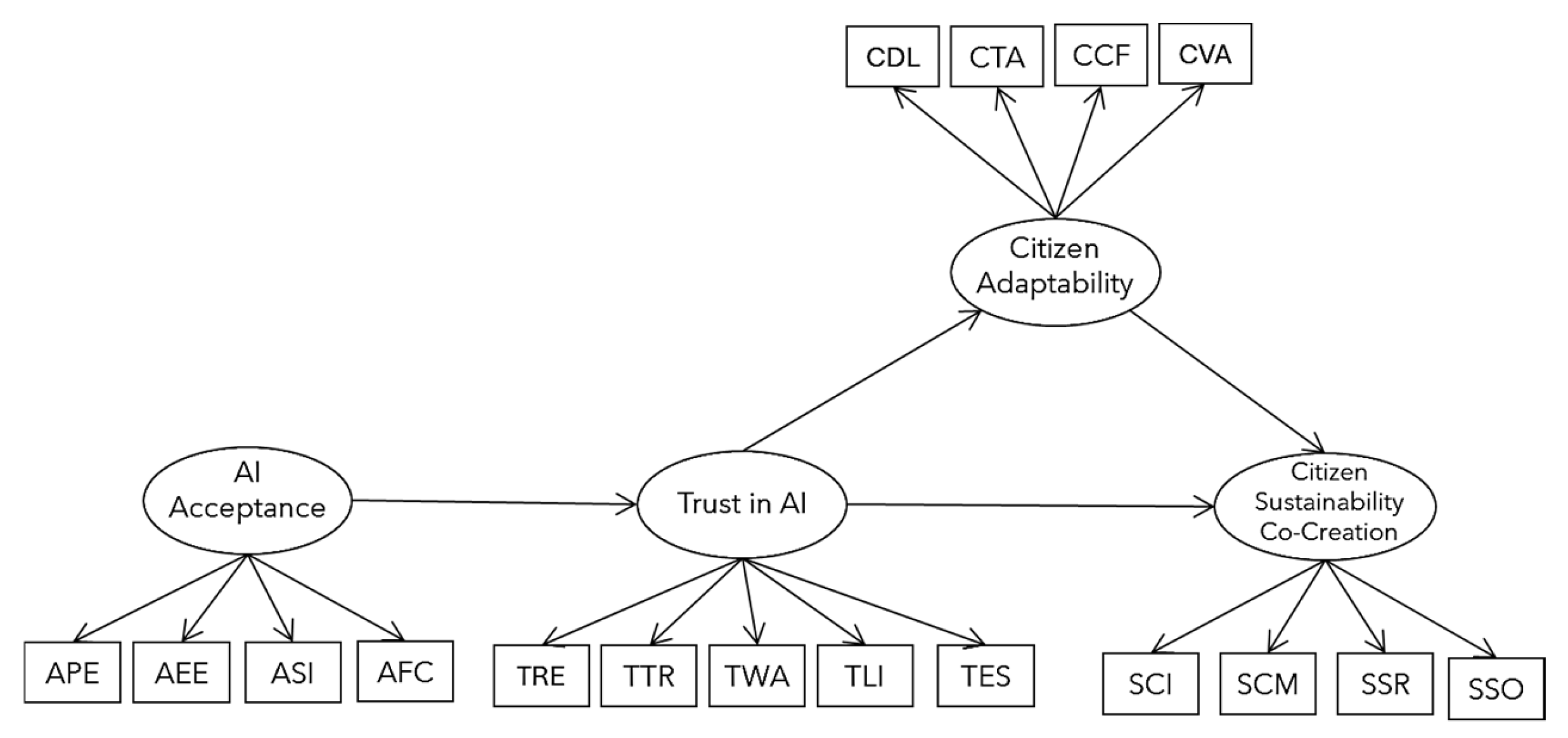
As illustrated in
Figure 1, the model comprises four latent constructs. AI Acceptance captures citizens’ initial willingness to engage with AI-enabled public services and is operationalized through multiple dimensions reflecting perceived performance benefits, effort requirements, social influence, and facilitating conditions. Trust in AI represents citizens’ evaluative judgments regarding the reliability, competence, transparency, and perceived alignment of AI systems with public values. Citizen Adaptability reflects citizens’ capacity to adjust to digitally mediated governance arrangements, including learning, coping with uncertainty, and modifying behavior in response to AI-enabled service processes. Citizen Sustainability Co-Creation is modeled as the outcome construct, capturing citizens’ active participation in generating social, institutional, and sustainability-related value through smart city initiatives.
The conceptual structure positions AI Acceptance as an entry condition that shapes citizens’ trust in AI and their adaptive capacity. Trust in AI is modeled as a mediating governance mechanism influencing how acceptance develops into reliance and legitimacy, while Citizen Adaptability represents a capability that sustains engagement over time. Sustainability co-creation is treated as an emergent outcome of these governance mechanisms rather than as a direct consequence of technology adoption alone. This configuration allows the study to move beyond adoption-centric perspectives and to test a mechanism-based explanation of how AI-enabled governance operates at the citizen level.
The unit of analysis is the individual citizen residing in smart city contexts where AI-enabled public services are in active use. The empirical assessment proceeds in two stages: first, the measurement model is evaluated to establish construct validity and reliability; second, the structural model is assessed to test the proposed causal relationships among the latent constructs. This design enables a rigorous examination of the pathways through which AI-enabled public services contribute to sustainability co-creation through citizen-centered governance mechanisms.
The causal relationships specified in the model should therefore be interpreted as theoretically informed explanatory pathways that reflect governance mechanisms operating at the citizen level, rather than as claims of deterministic or time-ordered causation.
3.2. Population and Sample
The target population of this study comprises citizens residing in smart city contexts in Thailand, where AI-enabled public services are actively implemented. Respondents were drawn from smart cities that have been officially certified under the national smart city program and identified as high-potential urban areas by the Digital Economy Promotion Agency (DEPA) [
23,
61]. These cities represent advanced stages of smart city development, characterized by the deployment of digital and AI-based public services across domains such as urban management, public administration, and citizen engagement. The unit of analysis is the individual citizen, reflecting the study’s focus on citizen-level governance mechanisms rather than organizational or system-level performance.
A non-probability sampling approach was employed, focusing on citizens who had direct or indirect exposure to AI-enabled public services. This approach is appropriate given the study’s emphasis on examining perceptual, behavioral, and adaptive responses to AI systems rather than estimating population-level prevalence. A total of 1002 valid responses were obtained and included in the analysis.
The adequacy of the sample size was assessed based on established recommendations for structural equation modeling. SEM guidelines commonly suggest a minimum ratio of 10–20 observations per free parameter to ensure stable parameter estimation and sufficient statistical power [
62,
63]. Given that the proposed model includes 55 free parameters, the recommended minimum sample size ranges from 550 to 1100 observations. The final sample of 1002 respondents exceeds the lower bound of this threshold and falls within the recommended range, providing adequate power and model stability for SEM estimation.
The achieved sample size also supports the estimation of mediation effects involving trust in AI and citizen adaptability, which typically require larger samples to detect indirect effects reliably. Accordingly, the sample is considered sufficient for testing the proposed causal relationships among AI acceptance, trust in AI, citizen adaptability, and sustainability co-creation.
3.3. Research Instrument
Data were collected using a structured questionnaire designed to measure the latent constructs specified in the conceptual model. Measurement items were adapted from established and validated scales in prior studies on AI acceptance, trust in AI, citizen adaptability, and sustainability co-creation, with wording refined to reflect the context of AI-enabled public services in smart cities. All items were measured using a five-point Likert scale ranging from 1 (“strongly disagree”) to 5 (“strongly agree”).
The questionnaire consisted of four sections corresponding to the study constructs. The AI Acceptance section captured citizens’ evaluations of AI-enabled public services in terms of perceived usefulness, ease of interaction, social influence, and facilitating conditions. The Trust in AI section measured perceptions of reliability, competence, transparency, and alignment with public values in AI-supported public services. The Citizen Adaptability section assessed respondents’ capacity to adjust to digitally mediated governance arrangements, including learning new interaction routines, coping with uncertainty, and modifying behavior in response to AI-enabled processes. The Citizen Sustainability Co-Creation section measured citizens’ active participation in contributing to social, institutional, and sustainability-related value through engagement with smart city initiatives.
The observed variables used to measure each latent construct are summarized as follows. AI Acceptance was measured using four dimensions: Performance Expectancy (APE), Effort Expectancy (AEE), Social Influence (ASI), and Facilitating Conditions (AFC). Trust in AI was operationalized through Reliability (TRE), Transparency (TTR), Emotional Safety (TES), Warmth (TWA), and Likability (TLI). Citizen Adaptability comprised Digital Literacy (CDL), Technology Adaptability (CTA), Cognitive Flexibility (CCF), and Value Alignment (CVA). Sustainability Co-Creation was assessed using Co-Implementation (SCI), Co-Communication (SCM), Shared Responsibility (SSR), and Sustainable Shared Ownership (SSO).
3.4. Validity and Reliability
The measurement properties of the research instrument were evaluated through reliability analysis and confirmatory factor analysis (CFA) to ensure the adequacy of the measurement model prior to testing the structural relationships. Reliability and validity were assessed using Cronbach’s alpha, composite reliability (CR), average variance extracted (AVE), and CFA-based fit indices, following established guidelines for structural equation modeling [
62,
63].
Internal consistency reliability was satisfactory across all latent constructs. Cronbach’s alpha values ranged from 0.680 to 0.839, meeting acceptable thresholds for behavioral research in complex social contexts. The overall reliability coefficient for the full measurement instrument was high (α = 0.979), indicating strong internal consistency. Composite reliability values for all constructs ranged from 0.93 to 0.96, further supporting the stability and consistency of the measures.
Convergent validity was supported by CFA results. All observed indicators loaded significantly on their respective latent constructs, with standardized factor loadings ranging from 0.81 to 0.90 (
p < 0.01). In addition, AVE values ranged from 0.71 to 0.78, exceeding the recommended minimum criterion of 0.50, indicating that each construct captured a substantial proportion of variance from its indicators [
62].
Discriminant validity was examined using the Fornell–Larcker criterion. The square root of AVE for each construct exceeded the corresponding inter-construct correlations, demonstrating that the latent constructs were empirically distinct despite their theoretical relatedness [
64]. No evidence of problematic multicollinearity or construct redundancy was observed.
Overall, the measurement model demonstrated an acceptable to good fit with the empirical data. CFA results indicated satisfactory model fit (χ
2/df = 4.504; RMSEA = 0.059; CFI = 0.977; TLI = 0.972; SRMR = 0.022). Given the large sample size, the chi-square statistic was expectedly significant; therefore, greater emphasis was placed on incremental and absolute fit indices, all of which met commonly accepted thresholds [
63]. These findings confirm that the measurement model provides a reliable and valid foundation for subsequent structural equation modeling.
3.5. Data Collection and Data Analysis
Data were collected through a cross-sectional survey administered to citizens residing in AI-enabled smart city contexts in Thailand. The questionnaire was distributed via both online and on-site channels to ensure accessibility and to capture respondents with varying levels of engagement with digital public services. Participation was voluntary, and responses were anonymized to reduce social desirability bias. After data screening, 1002 valid responses were retained for analysis.
Prior to model estimation, the dataset was examined for completeness, outliers, and multicollinearity. Missing data were minimal and handled using standard procedures appropriate for structural equation modeling (SEM). Given the study’s objective of testing theoretically specified causal relationships among multiple latent constructs measured by multiple indicators, SEM was selected as the primary analytical technique.
The analysis followed a two-stage SEM approach, in which the measurement model was first evaluated using confirmatory factor analysis (CFA), followed by estimation of the structural model to test the hypothesized relationships among AI acceptance, trust in AI, citizen adaptability, and sustainability co-creation, in line with established SEM practices [
62,
63]. Model estimation was conducted using maximum likelihood procedures.
Model fit was evaluated using multiple indices representing absolute, incremental, and residual-based fit, including χ
2/df, CFI, TLI, RMSEA, and SRMR, as commonly recommended in SEM research [
63,
65]. Path coefficients were assessed for statistical significance and substantive magnitude to evaluate the proposed causal relationships. Mediation effects were examined by assessing the significance of indirect paths within the structural model, following standard SEM conventions [
63].
This analytical strategy allows for a rigorous examination of how AI-enabled governance mechanisms operate at the citizen level by explicitly testing both direct and indirect pathways linking AI acceptance to sustainability co-creation through trust in AI and adaptive capacity.
Additional details on measurement items, reliability analysis, and extended model representations are provided in the
Supplementary Materials.
4. Results
4.1. Descriptive Statistics
The final sample consisted of 1002 respondents drawn from three certified smart city contexts in Thailand, namely Samyan (Bangkok), Khon Kaen, and Chiang Mai University. These locations represent distinct smart city environments with active deployment of digital and AI-enabled public services. The inclusion of multiple smart city contexts aimed to capture diversity in citizens’ exposure to AI-enabled governance, rather than to conduct city-level comparisons.
As summarized in
Table 1, the sample was dominated by respondents of working and study age, with the largest proportion aged between 18 and 24 years. Most respondents held at least a bachelor’s degree and were either students or employed in the private or public sector. This demographic profile reflects a population with relatively high digital literacy and frequent interaction with online public services, which is appropriate for examining perceptions and behaviors related to AI-enabled smart city systems.
Descriptive statistics for the main study constructs are reported in
Table 2, which presents the overall mean scores and standard deviations for AI Acceptance, Trust in AI, Citizen Adaptability, and Sustainability Co-Creation. Overall, respondents reported high mean levels across all constructs, indicating generally positive attitudes toward AI-enabled public services, strong perceived capacity to adapt to AI-driven systems, and a high willingness to engage in sustainability-related co-creation activities through digital and AI-supported platforms.
The demographic profile of the respondents indicates that the sample is dominated by younger and digitally engaged citizens, particularly individuals aged 18–24. This composition reflects the characteristics of populations that are more likely to interact with AI-enabled public services and digital platforms in smart city contexts. As such, the descriptive statistics primarily capture perceptions and behavioral tendencies of citizens who are relatively familiar with digital governance environments, rather than representing the full demographic diversity of urban populations.
Across all constructs, the observed standard deviations indicate sufficient variability in responses, supporting the suitability of the dataset for subsequent structural equation modeling. Detailed descriptive statistics for each construct dimension are provided in the
Supplementary Materials, allowing full transparency while maintaining conciseness in the main text. Together, these descriptive results confirm that the data are appropriate for examining the theoretically specified relationships in the proposed model.
4.2. Measurement Model Assessment
The measurement model was evaluated using confirmatory factor analysis (CFA) to assess the reliability, convergent validity, and discriminant validity of the latent constructs in the AI–Urban Citizen Sustainability Co-Creation Framework (AI–CSCF). The model comprises four higher-order constructs—AI Acceptance (AA), Trust in AI (TA), Citizen Adaptability (CA), and Citizen Sustainability Co-Creation (CSCC)—measured by multiple observed indicators.
4.2.1. Reliability and Convergent Validity
Internal consistency and convergent validity were assessed using Cronbach’s alpha (α), composite reliability (CR), average variance extracted (AVE), and standardized factor loadings. As summarized in
Table 3, all constructs exhibited strong reliability, with Cronbach’s alpha and CR values exceeding the recommended threshold of 0.70. AVE values ranged from 0.71 to 0.78, indicating that each construct explained more than half of the variance of its indicators.
Standardized factor loadings for all indicators were statistically significant (p < 0.01) and exceeded 0.80, confirming strong convergent validity. These results demonstrate that the measurement items reliably represent their intended latent constructs.
4.2.2. Discriminant Validity
Discriminant validity was examined using the Fornell–Larcker criterion. As reported in
Table 4, the square root of the AVE for each construct exceeded its correlations with other constructs, indicating adequate discriminant validity. Although some inter-construct correlations were moderately high—reflecting theoretically related dimensions—the results confirm that all constructs remain empirically distinct.
Overall, the CFA results indicate that the measurement model possesses satisfactory reliability and construct validity, supporting its suitability for subsequent structural model analysis. For completeness, detailed reliability statistics and item-level CFA results are reported in the
Supplementary Materials (Tables S7 and S8 and Figure S1).
4.3. Structural Model Results
The structural model was estimated to examine the hypothesized causal relationships among AI Acceptance, Trust in AI, Citizen Adaptability, and Sustainability Co-Creation. Overall model fit was assessed prior to interpreting the structural paths. As reported in
Table 5, the structural model demonstrated a good fit with the empirical data (χ
2 = 3790.541, df = 1867, χ
2/df = 2.030). Incremental and absolute fit indices further confirmed model adequacy, with RMSEA = 0.032, CFI = 0.948, TLI = 0.945, and SRMR = 0.030, all of which fall within commonly accepted thresholds for SEM model evaluation. These results indicate that the proposed structural model provides an adequate representation of the observed data.
Path estimates from the structural model are summarized in
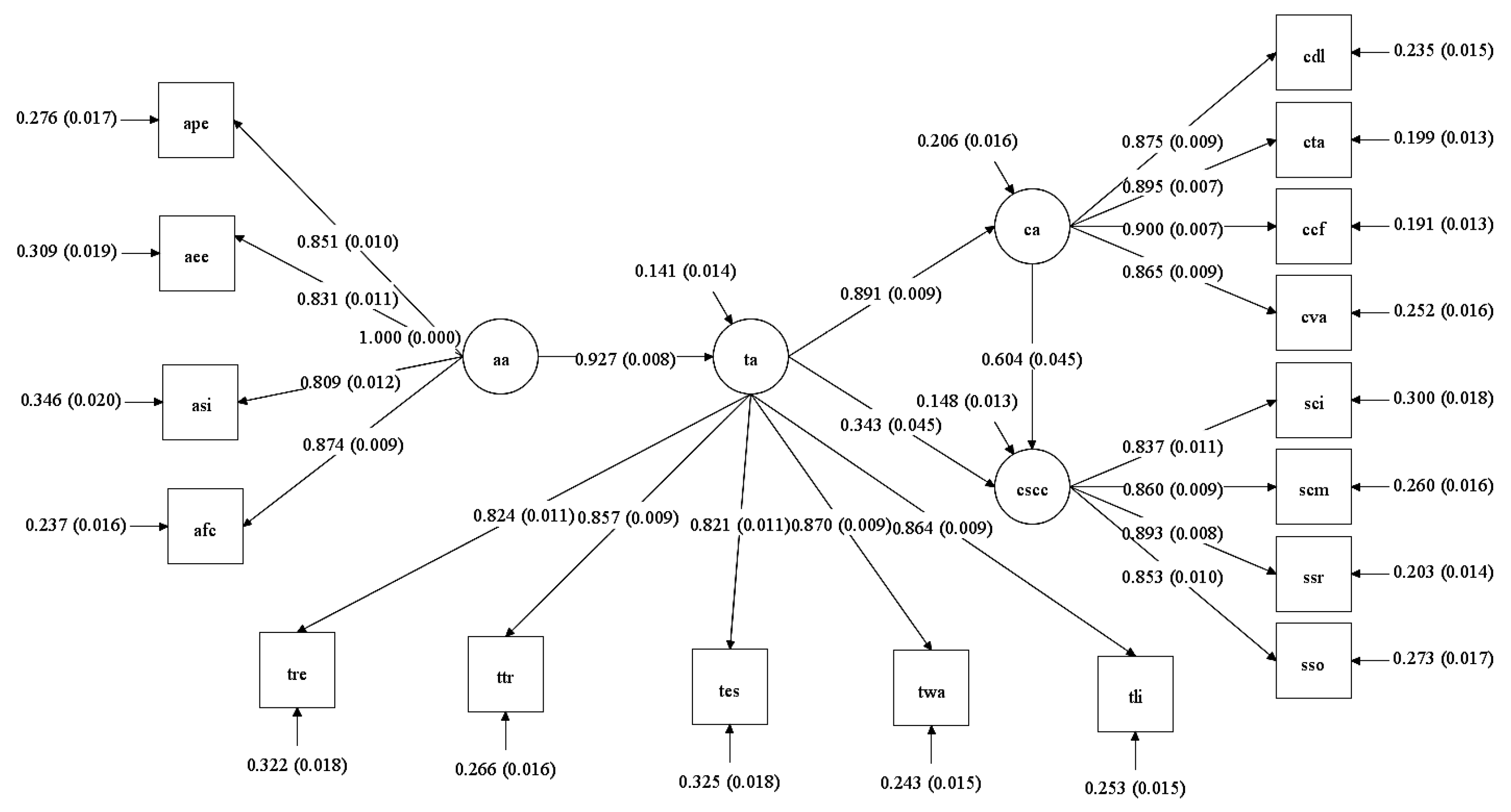
Table 6 and illustrated in
Figure 2, which presents the standardized structural equation model. AI Acceptance exhibited significant positive associations with Trust in AI (β = 0.218,
p < 0.01), Citizen Adaptability (β = 0.199,
p < 0.01), and Sustainability Co-Creation (β = 0.195,
p < 0.01). These findings indicate that citizens’ acceptance of AI-enabled public services is directly associated with both governance mechanisms and sustainability-oriented outcomes.
Trust in AI also showed significant positive effects on Citizen Adaptability (β = 0.201, p < 0.01) and Sustainability Co-Creation (β = 0.197, p < 0.01), highlighting its role as a mediating governance mechanism that strengthens citizens’ capacity to engage with AI-enabled systems and participate in sustainability-related activities. In addition, Citizen Adaptability exhibited a significant positive relationship with Sustainability Co-Creation (β = 0.213, p < 0.01), suggesting that adaptive capacity plays a critical role in translating AI-related perceptions into active co-creation behaviors.
Taken together, the structural results support the proposed mechanism-based framework, demonstrating that Sustainability Co-Creation is shaped by both direct and indirect pathways originating from AI Acceptance and operating through Trust in AI and Citizen Adaptability. The pattern of relationships underscores the importance of citizen-centered governance mechanisms in enabling AI-driven smart city initiatives to contribute to sustainability outcomes.
Figure 2 presents the structural equation model with standardized estimates, enabling direct comparison of the relative strengths of the hypothesized relationships. All standardized factor loadings exceed commonly accepted thresholds, and all hypothesized structural paths are statistically significant, indicating adequate measurement quality and internal consistency. No post hoc model modifications were required. For methodological transparency, the standardized item-level measurement model and an alternative representation of the structural model are reported in
Supplementary Figures S1 and S2, respectively.
4.4. Mediation Analysis
To further examine the underlying governance mechanisms proposed in the AI–Urban Citizen Sustainability Co-Creation Framework (AI–CSCF), mediation analysis was conducted to assess the direct, indirect, and total effects among AI Acceptance (AA), Trust in AI (TA), Citizen Adaptability (CA), and Sustainability Co-Creation (CSCC). This analysis allows for a more precise understanding of how AI acceptance translates into sustainability-related outcomes through intermediate constructs.
The results indicate that AI Acceptance (AA) does not exert a direct effect on Sustainability Co-Creation (CSCC). Instead, its influence operates entirely through indirect pathways, providing evidence consistent with full mediation. As reported in
Table 7, the total indirect effect of AA on CSCC is substantial (β = 0.770,
p < 0.01), highlighting that acceptance of AI-enabled public services contributes to sustainability co-creation only when it is translated into trust and adaptive capacity.
Two indirect pathways were identified. First, the sequential pathway AA → TA → CA → CSCC exhibits a significant indirect effect (β = 0.471, p < 0.01), indicating that AI acceptance enhances trust in AI, which in turn strengthens citizens’ adaptive capacity, ultimately leading to higher levels of sustainability co-creation. Second, the pathway AA → TA → CSCC is also significant (β = 0.299, p < 0.01), suggesting that trust in AI independently enables citizens to engage in sustainability-related activities even without the full mediation of adaptability.
Trust in AI (TA) emerged as the most influential mediating construct in the model. TA demonstrates both a significant direct effect on CSCC (β = 0.325, p < 0.01) and a strong indirect effect through Citizen Adaptability (β = 0.510, p < 0.01), resulting in the largest total effect on sustainability co-creation (β = 0.835, p < 0.01). These findings underscore the central role of trust in shaping the translation of technological acceptance into sustained participatory behavior within AI-enabled governance systems.
Citizen Adaptability (CA) also shows a significant direct effect on CSCC (β = 0.325, p < 0.01) and functions as a critical reinforcing mechanism within the mediation structure. While the direct effect of AA on CA is relatively modest, the indirect influence transmitted through TA substantially amplifies citizens’ adaptive capacity, which in turn strengthens sustainability co-creation outcomes.
Overall, the mediation results demonstrate that sustainability co-creation in smart cities is not a direct consequence of AI acceptance, but rather the outcome of a multi-stage governance process in which trust in AI and citizen adaptability play pivotal roles. The findings confirm the mechanism-based structure of the AI–CSCF and provide empirical support for the theorized sequence linking acceptance, trust, adaptability, and sustainability-oriented citizen participation.
4.5. Summary of Hypothesis Testing
Based on the structural equation modeling and mediation analyses, the proposed hypotheses of the AI–Urban Citizen Sustainability Co-Creation Framework (AI–CSCF) were systematically evaluated. The results indicate that the hypothesized causal relationships among AI Acceptance, Trust in AI, Citizen Adaptability, and Sustainability Co-Creation are largely supported by the empirical data.
Specifically, AI Acceptance demonstrates significant positive effects on Trust in AI and Citizen Adaptability, supporting its role as an upstream condition shaping citizen-level governance mechanisms. Trust in AI exerts significant direct effects on both Citizen Adaptability and Sustainability Co-Creation, while Citizen Adaptability also shows a significant direct effect on Sustainability Co-Creation. These findings support the hypothesized causal paths within the structural model.
Mediation analysis further reveals that the relationship between AI Acceptance and Sustainability Co-Creation is fully mediated by Trust in AI and Citizen Adaptability. Trust in AI plays a dominant mediating role, exerting both direct and indirect effects on sustainability co-creation, whereas Citizen Adaptability functions as a reinforcing mechanism that strengthens the translation of trust into participatory sustainability outcomes.
An overview of the hypothesis testing results is provided in
Table 8, which summarizes the status of each hypothesis based on the estimated path coefficients and significance levels.
5. Discussion
The discussion of findings is guided by a theory-driven interpretation of the structural relationships identified in the model. Given the cross-sectional design of the study, the results are discussed in terms of theoretically consistent associations among AI acceptance, trust in AI, citizen adaptability, and sustainability co-creation, rather than as evidence of definitive causal effects.
The relatively high mean values observed across the core constructs, accompanied by moderate dispersion, warrant cautious interpretation. This distribution likely reflects the study context, in which respondents are predominantly digitally engaged citizens interacting with AI-enabled public services in early-stage smart governance environments. In such settings, positive response tendencies may arise from policy signaling, familiarity with digital platforms, and normative support for smart city initiatives, rather than from uniformly strong effects across the entire urban population.
Importantly, while restricted variance can attenuate effect sizes, the structural relationships identified in the model remain theoretically consistent and statistically robust within this context. The findings, therefore, reflect context-dependent associations among AI acceptance, trust in AI, citizen adaptability, and sustainability co-creation, rather than as universal claims applicable to all demographic segments or stages of smart city development.
5.1. From AI Acceptance to Sustainability: Why Trust and Adaptability Matter
The finding that AI Acceptance does not exert a direct effect on Sustainability Co-Creation, but instead operates entirely through indirect pathways, challenges technology-centric interpretations of smart city success. While technology acceptance models have traditionally focused on usage intention and perceived usefulness, the present results demonstrate that acceptance is a necessary but insufficient condition for sustainability-oriented civic engagement. This aligns with critical smart city scholarship, arguing that cities can become technologically advanced without becoming socially sustainable or democratically legitimate [
37,
66].
Trust in AI emerged as the most influential mediating mechanism in the model, exerting both direct and indirect effects on sustainability co-creation. This finding reinforces recent evidence that trust in algorithmic systems is not easily manufactured through short-term ethical signaling or transparency claims, but instead reflects deeper perceptions of reliability, fairness, and institutional alignment [
9,
10]. In the context of AI-enabled urban governance, trust functions as a governance enabler, shaping whether citizens are willing to share data, engage with digital platforms, and participate in collective sustainability initiatives.
Citizen Adaptability further strengthens this process by translating trust into action. The strong effect of adaptability on sustainability co-creation highlights that digital skills, cognitive flexibility, and value alignment are not peripheral competencies but core capabilities required for participatory smart city governance. This supports arguments that smart cities must be understood as socio-technical systems, where citizens’ adaptive capacities condition the effectiveness of technological interventions [
51,
54].
5.2. Reframing Smart Governance as Co-Creation Infrastructure
The structural relationships observed in this study contribute to an emerging shift in smart governance research—from viewing governance as a control mechanism to understanding it as an infrastructure for co-creation. Rather than positioning citizens as passive users or data sources, the results indicate that sustainability outcomes depend on citizens’ ability to meaningfully engage with AI-enabled systems through trust-based and capability-driven pathways.
This finding resonates with participatory city frameworks that emphasize co-implementation, co-communication, and shared responsibility as central dimensions of sustainable urban development [
52,
57]. It also aligns with recent critiques of algorithmic bureaucracy, which warn that opaque or unaccountable AI systems can undermine legitimacy even when technically efficient [
10,
58]. In contrast, the AI–CSCF model demonstrates that governance quality—not algorithmic sophistication—is the primary determinant of whether AI contributes to sustainability co-creation.
5.3. Implications for Smart Cities in the Global South
The Thai smart city context provides important insights for Global South settings, where digital transformation often proceeds rapidly but unevenly. Consistent with prior studies in Thailand and Southeast Asia, the results suggest that top-down digitalization risks disengagement unless accompanied by trust-building and citizen capacity development [
21,
67]. The strong mediating role of trust and adaptability indicates that investments in AI infrastructure must be matched by investments in governance design, digital literacy, and participatory institutions.
To ground the interpretation of the findings in concrete governance contexts, respondents reported prior exposure to a range of AI-enabled public services across multiple domains.
Table 9 summarizes illustrative examples of these services, reflecting everyday interactions with AI-enabled governance systems in Thai smart cities.
Importantly, the absence of a direct AA → CSCC path cautions policymakers against assuming that expanding AI services will automatically generate sustainability-oriented civic behavior. Instead, the findings suggest that AI-enabled urban governance must be intentionally designed to foster trust and adaptive engagement, particularly in societies with diverse digital competencies and historical sensitivities toward state technologies.
5.4. Theoretical Contributions
This study advances smart city and sustainability scholarship in three key ways. First, it empirically demonstrates that technology acceptance and sustainability co-creation are conceptually distinct phenomena, linked through governance mechanisms rather than direct causality. Second, it integrates trust in AI and citizen adaptability into a unified causal framework, clarifying their complementary roles in enabling participatory sustainability outcomes. Third, by operationalizing sustainability co-creation as a multidimensional construct, the study moves beyond abstract notions of participation toward measurable civic action within AI-enabled governance systems.
Together, these contributions support a governance-centered interpretation of smart cities, where AI becomes a catalyst for sustainability only when embedded in trusted, adaptive, and participatory institutional arrangements.
6. Conclusions
6.1. Summary of Key Findings and Contributions
This study examined how artificial intelligence (AI) adoption in smart cities translates into citizen sustainability co-creation by developing and empirically testing the AI–Urban Citizen Sustainability Co-Creation Framework (AI–CSCF). Drawing on survey data from Thai smart city contexts and structural equation modeling, the findings indicate that AI acceptance alone does not directly lead to sustainability co-creation. Instead, its influence operates through a structured sequence of trust in AI and citizen adaptability, highlighting the central role of governance-related mechanisms in shaping participatory sustainability outcomes.
By explicitly distinguishing technology acceptance from sustainability co-creation, this study contributes to the smart city and AI governance literature in three key ways. First, it advances a citizen-centered, mechanism-based explanation of how AI-enabled governance systems support sustainability outcomes. Second, it empirically clarifies the mediating roles of trust in AI and citizen adaptability, moving beyond adoption-centric interpretations of smart city success. Third, by operationalizing sustainability co-creation as a multidimensional construct, the study provides a concrete analytical framework for examining participatory governance in AI-enabled urban contexts, particularly in the Global South.
6.2. Limitations and Future Research
Several limitations should be acknowledged when interpreting the findings. First, the study sample primarily represents digitally engaged citizens in selected Thai smart city contexts, with a high proportion of younger respondents. While this focus is appropriate for examining citizen–AI interactions in early-stage smart governance environments, it limits the generalizability of the findings to older populations or groups with lower levels of digital access and literacy. The results should therefore be interpreted as reflecting bounded external validity within digitally active urban segments rather than the entire urban population.
Second, the cross-sectional research design constrains the ability to capture the dynamic evolution of trust in AI, citizen adaptability, and sustainability co-creation over time. Although the proposed framework specifies theoretically grounded explanatory pathways, temporal causal inference cannot be established. Future research could address these limitations by employing longitudinal designs, more demographically balanced samples, comparative analyses across additional certified smart cities, or multi-group and multi-level SEM approaches. Such extensions would allow deeper examination of how age, digital experience, and institutional context shape AI acceptance, trust formation, and sustainability co-creation in diverse urban settings.