Blue Carbon in the Persian Gulf: Evidence of Phytoplankton Contribution to Carbon in Sediments

 ,
,  ,
, 
Abstract
1. Introduction
2. Materials and Methods
3. Results
4. Discussion
5. Conclusions
Supplementary Materials
Author Contributions
Funding
Institutional Review Board Statement
Informed Consent Statement
Data Availability Statement
Acknowledgments
Conflicts of Interest
References
- Mcleod, E.; Chmura, G.L.; Bouillon, S.; Salm, R.; Björk, M.; Duarte, C.M.; Lovelock, C.E.; Schlesinger, W.H.; Silliman, B.R. A blueprint for blue carbon: Toward an improved understanding of the role of vegetated coastal habitats in sequestering CO2. Front. Ecol. Environ. 2011, 9, 552–560. [Google Scholar] [CrossRef]
- Costa, M.; Macreadie, P. The Evolution of Blue Carbon Science. Wetlands 2022, 42, 109. [Google Scholar] [CrossRef]
- Nellemann, C.; Corcoran, E.; Duarte, C.M.; Valdés, L.; De Young, C.; Fonseca, L.; Grimsditch, G. Blue Carbon—A Rapid Response Assessment; United Nations Environment Programme, GRID-Arendal: Arendal, Norway, 2009; 80p, ISBN 978-82-7701-060-1. Available online: www.grida.no (accessed on 27 August 2025).
- Filbee-Dexter, K.; Wernberg, T. Substantial blue carbon in overlooked Australian kelp forests. Sci. Rep. 2020, 10, 12341. [Google Scholar] [CrossRef]
- Hill, R.; Bellgrove, A.; Macreadie, P.I.; Petrou, K.; Beardall, J.; Steven, A.; Ralph, P.J. Can macroalgae contribute to blue carbon? An Australian perspective. Limnol. Oceanogr. 2015, 60, 1689–1706. [Google Scholar] [CrossRef]
- Krause-Jensen, D.; Lavery, P.; Serrano, O.; Marbà, N.; Masque, P.; Duarte, C.M. Sequestration of macroalgal carbon: The elephant in the Blue Carbon room. Biol. Lett. 2018, 14, 20180236. [Google Scholar] [CrossRef]
- Trevathan-Tackett, S.M.; Kelleway, J.; Macreadie, P.I.; Beardall, J.; Ralph, P.; Bellgrove, A. Comparison of marine macrophytes for their contributions to blue carbon sequestration. Ecology 2015, 96, 3043–3057. [Google Scholar] [CrossRef] [PubMed]
- Raven, J. Blue carbon: Past, present and future, with emphasis on macroalgae. Biol. Lett. 2018, 14, 20180336. [Google Scholar] [CrossRef]
- Smith, S.V. Marine macrophytes as a global carbon sink. Science 1981, 211, 838–840. [Google Scholar] [CrossRef]
- Duarte, C.M.; Middelburg, J.J.; Caraco, N. Major role of marine vegetation on the oceanic carbon cycle. Biogeosciences 2005, 2, 1–8. [Google Scholar] [CrossRef]
- Duarte, C.M.; Losada, I.J.; Hendriks, I.E.; Mazarrasa, I.; Marbà, N. The role of coastal plant communities for climate change mitigation and adaptation. Nat. Clim. Change 2013, 3, 961–968, Correction in Nat. Clim. Change 2016, 6, 802. https://doi.org/10.1038/nclimate3062. [Google Scholar] [CrossRef]
- Ziegler, S.; Benner, R. Dissolved organic carbon cycling in a subtropical seagrass-dominated lagoon. Mar. Ecol. Progress. Ser. 1999, 180, 149–160. [Google Scholar] [CrossRef]
- Nellemann, C.; Corcoran, E.; Duarte, C.; Valdes, L.; Young, C.; Fonseca, L.; Grimsditch, G. Blue Carbon—The Role of Healthy Oceans in Binding Carbon; UN Environment (United Nations Environment Programme): Nairobi, Kenya, 2009. [Google Scholar]
- Lovelock, C.E.; Duarte, C.M. Dimensions of Blue Carbon and emerging perspectives. Biol. Lett. 2019, 15, 20180781. [Google Scholar] [CrossRef]
- Adame, M.F.; Connolly, R.M.; Turschwell, M.P.; Lovelock, C.E.; Fatoyinbo, T.; Lagomasino, D.; Goldberg, L.A.; Holdorf, J.; Friess, D.A.; Sasmito, S.D.; et al. Future carbon emissions from global mangrove forest loss. Glob. Change Biol. 2021, 27, 2856–2866. [Google Scholar] [CrossRef]
- Arkema, K.; Guannel, G.; Verutes, G.; Wood, S.; Guerry, A.; Ruckelshaus, M.; Kareiva, P.; Lacayo-Emery, M.; Silver, J. Coastal habitats shield people and property from sea-level rise and storms. Nat. Clim. Change 2013, 3, 913–918. [Google Scholar] [CrossRef]
- Menéndez, P.; Losada, I.J.; Torres-Ortega, S.; Narayan, S.; Beck, M.W. The Global Flood Protection Benefits of Mangroves. Sci. Rep. 2020, 10, 4404. [Google Scholar] [CrossRef]
- Jänes, H.; Macreadie, P.I.; Zu Ermgassen, P.S.E.; Gair, J.R.; Treby, S.; Reeves, S.; Nicholson, E.; Ierodiaconou, D.; Carnell, P. Quantifying fisheries enhancement from coastal vegetated ecosystems. Ecosyst. Serv. 2020, 43, 101105. [Google Scholar] [CrossRef]
- Kazemi, A.; Castillo, L.; Curet, O.M. Mangrove roots model suggest an optimal porosity to prevent erosion. Sci. Rep. 2021, 11, 9969. [Google Scholar] [CrossRef] [PubMed]
- Macreadie, P.I.; Costa, M.D.P.; Atwood, T.B.; Friess, D.A.; Kelleway, J.J.; Kennedy, H.; Lovelock, C.E.; Serrano, O.; Duarte, C.M. Blue carbon as a natural climate solution. Nat. Rev. Earth Environ. 2021, 2, 826–839. [Google Scholar] [CrossRef]
- Herr, D.; von Unger, M.; Laffoley, D.; McGivern, A. Pathways for implementation of blue carbon initiatives. Aquat. Conserv. Mar. Freshw. Ecosyst. 2017, 27, 116–129. [Google Scholar] [CrossRef]
- WHO. World Bank Announces New Blue Economy Financing Program for African Countries; The World Bank: Washington, DC, USA, 2022; Available online: https://www.worldbank.org/en/news/press-release/2022/11/16/world-bank-announces-new-blue-economy-financing-program-for-african-countries (accessed on 31 August 2025).
- Jiang, L.; Yang, T.; Yu, J. Global trends and prospects of blue carbon sinks: A bibliometric analysis. Environ. Sci. Pollut. Res. 2022, 29, 65924–65939. [Google Scholar] [CrossRef]
- Lai, Q.; Ma, J.; He, F.; Zhang, A.; Pei, D.; Wei, G.; Zhu, X. Research Development, Current Hotspots, and Future Directions of Blue Carbon: A Bibliometric Analysis. Water 2022, 14, 1193. [Google Scholar] [CrossRef]
- Krause-Jensen, D.; Duarte, C.M. Substantial role of macroalgae in marine carbon sequestration. Nat. Geosci. 2016, 9, 737–742. [Google Scholar] [CrossRef]
- Ortega, A.; Geraldi, N.R.; Alam, I.; Kamau, A.A.; Acinas, S.G.; Logares, R.; Gasol, J.M.; Massana, R.; Krause-Jensen, D.; Duarte, C.M. Important contribution of macroalgae to oceanic carbon sequestration. Nat. Geosci. 2019, 12, 748–754. [Google Scholar] [CrossRef]
- Pessarrodona, A.; Filbee-Dexter, K.; Krumhansl, K.A.; Pedersen, M.F.; Moore, P.J.; Wernberg, T. A global dataset of seaweed net primary productivity. Sci. Data 2022, 9, 484. [Google Scholar] [CrossRef] [PubMed]
- Boyd, P.W.; Bach, L.T.; Hurd, C.L.; Paine, E.; Raven, J.A.; Tamsitt, V. Potential negative effects of ocean afforestation on offshore ecosystems. Nat. Ecol. Evol. 2022, 6, 675–683. [Google Scholar] [CrossRef]
- Filbee-Dexter, K.; Pessarrodona, A.; Duarte, C.; Krause-Jensen, D.; Hancke, K.; Smale, D.; Wernberg, T. Seaweed forests are carbon sinks that may help mitigate CO2 emissions: A comment on Gallagher et al. (2022). ICES J. Mar. Sci. 2023, 80, 1814–1819. [Google Scholar] [CrossRef]
- Gallagher, J.B.; Shelamoff, V.; Layton, C. Seaweed ecosystems may not mitigate CO2 emissions. ICES J. Mar. Sci. 2022, 79, 585–592. [Google Scholar] [CrossRef]
- Ciais, P.; Sabine, C.; Bala, G.; Bopp, L.; Brovkin, V.; Canadell, J.; Chhabra, A.; DeFries, R.; Galloway, J.; Heimann, M.; et al. Carbon and Other Biogeochemical Cycles. In: Climate Change 2013: The Physical Science Basis. In Contribution of Working Group I to the Fifth Assessment Report of the Intergovernmental Panel on Climate Change; Stocker, T.F., Qin, D., Plattner, G.-K., Tignor, M., Allen, S.K., Boschung, J., Nauels, A., Xia, Y., Bex, V., Midgley, P.M., Eds.; Cambridge University Press: Cambridge, UK; New York, NY, USA, 2013; pp. 465–570. [Google Scholar]
- Boysen-Jensen, P. Studies concerning the organic matter of the sea bottom. Rep. Dan. Biol. Stn. 1914, 22, 1–39. [Google Scholar]
- Howard, J.; Sutton-Grier, A.; Herr, D.; Kleypas, J.; Landis, E.; Mcleod, E.; Pidgeon, E.; Simpson, S. Clarifying the role of coastal and marine systems in climate mitigation. Front. Ecol. Environ. 2017, 15, 42–50. [Google Scholar] [CrossRef]
- IPCC. 2013 Supplement to the 2006 IPCC Guidelines for National Greenhouse Gas Inventories: Wetlands. In Methodological Guidance on Lands with Wet and Drained Soils, and Constructed Wetlands for Wastewater Treatment; IPCC, Hiraishi, T., Krug, T., Tanabe, K., Srivastava, N., Baasansuren, J., Fukuda, M., Troxler, T.G., Eds.; Intergovernmental Panel on Climate Change: Geneva, Switzerland, 2014. [Google Scholar]
- Ahmed, N.; Glaser, M. Coastal aquaculture, mangrove deforestation and blue carbon emissions: Is REDD+ a solution? Mar. Policy 2016, 66, 58–66. [Google Scholar] [CrossRef]
- Needelman, B.; Emmer, I.; Emmett-Mattox, S.; Crooks, S.; Megonigal, P.; Myers, D.; Oreska, M.; McGlathery, K. The Science and Policy of the Verified Carbon Standard Methodology for Tidal Wetland and Seagrass Restoration. Estuaries Coasts 2018, 41, 2159–2171. [Google Scholar] [CrossRef]
- Kelleway, J.; Serrano, O.; Baldock, J.; Cannard, T.; Lavery, P.; Lovelock, C.; Macreadie, P.; Masqué, P.; Saintilan, N.; Steven, A. Technical Review of Opportunities for Including Blue Carbon in the Australian Government’s Emissions Reduction Fund. Final Report. Prepared for the Department of the Environment and Energy; CSIRO: Canberra, Australia, 2017. [Google Scholar]
- Krauss, K.W.; Noe, G.B.; Duberstein, J.A.; Conner, W.H.; Stagg, C.L.; Cormier, N.; Jones, M.C.; Bernhardt, C.E.; Graeme Lockaby, B.; From, A.S.; et al. The Role of the Upper Tidal Estuary in Wetland Blue Carbon Storage and Flux. Glob. Biogeochem. Cycles 2018, 32, 817–839. [Google Scholar] [CrossRef]
- Duarte, C.M.; Wu, J.; Xiao, X.; Bruhn, A.; Krause-Jensen, D. Can Seaweed Farming Play a Role in Climate Change Mitigation and Adaptation? Front. Mar. Sci. 2017, 4, 100. [Google Scholar] [CrossRef]
- Habibi, N.; Uddin, S.; Al-Sarawi, H.; Aldhameer, A.; Shajan, A.; Zakir, F.; Abdul Razzack, N.; Alam, F. Metagenomes from Coastal Sediments of Kuwait: Insights into the Microbiome, Metabolic Functions and Resistome. Microorganisms 2023, 11, 531. [Google Scholar] [CrossRef]
- Dobin, A.; Davis, C.A.; Schlesinger, F.; Drenkow, J.; Zaleski, C.; Jha, S.; Batut, P.; Chaisson, M.; Gingeras, T.R. STAR: Ultrafast universal RNA-seq aligner. Bioinformatics 2013, 29, 15–21. [Google Scholar] [CrossRef]
- Li, H. Minimap2: Pairwise alignment for nucleotide sequences. Bioinformatics 2018, 34, 3094–3100. [Google Scholar] [CrossRef]
- Buchfink, B.; Xie, C.; Huson, D.H. Fast and sensitive protein alignment using DIAMOND. Nat. Methods 2015, 12, 59–60. [Google Scholar] [CrossRef]
- Bankevich, A.; Nurk, S.; Antipov, D.; Gurevich, A.A.; Dvorkin, M.; Kulikov, A.S.; Lesin, V.M.; Nikolenko, S.I.; Pham, S.; Prjibelski, A.D. SPAdes: A new genome assembly algorithm and its applications to single-cell sequencing. J. Comput. Biol. 2012, 19, 455–477. [Google Scholar] [CrossRef] [PubMed]
- Langmead, B.; Salzberg, S.L. Fast gapped-read alignment with Bowtie 2. Nat. Methods 2012, 9, 357–359. [Google Scholar] [CrossRef] [PubMed]
- Baillie, V.L.; Madhi, S.A.; Ahyong, V.; Olwagen, C.P. Metagenomic sequencing of post-mortem tissue samples for the identification of pathogens associated with neonatal deaths. Nat. Commun. 2023, 14, 5373. [Google Scholar] [CrossRef] [PubMed]
- Almahasheer, H. Spatial coverage of mangrove communities in the Arabian Gulf. Environ. Monit. Assess. 2018, 190, 85. [Google Scholar] [CrossRef]
- ROPME. Blue Carbon Inventory for the ROPME Sea Area; Benson, L., Kroger, S., Howes, E., Procter, W., Martinez, R., Le Quesne, W., Eds.; Regional Organization for Protection of Marine Environment: Kuwait City, Kuwait, 2021; 24p. [Google Scholar]
- Habshi, A.A.; Youssef, T.; Aizpuru, M.; Blasco, F. New mangrove ecosystem data along the UAE coast using remote sensing. Aquat. Ecosyst. Health Manag. 2007, 10, 309–319. [Google Scholar] [CrossRef]
- Ghorbanian, A.; Ahmadi, S.A.; Amani, M.; Mohammadzadeh, A.; Jamali, S. Application of Artificial Neural Networks for Mangrove Mapping Using Multi-Temporal and Multi-Source Remote Sensing Imagery. Water 2022, 14, 244. [Google Scholar] [CrossRef]
- Cookson, P.; Shoji, T.; Jupp, B.P. A review of 10 years of scientific studies on Mangroves in Oman (1990-2001). In Proceedings of the 2nd International Symposium and Workshop on Arid Zone Environments, Abu Dhabi, United Arab Emirates, 22–24 December 2001. [Google Scholar]
- Al-Mansoori, N.; Das, H.S. Seagrasses of the United Arab Emirates. In A Natural History of the Emirates; Burt, J.A., Ed.; Springer Nature Switzerland: Cham, Switzerland, 2024; pp. 267–285. [Google Scholar] [CrossRef]
- BCSR. Development Plan Marine and Coastal Evironmental Database for Bahrain; Bahrain Centre for Studies and Research (BCSR): Riffa, Bahrain, 2001. [Google Scholar]
- Al-Bader, D.A.; Shuail, D.A.; Al-Hasan, R.; Suleman, P. Intertidal seagrass Halodule uninervis: Factors controlling its density, biomass and shoot length. Kuwait J. Sci. 2014, 41, 171–192. [Google Scholar]
- Jones, D.A.; Price, A.R.G.; Al-Yamani, F.; Al-Zaidan, A. Coastal and marine ecology. In The Gulf Ecosystem: Health and Sustainability; Khan, N.H., Munawar, M., Price, A.R.G., Eds.; Backhuys Publishers: Leidem, The Netherlands, 2002; pp. 65–103. [Google Scholar]
- Delft Hydraulics. Impact Assessment on Recirculation, Water Quality and Marine Ecology for QAFAC II Methanol/Ammonia Complex, Mesaieed Qatar; Delft Hydraulics: Delft, The Netherlands, 2005; Report Z3864 2005. [Google Scholar]
- COWI. Environmental Impact Assessment-Lusail, Qatar; COWI Brochure: Lyngby, Denmark, 2004. [Google Scholar]
- Phillips, R.C. The Seagrass of the Arabian Gulf and Arabian Region. In World Atlas of Seagrasses; Phillips, R.C., Green, E.P., Short, F.T., Eds.; University of California Press: Berkeley, CA, USA, 2003; pp. 74–81, UNEP-WCMC. [Google Scholar]
- EMU. Shuwayhat Biotope Mapping and Ecological Assessment; Final Report 1999, 99/0131; EMU: Adelaide, Australia, 1999. [Google Scholar]
- Fugro. Final Report for Benthic/Environmental Offshore Associated Gases (OAG) Project-Offshore Geophysical and Geotechnical Surveys: Das Island to Ras Al Qila, United Arab Emirates; Report No. MU57-ENV-REV2 2005; FUGRO: Nootdorp, The Netherlands, 2005. [Google Scholar]
- Delft Hydraulics. Mubarraz Causeway-Gap Studies: Environmental Design Aspects. Delft Hydraulics Report; Delft Hydraulics: Delft, The Netherlands, 2007; Volume H4808, 40p. [Google Scholar]
- Mateos-Molina, D.; Antonopoulou, M.; Baldwin, R.; Bejarano, I.; Burt, J.A.; García-Charton, J.A.; Al-Ghais, S.M.; Walgamage, J.; Taylor, O.J. Applying an integrated approach to coastal marine habitat mapping in the north-western United Arab Emirates. Mar. Environ. Res. 2020, 161, 105095. [Google Scholar] [CrossRef]
- Erftemeijer, P.; Shuail, D. Seagrass habitats in the Arabian Gulf: Distribution, tolerance thresholds and threats. Aquat. Ecosyst. Health Manag. 2012, 15, 73–83. [Google Scholar] [CrossRef]
- Ghorbanian, A.; Zaghian, S.; Asiyabi, R.M.; Amani, M.; Mohammadzadeh, A.; Jamali, S. Mangrove Ecosystem Mapping Using Sentinel-1 and Sentinel-2 Satellite Images and Random Forest Algorithm in Google Earth Engine. Remote Sens. 2021, 13, 2565. [Google Scholar] [CrossRef]
- Rondon, M.; Ewane, E.B.; Abdullah, M.M.; Watt, M.S.; Blanton, A.; Abulibdeh, A.; Burt, J.A.; Rogers, K.; Ali, T.; Reef, R.; et al. Remote sensing-based assessment of mangrove ecosystems in the Gulf Cooperation Council countries: A systematic review. Front. Mar. Sci. 2023, 10, 1241928. [Google Scholar] [CrossRef]
- Ortega, A.; Geraldi, N.R.; Duarte, C.M. Environmental DNA identifies marine macrophyte contributions to Blue Carbon sediments. Limnol. Oceanogr. 2020, 65, 3139–3149. [Google Scholar] [CrossRef]
- Womersley, H.B.S. The Marine Benthic Flora of Southern Australia; South Australian Government Printing Division: Adelaide, Australia, 1987. [Google Scholar]
- Guiry, M.D.; Guiry, G.M. AlgaeBase. In World-Wide Electronic Publication; University of Galway: Galway, Ireland, 2024; Available online: https://www.algaebase.org/search/species/ (accessed on 31 August 2025).
- Freshwater, D.W.; Fredericq, S.; Butler, B.S.; Hommersand, M.H.; Chase, M.W. A gene phylogeny of the red algae (Rhodophyta) based on plastid rbcL. Proc. Natl. Acad. Sci. USA 1994, 91, 7281–7285. [Google Scholar] [CrossRef]
- Leliaert, F.; Smith, D.R.; Moreau, H.; Herron, M.D.; Verbruggen, H.; Delwiche, C.F.; De Clerck, O. Phylogeny and Molecular Evolution of the Green Algae. Crit. Rev. Plant Sci. 2012, 31, 1–46. [Google Scholar] [CrossRef]
- Raven, J.; Hurd, C. Ecophysiology of photosynthesis in macroalgae. Photosynth. Res. 2012, 113, 105–125. [Google Scholar] [CrossRef]
- Littler, M.M.; Littler, D.S. Relationships between macroalgal functional form groups and substrata stability in a subtropical rocky-intertidal system. J. Exp. Mar. Biol. Ecol. 1984, 74, 13–34. [Google Scholar] [CrossRef]
- Pianka, E.R. On r- and K-Selection. Am. Nat. 1970, 104, 592–597. [Google Scholar] [CrossRef]
- Krumhansl, K.; Scheibling, R. Production and fate of kelp detritus. Mar. Ecol. Progress. Ser. 2012, 467, 281–302. [Google Scholar] [CrossRef]
- Duarte, C.M.; Cebrián, J. The fate of marine autotrophic production. Limnol. Oceanogr. 1996, 41, 1758–1766. [Google Scholar] [CrossRef]
- Filbee-Dexter, K.; Wernberg, T. Rise of Turfs: A New Battlefront for Globally Declining Kelp Forests. BioScience 2018, 68, 64–76. [Google Scholar] [CrossRef]
- Macreadie, P.I.; Serrano, O.; Maher, D.T.; Duarte, C.M.; Beardall, J. Addressing calcium carbonate cycling in blue carbon accounting. Limnol. Oceanogr. Lett. 2017, 2, 195–201. [Google Scholar] [CrossRef]
- Enríquez, S.; Duarte, C.M.; Sand-Jensen, K.; Nielsen, S.L. Broad-scale comparison of photosynthetic rates across phototrophic organisms. Oecologia 1996, 108, 197–206. [Google Scholar] [CrossRef]
- Nielsen, S.L.; Enriquez, S.; Duarte, C.M.; Sand-Jensen, K. Scaling Maximum Growth Rates Across Photosynthetic Organisms. Funct. Ecol. 1996, 10, 167–175. [Google Scholar] [CrossRef]
- Enríquez, S.; Duarte, C.M.; Sand-Jensen, K. Patterns in decomposition rates among photosynthetic organisms: The importance of detritus C:N:P content. Oecologia 1993, 94, 457–471. [Google Scholar] [CrossRef]
- Gattuso, J.P.; Gentili, B.; Duarte, C.M.; Kleypas, J.A.; Middelburg, J.J.; Antoine, D. Light availability in the coastal ocean: Impact on the distribution of benthic photosynthetic organisms and their contribution to primary production. Biogeosciences 2006, 3, 489–513. [Google Scholar] [CrossRef]
- Snelgrove, P.V.R.; Soetaert, K.; Solan, M.; Thrush, S.; Wei, C.-L.; Danovaro, R.; Fulweiler, R.W.; Kitazato, H.; Ingole, B.; Norkko, A.; et al. Global Carbon Cycling on a Heterogeneous Seafloor. Trends Ecol. Evol. 2018, 33, 96–105. [Google Scholar] [CrossRef] [PubMed]
- Filbee-Dexter, K.; Wernberg, T.; Barreiro, R.; Coleman, M.A.; de Bettignies, T.; Feehan, C.J.; Franco, J.N.; Hasler, B.; Louro, I.; Norderhaug, K.M.; et al. Leveraging the blue economy to transform marine forest restoration. J. Phycol. 2022, 58, 198–207. [Google Scholar] [CrossRef] [PubMed]
- Duarte, C.M.; Gattuso, J.P.; Hancke, K.; Gundersen, H.; Filbee-Dexter, K.; Pedersen, M.F.; Middelburg, J.J.; Burrows, M.T.; Krumhansl, K.A.; Wernberg, T.; et al. Global estimates of the extent and production of macroalgal forests. Glob. Ecol. Biogeogr. 2022, 31, 1422–1439. [Google Scholar] [CrossRef]
- Habibi, N.; Uddin, S.; Lyons, B.; Al-Sarawi, H.A.; Behbehani, M.; Shajan, A.; Razzack, N.A.; Zakir, F.; Alam, F. Antibiotic Resistance Genes Associated with Marine Surface Sediments: A Baseline from the Shores of Kuwait. Sustainability 2022, 14, 8029. [Google Scholar] [CrossRef]
- Watanabe, T.; Sakami, T. Comparison of Microscopic and PCR Amplicon and Shotgun Metagenomic Approaches Applied to Marine Diatom Communities; Springer: Singapore, 2019; pp. 123–136. [Google Scholar] [CrossRef]
- Guiry, M.D. How many species of algae are there? J. Phycol. 2012, 48, 1057–1063. [Google Scholar] [CrossRef]
- Kremer, B.P. Light independent carbon fixation by marine macroalgae. J. Phycol. 1979, 15, 244–247. [Google Scholar] [CrossRef]
- Saunders, G.W. Applying DNA barcoding to red macroalgae: A preliminary appraisal holds promise for future applications. Philos. Trans. R. Soc. Lond. B Biol. Sci. 2005, 360, 1879–1888. [Google Scholar] [CrossRef]
- Saunders, G.W.; Kucera, H. An evaluation of rbcL, tufA, UPA, LSU and ITS as DNA barcode markers for the marine green macroalgae. Cryptogam. Algol. 2010, 31, 487. [Google Scholar]
- Ortega, A.; Geraldi, N.R.; Díaz-Rúa, R.; Ørberg, S.B.; Wesselmann, M.; Krause-Jensen, D.; Duarte, C.M. A DNA mini-barcode for marine macrophytes. Mol. Ecol. Resour. 2020, 20, 920–935. [Google Scholar] [CrossRef] [PubMed]
- Watanabe, T.; Taniuchi, Y.; Kakehi, S.; Sakami, T.; Kuwata, A. Seasonal succession in the diatom community of Sendai Bay, northern Japan, following the 2011 off the Pacific coast of Tohoku earthquake. J. Oceanogr. 2016, 73, 133–144. [Google Scholar] [CrossRef]



| Habitat | GHG Removal Potential | Long-Term Storage of Fixed CO2 | Enhance Carbon Stocks |
|---|---|---|---|
| Mangroves | High [31] | High [32] | High [10,13] |
| Tidal Marsh | High [31,33] | High [33] | High [34,35] |
| Seagrass | High [36] | High [37] | High [11] |
| Sabkha | Inconclusive [14] | Inconclusive [14] | Inconclusive [14] |
| Macroalgae | High [38] | Inconclusive [38] | High [7] |
| Microalgae | High [39] | Inconclusive [6] | Inconclusive [14] |
| Bahrain | Iran | Iraq | Kuwait | Oman | Qatar | KSA | UAE | Total | Reference | |
|---|---|---|---|---|---|---|---|---|---|---|
| Mangroves | 580,000 | 65,240,000 | 580,000 | 9,970,000 | 10,360,000 | 78,760,000 | 165,500,000 | [47] | ||
| 1,000,000 | 90,000,000 | 0 | 0 | 7,000,000 | 6,000,000 | 36,000,000 | 162,000,000 | 302,000,000 | [48] | |
| 4,000,000 | 89,000,000 | 9,000,000 | 204,000,000 | 40,000,000 | [49] | |||||
| 420500 (Qesham Island) [50] | 11,000,000 | [51] | ||||||||
| Seagrass | 920,000,000 | 2,120,000,000 | 55,000,000 | 363,000,000 | 883,000,000 | 789,000,000 | 1,630,000,000 | [48] | ||
| 2,957,070,000 * | [52] | |||||||||
| 500,000,000 to 1,000,000,000 [53] | 2,000,000–3,000,000 + [54] | 50,000,000 [55] | 6,000,000–10,000,000 [56], 15,000,000–20,000,000 (Lusail) [57] | 370,000,000 [58] | 5,500,000,000 (Abu Dhabi) [58], 30,000,000 (Ruwais) [59], 500,000 (Das Island) [60], 70,000,000–80,000,000 (Mubarraz Island) [61], 11,100,000 (Umm Al Quwain) [62], 10,470,000 (Ras Al-Khaima) [62], 10,500,000 (Dubai) [62], 292,200,000 (Abu Dhabi) [62] | 67,900,000,000–73,200,000,000 [63] | [63] | |||
| Salt marsh | 262,000,000 | 21,000,000 | 2,000,000 | 51,000,000 | 336,000,000 | [48] |
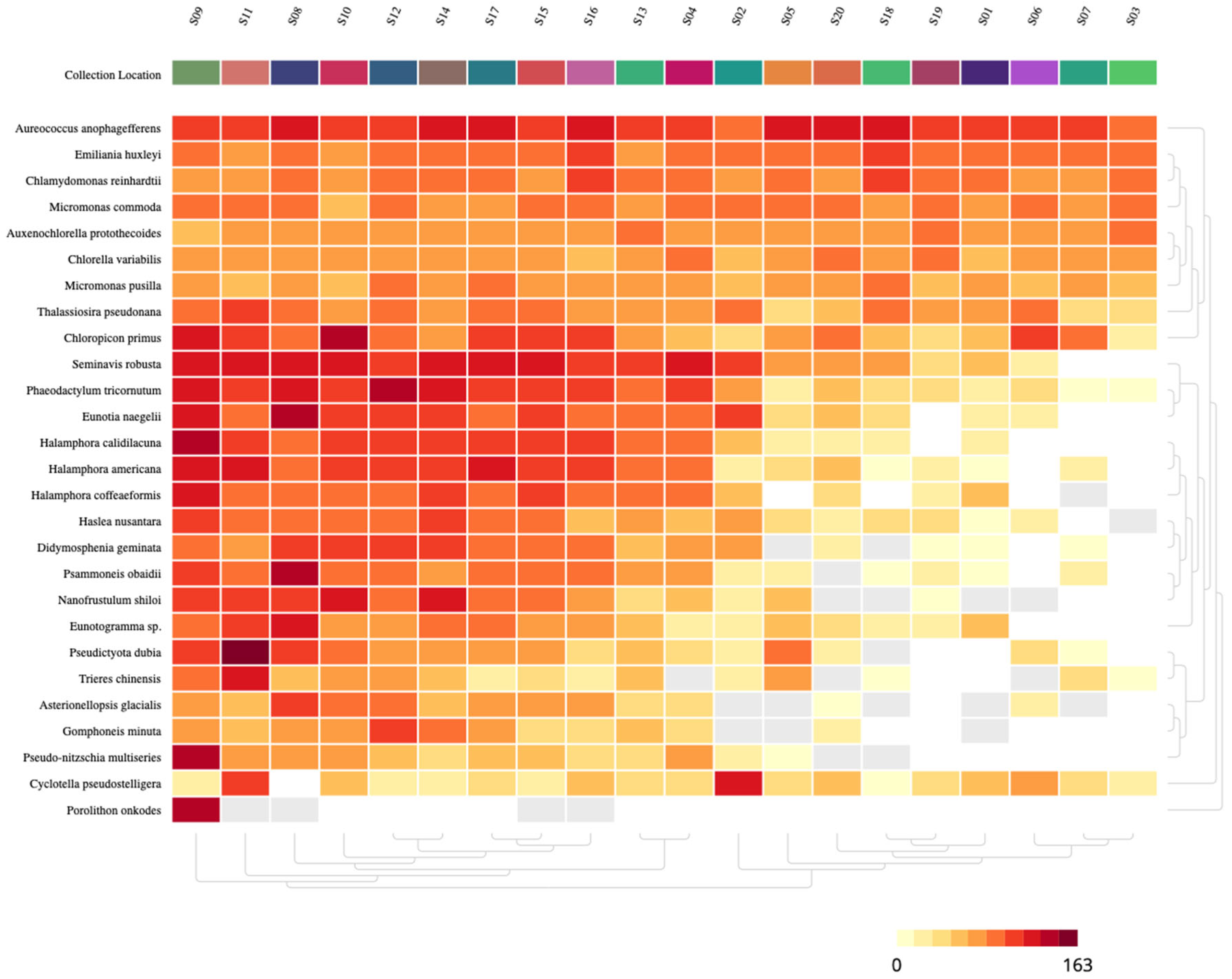
| Species | Clade-Phylum | Possible Role/Cause |
|---|---|---|
| Aureococcus anophagefferens | Clade-Diaphoretickes; Phylum-Gyrista | Heterokont algae that cause algal blooms. |
| Emilliania huxleyi (now Gephyrocapsa huxleyi) | Clade- Diaphoretickes; Phylum-Haptista | Photosynthetic plankton that form algal blooms in nutrient-depleted waters. Release a group of chemicals known as alkenones. |
| Chlamydomonas reinhardtii | Clade- Viridiplantae; Division-Chlorophyta | Single-cell green phototrophic near surface. On oceanic floors, it grows in the presence of organic carbon. |
| Micromonas commode | Clade- Viridiplantae; Division-Chlorophyta | Green algae are a major contributor to picoplanktonic biomass in oceanic and coastal regions. |
| Auxenochlorella protothecoides (formerly known as Chlorella protothecoides) | Clade- Viridiplantae; Division-Chlorophyta | Facultative heterotrophic algae with a high lipid content and application in biofuel research and dietary supplements. |
| Chlorella variabilis | Clade- Viridiplantae; Division-Chlorophyta | Single-cell green algae are widely exploited as a source of food and energy. |
| Micromonas pusilla | Clade- Viridiplantae; Division-Chlorophyta | Green algae are and major contributor of picoplanktonic biomass in oceanic and coastal regions. |
| Thalassiosira pseudonana | Clade-Diaphoretickes; Phylum-Gyrista | Marine diatoms with high CO2 absorption. |
| Chloropicon primus | Clade- Viridiplantae; Division-Chlorophyta | Green algae with key roles in phytoplanktonic communities. |
| Seminavis robusta | Clade- Stramenophiles; Phylum- Bacillariophyta | Marine biofilm-forming diatoms. |
| Phaeodactylum tricornutum | Clade-Diaphoretickes; Phylum-Gyrista | Marine diatoms capable of growing in absence of silicon. |
| Eunotia naegelii | Clade- Stramenophiles; Phylum- Bacillariophyta | Diatoms. |
| Halamphora calidilacuna | Phylum- Heterokontophyta | Diatoms. |
| Halamphora Americana | Phylum- Heterokontophyta | Diatoms. |
| Halamphora coffeaeformis | Phylum- Heterokontophyta | Diatom. |
| Haslea nusantara | Clade- Stramenophiles; Phylum- Bacillariophyta | Blue Diatoms. |
| Didymosphenia geminate | Clade-Diaphoretickes; Phylum-Gyrista; Class Bacillariophyceae | Invasive diatom species. |
| Psammoneis obaidii | Clade- Stramenophiles; Phylum- Bacillariophyta | Diatoms found in sediments or as epiphytes. |
| Nanofrustulum shiloi | Clade- Stramenophiles; Phylum- Bacillariophyta | Diatoms with high biotechnological potential. |
| Eunotogramma sp. | Clade- Stramenophiles; Phylum- Bacillariophyta | Diatoms. |
| Pseudodictyota dubia | Brown algae. | |
| Trieres chinensis | Clade- Stramenophiles; Phylum- Bacillariophyta | Marine diatoms. |
| Asterionellopsis glacialis | Phylum- Heterokontophyta; Class- Bacillariophyceae | Diatoms. |
| Gomphoneis minuta | Clade- Stramenophiles; Phylum- Bacillariophyta | Diatoms. |
| Pseudo-nitzschia multiseries | Clade- Stramenophiles; Phylum- Bacillariophyta | Marine planktonic diatoms account for 4.5% of the pennate diatoms found across the world. |
| Cyclotella pseudostelligera (now Discostella pseudostelligera) | Phylum- Heterokontophyta; Class- Bacillariophyceae | Diatoms. |
| Porolithon onkodes | Phylum-Rhodophyta | Red algae. |
Disclaimer/Publisher’s Note: The statements, opinions and data contained in all publications are solely those of the individual author(s) and contributor(s) and not of MDPI and/or the editor(s). MDPI and/or the editor(s) disclaim responsibility for any injury to people or property resulting from any ideas, methods, instructions or products referred to in the content. |
© 2026 by the authors. Licensee MDPI, Basel, Switzerland. This article is an open access article distributed under the terms and conditions of the Creative Commons Attribution (CC BY) license.
Share and Cite
Uddin, S.; Habibi, N.; Behbehani, M.; Faizuddin, M.; Al-Babtain, Y.; Al-Rouwayeh, S.; Al-Sinan, M.; Al-Qadeeri, G. Blue Carbon in the Persian Gulf: Evidence of Phytoplankton Contribution to Carbon in Sediments. Sustainability 2026, 18, 1102. https://doi.org/10.3390/su18021102
Uddin S, Habibi N, Behbehani M, Faizuddin M, Al-Babtain Y, Al-Rouwayeh S, Al-Sinan M, Al-Qadeeri G. Blue Carbon in the Persian Gulf: Evidence of Phytoplankton Contribution to Carbon in Sediments. Sustainability. 2026; 18(2):1102. https://doi.org/10.3390/su18021102
Chicago/Turabian StyleUddin, Saif, Nazima Habibi, Montaha Behbehani, Mohammad Faizuddin, Yasmeen Al-Babtain, Shua’a Al-Rouwayeh, Maha Al-Sinan, and Ghadeer Al-Qadeeri. 2026. "Blue Carbon in the Persian Gulf: Evidence of Phytoplankton Contribution to Carbon in Sediments" Sustainability 18, no. 2: 1102. https://doi.org/10.3390/su18021102
APA StyleUddin, S., Habibi, N., Behbehani, M., Faizuddin, M., Al-Babtain, Y., Al-Rouwayeh, S., Al-Sinan, M., & Al-Qadeeri, G. (2026). Blue Carbon in the Persian Gulf: Evidence of Phytoplankton Contribution to Carbon in Sediments. Sustainability, 18(2), 1102. https://doi.org/10.3390/su18021102