Article

Can Digital Literacy Alleviate the Multi-Dimensional Inequalities Among Rural Residents? Evidence from China

1
Soviet Area Revitalization Institute, Jiangxi Normal University, Nanchang 330022, China
2
School of Marxism, Jiangxi Normal University, Nanchang 330022, China
3
School of Economics and Management, Nanchang University, Nanchang 330031, China
4
School of Management, Universiti Sains Malaysia, Penang 11800, Malaysia
*
Author to whom correspondence should be addressed.
Sustainability 2026, 18(2), 1069; https://doi.org/10.3390/su18021069
Submission received: 8 December 2025 / Revised: 6 January 2026 / Accepted: 16 January 2026 / Published: 21 January 2026

Abstract

Multi-dimensional inequality among rural residents has become a major obstacle hindering the achievement of global poverty alleviation goals. This study utilized household sample data from the China Family Panel Studies (CFPS) over four periods from 2014 to 2020 and applied them to a high-dimensional fixed effects model to estimate the impact of digital literacy on multi-dimensional inequality among rural residents. The results show that digital literacy can effectively alleviate the multi-dimensional inequality of rural residents. From the perspective of a mediating effect, digital literacy alleviates the multi-dimensional inequality of rural residents by improving the level of social capital and promoting social harmony. Moreover, the alleviation of multi-dimensional inequality among rural residents by digital literacy varies among different groups. The impact of digital literacy on the multi-dimensional inequality of agricultural workers and rural residents in western regions is relatively greater than that of non-agricultural workers and rural residents in other regions. Information processing literacy in digital literacy has the most significant impact on the multi-dimensional inequality of rural residents. This paper enriches the mechanism paths of digital literacy in alleviating the multi-dimensional inequality among rural residents in terms of both material and spiritual aspects, and provides a certain reference value for achieving the all-round development of rural residents and contributing to rural production practices.

1. Introduction

According to the World Bank’s latest Global Economic Outlook report, global trade growth is projected to slow from 3.4% in 2024 to 1.8% in 2025, marking the lowest level in nearly a decade. Global economic growth is facing great challenges. The global poverty eradication goal set by the United Nations’ “2030 Agenda for Sustainable Development” is to “eliminate all forms of poverty worldwide by 2030”. The implementation of the 2030 Agenda has encountered severe challenges; rural issues and the multi-dimensional inequality of rural residents have become bottlenecks for achieving the United Nations Sustainable Development Goals (SDGs) globally. China is the largest developing country and is crucial to achieving the Sustainable Development Goals. The imbalance between urban and rural development and the lagging development of rural areas are the primary manifestations of the main social contradictions in China at present. Rural areas are facing problems such as intensified population outflow, large income gaps between urban and rural areas, the underutilized value of agricultural resources, and a prominent dual urban–rural structure, each of which have become weak links in China’s efforts to achieve the Sustainable Development Goals (SDGs).
The digital transformation of agriculture and rural areas is a key area that many countries and regions around the world, as well as international organizations, are committed to promoting. It is also an important signifier of cooperation between China and the Food and Agriculture Organization of the United Nations. Digital transformation is driving the development of agriculture and rural areas globally. Since the concept of the “Digital Countryside” was first included in the Central Document No. 1 of China in 2018, major policy documents at all levels, such as the “Digital Countryside Development Strategy Outline”, the “Digital Countryside Development Action Plan”, and the “National Smart Agriculture Action Plan (2024–2028)”, have been promulgated, providing policy guarantees for the development of the digital countryside. According to the 54th Statistical Report on the Development of China’s Internet, released in 2024, the internet penetration rate in rural areas was 63.8%, lower than that in urban areas, which is 85.3%. Rural areas still need to focus on multiple digital divides. From a macro perspective and down to the perspective of individual rural residents there are, beyond gaps in facilities, equipment, and network terminal hardware, differences in digital literacy among rural residents in different regions in terms of application. Making rural residents participate in sharing the fruits of digital economic development and enabling them to some extent escape multi-dimensional inequality will be key to the future development of digital villages [1]. Enhancing rural residents’ digital literacy and shaping new rural residents in the digital era is the inevitable path to promoting digital empowerment for rural revitalization and also provides experience reference for other developing countries and underdeveloped regions.
Academic research on multi-dimensional inequality among rural residents mainly focuses on identification, measurement and analysis of influencing factors. The research subjects and themes of digital literacy focus mainly on high-quality groups and deep-level digital divides, and the related research fields mainly involve finance, healthcare and education. As of now, there is still considerable room for supplementation in the literature that links digital domains such as the internet and digital literacy with rural areas, agriculture and rural residents. This paper is based on the further study of relevant research content. The adoption of digital technologies by rural residents has enhanced the willingness of agricultural entrepreneurship, and the advantages of digital finance with “wide coverage, low cost and fast speed” can solve the problem of the “last mile” of financial services, greatly improving rural residents’ livelihoods and helping to reduce poverty [2,3]. The digital literacy of rural residents can reduce the risk of returning to poverty, while employment and entrepreneurship are important mechanisms to reduce the risk of returning to poverty, with vulnerable households benefiting more from digital literacy [4]. Digital literacy has a significant promoting effect on the efficiency of green agricultural production, and can also effectively enhance rural residents’ awareness of green agricultural products and their adoption of green production technologies [5]. In the era of digital intelligence, shaping new farmers is an inevitable path to promoting the development of rural revitalization through digital empowerment. The study of the impact of digital literacy on multi-dimensional inequalities aims to provide action guidelines for the economic and social development of developing countries and underdeveloped regions.
The marginal contribution of this article lies mainly in three aspects. Firstly, from the perspective and methods of the research, this study focuses on rural residents and uses CFPS panel data and fixed-effect estimation, aiming to reveal the impact of digital literacy on multi-dimensional inequalities. Based on multi-dimensional egalitarianism theory, social justice is grounded in “human relationship patterns” that align with different distribution principles, focusing on interpersonal relationships and objective environments in human society to construct multi-dimensional inequality indices [6]. Digital economy theory reveals that data, as forming a non-exclusive new production factor, exacerbate existing social, economic, and regional inequalities through digital applications, forming a “digital divide” [7]. Digital literacy refers to the quantified “feasibility” of individuals in digital environments. Differences in digital literacy levels are both the cause and core manifestation of multi-dimensional inequality. This study empirically analyzes the impact of digital literacy on multi-dimensional inequality among rural residents at the household level, providing valuable supplements to theoretical research on multi-dimensional inequality. Secondly, the study examines the mediating effect of digital literacy on multi-dimensional inequality among rural residents, using social capital levels and social harmony as mechanism variables to provide new analytical pathways. Social capital theory posits that social capital levels directly influence collaborative efficiency and opportunity structures between individuals and groups [8]. Social identity theory clarifies that individuals’ sense of belonging and identification with groups strengthens internal cohesion, while social harmony is precisely the result of such identity integration. Economic behavior theory indicates that rational decision-making is not only driven by material interests but also embedded in social relationships and identity contexts [9]. The coherent mechanism of “social structure-psychological identity-economic behavior” is formed, social capital influences economic behavior by enhancing the possibility of cooperation, and social identity strengthens this process by increasing the willingness and stability of cooperation, ultimately driving more efficient and sustainable economic actions. Thirdly, analyzing the heterogeneous impacts of rural household employment patterns, the role of regional disparities in mitigating digital literacy effects, and how different digital literacy levels influence the alleviation of multi-dimensional inequalities can help identify key areas for improving rural residents’ digital literacy benefits. This research provides valuable insights for governments and social organizations to enhance the effectiveness of digital application strategies.
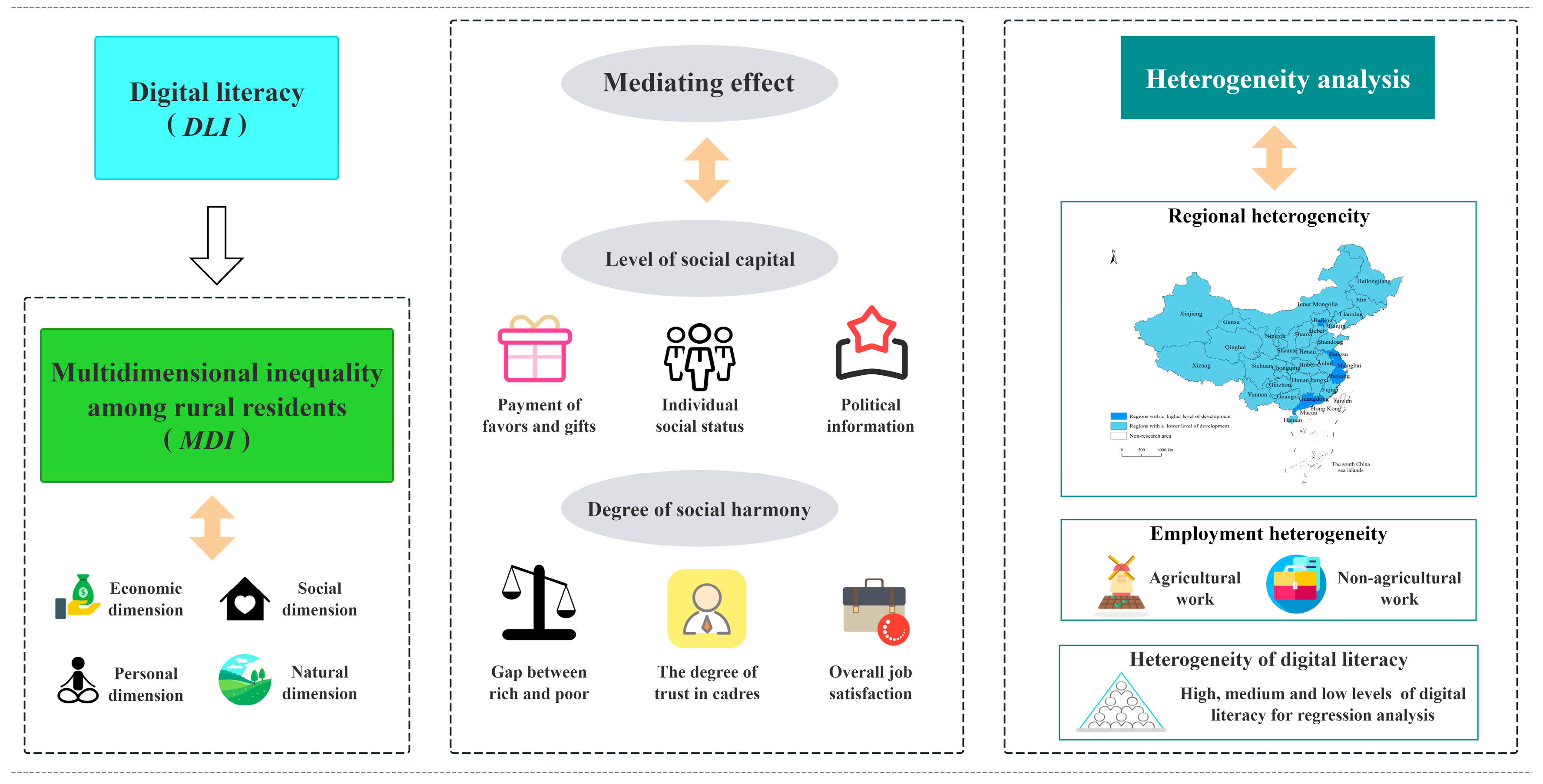
The remaining contents of the paper are arranged as follows: The second part puts forward a theoretical hypothesis based on a realistic background and theoretical basis; the third part introduces the data source, index selection, variable description and model design in detail. The fourth part makes empirical analysis based on the content of the third part, and explains the empirical results. The fifth part draws conclusions and puts forward relevant suggestions. To sum up, the main thought of this paper is shown in Figure 1.

2. Theoretical Assumption

Eliminating multi-dimensional inequality and promoting sustainable development are the common missions of humanity and also the top priorities of the Chinese government. Multi-dimensional inequality is not only the lack of income, resources and energy that makes it difficult to make a living, but also manifest in physical and mental health [10], living standard [11], environment quality [12], degree of education [13], public service [14,15] and so on, which amount to the multi-dimensional hardship and social problems of rural residents that are brought about by inequity and inadequacy. The improvement of production and life must be inclusive in order to achieve sustainable development. With the steady development of the digital economy, the wide application of digital technologies such as big data, artificial intelligence, the internet of things and cloud computing can reduce transaction costs and improve operational efficiency, promote the digital transformation of enterprises, and attract great attention from policymakers, practitioners and academia. Previously, digital literacy has often been associated with health [16,17], education [18,19], finance [20], risk [21], etc. If we enhance digital literacy we embrace a better life. Therefore, the demand gap for skilled labor with digital literacy is large in terms of its creation and employment. In rural areas, developing the digital economy requires the development or acquisition of human resources related to digital technology. At the same time, rural residents need to enhance their digital literacy in order to adapt to the digital economy era and achieve significant development. Hence, this paper puts forward research hypothesis 1.
Hypothesis 1.
Digital literacy can alleviate multi-dimensional inequalities among rural residents.
Digital literacy can directly alleviate economic income and social resource inequalities among rural residents by enhancing their social capital levels. Digital literacy can reduce the risk of returning to poverty by promoting local non-agricultural employment and migrant workers’ employment, enhancing entrepreneurial performance and expanding the scale of entrepreneurship. By examining the relationship between digital literacy and poverty reduction in terms of employment and entrepreneurship, it is found that the employment approach is a more effective and significant way. Internet use has also increased the stability of non-farm employment. Digitalization can enhance the efficiency of labor investment in enterprises by improving labor skills. Only when enterprises possess digital technologies and skilled workers can digitalization increase the value of enterprises [22]. The creative dimension of digital literacy has a significant predictive effect on the accumulation of network social capital. The use of digital information technologies has actually improved multi-dimensional inequalities for all groups, where social capital plays a key mediating role. As a “toolbox” for individuals to acquire and mobilize resources, digital literacy helps rural residents break geographical and social barriers, expand their networks, and access high-quality information and opportunities [23]. It also fosters the establishment of online trust and the formation of norms, reducing collaboration costs and thereby converting social capital into tangible economic benefits such as credit support and entrepreneurial partnerships. Based on the above evidence, the paper puts forward research hypothesis 2.
Hypothesis 2.
Digital literacy can improve the level of social capital of rural residents, thus alleviating multi-dimensional inequality among rural residents.
Digital literacy can indirectly alleviate the inequality associated with rural residents’ physical and mental health and their living environment. Digital information technology has the characteristics of inclusive growth, is conducive to economic growth, and has a positive role in narrowing the urban–rural income gap. However, Toffler found that the information gap and wealth gap are widened by differences in the ownership, application, and innovation capacity of information and network technologies [24]. This also implies that the relationship between the development of the digital economy and multi-dimensional inequalities might be more complex. By comparing the different mechanisms in existing studies, it is found that the role of digital literacy in terms of humanistic care such as social harmony has been overlooked. Chinese society is a “relationship-oriented” society. Social relationships, as a social resource, can provide social support for people [25]. Digital literacy, as a “lubricant” for interpersonal interaction, can reduce the sense of social isolation by meeting social and emotional needs and enhance the sense of belonging and subjective well-being of disadvantaged groups. The instant communication function of the internet breaks through the limitations of time and space, promoting cross-group cultural exchanges and community identification. It broadens the channels for public participation, making grassroots governance more transparent and responsive. By creating a more inclusive, trusting, and fair social atmosphere, it can generally and positively alleviate disparities in psychological well-being, accessibility of public services, and sense of community belonging, and has shared and positive external effects in alleviating multi-dimensional inequalities among rural residents. Based on this, this paper puts forward the research hypothesis 3.
Hypothesis 3.
Digital literacy can improve the social harmony of rural residents, and then alleviate the multi-dimensional inequality of rural residents.
The use of digital information technology has had heterogeneous impacts on the multi-dimensional inequality conditions of various types of rural residents. Different types of employment have systematic differences in the demand for digital skills and application scenarios. Agricultural workers rely on digital technology to obtain production information, market prices, and agricultural policies. Digital applications are limited to specific fields. Non-agricultural employment usually requires a wider range of digital tool usage, and digital literacy has a direct impact on income and career development [26,27]. The effectiveness of digital literacy largely depends on the local digital infrastructure and support environment [28]. Regional differences often determine the practical feasibility of digital literacy in alleviating multi-dimensional inequality [29]. The level of digital literacy itself has a class distinction, and different levels of digital literacy have different effects on alleviating multi-dimensional inequality. The low digital literacy group largely improves the convenience of life through basic skills, while high digital literacy individuals use digital tools to generate income, participate in decision-making, or enhance their ability to resist risks, thereby more effectively breaking through structural disadvantages. Based on the above analysis, this paper further proposes hypothesis 4.
Hypothesis 4.
The alleviating effect of digital literacy on the multi-dimensional inequality among rural residents varies depending on employment status, the level of digital information development in the region, and an individual’s digital literacy level.

3. Research Design

3.1. Data Sources

The data for this study primarily comes from the “China Family Panel Survey (CFPS)” database released by the Institute of Sociology and Policy Studies at Peking University. The data cover samples from 31 provinces (municipalities and autonomous regions) across the country, demonstrating extensive coverage and high representativeness. CFPS tracks data collection at three levels (individual, family, and community) to reflect changes in China’s social, economic, demographic, educational, and health sectors, providing high-quality data support for this study. The “Digital Rural Strategy” was first proposed in the 2018 Central Document No. 1 of the Chinese government. The period from 2014 to 2016 was the foundational phase before policy implementation, while 2018 to 2020 was the later phase of policy advancement, effectively revealing the changing role of digital literacy in multi-dimensional inequality among rural residents. Additionally, because CFPS data were released consecutively as expected in 2014, 2016, 2018, and 2020, the survey questionnaire design maintained stronger continuity, enhancing the accuracy of the study. Therefore, this paper constructs a measurement index system for multi-dimensional inequality among rural residents and a digital literacy measurement index system based on data from these four periods at the individual and family levels, while selecting control variables. Furthermore, the per capita disposable income data for rural residents in each province is sourced from the “China Statistical Yearbook”. Samples with statistical biases or missing systematic indicators, such as those who answered “refused to answer” or “don’t know”, were excluded. Ultimately, a total of 59,066 sample data were obtained over four years.

3.2. Variables Description

3.2.1. Explained Variable

The explained variable of this paper is multi-dimensional inequality of rural residents, denoted as MDI. Based on the multi-dimensional poverty theory, the authors constructed a multi-dimensional inequality index (MDI), akin to that of Alkire, Foster and Santos, to judge Chinese rural residents deprived in several dimensions of human life [30,31].
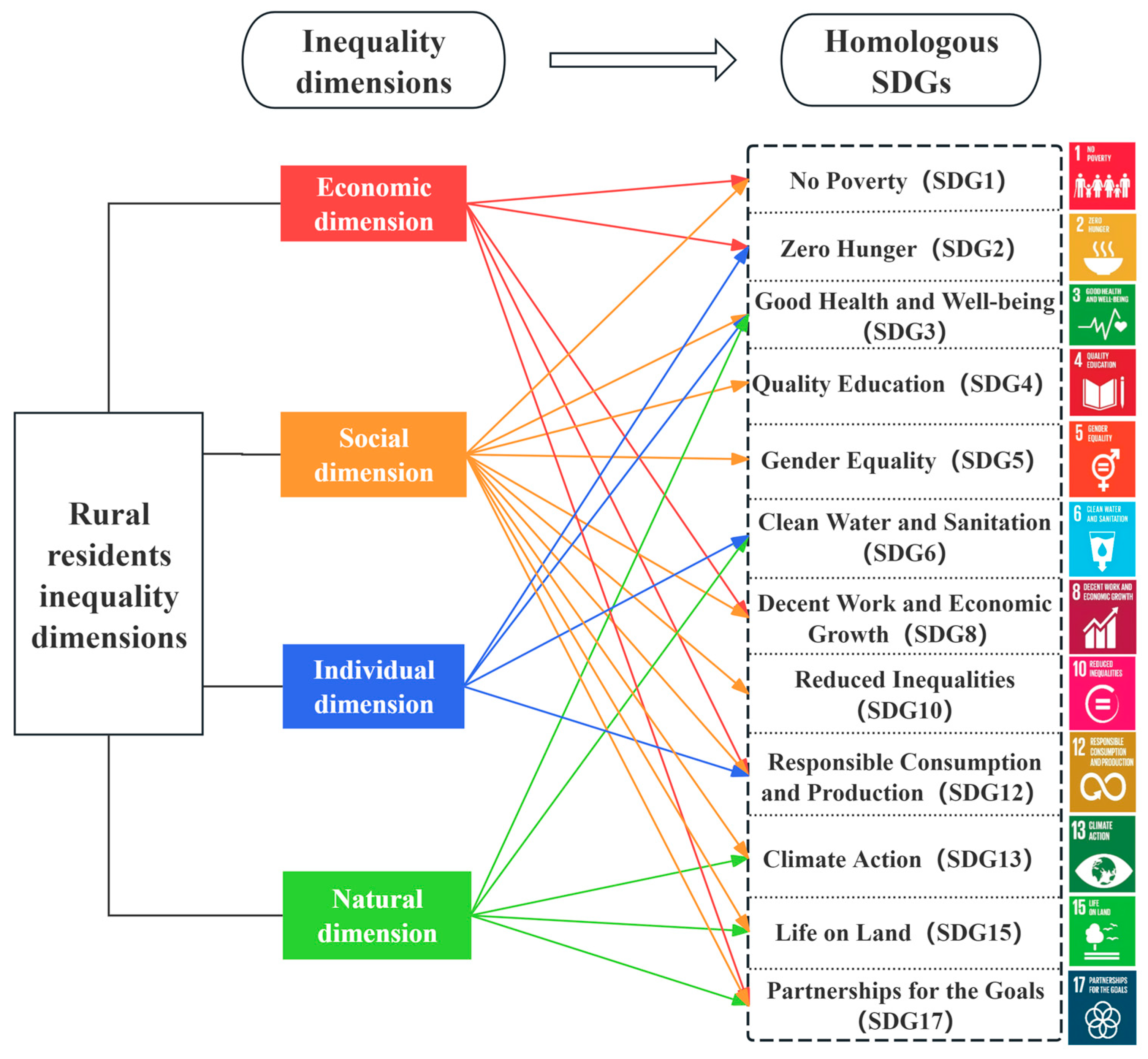
First of all, according to the United Nations 2030 Sustainable Development Goals and China’s goal of fully building a modern socialist country, the preliminary multi-dimensional inequality dimension is determined. The identification and measurement of multi-dimensional inequality among rural residents are mostly conducted by calculating comprehensive indices. Secondly, one must refer to the existing literature to further determine the multi-dimensional inequality dimension. Multi-dimensional inequality among rural residents is influenced by multiple factors such as the economy, society, personal attributes and the environment. The multi-dimensional inequalities were divided into five dimensions: income, education, livelihood, housing, and employment [32]. We constructed an indirect effect model and dynamic panel threshold model, and the results indicate that a digital economy significantly reduces energy poverty in China [33]. Age, marital status, educational attainment, awareness of poverty alleviation policies and region are significant predictors of the multi-dimensional inequality [34]. The MPI is constructed around four basic dimensions: health, education, economic status and living standards [35]. Education is the key to eradicating poverty and achieving stable poverty alleviation, and it is also the fundamental means and important method to prevent the transmission of poverty from one generation to the next. The research results of the World Bank show that, based on the poverty line set by the World Bank, if the education years of the labor force in a family are less than 6 years, the poverty incidence rate will be higher than 16%. Therefore, the threshold for the education indicator of the years of schooling is set at 6 years. Based on the existing research, it can be observed that rural residents engaged in agricultural work in China are generally more likely to fall into economic inequality when compared with those engaged in non-agricultural work. This risk is particularly prominent among those engaged in small-scale, traditional agricultural production. The production profits of major agricultural products such as grains are meager, sometimes even negative. The income of farmers is unstable and their sources of income are limited. The “life satisfaction score” of 4 points is generally regarded as the key dividing point between “satisfaction” and “average”. This threshold can effectively screen out the groups of family members that require attention, avoiding diluting the targeted nature of the intervention by including “neutral evaluations”. This conforms to the early warning principle of the “satisfaction gap” in social psychology. In the 10-point scale of “environmental problem severity”, 5 points represents the theoretical median of the severity of the problem. A score above 5 indicates that the public’s perception of environmental problems has shifted from the “acceptable” range to the negative range of “requiring attention”, which corresponds to the empirical research on “the decline in public tolerance for environmental pollution” in China’s environmental governance, and conforms to the practical convention in the environmental policy field of using “over half score” as a risk signal monitoring node [36]. A multi-dimensional inequality measurement index system consisting of four dimensions and eight indicators is constructed by further thinking and by considering factors such as data availability. The specific contents are shown in Table 1, the relationship between multi-dimensional inequality and the SDGs is shown in Figure 2.
Finally, the “double threshold method” is used to measure multi-dimensional inequality. The first threshold is the poverty limit in a single dimension, and each threshold is defined by indicator critical value in Table 1. At the same time, this paper adopts the equal-weight method common at home and abroad to calculate the multi-dimensional inequality index, so as to ensure that the feasible capabilities described in each dimension have the same importance for alleviating the multi-dimensional inequality of rural residents. The question of whether it be economic, social, self, nature, or any dimension associated with the alleviation of the inequality of rural residents or the realization of the sustainable long-term development of families is not determined because of differences in different dimensions. The second threshold is the critical value k of multi-dimensional inequality, that is, the limit of the overall multi-dimensional inequality index weighted by multiple dimensions. The choice of k value is crucial. The critical value of multi-dimensional relative poverty is set as 0.33 by the United Nations Development Programme. Using this standard, the threshold k of the multi-dimensional inequality composite index is set at 0.33; that is, if the multi-dimensional inequality index of rural residents exceeds 0.33, they are in multi-dimensional inequality. Therefore, this paper sets the critical value k to 0.33. When the multi-dimensional inequality index of rural residents is greater than or equal to 0.33, the farmer is in multi-dimensional inequality and its value is reassigned to 1; otherwise, the multi-dimensional inequality index is reassigned to 0.

3.2.2. Core Explanatory Variable

The explained variable of this paper is digital literacy, expressed by D L I . According to the Delphi method, digital literacy is evaluated in terms of software, hardware, and technical problem-solving, network communication, ethics, security, artificial intelligence, and interest knowledge [37]. This paper defines the digital literacy of rural residents as their ability to acquire, process, utilize and transmit digital resources for work, entertainment, socializing, learning and business by using digital technologies and tools in daily life and production work. Based on the actual needs of rural residents and the availability of CFPS data, this paper divides digital literacy into five functions and nine indicators: digital general literacy, information processing literacy, digital social literacy, digital entertainment literacy, and digital work literacy. Among these, the four indicators “Whether you will conduct online shopping or sell goods online”, “Whether you will study online”, “Whether you will communicate with family and friends through mobile communication software (WeChat)”, and “Whether you will watch short videos, play games, etc. for entertainment online” have differences in the questionnaire settings for 2020 when compared with the previous three periods. To maintain the continuity of the samples from the four periods without losing the latest sample, the process of this paper is undertaken in order to uniformly eliminate invalid samples and then set the responses of the previous three periods. As a result, when “the frequency of using the internet for commercial activities”, “the frequency of using the internet for learning”, “the frequency of using the internet for socializing”, and “the frequency of using the internet for entertainment” are “almost every day, 3–4 times a week, 1–2 times a week, 2–3 times a month, once a month, and once every few months” the answer is set as “Yes”, and the responses of “Never, not applicable” are set as “No”. In this way, the samples from the previous three periods and the 2020 period can reach the same standard in the calculation of the digital literacy indicator system. Finally, the principal component analysis method was adopted to calculate the digital literacy index of the samples. The detailed content is shown in Table 2.

3.2.3. Control Variables

The characteristics of household head and family were selected as control variables. Among these, the characteristics of the head of household include gender ( G e n d e r ), age ( A g e ), education ( E d u c a t i o n ), health ( P h y s i c a l ), marital status ( M a r r y ), which are the classic control variables. The characteristics of the family include the nature of the family account ( H R T ), the size of the family ( M e m b e r ), and the family deposit ( S a v i n g ).

3.2.4. Mechanism Variables

The mechanism variables selected were social capital level and social harmony degree. As for the measurement of social capital, this paper adopts three indicators associated with the responses regarding the family’s expenditure on human favors ( G i f t ), personal social status ( S o c i a l ), and the number of days in a week that they obtain political information through the internet ( P o l i t i c a l ). The degree of social harmony is expressed by the severity of the gap between the rich and the poor ( G R P ), the degree of trust of the respondents’ families on the government’s trust in cadres ( D T C ), and the overall satisfaction with their work ( O J S ). The assignment method and descriptive statistics of all variables are shown in Table 3 and Table 4.

3.3. Model Design

The empirical model of digital literacy on the multi-dimensional inequality of rural residents is set as follows:
M D I i t = α + β D L I i t + k = 1 K γ k C o n t r o l s k i t + δ t + μ i + ε i t
In type (1), i represents the rural residents, t represents the year, k represents sample quantity, explained variable M D I i t represents the multi-dimensional inequality index, α represents constant term, D L I i t represents digital literacy among rural residents, and β represents the digital literacy influence coefficient for the multi-dimensional inequality. Let K represent the total number of samples, C o n t r o l s k i t include household head characteristics and family characteristics, γ k represent the regression coefficients for each control variable, δ t represent the time fixed effects, and μ i represent the individual fixed effects of rural residents, which control for the fixed characteristics of rural residents that do not vary over time. ε i t represents the random disturbance term. At this point, the core explanatory variable is digital literacy. The article focuses on the variable β , if the β is significantly negative, this indicates that digital literacy helps to mitigate multi-dimensional inequality among rural residents, thereby verifying the hypothesis proposed earlier.
In order to analyze the path of digital literacy to alleviate the impact of multi-dimensional inequality on rural residents, the mechanism analysis model of this paper is set as follows:
M i t = α + φ D L I i t + k = 1 K γ k C o n t r o l s k i t + δ t + μ i + ε i t
In type (2), M i t represents the mechanism variable through which digital literacy affects multi-dimensional inequality among rural residents and φ represents the coefficient of the effect of digital literacy on the mechanism variable. The meanings of the other variables are the same as Equation (1).

4. Empirical Analysis

4.1. Benchmark Regression Results

In order to examine the impact of digital literacy on the multi-dimensional inequality of rural residents, a multiple linear regression estimation was used. According to model (1) in Table 5, it can be seen that only the cluster of core explanatory variables is added to the heteroscedasticity robust standard error of individual and year tests; model (2) represents the regression result after the introduction of individual characteristic variables on the basis of the addition of core explanatory variables; model (3) introduces the regression result of family characteristic variables on the basis of model (2). The three models in Table 5 show that digital literacy has a negative impact on the multi-dimensional inequality of rural residents, and all are significant at the 1% level. This indicates that the higher the digital literacy of rural residents, the more effectively they can alleviate the multi-dimensional inequality of rural residents. With the popularization of the internet and mobile communication technologies, rural residents with higher digital literacy can more easily access various information resources and development opportunities, including employment, education, healthcare, and market dynamics, which is of great significance for alleviating the multi-dimensional inequality of rural residents, thus verifying Hypothesis 1 of this paper.
According to the regression results, other variables also have a certain impact on the multi-dimensional inequality of rural residents. From the perspective of individual characteristic variables, rural laborers with higher education and better health are more likely to avoid falling into a state of multi-dimensional inequality. On the one hand, education, as an important indicator of individual ability and social status, has a significant positive impact on escaping multi-dimensional inequality. Higher education is usually associated with greater potential for capital accumulation [38]. The optimization and improvement of the higher education structure help to enhance the level of basic research, enabling the educated to better understand the objective laws of development and thereby improving their ability to identify and solve problems, as well as their learning thinking ability, problem-solving ability, and social resource utilization ability. The talents cultivated by higher education not only have a more complete knowledge system to promote the accumulation of human capital, but more importantly, the expansion of higher education increases the innovative human capital of enterprises. Technological innovation is a mechanism through which higher education influences productivity growth and, in turn, the economy. Therefore, education can enhance an individual’s productivity and innovation ability, and they tend to perform better in both economic and social dimensions. On the other hand, good health is the foundation for individuals to participate in social activities, pursue education, and seek economic opportunities. Health status directly affects an individual’s labor productivity and subsequent development ability [39]. Health problems can lead to higher medical expenses, increasing the economic burden on families, especially for low-income families, where this additional economic pressure is likely to lead to the long-term persistence of multi-dimensional inequality.
In addition, from the perspective of family characteristic variables, the nature of the household registration and the size of the family of the respondents have a significant positive impact on their multi-dimensional inequality status; the family’s savings have a significant negative impact on their multi-dimensional inequality status. In China, agricultural household registration is usually associated with rural areas, while non-agricultural household registration is related to urban areas. Members of agricultural household registration families are subject to certain geographical restrictions on employment due to both subjective and objective factors, and the income level from agricultural work is generally low. Moreover, the upward social mobility of agricultural household registration residents is limited, which affects their ability to improve their economic and social status. Intergenerational inequality is thus maintained because the nature of a parents’ household registration often determines the resources and opportunities available to their children [40]. In contrast, members of non-agricultural household registration families have more and broader employment opportunities outside of agriculture and are more likely to achieve occupational mobility compared with rural laborers.
Family size is an important indicator for measuring family structure and social relationships. It affects the distribution of resources within the family, economic conditions, and the social and economic opportunities of family members. Larger families may face higher living costs, especially in terms of food, housing, and education. This may lead to a decrease in per capita income of family members, thereby affecting the overall economic security and well-being of the family. Moreover, a larger family size may limit the opportunities for family members to receive higher education and participate in the labor market, as the family needs more resources to meet basic needs [41]. When the proportion of elderly and children in the family is larger, this means that the young and middle-aged rural laborers in the family need to bear greater responsibilities for supporting the elderly and raising children. As a result, their work locations and times are more restricted, leading to a greater probability that this part of the labor force will choose to take care of the family full-time or will prefer flexible employment, though their income is often not guaranteed.

4.2. Robustness Test

In order to ensure the reliability of the benchmark regression conclusion, the robustness test was carried out by changing the measurement method of the explained variable, changing the measurement method of the core explanatory variable, replacing the model, random sampling and dual machine learning.

4.2.1. Change the Measure of the Explained Variable

When using the A-F method to identify the multi-dimensional inequalities, there is a problem that households near the critical value are classified into two different states of poverty and non-poverty. Therefore, the actual original multi-dimensional inequalities index M D I o r i g is directly used as the dependent variable, and the results are shown in column (1) of Table 6. The results show that the digital literacy of rural residents has a significant negative impact on the multi-dimensional inequalities index.

4.2.2. Change the Measurement Method of Core Explanatory Variables

According to the definition of rural residents’ digital literacy level, the principal component analysis method was used to measure nine sub-indexes from five dimensions: digital generality, information processing, digital sociability, digital entertainment and digital work. In this paper, the score direct sum method is used to measure the level of digital literacy of rural residents, denoted as D L I S , and the benchmark regression is carried out. Model (2) in Table 6 shows that rural residents’ digital literacy still has a significant negative impact on their multi-dimensional inequalities index.

4.2.3. Replace the Model

The panel regression model was used in the previous part of benchmark regression. In order to ensure the reliability of the results, the panel Probit model was used as a reference. As shown in Model (3) in Table 6, one can see little difference between the panel Probit regression results and the benchmark regression results.

4.2.4. Random Sampling

To ensure the representativeness and objectivity of the sample, this study adopted a random sampling method to make the treatment variable independent of all confounding factors, creating an environment without endogeneity. The causal conclusions are the most reliable and intuitive. Therefore, sub-samples were automatically selected at a rate of 20% per province. The results are shown in model (4) in Table 6, which shows that the digital literacy of rural residents still has a significant negative impact on the multi-dimensional inequalities index at the level of 1%.

4.2.5. Dual Machine Learning

Dual machine learning (DML) is a statistical estimation method that enables consistent estimation of causal effects even when there is endogeneity in the observed data [42]. When there are complex and high-dimensional confounding factors, DML ingeniously combines machine learning and uses “orthogonalization” to remove the influence of confounding factors, thereby isolating the “pure” effect of X on Y. In order to effectively deal with complex nonlinear relationships and high-dimensional features, and to reduce the bias caused by model missetting in traditional methods, this paper solves the problem of estimating causal effects in high-dimensional data by using DML method, the results of which are shown in model (5) in Table 6.

4.3. Mechanism Test

The previous section has verified the significant alleviating effect of digital literacy on the multi-dimensional inequality of rural residents. To further explore its influence mechanism, while referring to the views and suggestions of Valkenburg, et al. on the mediating effect [43], this paper focuses mainly on the impact of the core independent variable on the mechanism variables. The mechanism variables selected are the level of social capital and the degree of social harmony. The estimation results are shown in Table 7.
For the measurement of social capital, this paper follows the approach of Yan, et al. [44] and uses three indicators: the expenditure on social gifts and cash by the respondent’s family ( G i f t ), personal social status ( S o c i a l ), and the number of days in a week spent obtaining political information through the internet ( P o l i t i c a l ). Regarding the level of social capital, as shown in mod els (1) and (2) of Table 7, digital literacy can significantly increase the expenditure on social gifts and cash and the frequency of obtaining political information through the internet at the 1% level. According to model (3) of Table 7, digital literacy has a positive impact on personal social status. This indicates that rural residents can indeed utilize social networks to broaden their social interaction channels, enrich their social interaction methods, and more skillfully maintain their interpersonal relationships and social status, thereby enhancing their own level of social capital. Other scholars’ research has also confirmed that social capital has a significant positive effect on alleviating multi-dimensional inequality among rural residents. For instance, personal social capital is more often established on the basis of close kinship, geographical ties, and causal relationships in China, and closer relationships are more likely to play a positive role in influencing income [45]. Each dimension of social capital, including social network, social status and social trust, has a significant negative impact on the vulnerability of rural households to relative inequalities [46].
Regarding the measurement of social harmony, this paper, based on the viewpoints on social harmony [47,48], indicates that the gap between the rich and the poor in society ( G R P ), the government’s integrity and communication in public governance ( D T C ), and the overall satisfaction of individuals with their work ( O J S ) have significant impacts on the perceived level of social harmony. Therefore, the degree of social harmony is represented by the severity of the wealth gap, the degree of trust that respondents have in government officials, and the overall satisfaction with work [49]. Regarding the degree of social harmony, according to Model (4) in Table 7, digital literacy can significantly inhibit the widening of the wealth gap at the 1% level. According to Models (5) and (6) in Table 7, digital literacy can significantly promote trust in government officials and overall satisfaction with work. This indicates that rural residents can indeed utilize the digital skills they have mastered to break through information barriers; have a more comprehensive understanding of the government, jobs and the overall development of society in their local areas; and enhance the degree of social harmony. Other scholars’ research has also confirmed that social harmony has a significant positive effect on alleviating multi-dimensional inequalities among rural residents. For example, Yang, et al. revealed that strong social solidarity facilitates the compatibility of property ownership, governance power, action capability, creating the smooth implementation and anticipated performance of the alleviation of multi-dimensional inequalities in rural communities [50]. A favorable atmosphere promotes the participation of people, families and society in social economic security, social cohesion, social inclusion and social empowerment, and plays an important role in shaping the well-being of this population.
To sum up, digital literacy can help rural residents remove multi-dimensional inequality by improving the level of social capital and social harmony. That is, hypothesis 2 and hypothesis 3 in this paper have been verified.

4.4. Heterogeneity Test

Among rural residents, which groups can benefit more from digital literacy to reduce long-term multi-dimensional inequalities? In order to deepen our understanding of the relationship between digital literacy and multi-dimensional inequality, the heterogeneity analysis is carried out from three aspects: employment type, location and different digital literacy levels.

4.4.1. Employment Heterogeneity

This paper divides rural laborers’ employment into that engaged with agricultural work and non-agricultural work for grouped regression analysis. The results are presented in Model (1) and Model (2) of Table 8. Digital literacy has a significant inhibitory effect on the multi-dimensional inequality of both types of rural laborers at the 1% significance level. Among these, the regression coefficient of residents engaged in agricultural work is greater than that of residents engaged in non-agricultural work. During the period from 2014 to 2020, the central government successively issued a series of guiding documents such as “Building an Agricultural Process Informationalization and Mechanization Technology System Focusing on Agricultural Internet of Things and Precision Equipment” and “Accelerating the Application of Modern Information Technologies Such as the Internet of Things and Artificial Intelligence in the Agricultural Field”. These goals and tasks jointly promoted the healthy and rapid development of China’s smart agriculture. It can be seen that the digital skills and application foundation in the agricultural sector lag behind those in non-agricultural industries, which constitutes a typical “low starting point, high marginal returns” situation. For residents engaged in traditional agriculture, improving digital literacy means crossing the long-standing information gap, directly connecting to the distant market, obtaining agricultural technologies, and optimizing production factors, which can generate significant direct economic returns in key livelihood dimensions such as production efficiency improvement and sales revenue increase [51]. Conducting remote education and training to enhance skills and developing into “new rural residents” can gain greater competitive advantages and economic benefits in the agricultural modernization process. In contrast, non-agricultural practitioners have generally mastered basic skills during the previous digitalization process, and the improvement of digital literacy in this period is more focused on efficiency optimization or life convenience, with relatively limited marginal economic improvement. The reason why the impact of digital literacy improvement on agricultural practitioners was greater than that on non-agricultural practitioners during the period from 2014 to 2020 lies in the initial endowment differences and the heterogeneity of skill application scenarios, and the adoption and effective use of these technologies largely depend on the digital literacy level of rural residents.

4.4.2. Regional Heterogeneity

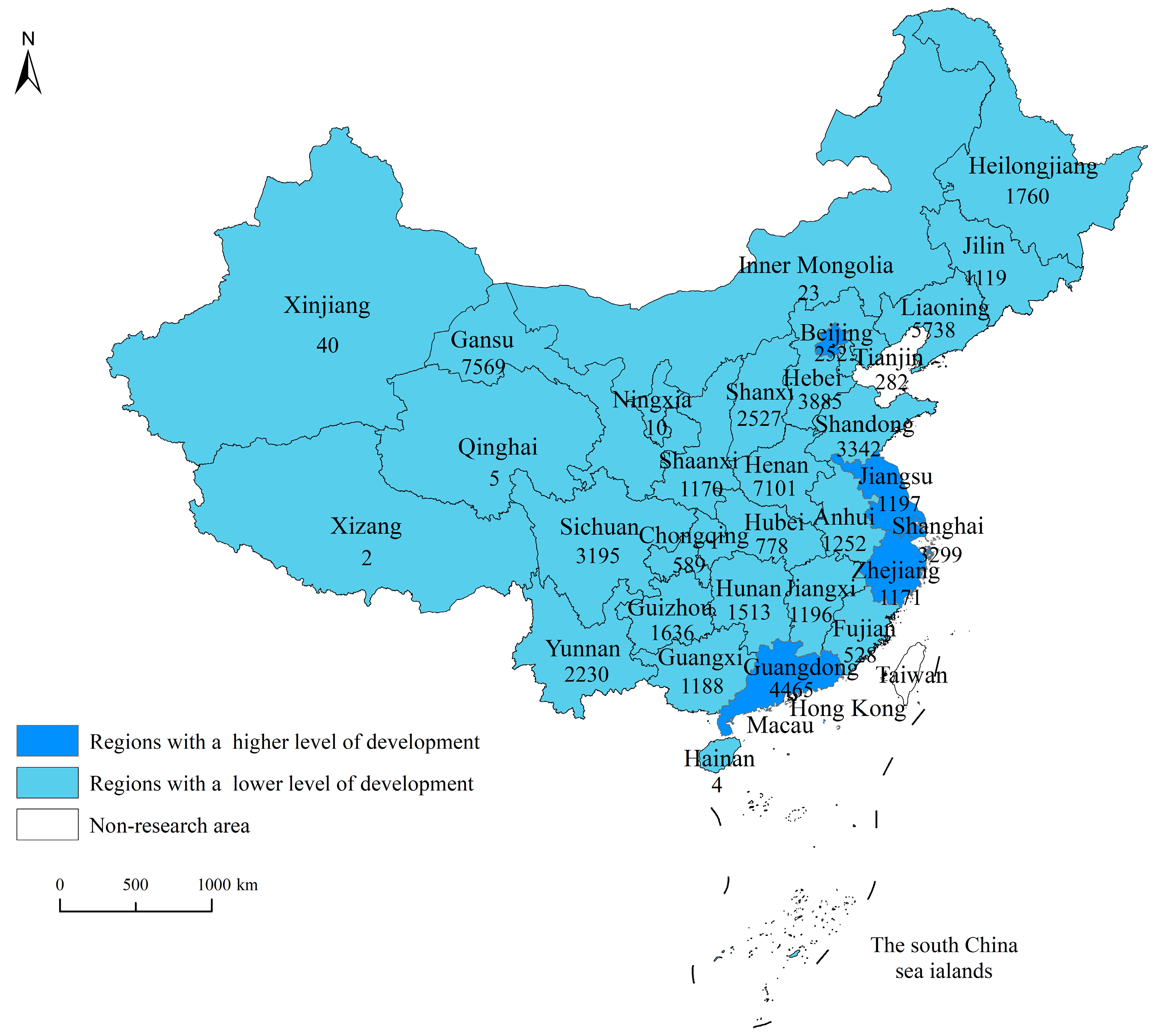
Considering the different development conditions, economic development status and internet development level among provinces, regions and cities—such as the different degree of influence of the “broadband China” policy, the difference in network infrastructure and the difference in digital education level—the digital literacy level of the rural labor force is affected by external interference, rather than being the result of a complete reliance on independent selection. According to the “Operation of Internet and Related Service Industries” released by the Ministry of Industry and Information Technology of China in 2020, the five provinces and cities with a high level of internet business development are Guangdong, Beijing, Shanghai, Zhejiang and Jiangsu. The distribution map of regional sample sizes for the 31 provinces (municipalities and autonomous regions) is shown in Figure 3. These five provinces and cities and other provinces and cities were divided into two groups for regression estimation, and the results are shown in Models (3) and (4) in Table 8. It can be seen that digital literacy has an inhibitory effect on the multi-dimensional inequality of rural residents in these two regions at the level of 1%. Among them, the five provinces of Guangdong, Beijing, Shanghai, Zhejiang and Jiangsu have consistently ranked at the forefront of China’s economic development. In provinces and cities with a relatively low level of internet business development, the impact of digital literacy on the reduction of multi-dimensional inequality is more significant. Obtaining more benefits from digital literacy stems from the breakthrough effect of digital technology on its structural constraints. The period from 2014 to 2020 was a critical period when mobile internet and digital services penetrated into less developed areas. The improvement of digital literacy enabled local residents to obtain educational resources, medical information, government services and access to the large national market at a lower cost, partially offsetting the disadvantages caused by physical distance and the scarcity of traditional resources. This functional substitution and compensation for traditional shortcomings is not as effective in developed regions. Therefore, digital literacy provided a “springboard” for less developed regions to leapfrog development, and the comprehensive welfare improvement it brought had a higher marginal value. This is similar to the regression finding that digital literacy has a stronger mitigating effect on residents who work in agriculture.

4.4.3. Heterogeneity of Digital Literacy

All samples were classified into high, medium and low levels based on the comprehensive index of digital literacy by different years for regression analysis. The results are shown in Table 9. It can be seen that the absolute values of the regression coefficients of the high and low digital literacy groups are greater than those of the medium digital literacy group. This might be because the high digital literacy group has mastered better computer hardware and software resources and can more efficiently utilize digital technology to obtain information, solve problems and create value; while the low digital literacy group, under policy support, directly applies digital technology to production and life, significantly enhancing productivity and income. This is similar to the regression results showing that digital literacy has a stronger mitigating effect on residents engaged in agricultural work and provinces and cities with lower levels of internet business development. To sum up, the mitigation effect of digital literacy on the multi-dimensional inequality of rural residents varies according to the employment status of rural households, the level of internet development in their regions and the digital literacy level. That is, Hypothesis 4 in this paper is verified.

4.5. Further Discussions

To explore which digital literacy can more effectively alleviate the multi-dimensional inequality among rural residents, further study was conducted on the mitigation effects of different types of digital literacy. Under the condition of k = 0.33, five digital literacy categories were investigated—digital general literacy, information processing literacy, digital social literacy, digital entertainment literacy and digital work literacy—and the results are shown in Table 10. These five digital literacy categories all have significant inhibitory effects on multi-dimensional inequality in rural residents, which further confirms the significant negative effects of digital literacy on multi-dimensional inequality in rural residents.
Among them, information processing literacy has the largest coefficient of influence on the multi-dimensional inequality of rural residents. This conclusion is in line with the evolution pattern of the digital divide theory. After digital infrastructure became balanced and initially bridged the “access gap” from 2014 to 2020, the core contradiction of the digital divide shifted from “physical access” to “skills and applications”. Once the differences in physical access were eliminated, information processing literacy would become the key determinant influencing whether rural residents can transform technological opportunities into actual benefits, thereby intensifying or alleviating multi-dimensional inequality [52]. Under conditions of equal technological opportunities, whether an individual can convert access into actual benefits entirely depends on high-level literacy. This directly determines who can effectively convert information into economic capital, bridge the “conceptual gap”, avoid risks, and thus gain an advantage during the digital dividend distribution period. Conversely, the applications of residents lacking information processing literacy, even if they “access” the network, may remain at the level of entertainment and consumption, unable to improve long-term well-being, and ultimately leading to the “capability gap” replacing the “access gap” as the core mechanism exacerbating multi-dimensional inequality. The second most influential is entertainment and social digital literacy. Online entertainment and social activities not only enrich the spiritual and cultural life of rural residents and enhance their subjective well-being but also serve as an important means of fostering interpersonal relationships and accumulating social capital, which is conducive to alleviating multi-dimensional inequality. The last category is work-related and general digital literacy. The main reason for this may be that work-related digital literacy is generally low, while general digital literacy is relatively high among rural residents. The smaller difference between these two types of literacy means that their impact on multi-dimensional inequality is relatively smaller when compared with the other three types of digital literacy.

5. Conclusions and Implications

5.1. Conclusions

At present, the main problem China faces in promoting high-quality development is the imbalance and inadequacy in development, and the imbalance and inadequacy are particularly prominent in rural areas. Therefore, focusing on the multi-dimensional inequality status of rural residents, and based on the CFPS panel data from 2014 to 2020, a multi-dimensional inequality index and a digital literacy index were constructed for measurement, series tests, and empirical analysis, which were conducted to examine the impact, mechanism and heterogeneity of rural residents’ digital literacy on multi-dimensional inequality. Three conclusions were drawn. (1) This study uses multiple linear regression estimation and adopts a high-dimensional fixed effect model, including time fixed effect and individual fixed effect. A total of 59,066 sample data are retained under this model. In addition, three robustness testing methods were adopted, all of which confirmed that digital literacy can significantly alleviate the multi-dimensional inequality of rural residents at the level of 1%, which confirmed the findings of some existing literature. Digital literacy facilitates the production and life of rural residents in the digital age, thus helping to alleviate the multi-dimensional inequality of rural residents. (2) Based on the theories of social capital, social identity, and economic behavior, this study adopts a “two-step method” for mechanism verification, confirming that digital literacy can significantly enhance the level of social capital and the degree of social harmony. Social harmony is a fundamental condition for production development, and social capital, as the core component of family livelihood capital [53], can significantly improve the social capital level and social harmony of rural residents, thereby effectively alleviating their multi-dimensional inequalities in economic, social, and information acquisition. This aligns with the inclusive growth concept proposed by the Asian Development Bank in 2007. Digital literacy directly corresponds to the three pillars of inclusive growth, not only narrowing the “digital divide” at the technical and tool level, but also promoting “inclusive development” at the social relationship and opportunity structure levels. By empowering individuals, activating social capital, and enhancing social cohesion, it provides a practical and feasible path for systematically alleviating the multi-dimensional inequalities of rural residents and implementing the international concept of inclusive growth. (3) Heterogeneity testing and further studies indicate that digital literacy has a significant easing effect on multi-dimensional inequality of different rural resident groups at the level of 1%. Specifically, the improvement of digital literacy has a greater impact on agricultural workers than non-agricultural workers, which may be because agricultural workers have greater potential space to access digital applications in the same period. The impact of digital literacy on the multi-dimensional inequality of rural residents in areas with low internet level is stronger. When the basic conditions of China’s digital network are relatively equal from 2014 to 2020, information processing literacy has the greatest impact on rural residents’ multi-dimensional inequality.

5.2. Implications

Advocate “Digital Inclusion”. Internationally, one must advocate for digital inclusion as a core issue on the global development agenda and support knowledge sharing and project cooperation. One should support cooperation with UNESCO to introduce and localize educational frameworks that align with information literacy and media. Domestically, one should strengthen the construction of “Digital Villages”. New infrastructure is an important component of the modern infrastructure system and an important foundation for promoting the digital transformation, intelligent upgrading, and integrated development of the entire society [54]. This study finds that, in provinces and cities with lower levels of internet business development, digital literacy has a stronger mitigating effect on the multi-dimensional inequality of rural residents. From a macro perspective, government policies should be tilted towards remote rural areas with weak digital information infrastructure, increase investment in new infrastructure construction, and fully utilize digital technology to enhance the equalization of basic public services such as employment, medical care, and social security, and build a higher-level and more inclusive rural information service facility system.
Cultivating and self-improving “new rural residents”. The construction of digital villages requires further cultivation of compound “new rural residents”. Research shows that information processing literacy is the core variable that determines whether individuals can transform equal technological opportunities into multi-dimensional unequal development results. Enhancing the digital literacy of rural residents, especially their high-level information processing, critical thinking and innovation capabilities, is the key to bridging multi-dimensional inequalities in the digital age. The World Economic Forum indicates that, by 2026, 30% of routine jobs will be automated and replaced by generative artificial intelligence, and by 2027, nearly 60% of workers will need to undergo skills retraining. The EU’s 2030 Digital Strategy aims to ensure that at least 80% of adults possess basic digital skills by 2030 [55]. It aims to significantly enhance the digital literacy of workers, actively guiding rural residents to explore more new employment opportunities through information processing and digital tools. This is not only an important demand for industrial development but also an inevitable choice for the overall development of humanity.
Deepen the empowerment of agricultural practitioners. One must build an integrated ecosystem of industry–university–research cooperation, integrate training into the production processes of smart agricultural parks and cooperatives, and enable villagers and residents to “learn by doing”. One must guide social capital to invest in agricultural scientific and technological innovation, focusing on key agricultural technologies such as biotechnology breeding, intelligent agricultural machinery equipment, and digital agriculture. One must deepen the integration of e-commerce and local characteristic agricultural products, striving to achieve “internet + agriculture” to go beyond the countryside and enter the cities, to open up agricultural product sales channels, and make rural residents the biggest beneficiaries of direct agricultural product supply. One must strengthen the collaborative linkage of production and operation among counties, promote cross-county economic cooperation and exchanges, integrate agricultural and tourism resources through internet data information, and expand the employment and income increase channels for rural residents.
Enhancing the usability of digital products and personalizing digital services. Currently, the underdeveloped regions around the world are facing the dual pressures of population aging and labor shortage. It is necessary to recognize and prevent the potential “digital benefit gap”, providing resources to low digital literacy groups, the elderly, and low-income individuals, and establishing monitoring mechanisms to assess whether the intervention measures benefit the most-needy groups. By developing lightweight or elderly-friendly applications, adding convenient and intelligent operation guides, and enhancing the ability of rural residents to use digital products to solve practical problems, the learning convenience and operational ease of the products can be effectively enhanced. At the same time, by actively applying new technologies, such as artificial intelligence, machine learning, and big data, to an array of purposes that include meeting the material needs of the elderly and delving into people’s emotional and spiritual aspects—and with a particular focusing on the emotional experience, social belonging, and self-actualization needs of elderly users—continuous optimization of digital service quality can be achieved.

Author Contributions

Conceptualization, S.L. and Y.L.; methodology, Y.L.; software, Y.L.; validation, S.L., H.W. and Y.W.; formal analysis, S.L. and Y.L.; investigation, H.W. and Y.W.; resources, Y.L.; data curation, S.L. and Y.L.; writing—original draft preparation, Y.L.; writing—review and editing, S.L. and Y.L.; visualization, H.W. and Y.L.; supervision, Y.W. All authors have read and agreed to the published version of the manuscript.

Funding

This research was funded by Key Project of Jiangxi Province Social Science Foundation, grant number 2025ZXXGC13 and Management Science and Technology Project of Jiangxi Province, grant number 20252BAA100063.

Institutional Review Board Statement

Ethical approval was not required as the study did not involve human participants.

Informed Consent Statement

Informed consent was not required as the study did not involve human participants.

Data Availability Statement

The original data presented in the study are openly available in the China Statistical Yearbook (The website link: https://data.cnki.net/yearBook/single?nav=%E7%BB%9F%E8%AE%A1%E5%B9%B4%E9%89%B4&id=N2024110295&pinyinCode=YINFN [accessed on 6 November 2025]). And the raw data supporting the conclusions of this article will be made available by the authors on request. All authors have read and agreed to the published version of the manuscript.

Conflicts of Interest

The authors declare that there are no financial or other relationships that might lead to a conflict of interest in the present article.

References

  1. Bai, C.; Guan, W.; Wang, D.; Chen, X. Digital village construction and the quality of life of rural residents. Int. Rev. Econ. Financ. 2024, 96, 103729. [Google Scholar] [CrossRef]
  2. Chen, H.; Chen, C.-P.; Li, Y.; Qin, L.; Qin, M. How Internet usage contributes to livelihood resilience of migrant peasant workers? Evidence from China. J. Rural. Stud. 2022, 96, 112–120. [Google Scholar] [CrossRef]
  3. Li, F.; Zang, D.; Chandio, A.; Yang, D.; Jiang, Y. Farmers’ adoption of digital technology and agricultural entrepreneurial willingness: Evidence from China. Technol. Soc. 2023, 73, 102253. [Google Scholar] [CrossRef]
  4. Zhou, D.; Zha, F.; Qiu, W.; Zhang, X. Does digital literacy reduce the risk of returning to poverty? Evidence from China. Telecommun. Policy 2024, 48, 102768. [Google Scholar] [CrossRef]
  5. Yang, C.; Ji, X.; Cheng, C.; Liao, S.; Bright, O.; Zhang, Y. Digital economy empowers sustainable agriculture: Implications for farmers’ adoption of ecological agricultural technologies. Ecol. Indic. 2024, 159, 111723. [Google Scholar] [CrossRef]
  6. Kolm, S.-C. Multidimensional egalitarianisms. Q. J. Econ. 1977, 91, 1–13. [Google Scholar] [CrossRef]
  7. Bowman, J.P. The Digital Economy: Promise and Peril in the Age of Networked Intelligence; McGraw-Hill: New York, NY, USA, 1996. [Google Scholar]
  8. Carpiano, R. Toward a neighborhood resource-based theory of social capital for health: Can Bourdieu and sociology help? Soc. Sci. Med. 2006, 62, 165–175. [Google Scholar] [CrossRef]
  9. Akerlof, G.A.; Kranton, R.E. Economics and Identity. Q. J. Econ. 2000, 115, 715–753. [Google Scholar] [CrossRef]
  10. Zhang, Z.; Shu, H.; Yi, H.; Wang, X. Household multidimensional energy poverty and its impacts on physical and mental health. Energy Policy 2021, 156, 112381. [Google Scholar] [CrossRef]
  11. Decancq, K.; Decoster, A.; Schokkaert, E. The Evolution of World Inequality in Well-being. World Dev. 2009, 37, 11–25. [Google Scholar] [CrossRef]
  12. Liu, Y.; Xu, Y. A geographic identification of multidimensional poverty in rural China under the framework of sustainable livelihoods analysis. Appl. Geogr. 2016, 73, 62–76. [Google Scholar] [CrossRef]
  13. Tang, J.; Xu, Y.; Ma, W.; Gao, S. Does participation in poverty alleviation programmes increase subjective well-being? Results from a survey of rural residents in Shanxi, China. Habitat Int. 2021, 118, 102455. [Google Scholar] [CrossRef]
  14. Karner, A.; Pereira, R.; Karner, A. Advances and pitfalls in measuring transportation equity. Transportation 2025, 52, 1399–1427. [Google Scholar] [CrossRef]
  15. Liu, M.; Feng, X.; Zhao, Y.; Qiu, H. Impact of poverty alleviation through relocation: From the perspectives of income and multidimensional poverty. J. Rural. Stud. 2023, 99, 35–44. [Google Scholar] [CrossRef]
  16. Kyaw, B.; Saxena, N.; Posadzki, P.; Vseteckova, J.; Nikolaou, C.; George, P.; Divakar, U.; Masiello, I.; Kononowicz, A.; Zary, N.; et al. Virtual Reality for Health Professions Education: Systematic Review and Meta-Analysis by the Digital Health Education Collaboration. J. Med. Internet Res. 2019, 21, e12959. [Google Scholar] [CrossRef] [PubMed]
  17. Ji, H.; Dong, J.; Pan, W.; Yu, Y. Associations between digital literacy, health literacy, and digital health behaviors among rural residents: Evidence from Zhejiang, China. Int. J. Equity Health 2024, 23, 68. [Google Scholar] [CrossRef] [PubMed]
  18. Getenet, S.; Cantle, R.; Redmond, P.; Albion, P. Students’ digital technology attitude, literacy and self-efficacy and their effect on online learning engagement. Int. J. Educ. Technol. High. Educ. 2024, 21, 3. [Google Scholar] [CrossRef]
  19. Abulibdeh, A.; Zaidan, E.; Abulibdeh, R. Navigating the confluence of artificial intelligence and education for sustainable development in the era of industry 4.0: Challenges, opportunities, and ethical dimensions. J. Clean. Prod. 2024, 437, 140527. [Google Scholar] [CrossRef]
  20. Choung, Y.; Chatterjee, S.; Pak, T. Digital financial literacy and financial well-being. Financ. Res. Lett. 2023, 58, 104438. [Google Scholar] [CrossRef]
  21. Li, P.; Li, Q.; Du, S. Does digital literacy help residents avoid becoming victims of frauds? Empirical evidence based on a survey of residents in six provinces of east China. Int. Rev. Econ. Financ. 2024, 91, 364–377. [Google Scholar] [CrossRef]
  22. Li, W.; Yang, X.; Yin, X. Digital transformation and labor upgrading. Pac.-Basin Financ. J. 2024, 83, 102280. [Google Scholar] [CrossRef]
  23. Phua, J.; Jin, S.; Kim, J. Uses and gratifications of social networking sites for bridging and bonding social capital: A comparison of Facebook, Twitter, Instagram, and Snapchat. Comput. Hum. Behav. 2017, 72, 115–122. [Google Scholar] [CrossRef]
  24. Toffler, A. Powershift. Rev. Filos. 1992, 39, 175–178. [Google Scholar] [CrossRef]
  25. Abele, A.; Ellemers, N.; Fiske, S.; Koch, A.; Yzerbyt, V. Navigating the Social World: Toward an Integrated Framework for Evaluating Self, Individuals, and Groups. Psychol. Rev. 2021, 128, 290–314. [Google Scholar] [CrossRef] [PubMed]
  26. Gong, S.; Jiang, L.; Yu, Z. Can Digital Human Capital Promote Farmers’ Willingness to Engage in Green Production? Exploring the Role of Online Learning and Social Networks. Behav. Sci. 2025, 15, 227. [Google Scholar] [CrossRef]
  27. Lei, J.; Xie, Y.; Chen, Y.; Zhong, T.; Lin, Y.; Wang, M. The Transformation of Peri-Urban Agriculture and Its Implications for Urban-Rural Integration Under the Influence of Digital Technology. Land 2025, 14, 375. [Google Scholar] [CrossRef]
  28. Rotz, S.; Gravely, E.; Mosby, I.; Duncan, E.; Finnis, E.; Horgan, M.; LeBlanc, J.; Martin, R.; Neufeld, H.; Nixon, A.; et al. Automated pastures and the digital divide: How agricultural technologies are shaping labour and rural communities. J. Rural. Stud. 2019, 68, 112–122. [Google Scholar] [CrossRef]
  29. Wang, Z.; Zheng, X.; Wang, Y.; Bi, G. A multidimensional investigation on spatiotemporal characteristics and influencing factors of China’s urban-rural income gap (URIG) since the 21st century. Cities 2024, 148, 104920. [Google Scholar] [CrossRef]
  30. Alkire, S.; Foster, J. Counting and multidimensional poverty measurement. J. Public Econ. 2011, 95, 476–487. [Google Scholar] [CrossRef]
  31. Alkire, S.; Santos, M. Measuring Acute Poverty in the Developing World: Robustness and Scope of the Multidimensional Poverty Index. World Dev. 2014, 59, 251–274. [Google Scholar] [CrossRef]
  32. Wang, Z.; Wang, W.; Yu, L.; Zhang, D. Multidimensional poverty alleviation effect of different rural land consolidation models: A case study of Hubei and Guizhou, China. Land Use Policy 2022, 123, 106399. [Google Scholar] [CrossRef]
  33. Lyu, Y.; Wu, Y.; Wu, G.; Wang, W.; Zhang, J. Digitalization and energy: How could digital economy eliminate energy poverty in China? Environ. Impact Assess. Rev. 2023, 103, 107243. [Google Scholar] [CrossRef]
  34. He, C.; Zhou, C.; Wen, H. Improving the consumer welfare of rural residents through public support policies: A study on old revolutionary areas in China. Socio-Econ. Plan. Sci. 2024, 91, 101767. [Google Scholar] [CrossRef]
  35. Gachanja, J.; Yang, T. The built environment and multidimensional poverty: Exploring accessibility as a mediator of spatial opportunity. Habitat Int. 2025, 160, 103402. [Google Scholar] [CrossRef]
  36. Wen, H.; Liu, Y.; Lee, C. How does judicial quality in ecological governance affect income gap between urban and rural residents. Cities 2025, 161, 105929. [Google Scholar] [CrossRef]
  37. Chen, Z.; Cui, R.; Tang, C.; Wang, Z. Can digital literacy improve individuals’ incomes and narrow the income gap? Technol. Forecast. Soc. Change 2024, 203, 123332. [Google Scholar] [CrossRef]
  38. Mishra, S. Social networks, social capital, social support and academic success in higher education: A systematic review with a special focus on ‘underrepresented’ students. Educ. Res. Rev. 2020, 29, 100307. [Google Scholar] [CrossRef]
  39. Chung, G.; Dong, D.; Wong, S.; Wong, H.; Chung, R. Perceived poverty and health, and their roles in the poverty-health vicious cycle: A qualitative study of major stakeholders in the healthcare setting in Hong Kong. Int. J. Equity Health 2020, 19, 13. [Google Scholar] [CrossRef] [PubMed]
  40. Barbalet, J. Intergenerational family relations in reform China: Background and context. Sociol. Rev. 2025, 73, 735–752. [Google Scholar] [CrossRef]
  41. Xie, H.; Huang, Y. Influencing factors of farmers’ adoption of pro-environmental agricultural technologies in China: Meta-analysis. Land Use Policy 2021, 109, 105622. [Google Scholar] [CrossRef]
  42. Lyons, A.; Castano, A.; Kass-Hanna, J.; Zhang, Y.; Soliman, A. A machine learning approach to assessing multidimensional poverty and targeting assistance among forcibly displaced populations. World Dev. 2025, 192, 107013. [Google Scholar] [CrossRef]
  43. Valkenburg, P.; Peter, J.; Walther, J. Media Effects: Theory and Research. Annu. Rev. Psychol. 2016, 67, 315–338. [Google Scholar] [CrossRef]
  44. Yan, Y.; Guan, J. Social capital, exploitative and exploratory innovations: The mediating roles of ego-network dynamics. Technol. Forecast. Soc. Change 2018, 126, 244–258. [Google Scholar] [CrossRef]
  45. Yang, T.; Zhang, T. Social capital meets guanxi: Social networks and income inequality in China. China Econ. Rev. 2024, 83, 102094. [Google Scholar] [CrossRef]
  46. Martin-Gutierrez, S.; van Dissel, M.; Karimi, F. Intersectional inequalities in social ties. Sci. Adv. 2025, 11, eadu9025. [Google Scholar] [CrossRef]
  47. Das, T.K.; Teng, B.-S. Between trust and control: Developing confidence in partner cooperation in alliances. Acad. Manag. Rev. 1998, 23, 491–512. [Google Scholar] [CrossRef]
  48. Brewer, R. Enhancing Crime Control Partnerships Across Government: Examining the Role of Trust and Social Capital on American and Australian Waterfronts. Police Q. 2013, 16, 371–394. [Google Scholar] [CrossRef]
  49. Li, Y.; Marquez, R. Can government subsidies and public mechanisms alleviate the physical and mental health vulnerability of China’s urban and rural residents? Int. J. Equity Health 2023, 22, 59. [Google Scholar] [CrossRef] [PubMed]
  50. Yang, C.; Chen, R.; Zhong, S.; Liu, W.; Xin, G. How social solidarity affects the outcomes of rural residential land consolidation: Evidence from Yujiang County, South China. Land Use Policy 2023, 130, 106662. [Google Scholar] [CrossRef]
  51. Padda, I.; Hameed, A. Estimating multidimensional poverty levels in rural Pakistan: A contribution to sustainable development policies. J. Clean. Prod. 2018, 197, 435–442. [Google Scholar] [CrossRef]
  52. Moravec, V.; Hynek, N.; Skare, M.; Gavurova, B.; Polishchuk, V. Algorithmic personalization: A study of knowledge gaps and digital media literacy. Humanit. Soc. Sci. Commun. 2025, 12, 341. [Google Scholar] [CrossRef]
  53. Chen, H.; Yu, J.; Zhang, Z.; Li, Y.; Qin, L.; Qin, M. How human capital prevents intergenerational poverty transmission in rural China: Evidence based on the Chinese general social survey. J. Rural. Stud. 2024, 105, 103220. [Google Scholar] [CrossRef]
  54. Song, Y.; Huang, H.; Li, Y.; Xia, J. Towards inclusive green growth in China: Synergistic roles and mechanisms of new infrastructure construction. J. Environ. Manag. 2024, 353, 120281. [Google Scholar] [CrossRef] [PubMed]
  55. Guio, A.; Marlier, E.; Gordon, D.; Fahmy, E.; Nandy, S.; Pomati, M. Improving the measurement of material deprivation at the European Union level. J. Eur. Soc. Policy 2016, 26, 219–233. [Google Scholar] [CrossRef]
Figure 1. Research flowchart.
Sustainability 18 01069 g001
Figure 2. The relationship between multi-dimensional inequality and the SDGs of rural residents.
Sustainability 18 01069 g002
Figure 3. Sample size regional distribution map.
Sustainability 18 01069 g003
Table 1. Multi-dimensional inequality index evaluation system.
DimensionsIndicatorsDeprivation ThresholdsWeights
Economic dimensionIncomeWhen the per capita income is less than 60% of the per capita disposable income in the rural areas of the province in which it is located in that year, the value is set at 1; otherwise the value is set to 0.1/8
DebtHouseholds with loans or arrears are assigned a value of 1; otherwise the value is set to 0.1/8
Social dimensionEducationIf any member of the family aged 16 or above has less than 6 years of education, it is assigned a value of 1; otherwise, it is assigned a value of 0.1/8
EmploymentIf any family member is engaged in agricultural work, it is assigned a value of 1; otherwise, it is assigned a value of 0.1/8
Personal dimensionHealthAssign a value of 1 if a family member has a chronic disease; otherwise, assign a value of 0.1/8
Life satisfactionAssign a value of 1 to any member of the family whose score for life (rated from 1 to 5) is lower than 4; otherwise, assign a value of 0.1/8
Natural dimensionLand availabilityIf a household fails to receive any of the following resources from the collective: farmland, ponds, forest farms or pastures, it is assigned a value of 1; otherwise, it is assigned a value of 0.1/8
Environmental evaluationThe score given by any member of the family for the severity of environmental issues in China (ranging from 1 to 10) is 1 if it is above 5; otherwise, it is 0.1/8
Note: In the context of China, it is reasonable to maintain the relative poverty line at 60% of the per capita disposable income of rural residents in the province.
Table 2. Index system and attribute of digital literacy.
TerritorySpecific IndexAttribute
Digital general literacyAre you accessing the internet (via mobile device)?+
The significance of the internet for your access to information.+
Information processing literacyWould you conduct online shopping or sell goods online?+
Would you undertake learning activities online?+
Digital social literacyWould you use mobile communication software (WeChat) to communicate with your family and friends?+
The significance of the internet for your social interaction.+
Digital entertainment literacyWould you engage in online activities such as watching short videos, playing games, etc. for entertainment purposes?+
The significance of the internet for your entertainment activities.+
Digital work literacyThe significance of the internet for your work activities.+
Note: + indicates a positive correlation.
Table 3. Research variables.
Types of VariableName of VariableSymbolAssignment Method
Explained variableMulti-dimensional inequality index M D I Synthesis by the A–F method
Core explanatory variableDigital literacy index D L I Principal component analysis method generation
Control variableGender G e n d e r Male = 1, female = 0
Age A g e The age of the survey year
Marital status M a r r y Marriage status = 1, otherwise = 0
Level of education E d u c a t e Illiterate/semi-literate = 1; primary school = 1; junior high school = 3; senior high school/technical school/vocational high school = 4; junior college = 5; university undergraduate = 6; Master’s degree = 7; Doctoral degree = 8
Physical condition P h y s i c a l The health status in the survey is taken as the reciprocal value
Household registration type H R T Agricultural household registration = 1, others = 0
Family scale M e m b e r Total number of family members
Household saving S a v i n g The total household income over the past 12 months minus the total household expenditure (normalized processing)
Mechanism variablePayment of favors and gifts G i f t Both in kind and in cash, total favors over the last 12 months (normalized processing)
Individual social status S o c i a l Rate your position in local society (1 to 5 points)
Political information P o l i t i c a l Number of days in a week to get political information on the internet
Gap between rich and poor G R P The severity of the gap between rich and poor in China (0 means not serious, 10 means very serious)
The degree of trust in cadres D T C Trust in local government officials (0 to 10 points)
Overall job satisfaction O J S Self-rated overall job satisfaction (1 to 5 points)
Table 4. Research measures.
SymbolMean ValueStandard DeviationMedianMinimum ValueMaximum Value
M D I 0.6730.469101
D L I 0.1150.2240.01901
G e n d e r 0.4820.500001
A g e 53.7514.28541698
M a r r y 0.8610.346101
E d u c a t e 2.2261.173218
P h y s i c a l 0.4040.2480.3330.2001
H R T 0.7810.414101
M e m b e r 4.2002.0354121
S a v i n g 0.3370.0080.33601
G i f t 0.0110.0190.0060.0001.000
S o c i a l 3.1051.1173.000−2.0005.000
P o l i t i c a l −4.0044.922−8.000−8.0007.000
G R P 6.5082.6076.000−9.00010.000
D T C 5.3572.7445.000−2.00010.000
O J S 1.0944.8893.000−9.0005.000
Note: Among the mechanism variables, negative answers represent “don’t know” “missing” or “not applicable”. Given that some questions occupy the majority of samples and still have research value, this part of the sample is not excluded. Due to the questionnaire design of CFPS stipulating that only specific respondents will answer the subsequent questions, the first approach is to merge the data from previous surveys, using the valid information from the previous rounds to fill in the missing values of the current round. Then, it is reasonable to assign “don’t know”, “missing”, or “not applicable” as “0”.
Table 5. Empirical results of benchmark regression.
Variable(1)(2)(3)
D L I −0.880 ***
(0.014)
−0.872 ***
(0.014)
−0.869 ***
(0.014)
G e n d e r −0.109
(0.070)
−0.107
(0.069)
A g e 0.005
(0.005)
0.005
(0.005)
E d u c a t e −0.041 ***
(0.008)
−0.039 ***
(0.008)
P h y s i c a l −0.064 ***
(0.010)
−0.064 ***
(0.010)
M a r r y 0.003
(0.012)
0.001
(0.012)
H R T 0.029 **
(0.013)
M e m b e r 0.003 *
(0.002)
S a v i n g −1.380 ***
(0.316)
C o n s t a n t 0.774 ***
(0.002)
0.647 **
(0.271)
1.077 ***
(0.290)
N 59,06659,06659,066
R 2 0.6430.6440.644
Y e a r   F E YesYesYes
P i d   F E YesYesYes
Note: (i) ***, **, and * indicate significance at 1%, 5%, and 10%, respectively; (ii) brackets indicate robust standard error; (iii) R 2 stands for P s e u d o   R 2 .
Table 6. Results of robustness tests.
Variable(1)(2)(3)(4)(5)
M D I o r i g M D I M D I M D I M D I
D L I −0.170 ***
(0.004)
−4.506 ***
(0.049)
−0.748 ***
(0.061)
−1.065 ***
(0.004)
D L I s u m −0.034 ***
(0.001)
C o n s t a n t 0.552 ***
(0.087)
1.070 ***
(0.292)
4.188 ***
(0.904)
1.387
(0.914)
−0.000
(0.002)
N 59,06659,06659,066412459,066
R 2 0.6860.6420.3120.708——
C o n t r o l s YesYesYesYesYes
Y e a r   F E YesYesYesYesYes
P i d   F E YesYesYesYesYes
Note: (i) *** indicates significance at 1%; (ii) brackets indicate robust standard error.
Table 7. Mechanism test results.
VariableLevel of Social CapitalDegree of Social Harmony
(1)(2)(3)(4)(5)(6)
D L I 0.291 ***
(0.067)
1.611 ***
(0.014)
0.041
(0.035)
−0.579 ***
(0.089)
0.390 ***
(0.086)
0.590 ***
(0.123)
C o n s t a n t −1.646
(1.346)
−0.892 ***
(0.175)
2.422 ***
(0.857)
9.338 ***
(1.965)
5.470 ***
(1.667)
−6.906 ***
(2.224)
N 57,05757,05757,05757,84357,84357,843
R 2 0.5710.9030.5500.4720.5720.772
C o n t r o l s YesYesYesYesYesYes
Y e a r   F E YesYesYesYesYesYes
P i d   F E YesYesYesYesYesYes
Note: (i) *** indicates significance at 1%; (ii) brackets indicate robust standard error.
Table 8. Analysis results of employment heterogeneity and regional heterogeneity.
VariableEmployment HeterogeneityRegional Heterogeneity
(1)(2)(3)(4)
D L I −1.000 ***
(0.025)
−0.737 ***
(0.020)
−0.788 ***
(0.034)
−0.887 ***
(0.015)
C o n s t a n t 1.725 ***
(0.468)
1.559 ***
(0.518)
0.432
(0.569)
1.347 ***
(0.312)
N 31,75421,50210,18648,536
R 2 0.5870.6820.6610.639
C o n t r o l s YesYesYesYes
Y e a r   F E YesYesYesYes
P i d   F E YesYesYesYes
Note: (i) *** indicates significance at 1%; (ii) brackets indicate robust standard error.
Table 9. Analysis results of the heterogeneity of the digital literacy level.
VariableDigital Literacy Level Heterogeneity
(1)(2)(3)
D L I −0.884 ***−0.806 ***−0.890 ***
(0.030)(0.051)(0.043)
C o n s t a n t 1.427 ***1.282−0.189
(0.511)(0.869)(0.948)
N 12,004966010,071
R 2 0.7400.6580.671
C o n t r o l s YesYesYes
Y e a r   F E YesYesYes
P i d   F E YesYesYes
Note: (i) *** indicates significance at 1%; (ii) brackets indicate robust standard error.
Table 10. Analysis results of the heterogeneity of digital literacy skills.
VariableMulti-Dimensional Inequality Index
(1)(2)(3)(4)(5)
Digital universal literacy−0.045 ***
(0.002)
Information processing literacy −0.247 ***
(0.006)
Digital social literacy −0.093 ***
(0.002)
Digital entertainment literacy −0.107 ***
(0.002)
Digital work literacy −0.087 ***
(0.002)
C o n s t a n t 1.167 ***
(0.292)
1.128 ***
(0.288)
1.090 ***
(0.287)
1.152 ***
(0.293)
1.014 ***
(0.301)
N 59,06659,06659,06659,06659,066
R 2 0.6170.6220.6400.6400.622
C o n t r o l s YesYesYesYesYes
Y e a r   F E YesYesYesYesYes
P i d   F E YesYesYesYesYes
Note: (i) *** indicates significance at 1%; (ii) brackets indicate robust standard error.
Disclaimer/Publisher’s Note: The statements, opinions and data contained in all publications are solely those of the individual author(s) and contributor(s) and not of MDPI and/or the editor(s). MDPI and/or the editor(s) disclaim responsibility for any injury to people or property resulting from any ideas, methods, instructions or products referred to in the content.