Article

Trade Agreements and Trade-Embedded Carbon: An Environmental Provisions Perspective

1
Business School, Xiangtan University, Xiangtan 411105, China
2
School of Liberal Arts and Social Sciences, City University of Hong Kong, Hong Kong 999077, China
*
Author to whom correspondence should be addressed.
Sustainability 2026, 18(2), 1066; https://doi.org/10.3390/su18021066
Submission received: 17 November 2025 / Revised: 31 December 2025 / Accepted: 13 January 2026 / Published: 21 January 2026

Abstract

Achieving sustainable growth in the global economy and promoting low-carbon development can be achieved by concluding trade agreements that advance trade liberalisation progressively. The study looks at how far environmental rulers go in trade deals between different countries, by examining what these agreements actually say. Combining this analysis with trade-embedded carbon data from 35 sub-sectors across 60 countries from 2009 to 2023, the effect of the depth of environmental rulers in trade deals on trade-embedded carbon is the focus of this empirical study and its underlying mechanisms. Research findings indicate that strengthening environmental clauses significantly reduces carbon emissions embedded in trade. This result remained consistent after undergoing a series of robustness tests and employing instrumental variable methods to address endogeneity issues. Mechanism tests reveal that the carbon reduction effect of environmental clauses can be achieved through two channels: green technology cooperation between countries and increased carbon productivity. Heterogeneity tests indicate that provisions in trade agreements that are more environmentally focused can have a greater effect on reducing embedded carbon in non-technology-intensive areas and pollution-intensive sectors, particularly for developing countries. Provisions relating to the environment in bilateral trade agreements demonstrate greater effectiveness in curbing trade-embedded carbon. This paper concludes that a more in-depth knowledge of the way environmental provisions are created in trade agreements, an accurate assessment of the impact, effectiveness and applicable scenarios of these provisions, and the promotion of targeted policy measures for future provisions relating to the environment and trade agreements and the global transition to green, low-carbon trade, will provide policy references and development guidance.

1. Introduction

Against the backdrop of global economic integration, global warming has emerged as a critical constraint on sustainable economic development worldwide. The primary drivers of global climate change are excessive emissions of greenhouse gases, such as carbon dioxide, from human production and consumption activities [1]. According to the International Energy Agency’s 2024 Carbon Dioxide Emissions Report, global carbon dioxide emissions surpassed 39.8 billion tonnes in 2023, setting a new historical record. Since 2008, carbon emissions embedded in global trade have continued to rise, consistently accounting for 20–25% of total global carbon dioxide emissions. Consequently, reducing trade-embedded carbon emissions is critical to achieving the global economic goals of decarbonisation and carbon neutrality.
Achieving a balance between trade and carbon emissions while reaching high-quality development in international trade is dependent on ensuring economic growth, which is vital for coordinated progress in sustainable economic development and environmental protection. To this end, economies should establish mutually recognised environmental standards and regulatory mechanisms by concluding trade agreements that incorporate high environmental standards. This will promote international cooperation in controlling cross-border pollution and reduce embedded carbon emissions in trade. However, the trend towards incorporating environmental considerations into international economic and trade rules has become increasingly evident in recent years. Competition to establish low-carbon regulations has intensified, with trade agreements placing greater emphasis on environmental issues. This shift is characterised by three main trends: an expansion in the scope of environmental protection, a deeper integration of environmental considerations with trade and investment, and stronger regulatory constraints.
Against the backdrop of low-carbon trade, major economies worldwide have been actively pursuing low-carbon transitions in recent years. However, their current influence on the development of international green trade rules and the advancement of regional environmental governance is limited, which undoubtedly impedes the transformation of global governance and the process of reshaping international trade regulations [2]. Therefore, a comprehensive and systematic study of the deep-seated connection between regional environmental regulations and the carbon embedded in trade is essential. This research has significant implications for economies engaging deeply in global governance and cooperation, advancing domestic institutional reforms for green development, cultivating new green productive forces and shaping green core competitiveness within global value chains.
Substantial results have been yielded by research on environmental provisions in international trade, with a gradual shift from qualitative to quantitative analysis. Empirical studies currently predominantly explore the economic effects of environmental provisions at the product or national level. They focus primarily on the influence of such provisions are included in trade agreements on investment, technological sophistication, innovation, export product quality and global value chains [3,4,5,6]. Moreover, in recent years, scholars have increasingly focused on the environmental, trade, and investment impacts stemming from the deepening of environmental rulers in trade deals. However, comprehensive and systematic analyses of the effect of intensifying environmental issues in trade agreements on embedded carbon remain scarce, as do explanations of the impact and underlying mechanisms of environmental provisions on embedded carbon. Therefore, it is vital to clarify the influence of environmental provisions on embedded carbon in order to achieve sustainable development in the global economy.
Research into environmental provisions in trade agreements and their implications for trade-embedded carbon emissions still faces several critical issues that require in-depth exploration. Firstly, analyses of the potential drivers and pathways for trade-embedded carbon have largely been based on theoretical frameworks, with relatively few empirical studies or investigations from the perspective of environmental provisions. Secondly, research into the influence of environmental provisions in trade agreements concerning carbon emissions that are embedded in trade is still in its infancy. In particular, the strong link between environmental clauses and global trade-embedded carbon has not been adequately substantiated by theoretical or empirical analysis, and the underlying mechanisms are unclear. Thirdly, there is still no comprehensive systemic indicator framework in place for quantifying trade-embedded carbon, and more detailed and comprehensive characterisations of the environmental provisions in trade agreements are yet to be developed [7]. In this context, the paper takes a perspective of trade-embedded carbon. Using global input–output data, environmental satellite account data and text mining data from environmental clauses in trade agreements, it quantifies trade-embedded carbon by internalising environmental costs. It empirically examines the heterogeneous impact of environmental clauses on trade-embedded carbon and their underlying mechanisms in a comprehensive manner. This in-depth analysis expands existing research perspectives and enriches the body of work in the field of green trade.
Compared to existing literature, this paper’s marginal contribution lies primarily in introducing trade-embedded carbon into interdisciplinary research on trade agreements and environmental issues. Firstly, with regard to the sample data, existing studies predominantly utilise data at the level of individual economies. Restricting the research perspective to individual economies results in an imbalanced evaluation of the effect of trade agreements include environmental provisions on trade-related carbon emissions. To this end, this study uses data from 60 economies between 2009 and 2023. This approach enhances the precision of the analysis and enables a more comprehensive and systematic evaluation of the effect of provisions relating to the environment in trade agreements concerning hidden carbon emissions resulting from international trade. Secondly, this study does not simply adopt pollution indicators measured through physical monitoring. Instead, it references the calculation framework proposed by Meng et al., focusing on embedded carbon emissions within value chain trade as its primary research subject [8]. This is because the indicator of trade-embedded carbon emissions, as measured by the input–output approach, provides a more objective and accurate portrayal of carbon emissions closely associated with value chain trade within the global division of labour. This is because it better reflects production and trade linkages between countries. Thirdly, this paper offers valuable insights into constructing depth indicators for environmental provisions in regional trade agreements. It provides a detailed and comprehensive analysis of environmental rules within such agreements, establishing a three-dimensional dataset encompassing 630 specific clauses. By measuring the depth of environmental provisions across multiple dimensions, the study delivers crucial reference points for clarifying the relationship between these provisions and trade-embedded carbon. Fourthly, existing literature has primarily examined the trade effects of environmental provisions in regional trade agreements. However, beyond trade impacts, environmental effects also warrant attention. By identifying the implications of these provisions on trade-related carbon emissions, this study not only enriches the existing research on the environmental effects of RTA environmental clauses but also provides insights and policy references for economies worldwide to further refine the content of such environmental provisions.

2. Literature Review

2.1. Research on Environmental Regulatory Provisions

Significant progress has been made in existing literature on environmental regulation provisions, in both qualitative and quantitative research. Qualitative analysis primarily focuses on two key aspects: Firstly, review the provisions for the environment and rules set out in trade agreements. Secondly, focus on individual economies and explore the patterns and characteristics of provisions for the environment in the trade negotiations they have signed. Discuss these economies’ environmental regulatory demands [9]. The quantitative analysis focuses on two main aspects: measuring the depth of environmental regulatory provisions and assessing the impact on trade. The measurement of environmental regulatory depth is discussed in terms of both breadth and depth. When measuring breadth, Elsig and Klotz examined both the total number and the word count of environmental provisions within chapters on goods trade [10]. Subsequently, Bellmann and Bulatnikova calculated weights based on how often environmental provisions were mentioned in trade agreements [11]. They then aggregated the coverage of each provision by multiplying it by its respective weight. In terms of depth, Elsig and Klotz suggested using the presence of substantive environmental commitments as a proxy variable [10]. However, this approach fails to distinguish between the varying levels of binding force among these commitments. To address these shortcomings, Abman et al. adopted approaches for measuring the depth of WTO rules in order to distinguish more clearly between provisions that are fully legally enforceable and those that are only partially legally enforceable [12]. As measurement issues have received significant attention, so too has research examining the trade effects of environmental regulatory provisions. The existing literature on trade studies concerning provisions for the environment in trade negotiations focuses primarily on two aspects: the overall impact of these provisions on trade and their effect on the composition of imports and exports. However, no consistent conclusions have yet been reached [13].

2.2. Research on Trade-Embedded Carbon

Research on measuring implicit carbon emissions in trade. The primary methodology currently in use involves incorporating pollution emission data into input–output models for quantification. Early literature used single-region input–output models to measure a country’s implicit carbon emissions. However, this approach struggles to account for differences in production technologies and emission factors between importing and exporting nations, resulting in measurement biases [14]. By contrast, the Multi-Region Input–Output (MRIO) model distinguishes production technologies and emission coefficients directly within the input–output table, avoiding measurement biases stemming from domestic technology assumptions [15]. As databases have developed and improved, MRIO has consequently become the primary method for measuring trade-embedded carbon emissions. Previous studies on trade-embedded carbon emissions have predominantly relied on trade volume metrics, failing to incorporate specific value chain pathways. This has left questions unanswered, such as the extent to which carbon emissions are embedded in value chain trade between nations [16]. Meng et al. addressed this gap by systematically tracing CO2 emissions within a value chain measurement framework [8]. This provided a crucial methodological approach for studying trade-embedded carbon emissions amid the rapid expansion of global value chains. A research study investigating the factors that influence emissions of carbon through trade. Grossman and Krueger were the first to use structural decomposition methods to examine the factors and pathways through which trade affects the environment [17]. Subsequently, scholars investigating the determinants of trade-embedded carbon emissions have largely followed this approach. Using various decomposition techniques, they break down embedded carbon emissions into distinct components, analyse fluctuations in each component and aggregate these changes in order to trace the root causes of carbon emission growth [18]. Within this framework, optimising the structure of traded goods and promoting technological progress in reducing emissions are critical factors in reducing trade-embedded carbon [19,20]. Scholars have started to examine the factors that determine trade-embedded carbon, including trade patterns, the intensity of environmental regulation, energy structure and position within value chains [21]. Additionally, some scholars have explored the factors influencing trade-embedded carbon from various angles. According to research, enhancing financial efficiency and financialisation, increasing participation in global value chains (GVCs), advancing technological progress and promoting the service-oriented and digital transformation of manufacturing are all key ways of reducing trade-embedded carbon intensity [22].

2.3. Research into the Link Between Environmental Pollution and Trade Agreements

Research into this topic to date has concentrated on social and the economic influences of trade deals, especially with respect to foreign direct investment, global value chains and trade flows. There is a widespread observation that deepening trade agreements can have a more positive influence [23]. Research into provisions relating to the environment and trade agreements are still in its infancy. Existing researchs primarily focus on the effect of such provisions on environmental quality, trade volume and structure. Perspectives are generally divided into two opposing viewpoints. Among studies with negative perspectives, Brandi et al. argue that, by taking the lead in incorporating environmental provisions into free trade agreements, developed countries such as the United States may establish a paradigm of clauses and environmental standards that favour the interests and international environmental discourse power of developed nations [24]. This could ultimately undermine the interests of developing countries. The higher the environmental standards set in trade agreements, the greater the likelihood that developing countries will lose the competitive advantages they had gained under their existing standards. Bastiaens and Postnikov argue that different countries tend to include different environmental protection provisions in their trade agreements [25]. Conflicts over these environmental clauses could lead to new forms of trade protectionism. Among studies adopting a positive stance, Shen et al. argue that environmental provisions in trade agreements can effectively safeguard domestic environments and reduce pollutant emissions [26]. They found that improving the extent and depth of these provisions yields better policy outcomes. Meanwhile, Balogh and Mizik examined how environmental and labour provisions in trade agreements influence investment behaviour [27]. They discovered that these provisions promote foreign direct investment (FDI) in clean industries while discouraging FDI in polluting industries. Balogh found that strengthening environmental provisions in trade agreements helps to reduce deforestation and protect forests, thereby preserving biodiversity [28]. Brandi et al. proposed that environmental clauses in trade agreements could reduce developing countries’ exports of polluting products, while encouraging growth in clean product exports and facilitating product substitution [24]. Di et al. argue that trade agreements that incorporate environmental provisions can effectively reduce the export of polluting products, encourage the export of environmentally friendly goods, and improve the composition of exports [29].
A review of the literature reveals that there is scope to expand. Existing studies on the extent of trade negotiations and carbon emissions embedded in trade in the following areas: Firstly, the existing literature on measuring the depth of environmental provisions in trade agreements rarely considers the differences in stipulations between various agreements. It fails to distinguish effectively between the enforceability of environmental clauses in different trade pacts and lacks sufficient dimensional decomposition and refinement. Therefore, future research should develop more targeted measurement indicators. Secondly, existing research has yet to establish a link between provisions concerning the environment in trade agreements and trade-related carbon emissions. Studies examining the impact of the depth of such provisions on trade-embedded carbon have primarily focused on the effects of a single country signing a trade agreement containing them on its domestic environment, trade volume and structure. Focusing solely on a single country makes it easy to overlook the broader implications of trade negotiation and misjudge the overall effect of their provisions for the environment on reducing global carbon emissions.

3. Theoretical Analysis

3.1. The Effect of Environmental Rules on Trade-Embedded Carbon

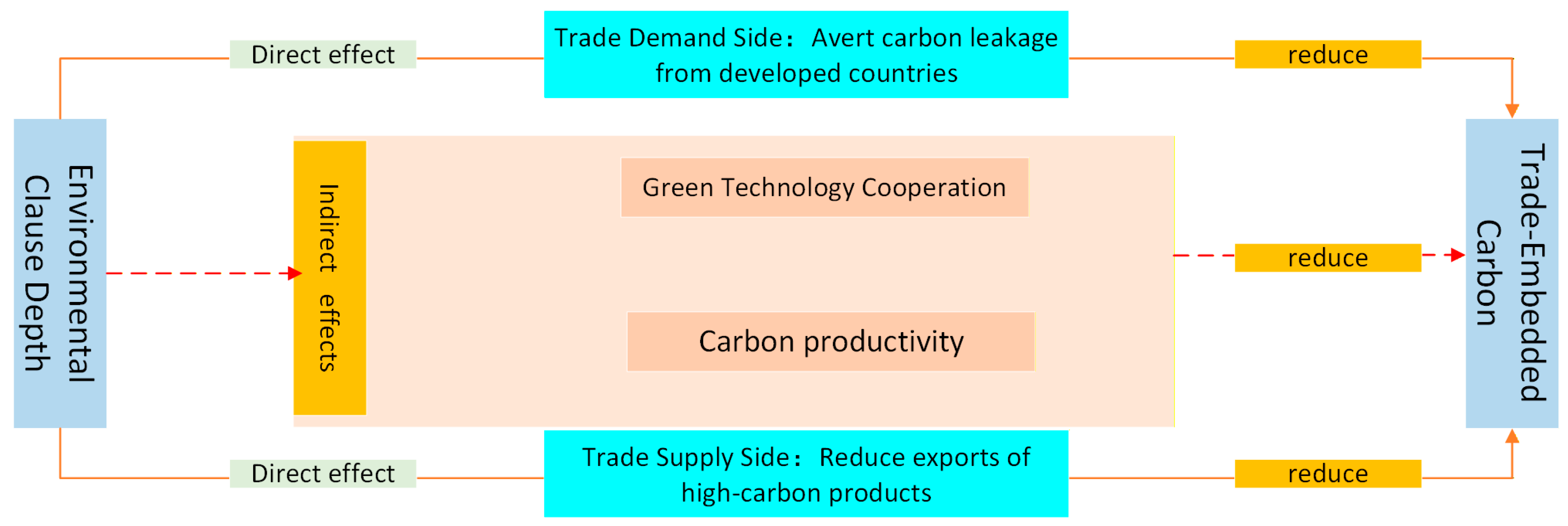
From the viewpoint of importing countries, environmental rules state that trade and investment should not be increased in a way that harms the natural environment or leads to the overexploitation and depletion of resources. They specifically demand member states to implement stringent clean product requirements and high environmental protection standards. These provisions significantly intensify restrictions on traded goods that are intensive in terms of pollution and tighten clean product standards, effectively preventing developed countries from shifting carbon emissions through imports [30]. The decline in market demand has led to a contraction with regard to the international trade of high-carbon products, this helps to stop the decline in environmental assets in emerging nations. Investment in green technology can be encouraged in developed countries by strict environmental terms of trade for imported goods, enhancing their commitment to innovating in this area. Through positive cross-border technology spillover effects, this approach increases the green production capacity and overall resource efficiency of developing countries within global value chains, thereby reducing embedded carbon in imports [31]. From the perspective of exporting countries, the process of strengthening environmental regulations within trade negotiations can directly lead to more stringent controls on the export of high-carbon products, reduce the volume of pollution-intensive exports and diminish the international competitiveness of high-carbon goods. Consequently, this can lower embedded carbon in trade. These enhanced provisions also encourage exporting countries to prioritise low-carbon production, strengthening domestic environmental regulations and allocating more resources towards cleaner, low-carbon manufacturing processes [32]. Green clauses in trade agreements can increase market competition among producers, enabling those with stronger clean production capabilities to gain a greater market penetration. This improves the clean production capacity and overall carbon productivity of the industry, reducing the amount of embedded carbon in exported goods [33]. Trade agreements can be signed that facilitate trade among the countries taking part. This can generate a number of effects, including trade diversion and spillover. It can also encourage exporting enterprises to sell their products to countries that have signed green clause trade deals. This encourages enterprises to enhance their green production capabilities proactively and reduce the carbon intensity of traded goods, thereby meeting the market access demands of their trading associates while effectively decreasing the carbon footprint of their exports [34]. The following research hypotheses are suggested in light of this:
H1: 
Strengthening environmental rules has reduced the carbon footprint of trade.

3.2. Green Technology Cooperation

Environmental rules in trade negotiations usually cover the exchange and collaboration on green production technologies. This includes setting up mechanisms for environmental think tank expert exchanges, promoting environmentally friendly products and services, improving transparency and the organisation holds regular conferences, seminars and exhibitions on environmental issues, as well as sharing knowledge on environmental protection policies and measures [35]. This gives participating countries the chance to work together on green development, requiring all participating countries to ensure the smooth progress of cooperative activities and the successful implementation of outcomes. As environmental provisions deepen, the frequency, scope and depth of technical cooperation and learning forums have increased, effectively promoting the sharing of green technologies and cooperation between countries is essential [36]. Additionally, environmental terms in trade negotiations can improve developing countries’ access to, and knowledge of, advanced green technologies from other countries. These rules encourage the integration and collaboration of clean technologies, green innovations and expertise between countries, thereby driving the global dissemination and adoption of green production technologies. This gives exporting countries the chance to replicate, build upon and embrace green technologies, helping them to innovate and improve their clean production capabilities. Within the framework of trade agreements, the allocation of more resources to activities related to green innovation and cleaner production will be the result of countries engaging in green technology cooperation. This will collectively strengthen the innovation capabilities of green and clean technologies, driving rapid iteration and exponential growth in knowledge of these technologies. This will help to reduce embedded carbon emissions in trade by facilitating cleaner production processes [37]. The following research hypotheses are suggested in light of this:
H2: 
Green technology cooperation is key to significantly reducing trade-embedded carbon through environmental rules.

3.3. Carbon Productivity

Strengthening environmental regulations in trade negotiations tightens the legislative framework governing businesses’ trading activities. Assigning enterprises prescribed carbon emission quotas compels them to increase investment in green technological innovation and enhance their production processes and carbon productivity [38]. Market competition mechanisms can phase out outdated production capacity, thereby increasing the market size for green and clean enterprises and boosting the efficiency with which resources are allocated. Ultimately, this enhances the carbon productivity of the country’s overall traded goods. Within limited carbon emission quotas, enterprises can create more value, accelerating the low-carbon transformation of export products and reducing embedded carbon in trade [39]. Furthermore, the intensification of environmental rules in trade deals has led to higher trade costs for businesses. Companies now face additional expenses due to procedures such as environmental customs inspections and eco-certification when producing according to existing standards and technologies. At the same time, stringent environmental regulations will increase the cost of high-carbon production processes, thereby influencing corporate production decisions in a market-driven way. Enterprises will adjust the structure and model of their traded products with the aim of conserving energy and reducing emissions, thereby enhancing their carbon productivity [40]. According to the Porter hypothesis, enterprises that improve carbon productivity through technological innovation can offset the long-term increase in production costs resulting from environmental regulations, either partially or fully. This facilitates sustained clean and low-carbon development, leading to improved carbon productivity and operational profitability. This creates a virtuous cycle that reduces embedded carbon in trade [41]. The following research hypotheses are suggested in light of this:
H3: 
Enhancing the depth of environmental provisions in trade agreements can effectively boost the carbon productivity of participating countries, thereby reducing the carbon embedded in trade (Figure 1).

4. Research Design

4.1. Model Design

To analyse the effect of environmental rules in trade agreements on implicit carbon emissions related to trade, this paper presents the following econometric model:
C O 2 i j f t = β 0 + β 1 d e p t h i j t + γ X + β i f t + β j f t + β t + β f + ε i j f t
Here, f denotes the industry, t denotes time, i denotes the exporting country and j denotes the importing country. C O 2 i j f t represents the amount of embedded carbon in trade between countries i and j in sector f during year t. d e p t h i j t denotes the depth of environmental provisions in trade agreements between country i and country j in year t. ε i j f t is the residual term. β i f t represents the fixed effect for the exporter’s country, industry and year; β j f t represents the fixed effect for the importer’s country, industry and year; β t represents the fixed effect for the year; and β f represents the fixed effect for the industry. X denotes the set of control variables, which specifically includes: Economic development level (PGDP) measured by per capita GDP, Trade openness (open) measured by the ratio of a country’s total imports and exports to its GDP, Research and development investment (rd) represented by the proportion of a country’s R&D expenditure relative to its GDP, Foreign direct investment (fdi) is calculated by dividing a country’s level of foreign direct investment by its GDP. All the variables have been log-transformed.

4.2. Variable Design

4.2.1. Environmental Clause Depth ( d e p t h i j t )

The depth of environmental provisions encompasses three areas: overall depth, core depth and implementation capacity. Data for measuring these provisions is sourced from the Trade and Environment Database. This database quantifies the number of specific provisions within each trade agreement across eight major categories, including regulatory space, environmental protection, and multilateral environmental agreements. This paper draws upon the research methodology of Hofmann et al. to calculate an indicator of the depth of environmental provisions in regional trade agreements, which reflects the overall coverage breadth of such provisions [42]. The specific calculation formula is as follows:
d e p t h i j t = p r o v i s i o n k / M a x ( p r o v )
where p r o v i s i o n k denotes the dummy variable indicating whether an environmental clause is included in a regional trade agreement, and M a x ( p r o v ) represents the maximum value of environmental clauses included in regional trade agreements.

4.2.2. Trade-Embedded Carbon ( C O 2 i j f t )

This paper utilizes export trade carbon intensity data primarily sourced from the OECD Input–Output (ICIO) database and the ADB World Input–Output Data. The database uses a multi-regional input–output model based on the improved consumer responsibility principle, drawing on the methodology developed by Meng et al. [8]. The innovation lies in the use of input–output tables, Information on the following is provided by the International Energy Agency: fuel combustion and carbon dioxide emissions, national sectoral energy consumption and carbon emission coefficients to decompose carbon emissions based on the regional responsibility principle, and to calculate producer responsibility carbon emissions for each country and industry. Then, the database combines producer responsibility carbon emissions with use the Leontief matrix to derive the implied carbon emissions associated with the input–output system, according to the principle of consumer responsibility. Finally, derived from the movement of goods and services between two parties, it calculates detailed, industry-specific carbon data for countries around the world. The formula for calculating trade-embedded carbon is:
C O 2 i j f t = e ( I A ) 1 × T
Among these, C O 2 i j f t represents the trade-implicit carbon emissions categorized by country–industry, while e denotes the diagonal matrix of carbon emission multipliers per unit of production. A is the global intermediate coefficient matrix, ( I A ) 1 is the global Leontief inverse matrix, and T is the trade flow matrix. Finally, the calculated carbon dioxide emissions were subjected to logarithmic transformation.

4.3. Data Description

This paper analyses data from 35 sectors in 60 countries and regions, including OECD nations and major developing economies, spanning the period from 2009 to 2023 (The 60 countries we selected specifically include: Argentina, Angola, Australia, Austria, Belgium, Bangladesh, Bulgaria, Belarus, Brazil, Canada, Switzerland, Chile, China, Czechia, Germany, Egypt, Spain, Estonia, Finland, France, United Kingdom, Greece, Hungary, Indonesia, India, Israel, Italy, Japan, Kazakhstan, Cambodia, Republic of Korea, Lao, Lithuania, Luxembourg, Latvia, Mexico, Myanmar, Malaysia, Nigeria, Netherlands, Norway, New Zealand, Pakistan, Peru, Philippines, Poland, Portugal, Romania, Russian Federation, Saudi Arabia, Singapore, Slovakia, Slovenia, Sweden, Thailand, Türkiye, Ukraine, United States, Viet Nam, South Africa). The carbon emissions embedded in export trade are primarily sourced from the OECD Input–Output Database and the ADB World Input–Output Database. In-depth data on digital trade is sourced from the Trade and Environment Database, which tracks and records the full texts of the 630 preferential trade deal. These deals cover over 300 different environmental rules. Control variable data is derived from the World Bank’s World Development Indicators database. This paper matches the input–output database with the trade and environment database, categorising by country, export destination, industry and year. The matching process begins with the input–output data, with 60 countries and regions retained on an annual basis. This forms the basis for establishing bilateral country pairs, with each pair covering 35 industries. These pairs are then matched with the trade agreement database from the trade and environment database (Table 1).

5. Results Analysis

5.1. Benchmark Regression Analysis

We examine the impact of environmental provisions in trade agreements on trade-embedded carbon emissions based on Equation (1). The benchmark regression results are presented in Table 2. The dependent variable in columns (1) to (5) is trade-embedded carbon emission intensity. Column (1) shows the regression results with year, industry and partner country fixed effects included, but control variables excluded. Column (1) shows that the estimated coefficient for environmental provisions is negative and highly significant at the 1% level. This indicates that environmental clauses in trade agreements can significantly reduce embedded carbon in trade. Columns (2) to (5) progressively incorporate control variables while maintaining the negative significance of the environmental provisions coefficient. The benchmark regression results in Table 2 validate research hypothesis H1, which states that environmental provisions in trade agreements effectively suppress embedded carbon emissions in manufacturing trade. The results also demonstrate that environmental provisions in bilateral trade agreements constrain carbon emissions for both parties, regardless of their specific form, thereby reducing embedded carbon emissions in manufacturing trade.

5.2. Endogenous Test

The more comprehensive the environmental provisions in trade agreements, the more effectively they encourage trading partners to prioritise environmental protection and stricter environmental policies should be formulated to promote sustainable resource development and reduce embedded carbon in trade. Conversely, countries with lower embedded carbon in trade tend to have stricter environmental and resource protection measures. They are more likely to include environmental provisions in trade agreements, thereby increasing their depth. Therefore, the relationship between environmental rulers in trade deals and trade-embedded carbon may involve endogeneity issues stemming from bidirectional causality. To avoid bias in the estimation results caused by endogeneity and to mitigate the impact of endogeneity issues on research conclusions, this study follows the research method adopted by Zhang et al. and uses the weighted depth of the trade agreement environmental clause as an instrumental variable [30]. There are two reasons for constructing this instrumental variable: Firstly, trade deals have third-party impacts, as it reflects a country’s openness to foreign trade and its emphasis on relevant clauses. A country that has signed trade agreements with a high depth of coverage with most nations is indicating a high degree of openness to the outside world. This makes it easier for that country to conclude trade agreements with other nations at a similarly high depth of coverage. This aligns with the correlation required for instrumental variables. Secondly, the depth of a country’s bilateral trade agreements with bilateral trade flows are not directly affected by third parties. Instead, the only way it can affect these flows is by changing the depth of coverage of the deals made by the parties involved. This satisfies the exogeneity requirement for instrumental variables. The weighted environmental rulers in trade deals have a significantly negative impact on the estimation of trade-embedded carbon. This confirms that enhancing the depth of such provisions effectively reduces trade-embedded carbon when potential endogeneity is controlled for using instrumental variables. Furthermore, this study treats the depth of environmental provisions as a lagged variable, with the results are shown in column 2 of Table 3. All variables are lagged by one period in this study because of the potential endogeneity issues between trade-implied carbon and the other time-varying control variables. The regression results are displayed in column (3) of Table 3. The findings suggest that, even after introducing lagged terms for the environmental terms and all time-varying variables, the depth of environmental clauses remains significantly negative. Even after using lagged terms to resolve endogeneity issues that may arise from reverse causal relationships, environmental terms in trade deals were found to have a considerable effect on reducing embedded carbon in trade. The estimation results from the KP-LM and Wald rk F tests reject the hypotheses of ‘insufficient instrument identification’ and ‘weak instrument identification’, thereby confirming the validity of the instrumental variables chosen for this study.

5.3. Robustness Test

5.3.1. Difference-in-Difference Estimation (DID)

This paper uses the difference-in-difference (DID) method to eliminate potential endogeneity arising from self-selection effects and sample selection bias associated with environmental provisions in trade agreements. Countries i and j are assigned to the treatment group if they sign a trade agreement containing environmental provisions. In this case, t r e a t e d i j   takes a value of 1; otherwise, it is 0. p o s t is a dummy variable for the year in which a trade agreement takes effect. Its value is set at 1 in the year of its entry into force, and remains at this level in subsequent years, and a value of 0 otherwise. We are primarily interested in the coefficient of the p o s t  ×  t r e a t e d i j interaction term. The coefficient for environmental rulers in trade deals in column (1) of Table 4 is significantly negative. This suggests that, even after addressing potential endogeneity issues arising from sample selection bias using the DID method, the findings are comparable to those of the benchmark analysis. Therefore, the outcomes of this research are reliable and robust.

5.3.2. Heteroscedasticity and the Trade-off Problem

Due to the prevalence of heteroscedasticity and trade zeros in trade data, using OLS estimation can result in biased estimates caused by non-random sample selection. To enhance robustness, this paper proposes using the Poisson Pseudo-Maximum-Likelihood (PPML) method for estimation instead. Column (2) in Table 4 displays that the direction and significance of the estimated coefficients for environmental clause depth largely align with those in Table 2. This suggests that the conclusion that environmental rulers in trade deals can considerably decrease the amount of embedded carbon in trade is robust and valid, regardless of the econometric estimation method used.

5.3.3. Different Methods for Calculating the Depth of Environmental Clauses

To avoid the impact of deviations in the results of the depth calculation of environmental clauses on the research findings, this section considers the union and maximum value methods for specific categories of environmental clauses, in order to recalculate the total depth of environmental clauses (depth2). Table 4 column (3) presents the regression results after remeasuring the depth of environmental clauses. The results show that the coefficients for the environmental clause depth variable are all negative at the 1% significance level. This demonstrates the robust validity of the conclusions.

5.3.4. Revised Methodology for Calculating Trade-Embedded Carbon

The increasingly deep impact of environmental terms in trade deals on suppressing implied carbon in trade intensity may be achieved by promoting increased domestic export value-added. To eliminate this interference, trade-embedded carbon intensity (new-CO2) is calculated using trade value as the denominator instead of domestic value-added. The findings are displayed in column (4) of Table 4. These results, which are consistent with the benchmark regression results, shows that, at the 1% significance level, the coefficients for environmental rules are all negative, indicating that the conclusions are very reliable.

5.3.5. Eliminate Outliers from the Variables

Due to statistical errors and measurement uncertainties, some statistical data may contain outliers, this can have an impact on the reliability of the estimated results. This research applied a 1% trimmed tail for all continuous variables, including trade-implied carbon intensity, to eliminate the impact of outliers on the results. The findings in column 5 of Table 4 reported that the coefficient for the environmental rulers remains consistently negative at the 1% level. This suggests that the study’s main findings are not affected by outliers in the variables.

5.3.6. Other Robustness Tests

The outbreak of the COVID-19 pandemic in 2019–2020, which began disrupting global trade order, and the Russia–Ukraine conflict that erupted in 2022 and persists to this day, have both fostered unconventional trade connections that will impact trade-related implicit carbon emissions. To eliminate the impact of these unexpected events on the conclusions of this study, the samples from 2018 onwards were excluded. The test results are shown in column (6) of Table 4. Additionally, to enhance the reliability of this study, samples from EU member states were excluded during the sample examination period. The results are presented in columns (7). As shown by the test results in columns (6) and (7) of Table 4, the findings of this study remain robust even after controlling for the impacts of the COVID-19 pandemic, the Russia–Ukraine conflict, and EU carbon costs.

5.4. Heterogeneity Analysis

5.4.1. Heterogeneity in Pollution Concentration

According to the ‘Pollution Paradise’ theory, international trade and specialised production enable developed countries with strict environmental regulations to shift the production of polluting goods to developing countries with weaker regulations. Industries with varying pollution levels respond differently to the strengthening of environmental legislation. This paper categorises industrial sectors as either pollution-intensive or non-pollution-intensive based on differences in pollution. The specific estimation results are displayed in columns (1) and (2) of Table 5. The findings suggest that environmental regulations have a stronger restraining effect on pollution-intensive industries than on non-pollution-intensive industries. One possible reason for this is that pollution-intensive industries are predominantly energy-oriented sectors with limited industrial synergy capabilities. Stronger environmental regulations have encouraged the clustering of these industries with productive services, achieving more significant carbon reduction in these sectors.

5.4.2. Heterogeneity in Technology Intensity

Different industries vary in their technological intensity, which leads to differences in the carbon emissions embedded in their traded goods, as well as in their capacity to absorb and apply clean green technologies. Consequently, they are sensitive to different depths of environmental provisions in trade agreements, resulting in the effectiveness of such provisions being heterogeneous. In light of this, this study categorises the research sample as either technology-intensive or non-technology-intensive. Empirical results suggest that strengthening environmental rulers in trade deals has a more meaningful effect on decreasing embedded carbon for non-technology-intensive industries. This is because technology-intensive industries generate relatively low carbon emissions during production and face fewer restrictions under environmental clauses in trade agreements. Conversely, non-technology-intensive industries, which predominantly comprise high-carbon sectors such as manufacturing, processing and raw material extraction, experience more significant impacts and constraints. Additionally, environmental provisions encourage countries to strengthen environmental governance and regulation, making them more likely to phase out outdated, non-technology-intensive industries. Consequently, strengthening environmental rulers in trade deals has a greater effect on decreasing embedded carbon in non-technology-intensive sectors.

5.4.3. Economic Development Heterogeneity

Given that the effect of reinforcing environmental rulers on embedded carbon in trade may vary across countries with different levels of economic development, this research categorises the entire sample as either developed or developing countries. This division is based on the classification methodology of the International Monetary Fund (IMF). The specific estimation results are displayed in columns (1) and (2) of Table 6. The findings suggest that the impact of deepening environmental provisions is stronger on developing countries. This may be because developed countries already have relatively robust environmental regulations in place, meaning the institutional improvements gained from signing trade agreements with other countries have a less pronounced effect on them than on developing nations. Consequently, the promotional effect of deepening environmental provisions on green value-added trade is more significant in developing countries.

5.4.4. Heterogeneity in Trade Agreement Types

Regional trade agreements encompass a larger number of member countries than bilateral agreements, enabling more comprehensive utilisation of the cumulation of origin rules within regional agreements. This improves their ability to encourage division of labour and cooperation between member countries within the region, as well as trade along value chains. Consequently, different types of trade agreement may have different impacts on trade-related implicit carbon emissions. This paper categorises trade agreements as either bilateral or regional, using information from the WTO Trade Agreements Database. Table 6, columns (3) and (4), respectively, presents the effect of bilateral and regional trade agreements on embedded carbon. The regression results indicate that bilateral agreements have a stronger suppressing effect than regional agreements. This is because bilateral free trade agreements only require the trading parties to resolve their differences, without considering the interests of other countries or facing multilateral coordination issues. Each country can influence the outcome of negotiations, making it easier to achieve high-commitment environmental provisions. In regional multilateral free trade agreements, however, coordinating diverse national interests and varying trade levels is challenging. Additionally, each country’s negotiating power is limited, making it challenging to achieve ambitious environmental provisions.

5.5. Mechanism Tests

Previous research suggests that environmental provisions in trade agreements can reduce carbon emissions associated with trade. So, how do these provisions achieve this? Theoretical analysis suggests that green technology cooperation and enhanced carbon productivity can effectively reduce such emissions. Furthermore, reducing differences in technological spillovers and carbon productivity between economies will reduce disparities in trade-embedded carbon emissions between contracting parties. In order to investigate the specific mechanism through which enhanced environmental provisions in trade agreements influence embedded carbon in trade, this study first examines the effect of the core explanatory variables on the instrumental variables. Next, interaction terms are introduced between the environmental terms and the mechanism variables in order to verify the assumed mechanism. The model is constructed as follows:
t e c h i j t = b 0 + b 1 d e p t h i j t + γ X + β i f t + β j f t + β t + β f + ε i j f t
t f p i j t = c 0 + c 1 d e p t h i j t + γ X + β i f t + β j f t + β t + β f + ε i j f t
C O 2 i j f t = α 0 + α 1 d e p t h i j t + α 2 d e p t h i j t × t e c h i j t + α 3 t e c h i j t + γ X + β i f t + β j f t + β t + β f + ε i j f t
C O 2 i j f t = d 0 + d 1 d e p t h i j t + d 2 d e p t h i j t × t f p i j t + d 3 t f p i j t + γ X + β i f t + β j f t + β t + β f + ε i j f t
Firstly, Equations (4) and (5) are employed to investigate the extent to which environmental rulers in trade deals encourage cooperation in the field of green technology and carbon productivity. Equations (6) and (7) are then employed to test whether such provisions influence embedded carbon in trade through green technology cooperation and carbon productivity. d e p t h i j t × t e c h i j t   and d e p t h i j t × t f p i j t , respectively, represent the interaction terms between environmental rulers in trade deals, cooperation in the field of green technology, and carbon productivity. At this stage, our primary focus is on α 2 and d 2 . If both α 2 and d 2 are significantly negative, cooperation in green technology and carbon productivity will enhance the impact of the environmental rulers of the trade deals in suppressing implicit carbon emissions from trade.

5.5.1. Green Technology Cooperation ( t e c h i j t )

The objective of this paper is to devise a methodology for the evaluation of collaborative endeavours in the domain of green technology amongst trading partners, through the meticulous analysis of bilateral green technology development cooperation data from the OECD Environmental Technology Innovation Database. The findings of the green technology cooperation channels test are presented in Table 7. Analysis of column (1) in Table 7 reveals that the coefficient for the environmental rulers is consistently positive when predicting green technology cooperation. By contrast, the coefficient for the interaction term in column (3) of Table 7 is considerably below zero. This suggests that strengthening environmental rulers in trade deals can considerably boost cooperation between countries in developing green technology, thereby decreasing the carbon footprint of trade. Research Hypothesis 2 has been validated. Environmental provisions in trade agreements include incentives and supportive policies to encourage the exchange and cooperation surrounding green technology. As these provisions become more extensive, opportunities for international technology exchange and learning increase, thereby enhancing the spillover effects of green technologies. Enterprises can more readily access advanced foreign production technologies, boost the adoption and integration of cutting-edge green technologies, and boost your own capabilities for green innovation. and resource utilisation efficiency. This effectively reduces embedded carbon in trade.

5.5.2. Carbon Productivity ( t f p i j t )

This research employs the carbon productivity from the OECD Green Growth Database to calculate the carbon productivity of participants in trade deals, which is described as GDP per unit of carbon dioxide. Analysis of Column (2) in Table 7 suggests that the coefficient for environmental clause depth has a significant positive effect on carbon productivity in participating countries. Conversely, the estimated coefficient for the interaction term between environmental clause depth and a strongly negative carbon productivity value is shown in column 4 of Table 7. This indicates that strengthening environmental clauses can increase carbon productivity among participating countries, thereby reducing embedded carbon in trade. The research hypothesis3 is thus validated. The carbon content of traded goods and the cleanliness of production processes are now subject to more stringent requirements, thanks to the strengthening of environmental provisions in trade agreements. More advanced, environmentally friendly machinery and equipment have had to be adopted by enterprises as a result, optimise energy usage structures and implement various measures, such as improved management and more efficient use of resources. By achieving greater output within limited carbon emission quotas, these efforts reduce the carbon footprint of trade. Trade facilitation among member parties is enhanced by the signing of trade agreements, facilitating smoother intellectual property transfers and technological diffusion. It encourages enterprises to optimise resource allocation and improve production processes for long-term development through low-carbon green transformation. It also provides technical capital support and market demand assurance to help enterprises enhance carbon productivity and reduce embedded carbon in trade.

6. Discussion

Since the beginning of the 21st century, the process of global economic integration has accelerated significantly. While the division of labour within the global value chain has improved the efficiency of factor allocation and trade benefits such as income and employment, it has also given rise to numerous environmental governance challenges, including the greenhouse effect. Carbon dioxide is the primary gas responsible for this effect, meaning that reducing emissions has become a shared responsibility and a universal consensus within the international community. Trade is a vital component of national economies and a significant conduit for the diffusion and transfer of global environmental challenges. Reducing carbon emissions throughout the trade process is therefore crucial for achieving low-carbon transformation and sustainable development. The importance of trade has been a major focus for scholars in recent years and investment stemming from the deepening of environmental rulers in trade deals. However, comprehensive and systematic analyses of the effects of such deepening on trade-embedded carbon remain scarce, and the impact of environmental provisions on trade-embedded carbon, and the underlying mechanisms, have yet to be fully elucidated. Research on environmental provisions in trade agreements and their implications for carbon emissions in trade still faces several critical issues that require further in-depth exploration. Firstly, analysis of the potential drivers and implementation pathways of trade-embedded carbon emissions has primarily focused on theoretical dimensions, while empirical research and exploration from the perspective of environmental clauses remains relatively scarce. Secondly, research on how environmental provisions in trade agreements affect trade-embedded carbon remains relatively scarce. In particular, the deep connection between environmental provisions and global trade-embedded carbon has not been sufficiently substantiated through theoretical and empirical analysis, and its underlying mechanisms remain unclear. Finally, regarding the quantification of trade-embedded carbon, a comprehensive and systematic indicator framework has yet to be established. Furthermore, the quantification of environmental provisions in trade agreements requires more detailed and comprehensive characterization. Against this backdrop, this paper investigates how deepening environmental rulers affect trade-embedded carbon, considering green technology cooperation and carbon productivity. Research findings indicate that strengthening environmental clauses significantly reduces carbon emissions embedded in trade. This result remained consistent after undergoing a series of robustness tests and employing instrumental variable methods to address endogeneity issues. Moreover, there are certain limitations to this study that could be looked into in future research. Firstly, this investigation looks at how the depth of environmental rulers affects corporate green innovation. In addition to green technology cooperation and carbon productivity, environmental governance capacity and environmental awareness may also be channels through which the depth of environmental provisions influences embedded carbon in trade. Further exploration of this topic is warranted in future research. Secondly, this paper uses input–output tables to construct a proxy variable for green trade-embedded carbon, which currently serves as an ideal indicator for measuring trade-embedded carbon. However, calculation errors mean it is not without limitations. Therefore, future research may explore alternative methods of quantifying trade-embedded carbon. Finally, this paper uses industry-level data for its research and does not examine the enterprise level. However, enterprises are the primary targets for environmental provisions and are responsible for pollution control and carbon reduction at a micro level. Future research may wish to employ enterprise-level data for further investigation.

7. Conclusions and Policy Recommendations

For the global economy to be developed in a sustainable way over the long term, it is crucial to expand trade agreement networks, advance international economic and trade exchanges, effectively reduce embedded carbon in trade and jointly develop a low-carbon and green society. Against this backdrop, this paper uses the TREND trade agreement database to quantify environmental rulers in different classifications of trade deal, accurately measuring environmental rulers in bilateral deals between various countries. Furthermore, based on the theoretical analysis of the mechanisms through which environmental provisions in trade agreements influence trade-embedded carbon, this study empirically examines the impact of the depth of environmental clauses in trade agreements on trade-embedded carbon. The research findings are as follows: Firstly, boosting the environmental rulers in trade deals can be an effective way to minimise the carbon footprint of trade. This conclusion remains consistent across multiple robustness tests involving changes to estimation methods and indicator measurement approaches. Furthermore, this conclusion remains robust even when potential endogeneity interference is eliminated by using weighted trade agreement environmental provision depth as an instrumental variable. Secondly, tests of the mechanism indicate that the intention is to improve the depth of environmental rulers in trade deals is primarily achieved through two pathways: promoting green technology cooperation among nations and improving carbon productivity. This allows trade agreements to leverage the implicit carbon reduction effects of trade effectively. Thirdly, the findings of the heterogeneity analysis indicate that the depth of the environmental rulers has a negative impact on trade-embedded carbon emissions is more pronounced in pollution-intensive and non-technology-intensive industries, in developing countries, and in bilateral trade agreements.
Based on the findings of this study, the following policy implications are derived: Firstly, when signing new trade agreements or negotiating upgrades to existing ones in the future, countries may consider appropriately increasing the number of environmental provisions and enhancing their depth to fully leverage the green technology cooperation effects of such clauses. Developing countries, in particular, should fully utilize the technology spillover and carbon productivity effects generated by environmental provisions in trade agreements to curb emissions of embedded carbon in trade. Secondly, major economies should actively expand their trade partnerships. Developing countries, in particular, should proactively implement domestic green policies before entering into deeper trade agreements. By actively participating in the development of international green standards, developing countries can enhance the environmental friendliness of their products and strengthen their international competitiveness. Thirdly, in trade agreement negotiations, countries should focus on designing specific provisions. In negotiations over environmental clauses within North–South trade agreements, they should actively pursue provisions such as environmental information exchange and green technology training. In negotiations over environmental clauses within South–South trade agreements, they should guide the establishment of platforms for exchange and cooperation. Finally, countries should actively promote green technology cooperation, optimize their business environments, and enhance the quality of their institutional frameworks. Developed countries should engage deeply in global environmental governance, promote international exchanges and cooperation in green technology innovation, and strengthen collaboration in areas such as green technology exchanges, joint research, and platform development through mechanisms like science and technology innovation action plans. Developed countries should proactively provide technical support to developing countries, particularly those that are less developed among the Agreement partners, assist in building sustainable development capacity, and enhance the implementation effectiveness of provisions affecting the quality of the institutional trade environment.

Author Contributions

Conceptualization, S.Z., Z.P. and Y.W.; Methodology, S.Z., Z.P. and Y.W.; Software, S.Z., Z.P. and Y.W.; Validation, S.Z., Z.P. and Y.W.; Formal analysis, S.Z., Z.P. and Y.W.; Investigation, S.Z., Z.P. and Y.W.; Resources, S.Z., Z.P. and Y.W.; Data curation, S.Z., Z.P. and Y.W.; Writing—original draft, S.Z., Z.P. and Y.W.; Writing—review & editing, S.Z., Z.P. and Y.W.; Visualization, S.Z., Z.P. and Y.W.; Supervision, S.Z., Z.P. and Y.W.; Project administration, S.Z., Z.P. and Y.W.; Funding acquisition, S.Z. and Z.P. All authors have read and agreed to the published version of the manuscript.

Funding

This research was funded by the Postgraduate Scientific Research Innovation Project of Hunan Province (No. LXBZZ2024096), Postgraduate Scientific Research Innovation Project of Xiangtan University (No. LXBZZ2024096).

Institutional Review Board Statement

Not applicable.

Informed Consent Statement

Not applicable.

Data Availability Statement

The original data used in this study are accessible at https://www.adb.org/ (accessed on 15 November 2025).

Conflicts of Interest

The authors declare no conflicts of interest.

References

  1. Wu, K.; Sun, C.; Zhang, J.; Duan, J. Carbon neutrality along the global value chain: An international embedded carbon network analysis. Environ. Sci. Pollut. Res. 2023, 30, 122051–122065. [Google Scholar] [CrossRef]
  2. Blümer, D.; Morin, J.F.; Brandi, C.; Berger, A. Environmental provisions in trade agreements: Defending regulatory space or pursuing offensive interests? Environ. Politics 2020, 29, 866–889. [Google Scholar] [CrossRef]
  3. Rocha, T.N.; Martínez-Zarzoso, I.; Zaki, C. What Type of Trade is Promoted by Environmental Provisions in Trade Agreements? Ann. Econ. Stat. 2024, 207–236. [Google Scholar] [CrossRef]
  4. Berger, A.; Brandi, C.; Morin, J.F.; Schwab, J.; Beverelli, C.; Kurtz, J.; Raess, D. The trade effects of environmental provisions in preferential trade agreements. Int. Trade Invest. Sustain. Dev. Goals 2020, 111–139. [Google Scholar]
  5. Gutsch, M.; Mai, J.; Ukhova, N.; Dijkstra-Silva, S. Effects of environmental provisions in international trade agreements on businesses and economies—A systematic review. Sustain. Account. Manag. Policy J. 2025, 16, 1–27. [Google Scholar] [CrossRef]
  6. Morin, J.F.; Brandi, C.; Schwab, J. Environmental agreements as clubs: Evidence from a new dataset of trade provisions. Rev. Int. Organ. 2024, 19, 33–62. [Google Scholar] [CrossRef]
  7. Dadush, U.; Prost, E.D. Preferential trade agreements, geopolitics, and the fragmentation of world trade. World Trade Rev. 2023, 22, 278–294. [Google Scholar] [CrossRef]
  8. Meng, B.; Peters, G.P.; Wang, Z.; Li, M. Tracing CO2 emissions in global value chains. Energy Econ. 2018, 73, 24–42. [Google Scholar] [CrossRef]
  9. Suh, J.; Roh, J. The effects of digital trade policies on digital trade. World Econ. 2023, 46, 2383–2407. [Google Scholar] [CrossRef]
  10. Elsig, M.; Klotz, S. Digital Trade Rules in Preferential Trade Agreements: Is There a WTO Impact? Glob. Policy 2021, 12, 25–36. [Google Scholar] [CrossRef]
  11. Bellmann, C.; Bulatnikova, A. Incorporating environmental provisions in regional trade agreements in chapters and articles dealing with trade in services. OECD Trade Environ. Work. Pap. 2022, 2022, 0_1–54. [Google Scholar]
  12. Abman, R.; Lundberg, C.; Ruta, M. The effectiveness of environmental provisions in regional trade agreements. J. Eur. Econ. Assoc. 2024, 22, 2507–2548. [Google Scholar] [CrossRef]
  13. Ansari, M.A.; Haider, S.; Khan, N.A. Does trade openness affects global carbon dioxide emissions: Evidence from the top CO2 emitters. Manag. Environ. Qual. Int. J. 2020, 31, 32–53. [Google Scholar] [CrossRef]
  14. Brolin, J.; Kander, A. Global trade in the Anthropocene: A review of trends and direction of environmental factor flows during the Great Acceleration. Anthr. Rev. 2022, 9, 71–110. [Google Scholar] [CrossRef]
  15. Verschuur, J.; Koks, E.E.; Hall, J.W. Ports’ criticality in international trade and global supply-chains. Nat. Commun. 2022, 13, 4351. [Google Scholar] [CrossRef] [PubMed]
  16. Gatto, A.; Chepeliev, M. Global food loss and waste estimates show increasing nutritional and environmental pressures. Nat. Food 2024, 5, 136–147. [Google Scholar] [CrossRef] [PubMed]
  17. Grossman, G.M.; Krueger, A.B. Environmental Impacts of a North American Free Trade Agreement; NBER: Cambridge, MA, USA, 1991. [Google Scholar]
  18. Yuan, W.; Lu, W.; Zhang, J. The impact of depth of environmental provisions and CO2 emissions embodied in international trade. Environ. Sci. Pollut. Res. 2023, 30, 108301–108318. [Google Scholar] [CrossRef]
  19. Lyu, Y.; Xiang, Y.; Wang, D. The impacts of digital value chain embeddedness on trade-related carbon emissions intensity. Front. Environ. Sci. 2024, 11, 1256544. [Google Scholar] [CrossRef]
  20. Wei, L.; Li, W.; Jin, Z. Global value chains participation and trade-induced carbon inequality: A comparative analysis of developed and developing economies. Ecol. Econ. 2024, 220, 108186. [Google Scholar] [CrossRef]
  21. Liu, S.J.; Li, J.; Wu, D.; Zhu, X.; Xu, X.L. Risk spillovers of carbon emissions in international trade: The role of disembodied technology communications. Humanit. Soc. Sci. Commun. 2024, 11, 1–16. [Google Scholar] [CrossRef]
  22. Leitão, N.C. Testing the role of trade on carbon dioxide emissions in Portugal. Economies 2021, 9, 22. [Google Scholar] [CrossRef]
  23. Khalid, U.; Okafor, L.E.; Burzynska, K. Do regional trade agreements enhance international tourism flows? Evidence from a cross-country analysis. J. Travel Res. 2022, 61, 1391–1408. [Google Scholar] [CrossRef]
  24. Brandi, C.; Schwab, J.; Berger, A.; Morin, J.-F. Do environmental provisions in trade agreements make exports from developing countries greener? World Dev. 2020, 129, 104899. [Google Scholar] [CrossRef]
  25. Bastiaens, I.; Postnikov, E. Social standards in trade agreements and free trade preferences: An empirical investigation. Rev. Int. Organ. 2020, 15, 793–816. [Google Scholar] [CrossRef]
  26. Shen, Y.; Liu, J.; Tian, W. Interaction between international trade and logistics carbon emissions. Energy Rep. 2022, 8, 10334–10345. [Google Scholar] [CrossRef]
  27. Balogh, J.M.; Mizik, T. Global impacts of climate policy and trade agreements on greenhouse gas emissions. Agriculture 2023, 13, 424. [Google Scholar] [CrossRef]
  28. Balogh, J.M. The impacts of agricultural development and trade on CO2 emissions? Evidence from the Non-European Union countries. Environ. Sci. Policy 2022, 137, 99–108. [Google Scholar] [CrossRef]
  29. Di, Y.; Cao, J.; Guo, Z.; Khan, M.K. Network evolution and influencing factors of global trade embodied carbon emission. Front. Environ. Sci. 2022, 10, 943939. [Google Scholar] [CrossRef]
  30. Zhang, Y.; Qi, L.; Tao, M.; Silva, E.; Zhang, Q. Impact of carbon emission trading on carbon transfers in China’s inter-provincial and international trade. J. Environ. Manag. 2025, 392, 126744. [Google Scholar]
  31. Tian, K.; Zhang, Y.; Li, Y.; Ming, X.; Jiang, S.; Duan, H.; Yang, C.; Wang, S. Regional trade agreement burdens global carbon emissions mitigation. Nat. Commun. 2022, 13, 408. [Google Scholar] [CrossRef] [PubMed]
  32. Hassan, M.U.; Rana, A.T.; Khan, M.; Gillani, S. Trade agreements and CO2 emissions in Asian countries: Accounting for institutional heterogeneity. Environ. Sci. Pollut. Res. 2024, 31, 9197–9217. [Google Scholar] [CrossRef]
  33. Dai, J.; Hiung, E.Y.T.; Destek, M.A.; Ahmed, Z. Green policymaking in top emitters: Assessing the consequences of external conflicts, trade globalization, and mineral resources on sustainable development. Int. J. Sustain. Dev. World Ecol. 2024, 31, 653–667. [Google Scholar] [CrossRef]
  34. Kou, J.; Ma, W.; Li, C.; Yang, H.; Xue, B.; Gou, X. The equity of carbon emissions in international trade from the perspective of value added. Geogr. J. 2024, 190, e12572. [Google Scholar] [CrossRef]
  35. Bersalli, G.; Tröndle, T.; Heckmann, L.; Lilliestam, J. Economic crises as critical junctures for policy and structural changes towards decarbonization–the cases of Spain and Germany. Clim. Policy 2024, 24, 410–427. [Google Scholar] [CrossRef]
  36. Bekoe, W.; Jalloh, T. Assessing the economic implications of free trade on environmental quality: Empirical evidence from Africa. Environ. Resour. Econ. 2023, 84, 19–36. [Google Scholar] [CrossRef]
  37. Lechner, L.; Spilker, G. Taking it seriously: Commitments to the environment in South-South preferential trade agreements. Environ. Politics 2022, 31, 1058–1080. [Google Scholar] [CrossRef]
  38. You, C.; Khattak, S.I.; Ahmad, M. Do international collaborations in environmental-related technology development in the US pay off in combating carbon dioxide emissions? Role of domestic environmental innovation, renewable energy consumption, and trade openness. Environ. Sci. Pollut. Res. 2022, 29, 19693–19713. [Google Scholar] [CrossRef]
  39. Zheng, S.; Zhou, X.; Zhu, M.; Cai, X.; Zhang, X.; Liu, C.; Tan, Z.; Gao, Y. Are exports a push or drag to China’s carbon constraint targets? Evidence from the new energy technology-rare earth industry chain. J. Clean. Prod. 2024, 469, 143185. [Google Scholar] [CrossRef]
  40. Afesorgbor, S.K.; Demena, B.A. Trade openness and environmental emissions: Evidence from a meta-analysis. Environ. Resour. Econ. 2022, 81, 287–321. [Google Scholar] [CrossRef]
  41. Zeng, S.; Wang, M. Theoretical and empirical analyses on the factors affecting carbon emissions: Case of Zhejiang Province, China. Environ. Dev. Sustain. 2023, 25, 2522–2549. [Google Scholar] [CrossRef]
  42. Hofmann, C.; Osnago, A.; Ruta, M. Horizontal depth: A new database on the content of preferential trade agreements. World Bank Policy Res. Work. Pap. 2017, 7981. [Google Scholar] [CrossRef]
Figure 1. Mechanisms by Which Environmental Provisions Affect Implicit Carbon in Trade.
Sustainability 18 01066 g001
Table 1. Covariance Matrix.
VariableCO2DepthPGDPOpenrdfdi
CO2
depth
1.0000
0.10581.0000
PGDP−0.0965−0.07041.0000
open0.0878−0.03170.03961.0000
rd0.13350.1889−0.0451−0.19391.0000
fdi0.31020.0856−0.07570.02840.08031.0000
Table 2. The results of the benchmark regression.
Variable(1)(2)(3)(4)(5)
depth−0.0272 ***−0.0275 ***−0.0282 ***−0.0282 ***−0.0270 ***
(−6.78)(−6.84)(−7.06)(−7.06)(−6.84)
PGDP 0.0074 ***0.0067 ***0.0068 ***0.0060 ***
(4.96)(4.49)(4.59)(4.08)
open 0.1951 ***0.1939 ***0.1776 ***
(42.37)(42.06)(38.94)
rd 0.0041 ***0.0025 ***
(5.63)(3.40)
fdi 0.2813 ***
(68.81)
cons1.6199 ***1.6021 ***1.5808 ***1.5630 ***1.5628 ***
(175.36)(161.75)(160.12)(150.74)(152.54)
N269,442269,442269,442269,442269,442
j. R-sq0.5600.5600.5640.5640.574
Note: *** indicate significance at 1% levels.
Table 3. Endogeneity analysis.
Variable(1)(2)(3)
2SLS
Weighted Depth Analysis of Environmental Provisions in Trade AgreementsKey Explanatory
Variable in Lag
All Explanatory
Variable in Lag
depth−0.162 *−0.0366 *−0.0442 **
(−1.72)(−1.74)(−2.07)
PGDP0.0066 ***−0.0017−0.0012
(4.28)(−0.84)(−0.63)
open0.1783 ***0.1785 ***0.0057
(38.73)(29.03)(0.85)
rd0.0025 ***0.0071 ***0.0068 ***
(3.42)(7.04)(6.40)
fdi0.2806 ***0.2604 ***0.0796 ***
(68.02)(44.31)(13.01)
KP-LM426.46601.0 × 1041.0 × 104
[0.0000][0.0000][0.0000]
Wald rk F309.67007916.67107924.9740
[0.0000][0.0000][0.0000]
N269,442133,614133,614
j. R-sq0.3420.3320.372
Note: *, **, and *** indicate significance at 10%, 5%, and 1% levels, respectively.
Table 4. Robustness analysis.
Variable(1)(2)(3)(4)(5)(6)(7)
DIDPPMLdepth2new-CO2Remove Outliers2009–2018Remove the EU
depth −0.2118 ***−0.1161 ***−0.0950 ***−0.0550 ***−0.0213 ***−0.0287 ***
(−6.96)(−8.18)(−6.74)(−4.38)(−3.92)(−5.26)
post × treated−0.0226 ***
(−6.83)
PGDP0.0060 ***0.0060 ***0.0166 ***0.0602 ***0.00100.0049 ***0.0071 ***
(4.07)(4.09)(3.15)(11.47)(0.29)(2.82)(3.88)
open0.1777 ***0.1776 ***0.8167 ***0.8560 ***−0.00600.0869 ***0.0901 ***
(38.97)(38.94)(49.82)(52.59)(−0.45)(10.37)(9.98)
rd0.0024 ***0.0025 ***−0.0279 ***0.1853 ***0.0011−0.0267 ***−0.0271 ***
(3.26)(3.39)(−10.71)(71.76)(0.51)(−22.31)(−20.66)
fdi0.2809 ***0.2812 ***1.0613 ***1.1337 ***−0.0775 ***0.3150 ***0.2963 ***
(68.72)(68.80)(72.23)(77.71)(−7.36)(59.68)(55.85)
cons1.4605 ***1.9214 ***3.4217 ***5.9673 ***0.6938 ***1.6338 ***1.6363 ***
(190.79)(31.73)(92.91)(163.17)(22.50)(117.76)(116.50)
N324,163269,442269,442269,442269,442167,160140,872
j. R-sq0.5740.5740.6850.7590.7180.5510.581
Note: *** indicate significance at 1% levels.
Table 5. Analysis of heterogeneity I.
Variable(1)(2)(3)(4)
PollutionNon-PollutionNon-Technology-IntensiveTechnology-Intensive
depth−0.0257 ***−0.0317 ***−0.0415 *−0.0257 ***
(−4.07)(−5.44)(−1.68)(−6.25)
PGDP0.00280.0083 ***0.00120.0065 ***
(1.01)(4.48)(0.12)(4.31)
open0.1599 ***0.1945 ***0.1729 ***0.1788 ***
(19.25)(33.96)(12.65)(36.37)
rd0.0050 ***−0.0038 ***0.0112 ***0.0013 *
(3.73)(-3.94)(3.95)(1.68)
fdi0.3124 ***0.2517 ***0.1563 ***0.2846 ***
(42.43)(49.66)(11.16)(65.82)
cons1.5829 ***1.5790 ***1.6430 ***1.5571 ***
(93.76)(106.38)(26.81)(145.90)
N 98,949170,49322,792246,650
j. R-sq0.5930.5950.5810.577
Note: *, and *** indicate significance at 10%, and 1% levels, respectively.
Table 6. Analysis of heterogeneity II.
Variable(1)(2)(3)(4)
Developing CountriesDeveloped CountriesBilateralRegional
depth−0.0234 ***−0.0179 **−0.0282 ***−0.0248 ***
(−4.74)(−2.32)(−4.94)(−4.40)
PGDP0.0207 ***−0.0163 **0.0063 ***0.0053 **
(6.67)(−2.17)(3.27)(2.27)
open0.1758 ***0.1855 ***0.1429 ***0.1694 ***
(33.83)(17.53)(23.72)(22.35)
rd0.00100.0017−0.0024 **0.0026 **
(1.21)(1.03)(−2.57)(2.23)
fdi0.2972 ***0.2495 ***0.3252 ***0.2383 ***
(51.97)(39.04)(55.99)(40.50)
cons1.5546 ***1.5689 ***1.6010 ***1.5432 ***
(115.01)(49.31)(112.25)(100.57)
N86,144183,298160,892108,550
j. R-sq0.5580.6070.5730.574
Note: **, and *** indicate significance at 5%, and 1% levels, respectively.
Table 7. Mechanism analysis.
Variable(1)(2)(3)(4)
techtfpCO2CO2
depth0.0066 ***0.0266 ***0.0273 ***0.1120 ***
(5.04)(7.03)(6.89)(43.35)
depth × tech −0.0617 ***
(−4.55)
tech 0.006
(0.18)
depth × tfp −0.0730 ***
(−50.69)
tfp 1.1564 ***
(331.98)
PGDP−0.0101 ***0.0066 ***0.0074 ***−0.0006
(−20.81)(4.65)(5.06)(−1.22)
open0.1510 ***0.1688 ***0.1543 ***0.0114 ***
(100.58)(38.67)(33.03)(7.48)
rd0.0030 ***0.0060 ***0.0019 ***−0.0034 ***
(12.68)(8.70)(2.69)(−14.05)
fdi−0.0343 ***0.2650 ***0.2866 ***0.0192 ***
(−25.51)(67.73)(70.09)(13.95)
cons0.0565 ***1.5810 ***1.5579 ***−0.2593 ***
(16.77)(161.18)(151.67)(−40.69)
N269,442269,442269,442269,442
j. R-sq0.5750.5510.5750.953
Note: *** indicate significance at 1% levels, respectively.
Disclaimer/Publisher’s Note: The statements, opinions and data contained in all publications are solely those of the individual author(s) and contributor(s) and not of MDPI and/or the editor(s). MDPI and/or the editor(s) disclaim responsibility for any injury to people or property resulting from any ideas, methods, instructions or products referred to in the content.