1. Introduction
1.1. Background
There is growing appreciation for urban parks as core social infrastructure that support public health, environmental sustainability, and social well-being [
1,
2,
3,
4]. They provide spaces for recreation, physical activity, and social interaction and are also critical components of urban resilience [
4,
5,
6,
7]. However, most of the literature on park use still focuses on visitors counting the number of people who access these facilities while paying much less attention to how individuals travel to parks, the distances they travel, and the timing and duration of their visits [
8]. The COVID-19 pandemic further highlighted the role of parks as safe and indispensable green spaces when many other venues were inaccessible [
9,
10]. During this period, mobility patterns and the temporal use of space changed markedly, generating emerging disparities in green-space accessibility and use [
9,
10,
11,
12,
13]. Observing these behavioral changes over time has become vital for supporting balanced and sustainable planning of open spaces.
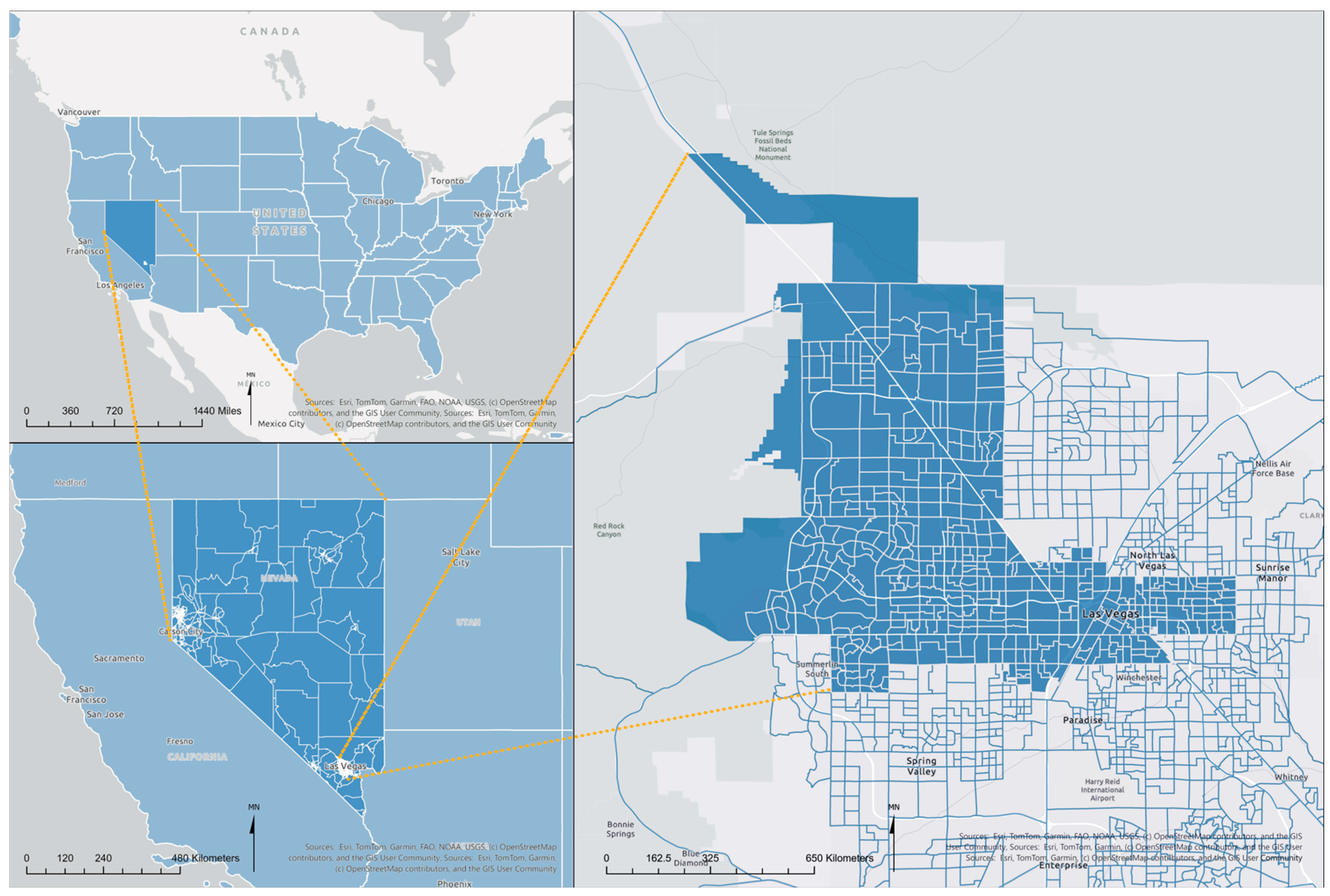
Las Vegas is an especially illustrative case for examining spatial and temporal inequalities in urban park use (
Figure 1). Beyond its extreme desert climate and strong automobile dependence, the city exhibits distinctive socio-economic characteristics that shape everyday mobility and access to public amenities. Compared with many U.S. metropolitan areas, Las Vegas has a relatively high proportion of Hispanic residents, a large service- and tourism-oriented workforce, and pronounced income inequality, with substantial variation in household income and educational attainment across neighborhoods. These structural conditions are accompanied by marked residential segregation and uneven access to transportation resources, which together influence how far and when residents can travel for leisure activities.
This socio-economic context is particularly relevant for interpreting patterns of park mobility. Communities with lower educational attainment, higher shares of racial and ethnic minorities, and more constrained mobility resources may rely more heavily on nearby parks and exhibit shorter travel distances, especially during periods of heightened risk or mobility restriction such as the COVID-19 pandemic. Accordingly, Las Vegas provides a critical urban context in which to examine how social inequality, spatial structure, and temporal adaptation jointly shape park use before, during, and after major societal disruptions.
In everyday life, public parks in Las Vegas support a wide range of routine and informal activities that extend beyond traditional notions of passive recreation. Many neighborhood parks function as spaces for walking, jogging, and dog-walking during early morning and evening hours, when extreme daytime heat limits outdoor activity. Playgrounds and shaded picnic areas are commonly used by families in the late afternoon, while open lawns and sports courts accommodate casual gatherings, youth sports, and informal social interaction. During cooler seasons and weekends, some larger parks also host community events such as farmers’ markets, outdoor performances, and organized recreational programs.
Evening and nighttime use plays a particularly important role in Las Vegas. Due to high daytime temperatures and a strong service-based economy with nonstandard work hours, residents frequently shift leisure activities to after sunset. Local parks often serve as nearby gathering spaces for short visits after work or dinner, while larger regional parks attract visitors for longer recreational trips, organized events, or destination-oriented outings. These everyday patterns help explain why proximity, travel distance, and time-of-day emerge as central dimensions of park accessibility in this study. Rather than reflecting abstract mobility preferences alone, observed differences in travel distance and temporal rhythms correspond closely to how residents integrate parks into daily routines shaped by climate, work schedules, and neighborhood conditions. For example, smaller neighborhood parks embedded within residential areas primarily support short, routine visits in the evening, whereas larger parks with extensive facilities and regional visibility tend to function as destination spaces for longer stays and organized activities.
Despite growing interest in post-pandemic urban resilience, relatively few studies have examined multi-year mobility behavior in and around public parks together with the resulting temporal dynamics [
14]. Existing work still relies largely on temporally and spatially limited or survey-based information, which constrains understanding of how spatial and temporal accessibility evolve over longer periods [
15]. To help fill this gap, this paper uses comprehensive Safe Graph mobility data (2018–2022) to investigate how individuals’ time-of-day preferences for park visits have changed and how these changes are associated with socio-demographic and environmental characteristics.
1.2. Literature Review
1.2.1. Theoretical and Conceptual Foundations of Urban Park Use
Urban parks not only provide spaces for recreational activities but also serve as critical infrastructure that supports mental health, social cohesion, and urban resilience. Examining how individuals experience and utilize parks offers critical insights into accessibility issues, distributive justice across spaces, and adaptive behaviors under changing environmental and social conditions, such as weather variations and health emergencies. Several theoretical perspectives underline this analysis [
16,
17].
In addition, time geography and activity-space theory explains mobility time boundaries, e.g., work obligations or daily routines, shape mobility timing and extent. During emergencies, public health and resilience theory see parks as substitutes for scarce indoor activities and as sites of adaptive behaviors.
Finally, conceptual works related to environmental justice and park equity highlight that [
18,
19,
20,
21] systemic inequalities (e.g., income, race, and disinvestment in the past) shape who benefits from parks, and that shocks, such as the COVID-19 pandemic, induce amplifications in park utilization disparities.
1.2.2. Mobility Data and Analytical Approaches in Park-Use Research
Over the past decade, park-use studies have shifted from small-sample surveys and direct observations to large-scale mobility data analysis [
22,
23]. Safe Graph data have been particularly noteworthy, providing anonymized visitation records based on devices linked to park points of interest (POIs). By combining Safe Graph POIs with assigned park polygons and discerning origin census block groups (CBGs), scholars can estimate a wide range of metrics, such as travel distances, origin diversity, and time-of-use profiles. Data are commonly subsampled into hourly or weekly bins to support the investigation of temporal patterns (e.g., separating weekday from weekend days or diurnal from evening hours) [
24]. The analytical methods used range from fixed-effects or mixed-effects regression models to gravity models that capture flow–distance relationships to nonlinear machine learning approaches (such as Random Forests) to unmask complex interactions. Researchers have attempted to address validity concerns by comparing Safe Graph counts with official park visitation data [
25,
26] and by exploring spatiotemporal sampling biases [
27,
28] to validate the data’s representativeness.
1.2.3. Research Objectives and Questions
Building on the theoretical perspectives and mobility-based methods reviewed above, this study investigates how urban park mobility and temporal usage patterns in Las Vegas evolved across multiple years, and how these dynamics relate to accessibility, spatial equity, and behavioral adaptation during and after the COVID-19 pandemic. By integrating large-scale mobility data with socio-demographic and environmental indicators, the research examines how residents’ travel distance, origin diversity, and time-of-day visitation rhythms jointly reshape patterns of park use and spatial interaction.
Accordingly, this study addresses four interrelated research questions:
RQ1: How did residents’ travel distances to parks change across pandemic phases, and did these shifts persist after reopening?
RQ2: How do community-level socioeconomic characteristics explain spatial variations in park-visit distance across the pre-, mid-, and post-pandemic periods?
RQ3: How do parks differ in their ability to attract visitors from near and far, and what factors drive these differences in spatial catchment and visitor diversity?
RQ4: Do parks with different attractor types exhibit distinct diurnal temporal rhythms of use (daytime, evening, and late-night), particularly in evening and late-night periods, and how did these rhythms evolve during the pandemic?
1.2.4. Empirical Evidence on RQ1–RQ4 and Remaining Gaps
With these research questions established, recent literature provides important context for RQ1–RQ4 and helps clarify the remaining gaps. For RQ1, multi-city comparisons demonstrate large pandemic-related disruptions in park use: across the United States, park visits fell by about 36% between March and November 2020 relative to pre-pandemic levels, dropping during lockdowns and only partially recovering afterward [
22]. Some cities, however, experienced the opposite pattern; for instance, in Buffalo, NY, park visits increased by roughly 25% in the early stages of the COVID-19 pandemic [
15]. Seasonal time series analyses, such as those conducted for Dallas, provide further insight into the relationship between temperature and park mobility, showing that extreme daytime heat suppresses visits, whereas cooler evening and nighttime conditions are associated with increased park use, indicating temporal adjustment to climatic stressors [
24].
In relation to RQ2, a growing body of work shows that park visits and travel distances correlate with CBG-level socio-demographic and environmental factors. Parks in higher-income, White-dominated areas tend to receive more visits and recover more quickly after reopening than parks serving lower-income and minority-dominated CBGs [
22,
27]. Other studies linking American Community Survey variables with Geographic Information System (GIS)-derived park attributes indicate that combinations of income, race and ethnicity, car ownership, and park characteristics (such as size and facilities) help explain both the frequency of park visits and the spatial reach of park catchments [
29,
30]. Accessibility metrics derived from mobility data are more informative than simple buffer-based measures, yet they consistently reveal pre-existing disparities across CBGs that were already present before the pandemic and widened during it [
30,
31].
Evidence relevant to RQ3 and RQ4 points to strong disparities in park use at both the park level and across times of day. Some investigations implicitly contrast “local” parks with “regional” destination parks based on travel distances and the number of distinct origin areas sending visitors to each site. Mobility indicators such as origin diversity, geographic scope, and the share of long-distance visitors have been used to assess the spatial extent of park catchments and to distinguish facilities that function as metropolitan attractors from those that primarily serve nearby residents [
21,
29,
30]. However, most of this work treats these indicators separately or describes them qualitatively, without developing explicit typologies of attractors or systematically linking attractor types to park attributes such as facility mix, size, or position in the urban landscape. Sub-daily analyses based on hourly SafeGraph records show that evening and nighttime park use is positively associated with hot daytime conditions and with the presence of artificial lighting [
24,
32,
33]. Temporal patterns of use differ across parks according to visitor groups, adjacent land uses, and physical characteristics, indicating that accessibility and physical layout play important roles in shaping diurnal and nocturnal activity. Recent studies of nighttime environments and urban lighting suggest that lighting upgrades, shading interventions, and microclimate improvements are increasingly used to enhance perceived evening usability and comfort in the evening and at night, but their findings remain case-specific and short-term [
34,
35,
36].
Integrating insights from these strands, several research gaps emerge. City-level contexts, including park availability, urban morphology, and local administration, are often described qualitatively but rarely incorporated as controlled variables in multi-year analyses. Very few studies work at sufficiently disaggregated spatial and temporal resolutions to jointly examine travel distance, origin diversity, long-distance shares, and time-of-day variation (for example, at the park–week or park–day level). Instead, most existing work remains purely correlational and cannot isolate causal mechanisms. Known sampling biases in mobility datasets further complicate the validity of origin diversity and long-distance indicators for marginalized populations [
27]. Finally, the long-term effects of design interventions such as lighting upgrades, shade installations, and facility improvements on park-going behavior remain particularly under-explored in hot, car-dependent desert cities such as Las Vegas [
34,
35].
1.3. Research Contributions
This study contributes to the broader discourse on urban mobility and spatial justice by: (1) providing longitudinal empirical evidence on how the COVID-19 pandemic reshaped residents’ spatial reach and temporal behaviors in urban park use; (2) revealing socio-spatial and design-related determinants of park accessibility and visitor diversity at both the community and park levels; and (3) establishing a transferable analytical framework that links high-resolution mobility data with questions of equity, behavioral adaptation, and nighttime urban design.
2. Research Method
2.1. Study Context and Data Collection
This study examines the spatial and temporal dynamics of urban park use in the City of Las Vegas, focusing on how community characteristics and park typologies relate to patterns of nighttime and long-distance visitation. The analysis draws on anonymized, aggregated mobility data that capture weekly visitor flows between residential block groups and public parks across the city [
37]. The mobility component of the data is derived from anonymized smartphone location signals aggregated by a third-party data provider SafeGraph Inc. ( Denver, CO, USA), which collects, processes, and disseminates these data in accordance with established privacy and data governance frameworks in the United States. These data are integrated with demographic and housing attributes from the American Community Survey and open municipal datasets on park facilities and locations.
To capture shifts associated with the COVID-19 pandemic and subsequent reopening, the study divides the observation period into three temporal phases: (1) Pre-pandemic (before 15 March 2020), (2) Mid-pandemic (15 March 2020–15 June 2021), and (3) Post-pandemic (after 15 June 2021).Policy information was derived from the Nevada state emergency declaration (
https://lasvegassun.com/news/2020/mar/12/nevada-in-uncharted-territory-sisolak-declares-sta/) (accessed on 13 January 2026). and supplemented with additional scholarly sources [
38,
39], This temporal segmentation allows the analysis to trace both short-term disruptions and longer-term behavioral adjustments in outdoor recreation. Although raw location pings are generated at irregular intervals, depending on device and application settings, all analyses in this study rely on weekly aggregated park-level visitation measures, ensuring consistent temporal resolution across the study period and minimizing individual-level traceability.
Hourly visit records are aggregated by week, producing consistent temporal units across all analyses [
15,
40]. The original datasets include, for each park, the number of visits by hour, visitor origins at the block-group level, and the straight-line distance between origins and destinations [
28,
29]. These data are cleaned, standardized, and filtered to remove implausible values and weeks with insufficient coverage. All mobility data are fully anonymized and aggregated prior to researcher access, contain no personally identifiable information, and are made available to researchers through institutional subscriptions or data use agreements. This allows other scholars to access the same data source, supporting research ethics, transparency, and reproducibility of the analysis.
2.2. Measures and Variable Construction
The core behavioral indicator is travelling distance to parks, calculated as the visitor-weighted mean distance between each block group and its visited parks [
17]. Additional variables quantify origin diversity (measured by the Shannon entropy of the distribution of visitor origins) [
21,
29] and the share of long-distance visits (defined as the proportion of visitors traveling beyond a fixed or percentile-based threshold, typically around 5 km [
17]. We adopt 5 km as a transparent, neighborhood-scale cutoff to distinguish proximate, routine park trips from cross-neighborhood visitation in a large, car-oriented metropolitan setting. To assess context sensitivity, we additionally examined alternative cutoffs (e.g., 3 km and 8 km) and found that the local–regional classification patterns were substantively consistent.
To examine temporal rhythms of park use, hourly visitation is grouped into three periods of the day: Daytime (06:00–18:00), Evening (18:00–22:00), and Late-night (22:00–06:00). The share of visits occurring during each period represents the park’s temporal activity profile [
32,
33].
Socioeconomic predictors include CBGs population, education, median income, poverty level, housing tenure, car ownership, and racial composition [
18,
19,
20]. All continuous variables are standardized to z-scores, and heavily skewed indicators are log-transformed.
2.3. Data Analytical Design
The research employs sequential quantitative design, combining time-series, cross-sectional, clustering, and multilevel modeling approaches. Each research question is addressed through a distinct but complementary analytical procedure. Across these steps, model choice is guided by the measurement scale of each outcome (continuous distance, bounded shares, and binary classification), the data structure (repeated weekly observations nested within parks and neighborhoods), and the need for robustness to heterogeneous visitation volumes. Specifically, ordinary least square (OLS) is used as a transparent baseline for average linear associations, weighted least squares (WLS) is used when unequal visitation counts imply heteroskedasticity and differential reliability across observational units, and mixed-effects models are used when repeated observations and unobserved park-specific baselines must be explicitly modeled. In addition, logit-based mixed specifications are estimated as robustness checks when outcomes are naturally bounded or can be represented as binomial processes (e.g., nighttime vs. non-nighttime visits).
Table 1 summarizes the key variables, their definitions, analytical roles, and associated research questions used in this study.
2.4. Model Selection Rationale
The modeling choices are aligned with the structure of each research question and the statistical properties of the dependent variables. For RQ2, the outcome is a continuous block-group-level mean travel distance aggregated by phase; therefore, OLS provides an interpretable baseline for estimating marginal socioeconomic associations. Because block groups contribute very different numbers of observed visits, the precision of the mean distance varies and heteroskedasticity may arise; we therefore additionally estimate WLS models weighted by total visitation to give greater influence to more reliably measured observations and to assess whether conclusions are sensitive to sample-size imbalance. For RQ4, the outcomes are weekly proportional measures of evening and late-night visitation that are repeatedly observed for the same parks over time; thus, mixed-effects models with park random intercepts are used to account for within-park dependence and unobserved time-invariant park heterogeneity while directly testing period, type, and their interaction. Finally, because visitation shares are bounded in [
1,
41], we report a logit mixed specification as a robustness check to confirm that inferences are not driven by linearity assumptions for proportional outcomes. Consistency of key effects across these complementary specifications strengthens support for the proposed hypotheses, while diagnostic checks (e.g., multicollinearity and residual spatial dependence) are used to verify model adequacy.
2.5. RQ1: Temporal Shifts in Travel Distance
To examine how residents’ spatial range of park use changed over time, the analysis models weekly citywide mean travel distance as a segmented time series with structural breaks corresponding to major pandemic transitions. Weekly average distances were computed from the Safe Graph mobility dataset (aggregated, anonymized smartphone location data) by weighting the Euclidean distance between residential block-group centroids and visited park coordinates according to the number of visits per origin–destination pair. Each week’s citywide value, therefore, represents a visitor-weighted mean travel distance.
Demographic and housing data were drawn from the American Community Survey (ACS) 2019 five-year estimates to provide contextual variables for later models, but RQ1 focuses solely on temporal variation in the aggregate distance measure. To ensure comparability over time, all weeks were standardized to ISO calendar weeks, and short gaps caused by data dropouts were linearly interpolated.
The modeling strategy combines descriptive decomposition and inferential segmentation. First, a seasonal–trend decomposition using Loess (
STL) is applied to separate long-term trends (
), seasonal cycles
), and irregular residuals (
) from the observed series (
):
This decomposition provides a visual understanding of annual periodicity, such as summer peaks and winter troughs, and distinguishes structural shifts from cyclical fluctuations.
Second, an interrupted segmented regression quantifies the magnitude of pandemic-related changes. Let
denote the weekly mean travel distance, and the sequence of weeks. Two breakpoints are defined at the start of pandemic restrictions (
) and the beginning of the reopening phase (
). The model is specified as:
where
= 1 if
(post-restriction period), 0 otherwise;
= 1 if
(post-reopening period), 0 otherwise;
represents the pre-pandemic trend (slope);
and
capture immediate level changes at the two breakpoints;
and
capture slope changes relative to the preceding phase; The summation term models annual seasonality using Fourier harmonics (
harmonics ≈ one-year cycle).
Residuals are checked for autocorrelation and heteroskedasticity, and all inference uses Newey–West heteroskedasticity- and autocorrelation-consistent (HAC) standard errors with a 12-week lag window.
Model fit is visualized through predicted and counterfactual series. The counterfactual extends the pre-pandemic trend and seasonal component into the pandemic period to estimate what travel distances would have been in the absence of the shock. Comparisons between fitted and counterfactual trajectories indicate whether Las Vegas residents expanded or contracted their spatial range of park visitation during lockdowns and whether pre-pandemic patterns eventually re-emerged.
This combination of STL decomposition and segmented regression provides both descriptive clarity—by separating long-term and cyclical components and inferential precision, by identifying structural breaks and slope changes in residents’ mobility behavior. Together, they reveal the temporal reorganization of spatial practices that underpin the city’s evolving nocturnal and recreational landscape.
2.6. RQ2: Socioeconomic Correlates of Travel Distance
To examine how community characteristics are associated with residents’ spatial range of park visitation, this section estimates between-community regression models using block-group–level data aggregated by pandemic phase (pre-, mid-, and post-COVID-19). Each model captures spatial variation across CBGs within Las Vegas, rather than temporal change. The dependent variable represents the average visitor-weight travel distance from each block group to the parks visited by its residents, derived from Safe Graph mobility records. Independent variables describe the CBGs’s demographic, socioeconomic, and mobility profiles, compiled from the 2019 American Community Survey (ACS). Because these attributes remain relatively stable over time, they are treated as time-invariant. For each period, an ordinary least square (OLS) model and a weighted least squares (WLS) model is estimated to assess robustness. This two-model strategy aligns with the study’s inference goal for RQ2: OLS offers an interpretable benchmark for average socioeconomic correlates of travel distance, whereas WLS addresses the empirically common condition that block groups contribute highly unequal numbers of visits (and thus unequal precision), which can induce heteroskedastic errors and over-weight low-coverage units in unweighted regressions. The OLS model provides a baseline, while WLS accounts for varying data reliability by weighing each observation by the total number of park visits originating from that block group (
). The general model form is expressed as:
where
is the mean visitor-weighted distance for block group
;
is a vector of standardized community-level predictors;
represents the estimated coefficients; and
is an error term.
For the WLS specification, the estimator minimizes:
Yielding efficient estimates when heteroskedasticity arises from unequal visitation volumes (i.e., block groups contribute different numbers of observed trips, leading to unequal measurement precision). Comparing OLS and visit-weighted WLS estimates provides a robustness check for whether socioeconomic gradients are sensitive to heteroskedasticity and uneven observation reliability across block groups.
For inference robustness, heteroskedasticity-robust standard errors (e.g., HC3) are reported in all models. We used variance inflation factors (VIFs) to assess multicollinearity among predictors; Moran’s I on regression residuals to detect spatial autocorrelation; and outlier and leverage tests (Cook’s distance, standardized residuals) to evaluate model stability. Standardized coefficients with 95% confidence intervals are reported for cross-variable comparison. Results are visualized through forest plots contrasting OLS and WLS estimates, highlighting whether socioeconomic effects, such as CBGs affluence, education, or housing tenure, consistently predict travel distance across pandemic phases. This between-community design isolates structural spatial inequalities in park accessibility and travel behavior. By distinguishing CBGs-level patterns from citywide temporal shifts, it complements the time-series analysis of RQ1 and deepens understanding of the social geography underlying urban park mobility during and after the pandemic.
2.7. RQ3: Typology of Park Attractors
To investigate how parks differ in their ability to attract visitors from varying distances and origins, this analysis constructs a cluster-based typology of park attractors grounded in empirical mobility patterns. Each park’s visitor composition is summarized by two key indicators derived from the Safe Graph mobility dataset. One is origin diversity, measured using the Shannon entropy of visitor home block-group shares. And the other is long-distance share, defined as the proportion of total visits originating beyond a fixed distance threshold (5 km). This threshold operationalizes a simple, interpretable separation between neighborhood-serving catchments and broader metropolitan draw, which is especially relevant in Las Vegas where motorized travel can blur perceived distance but still reflects cross-neighborhood movement. Sensitivity checks using alternative thresholds (e.g., 3 km and 8 km) yielded clustering structures and interpretations that were substantively similar. These measures capture complementary aspects of a park’s spatial appeal, whether it primarily serves its immediate CBGs or draws visitors from across the metropolitan region.
After standardizing both indicators, parks are grouped using k-means clustering with k = 2, yielding a parsimonious typology that balances interpretability and statistical separation. In addition to silhouette performance, k = 2 was retained because it produces the most interpretable “neighborhood-serving vs. destination-serving” separation and avoids small intermediate clusters that are difficult to interpret and less comparable across pandemic phases when visitation profiles are disrupted. The optimization minimizes within-cluster variance according to the Euclidean distance in standardized feature space:
where
is the two-dimensional feature vector of the park and
is the centroid of the cluster [
21].
Cluster validity is evaluated using silhouette coefficients, and robustness is assessed by comparing the results with a Gaussian Mixture Model (GMM) to determine whether the data exhibits elliptical or overlapping substructure. The resulting clusters are interpreted as:
Type 0: Local Attractors: lower long-distance shares and moderate origin diversity, representing community-serving parks primarily used by nearby residents.
Type 1: Regional Attractors: higher long-distance shares and diverse visitor origins, indicating destination-type parks with a metropolitan catchment.
Spatial visualization through bivariate scatterplots and kernel maps illustrates how these types are distributed across the urban landscape, revealing spatial hierarchies of attraction within Las Vegas. To explore which attributes most strongly predict a park’s attractor type beyond its defining indicators, a gradient-boosted decision tree model (XGBoost) is estimated. The dependent variable is the binary park type (0 = Local, 1 = Regional). Predictors include total visitation, active weeks, temporal rhythm indicators (evening and late-night shares), and locational characteristics (longitude, latitude).
The XGBoost model approximates a non-linear mapping:
where
denotes the m-th regression tree,
is its learning rate, and
is the number of boosting iterations. The model is trained on 75% of the sample and validated on the remaining 25%, with accuracy and AUC metrics used to assess predictive performance.
To interpret these non-linear relationships, Shapley Additive Explanations (SHAP) are applied. For each feature
, the SHAP value
quantifies its marginal contribution to the predicted probability relative to a baseline expectation:
where
is the mean model output, and
represents the Shapley value of the feature jfor observation i.
Global importance is visualized through beeswarm plots, summarizing the absolute mean of across parks, while dependence plots reveal threshold effects. For instance, whether increases in total visitation or evening activity disproportionately increases the likelihood that a park will function as a regional attractor.
This combined clustering and interpretable machine-learning framework identifies distinct typologies of park attractors and elucidates the underlying spatial, temporal, and locational mechanisms that differentiate localized recreational spaces from regionally significant destinations in the urban park network.
2.8. RQ4: Temporal Rhythms and Park Typology
The final stage of analysis investigates whether parks of different attractor types, as identified in RQ3, exhibit distinct temporal rhythms of use across the day and whether these rhythms vary between pandemic phases. This inquiry links spatial typology with temporal behavior, testing whether regional attractors sustain higher evening or late-night activity than local attractors, and whether such differences intensified or diminished during the COVID-19 period. Weekly visitation data are disaggregated by hour of day and normalized to form proportional measures of evening share (18:00–22:00) and late-night share (22:00–06:00). These proportions constitute the dependent variables, each analyzed separately. Daytime share (06:00–18:00) is additionally examined as a reference condition derived as the complement of evening and late-night shares, enabling an interpretable day–night comparison without introducing redundant dependent variables.
To account for repeated measures of the same park over time, linear mixed-effects models (LMMs) are employed with random intercepts for parks, capturing unobserved heterogeneity in baseline visitation levels. This multilevel specification is theoretically consistent with place-based park use: parks have persistent, unobserved baseline differences (size, setting, management, surrounding land use) that may not be fully captured by observed covariates, and repeated weekly observations require explicit modeling of within-park dependence. The fixed-effects structure includes park type, pandemic period, and their interaction term, specified as:
where
denotes the visitation share for the park in week t;
is a binary indicator of attractor type (0 = Local, 1 = Regional);
distinguishes the pre-, mid-, and post-pandemic phases;
is the random intercept representing park-specific effects; and
is the residual error term assumed to follow a normal distribution with mean zero [
32,
33].
The mixed model is estimated using restricted maximum likelihood (REML). Because visitation shares are bounded in [
1,
41], we additionally estimate a logit-based mixed-effects specification as a robustness check by representing nighttime activity as a binomial process (nighttime visits vs. non-nighttime visits) with park-level random intercepts; the consistency between linear and logit mixed results strengthens inference to distributional assumptions (
Table 2). The inclusion of the interaction term allows direct inference on whether the temporal rhythm of park use, particularly the intensity of evening and late-night activity, differs systematically between local and regional attractors across pandemic phases.
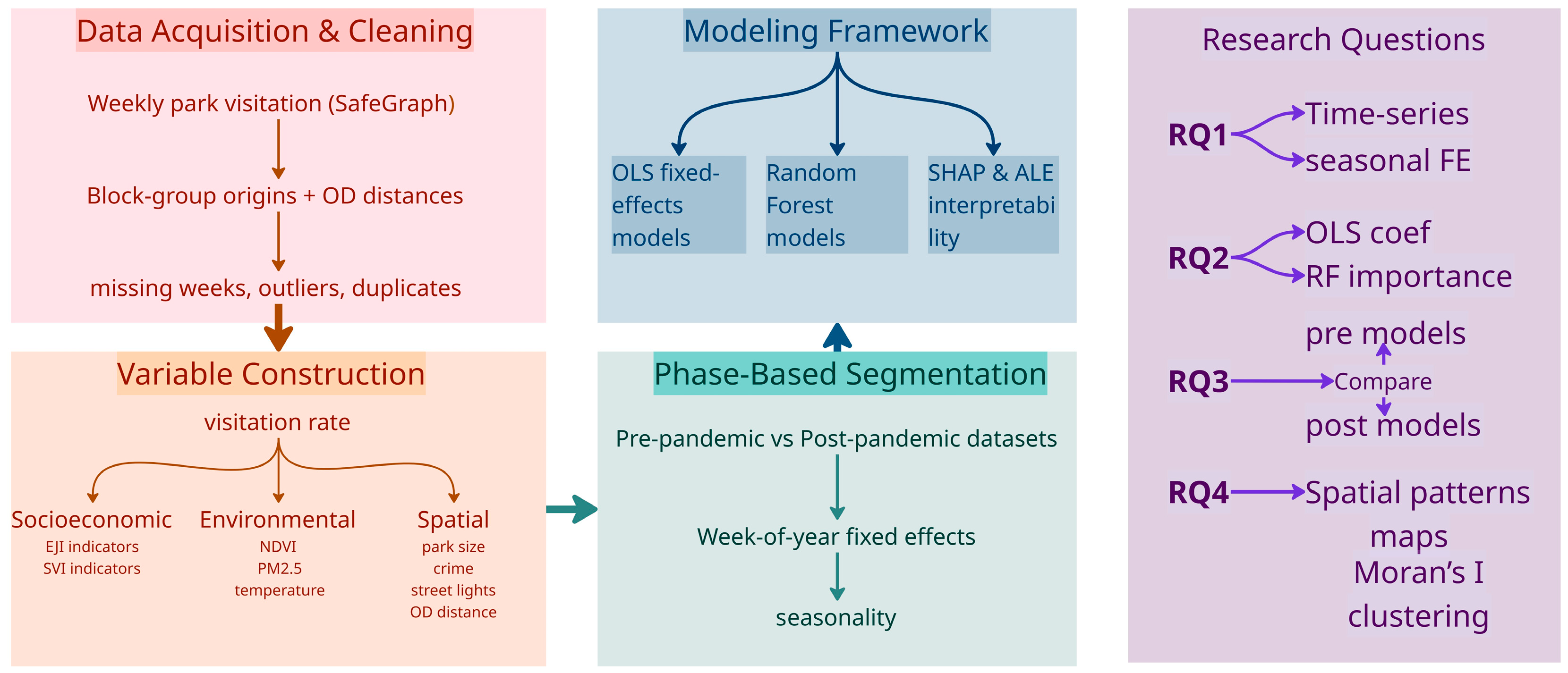
To provide a clearer overview of how the methodological components link to RQ1–RQ4, the full analytical workflow is summarized in
Figure 2.
3. Results
3.1. Descriptive Analysis
Table 2 summarizes the descriptive statistics of the variables used in the analysis. At the community level, socioeconomic indicators such as population size, income, renter occupancy, and racial composition display substantial heterogeneity across Las Vegas CBGs. At the park level, the mean visitor-weighted travel distance was approximately 8.4 km, with long-distance visits accounting for about 52% of total visits, indicating that many parks attracted users beyond their immediate vicinity. The normalized Shannon entropy of visitor origins averaged 0.85, suggesting generally high diversity in visitor catchment areas. Temporal rhythm indicators show that visits peaked in the afternoon, followed by evening hours, while late-night activity remained limited. The average park remained active for approximately 76 weeks during the study period.
Table 2.
Descriptive Statistics of Community- and Park-Level Variables.
Table 2.
Descriptive Statistics of Community- and Park-Level Variables.
| Variable | Mean | SD | Min | Max |
|---|
| Community-level variables | | | | |
| log(total population) | 7.327 | 0.536 | 2.197 | 9.140 |
| log(income) | 10.976 | 0.476 | 9.297 | 12.429 |
| Renter-occupied housing (%) | 0.401 | 0.232 | 0.000 | 1.000 |
| Households without vehicle (%) | 0.073 | 0.099 | 0.000 | 0.680 |
| Different house 1 year ago (%) | 0.161 | 0.106 | 0.000 | 1.000 |
| Black population (%) | 0.121 | 0.119 | 0.000 | 1.000 |
| Asian population (%) | 0.081 | 0.079 | 0.000 | 0.675 |
| Hispanic population (%) | 0.347 | 0.236 | 0.000 | 0.987 |
| Park-level variables | | | | |
| Mean visit distance (km) | 8.386 | 2.697 | 3.017 | 20.159 |
| Share of long-distance visits | 0.524 | 0.153 | 0.145 | 0.941 |
| Origin diversity (normalized entropy) | 0.846 | 0.068 | 0.524 | 0.983 |
| Morning visits (06:00–12:00, %) | 0.235 | 0.085 | 0.000 | 0.562 |
| Afternoon visits (12:00–18:00, %) | 0.428 | 0.074 | 0.000 | 0.619 |
| Evening visits (18:00–22:00, %) | 0.237 | 0.076 | 0.000 | 0.519 |
| Late-night visits (22:00–06:00, %) | 0.100 | 0.070 | 0.000 | 0.833 |
| Total visits | 63,389.231 | 103,993.930 | 125.454 | 1,000,462 |
| Active weeks | 76.350 | 25.434 | 1.000 | 115.000 |
3.2. RQ1: Descriptive Analysis (Map + Python3.12.12/r)
To examine how cross-community park mobility evolved across the pandemic, we analyzed (i) spatial distributions of average weekly travel distance by CBGs, (ii) seasonal mobility dynamics extracted via STL decomposition, and (iii) structural breaks tested through interrupted time-series models. Together, these analyses reveal both an immediate pandemic-driven contraction in park travel radii and a lasting re-scaling of urban park use toward more localized, CBG-embedded patterns.
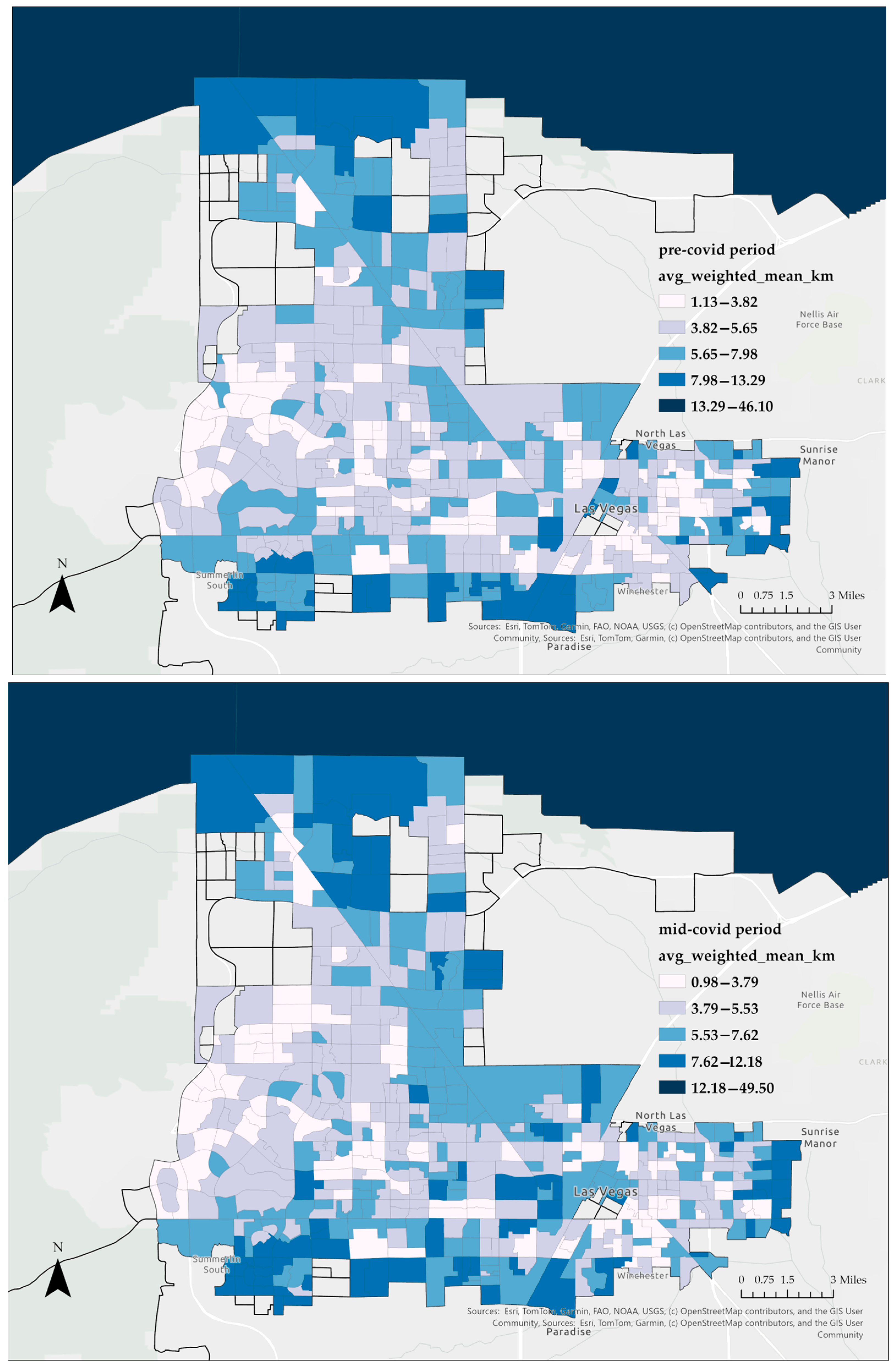
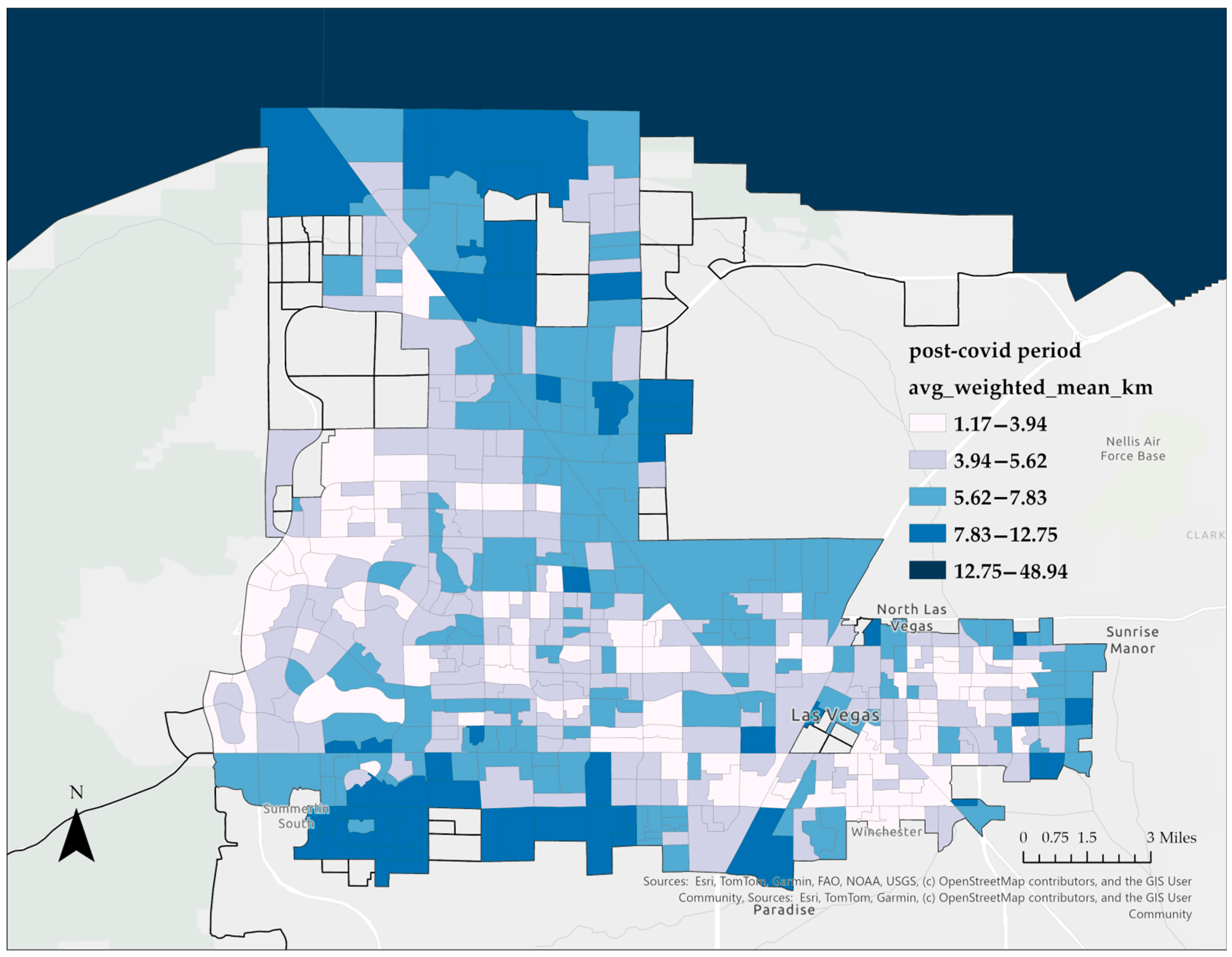
The spatial maps of weighted mean travel distance (
Figure 3) first illustrate the geographic structure of mobility before, during, and after COVID-19. Prior to the pandemic, residents of outer-edge suburban districts, particularly Centennial Hills, Tule Springs, and the western foothill CBGs, traveled substantially farther to reach parks, while inner-city CBGs and mature suburban zones around Downtown Paradise, and Summerlin South exhibited shorter park-travel profiles. This spatial hierarchy, reflecting both residential geography and park distribution, persisted during the pandemic but flattened markedly in magnitude. High-distance outer-suburban tracts saw notable reductions in travel distance, while central CBGs exhibited only modest shifts, indicating a citywide turn toward more proximate park visit. In the post-pandemic period, distance patterns partially rebounded yet remained below pre-pandemic spatial levels, suggesting a partial but incomplete restoration of long-distance park visitation behavior.
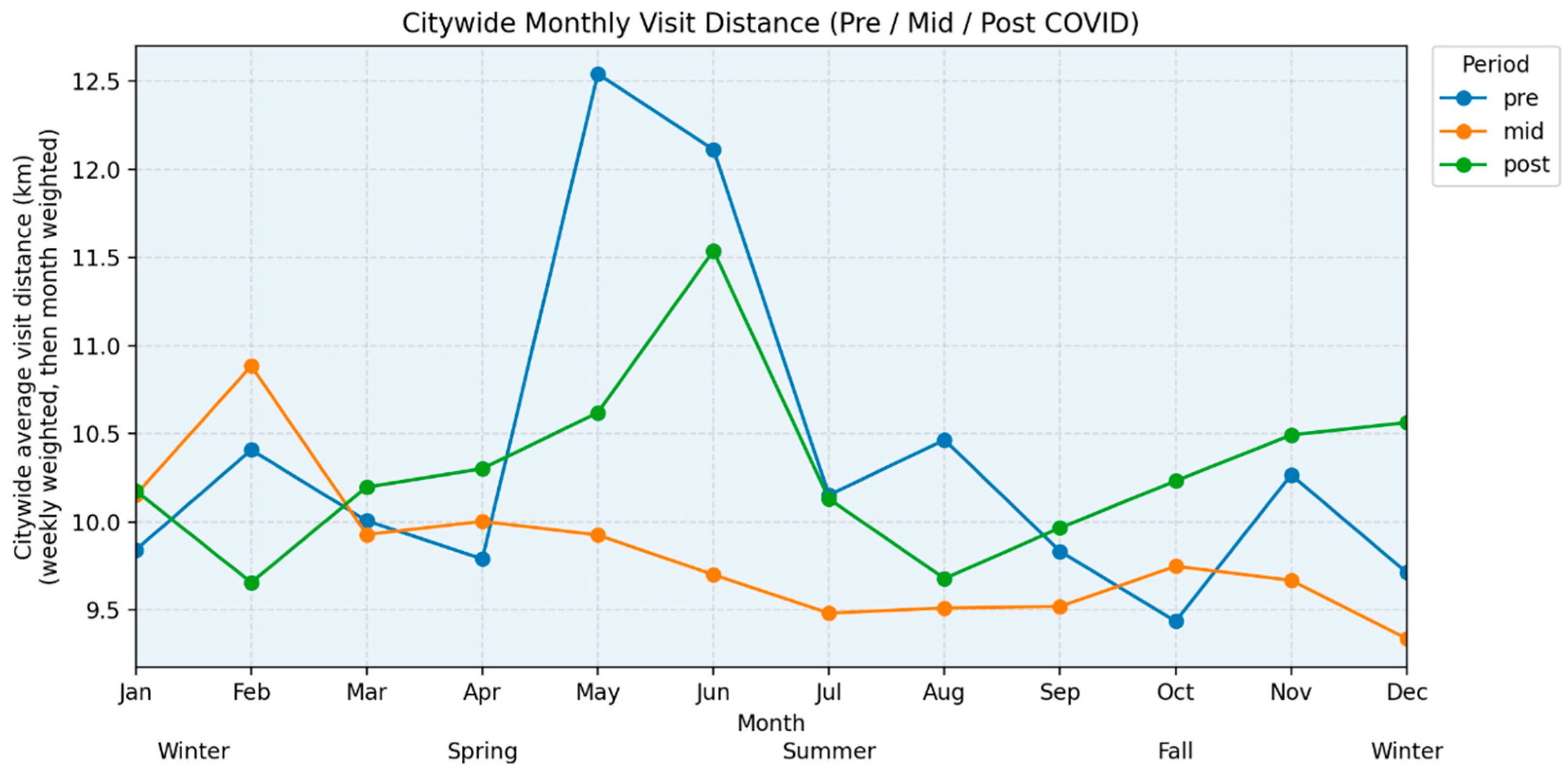
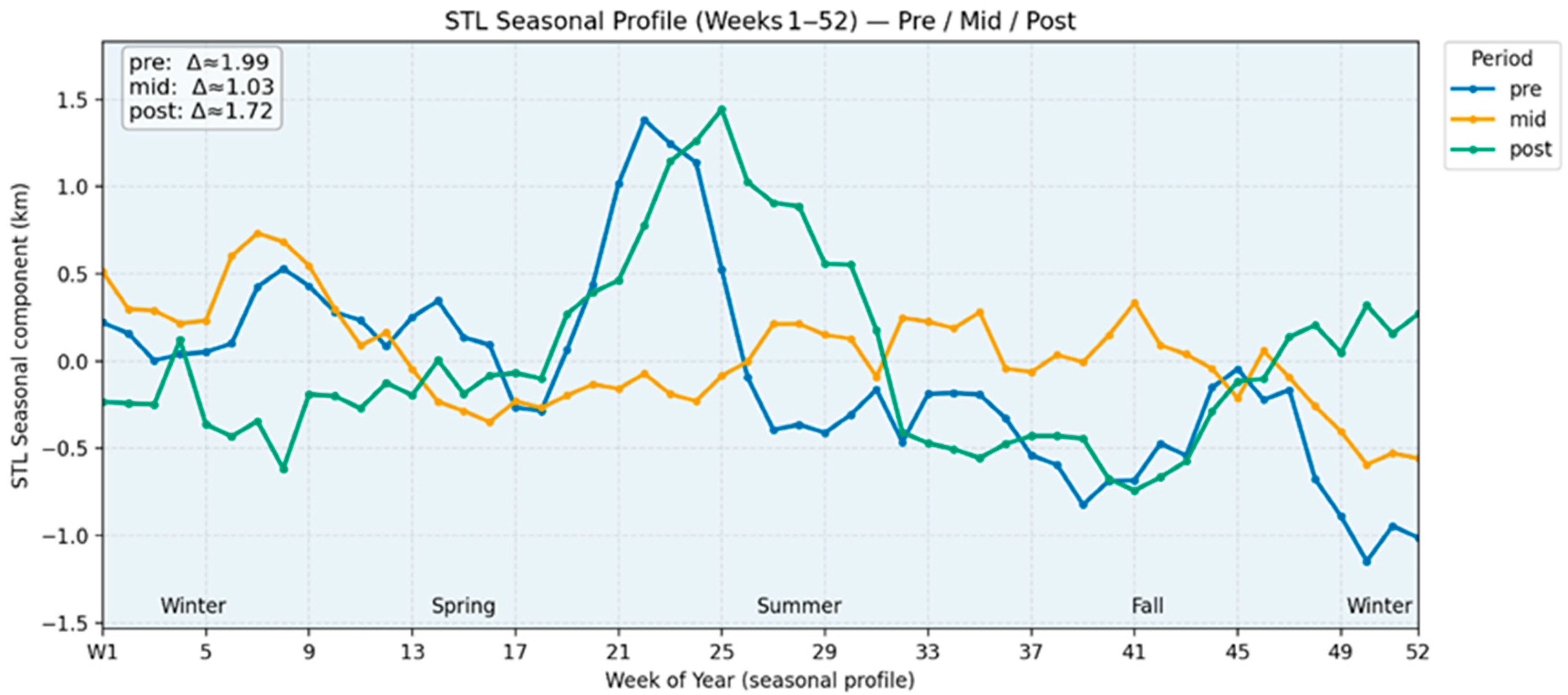
To clarify whether this spatial re-scaling also altered seasonal mobility rhythms, we applied seasonal-trend decomposition to the weekly citywide distance series and extracted the seasonal component for pre-pandemic (weeks before 15 March 2020), mid-pandemic (15 March 2020–15 June 2021), and post-pandemic periods (weeks after 15 June 2021) (
Figure 4). Before COVID-19, seasonal cycles displayed a clear and repeatable pattern: park travel distances rose sharply in late spring and peaked in early summer, coinciding with the onset of favorable outdoor activity conditions before declining through fall and reaching annual lows in winter. During the pandemic, however, this seasonal structure weakened substantially. The mid-pandemic curve exhibits dampened peaks and troughs and, notably, a sharper winter decline, indicating heightened spatial contraction during colder months when indoor options were limited and outdoor mobility was still risk sensitive. Following reopening, seasonal cycles reappeared, with reduced amplitude and smoother transitions, suggesting the emergence of a more muted and stable seasonal rhythm in park travel. The normalized STL profiles confirm that this attenuation is not merely a difference in scale: even when standardized, the amplitude of seasonal swings declines progressively from pre- to mid- to post-periods, with winter troughs particularly compressed in the later phase.
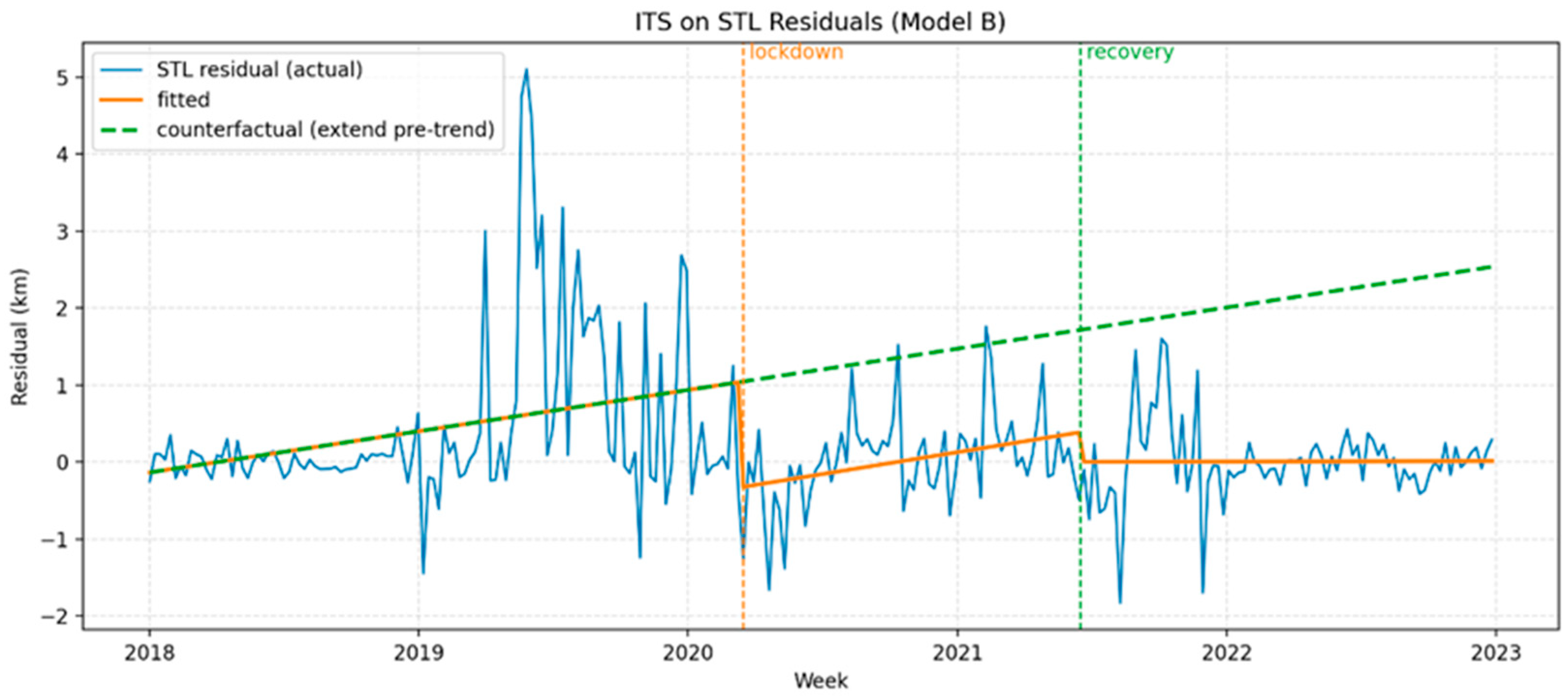
To isolate the structural effect of the pandemic from seasonal and gradual time trends, we estimated interrupted time-series models on both raw weekly mobility and STL residuals (
Figure 5).
Figure 6 displays the interrupted time-series estimates based on seasonally adjusted weekly park-visit distances, isolating the structural impact of the pandemic from underlying seasonal and gradual trends. In the full ITS model using raw distance values, mobility dropped sharply at the onset of the March 2020 lockdown, with an immediate decline of approximately 1.3–1.5 km relative to the pre-COVID trajectory (
p < 0.01), followed by a slow rebound that did not fully converge to the counterfactual trend. Applying ITS to STL-filtered residuals ensures that this discontinuity is not driven by seasonal cycles; this second model similarly yields a significant negative level shift at lockdown, while post-reopening slope changes remain statistically small and near zero. These consistent estimates indicate that the pandemic induced an abrupt contraction in mobility that persisted beyond the relaxation of restrictions and was not simply the result of seasonal variation or short-term behavioral disruption.
Taken together, these spatial, seasonal, and causal analyses converge toward a shared interpretation that COVID-19 fundamentally re-shaped park mobility in Las Vegas by reducing travel radii and dampening seasonal excursion patterns, particularly curtailing long-distance summer park trips and deepening winter localization during the pandemic’s peak. Although mobility rebounded as public health restrictions eased, neither travel distance nor seasonal amplitude returned to pre-pandemic norms, pointing to a durable behavioral shift toward nearby park use and more routine, geographically bounded outdoor recreation. In contrast to the episodic, destination-oriented park travel that previously characterized the city’s summer peak, post-pandemic visitation appears more stable, proximate, and embedded in everyday CBGs rhythms evidence of a re-scaled urban leisure geography shaped by pandemic experience.
3.3. RQ2: Relationship Between Community Socio-Economic Structure and Travel Distance
To identify which CBGs characteristics shaped how far Las Vegas residents traveled to parks across the pre-, mid-, and post-pandemic periods, between-community regressions were estimated separately for each period. Both OLS and WLS were used to assess robustness, with weights proportional to the total number of park visits per census block group.
Model diagnostics (
Table 3) indicate that explanatory power remained modest but consistent across periods, with OLS R^2values between 0.135 and 0.142 and WLS R^2values between 0.082 and 0.087. All models were statistically significant at
p < 0.001 based on F-tests, suggesting that the selected socioeconomic predictors collectively explained a meaningful portion of the spatial variation in average park-visit distance. The small differences between OLS and WLS results imply that heteroskedasticity or sample-size imbalance across CBGs did not substantially bias the findings. Variance Inflation Factor (VIF) tests confirmed that multicollinearity was within acceptable limits (mean ≈ 6.9, median ≈ 1.9), and Moran’s I statistics for residuals were near zero, indicating minimal residual spatial autocorrelation.
The regression coefficients (
Table 4) reveal persistent social and demographic gradients in travel distance across all three phases. CBGs with higher educational attainment consistently exhibited shorter average travel distances (
p < 0.05), indicating that well-educated populations tended to visit parks closer to home. Similarly, the share of Black and Hispanic residents was strongly and negatively associated with visit distance across all models (
p < 0.05–0.001), suggesting spatial confinement in recreational mobility among historically marginalized communities.
In contrast, total population size and median income showed small, positive, but mostly nonsignificant coefficients, suggesting that CBGs density and affluence were not primary drivers of spatial range after controlling other factors. The share of households without vehicles had weak, negative associations, consistent with limited mobility options but not reaching statistical significance. Meanwhile, the proportion of residents who had moved within the past year showed negative coefficients of moderate magnitude (−0.56 to −0.79 SD), suggesting that residential instability may be associated with reduced access to more distant parks.
Across all phases, results remained directionally consistent between the OLS and WLS specifications, confirming that weighting by visitation volume did not alter the substantive interpretation of the predictors. Standardized effect magnitudes were largest for race-related and educational variables, underscoring persistent socio-spatial inequalities in access to urban recreational opportunities.
Comparing pre-, mid-, and post-pandemic periods shows no reversal in the pattern of social differentiation, but rather a gradual attenuation of coefficient magnitudes. The negative effects of educational and racial variables became slightly weaker after reopening, suggesting some normalization of travel behavior as mobility restrictions eased. Nonetheless, the persistence of these associations across all phases indicates that underlying CBGs disparities in access to distant parks remained structurally embedded rather than transient pandemic outcomes.
3.4. RQ3: Do Parks Exhibit Distinct Socio-Spatial “Attractor Types,” and Do These Change Across Pandemic Phases?
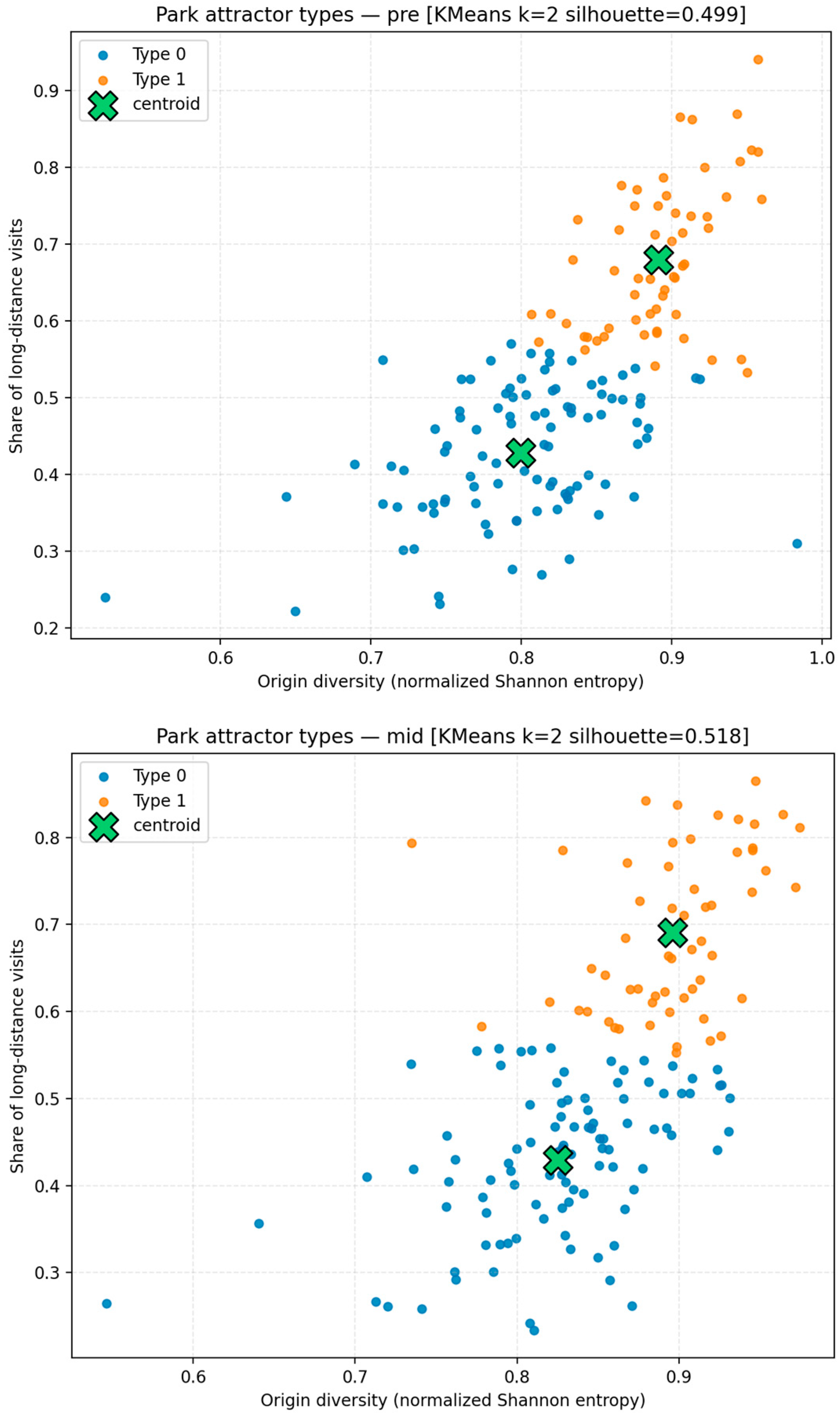
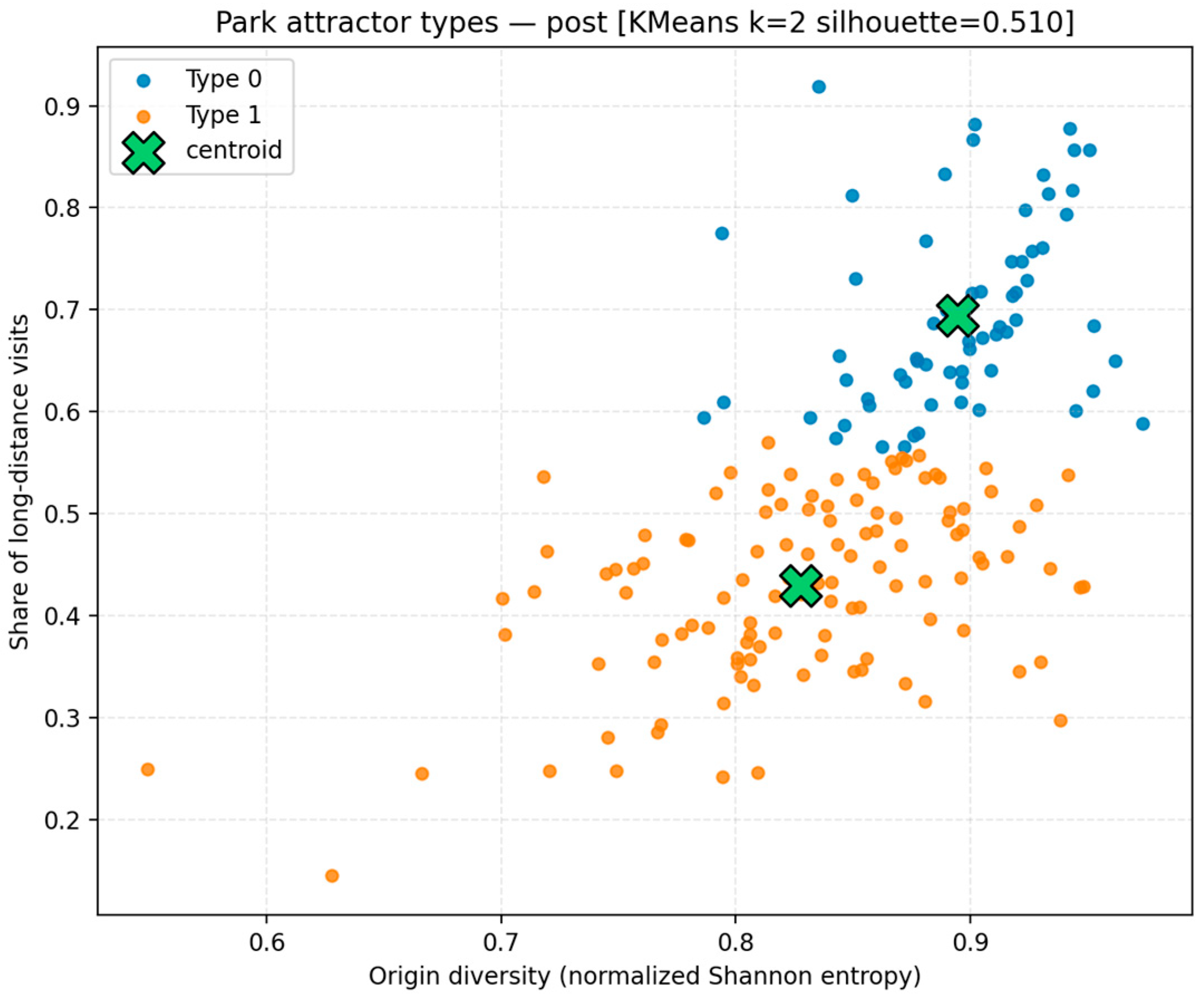
To reveal how Las Vegas parks differ in their spatial reach and visitor composition, two key indicators, origin diversity and share of long-distance visits, were analyzed through k-means clustering (
Figure 7). Across the three pandemic phases, the optimal two-cluster solution (k = 2) achieved silhouette coefficients of 0.46–0.52, indicating clear group separation and stable typological structure over time. Here, “stability” refers to the persistence of a two-mode structure in the indicator space (local-serving vs. metropolitan-serving parks), even though the pandemic temporarily reshuffled the relative mix of nearby versus long-distance trips. In other words, parks may shift their position within the two-dimensional space as travel radii compress or rebound, but the underlying separation between the two attractor roles remains evident across phases.
Type 0, local attractors, is characterized by lower long-distance shares (typically < 0.5) and moderate origin diversity, and Type 1, regional attractors, is marked by both higher diversity and higher proportions of long-distance visitors (≥0.6). This binary classification captures a structural divide between CBG-serving parks and destination-type parks with metropolitan catchments.
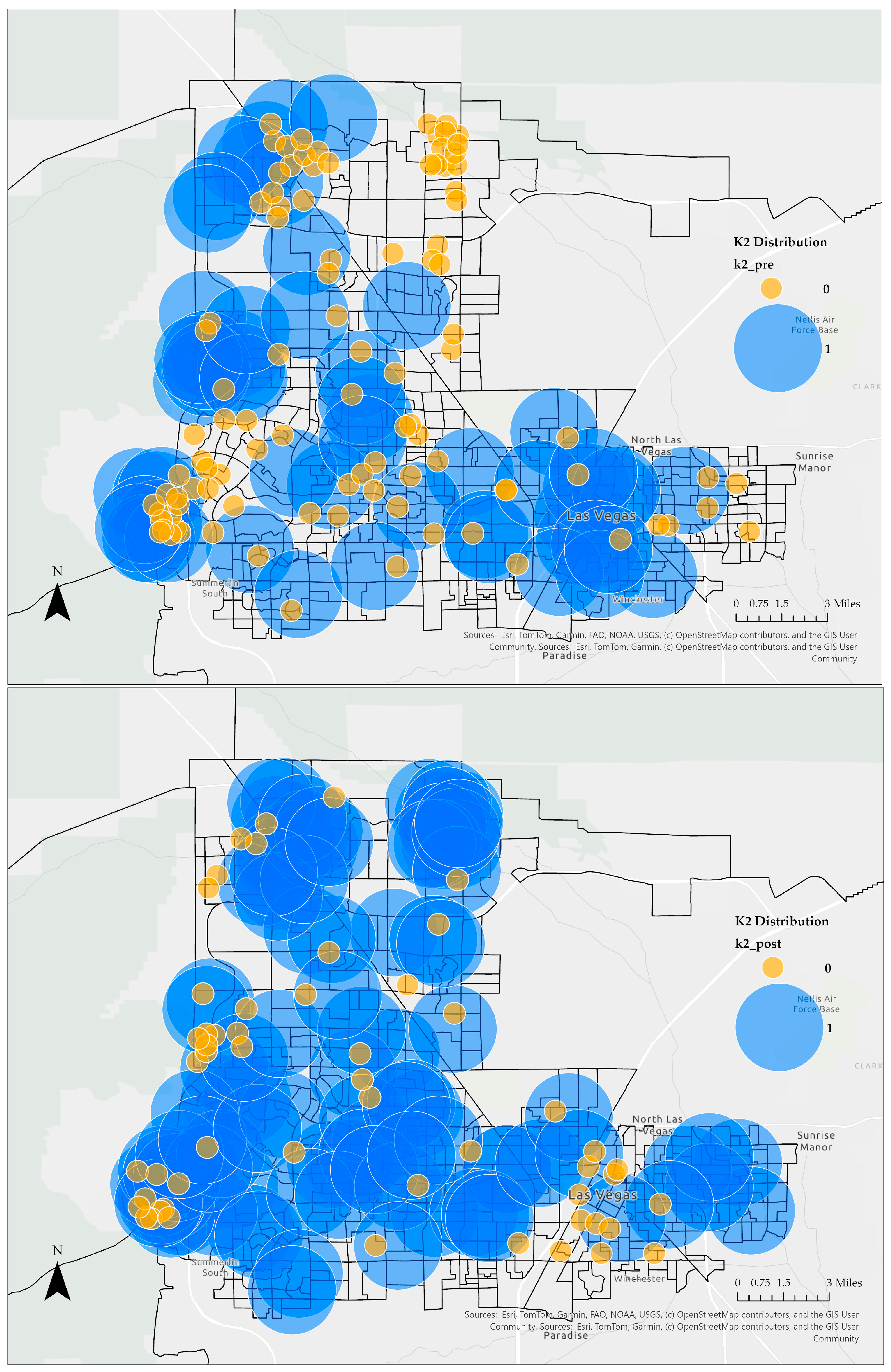
Spatially, the contrast between local and regional attractors reveals a clear reorganization of the park system’s functional geography across pandemic phases (
Figure 8). Before the pandemic, Type 1 (regional) parks were concentrated along major arterial corridors and at the city’s recreational periphery, particularly in the southwest and near downtown Las Vegas, reflecting their role as large, destination-oriented spaces connected to broader metropolitan flows. In contrast, Type 0 (local) parks were more uniformly distributed across residential CBGs, providing proximate leisure opportunities within the urban fabric.
Following the pandemic, the overall spatial pattern persisted, but notable shifts emerged. The proportion and spatial footprint of local-attractor parks expanded, particularly across central and northwestern CBGs, while several peripheral regional parks exhibited a reduction in long-distance reach. This spatial contraction of Type 1 influence and the concurrent densification of Type 0 clusters indicate a transition toward more CBGs-based recreational networks. The post-pandemic configuration thus suggests that residents increasingly oriented their park use toward accessible, nearby green spaces, reinforcing localized patterns of evening and routine leisure while reducing dependence on large regional destinations.
To identify which attributes most strongly differentiated these attractor types beyond their defining indicators, gradient-boosted decision trees (XGBoost) with SHAP interpretability were applied [
42]. Model accuracy and AUC values confirmed strong predictive performance across all three phases.
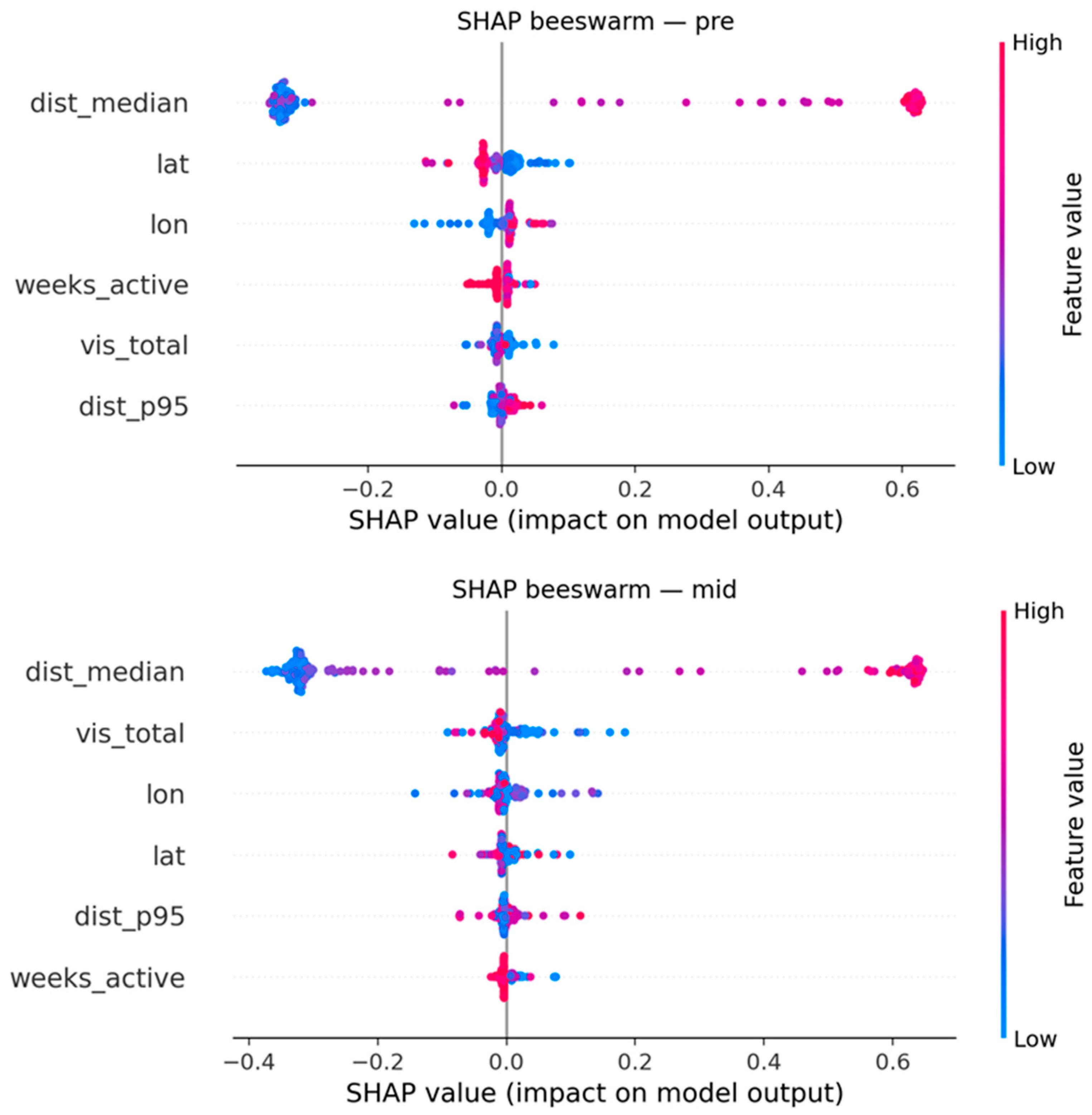
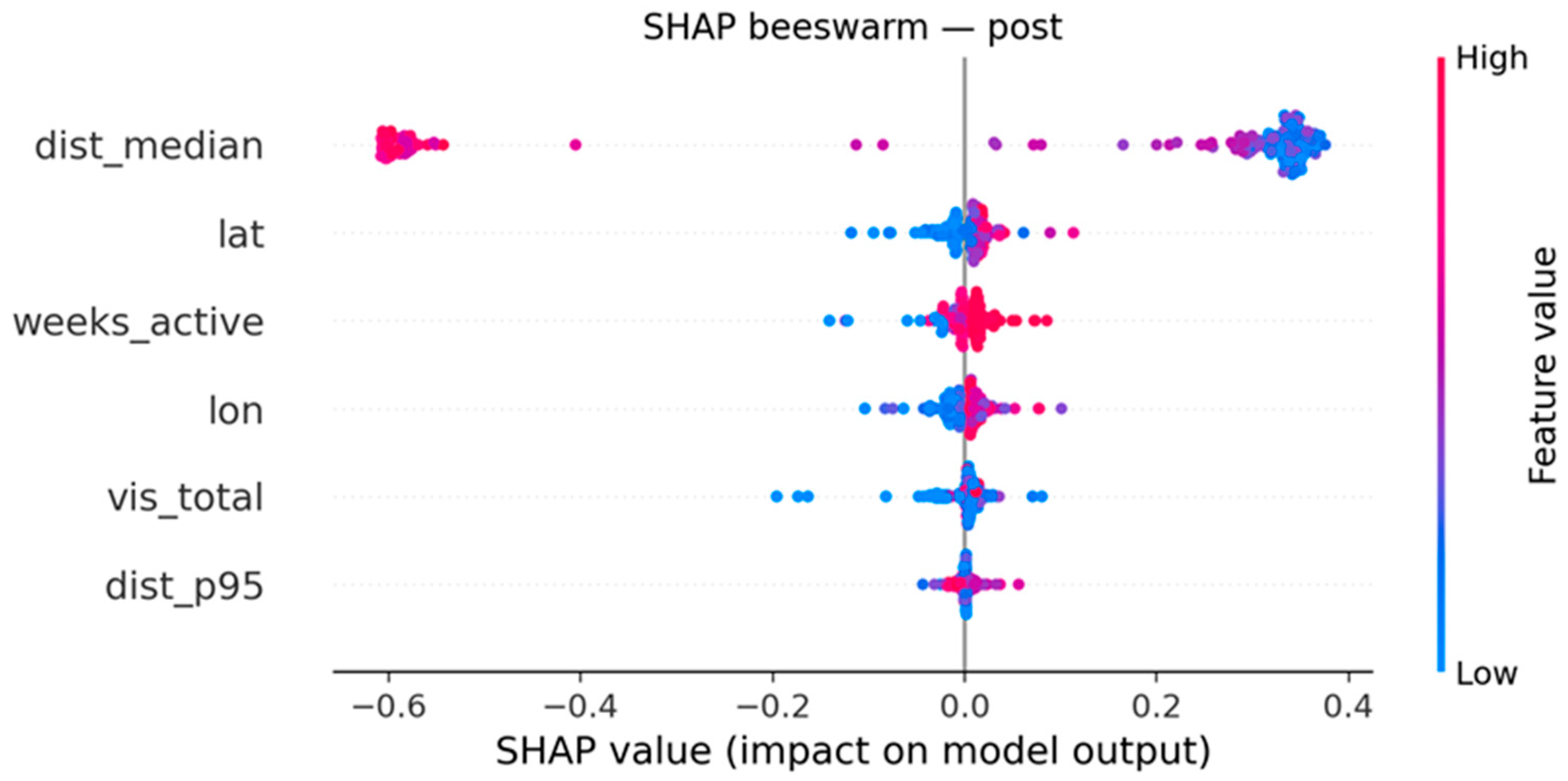
The SHAP beeswarm plots (
Figure 9) reveal that distance-based indicators, particularly the median and 95th-percentile travel distances, dominated model influence, followed by park location coordinates (latitude and longitude) and temporal intensity measures such as total visits and weeks active. Across all phases, dist_median exhibited the largest positive SHAP values, indicating that parks with higher median travel distances were more likely to be classified as regional attractors. Similarly, parks situated farther north or west (higher latitude or longitude values) showed positive SHAP effects, corresponding to the city’s spatial development pattern and concentration of large-scale recreation areas in those directions.
The importance of temporal continuity (weeks_active) and overall visitation volume increased slightly from the pre- to the post-pandemic period, suggesting that sustained activity and cumulative visitation became stronger predictors of regional-type status over time. This trend reflects a normalization process: as mobility restrictions eased, parks that maintained consistent engagement during lockdown evolved into enduring metropolitan destinations.
Taken together, the clustering and SHAP analyses demonstrate a robust, interpretable typology of park attractors that remained consistent throughout the pandemic. The distinction between local and regional parks is not merely spatial but also functional: regional attractors combine broad catchment areas with sustained visitation and extended temporal rhythms, while local attractors retain CBGs-centered patterns of use. This differentiation provides the empirical foundation for RQ4, which examines whether these spatial typologies also manifest distinct temporal rhythms of activity across the day and night.
3.5. RQ4: Are the Temporal Patterns of Park Use (Daytime vs. Evening) Associated with Parks’ Socio-Spatial Attractor Types?
Mixed-effects regression models were estimated to assess whether local and regional park attractors exhibited different temporal rhythms of use across pandemic periods. We modeled daytime (06:00–18:00), evening (18:00–22:00), and late-night (22:00–06:00) visitation shares as separate dependent variables in parallel specifications, with parks as random intercepts to account for repeated observations over time.(
Table 5) Results from both linear and logit specifications were highly consistent, indicating robustness to distributional assumptions.
To provide a fuller view of temporal change, daytime use (06:00–18:00) was examined as a reference condition alongside evening and late-night activity. Because daytime share is mechanically linked to the other periods (daytime = 1 − evening − late-night), its variation is comparatively more stable and primarily reflects seasonal fluctuations rather than the sharp structural shift observed in nighttime activity during and after COVID-19. This comparison indicates that temporal adaptation was asymmetric across the day: the most pronounced and policy-relevant changes occurred through an extension of park use into evening and late-night hours, consistent with Las Vegas’s climatic constraints and pandemic-era behavioral adjustments.
Across all parks, nighttime visitation was significantly lower in the pre-pandemic period (before 15 March 2020; β = −0.033, p < 0.001) and rose sharply in the post-pandemic phase (after 15 June 2021; β = 0.045, p < 0.001) relative to the mid-pandemic baseline (15 March 2020–15 June 2021). This pattern aligns with the timing of COVID-19 movement controls in Nevada and Clark County. Shortly after our mid-pandemic period began, Clark County closed park and recreation facilities while generally keeping outdoor areas open, and Nevada issued statewide emergency directives culminating in a Stay-at-Home order (Directive 010) and strict limits on non-essential activity and public gatherings, including in parks—conditions that likely suppressed discretionary evening outings more than daytime use.
As restrictions eased through phased reopening and the later transition to county-managed mitigation, the region moved into a substantially reopened regime by early June 2021 (e.g., capacity and social distancing requirements removed in Clark County effective 1 June 2021). Our post-pandemic window (after 15 June 2021) therefore captures behavior after reopening had largely taken effect, consistent with the observed rebound and modest intensification of nighttime park use.
Regional attractor parks (Type 1) showed marginally lower nighttime shares overall (β = −0.002, p < 0.01), indicating that large destination parks were relatively more daytime-oriented, whereas local parks sustained more evening use. The significant negative interaction between park type and the post-pandemic period (β = −0.023, p < 0.001) suggests this divergence widened after reopening, with local parks regaining evening visitors more rapidly than regional parks, consistent with a neighborhood-oriented recovery of leisure mobility.
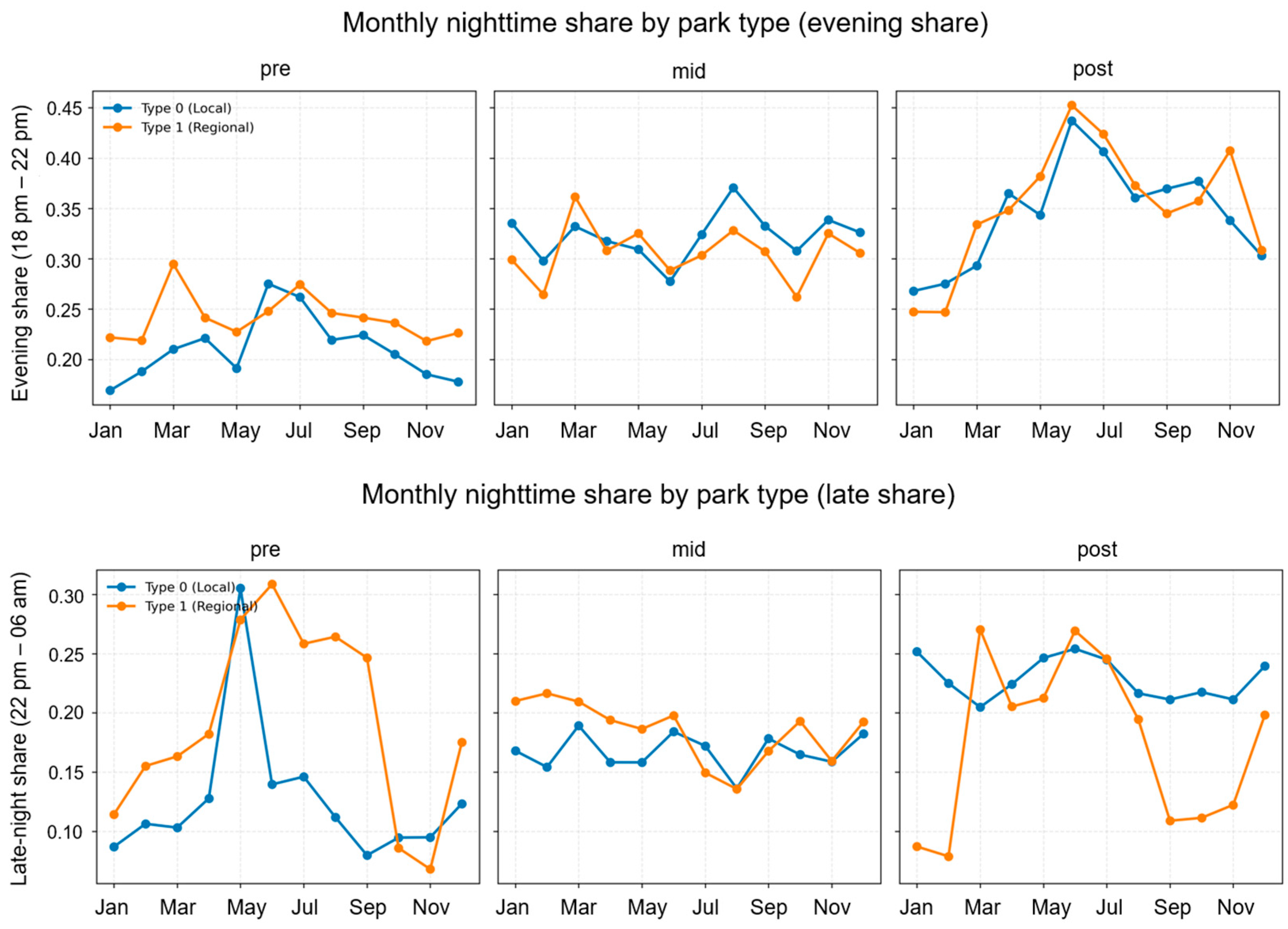
Figure 10 compares the monthly evening (18:00–22:00) and late-night (22:00–06:00) visitation shares for local (Type 0) and regional (Type 1) parks across the pre-, mid-, and post-pandemic periods. Before the pandemic, regional parks consistently attracted a higher proportion of evening visitors than local parks, reflecting their broader recreational functions and capacity to support extended activity hours. However, this difference narrowed during the mid-pandemic phase, when both park types converged toward similar evening shares, suggesting that mobility restrictions and behavioral caution temporarily suppressed late-evening activity in larger regional destinations. After reopening, both types exhibited a strong rebound in evening use, peaking in the late spring and summer months, with regional parks showing a more pronounced seasonal amplitude.
The late-night patterns reveal a more distinct divergence. In the pre-pandemic period, regional parks supported substantially higher late-night visitation, while local parks displayed limited nocturnal engagement. During the restriction phase, both types experienced flattening in late-night activity, consistent with the curtailment of social gatherings. In the post-pandemic period, however, local parks demonstrated a notable rise in late-night use, which approached or even exceeded that of regional parks during certain months. It indicates a behavioral shift toward nearby spaces for informal nighttime leisure. The seasonal peaks in both evening and late-night shares, especially in summer months, emphasize the persistence of climatic and daylight constraints on nighttime park use, while the convergence between park types of points to a gradual normalization of community-scale nocturnal activity after the pandemic.
Taken together, these findings demonstrate a temporal reorganization of park use across the pandemic timeline. While overall evening visitation recovered to and even surpassed pre-pandemic levels, its spatial distribution became more localized. Local CBGs parks increasingly served as centers of evening social activity, reflecting a durable behavioral shift toward proximate and community-oriented nighttime leisure. Regional parks, in contrast, retained a more diurnal rhythm, highlighting how pandemic disruptions reconfigured not only the magnitude but also the spatio-temporal structure of urban park use in Las Vegas.
4. Implication and Discussion
The primary contribution of this study is to show that residents’ spatial range for park use shifted markedly across the pre-, mid-, and post-pandemic periods, with discrete breaks in both level and slope of weekly travel distance. By combining segmented time-series modeling with seasonal controls, the analysis demonstrates that movement restrictions compressed typical travel radii in the mid-period and that reopening produced an incomplete and uneven rebound rather than a simple reversion to the pre-period trend. For agencies, the implication is straightforward: demand for parks is not merely cyclical or seasonal; it is structurally sensitive to public-health regimes and mobility frictions. Operations and capital planning should therefore treat “travel distance to parks” as a system-level performance indicator that is tracked routinely and used to trigger adaptive deployment of staffing, programming, and lighting where residents substitute nearby parks for traditional destination venues. In practice, this can be operationalized as a rolling monthly indicator computed from the same weekly origin–destination visit table used in RQ1 (i.e., device-aggregated visits by census block group × park, combined with park polygons and origin centroids), reported as both a citywide mean and neighborhood scorecards to flag structural contractions early. Yet these citywide patterns do not reveal which communities are most affected by the contraction and partial rebound in travel distance, motivating a closer examination of CBG-level heterogeneity.
Building on that structural picture, the between-community models (RQ2) clarify which CBGs most expanded or contracted their travel range. Because these regressions isolate spatial (rather than temporal) variation within each phase, they help translate the citywide curves into place-based guidance. Communities with specific socioeconomic profiles (e.g., lower car access, different work schedules, or housing tenure patterns) consistently exhibited shorter or longer travel distances. Although this study uses SafeGraph for research-scale coverage, the proposed indicators (distance-to-park, origin diversity, and time-of-day shares) are data-agnostic and can be computed from other sources commonly available to agencies, such as aggregated mobility summaries from commercial vendors or regional data collaboratives, automated park counters/entry sensors, parking and transit usage records, and short intercept or online visitor surveys. Where origin–destination data are unavailable, agencies can still track proxy accessibility metrics using network-based travel-time catchments and resident-weighted distances derived from population and street networks. From an equity perspective, these findings suggest that spatial inequality in park access cannot be addressed solely by increasing overall park supply, but requires targeted interventions tailored to neighborhood mobility constraints. In practice, this means that when citywide distance contracts, as it did during restrictions, some CBGs disproportionately shoulder the load on local parks, while others disengage from regional destinations. Park providers can use these coefficients to prioritize “pressure-relief” interventions: pop-up amenities and extended-hour lighting in CBGs predicted to substitute heavily toward local parks, prioritized maintenance and safety upgrades in high-substitution neighborhoods, and targeted mobility support (e.g., evening transit frequency, micromobility docking, wayfinding) for areas otherwise dependent on distant destination parks. Such differentiated strategies directly operationalize the regression results into concrete actions aimed at mitigating spatial inequities rather than treating all neighborhoods uniformly. Because the models were also estimated with visit-weighted precision and subjected to multicollinearity and spatial-autocorrelation diagnostics, the resulting patterns are robust enough to be operationalized in allocation formulas and incorporated into annual budgeting, Capital Improvement Program (CIP) prioritization, and parks-and-recreation master planning. These CBGs-level disparities highlight the importance of understanding how different types of parks function within the system, which the next subsection addresses by distinguishing local and regional attractors.
The typology in RQ3, which distinguishes local attractors from regional attractors using origin diversity and the share of long-distance visitors, explains where the redirected demand lands. During the mid-period, local attractors gained relative prominence as “pressure valves,” while many regional attractors recovered more slowly. This distinction implies that local and regional parks should not be managed under a single operational logic, particularly in the post-pandemic context of altered temporal and spatial use patterns. This provides a direct programming and investment cue: CBGs-scale parks that repeatedly rank as local attractors should be treated as critical resilience infrastructure, eligible for small-cap, high-impact upgrades (illumination quality, sightlines, restroom reliability, water access, and flexible-use pads) that make spontaneous evening use safe and comfortable. Because these parks increasingly absorb redistributed evening and late-night activity, targeted investments should prioritize safety, visibility, and flexibility rather than capacity expansion alone. Conversely, regional attractors should be planned with modularity: reservable evening zones, traffic-calmed perimeters, and coordinated transit headways that can scale up when distance rebounds. For these destination-oriented parks, the findings suggest emphasizing adaptive scheduling, transportation coordination, and scalable amenities that respond to fluctuating demand rather than assuming a full return to pre-pandemic visitation rhythms. The typology can also be mapped to equity goals by checking whether historically underserved communities are over-represented among local attractors without commensurate nighttime-ready features. However, where redirected demand lands is only part of the story; when people use these parks also matters for resilience, evening usability, and everyday accessibility.
Building on this spatial typology, RQ4 links typology to temporal rhythms by showing that evening (and, in sensitivity checks, late-night) shares evolve differently across phases for local versus regional attractors. After reopening, local attractors retained comparatively elevated evening activity, indicating a durable temporal reprogramming of everyday leisure toward nearby public space. At the same time, evening and late-night activity is strongly shaped by park-level physical and managerial conditions—especially lighting quality, perceived safety, microclimate, and supporting amenities. Because these attributes are not explicitly included as covariates in the RQ4 models, the estimated differences across attractor types may partly reflect omitted-variable bias and unobserved park-level heterogeneity correlated with the typology. In other words, the typology should be interpreted as a composite signal that captures not only spatial reach but also correlated design and management conditions that affect nocturnal use. This suggests three actionable moves. First, include time-of-day targets in park performance dashboards (e.g., “comfort evening activation” metrics) rather than relying solely on daily totals. Second, coordinate asset management across departments on the nocturnal horizon, including lighting standards, pedestrian priority around park edges after 6 p.m., and noise/overtime protocols that enable low-impact programming. Third, use the mixed-effects estimates to stage pilot “evening kits” (portable lighting, staff shifts, and family-oriented programming) in parks where the model predicts the largest marginal gains for evening usability and participation. First, include time-of-day targets in park performance dashboards (e.g., “evening activation” metrics) rather than relying solely on daily totals. Second, coordinate after-hours operations across departments, including lighting standards, pedestrian priority around park edges after 6 p.m., and staffing/noise protocols that enable low-impact programming. Third, use the mixed-effects estimates to stage pilot “evening kits” (portable lighting, staff shifts, and family-oriented programming) in parks where the model predicts the largest marginal gains in evening participation. We note that evening usability outcomes (e.g., crime or injury) are not directly measured in this study; the recommendations above focus on operational readiness and the conditions that support comfortable evening use.
Across RQ1–RQ4, a consistent policy message emerges resilience in park systems is not only about adding acreage; it is about managing spatial reach and temporal access as coupled levers. In practical terms, agencies can (i) institutionalize segmented distance monitoring with quarterly break-tests (using weekly OD-aggregated visit tables; report a monthly rolling mean for routine tracking and run break-tests once per quarter), (ii) publish CBGs-level distance scorecards that pre-commit surge resources when structural contractions recur (e.g., trigger thresholds based on deviations from the same-season baseline and include minimum data inputs such as visits-by-origin CBG, park polygons, and time-of-day bins), (iii) adopt the attractor typology as a classification in the capital plan and night-use guidelines and translate model outputs into “priority lists” by ranking parks with the largest predicted post-period evening gains (from the mixed-effects estimates) and cross-checking whether they are local attractors serving high-substitution neighborhoods, and (iv) align transit and lighting investments with empirically observed evening behaviors rather than assumed daytime peaks by pairing (a) “night-use planning” with targeted lighting/visibility audits and staffing shifts in the top-ranked parks and (b) “pressure-relief interventions” in neighborhoods flagged by RQ2 as high-substitution—prioritizing low-cost packages such as pop-up seating/restroom reliability, extended-hour lighting, and quick-turn maintenance and safety upgrades before capacity expansion. By treating distance, typology, and time of day as integrated operational metrics, cities like Las Vegas can make night-ready park access a durable component of public health preparedness and community well-being, not just an emergency response to extraordinary events.
5. Limitations and Future Research
While this study offers new insights into the spatial and temporal restructuring of park visitation in Las Vegas, several limitations should be noted.
First, SafeGraph smartphone mobility data constitute a non-random, opt-in panel rather than a population census. As a result, groups that are less likely to carry smartphones or enable location services (e.g., older adults and some low-income residents) may be systematically underrepresented, and coverage can vary across neighborhoods and over time. Such sampling biases can affect absolute visitation levels and may also influence derived indicators such as origin diversity, long-distance share, and time-of-day shares, particularly for marginalized populations. To reduce sensitivity to coverage differences, our analyses emphasize within-city comparisons and phase-to-phase changes, and we rely primarily on normalized, relative measures (shares and standardized indicators) rather than interpreting raw counts as population totals. We also report robustness checks using visit-weighted specifications (WLS) and apply data cleaning and low-coverage filtering as described in
Section 2.1. Nevertheless, the results should be interpreted as patterns observed in the device panel, and future work should triangulate these findings using complementary sources (e.g., park counters, administrative counts, and visitor surveys).
First, the analysis draws on anonymized mobility data that, despite providing fine-grained temporal coverage, represent only a subset of the population. Groups that are less likely to use location-based devices, such as older adults and low-income residents, may be undercounted. These biases affect the representativeness of the observed travel distances, though they do not undermine the relative comparisons across periods or neighborhoods. Second, the segmentation of pre-, mid-, and post-pandemic phases necessarily simplifies a fluid timeline of policy shifts and behavioral adaptations. The defined phases are designed for analytic clarity rather than capturing every transient response. Third, as the models operate at the community and park levels, they reveal aggregate patterns rather than individual motivations; factors such as park quality, safety perception, or neighborhood design characteristics remain potential unobserved influences. In particular, park-level attributes related to lighting, perceived safety, microclimatic comfort, and amenity provision may partially account for unobserved heterogeneity in evening and late-night use across different park attractor types.
Future research should build on these findings in several directions. Methodologically, integrating multiple data sources, such as park sensor data, visitor surveys, or participatory mapping, could improve behavioral representativeness and capture experiential dimensions of park use. Spatial-temporal models that incorporate microclimatic variables or dynamic accessibility networks would further clarify how environmental and infrastructural conditions influence mobility patterns over time.
Conceptually, extending the framework beyond the pandemic offers a broader agenda for studying how mobility shocks, climate events, or nighttime accessibility policies reshape urban rhythms. Comparative studies across cities with differing park systems and governance structures could test the generalizability of the local–regional attractor typology. From an applied perspective, the findings suggest opportunities for adaptive park planning. Recognizing how residents recalibrate between CBGs-based and destination-based recreation could inform equitable investment in local green spaces, distributed amenities, and lighting strategies that support safe and inclusive nighttime access. Future work linking spatial analytics with participatory design processes may help translate these dynamic behavioral patterns into planning tools for resilient and time-sensitive urban landscapes.
6. Conclusions
In conclusion, this research analyzed multi-year park mobility flows and time-of-use profiles in Las Vegas across pre-, mid-, and post-COVID periods. It further examined how these dynamics interact with CBGs characteristics and park types. This was achieved using segmented time series models, between-community regression analyses, the local versus regional attractor typologies, as well as the use of the evening visitation share models, which were analyzed using the generalized linear models/mixed models. The results demonstrate that the pandemic resulted in a dramatic reduction in travel distance, which, while partial, has yet to fully recover, resulting in the emergence of a more localized system than previously seen. Moreover, this change was not evenly felt in the sense that certain communities, depending upon their socio-economic profile, recorded smaller travel distances, while the local attractors continued to absorb the growing proportion of redistributed visits, while evening activities continued to firmly anchor in the local parks. In sum, the results of this research demonstrate the role of the COVID-19 pandemic as a trigger rather than a fleeting disturbance in the process of the re-scaling of the everyday of leisure activities toward the nearest Public Spaces.
From a theory perspective, this research moves the state of the art regarding the role of park systems in resilience infrastructure by conceptualizing spatial support and temporal support as inherently entwined dimensions of equity. By zooming in beyond the aggregate counts of visit volumes, this research aims to demonstrate the importance of travel distance, origin diversity, as well as time series usage information in tandem, to jointly understand who can feasibly access which parks, as well as when. The local-regional attractor approach, conceptualized in direct relationship to evening/late night schedules, provides a scalable approach in distinguishing parks as serving mainly locally adjacent CBGs, as opposed to serving as destinations in the city, as well as adapting to the impact of mobility disturbances. From a methodological perspective, this study brings together segmented time-series models, CBGs-level regressions, park-level models, and spatially weighted temporal models in one analytical pipeline. Using a consistent set of variables and outputs keeps this combined framework interpretable.
Generalizability beyond Las Vegas should be interpreted in terms of the framework versus the site-specific drivers. The analytical framework is transferable: it links (i) longitudinal mobility-based distance metrics, (ii) park “attractor” roles defined by origin diversity and long-distance share, and (iii) time-of-day visitation rhythms within a unified pipeline that can be replicated wherever comparable origin–destination mobility traces are available. By contrast, several findings are likely to be context-sensitive in Las Vegas, including the strong climatic incentive to shift discretionary outdoor activity to evening hours and the high baseline auto-dependence that widens typical travel radii and raises the share of long-distance trips. In more walkable or transit-oriented cities, we would expect a higher baseline prevalence of short-distance trips, a potentially more continuous spectrum of attractor roles (rather than a sharply bimodal local–regional split), and temporal rhythms that are shaped less by extreme heat and more by transit service hours, lighting policies, and mixed-use night economies. These differences imply that the same typology-and-rhythm approach may yield different thresholds and cluster boundaries, but the underlying logic, that treating spatial reach and temporal access as coupled dimensions of park equity and resilience, remains broadly applicable.
The implications of this research, therefore, highlight the importance of equity-focused and time-conscious park planning [
9,
10]. The distance travel, type of attractor, and evening visitation share should be central measures to park planning departments, in addition to the usual measures of land mass and daily visits [
18,
23,
43]. Local attractors, which chronically absorb redistributed demand, particularly in socio-economically fragile CBGs, should also be the priority resilience asset designated for targeted quality light, evening usability, and dynamic amenities that promote comfort evening usage [
24,
32,
33]. On the other hand, the planning of regional attractors should also prioritize modular capacity planning, coordinated transit planning, as well as traffic calming strategies designed to adapt based on the velocities of distance to promote resilience based upon distance recovery. In conclusion, the importance of segmented distance monitoring, distance dashboard analytics for CBGs, as well as night use type analytic planning can make active preparations for crisis periods the priority strategy for cities rather than reactive crisis management. The proposal brought forward in this research, while asserting challenges in Las Vegas related to the COVID-19 pandemic, should be applied in the future for other mobility crisis conditions, extreme weather conditions, as well as related night-time accessibility strategies [
7,
44], with local calibration of distance thresholds, attractor boundaries, and time-of-day definitions to match different urban mobility regimes and governance contexts.