_Li.png)
IoT-Driven Pathways Toward Corporate Sustainability in Industry 4.0 Ecosystems: A Systematic Review

 ,
,  ,
,  , , and
Abstract
1. Introduction
Main Contributions of the Study
2. Literature Review
2.1. The Role of IoT in Corporate Sustainability: A Holistic View
2.2. IoT and Efficient Resource Management in Organizations
2.3. IoT and Energy Sustainability in the Green Digital Transformation
2.4. IoT and Green Talent Management in the Circular Economy
2.5. Theoretical Gaps and Emerging Research Directions
- There is little presence of empirical studies applied to Latin American contexts, where sociotechnical and regulatory conditions differ from those commonly addressed in research focused on Europe or Asia.
- Lack of integrative theoretical frameworks that link IoT tools with sustainable practices in areas such as resource management, energy efficiency, and organizational culture. Most of the studies reviewed analyze these elements in isolation.
- Limited evidence on the integration of IoT into human resource management, particularly about measuring environmental performance, green training, and promoting a sustainable work culture.
- Lack of longitudinal studies analyzing the lasting impact of IoT on sustainability indicators beyond immediate operational improvements, making it difficult to assess its structural contribution to sustainable development.
3. Methodology
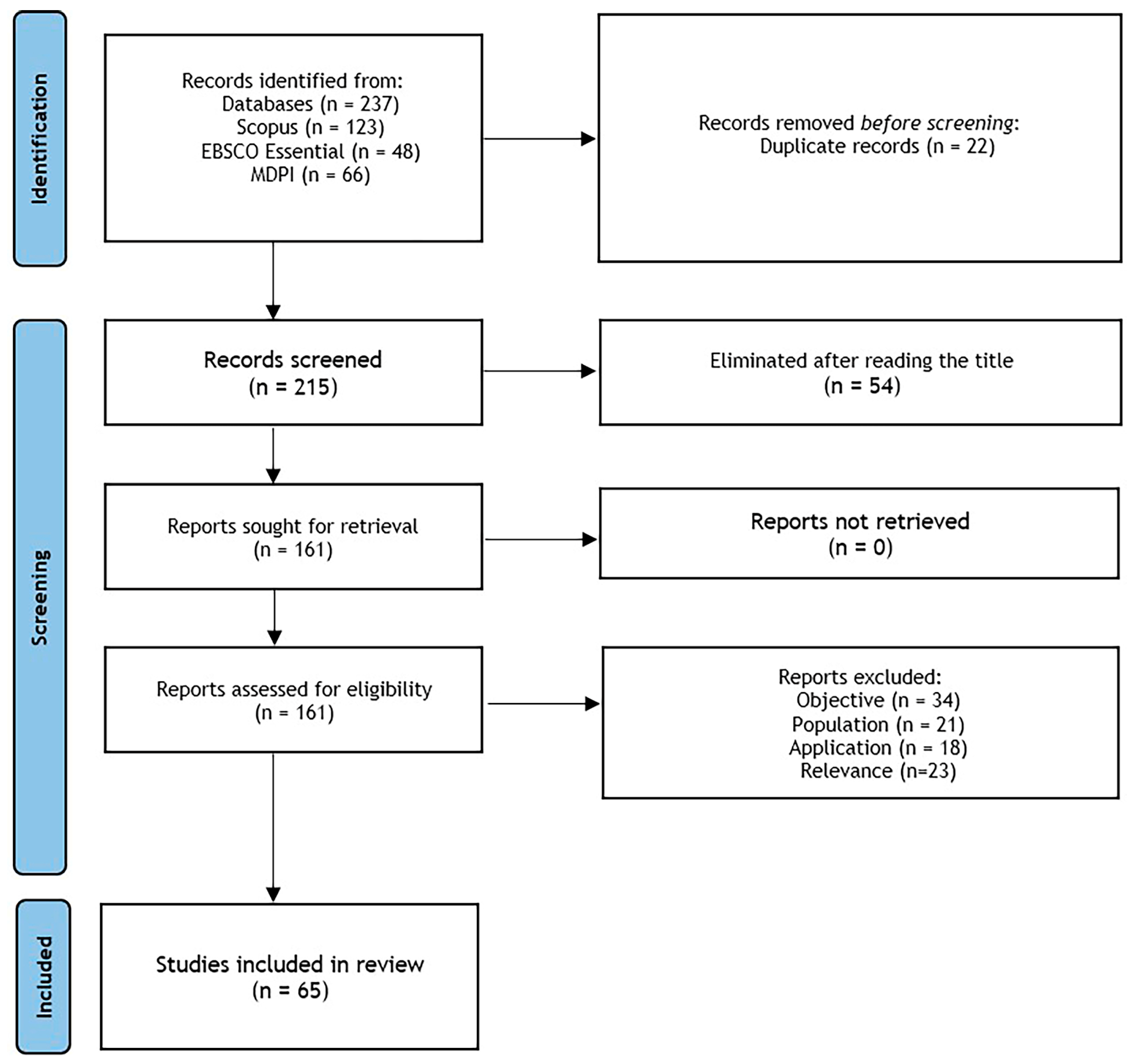
- Articles related to Industry 4.0 and the IoT in business sustainability, smart resources, digital transformation, and green human resources, and topics focused on technological benefits for a sustainable company.
- Articles in English and Spanish
- Peer-reviewed journals and articles that include empirical data.
- Articles published in the period 2009–2025.
4. Results
4.1. Identifying Gaps in Literature and Research Opportunities
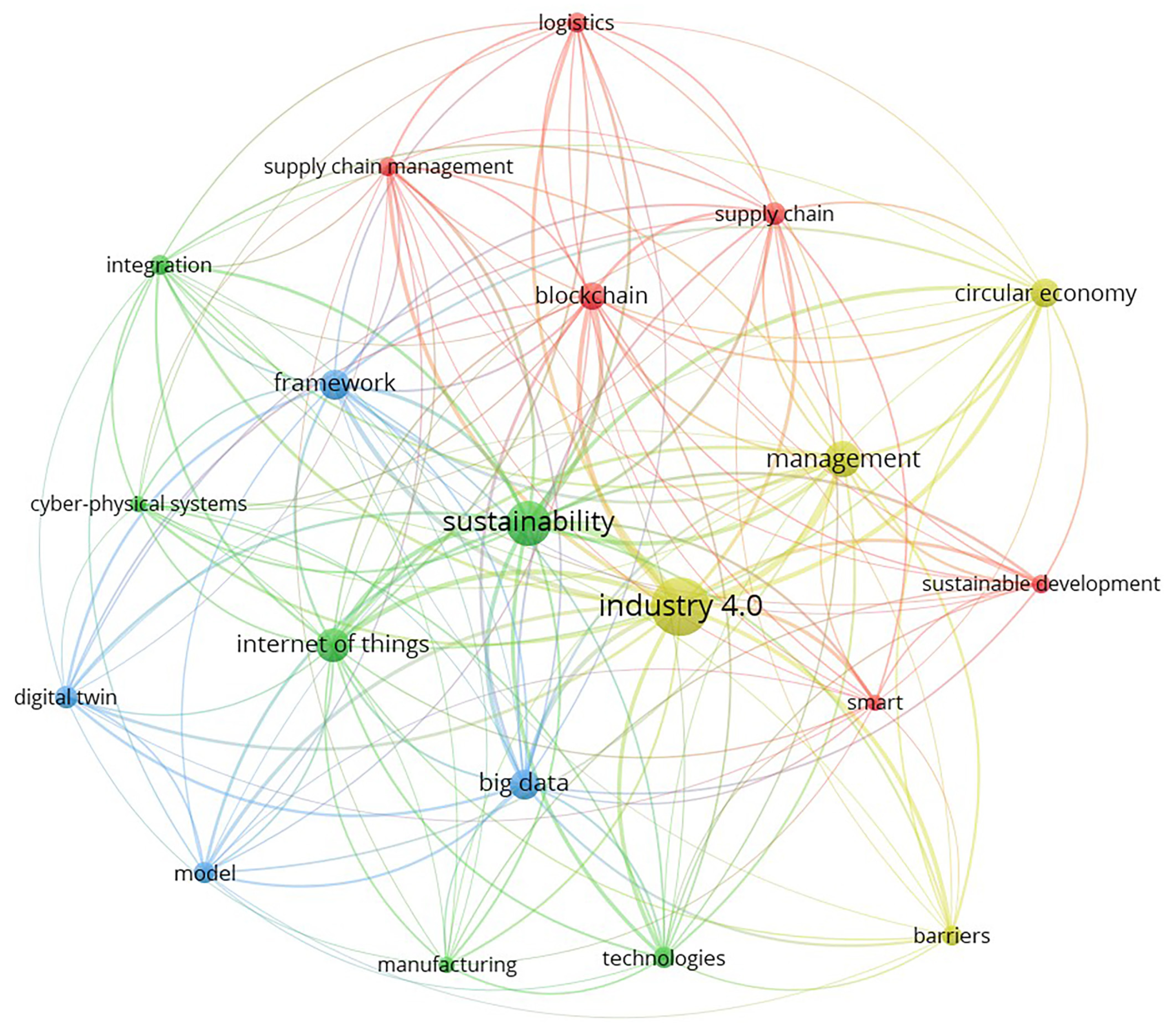
- Industry 4.0, IoT, and associated technologies, driving digital transformation and the integration of intelligent systems to improve industrial sustainability (26 documents).
- Green management of human resources, focused on environmental sustainability through strategies that strengthen organizational culture and promote responsible practices (16 documents).
- Use of virtual machines, essential for process optimization and operational efficiency in digital environments (12 documents).
4.2. Virtual Machine and Sustainability
4.3. Industry 4.0 and Sustainability
4.4. Green HR Management and Sustainability
5. Discussion
6. Practical Implications for the Manufacturing Industry
- -
- Operational efficiency and process optimization
- -
- Energy management and environmental monitoring
- -
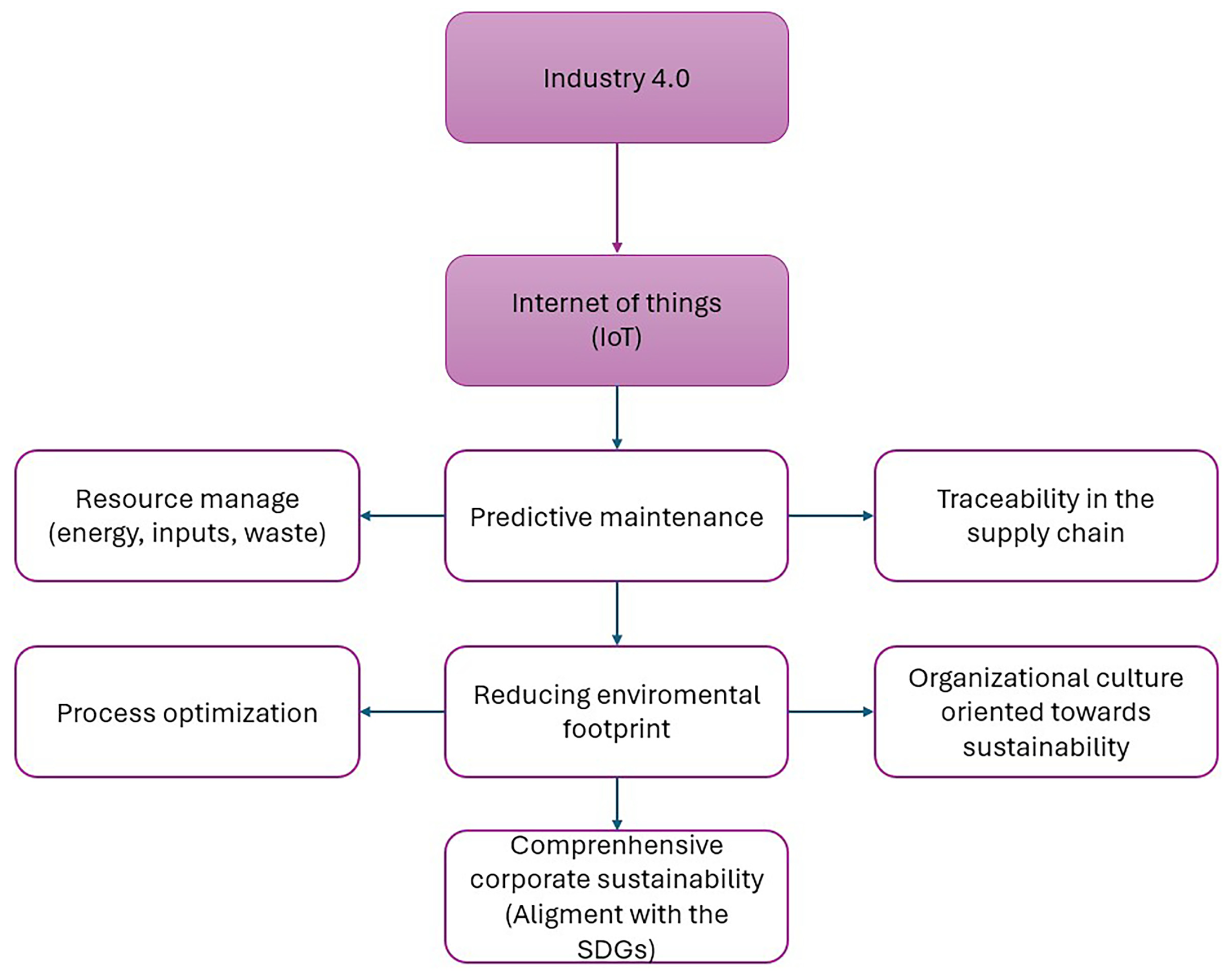
- Predictive and condition-based maintenance
- -
- Enhanced supply-chain traceability and transparency
- -
- Enabling circular-economy and resource-regeneration strategies
- -
- Reinforcing sustainability-oriented organizational culture
7. Conclusions
Supplementary Materials
Author Contributions
Funding
Institutional Review Board Statement
Informed Consent Statement
Data Availability Statement
Conflicts of Interest
References
- Melo, L.d.S.; Fernandes, R.M.; Nunes, D.R.d.L.; Oliveira, R.M.e.S.d.; Silva, J.M.N.; Avila, L.V.; Martins, V.W.B. Industry 4.0 and Sustainability: Empirical Validation of Constructs of Industry Technology and Sustainable Development. Platforms 2024, 2, 150–164. [Google Scholar] [CrossRef]
- Culot, G.; Nassimbeni, G.; Orzes, G.; Sartor, M. Behind the Definition of Industry 4.0: Analysis and Open Questions. Int. J. Prod. Econ. 2020, 226, 107617. [Google Scholar] [CrossRef]
- Kibe, L.W.; Kwanya, T.; Nyagowa, H. Harnessing Fourth Industrial Revolution (4IR) Technologies for Sustainable Development in Africa: A Meta-Analysis. Technol. Sustain. 2023, 2, 244–258. [Google Scholar] [CrossRef]
- Pansare, R.; Yadav, G.; Garza-Reyes, J.A.; Nagare, M.R. Assessment of Sustainable Development Goals through Industry 4.0 and Reconfigurable Manufacturing System Practices. J. Manuf. Technol. Manag. 2023, 34, 383–413. [Google Scholar] [CrossRef]
- Yavuz, O.; Uner, M.M.; Okumus, F.; Karatepe, O.M. Industry 4.0 technologies, sustainable operations practices and their impacts on sustainable performance. J. Clean. Prod. 2023, 387, 135951. [Google Scholar] [CrossRef]
- Khan, M.H.; Muktar, S.N. A Bibliometric Analysis of Green Human Resource Management Based on Scopus Platform. Cogent Bus. Manag. 2020, 7, 1831165. [Google Scholar] [CrossRef]
- Al-Khatib, A.W. The Impact of Industrial Internet of Things on Sustainable Performance: The Indirect Effect of Supply Chain Visibility. Bus. Process Manag. J. 2023, 29, 1607–1629. [Google Scholar] [CrossRef]
- Erboz, G.; Yumurtacı Hüseyinoğlu, I.Ö. The Role of Industry 4.0 on Supply Chain Cost and Supply Chain Flexibility. Bus. Process Manag. J. 2023, 29, 1330–1351. [Google Scholar] [CrossRef]
- Khodair, A. Key Embrace Factors for Designing Sustainable Supply Chains in Egyptian Industry 4.0. Bus. Process Manag. J. 2024, 30, 1111–1130. [Google Scholar] [CrossRef]
- Aravindaraj, K.; Rajan Chinna, P. A Systematic Literature Review of Integration of Industry 4.0 and Warehouse Management to Achieve Sustainable Development Goals (SDGs). Clean. Logist. Supply Chain 2022, 5, 100072. [Google Scholar] [CrossRef]
- Rampasso, I.S.; Martins, V.W.B.; Serafim, M.P.; Cavaliero, C.K.N.; Quelhas, O.L.G.; Leal Filho, W.; Anholon, R. Brazilian Contributions to the Sustainable Development Goal 7 and Policy Implications. Kybernetes 2021, 51, 3025–3040. [Google Scholar] [CrossRef]
- Rasheed, M.; Liu, J.; Ali, E. Incorporating Sustainability in Organizational Strategy: A Framework for Enhancing Sustainable Knowledge Management and Green Innovation. Kybernetes 2024, 54, 2363–2388. [Google Scholar] [CrossRef]
- Gu, F.; Guo, J.; Hall, P.; Gu, X. An Integrated Architecture for Implementing Extended Producer Responsibility in the Context of Industry 4.0. Int. J. Prod. Res. 2019, 57, 1458–1477. [Google Scholar] [CrossRef]
- Ford, S.; Despeisse, M. Additive Manufacturing and Sustainability: An Exploratory Study of the Advantages and Challenges. J. Clean. Prod. 2016, 137, 1573–1587. [Google Scholar] [CrossRef]
- Mishra, P. Mapping the Evolution of Industry 4.0 and Sustainability Research: A Comprehensive Bibliometric Study. Sustain. Oper. Comput. 2024, 5, 227–238. [Google Scholar] [CrossRef]
- Olsen, T.L.; Tomlin, B. Industry 4.0: Opportunities and challenges for operations management. Manuf. Serv. Oper. Manag. 2020, 22, 113–122. [Google Scholar] [CrossRef]
- Purvis, B.; Mao, Y.; Robinson, D. Three Pillars of Sustainability: In Search of Conceptual Origins. Sustain. Sci. 2019, 14, 681–695. [Google Scholar] [CrossRef]
- Saleh, M.A.S.; AlShafeey, M. Examining the Synergies Between Industry 4.0 and Sustainability Dimensions Using Text Mining, Sentiment Analysis, and Association Rules. Sustain. Futures 2025, 9, 100423. [Google Scholar] [CrossRef]
- Kraus, S.; Jones, P.; Kailer, N.; Weinmann, A.; Chaparro-Banegas, N.; Roig-Tierno, N. Digital Transformation: An Overview of the Current State of the Art of Research. SAGE Open 2021, 11, 21582440211047576. [Google Scholar] [CrossRef]
- Bouwman, W.A.; Nikou, S.; de Reuver, M. Digitalization, Business Models, and SMEs: How Do Business Model Innovation Practices Improve Performance of Digitalizing SMEs? Telecommun. Policy 2019, 43, 101828. [Google Scholar] [CrossRef]
- Niaz, M. Revolutionizing Inventory Planning: Harnessing Digital Supply Data through Digitization to Optimize Storage Efficiency Pre- and Post-Pandemic. BULLET J. Multidisiplin Ilmu 2022, 1, 592273. Available online: https://journal.mediapublikasi.id/index.php/bullet/article/view/3534 (accessed on 5 December 2025).
- Kamalaldin, A.; Linde, L.; Sjödin, D.; Parida, V. Transforming provider-customer relationships in digital servitization: A relational view on digitalization. Ind. Mark. Manag. 2020, 89, 306–325. [Google Scholar] [CrossRef]
- Matarazzo, M.; Penco, L.; Profumo, G.; Quaglia, R. Digital Transformation and Customer Value Creation in Made in Italy SMEs: A Dynamic Capabilities Perspective. J. Bus. Res. 2021, 123, 642–656. [Google Scholar] [CrossRef]
- Hasan, N.A.; Rahim, M.A.; Ahmad, S.H.; Meliza, M. Digitization of Business for Small and Medium-Sized Enterprises (SMEs). Environ.-Behav. Proc. J. 2022, 7, 11–16. [Google Scholar] [CrossRef]
- Bouwman, H.; Nikou, S.; Molina-Castillo, F.J.; de Reuver, M. The Impact of Digitalization on Business Models. Digit. Policy Regul. Gov. 2018, 20, 105–124. [Google Scholar] [CrossRef]
- Murray, A.; Skene, K.; Haynes, K. The Circular Economy: An Interdisciplinary Exploration of the Concept and Application in a Global Context. J. Bus. Ethics 2017, 140, 369–380. [Google Scholar] [CrossRef]
- Langley, D.J. Digital Product-Service Systems: The Role of Data in the Transition to Servitization Business Models. Sustainability 2022, 14, 1303. [Google Scholar] [CrossRef]
- González-Varona, J.M.; Poza, D.; Acebes, F.; Villafáñez, F.; Pajares, J.; López-Paredes, A. New Business Models for Sustainable Spare Parts Logistics: A Case Study. Sustainability 2020, 12, 3071. [Google Scholar] [CrossRef]
- Paiola, M.; Schiavone, F.; Grandinetti, R.; Chen, J. Digital Servitization and Sustainability Through Networking: Some Evidences from IoT-based Business Models. J. Bus. Res. 2021, 132, 507–516. [Google Scholar] [CrossRef]
- Park, A. Use of Internet-of-Things for Sustainable Art Businesses: Action Research on Smart Omni-Channel Service. Sustainability 2023, 15, 12035. [Google Scholar] [CrossRef]
- Fatorachian, H.; Kazemi, H.; Pawar, K. Digital Transformation for Sustainable Transportation: Leveraging Industry 4.0 Technologies to Optimize Efficiency and Reduce Emissions. Future Transp. 2025, 5, 34. [Google Scholar] [CrossRef]
- De Vass, T.; Shee, H.; Miah, S.J. The Effect of “Internet of Things” on Supply Chain Integration and Performance: An Organisational Capability Perspective. Australas. J. Inf. Syst. 2018, 22, 1734. [Google Scholar] [CrossRef]
- Tiwari, S. Supply Chain Integration and Industry 4.0: A Systematic Literature Review. Benchmarking 2021, 28, 990–1030. [Google Scholar] [CrossRef]
- Abdallah, A.B.; Rawadiah, O.M.; Al-Byati, W.; Alhyari, S. Supply Chain Integration and Export Performance: The Mediating Role of Supply Chain Performance. Int. J. Prod. Perform. Manag. 2021, 70, 1907–1929. [Google Scholar] [CrossRef]
- Mashat, R.M.; Abourokbah, S.H.; Salam, M.A. Impact of Internet of Things Adoption on Organizational Performance: A Mediating Analysis of Supply Chain Integration, Performance, and Competitive Advantage. Sustainability 2024, 16, 2250. [Google Scholar] [CrossRef]
- Quasim, M.T.; Khan, M.A.; Algarni, F.; Alharthi, A. Internet of Things: On the Opportunities, Applications and Open Challenges in Saudi Arabia. In Proceedings of the 2019 International Conference on Advances in the Emerging Computing Technologies (AECT), Al Madinah Al Munawwarah, Saudi Arabia, 10 February 2020; pp. 1–5. [Google Scholar] [CrossRef]
- Rahman, M.M.; Khan, I.; Field, D.L.; Techato, K.; Alameh, K. Powering Agriculture: Present Status, Future Potential, and Challenges of Renewable Energy Applications. Renew. Energy 2022, 188, 731–749. [Google Scholar] [CrossRef]
- Branquinho, R.; Briga-Sá, A.; Ramos, S.; Serôdio, C.; Pinto, T. Sustainable Irrigation Systems in Vineyards: A Literature Review on the Contribution of Renewable Energy Generation and Intelligent Resource Management Models. Electronics 2024, 13, 2308. [Google Scholar] [CrossRef]
- Fellmann, T.; Witzke, P.; Weiss, F.; Van Doorslaer, B.; Drabik, D.; Huck, I.; Salputra, G.; Jansson, T.; Leip, A. Major Challenges of Integrating Agriculture into Climate Change Mitigation Policy Frameworks. Mitig. Adapt. Strateg. Glob. Change 2018, 23, 451–468. [Google Scholar] [CrossRef]
- European Commission. Strategy and Policy—European Commission. Available online: https://commission.europa.eu/strategy-and-policy_es (accessed on 11 December 2025).
- Energy Watch Group; LUT University. Global Energy System Based on 100% Renewable Energy: Power, Heat, Transport and Desalination Sectors. April 2019. Available online: https://energywatchgroup.org/wp/wp-content/uploads/2023/12/EWG_LUT_100RE_All_Sectors_Global_Report_2019.pdf (accessed on 11 December 2025).
- Chai, M. Design of Rural Human Resource Management Platform Integrating IoT and Cloud Computing. Comput. Intell. Neurosci. 2022, 2022, 4133048. [Google Scholar] [CrossRef]
- Ahmed, R.A.; Abdelraouf, M.; Elsaid, S.A.; ElAffendi, M.; El-Latif, A.A.A.; Shaalan, A.A.; Ateya, A.A. Internet of Things-Based Robust Green Smart Grid. Computers 2024, 13, 169. [Google Scholar] [CrossRef]
- Vaníčková, R. The Influence of the Human Factor on the Success of the Localization Project of the Automated Technological Line for Wood Production. TEM J. 2021, 10, 5–12. [Google Scholar] [CrossRef]
- Enderwick, P. Rising Regionalization: Will the Post-COVID-19 World See a Shift from Globalization to Regionalization? Transnatl. Corp. J. 2020, 27, 99–112. Available online: https://ssrn.com/abstract=3692317 (accessed on 11 December 2025).
- Raja, K.A.K.; Murali, K. Resource Management in Construction Project. Int. J. Sci. Res. Publ. 2020, 10, 252–259. [Google Scholar] [CrossRef]
- Althoey, F.; Waqar, A.; Alsulamy, S.H.; Khan, A.M.; Alshehri, A.; Falqi, I.I.; Abuhussain, M.; Abuhussain, M.A. Influence of IoT Implementation on Resource Management in Construction. Heliyon 2024, 10, e32193. [Google Scholar] [CrossRef]
- Darvazeh, S.S.; Mooseloo, F.M.; Aeini, S.; Rezaei Vandchali, H.; Babaee Tirkolaee, E. An Integrated Methodology for Green Human Resource Management in Construction Industry. Environ. Sci. Pollut. Res. Int. 2023, 30, 124619–124637. [Google Scholar] [CrossRef] [PubMed]
- Pandey, S.; Chaudhary, M.; Tóth, Z. An Investigation on Real-Time Insights: Enhancing Process Control with IoT-Enabled Sensor Networks. Discov. Internet Things 2025, 5, 29. [Google Scholar] [CrossRef]
- Amade, B.; Nwakanma, C.I. Identifying Challenges of Internet of Things on Construction Projects Using Fuzzy Approach. J. Eng. Proj. Prod. Manag. 2021, 11, 215–227. [Google Scholar] [CrossRef]
- Khurshid, K.; Danish, A.; Salim, M.U.; Bayram, M.; Ozbakkaloglu, T.; Mosaberpanah, M.A. An In-Depth Survey Demystifying the Internet of Things (IoT) in the Construction Industry: Unfolding New Dimensions. Sustainability 2023, 15, 1275. [Google Scholar] [CrossRef]
- Katiyar, A.; Kumar, P. A Review of Internet of Things (IoT) in Construction Industry: Building a Better Future. Int. J. Adv. Sci. Comput. Eng. 2021, 3, 65–72. [Google Scholar] [CrossRef]
- Maqbool, R.; Saiba, M.R.; Ashfaq, S. Emerging Industry 4.0 and Internet of Things (IoT) Technologies in the Ghanaian Construction Industry: Sustainability, Implementation Challenges, and Benefits. Environ. Sci. Pollut. Res. Int. 2023, 30, 37076–37091. [Google Scholar] [CrossRef]
- Kim, J.; Lee, J.W. OpenIoT: An Open Service Framework for the Internet of Things. In Proceedings of the 2014 IEEE World Forum on Internet of Things (WF-IoT), Seoul, Republic of Korea, 6–8 March 2014; pp. 89–93. [Google Scholar] [CrossRef]
- Alhasnawi, B.N.; Jasim, B.H.; Anvari-Moghaddam, A.; Blaabjerg, F. Energy Management-as-a-Service Over Fog Computing Platform. IEEE Internet Things J. 2016, 3, 161–169. [Google Scholar] [CrossRef]
- Abreu, D.P.; Velasquez, K.; Curado, M.; Monteiro, E. A Resilient Internet of Things Architecture for Smart Cities. Ann. Telecommun. 2017, 72, 19–30. [Google Scholar] [CrossRef]
- Rani, S.; Talwar, R.; Malhotra, J.; Ahmed, S.H.; Sarkar, M.; Song, H. A Novel Scheme for an Energy Efficient Internet of Things Based on Wireless Sensor Networks. Sensors 2015, 15, 28603–28626. [Google Scholar] [CrossRef] [PubMed]
- Wuhib, F.; Yanggratoke, R.; Stadler, R. Allocating Compute and Network Resources Under Management Objectives in Large-Scale Clouds. J. Netw. Syst. Manag. 2015, 23, 111–136. [Google Scholar] [CrossRef][Green Version]
- Gao, Y.; Zhang, Y.; Zhou, Y.-Z. A Remote Resource Management Method for Transparent Computing. In Proceedings of the 2012 International Conference on Computer Science and Information Processing (CSIP), Xi’an, China, 24–26 August 2012; pp. 1378–1381. [Google Scholar] [CrossRef]
- Xiong, Y.; Huang, S.; Wu, M.; Zhang, Y.; She, J. A Novel Resource Management Method of Providing Operating System as a Service for Mobile Transparent Computing. Sci. World J. 2014, 2014, 153847. [Google Scholar] [CrossRef] [PubMed]
- Papaioannou, A.; Dimara, A.; Kouzinopoulos, C.S.; Krinidis, S.; Anagnostopoulos, C.-N.; Ioannidis, D.; Tzovaras, D. LP-OPTIMA: A Framework for Prescriptive Maintenance and Optimization of IoT Resources for Low-Power Embedded Systems. Sensors 2024, 24, 2125. [Google Scholar] [CrossRef]
- Li, J.; Li, F.; Li, X.; Li, Y. Resource Optimization Scheduling and Allocation for Hierarchical Distributed Cloud Service System in Smart City. Future Gener. Comput. Syst. 2020, 107, 247–256. [Google Scholar] [CrossRef]
- Zahedi, A.; Liyanapathirana, R.; Thiyagarajan, K. Biodegradable and Renewable Antennas for Green IoT Sensors: A Review. IEEE Access 2024, 12, 189749–189775. [Google Scholar] [CrossRef]
- Ruiz-Guirola, D.E.; Rodríguez-López, C.A.; Montejo-Sánchez, S.; Souza, R.D.; López, O.L.A.; Alves, H. Energy-Efficient Wake-Up Signalling for Machine-Type Devices Based on Traffic-Aware Long-Short Term Memory Prediction. IEEE Internet Things J. 2022, 9, 21620–21631. [Google Scholar] [CrossRef]
- Rup, C.; Bajic, E. Green and Sustainable Industrial Internet of Things Systems Leveraging Wake-Up Radio to Enable On-Demand IoT Communication. Sustainability 2024, 16, 1160. [Google Scholar] [CrossRef]
- Alqahtani, H. Green IoT: How Wireless Sensor Networks Are Paving the Way for Sustainable Internet-of-Things Deployment. Big Data Comput. Vis. 2023, 3, 39–44. [Google Scholar] [CrossRef]
- Belkhir, L.; Elmeligi, A. Assessing ICT Global Emissions Footprint: Trends to 2040 & Recommendations. J. Clean. Prod. 2018, 177, 448–463. [Google Scholar] [CrossRef]
- Baldé, C.P.; Forti, V.; Gray, V.; Kuehr, R.; Stegmann, P. The Global E-Waste Monitor 2017: Quantities, Flows and Resources; United Nations University, International Telecommunication Union, and International Solid Waste Association: Tokyo, Japan, 2017; Available online: https://ewastemonitor.info/gem-2017/ (accessed on 11 December 2025).
- Modarress Fathi, B.; Ansari, A.; Ansari, A. Threats of Internet-of-Thing on Environmental Sustainability by E-Waste. Sustainability 2022, 14, 10161. [Google Scholar] [CrossRef]
- Nowakowski, T.; Werbińka, S. On Problems of Multicomponent System Maintenance Modelling. Int. J. Autom. Comput. 2009, 6, 364–378. [Google Scholar] [CrossRef]
- Baldini, E.; Chessa, S.; Brogi, A. Estimating the Environmental Impact of Green IoT Deployments. Sensors 2023, 23, 1537. [Google Scholar] [CrossRef]
- Ahmad, S. Green Human Resource Management: Policies and Practices. Cogent Bus. Manag. 2015, 2, 1030817. [Google Scholar] [CrossRef]
- Singh, R.; Joshi, A.; Dissanayake, H.; Iddagoda, A.; Khan, S.; Félix, M.J.; Santos, G. Integrating Industry 4.0, Circular Economy, and Green HRM: A Framework for Sustainable Transformation. Sustainability 2025, 17, 3082. [Google Scholar] [CrossRef]
- Renwick, D.W.S.; Redman, T.; Maguire, S. Green Human Resource Management: A Review and Research Agenda. Int. J. Manag. Rev. 2013, 15, 1–14. [Google Scholar] [CrossRef]
- Jabbour, C.J.C.; Santos, F.C.A.; Nagano, M.S. Contributions of HRM Throughout the Stages of Environmental Management: Methodological Triangulation Applied to Companies in Brazil. Int. J. Hum. Resour. Manag. 2010, 21, 1049–1089. [Google Scholar] [CrossRef]
- Saeed, B.B.; Afsar, B.; Hafeez, S.; Khan, I.; Tahir, M.; Afridi, M.A. Promoting Employee’s Pro-Environmental Behavior Through Green Human Resource Management Practices. Corp. Soc. Responsib. Environ. Manag. 2019, 26, 424–438. [Google Scholar] [CrossRef]
- Pinzone, M.; Guerci, M.; Lettieri, E.; Huisingh, D. Effects of “Green” Training on Pro-Environmental Behaviors and Job Satisfaction: Evidence from the Italian Healthcare Sector. J. Clean. Prod. 2019, 226, 221–232. [Google Scholar] [CrossRef]
- Iddagoda, Y.A.; Bulińska-Stangrecka, H.; Abeysinghe, R. Greening of Military Personnel: Conceptual Exploration of Green Work Behaviour in Military Context. Bezpieczeństwo Obron. Socjol. 2020, 1–2, 102–121. Available online: https://repo.pw.edu.pl/info/article/WUT81a2ebf9847e4601919d0d888752eb8f?affil=TCTI&r=publication&lang=pl (accessed on 11 December 2025).
- Hong, N.T.H.; Hanh, T.T.; Anh, N.Q.; Anh, D.N.; Ngoc, T.M.; Nhi, N.D.L. Green Human Resources Management and Employees’ Green Behavioral Intention: The Role of Individual Green Values and Corporate Social Responsibility. Cogent Bus. Manag. 2024, 11, 2386464. [Google Scholar] [CrossRef]
- Demir, S.; Gunduz, M.A.; Kayikci, Y.; Paksoy, T. Readiness and maturity of smart and sustainable supply chains: A model proposal. Eng. Manag. J. 2023, 35, 181–206. [Google Scholar] [CrossRef]
- Page, M.J.; McKenzie, J.E.; Bossuyt, P.M.; Boutron, I.; Hoffmann, T.C.; Mulrow, C.D.; Shamseer, L.; Tetzlaff, J.M.; Akl, E.A.; Brennan, S.E.; et al. The PRISMA 2020 statement: An updated guideline for reporting systematic reviews. BMJ 2021, 372, n71. [Google Scholar] [CrossRef] [PubMed]
- Grant, M.J.; Booth, A. A Typology of Reviews: An Analysis of 14 Review Types and Associated Methodologies. Health Inf. Libr. J. 2009, 26, 91–108. [Google Scholar] [CrossRef]
- Haddaway, N.R.; Page, M.J.; Pritchard, C.C.; McGuinness, L.A. PRISMA2020: An R Package and Shiny App for Producing PRISMA 2020-Compliant Flow Diagrams, With Interactivity for Optimised Digital Transparency and Open Synthesis. Campbell Syst. Rev. 2022, 18, e1230. [Google Scholar] [CrossRef]
- ISO 14001:2015; Environmental management systems—Requirements with guidance for use. International Organization for Standardization: Geneva, Switzerland, 2015. Available online: https://www.en-standard.eu/une-en-iso-14001-2015-environmental-management-systems-requirements-with-guidance-for-use-iso-14001-2015/?gad_source=1&gad_campaignid=21676868379&gbraid=0AAAAADPppxsmhxTgJmOu46S6CxQedID0r&gclid=CjwKCAiAybfLBhAjEiwAI0mBBmF2QRliu85ibg0Z9QQ8IdfXM4TvtcASmkHZYZEcR9V0luNYCJq7zhoC-JYQAvD_BwE (accessed on 5 December 2025).
- Piccoli, G.; Pigni, F. Information Systems for Managers: With Cases, 4th ed.; Prospect Press: Burlington, VT, USA, 2018. [Google Scholar]
- Živanović, S.; Dimić, Z.; Furtula, M.; Slavković, N.; Đurkovic, M.; Vidaković, J. A Flexible Programming and Verification Methodology for Reconfigurable CNC Woodworking Machine. BioResources 2024, 19, 9708–9726. [Google Scholar] [CrossRef]
- Lifelo, Z.; Ding, J.; Ning, H.; Ain, Q.U.; Dhelim, S. Artificial Intelligence-Enabled Metaverse for Sustainable Smart Cities: Technologies, Applications, Challenges, and Future Directions. Electronics 2024, 13, 4874. [Google Scholar] [CrossRef]
- Wang, Y.; Su, Z.; Zhang, N.; Xing, R.; Liu, D.; Luan, T.H.; Shen, X. A Survey on Metaverse: Fundamentals, Security, and Privacy. IEEE Commun. Surv. Tutor. 2023, 25, 319–352. [Google Scholar] [CrossRef]
- Sarwatt, D.S.; Lin, Y.; Ding, J.; Sun, Y.; Ning, H. Metaverse for Intelligent Transportation Systems (ITS): A Comprehensive Review of Technologies, Applications, Implications, Challenges and Future Directions. IEEE Trans. Intell. Transp. Syst. 2024, 25, 6290–6308. [Google Scholar] [CrossRef]
- Voulgaridis, K.; Lagkas, T.; Angelopoulos, C.M.; Nikoletseas, S.E. IoT and Digital Circular Economy: Principles, Applications, and Challenges. Comput. Netw. 2022, 219, 109456. [Google Scholar] [CrossRef]
- Awan, U.; Rafiq, M.; Shahbaz, M.; Sroufe, R.; Khan, M. Industry 4.0 and the Circular Economy: A Systematic Literature Review and Future Research Directions. Bus. Strategy Environ. 2022, 31, 189–208. [Google Scholar] [CrossRef]
- Necula, A.-T.; Tanase, A.G.; Maldareanu, A.; Cretu, R.-F.; Banta, V.C. Circular Economy Through Integrating Industry 4.0: Sustainable Transformation Via IoT And AI. Ann.—Econ. Ser. 2025, 1, 184–189. Available online: https://ideas.repec.org/a/cbu/jrnlec/y2025v1p184-189.html (accessed on 11 December 2025).
- Kamble, S.S.; Gunasekaran, A.; Gawankar, S.A. Achieving Sustainable Performance in a Data-Driven Agriculture Supply Chain: A Review for Research and Applications. Int. J. Prod. Econ. 2020, 219, 179–194. [Google Scholar] [CrossRef]
- Dalenogare, L.S.; Benitez, G.B.; Ayala, N.F.; Frank, A.G. The Expected Contribution of Industry 4.0 Technologies for Industrial Performance. Int. J. Prod. Econ. 2018, 204, 383–394. [Google Scholar] [CrossRef]
- Cosma, A.M.; Zangara, G.; Silvestri, L.; Filice, L. Sustainability Impact of Automated Warehouses in an Industry 4.0 Scenario. Procedia Comput. Sci. 2025, 253, 3196–3205. [Google Scholar] [CrossRef]
- Holt, D.; Anthony, S. Exploring “Green” Culture in Nortel and Middlesex University. EcoManage. Audit. 2000, 7, 143–155. [Google Scholar] [CrossRef]
- Ouragini, I.; Ben Achour, I.; Lakhal, L. The Effect of Lean, Agile, Resilient and Sustainable (LARS) HRM on Environmental Performance: The Mediating Role of Green Innovation. Int. J. Qual. Reliab. Manag. 2024, 41, 2526–2548. [Google Scholar] [CrossRef]
- Song, W.; Yu, H.; Xu, H. Effects of Green Human Resource Management and Managerial Environmental Concern on Green Innovation. Eur. J. Innov. Manag. 2021, 24, 951–967. [Google Scholar] [CrossRef]
- Soomro, B.A.; Mangi, S.; Shah, N. Strategic Factors and Significance of Organizational Innovation and Organizational Learning in Organizational Performance. Eur. J. Innov. Manag. 2020, 24, 481–506. [Google Scholar] [CrossRef]
- Cegarra-Navarro, J.-G.; Jiménez-Jiménez, D.; García-Pérez, A. An Integrative View of Knowledge Processes and a Learning Culture for Ambidexterity: Toward Improved Organizational Performance in the Banking Sector. IEEE Trans. Eng. Manag. 2021, 68, 408–417. [Google Scholar] [CrossRef]
- Kement, Ü.; Zeybek, B.; Eter, E.; Bayram, G.E.; Raza, A. How Does the Green Entrepreneurship Process of Students Undergoing Tourism Education Proceed? Implementation of the Policy Acceptance Model. Int. J. Environ. Workplace Empl. 2023, 7, 198–223. [Google Scholar] [CrossRef]
- Zhang, J.; Li, J.; Yan, Y.; Xie, Z. Concentration in cross-border research collaborations and MNCs’ knowledge creation in a host country. Strateg. Manag. J. 2025, 47, 2. [Google Scholar] [CrossRef]
- Zhang, K.; Zheng, B.; Xue, J.; Zhou, Y. Explainable and Trust-Aware AI-Driven Network Slicing Framework for 6G IoT Using Deep Learning. IEEE Internet Things J. 2025, 47, 2. [Google Scholar] [CrossRef]
- Wu, B.; Ren, K.; Fu, Y.; He, D.; Pan, M. Institutional investor ESG activism and green supply chain management performance: Exploring contingent roles of technological interdependences in different digital intelligence contexts. Technol. Forecast. Soc. Change 2024, 209, 123789. [Google Scholar] [CrossRef]
- Ma, J.; Shang, Y.; Liu, L. Green image, digital transformation, and corporate green innovation. Int. Rev. Financ. Anal. 2025, 106, 104518. [Google Scholar] [CrossRef]
- Sariisik, G.; Demir, S. Industry 5.0: A Human-Centric Paradigm for Sustainable and Resilient Industrial Transformation. J. Soc. Perspect. Stud. 2025, 2, 50–66. [Google Scholar] [CrossRef]



| Search Topic | Search Algorithms |
|---|---|
| The Role of IoT in Corporate Sustainability: A Holistic View | Ebsco Essential: AND IoT AllFields AND sustainability AllFields |
| MDPI: IoT AllFields AND sustainability AllFields AND organization AllFields | |
| Scopus: IoT AND sustainability AND organization | |
| IoT and intelligent resource management in organizations | Ebsco Essential: AND IoT AllFields AND Intelligent resource AllFields AND organization AllFields |
| MDPI: IoT AllFields AND intelligent resource AllFields AND organization AllFields | |
| Scopus: IoT AND intelligent resources AND organization | |
| IoT towards a green digital transformation | Ebsco Essential: AND IoT AllFields AND green digital AllFields |
| MDPI: IoT AllFields AND green digital AllFields | |
| Scopus: IoT AND intelligent resources AND organization | |
| IoT and Green Human Resource Management (GHRM) | Ebsco Essential: AND IoT AllFields AND green human AllFields AND resource management AllFields |
| MDPI: IoT AllFields AND green human AllFields AND resource management | |
| Scopus: IoT AND green human AND resource management |
| Author | Method | Focus/Objective | Applied Technology | Key Result |
|---|---|---|---|---|
| Nowakowski. T [70] | Mathematical development | Models in multi-component systems | Mathematical models | Preventive maintenance |
| Jabbour. C [75] | Literature review | Human resources and sustainability | ISO 14001 [84] | Limitations and possibilities of the system |
| Gao. Y [59] | Remote platform | Personalized monitoring | TMON, Virtual Machines | Better resource management |
| Renwick. D [74] | Literature review | GHRM and Environmental Performance | GHRM, AMO model | Positive Impact of GHRM |
| Kim. J [54] | IoT Platform Design | Technology ecosystem and quality of life | IoT, API, App/Web | Smart cities, control, and security |
| Xiong. Y [60] | Fast emulation | Transparent Mobile Computing | KVM, Linux, 3G, Wi-Fi | Remote Services and Challenges |
| Rani. S [57] | Neural Network Simulation | Energy efficiency | IoT, RFID, WSN, algorithms | Energy and communication optimization |
| Wuhib. F [58] | Distributed design | Driver Enhancement | SLA, VMs | Continuous improvement in processes |
| Ahmad. S [72] | Literature review | GHRM in companies | Green building, HRM | Sustainable labor initiatives |
| Faruque. M [55] | Experimental development | Smart energy management | IoT, cloud/fog, TelosB | Innovative energy management platform |
| Murray. A [26] | Conceptual review | Origin of circular economy | Home Technology | Intergenerational equity and sustainability |
| Fellman. T [39] | Intergenerational equity and sustainability | Emissions reduction | CAPRI, patterned | Climate impact and production |
| Abreu. D [56] | Architectural Design | Resilient Smart Cities | IoT, SDN, cloud, M2M | Improving technological resilience |
| Zahedi. A [63] | Literature review | Use of biodegradable materials | PLA, IoT, PHA | Sustainable future applications |
| Baldé. C [68] | Literature review | Legislation and sustainability | E-waste | Future applications |
| Bouwman. H (a) [20] | Exploratory | Digital Business Models | Big Data, Industria 4.0 | Strategy and Job Performance |
| De Vass. T [32] | Findings Perspective | Supply Chain Effects of IoT | IoT, ERP, SEM | Technology integration in logistics |
| Belkhir. L [67] | Literature review | ICT and sustainability | GHG, LCA, smartphones | Reduction in ecological footprint |
| Purvis. B [17] | Conceptual review | Sustainability Applications | IUCN | Benefits of integrated sustainability |
| Khan. M (a) [36] | Literature review | IoT and current findings | IoT, M2M | Benefits and challenges |
| Li. J [62] | Technological development | Modelo 5G y cloud | 5G, micro cloud | Resource optimization |
| Saeed. B [76] | Case Study | Effect of GHRM | Green HRM | Improving the work environment |
| Pinzone. M [77] | Literature review | Green Capabilities Analysis | HRM, varimax | Green job satisfaction |
| Kamalaldin. A [22] | Vision from literature | Digitalization and servitization | AI, sensors, cloud, ML | Digital Capabilities |
| Tiwari. S [33] | Systematic review | Industry 4.0 conceptual framework | SCI, SRL | Supply Chain Leadership |
| Enderwick. P [45] | Systematic review | Economic equilibrium | MNEs | Impact Assessment |
| Raja. K [46] | Construction Project | Quality planning on construction sites | MS Project | Resource optimization |
| Criteria Evaluated | Number of Documents | % Impact | Authors | Citation Number |
|---|---|---|---|---|
| Circular economy and business model | 2 | 3 | Langley. D [27] | 6 |
| Comisión Europea [40] | 695 | |||
| Cloud computing | 6 | 9 | Li. J [62] | 40 |
| Kamalaldin. A [22] | 469 | |||
| Abreu. D [56] | 145 | |||
| Chai. M [42] | 11 | |||
| Faruque. M [55] | 367 | |||
| Fathi. B [69] | 31 | |||
| Green human resource management | 10 | 16 | Renwick. D [74] | 3235 |
| Iddagoda. Y [78] | 11 | |||
| Khan. M.H [6] | 96 | |||
| Darvazeh. S [48] | 18 | |||
| Hong. N [79] | 2 | |||
| Saeed. B [76] | 1067 | |||
| Ahmad. S [72] | 1372 | |||
| Pinzone. M [77] | 569 | |||
| Belkhir. L [67] | 1191 | |||
| Baldini. E [71] | 16 | |||
| IoT, devices and programming | 14 | 22 | Katiyar. A [52] | 16 |
| Papaioannou. A [61] | 5 | |||
| Paiola. M [29] | 196 | |||
| Ahmed. R [43] | 3 | |||
| Park. A [30] | 5 | |||
| Zahedi. A [63] | 0 | |||
| Rani. S [57] | 260 | |||
| De Vass. T [32] | 264 | |||
| Khan. M.A [36] | 40 | |||
| Rup. C [65] | 3 | |||
| Niaz. M [21] | 44 | |||
| Ruiz. D [64] | 24 | |||
| Kim. J [54] | 144 | |||
| Amade. B [50] | 14 | |||
| ISO 14001 | 1 | 2 | Jabbour. C [75] | 787 |
| Mathematical models | 3 | 5 | Nowakowski. T [70] | 140 |
| Fellman. T [39] | 202 | |||
| Abdallah. A [34] | 40 | |||
| Multinational enterprises | 1 | 2 | Enderwick. P [45] | 235 |
| PMBOK and projects | 2 | 3 | Raja. K [46] | 103 |
| Vaníčková. R [44] | 8 | |||
| SMES’s circular economy and business model | 2 | 3 | Bouwman. H (b) [20] Matarazzo. M [23] | 632 |
| 1247 | ||||
| Industry 4.0, IoT and Sustainability and technologies | 5 | 28 | Baldé. C [68] | 2853 |
| Rahman. M [37] | 209 | |||
| Saleh. M [18] | 4 | |||
| Energy watch group [41] | 0 | |||
| Branquinho. R [38] | 3 | |||
| Virtual machines | 4 | 6 | Wuhib. F [58] | 51 |
| Gao. Y [59] | 9 | |||
| Kraus. S [19] | 1360 | |||
| Murray. A [26] | 4349 | |||
| Wifi and IOS | 1 | 2 | Xiong. Y [60] | 8 |
| Group | Technology Group Name | Years Represented |
|---|---|---|
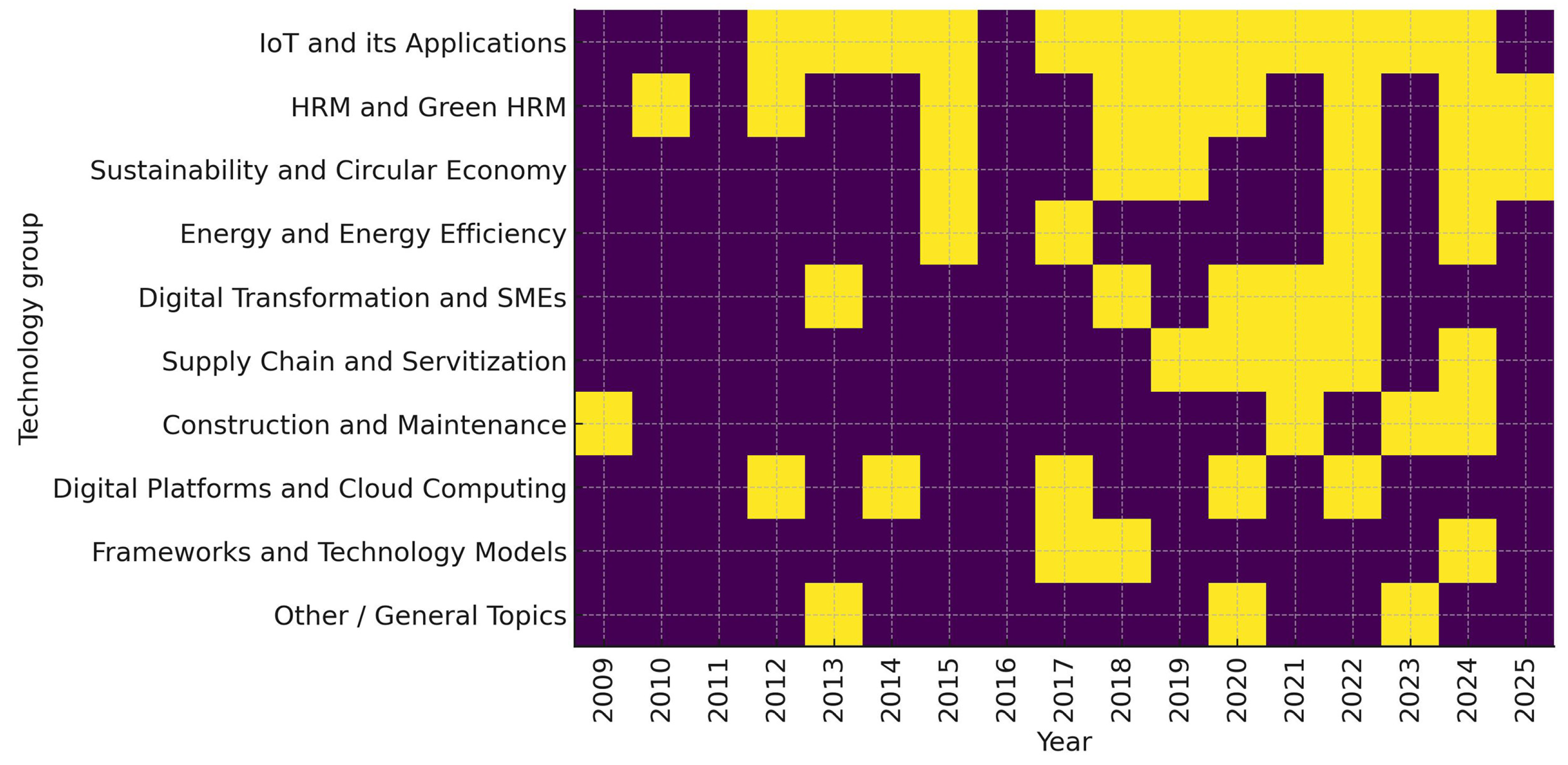
| 1 | IoT and its Applications | 2012–2015, 2017–2024 |
| 2 | Human Resources (HRM and Green HRM) | 2010, 2012, 2015, 2018–2020, 2022, 2024, 2025 |
| 3 | Sustainability and Circular Economy | 2015, 2018, 2019, 2022, 2024, 2025 |
| 4 | Energy and Energy Efficiency | 2015, 2017, 2022, 2024 |
| 5 | Digital Transformation and SMEs | 2013, 2018, 2020–2022 |
| 6 | Supply Chain y Servitization | 2019, 2020–2022, 2024 |
| 7 | Construction and Maintenance | 2009, 2021, 2023, 2024 |
| 8 | Digital Platforms and Cloud Computing | 2012, 2014, 2017, 2020, 2022 |
| 9 | Frameworks and Technology Models | 2017, 2018, 2024 |
| 10 | Other/General Topics | 2013, 2020, 2023 |
| IoT Technology/Application Area | Environmental (E) | Social (S) | Governance (G) |
|---|---|---|---|
| IoT-based sensing and real-time monitoring | Energy efficiency, emissions reduction, waste minimization through continuous process control | Improved occupational safety and reduced exposure to hazardous conditions | Data-driven environmental compliance and reporting |
| Smart energy management systems | Optimization of energy consumption, integration of renewable energy sources, reduced carbon footprint | Energy cost stability and improved working conditions | Transparent energy performance indicators supporting ESG disclosure |
| Predictive and condition-based maintenance | Extended equipment lifespan, reduced material waste, optimized resource use | Reduced unplanned downtime and improved workforce safety | Asset management accountability and maintenance governance |
| Digital supply chain traceability (IoT-enabled logistics) | Reduced environmental impact through optimized logistics and material flows | Improved labor standards monitoring and supplier transparency | Enhanced traceability, compliance, and ESG auditing across the value chain |
| IoT-enabled circular economy platforms | Waste reduction, material reuse, recycling optimization | Support for sustainable consumption and responsible production practices | Lifecycle governance and circularity performance monitoring |
| Environmental monitoring and reporting platforms | Real-time environmental impact assessment and pollution control | Increased stakeholder awareness and transparency | Evidence-based sustainability reporting and regulatory compliance |
| IoT-driven decision-support and analytics platforms | Optimization of resource allocation and environmental performance | Support for informed managerial decision-making | Strengthened corporate governance through data transparency and accountability |
| Integration of IoT with Green Human Resource Management (GHRM) | Support for environmentally responsible operational practices | Development of green competencies, pro-environmental behavior, and organizational culture | Alignment of human resource policies with sustainability governance |
Disclaimer/Publisher’s Note: The statements, opinions and data contained in all publications are solely those of the individual author(s) and contributor(s) and not of MDPI and/or the editor(s). MDPI and/or the editor(s) disclaim responsibility for any injury to people or property resulting from any ideas, methods, instructions or products referred to in the content. |
© 2026 by the authors. Licensee MDPI, Basel, Switzerland. This article is an open access article distributed under the terms and conditions of the Creative Commons Attribution (CC BY) license.
Share and Cite
Díaz-Martínez, M.A.; Román-Salinas, R.V.; Fuentes-Rubio, Y.A.; Morales-Rodríguez, M.A.; Cervantes-Zubirias, G.; Rivera-García, G.E. IoT-Driven Pathways Toward Corporate Sustainability in Industry 4.0 Ecosystems: A Systematic Review. Sustainability 2026, 18, 1052. https://doi.org/10.3390/su18021052
Díaz-Martínez MA, Román-Salinas RV, Fuentes-Rubio YA, Morales-Rodríguez MA, Cervantes-Zubirias G, Rivera-García GE. IoT-Driven Pathways Toward Corporate Sustainability in Industry 4.0 Ecosystems: A Systematic Review. Sustainability. 2026; 18(2):1052. https://doi.org/10.3390/su18021052
Chicago/Turabian StyleDíaz-Martínez, Marco Antonio, Reina Verónica Román-Salinas, Yadira Aracely Fuentes-Rubio, Mario Alberto Morales-Rodríguez, Gabriela Cervantes-Zubirias, and Guadalupe Esmeralda Rivera-García. 2026. "IoT-Driven Pathways Toward Corporate Sustainability in Industry 4.0 Ecosystems: A Systematic Review" Sustainability 18, no. 2: 1052. https://doi.org/10.3390/su18021052
APA StyleDíaz-Martínez, M. A., Román-Salinas, R. V., Fuentes-Rubio, Y. A., Morales-Rodríguez, M. A., Cervantes-Zubirias, G., & Rivera-García, G. E. (2026). IoT-Driven Pathways Toward Corporate Sustainability in Industry 4.0 Ecosystems: A Systematic Review. Sustainability, 18(2), 1052. https://doi.org/10.3390/su18021052