Green Industry and High-Quality Employment Outcomes in 20 Mountainous Counties of Zhejiang (2010–2023)

Abstract
1. Introduction
2. Theoretical Mechanism Analysis
2.1. Direct Effects of Green Industry Development on High-Quality Employment
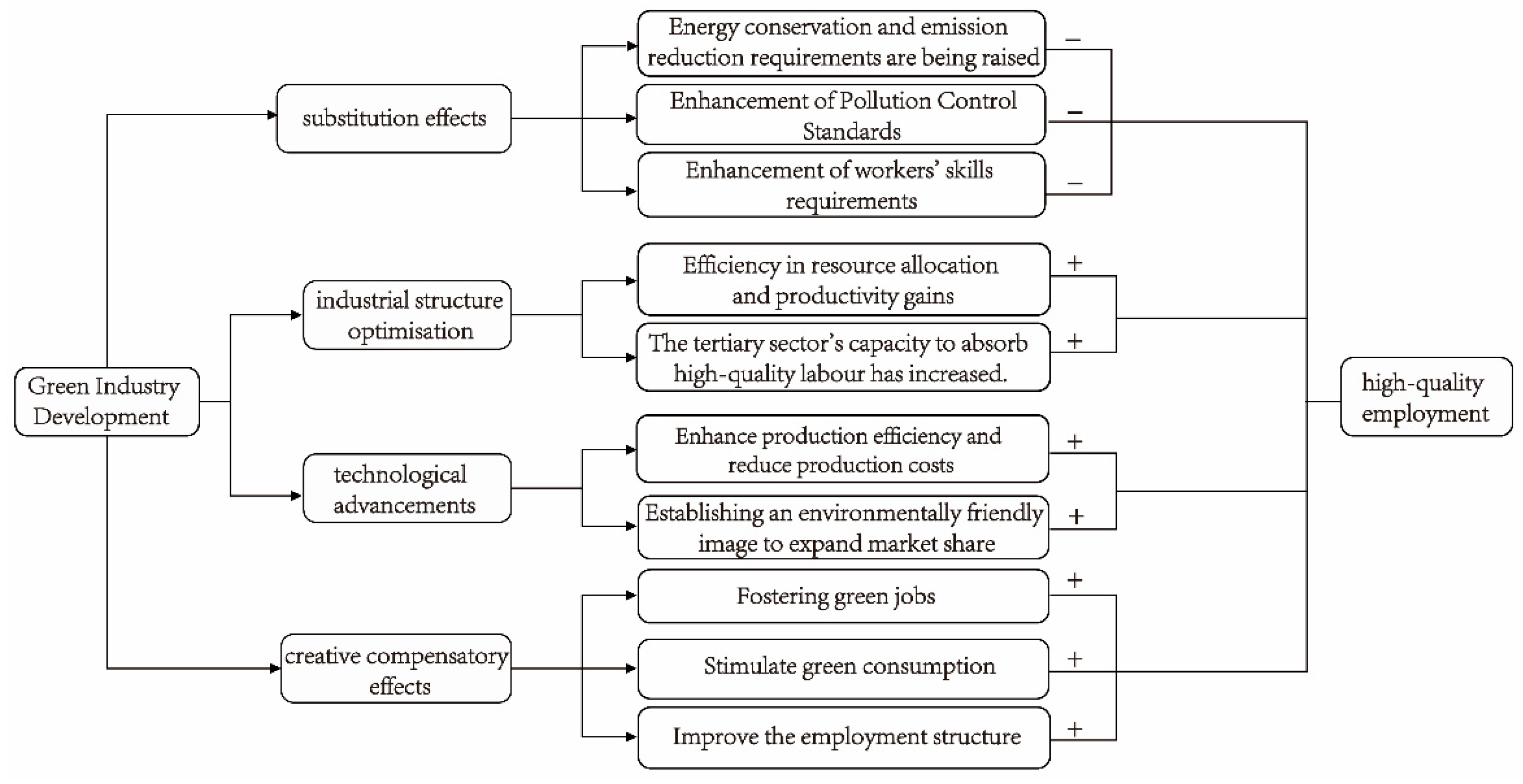
2.2. The Mechanism Through Which Green Industry Development Promotes High-Quality Employment
2.3. The Nonlinear Impact of Green Industry Development on High-Quality Employment
3. Research Design
3.1. Variable Selection
3.1.1. Explanatory and Dependent Variables
3.1.2. Mediating Variables
3.1.3. Control Variables
3.2. Data Processing and Measurement Methods
3.3. Model Construction
3.3.1. Benchmark Regression Model
3.3.2. Mediating Effect Model
3.3.3. Panel Threshold Model
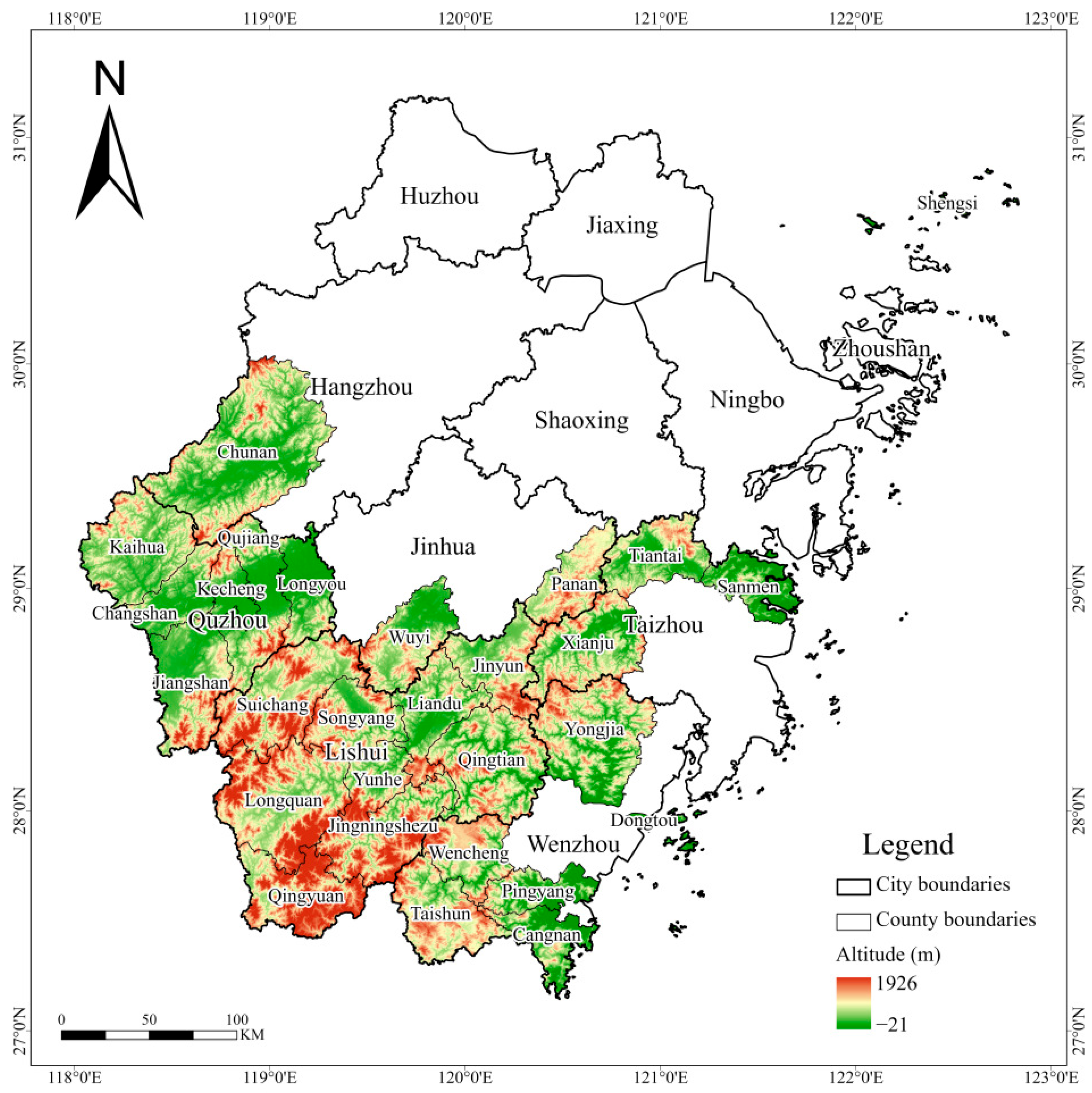
4. Overview of the Study Area
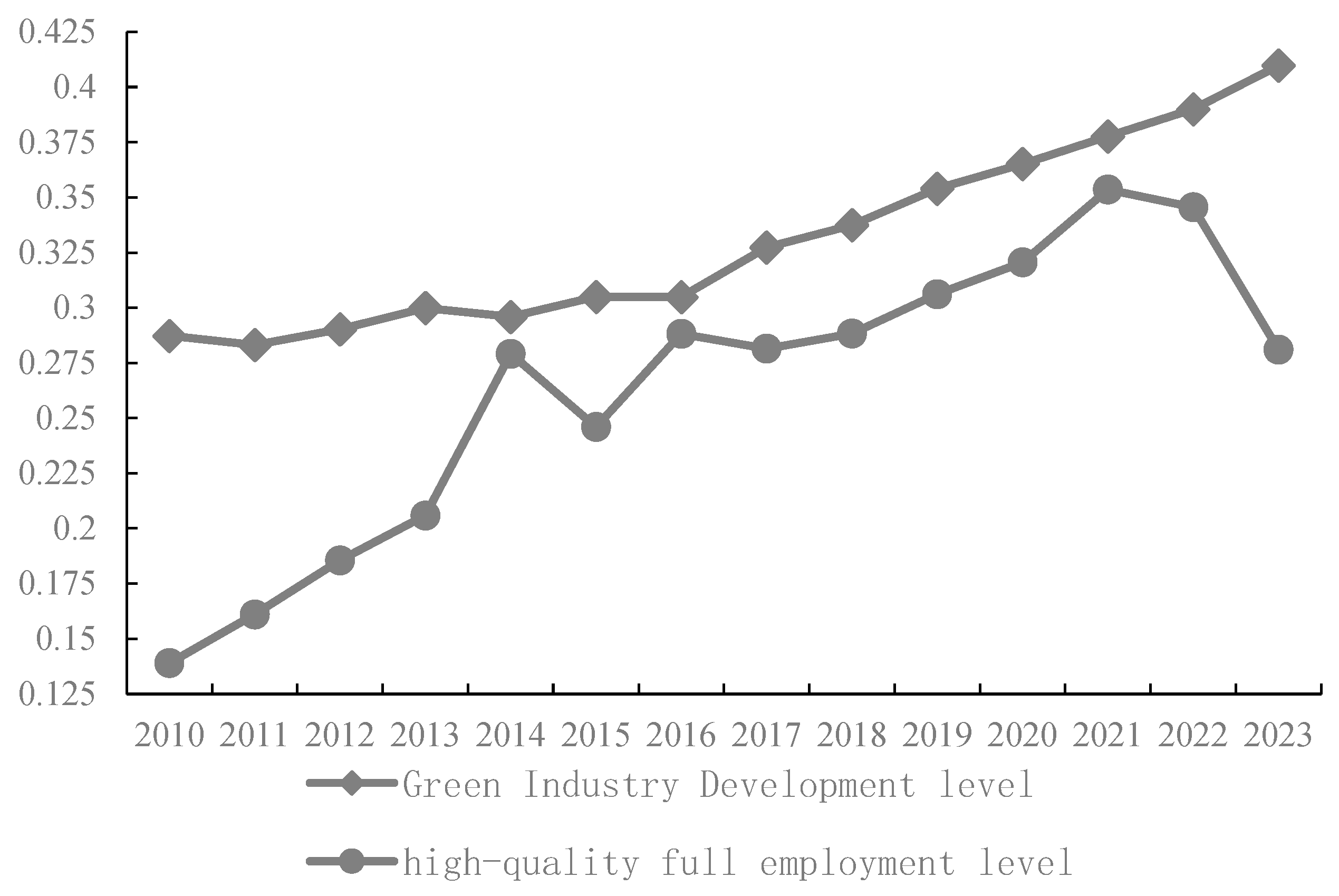
4.1. Analysis of Temporal Trends
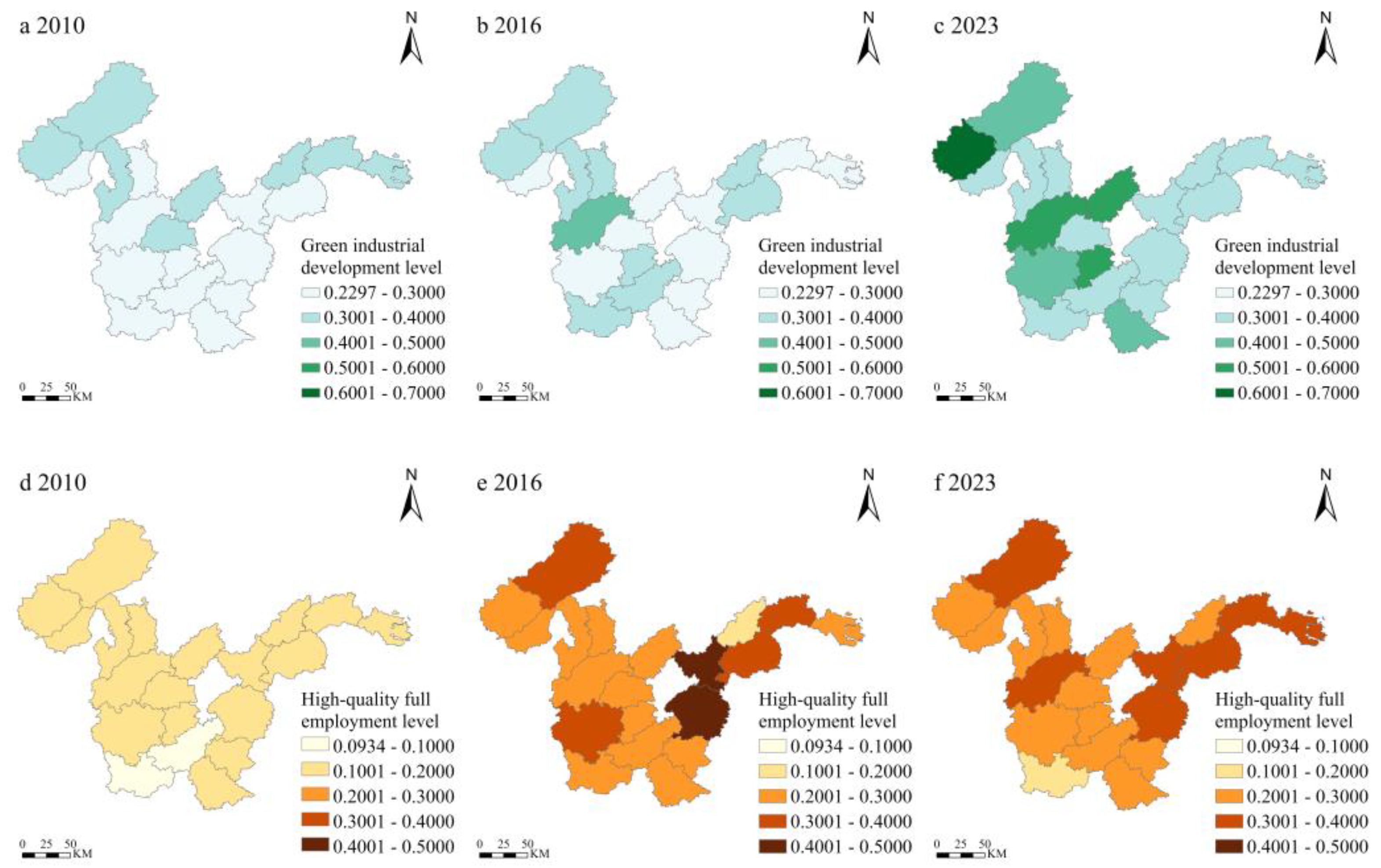
4.2. Analysis of Spatial Evolution Trends
5. Impact of Green Industry Development on High-Quality Employment
5.1. Benchmark Regression Results
5.2. Robustness Tests
5.3. Endogeneity Testing
5.4. Heterogeneity Analysis
5.5. Testing the Mechanism of Action
5.6. Testing Nonlinear Effects
5.6.1. Threshold Effect Analysis
5.6.2. Analysis of Threshold Regression Results
6. Discussion
- (1)
- The employment-boosting effects of green industrial development revealed herein are significantly attributable to Zhejiang Province’s proactive policy environment. In regions lacking comparable intensive policy support, the employment-generating impact of green industrial development may prove weaker, emerge more slowly, or require overcoming higher initial investment and technological barriers. Future research may focus on two directions: comparative studies and theoretical refinement. Firstly, applying this research framework to regions with varying policy support intensities and developmental stages, using comparative analysis to test and refine the generalizability of this paper’s conclusions. Secondly, incorporating policy support intensity or institutional quality as a moderating variable or precondition into the theoretical model, constructing an integrated analytical framework encompassing ‘policy environment—green industries—high-quality employment’ to provide a more universal explanation for regional differences.
- (2)
- Due to limited county-level social data, this study used proxy indicators for key constructs. These proxies do not always align well with their theoretical counterparts. Future research should seek more direct measurement tools to develop a more comprehensive and reliable measurement system. The study also uses the lagged level of green industry development as an instrumental variable to address reverse causality. While common in the literature and passing basic tests, this method has limits. Historical variables may be linked to omitted variables, thereby weakening exogeneity. Future research could utilize more exogenous instrumental variables, such as those based on geography or policy shocks, to provide stronger validation.
7. Conclusions
- (1)
- During the study period, both the green industrial development level and the high-quality employment level in the 20 mountainous counties of Zhejiang exhibited specific imbalances. Regarding green industrial development, the overall trend across the 20 counties shifted from fluctuating growth between 2010 and 2016 to steady advancement thereafter. Chun’an County and Kaihua County consistently outperformed other counties, while Qingdao County and Jinyun County lagged. Wuyi County and Yunhe County demonstrated the most rapid development. Concerning high-quality employment, the overall trend across Zhejiang’s 20 mountainous counties shifted from fluctuating growth between 2010 and 2021 to a sharp decline thereafter. Chun’an, Qingdao, and Jinyun counties consistently outperformed the others, while Qingyuan and Jingning counties lagged. Xianju and Tiantai counties demonstrated the most rapid advancement.
- (2)
- Impact analysis reveals that green industrial development exerts a significant direct effect in promoting high-quality employment, a conclusion upheld by robustness and endogeneity tests. This suggests that, under the ‘sustainable development’ paradigm, green industrial growth can facilitate the coordinated advancement of both employment scale and quality. Additionally, urbanization levels and economic development levels exert a significant positive influence on high-quality employment, while government intervention and resource concentration exert a significant negative influence.
- (3)
- Heterogeneity analysis indicates that the impact of green industry development on high-quality employment exhibits significant variation across different industrial structures. It substantially promotes high-quality employment in counties dominated by the tertiary sector yet exerts no substantial effect on those primarily reliant on the secondary sector. This suggests that green industry development exerts a more substantial promotional effect on high-quality employment in regions with more optimized industrial structures.
- (4)
- Mechanism analysis reveals that green industrial development can stimulate industrial upgrading and technological progress, thereby indirectly empowering high-quality employment. This establishes a causal pathway whereby ‘green industrial development promotes high-quality employment through the dual transmission mechanisms of industrial upgrading and technological progress,’ with both industrial structure and technological advancement exhibiting mediating effects on employment.
- (5)
- Threshold effect analysis reveals that treating technological progress as a threshold variable indicates a dual-threshold effect in the nonlinear relationship between green industrial development and high-quality employment. When technological progress levels fall below the first threshold (TP ≤ 8.0107), the promotional effect of green industrial development on high-quality employment is insignificant; When technological progress levels fall between the first and second thresholds (8.0107 < TP ≤ 8.673), the promotion effect of green industrial development on high-quality employment begins to become significant; when technological progress levels exceed the second threshold (TP > 8.6739), the promotion effect of green industrial development on high-quality employment significantly intensifies, presenting an overall J-shaped nonlinear relationship.
Author Contributions
Funding
Institutional Review Board Statement
Informed Consent Statement
Data Availability Statement
Acknowledgments
Conflicts of Interest
References
- Paramati, S.R.; Mo, D.; Huang, R. The role of financial deepening and green technology on carbon emissions: Evidence from major OECD economies. Financ. Res. Lett. 2021, 41, 101794. [Google Scholar] [CrossRef]
- Notice on Soliciting Public Comments on the Draft Green Industry Guidance Catalogue (2023 Edition). Available online: https://yyglxxbsgw.ndrc.gov.cn/htmls/article/article.html?articleId=2c97d16b-8678801b-0186-e9501f66-0000 (accessed on 20 December 2025).
- Wang, A.; Ma, J.; He, K. Citizenization and urban–rural income inequality: Evidence from the reform of hukou system in China. World Dev. 2026, 199, 107238. [Google Scholar] [CrossRef]
- Zheng, J.; He, J.; Shao, X.; Liu, W. The employment effects of environmental regulation: Evidence from eleventh five-year plan in China. J. Environ. Manag. 2022, 316, 115197. [Google Scholar] [CrossRef] [PubMed]
- Liu, M.; Tan, R.; Zhang, B. The costs of “blue sky”: Environmental regulation, technology upgrading, and labor demand in China. J. Dev. Econ. 2021, 150, 102610. [Google Scholar] [CrossRef]
- Chen, W.; Chen, J.; Xu, D.; Liu, J.; Niu, N. Assessment of the practices and contributions of China’s green industry to the socio-economic development. J. Clean. Prod. 2017, 153, 648–656. [Google Scholar] [CrossRef]
- Fan, D. High-quality and full employment of women in the digital economy era: Challenges and opportunities. Asia Pac. Econ. Manag. Rev. 2024, 1. [Google Scholar] [CrossRef]
- Zhou, Y.; Wang, H.; Chi, G. Construction and Application of Green Industry Evaluation Indicator System based on Factor Analysis. J. Syst. Manag. 2016, 25, 338–352. [Google Scholar]
- Shi, B.; Xiu, Y.; Wang, J. Evaluation on Cities’ Green Industry by Combined Weight Method Based on Game Theory. Technol. Econ. 2017, 36, 75–84. [Google Scholar]
- Gökten, M.; Heimberger, P.; Lichtenberger, A. How far from full employment? The European unemployment problem revisited. Eur. Econ. Rev. 2024, 164, 104725. [Google Scholar] [CrossRef]
- Wu, B.; Yang, W. Empirical test of the impact of the digital economy on China’s employment structure. Financ. Res. Lett. 2022, 49, 103047. [Google Scholar] [CrossRef]
- Zhong, S.; Xiong, Y.; Xiang, G. Environmental regulation benefits for whom? Heterogeneous effects of the intensity of the environmental regulation on employment in China. J. Environ. Manag. 2021, 281, 111877. [Google Scholar] [CrossRef]
- Li, M.; Du, W. The impact of environmental regulation on the employment of enterprises: An empirical analysis based on scale and structure effects. Environ. Sci. Pollut. Res. Int. 2022, 29, 21705–21716. [Google Scholar] [CrossRef] [PubMed]
- Bu, T.; Du, W.; Tang, C.; Liu, Y.; Wang, X.; Wang, Y.; Tang, D. Market-oriented environmental regulations, employment adjustment and transfer path: Quasi-experimental evidence from China’s carbon emissions trading pilot. J. Clean. Prod. 2022, 369, 133292. [Google Scholar] [CrossRef]
- Cheng, Z.; Yu, X. Can central environmental protection inspection induce corporate green technology innovation? J. Clean. Prod. 2023, 387, 135902. [Google Scholar] [CrossRef]
- Lu, S.; Yang, Q. Price of going green: The employment effects of the environmental protection tax in China. China Econ. Rev. 2024, 87, 102244. [Google Scholar] [CrossRef]
- Kim, T.; Lim, Y. Environmental spillovers and local agglomeration: Evidence from large plant openings. J. Behav. Exp. Financ. 2024, 43, 100968. [Google Scholar] [CrossRef]
- Huang, J.; Xu, X.; Zhao, T. The moderating effect of clean technology innovation in the process of environmental regulation affecting employment: Panel data analysis based on 22 industrial sectors in China. J. Clean. Prod. 2023, 414, 137672. [Google Scholar] [CrossRef]
- Maczulskij, T. How are green jobs created? A decomposition analysis. Econ. Lett. 2024, 244, 111950. [Google Scholar] [CrossRef]
- Fan, F.; Lian, H.; Liu, X.; Wang, X. Can environmental regulation promote urban green innovation Efficiency? An empirical study based on Chinese cities. J. Clean. Prod. 2021, 287, 125060. [Google Scholar] [CrossRef]
- Liu, Y.; Wang, A.; Wu, Y. Environmental regulation and green innovation: Evidence from China’s new environmental protection law. J. Clean. Prod. 2021, 297, 126698. [Google Scholar] [CrossRef]
- Chen, Y. Environmental regulation, local labor market, and skill heterogeneity. Reg. Sci. Urban Econ. 2023, 101, 103898. [Google Scholar] [CrossRef]
- Wang, J.; Weng, X.; Zhang, C. The effect of digital infrastructure on human capital development: Evidence from employment quality in China. Int. Rev. Financ. Anal. 2025, 108, 104698. [Google Scholar] [CrossRef]
- Gao, P.; Wang, Y.; Zou, Y.; Su, X.; Che, X.; Yang, X. Green technology innovation and carbon emissions nexus in China: Does industrial structure upgrading matter? Front. Psychol. 2022, 13, 951172. [Google Scholar] [CrossRef]
- Shao, Y.; Han, W.; Jin, M.; Wang, L. Indicators and methodologies for assessing urban agglomeration sustainability. iScience 2025, 28, 112927. [Google Scholar] [CrossRef]
- Xu, Z.; Ke, F.; Yu, J. Spatio-temporal evolution and influencing factors of rural production-living-ecological function: A case study of mountainous counties in Zhejiang Province, China. Front. Environ. Sci. 2025, 13, 1495778. [Google Scholar] [CrossRef]
- Hou, H.; Wang, Y.; Zhang, M. Spatial spillover effect of low-carbon transition on employment—An empirical study based on 285 cities in China. Appl. Econ. Lett. 2025, 32, 1151–1156. [Google Scholar] [CrossRef]
- Chen, T.; Zhou, D.; Ding, H.; Shi, X. Implications of energy transition on regional employments in China. Energy Policy 2025, 206, 114742. [Google Scholar] [CrossRef]
- Can environmental regulation promote the coordinated development of economy and environment in China’s manufacturing industry?–A panel data analysis of 28 sub-sectors. J. Clean. Prod. 2017, 149, 11–24. [CrossRef]
- Liu, M.; Shadbegian, R.; Zhang, B. Does environmental regulation affect labor demand in China? Evidence from the textile printing and dyeing industry. J. Environ. Econ. Manag. 2017, 86, 277–294. [Google Scholar] [CrossRef]
- Zhang, G.; Zhang, N. Environmental regulation and worker earnings: Evidence from city-level air quality standards in China. Energy Econ. 2024, 138, 107834. [Google Scholar] [CrossRef]
- Mao, X.; Chen, X. Does low-carbon transition shock employment? Insights from the low-carbon city pilot in China. Carbon Manag. 2025, 16, 2574024. [Google Scholar] [CrossRef]
- Chen, C.-F.; Zhou, Z.; Li, C.; Liu, W. Ecological compensation and breakthrough innovation: Evidence from heavily polluting firms. J. Environ. Manag. 2025, 392, 126682. [Google Scholar] [CrossRef] [PubMed]
- Li, R.; Du, J.; Wu, J.; Chen, X. Government carbon reduction policies and the shift to green lifestyles: The role of innovation, incentive, driving and economic effect. J. Environ. Manag. 2025, 374, 124056. [Google Scholar] [CrossRef]
- Ding, S.; Li, R.; Liu, Z.; Li, Y.; Geng, S. Sustainable potential of the strategic emerging industries: Insights from technological innovation, economy, and ecology. J. Clean. Prod. 2024, 434, 140038. [Google Scholar] [CrossRef]
- Markaki, M.; Papadakis, S. Productive structure optimization under macroeconomic constraints based on input-output analysis. Struct. Change Econ. Dyn. 2024, 70, 91–105. [Google Scholar] [CrossRef]
- Baymul, C.; Sen, K. Was kuznets right? New evidence on the relationship between structural transformation and inequality. J. Dev. Stud. 2020, 56, 1643–1662. [Google Scholar] [CrossRef]
- Guo, D.; Wang, Y.; Liu, S.; Chen, L.; Zhao, C. Environmental tax policy, green investment, and high-quality economic development. Financ. Res. Lett. 2025, 86, 108801. [Google Scholar] [CrossRef]
- Darwish, M.A. Balancing worker and producer benefits in economic production quantity. Int. J. Prod. Econ. 2025, 283, 109582. [Google Scholar] [CrossRef]
- Alam, S.M.S.; Islam, K.M.Z. Examining the role of environmental corporate social responsibility in building green corporate image and green competitive advantage. Int. J. Corp. Soc. Responsib. 2021, 6, 8. [Google Scholar] [CrossRef]
- Yan, W.-J.; Guo, S.-L. How Does Environmental Regulation Affect Employment—An Empirical Research Based on Medi-ating Effect Model. Collect. Essays Financ. Econ. 2016, 32, 105–112. [Google Scholar]
- Ru, L.; Yao, Y. Low-carbon city policies and employment in China: Impact effects and spatial spillovers. Land 2025, 14, 656. [Google Scholar] [CrossRef]
- Guo, M.; Luo, D.; Liu, C. City civilization, employment creation and talent agglomeration: Empirical evidence from “National Civilized City” policy in China. China Econ. Rev. 2024, 87, 102215. [Google Scholar] [CrossRef]
- Sarkar, S.; Arcaute, E.; Hatna, E.; Alizadeh, T.; Searle, G.; Batty, M. Evidence for localization and urbanization economies in urban scaling. R. Soc. Open Sci. 2020, 7, 191638. [Google Scholar] [CrossRef] [PubMed]
- Chen, Z.; Sarkar, A.; Rahman, A.; Li, X.; Xia, X. Exploring the drivers of green agricultural development (GAD) in China: A spatial association network structure approaches. Land Use Policy 2022, 112, 105827. [Google Scholar] [CrossRef]
- Jiang, T. Mediating Effects and Moderating Effects in Causal Inference. China Ind. Econ. 2022, 100–120. [Google Scholar] [CrossRef]
- Wei, P.; Chen, B.; Zhao, Y.N. Green Governance, Technical Progress and Employment. Mod. Econ. Sci. 2024, 46, 18–31. [Google Scholar]



| Target Layer | Criterion Layer | Indicator Layer | Weights | Unit | Attribute |
|---|---|---|---|---|---|
| Green industry development level | Green industry | The proportion of the tertiary sector’s total output value in GDP | 0.0244 | % | + |
| Industrial electricity consumption | 0.0569 | 10,000 kWh | − | ||
| Industrial smoke (and dust) emissions per unit of GDP | 0.0151 | ton | − | ||
| Industrial sulphur dioxide emissions per unit of GDP | 0.0429 | ton | − | ||
| Green consumption | The proportion of science and technology expenditure within the general public budget expenditure | 0.1860 | % | + | |
| Domestic electricity consumption for urban and rural residents | 0.0438 | 10,000 kWh | − | ||
| Year-end public bus and tram operational vehicles | 0.2803 | vehicle | + | ||
| Daily per capita domestic water consumption | 0.0136 | litre | − | ||
| Rate of harmless treatment of domestic waste | 0.0057 | % | + | ||
| Green environment | Wastewater treatment rate | 0.0445 | % | + | |
| Per capita park green space area | 0.2388 | square metre | + | ||
| Green coverage rate in built-up areas | 0.0480 | % | + |
| Target Layer | Criterion Layer | Indicator Layer | Weights | Unit | Attribute |
|---|---|---|---|---|---|
| High-quality employment level | Job opportunities | Total employment across society | 0.0608 | ten thousand people | + |
| Employment Structure | Share of the population employed in the secondary sector | 0.0084 | % | − | |
| Labor remuneration | Income disparity between urban and rural residents | 0.0352 | yuan | − | |
| Urban residents’ income | 0.0615 | yuan | + | ||
| Rural residents’ income | 0.0818 | yuan | + | ||
| Growth rate of urban residents’ income | 0.0165 | % | + | ||
| Rural residents’ income growth rate | 0.0974 | % | + | ||
| Employment and social security | Number of participants in the basic pension insurance scheme | 0.0987 | ten thousand people | + | |
| Number of people covered by basic medical insurance | 0.1035 | ten thousand people | + | ||
| Number of people covered by unemployment insurance | 0.1521 | ten thousand people | + | ||
| Employment capacity | The proportion of education expenditure in general public budget expenditure | 0.0206 | % | + | |
| Employment environment | Number of doctors per 10,000 people | 0.0635 | per 10,000 people | + | |
| Total number of specialized vehicles and equipment for urban sanitation | 0.1040 | platform | + | ||
| Total holdings of books in public libraries | 0.0960 | ten thousand volumes | + |
| Variance | Sample Size | Mean | Standard Error | Minimum | Median | Maximum |
|---|---|---|---|---|---|---|
| HQE | 269 | 0.2670 | 0.0872 | 0.0934 | 0.2620 | 0.5130 |
| GID | 269 | 0.3310 | 0.0691 | 0.2160 | 0.3190 | 0.6510 |
| Urban | 269 | 0.3630 | 0.1400 | 0.0660 | 0.3620 | 0.7540 |
| Gov | 269 | 0.3100 | 0.1480 | 0.0912 | 0.2750 | 1.0430 |
| Density | 269 | 64.3900 | 37.2200 | 7.4530 | 48.8300 | 176.3000 |
| GDPG | 269 | 7.7490 | 2.8340 | −4.1000 | 7.8000 | 14.3000 |
| IS | 269 | 1.2640 | 0.6040 | 0.3040 | 1.1710 | 4.3160 |
| TP | 269 | 8.5290 | 0.6930 | 6.9640 | 8.5170 | 10.1500 |
| (1) | (2) | (3) | (4) | (5) | |
|---|---|---|---|---|---|
| GID | 0.1360 *** | 0.1260 *** | 0.1270 *** | 0.1270 *** | 0.1700 *** |
| (2.7040) | (2.6740) | (2.7280) | (2.7550) | (3.6830) | |
| Urban | 0.1240 *** | 0.1180 *** | 0.1200 *** | 0.1280 *** | |
| (5.7640) | (5.5620) | (5.6590) | (6.1920) | ||
| Gov | −0.0934 *** | −0.0945 *** | −0.1070 *** | ||
| (−2.6040) | (−2.6470) | (−3.0860) | |||
| GDPG | 0.0020 * | 0.0019 * | |||
| (1.8430) | (1.7940) | ||||
| Density | −0.0006 *** | ||||
| (−3.8680) | |||||
| Constant | 0.0943 *** | 0.0586 *** | 0.0801 *** | 0.0534 ** | 0.0800 *** |
| (5.7760) | (3.5480) | (4.3810) | (2.2940) | (3.3870) | |
| Individual fixed effects | YES | YES | YES | YES | YES |
| Time-fixed effect | YES | YES | YES | YES | YES |
| Obs | 269 | 269 | 269 | 269 | 269 |
| R2 | 0.8250 | 0.8460 | 0.8510 | 0.8530 | 0.8620 |
| Replacing Variable Assignment Methods | Tail-End | |
|---|---|---|
| (1) | (2) | |
| GID | 1.1130 ** | 0.1820 *** |
| (1.9940) | (3.7940) | |
| Urban | 1.3530 *** | 0.1280 *** |
| (5.4210) | (6.1740) | |
| Gov | 1.1220 *** | −0.1130 *** |
| (−2.6740) | (−3.0290) | |
| GDPG | 0.0062 | 0.0022 * |
| (0.4800) | (1.9340) | |
| Density | 0.0065 *** | −0.0006 *** |
| (−3.3640) | (−3.8350) | |
| Constant | 1.9000 *** | 0.0763 *** |
| (−6.6710) | (3.0660) | |
| Individual fixed effects | YES | YES |
| Time-fixed effect | YES | YES |
| Obs | 269 | 269 |
| R2 | 0.9100 | 0.8640 |
| Explanatory Variable Lagged by One Period (1) | Instrumental Variables Estimation (2) | |
|---|---|---|
| L.GID | 0.869 *** | |
| (20.75) | ||
| GID | 0.163 *** | |
| (2.839) | ||
| Urban | −0.0122 | 0.124 *** |
| (−0.712) | (6.082) | |
| Gov | 0.00967 | −0.0953 *** |
| (0.334) | (−2.771) | |
| GDPG | −0.00122 | 0.00164 |
| (−1.351) | (1.532) | |
| Density | 0.000140 | −0.000617 *** |
| (1.052) | (−3.849) | |
| Constant | 0.0325 * | 0.0800 *** |
| (1.704) | (3.387) | |
| Individual fixed effects | YES | YES |
| Time-fixed effect | YES | YES |
| Obs | 249 | 249 |
| R2 | 0.853 | 0.828 |
| Dominated by the Secondary Sector | Dominated by the Tertiary Sector | |
|---|---|---|
| (1) | (2) | |
| GID | 0.0800 | 0.4630 *** |
| (1.5980) | (3.6030) | |
| Urban | 0.1070 *** | 0.1270 ** |
| (4.7980) | (2.4130) | |
| Gov | −0.0559 | −0.3520 *** |
| (−1.5830) | (−2.8660) | |
| GDPG | 0.0015 | 0.0013 |
| (1.0420) | (0.5200) | |
| Density | −0.0005 *** | −0.0006 |
| (−3.1430) | (−0.3820) | |
| Constant | 0.0949 *** | 0.0352 |
| (3.4510) | (0.3510) | |
| Individual fixed effects | YES | YES |
| Time-fixed effect | YES | YES |
| Obs | 173 | 96 |
| R2 | 0.8530 | 0.8860 |
| Variable | HQE (1) | IS (2) | TP (3) |
|---|---|---|---|
| GID | 0.1700 *** | 1.6330 *** | 1.6950 *** |
| (3.6830) | (2.7000) | (4.2520) | |
| Constant | 0.0800 *** | 0.1140 | 7.3440 *** |
| (3.3870) | (0.3680) | (39.7400) | |
| Individual fixed effects | YES | YES | YES |
| Time-fixed effect | YES | YES | YES |
| Obs | 269 | 269 | 269 |
| R2 | 0.8620 | 0.4340 | 0.8860 |
| Model | RSS | MSE | Fstat | Prob | Crit10 | Crit5 | Crit1 |
|---|---|---|---|---|---|---|---|
| Single-threshold | 0.4614 | 0.0023 | 51.8800 | 0.0000 | 12.9980 | 15.7000 | 20.1470 |
| Double-threshold | 0.3702 | 0.0019 | 48.5200 | 0.0000 | 12.7730 | 14.8650 | 20.4580 |
| Triple-threshold | 0.3442 | 0.0017 | 14.8900 | 0.6200 | 28.8020 | 31.5960 | 38.6680 |
| Variable | Estimated Coefficient |
|---|---|
| TP (TP ≤ 8.0107) | 0.0621 |
| (0.5550) | |
| TP (8.0107 < TP ≤ 8.6739) | 0.2980 *** |
| (2.9770) | |
| TP (TP > 8.6739) | 0.4810 *** |
| (4.9510) | |
| Urban | 0.1620 *** |
| (4.2410) | |
| Gov | 0.0427 |
| (0.8680) | |
| GDPG | −0.0050 *** |
| (−3.0720) | |
| Density | −0.000495 |
| (−1.2820) | |
| Constant | 0.1540 *** |
| (3.7680) | |
| R2 | 0.6430 |
Disclaimer/Publisher’s Note: The statements, opinions and data contained in all publications are solely those of the individual author(s) and contributor(s) and not of MDPI and/or the editor(s). MDPI and/or the editor(s) disclaim responsibility for any injury to people or property resulting from any ideas, methods, instructions or products referred to in the content. |
© 2026 by the authors. Licensee MDPI, Basel, Switzerland. This article is an open access article distributed under the terms and conditions of the Creative Commons Attribution (CC BY) license.
Share and Cite
Wang, Y.; Zhang, W.; Weng, Y. Green Industry and High-Quality Employment Outcomes in 20 Mountainous Counties of Zhejiang (2010–2023). Sustainability 2026, 18, 1051. https://doi.org/10.3390/su18021051
Wang Y, Zhang W, Weng Y. Green Industry and High-Quality Employment Outcomes in 20 Mountainous Counties of Zhejiang (2010–2023). Sustainability. 2026; 18(2):1051. https://doi.org/10.3390/su18021051
Chicago/Turabian StyleWang, Yiwei, Wenke Zhang, and Yijing Weng. 2026. "Green Industry and High-Quality Employment Outcomes in 20 Mountainous Counties of Zhejiang (2010–2023)" Sustainability 18, no. 2: 1051. https://doi.org/10.3390/su18021051
APA StyleWang, Y., Zhang, W., & Weng, Y. (2026). Green Industry and High-Quality Employment Outcomes in 20 Mountainous Counties of Zhejiang (2010–2023). Sustainability, 18(2), 1051. https://doi.org/10.3390/su18021051