Translating the One Security Framework for Global Sustainability: From Concept to Operational Model


Abstract
1. Introduction
2. One Security: Framework and Dimensions
2.1. One Security Framework (Definition and Scope)
2.2. Dimensions of One Security
2.3. Theoretical Grounding and Definitional Clarity
2.3.1. Weak Securitisation (Urgency Without Exceptional Powers)
2.3.2. What Are “Spheres”? Ontology, Sectors, and the Overlap Rule
2.3.3. Power, Asymmetry, and Political Economy
2.3.4. Anchoring the Biophysical Sphere: Planetary Boundaries and Resilience
3. Operationalising One Security: The Spheres of Security (SOS) Model
3.1. Rationale and Design Principles
3.2. Structure: Four Overlapping Spheres and the Overlap Objective
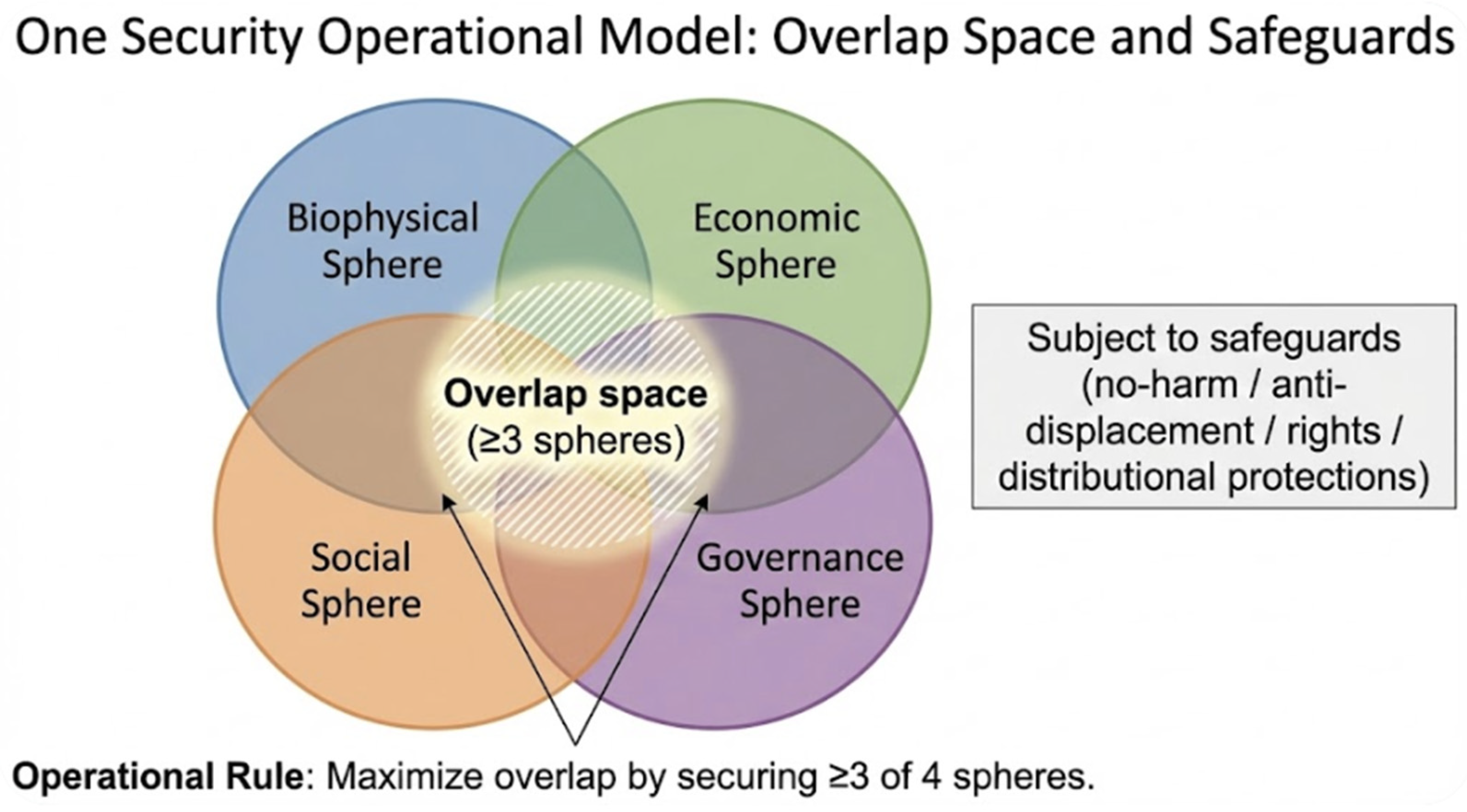
- SOS treats the four domains—biophysical, economic, social, and governance—as overlapping spheres of value production and risk management, and it targets the overlap where co-benefits are maximised and trade-offs are explicitly managed. The operational objective is to increase the share of portfolio spend that delivers verified positive effects in at least three spheres within the same geography and time window, subject to explicit safeguards (Figure 2). This “overlap-first” objective is designed to make integration decision-relevant in routine public management systems, rather than leaving co-benefits as narrative aspirations [25,26].
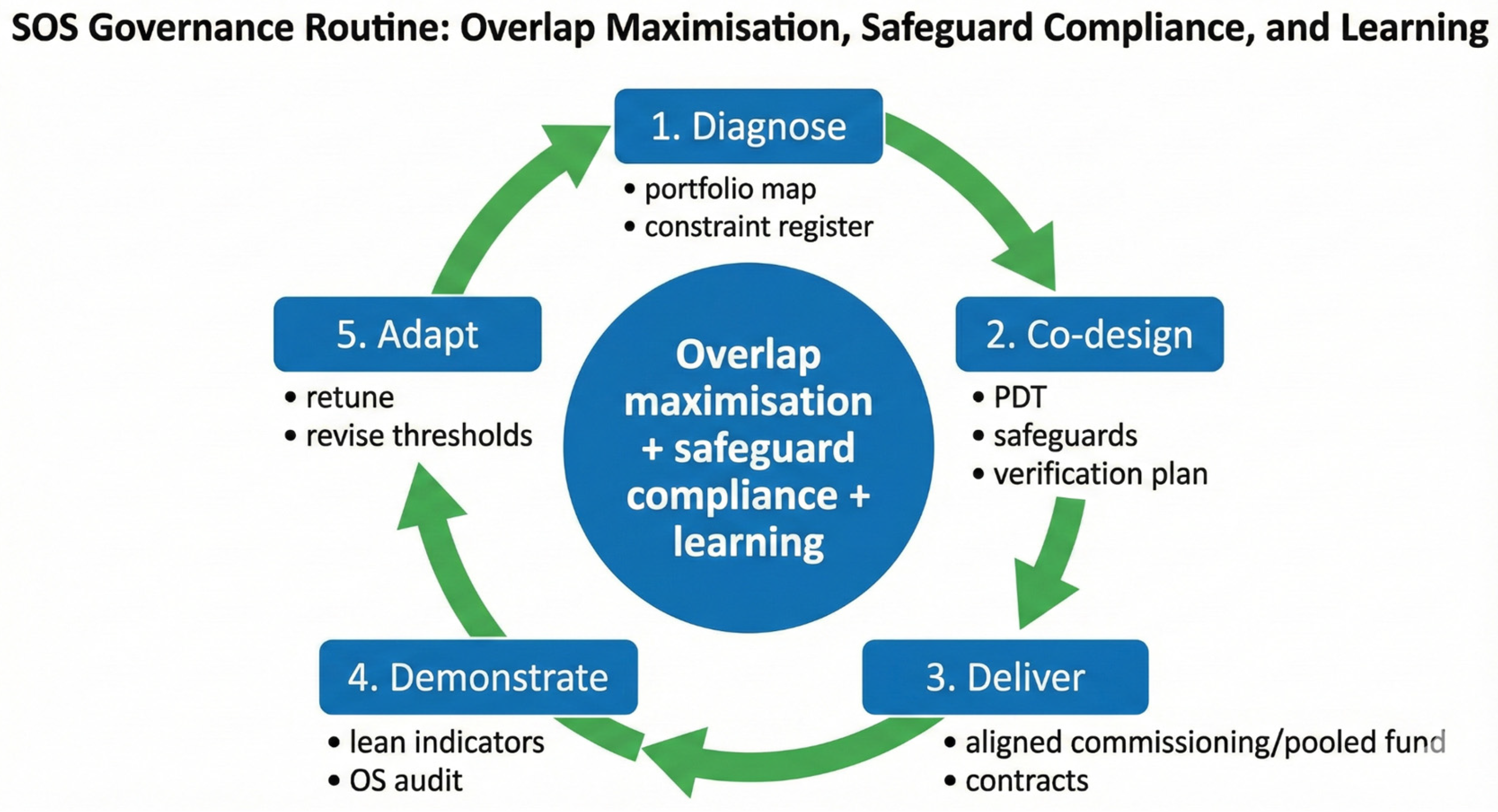
3.3. Operating Cycle: Diagnose → Co-Design → Deliver → Demonstrate → Adapt
3.3.1. Diagnose (Portfolio and Institutional Diagnostics)
- Portfolio map (programme by programme): primary sphere(s), claimed co-benefits, evidence quality, spillover risks;
- Constraint register: legal barriers (e.g., budget pooling), administrative capacity constraints, data gaps;
- Candidate “overlap bundles” for priority zones (e.g., heat adaptation + housing stability + local jobs + transparent reporting).
3.3.2. Co-Design (Polycentric Delivery Teams and Safeguard Design)
- Co-owned programme design (scope, eligibility, targeting rules, safeguard triggers);
- Verification plan (what evidence is required, who verifies, audit cadence);
- Dispute pathway and escalation ladder (Section 3.4).
3.3.3. Deliver (Routine Public Management Levers: Pooled or Aligned)
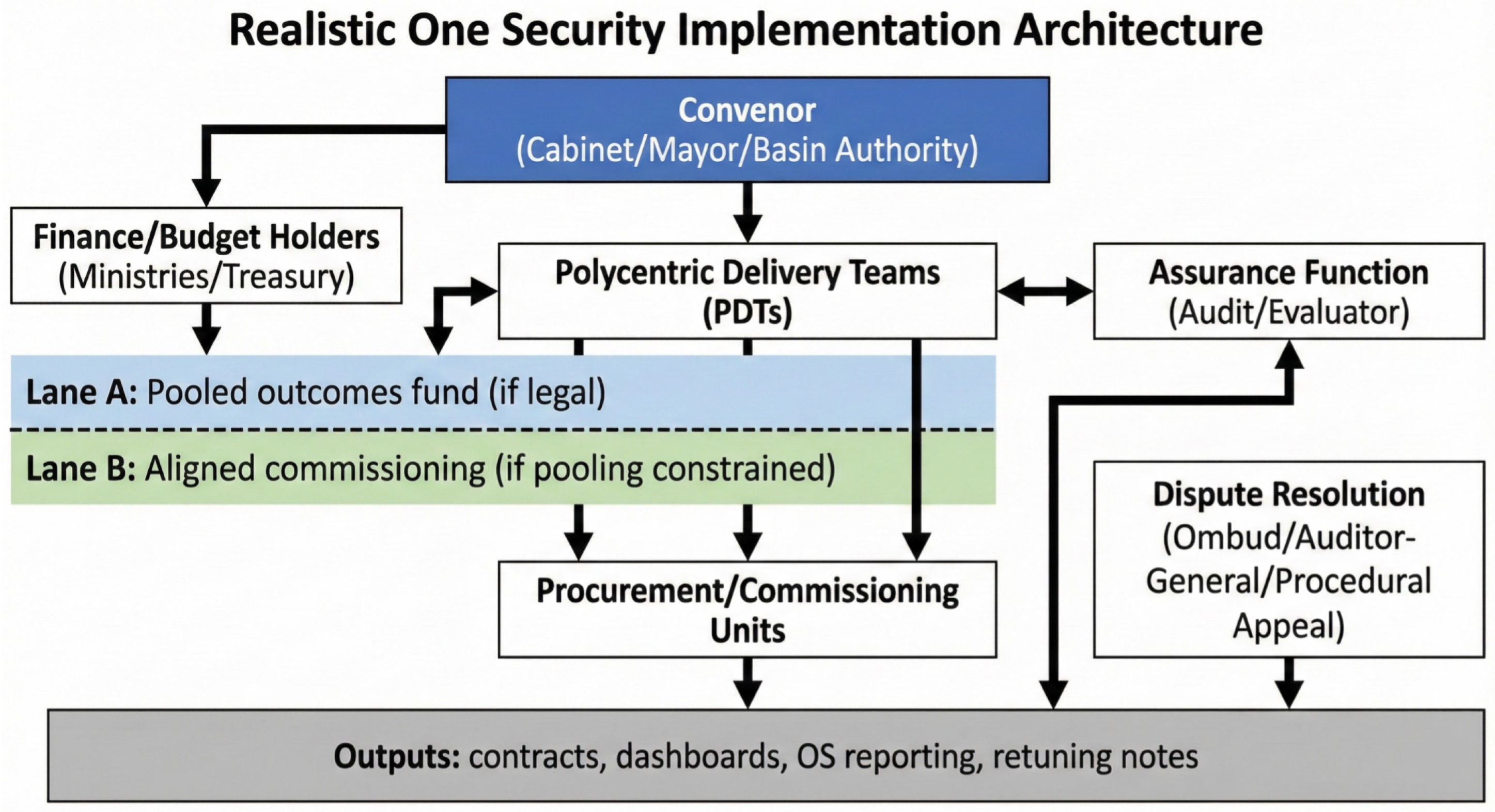
- Where pooled budgets are legally feasible: establish a time-bound Joint Outcomes Fund with results-based contracting and published overlap performance;
- Where pooled budgets are constrained: implement aligned commissioning (parallel appropriations with shared targets, joint calls, and common assurance protocols). This preserves legal accountability while still shifting incentives toward overlap outcomes (Section 3.7).
- Commissioning plan (roles, procurement route, safeguards, verification);
- Standard procurement clauses for overlap performance + safeguard compliance;
- Public-reporting template (dashboards + decision notes).
3.3.4. Demonstrate (Lean Assurance + Overlap Verification)
- Biophysical: ecosystem integrity proxy (e.g., biodiversity intactness or comparable index) [41];
- Economic: jobs/affordability or income stability in target cohorts;
- Social: health coverage/outcomes or education access/attainment, depending on challenge framing [4];
- Governance: transparency/accountability proxies supported by evidence rules (see below), complemented where useful by governance indicator infrastructures [27].
- Transparency: publication of budgets, procurement decisions, award rationales, and performance dashboards (dated, accessible, and complete);
- Participation: documented co-design processes; representation criteria; published responses to submissions; evidence of “you said, we did”;
- Accountability: a functioning grievance mechanism with service standards (e.g., response times), logged cases, and resolution rates;
- Coordination capability: formal co-ownership agreements (MoUs/charters), joint targets, and documented cross-agency decision minutes;
- Integrity/compliance: conflict-of-interest registers, procurement integrity checks, and audit findings closed within defined periods.
- Appraisal rule (illustrative). Score bids on (a) within-sphere indicators + safeguard compliance, and (b) OS. Reserve a material portfolio share (an initial “set-aside”) for high-overlap interventions in priority zones;
- Procurement rubric (illustrative). Technical quality 35%, cost 25%, overlap performance 30%, delivery risk 10%;
- Performance adjustment (illustrative). Shift a modest proportion of annual allocations toward implementers whose audited OS and safeguard compliance exceed targets; persistent under-performance triggers corrective action or re-competition.
3.3.5. Adapt (Institutionalised Learning and Retuning)
- Annual retuning decision note (what changed and why);
- Updated safeguard triggers and enforcement actions;
- Revised OS/assurance rules as evidence quality improves.
3.4. Governance Architecture: Coordination, Coherence, and Dispute Resolution
- Joint Outcomes Fund (pooled appropriations) where legally feasible;
- Aligned commissioning (parallel appropriations with shared targets, joint calls, common assurance) where pooling is constrained.
- PDT mediation using agreed principles (co-benefit maximisation, safeguard compliance);
- Decision by an executive coordination committee (e.g., environment–health–finance leaders);
- Procedural appeal to an independent arbiter (auditor-general/ombud) with published rationales.
3.5. External Enablers and Alignment
3.6. Stylised Applications (Vignettes): Urban Heat and Health; Watershed Food–Water–Energy
3.6.1. Urban Heat and Health (Managing the Green–Gentrification Trade-Off)
- Cooling measures: street trees, cool roofs, schoolyard greening targeted to priority tracts;
- Housing stability safeguards: right-to-return provisions linked to retrofit works; affordability protections; community land trust acquisitions; value-capture mechanisms that ring-fence uplift into permanently affordable housing;
- Jobs and equity: local-hire and apprenticeship targets; targeted rebates for vulnerable households; culturally tailored outreach;
- Governance: published dashboards; grievance mechanisms; transparent selection criteria and rationales.
- Biophysical: reduced heat exposure in treated blocks relative to matched comparators;
- Economic: local job-months created; net household energy-bill reductions;
- Social: reduced heat-related emergency presentations; maintained/improved housing stability indicators relative to controls;
- Governance: documented co-ownership agreements; dashboard publication; verified grievance performance.
3.6.2. Watershed Food–Water–Energy (Negotiating Flows and Farm Income)
- Biophysical: improved low-flow reliability; reduced sediment in targeted sub-catchments relative to baseline/climate-adjusted expectations;
- Economic: maintained or improved farm net margins relative to baseline (accounting for transition support);
- Social: improved household water security and distributional indicators for affected communities;
- Governance: verified compliance with allocation rules; audited co-ownership agreements; transparent reporting of trade-offs.
3.7. Minimum Institutional Preconditions and Entry-Point Implementation (Feasibility)
- Legitimate convenor with a mandate to coordinate across agencies for a defined challenge and geography (cabinet directive, mayoral authority, basin charter, or interagency MoU);
- Agreed diagnostic boundary (place, time window, counterfactual logic) and a small set of verifiable indicators;
- Assurance function with authority to validate reported co-benefits (internal audit, auditor-general function, or independent evaluator);
- Dispute pathway so trade-offs are adjudicated transparently rather than displaced into informal vetoes.
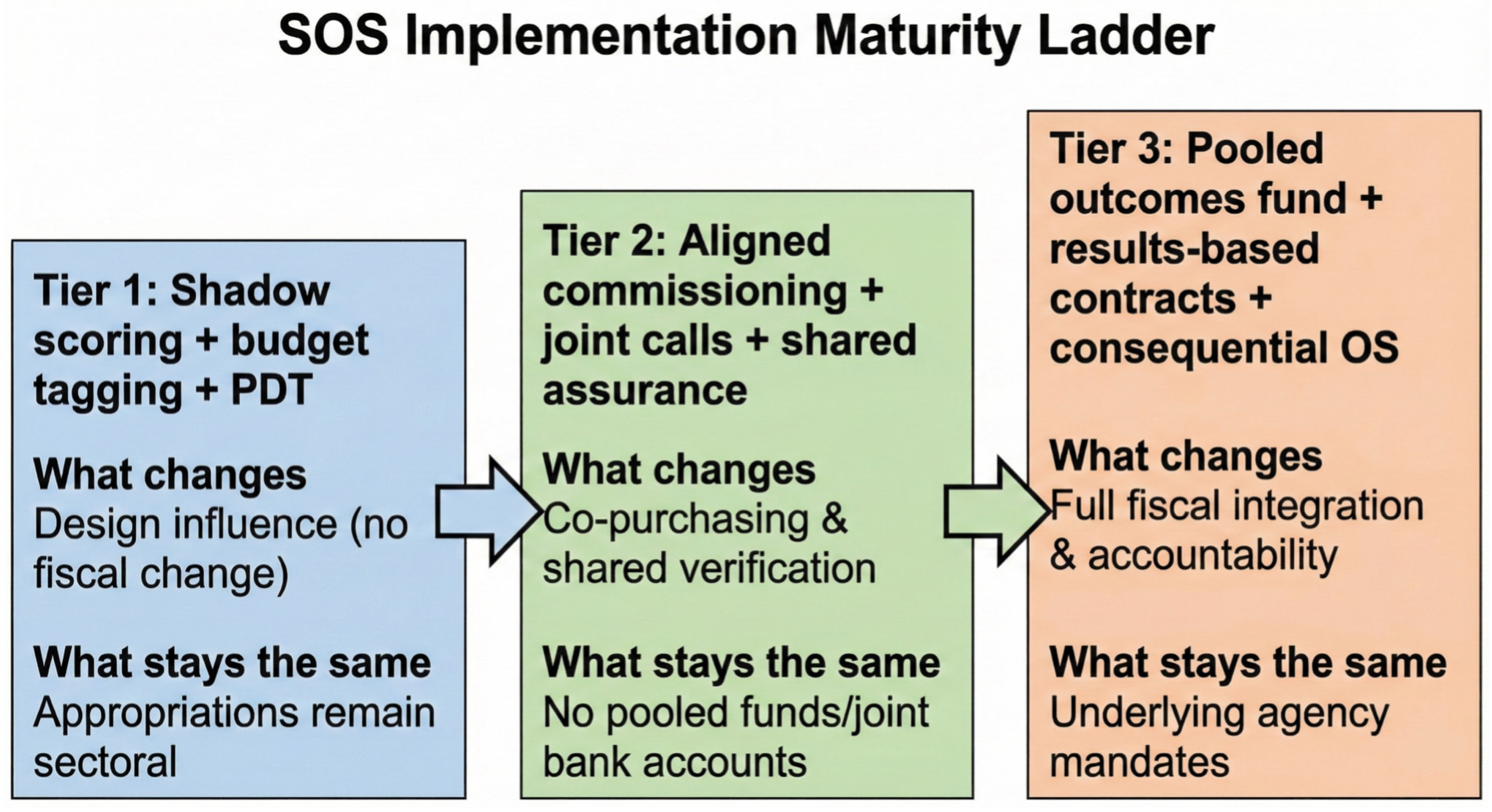
- Tier 1—Coordination-first (no pooled budgets). Establish a PDT, complete the shared diagnostic mapping, introduce budget tagging to identify overlap-relevant spend, and apply OS as a non-binding appraisal criterion (“shadow scoring”);
- Tier 2—Aligned commissioning (virtual pooling). Run joint calls where agencies co-commission via parallel appropriations or matched contributions, adopt shared targets and common assurance, and include overlap + safeguards as material procurement criteria;
- Tier 3—Pooled outcomes fund (full SOS). Where legal authority exists, establish a time-bound joint outcomes fund with pooled appropriations and results-based contracting; hard-wire overlap performance into allocation shifts and re-competition decisions.
4. Enabling Cross-Sectoral Integration and Policy Translation
4.1. Institutional Coordination: Convening, Boundary-Spanning, and Coherence
- Designated convenor with a written mandate (cabinet directive, mayoral order, basin authority charter) requiring cross-agency participation for a defined challenge and geography;
- Standing PDT “delivery unit” (environment–health–finance–planning + implementers + community representatives) with documented decision rules and escalation;
- Vertical compacts (city–state; basin–national) specifying shared outcomes, reporting cadence, and dispute escalation procedures;
| Category | Specifications |
| Purpose | Coordinate design and delivery of SOS overlap bundles for a defined challenge and boundary (geography/time window/counterfactual). |
| Convenor Mandate | Written authority (cabinet directive/mayoral order/basin charter/MoU) to require cross-agency participation and to publish decision artefacts [25,26]. |
| Membership (Minimum) |
|
| Decision Rules | Quorum: Greater than 70% of agencies + community rep present. Mode: Consensus where feasible; recorded vote otherwise. Ethics: Conflict-of-interest declarations required for all members. |
| Outputs (Each Cycle) |
|
| Reporting Cadence | Monthly: Implementation dashboard. Quarterly: Decision note. Annual: Retuning note (Section 4.5). |
| Dispute Escalation | PDT mediation → executive coordination committee → procedural appeal to independent arbiter with published rationale (Section 3.4). |
4.2. Policy Design Beyond Single Instruments: Coherent Policy Mixes for Overlap Outcomes
- (i)
- Nature-based solutions (NbS). When specified to recognised standards, NbS can jointly reduce hazard risk, strengthen biodiversity, generate livelihoods, and build social licence through participatory stewardship—subject to safeguards (land rights, distributional impacts, long-term maintenance) [4,43]. Under SOS, an NbS contract becomes an “overlap bundle” when coupled with (a) affordability or tenure protections in high-risk displacement zones, (b) local hiring and training, and (c) transparent monitoring and grievance pathways;
- (ii)
- Clean-energy and efficiency programmes. Energy transitions can be overlap bundles when paired with labour standards, targeted affordability protections, and transparent monitoring of distributional impacts and integrity risks [4,44]. Under SOS, energy efficiency upgrades for vulnerable households can be commissioned as packages: emissions/energy savings (biophysical) + bill reduction (economic) + health improvements via better indoor conditions (social) + published dashboards and complaint resolution (governance).
- “Bundle-by-default” guidance: every programme design must include (a) at least one safeguard and (b) at least one co-benefit mechanism beyond the primary objective;
- Challenge templates: heat, flood, water scarcity, food-system risk templates specifying minimum social and governance protections (e.g., anti-displacement, benefit-sharing, grievance systems);
- Standard clauses: community benefit agreements, affordability protections, and participation requirements triggered when distributional risks exceed defined thresholds.
4.3. Public Financial Management: Aligning Budgets, Procurement, and Incentives
- Budget tagging for overlap-relevant spend (Tier 1): make multi-sphere investment visible within existing appropriations;
- Procurement rubrics that assign a material weight to overlap performance and safeguard compliance (Section 3.3.4), even before OS becomes binding;
- Matched funding calls (Tier 2): agencies co-commission a programme line to reduce fragmentation without requiring full pooling;
- Contractual verification clauses requiring documentary evidence and independent assurance for sphere deltas and safeguards.
- Joint problem definition: Convenor/PDT defines the boundary (place/time window) and confirms the overlap objective and safeguard triggers;
- Parallel budget tagging: Each agency tags relevant spend as SOS-eligible (for transparency and portfolio tracking);
- Joint call, separate appropriations: Agencies issue a joint call for proposals with a single specification, while each funds its portion under its own appropriation line;
- Common scoring + assurance: A shared evaluation panel uses a single rubric (below) and a single assurance protocol (Table 2);
- Contract alignment: Separate contracts (if required) contain harmonised clauses for verification, safeguards, reporting, and grievance mechanisms;
- Single public dashboard: All funded work reports into one overlap dashboard for the defined boundary, including trade-off decisions and safeguard enforcement actions;
- Retuning: Annual (and mid-term) recalibration shifts future calls toward high-overlap performers with verified safeguard compliance (Section 4.5).
- Technical quality and deliverability: 35%;
- Cost/value for money: 25%;
- Verified overlap performance plan (OS) + safeguard design: 30%;
- Delivery risk and assurance readiness: 10%;
4.4. Metrics and Accountability: From Indicator Inventories to Verifiable Overlap Performance
- Published assurance protocol: evidence rules for each sphere (including governance);
- Independent verification: internal audit, auditor-general functions, or accredited evaluators;
- Anti-gaming safeguards: audit sampling, penalties for misreporting, transparent counterfactual assumptions, and documented trade-off rationales.
4.5. Learning Cycles: Institutionalising Iterative Risk Management and Portfolio Re-Tuning
- Annual portfolio re-tuning: shift a modest share of resources toward verified high-overlap programmes and document why;
- Mid-term safeguard review: tighten or redesign safeguards where distributional impacts worsen;
- Published learning notes: “what changed and why” to strengthen legitimacy and reduce policy volatility;
4.6. Legislative and Normative Anchoring: Making Integration Durable
- Duty-to-cooperate provisions for designated challenges (statutory, cabinet-level, or treasury rules);
- Mandatory publication of procurement and evaluation artefacts for overlap-funded programmes;
- Formal dispute pathways and procedural appeals to prevent silent vetoes and increase accountability (Section 3.4).
4.7. A Minimum Viable SOS Package (Early Adoption Under Fragmentation)
5. Discussion: Governance Implications, Implementation Pathways, Limitations, and Future Outlook
5.1. Global Governance Implications for One Security
5.2. Implementation Pathways and Sequencing (Feasibility Under Real Constraints)
5.3. Limitations
5.4. Future Research Directions (Future Outlook)
Author Contributions
Funding
Institutional Review Board Statement
Informed Consent Statement
Data Availability Statement
Acknowledgments
Conflicts of Interest
References
- Rockström, J.; Steffen, W.; Noone, K.; Persson, Å.; Chapin, F.S., III; Lambin, E.F.; Lenton, T.M.; Scheffer, M.; Folke, C.; Schellnhuber, H.J.; et al. A safe operating space for humanity. Nature 2009, 461, 472–475. [Google Scholar] [CrossRef] [Scilit]
- Steffen, W.; Richardson, K.; Rockström, J.; Cornell, S.E.; Fetzer, I.; Bennett, E.M.; Biggs, R.; Carpenter, S.R.; de Vries, W.; de Wit, C.A.; et al. Planetary boundaries: Guiding human development on a changing planet. Science 2015, 347, 1259855. [Google Scholar] [CrossRef] [Scilit]
- Michel, D. One Earth, One Security Space: From the 1972 Stockholm Conference to Stockholm+50 and Beyond; Stockholm Environment Institute: Stockholm, Sweden, 2022. [Google Scholar]
- IPCC. Climate Change 2022: Impacts, Adaptation and Vulnerability (AR6 WGII); Cambridge University Press: Cambridge, UK, 2022. [Google Scholar]
- United Nations. Our Common Agenda: Report of the Secretary-General; United Nations: New York, NY, USA, 2021. [Google Scholar]
- Stockholm International Peace Research Institute (SIPRI). Environment of Peace: Security in a New Era of Risk; SIPRI: Stockholm, Sweden, 2022. [Google Scholar]
- United Nations Development Programme (UNDP). Human Development Report 1994: New Dimensions of Human Security; Oxford University Press: New York, NY, USA, 1994. [Google Scholar]
- Whitmee, S.; Haines, A.; Beyrer, C.; Boltz, F.; Capon, A.G.; de Souza Dias, B.F.; Ezeh, A.; Frumkin, H.; Gong, P.; Head, P.; et al. Safeguarding human health in the Anthropocene epoch: Report of The Rockefeller Foundation–Lancet Commission on planetary health. Lancet 2015, 386, 1973–2028. [Google Scholar] [CrossRef] [Scilit] [PubMed]
- World Health Organization; Food and Agriculture Organization of the United Nations; World Organisation for Animal Health; United Nations Environment Programme. One Health Joint Plan of Action (2022–2026); WHO: Geneva, Switzerland, 2022. [Google Scholar]
- Trombetta, M.J. Environmental Security and Climate Change: Analysing the Discourse. Camb. Rev. Int. Aff. 2008, 21, 585–602. [Google Scholar] [CrossRef] [Scilit]
- McDonald, M. Climate change and security: Towards ecological security? Int. Theory 2018, 10, 153–180. [Google Scholar] [CrossRef] [Scilit]
- One Health High-Level Expert Panel (OHHLEP); Adisasmito, W.; Almuhairi, S.; Behravesh, C.B.; Bilivogui, P.; Bukachi, S.A.; Casas, N.; Becerra, N.C.; Charron, D.F.; Chaudhary, A.; et al. One Health: A new definition for a sustainable and healthy future. PLoS Pathog. 2022, 18, e1010537. [Google Scholar] [CrossRef] [Scilit]
- Faijue, D.D.; Segui, A.O.; Shringarpure, K.; Razavi, A.; Hasan, N.; Dar, O.; Manikam, L. Constructing a One Health governance architecture: A systematic review and analysis of governance mechanisms for One Health. Eur. J. Public Health 2024, 34, 1086–1094. [Google Scholar] [CrossRef] [Scilit]
- Srigiri, S.; Dombrowsky, I. Analysing the Water-Energy-Food Nexus From a Polycentric Governance Perspective: Conceptual and Methodological Framework. Front. Environ. Sci. 2022, 10, 725116. [Google Scholar] [CrossRef] [Scilit]
- Mooren, C.E.; Munaretto, S.; La Jeunesse, I.; Sievers, E.; Hegger, D.L.T.; Driessen, P.P.J.; Hüesker, F.; Cirelli, C.; Canovas, I.; Mounir, K.; et al. Water–energy–food–ecosystem nexus: How to frame and how to govern. Sustain. Sci. 2025, 20, 2313–2334. [Google Scholar] [CrossRef] [Scilit]
- Dzebo, A. Does Policy Coherence Make National Implementation of Global Sustainability Agendas More Successful? Annu. Rev. Environ. Resour. 2025, 50, 457–478. [Google Scholar] [CrossRef] [Scilit]
- Bel, G.; Esteve, M.; Straub, S. Performance-Based Contracting: A Meta-Regression Analysis of the Determinants of Impact. J. Public Adm. Res. Theory 2025, 52, muaf037. [Google Scholar] [CrossRef] [Scilit]
- McBratney, A.; Park, D. One Security. In International Yearbook of Soil Law and Policy; Springer: Berlin/Heidelberg, Germany, 2025. [Google Scholar]
- Ostrom, E. Polycentric systems for coping with collective action and global environmental change. Glob. Environ. Change 2010, 20, 550–557. [Google Scholar] [CrossRef] [Scilit]
- UNFCCC. Decision 18/CMA.1: Modalities, Procedures and Guidelines for the Transparency Framework; UNFCCC: Bonn, Germany, 2018. [Google Scholar]
- UNFCCC. Decision 2/CMA.3: Guidance on Cooperative Approaches Referred to in Article 6.2 of the Paris Agreement; UNFCCC: Bonn, Germany, 2021. [Google Scholar]
- Convention on Biological Diversity (CBD). Kunming–Montreal Global Biodiversity Framework; CBD: Montreal, QC, Canada, 2022. [Google Scholar]
- McBratney, A.; Field, D.J.; Koch, A. The dimensions of soil security. Geoderma 2014, 213, 203–213. [Google Scholar] [CrossRef] [Scilit]
- Evangelista, S.J.; Field, D.J.; McBratney, A.B.; Minasny, B.; Ng, W.; Padarian, J.; Román Dobarco, M.; Wadoux, A.M.J.-C. A proposal for the assessment of soil security: Soil functions, soil services and threats to soil. Soil Secur. 2023, 10, 100086. [Google Scholar] [CrossRef] [Scilit]
- OECD. Policy Coherence for Sustainable Development 2019: Empowering People and Ensuring Inclusiveness and Equality; OECD Publishing: Paris, France, 2019. [Google Scholar]
- OECD. PCSD Framework: A Framework for Policy Coherence for Sustainable Development; OECD Publishing: Paris, France, 2021. [Google Scholar]
- Kaufmann, D.; Kraay, A.; Mastruzzi, M. The Worldwide Governance Indicators. In World Bank Policy Research Working Paper; World Bank Group: Washington, DC, USA, 2010; p. 5430. [Google Scholar]
- Buzan, B.; Wæver, O.; de Wilde, J. Security: A New Framework for Analysis; Lynne Rienner Publishers: Boulder, CO, USA, 1998. [Google Scholar]
- Newell, P.; Mulvaney, D. The political economy of the “just transition”. Geogr. J. 2013, 179, 132–140. [Google Scholar] [CrossRef] [Scilit]
- Walker, B.; Holling, C.S.; Carpenter, S.R.; Kinzig, A. Resilience, adaptability and transformability in social–ecological systems. Ecol. Soc. 2004, 9, 5. [Google Scholar] [CrossRef] [Scilit]
- Meadows, D.H. Thinking in Systems: A Primer; Chelsea Green: White River Junction, VT, USA, 2008. [Google Scholar]
- Folke, C.; Carpenter, S.R.; Walker, B.; Scheffer, M.; Chapin, T.; Rockström, J. Resilience thinking: Integrating resilience, adaptability and transformability. Ecol. Soc. 2010, 15, 20. [Google Scholar] [CrossRef] [Scilit]
- Jordan, A.; Huitema, D.; Hildén, M.; van Asselt, H.; Rayner, T.; Schoenefeld, J.; Tosun, J.; Forster, J.; Boasson, E. Governing climate change polycentrically. Annu. Rev. Environ. Resour. 2018, 43, 417–440. [Google Scholar]
- Carlisle, K.; Gruby, R.L. Polycentric systems of governance: A theoretical model for the commons. Policy Stud. J. 2019, 47, 927–952. [Google Scholar] [CrossRef] [Scilit]
- Pahl-Wostl, C. A conceptual framework for analysing adaptive capacity and multi-level learning processes in resource governance regimes. Glob. Environ. Change 2009, 19, 354–365. [Google Scholar] [CrossRef] [Scilit]
- Guston, D.H. Boundary organizations in environmental policy and science: An introduction. Sci. Technol. Hum. Values 2001, 26, 399–408. [Google Scholar] [CrossRef] [Scilit]
- Cash, D.W.; Clark, W.C.; Alcock, F.; Dickson, N.M.; Eckley, N.; Guston, D.H.; Jäger, J.; Mitchell, R.B. Knowledge systems for sustainable development. Proc. Natl. Acad. Sci. USA 2003, 100, 8086–8091. [Google Scholar] [CrossRef] [Scilit]
- Armitage, D.; Plummer, R.; Berkes, F.; Arthur, R.I.; Charles, A.T.; Davidson-Hunt, I.J.; Diduck, A.P.; Doubleday, N.C.; Johnson, D.S.; Marschke, M.; et al. Adaptive co-management for social–ecological complexity. Front. Ecol. Environ. 2009, 7, 95–102. [Google Scholar] [CrossRef] [Scilit]
- ILO. Guidelines for a Just Transition Towards Environmentally Sustainable Economies and Societies for All; International Labour Organization: Geneva, Switzerland, 2015. [Google Scholar]
- Mazzucato, M. Mission-Oriented Research & Innovation in the European Union; European Commission: Brussels, Belgium, 2018. [Google Scholar]
- Scholes, R.J.; Biggs, R. A biodiversity intactness index. Nature 2005, 434, 45–49. [Google Scholar] [CrossRef] [Scilit]
- Howlett, M.; Rayner, J. Design principles for policy mixes: Cohesion and coherence in ‘new governance arrangements’. Policy Soc. 2007, 26, 1–18. [Google Scholar] [CrossRef] [Scilit]
- IUCN. Global Standard for Nature-Based Solutions; International Union for Conservation of Nature: Gland, Switzerland, 2020. [Google Scholar]
- IRENA. Renewable Energy and Jobs: Annual Review 2023; International Renewable Energy Agency: Abu Dhabi, United Arab Emirates, 2023. [Google Scholar]
- WHO/UNICEF. Estimates of National Immunization Coverage (WUENIC); World Health Organization and UNICEF: Geneva, Switzerland, 2023. [Google Scholar]
- Nilsson, M.; Griggs, D.; Visbeck, M. Policy: Map the interactions between Sustainable Development Goals. Nature 2016, 534, 320–322. [Google Scholar] [CrossRef] [Scilit]




| Requirement (Minimum) | What It Means in Practice | Evidence Artefact (Publish/Verify) |
|---|---|---|
| Primary objective | A clear primary outcome in one sphere (B/E/S/G) | Theory of change + baseline/counterfactual statement |
| At least one co-benefit mechanism | A specific design feature expected to produce a second-sphere gain (not incidental) | Design specification + targeting rules |
| Safeguard(s) for foreseeable harms | Triggered protections for distributional, integrity, or ecological risks | Safeguard trigger rules + enforcement mechanism |
| Governance artefacts | Participation, transparency, and grievance pathways are built in | “You said/we did” log; grievance register; dashboard fields |
| Verification plan | Evidence rules for each claimed sphere delta and safeguard compliance | Assurance protocol (Table 2) + audit cadence |
| Ye sDelivery feasibility | Commissioning route feasible under legal constraints | Commissioning plan (pooled vs. aligned) + role assignment |
| Adaptation hook | Pre-registered retuning points (what would cause redesign) | Annual retuning note template (Box 1) |
| Sphere | Indicator/Proxy (Illustrative) | Evidence Required | Verification Method | Pass/Fail/Materiality Rule |
|---|---|---|---|---|
| Biophysical (B) | Condition/risk proxy relevant to challenge (e.g., biodiversity intactness; heat exposure; sediment load) | Monitoring data or audited environmental reporting | Independent technical audit or accredited evaluator | Material positive delta ≥ threshold ΘB within boundary/time window |
| Economic (E) | Target-cohort affordability/income stability/jobs | Administrative data (payments, bills, employment) + sampling | Audit sampling + counterfactual check | Material positive delta ≥ ΘE; distributional test applied |
| Social (S) | Health/security outcome relevant to challenge | Health/admin data, surveys, service use | Independent evaluator + privacy-compliant audit | Material positive delta ≥ ΘS; equity subgroup checks |
| Governance (G) | Auditable governance proxies (transparency/participation/grievance/integrity) | Documentary artefacts + administrative logs | Documentary audit (pass/fail) | Counts only if evidence rule satisfied (no partial credit) |
| Component | Minimum Input | Required Artefact | Minimum Output (Impact) |
|---|---|---|---|
| Mandate | Written convenor authority + PDT membership list | PDT ToR (Box 1) | Cross-agency participation is routinised |
| Boundary | Defined place/time window + counterfactual logic | Boundary statement (dated) | Comparable verification window |
| Safeguards | Distributional/integrity trigger rules + enforcement | Safeguard schedule + grievance | Harms are governable, not displaced |
| Assurance | Named verifier + evidence rules | Assurance protocol (Table 2) | Auditable sphere deltas (incl. governance) |
| Finance Hook | Budget tagging and/or aligned commissioning | Commissioning plan + rubric | Overlap becomes decision-relevant |
| Learning | Annual MELR calendar | Retuning note template (Box 1) | Parameters improve over time |
Disclaimer/Publisher’s Note: The statements, opinions and data contained in all publications are solely those of the individual author(s) and contributor(s) and not of MDPI and/or the editor(s). MDPI and/or the editor(s) disclaim responsibility for any injury to people or property resulting from any ideas, methods, instructions or products referred to in the content. |
© 2026 by the authors. Licensee MDPI, Basel, Switzerland. This article is an open access article distributed under the terms and conditions of the Creative Commons Attribution (CC BY) license.
Share and Cite
Park, M.; McBratney, A. Translating the One Security Framework for Global Sustainability: From Concept to Operational Model. Sustainability 2026, 18, 1031. https://doi.org/10.3390/su18021031
Park M, McBratney A. Translating the One Security Framework for Global Sustainability: From Concept to Operational Model. Sustainability. 2026; 18(2):1031. https://doi.org/10.3390/su18021031
Chicago/Turabian StylePark, Minhyung, and Alex McBratney. 2026. "Translating the One Security Framework for Global Sustainability: From Concept to Operational Model" Sustainability 18, no. 2: 1031. https://doi.org/10.3390/su18021031
APA StylePark, M., & McBratney, A. (2026). Translating the One Security Framework for Global Sustainability: From Concept to Operational Model. Sustainability, 18(2), 1031. https://doi.org/10.3390/su18021031